Review

Advances in Nanomedicine-Enabled Transdermal Patches for Insulin Delivery: From Design to Clinical Translation

by
Borish Loushambam
1,
Venkateswaran Krishnaswami
2,
Munish Kumar
3 and
Sivakumar Vijayaraghavalu
1,4,*
1
Department of Life Sciences (Zoology), Manipur University (A Central University), Imphal 795003, MN, India
2
Department of Pharmaceutics, SA Raja Pharmacy College, Tirunelveli 627116, TN, India
3
Department of Biochemistry, University of Allahabad, Prayagraj 211002, UP, India
4
Department of Medical Science & Technology, Indian Institute of Technology Madras, Chennai 600036, TN, India
*
Author to whom correspondence should be addressed.
J. Pharm. BioTech Ind. 2026, 3(1), 5; https://doi.org/10.3390/jpbi3010005
Submission received: 6 January 2026 / Revised: 30 January 2026 / Accepted: 25 February 2026 / Published: 3 March 2026

Abstract

Insulin injection remains the best therapy for diabetes mellitus, but subcutaneous injection continues to pose challenges, including patient discomfort, poor compliance and fluctuating plasma glucose profiles. Recently, transdermal insulin delivery has emerged as a non-invasive strategy that bypasses gastrointestinal degradation and first-pass hepatic metabolism, thereby increasing insulin bioavailability and enhancing patient acceptance. Recent developments in nanomedicine have facilitated the development of transdermal patches with enhanced drug encapsulation, uptake and controlled release. Nanostructured lipid carriers, polymeric nanocomposites, liposomes and SLNs have demonstrated a five-fold enhancement of transdermal flux and an extended insulin effect in preclinical models. The addition of ionic liquids and polymeric nanogels leads to an additional increase in insulin aqueous solubility and permeation, resulting from the temporary regulation of stratum corneum lipid organization. Bright and stimuli-responsive patches with glucose oxidase or phenylboronic acid functional groups enable regulated insulin delivery in response to changes in blood glucose, demonstrating near-normoglycemia for up to 48 h in animal testing. Nanocomposite systems assisted by microneedles have also been advanced to the early clinical phase, offering enhanced reproducibility of their pharmacokinetics and a low risk of dermal irritation. Despite these encouraging results, several translational challenges remain, such as biocompatibility, repeatability in the production of nanocarriers, long-term stability of formulations and regulatory standardization. This review examines the physicochemical design principles, materials innovations and permeation mechanism of nanomedicine-engineered insulin patches, the current state of preclinical and clinical advancements, challenges in production and future perspectives in viable patient-focused transdermal insulin delivery.

1. Introduction

Diabetes is a growing health concern among individuals across the globe, which has a significant clinical and economic burden all over the world. It causes serious microvascular and macrovascular complications such as blindness, neurodegeneration, kidney failure, heart disease, stroke and non-traumatic lower-limb amputations, which greatly worsen the quality of life and risk mortality [1,2]. International Diabetes Federation (IDF) Atlas, 11th edition, states that in the year 2024, around 589 million adults aged 20–79 years of the world were living with diabetes, with the figures expected to rise to more than 850 million by 2050 [1]. The global death toll of diabetes was estimated to be about 34 million each year in 2024 alone, with a significant number of them being premature (IDF, 2024) [1]. It is estimated that the global diabetes expenditure is over 1 trillion annually and is 12 percent of total healthcare spending. Type 1 Diabetes (T1DM) is caused by pancreatic β-cell autoimmune destruction, which causes absolute insulin deficiency and occurs most often in children, adolescents and young adults, although it can occur at any age. Type 2 Diabetes (T2DM), on the contrary, is a disease that is typified by insulin resistance, which is progressive in nature with a dysfunctional β-cell. The most prevalent is T2DM, with a prevalence of 90 to 95 percent of all diabetes cases [1,2]. There are factors of risk, namely aging, sedentary lifestyle, urbanization, overweight, obesity and unhealthy diet. Collectively, the trend of growing prevalence, lifelong pathology, heavy burden of complications and the growth in the economic costs of the disease demand the implementation of effective preventive measures, early stage of diagnosis and new forms of therapeutic intervention to stop the epidemic of diabetes worldwide [1,2].
Human insulin is a tiny peptide hormone weighing about 5.8 kDa, which is generated and released by the pancreatic islet 5-cells. It is a disulfide-linked polypeptide in the form of two chains, A (21 amino acids) and B (30 amino acids). Although insulin has a therapeutic value, insulin compounds are not very favorable to the maintenance of cold-chain and, thus, insulin must be maintained at low temperatures, usually at 2 to 80 °C, during the manufacturing, transportation and storage phases to ensure that its biological activity is preserved [3]. This high-temperature specification poses a huge logistical problem, especially in the developing and resource-constrained areas, where proper refrigeration and distribution facilities may be insufficient.
Clinical insulin requirements vary by diabetes type and stage of disease progression. In type 1 diabetes, where endogenous insulin production is mainly absent, typical full replacement needs are approximately 0.5–1.0 units per kilogram of body weight per day. During the early phase of the disease, often referred to as the partial remission or “honeymoon” period, residual beta-cell activity allows lower exogenous insulin doses, generally 0.2–0.6 units/kg/day [4]. In type 2 diabetes, progressive beta-cell dysfunction occurs alongside insulin resistance, which can substantially increase insulin demand over time. As a result, total daily insulin requirements in some individuals with type 2 diabetes may exceed 1 unit/kg/day. When insulin therapy is initiated, basal insulin is commonly started at a fixed dose of 10 units per day or at a weight-based dose of 0.1–0.2 units/kg/day, with subsequent dose adjustments based on glycemic response. These values provide a useful clinical benchmark when interpreting insulin delivery outcomes reported for novel transdermal systems [4]. In a large U.S. cohort of adults with type 2 diabetes using multiple daily injections (MDI), the mean total daily insulin dose (TDD) was 96 units, with a median of 80 units, corresponding to an average of 1.0 units/kg/day [5]. In another cohort of intensively treated Chinese patients with type 2 diabetes receiving basal–bolus therapy, the mean TDD was 38.22 IU/day, equivalent to 0.58 IU/kg/day, with basal insulin accounting for approximately 23% of the total daily dose [6]. These clinical dosing ranges highlight the magnitude of systemic insulin exposure typically required to achieve glycemic control and serve as a therapeutic reference point when interpreting reported glucose reductions, transdermal flux values, or duration of hypoglycemic effects in experimental transdermal insulin delivery studies.
Existing insulin therapy of diabetes is largely based on subcutaneous insulin injections with the help of syringes, pen, or continuous infusion devices, which, although they are indispensable in the process of glycemic control, have a number of important limitations affecting the experience of patients and their treatment outcomes [7]. Repeated injections may also result in pain and discomfort. Although the pain perception has declined with the development of shorter, thinner needles, the feeling of injections and the feeling of phobia to needles still persist. Thus, psychological insulin resistance and low adherence to the insulin regimen are frequent fallacies in most patients with diabetes [7].
The inconvenience caused by a need to take injections frequently (in many cases, more than once a day) and the embarrassment of administering insulin in social areas also contribute to the inconvenience, which disrupts lifestyle and thus leads to more inadequate adherence [8]. Lipohypertrophy, induration, ecchymosis and risk of infection may also be caused by improper technique and repeated injections in the same location, which not only affect comfort but also modify the insulin intake and lead to the variation in plasma glucose levels [7,8].
In addition, insulin action through subcutaneous injection is associated with the pharmacokinetic profile, which is slower and erratic in absorption, resulting in glucose variability, unpredictable hypoglycemia and difficulties in matching insulin activity to physiological requirements, thereby making it harder to optimally regulate glycemic regulation [9,10]. All these combine to highlight the necessity of better delivery technologies and patient-centered care to achieve better outcomes of insulin therapy, as these factors, such as pain and needle fear, poor adherence, injection site complications and pharmacokinetic limitations, persist.
Insulin transdermal delivery is actively being developed as an alternative non-invasive route to subcutaneous delivery since it has the potential to significantly enhance patient comfort and long-term compliance, as well as overcome multiple physiological and pharmacokinetic drawbacks of traditional methods of drug administration [11]. As opposed to injectable therapeutic agents, transdermal systems such as patches, ionic liquid-mediated delivery, polymeric carriers and microneedle (MN)-mediated delivery allow the delivery of insulin across the skin directly to the systemic circulation, bypassing the gastrointestinal (GI) environment, avoiding enzymatic degradation and first-pass hepatic metabolism, which dramatically undermine the bioavailability of orally administered peptide therapeutics [12]. Recent studies have shown that improved transdermal preparations are capable of greatly increasing insulin diffusion across the stratum corneum (SC) and lead to controlled or sustained insulin release and an improved and more stable plasma insulin response with extended periods of time than regular injections, leading to improved glycemic regulation and reducing the frequency of dosing [12]. Transdermal delivery also lowers inter- and intra-patient variability in insulin exposure and maximizes the proportion of biologically active insulin reaching the circulation because it circumvents hepatic and GI degradation [13]. Moreover, the transdermal system is needle-free and convenient; thus, injection-related pain, and psychological barriers are reduced, making it a more patient-friendly injection method that can contribute to increasing adherence, which is a critical component of reaching optimal glycemic results in life-long insulin therapy [12]. Taken together, these benefits, including non-invasive administration, GI degradation and first-pass metabolism inhibition, enhanced bioavailability and the ability to sustain drug release, give a solid case on why transdermal insulin delivery systems should continue to be developed and be promoted as valid options in diabetes management.
Nanomedicine has become an innovative approach to overcome the daunting barrier of the SC, the outermost layer of skin impeding the entry of most therapeutic molecules, by using engineered nanocarriers, including nanoparticles (NPs), liposomes, ectosomes, nano-emulsions and deformable vesicles, which interact with and temporarily disaggregate the lipid matrix of the skin, allowing better penetration of most drug molecules and improved fluxation of drugs into viable epidermal and dermal tissues [14,15,16]. Such nanoscale systems (usually less than 100 nm) enhance drug solubility, shield encapsulated agents against degradation and take advantage of these high surface-area to volume ratios to maximize contact with lipids and proteins in the skin and to deliver drugs systemically, which is hard to achieve with traditional formulations [14,15,16]. Notably, nanocarriers may be incorporated to be released slowly and gradually, and therapeutic levels can be delivered over prolonged durations, which minimizes the number of doses required. Meanwhile, surface modifications and reactive materials can be used to achieve stimuli-activated release in response to physiological changes, which, in turn, can form the basis of the so-called smart delivery systems with enhanced pharmacokinetic characteristics. Moreover, NPs that are combined with physical enhancers like MNs, iontophoresis and electroporation enhance the level of skin permeability and offer the capability of delivering biomolecules in a spatially and temporally regulated manner, expanding the applicability of transdermal platforms to large biomolecules, such as insulin. Taken together, these developments testify to the direct challenges that nanotechnology faces in terms of a skin barrier and how nanotechnology can be used to create a responsive, efficient and patient-friendly transdermal delivery infrastructure that can be used to enhance therapeutic responses and compliance in chronic diseases like diabetes [14,15,16].
In this review, the current state of knowledge on the use of nanomedicine in insulin delivery across the skin will be discussed to highlight the concepts of design, materials involved and mechanisms of permeation. In addition, critical technological advancements will be highlighted, including the innovative delivery systems such as the MN-assisted delivery system, while reviewing the biological, translational and regulatory hurdles that must be overcome.

2. Skin Physiology and Barriers to Transdermal Delivery

2.1. Skin Structure and Barrier Function

The skin is a multilayered organ comprising the epidermis, dermis, and hypodermis, each of which presents distinct barriers to transdermal drug delivery [9,10]. Among these, the epidermis, particularly the SC, acts as the primary rate-limiting barrier for macromolecules such as insulin. The epidermis consists of four layers (stratum basale, spinosum, granulosum, and corneum) with approximately 40–50 layers of keratinocytes. Keratinocyte differentiation and upward migration over 30–40 days result in the formation of terminally differentiated corneocytes in the SC [17].
The SC is a 10–20 µm-thick, lipid-rich layer organized in a characteristic “brick-and-mortar” architecture, in which corneocytes are embedded within a continuous lipid matrix composed mainly of ceramides, cholesterol, and free fatty acids [17]. While this structure is essential for preventing transepidermal water loss and microbial invasion, it severely restricts the permeation of biologics such as insulin due to their high molecular weight, hydrophilicity, and limited diffusivity.
Beneath the SC lies the viable (living) epidermis, which contains keratinocytes, Langerhans cells, melanocytes, and Merkel cells. This layer may influence drug tolerability and immune responses but offers comparatively less resistance to diffusion [17]. The dermis, a highly vascularized connective tissue rich in collagen and elastin, serves as the principal site for systemic absorption following successful permeation across the epidermis. However, enzymatic activity, extracellular matrix density, and interstitial fluid dynamics can further limit insulin diffusion and bioavailability [18]. The hypodermis, composed mainly of adipose tissue, functions as a mechanical and metabolic buffer and does not directly participate in drug transport.
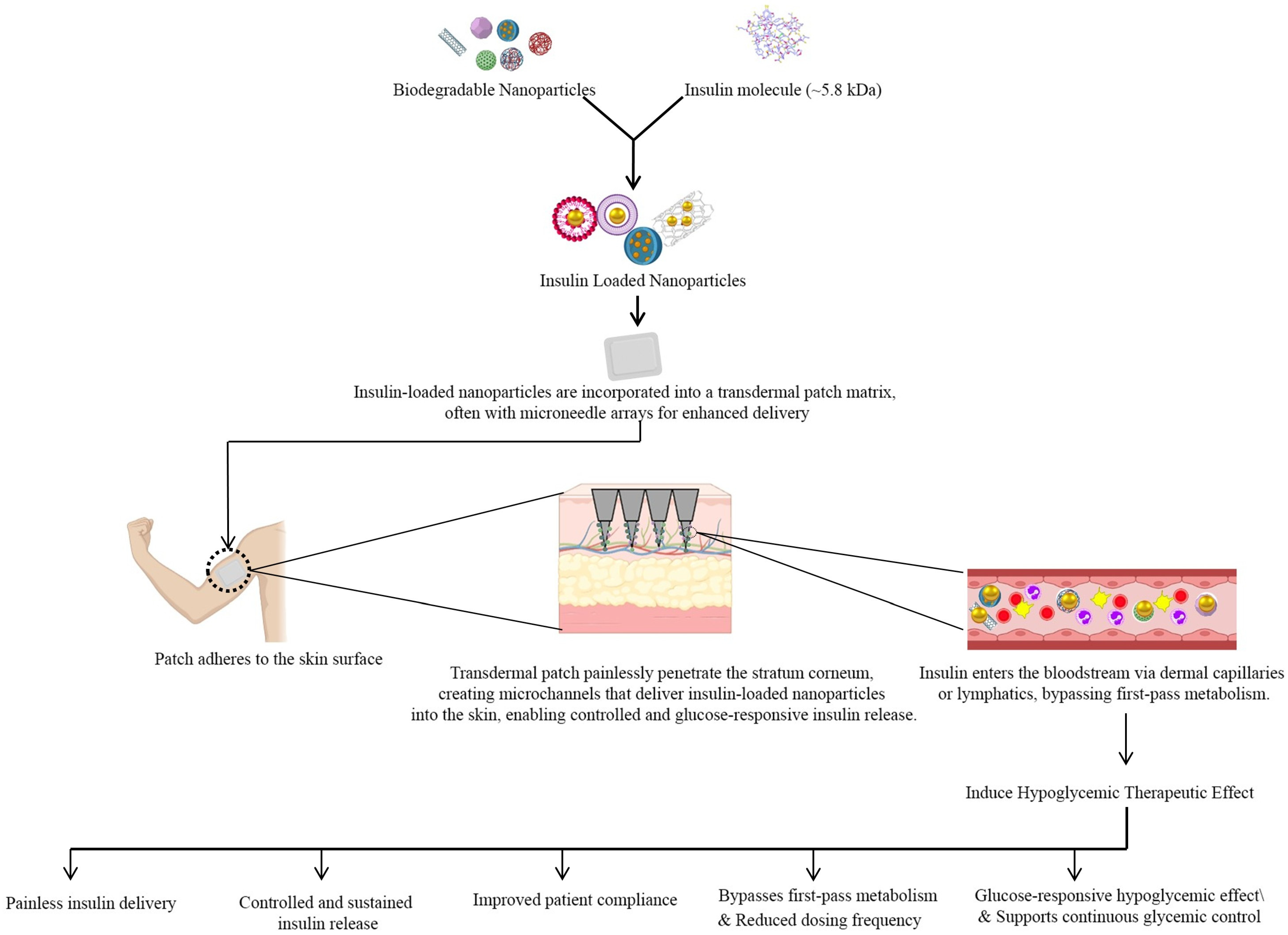
Effective transdermal insulin delivery, therefore, requires strategies that can overcome the SC barrier, protect insulin from degradation in the viable epidermis, and promote efficient diffusion toward the dermal microcirculation [19]. These multiple anatomical and physiological barriers underscore the need for advanced approaches, such as nanocarrier systems and MN-based devices, to enhance skin permeability while preserving insulin bioactivity. A schematic overview of a nanomedicine-enabled, MN-integrated transdermal insulin delivery pathway is presented in Figure 1.

2.2. Mechanism of Transdermal Permeation

Transdermal drug delivery enables systemic absorption while bypassing hepatic first-pass metabolism and allowing sustained drug release. Skin permeation primarily occurs via passive diffusion and follows Fick’s first law of diffusion, relying on drug partitioning into and diffusion across the SC without external energy input [18,20,21]. The SC remains the dominant barrier to this process.
Pathways of Transdermal Permeation
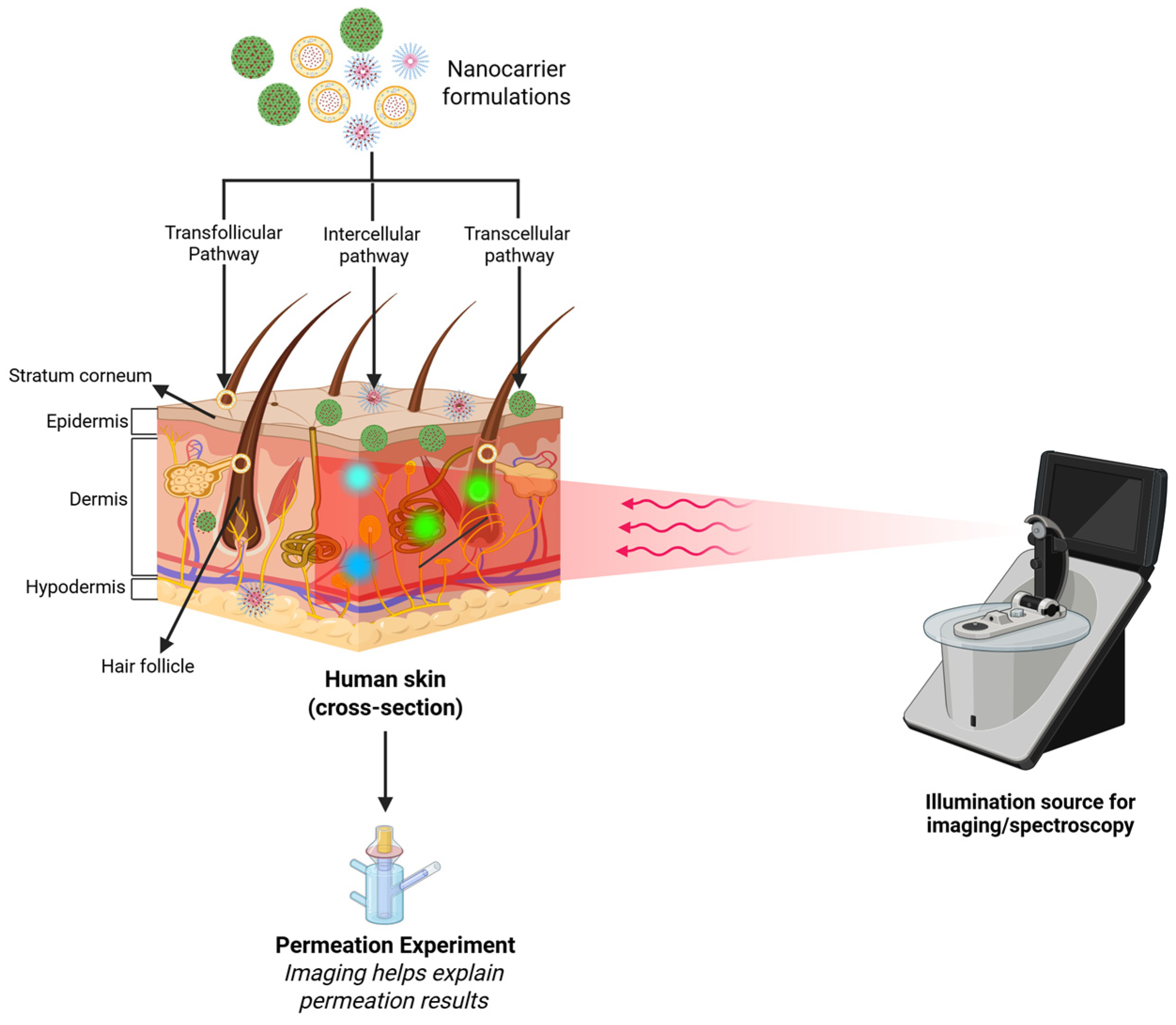
Drug molecules can traverse the skin through three principal pathways:
Intercellular (Paracellular) Pathway:
This is the predominant route for passive diffusion, involving transport through the tortuous lipid domains between corneocytes. Despite the SC being only 10–20 µm thick, the effective diffusion path length through this lipid matrix can reach ~500 µm. Lipophilic drugs (log p > 2) preferentially partition into this domain and exhibit higher permeation rates. Hydrophilic molecules may diffuse through inter-lamellar aqueous regions, albeit with significantly higher resistance [18,20,21].
Intracellular (Transcellular) Pathway:
This pathway involves repeated partitioning of drugs between hydrophilic keratin-rich corneocytes and surrounding lipid bilayers. Due to the dense keratin structure and multiple membrane crossings, this route presents high resistance and is generally unfavorable. It may be relevant for small, moderately lipophilic drugs or when penetration enhancers disrupt corneocyte integrity. For hydrophilic macromolecules such as insulin, this pathway is particularly inefficient [18,21].
Trans-appendageal Pathway:
This shunt pathway occurs through hair follicles, sweat glands, and sebaceous glands, collectively accounting for approximately 0.1% of the total skin surface area. Although limited in extent, it plays a crucial role in the initial transport of large, hydrophilic, or ionized molecules that poorly permeate through epidermal routes [18,20].

2.3. Factors Influencing Transdermal Insulin Transport

Insulin (a peptide hormone with a molecular weight of ~5808 Da) exemplifies the challenges of transdermal delivery due to its size and polarity. Passive permeation across the SC is generally restricted to molecules with molecular weights below 500–600 Da, making insulin an unsuitable candidate without enhancement strategies [12,20].
Factors influencing insulin transport include:
Molecular Weight:
According to the Stokes–Einstein relationship, larger molecules have lower diffusion coefficients, leading to reduced skin permeability. Insulin’s high molecular weight (~6 kDa) severely limits its diffusion through both intercellular and intracellular pathways of the SC, necessitating physical or chemical enhancement methods, such as MNs, that create microchannels bypassing the SC barrier [22,23].
Hydrophilicity:
The SC contains only ~20% water, favoring drugs with balanced lipophilic–hydrophilic properties. Insulin’s strong hydrophilicity leads to poor partitioning into the lipid matrix of the SC, resulting in low permeability. Consequently, insulin transport often relies on the trans-appendageal route or requires chemical penetration enhancers (e.g., fatty acids and DMSO) to disrupt lipid organization and form aqueous diffusion pathways [12,20,21].
Additional factors affecting transdermal permeation include drug ionization state (with unionized forms permeating more readily), skin hydration (enhanced absorption under moist conditions), and formulation-based enhancement techniques such as iontophoresis and sonophoresis [12,21]. While passive diffusion suffices for small lipophilic drugs, insulin’s physicochemical properties demand active enhancement strategies to achieve therapeutic plasma concentrations.

2.4. Challenges in Transdermal Insulin Delivery and the Need for Nanomedicine

The large molecular size, hydrophilicity, and susceptibility of insulin to enzymatic degradation, pH fluctuations, and environmental stress pose significant challenges to its effective transdermal delivery [24,25]. The tightly packed corneocytes and intercellular lipids of the SC confer extremely low permeability to insulin, resulting in negligible bioavailability unless assisted by advanced delivery strategies. Although subcutaneous injections remain effective, they are associated with pain, needle phobia, and poor long-term adherence, underscoring the demand for non-invasive alternatives [24,25].
Nanomedicine offers promising solutions by enabling the design of nanoscale carriers that protect insulin, enhance skin penetration, and allow controlled release. Lipid-based nanovesicles, PNPs (e.g., chitosan- or PLGA-based systems), and liposomes encapsulate insulin, shield it from degradation, and modulate its surface properties to improve permeation. Mechanistically, these systems promote lipid fluidization of the SC or transient disruption of tight junctions, facilitating enhanced dermal absorption [22,26]. Furthermore, stimulus-responsive nanocarriers (e.g., pH- or glucose-responsive polymers) enable sustained, on-demand insulin release, mimicking physiological secretion and reducing the risk of hypoglycemia.
Recent preclinical studies highlight the potential of nanomedicine-based transdermal insulin delivery. Ionic liquid-mediated ethosomes and transethosomes reduced blood glucose by up to 62% over 15 h in diabetic mice at a dose of 30 IU/kg, attributed to enhanced lipid bilayer disruption [26]. Biodegradable polymeric MN patches incorporating alginate–chitosan NPs demonstrated 2- to 5-fold prolonged bioavailability with minimal skin irritation in diabetic rat models [22,24]. Similarly, hyaluronic acid-coated chitosan NPs exhibited improved penetration and a relative bioavailability of 14.6% in animal studies [22,24,27].
Collectively, these findings underscore the transformative potential of nanomedicine in transdermal insulin delivery. Despite remaining challenges in scalability, long-term safety, and clinical translation, continued advancements, particularly in glucose-responsive and MN-assisted systems, are paving the way for needle-free insulin therapies to improve diabetes management [25].
These developments underscore the fact that nanomedicine has the potential to transform the way diabetes is handled, but issues like scalability and long-term safety will persist. The continuing studies, such as glucose-responsive systems development, can provide even more accurate regulation, and nowadays, the way to the commercially produced therapies that do not need any needles is open [25].

3. Techniques Available for Skin Permeability

Only a limited number of drugs possess the physicochemical properties required for effective passive transdermal permeation. Consequently, several strategies have been developed to overcome the formidable barrier function of the SC. These approaches are broadly classified into chemical, physical, and nanotechnological methods, each differing in mechanism of action, efficacy, safety profile, scalability, and regulatory acceptance [28].
Chemical penetration enhancers remain the most extensively investigated and industrially applied strategy due to their ease of formulation, scalability, and compatibility with conventional dosage forms such as patches, creams, gels, and ointments [28]. However, their clinical utility is often limited by safety concerns, including skin irritation, cytotoxicity, barrier disruption, and allergic reactions, particularly at higher concentrations or upon penetration into the viable epidermis [28,29]. Despite these drawbacks, advances in high-throughput screening platforms (e.g., INSIGHT) have facilitated the identification of synergistic enhancer combinations with improved efficacy and tolerability in human skin [28]. Physical enhancement techniques bypass biochemical interactions by transiently disrupting the SC using mechanical, electrical, or acoustic energy. At the same time, nanotechnology-based systems modulate skin permeability through carrier-mediated transport and controlled release.

3.1. Chemical Penetration Enhancers

Chemical penetration enhancers transiently and reversibly increase SC permeability by interacting with intercellular lipids, keratin, or both. More than 600 compounds have been identified and categorized into groups, including water, hydrocarbons, alcohols, fatty acids and esters, amines, amides, surfactants, terpenes, essential oils, and sulfoxides [29,30].
Their primary mechanisms involve disruption of lipid organization, increased membrane fluidity, extraction of SC components, and alteration of keratin conformation. Hydration enhancers, such as water, swell corneocytes and create aqueous diffusion pathways. Hydrocarbons and fatty acids (e.g., oleic acid) perturb lipid bilayers and enhance drug partitioning. Alcohols, particularly ethanol, improve drug solubility while extracting lipids and proteins with acceptable tolerability. Surfactants increase permeability via lipid solubilization and protein interactions, whereas terpenes and essential oils disrupt lipid packing with relatively favorable safety profiles. In contrast, potent enhancers such as dimethyl sulfoxide (DMSO) form aqueous pores and strongly alter lipid–protein interactions but are limited by dose-dependent toxicity and irritation [29,30].

3.2. Physical Techniques of Skin Permeability

Physical enhancement methods increase transdermal drug transport by inducing controlled structural perturbations in the SC using external energy sources. These approaches are particularly valuable for hydrophilic drugs, peptides, proteins, and macromolecules with poor passive permeability [31].
Iontophoresis employs a low-intensity direct electrical current to drive charged molecules across the skin via electrorepulsion and electroosmosis, enabling programmable, non-invasive delivery. Clinically approved systems such as LidoSite™ and Ionsys™ demonstrate their translational potential [31,32]. However, limitations include skin irritation, pH changes, Joule heating, and reduced efficiency due to competing ions [33,34].
Sonophoresis utilizes ultrasound (20 kHz–16 MHz) to enhance permeability primarily through cavitation-induced disruption of the SC, forming transient microchannels. It has been successfully applied to deliver macromolecules such as insulin and heparin, though careful optimization is required to avoid thermal or mechanical damage [34].

3.3. Microneedle-Based Approaches

MNs are micron-scale projections that painlessly penetrate the SC to create transient microchannels, enabling the efficient delivery of biologics. Designs include solid, coated, dissolving, hollow, and hydrogel-forming MNs [12]. These systems offer high patient compliance, self-administration, and effective delivery of peptides, proteins, vaccines, and insulin. MNs are also increasingly employed for interstitial fluid sampling in point-of-care diagnostics [15]. Synergistic enhancement has been reported when combined with iontophoresis [12]. Limitations include mechanical fragility, limited drug loading, manufacturing complexity, and variability due to skin elasticity, although adverse effects are typically mild and transient.

3.4. Electroporation

Electroporation enhances transdermal delivery by applying short, high-voltage electrical pulses that transiently form aqueous pores within SC lipid domains [12,35]. Unlike iontophoresis, it does not require continuous current flow. The technique enables controlled delivery of hydrophilic drugs, peptides, proteins, insulin, vaccines, and nucleic acids, with permeation governed by pulse voltage, duration, and frequency [35]. Clinical translation is limited by pain, muscle stimulation, erythema, and device complexity, although advances in microelectrode arrays and optimized pulse protocols are improving tolerability [32].

3.5. Needle-Free Jet Injection

Needle-free jet injection delivers drugs into the skin using high-velocity liquid jets (60–140 m/s) generated by compressed gas or spring mechanisms [36]. Drug deposition depth depends on jet velocity, pressure, nozzle geometry, and skin resistance. This method offers rapid absorption and fast pharmacodynamic responses, particularly for insulin. However, bruising, bleeding, discomfort, dose variability, limited injection volume, and high device cost restrict its widespread adoption, despite the availability of FDA-approved systems [36].

3.6. Nanotechnology Processes of Permeability Enhancement

Nanotechnology-based delivery systems enhance transdermal transport by modulating carrier size, surface charge, deformability, and lipid composition, thereby improving drug solubility, stability, and controlled release. Nano- and microemulsions containing surfactants and co-surfactants enhance SC lipid permeability more effectively than conventional formulations, although high surfactant concentrations may irritate, necessitating the use of natural enhancers [37].
Lipid-based vesicular systems, including liposomes, transferosomes, ethosomes, invasomes, and glycerosomes, differ in composition and deformability, which directly influence penetration efficiency and stability [38,39]. Solid lipid nanoparticles (SLNs) and nanostructured lipid carriers (NLCs) enhance permeability through occlusive hydration of the SC, with NLCs offering superior drug loading and stability [40,41]. Emerging nanocarriers such as PNPs, niosomes, cubosomes, carbon-based nanomaterials, metal–organic frameworks (MOFs), and exosomes offer additional opportunities for controlled, follicular-targeted delivery; however, challenges related to biodegradability, toxicity, large-scale production, and regulatory approval remain [42]. Table 1 presents a comparative overview of various strategies for improving skin permeability, including chemical penetration enhancers, physical techniques, microneedle-based approaches, electroporation, needle-free jet injection, and nanotechnology-based permeability enhancement methods.

4. Nanomedicine Platforms for Transdermal Insulin Patches

4.1. Lipid-Based Nanocarriers

4.1.1. Ethosomes

Ethosomes are flexible lipid nanovesicles specifically engineered to enhance dermal and transdermal drug delivery by incorporating high concentrations of ethanol into phospholipid bilayers. Structurally, they consist of phospholipids arranged in deformable bilayers surrounding a hydroethanolic core, enabling encapsulation of both hydrophilic and lipophilic molecules and distinguishing them from conventional liposomes. Ethanol plays a dual mechanistic role by fluidizing both the vesicular membrane and the SC lipids, thereby increasing vesicle deformability and facilitating deeper penetration into skin layers. Synergistic interactions among ethanol, phospholipids, and skin lipids destabilize the highly ordered SC lipid domains, reduce barrier resistance, and promote vesicle fusion or mixing with skin lipids. This process enhances localized drug accumulation while also supporting controlled systemic delivery when desired. Typical ethosomal formulations contain phosphatidylcholine, 20–45% ethanol, and water, while advanced variants, such as trans-ethosomes, incorporate additional edge activators or penetration enhancers to improve elasticity and permeation efficiency further. Physicochemical characterization generally reveals nanoscale vesicle size, a negative zeta potential indicating colloidal stability, and acceptable storage stability under refrigerated conditions, all of which contribute to improved drug loading, release, and bioavailability compared with conventional vesicular systems [50,51].
Recent innovations have introduced ionic liquid (IL)-mediated ethosomes, in which biocompatible lipid-based ionic liquids are incorporated into the vesicular structure to enhance transdermal performance further. Ionic liquids—organic salts that remain liquid near room temperature and have tunable physicochemical properties—can function as multifunctional excipients, acting as penetration enhancers, solubilizing agents, and membrane-modifying components. These IL-containing ethosomes promote deeper SC lipid infiltration and disrupt hydrogen bonding and lipid packing, without causing permanent skin damage, and show improved biocompatibility and reduced irritation compared with conventional chemical penetration enhancers in both in vitro and in vivo models. In the context of transdermal insulin delivery, IL-mediated ethosomes have demonstrated significantly enhanced insulin permeation across murine and porcine skin, prolonged hypoglycemic effects following topical application, and therapeutic efficacy at reduced insulin doses while preserving vesicle stability and protein integrity. Beyond insulin, these systems have shown promise for transdermal delivery of peptides, nucleic acids, and poorly soluble small molecules, offering tunable membrane interactions and scalable, patient-friendly alternatives to invasive administration routes [22,50,52].

4.1.2. Ionic-Liquid Microemulsions

Ionic liquid-based microemulsions (IL-MEs) have emerged as promising nanostructured systems for transdermal delivery of macromolecules such as insulin, which otherwise shows negligible passive permeation due to its high molecular weight and hydrophilicity. These systems combine the solubilizing capacity of ionic liquids with thermodynamic stability, nanoscale droplet size, and interfacial flexibility of microemulsions, creating multifunctional carriers that enhance drug solubility, skin penetration, and systemic bioavailability [53,54]. In insulin-focused IL-ME formulations, biocompatible choline-derived and fatty acid-based ionic liquids are commonly employed as both penetration enhancers and pseudo-aqueous phases within oil-based microemulsions. Typical compositions include choline–fatty acid ionic liquids dispersed in nonpolar oils such as isopropyl myristate and stabilized by nonionic surfactants and cosurfactants. Physicochemical characterization demonstrates formation of transparent, thermodynamically stable systems with nanometer-scale droplets that maintain close contact with the skin surface and facilitate efficient intercellular diffusion [53].
Mechanistically, IL-MEs enhance insulin permeation by inducing reversible structural and dynamic modifications in the SC lipid matrix. Spectroscopic and histological studies indicate that choline-based ionic liquids disrupt the ordered lamellar arrangement of intercellular lipids, increasing lipid fluidity and partially extracting lipid components, thereby lowering diffusional resistance without causing permanent structural damage. This reversible lipid reorganization offers a safer alternative to conventional chemical penetration enhancers that rely on more aggressive lipid disruption [54]. In vivo studies in diabetic animal models further demonstrate that low insulin doses delivered via IL-MEs produce sustained glucose-lowering effects with prolonged pharmacodynamic action compared with subcutaneous administration, likely due to extended intercellular absorption and reduced enzymatic degradation in the skin. Importantly, insulin maintains its structural integrity and biological activity within these formulations, with no evidence of ionic-liquid-induced denaturation. IL-MEs also show favorable physical stability over months under both room and refrigerated conditions, while biocompatibility studies reveal minimal cytotoxicity, limited inflammation, and recovery of normal epidermal morphology after repeated exposure. Collectively, these findings position IL-ME systems as a versatile and potentially translatable platform for non-invasive insulin and peptide delivery, offering improved permeation, sustained therapeutic exposure, and enhanced patient acceptability [53,54].

4.1.3. Liposomes

Liposomes are nanoscale vesicular carriers composed of concentric phospholipid bilayers surrounding an aqueous core, enabling the simultaneous loading of hydrophilic drugs into the internal compartment and lipophilic or amphiphilic molecules into the membrane. Since their introduction in the 1960s, they have been extensively investigated as drug delivery systems due to their biocompatibility, resemblance to biological membranes, protection of labile molecules, and ability to modulate pharmacokinetics [55]. Liposomes are classified by size and lamellarity into small and large unilamellar vesicles, multilamellar vesicles, and multivesicular systems. They can be produced using techniques such as thin-film hydration, reverse-phase evaporation, and solvent injection, which influence vesicle size, encapsulation efficiency, and release behavior [55]. In dermal and transdermal delivery, liposomes can interact with SC lipids, enhance skin hydration, and serve as local drug depots that prolong release while limiting systemic exposure. However, conventional phospholipid liposomes generally exhibit poor penetration through intact skin, tending to accumulate in the upper SC or within appendages such as hair follicles rather than reaching deeper viable tissues. This limited permeation is attributed to their relatively rigid bilayers, which may fuse with or rupture upon contact with SC lipids, leading to premature drug release at the surface [56,57].
Despite these limitations, liposomes have provided a foundational platform for the development of more deformable vesicular carriers and remain relevant in optimized and combination approaches. Modifying lipid composition, bilayer phase behavior, vesicle size, surface charge, and membrane fluidity can influence liposome–skin interactions and drug distribution across skin layers, although passive transdermal delivery remains challenging [56]. Physical enhancement techniques, particularly iontophoresis using a mild electric current, have been shown to synergistically improve the transdermal transport of liposomal formulations by promoting passage through low-resistance appendageal pathways without compromising overall skin integrity [57]. In the context of insulin delivery, liposomes can encapsulate and stabilize the peptide, protecting it from degradation at the skin surface. Yet, passive application of insulin-loaded conventional liposomes generally results in minimal systemic absorption, with most insulin retained in superficial layers [56]. More promising results have been observed when liposomal insulin is combined with iontophoresis, which enhances transfollicular transport and produces sustained glucose-lowering effects in experimental models [57]. Thus, while traditional liposomes alone are insufficient for therapeutically meaningful passive transdermal insulin delivery, they remain scientifically valuable as protective reservoirs within hybrid systems that incorporate external driving forces, even as newer deformable vesicles demonstrate superior passive permeation.

4.1.4. Transferosomes

Transferosomes are ultra-deformable lipid vesicles designed to overcome the barrier properties of the SC and enable transdermal delivery of both small molecules and macromolecules. They consist of phospholipid bilayers combined with single-chain surfactants (edge activators) such as sodium cholate, sodium deoxycholate, Tween 80, or Span 80, which destabilize the membrane in a controlled manner and impart exceptional elasticity. This structure allows transferosomes to squeeze through pores and intercellular pathways that are much smaller than their own diameter, while remaining intact and retaining their drug payload [58,59]. Unlike conventional liposomes, transferosomes penetrate the skin by following the natural hydration gradient between the relatively dry skin surface and the more hydrated viable epidermis. This gradient-driven movement, together with their self-adapting deformability, enables intact vesicles to migrate through predominantly intercellular routes. Edge activators also transiently fluidize vesicular and SC lipids, temporarily lowering barrier resistance without causing lasting skin damage [50].
Transferosomes are typically prepared using methods such as thin-film hydration or reverse-phase evaporation, followed by size-reduction techniques such as sonication or extrusion, to obtain nanoscale vesicles with high drug entrapment efficiency, a suitable zeta potential, and strong mechanical flexibility [58,59]. These features make them especially ideal for delivering hydrophilic macromolecules such as insulin. Studies have shown that insulin can be efficiently encapsulated in transferosomes while maintaining its structural stability. For example, formulations prepared with soy lecithin and sodium deoxycholate have demonstrated nanosized vesicles, high encapsulation efficiency, and sustained release when incorporated into hydrogel systems, supporting their role as effective carriers for transdermal insulin delivery [60]. Preclinical studies in diabetic animal models further confirm systemic therapeutic effects, with transferosomal insulin producing significant reductions in blood glucose levels after topical application. Notably, a proprietary transferosomal insulin formulation (Transfersulin®) advanced into early clinical evaluation, where topical application demonstrated hypoglycemic activity, highlighting the translational potential of this platform [58,59]. Compared with other elastic vesicles, such as ethosomes and invasomes, transferosomes rely primarily on mechanical deformability rather than substantial chemical disruption of SC lipids, which may offer safety advantages by reducing irritation risk [50]. Overall, transferosomes represent one of the most advanced vesicular systems for non-invasive transdermal delivery of biologically active macromolecules, with continued formulation optimization and scale-up strategies expected to support their clinical and commercial translation further.

4.1.5. Nanostructured Lipid Carriers (NLCs)

Nanostructured lipid carriers (NLCs) are second-generation lipid NPs developed to overcome the physicochemical limitations and drug expulsion issues associated with solid lipid nanoparticles (SLNs). They are composed of a solid lipid matrix blended with a proportion of liquid lipid, creating a partially disordered internal structure that enhances drug accommodation, minimizes drug expulsion during storage, and enables more controlled release while maintaining the biocompatibility and low toxicity typical of lipid-based systems [61,62]. In dermal and transdermal delivery, NLCs enhance drug transport primarily through close contact with the SC, formation of an occlusive lipid film, and subsequent hydration-induced loosening of corneocyte packing. This occlusive effect reduces transepidermal water loss, leading to SC swelling and widening of intercellular lipid channels, which facilitates drug diffusion into deeper skin layers. Their nanoscale size and high surface area also promote prolonged skin residence and sustained release of encapsulated drugs [61,63]. NLCs are commonly prepared using high-pressure homogenization, hot homogenization, or ultrasonication, often combined with solvent diffusion methods. Formulation parameters, such as the solid-to-liquid lipid ratio, surfactant concentration, and lipid composition, critically influence particle size, entrapment efficiency, and transdermal flux. Optimized systems typically exhibit particle sizes of 100–200 nm, a negative zeta potential, and a high encapsulation capacity, making them suitable for incorporation into gels or patch-based systems for transdermal application [62,63].
Substantial experimental evidence supports the effectiveness of NLCs in the transdermal delivery of small-molecule antidiabetic drugs such as glibenclamide, repaglinide, and pioglitazone. NLC-based gels have demonstrated higher transdermal flux, deeper skin penetration observed via confocal microscopy, and improved systemic bioavailability compared with conventional gels and oral formulations. In vivo pharmacokinetic studies further show prolonged plasma drug levels and enhanced bioavailability, indicating that NLCs can bypass hepatic first-pass metabolism and support sustained systemic exposure [61,62,63]. Direct studies on insulin-loaded NLCs for transdermal delivery remain limited, primarily because insulin’s high molecular weight, hydrophilicity, and susceptibility to enzymatic degradation make passive skin permeation extremely challenging. Nevertheless, NLCs enhanced skin hydration, prolonged residence time, controlled release and improved permeation of other antidiabetic agents, providing a strong theoretical rationale for their future application in insulin delivery. Their ability to enhance systemic delivery of structurally diverse antidiabetic drugs suggests that, when combined with additional enhancement strategies such as chemical penetration enhancers, MNs, or ionic liquid systems, NLCs could serve as a complementary platform in advanced transdermal insulin formulations [61,63]. Overall, NLCs represent a well-established and versatile transdermal delivery system with favorable safety, scalability, and sustained-release properties, supporting their potential role in next-generation non-invasive antidiabetic therapies, including prospective transdermal insulin systems.

4.1.6. Solid Lipid Nanoparticles (SLNs)

Solid lipid nanoparticles (SLNs) are submicron colloidal carriers composed of physiological lipids that remain solid at room and body temperature and are stabilized by surfactants or emulsifiers. Since their introduction in the early 1990s, SLNs have attracted significant attention as drug delivery systems due to their biocompatibility, biodegradability, low toxicity, and capacity to incorporate a broad range of therapeutic agents. Structurally, SLNs consist of a solid lipid core, commonly made from triglycerides, fatty acids, waxes, or partial glycerides within which the active ingredient may be molecularly dispersed, embedded in an amorphous matrix, or associated with the particle surface [64,65]. In transdermal delivery, SLNs offer several mechanistic advantages. Their nanoscale size promotes close contact with the SC, forming an occlusive lipid film that reduces transepidermal water loss, enhances skin hydration, and induces corneocyte swelling. These effects widen intercellular lipid pathways and facilitate drug penetration. SLNs also enable sustained and controlled drug release, prolonging residence time in the skin and reducing dosing frequency. Such benefits have been well demonstrated for small-molecule drugs, where SLN-based gels and patches outperform conventional formulations in terms of skin penetration and bioavailability [65].
SLNs can be produced using scalable techniques such as high-pressure homogenization, microemulsion methods, solvent emulsification–diffusion, and double-emulsion techniques. Formulation parameters, including lipid crystallinity and composition, surfactant type and concentration, and processing conditions, strongly influence particle size, polydispersity, zeta potential, drug loading, and release kinetics. Optimized SLNs typically exhibit particle sizes of 100–200 nm, sufficient surface charge for colloidal stability, and high encapsulation efficiency, making them suitable for dermal and transdermal applications [64,65]. For insulin delivery, SLNs have been widely explored as protective carriers that reduce chemical and enzymatic degradation, preserve insulin’s secondary structure, and enable sustained release. Various preparation strategies, such as double-emulsion and gel-core SLN methods, have achieved efficient insulin encapsulation while maintaining bioactivity during formulation and storage, as supported by physicochemical characterization and in vivo hypoglycemic studies [64]. However, direct evidence for effective systemic insulin delivery via passive transdermal SLN application remains lacking. Consequently, research has shifted toward hybrid strategies that combine SLNs with physical or chemical enhancement techniques such as MNs, iontophoresis, ionic liquids, or elastic vesicles to overcome the SC barrier. Despite current limitations, the favorable safety profile, scalability, and formulation versatility of SLNs support their continued investigation as components of future combination systems for transdermal insulin therapy [64,65].

4.2. Polymeric Nanoparticles (PNPs)

PNPs are biodegradable nanocarriers typically ranging from 50 to 500 nm that can encapsulate therapeutic agents within matrix or core–shell structures. Their tunable physicochemical properties, including particle size, surface charge, hydrophilicity, and degradation rate, allow precise control over drug loading, release kinetics, and biological interactions. In transdermal delivery, PNPs offer distinct advantages over conventional formulations by protecting labile drugs from enzymatic degradation, prolonging skin residence time, and enabling sustained or stimuli-responsive release [66,67]. Both natural polymers (such as chitosan, alginate, gelatin, and dextran) and synthetic polymers (including PLGA, PCL, and PVA) have been widely explored for NP fabrication. Natural polymers are valued for inherent biocompatibility and mucoadhesive properties, while synthetic polymers provide superior mechanical strength and more predictable degradation behavior features that are important for maintaining prolonged skin contact and modulating permeation across the SC [66,67].
Recent studies show that PNPs can significantly enhance transdermal insulin delivery when combined with physical or electrically assisted methods. For example, water-soluble polypyrrole NPs have been investigated as insulin carriers in iontophoresis-assisted systems, in which in vitro Franz diffusion studies demonstrated markedly higher cumulative insulin permeation under controlled electrical stimulation than with passive delivery, highlighting the combination between polymeric nanocarriers and iontophoresis [68]. Polysaccharide-based NPs, such as carboxymethyl chitosan NPs, have also shown promise when incorporated into MN arrays, achieving high encapsulation efficiency, improved permeation, and significant glucose-lowering effects in vivo without notable skin irritation [69]. Polymeric MNs fabricated from biodegradable materials can create transient microchannels that bypass the SC barrier; subsequent application of insulin-loaded PNPs enables controlled diffusion into viable skin layers, with preclinical studies reporting bioavailability approaching that of subcutaneous injection [70]. In these systems, PNPs also support sustained insulin release within microchannels, reducing burst effects and hypoglycemia risk, while advanced conductive or stimuli-responsive polymers offer potential for responsive or closed-loop delivery strategies [66,68]. Although in vitro and in vivo studies generally report good biocompatibility and low cytotoxicity, clinical translation still faces challenges, including large-scale manufacturing, maintaining insulin stability within polymer matrices, and regulatory considerations for combination products involving NPs and MNs. Ongoing advances in polymer chemistry and nanofabrication are expected to address these barriers and accelerate clinical development [66,71].

4.3. Stimuli-Responsive and Smart Patches

Stimuli-responsive “smart” transdermal patches represent an advanced class of MN delivery systems designed for on-demand, self-regulated insulin administration in response to physiological or external triggers. Unlike conventional transdermal patches or dissolving MN arrays that release insulin immediately upon application, innovative systems integrate responsive materials that sense disease-related signals and modulate insulin release accordingly. This strategy aims to mimic pancreatic endocrine feedback, thereby reducing the risks of hypoglycemia and dosing errors associated with traditional insulin therapy [69,72]. Among endogenous triggers, glucose-responsive platforms are the most extensively investigated for diabetes management. These systems typically rely on glucose-sensing chemistries such as glucose oxidase (GOx), phenylboronic acid (PBA), or glucose-binding proteins. GOx-based approaches utilize enzymatic glucose oxidation to generate localized hypoxia, hydrogen peroxide, or pH changes that destabilize vesicular or polymeric matrices within MNs, thereby triggering insulin release [62,70]. PBA-containing polymers, on the other hand, undergo reversible glucose binding to form boronate esters, leading to polymer swelling, charge redistribution, or matrix disassembly under hyperglycemic conditions, thereby accelerating insulin diffusion while limiting release at normoglycemia [73].
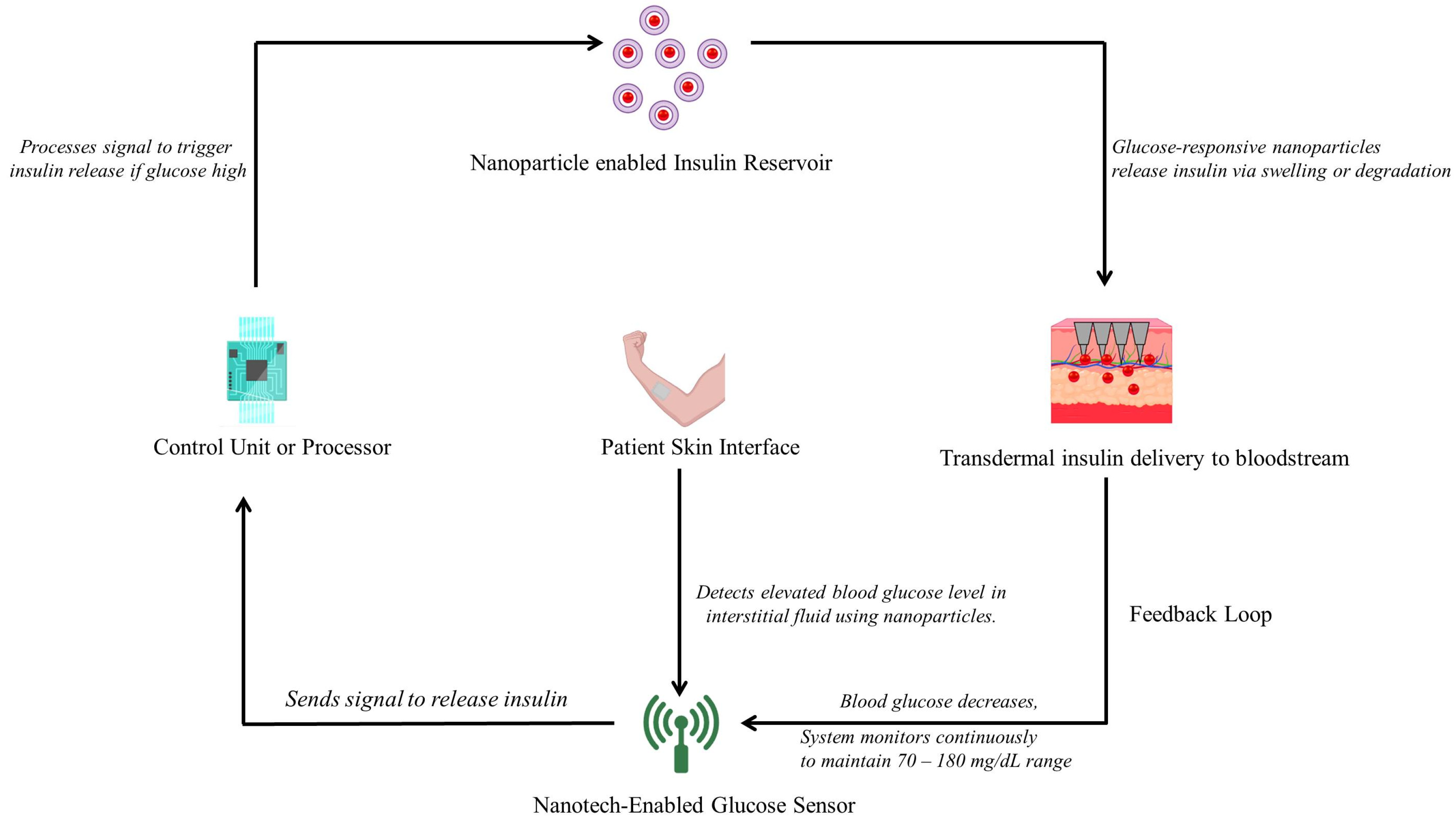
Landmark studies have demonstrated the feasibility of glucose-responsive MN patches in which insulin is embedded within PBA-functionalized polymer matrices formed via in situ photopolymerization. Under hyperglycemic conditions, glucose–boronate complex formation increases matrix swelling and electrostatic interactions with insulin, promoting rapid, glucose-dependent release; such systems have achieved prolonged glycemic control in diabetic minipig models, supporting their translational promise [73]. Complementary designs using hypoxia-sensitive hyaluronic acid vesicles co-loaded with insulin and GOx have also shown closed-loop-like glucose regulation with reduced hypoglycemia risk in diabetic animals [73]. Beyond glucose-responsive systems, enzyme- and pH-sensitive MN patches have been explored, where pathological or microenvironmental changes trigger polymer degradation or vesicle destabilization to release insulin; although less specific, these platforms may serve as adjunct controlled-delivery strategies or components of combination systems [74,75]. Bright patches can also be engineered to respond to exogenous stimuli such as light, temperature, electrical fields, or mechanical forces. For instance, near-infrared-responsive photothermal MN systems convert light into heat to induce polymer phase transitions or matrix melting for externally triggered insulin release, offering precise temporal control but requiring auxiliary devices, which may limit routine clinical use compared with autonomous glucose-responsive designs [72,75]. Emerging multi-responsive and closed-loop concepts integrate nanoscale glucose-responsive NPs within MN arrays to combine sensing accuracy with efficient skin penetration, enhancing insulin stability, loading, and responsiveness [70,74]. Figure 2 shows a schematic illustration of a closed-loop smart transdermal patch for nanomedicine-enabled insulin delivery. Overall, intelligent, stimulus-responsive transdermal insulin patches mark a shift from passive delivery to feedback-controlled therapy, with strong preclinical evidence of improved glycemic control and reduced hypoglycemic events. Nevertheless, challenges related to long-term biocompatibility, scalable manufacturing, insulin loading capacity, and regulatory translation remain key barriers to clinical implementation [70,72].

4.4. Microneedle-Assisted Nanocomposite Systems

The SC presents a significant barrier to transdermal insulin delivery due to insulin’s high molecular weight, hydrophilicity, and susceptibility to enzymatic degradation. MN technology offers a minimally invasive strategy to bypass this barrier by creating micron-scale channels that enable insulin to reach the viable epidermis and superficial dermis for systemic absorption while maintaining patient comfort and adherence [76]. However, conventional MN systems release insulin immediately after insertion and lack self-regulated dose control, increasing the risk of hypoglycemia. To address this limitation, nanocomposite approaches incorporating glucose-responsive NPs, vesicles, or polymeric matrices into MN platforms have been developed to enable feedback-controlled, on-demand insulin release [76]. By combining the physical skin penetration of MNs with the stimuli-responsive behavior of nanoscale materials, these systems form closed-loop or semi-closed-loop insulin delivery devices that more closely mimic pancreatic endocrine function, representing a convergence of microfabrication, nanotechnology, and innovative biomaterials and a promising direction for next-generation transdermal insulin therapy [70,74].

4.4.1. Hypoxia-Responsive Nanovesicle–Microneedle Systems

Yu et al. (2020) [73] reported the first conclusive evidence of a glucose-responsive MN-based nanocomposite insulin delivery system. In this groundbreaking research, a dissolving microarray of MNs was loaded with insulin and glucose oxidase (GOx)-sensitive hyaluronic acid nanovesicles. When glucose was exposed to hyperglycemic conditions, the enzymatic oxidation of glucose by GOx consumed local oxygen, creating a temporary hypoxic microenvironment. This hypoxia resulted in the chemical degradation of nitroimidazole functional groups within the nanovesicle framework, leading to destabilization of the vesicles and the release of insulin [73].
In vivo experiments in streptozotocin-induced diabetic mice showed that glucose-sensitive insulin release was possible and that blood glucose levels could be successfully normalized, with a lower rate of hypoglycemia compared with non-responsive controls. Notably, this technology enabled the creation of a fully synthetic, enzyme-amplified, and closed-loop insulin patch that did not require any external electronics or patient interaction [73]. Following these reviews, hypoxia-responsive vesicle-MN systems were identified as a guiding design for smart insulin delivery, inspiring future advances in vesicular and polymeric nanocomposite designs [70,74].

4.4.2. Phenylboronic Acid-Based Polymeric Nanocomposite Microneedles

Although hypoxia-responsive vesicle systems showed high responsiveness, their insulin loading ability was not very high, leading to the invention of polymeric nanocomposite MNs, which had higher drug loads. One of the key developments was made by Yu et al. (2020), who presented a glucose-responsive polymeric MN patch based on phenylboronic acid (PBA) produced through in situ photopolymerization [73]. Under this system, insulin was homogeneously covalently incorporated into a cross-linked polymer gel containing PBA moieties with reversible glucose-binding capacity. In hyperglycemic conditions, the density of negative charges in the polymer network, due to the formation of glucose-boronate esters, affected MN swelling and weakened the electrostatic forces between insulin and the polymer matrix. This led to faster insulin diffusion into the skin, but normoglycemic states prevented swelling and slowed release, thereby reducing the risk of hypoglycemia [73]. More importantly, this nanocomposite MN patch achieved clinically relevant insulin loading and sustained glucose regulation for over 20 h in diabetic minipigs, representing a significant advance in translational applicability. It was found that PBA-based polymer nanocomposites are a solid alternative to enzyme-dependent systems, offering better stability, scalability, and manufacturability [73,76].

4.4.3. Nanoparticle-Loaded Microneedle Composites and Hybrid Architectures

In addition to the vesicular and bulk polymer matrices, the literature is increasingly investigating MNs containing glucose-responsive NPs, such as PNPs, nanogels, and hybrid inorganic–organic systems. In such designs, insulin is surrounded by responsive NPs, which are then incorporated into dissolving or hydrogel-forming MNs. Microinjections provide direct access to the dermis, and the NPs release insulin in response to glucose or other biochemical signals [74].
The benefits of such NP-MN composites include high insulin stability, modular design flexibility, and multiple levels of responsiveness (e.g., glucose, pH, or enzyme sensitivity). Glucose-responsive NP-loaded MNs have consistently demonstrated superiority over traditional MNs in both glycemic control and safety in preclinical systems. However, the vast majority of studies remain at the proof-of-concept stage [70,74].
Table 2 compares various nanocarrier systems explored for enhanced transdermal insulin delivery based on their primary mechanisms of skin penetration, passive diffusion efficiency, in vivo efficacy, safety, biocompatibility, and translation status. Traditional lipid vesicles, such as liposomes and ethosomes, primarily rely on lipid fluidity for their function. In contrast, novel vesicles, including IL-mediated vesicles, transferosomes, and MN-assisted nanocomposites, exhibit excellent skin penetration properties. Glucose-sensitive bright patches exhibit excellent controlled release properties, utilizing glucose sensors such as glucose oxidase or phenylboronic acid. This demonstrates the evolution of nanocarriers from passive delivery systems to hybrid physical/biochemical systems with greater translational value.
Nanocarrier-based transdermal insulin patches could be considered on the basis of their overall potential, including delivery effectiveness, insulin-specific activity, safety, and translational development. Nanocomposite systems with MN-assisted innovation offer the most promising opportunities, encompassing both reliable skin penetration and controlled or glucose-responsive insulin delivery. These systems demonstrate high glycemic control in rodent and large-animal models and are highly acceptable to patients. The translation of these materials, however, is hampered by factors such as insulin stability, manufacturability, skin safety, and the regulation of combination and responsive materials. Among the vesicular carriers of insulin, transferosomes have the highest efficiency, utilizing a passive method to transport insulin across intact skin, making them highly promising for clinical trials. Despite this strength, recent translational advances have been scarce, and no commercial products have been developed to date [38].
Newer classes, such as ionic liquid-mediated ethosomes and microemulsions, exhibit significant passive enhancement capabilities for macromolecular transport with good biocompatibility in preclinical trials. But in humans, validation is yet to be done [22,52]. Stimuli-responsive transdermal patches provide feedback-controlled insulin release but typically do not achieve therapeutic insulin flux without physical methods of enhancement, such as microneedles [72]. Traditional and deformable vesicles, such as liposomes and ethosomes, provide a solid foundation for formulation but cannot deliver sufficient insulin on their own [56]. In general, most nanomedicine-based transdermal insulin platforms are preclinical, and no clinical approvals have been obtained to date. The recent developments, including charge-shifting polymers that enable the targeted delivery of insulin to minipig models, are encouraging but remind us of the necessity for human studies. Taken together, the existing evidence suggests that the most promising direction for the development of patient-friendly transdermal insulin patches is the use of hybrid systems that incorporate biocompatible chemical enhancers and MN-delivered nanocarriers. Table 3 shows a comparison among ethosomes, transferosomes and microneedles.

5. Material Innovations in Nanoparticle Systems

Innovative materials have played a central role in advancing NP-based transdermal insulin delivery, particularly through the development of tunable polymeric and lipid-based systems. PNPs, derived from natural or synthetic polymers, are especially valuable because their physicochemical properties can be designed to enhance skin interaction, drug protection, and controlled release; for example, chitosan-based NPs exploit the polymer’s mucoadhesive and permeation-enhancing characteristics to facilitate insulin transport across the skin while encapsulating the peptide within protective core–shell structures that can support pH-responsive release in the dermal environment [16,82]. Lipid-based NPs such as SLNs and NLCs also show promise, as their lipid matrices resemble skin lipids, promoting close SC interaction and sustained insulin release, while hybrid lipid–polymer composites further improve stability and drug loading efficiency [82]. Although inorganic NPs, such as gold and silica, have been explored for their structural robustness, concerns about long-term accumulation have limited their application in transdermal systems [82]. Emerging strategies additionally include amphiphilic, skin-permeable polymers that form NPs capable of diffusing through intercellular pathways without mechanical assistance, as well as bioinspired carriers based on natural polymers such as alginate and hyaluronic acid that mimic extracellular matrix components to enhance biocompatibility and permeation. Collectively, these material innovations aim to overcome the dual challenges of poor skin permeability and insulin instability, thereby supporting the clinical translation of non-invasive transdermal insulin therapies [71].

5.1. Selection Criteria for Nanoparticle Materials

Strict considerations determine the selection of materials for NPs used to deliver insulin transdermally, ensuring safety, efficacy, and manufacturability. Biocompatibility, biodegradability, and scalability are essential considerations that can be measured using preclinical and regulatory frameworks.

5.1.1. Biocompatibility

The most crucial consideration is biocompatibility to avoid adverse immune response, inflammation, or toxicity when in contact with the skin. They must be minimally cytotoxic, hemocompatible, and non-immunogenic, as commonly determined by in vitro (e.g., MTT cell viability test) and in vivo testing. NPs used in transdermal systems can be designed to blend with skin tissues without affecting their barrier function over the long term. Natural polymers, including chitosan and hyaluronic acids, are also preferred due to their natural biocompatibility, because they are biologically obtained and have low antigenicity [83,84,85]. Synthetic materials, including PLGA, are selected based on their prior experience in inhibiting complement activation and their ability to induce cellular uptake without adverse effects. The selection criteria are surface charge (preferably neutral or slightly positive to allow skin interactions), size (preferably 50–200 nm to maximize permeation), and zeta potential to maintain stability under physiological conditions. Comprehensive biocompatibility testing is emphasized as a regulatory requirement to reduce risks such as allergic reactions, as outlined in ISO 10993 standards [83,84,85].

5.1.2. Biodegradability

Biodegradability ensures that NPs are broken down into non-toxic byproducts that can be eliminated from the body, preventing bioaccumulation. It is a critical criterion in chronic applications, where repeated exposure is required (i.e., insulin delivery). The hydrolysis or enzymatic degradation of biodegradable materials occurs in a controlled breakage, releasing insulin as they undergo metabolism or excretion. Polymers such as PLGA and polycaprolactone (PCL) are used because of their adjustable degradation rates, which can be tailored to therapeutic requirements by varying molecular weight or copolymer content [86]. Selection will be based on degradation kinetics under simulated dermal conditions, with products of the process being biocompatible and not inducing acidosis [86]. In general, non-biodegradable substitutes, including certain metallic NPs, are not preferred unless they are designed for clearance, as they pose a long-term hazard due to their retention. Altogether, biodegradability leads to better safety profiles and facilitates sustained release, making it a foundational criterion for material vetting [86].

5.1.3. Scalability and Excipients

Scalability helps address the challenge of producing at large volumes without sacrificing quality, economic viability, or regulatory compliance. Criteria for reproducible synthesis, such as emulsion-solvent evaporation or nanoprecipitation, that can be scaled from lab to industrial levels without affecting particle uniformity are included [87]. Production variability and high manufacturing costs must be reduced through efficient process optimization and quality control. Another essential feature of scalability is the use of FDA-approved excipients, which facilitate rapid regulatory approval based on existing safety data. PLGA, polyethylene glycol (PEG), and lecithin can be used to create NPs, as they stabilize and enhance their permeability. Such excipients meet the GMP standards and enable clinical translation, as is the case with approved nanomedicines by other routes [87]. The combination of excipients with GRAS (Generally Recognized as Safe) status enables seamless incorporation into transdermal patches. Nevertheless, for new NP systems, further stability tests under accelerated conditions are necessary to ascertain scaling [87].

5.2. Encapsulation and Uptake Strategies

Successful NP-mediated transdermal insulin delivery depends on high encapsulation efficiency (EE), preservation of insulin bioactivity, and effective skin penetration and cellular uptake. These goals are achieved through optimized loading techniques, precise particle size control to exploit follicular pathways, and surface engineering to enhance stability, permeation, and biological compatibility.

5.2.1. Insulin Loading Techniques

Multiple developed methods are used to entrap insulin in NPs and safeguard its structure and biological activity. In PNPs, the double-emulsion solvent evaporation (w/o/w) method remains a standard approach, where insulin is emulsified within polymer solutions (e.g., PLGA and chitosan) and stabilized in an external aqueous phase, often achieving EE values above 85–95% while minimizing insulin exposure to organic solvents [66]. Lipid-based systems such as SLNs and NLCs commonly use hot homogenization, followed by ultrasonication, incorporating insulin into molten lipids that solidify into NPs upon cooling; newer adaptations using ionic liquids or deep eutectic solvents report EE above 97% with preserved insulin structure [88]. Nanoprecipitation and self-assembly methods using amphiphilic block copolymers or peptide carriers enable spontaneous NP formation with a narrow size distribution and EE of around 90% [69]. Advanced fabrication approaches, such as electrospraying, enable one-step production of core–shell NPs. At the same time, mesoporous silica or metal–organic frameworks can load insulin via adsorption, with stimuli-responsive “gatekeepers” for controlled release [89].

5.2.2. Particle Size Optimization and Follicular Penetration (<100 nm)

Particle size optimization is essential for transdermal NP delivery. The transfollicular route offers a low-resistance pathway, and studies show that NPs smaller than 100 nm penetrate more deeply into hair follicles, with 40–90 nm particles reaching sebaceous glands and perifollicular dermis. In contrast, particles > 200 nm tend to remain at the follicular opening [90]. For insulin delivery, smaller particles have shown markedly higher transdermal flux and deeper deposition; for example, ~65 nm chitosan-coated PLGA NPs demonstrated substantially greater insulin transport than larger counterparts, and nanosized elastic vesicles have achieved prolonged glycemic control via follicular uptake in animal models [91]. Optimal design balances penetration, loading capacity, and stability, with polydispersity indices below 0.2 typically required for reproducible performance [92].

5.2.3. Surface Modifications of Enhanced Uptake and Stealth Properties

Surface chemistry plays a significant role in NP–skin interactions, coronation of proteins, enzymatic degradation and immune recognition. PEGylation provides “stealth” properties by forming a hydrated shell that reduces protein adsorption and immune recognition while improving diffusion through skin interstitial fluid; PEG chain density and molecular weight are key determinants of performance, and PEGylated insulin NPs have shown prolonged hypoglycemic effects [93]. Zwitterionic coatings, such as poly(carboxybetaine) or poly(sulfobetaine), exhibit ultra-low protein fouling and have enabled insulin delivery without additional penetration enhancers [94]. Cell-penetrating peptides (e.g., TAT, penetratin, and polyarginine) can enhance transcellular uptake, especially when combined with pH-responsive linkers that activate in deeper skin layers [95]. Mucoadhesive and targeting coatings using chitosan or hyaluronic acid promote keratinocyte interaction, while charge-reversal systems that become positively charged in mildly acidic environments improve sequential barrier crossing [96]. Lipid-mimetic surface modifications incorporating ceramides or fatty acids can facilitate fusion with SC lipids, supporting transcellular transport alongside follicular penetration [96].

5.3. Nanotechnology-Assisted Transdermal Drug Delivery Permeation Enhancement Mechanisms

Transdermal drug delivery systems that are facilitated by nanotechnology enhance the skin permeation using an array of interdependent biophysical, physicochemical and biological interactions that largely focus on the SC, which is the main barrier of percutaneous transport. The SC is a very specialized structure containing terminally differentiated corneocytes that are incorporated in an ordered lamellar lipid matrix that is enriched with ceramides, cholesterol and free fatty acids. Nano-enabled formulations are able to burst through this barrier by triggering lipid reorganization and phase transition control, hydration-driven structural plasticity, vesicle deformability with stress-gradient-driven transport, use of transappendageal signaling, synergistic interaction with physical enhancers of transport such as iontophoresis and MNs, cellular uptake, cutaneous microbiome dynamic interactions and modulation of diffusion kinetics, which can be described using modified Fickian transport models. These mechanisms in combination allow improved, controllable and reversible transdermal permeation with increased reproducibility and with translational capabilities [22,97].

5.3.1. Multiscale Lipid Reorganization and Phase Transition Modulation

Nanocarriers interacting directly with the intercellular lipid lamellae of the SC include liposomes, ethosomes, transferosomes, invasomes, glycerosomes, SLNs, and NLCs and, at the molecular and supramolecular level, induce fluidization and reorganization of lipids in cell walls and membranes. Excipients, which enhance penetration, such as surfactants, terpenes and ethanol and glycerin, disrupt hydrogen bonding and van der Waals forces between lipid acyl chains, decreasing the lipid packing density and lowering the lipid phase transition temperatures [22,97]. Ethanol-containing vesicles (ethosomes) are known to intercalate lipid bilayers, raising membrane fluidity and raising drug partitioning into skin lipids, whereas terpenes introduced into invasomes cause a temporary lipid extraction and reorientation [22,87]. The lateral diffusion is improved by imperfect lipid crystallinity and lipid exchange of carrier matrices and native SC lipids in SLNs and NLCs that create lattice defects and intercellular spaces, improving lateral diffusion. Notably, such changes can be largely reversible, which means that the integrity of the barrier can be restored, and this gives a high degree of safety over aggressive chemical enhancers [22,87].

5.3.2. Osmotic Transport and Hydration-Mediated Permeation Enhancement

The most critical factor of transdermal permeability is skin hydration, and transdermal permeability is actively regulated by many nanocarrier systems that control the water content of the SC. Lipid NPs and vesicular formulations adsorb over the skin surface as occlusive or semi-occlusive films that cause a decrease in transepidermal water loss and an increase in bound and free water of the SC. High hydration causes corneocyte swelling, mechanical strain in the lipid protein matrix and dilation of the intercellular diffusion pathways. Slender lipid vignettes, known as glycerosomes with high glycerin concentration, perform a dual role, where they are fatty humectants as well as lipid bilayer fluidizers, enhancing the effect of hydration on the permeation process. In recent mechanistic models, the effect is termed poroelastic transport, where mechanical deformation of the SC due to the presence of hydration forms transient aqueous pores, which, together with lipid disorder, enhance deeper penetration into the viable epidermis and dermis [22,80,87].

5.3.3. Vesicle Deformability, Stress-Driven Transport and Transblemish Pathways

Transmembrane vesicles, which are ultra-deformable, such as transferosomes, ethosomes, invasomes and glycerosomes, possess a special capacity to traverse the SC through the mechanisms of stress-gradient-driven transport. These vesicles deform dynamically and compress and lengthen according to the hydration gradient between the surface of the relatively dry skin and the deeper, wetter layers, as they squeeze through pores and intercellular space considerably narrower than their original size without tearing. Ethanol, glycerin, or edge activators are used to confer high membrane elasticity to allow passage through complicated routes of diffusion. The further development of imaging reveals that such vesicles selectively use hair follicles and sweat ducts as low-entry routes, whereby they temporarily accumulate, partially disperse and onward release into intercellular lipid zones. This is a hybrid intercellular–transappendageal transport system in which bioavailability is greatly increased, especially with macromolecules like peptides, proteins and nucleic acids [80].

5.3.4. Synergistic Integration with Physical Enhancement Methods

There is a strong level of synergism in nanocarrier-based systems coupled with physical methods of enhancing permeation. Ionophoresis that imposes a low-intensity electrical current improves transport by electromigration and electroosmosis, but also boosts skin surrounding hydration and provokes temporary lipid malady. Iontophoresis, when used along with the NPs, enhances directional carrying of charged carriers, increases the depth of penetration and allows externally directed release of the drug. The other effective hybrid strategy is MN-mediated NP delivery, in which microchannels circumvent the SC altogether and directly introduce NPs (especially exosomes and polymer or lipid carriers) into the epidermis or dermis. These hybrid systems allow drug delivery on demand and are programmable and of particular interest in glucose-responsive insulin systems and other chronotherapeutic uses [98].

5.3.5. Cellular Uptake, Endocytosis and Intracutaneous Transport

The entry of NPs into the SC and through to viable layers of the skin is followed by cellular absorption patterns of the NPs as an effective determinant of therapeutic efficacy. Based on size, surface charge and composition, nanocarriers accommodate either clathrin-mediated endocytosis, caveolae-dependent uptake, macropinocytosis, or direct membrane fusion. Such are especially true of lipid vesicles and exosome-based systems since they have membrane properties where fusion and intracellular trafficking are likely to occur. Exosomes also offer a biologically smart system of delivery, tapping cell recognition, immune regulation, extracellular remodeling and angiogenic regulation via inherent surface proteins and expanding their capability beyond a role in the passive delivery of drugs [99].

5.3.6. Nanoparticle and Skin Microbiome Interactions

A new and understudied aspect of nano-enabled transdermal delivery relates to interaction with the cutaneous microbiome, which is an important component of lipid metabolism, immune regulation and the maintenance of barrier homeostasis. There is some initial evidence that some types of lipid NPs and plant-derived exosomes have the potential to regulate microbial composition as well as decrease inflammation-induced barrier tightening and indirectly increase permeability and skin health. This microbiome–NP interface can be described as a new mechanistic interface with tremendous potential over the long term in terms of safety and therapeutic effectiveness [100].

5.3.7. Mathematical Modeling: Modified Fickian Transport and Advanced Frameworks

Classically, the steady-state flux (J) of a drug across the skin is described using the laws of diffusion by Fick, expressed as:
J = D × K × Δ C h
where
D is the effective diffusion coefficient,
K is the partition coefficient between the formulation and the SC,
ΔC is the concentration gradient,
and h is the effective diffusion barrier thickness.
Additional mechanisms of flux enhancement with nanotechnology-assisted systems include D increased by lipid fluidization as well as hydration, K improved by better solubilization as well as skin affinity and h decreased by barrier disruption or bypass by use of deformable vesicles and MNs. These advanced modeling models build upon classical Fickian theory to include time-dependent transport coefficients, dual intercellular–appendageal pathways, carrier-mediated drug release kinetics and electro-diffusion coupling to iontophoresis [101].

5.3.8. Advanced Mathematical Modeling

NP-based transdermal insulin delivery also requires advanced mathematical models that are less steady and more dynamic and heterogeneous, like skin transportation. In contemporary modeling, time-varying skin permeability due to hydration, lipid reorganization, NP–skin interactions and externally applied enhancement methods, like iontophoresis, are all included in the modeling. Through the incorporation of multilayer skin architecture, release behavior, and electrical or physical stimuli, the models give more realistic predictions of drug flux-enabling enhancement of in vitro–in vivo correlation (IVIVC) and rational formulation artistry [102]. Time-dependent models consider the changing permeability of the skin as the treatment proceeds and capture effects of transient process bottlenecks such as burst release, gradually disruptive penetration of barriers and controlled or pulsatile delivery of insulin. Another extension of skin transport modeling involves the modeling of intercellular and appendageal pathways as separate paths differing in their relative diffusivity, which is especially important to NPs and macromolecules that selectively target hair follicles and sweat ducts. Kinetics relating NP release to incorporation of formulation-dependent availability of drug and behavior of permeation gives a realistic prediction of sustained and stimuli-responsive insulin delivery [102]. In the case of electrically assisted systems, the influence of the iontophoresis is combined with the electro-diffusion models, which take into consideration the effects of capturing electromigration, electroosmosis and current-dependent amplified transport. These methods have proven good insulin permeation (electric powered) prediction and optimization in devices. Multilayer compartmental models are even more physiologically relevant, in that the skin is further subdivided into discrete functional layers, and drug transfer between them is represented, so that disease-specific conditions and long-term exposure conditions can be simulated [95]. The approaches of machine learning gradually supplement the mechanistic models through the management of the nonlinear relationships that exist between formulation variables and skin properties on one hand and permeation outcomes on the other. IVIVC is enhanced by artificial neural networks and hybrid mechanistic-data-driven frameworks, experimental load reduction and design quality strategies. Together, all these sophisticated modeling methods constitute a strong tool set to model, optimize and personalize nanotechnology-based transdermal insulin delivery to further catalyze the clinical translation and enhance therapeutic dependability [102].

5.4. Assessment Method for Transdermal Drug Delivery Systems

The evaluation of transdermal drug delivery systems relies on a set of in vitro, ex vivo, and in vivo techniques to assess drug release, skin permeation, and systemic or local bioavailability.
During formulation development, in vitro and ex vivo techniques are primarily employed. Franz diffusion cells (or vertical diffusion cells) remain the most popular devices for in vitro release testing (IVRT) and in vitro permeation testing (IVPT). IVRT is based on the kinetics of drug release from synthetic membranes under infinite-dose conditions. In contrast, IVPT uses human or animal skin at a finite dose to better mimic in vivo absorption. The significant parameters reported by these studies are flux, cumulative permeation, and lag time. They can help optimize formulations and, for bioequivalence studies, despite challenges such as skin variability and limited tissue availability. Flow through diffusion cells creates greater physiological relevance by continually pumping receptor media, simulating dermal blood flow, and permitting automated sampling. Yet, they are expensive and more complex to operate, which limits their prevalence [30].
Recent developments include organ-on-a-chip (skin-on-a-chip) systems that combine microfluidics with three-dimensional skin-on-a-chip models to replicate native skin architecture and perfusion dynamics better. These systems do not require large sample volumes, can support mechanistic and molecular studies, and are more reproducible and biologically relevant than traditional diffusion cells. Tape stripping is another proven method for measuring drug uptake in SC by progressively removing the corneocyte layer and analyzing it [30].
In vivo approaches give the most physiologically beneficial assessment of transdermal use. Dermal open-flow microperfusion (DOFM) and microdialysis, which allow real-time measurement of intradermal drug concentrations and local pharmacokinetics, provide information on formulation variability but may not be readily apparent in in vitro investigations [30]. The use of transdermal systems is also supported by clinical pharmacokinetic studies demonstrating bioequivalence between transdermal patches and oral dosing for specific drugs, thereby establishing the clinical viability of transdermal delivery for chronic treatment [30].
In general, in vitro, ex vivo, and in vivo experimental solutions can be vital for fully characterizing transdermal drug performance and for minimizing clinical failures and regulatory approval delays.

5.5. Measurement of Skin Penetration and Visualization Techniques

High-order imaging and spectroscopic methods are essential for obtaining information on drug positions, penetration depth, and transport routes across multiple layers of skin, thereby supplementing quantitative permeation experiments. Figure 3 shows the penetration and transport of nanoformulations across skin layers, as revealed by high-order imaging and spectroscopic methods.
Confocal Laser Scanning Microscopy (CLSM) is a vital imaging technique commonly used to visualize the localization of drugs and nanocarriers in the skin. It allows imaging depth-dependent, high-resolution structures and tracing dominant transport routes, including intercellular, intracellular, and transfollicular routes. CLSM has been useful, especially for assessing NP-based delivery, as evidenced by studies on the selective follicular penetration of chitosan NPs, which identify hair follicles as valuable reservoirs and routes of delivery for nanosystems [103].
Confocal Raman Spectroscopy (CRS) has emerged as a non-invasive, chemically selective analysis technique capable of producing depth-resolved molecular concentration profiles in both in vivo and ex vivo skin. CRS does not involve the use of labels, as in fluorescence-based applications, thus enabling real-time study of drug penetration. CRS studies have shown its ability to measure the penetration depth and concentration of retinyl acetate, progesterone, and estrogen, thereby providing time-resolved information on intrinsic permeation and formulation behavior. These characteristics render CRS especially useful in the quantitative evaluation of topical and transdermal preparations [104].

5.6. Membrane and Skin Models for Transdermal Evaluation

Selecting appropriate membranes or skin models is crucial for obtaining credible, translational data on transdermal permeation. Some common membrane and skin models for transdermal evaluation are described below.

5.6.1. Human Skin

Human skin, when used as a model for excised human skin, is regarded as a gold standard for assessing TDDS because it closely approximates the anatomical, biochemical processes, and physiological functions of human skin in vivo. In vitro permeation rates measured in human skin show strong correlations with clinical outcome data when experimental parameters are strictly controlled. Cosmetic surgeries, amputation, and cadavers are the sources where human skin is usually acquired, although the abdominal, back, chest, and thigh skin are the most commonly used. Regardless of its applicability, the use of human skin is limited by ethical constraints, availability, inter-donor variability, and facility requirements. One of these agencies is the regulatory (EMA and FDA), which requires a thorough evaluation of the skin barrier’s integrity before proceeding to experimentation, which is most commonly measured by transepidermal water loss (TEWL). Still, tritiated water permeability or electrical resistance is also widely used as a standardized parameter [30,105].

5.6.2. Animal Skin

A core use of animal skin models is when human skin is unavailable. Among the latter, porcine skin is considered the closest surrogate because of its similarities in epidermal thickness, lipid composition, follicular structure, and dermal architecture. It has also been used in other animal models, including rodents, guinea pigs, rabbits, cattle, and reptiles. Rodent models are particularly popular because of their low cost, the ease of manipulation, and availability in hairless strains. Nonetheless, it should be ethically approved, and the use of animal-based information should be accepted differently across jurisdictions. Additionally, variations in baseline TEWL values and the properties of the barriers of animal and human skin should be considered when interpreting results [30,105].

5.6.3. Artificial Membranes

An artificial membrane has been developed to overcome the constraints of biological tissues. All these membranes are polymers made from polyethersulfone, polysulfone, cellulose derivatives, or phospholipid-based platforms, providing high reproducibility and minimal variability. Other models, such as Strat-M® membranes or Skin-PAMPA, are helpful for early formulation screening and mechanistic and comparative permeability screening, but they are not as complex as biological tissue [106].

5.6.4. Human Skin Equivalents

Three-dimensional bioengineered skin equivalents (HSEs) are bioengineered constructs of human cells cultured in three dimensions, designed to replace native skin architecture. These are reconstructed human epidermis (RHE) models and full-thickness models with both epidermal and dermal layers. Precisely the same thing has been commercially available as ethically acceptable and biologically relevant alternatives to excised human skin, such as systems like EpiDerm (USA), SkinEthic (France), and GraftSkin (USA) [107].

5.6.5. MIVO® (Multi In Vitro Organ) Systems

MIVO® systems are advanced, dynamic in vitro systems for culturing applications that can be used under physiologically relevant conditions because fluid circulation is continuous, thereby mimicking human vascularization. These disposable chambers contain either live tissues or an artificial membrane. They can be used in controlled interaction between donor and receptors, similar to a classical Franz diffusion cell, but with dynamic flow. The OECD 428-compliant MIVO wall system features a peristaltic pump and a three-way valve, enabling the sampling of a sterile solution without compromising the tissue structure. MIVO 8 systems and Franz diffusion cells exhibited comparable performance in terms of caffeine and LIP1 permeation kinetics at the Strat-M 2 membranes and porcine skin. Interestingly, MIVO 2 demonstrated a consistent difference in the penetration of lipophilic compounds, enhancing physiological applicability and providing more accurate mimics of in vivo dermal skin penetration, particularly for compounds that are both permeable and metabolite-sensitive. Compared to simple diffusion, MIVO provides greater translational value through dynamic flow, reduced stagnation, and improved nutrient-to-waste exchange. The characteristics make it particularly suitable for assessing complex formulations, lipophilic drugs, and transdermal systems that incorporate nanocarriers, as well as for long-term exposure. Here, the idea is that cells expressing lactate dehydrogenase release the enzyme into the medium, leading to the generation of hydrogen peroxide [108].

5.6.6. Skin-PAMPA (Parallel Artificial Membrane Permeability Assay) System

Skin-PAMPA is an in vitro permeability screening model, consisting of donor and acceptor chamber assays in a 96-well plate format. The synthetic membrane is designed to replicate key biochemical components of the SC, such as free fatty acids, cholesterol, and ceramide analogs, in physiologically relevant amounts. Several studies have confirmed that skin-PAMPA is a reliable screening measure in the initial stages of drug development. PAMPA is strongly correlated with skin permeability in porcine and human skin under finite dose conditions. Skin-PAMPA enables the rapid screening of formulations, ranking of permeability, and reduction of animal testing, especially in the context of drug development, making it a beneficial tool. Nevertheless, the lack of active metabolism, immune components, and dynamic flow constrains its predictive capability of intricate formulations and biologics. Skin-PAMPA would therefore be best suited as an initial screening device, parallel to more physiologically advanced screening methods [30].

6. Nanomedicine-Assisted Transdermal Patch Therapy for Gene Therapy and Stem Cell Therapy in Diabetic Patients

Cell and genetic therapies are yet another revolutionary area of diabetic care, which target not only glycemic control but also disease modification and, hopefully, a cure. The integration of the fields of nanomedicine and TDDS, including MN patch technology, offers an almost completely non-invasive, flexible method for crossing the hurdles associated with traditional systemic delivery systems.

6.1. Stem Cell Therapy Assisted by Nanomedicine via Transdermal Systems

Mesenchymal stem cell (MSC) therapy is mostly focused on the regeneration of β-cells, immunomodulation, angiogenesis and tissue repair. MSCs of bone marrow, adipose tissue or umbilical cord were found to possess the potential of differentiating into insulin-secreting cells and secrete paracrine factors that enhance 8-cell survival, vascularization and glycemic regulation. These characteristics are especially important in T1DM, the pathology of which is still autoimmune destruction of beta-cells [102,103]. There is a great advancement in the treatment efficacy of stem cell-based therapies through nanotechnology. Transdermal patch-observed NPs can enhance the survival, homing and functionality of stem cells by developing a protective and instructive microenvironment. Plastic NPs like PLGA, chitosan and PEGylated hydrogel control MSC differentiation pathways, decrease oxidative stress and maintain paracrine signaling in hyperglycemic conditions. Gold NPs and PNPs have also been demonstrated to increase the viability of the stem cells and insulin gene expression. Transdermal patches with the help of MNs may provide an alternative to direct cell transplantation. MN patches can be used to administer locally, rather than systemically; risks of immunogenicity, embolism and poor engraftment continue to be a concern when whole cells are delivered systemically. Micro-needles made out of hydrogel that are loaded with MSC exosomes and angiogenic NPs have been shown to accelerate healing, increase neovascularization and re-epithelialization of diabetic animals. This strategy avoids immune rejection, yet it maintains the regenerative properties of stem cells. MN patches with magnetic NPs also allow spatiotemporal regulation and in vivo monitoring of stem cell migration and retention and would be beneficial in patients having cardiovascular complications related to diabetes [109,110].

6.2. Gene Delivery by Nanocarriers Using Transdermal Patches

Gene therapy is directed to restore endogenous production of insulin, regenerate the 2-cells or regulate metabolic pathways that cause insulin resistance. Nevertheless, traditional non-viral and viral vector delivery methods have limitations associated with systemic toxicity, immune response and lack of tissue specificity. Nanomedicine-based transdermal patches will offer a reproducible, localized and easy-to-use alternative. MN arrays have been engineered with nanocarriers, including lipid NPs, PNPs, dendrimers, and inorganic NPs, to deliver plasmid DNA, siRNA, miRNA and CRISPR-based gene-editing systems. These nanocarriers keep nucleic acids intact, increase uptake by cells and release under pH, enzyme-activity, or inflammatory conditions. During preclinical experiments, MNs of dissolving and hydrogel type have reported transfection of skin and subcutaneous tissues with an efficiency of more than 50%. Direct 8-cell gene editing is still mainly preclinical but has demonstrated promising metabolic gene therapies [111,112]. As an example, CRISPR activation (CRISPRa) systems administered using hyaluronic acid MNs have been able to induce adipose browning and weight loss, increase insulin sensitivity, and enhance glucose tolerance and hepatic steatosis in obese diabetic mouse models. This is an effective adjunctive approach towards the management of Type 2 diabetes because of such indirect metabolic modulation [111,112]. Similarly, siRNA-loaded MN patches depleting inflammatory or fibrotic regimes have been demonstrated to have potential in the treatment of diabetes-related complications like macular edema and chronic wounds. The skin, being an immunologically active and gene-responsive organ, is an effective target for transdermal genetic modulation [111,112].

7. Preclinical and Clinical Advancements of Nanomedicine-Enabled Transdermal Insulin Delivery

7.1. Preclinical Trials

The preclinical trials of nanomedicine-assisted transdermal insulin delivery systems, especially those based on MN patch systems, polymer-insulin conjugates, hydrogels and ionic liquid nanocarriers, are fully explored. This not only helps in understanding the effectiveness but also the pharmacokinetics and pharmacodynamics, which are the precursors for clinical trials. The preclinical trials are mainly executed in animal models that closely imitate the pathophysiology of diabetes and the skin of humans, thereby enabling the evaluation of the hypoglycemic effects, bioavailability in the context of subcutaneous insulin delivery, and sustained insulin activity and toxicity studies. We will describe the animal models comprehensively, followed by the results regarding the extended insulin actions, bioavailability enhancements and toxicity and safety studies based on the well-characterized models involving streptozotocin-induced diabetic animal models and the pig skin models.

7.1.1. Animal Models Used

Streptozotocin (STZ) diabetic rodent models are versatile methodological platforms adopted to preclinically assess pharmacokinetic/pharmacodynamic (PK/PD) parameters, and the disease phenotype being dose, regimen/study and co-treatment dependent. High-dose or repeated low-dose STZ regimens induce severe β-cell damage and sustained insulin deficiency, and sub-diabetogenic STZ regimens or STZ combined with nicotinamide induce partial β-cell damage and residual insulin secretion, which allows recapitulation of type 2-like metabolic conditions. These have been used to induce reproducible hyperglycemia that can be used to determine PK/PD relationships of insulin and other antidiabetic agents by measuring serial blood glucose concentration, insulin exposure profiles and time responses, which have been used extensively in comparative bioavailability and delivery studies [113,114].
To better assess the translational application, mini-pigs and skin from pigs are used for skin penetration studies and systemic effects because of the collagens and lipids found in the skin being very similar to human skin [115,116]. Ex vivo skin from pigs acts as a model for skin penetration and imaging, proving the penetration of nanocarrier–insulin constructs for a full layer of skin before in vivo studies in mini-pigs [71,115,116]. Mini-pigs in vivo studies include the effect of the dosage of hypoglycemia and the regulation of glycemia in the animal model, leading from rodents to human-like biology [71,114]. Other models derived from recent studies are the diet-induced obese diabetic mouse models for the evaluation of metabolic syndrome and the combination of high-fat diet and STZ rats for the simulation of type 2 diabetes, which have extended the scope of evaluation for glucose-responsive systems [117,118].

7.1.2. Important Findings on Prolonged Insulin Action

Transdermal systems show adjustable prolonged insulin action, sometimes longer than SC administration, and without hypoglycemia risks. In diabetic rats made by STZ, sugar-free polymer MNs with cores of disintegrated or gated gelatin/starch or CMC/gelatin arrays provide prolonged normoglycemic states of 4–20+ h, while bioresponsive or swelling compositions prolong the action beyond 8–10 h [70,115].
In mini-pigs, GelMA MN patches and SK-perforated polymer–insulin conjugates, such as optimized amphiphilic polymer–insulin (OP–I), could support near-normal glucose levels for up to 20 h following application, with plasma insulin concentrations being sustained for longer periods than with SC administration [73]. Nanovesicles based on ionic-liquid and involving STZ-induced mice, such as low-viscosity biocompatible ionic-liquid Ethosomes, could support hypoglycemia for 15–24 h.
Recent developments include glucose-responsive hybrids, such as biomineralized insulin NPs in pH-responsive MNs, which allow on-demand release for up to 1–2 days in STZ-diabetic rats [117,118]. Red blood cell (RBC)-vesicle insulin MNs in diabetic mice also keep BGLs constant at approximately 200 mg/dL for up to 5 h with no rebound hyperglycemia [117]. A glucose-sensing, osmotic MN patch in diabetic rodents delivers high doses of insulin with the ability to last for several hours, with the latest osmotic patch designed for the year 2024 [119].

7.1.3. Bioavailability Enhancers

Relative bioavailability as compared to SC insulin is typical of these platforms and is higher than 80–95% when analyzed in the case of animals. In STZ-diabetic rats, dissolvable MNs show 90–96% relative bioavailability and pharmacological availability, and the hypoglycemia curves are practically superimposable on those of SC [115,116]. Insulin-loaded nanoparticle-containing MNs (chitosan-4-carboxyphenylboronic acid conjugates in the base of PVA), when studied on diabetic Wistar rats, prove more effective regarding BGL lowering and insulin levels, with onset being faster and comparable to SC [120].
Results in mini-pigs demonstrate that OP-I couplings and GelMA-synthesized MNs stimulate SC-similar PK profiles, achieving target concentrations equivalent, or indeed, more than SC, around 1.6–6-fold elevated insulin levels in the PT phase in mice and mini-pigs [73]. Ionic liquid formulations increase penetration and demonstrate superiority over passive patches, with bioavailability approaching SC levels in mice and pigs [116]. Glucose-sensitive formulations, for instance, CR9-peptide-functionalized AuNCs, facilitate bioavailability through higher drug loading (1297 mmol/g) and controlled delivery. Additionally, the combination of iontophoresis and NPs increases the permeation rate: in diabetes, solid lipid NPs using MNs increase the absorption in the oral glucose tolerance test in rodents by regulating the postprandial peak [117,118]. Taking everything together, these advantages arise from the enhanced mechanisms of penetration, stability and responsiveness.

7.1.4. Toxicity

Toxicity profiles are overall favorable, with very low irritation and the absence of systemic toxicity in models, again indicating the biocompatibility of the used biomaterials, including gelatin, CMC, hyaluronic and PLGA. In the case of STZ-diabetized rodents and mini-pigs, the MN plasma delivery system with the polymers results in largely unchanged skin morphology following application, with very low infiltration with neutrophils, the absence of inflammation biomarkers (IL-1β, TNF-α, CRP and IgG) and restoration of the barrier within several hours or days [70,114,116]. Systemic toxicity studies show that there are no changes in hematological parameters, hepatorenal function, or histological findings after multiple administrations of OP-I or ionic liquid formulations [114,116]. Glucose-responsive hybrids (GelMA-PEGDA and RBC-vesicle MNs) have non-toxic degradation properties and no immune reaction; however, immunogenicity information (for example, anti-insulin antibodies) has been sparse [117,118]. In mini-pigs, there has been no marked irritation or sensitization indicated; safety in mechanics during insertion exists [110]. Recent work stresses low inflammation risk but requires further characterization [110]. Systemic profiles suggest that there are no changes in hematological parameters or histological findings after multiple administrations of OP-I or OP-II [116,117].
Table 4 shows representative preclinical studies on transdermal and MN-assisted insulin delivery systems, highlighting formulation strategies, pharmacokinetic–pharmacodynamic outcomes, relative bioavailability and safety profiles. Thus, the preclinical data using STZ-diabetic rodents and pig models demonstrate consistent and potent glucose control, favorable bioavailability, prolonged effects and excellent safety profiles to support the use of nanomedicine-assisted transdermal insulin therapy. Thus, there is sufficient reason to move towards more extensive studies to fulfill the remaining gaps.

7.2. Clinical Trials

A systematic review of clinical trials registered on ClinicalTrials.gov indicates that several human studies have investigated MN-based insulin delivery; however, all reported trials to date remain limited to Phase I or Phase II development. None of these systems has advanced to late-stage pivotal trials or achieved regulatory approval, underscoring both the translational promise and the unresolved challenges of this delivery strategy. Importantly, despite extensive preclinical and technological maturation of solid, coated, dissolving, and hydrogel-forming MN platforms, hollow MN systems are currently the only MN architecture to have undergone formal clinical evaluation in humans. This clinical preference likely reflects their high dose accuracy, direct compatibility with approved liquid insulin formulations, and alignment with established regulatory paradigms governing injectable biologics.
Across approximately seven comparative early-phase clinical trials, MN-mediated intradermal (ID) insulin delivery demonstrated noninferior, and in some cases superior, glycemic efficacy compared with conventional subcutaneous administration. Four studies reported improved glycemic outcomes, particularly reductions in postprandial glucose (PPG) excursions, whereas the remaining trials showed comparable overall glycemic control between the MN and subcutaneous routes [125]. Notably, none of the studies reported inferior glycemic control with MN delivery, supporting a consistent non-inferiority profile within early clinical settings and suggesting potential relevance for prandial insulin administration [125]. The observed glycemic performance of MN-based delivery is closely linked to its distinctive pharmacokinetic (PK) and pharmacodynamic (PD) characteristics. Across multiple insulin kinetic studies, ID delivery via MNs resulted in faster absorption than subcutaneous injection, as evidenced by a shorter time to maximum plasma concentration (Tmax), greater early insulin exposure, more rapid onset of action, and earlier offset [126]. These PK features directly address a significant limitation of subcutaneous insulin therapy: delayed absorption, which leads to suboptimal synchronization between insulin action and postprandial glucose appearance [126].
Among the earliest clinical investigations, Pettis et al. (2011) [127] conducted a randomized, open-label, five-way crossover study (ClinicalTrials.gov Identifier: NCT00553488) involving 29 patients with type 1 diabetes mellitus (T1DM), comparing ID delivery of insulin lispro (IL) and regular human insulin (RHI) using hollow MNs with SC injection. ID administration of RHI reduced 90 min PPG exposure by 14% compared with SC RHI. It produced PPG responses comparable to those achieved with SC IL, suggesting that MN-mediated ID delivery can accelerate the action of slower insulin formulations without molecular modification [127]. Consistent with this concept, Gupta et al. (2009) [128] reported a proof-of-concept study in adults with T1DM demonstrating rapid absorption and effective postprandial glucose control following MN-based ID delivery of IL; however, the small sample size (n = 2) limits the generalizability of these findings and supports their interpretation as early feasibility evidence rather than definitive clinical validation [128].
The applicability of MN systems has also been explored in pediatric and adolescent populations. Norman et al. (2013) [129] evaluated hollow MN-mediated ID insulin delivery in 16 young patients with T1DM (ClinicalTrials.gov Identifier: NCT00837512) and reported a significantly faster onset and offset of insulin action by 22 and 34 min, respectively, compared with SC pump catheter delivery. The accelerated offset is particularly relevant in pediatric care, as it may reduce the risk of late postprandial hypoglycemia, a frequent and clinically significant complication in this population [129].
Further support for the PK/PD advantages of MN delivery was provided by Rini et al. (2015) [130], who conducted a randomized, open-label, crossover study in 28 patients with T1DM, comparing basal–bolus insulin aspart administration via MN-mediated ID delivery and SC infusion. ID bolus dosing resulted in reduced Tmax, lower intra-subject PK variability, and diminished early PPG excursions, particularly within the first 1.5–2 h post-dosing [130]. Reduced PK variability is a critical attribute for improving the predictability of insulin action and is especially desirable for closed-loop and hybrid artificial pancreas systems.
Complementary studies further corroborated these findings. In a small cohort of five patients with T1DM, MN-mediated ID insulin delivery achieved peak plasma insulin concentrations approximately half as fast as SC catheter-based infusion, resulting in faster glycemic reduction and reduced discomfort. Similar kinetic advantages were observed in healthy volunteers, where ID delivery of IL via MNs produced more rapid absorption, greater early insulin exposure, and earlier offset compared with SC injection, while maintaining equivalent total bioavailability, an essential consideration for dose titration and safety [127]. The reproducibility of these PK/PD benefits was confirmed by McVey et al. (2012) [131] in an eight-arm complete crossover study involving 22 patients with T1DM, demonstrating consistently improved insulin availability and PD responses across varying dosing conditions [131].
From a device development perspective, the BD Research Catheter Set (1.5 mm, 34-gauge hollow needle) is the most extensively evaluated clinical MN platform. Across four clinical trials (NCT00553488, NCT01120444, NCT01061216, and NCT01557907), this device demonstrated faster insulin absorption, reduced PPG excursions, lower PK variability, and favorable tolerability without major dermal adverse events compared with SC injection [121,125]. Similarly, the MicronJet® device has shown promising clinical performance. In a Phase II trial involving patients with type 2 diabetes mellitus (ClinicalTrials.gov Identifier: NCT01684956), Kochba et al. (2016) [132] reported shorter Tmax, greater early insulin exposure, and reduced time to 50% Cmax following ID delivery of insulin aspart compared with SC injection [132]. These PK changes were accompanied by increased late glucose area under the curve, suggesting a reduced likelihood of late postprandial hypoglycemia.
Beyond metabolic outcomes, patient-reported measures consistently indicated lower pain perception with MN administration compared with SC catheters, without increased skin irritation or infusion-related discomfort [129,133]. These features may be particularly advantageous for pediatric patients, insulin-naïve individuals, and patients with needle anxiety, where adherence to insulin therapy remains a significant barrier to optimal glycemic control.
In addition to insulin replacement, MN platforms are being explored for immunomodulatory applications. A preclinical pilot study (ClinicalTrials.gov Identifier: NCT02837094) evaluated the delivery of insulin-related peptides conjugated to gold NPs via MNs to modulate autoimmune responses in T1DM [133]. Although clinical efficacy data from this approach are not yet publicly available, its initiation reflects expanding investigative interest in MN-enabled transdermal delivery beyond glucose control alone [129,134]. Table 5 shows completed clinical trials evaluating the progress of intra-dermal insulin delivery devices to combat diabetes. Table 6 shows that MN arrays incorporating NP-based insulin delivery systems achieve markedly enhanced transdermal insulin flux and sustained pharmacodynamic effects compared with passive delivery in preclinical animal models; however, their translation to human clinical use remains limited by the scarcity of controlled human pharmacokinetic data, variability in skin penetration across populations and practical challenges associated with real-world clinical deployment.
Overall, while early-phase clinical trials provide consistent evidence that hollow MN-mediated intradermal insulin delivery can achieve favorable PK/PD profiles and noninferior glycemic control compared with SC administration, translating nanomedicine-enabled MN patches into routine clinical use remains limited. Major challenges include the paucity of controlled human pharmacokinetic data for NP-integrated MN systems, inter-individual variability in skin permeability, manufacturing scalability, and regulatory complexity associated with combination drug–device–nanomedicine products.

7.3. Limited Clinical Trials and Failures

Until now, no clinical trials investigating only the use of NP-enabled transdermal insulin patches as a treatment approach have been documented as completed with confirmed positive results sufficient for the product to reach the market. Transdermal insulin delivery systems related to the present study, using or incorporating other enhancement technologies together with or rather than NP, have undergone clinical trials but with common results of failure or abandoning the study itself [143,144].
Passport Transdermal Insulin Delivery System by Altea Therapeutics, which utilized thermal microporation to facilitate the diffusion of insulin via the creation of pores on the patient’s skin (not purely driven by NP technology), completed a phase I/II clinical study with the clinical trial identifier NCT00519623 to examine the efficacy of the pharmaceutical product as regards the pharmacokinetics/pharmacodynamics in patients with T1DM. The target was to investigate the basal insulin dose delivery by the insulin patch, but it was not developed into an approved product by the company due to the end of the collaborative agreement with the sponsor, Hospira, in 2010, which led to the shutdown of the company itself in 2011 after gaining over $60 million in funding support [143,144].
In another trial (NCT05159453), a dose–response trial assessing the effectiveness of human insulin patches, though not specific to NPs, found trial completion on methods using a patch system without moving on to later stages. Though not aimed at NPs, these clinical tests point out several issues that would develop regardless of whether NPs are included in these patches, including inconsistent insulin uptake based on skin type, with levels of treated insulin being too low [145]. The lack of specific NP clinical studies for the transdermal delivery of insulin itself may be said to be a development shortcoming, as the promising preclinical results have not led to the transfer to the clinical stage due to the remaining technological hurdles [12].

8. Translational Challenges and Regulatory Considerations

8.1. Biocompatibility and Safety Issues of Nanomaterials

The recent surge in the use of nanomaterials in the biomedical, industrial and consumer fields raised the issue of the biocompatibility and long-term toxicity of these materials. Although nanoscale engineering is capable of making revolutionary progress in drug delivery, diagnostics and therapeutics, the same physicochemical characteristics that make nanoscale engineering advantageous, such as reduced size, increased surface area and enhanced surface reactivity, also pose complicated toxicological issues [146]. Therefore, extensive assessment of the cytotoxicity, immunogenicity and chronic health outcomes has now become a precondition of the responsible development and clinical translation of nanomaterial-based systems.

8.1.1. Parameters of Nanomaterial Biocompatibility

The general definition of the term biocompatibility is the capacity of a nanomaterial to conduct its designated functionality without provoking adverse biological reactions. It is a multifactorial property, which is regulated by a number of parameters that are interdependent. Cytotoxicity is used to describe the degree of nanomaterial-induced damage to cellular viability, metabolism or membrane integrity. Immunogenicity refers to the ability of nanomaterials to induce an innate or adaptive immune reaction and result in inflammation, hypersensitivity reactions, or immunosuppression. Hemocompatibility includes the response to blood constituents, erythrocytes, platelets and coagulation factors, and is associated with the results of hemolysis, platelet activation, or thrombogenicity. Localized biological responses after exposure or implantation are dependent on tissue response and may result in transient inflammation, fibrosis or successful tissue integration. Together, these parameters constitute the biosafety profile of nanomaterials and are the foundation for regulatory approval in biomedical applications [70,146].

8.1.2. Safety Evaluation and Regulation

The effects of nanomaterials are evaluated using a combination approach of in vitro screening, in vivo research as well as internationally accepted regulatory frameworks. Standards guidelines give systematic instructions on evaluation of cytotoxicity, immunotoxicity, Hemocompatibility, systemic toxicity and implantation effects. Although this has been done, there are still shortcomings in the predictive accuracy and cross-study comparability due to the absence of standardized testing protocols and inter-model variability, which underscores the importance of harmonized methods of assessment [70].

8.1.3. Nanoparticles-Induced Toxicity and Its Fundamental Mechanism

NP toxicity arises from multiple, often interconnected biological pathways, with oxidative stress being the central mechanistic driver. NPs can induce excessive production of reactive oxygen species (ROS), overwhelming endogenous antioxidant defenses and disrupting cellular redox homeostasis. Elevated ROS levels damage lipids, proteins, and nucleic acids, leading to apoptosis, necrosis, and chronic inflammation [146,147]. Due to their nanoscale size, NPs readily cross biological barriers and accumulate in secondary organs such as the liver, lungs, kidneys, brain, and reproductive tissues, raising concerns during chronic or low-dose exposure. Cellular uptake via endocytosis or phagocytosis enables NP interactions with intracellular organelles, particularly mitochondria, leading to impaired bioenergetics, disrupted signaling cascades, and increased ROS production. Importantly, physicochemical properties, including size, shape, surface charge, and composition, critically determine the extent and nature of these toxic effects [148,149,150].
Cytotoxicity and Genotoxicity
NP-induced cytotoxicity involves membrane disruption, metabolic dysfunction, oxidative stress, and programmed cell death, which are commonly assessed using MTT, LDH release, and caspase-based assays. Beyond acute toxicity, prolonged exposure can result in genotoxic effects, including DNA strand breaks, chromosomal aberrations, oxidative base modifications, and epigenetic alterations. DNA damage may occur through direct NP–DNA interactions or indirectly via ROS-mediated mechanisms. Emerging evidence highlights surface chemistry and nano-composition as key determinants of genotoxic risk [148,149,150].
Immunogenicity and Immune Modulation
Nanomaterials also have a long-standing relationship with the immune system, which suppresses both the innate and adaptive immune system. Pattern recognition receptors of NPs, macrophages, dendritic cells, and natural killer cells are the initial form of contact, where they perceive NPs as foreign. NPs can elicit immunostimulatory responses (release of cytokines and activation of the immune system) or immunosuppressive responses (impairment of host defense mechanisms), depending on their physicochemical properties. One of the most essential elements of immune recognition is the formation of a protein corona at the nanobio interface, which alters surface identity and subsequent immune responses. The nature and magnitude of immune activation are strongly influenced by particle size, surface charge, and morphology. Although controlled immunomodulation has benefits for vaccine delivery and cancer immunotherapy, unintended immune activation is a significant safety issue [148,149,150].
Fibrosis and Chronic Tissue Remodeling
Chronic NP exposure has been linked to fibrotic remodeling, particularly in pulmonary tissues. Persistent oxidative stress and inflammation activate profibrotic signaling pathways, notably transforming growth factor-β (TGF-β), leading to extracellular matrix accumulation. Subclinical progression and delayed symptom onset underscore the need for long-term exposure studies [148,149,150].
Long-Term and Systemic Toxicity
In addition to acute toxicity, there has been growing concern about the systemic and long-term effects of exposure to NPs. Various studies have shown that NPs affect multiple organ systems, including the nervous, endocrine, immune, and reproductive systems. The fact that they can cross the blood–brain barrier makes them of particular concern for neurotoxicity. In contrast, endocrine disruption has been associated with interference with hormone receptors and altered steroidogenesis. Several NP classes have also been reported to cause reproductive toxicity, either in the form of impairment of spermatogenesis or ovarian dysfunction. The carcinogenicity of nanomaterials is a field of ongoing research [146,147]. It is claimed that chronic inflammation, long-lasting oxidative stress, genotoxicity, and immune dysregulation can increase tumor onset and progression in a synergistic effect. The fact that cancer takes a long time to develop, however, points to the need to conduct long exposure studies and intense post-market surveillance [148,149,150].

8.1.4. Interaction Between Nanoparticles and Cellular Toxicity Pathways

Nanoparticles and Reactive Oxygen Species (ROS)
Incomplete reduction of oxygen in mitochondria, peroxisomes, and the endoplasmic reticulum produces reactive oxygen species, such as superoxide anion (O2), hydrogen peroxide (H2O2), and hydroxyl radicals (•OH). In physiological settings, ROS play a vital role in secondary signaling in cells, cell growth, and differentiation [146,147]. Nevertheless, when ROS is excessively accumulated, it disturbs redox homeostasis and causes oxidative stress, which overwhelms antioxidant mechanisms, including superoxide dismutase, catalase, and glutathione peroxidase. Oxidative stress is implicated in the pathology of cardiovascular, neurodegenerative, metabolic, and malignant diseases. ROS in cancer has a dual activity: an intermediate level stimulates tumorigenesis by inducing DNA damage and oncogenic signaling, whereas excessive levels trigger apoptosis and inhibit tumor growth. High basal levels of ROS are often sustained by cancer cells, making them highly vulnerable to further oxidative damage, a property used in ROS-based anticancer therapies. Exposure to NPs is among the leading contributors to intracellular ROS overproduction [146,147]. Silica NPs affect the blood–brain barrier via ROS-mediated mechanisms, whereas polystyrene NPs, ZnO-NPs, and CuO-NPs cause ROS-dependent neurotoxicity, hepatotoxicity, and developmental toxicity. Oxidative reactions have also been observed to be similar to carbon NPs, TiO2-NPs, NiO-NPs, and CeO2-NPs. Significantly, not all NPs are harmful in modulating ROS. Some nanomaterials have inherent antioxidant properties. Polydopamine NPs prevent ROS in periodontal disease models, and β-cyclodextrin NPs suppress systemic oxidative stress and inflammatory plaque formation in atherosclerosis. Nanostructuring enhances antioxidant efficacy by improving cellular uptake, highlighting the context-dependent nature of NP–ROS interactions [148,149,150].
Nanoparticles and Mitochondrial Dysfunction
Mitochondria are key regulators of ATP production, calcium homeostasis, redox signaling, and apoptosis. Mitochondrial dysfunction is a central upstream mediator of NP-induced ROS accumulation. PS-NPs, ZnO-NPs, Fe3O4-NPs, SiO2-NPs, and carbon black NPs cause mitochondrial membrane potential depolarization, cytochrome c release, ATP depletion, calcium overload, and activation of Bax/BCL-2-mediated apoptotic pathways. Nanocomposites also disrupt mitochondrial calcium buffering in tumor-associated macrophages, exacerbating mitochondrial damage. There is, however, no uniform mitochondrial toxicity with nanomaterials. For example, TiO2-NPs exhibit little mitochondrial toxicity in some epithelial models, suggesting that toxicity is not only physicochemical but also size-dependent. The exact processes, which may involve either a direct interaction between the membranes or interference with mitochondrial protein complexes, are not fully clarified [148,149,150].
Nanoparticles and Inflammatory Signaling
Inflammation is one of the main biological responses to NP exposure. Macrophages treat NPs as foreign organisms and activate inflammatory responses, including TLR4/NOX2, ROS/MAPK, and NF-κB pathways. Excessive production of cytokines (TNF-α, IL-6, and IL-8), immune imbalance, and tissue damage in various organs are caused by environmental and engineered NPs: silica, carbon NPs, TiO2-NPs, graphene oxide, and PS-NPs. Oxidative stress, developmental toxicity, and tissue degeneration are also enhanced by chronic inflammation [148].
Nanoparticles and Apoptosis
The activation of apoptotic pathways in response to NP exposure is often triggered by ROS production, mitochondrial damage, ER stress, and calcium dysregulation. Ag-NPs enhance chemotherapeutic efficacy by increasing ROS-mediated apoptosis via ZnO-NPs, which induce apoptosis via ER stress and Keap1/Nrf2 signaling. There is synergistic toxicity with combined NP exposure, leading to increased oxidative stress, inflammation, and apoptosis. Interventions (activation of autophagy by proteomic agents like melatonin) are a potential solution to NP-induced apoptosis [148].
Nanoparticles and DNA Damage
DNA damage is a key link between NP exposure and carcinogenesis and aging. NPs cause DNA damage either directly or indirectly through ROS-mediated pathways. TiO2-NPs at low concentrations deplete glutathione and cause oxidative DNA damage. There are other NPs, such as Fe3O4-NPs, Ni-NPs, CuO-NPs, Ag-NPs, Au-NPs, PS-NPs, and hafnium oxide NPs, which induce pathways of DNA damage response, which include ATM, p53, γ-H2AX, MAPK, and HIF-1α signaling [146,147,148].
Nanoparticles and Cell Cycle Dysregulation
Oxidative stress and DNA damage caused by NP often lead to G1/S or G2/M checkpoint arrest. The positively charged NPs are especially disruptive due to their stronger nuclear interactions. Ag-NPs, Si-NPs, ZnO-NPs, Pd-NPs, and carbon black NPs inhibit proliferation in the absence of ATP-depleted conditions, which indicates metabolic compensation. Re-exposure can allow bypassing the checkpoint, which facilitates division with unrepaired DNA—a supposition that needs to be researched immediately [148,149,150].
Nanoparticles and Epigenetic Reprogramming
The new evidence shows that NPs cause epigenetic changes, such as alterations in DNA methylation, histone modifications, and non-coding RNA expression. Au-NPs, Ag-NPs, PS-NPs, and CuO-NPs regulate the DNA methyltransferases, histone regulators, and lncRNA profiles. Mechanisms of protective epigenetic, e.g., histone methylation mediated by MET-2, reduce PS-NP toxicity, whereas regulators, e.g., spr-5, mediate transgenerational reproductive toxicity. The question of whether these epigenetic responses can be shared across NP classes remains open and critical [148,149,150].

8.1.5. Safety Considerations of Microneedle-Delivered Insulin

Since MNs have to go through the skin barrier to inject insulin, the choice of the fabrication material used is critical. The optimum MN materials must be biocompatible, non-immunogenic, chemically inert and stable to mechanical forces to guarantee patient safety and translational viability. The manufacturing of MNs has been done in a large variety of materials such as silicon, glass, metals and polymers, each of which has its own safety issues [70,151].
Silicon and glass MNs are highly stiff MNs, which by nature are brittle, which means that they may fracture easily when inserted. Skin fractures can result in the remaining debris that can induce local inflammation or granuloma formation, which poses a question about their biocompatibility in the long run. Stainless steel, titanium and nickel metallic MNs are better in mechanical strength but cannot be biodegraded, and this can lead to a retained tip and related biological risks. It is relevant to note that nickel is a well-known allergen and can therefore not be used in MN fabrication to be used in repeated clinical practice [70,151].
Polymeric MNs have come out as less harmful alternatives owing to their flexibility, low fracture risk and adjustable biodegradation. The most common polymers used are biodegradable polymers, including PLA, PGA and PLGA [152]. Although these materials are beneficial in the single-dose format, like vaccination, the repeated insulin injection may cause the accumulation of polymers underneath the skin, and this may not be suitable in the long-term management of diabetes [70,151].
MN-type glucose-responsive MNs are a potential approach to self-regulated insulin administration, but the safety issues surrounding glucose-sensing units have not been fully addressed. GOx can cause immune responses and is also a by-product of glucose oxidation, which can lead to oxidative stress and tissue damage. Concanavalin A (Con A) is inherently cytotoxic, whereas the long-term toxicity of PBA derivatives has not been sufficiently studied and requires additional toxicological investigation [70,151].
Another significant example of safety is local skin reactions. Recurrent use of MN has been linked with erythema, edema, irritation and, in some instances, granuloma formation. Furthermore, the long-lasting opening of pores after the removal of MN can also expose the organism to the invasion of microbes or environmental toxins. The changes in the skin thickness in different sites of application may also play a role in variability in the absorption and bioavailability of insulin, and the importance of application protocols and site rotation strategies is well justified [70,151].

8.1.6. Efficacy Challenges of Microneedle-Based Insulin Delivery

The main goal of insulin delivery using MN is to reach a good glycemic regulation with minimal adverse effects like hypoglycemia. Insurmountable among the factors that affect efficacy is the insulin loading capacity. The solid and coated MNs are limited to low drug payloads, whereas the dissolving MNs tend to concentrate the insulin at the end of the needles, limiting the amount of insulin that can be delivered. As a result, the delivery of insulin directly depends on MN geometry, such as needle length, tip volume, density and array size, which must be carefully optimized to increase drug loading [70,151].
Hydrogel-forming MNs provide increased loading capacity with external drug reservoirs; diffusion is the main mechanism of releasing insulin, and this means slower pharmacokinetics. This is a better release profile in insulin supplementation during the basal period and not in rapid glycemic regulation postprandial. The overall bioavailability can also be decreased by incomplete release of the drug out of the reservoir [70,151].
Another essential efficacy issue is insulin stability through MN systems. Environmental stress can be categorized as highly sensitive to insulin due to effects of heat, UV radiation, pH and oxygen exposure, trace metal ion exposure during manufacturing of insulin, storage and scale-up production. Insulin bioactivity can be significantly diminished as a result of oxidative degradation, in which case excipient metal ion contamination or stainless-steel processing equipment are the major risks. It has been demonstrated that even exposure to low oxygen concentrations has been observed to increase the rate of protein oxidation, highlighting the importance of tight control of processes and protective formulation strategies [70,151].
To be able to deliver insulin reliably, MNs have to perform their tasks mechanically. High fracture resistance and low insertion force are needed to achieve successful penetration of the skin. The MN geometry, such as tip sharpness, aspect ratio, base diameter and material stiffness, will be decisive in the trade-off between insertion efficiency and mechanical stability. Hollow MNs are easily attractive in delivering liquids, but are often not strong enough and may bend or be torn when inserted. High levels of insertion force not only affect the integrity of MNs but can also augment the experience of pain [70,151]. The MN insertion is also complicated by skin biomechanics. SC offers much resistance, as it is composed of high levels of keratin that provide it with its structure, and the dermis contains collagen and elastin fibers that provide skin with elasticity. Such properties may result in partial insertion, particularly with blunt or short MNs, which creates imprecise dosing and under-therapeutic effect [70,151].
The control of dose has not been addressed seriously. The partial insertion of dissolving MNs leads to the loss of insulin and inter-individual differences in the efficiency of delivery. Although this can be used to concentrate insulin at the end of the needles and discourage the waste, this method also reduces the payload capacity. In addition, the fact that insulin can be diffused in water-soluble MN matrices during the process of fabrication makes it difficult to control the dosage accurately. It is thus necessary to develop strong correlations between insulin loading, release kinetics and delivered dose to facilitate clinical translation [70,151].
Glucose-responsive MN patches have significant translational barriers despite promising preclinical results. Although animal experiments have shown the potential to control glucose, extrapolation of these mechanisms to humans indicates a large disparity between the insulin dosages needed and the insulin loading capacities of MNs. There are also structural and physiological dissimilarities between human and animal skin that aggravate this difficulty. Consequently, MN-based insulin patches cannot be used in humans to allow consistent and safe glycemic regulation until a great deal of clinical assessments and further optimization of the materials and design are done [70,151].

8.1.7. Patient Acceptability

The clinical and commercial performance of MN-based insulin delivery systems in the long term is not only determined by the pharmacological performance of MN-based insulin but also by the patient acceptability, usability and adherence of the system [153]. Diabetes is a lifelong condition; hence, it means that even a slight sensation or inconvenience may play a major role in patient adherence and therapeutic response. One of the most important determinants of patient acceptance is pain perception. MNs are programmed to enter the skin only through the upper layers but not through the deeper layers of the dermis, where nociceptive nerve endings are concentrated, to prevent as much pain as possible. The initial clinical tests carried out by Kaushik et al.(2001) [154] showed that silicon MNs induced much less intense pain sensations when used on human volunteers than when using conventional hypodermic needles with 26-gauge sizes [154]. These findings were later systematically investigated, and the investigations yielded quantitative research on the design–pain associations. Gill et al. (2008) [155] tested the effect of MN geometry on pain perception and claimed that MNs with the length of a few hundred to about 1.5 mm yielded pain scores of only 5–40% of the pain scores that were attributed to standard hypodermic injections [155]. Needle length has been found to be the most significant variable that affects the level of pain; an increase of three times the MN length caused a rise of about seven times the pain score. The density of needles was also a source of discomfort, as the number of needles increased by tenfold, and the amount of perceived pain increased by more than twofold. Conversely, the differences in the tip angle, thickness and base width did not have a statistically significant influence on the perception of pain [155]. These data demonstrate the fact that MN dimensions should be optimized according to the needs to achieve the best penetration of the skin and reduce the level of discomfort. In addition to pain, local skin tolerability is considered a significant factor in patient confidence and repeat usage. Arya et al. (2017) [156] evaluated the dissolution of MN patches in human volunteers and found that their behavior was excellent and caused no pain, erythema, edema, or swelling at the sites of application [156]. The participants expressed a clear preference for MN patches as compared to the traditional needle-and-syringe injections, which supports the prospects of MNs to enhance patient satisfaction and adherence [156]. The other patient compliance determinants include convenience and ease of use, especially when self-administered insulin therapy is involved. MN-based systems are meant to minimize the burden of injection, anxiety regarding the needle and the complexities of handling. Nonetheless, hollow MN platforms have a set of platforms that involve an auxiliary delivery device or pump, which complicates the operation as compared to insulin pens that are generally accepted. This complexity can deter normal usage and restrain patient adoption in actual practice. Thus, the creation of convenient, one-step and disposable MN patches is one of the priorities in the design.
To achieve safe and effective MN application, effective patient education is necessary. The useful aspects like application pressure, residence time, site selection and rotation may affect the efficiency in the delivery of insulin and the skin reaction. Poor training can lead to failure to insert it adequately, dose variation or irritation of the locality. To this end, the training led by prescribers, labeling and a uniform patient counseling approach are required to help patients use it properly and achieve optimal treatment results [153]. Other elements that affect acceptability are how a device looks, the discretion of use, portability and psychological comfort. MN patches would have a less threatening image than naked needles, which could potentially enhance their acceptability by needle-phobic patients and children [153]. In addition, fewer sharps waste and fewer accidental needle-stick injuries are additional benefits both in terms of patient safety and population health. Collectively, there is a growing body of clinical evidence that indicates that MN-based insulin delivery systems have considerable benefits regarding less pain, better skin tolerability and more favorable patient preference over conventional injections. To maximally achieve the benefits of the acceptability of MN technology in diabetes care, further streamlining of devices, patient education measures and the long-term usability will be needed.

8.2. Production and Scalability

The clinical translation of nanomedicine-enabled transdermal insulin patches critically depends on the reproducibility and scalability of nanocarrier manufacturing. Although PNPs, lipid-based systems, nanoemulsions, and inorganic nanostructures can be reliably produced at laboratory scale, scale-up often introduces instability. Changes in mixing conditions, solvent removal rates, temperature control, and raw material quality can markedly affect NP size, surface charge, encapsulation efficiency, and insulin stability. Such variability is particularly problematic for transdermal delivery, as nanocarrier physicochemical properties directly influence skin permeation, insulin release kinetics, and intradermal bioavailability, potentially leading to inconsistent glycemic outcomes [153,157].
To meet regulatory requirements, technology-specific quality control strategies must be implemented across the manufacturing process. For polymeric and lipid-based nanocarriers, tight control of particle size distribution and polydispersity, commonly assessed by dynamic light scattering, is essential, as these factors impact MN-mediated skin transport and drug release behavior. Complementary analyses, including zeta potential, electron microscopy, insulin loading efficiency, and in vitro release testing, are necessary to ensure product uniformity. In MN-integrated patches, additional manufacturing challenges arise from the need to maintain consistent needle geometry, mechanical strength, and homogeneous nanocarrier incorporation, as variations in MN structure can significantly alter skin penetration and insulin deposition [153].
Cost-effectiveness represents another significant translational barrier. Complex multistep synthesis, expensive raw materials, solvent-intensive purification, and extensive quality testing substantially increase production costs compared with conventional insulin formulations. While improved patient compliance and glycemic control may reduce long-term healthcare costs, initial manufacturing expenses must be minimized to enable broad clinical adoption. Emerging strategies such as continuous or solvent-free manufacturing, the use of Generally Recognized as Safe (GRAS) materials, and scalable fabrication techniques, including microfluidics and spray-drying, offer promising routes to improve economic viability. Ultimately, successful commercialization will require careful balancing of manufacturing robustness, regulatory compliance, and affordability [158].

8.3. Formulation Stability in Nanomedicine-Enabled Transdermal Patches to Deliver Insulin

The use of insulin delivery through nanomedicine-designed transdermal patches is an emerging opportunity towards the delivery of insulin in the treatment of diabetes. They seek to address the shortcomings of the classic subcutaneous injections in an effort to offer painless and non-invasive delivery of insulin without compromising its therapeutic effects. Stability of formulations is also of great importance since insulin, being a thermolabile protein, is prone to being degraded by environmental factors, and this may result in loss of structural integrity and bioactivity. This part deals with storage, shelf life and conditions in the environment that affect insulin stability in such patches based on recent experimental results.

8.3.1. Storage Conditions

The best storage facilities for insulin-loaded nanomedicine transdermal patches are intended to maintain the native conformation of a protein as well as to avoid aggregation or oxidation. Traditional insulin preparations must be refrigerated at 2–8 °C to preserve distribution and shelf-life. Nevertheless, the method of nanomedicine, i.e., the dissolution of MNs produced by droplet-born air blowing (DAB), allows milder cold-chain-free storage [23]. As an example, insulin in dissolving MNs made in dextrin is stable at temperatures up to 40 °C, and over long times, no refrigeration is required, as in the developing world. Hyaluronic acid (HA)-based MNs have shown high stability over the temperature range, where more than 90 percent of the insulin bioactivity is retained after 1 month of storage at −40 °C, 4 °C, 20 °C and 40 °C. The gelatin/starch composite MNs also maintain insulin integrity at 25 °C and 37 °C after one month, and experimental findings indicate the sustained hypoglycemic effects in the diabetic rat models after storage. Regulatory specifications focus on the measurement of storage at real-time and stressed conditions, such as temperature cycling, to replicate market distribution, and are particularly against refrigeration when it causes crystallization or phase separation of the patch matrix. Container closure systems should guard against moisture and oxygen permeation, as measured in stability procedures in line with ICH Q1A(R2) [23,70,159].

8.3.2. Shelf-Life

The determination of the shelf-life of these patches is based on accelerated and real-time stability tests, which are aimed at assessing insulin bioactivity, release kinetics and physical integrity. MN dissolutions encapsulated with dextrin show no loss of insulin activity after a month at 40 °C, which indicates the possibility of shelf-life increase compared to conventional formulations. Examinations employing lysozyme as a prototype protein in the MNs constructed using DAB revealed that 99.8 ± 3.8% activity remained at 4 °C and 96.6 ± 3.0% at 25 °C, meaning that insulin analogs were equally steady. HA-based systems retain >90% bioactivity beyond 1 month in a range of temperatures, and in vivo data in diabetic mice show that blood glucose level (BGL) decreases to about ~200 mg/dL within 0.5 h and holds steady up to 4 h after administration. At normal temperatures, gelatin/calcium sulfate hemihydrate MNs are reported to be at least 90% bioactive, and at temperatures over 45 °C, the patches lose bioactivity to only 20%; in diabetic rats, the patches could sustain normoglycemia up to 4.8 h. General rate corresponds to the same release and shelf-life criteria of in vitro drug release and adhesion, including a tighter release limit, to guarantee compliance across the proposed shelf-life with in vitro studies of skin permeation at low frequencies. In the case of bioresponsive MNs, the enzyme stability of GOx, which can be lost through denaturation in dry conditions, is used to define shelf-life, by addition of stabilizers like catalase to reduce oxidative by-products [23,70,159].

8.3.3. Environmental Factors Affecting Insulin Integrity

In insulin patches based on nanomedicine, environmental factors, such as temperature, pH, humidity, oxidative stress and UV radiation, are major factors that affect the insulin integrity. One major factor is temperature; insulin is denatured at temperatures of around 35 °C; it is best kept at temperatures below 37 °C and at a pH of 3–4. There is degradation at high fabrication temperatures (e.g., 60–70 °C in microemulsions) and preservation in mild conditions such as DAB (4–25 °C), which retains 96.6 ± 2.4% bioavailability in diabetic mice, which is similar to subcutaneous injection. Aggregation occurs at high temperatures (~pH 5.3), and oxidation occurs at low temperatures at both extremes of pH; bioresponsive systems promote acidic microenvironments and the generation of ROS. The humidity influences the stability of the matrices; polymers in MNs are sensitive to moisture, and they need to be packaged under controlled conditions to avoid premature dissolution or inactivation of enzymes. Trace metal oxidative stress (iron in equipment or oxygen levels of 1%) or low oxygen (1%) causes degradation, and experimental evidence indicates that 60–90% of bioactivity in dextran-conjugated insulin is lost. Polymerization UV radiation (>30 min) decreases potency, which is counteracted by pre-polymerization measures. The skin-related issues can include elasticity, causing partial insertion of MN, which may result in waste of the drugs and indirect integrity problems with the use. Risk assessment of these factors, such as in vitro permeation at 32 ± 1 °C using human skin, variability calculated using ANOVA and coefficient of variation, should be implemented in stability programs [23,38,159].

8.4. Regulatory Standardization

Regulatory oversight of nanomedicine-enabled transdermal insulin delivery systems is particularly stringent due to their non-conventional design and frequent classification as combination products comprising a pharmaceutical, a delivery device, and, in many cases, a nanotechnology component. Regulatory agencies such as the FDA and EMA categorize TDDS, including generic versions, as complex generics, reflecting the challenges in demonstrating pharmaceutical equivalence, bioequivalence, and consistent clinical performance. These challenges are amplified for nanomedicine-integrated insulin patches, where variability in nanocarrier properties and MN design can directly influence pharmacokinetics, skin penetration, and dose delivery.
From a regulatory and safety perspective, nanocarrier-based insulin patches must comply with Good Laboratory Practice (GLP) and Good Manufacturing Practice (GMP) requirements to ensure data reliability, batch reproducibility, and traceability. In addition to standard systemic toxicity testing, safety assessment must address technology-specific risks, including dermal irritation, sensitization, phototoxicity, and long-term systemic exposure resulting from repeated intradermal administration. MN-assisted patches are typically regulated as combination products. They therefore must satisfy both medicinal product and medical device regulations, including biocompatibility testing in accordance with ISO standards, risk management documentation, and device-specific labeling requirements [160]. While alternative non-animal testing approaches (e.g., skin-PAMPA and organ-on-chip models) are increasingly encouraged by ICH and OECD initiatives, regulatory acceptance remains conditional on robust validation against established in vivo data.
Bioequivalence evaluation of transdermal insulin systems is primarily based on in vivo pharmacokinetic studies, typically employing randomized, crossover designs in healthy volunteers. Key parameters such as Cmax, AUC_0-t, and AUC_0–∞ must fall within the accepted 80–125% equivalence range. For MN-based systems, bioequivalence assessment extends beyond PK similarity to include patch adhesion performance, insertion reliability, and local tolerability, as these device-related factors directly affect insulin absorption and clinical outcomes. Regulatory agencies, therefore, require integrated evaluation of pharmacokinetics, adhesion, and regional/systemic safety rather than reliance on PK metrics alone [123,161].
Although in vitro release testing (IVRT) and in vitro permeation testing (IVPT) are well established for topical products, their regulatory role in TDDS remains limited because transdermal systems are intended for systemic delivery. Nevertheless, for nanomedicine-enabled insulin patches, IVRT and IVPT play an increasingly important role during formulation optimization and comparability assessment, particularly in evaluating the impact of nanocarrier size, release kinetics, and MN-assisted skin transport. Regulatory expectations for these studies are highly stringent, requiring strict control of skin integrity, donor variability, storage conditions, and experimental reproducibility [161,162].
A significant regulatory challenge specific to MN-based insulin delivery is the absence of harmonized classification and testing standards. MNs may be regulated as drug delivery systems, medical devices, or combination products, depending on needle geometry, penetration depth, and intended mechanism of action. FDA guidance on microneedling products, although initially developed for cosmetic applications, provides relevant regulatory insight by highlighting how MN design parameters such as length, sharpness, and penetration depth directly influence regulatory classification [162]. MN-based insulin patches are generally considered prefilled drug delivery devices and thus fall under combination product regulations (21 CFR 3.2(e)), with additional sterility assurance requirements. Significantly, conventional sterilization methods (e.g., heat or irradiation) may compromise insulin stability, necessitating aseptic manufacturing strategies that further complicate regulatory compliance and cost.
The lack of internationally harmonized regulatory standards for nanomedicine-enabled MN systems remains a significant barrier to large-scale translation and commercialization. In the absence of dedicated guidelines, quality requirements are currently adapted from ICH frameworks for parenteral and novel drug products, encompassing mechanical integrity of MNs, dose uniformity, sterility, extractables, and functional performance testing. Demonstrating reproducible skin penetration depth and consistent insulin delivery in real-world use is essential to meet regulatory expectations [162,163]. Addressing these technology-specific regulatory challenges through harmonized standards and validated testing methodologies will be critical for advancing nanomedicine-enabled transdermal insulin patches from early development to routine clinical use.

8.5. Ethical and Accessibility Concerns

Nanomedicine, when incorporated in transdermal patches to deliver insulin, has transformative potential in diabetes management, since the dosage of insulin can be delivered by non-invasive methods using MNs or NP carriers to release insulin. Nevertheless, this development presents considerable ethical and access issues, especially those embracing equity in access and intellectual property (IP) rights. Such concerns should be taken care of so that innovations have a positive impact on world populations without increasing healthcare disparities. Based on the general ethics of nanomedicine, this section explores these issues, emphasizing their significance to insulin delivery systems in low-resource communities.

8.5.1. Equity in Access, Especially in Low-Resource Settings

The ethical concern about access to nanomedicine-based transdermal insulin patches is a timely one, because the high cost of development and manufacture might put a limitation on the availability to the more affluent areas, which would result in an apparent “nano-divide” between the developed and developing world. In low-resource environments, where the rates of diabetes cases are increasing at an alarming pace, with 783 million adults expected to have the condition by 2045 and 81% of them living in the low- and middle-income countries, concerns like inadequate infrastructure, lack of refrigeration to store traditional insulin and price are impediments to adoption. These areas have potential with nanomedicine patches that could remove cold-chain needs by encapsulating NPs in a stable manner, avoiding the use of cold-chain and improving ambient stability and self-administration. Nevertheless, in the absence of specific efforts to address them, these technologies can remain closed, creating health disparities around the world. These differences are highlighted by empirical data on related studies of devices. When 83 papers on ingestible and implantable devices (mostly on metabolic disorders, including diabetes) were reviewed, 47 equity issues were identified. Nevertheless, the use of covariates, including race or income, was only present in three out of the 18 empirical studies, and 84 papers were based on high-resource areas (the Americas and Europe). In 34 papers, high costs have been identified as barriers to access, in 23 papers, insurance coverage was identified, and in 7 papers, discontinuation because of high costs was identified; it was observed how marginalized populations with metabolic conditions are at increased risk of being excluded. In the case of transdermal insulin patches, the same problems can be seen; NP-based systems have increased bioavailability (e.g., >90% in hyaluronic acid matrices), but they need more complex manufacturing methods, which cannot be easily found in the low-resource setting [163,164]. Ethical principles, including Responsible Research and Innovation (RRI), suggest the potential to introduce inclusivity in development, including global sharing of benefits and investment in infrastructure, to facilitate affordability and cultural suitability in underserved areas. Some of the suggested measures are subsidies to low-income patients and collaboration to transfer technology, so that patches are available to diabetic patients in Africa and South-East Asia, where only a small portion of the need is fulfilled [164,165].

8.5.2. The Intellectual Property Issues

Intellectual patent in nanomedicine can be ethically challenging due to exclusivity and thereby access and innovation, especially in the case of the transdermal insulin delivery system. NP formulations and designs of MNs (which are frequently owned by the developed country institutions, i.e., the US, Canada, Germany, and South Korea) result in monopolies that are associated with inflated costs and reduced generic production in low-resource environments. This monopoly is worsening the ethical issues of justice since IP protections can be more concerned with profit than with the health of the population, which slows the fair sharing of life-saving insulin patches [165,166]. IP rights such as patents and trademarks in medical biotechnology have an effect on ethical access and statistics and have indicated that robust protection measures tend to impede the innovation of affordable drug delivery. As an example, the existence of conflicts of interest due to industry funding was reported in 15 out of 83 trials on the related devices, and pharma/biotech connections cast doubt on biased IP protection [166]. The uncertainty of regulations also adds to the problem of IP in nanomedicine, where nanomaterials tend to confuse the boundaries of the drugs and devices, causing the lengthy patent application process and delay in commercializing new products for small businesses. The registration of IP costs a maximum of £8000 and 1500 h per substance, which is a huge burden to low-resource innovators [165,166]. Such ethical solutions as equitable benefit-sharing schemes, mandatory licensing of essential medicines, such as insulin, and global guidelines to strike a balance between innovation incentives and accessibility can be considered ethical solutions. In the case of transdermal patches, the promotional strategy in non-core IP may help fast-track the adoption in diabetes-endemic regions.
Figure 4 shows the basic translational pathway involved in the development of a nanomedicine-enabled transdermal insulin patch.

9. Future Perspective and Emerging Innovations

9.1. Next-Generation Technologies

The use of transdermal insulin patches in nanomedicine is becoming more popular and includes next-generation technologies, including AI-optimizations, 3D printing of patches and wearable integration to enable real-time monitoring. These developments are intended to be more accurate, scalable and user-friendly to counteract the difficulties of skin penetration, drug release kinetics and continuous glucose regulation in diabetes treatment. Intelligent designs, such as AI-optimized designs, are based on machine learning (ML) and finite element analysis (FEA) to optimize the geometry of MN, improving mechanical performance and transdermal efficacy [167,168]. An extensive ML-augmented design of experiment (DOE) framework was used to test four solid MN shapes, i.e., cone, tapered cone, square pyramidal and triangular pyramidal, in terms of the parameters such as base width (50–300 µm), tip radius (10–40 µm), and height (200–1000 µm). Gaussian Process regression (GPR) models were used to make predictions in compressive, buckling and bending loads and sensitivity analysis, which indicated a negative relationship between the MN length and buckling load multipliers (exponential decrease). Meanwhile, the base diameter improves the stress resistance [167,168]. Improved factor of safety (FOS) > 15, reduced tip deformation (~1.88 × 10⁻⁴ µm in cone shapes) and insertion forces (0.1–3 N) were realized with optimized designs, enhancing skin permeability to macromolecules, such as insulin, by as many as three orders in biodegradable polymer MNs. Next, AI-enhanced hollow microspheres (HMNs) can be inserted shallowly (1 mm) to promote insulin uptake quickly, without causing pain, and lower the postprandial glucose levels in T1DM patients [167,168]. The optimization of this nature enables predictive alarm generation and informed selection of materials, preconditioning the establishment of individualized and effective insulin delivery.
The 3D-printed patches are fast in prototyping and customizing, which requires stereolithography (SLA) resin-based biocompatible materials. Polymeric MN patches prepared using SLA were found to be effective in transdermal insulin delivery and in vessels in vitro; transdermal delivery of insulin was found to occur rapidly and was detected in a Franz diffusion cell in 30 min [169,170]. The sustained hypoglycemic effects were also confirmed in in vivo experiments in diabetic models, where comparable blood glucose lowering was observed when compared to that by subcutaneous injections. Pyramidal-shaped hollow MN arrays (HMNAs) (1.2 mm high, 400 µm base) were mechanically stable (elastic modulus, 2.79 GPa) and had no pump, reducing the risk of bulk and failure. These patches accommodate some of the intradermal delivery microarray configurations, which increase the bioavailability of peptides, including insulin [169,170].
Wearables can be integrated to create closed-loop glucose monitoring and insulin dosing, thereby integrating wearables into closed-loop systems. Stability-enhanced MN patch, a sensing patch with graphene and Prussian blue electrodes (sensitivity 6.32 nA/mM in PBS) and delivery with an electroosmotic micropump, is enclosed in a wearable 2.5 cm enclosure. It is highly selective and stable in vitro in the presence of glucose (0.8–34 mM) (91.73% response at pH 9; 89.11% response after 10 days of storage). In diabetic rats, it is associated with glucometers (R2 = 0.9746, MARD = 6.21%), lowering glucose concentrations (approximately 22 mM) to less than 8 mM after 110 min through pulsed delivery (6.85 mL/min at 100 U/mL) and returning them to normalcy over several days [170,171,172]. Other related systems use a sweat-based sensor that has transdermal feedback modules or interstitial fluid electrodes and can provide a continuous maximum of 72 h of monitoring. These integrations facilitate wireless data communication and battery power operation and transform the management of diabetes with a smooth, non-invasive controlling mechanism [170,171,172].

9.2. Personalized Medicine Approaches

In nanomedicine, personalized medicine in transdermal patches can introduce insulin into cells according to the individual needs of the patient, like skin type, glucose fluctuations and metabolic variations, to improve the effectiveness and reduce the side effects. This method capitalizes on responsive nanomaterials and data-driven changes in maintaining individual variations in skin barrier behavior, glycemic fluctuations and lifestyle factors [70].
The skin type case is to maximize the MN penetration and adhesion to thickness, elasticity and hydration changes. As an example, the dissolving or hydrogel MNs adapt to the various skin barriers, and the hyaluronic acid-based design of the MNs allows painless insertion and full dissolution. Experimental results show that MN arrays having a side wall thickness of 33 µm attain minimal invasiveness of delivery without irritation of delicate or aged skin. Antifouling surfaces (e.g., PDA/PEG/BSA) used in wearable patches have been shown to be stable over a diverse range of temperatures (25–40 °C) and skin pH (6–9) but allow over 70% of custom dosing flow to be maintained [70,172].
Meeting glucose variability, the glucose-sensitive MN patches are made to replicate pancreatic activity by discharging insulin based on the real-time BGLs. A three-layered patch, where the chitosan shell has been grafted with FCPBA and the graft is osmotically propelled by a core, responds to hyperglycemia, swelling to release and contracting in normoglycemia. The visualization of the release in the diabetic mice requires a patch area of 0.3 cm2 to keep the mice in a normoglycemic state over 24 h [172,173]. This is individualized to the specifics of one’s diet and activity, which minimizes the dose schedule. Bright spots like the coin-sized design of UCLA can sense and control glucose without human intervention, adjusting their method to fluctuations in high drug loads and elimination. Physics models also take a step to be more personalized and model the sensitivities of MNs in disease conditions by optimizing over glucose–insulin dynamics [172,173]. These interventions foster patient-centered care, which is equitable and based on sensing and adaptive delivery.

9.3. Potential for Combination Therapies

The possibilities of combination therapies in the nanomedicine-enabled transdermal patches would expand the delivery of insulin by incorporating other antidiabetic drugs or closed-loop systems, looking at synergies, better glycemic regulations and less restrictive monotherapy, including resistance or side effects. The co-delivery of drugs by matrix patches or nanoemulsions with other antidiabetic agents, sulfonylureas (e.g., glibenclamide, glipizide) or biguanides (e.g., metformin) is considered integration. Transdermal systems increase bioavailability (e.g., flux up to 27.22 µg/cm2/h in nano-transfersomes) but do not result in oral problems, like first-pass metabolism [22,142]. As an example, glibenclamide patches exhibit sustained release, ex vivo permeation and pharmacodynamic efficacy in rats, which lowers the chances of hypoglycemia when taken with insulin. Ionic liquid-based patches are used to administer insulin along with adherents, increasing adherence and comfort in multi-drug therapy. In combination with oral agents, including pioglitazone or repaglinide, it is better controlled compared to insulin treatment, and transdermal forms provide stability and controlled release [22,142].
Closure Loop systems use two hormones (glucagon and insulin) and better regulation. Glycemic stability in diabetic models with minimal excursions is accomplished through the release of hormones of a glucose-responsive MN patch, which is dependent on BGLs. It is able to maintain post-challenge blood glucose levels within normal ranges in vivo, and experimental studies indicate that it is able to counter-regulate hypoglycemia. Wearable MN patches allow automated pulsing (e.g., lowering glucose concentration in rats from 22 mM to <8 mM), combining sensing (MARD = 6.21%) and delivery in long-term control. Physics-based modeling provides these systems with a highly effective combination therapy to improve the outcomes in various diabetic populations [172,173,174].

9.4. Roadmap to Commercialization

Nanomedicine commercialization facilitated the introduction of transdermal insulin-delivery patches, especially the ones that include MNs and NP carriers, which need a well-defined roadmap, focusing on regulatory, clinical, manufacturing and market issues. This roadmap is based on the maturation of nanomedicine in 2025, where evidence of concept gives way to clinical translation and scalable manufacturing, where insulin stability, patient adherence and cold-chain elimination are improved. Some of the milestones suggested are preclinical optimization, phased clinical trials, strategic partnerships and market entry, which are in line with the global trends in drug delivery systems, which are expected to pick up momentum until 2026 [175,176,177].
Core milestones to start with are preclinical and first-phase trials to confirm safety and effectiveness. An example is the dissolution of MNs containing insulin NP, which has been shown to release insulin in type-I diabetes models, and in vivo bioavailability measurements of MNs demonstrated 2–5-fold higher values than conventional approaches. Further Phase II/III trials, with a target of 500–1000 participants each, are necessary to determine the long-term glycemic control and skin tolerability (mild reactions in less than 5% cases) and a one-on-one comparison with subcutaneous injections. Companies such as Micron Biomedical have taken the insulin-specific MN patches to early human trials, with sustained release profiles, allowing for sustaining normoglycemia up to 24 h. Agencies like the FDA and EMA regulatory approvals will be anticipated to be based on simplified nanomedicine strategies that focus on the biocompatibility tests and risk evaluation of the nanomaterials. By 2027–2028, post-approval surveillance studies would be able to track the real-world compliance of diverse populations, including low-resource settings [175,176,177].
Strategic alliances are essential for scaling. Technology transfer and co-development can be achieved through collaborations between biotech companies (e.g., Vaxxas (Brisbane, QLD, Australia) or 3M to manufacture MN fabrics) and pharmaceutical industry giants (e.g., Novo Nordisk (Bagsværd, Denmark) or Eli Lilly (Indianapolis, IN, USA) to supply insulin), as in the case of vaccine MN platforms in Phase II/III with high dose-sparing immunogenicity results (e.g., 90%). Nanomedicine infrastructure in developing regions, such as those used in cancer and infectious diseases, could be sponsored by the public and the private sector, relating to production scalability between small-scale molding and automated roll-to-roll operations. The vision of these partnerships is to cut down the production cost, which will soon act as a hindering factor to large-scale use, to less than USD $5 per patch [175,177].
The transdermal patch market is projected to grow to USD 12.01 billion by 2032 at 5.29% CAGR due to demand in the non-invasive diabetes treatment area. The nanotechnology drug delivery market, such as insulin patches, is expected to increase to USD 200.77 billion by 2032, with the growth fueled by chronic disease rates and the development of stimuli-responsive systems (e.g., glucose-sensitive MNs that can increase control by 40% in preclinical models). The transdermal drug delivery system will have reached USD 114.98 billion by 2035, and the insulin patches will have a market share of 10–15 percent by the integration with wearable sensors to form a closed-loop system. The challenge of hurdles, such as regulatory uncertainty and excessively high initial costs, is the key to the successful commercialization that might lead to market entry by 2028–2030 when it is distributed worldwide [178,179].

9.5. Broader Implications

The insulin-delivering transdermal patches facilitated by nanomedicine have a potential for revolution not only in diabetes but also in other peptide drug therapies and metabolic diseases, and significantly influence the way chronic diseases are managed in society. The systems exploit nanomaterials to provide targeted and controlled release, which can be used in obesity, cancer, wound healing and immunotherapy, and the benefits of the system to society are that it has reduced healthcare burdens and enhanced equity [49,180].
There are prospects of application to other peptides, with patches being used to deliver biologics, which degrade easily, non-invasively. Indicatively, peptide–drug conjugates (PDCs), including FDA-approved motixafortide (Aphexda, BioLineRx Ltd., Waltham, MA, USA), which underwent Phase II trials, showing tumor conversion to a hot state and stem cell mobilization, exhibit superior bioavailability through nanocarriers [49,181]. Growth hormones, estradiol or monoclonal antibodies are delivered using MN-enhanced systems, and experimental evidence suggests sustained release (e.g., proinsulin–gold NP conjugates in diabetic models, which induce tolerogenic effects without immunogenicity). In obesity, rosiglitazone-loaded dissolving MNs decrease body weight and fat mass of the mice by 20–30%, increase UCP1 and decrease inflammation markers (TNF-a, IL-1b, and IL-6) via adipose browning. Wider extensions encompass hypertension (e.g., valsartan MNs to achieve fast bioavailability of more than 80%) and hyperuricemia (e.g., allopurinol–uricase combinations to maintain urate reduction days) [49,180,181]. They have further applications in peptide vaccines and ACPs, including LTX-315 (in Phase II for tumor ablation), and more than 200 trials were planned in 2023–2024 in infectious disease and oncology [49,180,181].
These patches transform the landscape of diabetes management within the societal context of managing the patient population with diabetes, both in delivering painless and self-administered patient therapy and by alleviating the burden on the health care system, estimated at 776 billion a year, in checking complications and hospitalizations [49,180]. Nanosensors on closed-loop systems (e.g., carbon nanotube biosensors, which are sensitive to glucose linearly in the range of 0–30 mM) improve the quality of life, adherence and personalized care, which are effective in reducing the risks of hypoglycemia among other things [49,180]. Nevertheless, difficulties like the toxicity of nanomaterials (e.g., the impact of carbon nanotubes on macrophages) raise ethical concerns of fair access, especially in cities with an increasing trend of metabolic illness. All in all, this technology can promote preventive healthcare, tissue regeneration (e.g., nanofiber scaffolds of diabetic wounds) and global health equity by making therapies easier in resource-limited environments [49,180].

10. Conclusions

Transdermal insulin delivery using nanomedicine is a paradigm shift in the management of diabetes due to its long-term clinical shortcomings that are inherent to traditional subcutaneous insulin therapy. Through the combination of breakthroughs in materials science, nanotechnology and skin engineering concepts, modern transdermal patches have gone beyond passive delivery to provide multifunctional therapeutic platforms with controlled, responsive and patient-centric insulin delivery. The combination of nanocarriers and transdermal technologies has shown strong preclinical results of improved insulin permeation, extended pharmacodynamic activity and decreased glycemic variability, which are significant parameters that directly influence long-term metabolic regulation and quality of life of patients.
The main success of this discipline is the ability to break the barriers of SC, which is a powerful barrier. The examples of lipid-based nanocarriers, polymeric nanocomposites, nanogels and systems based on the use of the MN demonstrate how the rational nanoscale design may be used to influence skin architecture, augment follicular and intercellular transport and retain insulin bioactivity. Meanwhile, glucose-responsive patches and stimuli-adaptive patches represent a new milestone in closed-loop insulin delivery and a potentially decisive development in the direction of self-regulated insulin release, which recreates the role of the pancreatic gland. These new systems that have been tested in animal models with long-term normoglycemia and positive safety profiles highlight the game-changer that nanomedicine holds in making autonomous care in diabetes a possibility.
Irrespective of these developments, there is still an unequal translational path between laboratory development and clinical reality. Much of the clinical research on platforms based on MN has also demonstrated safety and lack of dermal irritation and pharmacokinetic viability, but there is limited data on human efficacy and long-term outcomes. There are still critical issues in developing standards of nanocarrier characterization, stability of formulations, scalability of reproducible manufacturing processes and locating through complex regulatory frameworks that span the drug–device classification boundary. All these obstacles will demand the concerted action of material scientists, clinicians, regulatory bodies and industry participants, along with the harmonized assessment procedures specific to nanomedicine-based transdermal systems.
In the future, the combination of artificial intelligence-driven formulation design, new manufacturing solutions, including 3D printing, and wearable biosensors will transform the face of transdermal insulin delivery. These advancements precondition the creation of personalized patches that will adjust themselves to the skin physiology, glucose dynamics and lifestyle patterns of a person. Additionally, the general applicability of this technology is not limited to only diabetes but also provides a generalized platform around which other therapeutic peptides and biologics previously restricted to the injection method of administration can be delivered.
Lastly, transdermal insulin patches made possible through nanomedicine represent a promising future of diabetes care, which places more emphasis on precision, comfort and self-determination. Although there are still major scientific and regulatory problems, further interdisciplinary innovation and clinical validation can convert such sophisticated systems into accessible, non-invasive and patient-centered therapies, and eventually redefine the standard of care of millions of diabetic patients across the globe.

Author Contributions

B.L., as the first author, was responsible for data collection and drafting the manuscript. V.K. provided data analysis and guidance during manuscript preparation. M.K. supervised the study, contributed to data analysis and refined the manuscript. S.V. conceptualized the review, supervised the study and finalized the manuscript. All authors have read and agreed to the published version of the manuscript.

Funding

This research received no external funding.

Institutional Review Board Statement

Not Applicable.

Informed Consent Statement

Not Applicable.

Data Availability Statement

This narrative review synthesizes information from previously published studies, which are appropriately cited within the manuscript. No new data were generated or analyzed in this study. Therefore, data sharing is not applicable.

Conflicts of Interest

The authors declare no conflicts of interest.

Abbreviations

The following abbreviations are used in this manuscript:
AbbreviationFull Form
IDFInternational Diabetes Federation
T1DMType 1 Diabetes Mellitus
T2DMType 2 Diabetes Mellitus
T1DType 1 Diabetes
SCStratum Corneum
GIGastrointestinal
MWMolecular Weight
DMSODimethyl Sulfoxide
NLCsNanostructured Lipid Carriers
SEDDSSelf-Emulsifying Drug Delivery Systems
ILIonic Liquid
IL-MEsIonic Liquid-Based Microemulsions
SLNsSolid Lipid Nanoparticles
PLGAPoly(lactic-co-glycolic acid)
PLAPoly(lactic acid)
PGAPoly(glycolic acid)
PCLPoly(ε-caprolactone)
PVAPolyvinyl Alcohol
PEGPolyethylene Glycol
MNMicroneedle
HMNsHollow Microneedles
GOxGlucose Oxidase
PBAPhenylboronic Acid
NIRNear-Infrared
GBPGlucose-Binding Protein
FDAU.S. Food and Drug Administration
EMAEuropean Medicines Agency
GRASGenerally Recognized as Safe
EEEncapsulation Efficiency
CPPsCell-Penetrating Peptides
IVIVCIn Vitro–In Vivo Correlation
IVRTIn Vitro Release Testing
IVPTIn Vitro Permeation Testing
DOFMDermal Open-Flow Microperfusion
CLSMConfocal Laser Scanning Microscopy
CRSConfocal Raman Spectroscopy
TDDSTransdermal Drug Delivery System
HSEsHuman Skin Equivalents
MSCMesenchymal Stem Cell
STZStreptozotocin
GLUT4Glucose Transporter Type 4
CMCCarboxymethyl Cellulose
GelMAGelatin Methacryloyl
PEGDAPoly(ethylene glycol) Diacrylate
OP–IOptimized Amphiphilic Polymer–Insulin
RBCRed Blood Cell
AuNCsGold Nanoclusters
CR9Cell-Penetrating Peptide-9
IL-1βInterleukin-1 beta
TNF-αTumor Necrosis Factor-Alpha
CRPC-Reactive Protein
IgGImmunoglobulin G
RHIRegular Human Insulin
PKPharmacokinetics
PDPharmacodynamics
PK/PDPharmacokinetic/Pharmacodynamic
PPGPostprandial Glucose
ROSReactive Oxygen Species
ATPAdenosine Triphosphate
BaxBcl-2-Associated X Protein
BCL-2B-Cell Lymphoma-2
PS-NPsPolystyrene Nanoparticles
ZnO-NPsZinc Oxide Nanoparticles
Fe3O4-NPsIron Oxide Nanoparticles
SiO2-NPsSilicon Dioxide Nanoparticles
TiO2-NPsTitanium Dioxide Nanoparticles
TLR4Toll-Like Receptor 4
NOX2NADPH Oxidase 2
MAPKMitogen-Activated Protein Kinase
NF-κBNuclear Factor Kappa-B
IL-6Interleukin-6
IL-8Interleukin-8
ER StressEndoplasmic Reticulum Stress
Keap1Kelch-Like ECH-Associated Protein 1
Nrf2Nuclear Factor Erythroid 2-Related Factor 2
ATMAtaxia Telangiectasia Mutated
γ-H2AXPhosphorylated Histone H2AX
HIF-1αHypoxia-Inducible Factor-1 Alpha
Con AConcanavalin A
DLSDynamic Light Scattering
DABDroplet-Born Air Blowing
HAHyaluronic Acid
BGLBlood Glucose Level
GLPGood Laboratory Practice
GMPGood Manufacturing Practice
ISOInternational Organization for Standardization
PAMPAParallel Artificial Membrane Permeability Assay
ICHInternational Council for Harmonization
OECDOrganization for Economic Co-operation and Development
EECEurasian Economic Commission
IPIntellectual Property
RRIResponsible Research and Innovation
MLMachine Learning
FEAFinite Element Analysis
DOEDesign of Experiments
GPRGaussian Process Regression
FOSFactor of Safety
SLAStereolithography
PBSPhosphate-Buffered Saline
PDAPolydopamine
BSABovine Serum Albumin
UCLAUniversity of California, Los Angeles
C57BL/6Inbred Mouse Strain C57BL/6

References

  1. Magliano, D.J.; Boyko, E.J.; Diabetes Atlas 11th Edition Scientific Committee. Chapter 3: The Global Picture of Diabetes. In Diabetes Atlas, 11th ed.; International Diabetes Federation: Brussels, Belgium, 2025. Available online: https://www.ncbi.nlm.nih.gov/books/NBK618744/ (accessed on 15 November 2025).
  2. Duncan, B.B.; Magliano, D.J.; Boyko, E.J. IDF Diabetes Atlas 11th Edition 2025: Global Prevalence and Projections for 2050. Nephrol. Dial. Transplant. 2026, 41, 7–9. [Google Scholar] [CrossRef]
  3. Heinemann, L.; Braune, K.; Carter, A.; Zayani, A.; Krämer, L.A. Insulin Storage: A Critical Reappraisal. J. Diabetes Sci. Technol. 2021, 15, 147–159. [Google Scholar] [CrossRef]
  4. Donnor, T.; Sarkar, S. Insulin—Pharmacology, Therapeutic Regimens and Principles of Intensive Insulin Therapy. In Endotext; Feingold, K.R., Adler, R.A., Ahmed, S.F., Anawalt, B., Blackman, M.R., Chrousos, G., Corpas, E., de Herder, W.W., Dhatariya, K., Dungan, K., et al., Eds.; MDText.com, Inc.: South Dartmouth, MA, USA, 2000. Available online: https://www.ncbi.nlm.nih.gov/books/NBK278938/ (accessed on 16 November 2025).
  5. Wright, E.E., Jr.; Shah, V.N.; Miller, E.; Thach, A.; Javadi, P.; Davies, S.; Sieradzan, R. Prescribed Total Daily Insulin Dose and Predictors of Insulin Dose for Adults with Type 2 Diabetes on Multiple Daily Injections of Insulin: A Retrospective Cohort Study. Diabetology 2025, 6, 13. [Google Scholar] [CrossRef]
  6. Cai, X.; Han, X.; Luo, Y.; Ji, L. Analysis of Insulin Doses of Chinese Type 2 Diabetic Patients with Intensive Insulin Treatment. PLoS ONE 2012, 7, e38962. [Google Scholar] [CrossRef]
  7. Kesavadev, J.; Basanth, A.; Shankar, A.; Saboo, B.; Mohan, A.R.; Joshi, S.; Ghosh, S.; Krishnan, G.; Jothydev, K.; Ashik, A. An Overview of Currently Available Injectable Therapies in Diabetes: A Guide to Practitioners. Adv. Ther. 2025, 42, 3634–3656. [Google Scholar] [CrossRef]
  8. Zhou, T.; Zheng, Y.; Li, J.; Zou, X. Insulin Injection Technique and Related Complications in Patients with Diabetes in a Northwest City of China. J. Eval. Clin. Pract. 2025, 31, e14226. [Google Scholar] [CrossRef]
  9. Niloy, K.K.; Lowe, T.L. Injectable Systems for Long-Lasting Insulin Therapy. Adv. Drug Deliv. Rev. 2023, 203, 115121. [Google Scholar] [CrossRef]
  10. El Maalouf, I.R.; Capoccia, K.; Priefer, R. Non-Invasive Ways of Administering Insulin. Diabetes Metab. Syndr. Clin. Res. Rev. 2022, 16, 102478. [Google Scholar] [CrossRef]
  11. Zhang, Y.; Yu, J.; Kahkoska, A.R.; Wang, J.; Buse, J.B.; Gu, Z. Advances in Transdermal Insulin Delivery. Adv. Drug Deliv. Rev. 2019, 139, 51–70. [Google Scholar] [CrossRef]
  12. Li, Y.; Nabila, F.H.; Kawaguchi, Y.; Wakabayashi, R.; Kamiya, N.; Goto, M. Needle-Free Transdermal Patches for Insulin Delivery in Diabetes Treatment. RSC Pharm. 2025, 2, 1437–1446. [Google Scholar] [CrossRef]
  13. Harjoh, N.; Wong, T.W.; Caramella, C. Transdermal Insulin Delivery with Microwave and Fatty Acids as Permeation Enhancers. Int. J. Pharm. 2020, 584, 119416. [Google Scholar] [CrossRef]
  14. Singh, J.P.; Saini, G.; Singh, B.; Tiwari, G. Nano-Formulation Approaches to Enhance Transdermal Drug Delivery—An Updated Review of Nanovesicular Carrier “Transethosomes”. Pharm. Nanotechnol. 2025, 13, 739–757. [Google Scholar] [CrossRef]
  15. Guo, Z.; Zhang, Y.N.; Zhao, M.; Zhang, W.; Li, X.; Zhou, F.; Peng, H.; Wang, Q.; Chen, Z. Intelligent Transdermal Nanoparticles as Synergizing Advanced Delivery Systems for Precision Therapeutics. Mater. Today Bio 2025, 34, 102220. [Google Scholar] [CrossRef] [PubMed]
  16. Rathore, K.S.; Monal, J. Nanocarriers Revolutionizing Transdermal Drug Delivery: A Comprehensive Review of Recent Advances. Int. J. Pharm. Sci. 2024, 2, 1753–1765. [Google Scholar] [CrossRef]
  17. Brito, S.; Baek, M.; Bin, B.H. Skin Structure, Physiology, and Pathology in Topical and Transdermal Drug Delivery. Pharmaceutics 2024, 16, 1403. [Google Scholar] [CrossRef]
  18. Crasta, A.; Painginkar, T.; Sreedevi, A.; Pawar, S.D.; Badamane Sathyanarayana, M.; Vasantharaju, S.G.; Osmani, R.A.M.; Ravi, G. Transdermal Drug Delivery Systems: A Comprehensive Review of Innovative Strategies, Applications, and Regulatory Perspectives. OpenNano 2025, 24, 100245. [Google Scholar] [CrossRef]
  19. Jabłonska, S.; Majewski, S.; Obalek, S.; Orth, G. Cutaneous Warts. Clin. Dermatol. 1997, 15, 309–319. [Google Scholar] [CrossRef]
  20. Ramadon, D.; McCrudden, M.T.C.; Courtenay, A.J.; Donnelly, R.F. Enhancement Strategies for Transdermal Drug Delivery Systems: Current Trends and Applications. Drug Deliv. Transl. Res. 2022, 12, 758–791. [Google Scholar] [CrossRef]
  21. Yu, Y.; Yang, X.; Wu, X.; Fan, Y. Enhancing Permeation of Drug Molecules across the Skin via Delivery in Nanocarriers: Novel Strategies for Effective Transdermal Applications. Front. Bioeng. Biotechnol. 2021, 9, 646554. [Google Scholar] [CrossRef]
  22. Nabila, F.H.; Islam, R.; Yamin, L.; Yoshirou, K.; Wakabayashi, R.; Kamiya, N.; Goto, M. Transdermal Insulin Delivery Using Ionic Liquid-Mediated Nanovesicles for Diabetes Treatment. ACS Biomater. Sci. Eng. 2024, 11, 402–414. [Google Scholar] [CrossRef] [PubMed] [PubMed Central]
  23. Hulambukie, E.; Liu, M.; Wu, W.; Xiang, X.; Hanning, S.; Wen, J. Formulation Approaches and Strategies for Transdermal Delivery of Insulin: Special Emphasis on Microneedle-Based Systems. Acta Mater. Med. 2025, 4, 468–494. [Google Scholar] [CrossRef]
  24. Caturano, A.; Nilo, R.; Nilo, D.; Russo, V.; Santonastaso, E.; Galiero, R.; Rinaldi, L.; Monda, M.; Sardu, C.; Marfella, R.; et al. Advances in Nanomedicine for Precision Insulin Delivery. Pharmaceuticals 2024, 17, 945. [Google Scholar] [CrossRef]
  25. Ko, J.; Kim, U.; Choi, S.; Kim, S.; Park, B.; Kim, Y.; Kim, J.; Lee, S.; An, H.; Hwang, N.S. Recent Advances in Nanotechnology-Mediated Noninvasive Transdermal and Topical Delivery of Proteins. Small Sci. 2024, 4, 2400175. [Google Scholar] [CrossRef]
  26. Islam, M.T.; Maisuradze, G.; Afanwi, Q.C. Nanomedicine in the Treatment of Diabetes: Emerging Nanotherapeutic Strategies of Novel Drug Delivery Systems. Eur. Med. J. 2025, 10, 45–56. [Google Scholar] [CrossRef]
  27. Ghazwani, M.; Hani, U.; Kyada, A.; Ballal, S.; Issa, B.S.; Abosaoda, M.K.; Singh, A.; Sabarivani, A.; Ray, S. Advancements in Insulin Delivery: The Potential of Natural Polymers for Improved Diabetes Management. Front. Bioeng. Biotechnol. 2025, 13, 1566743. [Google Scholar] [CrossRef]
  28. Bakhrushina, E.; Shumkova, M.; Avdonina, Y.; Ananian, A.; Babazadeh, M.; Pouya, G.; Grikh, V.; Zubareva, I.; Kosenkova, S.; Krasnyuk, I.; et al. Transdermal Drug Delivery Systems: Methods for Enhancing Skin Permeability and Their Evaluation. Pharmaceutics 2025, 17, 936. [Google Scholar] [CrossRef]
  29. Herman, A.; Herman, A.P. Essential Oils and Their Constituents as Skin Penetration Enhancers for Transdermal Drug Delivery: A Review. J. Pharm. Pharmacol. 2015, 67, 473–485. [Google Scholar] [CrossRef]
  30. Wu, J.; Xu, R.; Xu, X.; Ye, S.; Huang, A. Preparation and Evaluation of Transdermal Permeation of Huperzine A Ethosomes Gel In Vitro. BMC Pharmacol. Toxicol. 2024, 25, 21. [Google Scholar] [CrossRef]
  31. Phatale, V.; Vaiphei, K.K.; Jha, S.; Patil, D.; Agrawal, M.; Alexander, A. Overcoming Skin Barriers through Advanced Transdermal Drug Delivery Approaches. J. Control. Release 2022, 351, 361–380. [Google Scholar] [CrossRef]
  32. U.S. Food and Drug Administration. LidoSite® (Lidocaine and Epinephrine Iontophoretic Patch) Labeling Information; NDA021504; U.S. Food and Drug Administration: Silver Spring, MD, USA, 2004. Available online: https://www.accessdata.fda.gov/drugsatfda_docs/label/2004/21504_lidoSite_lbl.pdf (accessed on 19 November 2025).
  33. Blue Cross Blue Shield of Massachusetts. Medical Policy: Iontophoresis and Phonophoresis as a Transdermal Technique for Drug Delivery. Available online: https://www.bluecrossma.org/medical-policies (accessed on 25 November 2025).
  34. Marathe, D.; Bhuvanashree, V.S.; Mehta, C.H.; Ashwini, T.; Nayak, U.Y. Low-Frequency Sonophoresis: A Promising Strategy for Enhanced Transdermal Delivery. Adv. Pharmacol. Pharm. Sci. 2024, 2024, 1247450. [Google Scholar] [CrossRef] [PubMed]
  35. Liu, S.; Deng, T.; Cheng, H.; Lu, J.; Wu, J. Advances in Transdermal Drug Delivery Systems and Clinical Applications in Inflammatory Skin Diseases. Pharmaceutics 2025, 17, 746. [Google Scholar] [CrossRef]
  36. Baxter, J.; Mitragotri, S. Needle-Free Liquid Jet Injections: Mechanisms and Applications. Expert Rev. Med. Devices 2006, 3, 565–574. [Google Scholar] [CrossRef] [PubMed]
  37. Rehman, M.; Tahir, N.; Sohail, M.F.; Qadri, M.U.; Duarte, S.O.D.; Brandão, P.; Esteves, T.; Javed, I.; Fonte, P. Lipid-Based Nanoformulations for Drug Delivery: An Ongoing Perspective. Pharmaceutics 2024, 16, 1376. [Google Scholar] [CrossRef] [PubMed]
  38. El-Kayal, M.; Hatem, S. A Comparative Study between Nanostructured Lipid Carriers and Invasomes for the Topical Delivery of Luteolin: Design, Optimization and Pre Clinical Investigations for Psoriasis Treatment. J. Drug Deliv. Sci. Technol. 2024, 97, 105740. [Google Scholar] [CrossRef]
  39. Zhu, C.; Zhang, Y.; Wu, T.; He, Z.; Guo, T.; Feng, N. Optimizing Glycerosome Formulations via an Orthogonal Experimental Design to Enhance Transdermal Triptolide Delivery. Acta Pharm. 2022, 72, 135–146. [Google Scholar] [CrossRef]
  40. Chantaburanan, T.; Teeranachaideekul, V.; Jintapattanakit, A.; Chantasart, D.; Junyaprasert, V.B. Enhanced Stability and Skin Permeation of Ibuprofen-Loaded Solid Lipid Nanoparticles Based Binary Solid Lipid Matrix: Effect of Surfactant and Lipid Compositions. Int. J. Pharm. X 2023, 6, 100205. [Google Scholar] [CrossRef]
  41. Gu, Y.; Tang, X.; Yang, M.; Yang, D.; Liu, J. Transdermal Drug Delivery of Triptolide-Loaded Nanostructured Lipid Carriers: Preparation, Pharmacokinetics, and Evaluation for Rheumatoid Arthritis. Int. J. Pharm. 2019, 554, 235–244. [Google Scholar] [CrossRef]
  42. Wang, Y.; Wei, Y.; Liao, H.; Fu, H.; Yang, X.; Xiang, Q.; Zhang, S. Plant Exosome-Like Nanoparticles as Biological Shuttles for Transdermal Drug Delivery. Bioengineering 2023, 10, 104. [Google Scholar] [CrossRef]
  43. Guimarães, D.; Cavaco-Paulo, A.; Nogueira, E. Design of Liposomes as Drug Delivery Systems for Therapeutic Applications. Int. J. Pharm. 2021, 601, 120571. [Google Scholar] [CrossRef]
  44. Brighenti, M.d.S.; Montanheri, L.R.d.S.; Duque, M.D.; Andreo-Filho, N.; Lopes, P.S.; Garcia, M.T.J.; Mackenzie, L.; Leite-Silva, V.R. In Vitro Drug Release and Ex Vivo Dermal Drug Permeation Studies of Selected Commercial Benzoyl Peroxide Topical Formulations: Correlation between Human and Porcine Skin Models. Mol. Pharm. 2025, 22, 1365–1372. [Google Scholar] [CrossRef]
  45. Khan, M.I.; Yaqoob, S.; Madni, A.; Akhtar, M.F.; Sohail, M.F.; Saleem, A.; Tahir, N.; Khan, K.-R.; Qureshi, O.S. Development and In Vitro/Ex Vivo Evaluation of Lecithin-Based Deformable Transfersomes and Transfersome-Based Gels for Combined Dermal Delivery of Meloxicam and Dexamethasone. BioMed Res. Int. 2022, 2022, 8170318. [Google Scholar] [CrossRef] [PubMed]
  46. Brunato, S.; Mastrotto, F.; Bellato, F.; Bastiancich, C.; Travanut, A.; Garofalo, M.; Mantovani, G.; Alexander, C.; Preat, V.; Salmaso, S.; et al. PEG-Polyaminoacid-Based Micelles for Controlled Release of Doxorubicin: Rational Design, Safety and Efficacy Study. J. Control. Release 2021, 335, 21–37. [Google Scholar] [CrossRef] [PubMed]
  47. Mahdipour, E. Beta vulgaris Juice Contains Biologically Active Exosome-Like Nanoparticles. Tissue Cell 2022, 76, 101800. [Google Scholar] [CrossRef]
  48. Gupta, D.K.; Ahad, A.; Aqil, M.; Al-Mohizea, A.M.; Al-Jenoobi, F.I. Iontophoretic Drug Delivery: Concepts, Approaches, and Applications. In Advanced and Modern Approaches for Drug Delivery; Nayak, A.K., Hasnain, M.S., Laha, B., Maiti, S., Eds.; Academic Press: Cambridge, MA, USA, 2023; pp. 515–546. [Google Scholar]
  49. Xiao, W.; Jiang, W.; Chen, Z.; Huang, Y.; Mao, J.; Zheng, W.; Shi, J. Advance in Peptide-Based Drug Development: Delivery Platforms, Therapeutics and Vaccines. Signal Transduct. Target. Ther. 2025, 10, 74. [Google Scholar] [CrossRef] [PubMed]
  50. Sala, M.; Diab, R.; Elaissari, A.; Fessi, H. Lipid Nanocarriers as Skin Drug Delivery Systems: Properties, Mechanisms of Skin Interactions and Medical Applications. Int. J. Pharm. 2018, 535, 1–17. [Google Scholar] [CrossRef]
  51. Patel, D.; Patel, B.; Thakkar, H. Lipid-Based Nanocarriers: Promising Drug Delivery Systems for Topical Application. Eur. J. Lipid Sci. Technol. 2021, 123, e2000264. [Google Scholar] [CrossRef]
  52. Shukla, M.K.; Tiwari, H.; Verma, R.; Dong, W.L.; Azizov, S.; Kumar, B.; Pandey, S.; Kumar, D. Role and Recent Advancements of Ionic Liquids in Drug Delivery Systems. Pharmaceutics 2023, 15, 702. [Google Scholar] [CrossRef]
  53. Islam, M.R.; Uddin, S.; Chowdhury, M.R.; Wakabayashi, R.; Moniruzzaman, M.; Goto, M. Insulin Transdermal Delivery System for Diabetes Treatment Using a Biocompatible Ionic Liquid-Based Microemulsion. ACS Appl. Mater. Interfaces 2021, 13, 42461–42472. [Google Scholar] [CrossRef]
  54. Lu, B.; Liu, T.; Wang, H.; Wu, C.; Chen, H.; Liu, Z.; Zhang, J. Ionic Liquid Transdermal Delivery Systems: Progress, Prospects, and Challenges. J. Mol. Liq. 2022, 351, 118643. [Google Scholar] [CrossRef]
  55. Xing, H.; Zhao, Z.; Zhu, X.; Zhang, Z.; Li, G.; Ma, D. Transdermal Liposomal Delivery Systems: Advantages, Applications, Challenges, and Prospects. MedComm. Biomater. Appl. 2025, 4, e70023. [Google Scholar] [CrossRef]
  56. Sapkota, R.; Dash, A.K. Liposomes and Transferosomes: A Breakthrough in Topical and Transdermal Delivery. Ther. Deliv. 2021, 12, 145–158. [Google Scholar] [CrossRef]
  57. Hasan, M.; Khatun, A.; Fukuta, T.; Kogure, K. Noninvasive transdermal delivery of liposomes by weak electric current. Adv. Drug Deliv. Rev. 2020, 154–155, 227–235. [Google Scholar] [CrossRef] [PubMed]
  58. Rajendran, A.; Elumalai, V.; Balasubramaniyam, S.; Elumalai, K. Transferosome formulations as innovative carriers for transdermal drug delivery: Composition, properties, and therapeutic applications. Biomed. Mater. Devices 2025, 4, 105–131. [Google Scholar] [CrossRef]
  59. Opatha, S.A.T.; Titapiwatanakun, V.; Chutoprapat, R. Transfersomes: A Promising Nanoencapsulation Technique for Transdermal Drug Delivery. Pharmaceutics 2020, 12, 855. [Google Scholar] [CrossRef]
  60. Prashanthini, V.P.; Sivaraman, S.; Kathirvelu, P.; Shanmugasundaram, J.; Subramanian, V.; Ramesh, S.S.; Karthikeyan, E.; Cheriyan, B.V. Transferosomal gel for transdermal delivery of insulin: Formulation development and ex vivo permeation study. Intell. Pharm. 2023, 1, 212–216. [Google Scholar] [CrossRef]
  61. Alam, S.; Aslam, M.; Khan, A.; Imam, S.S.; Aqil, M.; Sultana, Y.; Ali, A. Nanostructured lipid carriers of pioglitazone for transdermal application: From experimental design to bioactivity detail. Drug Deliv. 2014, 23, 601–609. [Google Scholar] [CrossRef] [PubMed]
  62. Aslam, M.; Aqil, M.; Ahad, A.; Najmi, A.K.; Sultana, Y.; Ali, A. Application of Box–Behnken design for preparation of glibenclamide-loaded lipid-based nanoparticles: Optimization, in vitro skin permeation, drug release and in vivo pharmacokinetic study. J. Mol. Liq. 2016, 219, 897–908. [Google Scholar] [CrossRef]
  63. Pandey, S.S.; Patel, M.A.; Desai, D.T.; Patel, H.P.; Gupta, A.R.; Joshi, S.V.; Shah, D.O.; Maulvi, F.A. Bioavailability enhancement of repaglinide from transdermally applied nanostructured lipid carrier gel: Optimization, in vitro and in vivo studies. J. Drug Deliv. Sci. Technol. 2020, 57, 101731. [Google Scholar] [CrossRef]
  64. Mohammadpour, F.; Kamali, H.; Gholami, L.; McCloskey, A.P.; Kesharwani, P.; Sahebkar, A. Solid lipid nanoparticles: A promising tool for insulin delivery. Expert Opin. Drug Deliv. 2022, 19, 1577–1595. [Google Scholar] [CrossRef] [PubMed]
  65. Tripathi, G. Development and optimization of solid lipid nanoparticles for transdermal drug delivery systems. Int. J. Trends Emerg. Res. Dev. 2025, 3, 18–21. [Google Scholar] [CrossRef]
  66. Mansoor, S.; Kondiah, P.P.D.; Choonara, Y.E.; Pillay, V. Polymer-based nanoparticle strategies for insulin delivery. Polymers 2019, 11, 1380. [Google Scholar] [CrossRef] [PubMed] [PubMed Central]
  67. Raghav, A.; Rastogi, V.; Chandra, P.; Prabahar, A.E.; Verma, A.K.; Saxena, U.; Durgapal, S.; Singh, B.; Verma, A. Polymeric advancements in transdermal drug delivery: A comprehensive review on stability, safety, and biocompatibility. Macromol. Symp. 2024, 413, 2400041. [Google Scholar] [CrossRef]
  68. Tari, K.; Khamoushian, S.; Madrakian, T.; Afkhami, A.; Łos, M.J.; Ghoorchian, A.; Samarghandi, M.R.; Ghavami, S. Controlled transdermal iontophoresis of insulin from water-soluble polypyrrole nanoparticles: An in vitro study. Int. J. Mol. Sci. 2021, 22, 12479. [Google Scholar] [CrossRef] [PubMed]
  69. Zhang, P.; Zhang, Y.; Liu, C. Polymeric nanoparticles based on carboxymethyl chitosan in combination with painless microneedle therapy systems for enhancing transdermal insulin delivery. RSC Adv. 2020, 10, 24319–24329. [Google Scholar] [CrossRef] [PubMed]
  70. Zhao, J.; Xu, G.; Yao, X.; Zhou, H.; Lyu, B.; Pei, S.; Wen, P. Microneedle-based insulin transdermal delivery system: Current status and translation challenges. Drug Deliv. Transl. Res. 2021, 12, 2403–2427. [Google Scholar] [CrossRef] [PubMed] [PubMed Central]
  71. Wei, Q.; He, Z.; Li, Z.; Zhou, Z.; Piao, Y.; Huang, J.; Shen, Y. A skin-permeable polymer for non-invasive transdermal insulin delivery. Nature 2025, 648, 459–467. [Google Scholar] [CrossRef]
  72. Qi, Z.; Yan, Z.; Tan, G.; Kundu, S.C.; Lu, S. Smart responsive microneedles for controlled drug delivery. Molecules 2023, 28, 7411. [Google Scholar] [CrossRef]
  73. Yu, J.; Wang, J.; Zhang, Y.; Chen, G.; Mao, W.; Ye, Y.; Kahkoska, A.R.; Buse, J.B.; Langer, R.; Gu, Z. Glucose-responsive insulin patch for the regulation of blood glucose in mice and minipigs. Nat. Biomed. Eng. 2020, 4, 499–506. [Google Scholar] [CrossRef] [PubMed] [PubMed Central]
  74. Xie, R.; Li, W.; Shi, K.; Yang, L.; Chen, H.; Jiang, S.; Zeng, X. Versatile platforms of microneedle patches loaded with responsive nanoparticles: Synthesis and promising biomedical applications. Adv. NanoBiomed Res. 2024, 4, 2300142. [Google Scholar] [CrossRef]
  75. Makvandi, P.; Jamaledin, R.; Chen, G.; Baghbantaraghdari, Z.; Zare, E.N.; Di Natale, C.; Onesto, V.; Vecchione, R.; Lee, J.; Tay, F.R.; et al. Stimuli-responsive transdermal microneedle patches. Mater. Today 2021, 47, 206–222. [Google Scholar] [CrossRef] [PubMed] [PubMed Central]
  76. Gowda, B.J.; Ahmed, M.G.; Sahebkar, A.; Riadi, Y.; Shukla, R.; Kesharwani, P. Stimuli-responsive microneedles as a transdermal drug delivery system: A demand–supply strategy. Biomacromolecules 2022, 23, 1519–1544. [Google Scholar] [CrossRef] [PubMed]
  77. Selvanayagi, S.; Pavithra, S.; Karthikeyan, G.; Senthilnathan, B.; Parameshwari, M.; Jayashree, S.; Lavanya, S.; Safrin, A.M. An Overview of Transferosomes: A Transdermal Drug Delivery System. EAS J. Pharm. Pharmacol. 2024, 6, 16–18. [Google Scholar] [CrossRef]
  78. Fukushima, K.; Yamazaki, T.; Hasegawa, R.; Ito, Y.; Sugioka, N.; Takada, K. Pharmacokinetic and Pharmacodynamic Evaluation of Insulin Dissolving Microneedles in Dogs. Diabetes Technol. Ther. 2010, 12, 465–474. [Google Scholar] [CrossRef] [PubMed]
  79. Patra, P. Cutting-Edge Advances in Transethosomes and Nanoethosomes for Transdermal Drug Delivery. Discov. Chem. 2025, 2, 148. [Google Scholar] [CrossRef]
  80. Medhi, J.; Thalluri, C.; Vasam, M.; Bukke, S.P.N. The Future of Vesicular Drug Delivery: Transferosomes in Therapeutic Advancement—Applications, Innovations and Challenges. Biomed. Eng. Online 2025, 25, 1. [Google Scholar] [CrossRef]
  81. Narayan, R.J. Transdermal Delivery of Insulin via Microneedles. J. Biomed. Nanotechnol. 2014, 10, 2244–2260. [Google Scholar] [CrossRef]
  82. Cai, Y.; Zhu, J.; Qi, C. Biodegradable inorganic nanostructured biomaterials for drug delivery. Adv. Mater. Interfaces 2020, 7, 2000819. [Google Scholar] [CrossRef]
  83. Calzoni, E.; Cesaretti, A.; Polchi, A.; Di Michele, A.; Tancini, B.; Emiliani, C. Biocompatible polymer nanoparticles for drug delivery applications in cancer and neurodegenerative disorder therapies. J. Funct. Biomater. 2019, 10, 4. [Google Scholar] [CrossRef] [PubMed] [PubMed Central]
  84. Sundar, D.S.; Antoniraj, M.G.; Kumar, C.S.; Mohapatra, S.S.; Houreld, N.N.; Ruckmani, K. Recent trends of biocompatible and biodegradable nanoparticles in drug delivery: A review. Curr. Med. Chem. 2016, 23, 3730–3751. [Google Scholar] [CrossRef] [PubMed]
  85. Jin, X.; Qian, H.; Xie, Y.; Liu, C.; Cheng, Y.; Hou, J.; Zheng, J. Biocompatible and Biodegradable Nanocarriers for Targeted Drug Delivery in Precision Medicine. Biomimetics 2025, 10, 430. [Google Scholar] [CrossRef]
  86. Herdiana, Y.; Wathoni, N.; Shamsuddin, S.; Muchtaridi, M. Scale-up Polymeric-Based Nanoparticles Drug Delivery Systems: Development and Challenges. OpenNano 2022, 7, 100048. [Google Scholar] [CrossRef]
  87. Khalid-Salako, F.; Salimi Khaligh, S.; Fathi, F.; Demirci, O.C.; Öncer, N.; Kurt, H.; Yüce, M. The Nanocarrier Landscape—Evaluating Key Drug Delivery Vehicles and Their Capabilities: A Translational Perspective. ACS Appl. Mater. Interfaces 2025, 17, 37383–37403. [Google Scholar] [CrossRef] [PubMed] [PubMed Central]
  88. Duong, V.-A.; Nguyen, T.-T.-L.; Maeng, H.-J. Preparation of Solid Lipid Nanoparticles and Nanostructured Lipid Carriers for Drug Delivery and the Effects of Preparation Parameters of Solvent Injection Method. Molecules 2020, 25, 4781. [Google Scholar] [CrossRef] [PubMed]
  89. Tanhaei, A.; Mohammadi, M.; Hamishehkar, H.; Hamblin, M.R. Electrospraying as a Novel Method of Particle Engineering for Drug Delivery Vehicles. J. Control. Release 2021, 330, 851–865. [Google Scholar] [CrossRef] [PubMed]
  90. Menichetti, A.; Mordini, D.; Montalti, M. Penetration of Microplastics and Nanoparticles Through Skin: Effects of Size, Shape, and Surface Chemistry. J. Xenobiot. 2025, 15, 6. [Google Scholar] [CrossRef]
  91. Alkilani, A.Z.; McCrudden, M.T.; Donnelly, R.F. Transdermal Drug Delivery: Innovative Pharmaceutical Developments Based on Disruption of the Barrier Properties of the Stratum Corneum. Pharmaceutics 2015, 7, 438–470. [Google Scholar] [CrossRef]
  92. Akombaetwa, N.; Ilangala, A.B.; Thom, L.; Memvanga, P.B.; Witika, B.A.; Buya, A.B. Current Advances in Lipid Nanosystems Intended for Topical and Transdermal Drug Delivery Applications. Pharmaceutics 2023, 15, 656. [Google Scholar] [CrossRef]
  93. Sanchez Armengol, E.; Unterweger, A.; Laffleur, F. PEGylated Drug Delivery Systems in the Pharmaceutical Field: Past, Present, and Future Perspectives. Drug Dev. Ind. Pharm. 2022, 48, 129–139. [Google Scholar] [CrossRef]
  94. Han, X.; Lu, Y.; Xie, J.; Zhang, E.; Zhu, H.; Du, H.; Wang, K.; Song, B.; Yang, C.; Shi, Y.; et al. Zwitterionic Micelles Efficiently Deliver Oral Insulin Without Opening Tight Junctions. Nat. Nanotechnol. 2020, 15, 605–614. [Google Scholar] [CrossRef]
  95. Gessner, I.; Neundorf, I. Nanoparticles Modified with Cell-Penetrating Peptides: Conjugation Mechanisms, Physicochemical Properties, and Application in Cancer Diagnosis and Therapy. Int. J. Mol. Sci. 2020, 21, 2536. [Google Scholar] [CrossRef]
  96. Gruber, J.V.; Holtz, R.; Riemer, J. Hyaluronic Acid Stimulates the In Vitro Expression of CD44 Proteins but Not HAS1 Proteins in Normal Human Epidermal Keratinocytes and Is Molecular Weight Dependent. J. Cosmet. Dermatol. 2022, 21, 1193–1198. [Google Scholar] [CrossRef]
  97. Farhath Fathima, A.; Khan, I.; Irfhan, M.N.; Ahmed, Z.N.; Anwar, N.; Khan, M.S.; Yadav, D.K.; Shamsi, S.; Shamsi, A. In Vitro and Ex Vivo Study Targeting the Development of Lavandula stoechas L. (Ustukhuddūs) Loaded Unani Transdermal Patch: Implication of Unani Medicine in the Treatment of Nisyan (Dementia). Heliyon 2024, 10, e25284. [Google Scholar] [CrossRef]
  98. Zhou, Y.; Jia, X.; Pang, D. An Integrated Mg Battery-Powered Iontophoresis Patch for Efficient and Controllable Transdermal Drug Delivery. Nat. Commun. 2023, 14, 297. [Google Scholar] [CrossRef]
  99. Bai, G.; Truong, T.M.; Pathak, G.N.; Benoit, L.; Rao, B. Clinical Applications of Exosomes in Cosmetic Dermatology. Skin Health Dis. 2024, 4, e348. [Google Scholar] [CrossRef] [PubMed]
  100. Al-Smadi, K.; Leite-Silva, V.R.; Filho, N.A.; Lopes, P.S.; Mohammed, Y. Innovative Approaches for Maintaining and Enhancing Skin Health and Managing Skin Diseases Through Microbiome-Targeted Strategies. Antibiotics 2023, 12, 1698. [Google Scholar] [CrossRef]
  101. Nguyen, H.T.; Bui, H.M.; Wang, Y.F.; You, S.J. Non-Fluoroalkyl Functionalized Hydrophobic Surface Modifications Used in Membrane Distillation for Cheaper and More Environmentally Friendly Applications: A Mini-Review. Sustain. Chem. Pharm. 2025, 28, 100714. [Google Scholar] [CrossRef]
  102. Sebastia-Saez, D.; Chen, T.; Deacon, B.; Lian, G. Modelling Drug Permeation Across the Skin: A Chemical Engineering Perspective. Phys. Sci. Rev. 2025, 10, 199–227. [Google Scholar] [CrossRef]
  103. Chaturvedi, S.; Garg, A. An Insight into Techniques for the Assessment of Permeation Flux across the Skin for Optimization of Topical and Transdermal Drug Delivery Systems. J. Drug Deliv. Sci. Technol. 2021, 62, 102355. [Google Scholar] [CrossRef]
  104. Krombholz, R.; Liu, Y.; Lunter, D.J. In-Line and Off-Line Monitoring of Skin Penetration Profiles Using Confocal Raman Spectroscopy. Pharmaceutics 2021, 13, 67. [Google Scholar] [CrossRef]
  105. Flaten, G.E.; Palac, Z.; Engesland, A.; Filipović-Grčić, J.; Vanić, Ž.; Škalko-Basnet, N. In Vitro Skin Models as a Tool for Optimization of Drug Formulations. Eur. J. Pharm. Sci. 2015, 75, 10–24. [Google Scholar] [CrossRef] [PubMed]
  106. Soriano-Meseguer, S.; Fuguet, E.; Port, A.; Rosés, M. Suitability of Skin-PAMPA and Chromatographic Systems to Emulate Skin Permeation: Influence of pH on Skin-PAMPA Permeability. Microchem. J. 2023, 190, 108567. [Google Scholar] [CrossRef]
  107. Neupane, R.; Boddu, S.H.S.; Renukuntla, J.; Babu, R.J.; Tiwari, A.K. Alternatives to Biological Skin in Permeation Studies: Current Trends and Possibilities. Pharmaceutics 2020, 12, 152. [Google Scholar] [CrossRef] [PubMed]
  108. Pulsoni, I.; Lubda, M.; Aiello, M.; Fedi, A.; Marzagalli, M.; von Hagen, J.; Scaglione, S. Comparison between Franz Diffusion Cell and a Novel Micro-Physiological System for In Vitro Penetration Assays Using Different Skin Models. SLAS Technol. 2022, 27, 161–171. [Google Scholar] [CrossRef] [PubMed]
  109. Merino, J.J.; Cabaña-Muñoz, M.E. Nanoparticles and Mesenchymal Stem Cell (MSC) Therapy for Cancer Treatment: Focus on Nanocarriers and a si-RNA CXCR4 Chemokine Blocker as Strategies for Tumor Eradication In Vitro and In Vivo. Micromachines 2023, 14, 2068. [Google Scholar] [CrossRef]
  110. Joshi, S.; Allabun, S.; Ojo, S.; Alqahtani, M.S.; Shukla, P.K.; Abbas, M.; Wechtaisong, C.; Almohiy, H.M. Enhanced Drug Delivery System Using Mesenchymal Stem Cells and Membrane-Coated Nanoparticles. Molecules 2023, 28, 2130. [Google Scholar] [CrossRef]
  111. Qu, F.; Geng, R.; Liu, Y.; Zhu, J. Advanced Nanocarrier- and Microneedle-Based Transdermal Drug Delivery Strategies for Skin Diseases Treatment. Theranostics 2022, 12, 3372–3406. [Google Scholar] [CrossRef]
  112. Pang, H.; Chen, Z.; Han, F.Y. Nano-Based Therapy for Type 1 Diabetes: From Immuno-Intervention to Insulin Delivery. Acta Biomater. 2025, 201, 101–120. [Google Scholar] [CrossRef]
  113. Singh, R.; Gholipourmalekabadi, M.; Shafikhani, S.H. Animal Models for Type 1 and Type 2 Diabetes: Advantages and Limitations. Front. Endocrinol. 2024, 15, 1359685. [Google Scholar] [CrossRef]
  114. Chen, C.H.; Shyu, V.B.; Chen, C.T. Dissolving Microneedle Patches for Transdermal Insulin Delivery in Diabetic Mice: Potential for Clinical Applications. Materials 2018, 11, 1625. [Google Scholar] [CrossRef]
  115. Ling, M.H.; Chen, M.C. Dissolving Polymer Microneedle Patches for Rapid and Efficient Transdermal Delivery of Insulin to Diabetic Rats. Acta Biomater. 2013, 9, 8952–8961. [Google Scholar] [CrossRef]
  116. Kumar, Y.G.; Anitha, K.N.; Verma, A.; Agrawal, S.L.; Motiram, N.; Gawai, H.A.S.; Devhare, L.D. Micro Needles Patch for Insulin: Transforming Drug Delivery in Diabetes Management. J. Neonatal Surg. 2025, 14, 2s. [Google Scholar]
  117. Choi, J.; Jang, S.; Yu, S. Microneedle–Nanoparticle Hybrid Platforms for Metabolic Syndrome: Advances in Point-of-Care Diagnostics and Transdermal Therapeutics. Discov. Nano 2025, 20, 193. [Google Scholar] [CrossRef] [PubMed]
  118. Guan, W.; Zhang, L. Applications and Prospects of Biomaterials in Diabetes Management. Front. Bioeng. Biotechnol. 2025, 13, 1547343. [Google Scholar] [CrossRef] [PubMed]
  119. Zhao, S.; Lu, Z.; Cai, R.; Wang, H.; Gao, S.; Yang, C.; Gu, Z. A Wearable Osmotic Microneedle Patch Provides High-Capacity Sustained Drug Delivery in Animal Models. Sci. Transl. Med. 2024, 16, eadp3611. [Google Scholar] [CrossRef]
  120. Chen, K.; Sun, X.; Liu, Y.; Li, S.; Meng, D. Advances in Clinical Applications of Microneedle. Front. Pharmacol. 2025, 16, 1607210. [Google Scholar] [CrossRef]
  121. Maia, M.; Jesus, S.; Borges, O. Optimizing Insulin Therapy: Are Microneedles a Viable Alternative to Subcutaneous Insulin Injection? J. Drug Deliv. Sci. Technol. 2024, 101, 106229. [Google Scholar] [CrossRef]
  122. Demir, B.; Rosselle, L.; Voronova, A.; Pagneux, Q.; Quenon, A.; Gmyr, V.; Jary, D.; Hennuyer, N.; Staels, B.; Hubert, T.; et al. Innovative Transdermal Delivery of Insulin Using Gelatin Methacrylate-Based Microneedle Patches in Mice and Mini-Pigs. Nanoscale Horiz. 2022, 7, 174–184. [Google Scholar] [CrossRef]
  123. Zhang, N.; Zhou, X.; Liu, L.; Zhao, L.; Xie, H.; Yang, Z. Dissolving Polymer Microneedles for Transdermal Delivery of Insulin. Front. Pharmacol. 2021, 12, 719905. [Google Scholar] [CrossRef]
  124. Yang, S.; Zhang, W.; Gao, L.; Zhang, J.; Li, J.; Qiu, X.; Gong, N. Customizable Glucose-Responsive Gelatin Methacryloyl-Based Hydrogel Microneedle Patches for Antibacterial Therapy and Promoted Diabetic Wound Healing. Int. J. Biol. Macromol. 2025, 332, 148610. [Google Scholar] [CrossRef]
  125. Limenh, L.W.; Worku, N.K.; Melese, M.; Esubalew, D.; Fenta, E.T.; Hailu, M.; Abie, A.; Mehari, M.G.; Dagnaw, T.E.; Delie, A.M. Effectiveness, Safety, and Preference of Transdermal Insulin Compared to Subcutaneous Insulin in the Treatment of Diabetes Patients: A Systematic Review of Clinical Trials. Diabetol. Metab. Syndr. 2024, 16, 197. [Google Scholar] [CrossRef]
  126. Hua, J.; Huang, R.; Yu, M.; You, R.; Wang, L.; Yan, S.; Huang, Y.; Zhang, Q. High-Performance Silk Fibroin/Hyaluronic Acid Interpenetrating Network Hydrogel Microneedles for Diabetes Management. Int. J. Biol. Macromol. 2025, 298, 140357. [Google Scholar] [CrossRef] [PubMed]
  127. Pettis, R.J.; Ginsberg, B.; Hirsch, L.; Sutter, D.; Keith, S.; McVey, E.; Harvey, N.G.; Hompesch, M.; Nosek, L.; Kapitza, C.; et al. Intradermal Microneedle Delivery of Insulin Lispro Achieves Faster Insulin Absorption and Insulin Action Than Subcutaneous Injection. Diabetes Technol. Ther. 2011, 13, 435–442. [Google Scholar] [CrossRef] [PubMed]
  128. Gupta, J.; Felner, E.I.; Prausnitz, M.R. Minimally Invasive Insulin Delivery in Subjects with Type 1 Diabetes Using Hollow Microneedles. Diabetes Technol. Ther. 2009, 11, 329–337. [Google Scholar] [CrossRef] [PubMed]
  129. Norman, J.J.; Brown, M.R.; Raviele, N.A.; Prausnitz, M.R.; Felner, E.I. Faster Pharmacokinetics and Increased Patient Acceptance of Intradermal Insulin Delivery Using a Single Hollow Microneedle in Children and Adolescents with Type 1 Diabetes. Pediatr. Diabetes 2013, 14, 459–465. [Google Scholar] [CrossRef]
  130. Rini, C.J.; McVey, E.; Sutter, D.; Keith, S.; Kurth, H.J.; Nosek, L.; Kapitza, C.; Rebrin, K.; Hirsch, L.; Pettis, R.J. Intradermal Insulin Infusion Achieves Faster Insulin Action Than Subcutaneous Infusion for 3-Day Wear. Drug Deliv. Transl. Res. 2015, 5, 332–345. [Google Scholar] [CrossRef]
  131. McVey, E.; Hirsch, L.; Sutter, D.E.; Kapitza, C.; Dellweg, S.; Clair, J.; Rebrin, K.; Judge, K.; Pettis, R.J. Pharmacokinetics and Postprandial Glycemic Excursions Following Insulin Lispro Delivered by Intradermal Microneedle or Subcutaneous Infusion. J. Diabetes Sci. Technol. 2012, 6, 743–754. [Google Scholar] [CrossRef]
  132. Kochba, E.; Levin, Y.; Raz, I.; Cahn, A. Improved Insulin Pharmacokinetics Using a Novel Microneedle Device for Intradermal Delivery in Patients with Type 2 Diabetes. Diabetes Technol. Ther. 2016, 18, 525–531. [Google Scholar] [CrossRef]
  133. Cardiff University. Enhanced Epidermal Antigen Specific Immunotherapy Trial-1 (EE-ASI-1). Available online: https://clinicaltrials.gov/ct2/show/NCT02837094 (accessed on 22 November 2025).
  134. Nguyen, H.X.; Nguyen, C.N. Microneedle-Mediated Transdermal Delivery of Biopharmaceuticals. Pharmaceutics 2023, 15, 277. [Google Scholar] [CrossRef]
  135. NanoPass Technologies Ltd. A Pilot Study to Assess the Safety, Pharmacokinetics (PK), and Pharmacodynamics (PD) of Insulin Injected via MicronJet or Conventional Needle (MicronJet). Available online: https://clinicaltrials.gov/ct2/show/NCT00602914 (accessed on 30 September 2025).
  136. Becton, Dickinson and Company. Pharmacokinetics/Pharmacodynamics of Basal (Continuous) Insulin Infusion Administered Either Intradermally or Subcutaneously. Available online: https://clinicaltrials.gov/ct2/show/NCT01061216 (accessed on 3 October 2025).
  137. Becton, Dickinson and Company. Study on the Effects on Blood Glucose Following Intradermal and Subcutaneous Dosing of Insulin in Diabetic Patients. Available online: https://clinicaltrials.gov/ct2/show/NCT01120444 (accessed on 23 October 2025).
  138. Becton, Dickinson and Company. Multi-Day (3) In-Patient Evaluation of Intradermal Versus Subcutaneous Basal and Bolus Insulin Infusion. Available online: https://clinicaltrials.gov/ct2/show/NCT01557907 (accessed on 29 September 2025).
  139. Li, Y.; Chen, Q.; Wang, T.; Ji, Z.; Regmi, S.; Tong, H.; Ju, J.; Wang, A. Advances in microneedle-based drug delivery system for metabolic diseases: Structural considerations, design strategies, and future perspectives. J. Nanobiotechnol. 2025, 23, 350. [Google Scholar] [CrossRef]
  140. Brahmam, B.; Salwa, S.; Yarlagadda, D.L.; Gurram, P.C.; Kumar, L.; Shenoy, R.R.; Lewis, S.A. Dissolving Microneedle Patch Incorporated with Insulin Nanoparticles for The Management of Type-I Diabetes Mellitus: Formulation Development and in Vivo Monitoring. Adv. Pharm. Bull. 2025, 15, 359–370. [Google Scholar] [CrossRef]
  141. Lin, Y.; Wu, J.; Zhuang, Z.; Gong, X.; Jin, Z.; Lin, X.; Zhang, C.; Zhao, K. A pH-Responsive Microneedle Patch for the Transdermal Delivery of Biomineralized Insulin Nanoparticles to Diabetes Treatment. Int. J. Biol. Macromol. 2025, 284, 137955. [Google Scholar] [CrossRef] [PubMed]
  142. Ng, L.C.; Gupta, M. Transdermal Drug Delivery Systems in Diabetes Management: A Review. Asian J. Pharm. Sci. 2020, 15, 13–25. [Google Scholar] [CrossRef] [PubMed]
  143. Karkaria, U. $60M Later, Biotech Altea Calls It Quits. Atlanta Business Chronicle; American City Business Journals: Charlotte, NC, USA, 2011; Available online: https://www.bizjournals.com/atlanta/print-edition/2011/12/09/60m-later-biotech-altea-calls-it-quits.html (accessed on 26 December 2025).
  144. ClinicalTrials.gov. Transdermal Basal Insulin Patch Study in Type 1 Diabetes. Available online: https://clinicaltrials.gov/study/NCT00519623 (accessed on 30 December 2025).
  145. ClinicalTrials.gov. Dose Response Study of Transdermal Human Insulin in Patients (LEVPS). Available online: https://clinicaltrials.gov/study/NCT05159453 (accessed on 30 December 2025).
  146. Loushambam, B.; Yanglem, S.; Krishnaswami, V.; Kumar, M.; Vijayaraghavalu, S. Nanomedicine: Pioneering Advances in Neural Disease, Stroke and Spinal Cord Injury Treatment. Neuroglia 2025, 6, 9. [Google Scholar] [CrossRef]
  147. Loushambam, B.; Shimray, M.M.K.; Khangembam, R.; Krishnaswami, V.; Vijayaraghavalu, S. Nanomedicine-Based Advances in Brain Cancer Treatment—A Review. Neuroglia 2025, 6, 28. [Google Scholar] [CrossRef]
  148. Egbuna, C.; Parmar, V.K.; Jeevanandam, J.; Ezzat, S.M.; Patrick-Iwuanyanwu, K.C.; Adetunji, C.O.; Ibeabuchi, C.G. Toxicity of Nanoparticles in Biomedical Application: Nanotoxicology. J. Toxicol. 2021, 2021, 9954443. [Google Scholar] [CrossRef]
  149. Xuan, L.; Ju, Z.; Skonieczna, M.; Zhou, P.K.; Huang, R. Nanoparticles-Induced Potential Toxicity on Human Health: Applications, Toxicity Mechanisms, and Evaluation Models. MedComm 2023, 4, e327. [Google Scholar] [CrossRef]
  150. Kyriakides, T.R.; Raj, A.; Tseng, T.H.; Xiao, H.; Nguyen, R.; Mohammed, F.S.; Halder, S.; Xu, M.; Wu, M.J.; Bao, S.; et al. Biocompatibility of Nanomaterials and Their Immunological Properties. Biomed. Mater. 2021, 16, 042003. [Google Scholar] [CrossRef]
  151. Jolapurm, H.R.; Chandu, D.B.; Mula, S. Safety & Efficacy of Microneedle Array Insulin Patches and Subcutaneous Administration of Insulin: A Comparative Analysis. Indian J. Med. Res. Pharm. Sci. 2019, 6, 30–33. [Google Scholar] [CrossRef]
  152. Raza, F.B.; Vaidyanathan, A.K.; Kandasamy, R.; Krishnaswami, V.; Vijayaraghavalu, S. Synthesis of Surface-Charged IGF-1-Loaded PLGA Nanoparticles and Assessment of Dual Antimicrobial and Osteogenic Effects for Peri-Implant Bone Health: An In Vitro Study. Int. J. Oral Maxillofac. Implant. 2025, 41, 77–88. [Google Scholar] [CrossRef]
  153. Donnelly, R. Clinical Translation and Industrial Development of Microneedle-Based Products. In Microneedles for Drug and Vaccine Delivery and Patient Monitoring, 1st ed.; Donnelly, R.F., Singh, T.R.R., Larrañeta, E., McCrudden, M.T.C., Eds.; John Wiley & Sons Ltd.: Hoboken, NJ, USA, 2018; pp. 307–322. [Google Scholar] [CrossRef]
  154. Kaushik, S.; Hord, A.H.; Denson, D.D.; McAllister, D.V.; Smitra, S.; Allen, M.G.; Prausnitz, M.R. Lack of Pain Associated with Microfabricated Microneedles. Anesth. Analg. 2001, 92, 502–504. [Google Scholar] [CrossRef]
  155. Gill, H.S.; Denson, D.D.; Burris, B.A.; Prausnitz, M.R. Effect of Microneedle Design on Pain in Human Volunteers. Clin. J. Pain 2008, 24, 585–594. [Google Scholar] [CrossRef] [PubMed]
  156. Arya, J.; Henry, S.; Kalluri, H.; McAllister, D.V.; Pewin, W.P.; Prausnitz, M.R. Tolerability, Usability and Acceptability of Dissolving Microneedle Patch Administration in Human Subjects. Biomaterials 2017, 128, 1–7. [Google Scholar] [CrossRef]
  157. Mitragotri, S.; Burke, P.A.; Langer, R. Overcoming the Challenges in Administering Biopharmaceuticals: Formulation and Delivery Strategies. Nat. Rev. Drug Discov. 2014, 13, 655–672. [Google Scholar] [CrossRef]
  158. U.S. Food and Drug Administration (FDA). Drug Products, Including Biological Products, that Contain Nanomaterials: Guidance for Industry; FDA: Silver Spring, MD, USA, 2017. Available online: https://www.fda.gov/regulatory-information/search-fda-guidance-documents/drug-products-including-biological-products-contain-nanomaterials-guidance-industry (accessed on 10 December 2025).
  159. European Medicines Agency (EMA). Guideline on Quality of Transdermal Patches; EMA/CHMP/QWP/608924/2014; European Medicines Agency: London, UK, 2014; Available online: https://www.ema.europa.eu/en/documents/scientific-guideline/guideline-quality-transdermal-patches_en.pdf (accessed on 1 December 2025).
  160. ISO 14971:2019; Medical Devices—Application of Risk Management to Medical Devices. ISO: Geneva, Switzerland, 2019. Available online: https://www.iso.org/standard/72704.html (accessed on 15 November 2025).
  161. Quality and Equivalence of Locally Applied, Locally Acting Cutaneous Products—Scientific Guideline|European Medicines Agency (EMA). Available online: https://www.ema.europa.eu/en/quality-equivalence-locally-applied-locally-acting-cutaneous-products-scientific-guideline (accessed on 24 December 2025).
  162. U.S. Food and Drug Administration. Regulatory Considerations for Microneedling Products; U.S. Food and Drug Administration: Silver Spring, MD, USA, 2020. Available online: https://www.fda.gov/regulatory-information/search-fda-guidance-documents/regulatory-considerations-microneedling-products (accessed on 23 December 2025).
  163. Kirkby, M.; Hutton, A.; Donnelly, R. Microneedle Mediated Transdermal Delivery of Protein, Peptide and Antibody Based Therapeutics: Current Status and Future Considerations. Pharm. Res. 2020, 37, 117. [Google Scholar] [CrossRef] [PubMed]
  164. Sunil, J. Ethics in Nanomedicine: Key Issues and Principles; AZoNano: Manchester, UK, 2024; Available online: https://www.azonano.com/article.aspx?ArticleID=1705 (accessed on 30 December 2025).
  165. Wasti, S.; Lee, I.H.; Kim, S.; Lee, J.H.; Kim, H. Ethical and Legal Challenges in Nanomedical Innovations: A Scoping Review. Front. Genet. 2023, 14, 1163392. [Google Scholar] [CrossRef] [PubMed]
  166. Ravi, S.; Sharma Bohra, S.; Mishra, N. Intellectual Property Rights (IPR) and Ethical Issues in Medical Biotechnology. In Advancing Biotechnology: From Science to Therapeutics and Informatics: Technological Advancements in Biosciences and Biotechnology; Springer: Cham, Switzerland, 2025; pp. 93–105. [Google Scholar] [CrossRef]
  167. Urifa, J.; Shah, K.W. Early Insights into AI and Machine Learning Applications in Hydrogel Microneedles: A Short Review. Micro 2025, 5, 48. [Google Scholar] [CrossRef]
  168. Abdullah, A.C.; Ahmadinejad, E.; Tasoglu, S. Optimizing Solid Microneedle Design: A Comprehensive ML-Augmented DOE Approach. ACS Meas. Sci. Au 2024, 4, 504–514. [Google Scholar] [CrossRef]
  169. Pere, C.P.P.; Economidou, S.N.; Lall, G.; Ziraud, C.; Boateng, J.S.; Alexander, B.D.; Lamprou, D.A.; Douroumis, D. 3D Printed Microneedles for Insulin Skin Delivery. Int. J. Pharm. 2018, 544, 425–432. [Google Scholar] [CrossRef]
  170. Rajesh, N.U.; Coates, I.; Driskill, M.M.; Dulay, M.T.; Hsiao, K.; Ilyin, D.; DeSimone, J.M. 3D-Printed Microarray Patches for Transdermal Applications. JACS Au 2022, 2, 2426–2445. [Google Scholar] [CrossRef]
  171. Zhang, J.; Xu, J.; Lim, J.; Nolan, J.K.; Lee, H.; Lee, C.H. Wearable Glucose Monitoring and Implantable Drug Delivery Systems for Diabetes Management. Adv. Healthc. Mater. 2021, 10, 2100194. [Google Scholar] [CrossRef]
  172. Liu, Y.; Yang, L.; Cui, Y. A Wearable, Rapidly Manufacturable, Stability-Enhancing Microneedle Patch for Closed-Loop Diabetes Management. Microsyst. Nanoeng. 2024, 10, 112. [Google Scholar] [CrossRef]
  173. He, Y.; Chen, N.; Zang, M.; Zhang, J.; Zhang, Y.; Lu, H.; Gao, Y. Glucose-Responsive Insulin Microneedle Patches for Long-Acting Delivery and Release Visualization. J. Control. Release 2024, 368, 430–443. [Google Scholar] [CrossRef]
  174. Fratus, M.; Alam, M.A. A Closed-Loop Microneedle-Integrated Physiological Model for Predictive Glycemic Management. Proc. Natl. Acad. Sci. USA 2025, 122, e2523517122. [Google Scholar] [CrossRef]
  175. Basnet, A. Nanomedicine In 2025: Current Trends and Future Prospects. J. Recent Adv. Nanomed. Nanotech. 2025, 1, 555570. [Google Scholar]
  176. DeGrazio, F. Drug Delivery Trends from 2025: Top 4 for Momentum Gains in 2026. Available online: https://www.drugdeliveryleader.com/doc/drug-delivery-trends-from-top-for-momentum-gains-in-0001 (accessed on 2 December 2025).
  177. Gattu, K.; Godugu, D.; Jain, H.; Jadhav, K.; Cho, H.; Rojekar, S. Microneedle Technologies for Drug Delivery: Innovations, Applications, and Commercial Challenges. Preprints 2025, 2025120407. [Google Scholar] [CrossRef] [PubMed]
  178. Transdermal Patches Market by Product Type (Drug-in-Adhesive Patches, Matrix Patches, Micro-Reservoir Patches), Active Ingredient (Buprenorphine, Clonidine, Fentanyl), Delivery System, Application, End User, Layer Type—Global Forecast 2025–2032. Available online: https://www.360iresearch.com/library/intelligence/transdermal-patches (accessed on 2 January 2026).
  179. Nanotechnology Drug Delivery Market Projected to Reach USD 200.77 Billion by 2032, Owing to Prevalence of Chronic Diseases & Advances in Nanomedicine. Available online: https://www.globenewswire.com/news-release/2025/11/26/3195125/0/en/Nanotechnology-Drug-Delivery-Market-Projected-to-Reach-USD-200-77-Billion-by-2032-Owing-to-Prevalence-of-Chronic-Diseases-Advances-in-Nanomedicine-SNS-Insider.html (accessed on 2 January 2026).
  180. Kaushal, A.; Musafir, A.; Sharma, G.; Rani, S.; Singh, R.K.; Kumar, A.; Bhadada, S.K.; Barnwal, R.P.; Singh, G. Revolutionizing Diabetes Management Through Nanotechnology-Driven Smart Systems. Pharmaceutics 2025, 17, 777. [Google Scholar] [CrossRef]
  181. Abbasi, M.; Boka, D.A.; DeLoit, H. Nanomaterial-Enhanced Microneedles: Emerging Therapies for Diabetes and Obesity. Pharmaceutics 2024, 16, 1344. [Google Scholar] [CrossRef] [PubMed]
Figure 1. Schematic representation of the nanomedicine-enabled transdermal delivery pathway of insulin using a microneedle-integrated patch. Insulin-loaded nanoparticles are delivered across the stratum corneum via microneedles, enabling systemic absorption through dermal vasculature (Image created using BioRender icons from https://biorender.com and edited using Adobe Photoshop 2021 version 22.022.5.8 and Adobe Lightroom Classic version 10.1.2).
Jpbi 03 00005 g001
Figure 2. Illustration of a closed-loop smart transdermal patch for nanomedicine-enabled insulin delivery in diabetes management. Glucose-responsive nanosensors continuously monitor interstitial glucose levels and transmit signals to an embedded control unit. Upon detection of hyperglycemia, insulin-loaded, glucose-responsive nanoparticles are activated, enabling on-demand insulin release into systemic circulation, resulting in the reduction of blood glucose, which continuously feeds back to the sensing module, allowing autonomous regulation within the normoglycemic range and minimizing risks of hypo- or hyperglycemia (Image created using BioRender icons from https://biorender.com and edited using Adobe Photoshop 2021 version 22.022.5.8 and Adobe Lightroom Classic version 10.1.2).
Jpbi 03 00005 g002
Figure 3. High-order imaging and spectroscopic methods for assessment of nanoformulation penetration and visualization of transport across skin layers. High-order imaging and spectroscopic approaches enable non-invasive, depth-resolved analysis of nanoformulations transport across multilayered skin. By providing spatial localization, penetration depth, and transport pathway information, these techniques complement conventional permeation experiments and improve the mechanistic understanding of transdermal delivery systems (Image created using BioRender icons from https://biorender.com and edited using Adobe Photoshop 2021 version 22.022.5.8 and Adobe Lightroom Classic version 10.1.2).
Jpbi 03 00005 g003
Figure 4. Diagram Illustrating the Translational Pathway of Nanomedicine-Enabled Transdermal Insulin Patch Development. The process progresses from rational material selection and nanocarrier–patch design to skin permeation strategies, in vitro and ex vivo evaluation, preclinical validation, clinical trials, and eventual regulatory approval and market translation. Each stage represents a critical decision point that influences the safety, efficacy, scalability, and clinical feasibility of transdermal insulin delivery systems. (Image created using BioRender icons from https://biorender.com and edited using Adobe Photoshop 2021 version 22.022.5.8 and Adobe Lightroom Classic version 10.1.2). * GMP: Good Manufacturing Practice; PK/PD: Pharmacokinetics/Pharmacodynamics; Jss: Steady-state flux; Kp: Permeability coefficient. Regulatory pathways and clinical requirements may vary depending on regional guidelines and regulatory agencies.
Jpbi 03 00005 g004
Table 1. Common Strategies for Enhancing Transdermal Drug Permeability.
Techniques for Skin PermeabilityPrimary Mechanism of SC Disruption or BypassDrug TypesAdvantagesLimitationsReferences
Solid, coated, dissolving, hollow, hydrogel MNsPhysical SC bypass via microchannelsPeptides, proteins, vaccinesPainless; self-administration; high acceptabilityFragility; limited loading; fabrication complexity[12,15]
Alcohols, fatty acids, esters, amines, amides, surfactants, terpenes, sulfoxidesIncreased lipid fluidity and drug solubility, keratin modification, lipid extraction, SC hydrationSmall molecules, some peptides, hydrophilic & lipophilic drugsEffective, widely used, scalable; formulation flexibility; industrial maturitySkin irritation, cytotoxicity, allergenicity; extensive toxicology needed[28,29]
ElectroporationHigh-voltage pulse-induced pore formationProteins, DNA, vaccinesHigh transport efficiencyPain, muscle stimulation, device complexity[32,35]
SonophoresisUltrasound-induced cavitationHydrophilic drugs, macromoleculesEnhances large molecule deliveryThermal injury, parameter sensitivity[34]
Needle-free jet injectionHigh-velocity liquid jet penetrationInsulin, vaccinesRapid absorption; no needlesBruising, dosing variability, cost[36]
Liposomes (1st & 2nd gen)Vesicular encapsulation; lipid interactionBroad drug classesBiocompatible; versatilePoor stability; limited penetration[38]
SEDDSSpontaneous emulsion formationLipophilic drugsHigh solubility; occlusion effectLimited hydrophilic delivery[38]
GlycerosomesGlycerol-enhanced flexibility and hydrationSmall moleculesImproved stability and loadingHigh glycerol affects homogeneity[39]
SLNs/NLCsOcclusion-induced hydration; matrix disorderSmall moleculesStability; enhanced loading (NLCs)Drug expulsion (SLNs)[40,41]
NiosomesNonionic surfactant vesiclesHydration & lipid fluidizationSmall molecules, lower penetration than elastic vesiclesStable; cost-effective[42]
Flexible silica filamentsMechanical microdisruption without rigid arraysSmall molecules, proteins, vaccinesConforms to uneven skin; minimal painFormulation-dependent; low-viscosity required[33,43]
IontophoresisElectro-repulsion and electroosmosisCharged drugs, peptides, proteins (insulin)Programmable, non-invasive, FDA-approved systemsBurns, irritation, limited current tolerance[43]
Nano/microemulsionsSurfactant-mediated lipid fluidizationHydrophilic & lipophilic drugsHigh solubilization; improved stabilitySurfactant-induced irritation[44]
Carbon nanomaterialsHigh surface area-mediated penetrationVarious drugsHigh loading; tunable chemistryBiodegradability concerns[44]
Invasomes, EthosomesEthanol/terpene-induced SC lipid disorderSmall molecules, phytochemicalsSuperior penetration vs. liposomesEthanol irritation risk[38,45]
TransferosomesExtreme deformability-driven transportSmall molecules, peptidesIntact vesicle penetrationManufacturing consistency[45]
Polymeric NPs (PNPs)Controlled release, surface tuningBroad (including proteins)Tunable release; protectionScale-up challenges[46]
ExosomesNatural vesicular transportProteins, nucleic acidsHigh biocompatibility; regenerative effectsSource variability; scalability[42,47]
CubosomesCubic lipid phase diffusionAntifungals, NSAIDsSkin-mimetic; high tolerabilityComplex formulation[48]
MOFsNanoporous controlled release; follicular targeting; enhanced SC penetration via tunable porosityAnticancer, anti-inflammatory drugs, anti-fungal, anti-bacterialPrecise release; follicular targeting, improved penetrationLong-term safety unknown[49]
Table 2. Nanocarrier-enabled strategies for passive and assisted transdermal insulin delivery: permeation mechanisms, biological performance, safety profile, and translational progress.
NanoparticlesMechanismPassive Permeation Efficacy for InsulinIn Vivo Hypoglycemic EffectSafety/BiocompatibilityTranslational StatusAdvantagesLimitationsReferences
EthosomesEthanol fluidizes SC lipids & vesicle membraneModerateModerate (better than liposomes)GoodPreclinicalFlexible vesicles; dual hydrophilic/lipophilic loadingEthanol irritation potential[50,51]
IL-mediated EthosomesIL disrupts SC hydrogen bonds; enhances fluidityHighStrong (prolonged in animal models)High (biocompatible ILs)Preclinical (recent innovations)Overcomes macromolecule barriers; stable insulinScalability of IL synthesis[22,52]
IL MicroemulsionsIL extracts/reorganizes SC lipids reversiblyHighStrong & sustained (better bioavailability than SC)High (reversible changes)PreclinicalThermodynamic stability; low doses effectiveLong-term skin recovery data limited[53,54]
LiposomesLipid fusion/hydration; limited deformationLow (mostly retained in SC)Limited without enhancersHigh (biocompatible)Preclinical; baseline for othersProtection from degradation; easy formulationPoor passive penetration; needs physical aid (e.g., iontophoresis)[55,56,57]
TransferosomesDeformability + hydration gradient driveHigh (intact vesicle passage)Strong (systemic in diabetics); early clinical (Transfersulin®)High (no chemical disruption)Closest to clinical (early trials ~2010s; status unclear)Mechanical penetration; low irritationManufacturing consistency[58,59,60]
NLCsImproved matrix disorder vs. SLNsModerate (for small molecules)Theoretical for insulin; proven for othersHighPreclinicalHigh loading; sustained releaseScarce insulin-specific data[61,62,63]
SLNsOcclusion + hydration; sustained releaseLow–moderateLimited passive; better with enhancersHighPreclinical (mostly oral/transdermal hybrids)Scalable; protects insulinCrystalline expulsion over time[64,65]
Polymeric NPsProtection + controlled release; often with aidsLow passiveGood with microneedles/iontophoresisGood (biodegradable)PreclinicalStimuli-responsive potentialNeeds combination for efficacy[66,67,68,69,70]
Stimuli-Responsive/Smart Patches (e.g., GOx/PBA-based)Glucose triggers (hypoxia, swelling, charge shift)N/A (often MN-integrated)Excellent closed-loop controlGood (preclinical)Preclinical (minipigs successful; no human trials yet)Mimics pancreas; reduces hypo riskEnzyme stability; loading capacity[70,71,72,73,74,75]
MN-Assisted NanocompositesPhysical bypass + responsive nano (vesicles/polymers/NPs)High (bypasses SC)Excellent (normoglycemia > 20 h in minipigs)Good (minimal irritation)Advanced preclinical; hollow MNs in human trials (non-smart)Feedback control; painlessManufacturing scale-up; long-term biocompatibility[73,76]
Table 3. Comparison of competing technologies of ethosomes, transferosomes and microneedles in terms of insulin dose delivery, pharmacokinetics, reproducibility, and translational feasibility.
FeatureEthosomes/TransethosomesTransferosomesMicroneedlesReferences
Dose delivery (in vivo)High doses (30 IU/kg) show an effect, but not quantified plasma PKHypoglycemic effects observed, but limited PK dataQuantified, reliable systemic insulin levels (e.g., ~59–72% bioavailability vs. SC)[22,77,78]
Pharmacokinetics (PK)Sustained glucose lowering observed; limited PK characterizationComparable insulin effect suggested; PK profiles sparseDetailed PK available in models (bioavailability, time to effect)[22,77,78]
ReproducibilityModerate; formulation variabilityVariable; dependent on vesicle compositionHigh; patch design yields reproducible systemic absorption[79,80,81]
Translational feasibilityModerate but limited by high doses required and lack of clinical studiesLimited; mostly early/preclinicalHigh; several clinical-focused designs in development[22,77,81]
Table 4. Experimental preclinical evidence for transdermal and microneedle-assisted insulin delivery systems: pharmacokinetic, pharmacodynamic and safety outcomes.
Animal ModelMN/Nanomedicine SystemDose/AdministrationPK/PD/Experimental FindingsRelative BioavailabilitySafety/ToxicityReferences
STZ-diabetic miceIonic-liquid mediated ethosomes (ET) & transferosomes (TET)Biocompatible ionic liquid carriersInsulin levels rise within 1 h; sustained up to ~15 hHigh relative systemic exposure vs. passive patchesNo notable skin irritation; systemic markers normal[22]
Mini-pigs (human-like skin)GelMA/PEGDA MNs & ionic liquid systemsTransdermal deliveryNear-normal glycemia up to ~20 hPK profiles approximating SC in late phaseFavorable dermal and systemic safety[22]
STZ-diabetic rats3D MN-MEMS systemIntegrated micro-deliveryRelative pharmacological availability ~105% vs. SC; sustained plasma insulin at 6 h~105% vs. SCReproducible plasma glucose profiles; no added toxicity[70]
STZ-diabetic ratsDissolving MNs (FITC-insulin)Multiple patchesInsulin bioavailability ~72%; high local diffusion promotes systemic absorption~72% vs. SCInsulin stable in MNs after 1 month at 4 °C; low irritation[78]
STZ-diabetic ratsRapid-dissolving starch/gelatin MNsInsulin encapsulated MNs; ~200–250 µm penetrationHypoglycemia similar to SC insulin; effective glucose reduction within ~30–60 min; MNs dissolve ~5 min~90–95% vs. SCMinimal skin irritation; barrier recovers rapidly[115]
STZ-diabetic ratsInsulin NP-loaded PVA MNs (2025)Insulin nanoparticles in PVA MNsSignificant glucose reduction; superior PK/PD vs. SC injectionComparable or higher vs. SCMinimal skin disruption; rapid recovery[121]
STZ-diabetic mice + minipigsMoS2-GelMA/PEGDA hydrogel MNsInsulin delivered via NIR-triggered releaseReduced BGL in mice and minipigs; improved bioavailabilityComparable to SC; enhanced transdermal uptakeGood skin compatibility; preserved bioactivity[122]
STZ-diabetic rodents (various)Composite MNs + nanoparticlesIntegrated dissolving tipsEffective hypoglycemic response; mechanical integrity preservedExtended glucose control vs. free insulinNo significant skin damage histologically[123]
STZ-diabetic mice/rodentsGlucose-responsive MNs (emerging)Glucose-dependent releasePotential for tunable insulin release at hyperglycemiaConceptual early PK data (limited)Good compressive strength; safety data emerging[124]
Table 5. Completed Clinical Trials and Studies Evaluating Microneedle Devices for Intradermal Insulin Delivery in Diabetes Mellitus.
ClinicalTrials.gov IDDiabetes TypeMicroneedle Type/DeviceDepth/LengthPhaseTrial DesignStatusEnrolled ParticipantsOutcomes (PK/PD/Safety/Efficacy)References
Multiple non-NCT studiesHealthy adults & Type 1Hollow intradermal microneedle infusion0.9–1.5 mmVarious crossoverPilot/comparativeCompleted10–30 per studyShorter Tmax, faster onset, higher early exposure, more rapid glucose uptake and earlier offset vs. SC; consistently well-tolerated[70]
NCT00553488Type 1Hollow (BD Research Catheter Set, 34 G (Franklin Lakes, NJ, USA))1.5 mmPhase IIRandomized crossoverCompleted30Faster Tmax, higher Cmax, reduced postprandial glucose vs. SC; well-tolerated, minimal pain[127]
Non-registered (proof-of-concept)Type 1 (small cohort)Hollow microneedles1.0 mmPilotNon-randomized, observationalCompleted2Rapid insulin absorption and glucose reduction in two T1D patients; minimal pain reported[128]
NCT00837512Type 1 (children & adolescents)Single hollow glass microneedle~1.0 mmPhase II/IIIRandomized crossoverCompleted16Faster Tmax, quicker onset/offset vs. SC pump catheter; minimal pain, well-tolerated[129]
NCT01684956Type 1 & Type 2Hollow (MicronJet™)~1.0 mmPhase I/IIPilot crossoverCompleted20Shorter Tmax, higher early insulin exposure, better postprandial control vs. SC; well-tolerated[132]
NCT02837094Type 1 (immunotherapy)Hollow (NanoPass®)—nanoparticle-conjugated peptide~1.0 mmPhase IOpen-label, dose-escalationCompleted8Focused on safety/tolerability for intradermal peptide immunotherapy (not insulin PK); no serious adverse events[133]
NCT00602914Type 2Hollow (MicronJet™ (NanoPass Technologies Ltd., Nes Ziona, Israel))~1.0–1.5 mmEarly Phase IPilot crossoverCompleted23Improved PK profile (faster absorption) vs. SC injection; safe and tolerable[135]
NCT01061216Type 1Hollow (BD Research Catheter Set)1.5 mmPhase I/IIRandomized crossoverCompleted20Faster onset and offset of basal insulin action vs. SC; good tolerability[136]
NCT01120444Type 1Hollow (BD Research Catheter Set)1.5 mmPhase I/IIRandomized crossoverCompleted20Superior PK/PD profile (shorter Tmax, higher early exposure) vs. SC; well-tolerated[137]
NCT01557907Type 1Hollow (BD Research Catheter Set)1.5 mmPhase I/IIRandomized crossoverCompleted23Faster absorption and glucose uptake vs. SC; minimal pain and good safety[138]
Table 6. Table showing the comparison of Microneedle-Based Nanoplatforms for Transdermal Insulin Delivery.
Nanoplatform/DesignMechanism/Flux EnhancementDuration of Action/PharmacokineticsModel UsedRepresentative OutcomesTranslation GapsReferences
Photothermal MoS2-MN HybridNanoplatform incorporating photothermal MoS2 nanosheets enables on-demand insulin release with controlled flux.On-demand release controlled by external trigger; delivery comparable to SC in animal PK.Animal: mice & mini-pigs demonstrate efficacy.Comparable reduction in BGL to SC injection in large animal (mini-pig) models.Human clinical data absent; external activation complexity (NIR) may hinder adoption.[122]
Solid Microneedles (metal/polymer)Creates microchannels by passing stratum corneum to enhance insulin flux vs. passive diffusion (no penetration). Flux greatly increased vs. passive permeation.Rapid insulin entry into circulation; short-term effect comparable to SC in rats.Animal only: diabetic rats. No controlled human studies yet.Reduced blood glucose up to ~80% in rat models; plasma insulin.Lack of long-term human PK/efficacy/safety data; penetration variability in human skin.[139]
Dissolving Microneedles with Insulin NPsInsulin nanoparticles embedded in dissolvable MNs enhance flux and protect insulin.Sustained insulin release over hours (e.g., BGL ≤ 200 mg/dL from ~2–8 h).Animal only: diabetic rats.Controlled and extended glucose lowering vs. immediate spike.Human studies lacking; manufacturing & scale-up challenges (NP uniformity).[140]
pH-/Glucose-Responsive Microneedles with Biomineralized NPsStimuli-responsive nanocarriers in MN enhance on-site triggered insulin release; flux increased under high glucose.Potential prolonged and glucose-responsive release; exact PK not fully quantified.Animal only: rat models in vivo.High biosafety & long-lasting effects in rodents.Human evidence missing; clinical glucose-responsive behavior uncertain.[141]
Hyaluronic Acid (HA) Dissolving MNsBiodegradable MNs dissolve to release insulin directly into dermis; enhanced flux vs. passive.Peak insulin seen ~1 h post application, then decline by ~6 h (rats).Animal: diabetic rats.Hypoglycemic effects similar to SC injection in rodents.Missing human studies; scope of sustained release limited.[142]
Disclaimer/Publisher’s Note: The statements, opinions and data contained in all publications are solely those of the individual author(s) and contributor(s) and not of MDPI and/or the editor(s). MDPI and/or the editor(s) disclaim responsibility for any injury to people or property resulting from any ideas, methods, instructions or products referred to in the content.