


Abstract
Dry eye disease is a common condition in which tear production or quality is insufficient to lubricate the eyes properly. Standard treatment usually involves lubricating eye drops. In this study, we assessed the human health risks, including both non-carcinogenic and carcinogenic effects, associated with long-term exposure to the chemical elements arsenic (As), cadmium (Cd), cobalt (Co), iron (Fe), nickel (Ni), lead (Pb), and zinc (Zn) in eye drops used in Brazil. The results indicated that the Co concentration (1.1048 mg/kg) in the eye drops sample 5 exceeded the limit established by the ICH Q3D (R2) guideline for parenteral products (0.5000 mg/kg). Additionally, As levels in eye drop samples 2, 8–10, 12, 13, and 16, as well as Cd levels in samples 2, 3, 8–10, and 12, exceeded the limits established by the Brazilian Pharmacopoeia for parenteral administration (0.0500–0.0532 mg/kg). The main health risk appears to come from oral exposure, as the drug can drain into the nasal cavity via the nasolacrimal duct and then be absorbed through the gastrointestinal tract. While none of the tested eye drops posed non-carcinogenic risks, carcinogenic risks from oral exposure to As and Cd were identified, with overall risk levels exceeding acceptable thresholds. These findings emphasize the need for strict regulation and continuous monitoring of these products to reduce health risks and prevent long-term damage.
1. Introduction
The eyes are responsible for converting light into nerve impulses, and through them, we can maintain our health and safety during everyday activities [1]. Like other parts of the human body, eyes also age, suffer wear and tear, can harbor diseases, and can be subject to degenerative processes [2]. Furthermore, eye problems can affect people’s quality of life.
Dry eye disease (DED) is a multifactorial ocular surface disorder characterized by loss of tear film balance and often accompanied by ocular symptoms. Tear instability and fluid loss, inflammation and damage to the ocular surface, and neurosensory abnormalities play etiological roles in the disease [3].
DED is considered one of the most common reasons for consultation with an ophthalmologist [3], affects millions of people worldwide [4], and has significant socioeconomic implications, such as expenses with medications and medical consultations, impaired productivity, loss of quality of life [5] and visual difficulties during daily activities, which can cause depression and anxiety [6].
The diagnosis is made by an ophthalmologist, through the evaluation of the symptoms/signs presented by the patient [3] and the results of clinical examinations [7]. Conventional treatment of DED is based on the use of lubricating eye drops [8,9], which may or may not contain preservatives in their composition. In addition, the management of DED can be strengthened by a balanced understanding of active treatments, the role of the placebo effect, and the integration of complementary therapies. Although placebo does not show significant improvement in indices such as the Ocular Surface Disease Index (OSDI), Schirmer I test (SIT), tear breakup time (TBUT), or corneal staining, it remains important for highlighting the psychobiological dimension of the patient’s response to care and the therapeutic context, including positive expectations and behavioral conditioning. In parallel, complementary approaches—such as acupuncture, nutritional supplementation, and lifestyle modifications—have been investigated in clinical studies and, despite methodological variability, may contribute to overall well-being, perceived improvement, and multidimensional symptom management. Thus, even though placebo does not produce objective clinical benefits in ocular physiology, recognizing its subjective influence and integrating it with evidence-based complementary therapies can enhance a patient-centered approach and optimize the overall management of the disease [10].
Regarding treatment with lubricating eye drops, these products may contain elemental impurities (EIs) in their composition [11], that is, contaminants that may have been added intentionally or arise naturally due to contamination of the excipients or the active substance that makes up the drug formulation [12], potentially posing risks to human health.
Heavy metals and other elements present in different environments can enter the human body through three main exposure routes: dermal, inhalation and oral, and pose both non-carcinogenic and carcinogenic health risks [13,14,15]. Approximately 50–100% of the dose of lubricating eye drops instilled into the eyes can reach the systemic circulation, mainly through the conjunctiva and nasolacrimal duct, and cause serious side effects [16,17,18]. However, current legislation does not define the limits for permitted concentrations of EIs in the ophthalmic route. Therefore, the parenteral route was adopted as the reference route, as most absorption of eye drops occurs similarly to medications administered parenterally, which also enter the systemic circulation directly [17,19,20].
Studies report that heavy metals and metalloids, when toxic to the body, can cause cardiovascular and respiratory problems, neurological disorders, and cancer [21,22,23] and are also associated with the development of ophthalmological diseases [24,25,26,27,28]. However, no clinical studies have investigated the presence of heavy metals and metalloids in lubricating eye drops used for the treatment of dry eye syndrome. In this context, the study by Oliveira et al. (2023) [11] represents the first experimental investigation on this subject, using Inductively Coupled Plasma Optical Emission Spectrometry (ICP OES) for elemental quantification.
Motivated by the results of the published study by Oliveira et al. (2023) [11], which identified elevated concentrations of aluminum (Al) (2.382 µg/g), arsenic (As) (0.204 µg/g), barium (Ba) (0.056 µg/g), cadmium (Cd) (0.051 µg/g), cobalt (Co) (1.085 µg/g), chromium (Cr) (0.020 µg/g), copper (Cu) (0.023 µg/g), iron (Fe) (0.453 µg/g), magnesium (Mg) (24.284 µg/g), manganese (Mn) (0.014 µg/g), molybdenum (Mo) (0.046 µg/g), nickel (Ni) (0.071 µg/g), lead (Pb) (0.049 µg/g), selenium (Se) (0.365 µg/g), vanadium (V) (0.083 µg/g), and zinc (Zn) (0.552 µg/g) in samples of lubricating eye drops with and without preservatives, analyzed using ICP OES, it was observed that the concentrations of As in five samples and Cd in three samples were above the limits permitted by the Brazilian Pharmacopeia (BP) [29] for impurities in parenteral use products. Additionally, the Co content in one of the samples exceeded the limit established by the International Council for Harmonisation of Technical Requirements for Pharmaceuticals for Human Use [30] for this route of administration. In view of these findings, it becomes important to assess whether the prolonged use of these eye drops in the treatment of DED may pose risks to human health.
Human health risk assessment is a process used to estimate the effects on human health that may result from exposure to carcinogenic and non-carcinogenic chemicals present in the physical environments of interest [31]. In this context, we aimed to evaluate the risks from exposure to As, Cd, Co, Fe, Ni, Pb, and Zn in lubricating eye drops used in the treatment of dry eye disease in Brazil.
2. Materials and Methods
2.1. Sample Collection, Acid Digestion, Calibration Curves, and Elemental Analysis
In this study, 95 samples of lubricant eye drops used in the treatment of DED, corresponding to 19 different pharmaceutical products, were purchased from pharmacies in the city of Campo Grande, Mato Grosso do Sul, and are commercially available throughout all Brazilian states.
Samples of lubricating eye drops with a volume of 10 mL and available in drops were selected, including 70 samples of eye drops with preservatives (5 samples from the same batch and 14 different eye drops) and 25 samples of eye drops without preservatives (5 samples from the same batch and 5 different eye drops). Samples from the same batch and the same manufacturer were mixed (pooled) to obtain a representative sample. Approximately 0.5 mL of each representative sample of lubricating eye drops was used in the open-system acid digestion process and elemental analysis using ICP OES.
Acid digestion, calibration procedures, and elemental analysis were performed according to the methodology described by Oliveira et al. (2023) [11]. Approximately 0.5 mL of each representative sample of lubricating eye drop was placed into a glass test tube, followed by the addition of 2.0 mL of nitric acid (HNO3) (65%, Merck, Darmstadt, Germany) and 1.0 mL of hydrogen peroxide (H2O2) (35%, Merck, Darmstadt, Germany), totaling 3.5 mL. The samples were then homogenized using a vortex mixer (Biomixer, QL-901, Brazil).
The representative samples were digested in an open digestion system for 40 min at 80 °C. Subsequently, all samples were transferred from the glass test tubes to Falcon-type plastic tubes, and 2.5 mL of ultrapure water (conductivity 18.2 MΩ·cm, Millipore, Biocel, Germany) was added.
External calibration curves were prepared using 100 mg/L stock standard solutions containing As, Cd, Co, Fe, Ni, Pb, and Zn (Specsol, São Paulo, Brazil). For each element, one analytical blank and 11 concentration intervals (ppm) were used, with calibration values ranging from 0.001 to 2 ppm.
The calculation of the limits of detection (LOD) and quantification (LOQ) followed the analytical standards established by the International Union of Pure and Applied Chemistry (IUPAC) [32], and the linearity of the curves was evaluated by the correlation coefficient (R2). Table 1 presents the calibration curve parameters and the values obtained for LOD, LOQ, and R2. The LOD, LOQ, and R2 values for the detected elements ranged from 0.0006–0.0070 (µg/g), 0.0020–0.0233 (µg/g), and 0,9990–0,9997, respectively.
Table 1.
Calibration equations (y = ax + b)*, R2, LOD, and LOQ obtained by external calibration.
To validate and assess the accuracy of the ICP OES [33], a spike recovery test was performed, in which 0.15 mL of each element was added to 0.5 mL of a lubricating eye drop sample. The results obtained yielded recoveries ranging from 91.15% to 99.20% (Table 2), which fall within the 80–120% range established by IUPAC [34].
Table 2.
Addition and Recovery Test.
The elements As, Cd, Co, Fe, Ni, Pb, and Zn were quantified in 14 representative samples of lubricating eye drops using the ICP OES technique with a Thermo Fisher Scientific instrument (Bremen, Germany), model iCAP 6300. All analyses were performed in triplicate, and the instrumental and operational parameters used for the ICP OES are presented in Table 3.
Table 3.
ICP OES instrumental parameters.
The maximum concentrations obtained from the elemental analysis were compared with the limits established by the Brazilian Pharmacopeia (FB) [29] and the Harmonized Guideline for Elemental Impurities (ICH Q3D, version R2) [30], both for use in drugs via the parenteral route of administration. Subsequently, these values were used in the risk assessment.
2.2. Risk Assessment
Human health risk assessment is a process used to estimate the health effects that may result from exposure to carcinogenic and non-carcinogenic chemicals [31]. In this study, it was considered that the elements As, Cd, Co, Fe, Ni, Pb, and Zn are potential hazardous agents for human health and, when present in different environments, can enter the human body through three main exposure routes—dermal, inhalation, and oral—cause carcinogenic and non-carcinogenic health risks [13,14,15].
Due to the scarcity of studies dealing with ocular exposure and risk assessment of topical ocular medications, it was considered that lubricating eye drops used in the treatment of dry eye disease instilled into the eyes are absorbed into the ocular surface (cornea, conjunctiva/sclera; dermal route), into the nasal and nasopharyngeal mucosa via the nasolacrimal duct (inhalation route) and into the gastrointestinal tract after being swallowed (oral route).
It was assumed that the entire composition of the lubricating eye drop—including the active chemical substance(s) and excipients—remains in contact with the ocular surface during exposure. After application, the applied drug is rapidly drained into the inferior fornix [35], and the drug-tear mixture takes approximately 6 min to be completely removed [36]. In this context, the daily exposure time of the eye drop on the ocular surface (ET) was calculated considering the drug-tear mixture removal time of 6 min (0.1 h) and the maximum daily instillation frequency recommended in the eye drop package insert (Table 4).
Table 4.
Lubricating eye drops, maximum daily frequency of eye instillations, maximum daily dose (mL) and daily exposure time (h/day). Adapted from Oliveira et al. (2023) [11].
In this study, it was also considered that most of the lubricating eye drops instilled into the eyes are drained into the nasal cavity through the nasolacrimal duct [37,38]. It is believed that the water-soluble components of the medication are absorbed at the sites where they are deposited, while the larger, insoluble particles are eliminated through the respiratory tract and subsequently swallowed, being then absorbed in the gastrointestinal tract [16,39,40].
Estimating the dose ingested from inhalation exposure is complex due to the anatomical and functional particularities of the respiratory system [41]. Therefore, this study adopted the convention that the daily intake rate corresponds to 80% of the maximum daily dose (mL/day) of the lubricating eye drops applied to the eyes (Table 4), reflecting the estimated drainage volume for the nasolacrimal duct, as described by Farkouh, Frigo and Czejka (2016) [38] and Lux et al. (2003) [42].
The health risk assessment study was based on the guidelines of the United States Environmental Protection Agency [43,44]. To estimate the risk of potentially toxic elements in relation to carcinogenic and non-carcinogenic effects, in the dermal, inhalation and oral routes, through the instillation of lubricating eye drops, the Average Daily Dose (MDD), expressed in mg/kg.day, was used.
The calculations of the average daily dose (ADD) for the dermal route were performed considering the equations adapted from the study by Saha et al. (2017) [45]—Equations (1) and (2). It was concluded that the dermal ADD of the ocular surface is calculated from the sum of the dermal ADD of the conjunctiva and cornea (Equation (3)).
ADD dermal_conjunctiva = (C × Aconjunctiva × Kpconjunctiva × ET × EF × ED)/(BW × AT) × CF
ADD dermal_cornea = (C × Acornea × Kpcornea × ET × EF × ED)/(BW × AT) × CF
ADDdermal_ocular_surface = ADDdermal_conjunctiva + ADDdermal_cornea
ADDs for inhalation and oral were calculated using Equations (4) and (5), which were adapted from the study by Victor; Kingsley Chukwuemeka; Eucharia (2018) [46].
where C (mg/kg) is the maximum concentration of the elements that were quantified in the lubricating eye drops used in the treatment of DED. Aconjunctiva corresponds to the contact area of the conjunctiva with the lubricating eye drops and is equivalent to half of its area (inferior fornix) (cm2); Acornea is the contact area of the cornea with the lubricating eye drops (cm2). Kpconjunctiva is the mean permeability coefficient of the conjunctiva (cm/h) and Kpcornea is the mean permeability coefficient of the cornea (cm/h); ET is the exposure time (h/day); EF is the frequency of exposure (day/year); ED is the duration of exposure (year); BW is the body weight of an adult (kg); AT is the average time (day); InhR is the inhalation rate (m3/day); PEF is the particle emission factor (m3/kg), IngR is the ingestion rate (mL/day), and CF is the conversion factor (10−3). The ADD parameters used are shown in Table 5.
ADD inhalation = (C × InhR × EF × ED)/(PEF × BW × AT)
ADD oral = (C × IngR × EF × ED)/(BW × AT) × CF
Table 5.
Parameters for calculating average daily doses of exposure to lubricating eye drops by dermal absorption, inhalation and oral routes.
2.2.1. Non-Carcinogenic Risk
The hazard quotient (HQ) was calculated considering that the elements Co, Fe, and Zn are not classified as carcinogenic, although they may pose health risks. The HQ for potentially toxic elements over a lifetime was determined by the ratio of the ADD of each exposure route (Equations (3)–(5)) to the specific reference dose (RfD), as shown in Equation (6) [13,54,55].
where HQ is the average daily dose (mg/kg.day) and RfD is the reference dose (mg/kg.day) of each element analyzed. When the inhalation and dermal RfD of the analyzed element were not available, extrapolation was performed.
HQ = ADD/RfD
The RfDinhalation was calculated by multiplying the Reference Concentration (RfC) (mg/m3) by the daily inhalation rate—InhR (m3/day) and dividing by the person’s body weight—BW (kg), according to Equation (7) [50,56]. The RfDdermal was calculated by multiplying the RfDoral by the gastrointestinal absorption factor (ABSGI) [57], according to Equation (8). The RfD values for the three exposure pathways used are presented in Table 6.
RfDinhalation = RfCinhalation × InhR/BW
RfDdermal = RfDoral × ABSGI
Table 6.
Reference doses (RfD) for non-carcinogenic elements.
As shown in Equation (6), a toxic risk is considered when HQ > 1, while HQ < 1 represents an insignificant risk (non-carcinogenic adverse effects).
Subsequently, the HQ calculated for all potentially toxic and non-carcinogenic elements in the dermal (HQdermal), inhalation (HQinhalation), and oral (HQoral) exposure routes using Equation (6) was added to obtain the Hazard Index (HI), according to Equation (9), adapted from Victor, Kingsley Chukwuemeka and Eucharia (2018) [46]. The hazard index (HI) is used to estimate the total potential non-carcinogenic health impacts caused by exposure to a mixture of heavy metals [62,63].
HI = HQ dermal + HQ inhalation + HQ oral
If HI ≤ 1, the exposed person is unlikely to experience adverse health effects. However, if HI > 1, there is a potential health risk and interventions and protective measures are required [54,55].
2.2.2. Carcinogenic Risk
Carcinogenic risk (CR) represents the incremental probability of a person developing cancer over the lifetime due to exposure to chemical substances. Estimating CR is essential to assess whether the exposed population is more prone to developing cancer [13]. According to the IARC (International Agency for Research on Cancer) classification, the elements As, Cd, Ni and Pb presented relatively high potential risks in the health risk assessment with a carcinogenic focus.
The CR associated with exposure to these carcinogenic elements through the dermal, inhalation and oral routes throughout life can be calculated using Equation (10), adapted from Victor, Kingsley Chukwuemeka, and Eucharia (2018) [46]. In this equation, ADD represents the average daily dose (Equations (3)–(5)) and CSF (mg/kg.day)−1 corresponds to the carcinogenic slope factor, the values of which are presented in Table 7.
CR = ADD × CSF
Table 7.
Cancer inclination factor.
The Total Carcinogenic Risk (TCR) corresponds to the sum of all carcinogenic risks (CR) calculated for the different routes of exposure—dermal (CRdermal), inhalation (CRinlation) and oral (CRoral)—using Equation (10), and can be obtained according to Equation (11), adapted from Victor, Kingsley Chukwuemeka, and Eucharia (2018) [46]. The acceptable range for TCR is between 1.00 × 10⁻⁶ and 1.00 × 10⁻⁴ [70]. If the risk exceeds the range, it implies that carcinogenic risks exist and the potential carcinogenic effect is likely to occur.
TCR = CRdermal + CRinhalation + CRoral
2.3. Statistical Analysis
To characterize the maximum concentrations of the elements in the different eye drops, a descriptive statistical analysis was initially performed, including the calculation of mean maximum concentrations, standard deviations, and coefficients of variation, as well as the identification of the minimum and maximum values for each element. A one-way ANOVA followed by Tukey’s post hoc test was then applied to determine specific differences among the eye drops. The results were presented using letter-based groupings, whereby eye drops sharing the same letter do not differ significantly at the 5% significance level. All analyses were carried out in Google Colaboratory using Python (Python 3.12) and the SciPy (SciPy 1.16.3) and StatsModels libraries (StatsModels 0.14.6), with a 95% confidence level adopted for all statistical tests.
3. Results
3.1. Maximum Concentration of Elements in Lubricating Eye Drops
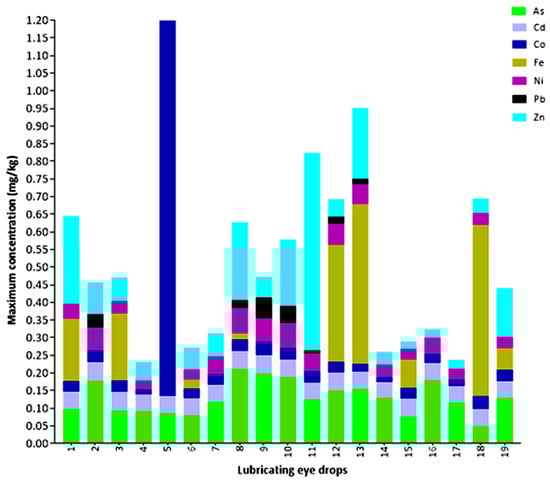
The elements As, Cd, Co, Ni, and Zn were quantified in all lubricating eye drops, while Fe was quantified in eye drops 1, 3, 6, 8, 12, 13, 15, 18, and 19, and Pb in eye drops 2 and 8–13 (Figure 1).
Figure 1.
Maximum concentration values of the elements quantified in lubricating eye drops used in Brazil.
Based on these quantification results, the descriptive analysis for each chemical element, as well as the maximum concentrations (mg/kg) of the elements in the lubricating eye drops, are presented in Table 8 and Table 9.
Table 8.
Descriptive statistics for each quantified element.
Table 9.
Maximum concentrations of quantified elements in lubricating eye drops (mg/kg).
The descriptive statistical analysis of the maximum concentrations of the elements evaluated in the lubricating eye drops revealed important variations among the metals and metalloids investigated. As showed a mean concentration of 0.12945 mg/kg and moderate variability (CV 35.75%), whereas Cd exhibited a highly homogeneous distribution, evidenced by the lowest coefficient of variation among the elements (CV 4.55%).
In contrast, Co and Fe presented the widest concentration ranges and high dispersion, with coefficients of variation of 290.11% and 165.86%, respectively, indicating the presence of samples with substantially higher levels. Ni had a mean of 0.04520 mg/kg and moderate variability (CV 34.94%), while Pb, despite its low mean (0.011 mg/kg), showed considerable variability due to the occurrence of higher isolated values (CV 165.09%).
Zn, although presenting the highest mean among the elements (0.11540 mg/kg), also demonstrated elevated dispersion (CV 112.29%) and a wide concentration range. Overall, the results indicate that some elements exhibit more uniform behavior among the samples, whereas others show marked heterogeneity, possibly related to formulation differences or manufacturing processes among the analyzed products.
The Tukey test results presented in Table 9 confirm that Cd exhibited the highest homogeneity among formulations, with all eye drops belonging to a single statistical group (p > 0.05), indicating uniform concentrations of this metal across all samples analyzed. In contrast, As, Ni, and Pb showed intermediate variability profiles, forming three to four statistically distinct groups, with minimum significant differences of 0.1844, 0.0620, and 0.0828, respectively. Notably, Co, Fe, and Zn exhibited the most heterogeneous profiles, with statistically significant outliers—particularly eye drop 5 for Co (1.1048 mg/kg), eye drop 11 for Zn (0.5598 mg/kg), and eye drops 13 and 18 for Fe (0.4529 mg/kg and 0.4851 mg/kg, respectively).
The maximum concentrations quantified in the lubricating eye drops were compared with the limits established by the Brazilian Pharmacopoeia (FB) [29] and the ICH Q3D (R2) guideline [30] for parenteral-use medicines, as shown in Table 10.
Table 10.
Comparison with the reference values of BP and the ICH Q3D (R2) guideline for parenteral administration compared with Maximum concentration of elements in lubricating eye drops obtained from the elemental analysis.
Eye drops 2, 8–10, 12, 13, and 16 showed maximum As concentrations above the BP limit (0.150 mg/kg) for parenteral administration, reaching up to 0.212 mg/kg (eye drop 8). However, all values remained below the ICH Q3D (R2) guideline limit (1.5 mg/kg). This finding indicates that, according to the national criteria, there is non-compliance in some products.
The maximum Cd concentrations in eye drops 2, 3, 8–10, and 12 were very close to or slightly above the FB limit for parenteral administration (0.050 mg/kg), ranging up to 0.0532 mg/kg. In contrast, all results are well below the ICH Q3D (R2) guideline limit (0.2 mg/kg). This reinforces that the Brazilian standard is more restrictive for this element.
Co presented a significant outlier in eye drop 5 (1.1048 mg/kg), above the maximum limit of 0.5 mg/kg of the ICH Q3D (R2) guideline for parenteral administration, in contrast to the median of 0.0307 mg/kg. This maximum concentration above the limit constitutes clear non-compliance and suggests a potential toxicological risk associated with this specific formulation. In the other eye drops, the concentrations remained below the international limit.
Fe was detected in 9 samples, with maximum concentration values between 0.0170 and 0.4851 mg/kg. Although the ICH Q3D (R2) and FB guidelines do not present specific limits for this element, the accumulation of this element in the body is associated with ocular diseases [25,71].
Ni was present in all samples, with maximum concentration values between 0.0255 and 0.0729 mg/kg, which is well below the reference limits for the parenteral route. Pb was detected in 7 eye drops, with maximum concentrations between 0.0101 and 0.0595 mg/kg. All samples remained below the limits established by the BP (0.5 mg/kg) and the ICH Q3D (R2) guideline (0.5000 mg/kg) for the parenteral route; therefore, there was no non-compliance for Pb in the analyzed sample.
Zn was detected in all samples, with maximum concentrations ranging from 0.0208 to 0.5598 mg/kg, but the consulted guidelines do not establish specific limits for this element.
3.2. Average Daily Dose
The ADD was calculated considering the parameters presented in Table 4 and Table 5, and the results obtained for the three exposure routes are presented in Table 11. In the eye drops analyzed, the ADDdermal values remained below the respective RfDs (Table 6), with Pb presenting the lowest ADDdermal value (1.32 × 10⁻⁸ mg/kg.day) in eye drop 11. In contrast, Co presented the highest value (1.44 × 10⁻⁶ mg/kg.day) in eye drop 5.
Table 11.
Average daily doses—dermal, inhalation and oral exposure routes (mg/kg.day).
The ADDinhalation values obtained in the eye drops analyzed were also below the reference doses for the inhalation route (Table 11). Pb presented the lowest ADDinhalation value in eye drop 11 (2.12 × 10⁻¹² mg/kg.day), and Co presented the highest value in eye drop 5 (2.32 × 10⁻¹⁰ mg/kg.day), as shown in Table 11.
Regarding ADDoral (mg/kg.day), the elements As, Cd, Co, Fe, Ni, Pb, and Zn showed ranges of 1.88 × 10⁻⁷ to 1.27 × 10⁻⁶, 1.06 × 10⁻⁷ to 3.52 × 10⁻⁷, 4.21 × 10⁻⁸ to 6.44 × 10⁻⁶, 9.52 × 10⁻⁸ to 3.11 × 10⁻⁶, 6.97 × 10⁻⁸ to 4.73 × 10⁻⁷, 5.54 × 10⁻⁸ to 3.26 × 10⁻⁷, and 5.42 × 10⁻⁸ to 3.07 × 10⁻⁶, respectively, as shown in Table 11. The element Co had both the lowest ADDoral value, in eye drop 17 (4.21 × 10⁻⁸), and the highest value, observed in eye drop 5 (6.44 × 10⁻⁶). All ADDoral values are below the recommended oral reference doses, as shown in Table 6.
3.3. Non-Carcinogenic Risk
The HQ and HI were used to estimate the non-carcinogenic risk due to heavy metal exposure. Table 12 presents the HQ values, while Table 13 presents the HI values, both for the elements As, Cd, Co, Fe, Ni, Pb, and Zn. These parameters represent the non-carcinogenic risks resulting from the instillation of lubricating eye drops during DED treatment, considering the dermal, inhalation, and oral routes of exposure.
Table 12.
Hazard quotient—dermal, inhalation and oral exposure routes.
Table 13.
Hazard Index.
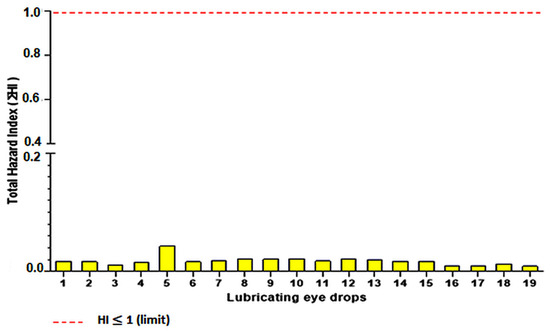
The HQs calculated for all “eye drop–element–route” copies presented values lower than 1. Similar to ADD, the results showed that the oral route constitutes the main route of exposure, followed by the dermal and inhalation routes. Finally, the total HIs remained below 1 in all 19 eye drops, suggesting a low probability of non-carcinogenic effects under the evaluated exposure conditions (Figure 2).
Figure 2.
Total Hazard Index in lubricating eye drops used in Brazil.
3.4. Carcinogenic Risk
The results of CR due to exposure to As, Cd, Ni, and Pb through the instillation of eye drops considering the dermal, inhalation and oral exposure routes are presented in Table 14 and the TCR considering all the eye drops analyzed is presented in Table 15. It can be observed that the oral CR is consistently the highest, followed by the dermal and inhalation routes, similar to the ADD and HQ values.
Table 14.
Carcinogenic Risk—routes of exposure: dermal, inhalation and oral.
Table 15.
Total Carcinogenic Risk.
Among the carcinogenic elements evaluated, As and Cd were main contributors to the CR. Both have high CSF values and very restrictive exposure limits, which increase their contribution even at relatively low concentrations. In contrast, Ni and Pb had a marginal contribution to the overall results.
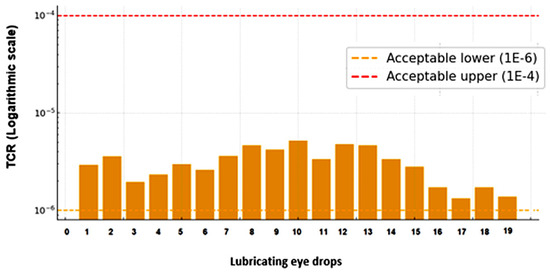
Table 15 shows that the TCRs varied approximately from 1.32 × 10⁻⁶ to 5.17 × 10⁻⁶ among the eye drops evaluated. Although they do not exceed the upper limit of the acceptability range established by international regulatory bodies (1.00 × 10⁻⁴), all values were above the lower limit (1.00 × 10⁻⁶) (Figure 3).
Figure 3.
Total Carcinogenic Risk in lubricating eye drops used in Brazil.
4. Discussion
4.1. Maximum Quantified Concentration in Lubricating Eye Drops
The results of the statistical analyses performed on the maximum concentrations revealed distinct patterns in the distribution of the elements among the different eye drop formulations. The homogeneity observed for Cd suggests a common source of contamination or physicochemical characteristics that favor its uniform distribution. In contrast, the significant variability identified for Co, Fe, Pb and Zn—evidenced by the high coefficients of variation and the formation of multiple statistically distinct groups in the Tukey test—points to differences in manufacturing processes or in the quality of raw materials used by different manufacturers. Particularly concerning is the identification of statistically significant outlier values, as observed in eye drop 5 for Co and in eye drop 11 for Zn, which exceeded the mean concentrations of the other products by several-fold.
The analysis of the maximum concentrations of As, Cd, Co, Fe, Ni, Pb, and Zn in the lubricating eye drops revealed that, although most of the values found are below the limits established by the ICH Q3D (R2) guideline for the parenteral administration route, some products did not meet the parameters defined by the BP, which presents more restrictive limits.
As was detected in all eye drops analyzed, with concentrations ranging from 0.0495 to 0.2120 mg/kg. Six formulations exceeded the limit established by the BP (0.150 mg/kg) for parenteral administration, indicating non-compliance at the national level, although below the reference value of the ICH Q3D (R2) guideline (1.5000 mg/kg). This finding is particularly relevant, since As is classified by the IARC as a human carcinogen, and its presence in the body is associated with the development of several types of cancer, even under chronic low-dose exposure. Furthermore, the values obtained in this study were higher than those reported in studies linking the presence of this element to age-related macular degeneration (AMD), with accumulation in the retinal pigment epithelium (RPE), choroid, and the retina [24]. There is evidence in the literature indicating that As can penetrate and accumulate in ocular tissues, with the potential to cause lesions in the cornea and conjunctiva [72,73]. Furthermore, its accumulation in the body has been associated with the progressive loss of central visual acuity [74].
In the case of Cd, concentrations ranged from 0.0447 to 0.0532 mg/kg, which were very close to or slightly above the BP limit for the parenteral route (0.0500 mg/kg), but below the ICH Q3D (R2) guideline value for this route of administration (0.2000 mg/kg). Despite apparently small differences, cumulative exposure to Cd in the body represents a considerable risk, given its potential for bioaccumulation and nephrotoxic and carcinogenic effects [75]. In humans, although there are no extensive reports of chronic corneal irritation, post-mortem analyses of ocular tissues have detected Cd concentrations in several regions, including the retina and the retinal pigment epithelium, suggesting a potential for accumulation and toxicity [76]. Additionally, a clinical case report indicates that topical exposure to cosmetics contaminated with Cd can cause severe corneal edema, toxic keratitis, and corneal scarring, resulting in subsequent visual impairment [77].
Co presented the most critical case: one of the formulations reached a maximum concentration of 1.1048 mg/kg, exceeding the limit established by the ICH Q3D (R2) guideline (0.5 mg/kg) for the parenteral route. Although the association between Co and IP remained at levels below the threshold of concern, these findings highlight the importance of regulatory attention, since high concentrations of Co in the body cause multiple adverse effects, including blurred vision, whitish spots in the eyes, hypothyroidism, cardiomyopathy, neuropathy, and, in more severe cases, irreversible vision loss [78,79]. In addition, a recent experimental study demonstrates that exposure to cobalt can trigger intense inflammatory reactions with the potential to affect ocular tissues, suggesting a risk to the cornea and conjunctiva under high local exposure conditions [80].
Although there are no reference values for Fe established by the FB or by ICH Q3D (R2) for the parenteral route, the presence of this element in the quantified samples reinforces the importance of monitoring, as chronic accumulation in the body can lead to ocular diseases, including AMD as well as conditions such as hereditary aceruloplasminemia, neurodegeneration associated with pantothenate kinase, intraocular hemorrhage [81] and cataract [82]. This potential for ocular toxicity is further supported by a clinical case report in which a patient rapidly developed severe ocular siderosis after crushing a ferrous sulfate tablet and applying it to the conjunctival fornix of the left eye [83].
Although Ni concentrations were below the reference limits for the parenteral route, it is essential to monitor its presence in products for continuous use. This element has a well-recognized toxic potential in the body and is associated with the development of cancer [23], AMD, [24] cardiovascular diseases, pulmonary fibrosis, renal failure, and conjunctivitis [84]. This concern is reinforced by an experimental study demonstrating that Ni can induce direct damage to corneal epithelial cells, promote oxidative stress, and increase the production of reactive oxygen species (ROS), leading to greater cellular apoptosis and potentially contributing to the development of DED [85].
Pb concentrations also remained below established limits. However, its presence, even at low concentrations, should be viewed with caution. Pb is a toxic and carcinogenic metal whose accumulation in the body has been associated with the development of several eye diseases, such as cataracts [28,86], AMD [24], and DED [87]. In addition, Pb—frequently detected in traditional cosmetics—has been linked to corneal edema and scarring [77], as well as conjunctival irritation, keratitis, and accumulation resulting from topical use [88].
It was not possible to compare the maximum zinc (Zn) concentrations with the limits established by the BP and ICH Q3D (R2) guidelines for parenteral administration, as these documents do not specifically address this element. However, it was observed that eye drops 1 (0.2492 mg/kg) and 11 (0.5598 mg/kg) had concentrations higher than those reported by Nourmohammadi, Modarress, and Pakdel (2006) [89], who measured Zn levels in the aqueous humor of patients with cataracts (0.2430 mg/kg). Furthermore, all analyzed eye drops contained higher concentrations than those reported by Hohberger et al. (2018) [71], who identified only 0.0003 mg/kg. Excess zinc in the body is widely recognized as a potential risk factor for eye disorders, including irritation, pain, corneal ulcers, edema, burns, hyperemia, hemorrhage, bullous keratopathy, glaucoma, cataracts, tearing, conjunctival inflammation, and a significant reduction in visual acuity [90]. There is evidence that, in an in vitro study, exposure to Zn—especially in the form of zinc oxide nanoparticles (ZnO)—may exert toxic effects on the cornea and the ocular surface [91]. These findings highlight the importance of systematically monitoring Zn levels in eye drops used continuously, especially for patients with pre-existing ocular conditions, to prevent potential cumulative toxic effects.
As discussed previously, even when concentrations of certain elements are below the limits established by regulatory agencies, such as BP and the ICH Q3D (R2) guideline, this does not guarantee the safety of using these components. Many of them have a prolonged biological half-life, are non-biodegradable, and can be toxic even at very low levels [92,93,94].
In this context, the findings of the present study indicate that, although most products comply with international safety standards, it is essential to establish specific limits for EIs in ophthalmic products. It is also recommended to include mandatory metal analyses in industrial quality control, as well as to implement post-market monitoring programs with periodic batch inspections. Furthermore, improvements in good manufacturing practices, greater transparency in labeling, and the development of technical guidelines specific to the risk assessment of eye drops would help strengthen the applicability of the study and mitigate the risks associated with the chronic use of these medications.
This study presents important strengths, including the methodological innovation of investigating the presence of elemental impurities in lubricating eye drops widely marketed in Brazil, as well as the integrated application of analytical methods and human health risk assessment. The use of sensitive techniques for the quantification of trace elements also contributes to the robustness of the results. However, some limitations should be considered. The risk assessment was based on theoretical assumptions and simplifications, such as the use of standardized exposure parameters and the absence of reference values specific to the ophthalmic route, which may introduce uncertainties into the estimation of actual risk. Furthermore, potential batch-to-batch variations and the cumulative contribution of the concurrent use of multiple products were not evaluated. These aspects should be explored in future studies to enhance the applicability of the findings.
It is emphasized that evaluating the presence of EIs in these products is essential to ensure patient safety, especially because the ocular route may facilitate both systemic absorption and direct exposure of highly sensitive tissues.
4.2. Average Daily Dose
Although eye drops are administered topically to the ocular surface, part of the dose may mix with tears, be drained through the nasolacrimal duct, swallowed, and subsequently absorbed by the gastrointestinal tract [16,39,40]. This mechanism explains why the oral route represents the main form of exposure, followed by the dermal route (conjunctival/corneal contact) and the inhalation route.
4.3. Non-Carcinogenic Risk
The HQ values indicated that the oral and dermal routes contribute most to the non-carcinogenic risk. Both the HQ and the HI for all elements analyzed in the three exposure routes presented values less than 1 (HQ < 1), indicating that the levels found are within the standards established by the USEPA [83]. This suggests that users of these eye drops are generally relatively free from non-carcinogenic risks.
However, Co stood out as the main contributor to non-carcinogenic risk, especially in eye drops 5. This result indicates that, even at low concentrations, the accumulation of the element over time may be relevant for continuous users. The fact that the total hazard index (HI) is also below 1 reinforces the absence of immediate risk; however, it does not eliminate concerns related to chronic exposure.
4.4. Carcinogenic Risk
CR showed the same trend observed for ADDs and HQs, decreasing in the order CRoral > CRdermal > CRinhalation. This result is consistent with ocular pharmacokinetics, as a large portion of the instilled volume is drained through the nasolacrimal duct and subsequently swallowed, leading to gastrointestinal absorption.
The CR values obtained for As in eye drops 2, 7–14, and for Cd in eye drops 1–15 and 18 for oral use, presented in Table 14, exceeded the acceptability range established by the USEPA (1.0 × 10⁻⁶ and 1.0 × 10⁻⁴) [70]. These results reinforce that chronic exposure to As and Cd, even at low concentrations, may pose a potential carcinogenic risk to health. This finding corroborates the literature that associates both elements with the induction of cancer in multiple organs [75] and highlights the need for specific regulatory measures for ophthalmic medications, which currently lack defined limits for EIs.
The CRT analysis (Table 15) demonstrated that the mean values remained consistently above the range considered tolerable (1.00 × 10⁻⁶ and 1.00 × 10⁻⁴), reflecting a relevant cumulative risk for chronic users. Given these results, it is essential to adopt mitigation strategies, including strict control of As and Cd concentrations in ophthalmic formulations, prevention of prolonged exposures, and implementation of continuous regulatory monitoring, in order to reduce the risks to human health associated with the prolonged use of these medications.
5. Conclusions
It was found that Co exhibited a maximum concentration above the limit established by the ICH Q3D (R2) guideline, whereas As and Cd exceeded the limits defined by the FB for the parenteral route. It was found that Co presented a maximum concentration above the limit established by the ICH Q3D (R2) guideline, while As and Cd exceeded the limits defined by the BP for the parenteral route.
The results indicated that the main risk to human health occurs via the oral route, as the medication can drain into the nasal cavity through the nasolacrimal duct and, after swallowing, be absorbed in the gastrointestinal tract. None of the eye drops analyzed presented a non-carcinogenic risk. However, a potential carcinogenic risk was identified in some products, considering the oral route of exposure to As and Cd, with CRT values exceeding acceptable limits.
These findings reinforce the need for rigorous oversight by regulatory agencies, as well as continuous monitoring of these medications, to mitigate health risks and prevent chronic damage to the body. Further studies with larger sample sizes are also recommended to more accurately assess the health risks in patients using lubricating eye drops to treat DED.
Author Contributions
Conceptualization, M.d.O.; methodology, E.S.d.P.M. and M.d.O.; software, M.d.O.; validation, E.S.d.P.M. and M.d.O.; formal analysis, M.d.O., E.S.d.P.M. and V.A.d.N.; investigation, M.d.O. and V.T.B.; resources, E.S.d.P.M., V.A.d.N., D.A.Z.G. and M.d.O.; data curation, M.d.O.; writing—original draft preparation, M.d.O.; writing—review and editing, V.A.d.N., D.A.Z.G. and M.d.O.; visualization, M.d.O.; M.A.P.A. and V.A.d.N.; project administration, V.A.d.N.; supervision, V.A.d.N. All authors have read and agreed to the published version of the manuscript.
Funding
This research was financially supported by the Brazilian Research Council (CNPq) (CNPq: Process No 314551/2023-9) and Coordenação de Aperfeiçoamento de Pessoal de Nível Superior-Brasil (CAPES)-Finance Code 001.
Institutional Review Board Statement
Not applicable.
Informed Consent Statement
Not applicable.
Data Availability Statement
The data used to support the findings of this study are available from the corresponding author upon request.
Conflicts of Interest
The authors declare no conflicts of interest.
References
- Shaw, M. How to administer eye drops and ointments. Nurs. Times 2014, 16–18. [Google Scholar] [CrossRef] [Scilit]
- Chaves, C. Ocular Senescence and the 21st Century. Rev. Bras. Oftalmol. 2010, 69, 215–216. [Google Scholar] [CrossRef] [Scilit]
- Golden, M.I.; Meyer, J.J.; Patel, B.C. Dry Eye Syndrome; StatPearls Publishing: Tampa, FL, USA; St. Petersburg, FL, USA, 2022. [Google Scholar]
- Şimşek, C.; Doğru, M.; Kojima, T.; Tsubota, K. Current Management and Treatment of Dry Eye Disease. Turk. J. Ophthalmol. 2018, 48, 309–313. [Google Scholar] [CrossRef] [Scilit]
- Uchino, M.; Uchino, Y.; Dogru, M.; Kawashima, M.; Yokoi, N.; Komuro, A.; Sonomura, Y.; Kato, H.; Kinoshita, S.; Schaumberg, D.A.; et al. Dry Eye Disease and Work Productivity Loss in Visual Display Users: The Osaka Study. Am. J. Ophthalmol. 2014, 157, 294–300. [Google Scholar] [CrossRef] [Scilit] [PubMed]
- Li, M.; Gong, L.; Chapin, W.J.; Zhu, M. Assessment of Vision-Related Quality of Life in Dry Eye Patients. Investig. Ophthalmol. Vis. Sci. 2012, 53, 5722–5727. [Google Scholar] [CrossRef] [Scilit] [PubMed]
- Rosa, A. Discover Everything About Dry Eye Syndrome. RetinaPro. Available online: https://retinapro.com.br/blog/doenca-ocular/descubra-tudo-sobre-a-sindrome-do-olho-seco/ (accessed on 28 April 2025).
- Dogru, M.; Nakamura, M.; Shimazaki, J.; Tsubota, K. Changing Trends in the Treatment of Dry-Eye Disease. Expert Opin. Investig. Drugs 2013, 22, 1581–1601. [Google Scholar] [CrossRef] [Scilit] [PubMed]
- Fonseca, E.C.; Arruda, G.V.; Rocha, E.M. Dry eye: Etiopathogenesis and treatment. Arq. Bras. Oftalmol. 2010, 73, 197–203. [Google Scholar] [CrossRef] [Scilit]
- Prinz, J.; Maffulli, N.; Fuest, M.; Walter, P.; Hildebrand, F.; Migliorini, F. Placebo Administration for Dry Eye Disease: A Level I Evidence Based Systematic Review and Meta-Analysis. Int. J. Clin. Pharm. 2022, 44, 1087–1101. [Google Scholar] [CrossRef] [Scilit]
- Oliveira, M.; Melo, E.S.P.; Silva, T.C.; Cardozo, C.M.L.; Siqueira, I.V.; Hamaji, M.P.; Braga, V.T.; Martin, L.F.T.; Fonseca, A.; Nascimento, V.A. Quantification of Metal (Loid)s in Lubricating Eye Drops Used in the Treatment of Dry Eye Disease. Molecules 2023, 28, 6508. [Google Scholar] [CrossRef] [Scilit]
- Silva, R.F.T. Range and Output Simulation for Elemental Impurities in Drug Products. Master’s Thesis, University of Lisbon, Lisbon, Portugal, 2018. [Google Scholar]
- Alam, M.F.; Akhter, M.; Mazumder, B.; Ferdous, A.; Hossain, M.D.; Dafader, N.C.; Ahmed, F.T.; Kundu, S.K.; Taheri, T.; Atique Ullah, A.K.M. Assessment of Some Heavy Metals in Selected Cosmetics Commonly Used in Bangladesh and Human Health Risk. J. Anal. Sci. Technol. 2019, 10, 2. [Google Scholar] [CrossRef] [Scilit]
- Khalili, F.; Mahvi, A.H.; Nasseri, S.; Yunesian, M.; Yaseri, M.; Djahed, B. Health Risk Assessment of Dermal Exposure to Heavy Metals Content of Chemical Hair Dyes. Iran. J. Public Health 2019, 48, 902–911. [Google Scholar] [CrossRef] [Scilit]
- Shomar, B.; Rashkeev, S.N. A Comprehensive Risk Assessment of Toxic Elements in International Brands of Face Foundation Powders. Environ. Res. 2021, 192, 110274. [Google Scholar] [CrossRef] [Scilit]
- Järvinen, K.; Järvinen, T.; Urtti, A. Ocular Absorption Following Topical Delivery. Adv. Drug Deliv. Rev. 1995, 16, 3–19. [Google Scholar] [CrossRef] [Scilit]
- Agrahari, V.; Mandal, A.; Agrahari, V.; Trinh, H.M.; Joseph, M.; Ray, A.; Hadji, H.; Mitra, R.; Pal, D.; Mitra, A.K. A Comprehensive Insight on Ocular Pharmacokinetics. Drug Deliv. Transl. Res. 2016, 6, 735–754. [Google Scholar] [CrossRef] [Scilit]
- Del Amo, E.M. Topical Ophthalmic Administration: Can a Drug Instilled onto the Ocular Surface Exert an Effect at the Back of the Eye? Front. Drug Deliv. 2022, 2, 954771. [Google Scholar] [CrossRef] [Scilit]
- Bachu, R.D.; Chowdhury, P.; Al-Saedi, Z.H.F.; Karla, P.K.; Boddu, S.H.S. Ocular Drug Delivery Barriers—Role of Nanocarriers in the Treatment of Anterior Segment Ocular Diseases. Pharmaceutics 2018, 10, 28. [Google Scholar] [CrossRef] [Scilit] [PubMed]
- Del Amo, E.M.; Urtti, A. Current and Future Ophthalmic Drug Delivery Systems: A Shift to the Posterior Segment. Drug Discov. Today 2008, 13, 135–143. [Google Scholar] [CrossRef] [Scilit]
- Al Osman, M.; Yang, F.; Massey, I.Y. Exposure Routes and Health Effects of Heavy Metals on Children. Biometals 2019, 32, 563–573. [Google Scholar] [CrossRef] [Scilit] [PubMed]
- Ayenimo, J.G.; Yusuf, A.M.; Adekunle, A.S.; Makinde, O.W. Heavy Metal Exposure from Personal Care Products. Bull. Environ. Contam. Toxicol. 2010, 84, 8–14. [Google Scholar] [CrossRef] [Scilit] [PubMed]
- Silva, M.F.D.J. Assessment of Health Risks Resulting from Mixtures of Metals Potentially Present in Medicines. Master’s Thesis, Higher Institute of Health Sciences Egas Moniz, Almada, Portugal, 2017. [Google Scholar]
- Aberami, S.; Nikhalashree, S.; Bharathselvi, M.; Biswas, J.; Sulochana, K.N.; Coral, K. Elemental Concentrations in Choroid-RPE and Retina of Human Eyes with Age-Related Macular Degeneration. Exp. Eye Res. 2019, 186, 107718. [Google Scholar] [CrossRef] [Scilit]
- Bocca, B.; Forte, G.; Pisano, A.; Farace, C.; Giancipoli, E.; Pinna, A.; Dore, S.; Madeddu, R. A Pilot Study to Evaluate the Levels of Aqueous Humor Trace Elements in Open-Angle Glaucoma. J. Trace Elem. Med. Biol. 2020, 61, 126560. [Google Scholar] [CrossRef] [Scilit]
- Chen, Y.; Chen, Y.; Lai, C. Clinical Association between Trace Elements of Tear and Dry Eye Metrics. Sci. Rep. 2022, 12, 18052. [Google Scholar] [CrossRef] [Scilit]
- Choi, M.R.; Ju, M.J.; Kim, D.H.; Choi, Y. Comparison of Environmental Phthalates and Heavy Metals Exposures by Dry Eye Disease Status. Fall 2020 Online Conference. In Proceedings of the Online Conference of the Korean Society for Environmental Health and Toxicology, in Virtual, 13 November 2020; p. 142. [Google Scholar]
- Dolar-Szczasny, J.; Święch, A.; Flieger, J.; Tatarczak-Michalewska, M.; Niedzielski, P.; Proch, J.; Majerek, D.; Kawka, J.; Mackiewicz, J. Levels of Trace Elements in the Aqueous Humor of Cataract Patients Measured by the Inductively Coupled Plasma Optical Emission Spectrometry. Molecules 2019, 24, 4127. [Google Scholar] [CrossRef] [Scilit]
- BRASIL. Brazilian Pharmacopoeia, 7th ed.; Brazilian Health Regulatory Agency: Brasilia, Brazil, 2024; Volume I—RDC n 940/2024.
- ICH. Guideline for Elemental Impurities Q3D (R2); The International Council for Harmonisation of Technical Requirements for Pharmaceuticals for Human: Geneva, Switzerland, 2022. [Google Scholar]
- USEPA Risk Assessment Guidance for Superfund. Volume I: Human Health Evaluation Manual (Part A), Interim Final; U.S. Environmental Protection Agency: Washington, DC, USA, 1989.
- Long, G.L.; Winefordner, J.D. Limit of Detection. A Closer Look at the IUPAC Definition. Available online: https://pubs.acs.org/doi/pdf/10.1021/ac00258a001 (accessed on 7 November 2025).
- Scientific, T.F. Thermo Scientific Tech Tip; Thermo Fisher Scientific: Waltham, MA, USA, 2007. [Google Scholar]
- Thompson, M.; Ellison, S.L.R.; Wood, R. Harmonized Guidelines for Single-Laboratory Validation of Methods of Analysis: (IUPAC Technical Report). Pure Appl. Chem. 2002, 74, 167–172. [Google Scholar] [CrossRef] [Scilit]
- Ramsay, E.; del Amo, E.M.; Toropainen, E.; Tengvall-Unadike, U.; Ranta, V.-P.; Urtti, A.; Ruponen, M. Corneal and Conjunctival Drug Permeability: Systematic Comparison and Pharmacokinetic Impact in the Eye. Eur. J. Pharm. Sci. 2018, 119, 83–89. [Google Scholar] [CrossRef] [Scilit]
- Batistuzzo, J.; Filho, A.L. Formulações Magistrais Em Oftalmologia. Acta Farm. Port. 2011, 1, 65–76. [Google Scholar]
- Agarwal, P.; Craig, J.P.; Rupenthal, I.D. Formulation Considerations for the Management of Dry Eye Disease. Pharmaceutics 2021, 13, 207. [Google Scholar] [CrossRef] [Scilit]
- Farkouh, A.; Frigo, P.; Czejka, M. Systemic Side Effects of Eye Drops: A Pharmacokinetic Perspective. Clin. Ophthalmol. 2016, 10, 2433–2441. [Google Scholar] [CrossRef] [Scilit] [PubMed]
- Paulsen, F.P.; Föge, M.; Thale, A.B.; Tillmann, B.N.; Mentlein, R. Animal Model for the Absorption of Lipophilic Substances from Tear Fluid by the Epithelium of the Nasolacrimal Ducts. Investig. Ophthalmol. Vis. Sci. 2002, 43, 3137–3143. [Google Scholar]
- Rothe, H.; Fautz, R.; Gerber, E.; Neumann, L.; Rettinger, K.; Schuh, W.; Gronewold, C. Special Aspects of Cosmetic Spray Safety Evaluations: Principles on Inhalation Risk Assessment. Toxicol. Lett. 2011, 205, 97–104. [Google Scholar] [CrossRef] [Scilit]
- EPA/100/B-19/001; USEPA Guidelines for Human Exposure Assessment. U.S. Environmental Protection Agency: Washington, DC, USA, 2019.
- Lux, A.; Maier, S.; Dinslage, S.; Süverkrüp, R.; Diestelhorst, M. A Comparative Bioavailability Study of Three Conventional Eye Drops versus a Single Lyophilisate. Br. J. Ophthalmol. 2003, 87, 436–440. [Google Scholar] [CrossRef] [Scilit] [PubMed]
- Hamad, S.H.; Schauer, J.J.; Shafer, M.M.; Al-Rheem, E.A.; Skaar, P.S.; Heo, J.; Tejedor-Tejedor, I. Risk Assessment of Total and Bioavailable Potentially Toxic Elements (PTEs) in Urban Soils of Baghdad–Iraq. Sci. Total Environ. 2014, 494, 39–48. [Google Scholar] [CrossRef] [Scilit]
- Sah, D.; Verma, P.K.; Kumari, K.M.; Lakhani, A. Chemical Partitioning of Fine Particle-Bound As, Cd, Cr, Ni, Co, Pb and Assessment of Associated Cancer Risk Due to Inhalation, Ingestion and Dermal Exposure. Inhal. Toxicol. 2017, 29, 483–493. [Google Scholar] [CrossRef] [Scilit] [PubMed]
- Saha, N.; Rahman, M.S.; Ahmed, M.B.; Zhou, J.L.; Ngo, H.H.; Guo, W. Industrial Metal Pollution in Water and Probabilistic Assessment of Human Health Risk. J. Environ. Manag. 2017, 185, 70–78. [Google Scholar] [CrossRef] [Scilit]
- Victor, O.; Kingsley Chukwuemeka, P.-I.; Eucharia, N. Heavy Metals Contents and Health Risk Assessment of Classroom Corner Dusts in Selected Public Primary Schools in Rivers State, Nigeria. J. Environ. Pollut. Hum. Health 2018, 6, 138–147. [Google Scholar] [CrossRef] [Scilit]
- De Sousa, C.I.P. Characterization of Tear Film Parameters and Corneal Topography in the Portuguese Adult Population: A Pilot Study. Master’s Thesis, University of Minho, Braga, Portugal, 2014. [Google Scholar]
- Ramsay, E.; Ruponen, M.; Picardat, T.; Tengvall, U.; Tuomainen, M.; Auriola, S.; Toropainen, E.; Urtti, A.; del Amo, E.M. Impact of Chemical Structure on Conjunctival Drug Permeability: Adopting Porcine Conjunctiva and Cassette Dosing for Construction of In Silico Model. J. Pharm. Sci. 2017, 106, 2463–2471. [Google Scholar] [CrossRef] [Scilit]
- Yao, W.; Gallagher, D.L.; Gohlke, J.M.; Dietrich, A.M. Children and Adults Are Exposed to Dual Risks from Ingestion of Water and Inhalation of Ultrasonic Humidifier Particles from Pb-Containing Water. Sci. Total Environ. 2021, 791, 148248. [Google Scholar] [CrossRef] [Scilit]
- DEP. Characterization of Risks Due to Inhalation of Particulates by Construction Workers; Massachusetts Department of Environmental Protection: Worcester, MA, USA, 2008.
- Yan, L.; Franco, A.-M.; Elio, P. Health Risk Assessment via Ingestion and Inhalation of Soil PTE of an Urban Area. Chemosphere 2021, 281, 130964. [Google Scholar] [CrossRef] [Scilit] [PubMed]
- Goudarzi, G.; Alavi, N.; Geravandi, S.; Idani, E.; Behrooz, H.R.A.; Babaei, A.A.; Alamdari, F.A.; Dobaradaran, S.; Farhadi, M.; Mohammadi, M.J. Health Risk Assessment on Human Exposed to Heavy Metals in the Ambient Air PM10 in Ahvaz, Southwest Iran. Int. J. Biometeorol. 2018, 62, 1075–1083. [Google Scholar] [CrossRef] [Scilit]
- IBGE—Country’s Population Will Stop Growing in 2041. News Agency. Available online: https://agenciadenoticias.ibge.gov.br/agencia-noticias/2012-agencia-de-noticias/noticias/41056-populacao-do-pais-vai-parar-de-crescer-em-2041 (accessed on 2 October 2025).
- Aghlmand, R.; Rasi Nezami, S.; Abbasi, A. Evaluation of Chemical Parameters of Urban Drinking Water Quality along with Health Risk Assessment: A Case Study of Ardabil Province, Iran. Int. J. Environ. Res. Public Health 2021, 18, 5179. [Google Scholar] [CrossRef] [Scilit]
- Wang, N.; Han, J.; Wei, Y.; Li, G.; Sun, Y. Potential Ecological Risk and Health Risk Assessment of Heavy Metals and Metalloid in Soil around Xunyang Mining Areas. Sustainability 2019, 11, 4828. [Google Scholar] [CrossRef] [Scilit]
- USEPA. Methods for Derivation of Inhalation Reference Concentrations and Application of Inhalation Dosimetry; U.S. Environmental Protection Agency: Washington, DC, USA, 1994.
- USEPA. Supplemental Guidance for Developing Soil Screening Levels for Superfund Sites; U.S. Environmental Protection Agency: Washington, DC, USA, 2002.
- USEPA. Regional Screening Levels (RSLs)—Generic Tables; U.S. Environmental Protection Agency: Washington, DC, USA, 2024.
- Mohammad, N.; Muhammad, N.; Nisar, M. Geo-Chemical Investigation and Health Risk Assessment of Potential Toxic Elements in Industrial Wastewater Irrigated Soil: A Geo-Statistical Approach. J. Biodivers. Environ. Sci. 2018, 12, 367–380. [Google Scholar]
- Adimalla, N. Heavy Metals Contamination in Urban Surface Soils of Medak Province, India, and Its Risk Assessment and Spatial Distribution. Environ. Geochem. Health 2020, 42, 59–75. [Google Scholar] [CrossRef] [Scilit]
- Zhou, P.; Guo, J.; Zhou, X.; Zhang, W.; Liu, L.; Liu, Y.; Lin, K. PM2.5, PM10 and Health Risk Assessment of Heavy Metals in a Typical Printed Circuit Noards Manufacturing Workshop. J. Environ. Sci. 2014, 26, 2018–2026. [Google Scholar] [CrossRef] [Scilit] [PubMed]
- Aendo, P.; Netvichian, R.; Thiendedsakul, P.; Khaodhiar, S.; Tulayakul, P. Carcinogenic Risk of Pb, Cd, Ni, and Cr and Critical Ecological Risk of Cd and Cu in Soil and Groundwater around the Municipal Solid Waste Open Dump in Central Thailand. J. Environ. Public Health 2022, 2022, 3062215. [Google Scholar] [CrossRef] [Scilit] [PubMed]
- Mohammadi, A.A.; Zarei, A.; Majidi, S.; Ghaderpoury, A.; Hashempour, Y.; Saghi, M.H.; Alinejad, A.; Yousefi, M.; Hosseingholizadeh, N.; Ghaderpoori, M. Carcinogenic and Non-Carcinogenic Health Risk Assessment of Heavy Metals in Drinking Water of Khorramabad, Iran. MethodsX 2019, 6, 1642–1651. [Google Scholar] [CrossRef] [Scilit] [PubMed]
- USDOE. The Risk Assessment Information System; US Department of Energy’s Oak Ridge Operations Office (ORO): Oak Ridge, TN, USA, 2024.
- Ni, F.; Liu, G.; Ren, H.; Yang, S.; Ye, J.; Lu, X.; Yang, M. Health Risk Assessment on Rural Drinking Water Safety—A Case Study in Rain City District of Ya’an City of Sichuan Province. J. Water Resour. Prot. 2009, 1, 128–135. [Google Scholar] [CrossRef]
- Environmental Affairs. The Framework for the Management of Contaminated Land; Department of Environmental Affairs: Pretoria, South Africa, 2010.
- OEHHA, Appendix B. Chemical-Specific Summaries of the Information Used to Derive Unit Risk and Cancer Potency Values; California Office of Environmental Health Hazard Assessment: Sacramento, CA, USA, 2011; p. 626.
- OEHHA. Nickel and Nickel Compounds; California Office of Environmental Health Hazard Assessment: Sacramento, CA, USA, 2009.
- Johnbull, O.; Abbassi, B.; Zytner, R.G. Risk Assessment of Heavy Metals in Soil Based on the Geographic Information System-Kriging Technique in Anka, Nigeria. Environ. Eng. Res. 2019, 24, 150–158. [Google Scholar] [CrossRef] [Scilit]
- Zhang, H.; Mao, Z.; Huang, K.; Wang, X.; Cheng, L.; Zeng, L.; Zhou, Y.; Jing, T. Multiple Exposure Pathways and Health Risk Assessment of Heavy Metal (Loid)s for Children Living in Fourth-Tier Cities in Hubei Province. Environ. Int. 2019, 129, 517–524. [Google Scholar] [CrossRef] [Scilit]
- Hohberger, B.; Chaudhri, M.A.; Michalke, B.; Lucio, M.; Nowomiejska, K.; Schlötzer-Schrehardt, U.; Grieb, P.; Rejdak, R.; Jünemann, A.G.M. Levels of Aqueous Humor Trace Elements in Patients with Open-Angle Glaucoma. J. Trace Elem. Med. Biol. 2018, 45, 150–155. [Google Scholar] [CrossRef] [Scilit]
- Baidya, K.; Raj, A.; Mondal, L.; Bhaduri, G.; Todani, A. Persistent Conjunctivitis Associated with Drinking Arsenic-Contaminated Water. J. Ocul. Pharmacol. Ther. 2006, 22, 208–211. [Google Scholar] [CrossRef] [Scilit]
- Hallum, A.V. Involvement of the Cornea in Arsenic Poisoning: Report of a Case. Jama Ophthalmol. 1934, 12, 93–98. [Google Scholar] [CrossRef] [Scilit]
- Freund, P.; Al-Shafai, L.; Mankovskii, G.; Howarth, D.; Margolin, E. Clinicopathological Correlates: Chronic Arsenic Toxicity Causing Bilateral Symmetric Progressive Optic Neuropathy. J. Neuroophthalmol. 2020, 40, 423–427. [Google Scholar] [CrossRef] [Scilit]
- Genchi, G.; Sinicropi, M.S.; Lauria, G.; Carocci, A.; Catalano, A.; Genchi, G.; Sinicropi, M.S.; Lauria, G.; Carocci, A.; Catalano, A. The Effects of Cadmium Toxicity. Int. J. Environ. Res. Public Health 2020, 17, 3782. [Google Scholar] [CrossRef] [Scilit] [PubMed]
- Erie, J.C.; Butz, J.A.; Good, J.A.; Erie, E.A.; Burritt, M.F.; Cameron, J.D. Heavy Metal Concentrations in Human Eyes. Am. J. Ophthalmol. 2005, 139, 888–893. [Google Scholar] [CrossRef] [Scilit]
- Amry, M.A.; Al-Saikhan, F.; Ayoubi, A. Toxic Effect of Cadmium Found in Eyeliner to the Eye of a 21 Year Old Saudi Woman: A Case Report. Saudi Pharm. J. 2011, 19, 269–272. [Google Scholar] [CrossRef] [Scilit]
- Garcia, M.D.; Hur, M.; Chen, J.J.; Bhatti, M.T. Cobalt Toxic Optic Neuropathy and Retinopathy: Case Report and Review of the Literature. Am. J. Ophthalmol. Case Rep. 2020, 17, 100606. [Google Scholar] [CrossRef] [Scilit] [PubMed]
- Lim, C.A.; Khan, J.; Chelva, E.; Khan, R.; Unsworth-Smith, T. The Effect of Cobalt on the Human Eye. Doc. Ophthalmol. 2015, 130, 43–48. [Google Scholar] [CrossRef] [Scilit]
- Obied, B.; Richard, S.; Zahavi, A.; Kreizman-Shefer, H.; Bajar, J.; Fixler, D.; Krmpotić, M.; Girshevitz, O.; Goldenberg-Cohen, N. Cobalt Toxicity Induces Retinopathy and Optic Neuropathy in Mice. Investig. Ophthalmol. Vis. Sci. 2024, 65, 59. [Google Scholar] [CrossRef] [Scilit]
- Wong, R.W.; Richa, D.C.; Hahn, P.; Green, W.R.; Dunaief, J.L. Iron Toxicity as a Potential Factor in AMD. RETINA 2007, 27, 997–1003. [Google Scholar] [CrossRef] [Scilit]
- Erol, M.A.; Ozalp, O.; Atalay, E. Cataract secondary to iatrogenic iron overload in a severely anemic patient. Indian J. Ophthalmol.-Case Rep. 2021, 1, 259. [Google Scholar] [CrossRef] [Scilit]
- Asproudis, I.; Zafeiropoulos, P.; Katsanos, A.; Kolettis, C. Severe Self-Inflicted Acute Ocular Siderosis Caused by an Iron Tablet in the Conjunctival Fornix. Acta Medica 2017, 60, 160–162. [Google Scholar] [CrossRef] [Scilit] [PubMed]
- Hołyńska-Iwan, I.; Sobiesiak, M.; Kowalczyk, W.; Wróblewski, M.; Cwynar, A.; Szewczyk-Golec, K. Nickel Ions Influence the Transepithelial Sodium Transport in the Trachea, Intestine and Skin. Sci. Rep. 2023, 13, 6931. [Google Scholar] [CrossRef] [Scilit]
- Zhang, Z.-N.; Liu, H.; Liu, M.-M.; Yang, D.-L.; Bi, J.; Chen, Q.-Q.; Chen, W.; Xiang, P.; Zhang, Z.-N.; Liu, H.; et al. Effects of Nickel at Environmentally Relevant Concentrations on Human Corneal Epithelial Cells: Oxidative Damage and Cellular Apoptosis. Biomolecules 2022, 12, 1283. [Google Scholar] [CrossRef] [Scilit] [PubMed]
- Cekic, O. Effect of Cigarette Smoking on Copper, Lead, and Cadmium Accumulation in Human Lens. Br. J. Ophthalmol. 1998, 82, 186–188. [Google Scholar] [CrossRef] [Scilit] [PubMed]
- Liou, Y.; Chen, Y.; Chen, W.; Li, K.; Chou, T.; Huang, Y.; Wang, C.; Lai, C. Associations between Biomarkers of Metal Exposure and Dry Eye Metrics in Shipyard Welders: A Cross-Sectional Study. Int. J. Environ. Res. Public Health 2022, 19, 2264. [Google Scholar] [CrossRef] [Scilit]
- Hore, P. Lead Poisoning in a Mother and Her Four Children Using a Traditional Eye Cosmetic—New York City, 2012–2023. MMWR Morb. Mortal. Wkly. Rep. 2024, 73. [Google Scholar] [CrossRef] [Scilit]
- Nourmohammadi, I.; Modarress, M.; Pakdel, F. Assessment of Aqueous Humor Zinc Status in Human Age-Related Cataract. Ann. Nutr. Metab. 2006, 50, 51–53. [Google Scholar] [CrossRef] [Scilit]
- Nriagu, J.O. (Ed.) Arsenic in the Environment: Advances in Environmental: Cycling and Characterization; John Wiley & Sons: New York, NY, USA, 1994. [Google Scholar]
- Lee, H.; Park, K. In Vitro Cytotoxicity of Zinc Oxide Nanoparticles in Cultured Statens Seruminstitut Rabbit Cornea Cells. Toxicol. Res. 2019, 35, 287–294. [Google Scholar] [CrossRef] [Scilit]
- Amartey, E.O.; Asumadu-Sakyi, A.B.; Adjei, C.A.; Quashie, F.K.; Duodu, G.O.; Bentil, N.O. Determination of Heavy Metals Concentration in Hair Pomades on the Ghanaian Market Using Atomic Absorption Spectrometry Technique. Br. J. Pharmacol. Toxicol. 2011, 2, 192–198. [Google Scholar]
- Ezeabara, C.; Ogochukwu, O.; Emeka, A.; Okeke, C.; Mbaekwe, E. Heavy Metal Contamination of Herbal Drugs: Implication for Human Health-A Review. Int. J. Trop. Dis. Health 2014, 4, 1044–1058. [Google Scholar] [CrossRef] [Scilit]
- Rai, P.K.; Lee, S.S.; Zhang, M.; Tsang, Y.F.; Kim, K.-H. Heavy Metals in Food Crops: Health Risks, Fate, Mechanisms, and Management. Environ. Int. 2019, 125, 365–385. [Google Scholar] [CrossRef] [Scilit] [PubMed]

Disclaimer/Publisher’s Note: The statements, opinions and data contained in all publications are solely those of the individual author(s) and contributor(s) and not of MDPI and/or the editor(s). MDPI and/or the editor(s) disclaim responsibility for any injury to people or property resulting from any ideas, methods, instructions or products referred to in the content. |
© 2026 by the authors. Licensee MDPI, Basel, Switzerland. This article is an open access article distributed under the terms and conditions of the Creative Commons Attribution (CC BY) license.