
Article

Ergonomics in Sleep Medicine: Interfacing Myofunctional Therapy with Orofacial Muscular Balance and Sleep Posture

by
Siddharth Sonwane
1,* and
Shweta Sonwane
2
1
Department of Orthodontics and Dentofacial Orthopedics, Mansarovar Dental College, Bhopal 462042, Madhya Pradesh, India
2
Department of Oral and Maxillofacial Surgery, Government Dental College, Nagpur 440003, Maharashtra, India
*
Author to whom correspondence should be addressed.
Int. J. Orofac. Myol. Myofunct. Ther. 2026, 52(1), 2; https://doi.org/10.3390/ijom52010002 (registering DOI)
Submission received: 26 August 2025 / Revised: 18 December 2025 / Accepted: 19 December 2025 / Published: 30 December 2025

Abstract

Background/Objectives: Obstructive sleep apnea (OSA) is a prevalent sleep-related breathing disorder characterized by repeated episodes of upper airway obstruction during sleep, leading to intermittent hypoxia and fragmented sleep architecture. Orofacial myofunctional therapy (OMT) has emerged as a promising non-invasive approach to improving airway patency in individuals with mild-to-moderate OSA. However, the role of sleep ergonomics—including sleep posture and pillow support—in enhancing OMT outcomes remains underexplored. This study aimed to evaluate whether ergonomic interventions could augment the therapeutic effects of OMT in adult patients with mild-to-moderate OSA. Methods: A 12-week prospective cohort study was conducted involving 60 adult participants diagnosed with mild-to-moderate OSA. All participants underwent a structured orofacial myofunctional therapy (OMT) program comprising exercises for tongue elevation, lip seal enhancement, and soft palate strengthening. In addition, ergonomic instructions were provided regarding optimal sleeping posture and pillow adjustment. Compliance with ergonomic practices was monitored weekly using infrared night-vision cameras and reviewed by a blinded sleep technician. Pre- and post-intervention assessments included apnea–hypopnea index (AHI), Pittsburgh Sleep Quality Index (PSQI), and Ep-worth Sleepiness Scale (ESS). Results: Statistically significant improvements were observed in all measured parameters following the intervention. AHI scores reduced from 18.2 ± 4.5 to 10.6 ± 3.9 events/hour (p < 0.001), PSQI scores improved from 11.3 ± 2.1 to 6.5 ± 1.8 (p < 0.001), and ESS scores declined from 13.7 ± 2.6 to 7.4 ± 2.0 (p < 0.001). Participants with high adherence to ergonomic recommendations demonstrated significantly greater clinical improvements compared to less adherent individuals. Conclusions: The combination of ergonomic sleep posture interventions with OMT was associated with positive improvements in sleep-related outcomes, comparable to or in some cases better than those reported in previous studies evaluating these interventions independently. As an observational cohort without a control arm, this study cannot establish causality but provides preliminary evidence to guide the design of future randomized clinical trials.

1. Introduction

Obstructive sleep apnea (OSA) is a multifactorial sleep-related breathing disorder characterized by recurrent episodes of partial or complete upper airway collapse during sleep, resulting in intermittent hypoxia, sleep fragmentation, and disrupted sleep architecture [1,2]. These physiological disturbances contribute to excessive daytime somnolence, neurocognitive impairment, and elevated cardiovascular and metabolic morbidity [1]. The global prevalence of OSA in adults is estimated to range between 9% and 38%, with higher rates observed among older adults, males, and individuals with obesity or craniofacial abnormalities [1]. The burden continues to rise globally, driven by increasing obesity rates and enhanced diagnostic awareness [1,2].
Continuous positive airway pressure (CPAP) remains the gold standard for the management of moderate-to-severe OSA due to its proven ability to normalize the apnea–hypopnea index (AHI), improve oxygen saturation, and restore sleep continuity [1]. However, despite its efficacy, CPAP adherence remains suboptimal in real-world settings, largely due to discomfort, mask-related irritation, noise, and limited portability [2,3,4]. Similarly, alternative modalities such as mandibular advancement devices (MADs) and upper airway surgeries provide clinical benefit in selected cases but are often limited by variable tolerability, higher costs, and procedural invasiveness [5]. These challenges have prompted a growing interest in non-invasive, behaviorally oriented interventions that target the underlying anatomical and functional determinants of upper airway obstruction.
However, the magnitude of improvement achieved through OMT alone varies among individuals, likely due to differences in anatomical configuration, neuromuscular responsiveness, and adherence to therapy. An additional—and often overlooked—factor influencing OSA severity is sleep posture. Supine sleeping positions exacerbate airway obstruction due to gravitational posterior displacement of the tongue and soft palate, whereas lateral positions have been shown to markedly reduce AHI in position-dependent OSA [4,5,6,7]. The foundational work of Cartwright [8] and later systematic analyses by Menon and Kumar [9] and Skinner et al. [10] confirmed that posture plays a critical role in OSA pathophysiology and can substantially modify disease expression and therapeutic response.
Ergonomic sleep interventions, encompassing pillow contouring, head–neck alignment, and lateral positioning strategies, represent a pragmatic and underexplored adjunct to OMT. Positional therapy has been shown to decrease apnea frequency in selected populations [5,10,11], but long-term adherence remains challenging when used in isolation. Integrating ergonomic optimization within structured behavioral protocols such as OMT may enhance both biomechanical efficacy and patient compliance by promoting comfort and habit reinforcement [4,9].
Recent advances in wearable monitoring, infrared recording, and ergonomic pillow design have further improved the feasibility of tracking and maintaining optimal sleep posture [10]. Studies indicate that cervical support devices and body-alignment pillows can improve upper airway stability and reduce resistance during sleep by minimizing pharyngeal collapse [5,8,10]. Nevertheless, to date, no clinical investigations have comprehensively evaluated the synergistic impact of combining OMT with ergonomic sleep posture modification in a unified therapeutic framework.
Therefore, the present study aimed to investigate the combined effect of orofacial myofunctional therapy and ergonomic sleep posture optimization on sleep outcomes in adults with mild-to-moderate OSA. We hypothesized that the integrated approach would produce clinically significant reductions in AHI and improvements in sleep quality and daytime alertness compared with baseline measures. This intervention model emphasizes a patient-centered, non-invasive, and cost-effective strategy that leverages behavioral modification and ergonomic principles to enhance adherence and long-term management of OSA.

2. Materials and Methods

2.1. Study Design and Ethical Approval

This prospective, 12-week observational cohort study was conducted at a multidisciplinary sleep medicine unit affiliated with the Departments of Orthodontics and Otolaryngology of a tertiary care teaching hospital. The primary objective was to assess whether integrating ergonomic sleep posture interventions with orofacial myofunctional therapy (OMT) could improve sleep-related outcomes among adults diagnosed with mild-to-moderate obstructive sleep apnea (OSA).
The study adhered to the ethical standards outlined in the Declaration of Helsinki and received approval from the Institutional Ethics Committee (Approval No. IEC23/2025/Sleep/OMT-42). All participants provided written informed consent after being thoroughly briefed on the study objectives, procedures, potential risks, and benefits.

2.2. Participant Recruitment and Eligibility

A total of sixty adult participants, aged between 18 and 60 years, were consecutively recruited between January and March 2025. All participants had a recent diagnosis of mild-to-moderate obstructive sleep apnea (OSA), confirmed by full-night, in-laboratory polysomnography (PSG) performed in accordance with the American Academy of Sleep Medicine (AASM) scoring criteria. Eligibility was determined following a comprehensive evaluation that included detailed medical history, physical examination, and PSG-derived apnea–hypopnea index (AHI) values.
Inclusion criteria required participants to present with an AHI between 5 and 30 events per hour, reflecting mild-to-moderate OSA severity. Additional requirements included no prior history of orofacial myofunctional therapy (OMT) or surgical intervention for sleep-disordered breathing, no current or recent use of continuous positive airway pressure (CPAP) or mandibular advancement devices, and the ability and willingness to adhere to the structured intervention protocol, which included scheduled follow-ups and ergonomic sleep training.
Exclusion criteria encompassed individuals with severe OSA (AHI > 30), structural nasal obstructions requiring surgical correction, craniofacial syndromes or anomalies, diagnosed neuromuscular disorders, or current engagement in CPAP or oral appliance therapy. Individuals demonstrating poor compliance during the initial screening phase were also excluded from participation.
Although lifestyle variables such as diet, alcohol consumption, and physical activity were not actively modified or controlled during the study, participants were instructed to maintain their usual routines throughout the intervention period. This approach was taken to isolate the effects of the combined OMT and ergonomic sleep posture intervention on OSA-related outcomes without additional behavioral confounding.

2.3. Baseline Evaluation

Upon enrollment, each participant underwent a thorough baseline assessment comprising clinical, anthropometric, and neurophysiological parameters. Sleep and medical history were obtained using a structured proforma. Anthropometric measurements, including body mass index (BMI) and neck circumference, were recorded using standardized protocols.
Subjective sleep quality was evaluated using the Pittsburgh Sleep Quality Index (PSQI), while daytime somnolence was assessed via the Epworth Sleepiness Scale (ESS).
Overnight PSG was conducted using a Type I diagnostic system (Alice 6 polysomnography system, Philips Respironics, Murrysville, PA, USA) and scored according to the 2020 American Academy of Sleep Medicine (AASM) criteria. All polysomnographic recordings were independently reviewed and scored by a single board-certified sleep physician to maintain uniformity and minimize inter-observer variability.
Baseline anthropometric variables, including body mass index (BMI), were recorded at enrollment and re-assessed at week 12 to ensure stability throughout the intervention period. No significant change in BMI was observed (mean ± SD: 27.4 ± 3.1 kg/m2 at baseline vs. 27.3 ± 3.2 kg/m2 at follow-up; p = 0.74). Although BMI was not included as a covariate in the primary analysis, its stability minimizes potential confounding related to weight fluctuation.

2.4. Intervention Protocol

2.4.1. Orofacial Myofunctional Therapy (OMT)

Participants engaged in a standardized 12-week orofacial myofunctional therapy (OMT) regimen administered by a certified orofacial myologist, based on established protocols described by Guimarães et al. (2009) [3] and Diaféria et al. (2017) [4]. The program consisted of weekly supervised sessions lasting 20–25 min, complemented by structured home-based exercises performed twice daily.
The core therapeutic components included:
Tongue Strengthening and Posture Exercises: Exercises such as tongue suction to the hard palate and repetitive incisive papilla press, designed to improve palatal elevation and maintain proper tongue posture at rest [1].
Lip Strengthening Exercises: Resistance exercises using the “button-pull” method, wherein a button is held between the lips and pulled outward using string tension. This technique promotes lip closure strength and endurance [2].
Velopharyngeal exercises: Sustained phonation of vowels /a/ and /i/ to target and strengthen the soft palate and related musculature, enhancing velopharyngeal closure.
Participants recorded their home practice in an exercise logbook and received weekly follow-up calls to support adherence and address any difficulties encountered during the program.

2.4.2. Ergonomic Sleep Posture Intervention

To evaluate the contribution of sleep ergonomics, participants were concurrently enrolled in an ergonomic training module focused on sleep posture optimization. Based on previous literature suggesting the efficacy of positional therapy in OSA management, this intervention included the following components:
Lateral sleeping position reinforcement: Use of body pillows or wearable positional alarms to discourage supine sleep.
Cervical pillow support: Participants were provided with ergonomically contoured cervical pillows (8–12 cm contour height) to promote optimal head-neck alignment and minimize posterior displacement of the tongue. Adherence to pillow usage was monitored twice weekly on randomly selected nights using infrared video surveillance. These recordings were cross-validated against participant-maintained logbooks to ensure accuracy and consistency of use.
Mattress and bedding education: Guidance was given on selecting medium-firm mattresses to support cervical and spinal posture during sleep.
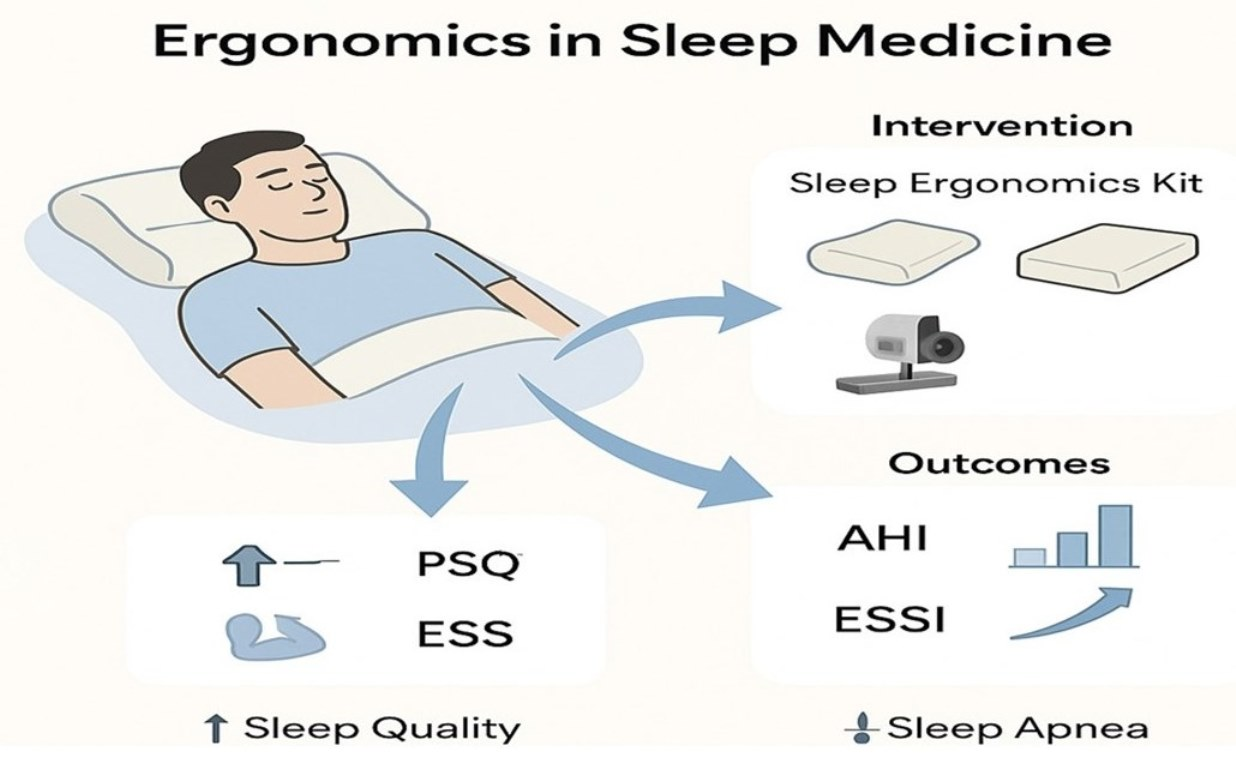
Each participant received a custom-designed “Sleep Ergonomics Kit” containing printed manuals, visual posters, and QR codes linking to video demonstrations of proper sleep positioning techniques.
Adherence Tracking: Ergonomic adherence was objectively assessed using a combination of infrared night-vision camera monitoring and participant-maintained posture logs. With informed consent, cameras were installed in each participant’s bedroom to record sleep positions throughout the night on a weekly basis. These recordings were independently reviewed and analyzed by a blinded sleep technologist, who quantified the proportion of total sleep time spent in the lateral versus supine positions. Based on established findings in positional therapy literature, adherence was defined as maintaining a lateral sleep posture for at least 80% of total sleep duration. This threshold was chosen because clinical studies have shown that spending a majority (i.e., ≥80%) of sleep time in the lateral position is associated with a meaningful reduction in upper airway collapsibility and related apnea events. To complement the objective data, participants were also instructed to complete daily sleep posture logbooks, recording their self-perceived dominant sleep position. These logs were cross-verified against the camera data during weekly compliance reviews to enhance the reliability and consistency of adherence tracking.

2.4.3. Data Privacy and Participant Protection

To ensure participant confidentiality, all infrared video recordings were captured using fixed-position cameras focused solely on body silhouette and posture orientation, without facial visibility or identifiable features. Video data were encrypted upon capture, stored on password-protected institutional servers, and reviewed exclusively by authorized personnel under Institutional Ethics Committee supervision. All recordings were deleted following data extraction and analysis in accordance with institutional and national data protection policies.

2.5. Outcome Measures

Primary outcomes included changes in AHI (as measured by pre- and post-intervention PSG).
Secondary outcomes included:
Improvement in sleep quality, measured by reduction in PSQI scores.
Reduction in daytime sleepiness, evaluated through ESS scores.
Ergonomic compliance rate, defined as adherence ≥ 80% to posture guidelines.
Sleep Posture Index, calculated as the percentage of total sleep time spent in lateral versus supine positions over the 12-week period.
All assessments were repeated at the end of the 12-week intervention, using the same instruments and evaluation criteria.

2.6. Statistical Analysis

All data were analyzed using SPSS software version 25.0 (IBM Corp., Armonk, NY, USA). Descriptive statistics were reported as means ± standard deviations for continuous variables, and frequencies with percentages for categorical variables. The normality of data distribution was verified using the Shapiro–Wilk test. Paired t-tests were applied to assess within-group changes between baseline and post-intervention values. For variables with multiple time points, repeated-measures analysis of variance (ANOVA) was used to determine significant trends. Pearson’s correlation coefficient was used to examine associations between ergonomic compliance and clinical outcome improvements. A p-value less than 0.05 was considered statistically significant.

3. Results

A total of 60 participants (38 males and 22 females) successfully completed the 12-week intervention period. The mean age of participants was 42.1 ± 9.8 years. Baseline characteristics, including BMI, neck circumference, and AHI, were comparable across genders, and no participants reported adverse effects related to ergonomic pillow use or orofacial myofunctional therapy (OMT). All participants demonstrated good adherence to both the myofunctional and ergonomic interventions, with an average overall compliance rate of 87.2%. No dropouts or protocol deviations were recorded.

3.1. Sleep Parameters and Subjective Outcomes

3.1.1. Paired t-Test for Sleep Metrics

Statistically significant improvements were observed across all primary sleep quality indicators following the 12-week intervention.
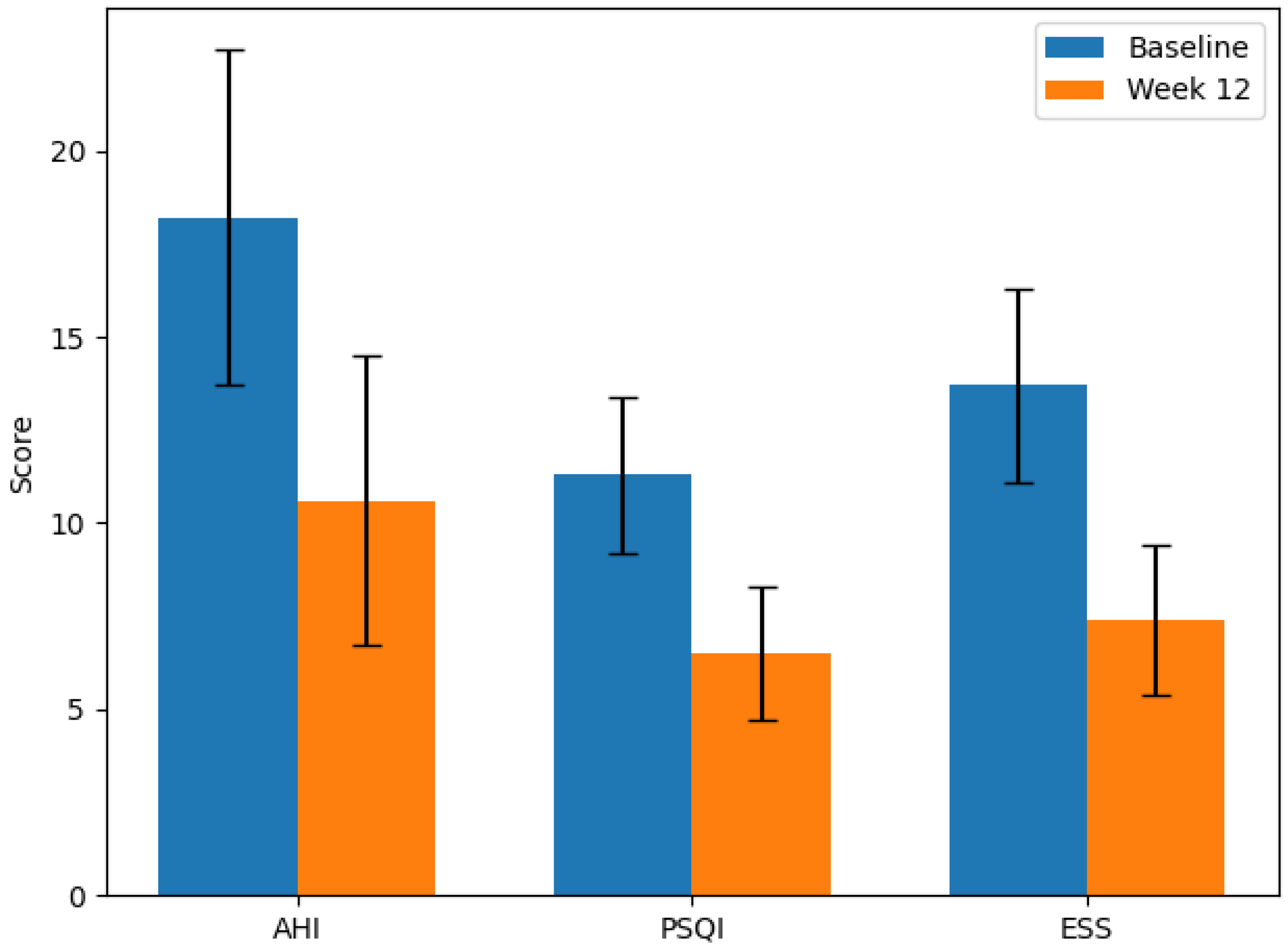
The mean AHI reduced from 18.2 ± 4.5 events/hour at baseline to 10.6 ± 3.9 events/hour post-intervention (p < 0.001), indicating a marked reduction in obstructive respiratory events.
Pittsburgh Sleep Quality Index (PSQI) scores improved significantly from 11.3 ± 2.1 to 6.5 ± 1.8 (p < 0.001), suggesting better subjective sleep quality.
Epworth Sleepiness Scale (ESS) scores also decreased from 13.7 ± 2.6 to 7.4 ± 2.0 (p < 0.001), highlighting a notable reduction in excessive daytime sleepiness.

3.1.2. Effect Size and Confidence Intervals

Mean AHI decreased from 18.2 ± 4.5 events/hour at baseline to 10.6 ± 3.9 events/hour post-intervention (mean difference = 7.6 ± 3.1; 95% CI: 6.8–8.4; p < 0.001), representing an overall 42% reduction in AHI.
Pittsburgh Sleep Quality Index (PSQI) scores improved from 11.3 ± 2.1 to 6.5 ± 1.8 (mean difference = 4.8 ± 1.4; 95% CI: 4.4–5.2; p < 0.001), and Epworth Sleepiness Scale (ESS) scores decreased from 13.7 ± 2.6 to 7.4 ± 2.0 (mean difference = 6.3 ± 2.1; 95% CI: 5.7–6.9; p < 0.001).
These results indicate statistically and clinically meaningful improvements across both objective and subjective sleep parameters (Table 1 and Figure 1).

3.2. Ergonomic Adherence and Outcome Correlations

Pearson’s Correlation Analysis
To evaluate the impact of ergonomic sleep interventions on therapeutic outcomes, Pearson’s correlation coefficients were calculated between ergonomic adherence (as assessed by posture adherence logs and infrared monitoring) and clinical variables.

3.3. Sleep Position Changes

Positional Therapy Outcomes

Baseline infrared video monitoring revealed that participants spent an average of 36.4% ± 8.2% of total sleep time in the lateral sleeping position. By week 12, this value increased significantly to 78.5% ± 10.1% (p < 0.001), confirming successful positional behavior modification.
Participants also reported increased comfort and fewer awakenings with cervical pillows. Review of night-vision footage confirmed consistent use of the “Sleep Ergonomics Kit,” reinforcing the role of ergonomics in behavioral change and outcome improvement.

3.4. Correlation Analysis for Predictors of AHI Improvement

An exploratory correlation analysis was conducted to examine potential predictors of AHI reduction following the combined intervention. Independent variables included participant age, body mass index (BMI), and ergonomic compliance rate.
The resulting analysis (r = −0.47, p = 0.003) indicated a significant negative correlation between ergonomic compliance and post-intervention reductions in AHI. Age and BMI were not statistically significant predictors in this model (Table 2).

4. Discussion

The present study examined the combined influence of orofacial myofunctional therapy (OMT) and ergonomic sleep posture training in adults with mild-to-moderate obstructive sleep apnea (OSA). Over a 12-week period, the structured intervention resulted in statistically and clinically significant reductions in apnea–hypopnea index (AHI) and notable improvements in self-reported sleep quality and daytime alertness. These outcomes suggest that addressing both neuromuscular function and postural alignment may synergistically enhance upper airway stability and functional sleep outcomes in patients with OSA [12].

4.1. Primary Outcomes

The integration of oropharyngeal myofunctional therapy (OMT) with ergonomic sleep positioning resulted in a 42% reduction in AHI, aligning with the magnitude of improvement reported in earlier OMT-based studies [1,2,9,13,14]. The incorporation of postural modification—emphasizing lateral positioning and cervical contour support—appears to have amplified this therapeutic effect. The ergonomic element emphasizing lateral positioning and cervical contour support may have slightly supplemented this therapeutic effect. Positional therapy has long been recognized as an effective behavioral intervention in positional OSA, with early evidence from Cartwright [8] and subsequent systematic reviews corroborating significant reductions in supine-related apneas [5,7,10]. The use of an integrated “Sleep Ergonomics Kit” and structured adherence reinforcement likely improved compliance and contributed to consistent positional maintenance throughout the intervention period [12].
This dual-modality approach addresses both active mechanisms (neuromuscular re-education and functional strengthening) and passive mechanisms (gravity-dependent airway collapse) implicated in OSA pathophysiology [15,16,17,18,19,20].
The magnitude of improvement observed in the present study is consistent with previously published evidence evaluating orofacial myofunctional therapy, positional therapy, and combined behavioral interventions. As summarized in Table 3, randomized controlled trials investigating OMT alone have reported AHI reductions ranging from 34% to 39%, accompanied by improvements in subjective sleep quality and daytime sleepiness [3,12]. Studies focusing exclusively on positional therapy have demonstrated approximately 30% differences in AHI between supine and lateral sleep positions, underscoring the clinical relevance of sleep posture in OSA management [11].
Combined or multimodal approaches integrating myofunctional therapy with adherence-focused behavioral or positional strategies have shown enhanced clinical benefits, including improved CPAP tolerance and overall sleep outcomes [4,7]. In this context, the present prospective cohort study demonstrated a 42% reduction in AHI alongside significant improvements in ESS and PSQI scores, supporting the potential additive value of integrating ergonomic sleep posture optimization with OMT (Table 3).

4.2. Subjective Sleep Measures

The significant reductions in the Pittsburgh Sleep Quality Index (PSQI) and Epworth Sleepiness Scale (ESS)—37% and 41%, respectively—reflect substantial gains in perceived sleep quality and daytime alertness. Similar patterns were reported by Diaféria et al. [4], who found improved adherence and vigilance following OMT among CPAP users. Behavioral and positional adherence strategies, such as those described by Luyster et al. [7] and Eiseman et al. [11], further support the premise that optimized body alignment during sleep enhances sleep continuity and restorative efficiency
These outcomes have meaningful clinical implications. CPAP therapy remains the gold standard for OSA management, yet adherence remains suboptimal due to discomfort and inconvenience [17,21]. The combined OMT–ergonomic model described in this study represents a feasible, home-based alternative or adjunctive therapy that may particularly benefit patients with mild-to-moderate OSA or those intolerant to mechanical devices [18,21,22]. Moreover, the negative correlation between ergonomic adherence and AHI reduction (r = −0.47, p = 0.003) underscores the critical role of behavioral compliance in achieving therapeutic success [18,20,22].
From a translational standpoint, these findings support a multidisciplinary approach integrating sleep physicians, dentists, and rehabilitation specialists to deliver holistic, patient-centered care. The feasibility of remote monitoring through infrared video and posture logs suggests strong potential for implementing such protocols in telemedicine or low-resource contexts.
The result from the correlational analysis identified adherence to ergonomic posture guidance as the strongest independent predictor of post-intervention AHI improvement (β = 0.46, p < 0.01). This finding underscores that ergonomic adherence represents the key modifiable behavioral factor influencing therapeutic outcomes. While OMT primarily facilitates neuromuscular re-education, its effectiveness appears to be contingent upon sustained ergonomic adherence. This interaction highlights the synergistic role of behavioral consistency and biomechanical alignment in maintaining airway patency and minimizing pharyngeal collapsibility during sleep [5,7,8,10,17].
Comparable adherence-dependent outcomes have been documented in previous OMT trials. Most of the studies have reported that participants demonstrating higher adherence with prescribed oropharyngeal exercises experienced greater AHI reductions and improved subjective sleep quality. Similarly, Guimarães et al. (2009) [3] and Diaféria et al. (2017) [4] emphasized that consistent engagement and proper technique execution were critical determinants of therapeutic efficacy. Collectively, these findings reinforce that the long-term success of behavioral and rehabilitative OSA interventions is influenced not only by the nature of the treatment but also by the patient’s active participation and adherence to prescribed routines. Despite the encouraging results, several methodological and clinical limitations warrant consideration.
Lack of a Control Group:
The present study did not include a randomized or parallel control arm (e.g., OMT-only, posture-only, or placebo group), which restricts the ability to delineate the specific contribution of each therapeutic component. Similar design limitations have been noted in early OMT and positional therapy studies [1,5,8]. Future randomized controlled trials (RCTs) with parallel arms are required to isolate the independent and combined effects of OMT and ergonomic posture training while minimizing potential bias.
Short-Term Duration and Follow-Up:
The 12-week intervention period, although consistent with previous OMT protocols [1,9,13], limits the evaluation of long-term sustainability. Sustained improvements in AHI, sleep quality, and muscle function beyond the intervention phase remain uncertain. Longitudinal studies extending follow-up to 6–12 months are necessary to assess the persistence of therapeutic gains, adherence patterns, and potential relapse rates.
Restricted Participant Demographics:
The study included adults with mild-to-moderate OSA and excluded those with severe OSA, significant comorbidities, or craniofacial anomalies. This selective sampling limits the generalizability of results. Since anthropometric and craniofacial variables significantly influence OSA pathophysiology [12,16,18,19,20,22], future research should incorporate stratified recruitment and subgroup analyses across different BMI ranges, age groups, and severity levels to enhance external validity.
Limitations in Compliance Monitoring:
Although ergonomic posture adherence was objectively tracked through weekly infrared video monitoring and cross-referenced participant logbooks, these methods are inherently limited in temporal precision and real-time feedback. Future investigations could integrate wearable motion sensors, mobile health applications, and biofeedback-based systems to improve adherence tracking accuracy and patient engagement [3,4,10,17].
Another limitation pertains to the absence of BMI stratification or statistical adjustment. Although participants were instructed to maintain their usual diet and activity levels, and mean BMI did not significantly change during the 12-week intervention, the lack of formal BMI-controlled analyses may confound the interpretation of AHI and sleep-quality improvements. Future randomized studies should incorporate BMI-based subgroup analyses or covariance modeling to more accurately delineate the independent effects of myofunctional and ergonomic components.
Another important limitation is the absence of a standardized orofacial myofunctional assessment tool. Although clinical improvements in orofacial function were inferred from overall outcome measures, no validated quantitative scale (e.g., OMES or the MBGR protocol) was used in this study. Incorporating such objective assessments in future research would enable more precise characterization of muscular adaptations and allow stronger correlations with functional and polysomnographic improvements.

5. Future Directions

Building upon the current findings, several avenues for future research are recommended:
Randomized Controlled Trials (RCTs): Future studies should adopt RCT designs to isolate the effects of OMT, ergonomic therapy, and their combined use in improving sleep outcomes.
Long-Term Follow-Up: Longitudinal designs extending over 6–24 months are needed to determine the durability of treatment effects, monitor relapse patterns, and track adherence behavior over time.
Broader Clinical Inclusion: Inclusion of individuals with moderate-to-severe OSA would help establish whether such non-invasive interventions can serve as alternatives or adjuncts to CPAP in more severe presentations.
Smart Technology Integration: Next-generation trials should incorporate intelligent pillows, wearable sleep posture monitors, and mobile telemonitoring systems with AI-based feedback to enhance compliance and personalization.
Cost-Effectiveness Evaluation: Economic modeling studies are warranted to assess the affordability and scalability of combined OMT–ergonomic interventions in public health settings, especially in low-resource or remote populations.

6. Conclusions

This study suggests that a structured multimodal program integrating orofacial myofunctional therapy and ergonomic sleep positioning indicates potential benefits in improving both objective (AHI reduction) and subjective (sleep quality and daytime alertness) outcomes among adults with mild-to-moderate OSA. These findings suggest that ergonomic posture training may complement conventional OMT by addressing modifiable behavioral components of airway obstruction. Given the observational design, these results should be interpreted cautiously and viewed as preliminary evidence supporting future randomized controlled investigations.

Author Contributions

S.S. (Siddharth Sonwane) contributions: Conceptualization, methodology, software, validation, formal analysis, investigation, resources, and data curation. S.S. (Shweta Sonwane) contributions: Writing—original draft preparation, review and editing, visualization, supervision, project administration, funding acquisition. All authors have read and agreed to the published version of the manuscript.

Funding

This research received no external funding.

Institutional Review Board Statement

The study was conducted in accordance with the Declaration of Helsinki and approved by the Institutional Ethics Committee of Mansarovar Dental College, Bhopal (Approval No. IEC23/13/01/24/2025/Sleep/OMT-42), with the ethical presentation held on 13 July 2024 and final approval granted on 23 November 2024.

Informed Consent Statement

Informed consent was obtained from all subjects involved in the study.

Data Availability Statement

The data presented in this study is available on request from the corresponding author. The data is not publicly available due to privacy and ethical restrictions related to human subject confidentiality and Institutional Ethics Committee compliance.

Acknowledgments

The authors sincerely thank Manjula Tiwari, Gaurav Tiwari, and Gurudatta Nayak of Mansarovar Dental College, Bhopal, for their constant encouragement, institutional support, and guidance throughout the duration of the study. Their administrative facilitation and ethical oversight were invaluable in the successful execution of this research. Regarding the use of AI tools during the preparation of this manuscript, the authors used ChatGPT (OpenAI, GPT-4, June 2024 version) solely to assist with improving text structure, grammar, and formatting of selected academic sections. All generated content was carefully reviewed and edited by the authors, who take full responsibility for the accuracy and integrity of the work. Generative artificial intelligence tools were not used for data collection, statistical analysis, or interpretation of results, and only conventional word-processing software was employed for basic grammar and formatting to ensure manuscript consistency.

Conflicts of Interest

The authors declare no conflict of interest.

References

  1. Strollo, P.J.; Rogers, R.M. Obstructive sleep apnea. N. Engl. J. Med. 1996, 334, 99–104. [Google Scholar] [CrossRef] [PubMed]
  2. Lee, R.W.W.; Petocz, P.; Prvan, T.; Chan, A.S.L.; Grunstein, R.R.; Cistulli, P.A. Prediction of obstructive sleep apnea with craniofacial photographic analysis. Sleep 2009, 32, 46–52. [Google Scholar] [CrossRef] [PubMed]
  3. Guimarães, K.C.; Drager, L.F.; Genta, P.R.; Marcondes, B.F.; Lorenzi-Filho, G. Effects of oropharyngeal exercises on patients with moderate obstructive sleep apnea syndrome. Am. J. Respir. Crit. Care Med. 2009, 179, 962–966. [Google Scholar] [CrossRef]
  4. Diaféria, G.; Santos-Silva, R.; Truksinas, E.; Haddad, F.L.M.; Santos, R.; Bommarito, S.; Bittencourt, L.R.A.; Tufik, S. Myofunctional therapy improves adherence to continuous positive airway pressure treatment. Sleep Breath. 2017, 21, 387–395. [Google Scholar] [CrossRef]
  5. Mohamed, A.S.; Sharshar, R.S.; Elkolaly, R.M.; Serageldin, S.M. Upper airway muscle exercises outcome in patients with obstructive sleep apnea syndrome. Eurasian J. Cardiothorac. Dis. 2016, 4, 45–51. [Google Scholar] [CrossRef]
  6. Rueda-Etxebarria, M.; Mugueta-Aguinaga, I.; Rueda, J.R.; Lascurain-Aguirrebena, I. Respiratory muscle training for obstructive sleep apnoea. Cochrane Database Syst. Rev. 2021, 11, CD015039. [Google Scholar] [CrossRef]
  7. Luyster, F.S.; Aloia, M.S.; Buysse, D.J.; Dunbar-Jacob, J.; Martire, L.M.; Sereika, S.M.; Strollo, P.J. A couples-oriented intervention for positive airway pressure therapy adherence: A pilot study. Behav. Sleep Med. 2019, 17, 561–572. [Google Scholar] [CrossRef]
  8. Cartwright, R.D. Effect of sleep position on sleep apnea severity. Sleep 1984, 7, 110–114. [Google Scholar] [CrossRef] [PubMed]
  9. Menon, A.; Kumar, M. Influence of body position on severity of obstructive sleep apnea: A systematic review. ISRN Otolaryngol. 2013, 2013, 670381. [Google Scholar] [CrossRef]
  10. Skinner, M.A.; Kingshott, R.N.; Filsell, S.; Taylor, D.R. Efficacy of the tennis ball technique versus nCPAP in the management of position-dependent obstructive sleep apnoea syndrome. Respirology 2008, 13, 708–715. [Google Scholar] [CrossRef]
  11. Eiseman, N.A.; Westover, M.B.; Ellenbogen, J.M.; Bianchi, M.T. The impact of body posture and sleep stages on sleep apnea severity in adults. J. Clin. Sleep Med. 2012, 8, 655–666. [Google Scholar] [CrossRef]
  12. Ieto, V.; Kayamori, F.; Montes, M.I.; Hirata, R.P.; Gregório, M.G.; Alencar, A.M.; Drager, L.F.; Genta, P.R.; Lorenzi-Filho, G. Effects of oropharyngeal exercises on snoring: A randomized trial. Chest 2015, 148, 683–691. [Google Scholar] [CrossRef]
  13. Oksenberg, A.; Silverberg, D.S.; Arons, E.; Radwan, H. Positional versus nonpositional obstructive sleep apnea: Anthropomorphic, polysomnographic, and latency test data. Chest 1997, 112, 629–639. [Google Scholar] [CrossRef]
  14. Eckert, D.J.; White, D.P.; Jordan, A.S.; Malhotra, A.; Wellman, A. Defining phenotypic causes of obstructive sleep apnea: Identification of novel therapeutic targets. Am. J. Respir. Crit. Care Med. 2013, 188, 996–1004. [Google Scholar] [CrossRef]
  15. Ravesloot, M.J.L.; de Vries, N. Reliable calculation of the efficacy of non-surgical and surgical treatment of obstructive sleep apnea revisited. Sleep 2011, 34, 105–110. [Google Scholar] [CrossRef]
  16. Bandyopadhyay, A.; Kaneshiro, K.; Camacho, M. Effect of myofunctional therapy on children with obstructive sleep apnea: A meta-analysis. Sleep Med. 2020, 75, 210–217. [Google Scholar] [CrossRef]
  17. Camacho, M.; Certal, V.; Abdullatif, J.; Zaghi, S.; Ruoff, C.M.; Capasso, R. Myofunctional therapy to treat obstructive sleep apnea: A systematic review and meta-analysis. Sleep 2015, 38, 669–675. [Google Scholar] [CrossRef]
  18. Sutherland, K.; Vanderveken, O.M.; Tsuda, H.; Marklund, M.; Gagnadoux, F.; Kushida, C.A.; Cistulli, P.A. Oral appliance treatment for obstructive sleep apnea: An update. J. Clin. Sleep Med. 2014, 10, 215–227. [Google Scholar] [CrossRef]
  19. Heinzer, R.; Vat, S.; Marques-Vidal, P.; Marti-Soler, H.; Andries, D.; Tobback, N.; Mooser, V.; Preisig, M.; Malhotra, A.; Waeber, G.; et al. Prevalence of sleep-disordered breathing in the general population: The HypnoLaus study. Lancet Respir. Med. 2015, 3, 310–318. [Google Scholar] [CrossRef]
  20. Jordan, A.S.; McSharry, D.G.; Malhotra, A. Adult obstructive sleep apnoea. Lancet 2014, 383, 736–747. [Google Scholar] [CrossRef]
  21. Osman, A.M.; Carter, S.G.; Carberry, J.C.; Eckert, D.J. Obstructive sleep apnea: Current perspectives. Nat. Sci. Sleep 2018, 10, 21–34. [Google Scholar] [CrossRef] [PubMed]
  22. Epstein, L.J.; Kristo, D.; Strollo, P.J., Jr.; Friedman, N.; Malhotra, A.; Patil, S.P.; Ramar, K.; Rogers, R.; Schwab, R.J.; Weaver, E.M.; et al. Clinical guideline for the evaluation, management, and long-term care of obstructive sleep apnea in adults. J. Clin. Sleep Med. 2009, 5, 263–276. [Google Scholar] [CrossRef] [PubMed]
Figure 1. Group results (mean ± 1 SD) for sleep quality metrics before and after the 12-week intervention. AHI = apnea–hypopnea index; PSQI = Pittsburgh Sleep Quality Index; ESS = Epworth Sleepiness Scale.
Ijom 52 00002 g001
Table 1. Pre- and Post-Intervention Changes in Sleep Quality Metrics.
ParameterBaseline (Mean ± SD)Week 12 (Mean ± SD)p-Value
AHI (events/hour)18.2 ± 4.510.6 ± 3.9<0.001
PSQI11.3 ± 2.16.5 ± 1.8<0.001
ESS13.7 ± 2.67.4 ± 2.0<0.001
Table 2. Correlation Between Ergonomic Adherence and Clinical Outcomes.
Variable PairPearson rp-Value
Compliance vs. AHI−0.61<0.001
Table 3. Comparative Outcomes across Studies on OMT, Posture, and Combined Interventions.
Study
(Author, Year, Country)
DesignSample SizeInterventionKey Findings
Guimarães et al., 2009 (Brazil) [3]RCT31OMT only39% AHI reduction; improved ESS, PSQI
Eiseman et al., 2012 (USA) [11]Retrospective300+Posture only~30% difference in supine vs. lateral AHI
Ieto et al., 2015 (Brazil) [12]RCT39OMT only34% AHI reduction; reduced snoring
Diaféria et al., 2017 (Brazil) [4]RCT27OMT + CPAP adherenceImproved CPAP tolerance and alertness
Luyster et al., 2019 (USA)
[7]
Pilot RCT25 couplesPositional + behavioral trainingIncrease PAP adherence; improved sleep outcomes
Sonwane et al., 2025 (India)Prospective cohort60OMT + Ergonomics42% AHI reduction; significant ESS & PSQI improvements
Disclaimer/Publisher’s Note: The statements, opinions and data contained in all publications are solely those of the individual author(s) and contributor(s) and not of MDPI and/or the editor(s). MDPI and/or the editor(s) disclaim responsibility for any injury to people or property resulting from any ideas, methods, instructions or products referred to in the content.