Article

Determination of the Requirements of Standardized Ileal Digestible Methionine Plus Cysteine and Lysine in Male Chicks of a Layer Breed (LSL Classic) During the Starter Period (1–21 d)


1
Institute of Animal Nutrition and Nutrition Physiology, Justus Liebig University Giessen, Heinrich-Buff-Ring 26-32, 35392 Giessen, Germany
2
Center for Sustainable Food Systems, Justus Liebig University Giessen, Senkenbergstrasse 3, 35390 Giessen, Germany
*
Author to whom correspondence should be addressed.
Poultry 2026, 5(1), 11; https://doi.org/10.3390/poultry5010011
Submission received: 10 December 2025 / Revised: 2 January 2026 / Accepted: 13 January 2026 / Published: 2 February 2026

Abstract

In most countries, male siblings of laying hybrids are culled immediately after hatching because their rearing is economically unfeasible due to low growth performance, poor feed efficiency, and a body composition unacceptable to consumers. In Germany, however, culling male day-old chicks has been prohibited for animal welfare reasons since 2022, making their rearing mandatory. Currently, no recommendations exist for protein and amino acid supply for these birds. This study aimed to determine the requirements for standardized ileal digestible (SID) methionine + cysteine (Met + Cys) and SID lysine (Lys) during the starter period (days 1–21) in male LSL Classic chicks by a dose–response approach. Two trials were conducted with 120 male chicks each, fed six diets containing SID Met + Cys concentrations ranging from 0.36% to 0.71% (Trial 1) or SID Lys concentrations ranging from 0.50% to 0.89% (Trial 2). Optimal concentrations were estimated using broken-line and exponential models based on body weight gain, feed intake, and feed conversion ratio. Considering all criteria, the optimal SID Met + Cys concentration was 0.58% (0.42 g/MJ AMEN), and the optimal SID Lys concentration was 0.74% (0.56 g/MJ AMEN). The calculated optimum SID Met + Cys:SID Lys ratio when standardized to an identical energy level was 74:100. These findings provide a basis for adjusting SID Met + Cys and SID Lys levels in starter diets for male chicks of a layer breed, supporting more efficient and sustainable rearing practices under current animal welfare regulations.

1. Introduction

In commercial poultry production, laying hens and broilers (meat-type chickens) are raised for egg and meat production, respectively. To maximize productivity, chickens have been selectively bred for either high egg-laying performance (layer lines) or rapid growth (broiler lines). However, a negative genetic correlation exists between growth and laying performance in domestic chickens. Consequently, layer lines exhibit low growth potential, and their male siblings are unsuitable for efficient meat production [1,2,3].
Conventional broiler breeds (e.g., Cobb 500, Ross 308) reach a live weight of 1.9–2.1 kg within 30 days, with a feed conversion ratio of 1.3–1.4 kg feed per kg body weight gain [4,5]. In contrast, male chicks of layer breeds require approximately 90 days to reach 1.1–1.4 kg body weight, with a feed conversion ratio of 2.8–4.0 kg feed per kg gain, depending on feeding strategy and genetic background [3]. Due to their poor growth capacity, inefficient feed conversion, lower slaughter yields, inferior carcass quality, and resulting economic unviability, male layer chicks are culled as day-old chicks in most countries, often processed as animal feed for pet shops and zoos. Globally, at least 7 billion male chicks are culled annually [1].
The culling of day-old male chicks raises significant animal welfare and ethical concerns [6,7,8]. In Germany, this practice has been prohibited since 1 January 2022 (§ 4c, Animal Welfare Act, 2006 [9]). Consequently, male layer chicks must either be reared despite their economic disadvantages. To prevent the development of male chicks, in ovo sexing techniques have been applied for several years. These methods rely either on optical approaches (mostly non-invasive) or non-optical approaches (mostly invasive). Depending on the technique, sex determination is typically performed between day 4 and day 13 of incubation, allowing eggs containing male embryos to be sorted out. These eggs are then primarily utilized as animal feed, fertilizer, or for biogas production. The accuracy of these methods generally ranges between 95% and 99% [10,11]. In Germany, chicken embryos may no longer be culled after day 13, as they are considered capable of experiencing pain at this stage [12]. Despite the increasing use of in ovo sexing techniques, approximately 11 million male chicks from layer breeds were still reared in Germany in 2023 [13].
Given their substantially lower growth rates compared to broilers, male chicks of a layer breed require less dietary protein and lower concentrations of essential amino acids. However, because these birds are rarely reared outside Germany, no controlled studies have determined their specific protein and amino acid requirements. Therefore, there are no specific recommendations regarding the concentrations of protein and amino acids in the feed for rearing male chickens of layer breeds. Field observations indicate that male layer chicks do not exhibit impaired growth when fed protein-reduced diets [14]. Nevertheless, they are often provided conventional broiler feed formulated for much higher growth rates, resulting in excessive protein intake. Oversupply of protein in broilers increases feed costs, reduces resource efficiency, and leads to elevated nitrogen excretion, which poses environmental concerns [15,16]. Therefore, defining optimal protein and amino acid requirements for male layer chicks is essential to formulate diets aligned with their low genetic growth potential while avoiding unnecessary protein surplus.
In poultry diets based on cereals, the first limiting amino acids are typically the sulfur amino acids [methionine (Met) + cysteine (Cys)] and [lysine (Lys)] [17,18]. Amino acid requirements vary across growth phases, with the highest concentrations needed during the starter phase, which carries the greatest risk of deficiency and influences subsequent growth and health. The present study aimed to determine the requirements for the first limiting amino acids (Met + Cys, Lys) in male chickens of the LSL Classic strain, selected because its female counterparts are among the most widely used for commercial egg production in Germany.

2. Materials and Methods

2.1. Animals and Experimental Design

A total of 240 day-old male LSL Classic chicks (Lohmann Süd, Neu-Ulm, Germany) were used in two separate trials. Each trial included 120 birds with initial body weights of 35.2 ± 2.6 g (trial 1; mean ± SD) and 36.8 ± 2.0 g (trial 2).
Trial 1 aimed to determine the standardized ileal digestible (SID) Met + Cys requirement, whereas Trial 2 focused on the SID Lys requirement. In both trials, birds were allocated to six dietary treatments, with 6 birds per cage and 3–4 cages per treatment.

2.2. Housing and Management

Birds were housed in cages (2.1 m2) equipped with nipple drinkers and automated feeders, providing ad libitum access to feed and water. Cage floors were covered with hemp-based bedding (Hemparada, HempFlax Group B.V., Oude Pekela, The Netherlands), replaced twice weekly to allow natural scratching and pecking behavior. Elevated perches and a sand bath were provided for resting and dust bathing.
Lighting was programmed as alternating 4 h light and 2 h darkness during the first week, followed by 18 h light and 6 h darkness from day 7 onward at 40 lux [19]. Room temperature decreased gradually from 30 to 34 °C during the first week (measured at bird height) to 27 °C by day 21. Infrared lamps (Albert Kerbl GmbH, Buchbach, Germany) provided supplemental heat during the first six days. Mean relative humidity was 60.0 ± 4.9%.

2.3. Diets

Birds received basal diets formulated to contain low native concentrations of SID Met + Cys (trial 1) or SID Lys (trial 2). Diets were supplemented with graded levels of DL-methionine (99%; NHU EUROPE GmbH, Bardowick, Germany) or L-lysine hydrochloride (79% L-lysine; Denkavit Futtermittel, Warendorf, Germany). Basal diet composition is shown in Table 1.
The analyzed Met + Cys concentration in the basal diet of trial 1 was 4.51 g/kg, corresponding to 3.59 g/kg SID Met + Cys. For trial 2, the analyzed Lys concentration was 5.68 g/kg, corresponding to 5.02 g/kg SID Lys. DL-methionine supplementation increased SID Met + Cys by 0.7 g/kg per step in trial 1, and L-lysine supplementation increased SID Lys by 0.8 g/kg per step in trial 2 (Table 2). Apart from Met + Cys or Lys concentrations, the basal diets met nutrient recommendations for LSL Classic layers [19]. The concentrations of SID amino acids were calculated using digestibility coefficients for the respective feed ingredients as provided by AminoDat® 5.0 (Evonik [20]). AminoDat® 5.0 is recognized as a global reference database for the amino acid composition of feedstuffs. The SID amino acid values for poultry in this database are derived from standardized ileal digestibility trials in poultry [20]. In both experiments, the concentrations of SID Met + Cys (Trial 1) and SID Lys (Trial 2) were varied across a wide range to ensure that diets included levels clearly below and above the requirement. This approach is essential for accurately estimating amino acid requirements using the selected regression models.
Diets were offered as crumbles during the first three days and as 2 mm pellets thereafter. Individual body weights and cage-level feed intake were recorded on day 1 and on the morning of day 22, following completion of the 21-day experimental period. Feed conversion ratio was calculated on a per-cage basis.

2.4. Chemical Analysis of Diets

Dry matter, crude protein (CP), crude ash, ether extract (EE), crude fiber, sugar, and starch in feed ingredients and experimental diets were analyzed according to official methods of Verband Deutscher Landwirtschaftlicher Forschungsanstalten (VDLUFA, [21]). The concentrations of amino acids in feedstuffs and diets were analyzed by using ion-exchange chromatography with post-column derivatization with ninhydrin [22,23]. In brief, amino acids were oxidized with performic acid, which was neutralized with Na metabisulfite, and were then liberated from the protein by hydrolysis with 6 N hydrochloric acid for 24 h at 110 °C and quantified with an internal standard by measuring the absorption of reaction products with ninhydrin at 570 nm. Concentration of crude protein was calculated using a nitrogen-to-protein conversion factor of 6.25. Apparent metabolizable energy corrected for nitrogen (AMEN) was estimated using the formula recommended by the World’s Poultry Science Association [24]:
AMEN (MJ/kg) = [(0.1551 × % CP) + (0.3431 × % EE) + (0.1669 × % starch) + (0.1301 × % sugar)].

2.5. Statistical Analysis

Data were analyzed using SPSS 28 (IBM, Armonk, NY, USA). The cage served as the experimental unit for feed intake, feed conversion ratio, and body weight measurements (initial, final, and gain). Normality was assessed using the Shapiro–Wilk test (n = 3–4 cages per group), and homoscedasticity using Levene’s test. Differences among the six dietary treatments were evaluated by one-way ANOVA followed by Tukey’s post hoc test. Statistical significance was set at p < 0.05.
To estimate SID Met + Cys and SID Lys requirements, body weight gain, feed intake, and feed conversion ratio data were fitted to two regression models: the broken-line model and the exponential model.
Broken-line model equation:
y = a + b × x, for x < c; y = a + b × c, for x > c,
where y is the response variable, a the intercept, b the slope for x < c ,   c the breakpoint (requirement), and x the dietary SID Met + Cys or SID Lys concentration. The broken-line model was used to determine the lysine or methionine concentration required to achieve the maximum of the criterion considered.
Exponential model equation:
y = a + b × (1 − ec(x−d))
where y is the response variable, a the baseline performance, b the maximum response, c the slope, d the basal SID Met + Cys or SID Lys concentration, and x the dietary concentration. The optimal requirement was defined as the dietary concentration corresponding to 95% of the maximum response. It is anticipated that the two models will yield different estimates for the optimal concentrations of SID Lys and SID Met + Cys. Therefore, the optimum should be determined using the model that demonstrates the superior goodness of fit for the respective criterion, as indicated by the coefficient of determination (R2).

3. Results

3.1. Trial 1—Determination of SID Met + Cys Requirement

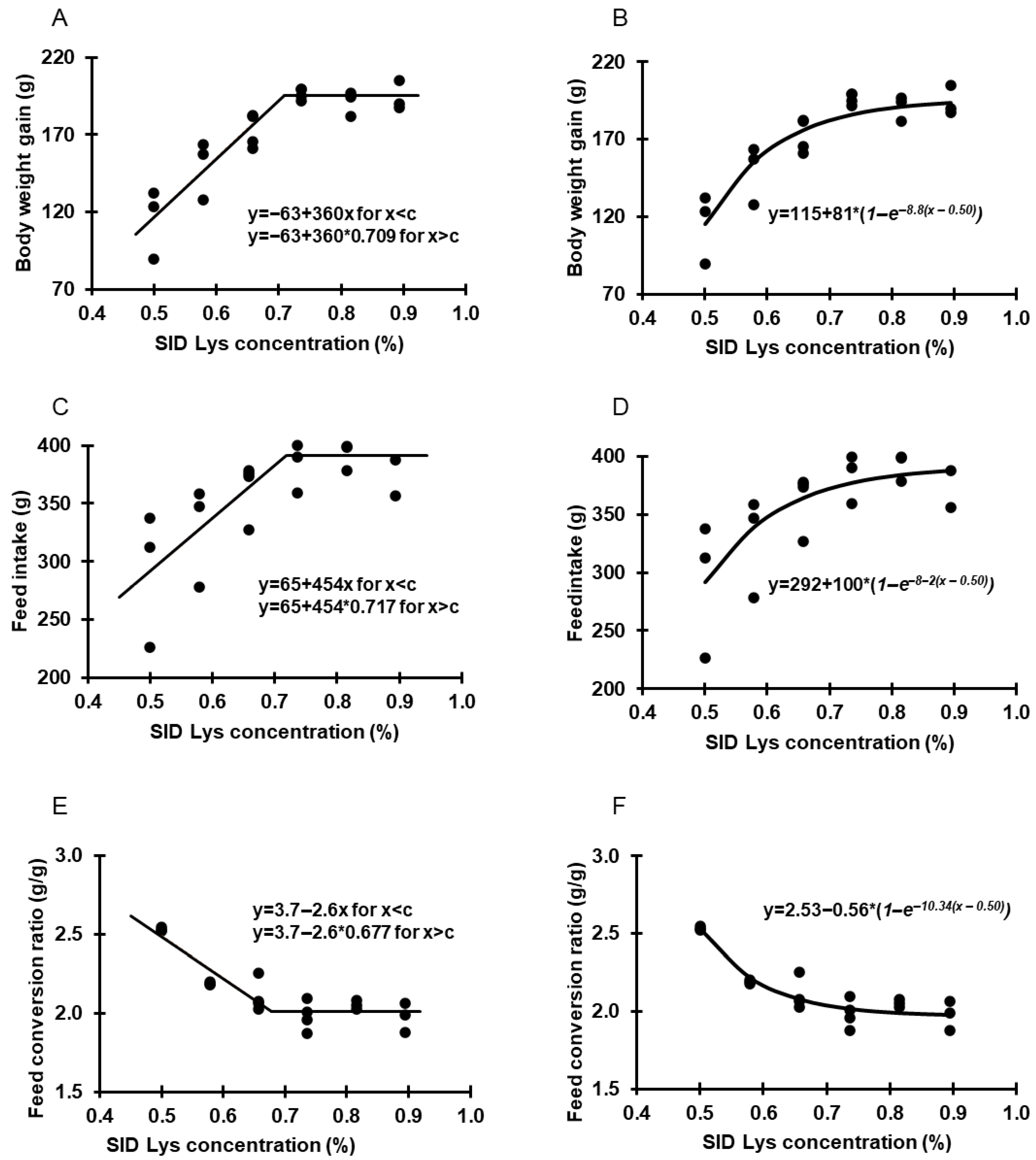
The basal diet contained a SID Met + Cys concentration markedly below levels required for optimal growth performance (Table 3; Figure 1A–D). Incremental supplementation with DL-methionine progressively improved body weight gain and feed intake until an optimum was reached (Table 3). Feed conversion ratio was highest with the basal diet and decreased with DL-methionine supplementation (Table 3; Figure 1E,F).
Requirements for SID Met + Cys were estimated using both the broken-line and exponential regression models (Table 4). For body weight gain, both models provided similar fits, whereas for feed intake and feed conversion ratio, the exponential model showed superior fit compared to the broken-line model. Optimum levels derived from both models were comparable for feed intake and feed conversion ratio, ranging between 0.52% and 0.55% SID Met + Cys. For body weight gain, the exponential model predicted a higher requirement than the broken-line model (0.62% vs. 0.53% SID Met + Cys).

3.2. Trial 2—Determination of SID Lys Requirement

The basal diet contained a SID Lys concentration substantially below levels required for optimal growth performance (Table 5; Figure 2A–D). Incremental supplementation with L-lysine hydrochloride resulted in a linear increase in body weight gain and feed intake until an optimum was reached (Table 5). Feed conversion ratio was highest in birds fed the basal diet and decreased progressively with increasing dietary SID Lys concentrations (Table 5; Figure 2E,F).
SID Lys requirements were estimated using broken-line and exponential regression models (Table 6). For all performance criteria, the exponential model provided a better fit than the broken-line model. Requirements for feed intake and feed conversion ratio were similar between models (0.72% vs. 0.70% for feed intake; 0.68% vs. 0.66% for feed conversion ratio). For body weight gain, the exponential model predicted a slightly higher requirement compared to the broken-line model (0.74% vs. 0.71% SID Lys).

4. Discussion

This study aimed to determine the SID Met + Cys and SID Lys requirements for male layer chicks of the LSL Classic strain during the starter period using a dose–response approach. When determining the requirement for a specific amino acid, it is an experimental prerequisite that no other amino acid or crude protein is growth-limiting. Therefore, the concentrations of essential amino acids and crude protein in the basal diet were formulated according to the recommendations for LSL Classic layers within the respective age range [19]. These recommendations include a safety margin, so it can be assumed that the requirements for other essential amino acids and crude protein in male birds were adequately met. To estimate the requirement of SID Met + Cys and SID Lys, we applied two commonly used regression models: the linear broken-line model and the exponential model. Typically, estimates from the exponential model are slightly higher than those from the broken-line model, which defines the requirement at the breakpoint [25,26,27].
Met and Cys are closely related within the body. While Met is essential, Cys can be synthesized from Met via the transsulfuration pathway when sufficient Met is available [28]. Therefore, the Met requirement depends on the level of Cys intake. In practice, recommendations for sulfur amino acids usually refer to the sum of Met + Cys. Although Cys requirements can be met by Met, there is a portion of Met that cannot be replaced by Cys. Thus, Cys cannot fully cover the Met requirement, but it can reduce it [28]. Consequently, the ratio between these two amino acids is important. Studies in broilers have shown that cysteine can supply no more than 52 or 48% of the total requirement for sulfur amino acids in broilers, indicating Met:Cys ratios of 48:52 or 52:48 [28,29]. Current recommendations suggest Met:Cys ratios of 51:49 to 55:45 for conventional broiler breeds within the first 3 weeks of life [5,30]. In the present study, we used a model in which the SID Cys content in the diet was fixed (2.06 g/kg), and the SID Met content was increased stepwise from a suboptimal concentration (1.53 g/kg; Met:Cys ratio 43:57) in increments of 0.7 g/kg diet up to 5.04 g SID Met/kg diet (Met:Cys ratio 71:29). Due to the metabolic interrelationship between Met and Cys, it is difficult to determine their individual requirements based on growth trials [31]. Therefore, we determined the requirement for the sum of both amino acids (Met + Cys).
In the trial performed to derive the requirement of SID Met + Cys, the fit of the data (R2) for feed intake and feed conversion ratio was better with the exponential model than with the linear model. Therefore, we derived the optimum Met + Cys concentrations for feed intake and feed conversion ratio from the exponential model, which were 0.55% and 0.53% SID Met + Cys in the diet, respectively. Interestingly, the optima obtained from the linear model (0.52% and 0.53%, respectively) were similar, although the model fit was lower. For body weight gain, the fit was similar for both models; thus, we propose the mean of both estimates (0.58% SID Met + Cys) as the optimum for body weight gain. Our findings also suggest that slightly more Met + Cys is required for optimal body weight gain than for optimal feed intake and feed efficiency. This observation aligns with other studies determining Met + Cys requirements in broilers [31,32]. Considering all three criteria, we conclude that 0.58% SID Met + Cys is required for optimal growth performance in male LSL Classic chicks during the starter phase (days 1 to 21). At the optimum SID Met + Cys concentration (0.58%), the Met:Cys ratio was 64:36. This ratio exceeds the recommended ratios of 51:49 to 54:46 (see above), indicating that Met was not limiting at this optimum and that part of the Met was used for Cys synthesis.
The optimum dietary SID Met + Cys concentration derived from our study is clearly below that of breeder guidelines [19] for LSL Classic pullets aged 1 to 3 weeks (0.75% digestible Met + Cys). As expected, the optimum SID Met + Cys concentration for male birds of a layer strain was substantially lower than recommendations for meat-type broilers (Cobb 500, Ross 308), which range from 0.94% and 0.88% SID Met + Cys for 0–8 days and 9–18 days [5] or 0.96% and 0.89% SID Met + Cys for 0–10 days and 11–24 days [30].
To determine the optimal lysine concentration in the diet, the exponential model provided a better fit to the data than the broken-line model. Therefore, we used the results derived from this model to estimate the requirement for SID Lys. Similarly to the trial for determining SID Met + Cys requirements, the highest requirement for SID Lys was observed when body weight gain was used as the response criterion. Considering all three criteria, an SID Lys requirement of 0.74% in the diet can be derived. The SID Lys requirement determined in this study is substantially lower than the recommendation of the breeder for pullets aged 1–3 weeks (1.00% digestible Lys in the diet [19]). Furthermore, the requirement for young male chicks of a layer strain identified in this study is markedly lower than recommendations for meat-type broilers (Cobb 500, Ross 308), which are 1.26% and 1.16% for the age periods 0–8 and 9–18 days, respectively [5], or 1.26% and 1.14% for the age periods 0–10 and 11–24 days, respectively [30].
Poultry is known to regulate feed intake according to dietary energy density [33], which justifies expressing amino acid requirements relative to energy content. Based on the energy levels of the experimental diets, the optimal concentrations were 0.42 g SID Met + Cys/MJ AMEN and 0.56 g SID Lys/MJ AMEN. From these values, the ideal ratio of SID Met + Cys to SID Lys was calculated as 74:100 when standardized to an identical energy level. This ratio aligns closely with previous findings in broilers (70:100 to 75:100) [34,35,36] and breeder recommendations for LSL Classic pullets aged 1 to 3 weeks (75:100 [19] and commercial broiler strains such as Cobb 500 and Ross 308 (approximately 75–78:100 for the starter phase) [5,30]. Our results indicate that, despite the markedly slower growth of male layer-type chickens, the optimal ratio of these amino acids is remarkably similar to that of fast-growing meat-type birds.
Our study confirms that rearing male layer chicks is problematic not only from an economic but also from an ecological perspective. Even with optimal Met + Cys or Lys supplementation, the feed conversion ratio (g feed/g body weight gain) of the male chicks of the layer strain considered in this study during days 1–21 was significantly higher (1.99 in Trial 1, 2.08 in Trial 2) than that of conventional broiler breeds (1.17 and 1.14 for Cobb 500 and Ross 308, respectively) reported for this period by the breeders [4,5]. Poor feed efficiency is associated with increased resource consumption and higher nitrogen excretion [3]. The body weights of male chicks of the layer strain at day 21 (approximately 0.23 kg) were dramatically lower than those of males of commercial broiler strains, which are 1.19 and 1.01 kg at the same age for Cobb 500 and Ross broilers, respectively [4,5].
The results of the present study provide an opportunity to optimize the supply of first-limiting amino acids for male birds of laying hen strains. Practical observations indicate that male chickens of laying breeds are often fed diets formulated for conventional broiler hybrids, although their amino acid requirements can also be met with extensive diets using alfalfa meal as the main protein source [14]. Commercial starter diets for broiler hybrids typically contain 21–23% crude protein and at least 0.72 g SID Met + Cys/MJ AMEN and 0.96 g SID Lys/MJ AMEN [5,30]. When expressed relative to AMEN, the levels of these amino acids in broiler starter diets exceed the requirements determined for male LSL Classic chickens by approximately 70% for both Met + Cys and Lys. Although not directly measured in this study, it can be assumed that with an adequate amino acid profile, the overall protein requirement of male birds from laying strains is considerably lower, likely in the range of a dietary crude protein content of 14–15%. Oversupply of protein beyond the requirement has significant disadvantages for the environment, climate, resource use, and feed costs. Amino acids not utilized for protein synthesis are catabolized, and nitrogen is excreted primarily as uric acid in chickens. This uric acid is subsequently degraded by microorganisms in the environment to ammonia, nitrate, and the highly climate-relevant nitrous oxide [37,38,39]. Furthermore, the production of soybeans as the main conventional protein source in animal feed promotes deforestation in South America, high water consumption, pesticide and herbicide use, loss of biodiversity, and increased carbon dioxide emissions from transport and processing [40,41,42,43,44]. Reducing the crude protein content in broiler diets has enormous potential to lower nitrogen excretion via urine and ammonia emissions. A meta-analysis including 33 studies demonstrated a linear decrease in nitrogen excretion with reduced dietary crude protein content. Nitrogen excretion declined by approximately 10% per percentage point reduction in dietary crude protein without reducing nitrogen retention in the body [16]. In the study by van Emous et al. [45], ammonia emissions decreased by 9% when dietary crude protein was reduced by 1.5% points. An evaluation of several broiler trials in Europe using Brazilian soybean meal showed that lowering crude protein by one percentage point reduced greenhouse gas emissions by 8% [46]. These data indicate that reducing crude protein from oversupply to a requirement-based level in diets of male chicken from laying breeds can substantially decrease nitrogen excretion, ammonia formation, and greenhouse gas emissions. Based on the cited data, lowering crude protein from 22% (conventional broiler starter diet) to 15% (estimated requirement in the starter phase) for male chickens of a laying strain would reduce nitrogen excretion by approximately 70%, ammonia emissions by 42%, and greenhouse gas impact by 56%. In addition to the effects of their production on the environment and climate, protein sources represent the most significant cost factor in the formulation of feed rations. Therefore, reducing the protein content in feed rations also leads to a substantial decrease in feed costs [47,48].
This study was conducted using male layer chicks of the LSL Classic strain, and the SID Met + Cys and SID Lys requirements determined herein are based on the growth rate of this strain. Male birds from different layer strains exhibit variable growth rates [49,50], meaning that these amino acid requirements cannot be directly applied to male birds of other layer strains. However, the determined requirements should be transferable to male chickens of laying breeds that exhibit similar growth rates and feed conversion efficiency. This includes, among others, male birds of the ISA Brown and Bovans White strains. In a recent study, males of these two strains reached a body weight of approximately 220 g at 21 days of age, with a feed conversion ratio of about 2.0–2.2 g feed per g weight gain [51]. These values are comparable to those observed in male chicks of the LSL Classic strain in the present study. Likewise, the body weights of these birds at 85 days (1.39 kg for ISA Brown and 1.20 kg for Bovans White) are similar to those of the LSL Classic strain (approximately 1.3 kg at 85 days) [14,51].
This study has two main limitations. First, technical constraints resulted in a relatively small number of replicates per treatment (n = 3–4), which reduced statistical power. Second, SID amino acid values were calculated from tabulated digestibility coefficients rather than determined directly for the feed ingredients used. These limitations should be considered when interpreting the findings. Nevertheless, we are confident that the data provide valuable guidance for optimizing SID Met + Cys and SID Lys concentrations in practical feed formulations for male chicks of the LSL Classic strain and other strains with a comparable low growth potential during the starter period.

5. Conclusions

This study determined the SID requirements for Met + Cys and Lys in male LSL Classic chicks during the starter phase (1–21 days). Using dose–response trials and regression models, the optimal levels were 0.58% SID Met + Cys and 0.74% SID Lys, corresponding to 0.42 g/MJ AMEN and 0.56 g/MJ AMEN, with an ideal ratio of 74:100. These requirements are substantially lower than breeder guidelines for pullets and far below those for fast-growing broilers, reflecting the slower growth of the male chickens of the laying breed. Despite optimized amino acid supply, feed efficiency and growth remain poor compared to fast-growing broilers, highlighting economic and ecological concerns. Current practice of feeding broiler-type diets to these birds results in excessive protein intake, increasing nitrogen excretion and greenhouse gas emissions. Optimizing amino acid supply and reducing the dietary crude protein concentration to a nutritionally adequate level in male chicken of laying breeds can strongly reduce nitrogen excretion and significantly lower environmental impact. The findings provide practical guidance for optimizing the concentrations of SID Met + Cys und SID Lys in starter diets for male layer chicks and moreover emphasize the need for requirement-based feeding strategies to improve sustainability. Since this study only examined the optimal concentrations of the first-limiting amino acids during the starter phase in male chicken of a laying breed, future research should also address the requirements for digestible crude protein and the next limiting essential amino acids in these birds. Furthermore, additional studies should investigate the protein and amino acid requirements during both the grower and finisher phases to enable a maximum reduction in dietary protein in feed for male chickens of layer breeds.

Supplementary Materials

The following supporting information can be downloaded at: https://www.mdpi.com/article/10.3390/poultry5010011/s1, Trial S1: Trial 1 data; Trial S2: Trial 2 data.

Author Contributions

Conceptualization, K.S. and K.E.; methodology, K.S. and E.M.; formal analysis, K.S. and E.M.; investigation, K.S., D.K.G., E.M. and K.E.; resources, K.E.; data curation, K.S. and K.E., writing—original draft preparation, K.S. and K.E.; writing—review and editing, D.K.G.; supervision, D.K.G., E.M. and K.E.; project administration, D.K.G. and K.E. All authors have read and agreed to the published version of the manuscript.

Funding

This research was conducted as part of the GreenChicken project. The project is funded by the Federal Ministry of Food and Agriculture (BMEL) based on a resolution of the German Federal Parliament. The project is managed by the Federal Office for Agriculture and Food (BLE) within the framework of the Federal Organic Farming Scheme (BÖL) (grant number 2822OE012).

Institutional Review Board Statement

This study was approved by the Animal Welfare Officer of Justus Liebig University Giessen (approval no.: JLU 0899_M, approved on 3 September 2024). All experimental procedures adhered to established guidelines for laboratory animal care and handling.

Informed Consent Statement

Not applicable.

Data Availability Statement

The original contributions presented in this study are included in the article. Further inquiries can be directed to the corresponding author.

Conflicts of Interest

The authors declare no conflicts of interest. The funders had no role in the design of the study; in the collection, analyses, or interpretation of data; in the writing of the manuscript; or in the decision to publish the results.

Abbreviations

The following abbreviations are used in this manuscript:
AMENApparent metabolizable energy, nitrogen-corrected
CPCrude protein
CysCysteine
DMDry matter
EEEther extract
IUInternational Units
LysLysine
MetMethionine
MJMegajoule
R2Coefficient of determination
SDStandard deviation
SIDStandardized ileal digestible

References

  1. Krautwald-Junghanns, M.E.; Cramer, K.; Fischer, B.; Förster, A.; Galli, R.; Kremer, F.; Mapesa, E.U.; Meissner, S.; Preisinger, R.; Preusse, G.; et al. Current approaches to avoid the culling of day-old male chicks in the layer industry, with special reference to spectroscopic methods. Poult. Sci. 2018, 97, 749–757. [Google Scholar] [CrossRef]
  2. Giersberg, M.F.; Kemper, N. Rearing male layer chickens: A German perspective. Agriculture 2018, 8, 176. [Google Scholar] [CrossRef]
  3. Damme, K.; Ristic, R. Fattening performance, meat yield and economic aspects of meat and layer type hybrids. Worlds Poult. Sci. J. 2003, 59, 50–53. [Google Scholar]
  4. Aviagen. ROSS 308 ROSS 308 FF. Performance Objectives. 2022. Available online: https://aviagen.com/assets/Tech_Center/Ross_Broiler/RossxRoss308-BroilerPerformanceObjectives2022-EN.pdf (accessed on 16 March 2022).
  5. Cobb. Cobb500 Broiler Performance & Nutrition Supplement. 2022. Available online: https://www.cobbgenetics.com/assets/Cobb-Files/2022-Cobb500-Broiler-Performance-Nutrition-Supplement.pdf (accessed on 21 November 2024).
  6. Buhl, A.C. Legal aspects of prohibiting chick shredding in the German state of North Rhine-Westphalia. Glob. J. Anim. Law 2013, 2, 1–8. [Google Scholar]
  7. Bruijns, M.R.N.; Blok, V.; Stassen, E.N.; Gremmen, H.G.J. Moral “lock in” in responsible innovation: The ethical and social aspects of killing day-old chicks and its alternatives. J. Agric. Environ. Ethics 2015, 28, 939–960. [Google Scholar] [CrossRef]
  8. de Haas, E.N.; Oliemans, E.; van Gerwen, M.A.A.M. The need for an alternative to culling day-old male layer chicks: A survey on awareness, alternatives, and the willingness to pay for alternatives in a selected population of dutch citizens. Front. Vet. Sci. 2021, 8, 662197. [Google Scholar] [CrossRef]
  9. Tierschutzgesetz. Section 4c of the Animal Protection Act, as Promulgated on 18 May 2006 (Federal Law Gazette I pp. 1206, 1313), Last Amended by Article 2 Paragraph 20 of the Act of 20 December 2022 (Federal Law Gazette I p. 2752). Available online: https://www.gesetze-im-internet.de/tierschg/BJNR012770972.html (accessed on 29 July 2024).
  10. Corion, M.; Santos, S.; De Ketelaere, B.; Spasic, D.; Hertog, M.; Lammertyn, J. Trends in in ovo sexing technologies: Insights and interpretation from papers and patents. J. Anim. Sci. Biotechnol. 2023, 14, 102. [Google Scholar] [CrossRef]
  11. Jia, N.; Li, B.; Zhu, J.; Wang, H.; Zhao, Y.; Zhao, W. A review of key techniques for in ovo sexing of chicken eggs. Agriculture 2023, 13, 677. [Google Scholar] [CrossRef]
  12. Süß, S.C.; Werner, J.; Saller, A.M.; Weiss, L.; Reiser, J.; Ondracek, J.M.; Zablotski, Y.; Kollmannsperger, S.; Anders, M.; Potschka, H.; et al. Nociception in chicken embryos, Part III: Analysis of movements before and after application of a noxious stimulus. Animals 2023, 13, 2859. [Google Scholar] [CrossRef]
  13. Landwirtschaft.de. Was Ist Seit Dem Verbot Vom Kükentöten Passiert? Available online: https://www.landwirtschaft.de/tier-und-pflanze/tier/gefluegel/was-ist-seit-dem-verbot-vom-kuekentoeten-passiert (accessed on 31 December 2025).
  14. Ammer, S.; Qunander, N.; Posch, J.; Maurer, V.; Leiber, F.L. Fattening performance of male layer hybrids fed different protein sources. Agrar. Schweiz 2017, 8, 120–125. (In German) [Google Scholar]
  15. Son, J.; Lee, W.-D.; Kim, C.-H.; Kim, H.; Hong, E.-C.; Kim, H.-J. Effect of dietary crude protein reduction levels on performance, nutrient digestibility, nitrogen utilization, blood parameters, meat quality, and welfare index of broilers in welfare-friendly environments. Animals 2024, 14, 3131. [Google Scholar] [CrossRef]
  16. de Rauglaudre, T.; Méda, B.; Fontaine, S.; Lambert, W.; Fournel, S.; Létourneau-Montminy, M.-P. Meta-analysis of the effect of low-protein diets on the growth performance, nitrogen excretion, and fat deposition in broilers. Front. Anim. Sci. 2023, 4, 1214076. [Google Scholar] [CrossRef]
  17. Emmert, J.L.; Baker, D.H. Use of the ideal protein concept for precision formulation of amino acid levels in broiler diets. J. Appl. Poult. Res. 1997, 6, 462–470. [Google Scholar] [CrossRef]
  18. Macelline, S.P.; Toghyani, M.; Chrystal, P.V.; Selle, P.H.; Liu, S.Y. Amino acid requirements for laying hens: A comprehensive review. Poult. Sci. 2021, 100, 101036. [Google Scholar] [CrossRef]
  19. Lohmann. Lohmann LSL-Classic Layers. Management Guide Cage Housing. 2020. Available online: https://lohmann-breeders.com/media/strains/cage/management/LOHMANN-LSL-Classic-Cage.pdf (accessed on 10 April 2024).
  20. Evonik. AminoDat®, version 5.0.; Evonik Nutrition and Care GmbH, Animal Nutrition: Hanau, Germany, 2016.
  21. VDLUFA (Verband Deutscher Landwirtschaftlicher Untersuchungs- und Forschungsanstalten). Die Chemische Untersuchung von Futtermitteln. VDLUFA-Methodenbuch. Band III; Ergänzungslieferungen von 1983, 1988, 1992, 1997, 2004, 2006, 2007; VDLUFA-Verlag: Darmstadt, Germany, 2007. [Google Scholar]
  22. AOAC International (Association of Official Analytical Chemists). Official Methods of Analysis, 16th ed.; Association of Analytical Communities: Arlington, VA, USA, 1995. [Google Scholar]
  23. Zeitz, J.O.; Fleischmann, A.; Ehbrecht, T.; Most, E.; Friedrichs, S.; Whelan, R.; Gessner, D.K.; Failing, K.; Lütjohann, D.; Eder, K. Effects of supplementation of DL-methionine on tissue and plasma antioxidant status during heat-induced oxidative stress in broilers. Poult. Sci. 2020, 99, 6837–6847. [Google Scholar] [CrossRef]
  24. WPSA (World’s Poultry Science Association). The prediction of apparent metabolizable energy values for poultry in compound feeds. Worlds Poult. Sci. J. 1984, 40, 181–182. [Google Scholar]
  25. Fisher, C.; Morris, T.R.; Jennings, J.R. A model for the description and prediction of the response of laying hens to amino acid intake. Br. Poult. Sci. 1973, 14, 469–484. [Google Scholar] [CrossRef] [PubMed]
  26. Fuller, M.F.; Garthwaite, P. The form of response of body protein accretion to dietary amino acid supply. J. Nutr. 1993, 123, 957–963. [Google Scholar] [CrossRef]
  27. Uddin, M.E.; van Lingen, H.J.; da Silva-Pires, P.G.; Batanon-Alavo, D.I.; Rouffineau, F.; Kebreab, E. Evaluating growth response of broiler chickens fed diets supplemented with synthetic DL-methionine or DL-hydroxy methionine: A meta-analysis. Poult. Sci. 2022, 101, 101762. [Google Scholar] [CrossRef] [PubMed]
  28. Pacheco, L.G.; Sakomura, N.K.; Suzuki, R.M.; Dorigam, J.C.P.; Viana, G.S.; Van Milgen, J.; Denadai, J.C. Methionine to cysteine ratio in the total sulfur amino acid requirements and sulfur amino acid metabolism using labelled amino acid approach for broilers. BMC Vet. Res. 2018, 14, 364. [Google Scholar] [CrossRef] [PubMed]
  29. Baker, D.H.; Fernandez, S.R.; Webel, D.M.; Parsons, C.M. Sulfur amino acid requirement and cystine replacement value of broiler chicks during the period three to six weeks posthatching. Poult. Sci. 1996, 75, 737–742. [Google Scholar] [CrossRef]
  30. Aviagen. Ross—Nutrition Specifications: All Plant Protein-Based Feeds. 2022. Available online: https://aviagen.com/assets/Tech_Center/Ross_Broiler/Ross-PlantProteinBasedBroilerNutritionSpecifications2022-EN.pdf (accessed on 21 November 2024).
  31. Chamruspollert, M.; Pesti, G.M.; Bakalli, R.I. Determination of the methionine requirement of male and female broiler chicks using an indirect amino acid oxidation method. Poult. Sci. 2002, 81, 1004–1013. [Google Scholar] [CrossRef]
  32. Mulyantini, N.G.A.; Ulrikus, R.I.; Bryden, W.I.; Li, X. Different levels of digestible methionine on performance of broiler starter. Anim. Prod. 2010, 12, 6–11. [Google Scholar]
  33. Leeson, S.; Caston, L.; Summers, J.D. Broiler response to diet energy. Poult. Sci. 1996, 75, 529–535. [Google Scholar] [CrossRef]
  34. Roth, F.X.; Gruber, K.; Kirchgessner, M. The ideal dietary amino acid pattern for broiler-chicks of age 7 to 28 days. Eur. Poult. Sci. 2001, 65, 199–206. [Google Scholar] [CrossRef]
  35. Wu, G. Dietary requirements of synthesizable amino acids by animals: A paradigm shift in protein nutrition. J. Anim. Sci. Biotechnol. 2014, 5, 34. [Google Scholar] [CrossRef] [PubMed]
  36. Baker, D.H.; Han, Y. Ideal amino acid profile for chicks during the first three weeks posthatching. Poult. Sci. 1996, 73, 1441–1447. [Google Scholar] [CrossRef]
  37. Cappelaere, L.; Le Cour Grandmaison, J.; Martin, N.; Lambert, W. Amino acid supplementation to reduce environmental impacts of broiler and pig production: A review. Front. Vet. Sci. 2021, 8, 689259. [Google Scholar] [CrossRef] [PubMed]
  38. Salim, H.M.; Patterson, P.H.; Ricke, S.C.; Kim, W.K. Enhancement of microbial nitrification to reduce ammonia emission from poultry manure: A review. Worlds Poult. Sci. J. 2014, 70, 839–855. [Google Scholar] [CrossRef]
  39. Jiang, J.; Stevenson, D.S.; Uwizeye, A.; Tempio, G.; Sutton, M.A. A climate-dependent global model of ammonia emissions from chicken farming. Biogeosciences 2021, 18, 135–158. [Google Scholar] [CrossRef]
  40. Della Chiesa, T.; Archontoulis, S.V.; Emmett, B.D.; Northrup, D.; Miguez, F.E.; Baum, M.E.; Venterea, R.T.; Malone, R.W.; Necpalova, M.; Iqbal, J.; et al. Reducing greenhouse gas emissions from North American soybean production. Nat. Sustain. 2024, 7, 1608–1615. [Google Scholar] [CrossRef]
  41. Lucas, K.R.G.; Ventura, M.U.; Barizon, R.R.M.; Folegatti-Matsuura, M.I.S.; Ralisch, R.; Mrtvi, P.R.; Possamai, E.J. Environmental performance of phytosanitary control techniques on soybean crop estimated by life cycle assessment (LCA). Environ. Sci. Poll. 2023, 30, 58315–58329. [Google Scholar] [CrossRef]
  42. Lucić, R.; Raposo, M.; Chervinska, A.; Domingos, T.; Teixeira, R.F.M. Global greenhouse gas emissions and land use impacts of soybean production: Systematic review and analysis. Sustainability 2025, 17, 3396. [Google Scholar] [CrossRef]
  43. Zhang, M.; Wimer, F.R.; Zhou, M.; Pinheiro, M.J.; Fernández, P.D. Socio-ecological impacts and sustainable transformation pathways of soybean cultivation in the Brazilian Amazon region. Land 2025, 14, 1802. [Google Scholar] [CrossRef]
  44. Springer, N.P.; Urriola, P.E.; Pelton, R.E.O.; Dhar, A.R.; Schmitt, J.; Shurson, G.C. Explaining global variation in life-cycle greenhouse gas (GHG) emissions from soybeans and soybean meal: A systematic review. Agric. Syst. 2026, 233, 104559. [Google Scholar] [CrossRef]
  45. van Emous, R.A.; Winkel, A.; Aarnink, A.J.A. Effects of dietary crude protein levels on ammonia emission, litter and manure composition, N losses, and water intake in broiler breeders. Poult. Sci. 2019, 98, 6618–6625. [Google Scholar] [CrossRef]
  46. Le Cour Grandmaison, J.; Martin, N.; Lambert, W.; Corrent, E. Benefits of low dietary crude protein strategies on feed global warming potential in broiler and pig production systems: A case study. In Proceedings of the 12th International Conference on Life Cycle Assessment of Food, Berlin, Germany, 13–16 October 2020. [Google Scholar]
  47. Tahir, M.; Pesti, G.M. Comparison of ingredient usage and formula costs in poultry feeds using different amino acid digestibility databases. J. Appl. Poult. Res. 2012, 21, 693–705. [Google Scholar] [CrossRef]
  48. Salahi, A.; Shir, M.H.; Attia, Y.A.; Fahmy, K.N.E.; Bovera, F.; Tufarelli, V. Impact of low-protein diets on broiler nutrition, production sustainability, gene expression, meat quality and greenhouse gas emissions. J. Appl. Anim. Res. 2025, 53, 2473419. [Google Scholar] [CrossRef]
  49. Koenig, M.; Hahn, G.; Damme, K.; Schmutz, M. Utilization of laying-type cockerels as “Coquelets”: Influence of genotype and diet characteristics on growth performance and carcass composition. Eur. Poult. Sci. 2012, 76, 197–202. [Google Scholar] [CrossRef]
  50. Kreuzer, M.; Müller, S.; Mazzolini, L.; Messikommer, R.E.; Gangnat, I.D.M. Are dual-purpose and male layer chickens more resilient against a low-protein–low-soybean diet than slow-growing broilers? Br. Poult. Sci. 2020, 61, 33–42. [Google Scholar] [CrossRef]
  51. Lumbo, N.B.; Salces, A.J.; Oliveros, M.C.R.; Alberto, J.; Nuez, I.; Albajadelo, H.M.; Dominguez, J.M.D. Utilization of male layer chickens (Bovans White and ISA Brown) for meat production under free ranged systems. Philipp. J. Vet. Anim. Sci. 2022, 48, 1–7. [Google Scholar]
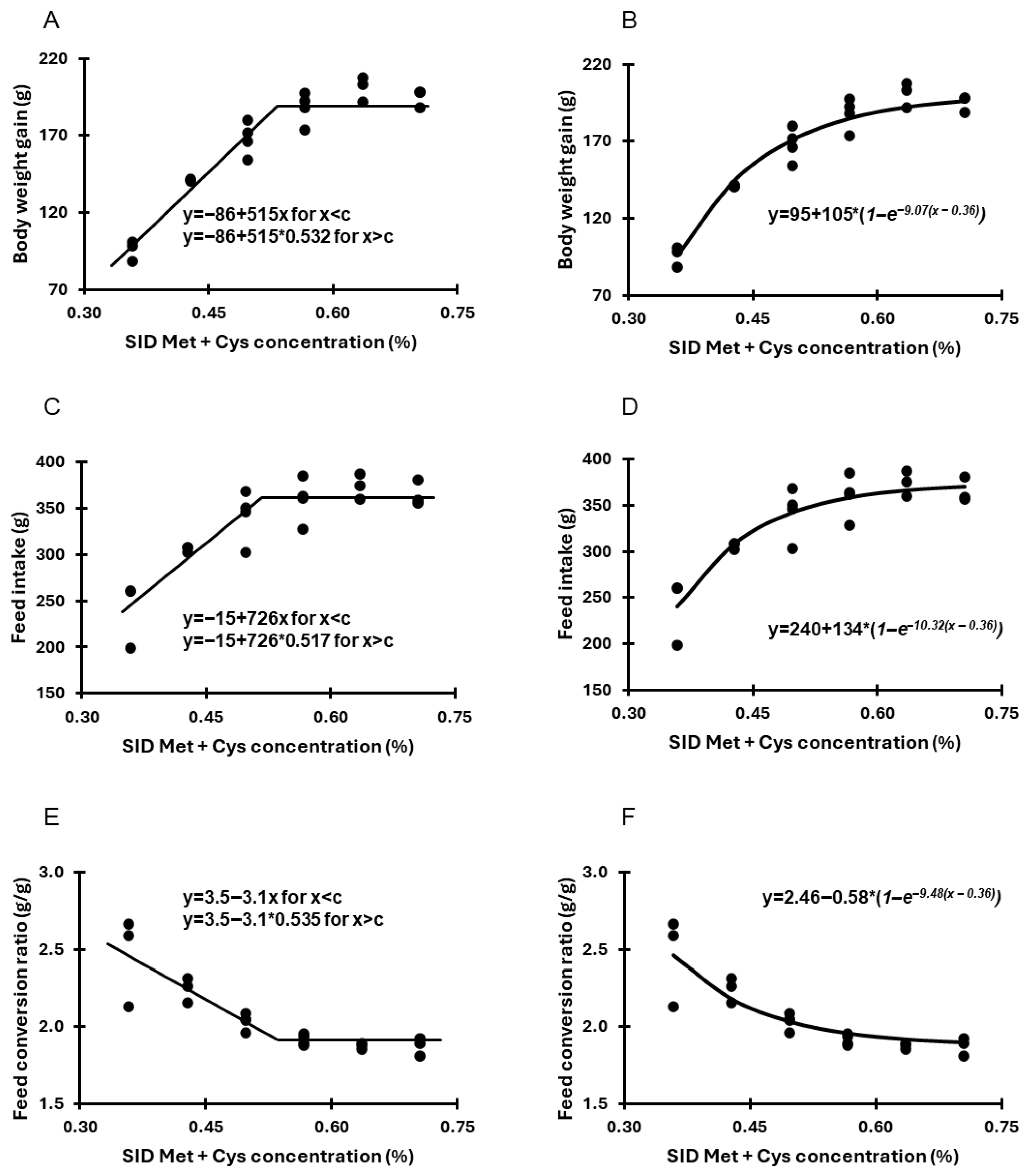
Figure 1. Regression analysis of body weight gain (g; (A,B)), feed intake (g; (C,D)), and feed conversion ratio (g/g; (E,F)) in male LSL Classic chicks in trial 1 as a function of dietary SID Met + Cys concentration. Broken-line models are shown in panels (A,C,E); exponential models in panels (B,D,F). y= response variable (body weight gain, feed intake, or feed conversion ratio); x = SID Met + Cys concentration; c = breakpoint in the broken-line model. Data points represent individual replicates.
Poultry 05 00011 g001
Figure 2. Regression analysis of body weight gain (g; (A,B)), feed intake (g; (C,D)), and feed conversion ratio (g/g; (E,F)) in male LSL Classic chicks in trial 2 as a function of dietary SID Lys concentration (g/kg diet). Broken-line models are shown in panels (A,C,E); exponential models in panels (B,D,F). y = response variable (body weight gain, feed intake, or feed conversion ratio); x = SID Lys concentration; c = breakpoint in the broken-line model. Data points represent individual replicates.
Poultry 05 00011 g002
Table 1. Composition of the basal diets used in Trial 1 and Trial 2.
Component (g/kg)Trial 1Trial 2
Faba bean200-
Wheat70633
Soybean meal120122
Wheat bran-80
Corn51355
Corn gluten-20
Mineral and vitamin mixture 12020
Soybean oil3317
Monocalcium phosphate1216
Calcium carbonate1116
Sodium chloride4.04.0
L-Valine2.54.0
L-Isoleucine2.54.0
L-Threonine2.53.5
L-Arginine1.32.7
DL-Methionine-2.5
L-Lysine HCL3.5-
L-Tryptophan0.70.5
Nutrients (analysed)
Dry matter (DM, %)87.7086.60
Crude protein (% of DM)17.9618.71
Ether extract (% of DM)6.064.14
Crude ash (% of DM)6.427.53
Crude fiber (% of DM)4.143.82
Starch (% of DM)52.3350.27
Sugar (% of DM)2.883.44
Calcium (% of DM)1.191.45
Phosphorus (% of DM)0.951.08
AMEN (MJ/kg DM, calculated)13.9713.16
Amino acids (g/kg diet)
Arginine10.9810.46
Cysteine3.023.57
Histidine3.503.17
Isoleucine7.088.19
Leucine12.4111.59
Lysine10.085.68
Methionine1.494.68
Phenylalanine6.306.52
Threonine7.568.34
Valine7.598.81
SID amino acids (g/kg diet) 2
Arginine10.439.75
Cysteine2.062.52
Histidine2.772.57
Isoleucine6.668.14
Leucine10.3210.17
Lysine10.025.02
Methionine1.534.46
Phenylalanine5.225.89
Threonine6.727.63
Valine6.948.62
1 The mineral and vitamin mixture supplied the following per kg diet: Fe (Iron-II-sulphate monohydrate), 50 mg; Cu (Copper-II-sulphate pentahydrate), 12 mg; Mn (Manganese-II-oxide), 80 mg; Zn (Zinc oxide), 80 mg; Se (Sodium selenite), 0.32 mg; vitamin A (Retinyl acetate), 10,000 IU; vitamin D3 (Cholecalciferol), 2000 IU; vitamin E (all-rac-α-Tocopherylacetat), 30 mg; vitamin K3 (Menadione sodium bisulfite), 2.6 mg; vitamin B1, 2.0 mg; vitamin B2, 6.0 mg; vitamin B6, 3.2 mg; folic acid, 0.65 mg; nicotinic acid, 34.2 mg; pantothenic acid, 9.7 mg; biotin, 0.07 mg; vitamin B12, 0.026 mg; choline chloride, 400 mg; vitamin C (L-ascorbic acid), 150 mg. 2 Concentration of SID amino acids were calculated based on value for digestibility by AminoDat® 5.0 [20]. DM = dry matter; SID = standardized ileal digestible.
Table 2. Dietary concentrations of total and SID Met + Cys (trial 1) and Lys (trial 2).
Met + Cys (%), Trial 1Lys (%), Trial 2
TreatmentTotal *SID **Total *SID **
10.450.360.570.50
20.520.430.650.58
30.590.500.730.66
40.660.570.810.74
50.730.640.890.82
60.800.710.970.89
* Total Amino acids analysed; ** SID calculated with AminoDat® 5.0 [20].
Table 3. Growth performance of male LSL Classic chicks (1–21 days) fed diets with varying SID Met + Cys concentrations (Trial S1).
SID Met + Cys
(%)
Body Weight, d 1 (g)Body Weight, d 21 (g)Body Weight Gain (d1–d21, g)Feed Intake (d1–d21, g)FCR
(g Feed:g Gain)
0.3635.0 ± 0.2131 ± 6 d96 ± 6 d240 ± 36 b2.50 ± 0.22 b
0.4335.5 ± 0.9176 ± 0 c141 ± 1 c306 ± 3 a2.17 ± 0.03 a
0.5035.2 ± 0.9203 ± 11 b168 ± 11 b342 ± 28 a2.03 ± 0.05 a
0.5735.0 ± 0.9223 ± 10 a188 ± 10 a360 ± 24 a1.91 ± 0.03 a
0.6435.3 ± 1.1236 ± 8 a201 ± 8 a374 ± 14 a1.89 ± 0.02 a
0.7135.2 ± 1.3230 ± 7 a195 ± 6 a365 ± 14 a1.88 ± 0.06 a
p-value0.98<0.001<0.001<0.001<0.001
Data are means ± SD, n = 3–4/group. Means without the same superscript letters (a–d) differ significantly (p < 0.05). FCR = feed conversion ratio; SID = standardized ileal digestible.
Table 4. An overview of the results of the derivation of the dietary SID Met + Cys concentration by the broken-line model and the exponential model for optimization of the criteria body weight gain, feed intake, and feed conversion ratio in male LSL Classic chicks during starter period (1–21 days) in trial 1.
Model
CriterionBroken-LineExponential
Body weight gain
        Optimum (g)188190
        SID Met + Cys (%)0.530.62
        Fit (R2)0.810.80
        p-value<0.0010.016
Feed intake
        Optimum (g)360355
        SID Met + Cys (%)0.520.55
        Fit (R2)0.620.77
        p-value<0.0010.022
Feed conversion ratio
        Optimum (g feed/g gain)1.921.99
        SID Met + Cys (%)0.530.53
        Fit (R2)0.690.88
        p-value<0.0010.005
Table 5. Growth performance of male LSL Classic chicks (1–21 days) fed diets with varying SID Lys concentrations (Trial S2).
SID Lys
(%)
Body Weight, d 1 (g)Body Weight, d 21 (g)Body Weight Gain (d1–d21, g)Feed Intake (d1–d21, g)FCR
(g Feed:g Gain)
0.5036.8 ± 0.0152 ± 23 b115 ± 23 b292 ± 58 b2.53 ± 0.01 c
0.5836.7 ± 0.3186 ± 19 b150 ± 19 b328 ± 43 a2.19 ± 0.01 b
0.6636.8 ± 0.2210 ± 11 a173 ± 11 a364 ± 24 a2.11 ± 0.10 a
0.7436.8 ± 0.1233 ± 4 a196 ± 4 a389 ± 21 a1.98 ± 0.09 a
0.8236.9 ± 0.1228 ± 8 a191 ± 8 a392 ± 12 a2.05 ± 0.03 a
0.8937.1 ± 0.4231 ± 9 a194 ± 9 a384 ± 24 a1.98 ± 0.10 a
p-value0.42<0.001<0.001<0.001<0.001
Data are means ±SD, n =3–4/group. Means without the same superscript letters (a–c) differ significantly (p < 0.05). FCR = feed conversion ratio; SID = standardized ileal digestible.
Table 6. An overview of the results of the derivation of the dietary SID Lys concentration by the broken-line model and the exponential model for optimization of the criteria body weight gain, feed intake, and feed conversion ratio of male LSL classic chicks during starter period (1–21 days) in trial 2.
Model
CriterionBroken-LineExponential
Body weight gain
        Optimum (g)193186
        SID Lys (%)0.710.74
        Fit (R2)0.700.79
        p-value<0.001<0.02
Feed intake
        Optimum (g)391372
        SID Lys (%)0.720.70
        Fit (R2)0.200.47
        p-value0.046<0.001
Feed conversion ratio
        Optimum (g feed/g gain)2.022.08
        SID Lys (%)0.680.66
        Fit (R2)0.640.75
        p-value<0.001<0.024
Disclaimer/Publisher’s Note: The statements, opinions and data contained in all publications are solely those of the individual author(s) and contributor(s) and not of MDPI and/or the editor(s). MDPI and/or the editor(s) disclaim responsibility for any injury to people or property resulting from any ideas, methods, instructions or products referred to in the content.