
Brief Report

The Impact of Periodontal Treatment on Rheumatoid Arthritis Outcomes: The Microbial Link

by
Daniela Santos Silva
1,2,*,
Charlotte de Vries
3,
Karin Lundberg
4,
Isabel Poiares Baptista
1,2,
José António Pereira da Silva
5,6,
Marta Kaminska
7,8 and
Piotr Mydel
7,8
1
Periodontology Institute, Faculty of Medicine, University of Coimbra, 3000-548 Coimbra, Portugal
2
Group of Environmental Genetics of Oncobiology (CIMAGO), Faculty of Medicine, University of Coimbra, 3000-548 Coimbra, Portugal
3
Division of Rheumatology, Department of Medicine Solna, Karolinska Institute, 171 76 Solna, Sweden
4
Division of Rheumatology, Department of Medicine Solna, Karolinska Institute and Center for Molecular Medicine, Karolinska University Hospital, 171 76 Stockholm, Sweden
5
Rheumatology Department, Hospitais da Universidade de Coimbra, Unidade Local de Saúde de Coimbra (ULS), 3000-075 Coimbra, Portugal
6
Coimbra Institute for Clinical and Biomedical Research (iCBR), 3000-548 Coimbra, Portugal
7
Department of Clinical Science, Faculty of Medicine and Dentistry, University of Bergen, Broegelmann Research Laboratory, 5009 Bergen, Norway
8
Faculty of Biochemistry Biophysics and Biotechnology, Department of Microbiology, Jagiellonian University, 30-387 Krakow, Poland
*
Author to whom correspondence should be addressed.
Rheumato 2026, 6(1), 2; https://doi.org/10.3390/rheumato6010002
Submission received: 13 October 2025 / Revised: 5 December 2025 / Accepted: 25 December 2025 / Published: 5 January 2026

Abstract

Background/Objectives: The aim of this study was to assess the relationship between the decline in rheumatoid arthritis (RA) disease activity—induced by periodontal treatment—and changes in the microbiology of subgingival plaque and serum antibody levels against the periodontal bacterium Porphyromonas gingivalis. Methods: Twenty-two RA patients with periodontitis underwent non-surgical periodontal treatment and assessment for the disease activity score of 28 joints (DAS28); antibody response to P. gingivalis virulence factors arginine (Rgp) and lysin (Kgp) gingipain; peptidyl arginine deiminase (PAD)2/4-activity; and the presence of P. gingivalis, Tannerella forsythia, and Prevotella intermedia in subgingival plaque through the evaluation of colony-forming units (CFUs) at baseline, two months, and six months post-treatment. Results: Periodontal treatment significantly reduced P. gingivalis CFUs at two and six months, and T. forsythia and P. intermedia CFUs at two months. Anti-RgpB IgG levels decreased at two months (p = 0.020). Higher baseline anti-RgpB IgG levels (r = −0.44, p = 0.039) and P. gingivalis CFU (r = −0.47, p = 0.028) correlated with greater reductions in DAS28. Greater reductions in P. gingivalis CFU were also associated with greater declines in DAS28 (r = 0.426, p = 0.048 and r = 0.467, p = 0.028, at two and six months, respectively). Anti-Kgp IgG and PAD2/PAD4 activity were not significantly affected by periodontal treatment. Conclusions: The impact of periodontal treatment on RA disease activity is more pronounced in patients with higher baseline P. gingivalis load and antibody response to RgpB. Better microbiological responses to periodontal treatment are associated with greater improvements in rheumatological symptoms. Further research is needed to confirm these findings and fully elucidate the underlying mechanisms.

1. Introduction

Periodontitis, a destructive inflammatory disease affecting the tooth-supporting structures, is the most prevalent bacteria-driven chronic disease in humans [1]. Severe forms of periodontitis affect approximately 11% of the adult population worldwide [2]. Periodontitis is associated with local dysbiosis and bacterial proliferation, where Porphyromonas gingivalis (P. gingivalis) has been described as a keystone pathogen. Both periodontitis and P. gingivalis specifically have been linked to the development and persistence of systemic chronic inflammatory diseases, including rheumatoid arthritis (RA) [3]. Several case–control studies support the association between periodontitis and RA, showing that patients with RA have a higher prevalence of periodontitis and tooth loss, with odds ratios between 1.82 and 20.57 [4]. Additionally, serum levels of anti-citrullinated protein antibodies (ACPAs), key biomarkers of RA, have been associated with the presence of periodontitis and P. gingivalis [5]. Furthermore, a recent study links oral bacteremia to RA flares [6]. A systematic review and meta-analysis by Silva et al. suggested periodontal treatment may have a favorable effect upon RA disease activity in patients with this comorbidity [7]. However, the literature is not consistent on this matter. A recent clinical trial by our group [8] addressing this hypothesis demonstrated that non-surgical periodontal treatment (steps 1 and 2) is locally effective in RA patients and has a positive impact on RA disease activity and ACPA levels, particularly in those with severe periodontitis, irrespective of RA disease activity and associated medication.
The current study was designed as part of the clinical trial described above to evaluate whether and how the RA activity level after non-surgical periodontal treatment are associated with changes in dental plaque microbial composition and serum levels of antibodies against P. gingivalis.

2. Materials and Methods

This study was performed as part of a registered (ISRCTN 17950307) randomized delayed-start study conducted at Centro Hospitalar e Universitário de Coimbra (CHUC), Portugal, from November 2018 to October 2021. All procedures were approved by the hospital’s ethics committee (protocol number CHUC-130-17). All participants provided written informed consent prior to inclusion in the study.
Patient recruitment and selection, periodontal intervention, clinical assessment (periodontal and rheumatological), and sampling are detailed in Supplementary Material S1 and were previously published [8,9,10,11,12,13,14,15].
Briefly, participants were recruited among consecutive adult individuals with RA, classified according to the ACR/EULAR 2010 criteria [16]. Full-periodontal assessment (including probing depth [PD], bleeding on probing [BoP], plaque index [PI], and clinical attachment loss [CAL]) allowed for the classification of periodontitis [1] according to its severity (stages I–IV), extent, and disease progression (grade A, B, or C). Only patients with moderate and severe periodontitis (Stages ≥ II) were included, irrespective of the extent and grade.
Additional exclusion criteria were as follows: less than six natural teeth, current inflammatory conditions other than RA, history of infection/antibiotic use in the previous four months, history of periodontal treatment, changes in RA medication in the previous three months or predicted to occur during the study timeframe, current or prior smoking habits, diabetes, current pregnancy, or lactation.
Recruitment continued until 22 consenting patients were included.
At baseline (visit 1 [V1]), all study participants were instructed to adopt adequate oral hygiene methods and were submitted to steps 1 and 2 (non-surgical) of periodontal therapy.
Full-periodontal and rheumatological assessments, as well as peripheral blood sampling and subgingival biofilm collection, were performed at baseline (V1) and at 2 (visit 2 [V2]) and 6 months (visit 3 [V3]) after the periodontal intervention.
Disease activity score for 28 joints (DAS28) was calculated based on the number of tender and swollen joints and C-reactive protein (CRP) levels (mg/L) [17].
Methods employed in serum analysis, namely, CRP levels, anti-cyclic citrullinated peptide 2 (CCP2) IgG, peptidyl arginine deiminase (PAD) 2 and PAD4 activity (PAD2Act and PAD4Act), anti-RgpB, and anti-Kgp IgG, are described in Supplementary Material S2.
Subgingival biofilm analyses, namely, P. gingivalis, Tannerella forsythia (T. forsythia), and Prevotella intermedia (P. intermedia) colony-forming units (CFUs) are detailed in Supplementary Material S2.

Statistical Analysis

Changes observed between visits, in each patient, for every clinical, serological, and imaging parameter described above, were calculated as absolute values. Data distribution was tested by the Shapiro–Wilk test for normality and the Levene test for equality of variances. Continuous data comparisons were conducted using the Mann–Whitney U test. The Friedman test was used to compare data acquired at the three visits, followed by Dunn’s post hoc test (1964) procedure with a Bonferroni correction for multiple comparisons. Spearman’s correlation was used to test for statistical dependence between two variables.

3. Results

3.1. Baseline Characteristics

The patients’ baseline characteristics were fully detailed in a previously published study [8] and are presented in supplementary Table S1. Briefly, a total of 85 RA patients were screened, and 33 patients were invited to a full-periodontal assessment based on the PSR criteria. Ten patients were excluded as they were diagnosed with stage I periodontitis, and one individual declined to participate. The final sample set included 22 study participants (n = 14 females, n = 8 males), with a mean age of 61.4 (±8.6) years (Table S1). Twenty-one patients were treated with conventional disease-modifying antirheumatic drugs (csDMARDs) and five with biological agents (bDMARDs); twelve patients were in remission, two had low disease activity, and eight had moderate disease activity. Regarding periodontitis severity, four individuals were classified as stage II (one localized; three generalized), seven as stage III (five localized; two generalized), and eleven as generalized stage IV periodontitis. Regarding periodontitis progression, the majority of the included patients were classified as grade B (moderate rate), except for four stage IV patients, who were grade C (rapid rate).

3.2. The Relationship Between Microbiological Parameters and Periodontitis Severity at Baseline

There were no differences between moderate and severe periodontitis patients regarding P. gingivalis, T. forsythia, and P. intermedia plaque CFUs or anti-RgpB IgG and anti-Kgp IgG levels at baseline. Nor did we detect differences in serum PAD2/PAD4 activity between the two patient groups (Supplementary Table S1).
Spearman correlation analyses revealed a positive correlation between baseline anti-RgpB IgG levels and BoP (r = 0.437, p = 0.042), while no correlations were found between any other microbiological and periodontal parameters.
Additionally, positive correlations were observed between P. gingivalis CFU and both anti-RgpB (r = 0.729, p = 0.0001) and anti-Kgp IgG levels (r = 0.562, p = 0.0065) at baseline.

3.3. The Impact of Periodontal Treatment on Microbiological and RA Outcomes

Periodontal treatment resulted in significant decreases in P. gingivalis, T. forsythia, and P. intermedia CFU. This was specifically evident for P. gingivalis, with a significant decrease at both two (p = 0.001) and six (p = 0.028) months post-treatment, while T. forsythia (p < 0.001) and P. intermedia (p = 0.048) decreased significantly at two months but not at six months. Anti-RgpB IgG levels also decreased at two (p = 0.020) but not six months. Anti-Kgp IgG levels remained unchanged. Serum PAD2/PAD4 activity showed no statistically significant changes following periodontal treatment (Table 1).
Changes in rheumatological parameters post-periodontal treatment were previously published [8]. Briefly, no significant changes were observed for DAS28-CRP, anti-CCP2 IgG, CRP, or global OMERACT-EULAR synovitis score (GLOESS) when including all patients in the analysis. However, significant improvements in DAS28 were observed between clinical visits (ΔV2-V1 p = 0.042; ΔV3-V1 p = 0.001), and anti-CCP2 IgG levels decreased significantly at six months (p = 0.032) in severe versus moderate periodontitis.

3.4. The Relationship Between Baseline Microbiological Load and Improvement of Periodontitis and RA Post-Treatment

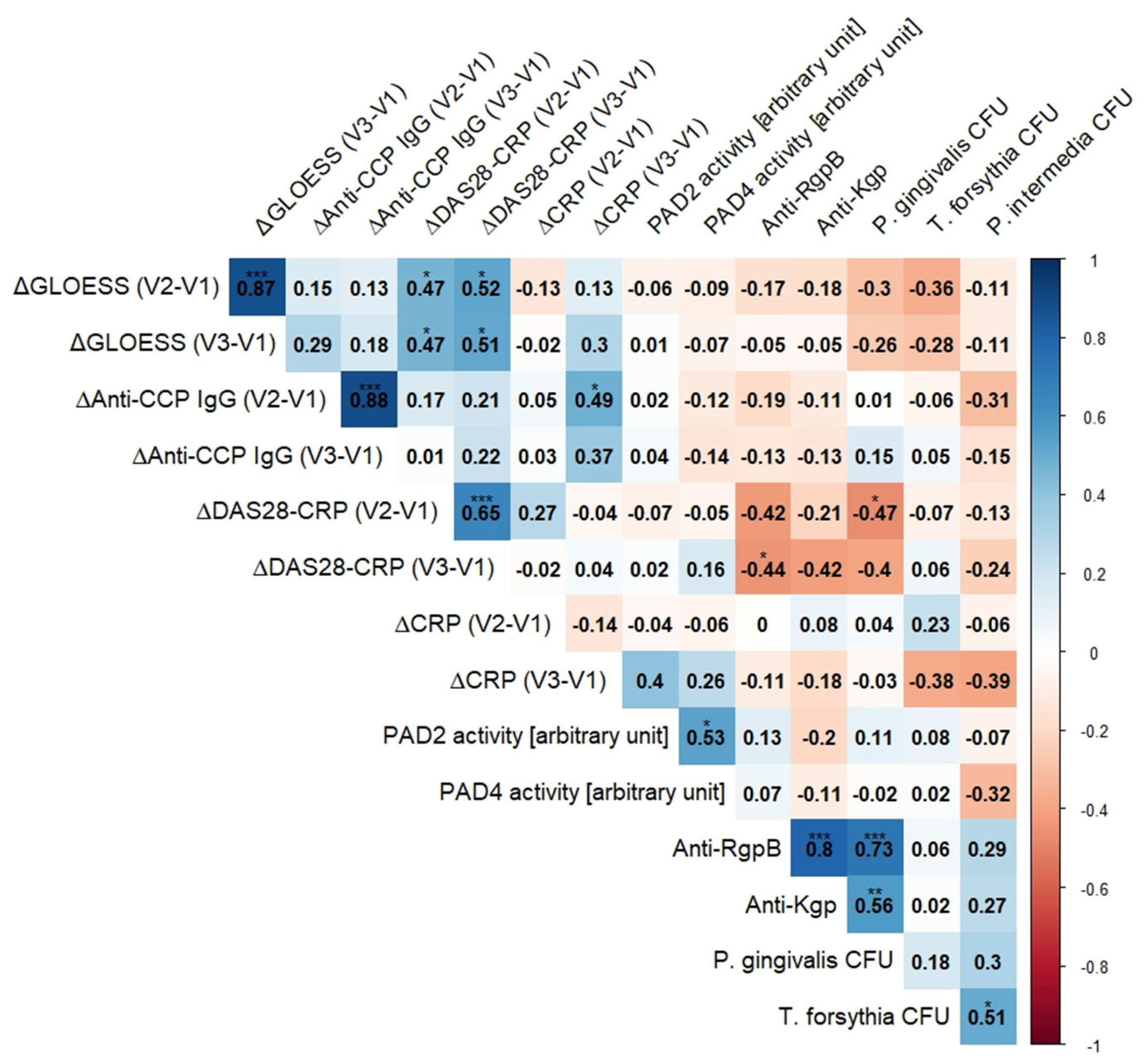
When assessing all patients using Spearman correlation analyses, we detected no significant correlations between baseline microbiological loads and periodontitis improvements. However, correlation analyses revealed that higher baseline P. gingivalis CFUs were associated with more pronounced improvements in DAS28 at two months post-treatment (ΔV2-V1; r = −0.47, p = 0.028), Figure 1.

3.5. The Relationship Between the Baseline Antibody Response to Gingipains and Improvement of Periodontitis and RA Post-Treatment

Spearman correlation analyses, including all patients, showed that higher baseline anti-Kgp IgG levels correlated with greater reductions in PD at two months post-treatment (ΔV2-V1; r = −0.54, p = 0.010). A similar relationship was observed regarding reductions in maximum CAL at both two (ΔV2-V1; r = −0.49; p = 0.022) and six (ΔV3-V1; r = −0.46; p = 0.029) months. No significant correlations were identified for baseline anti-RgpB IgG levels and periodontal improvements.
Regarding correlations with rheumatological improvements, we found that higher baseline anti-RgpB IgG levels correlated with greater reductions in DAS28 six months post-treatment (V3-V1; r = −0.44, p = 0.039) (Figure 1).

3.6. The Relationship Between Changes in Microbiological Parameters and RA Outcome Measures in Response to Periodontal Treatment

To investigate whether a deeper microbiological response to periodontal treatment was associated with more pronounced improvements in rheumatological symptoms, we performed additional Spearman correlation analyses. A significant positive correlation was detected between changes in P. gingivalis CFU (ΔV2-V1 and ΔV3-V1) and changes in DAS28 (ΔV2-V1) (r = 0.426, p = 0.048 and r = 0.467, p = 0.028, respectively). No correlations were observed for other microbiological or rheumatological parameters, including CRP and anti-CCP2 IgG levels.

4. Discussion

This study aimed to explore the impact of periodontal treatment on microbiological parameters and its relationship with RA outcomes measures. The results indicate that periodontal therapy significantly affects the gingival microbiological profile, with reductions in key periodontal pathogens such as P. gingivalis, T. forsythia, and P. intermedia. Specifically, P. gingivalis showed a significant decrease at 2 and 6 months post-treatment, while T. forsythia and P. intermedia demonstrated significant reductions only at the 2-month visit. Indeed, the link between RA and periodontitis has been suggested to depend on P. gingivalis [18,19], which is the only bacterium that expresses its own PAD enzyme, denoted P.PAD. Strikingly, ACPAs have been detected in gingival crevicular fluid [20], and B cells residing in the gingiva of a periodontitis patient with RA were found to cross-react with citrullinated antigens derived from human proteins and P.PAD [21].
While there were significant microbiological improvements at the plaque level, serum PAD2 and PAD4 activities did not show any significant changes post-treatment. This suggests that either long-term periodontal interventions are needed to effectively reduce these inflammatory serum markers or that they are maintained by extraoral sources.
There was a transient decrease in anti-RgpB IgG levels at 2 months (p = 0.020), which was not sustained at 6 months, and no changes in anti-Kgp IgG levels. Since a positive correlation between baseline anti-RgpB levels and BoP exists, we hypothesize that these results may reflect the lack of sustained improvement in local periodontal inflammation upon treatment. Future studies aiming to confirm this hypothesis should implement more frequent intermediate visits to reinforce oral hygiene instructions and supragingival plaque control, as it would improve periodontal inflammatory outcomes.
In terms of rheumatological outcome measures, as reported in the previously published study [8], patients with severe (but not moderate) periodontitis experienced significant improvements in DAS28 scores and anti-CCP2 IgG levels at 6 months. We hypothesize that the specific significant decrease in P. gingivalis at 2 and 6 months (and not the other analyzed bacteria) may be the possible explanation for those results. The results reported herein extend these observations to suggest that higher P. gingivalis loads and antibody responses to RgpB predict a greater reduction in DAS28 following periodontal treatment. Moreover, greater reductions in P. gingivalis CFU after periodontal treatment were associated with greater declines in DAS28 levels. Future studies should clarify whether these findings are directly related to P. gingivalis load or to the periodontal inflammatory status.
We acknowledge the small sample size, the limited treatment scheme, and the analysis of only a few selected organisms (P. gingivalis, T. forsythia, and P. intermedia), but our exploratory study overcomes most other major limitations identified in the published literature in this field [7], including (i) lack of standardized disease case definition (periodontitis and RA), intervention, and measurements; (ii) uncertainty regarding the stability of RA medication during the trial; and (iii) adequate control of confounding factors like smoking.

5. Conclusions

In conclusion, while periodontal treatment effectively reduces periodontal pathogens in all patients, its impact on RA parameters was more pronounced in patients with a higher P. gingivalis load. Moreover, better microbiological responses to periodontal treatment were associated with greater improvements in rheumatological symptoms. These observations support a pathogenic link between P. gingivalis and RA and the potential benefit of targeted periodontal therapy in the management of RA, especially in patients with high microbiological counts. Further research is needed to confirm these preliminary findings, establish the ideal method and duration of treatment, and fully elucidate the mechanisms underlying these observations. The potential value of integrating periodontal care into the routine management of RA patients merits further study.

Supplementary Materials

The following supporting information can be downloaded at https://www.mdpi.com/article/10.3390/rheumato6010002/s1: Supplementary methods S1: Patient recruitment and selection, periodontal intervention, clinical assessment (periodontal and rheumatological), and sampling; Supplementary methods S2: Serum and subgingival biofilm analyses; Table S1: Baseline characteristics of the included individuals. References [1,9,10,11,12,13,14,15,16,17] are cited in the Supplementary Material.

Author Contributions

Conceptualization, D.S.S., J.A.P.d.S. and I.P.B.; methodology, D.S.S., J.A.P.d.S., I.P.B., K.L. and P.M.; validation, D.S.S., J.A.P.d.S., I.P.B., K.L. and P.M.; formal analysis, D.S.S., J.A.P.d.S., I.P.B., C.d.V., K.L., M.K. and P.M.; investigation, D.S.S., C.d.V. and M.K.; resources, D.S.S., J.A.P.d.S., I.P.B., C.d.V., K.L., M.K. and P.M.; data curation, D.S.S., J.A.P.d.S., I.P.B., C.d.V., K.L., M.K. and P.M.; writing—original draft preparation, D.S.S.; writing—review and editing, D.S.S., J.A.P.d.S., I.P.B., C.d.V., K.L., M.K. and P.M.; supervision, J.A.P.d.S., I.P.B., K.L. and P.M., project administration, D.S.S.; funding acquisition, D.S.S., J.A.P.d.S., I.P.B., K.L. and P.M. All authors have read and agreed to the published version of the manuscript.

Funding

This research was funded by grant number 296129 (Research Council of Norway, awarded to P.M.), 2019/34/H/NZ1/00674 (National Science Center in Poland, awarded to P.M.). K.L. and C.d.V. acknowledge grant support from the King Gustav V 80-Year Foundation (FAI-2020-0646 and FAI-2021-0771) and the Swedish Rheumatism Foundation (R-969194).

Institutional Review Board Statement

This study was conducted in accordance with the Declaration of Helsinki and approved by the Ethics Committee of Centro Hospitalar e Universitário de Coimbra (CHUC) (protocol number CHUC 130-17, 28 September 2018).

Informed Consent Statement

Informed consent was obtained from all subjects involved in the study.

Data Availability Statement

The data presented in this study are available upon request from the corresponding author due to ethical reasons.

Acknowledgments

We thank Sara Serra and João Rovisco for the rheumatological assessment and Cristiano Matos for the statistical analysis.

Conflicts of Interest

The authors declare no conflicts of interest.

References

  1. Papapanou, P.N.; Sanz, M.; Buduneli, N.; Dietrich, T.; Feres, M.; Fine, D.H.; Flemmig, T.F.; Garcia, R.; Giannobile, W.V.; Graziani, F.; et al. Periodontitis: Consensus report of workgroup 2 of the 2017 World Workshop on the Classification of Periodontal and Peri-Implant Diseases and Conditions. J. Periodontol. 2018, 89, S173–S182. [Google Scholar] [CrossRef] [PubMed]
  2. Kassebaum, N.; Bernabé, E.; Dahiya, M.; Bhandari, B.; Murray, C.; Marcenes, W. Global Burden of Severe Periodontitis in 1990-2010 A Systematic Review and Meta-regression. J. Dent. Res. 2014, 93, 1045–1053. [Google Scholar] [CrossRef] [PubMed]
  3. Hussain, M.; Stover, C.M.; Dupont, A. P. gingivalis in Periodontal Disease and Atherosclerosis-Scenes of Action for Antimicrobial Peptides and Complement. Front. Immunol. 2015, 6, 45. [Google Scholar] [CrossRef] [PubMed]
  4. Kaur, S.; White, S.; Bartold, P.M. Periodontal disease and rheumatoid arthritis: A systematic review. J. Dent. Res. 2013, 92, 399–408. [Google Scholar] [CrossRef]
  5. Eezammuddeen, N.N.; Vaithilingam, R.D.; Hassan, N.H.M. Influence of periodontitis on levels of autoantibodies in rheumatoid arthritis patients: A systematic review. J. Periodontal Res. 2023, 58, 29–42. [Google Scholar] [CrossRef]
  6. Brewer, R.C.; Lanz, T.V.; Hale, C.R.; Sepich-Poore, G.D.; Martino, C.; Swafford, A.D.; Carroll, T.S.; Kongpachith, S.; Blum, L.K.; Elliott, S.E.; et al. Oral mucosal breaks trigger anti-citrullinated bacterial and human protein antibody responses in rheumatoid arthritis. Sci. Transl. Med. 2023, 15, eabq8476. [Google Scholar] [CrossRef]
  7. Silva, D.S.; Costa, F.; Baptista, I.P.; Santiago, T.; Lund, H.; Tarp, S.; Dasilva, J.A.P.; Christensen, R. Evidence-Based Research on Effectiveness of Periodontal Treatment in Rheumatoid Arthritis Patients: A Systematic Review and Meta-Analysis. Arthritis Care Res. 2021, 74, 1723–1735. [Google Scholar] [CrossRef]
  8. Silva, D.S.; de Vries, C.; Rovisco, J.; Serra, S.; Kaminska, M.; Mydel, P.; Lundberg, K.; da Silva, J.A.P.; Baptista, I.P. The impact of periodontitis and periodontal treatment on rheumatoid arthritis outcomes: An exploratory clinical trial. Rheumatology 2025, 64, 1679–1688. [Google Scholar] [CrossRef]
  9. Landry, R.G.; Jean, M. Periodontal Screening and Recording (PSR) Index: Precursors, utility and limitations in a clinical setting. Int. Dent. J. 2002, 52, 35–40. [Google Scholar] [CrossRef]
  10. Dietrich, T.; Ower, P.; Tank, M.; West, N.X.; Walter, C.; Needleman, I.; Hughes, F.J.; Wadia, R.; Milward, M.R.; Hodge, P.J.; et al. Periodontal diagnosis in the context of the 2017 classification system of periodontal diseases and conditions-implementation in clinical practice. Br. Dent. J. 2019, 226, 16–22. [Google Scholar] [CrossRef]
  11. Sanz, M.; Herrera, D.; Kebschull, M.; Chapple, I.; Jepsen, S.; Beglundh, T.; Sculean, A.; Tonetti, M.S.; EFP Workshop Participants and Methodological Consultants. Treatment of stage I-III periodontitis-The EFP S3 level clinical practice guideline. J. Clin. Periodontol. 2020, 47, 4–60. [Google Scholar] [CrossRef] [PubMed]
  12. Herrera, D.; Sanz, M.; Kebschull, M.; Jepsen, S.; Sculean, A.; Berglundh, T.; Papapanou, P.N.; Chapple, I.; Tonetti, M.S.; EFP Workshop Participants and Methodological Consultants. Treatment of stage IV periodontitis: The EFP S3 level clinical practice guideline. J. Clin. Periodontol. 2022, 49, 4–71. [Google Scholar] [CrossRef] [PubMed]
  13. Nesse, W.; Abbas, F.; Van Der Ploeg, I.; Spijkervet, F.K.L.; Dijkstra, P.U.; Vissink, A. Periodontal inflamed surface area: Quantifying inflammatory burden. J. Clin. Periodontol. 2008, 35, 668–673. [Google Scholar] [CrossRef] [PubMed]
  14. Brites, L.; Rovisco, J.; Costa, F.; Freitas, J.P.D.; Jesus, D.; Eugénio, G.; Serra, S.; Duarte, C.; Ferreira, R.J.O.; da da Silva, J.A.P. High patient global assessment scores in patients with rheumatoid arthritis otherwise in remission do not reflect subclinical inflammation. Jt. Bone Spine 2021, 88, 105242. [Google Scholar] [CrossRef]
  15. D’Agostino, M.A.; Boers, M.; Wakefield, R.J.; Berner Hammer, H.; Vittecoq, O.; Filippou, G.; Balint, P.; Möller, I.; Iagnocco, A.; Naredo, E.; et al. Exploring a new ultrasound score as a clinical predictive tool in patients with rheumatoid arthritis starting abatacept: Results from the APPRAISE study. RMD Open 2016, 2, e000237. [Google Scholar] [CrossRef]
  16. Kay, J.; Upchurch, K.S. ACR/EULAR 2010 rheumatoid arthritis classification criteria. Rheumatology 2012, 51, vi5–vi9. [Google Scholar] [CrossRef]
  17. Fleischmann, R.M.; van der Heijde, D.; Gardiner, P.V.; Szumski, A.; Marshall, L.; Bananis, E. DAS28-CRP and DAS28-ESR cut-offs for high disease activity in rheumatoid arthritis are not interchangeable. RMD Open 2017, 3, e000382. [Google Scholar] [CrossRef]
  18. Hajishengallis, G. Immunomicrobial pathogenesis of periodontitis: Keystones, pathobionts, and host response. Trends Immunol. 2014, 35, 3–11. [Google Scholar] [CrossRef]
  19. Roberts, F.A.; Darveau, R.P. Microbial protection and virulence in periodontal tissue as a function of polymicrobial communities: Symbiosis and dysbiosis. Periodontol. 2000 2015, 69, 18–27. [Google Scholar] [CrossRef]
  20. Harvey, G.P.; Fitzsimmons, T.R.; Dhamarpatni, A.A.S.S.K.; Marchant, C.; Haynes, D.R.; Bartold, P.M. Expression of peptidylarginine deiminase-2 and -4, citrullinated proteins and anti-citrullinated protein antibodies in human gingiva. J. Periodontal Res. 2013, 48, 252–261. [Google Scholar] [CrossRef]
  21. Sherina, N.; de Vries, C.; Kharlamova, N.; Sippl, N.; Jiang, X.; Brynedal, B.; Kindstedt, E.; Hansson, M.; Mathsson-Alm, L.; Israelsson, L.; et al. Antibodies to a Citrullinated Porphyromonas gingivalis Epitope Are Increased in Early Rheumatoid Arthritis, and Can Be Produced by Gingival Tissue B Cells: Implications for a Bacterial Origin in RA Etiology. Front. Immunol. 2022, 13, 804822. [Google Scholar] [CrossRef]
Figure 1. Graphical representation of the correlation matrix of baseline microbiological parameters and variation in rheumatological parameters after steps 1 and 2 of periodontal therapy. The figure shows correlation coefficients, r (scale on the right); p-values are shown as asterisks (* < 0.05; ** < 0.01; *** < 0.001). CCP2 = second generation cyclic citrullinated peptide; CFU = colony-forming unit; CRP = C-reactive protein; DAS28 = disease activity score for 28 joints; Kgp = lysine-specific gingipain; N = number; PAD = enzyme peptidyl–arginine–deiminase; RgpB = arginine-specific cysteine proteinase; V1 = visit 1 (baseline/treatment visit); V2 = visit 2 (2-month visit); V3 = visit 3 (6-month visit).
Rheumato 06 00002 g001
Table 1. Effect of periodontal treatment on rheumatological and microbiological parameters.
V1
N = 22
V2
N = 22
V3
N = 22
V1 vs. V2 vs. V3V1 vs. V2V1 vs. V3
DAS28; median (IQR)2.4 (2.3)2.7 (2.0)2.5 (1.4)p = 0.873 (a)--
CRP (mg/L); median (IQR)3.3 (5.3)2.2 (4.6)3.7 (5.9)p = 0.727 (a)--
GLOESS; median (IQR)12.5 (18.3)9.5 (9.5)10.5 (17.3)p = 0.130 (a)--
Anti-CCP2 IgG (AU); median (IQR)81.8 (457.0)47.2 (413.6)49.1 (441.7)p = 0.051 (a)--
P.gingivalis (CFU); median (IQR)42,071,037.4 (85,048,214.0)29,222.7 (3,297,647.6)1,100,033.1 (8,658,932.8)p = 0.001 (a)p = 0.001 (b)p = 0.028 (b)
T. forsythia (CFU); median (IQR)34,118,972.9 (47,584,588.9)2,579,187.6 (14,318,373.0)13,159,283.3 (38,205,370.0)p = 0.001 (a)p < 0.001 (b)p = 0.125 (b)
P. intermedia (CFU); median (IQR)32,127,107.2 (64,982,187.7)2,894,642.5 (22,537,760.0)10,051,666.6 (40,115,783.6)p = 0.020 (a)p = 0.048 (b)p = 0.150 (b)
PAD2 activity (AU); median (IQR)9371.1 (1736.4)9518.5 (1493.1)9476.0 (3297.3)p = 0.280 (a)--
PAD4 activity (AU); median (IQR)40,936.1 (21,959.3)40,901.9 (20,775.9)41,491.8 (21,130.6)p = 0.280 (a)--
Anti-RgpB IgG; median (IQR)271.1 (447.0)211.5 (430.3)239.6 (281.7)p = 0.015 (a)p = 0.020 (b)p = 0.071 (b)
Anti-Kgp IgG; median (IQR)522.9 (942.9)537.4 (835.6)661.3 (1012.3)p = 0.554 (a)--
AU = arbitrary unit; BoP: bleeding on probing; CCP2 = second generation cyclic citrullinated peptide; CFU = colony-forming unit; CRP = C-reactive protein; DAS28 = disease activity score for 28 joints; GLOESS = global OMERACT/EULAR ultrasound synovitis score; IQR = interquartile range; Kgp = lysine-specific gingipain; N = number; PAD = enzyme peptidyl–arginine–deiminase; RgpB = arginine-specific gingipain; V1 = visit 1 (baseline/treatment visit); V2 = visit 2 (2-month visit); V3 = visit 3 (6-month visit). (a) Related-samples Friedman’s two-way analysis of variance by ranks; (b) Dunn’s test for multiple comparisons (post hoc test).
Disclaimer/Publisher’s Note: The statements, opinions and data contained in all publications are solely those of the individual author(s) and contributor(s) and not of MDPI and/or the editor(s). MDPI and/or the editor(s) disclaim responsibility for any injury to people or property resulting from any ideas, methods, instructions or products referred to in the content.