

Abstract
The latest direct measurements of the germanium quenching factor deviate significantly from the standard Lindhard model for nuclear recoil energies at the sub keV region. Here, we show that the recently measured coherent elastic neutrino–nucleus scattering (CENS) data from reactor antineutrinos can be used to probe the quenching factor model, and a 2 improvement can be achieved in the fit to the measured CENS data if the quenching factor is described by a modified Lindhard model with a negative value of q, which is also consistent with the direct quenching factor measurement. Constraints on the parameter space of a light vector or scalar mediator that couples to neutrinos and quarks, and on a neutrino magnetic moment, are also placed by using the measured CENS data, and we find that they are quite sensitive to the quenching factor model at low recoil energies.
1. Introduction
The study of nuclear recoils plays an important role in both dark matter direct detection experiments and Coherent elastic neutrino–nucleus scattering (CENS) experiments. CENS is a process in which low-energy neutrinos scatter off a nucleus as an entire entity via neutral current interactions [1]. This process was first observed by the COHERENT collaboration [2] by using a pion-decay-at-rest (DAR) neutrino source with a cesium-iodide detector. The COHERENT collaboration also confirmed the existence of CENS with an argon detector at a confidence level (CL) of more than 3 using the same source [3]. The observation of CENS opens a new window to probe neutrino and nuclear physics at low energies; for a recent review, see Ref. [4] and references therein.
Due to the abundant neutrino fluxes produced by nuclear power reactors, reactor antineutrinos also serve as an ideal source for the measurement of CENS. However, the observation of CENS from reactor antineutrinos is much more difficult than from the DAR source due to the lower energies of reactor antineutrinos. Thus, a detector with a very low threshold is required to detect CENS from reactor antineutrinos. Currently, CONNIE [5] and CONUS [6] experiments have placed constraints on CENS with reactor antineutrinos with a silicon and germanium detector, respectively. Colaresi et al. have also used a germanium detector to measure CENS at the Dresden-II power reactor [7], and they found the first hint of CENS from reactor antineutrinos in a recent measurement made with the NCC-1701 germanium detector [8]. In addition, the latest direct measurements of the germanium quenching factor show a significant deviation from the standard Lindhard model for nuclear recoil energies in the sub keV region [9]. In this work, we use the recently measured CENS spectrum to probe the germanium quenching factor model.
2. CENS
Here we show the calculation of the CENS spectrum from reactor antineutrinos in details. The differential CENS event rate with respect to the nuclear recoil energy is given by
where is the number of nuclei in the detector, and is the reactor antineutrino flux. The differential CENS cross section in the standard model (SM) is given by [1]
where M is the nuclear mass, is the Fermi coupling constant, with the weak mixing angle, and is the Klein–Nystrand form factor [10]. Due to the low momentum transfer in CENS with reactor antineutrinos, the calculated signal is not sensitive to the specific choice of the form factors and its uncertainties [11].
The measured CENS spectrum is strongly dependent on the germanium quenching factor Q, which is defined as the ratio of the observable ionization energy to the nuclear recoil energy , i.e., . Therefore, the differential event rate with respect to is
Currently, experimental measurements of the quenching factor are well described by the standard Lindhard model [12] for , which can be clearly seen from Figure 3 in Appendix II of Ref. [13]. In the Lindhard model, the quenching factor is given by
where is well fitted by with [14], and for germanium in the standard Lindhard model.
However, for sub-keV nuclear recoils, the quenching factors are not well modeled by the Lindhard model due to uncertainties in nuclear scattering and stopping at low energies [15,16]. A recent measurement of the germanium quenching factor shows a departure from the Lindhard model for nuclear recoil energies below ∼1 [9], and the overall shape of the quenching factor can be parameterized by a modified Lindhard model [16,17],
where the parameter q can be negative (positive) if the energy given to electrons is enhanced (cutoff). After taking into account of the energy resolution, the differential event rate with respect to the measured energy is
where
and with eV the intrinsic electronic noise, eV the average energy to produce an electron–hole pair in germanium, and the Fano factor taken from Ref. [8].
3. Results and Discussion
We first use the measured CENS data [8] to probe the quenching factor model. The CENS data are measured by a low-noise 3 kg germanium detector with a distance of ∼10 m from the 2.96 GW Dresden-II power reactor for a 96.4 day exposure. We analyze the spectrum of residual counts in Figure 5 of Ref. [8] and fit 20 bins in from 0.2 to 0.4 keV. We use the following to evaluate the statistical significance of a theoretical model, i.e.,
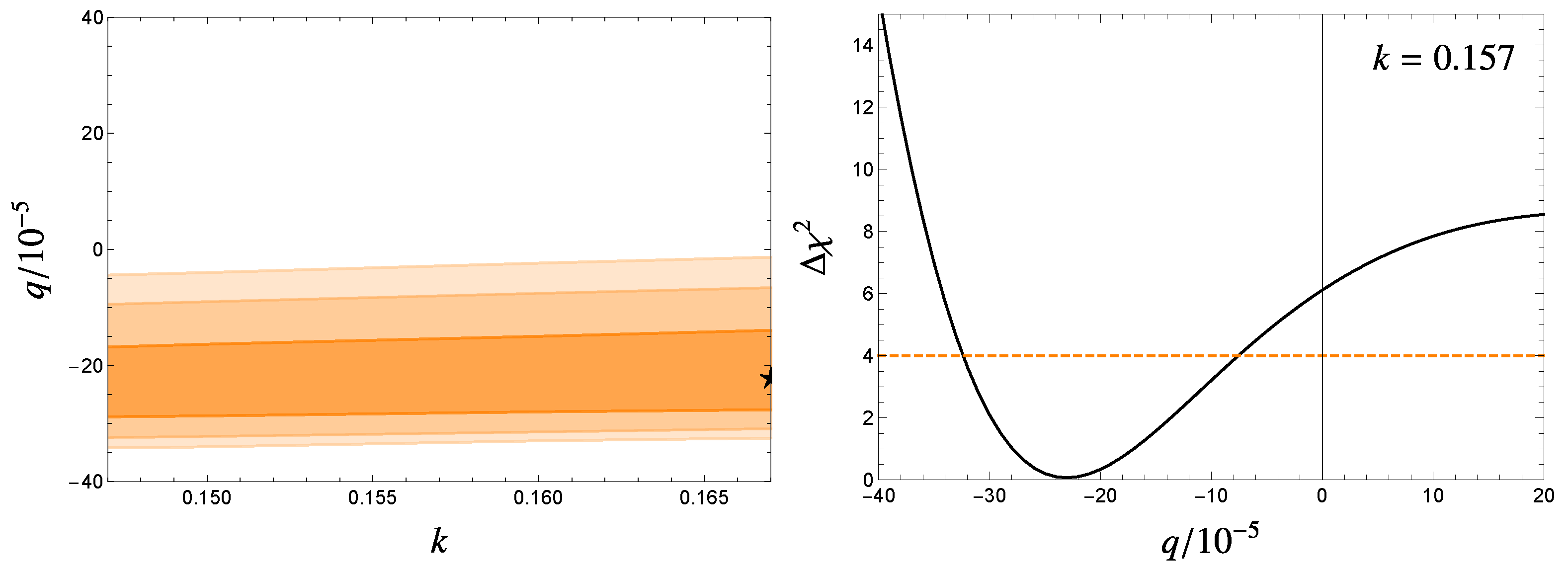
where () is the measured (predicted) number of residual counts per bin and is the corresponding uncertainty with being the percent uncertainty in the reactor neutrino flux normalization. The minimum of is obtained by marginalizing over the auxiliary parameter . We get for the SM with the standard Lindhard model for the quenching factor. Moreover, we find that a modified Lindhard model can improves the fit. In order to be compatible with quenching factor measurements at high recoil energies [13], we only consider k values in the range of [0.147, 0.167]. The 1, 90% CL, and allowed regions in the (k, q) space are shown in Figure 1. The best-fit point is located at and , with . We can see that it is a substantial improvement over the standard Lindhard model. Furthermore, we notice that this best-fit point is consistent with the direct quenching factor measurements of Ref. [9], which can be parametrized by a negative q, as shown in Ref. [17]. Hence, the measured NCC-1701 data provide an independent probe of the quenching factor. From the left panel of Figure 1, we see that the data are not sensitive to k, and negative values of q are preferred. We also plot for in the right panel of Figure 1. We can see that the measured data prefer at CL.
Figure 1.
Left panel: The 1, 90% CL, and allowed regions in the (k, q) plane for the modified quenching factor model. The best fit point is marked by a star. Right panel: for a fixed [18].
We also use the measured CENS spectrum to place constraints on three simple new physics scenarios in the neutrino sector: a light or scalar that couples to neutrinos and quarks universally, and a large neutrino magnetic moment. The differential cross sections of the three new physics scenarios are given in Ref. [18], and we use the same in Equation (8) for our analysis. In order to place constraints on the new physics parameter space, we scan over possible values of the coupling and mediator mass for the light and scalar cases. We also consider two different treatments of the quenching factor: (i) we fix the quenching factor as the standard Lindhard model, and (ii) we reduce the dependence on the quenching factor model by marginalizing over k and q in the modified Lindhard model. The best fit points and /dof values are listed in Table 1. We see that if the standard Lindhard model is assumed for the quenching factor, the data show a mild preference for the new physics scenarios compared to the SM. Furthermore, we find that the constraints are qualitatively affected by the quenching factor model due to its dependence on q [18]. The best-fit value of the neutrino magnetic moment, and the corresponding , are also provided in Table 1. We find that the 90% CL bound from NCC-1701 data is , which is an order of magnitude weaker than the current bound on the electron neutrino magnetic moment by the GEMMA experiment, [19].
Table 1.
Values of /dof for the SM and new physics scenarios with various quenching factor model from the NCC-1701 data.
4. Conclusions
Recent direct measurement of germanium quenching factor indicates a departure from the standard Lindhard model at low energies, and this deviation can be parameterized by a negative q in the modified Lindhard model. The recently measured CENS data can be also used to provide an independent probe of the quenching factor models. We show that the latest measured NCC-1701 data prefer negative values of q in the modified Lindhard model, and the best-fit point is consistent with the direct quenching factor measurements. A precise measurement of the quenching factor is essential to detect new physics at CENS. If the germanium quenching factor is described by the standard Lindhard model correctly, then the NCC-1701 data may indicate the presence of a light vector or scalar or a large neutrino magnetic moment.
Funding
This research was funded by the National Natural Science Foundation of China, grant number 12275368.
Institutional Review Board Statement
Not applicable.
Informed Consent Statement
Not applicable.
Data Availability Statement
Not applicable.
Conflicts of Interest
The author declares no conflict of interest.
References
- Freedman, D.Z. Coherent neutrino nucleus scattering as a probe of the weak neutral current. Phys. Rev. D 1974, 9, 1389. [Google Scholar] [CrossRef]
- Akimov, D.; Albert, J.B.; An, P.; Awe, C.; Barbeau, P.S.; Becker, B.; Belov, V.; Brown, A.; Bolozdynya, A.; Cabrera-Palmer, B.; et al. Observation of coherent elastic neutrino-nucleus scattering. Science 2017, 357, 1123–1126. [Google Scholar] [CrossRef] [PubMed]
- Akimov, D.; Albert, J.B.; An, P.; Awe, C.; Barbeau, P.S.; Becker, B.; Belov, V.; Bernardi, I.; Blackston, M.A.; Blokl, L.; et al. First Measurement of Coherent Elastic Neutrino-Nucleus Scattering on Argon. Phys. Rev. Lett. 2021, 126, 012002. [Google Scholar] [CrossRef] [PubMed]
- Papoulias, D.K.; Kosmas, T.S.; Kuno, Y. Recent probes of standard and non-standard neutrino physics with nuclei. Front. Phys. 2019, 7, 191. [Google Scholar] [CrossRef]
- Aguilar-Arevalo, A.; Bertou, X.; Bonifazi, C.; Cancelo, G.; Castañeda, A.; Vergara, B.C.; Chavez, C.; D’Olivo, J.C.; Dos Anjos, J.C.; Estrada, J.; et al. Exploring low-energy neutrino physics with the Coherent Neutrino Nucleus Interaction Experiment. Phys. Rev. D 2019, 100, 092005. [Google Scholar] [CrossRef]
- Bonet, H.; Bonhomme, A.; Buck, C.; Fülber, K.; Hakenmüller, J.; Heusser, G.; Hugle, T.; Lindner, M.; Maneschg, W.; Rink, T.; et al. Constraints on Elastic Neutrino Nucleus Scattering in the Fully Coherent Regime from the CONUS Experiment. Phys. Rev. Lett. 2021, 126, 041804. [Google Scholar] [CrossRef] [PubMed]
- Colaresi, J.; Collar, J.I.; Hossbach, T.W.; Kavner, A.R.L.; Lewis, C.M.; Robinson, A.E.; Yocum, K.M. First results from a search for coherent elastic neutrino-nucleus scattering at a reactor site. Phys. Rev. D 2021, 104, 072003. [Google Scholar] [CrossRef]
- Colaresi, J.; Collar, J.I.; Hossbach, T.W.; Lewis, C.M.; Yocum, K.M. Suggestive evidence for coherent elastic neutrino-nucleus scattering from reactor antineutrinos. arXiv 2022, arXiv:2202.09672. [Google Scholar]
- Collar, J.I.; Kavner, A.R.L.; Lewis, C.M. Germanium response to sub-keV nuclear recoils: A multipronged experimental characterization. Phys. Rev. D 2021, 103, 122003. [Google Scholar] [CrossRef]
- Klein, S.R.; Nystrand, J. Interference in exclusive vector meson production in heavy ion collisions. Phys. Rev. Lett. 2000, 84, 2330–2333. [Google Scholar] [CrossRef]
- Sierra, D.A.; Liao, J.; Marfatia, D. Impact of form factor uncertainties on interpretations of coherent elastic neutrino-nucleus scattering data. J. High Energy Phys. 2019, 6, 141. [Google Scholar] [CrossRef]
- Lindhard, J.; Nielsen, V.; Scharff, M.; Thomsen, P. Integral equations governing radiation effects. Kgl. Danske Videnskab. Selskab. Mat. Fys. Medd. 1963, 33, 10. [Google Scholar]
- Lin, S.T.; Li, H.B.; Li, X.; Lin, S.K.; Wong, H.T.; Deniz, M.; Fang, B.B.; He, D.; Li, J.; Lin, C.W.; et al. New limits on spin-independent and spin-dependent couplings of low-mass WIMP dark matter with a germanium detector at a threshold of 220 eV. Phys. Rev. D 2009, 79, 061101. [Google Scholar] [CrossRef]
- Lewin, J.D.; Smith, P.F. Review of mathematics, numerical factors, and corrections for dark matter experiments based on elastic nuclear recoil. Astropart. Phys. 1996, 6, 87–112. [Google Scholar] [CrossRef]
- Lindhard, J.; Scharff, M.; Schiott, H.E. Range concepts and heavy ion ranges. Mat. Fys. Medd. Dan. Vid. Selsk. 1963, 33, 14. [Google Scholar]
- Sorensen, P. Atomic limits in the search for galactic dark matter. Phys. Rev. D 2015, 91, 083509. [Google Scholar] [CrossRef]
- Liao, J.; Liu, H.; Marfatia, D. Coherent neutrino scattering and the Migdal effect on the quenching factor. Phys. Rev. D 2021, 104, 015005. [Google Scholar] [CrossRef]
- Liao, J.; Liu, H.; Marfatia, D. Implications of the first evidence for coherent elastic scattering of reactor neutrinos. Phys. Rev. D 2022, 106, L031702. [Google Scholar] [CrossRef]
- Beda, A.; Brudanin, V.; Egorov, V.; Medvedev, D.; Pogosov, V.; Shirchenko, M.; Starostin, A. The results of search for the neutrino magnetic moment in GEMMA experiment. Adv. High Energy Phys. 2012, 2012, 350150. [Google Scholar] [CrossRef]
Disclaimer/Publisher’s Note: The statements, opinions and data contained in all publications are solely those of the individual author(s) and contributor(s) and not of MDPI and/or the editor(s). MDPI and/or the editor(s) disclaim responsibility for any injury to people or property resulting from any ideas, methods, instructions or products referred to in the content. |
© 2023 by the author. Licensee MDPI, Basel, Switzerland. This article is an open access article distributed under the terms and conditions of the Creative Commons Attribution (CC BY) license (https://creativecommons.org/licenses/by/4.0/).