1. Introduction
The intestinal microbiota is a vast community of bacteria, viruses, fungi, and other microbes in the gastrointestinal tract. It is referred to as the “hidden organ” because it functions as an endocrine and immune system, significantly impacting overall human health. Indeed, the intestinal microbiota is a pivotal regulator of host physiology, contributing to essential processes such as nutrient utilization, immune system development, preservation of epithelial barrier function, and defense against pathogen microorganisms. In addition, many of the beneficial effects of the gut microbiota are mediated by bioactive compounds produced through its metabolic activity, known as postbiotics. They are classified on the basis of their chemical structure in carbohydrates and exopolysaccharides, short-chain fatty acids (SCFAs), proteins and peptides, enzymes, vitamins, organic acids and cell wall components [
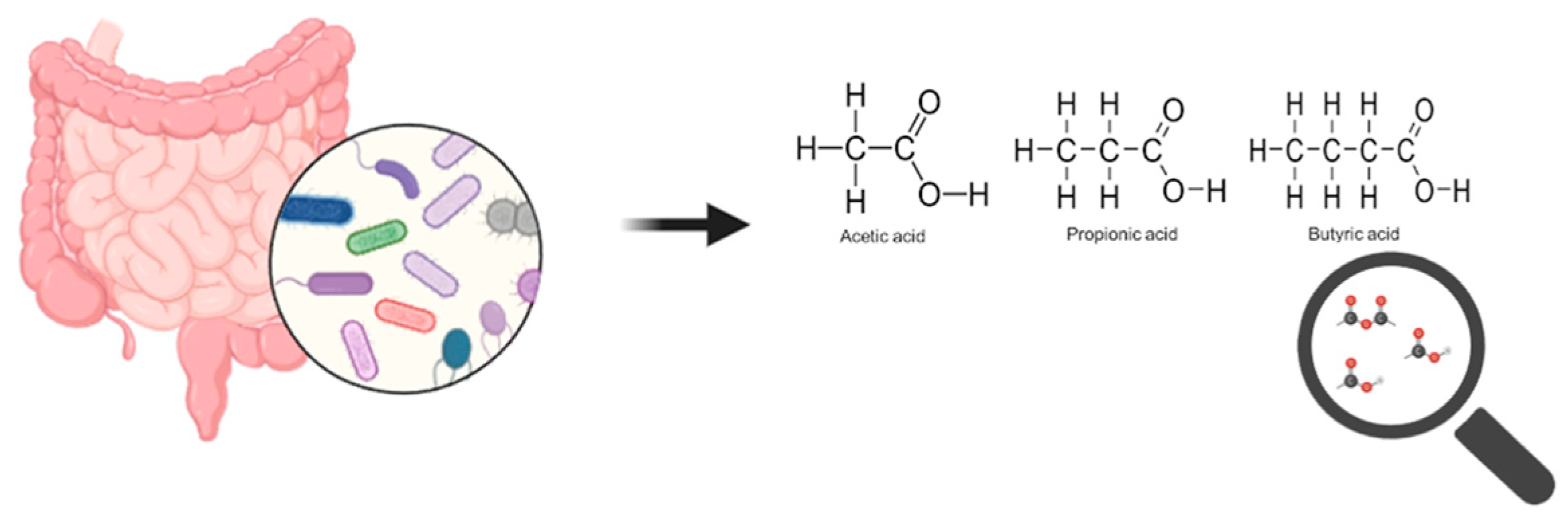
1]. In particular, SCFAs have been extensively investigated owing to their broad physiological functions. Acetate, propionate, and butyrate are produced through the anaerobic fermentation of dietary fibers by commensal bacteria and are integral to the regulation of intestinal physiology, immune function, and systemic metabolic homeostasis (
Figure 1) [
2].
They exert multiple biological effects, including induction of apoptosis, modulation of inflammation, enhancement of epithelial barrier integrity, and regulation of gene expression through mechanisms such as histone deacetylase inhibition and G-protein-coupled receptor signaling. These properties position SCFAs as important mediators of host–microbiota interactions with potential implications for disease prevention and therapy [
3].
It is noteworthy that these biological activities have attracted considerable interest in the context of colorectal cancer (CRC), where SCFAs are thought to influence tumor initiation, progression, and response to therapy by shaping the intestinal microenvironment, directly affecting cancer cell behavior. CRC is a leading cause of cancer-related morbidity and mortality worldwide, with rising incidence in both developed and developing countries. Despite advances in early detection and treatment, therapeutic options for advanced or treatment-resistant CRC remain limited, and prognosis is often poor [
4]. Emerging evidence suggests that modulation of the gut microbiota and its metabolites may influence tumor initiation and progression and enhance the efficacy of conventional therapies.
Nonetheless, it is important to note that the preclinical findings are fragmented and a systematic comparison of dose–response relationships and mechanistic pathways across different CRC models is currently lacking. The clinical translation of laboratory evidence into potential therapeutic applications remains an area that has not yet been extensively explored, thus creating a significant gap between the two fields. In this context, the present systematic review provides a comprehensive synthesis of the anticancer effects of SCFA across in vitro, in vivo and organoid CRC models, integrating mechanistic insights and, where possible, quantitative evidence. The objective of this study is to provide a comprehensive understanding of the role of SCFAs in CRC pathogenesis and, ultimately, to explore the potential of microbiota-informed, tailored therapeutic strategies. This research may contribute to the development of translational and early-phase clinical studies in CRC by integrating SCFA actions with relevant cellular pathways and tumor biology.
2. Materials and Methods
A systematic review was conducted using an Extensive Literature Search (ELS) strategy combined with the PRISMA 2020 (Preferred Reporting Items for Systematic reviews and Meta-Analyses) guidelines [
5]. Searches were performed in PubMed, Scopus, and Web of Science, using MeSH-based keywords. Primary search strings included “postbiotic AND colorectal cancer” and “postbiotic AND colorectal cancer OR tumor”. Secondary terms were incorporated to broaden retrieval, including “butyrate”, “propionate”, “acetate”, “cell-free supernatant”, “Lactobacillus”, “bacteriocins”, “exopolysaccharides”, and “colon organoids”.
Search results were imported into EndNote Web (ClarivateTM, London, UK; accessed 15 March 2025) for duplicate removal and initial screening. The screening of titles and abstracts was performed according to predefined eligibility criteria, followed by full-text assessment for all potentially relevant articles. Only peer-reviewed studies published in English between 2015 and 2025 and investigating postbiotics in CRC-related experimental systems were included.
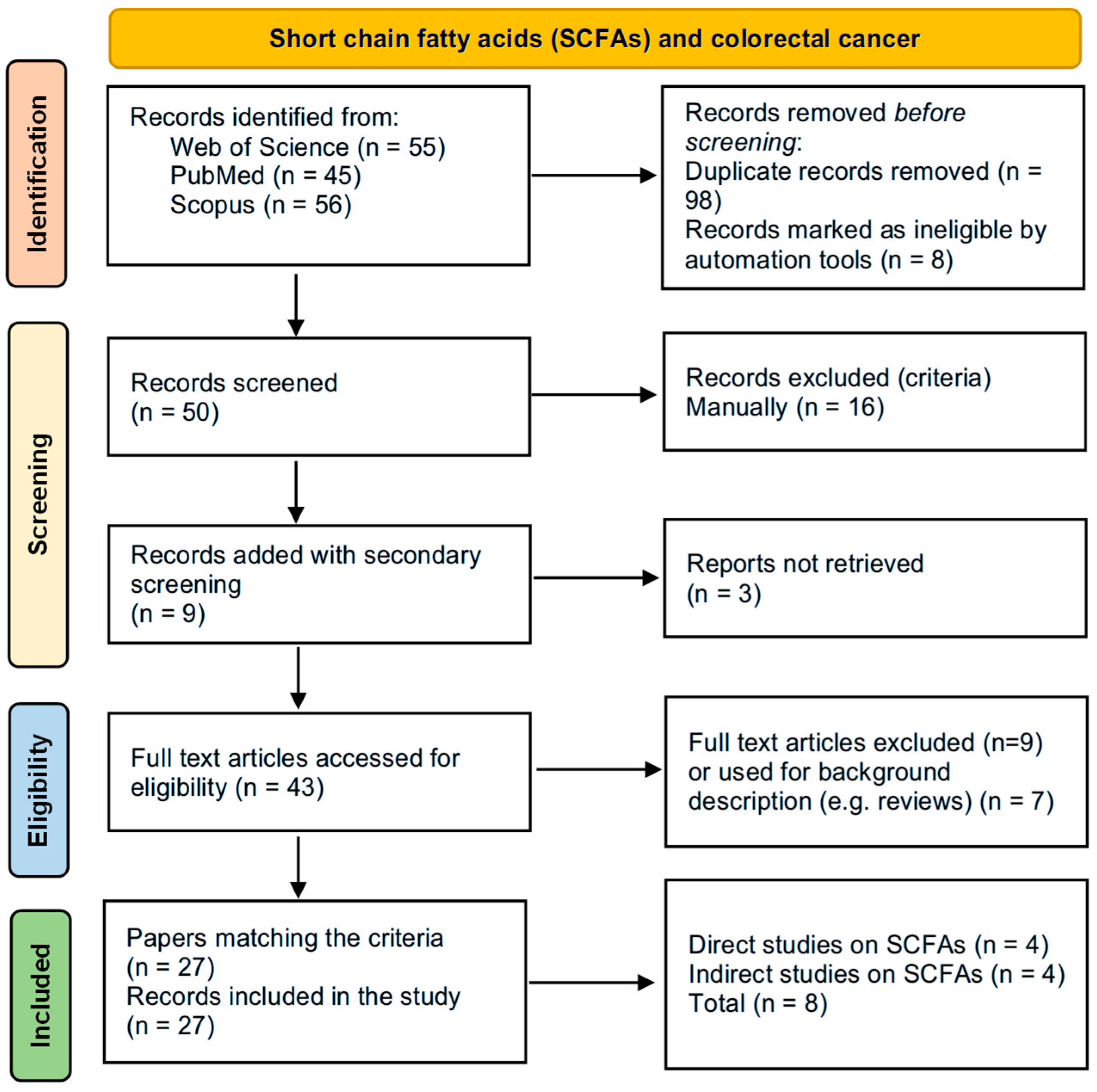
After full-text screening of 27 studies, a refinement step was performed to focus exclusively on studies evaluating SCFAs. Eight studies met this criterion: four directly testing purified SCFAs (e.g., sodium butyrate, acetate, propionate) and four evaluating SCFA-producing bacterial strains or SCFA-rich cell-free supernatants. These studies were included in the mechanistic and quantitative synthesis. The study selection workflow is illustrated in the PRISMA diagram (
Figure 2).
3. Results
Preclinical evidence demonstrates that SCFAs, particularly butyrate, exert robust anticancer effects in CRC models through multiple mechanisms, including tumor growth inhibition, apoptosis induction, anti-inflammatory activity, and immune activation, with the strongest evidence supporting their chemopreventive potential in inflammation-associated carcinogenesis and microsatellite instability tumor subtypes. As illustrated in
Table 1, the studies selected encompass a range of models, including cell lines, animal models and patient-derived organoids. These models are utilized to analyze the primary mechanisms and identify key findings.
3.1. In Vitro Evidence
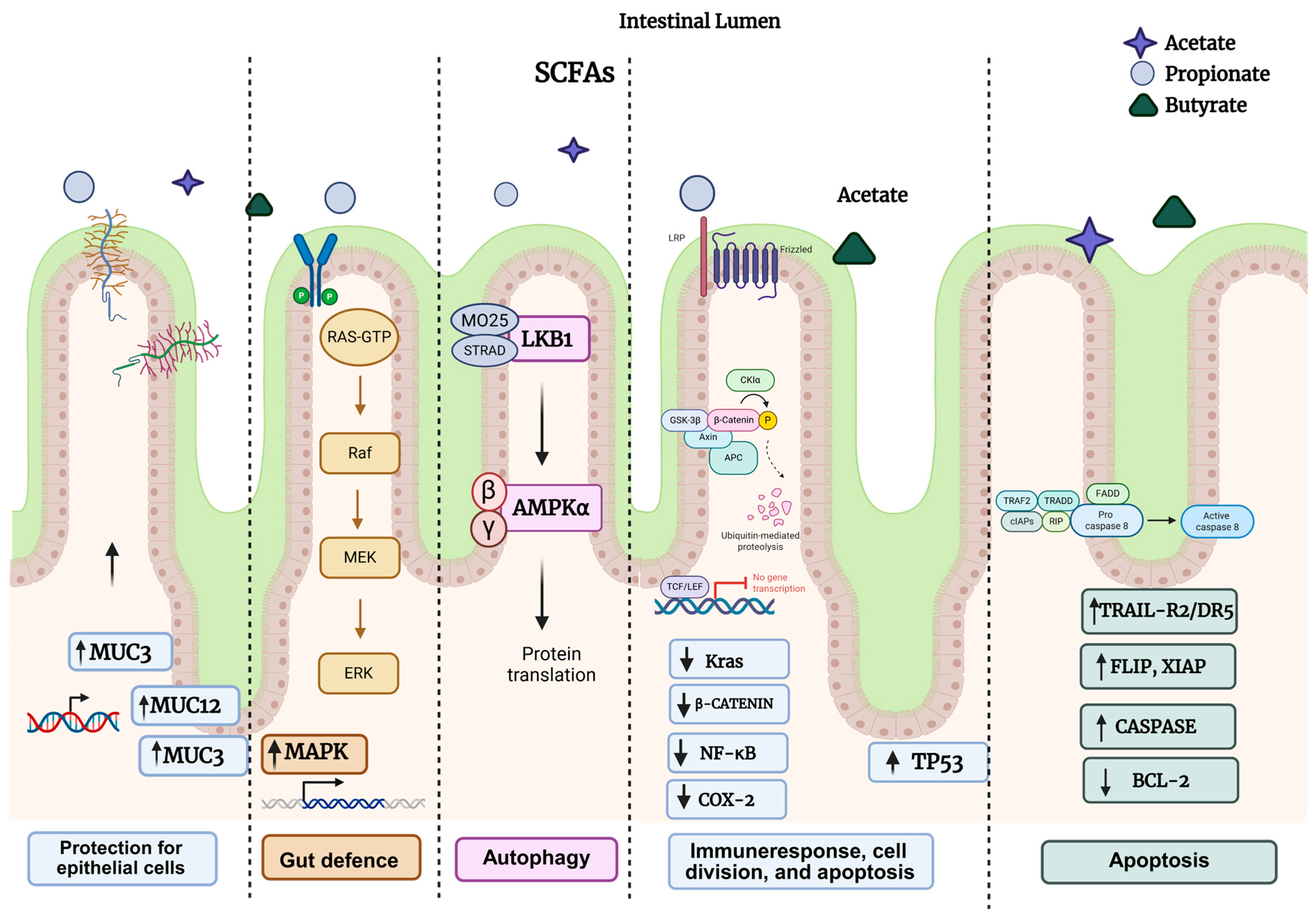
Cell line studies consistently demonstrate that SCFAs, particularly butyrate, induce apoptosis and cell cycle arrest while exhibiting selectivity toward cancer cells over normal epithelium. Luo et al. explored how sodium butyrate (NaB) triggers autophagy in the CRC cell lines HCT-116 and HT-29. Their results showed that NaB exposure promoted autolysosome formation and elevated the phosphorylated forms of key regulators involved in energy sensing, including LKB1, AMPK, and ACC. The study highlighted that activation of the LKB1–AMPK axis is essential for the autophagic response elicited by NaB [
6]. In a separate investigation, Cousin et al. demonstrated that propionate and acetate produced by
Propionibacterium freudenreichii ITG-P9 can activate intrinsic apoptotic pathways in HT-29 and HCT-116 cells, either independently or in conjunction with TRAIL, thereby enhancing cell death signaling [
7]. Another study using LS174T Dukes type B colorectal adenocarcinoma cells showed that butyrate—typically generated by beneficial genera such as
Lactobacillus and
Bifidobacterium—stimulates mucin production in a concentration-dependent manner, with maximal effects observed at 6–9 mM. This increase in mucin content improves probiotic adhesion and activates MAPK signaling, ultimately reinforcing intestinal epithelial defense mechanisms [
8].
3.2. In Vivo Evidence
Sharma and Shukla further investigated postbiotic effects in vivo using Sprague–Dawley rats. Administration of a cell-free supernatant derived from
Lactobacillus rhamnosus MD14, containing multiple metabolites including acetate, propionate, butyrate, acetamide, thiocyanic acid, and oxalic acid, attenuated early colon carcinogenesis. This was reflected by reduced oxidative stress, lower fecal procarcinogenic enzyme activity, and a decrease in aberrant crypt foci. Additionally, the treatment downregulated oncogenic drivers such as
β-catenin,
K-ras,
Cox-2, and
NF-κB while enhancing
TP53 expression, collectively contributing to a near-normal histological appearance of colon tissue [
9].
The most comprehensive quantitative data on tumor outcomes comes from the AOM/DSS mouse model studies. SCFA mixture administration significantly reduced tumor incidence from 8.3 ± 2.4 tumors/mouse to 4.0 ± 1.6 tumors/mouse (
p < 0.001). Tumor size was similarly reduced from 2.5 ± 0.4 mm to 1.3 ± 0.5 mm (
p < 0.001). These findings were corroborated by improvements in disease activity index scores (3.1 ± 0.6 vs. 5.6 ± 1.9;
p = 0.002) and colon inflammation severity scores (0.9 ± 0.7 vs. 2.0 ± 0.8;
p = 0.005) [
10]. SCFAs consistently demonstrated antiproliferative effects across different experimental systems. In the AOM/DSS model, Ki67-positive proliferating cells decreased from 6.8 ± 1.7 to 3.5 ± 1.0 (
p < 0.001) with SCFA treatment. Cell line studies confirmed that SCFAs inhibit colony formation and cell proliferation, with cell-cycle arrest observed at 24 h post-treatment. Butyrate and propionate inhibited growth of colon cancer cell lines, with butyrate demonstrating particularly potent effects.
3.3. Integrated Approaches
A combined in silico–in vitro approach was employed by Erfanian et al. to elucidate how
Lactobacillus acidophilus-derived postbiotics influence CRC cell behavior. Their computational analyses initially identified several Wnt-associated genes—such as
RSPO2,
NGF,
MMP7,
SFRP1,
SFRP2, and
SFRP4—as key regulatory nodes potentially responsive to postbiotic exposure. Subsequent validation in HT-29 cells supported these predictions, showing that treatment with the postbiotic preparation led to marked suppression of proliferative and migratory phenotypes, accompanied by modulation of Wnt pathway components at the transcriptional level [
11]. In a follow-up study, the same group extended their investigation to postbiotics produced by Bifidobacterium breve and
Lactobacillus rhamnosus. Consistent with their previous findings, these preparations also induced apoptosis and inhibited cell proliferation in HT-29 cells. Mechanistically, the effects appeared to converge on pathways associated with Wnt signaling and apoptosis regulation, including alterations in Bax/Bcl-2 ratios and repression of genes involved in tumor-promoting signaling cascades. Together, these studies reinforce the emerging concept that postbiotics from different beneficial gut bacterial species can modulate conserved oncogenic pathways, particularly Wnt-driven transcription, to counteract CRC cell growth and dissemination [
12].
A similar study using an AOM/DSS mouse model of CRC investigated the role of the potential postbiotic putrescine and SCFAs, finding that they reduced the number and size of colonic tumors and downmodulated the release of inflammatory cytokines in the colonic lumen [
13].
A comprehensive summary of mechanisms of action of SCFAs in CRC is presented in
Figure 3.
4. Discussion
Preclinical evidence consistently supports the anticancer potential of SCFAs, particularly butyrate, in CRC models. Across in vitro studies, SCFAs induce apoptosis through caspase activation and death receptor signaling, promote autophagy via the LKB1–AMPK axis, and reinforce epithelial barrier integrity through mucin upregulation and MAPK activation. These effects converge on key hallmarks of CRC, including proliferation, inflammation, and survival pathways. In vivo, SCFA supplementation or SCFA-rich postbiotic preparations significantly reduce tumor burden and inflammatory markers in AOM/DSS models, while metabiotic extracts modulate Wnt/β-catenin and NF-κB signaling, restoring near-normal histology.
Despite these promising findings, heterogeneity in experimental design, SCFA concentrations, and delivery matrices complicates mechanistic attribution. Purified SCFAs allow clearer interpretation, whereas cell-free supernatants introduce compositional complexity, often containing additional metabolites such as polyamines that may synergize or confound observed effects. Furthermore, variability in dosing and lack of standardized pharmacokinetic data limit translational extrapolation. Most studies rely on single-cell lines or chemically induced models, underscoring the need for organoid systems and microbiota-competent animal models to better mimic human CRC biology.
Collectively, these data position SCFAs as modulators of oncogenic signaling networks—Wnt/β-catenin, AMPK, MAPK, and NF-κB—suggesting potential for microbiota-informed interventions. However, clinical validation remains absent. Future research should prioritize standardized dosing, mechanistic confirmation in complex postbiotic mixtures, and early-phase trials assessing safety, tolerability, and biomarker-driven efficacy. Integration of SCFA-based strategies with dietary fiber interventions or conventional therapies may represent a promising avenue for CRC prevention and management.
5. Conclusions
SCFAs represent one of the most biologically active classes of postbiotics currently studied in CRC research. They can modulate apoptosis, autophagy, inflammation, and key signaling pathways such as Wnt/β-catenin, AMPK, MAPK, and NF-κB. These findings highlight SCFAs as promising candidates for microbiota-informed strategies in CRC prevention and therapy. While current evidence is preclinical, the mechanistic insights and tumor-suppressive effects observed across in vitro and in vivo systems provide a strong rationale for translational research. Future studies should focus on standardized dosing, formulation optimization, and early-phase clinical trials to validate efficacy and safety, paving the way for integration of SCFA-based interventions into personalized cancer management.
Author Contributions
Conceptualization and methodology, T.D.; investigation, T.D., C.Z., V.L. and A.D.C.; data curation, T.D.; writing—original draft preparation, T.D. and C.Z.; writing—review and editing, T.D., A.V. and T.V.; funding acquisition, T.D. All authors have read and agreed to the published version of the manuscript.
Funding
This work is part of Ricerca Corrente 2025 (Italian Ministry of Health—project “Relevance assessment of human-based next generation in vitro models for Colorectal Cancer: new perspectives in Cancer Research” (CROB RC2025/01; ID 2791643).
Data Availability Statement
Data Availability Statement: The original contributions presented in this study are included in this article. Further inquiries can be directed at the corresponding author.
Conflicts of Interest
The authors declare no conflicts of interest.
Abbreviations
The following abbreviations are used in this manuscript:
| ACC | Acetyl-CoA Carboxylase |
| AMPK | AMP-Activated Protein Kinase |
| AOM/DSS | Azoxymethane/Dextran Sodium Sulfate |
| CFS | Cell-Free Supernatant |
| CRC | Colorectal Cancer |
| ELS | Extensive Literature Search |
| IL | Interleukin |
| LC-MS/MS | Liquid Chromatography–Tandem Mass Spectrometry |
| MAPK | Mitogen-Activated Protein Kinase |
| NaB | Sodium Butyrate |
| NF-κB | Nuclear Factor kappa-light-chain-enhancer of activated B cells |
| LKB1 | Liver Kinase B1 |
| MeSH | Medical Subject Headings |
| PRISMA | Preferred Reporting Items for Systematic Reviews and Meta-Analyses |
| SCFA | Short-Chain Fatty Acid |
| SR | Systematic Review |
| TNF-α | Tumor Necrosis Factor alpha |
| TP53 | Tumor Protein p53 |
| TRAIL | TNF-Related Apoptosis-Inducing Ligand |
| Wnt | Wingless/Integrated |
References
- D’Amore, T.; Zolfanelli, C.; Lauciello, V.; Di Ciancia, A.; Vagliasindi, A.; Smaoui, S.; Varzakas, T. Using Postbiotics from Functional Foods for Managing Colorectal Cancer: Mechanisms, Sources, Therapeutic Potential, and Clinical Perspectives. Microorganisms 2025, 13, 1335. [Google Scholar] [CrossRef] [PubMed]
- Feizi, H.; Plotnikov, A.; Rezaee, M.A.; Ganbarov, K.; Kamounah, F.S.; Nikitin, S.; Kadkhoda, H.; Gholizadeh, P.; Pagliano, P.; Kafil, H.S. Postbiotics versus Probiotics in Early-Onset Colorectal Cancer. Crit. Rev. Food Sci. Nutr. 2024, 64, 3573–3582. [Google Scholar] [CrossRef] [PubMed]
- Gomes, S.; Baltazar, F.; Silva, E.; Preto, A. Microbiota-Derived Short-Chain Fatty Acids: New Road in Colorectal Cancer Therapy. Pharmaceutics 2022, 14, 2359. [Google Scholar] [CrossRef] [PubMed]
- Bray, F.; Laversanne, M.; Sung, H.; Ferlay, J.; Siegel, R.L.; Soerjomataram, I.; Jemal, A. Global Cancer Statistics 2022: GLOBOCAN Estimates of Incidence and Mortality Worldwide for 36 Cancers in 185 Countries. CA A Cancer J. Clin. 2024, 74, 229–263. [Google Scholar] [CrossRef] [PubMed]
- Page, M.J.; McKenzie, J.E.; Bossuyt, P.M.; Boutron, I.; Hoffmann, T.C.; Mulrow, C.D.; Shamseer, L.; Tetzlaff, J.M.; Akl, E.A.; Brennan, S.E.; et al. The PRISMA 2020 Statement: An Updated Guideline for Reporting Systematic Reviews. Syst. Rev. 2021, 10, 89. [Google Scholar] [CrossRef] [PubMed]
- Luo, S.; Li, Z.; Mao, L.; Chen, S.; Sun, S. Sodium Butyrate Induces Autophagy in Colorectal Cancer Cells through LKB1/AMPK Signaling. J. Physiol. Biochem. 2019, 75, 53–63. [Google Scholar] [CrossRef] [PubMed]
- Cousin, F.J.; Jouan-Lanhouet, S.; Théret, N.; Brenner, C.; Jouan, E.; Moigne-Muller, G.L.; Dimanche-Boitrel, M.-T.; Jan, G. The Probiotic Propionibacterium Freudenreichii as a New Adjuvant for TRAIL-Based Therapy in Colorectal Cancer. Oncotarget 2016, 7, 7161–7178. [Google Scholar] [CrossRef] [PubMed]
- Jung, T.-H.; Park, J.H.; Jeon, W.-M.; Han, K.-S. Butyrate Modulates Bacterial Adherence on LS174T Human Colorectal Cells by Stimulating Mucin Secretion and MAPK Signaling Pathway. Nutr. Res. Pract. 2015, 9, 343–349. [Google Scholar] [CrossRef] [PubMed]
- Sharma, M.; Shukla, G. Administration of Metabiotics Extracted From Probiotic Lactobacillus Rhamnosus MD 14 Inhibit Experimental Colorectal Carcinogenesis by Targeting Wnt/β-Catenin Pathway. Front. Oncol. 2020, 10, 746. [Google Scholar] [CrossRef] [PubMed]
- Tian, Y.; Xu, Q.; Sun, L.; Ye, Y.; Ji, G. Short-Chain Fatty Acids Administration Is Protective in Colitis-Associated Colorectal Cancer Development. J. Nutr. Biochem. 2018, 57, 103–109. [Google Scholar] [CrossRef] [PubMed]
- Erfanian, N.; Nasseri, S.; Miraki Feriz, A.; Safarpour, H.; Namaei, M.H. Characterization of Wnt Signaling Pathway under Treatment of Lactobacillus Acidophilus Postbiotic in Colorectal Cancer Using an Integrated in Silico and in Vitro Analysis. Sci. Rep. 2023, 13, 22988. [Google Scholar] [CrossRef] [PubMed]
- Erfanian, N.; Safarpour, H.; Tavakoli, T.; Mahdiabadi, M.A.; Nasseri, S.; Namaei, M.H. Investigating the Therapeutic Potential of Bifidobacterium Breve and Lactobacillus Rhamnosus Postbiotics through Apoptosis Induction in Colorectal HT-29 Cancer Cells. Iran. J. Microbiol. 2024, 16, 68–78. [Google Scholar] [CrossRef] [PubMed]
- Oliero, M.; Cuisiniere, T.; Ajayi, A.S.; Gerkins, C.; Hajjar, R.; Fragoso, G.; Calvé, A.; Vennin Rendos, H.; Mathieu-Denoncourt, A.; Dagbert, F.; et al. Putrescine Supplementation Limits the Expansion of Pks+ Escherichia Coli and Tumor Development in the Colon. Cancer Res. Commun. 2024, 4, 1777–1792. [Google Scholar] [CrossRef] [PubMed]
| Disclaimer/Publisher’s Note: The statements, opinions and data contained in all publications are solely those of the individual author(s) and contributor(s) and not of MDPI and/or the editor(s). MDPI and/or the editor(s) disclaim responsibility for any injury to people or property resulting from any ideas, methods, instructions or products referred to in the content. |




 ,
,