


Abstract
Background: Quality of life is a foundational component of overall health and is negatively impacted by post-traumatic stress disorder (PTSD). In the last decade, acupuncture treatment has become a popularized treatment option for PTSD, especially for Veterans. Research evidence is needed to provide support for acupuncture as a treatment for PTSD which leads to an enhanced quality of life. Objectives: This paper investigated the changes in health-related quality of life in Veterans with combat PTSD who enrolled in a 5-year randomized (two-arm, parallel-group, prospective, single-blinded) clinical trial, completing either a control (Sham) or acupuncture (Verum) treatment (N = 93). Methods: Health-related quality of life was measured by the Veterans RAND 12-item Health Survey (VR-12). Paired t tests between and among participants’ differences were calculated for the Verum acupuncture group, Sham acupuncture group, and Total group. Results: Veterans who completed acupuncture treatment in either randomized arm (Verum and Sham) had a self-perceived improvement in quality of life when assessing physical and mental health symptoms. Specifically, those who were randomized and completed Verum acupuncture treatment reported the greatest improvement in mental health quality of life. Conclusions: Study results support prior foundational findings that acupuncture has a positive effect on self-reported quality of life by reducing PTSD symptoms in Veterans with combat PTSD, with Verum acupuncture eliciting the greatest improvement on mental health symptoms.
1. Introduction
1.1. Origin of Acupuncture Treatment
Acupuncture treatment originated in China during the clan commune period, approximately 4000–6000 years ago [1]. Through trade and cultural exchanges, acupuncture spread to Japan, Korea, Southeast Asia, and, later, India. In the 16th century, France greatly contributed to acupuncture being spread throughout Europe [1]. With time, due to globalization, and through the advancement of technology, techniques of acupuncture have evolved to become a popularized treatment option for enhancing overall health and reducing the impact of often comorbid mental and physical symptoms.
1.2. Brief Overview of Acupuncture
There are numerous acupuncture points over the human body which serve both as pathways of “circulation of qi and blood” and “loci of responses to diseases” [1]. Proper techniques of needle insertion and manipulation are applied at acupuncture points to increase the body’s strength to treat and prevent disease. In addition, proper needle insertion assists in the regulation of the body’s functional activities. Over the ages, practitioners of acupuncture have created recordings “describing the locations and indications of acupuncture points” formulating a systematic theory [1].
1.3. Acupuncture Treatment in Veterans
Utilization of acupuncture as a treatment for Veterans at the Veterans Health Administration (VA) has been increasing in the last decade as part of the Whole Health Initiative [2]. In May 2017, VA included acupuncture as a “covered treatment” option in the Veterans’ medical benefits package, initiated by Directive 1137. Interest has grown so much that the VA restructured the program in December 2022 to add acupuncture as an option to “complement conventional health care” [3]. Moreover, acupuncture as a treatment for post-traumatic stress disorder (PTSD) in Veterans has emerged with promising results in the last decade [4,5].
1.4. PTSD and Quality of Life
A Veteran’s quality of life is negatively impacted by PTSD in several ways. Interpersonally, PTSD has been found to impair several life domains, including occupational, academic, marital, friendship, and family functioning [6,7,8,9]. At the individual level, PTSD causes emotional and cognitive challenges, such as intrusive thoughts, sleep disturbances, flashbacks, challenges with concentration, and irritability, that impact their psychological functioning [10]. A diagnosis of PTSD requires that symptoms cause distress and interfere with social functioning, and/or occupational/other important areas of functioning [10].
Though PTSD is largely recognized as a mental disorder, it also impacts physical health. Increased PTSD symptoms have been found to be associated with poorer mental and physical health in Veterans [11]. PTSD was also found to be independently associated with an increase in medical illnesses and more frequent use of health care. Over time, the relationship between PTSD and medical illnesses has been shown to have strengthened [12]. Other studies have indicated that rates of smoking, alcohol consumption, and other behavioral risks are higher in Veteran populations with PTSD, while they simultaneously have lower rates of engagement in preventative health behaviors and diminished health scores [13,14,15,16].
1.5. Current Paper and Main Study Overview
The current paper is an investigation into the changes in self-reported health-related quality of life in Veterans with combat PTSD that have completed acupuncture treatment. Health-related quality of life was measured by the Veterans RAND 12-item Health Survey (VR-12). See Section 2.3.2 (below) for psychometric properties of VR-12.
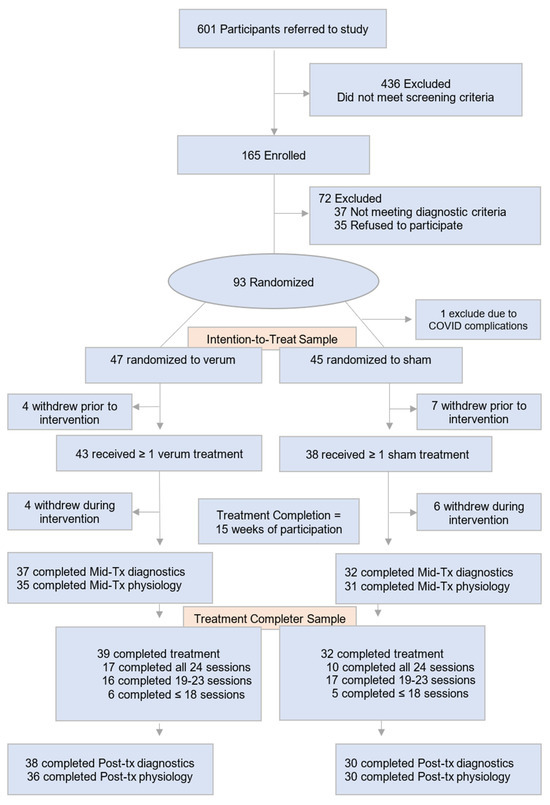
This current study is a secondary analysis of data from a published randomized controlled trial study of acupuncture for PTSD in Veterans [5]. That main study was a two-arm, parallel-group, prospective, single-blinded, randomized clinical trial (RCT) that hypothesized the superiority of Verum to Sham acupuncture in symptom reduction for Veterans with combat PTSD. It was designed to address previous limitations by comparing Verum (active) vs. Sham (placebo) procedures in an adequately powered sample assessing clinical and biological outcomes and monitoring protocol adherence. See Figure 1 for the study flow.
Figure 1.
Participant recruitment flowchart.
1.6. Current Study Hypotheses
We hypothesized that Verum acupuncture treatment will result in greater improvements from pre- to post-treatment in health-related quality of life than Sham acupuncture treatment in Veterans with combat PTSD.
2. Materials and Methods
2.1. Ethics and IRB
The original study received institutional review board approval by the Tibor Rubin VA Medical Center, and data were monitored by the Veterans Health Administration Office of Research and Development. This study was registered on 8 August 2016 at ClinicalTrials.gov under NCT02869646 (https://clinicaltrials.gov/study/NCT02869646, accessed on 9 August 2025).
2.2. Recruitment, Inclusion and Exclusion Criteria
Recruitment for the main RCT was carried out from April 2018 to May 2022 using flyers, email, and in-person recruitment at VA Hospital in Long Beach, California. Inclusion criteria were Veterans between the ages of 18 and 55 meeting diagnostic criteria per the Diagnostic and Statistical Manual (DSM-5) for PTSD, with a severity score of >26 on the Clinician-Administered PTSD Scale-5 (CAPS-5). The exclusion criteria included variables that are known PTSD treatment confounders, might affect biological assessment, indicate past non-adherence or treatment resistance, or indicate a risk of harm.
2.3. Intervention and Measures
2.3.1. Acupuncture
Individual treatment sessions for Verum and Sham acupuncture were one-hour-long, carried out twice per week for up to 15 weeks to complete 24 sessions, and structured to reflect clinical practice. Sessions were structured with an interview, pulse and tongue observation, standard needling, and needle retention. Participants were blinded to group assignment and received alternating front and back treatment. Fidelity to protocol was also established. Adverse events and serious adverse events were assessed upon each study visit. Although acupuncturists were not blind to the intervention, fidelity video assessment suggested that participants were. This design enhanced internal validity and better assessed the specific effect of Verum acupuncture compared with that of minimal needling [5]. Verum acupuncture was delivered vis a protocol that was empirically developed to use 11 front alternating and 13 back points, with up to three additional points selected to address current constitutional factors [17]. Sham acupuncture used the same number of alternating points using “non-points” near acupoints not expected to have an effect on PTSD.
2.3.2. Veterans RAND 12-Item Health Survey (VR-12)
The VR-12 is a 12-item self-report questionnaire for assessing health-related quality of life and disease burden [18]. The VR-12 is a valid and reliable measure and has been utilized on Veterans since 1997 [18,19]. The questionnaire queries several health domains, including “general health perceptions, physical functioning, role limitations due to physical and emotional problems, bodily pain, energy-fatigue, social functioning, and mental health” [18]. For all 12 questions, respondents can choose from a Likert scale to select their best response. Response items are then summarized into two scores—a Physical Component Summary (PCS) score and a Mental Component Summary (MCS) score. “Higher scores” are interpreted as better quality of life.
Outcomes for the current study were the pre- to post-intervention changes in the VR-12. Internal consistency reliability (Cronbach α) was estimated to be at 0.90 for PCS and MCS. PCS and MCS scores from VR-12 were also found to account for 92% of the reliable variance from previous VR assessment versions.
2.4. Data Analyses
All randomized participants were included in analysis. Paired t tests and effect sizes for between- and among-participant differences were calculated for the Verum acupuncture group, Sham acupuncture group, and Total group (which included both Verum and Sham acupuncture). Data were missing due to computer error and participant withdrawal from testing; individuals with missing data were not included in the analyses.
3. Results
Table 1 shows the demographic characteristics of participants and that there were no differences between the Verum and Sham groups.
Table 1.
Table of demographics.
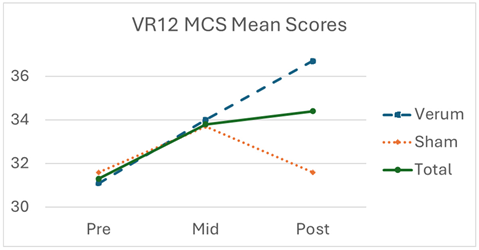
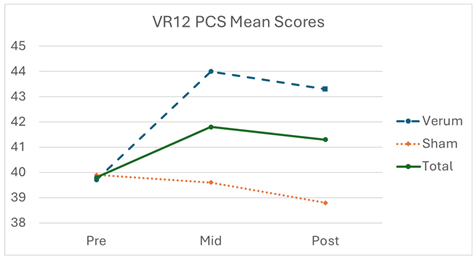
The analyses only included two time points representing primary outcomes, pre- and post-treatment, for treatment completers. Differences and p values were calculated for pre- and post-treatment completers, as shown in Table 2 and Table 3. The figures and tables below also show mid-point data as a visual for the reader.
Table 2.
VR-12 MCS mean scores.
Table 3.
VR-12 PCS mean scores.
3.1. Primary Analysis of MCS Findings
Among the VR-12 MCS scores, there was a statistically significant change found (with a medium effect size) in the Verum treatment group from pre (31.1[10.1])- to post (36.7[11.1])-treatment (n = 39, Δ = 5.22, paired t = 2.83, p = 0.01, d = 0.53).
There was also a statistically significant change found (with a small effect size) in the Total treatment group from pre (31.3[9.2])- to post (34.4[11.4])-treatment (Δ = 2.55, paired t = 2.01, p = 0.049, d = 0.12).
Lastly, the degree of change in VR-12 MCS scores (from pre- to post-treatment) was larger in the Verum group than the change in scores in the Sham group (n = 39, Δ= −5.22 vs. n = 32, Δ = 0.71; t = 2.40, p = 0.002).
3.2. Primary Analysis of PCS Findings
Among the VR-12 PCS scores, there was a statistically significant change found (with a small effect size) in the Total group from pre (39.8[10.8])- to post (41.3[10.9])-treatment (Δ = 2.85, paired t = 2.56, p =0.01, d = 0.30) but no significant pre- to post-treatment change for the Verum group, the Sham group, or the between-group comparison.
3.3. Percentage of Clinically Relevant Change at the Individual Level
The percentage of participants who experienced a clinically relevant change in mental health (MCS) and physical health (PCS) symptoms for each treatment group from pre- to post-treatment at the individual level (versus the population level) was calculated. In other words, the percentage of participants in each treatment group (Verum and Sham) who experienced a clinically relevant change in their PCS and MCS scores was examined. A clinically relevant change (at the individual level) is defined as an increase in score of 6.5 for PCS and 7.9 for MCS [20].
Although the Verum group showed a greater percentage of individual participants who experienced a clinically relevant change than the Sham group for MCS (38.5% vs. 18.8%), the difference was not statistically significant.
Similarly, the Verum group showed a greater percentage of individual participants who experienced a clinically relevant change than the Sham group for PCS (35.9% vs. 28.1%), though this difference also did not achieve statistical significance.
4. Discussion
4.1. Discussion of Results
It was originally hypothesized that Verum acupuncture would result in a greater improvement in health-related quality of life (in terms of both physical and mental symptoms) than Sham acupuncture in Veterans with combat PTSD from pre- to post-treatment. The current findings generally support this hypothesis for mental health symptoms, but surprisingly not for physical health symptoms.
Overall, a statistically significant improvement (with a medium effect size) in quality of life, as measured by mental health symptoms from pre- to post-treatment, was found for participants who completed Verum acupuncture, consistent with the original hypothesis.
A statistically significant improvement (with a small effect size) in quality of life, as measured by mental health symptoms, was also found in both the Verum and Total group, but not the Sham group. The Total group included both types of acupuncture treatment (Verum and Sham). The lack of significance in the Sham group may suggest that while receiving some acupuncture treatment (Verum or Sham) may have some positive impact on mental health-related quality of life, the impact is much stronger when Verum acupuncture is provided.
When examining physical health symptoms, a statistically significant improvement (with a small effect size) was found in the Total group, but not for the individual Verum or Sham groups. It is important to re-emphasize that the Total group involved a combination of data from both the Verum and Sham acupuncture types. This finding indicates that both types of acupuncture, and not specifically one type over the other, resulted in some improvement in quality of life. This is somewhat inconsistent with the original hypothesis, which posits greater improvement from Verum treatment. With further investigation and a larger sample size, it should be determined if this is extant data.
Importantly, no statistically significant improvements were noted in either mental health or physical health symptoms for those specifically receiving Sham acupuncture; only a numeric improvement in scores was observed.
Additional intragroup analyses of each of the acupuncture treatment modalities (Verum and Sham) yielded more insights. Within the Verum acupuncture group, statistical significance for improvements in mental health symptoms was reached, but not for physical health symptoms, though the values for the latter approached significance (p = 0.06). In other words, physical health symptoms appear to have improved for those who received Verum acupuncture, but mental health symptoms improved to a greater extent. This result was not fully expected because acupuncture is commonly known as a somatic or physical intervention for physical ailments such as chronic pain, gastrointestinal diseases, and osteoarthritis [21,22,23,24,25,26,27]. On the other hand, the acupuncture protocol was developed specifically for PTSD, suggesting that the specificity of the current protocol likely plays an important and meaningful role in targeting intended symptoms, and further supporting acupuncture as a treatment for mental health disorders such as depression, insomnia, and anxiety [21,22,23,24,25]. This study shows support for acupuncture resulting in improvements in both mental health- and physical health-related quality of life, with Verum treatment demonstrating better outcomes.
4.2. Population-Level Changes in PCS and MCS
Though minimal, small changes of 1–2 points in the PCS and MCS scores at the population level have been shown to have implications on the social, clinical, and policy levels [20,26,27,28,29]. At the population level, a one-point increase in PCS scores has been associated with lower rates of total health care and pharmacy expenditures and lower rates of hospital inpatient, outpatient, and medical provider visits [20]. A one-point increase at the population level in MCS scores has also been associated with lower rates of total health care and pharmacy expenditures and lower rates of hospital inpatient visits and medical provider visits [20]. These “small” changes were found in this study and reflect the positive potential impact of acupuncture for PTSD.
4.3. Individual-Level Changes in PCS and MCS
At the individual level, an improvement in score of 7.9 units in MCS and 6.5 units in PCS are considered clinically important [20,27,28,29]. Though a secondary analysis, the importance of how many individuals benefitted from acupuncture is crucial, especially for clinicians and patients looking for “non-traditional” treatment options for PTSD.
Of the participants who completed Verum acupuncture, 38.5% of participants experienced a meaningful improvement in mental health symptoms, compared to 18.8% participants in the Sham acupuncture group. In total, 35.9% of participants in the Verum acupuncture group experienced a meaningful improvement in physical health symptoms, compared to 28.1% participants in the Sham acupuncture group.
While both treatment groups (Verum and Sham) reported clinically meaningful changes for both physical and mental health symptoms (yet not at the statistically significant level), it is worth highlighting that over a third of participants in the Verum treatment group reported meaningful improvements in their quality of life subsequent to study participation for both mental and physical health symptoms. Additionally, it is worth noting that even participants in the Sham acupuncture group, despite this intervention being purposely designed as a placebo comparator, experienced an improvement in both physical and mental health symptoms.
4.4. Clinical Implications
This study’s results have important clinical implications for the treatment of PTSD and the range of therapeutic options available to Veterans. For Veterans who have not benefited from “conventional” PTSD treatments or who are seeking complementary approaches, these findings provide foundational evidence supporting the use of acupuncture as an effective treatment option.
The primary analysis [5] demonstrated that acupuncture significantly reduced PTSD symptom severity among Veterans. This current secondary analysis showed additional improvements in quality of life, suggesting that the benefits of acupuncture extend beyond symptom reduction to overall well-being. These findings support the use of acupuncture and the meaningful therapeutic benefits it has for Veterans experiencing PTSD, exemplifying improvements in (both mental health- and physical health-related) quality of life aspects that, unfortunately, PTSD can negatively impact. With continued research showing positive outcomes for acupuncture, more options will become accessible for Veterans to augment traditional treatment.
4.5. Strengths, Limitations, and Future Direction
This study and data analysis exemplify the several strengths of a randomized controlled trial design. By employing a Verum and an active control Sham group, this study allowed the data to control for any potential placebo effects that may have arisen from having received any treatment at all. Although not examined in the current data analysis, the design of the overall study was structured to capture data at several time points throughout the study, including pre-, mid-, and post-treatment, allowing for various data analyses. In addition, the utilization of the VR-12, a well-established questionnaire in the Veteran population, was decided upon in order to capture a more functional perspective rather than purely a symptomatologic perspective of the impact of acupuncture treatment on PTSD symptom severity.
Limitations of this study do exist, such as the geographical recruitment restrictions that only included Southern California and the recruitment of a predominately biologically male study population. While the sample size was adequate for statistical analysis of the primary study objective, it may not have been sufficient for finding differences pre–post-treatment according to the VR-12. Further, complete data collection was challenging and contributed to having incomplete data at the post-treatment mark.
Future directions may include capturing more data timepoints such as an additional follow-up period post-treatment to determine the potential generalizability and durability of acupuncture treatment, stronger efforts and incentives for completing questionnaires at all time points, and the recruitment of a more diverse recruitment population.
5. Conclusions
This study found that Veterans with PTSD who completed Verum acupuncture treatment had a greater improvement in quality of life in mental health symptoms than physical health symptoms. Overall, it was found that acupuncture treatment (both Verum and Sham) resulted in some improvement in both physical and mental health related quality of life symptoms. The current study’s findings support prior foundational findings that acupuncture has a positive effect on quality of life for Veterans with combat-related PTSD. Furthermore, it provides information for clinicians and those affected by PTSD about acupuncture as a viable treatment option for PTSD.
Author Contributions
Conceptualization: A.M., J.L.-T., M.H. and A.-F.H.; methodology: A.M., T.S. and M.H.; software: T.S., A.M., K.C. and R.A.; formal analysis: T.S. and M.H.; investigation: T.C., A.M., K.C., R.A. and N.N.F.; resources: A.K., M.J., S.D.N. and T.J.; data curation: K.C., J.L.-T., A.M. and R.A.; writing—original draft preparation: A.M., M.H., T.S. and J.L.-T.; writing—review and editing: All authors; visualization: A.M., T.S. and J.L.-T.; supervision: M.H., A.-F.H. and N.N.F.; project administration: J.L.-T., C.A., K.C., A.M., N.N.F., T.C. and R.A.; funding acquisition: M.H. All authors have read and agreed to the published version of the manuscript.
Funding
This trial was supported by Veterans Health Administration grant #5I01CX001416-02.
Institutional Review Board Statement
The original study received institutional review board approval by Tibor Rubin VA Medical Center (MIRB #1414; date of approval: 18 June 2016), and data were monitored by Veterans Health Administration Office of Research and Development. This study was registered on 8 August 2016 at ClinicalTrials.gov under NCT02869646 (https://clinicaltrials.gov/study/NCT02869646).
Informed Consent Statement
Informed consent was obtained from all subjects involved in the study.
Data Availability Statement
Data sharing will be considered via negotiation between interested partners and authors with VA IRB participation.
Acknowledgments
Karen Cocozza, Tibor Rubin VA Medical Center, is acknowledged for her clinical contribution to the main study as a study acupuncturist. J. Matthew Brand, University of California, Irvine, is acknowledged for his clinical contribution to the main study as a study acupuncturist while employed at Tibor Rubin VA Medical Center (no additional compensation was received). Chris Reist, Science 57, is acknowledged for the administrative and content support provided for the project (no compensation was received).
Conflicts of Interest
The authors declare no conflicts of interest.
References
- Cheng, X. Chinese Acupuncture and Moxibustion; Foreign Languages Press: Beijing, China, 2010. [Google Scholar]
- VA Health Care. FY 2015 VHA Complementary & Integrative Health (CIH) Services; The United States Department of Veterans Affairs: Washington DC, USA, 2015.
- VA Health Care. VHA Directive 1137 Provision of Complementary and Integrative Health; The United States Department of Veterans Affairs: Washington DC, USA, 2022.
- Kwak, H.Y.; Leem, J.; Seung, H.B.; Kwon, C.Y.; Jeong, H.S.; Kim, S.H. Acupuncture Therapy for Military Veterans Suffering from Posttraumatic Stress Disorder and Related Symptoms: A Scoping Review of Clinical Studies. Healthcare 2023, 11, 2957. [Google Scholar] [CrossRef] [Scilit]
- Hollifield, M.; Hsiao, A.F.; Smith, T.; Calloway, T.; Jovanovic, T.; Smith, B.; Carrick, K.; Norrholm, S.D.; Munoz, A.; Alpert, R.; et al. Acupuncture for Combat-Related Posttraumatic Stress Disorder: A Randomized Clinical Trial. JAMA Psychiatry 2024, 81, 545–554. [Google Scholar] [CrossRef] [Scilit]
- Norman, S.B.; Schmied, E.; Larson, G.E. Predictors of continued problem drinking and substance use following military discharge. J. Stud. Alcohol Drugs 2014, 75, 557–566. [Google Scholar] [CrossRef] [Scilit]
- McCaslin, S.E.; Maguen, S.; Metzler, T.; Bosch, J.; Neylan, T.C.; Marmar, C.R. Assessing posttraumatic stress related impairment and well-being: The Posttraumatic Stress Related Functioning Inventory (PRFI). J. Psychiatr. Res. 2016, 72, 104–111. [Google Scholar] [CrossRef] [Scilit]
- Rodriguez, P.; Holowka, D.W.; Marx, B.P. Assessment of posttraumatic stress disorder-related functional impairment: A review. J. Rehabil. Res. Dev. 2012, 49, 649–665. [Google Scholar] [CrossRef] [Scilit] [PubMed]
- Sherman, M.D.; Larsen, J.; Straits-Troster, K.; Erbes, C.; Tassey, J. Veteran-child communication about parental PTSD: A mixed methods pilot study. J. Fam. Psychol. 2015, 29, 595–603. [Google Scholar] [CrossRef] [Scilit]
- American Psychiatric Association. Diagnostic and Statistical Manual of Mental Disorders, 5th ed.; American Psychiatric Association: Washington, DC, USA, 2022. [Google Scholar]
- Asnaani, A.; Reddy, M.K.; Shea, M.T. The impact of PTSD symptoms on physical and mental health functioning in returning veterans. J. Anxiety Disord. 2014, 28, 310–317. [Google Scholar] [CrossRef] [Scilit] [PubMed]
- Possemato, K.; Wade, M.; Andersen, J.; Ouimette, P. The impact of PTSD, depression, and substance use disorders on disease burden and health care utilization among OEF/OIF veterans. Psychol. Trauma Theory Res. Pract. Policy 2010, 2, 218–223. [Google Scholar] [CrossRef] [Scilit]
- Smith, T.C.; Wingard, D.L.; Ryan, M.A.; Kritz-Silverstein, D.; Slymen, D.J.; Sallis, J.F. PTSD prevalence, associated exposures, and functional health outcomes in a large, population-based military cohort. Public Health Rep. 2009, 124, 90–102. [Google Scholar] [CrossRef] [Scilit] [PubMed]
- Buckley, T.; Mozley, S.; Bedard, M.; Dewulf, A.-C.; Grief, J. Preventive health behaviors, health-risk behaviors, physical morbidity, and health-related role functioning impairment in veterans with postraumatic stress disorder. Mil. Med. 2004, 169, 536–540. [Google Scholar] [CrossRef] [Scilit]
- Vasterling, J.J.; Schumm, J.; Proctor, S.P.; Gentry, E.; King, D.W.; King, L.A. Posttraumatic stress disorder and health functioning in a non-treatment-seeking sample of Iraq war veterans: A prospective analysis. J. Rehabil. Res. Dev. 2008, 45, 347–358. [Google Scholar] [CrossRef] [Scilit]
- LeardMann, C.A.; Smith, T.C.; Smith, B.; Wells, T.S.; Ryan, M.A. Baseline self reported functional health and vulnerability to post-traumatic stress disorder after combat deployment: Prospective US military cohort study. BMJ 2009, 338, b1273. [Google Scholar] [CrossRef] [Scilit]
- Sinclair-Lian, N.; Hollifield, M.; Menache, M.; Warner, T.; Viscaya, J.; Hammerschlag, R. Developing a traditional chinese medicine diagnostic structure for post-traumatic stress disorder. J. Altern. Complement. Med. 2006, 12, 45–57. [Google Scholar] [CrossRef] [Scilit]
- Selim, A.J.; Rothendler, J.A.; Qian, S.X.; Bailey, H.M.; Kazis, L.E. The History and Applications of the Veterans RAND 12-Item Health Survey (VR-12). J. Ambul. Care Manag. 2022, 45, 161–170. [Google Scholar] [CrossRef] [Scilit] [PubMed]
- Kazis, L.E.; Selim, A.; Rogers, W.; Ren, X.S.; Lee, A.; Miller, D.R. Dissemination of methods and results from the veterans health study: Final comments and implications for future monitoring strategies within and outside the veterans healthcare system. J. Ambul. Care Manag. 2006, 29, 310–319. [Google Scholar] [CrossRef] [Scilit] [PubMed]
- Scores Interpretation. Boston University School of Public Health. Available online: https://www.bu.edu/sph/research/centers-and-groups/vr-36-vr-12-and-vr-6d/how-to-use-the-instruments/scores-interpretation/ (accessed on 16 June 2025).
- Kelly, R.B.; Willis, J. Acupuncture for Pain. Am. Fam. Physician 2019, 100, 89–96. [Google Scholar]
- Li, X.; Liu, S.; Liu, H.; Zhu, J.J. Acupuncture for gastrointestinal diseases. Anat. Rec. 2023, 306, 2997–3005. [Google Scholar] [CrossRef] [Scilit]
- Tu, J.F.; Yang, J.W.; Shi, G.X.; Yu, Z.S.; Li, J.L.; Lin, L.L.; Du, Y.Z.; Yu, X.G.; Hu, H.; Liu, Z.S.; et al. Efficacy of Intensive Acupuncture Versus Sham Acupuncture in Knee Osteoarthritis: A Randomized Controlled Trial. Arthritis Rheumatol. 2021, 73, 448–458. [Google Scholar] [CrossRef] [Scilit]
- de Oliveira Rodrigues, D.M.; Menezes, P.R.; Machado Ribeiro Silotto, A.E.; Heps, A.; Pereira Sanches, N.M.; Schveitzer, M.C.; Faisal-Cury, A. Efficacy and Safety of Auricular Acupuncture for Depression: A Randomized Clinical Trial. JAMA Netw. Open 2023, 6, e2345138. [Google Scholar] [CrossRef] [Scilit] [PubMed]
- Yin, X.; Li, W.; Liang, T.; Lu, B.; Yue, H.; Li, S.; Zhong, V.W.; Zhang, W.; Li, X.; Zhou, S.; et al. Effect of Electroacupuncture on Insomnia in Patients with Depression: A Randomized Clinical Trial. JAMA Netw. Open 2022, 5, e2220563. [Google Scholar] [CrossRef] [Scilit]
- Amorim, D.; Brito, I.; Caseiro, A.; Figueiredo, J.P.; Pinto, A.; Macedo, I.; Machado, J. Electroacupuncture and acupuncture in the treatment of anxiety—A double blinded randomized parallel clinical trial. Complement. Ther. Clin. Pract. 2022, 46, 101541. [Google Scholar] [CrossRef] [Scilit] [PubMed]
- Kazis, L.E.; Miller, D.R.; Clark, J.A.; Skinner, K.M.; Lee, A.; Ren, X.S.; Spiro, A., 3rd; Rogers, W.H.; Ware, J.E., Jr. Improving the response choices on the veterans SF-36 health survey role functioning scales: Results from the Veterans Health Study. J. Ambul. Care Manag. 2004, 27, 263–280. [Google Scholar] [CrossRef] [Scilit] [PubMed]
- Kazis, L.E.; Miller, D.R.; Skinner, K.M.; Lee, A.; Ren, X.S.; Clark, J.A.; Rogers, W.H.; Sprio, A., III; Selim, A.; Linzer, M.; et al. Applications of methodologies of the Veterans Health Study in the VA healthcare system: Conclusions and summary. J. Ambul. Care Manag. 2006, 29, 182–188. [Google Scholar] [CrossRef] [Scilit] [PubMed]
- Ware, J., Jr.; Kosinski, M.; Keller, S.D. A 12-Item Short-Form Health Survey: Construction of scales and preliminary tests of reliability and validity. Med. Care 1996, 34, 220–233. [Google Scholar] [CrossRef] [Scilit] [PubMed]

Disclaimer/Publisher’s Note: The statements, opinions and data contained in all publications are solely those of the individual author(s) and contributor(s) and not of MDPI and/or the editor(s). MDPI and/or the editor(s) disclaim responsibility for any injury to people or property resulting from any ideas, methods, instructions or products referred to in the content. |
© 2025 by the authors. Licensee MDPI, Basel, Switzerland. This article is an open access article distributed under the terms and conditions of the Creative Commons Attribution (CC BY) license (https://creativecommons.org/licenses/by/4.0/).