Article

The Increase in Kidney Biopsies in Germany—Potential Risks and Reasons


1
Medical Clinic I, University Hospital Schleswig-Holstein, University of Lübeck, Campus Lübeck, 23538 Lübeck, Germany
2
Department of Internal Medicine, Schön Klinik Neustadt, 23730 Neustadt in Holstein, Germany
*
Author to whom correspondence should be addressed.
Kidney Dial. 2026, 6(1), 12; https://doi.org/10.3390/kidneydial6010012
Submission received: 6 January 2026 / Revised: 29 January 2026 / Accepted: 13 February 2026 / Published: 17 February 2026

Abstract

Background: Kidney biopsy is the diagnostic gold standard for characterizing glomerular disease and other intrarenal pathologies. Despite its clinical importance, epidemiological trends in kidney biopsy incidence remain poorly understood in many developed healthcare systems. This study characterizes temporal and demographic trends in kidney biopsy utilization in Germany between 2006 and 2023, providing crucial data for resource allocation in renal pathology services. Methods: Data on all kidney biopsies (OPS code 1-465.0) performed in German hospitals were extracted from the Federal Statistical Office database and stratified by age and sex. Population denominators were obtained from national census data. Incidence rates per 100,000 inhabitants per year were calculated, and temporal trends were analyzed using Poisson regression with year as a continuous predictor variable. Separate models were fitted for overall population incidence, age-stratified incidence, and sex-stratified incidence. Results: The incidence of kidney biopsies increased 96.6% over 18 years, from 8.59 per 100,000 inhabitants in 2006 to 16.89 per 100,000 in 2023 (IRR: 1.0296 per year, 95% CI: 1.0287–1.0305; p < 0.0001). Age-stratified analysis revealed pronounced heterogeneity, with the oldest patients (>80 years) experiencing the steepest increase of 7.74% annually, while the youngest age group (<20 years) showed no significant temporal change. Sex-stratified analysis demonstrated similar increases in both males and females (3.36% and 3.04% annually, respectively). Conclusion: The substantial increase in kidney biopsy utilization in Germany over nearly two decades mirrors international patterns and suggests a global shift toward more liberal biopsy utilization in aging populations. Multiple factors likely contributed to this increase, including demographic aging, improved procedural safety and accessibility, evolving diagnostic guidelines, and expanding therapeutic options for glomerular disease. These findings underscore the need for national registry systems to optimize resource allocation for renal pathology and ensure equitable diagnostic access across healthcare systems.

1. Introduction

Since its invention in 1951, kidney biopsy has revolutionized diagnostic strategies for kidney disease [1]. Nowadays it is considered a standard procedure to diagnose and further characterize glomerular disease and other causes of intrarenal acute kidney injury (AKI) in native kidneys as well as in transplant kidneys [2,3]. It has laid the groundwork for further research and understanding of the pathophysiology of kidney disease, leading to a tremendous improvement in the quality of therapeutic regimes. Therefore, kidney biopsies as well as their interpretation by experienced renal pathologists are the cornerstone of personalized patient care in nephrology. Over recent decades, shifts in biopsy incidence and demographic patterns have been reported globally, yet significant gaps persist in understanding these trends within specific populations.
The German healthcare system represents one of Europe’s most comprehensive and well-funded universal health insurance systems, with approximately 85% of the population covered by statutory health insurance [4]. Within this framework, kidney biopsy services are typically offered through university hospital nephrology departments and large teaching hospitals with established renal pathology infrastructure. Despite this, systematic surveillance of biopsy epidemiology has been limited, and Germany lacks a comprehensive national registry comparable to those maintained in neighboring countries such as Denmark and the Netherlands. This absence of centralized epidemiological monitoring creates a significant knowledge gap regarding the true scope of kidney biopsy utilization and its implications for healthcare resource allocation.

1.1. Indication

Kidney biopsies are considered the diagnostic gold standard for kidney disease. The decision to perform a kidney biopsy hinges on a careful risk-benefit analysis, influenced by evolving clinical guidelines, regional expertise, and advancements in non-invasive diagnostic tools. Current KDIGO guidelines recommend diagnostic kidney biopsies in patients with proteinuria and/or glomerular hematuria “if the biopsy is expected to modify treatment and/or if additional prognostic information is needed” [3]. This excludes children with steroid-sensitive nephrotic syndrome or poststreptococcal glomerulonephritis (GN). Biopsy can be refrained from in patients whose condition can be fully explained through genetic testing—e.g., Alport disease—or antibody diagnostics—e.g., phospholipase A2 receptor-positive membranous GN. Furthermore, biopsy is recommended in marginal donor kidneys pre-transplant as well as part of the post-transplant protocol in many transplant centers [5,6]. In other cases of AKI without any evident cause kidney biopsy can also be considered [7]. Additionally, biopsies can help healthcare providers distinguish between various etiologies of tubulointerstitial disease, provide feedback on treatment response as well as disease progression in CKD.
Beyond standard diagnostic indications, kidney biopsies have become increasingly important for research purposes and for entering patients into disease-specific clinical trials. The growing role of kidney biopsy in precision medicine and personalized treatment selection has elevated the perceived clinical value of biopsy-based diagnosis. Patients and their physicians increasingly view precise histopathologic characterization not merely as informative but as potentially essential for access to newer therapeutic agents.

1.2. Epidemiological Data

Although there has been a trend of establishing biopsy registries, epidemiological data concerning kidney biopsies in Germany, a country with a well-established healthcare system and robust nephrology infrastructure, are still scarce. This can mainly be attributed to the mostly regional character of registries [8,9]. To this day Germany does not contribute to the registry of the European Renal Association [10]. An initiative of the German Society of Nephrology to start a registry of kidney biopsies was stopped after its initial phase due to the lack of funding [11]. However, providing detailed epidemiological information is essential for public health care planning. Knowing about trends in kidney biopsies is the basis for the allocation of resources, e.g., pathologists specialized in renal pathology.
The absence of comprehensive national biopsy surveillance in Germany represents a significant gap in healthcare informatics. Unlike some other European nations and the United States, which maintain population-based registries documenting biopsy indications, histologic diagnoses, and clinical outcomes, Germany has to rely on surrogate data to quantify biopsy procedures.
In this paper we give an overview of the role of kidney biopsies between 2006 and 2023 in Germany by introducing a novel approach to quantify their incidence. We further elucidate the reasons for the changes in incidence as well as implications of our findings for health care policy and give an overview of the situation in other countries.

2. Methods

2.1. Data Collection

Biopsy data were extracted from a database of the Statistisches Bundesamt (Federal Statistical Office of Germany). In Germany every medical procedure and diagnosis of patients treated in hospitals is anonymously reported to the Federal Statistics Office. Therefore, full and detailed information can be ensured. To quantify the kidney biopsies, we looked at the procedures with the OPS-Code 1-465.0 between 2006 and 2023. The OPS (Operation and Procedure Classification System) is a modified version of the International Classification of Procedures in Medicine that is used in Germany [12].
Population data were also extracted from the Federal Statistics Office [13,14].
Epidemiological data of kidney disease were extracted from the Gesundheitsberichterstattung des Bundes (federal health reporting) database of the German ministry of health [15].

2.2. Data Quality Check

Data quality checks were performed to ensure consistency and completeness of the administrative database. All kidney biopsy procedures registered under OPS code 1-465.0 were included without exclusion criteria, as the administrative data does not provide access to clinical information that would permit selective case inclusion or exclusion. The reliability of OPS coding for kidney biopsies in the German hospital system has been documented in previous studies of administrative discharge data, though with expected limitations regarding clinical specificity. For age-stratified analyses, we used the standardized age groupings (<20, 20–30, 30–40, 40–50, 50–60, 60–70, 70–80, >80 years) consistently across all study years.

2.3. Statistical Analysis

Statistical analysis was performed using Python 3.11 with the statsmodels library for Poisson regression modeling. Figures were created using Microsoft Excel. Epidemiological data were analyzed at multiple levels of stratification: overall population incidence, age-stratified incidence, and sex-stratified incidence.
Incidence rates were calculated as the number of kidney biopsies per 100,000 inhabitants per year. For age-stratified and sex-stratified analyses, incidence rates were calculated as biopsies per 100,000 persons within each specific age group or sex category, accounting for the sex- and age-specific population denominators. This approach standardized the comparison across different population subgroups and temporal changes in population structure.
Temporal trends in kidney biopsy incidence were analyzed using Poisson regression with year as a continuous predictor variable. Poisson regression is the standard statistical approach for analyzing count-based epidemiological surveillance data at the population level and is specifically designed for non-negative integer count outcomes. Our analysis of annual kidney biopsy counts stratified by age group and sex consists of non-negative integer data aggregated at the national level, which are naturally suited to Poisson regression modeling. Separate models were fitted for (1) overall population incidence, (2) age-stratified incidence, and (3) sex-stratified incidence. Sex-stratified models included a sex-by-year interaction term to assess whether temporal trends differed significantly between males and females. The Poisson regression model was checked for goodness-of-fit and appropriateness given the count data structure. Confidence intervals were computed using the likelihood ratio method. No adjustment was made for potential clustering by hospital or regional variation, as the outcome was aggregated at the national level for the primary analysis.
Statistical significance was defined as p < 0.05. All analyses were conducted on the complete dataset spanning 2006 to 2023 (18 years).

3. Results

The population incidence of kidney biopsies increased from 8.59 per 100,000 inhabitants in 2006 to 16.89 per 100,000 in 2023, representing a 96.6% increase over the 18-year study period. The absolute numbers are displayed in Table 1. Additional data tables can be found in the Supplementary Materials. Poisson regression analysis demonstrated a statistically significant annual increase with an incidence rate ratio (IRR) of 1.0296 per calendar year (95% CI: 1.0287–1.0305; p < 0.0001), corresponding to a 2.96% multiplicative increase in biopsy incidence per year.

3.1. Relative Kidney Biopsy Incidence by Age Group and Year

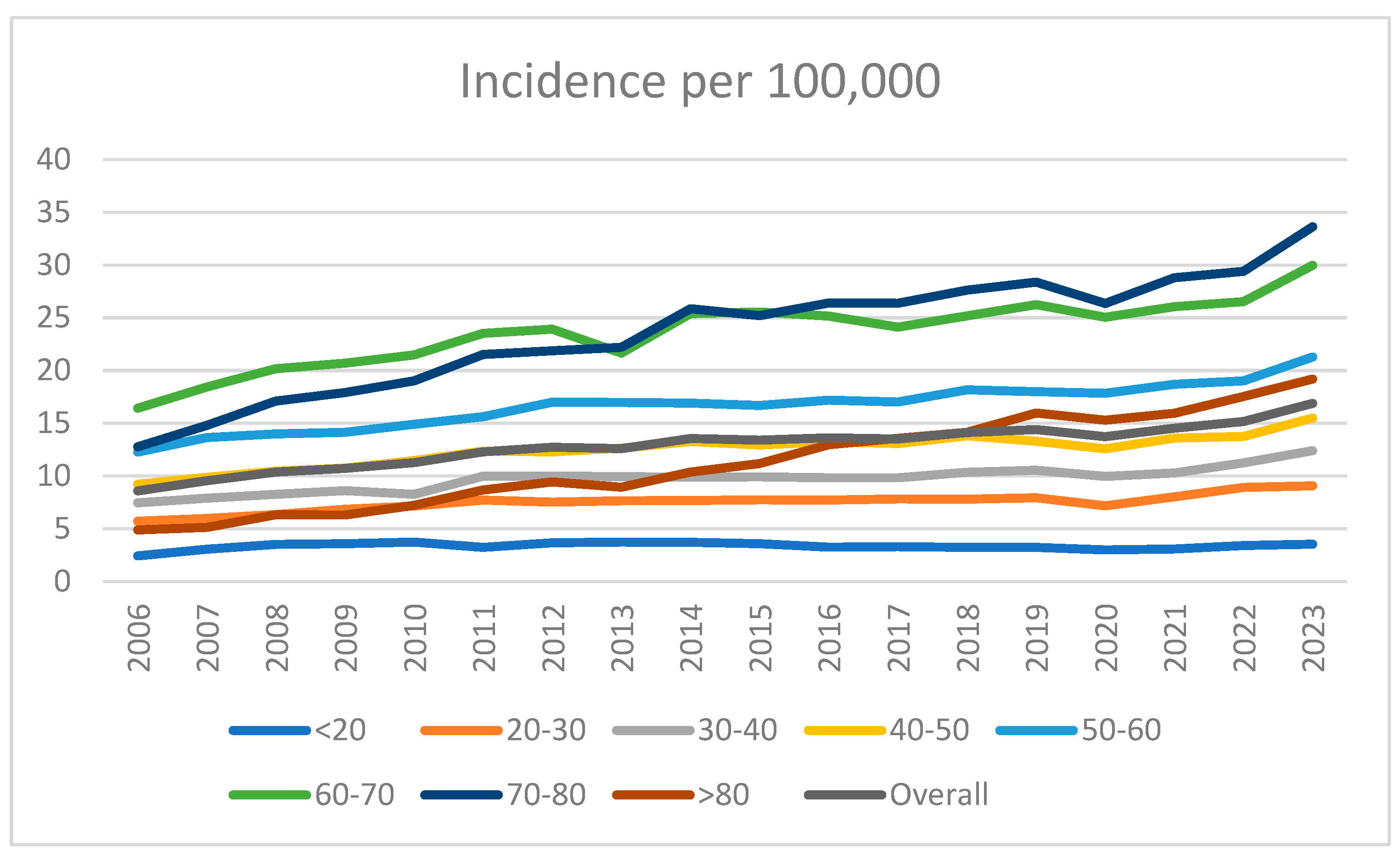
Biopsy incidence demonstrated pronounced age-dependency across the study period. Age-stratified Poisson regression models revealed differential temporal trends by age group (Figure 1). The youngest age group (<20 years) showed minimal change over time, with an IRR of 1.0015 per year (95% CI: 0.9976–1.0054; p = 0.46), indicating no statistically significant trend. In contrast, older age groups demonstrated substantially steeper rates of increase. The 20–30 age group increased at a rate of 1.019 per year (95% CI: 1.0156–1.0224; p < 0.0001), the 30–40 age group at 1.022 per year (95% CI: 1.0187–1.0243; p < 0.0001), and the 40–50 age group at 1.022 per year (95% CI: 1.0200–1.0247; p < 0.0001). The 50–60 age group demonstrated an IRR of 1.024 per year (95% CI: 1.0217–1.0258; p < 0.0001), and the 60–70 age group an IRR of 1.024 per year (95% CI: 1.0222–1.0259; p < 0.0001). The two oldest age groups showed the steepest increases: the 70–80 age group increased at 1.044 per year (95% CI: 1.0416–1.0461; p < 0.0001), and the >80 age group at 1.077 per year (95% CI: 1.0731–1.0817; p < 0.0001).

3.2. Sex Disparities

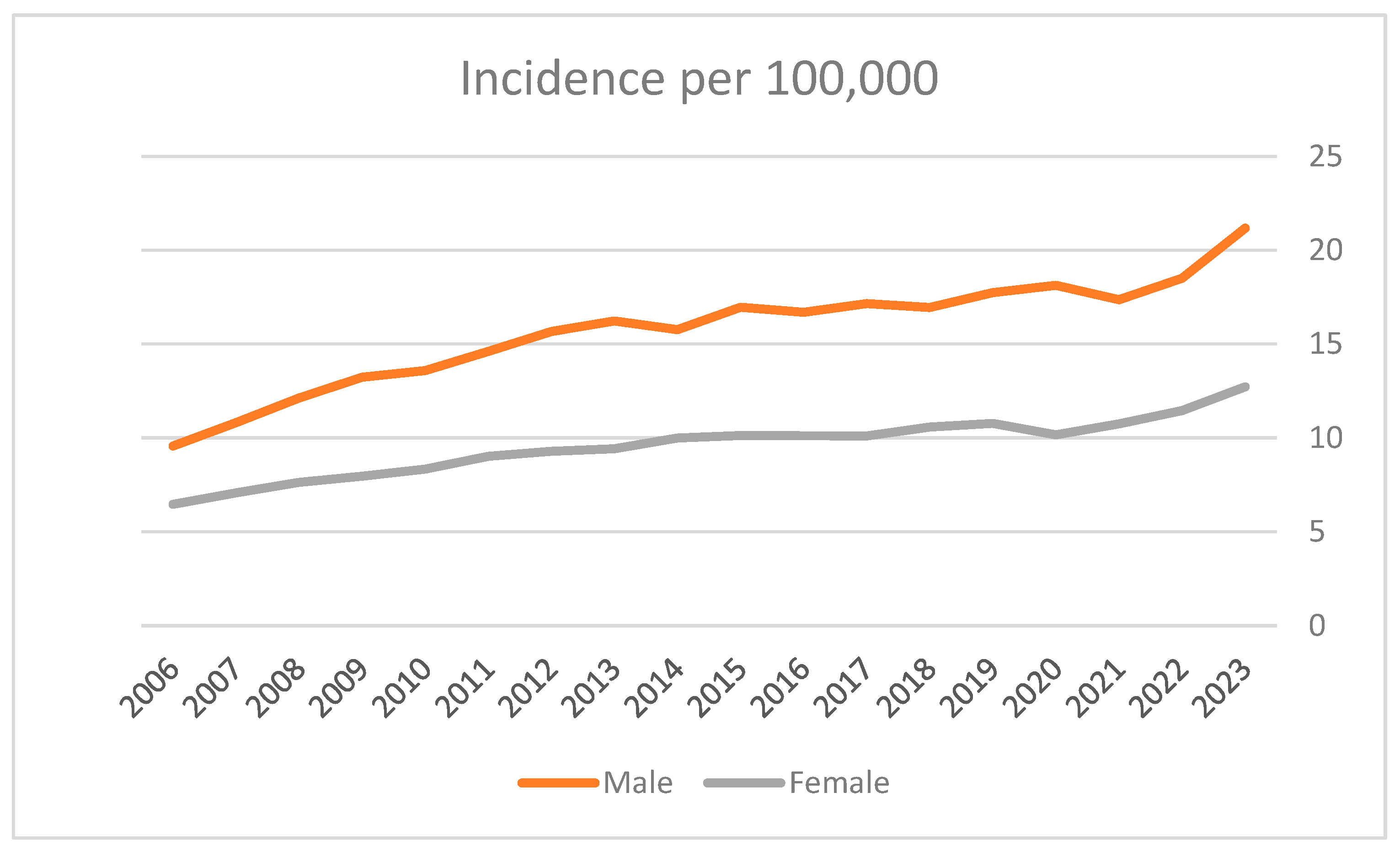
Sex-stratified analysis of overall crude incidence across all 18 years (2006–2023) revealed that both males and females experienced significant increases in kidney biopsy incidence (Figure 2). Males showed an IRR of 1.0336 per year (95% CI: 1.0104–1.0573; p = 0.0044), representing a 3.36% annual increase, while females demonstrated an IRR of 1.0304 per year (95% CI: 1.0009–1.0608; p = 0.0430), representing a 3.04% annual increase. The sex-by-year interaction was not statistically significant (IRR: 1.0030; 95% CI: 0.9668–1.0407; p = 0.8714), indicating that males and females experienced similar rates of temporal change in kidney biopsy incidence.

4. Discussion

4.1. Changes in Incidence

Our analysis demonstrates a striking 96.6% increase in kidney biopsy incidence over 18 years (2006–2023), with an annual growth rate of 2.96% (IRR: 1.0296 per year). This trend was not uniform across age groups: the oldest population (>80 years) experienced the most dramatic increase (7.74% per year), while the youngest (<20 years) showed no significant temporal change. Both males and females experienced similar rates of increase (3.36% and 3.04% per year, respectively), indicating that sex-specific prevalence patterns remained stable despite rising absolute numbers.

4.2. Possible Reasons for These Changes

4.2.1. Demographics

Multiple factors likely contribute to the sustained increase in kidney biopsy incidence across Germany: (1) Germany’s aging demographic structure is a major driver of the observed trend in absolute incidence. Between 2006 and 2023, the proportion of the population over age 70 increased substantially. Age-stratified analysis clearly shows that older individuals are increasingly biopsied, and older populations experience higher rates of age-related glomerular diseases as well as AKI of other etiology [16,17]. The disproportionate increase in the >80 age group (7.74% per year) reflects both demographic shifts and increased willingness to perform diagnostic biopsies in elderly patients who previously might have been managed conservatively.

4.2.2. Advances in Biopsy Technique

Enhanced biopsy techniques and widespread availability have lowered the procedural threshold [18,19]. Modern kidney biopsy techniques have evolved substantially since the early 2000s. The widespread adoption of ultrasound-guided percutaneous biopsy, the introduction of automated needle biopsy devices, and improved anesthesia protocols have substantially reduced procedural complications and mortality [20,21]. Furthermore, the introduction of needle guides has led to improved tissue adequacy and reduced rates of minor complications [21]. Large meta-analyses have demonstrated that major complications including erythrocyte transfusion requirement occur in less than 1% of cases, with mortality rates below 0.02% [22,23]. Therefore, percutaneous kidney biopsy has become safer and more widely offered in non-tertiary centers. Training of nephrologists in biopsy techniques, increased availability of ultrasound-guided procedures, and demonstrably low complication rates have made the procedure more accessible and acceptable to both clinicians and patients. Risk stratification tools and patient optimization strategies have enabled biopsy performance in elderly and high-risk patients who would have been deemed unsuitable for biopsy in earlier decades. This reduction in procedural risk likely lowers the threshold for recommending biopsy in patients with significant comorbidities, particularly the elderly population, where procedural safety is of paramount concern. Greater confidence in procedural safety likely translates to more liberal biopsy indications.

4.2.3. Changes in Indication

The landscape of glomerular disease therapeutics has undergone revolutionary change in the past two decades. Novel biologic agents targeting specific pathogenic pathways have been approved. Expanding therapeutic options have created new incentives for histological diagnosis. The approval of disease-modifying agents for previously untreatable conditions has shifted clinical practice toward early diagnosis and risk stratification. Additionally, the emergence of proteomic and genomic technologies that can be performed on kidney biopsy tissue has created additional value from biopsy specimens. These novel technologies enable clinicians and researchers to extract molecular-level insights from formalin-fixed paraffin-embedded tissue, including comprehensive proteomic profiling and identification of specific protein composition in renal deposits. While such technologies are not routinely integrated into clinical care in most centers, their increasing availability and validation may be creating an additional driver for biopsy performance in research-active nephrology centers. Histological assessment therefore enables personalized prognostic prediction and treatment selection, making biopsies more clinically valuable than in earlier decades when therapeutic options were limited.
Mertens et al. evaluated the biopsy results in a German nephropathologic center from 2010 to 2021 [24]. They too saw an increased incidence of biopsies, correlating with a higher percentage of vascular glomerulopathies and a lower percentage of primary glomerular diseases, suggesting a more liberal indication for biopsy for patients with vascular glomerulopathy as well as an increase in vascular disease prevalence within that region.

4.2.4. Healthcare System Factors and Infrastructure

Beyond clinical and demographic drivers, structural factors within Germany’s healthcare system have likely facilitated increased biopsy utilization. The German statutory health insurance (gesetzliche Krankenversicherung) provides universal coverage, ensuring that financial barriers to procedures are minimal compared to healthcare systems with restricted insurance access. This universal coverage is a prerequisite for sustained increases in diagnostic procedures. Additionally, the decentralized structure of German nephrology services means that kidney biopsies are increasingly performed not only at tertiary academic centers but also at secondary teaching hospitals and large district hospitals with adequate ultrasound and pathology infrastructure. The relative availability of ultrasound-equipped rooms and trained nephrologists in German hospitals exceeds that of many countries, removing practical bottlenecks that might otherwise limit biopsy volume. Radiologists specialized in interventional radiology can also undertake the procedure. Furthermore, the shift toward outpatient and day clinic management of chronic kidney disease has created more touchpoints for nephrologists to encounter patients with proteinuria or hematuria, potentially lowering the threshold for biopsy recommendations. The integration of nephropathology expertise within university hospitals and the continued training of specialist pathologists in renal disease diagnosis ensure that tissue interpretation capacity has generally kept pace with rising biopsy volumes, though this may not be uniformly distributed across regions. Economic incentive structures within the German diagnosis-related group (DRG) system may also contribute. While kidney biopsy is reimbursed under standard DRG codes, the procedure itself may be economically advantageous for hospitals seeking to optimize case-mix complexity and reimbursement. Investigation of whether reimbursement policies have shifted in favor of biopsy procedures would be valuable to understand the financial drivers of increased utilization.

4.3. Implications for Health Care Policy

Our data show a clear increase in the numbers of performed kidney biopsies throughout all age groups. In the elderly (>80 years) there was an almost a five-fold increase in absolute numbers within only fifteen years. The trend is linear and was just slightly slowed down in 2020 most likely due to the disruptive effects of the coronavirus pandemic. Thus, a continuation of the trend can be expected in the upcoming years, especially considering the general demographic trend in the German population.
The increase in biopsies provides great potential for patients as well as the research community. However, it also increases the workload of renal pathologists. Elderly patients usually present with comorbidities that might complicate the analysis of the renal tissue as well as the correct diagnosis. Increased focus on the training of residents or fellows as well as optimizing the use of technical potential such as artificial intelligence could help cope with the workload [25]. Some of the contributing factors might reverse in the future with emerging biomarkers reducing the need for kidney biopsy to make a diagnosis [26].
The current trajectory, if continued unabated, would result in further substantial increases in demand for renal pathology services and specialized nephrologists capable of performing kidney biopsies within the next 10–15 years. Germany’s healthcare system must proactively address this emerging challenge through several coordinated strategies. First, this study underscores the urgent need for Germany to establish a comprehensive national kidney biopsy registry that captures not only procedure counts but also indications, histologic diagnoses, complications, and clinical outcomes. Such a registry would enable more granular understanding of biopsy practice patterns, identification of geographic variations and potential care disparities, and informed healthcare workforce planning.
Second, German medical education institutions should assess the adequacy of nephrology training positions and curriculum content related to kidney biopsy skill development. If biopsy demand is genuinely expanding, training capacity must expand proportionally to ensure adequate supply of skilled nephrologists. Third, renal pathology services should be evaluated for capacity constraints and infrastructure limitations that might impede timely tissue processing and interpretation. Investment in digital pathology, automated image analysis, and remote consultation networks could enhance efficiency and reduce turnaround times.
Fourth, healthcare policy should mandate or incentivize development of evidence-based biopsy utilization guidelines tailored to the German healthcare context, with explicit consideration of cost-effectiveness and appropriateness criteria. Not all patients with kidney disease require biopsy, and clear guidance regarding when biopsy is and is not indicated can optimize resource allocation and patient safety. Finally, Germany should participate in international benchmarking initiatives and registry collaborations to contextualize its biopsy epidemiology within Europe and globally, facilitating knowledge exchange and best practice adoption.

4.4. Cost-Effectiveness and Resource Allocation Considerations

The sustained increase in kidney biopsy incidence carries substantial economic implications for the German healthcare system. While individual kidney biopsies are relatively inexpensive procedures (typically €500–€1500 per biopsy in German hospitals), the cumulative impact of increasing volumes must be contextualized within healthcare budgets. The shift toward more frequent biopsying of elderly patients with comorbidities may increase downstream healthcare utilization through diagnostic and therapeutic interventions triggered by biopsy findings. Cost-effectiveness analysis comparing kidney biopsy-guided management to management based solely on clinical and laboratory findings has not been systematically evaluated in German populations. Such analyses would inform policy decisions regarding appropriate utilization thresholds. In particular, cost-effectiveness metrics should examine whether increased biopsy utilization in elderly populations (>80 years) with multiple comorbidities translates into clinically meaningful improvements in outcomes, reduced hospitalizations, or improved survival—or whether biopsies in this population primarily generate diagnostic information with limited therapeutic consequences. It is commonly known that the elderly carry higher risk of interventional complications and are more likely to suffer from adverse events in case of therapy. The growing workload of renal pathologists must be addressed through workforce planning as well measures to increase their efficiency. Germany trains specialist pathologists in nephropathology, but the adequacy of current training pipeline capacity relative to demand has not been formally assessed. Investment in artificial intelligence- based image analysis and digital pathology infrastructure could improve efficiency and turnaround times, reducing the per-case resource requirement even as absolute volume increases. However, implementation of these technologies requires upfront capital investment and ongoing technical support. Furthermore, geographic variation in biopsy utilization within Germany remains poorly characterized. Identifying regional outliers—both high and low utilizers—could highlight best practices, inefficiencies, or barriers to appropriate care. National benchmarking would enable hospitals to contextualize their biopsy practice within peer comparisons and facilitate quality improvement initiatives.

4.5. Comparison to Other Countries

To appropriately contextualize our findings within the global nephrology landscape, Germany’s current kidney biopsy incidence warrants explicit comparison with rates from comparable healthcare systems. Germany’s 2023 incidence of 16.89 per 100,000 inhabitants represents a mid-to-high rate within Western Europe and North America, though with substantial variation across regions and healthcare systems.
Germany’s biopsy rate of 16.89 per 100,000 places it at the upper end of documented Western European rates. In Flanders (Belgium), which maintains a comprehensive population-based biopsy registry from 2017 to 2019, the incidence rate was 129.3 per million person-years (equivalent to approximately 12.9 per 100,000)—slightly lower than contemporary Germany [27]. Scotland reported similarly high rates of 126 per million person-years (12.6 per 100,000) [28].
The United States reports kidney biopsy incidence of approximately 17 per 100,000 inhabitants, nearly identical to Germany’s current rate and among the highest globally. Australia presents a more complex picture: early population-based data from Victoria (1995–1997) reported 21.5 per 100,000, while more recent national surveillance (2000–2024) documented rates rising from 3.03 to 7.97 per 100,000, with marked regional heterogeneity, with New South Wales showing the largest increases (13.59 per 100,000 absolute change between 2000 and 2024) [29,30]. This internal variability highlights that even within resource-rich, developed healthcare systems, substantial differences in biopsy utilization can persist—a finding with implications for understanding the drivers of procedural variation.
A striking contrast emerges when comparing Western European and German rates with those from Central and Eastern European countries. Hungary reported a biopsy incidence of 36.3 per million person-years (approximately 3.6 per 100,000)—a roughly 4.5-fold lower rate than Germany [31]. Romania documented between 11.3 and 14.75 per million person-years, representing a 12- to 15-fold difference from Western European rates [32,33]. These substantially lower rates in Central and Eastern Europe are principally attributed to financial constraints, limited specialist workforce capacity, and lower healthcare access and quality indices, rather than to differences in underlying disease burden, underscoring significant geographic disparities in diagnostic resource allocation within Europe.
The temporal trends observed in our German cohort—namely, a 96.6% increase over 18 years with pronounced acceleration in elderly populations—mirror patterns documented internationally. Molnár et al. reported a 2.37-fold increase in Hungarian biopsy rates from 2006 to 2020 (24.5 to 57.9 pmpy), suggesting movement toward higher diagnostic rates even in regions historically characterized by lower biopsy utilization [31]. The largest US cohort (57,613 biopsies from the Southwestern United States, 1993–2022) demonstrated similar demographic shifts, with mean patient age increasing from 48.8 to 53.2 years alongside rising rates of diabetic glomerulosclerosis diagnosis (9.3% to 23.8%) [34]. Uruguay reported a doubling of glomerular disease incidence over 25 years, driven primarily by increasing IgA nephropathy detection, with biopsy rates increasing from 38.5 pmpy in 1990–1994 to 65.6 pmpy in 2010–2014 [35].
These global trends suggest that Germany’s rising biopsy incidence does not represent an isolated phenomenon but rather reflects a broader pattern of diagnostic intensification in developed and middle-income healthcare systems. The convergence of rates between Germany (16.89 per 100,000), the United States (17 per 100,000), Belgium (12.9 per 100,000), and other Western European systems suggests shared underlying drivers: advancing procedural safety and accessibility, expansion of therapeutic options for glomerular diseases, aging populations with higher prevalence of both glomerular and vascular kidney disease, and evolving diagnostic paradigms that increasingly favor histological characterization for prognostic precision and therapeutic guidance. Whether Germany’s rates—and those of similar Western European systems—represent optimal diagnostic utilization, reflect potential overutilization, or whether lower Central and Eastern European rates represent underutilization with consequent diagnostic gaps remains an important question that will require outcome-focused health services research and international collaborative registries to address definitively. Future investigations should examine whether differences in biopsy rates translate to differences in clinical outcomes, disease prognosis, survival, or therapeutic appropriateness across these diverse healthcare settings.

4.6. Limitations

This study demonstrates rising kidney biopsy incidence in Germany but is limited by its reliance on administrative coding data without access to clinical indications, histologic diagnoses, or treatment outcomes. Administrative data capture procedures performed but not the reasons they were performed. Consequently, we cannot directly attribute the observed increases to specific driver factors; instead, we can infer plausible mechanisms based on parallel trends in clinical practice and disease epidemiology. Due to our method of data collection, only kidney biopsies performed in hospitals could be taken into consideration. Biopsies performed in outpatient settings could not be considered. However, in our experience only very few biopsies are performed outside of hospitals due to the risks associated with the procedure. However, an increase in the fraction of inpatient versus outpatient biopsies could be responsible for the perceived increase in biopsy incidence described in the paper.
The data presented here is only representative for the situation in Germany. Nonetheless, as presented above, similar findings can be seen in other countries similar to Germany. Finally, this analysis captures procedures performed in Germany but does not distinguish between residents and non-residents, nor between German and foreign nephrologists. Migration patterns of patients seeking specialized nephrology care in university centers could influence regional variation, though this is unlikely to substantially affect national-level trends.

5. Conclusions

This 18-year national analysis of German kidney biopsies provides a comprehensive epidemiological overview of biopsy trends in a major Western European country with universal healthcare. The 96.6% increase in overall incidence, combined with age-dependent acceleration (>80 years experiencing 7.74% annual increases), mirrors patterns observed in similar countries.
Kidney biopsies in Germany have become increasingly accessible and clinically valued, reflecting improved procedural safety, expanding therapeutic options for glomerular diseases, and evolving diagnostic paradigms that favor earlier histological assessment. The convergence of German biopsy practices with more intensive diagnostic approaches from Australia, USA, and Northern Europe suggests a global shift toward earlier and more liberal kidney biopsy utilization. A greater prevalence of underlying vascular diseases is also reflected here.
However, substantial geographic variation remains. Central and Eastern European countries continue to perform fewer biopsies despite comparable disease burdens, highlighting healthcare disparities in diagnostic resource availability and clinical training. The establishment of national and international kidney biopsy registries is essential for understanding and optimizing these patterns and ensuring equitable access to diagnostic tools that inform treatment decisions and prognosis.
Future research should investigate whether increased biopsy incidence in older populations translates to improved clinical outcomes, how diagnostic composition is shifting toward age-related diseases, and how international harmonization of biopsy indications can reduce unwarranted geographic variation.

Supplementary Materials

The following supporting information can be downloaded at: https://www.mdpi.com/article/10.3390/kidneydial6010012/s1, Table S1. Absolute number of kidney biopsies by age group and year (2006–2023); Table S2. Kidney biopsy incidence per 100,000 inhabitants by age group and year (2006–2023); Table S3. Kidney biopsy incidence per 100,000 males by age group and year (2006–2023); Table S4. Kidney biopsy incidence per 100,000 females by age group and year (2006–2023).

Author Contributions

Conceptualization, L.M. and Y.R.; Methodology, L.M. and Y.R.; Software, L.M.; Validation, L.M.; Formal analysis, L.M. and Y.R.; Investigation, L.M. and Y.R.; Data curation, L.M.; Writing—original draft, L.M.; Writing—review & editing, Y.R.; Visualization, L.M.; Supervision, L.M.; Project administration, L.M. All authors have read and agreed to the published version of the manuscript.

Funding

This research did not receive any specific grant from funding agencies in the public, commercial, or not-for-profit sectors.

Institutional Review Board Statement

Data was already completely anonymized before extraction from the national database and no ethical concerns needed to be addressed.

Data Availability Statement

The original contributions presented in this study are included in the article/Supplementary Materials. Further inquiries can be directed to the corresponding author.

Conflicts of Interest

The authors declare no conflict of interest.

References

  1. Iversen, P.; Brun, C. Aspiration Biopsy of the Kidney. Am. J. Med. 1951, 11, 324–330. [Google Scholar] [CrossRef]
  2. Eckardt, K.-U.; Kasiske, B.L.; Zeier, M.G. Kidney Disease: Improving Global Outcomes (KDIGO) Transplant Work Group KDIGO Clinical Practice Guideline for the Care of Kidney Transplant Recipients. Am. J. Transplant. 2009, 9, S1–S155. [Google Scholar] [CrossRef]
  3. Kidney Disease: Improving Global Outcomes (KDIGO) Glomerular Diseases Work Group KDIGO 2021 Clinical Practice Guideline for the Management of Glomerular Diseases. Kidney Int. 2021, 100, S1–S276. [CrossRef] [PubMed]
  4. Busse, R.; Blümel, M. Germany: Health System Review. Health Syst. Transit. 2014, 16, 5. [Google Scholar]
  5. Randhawa, P.S.; Minervini, M.I.; Lombardero, M.; Duquesnoy, R.; Fung, J.; Shapiro, R.; Jordan, M.; Vivas, C.; Scantlebury, V.; Demetris, A. Biopsy of Marginal Donor Kidneys: Correlation of Histologic Findings with Graft Dysfunction. Transplantation 2000, 69, 1352–1357. [Google Scholar] [CrossRef]
  6. Sakai, K.; Oguchi, H.; Muramatsu, M.; Shishido, S. Protocol Graft Biopsy in Kidney Transplantation. Nephrology 2018, 23, 38–44. [Google Scholar] [CrossRef]
  7. Waikar, S.S.; McMahon, G.M. Expanding the Role for Kidney Biopsies in Acute Kidney Injury. Semin. Nephrol. 2018, 38, 12–20. [Google Scholar] [CrossRef]
  8. Zink, C.M.; Ernst, S.; Riehl, J.; Helmchen, U.; Gröne, H.-J.; Floege, J.; Schlieper, G. Trends of Renal Diseases in Germany: Review of a Regional Renal Biopsy Database from 1990 to 2013. Clin. Kidney J. 2019, 12, 795–800. [Google Scholar] [CrossRef]
  9. Braun, N.; Schweisfurth, A.; Lohöfener, C.; Lange, C.; Gründemann, C.; Kundt, G.; Gröne, H.-J. Epidemiology of Glomerulonephritis in Northern Germany. Int. Urol. Nephrol. 2011, 43, 1117–1126. [Google Scholar] [CrossRef] [PubMed]
  10. ERA-EDTA Registry Annual Report 2019, 160. Available online: https://www.era-online.org/registry/AnnRep2019.pdf (accessed on 13 July 2022).
  11. Amann, K.; Erley, C.; Wetzel, T.; Schrader, T. Deutsches Nierenbiopsieregister. Nephrologe 2015, 10, 310–314. [Google Scholar] [CrossRef]
  12. BfArM-OPS Version 2022. Available online: https://klassifikationen.bfarm.de/ops/kode-suche/htmlops2022/block-1-40...1-49.htm (accessed on 12 July 2022).
  13. Genesis 12411-0005 Bevölkerung: Deutschland, Stichtag, Altersjahre. Available online: https://www-genesis.destatis.de/genesis/online?sequenz=tabellen&selectionname=12411-0005#abreadcrumb (accessed on 10 August 2022).
  14. Genesis 12411-0003 Bevölkerung: Deutschland, Stichtag, Geschlecht. Available online: https://www-genesis.destatis.de/genesis/online?operation=abruftabelleBearbeiten&levelindex=3&levelid=1660132450426&auswahloperation=abruftabelleAuspraegungAuswaehlen&auswahlverzeichnis=ordnungsstruktur&auswahlziel=werteabruf&code=12411-0003&auswahltext=&werteabruf=Werteabruf#abreadcrumb (accessed on 10 August 2022).
  15. Gesundheitsberichterstattung Des Bundes. Available online: https://www.gbe-bund.de/gbe/pkg_isgbe5.prc_menu_olap?p_uid=gast&p_aid=71727863&p_sprache=D&p_help=2&p_indnr=702&p_indsp=&p_ansnr=63133484&p_version=30 (accessed on 13 July 2022).
  16. Rau, Y.; Matrisch, L. Incidence and Epidemiology of Kidney Infarctions in Germany-A Cohort Study. Epidemiologia 2025, 6, 19. [Google Scholar] [CrossRef]
  17. Matrisch, L.; Karsten, H.; Schücke, J.; Rau, Y. Increase in Registered Acute Kidney Injuries in German Hospitals. Cureus 2023, 15, e36868. [Google Scholar] [CrossRef] [PubMed]
  18. Tøndel, C.; Vikse, B.E.; Bostad, L.; Svarstad, E. Safety and Complications of Percutaneous Kidney Biopsies in 715 Children and 8573 Adults in Norway 1988–2010. Clin. J. Am. Soc. Nephrol. 2012, 7, 1591–1597. [Google Scholar] [CrossRef]
  19. Kajawo, S.; Ekrikpo, U.; Moloi, M.W.; Noubiap, J.J.; Osman, M.A.; Okpechi-Samuel, U.S.; Kengne, A.P.; Bello, A.K.; Okpechi, I.G. A Systematic Review of Complications Associated With Percutaneous Native Kidney Biopsies in Adults in Low- and Middle-Income Countries. Kidney Int. Rep. 2021, 6, 78–90. [Google Scholar] [CrossRef]
  20. Bakdash, K.; Schramm, K.M.; Annam, A.; Brown, M.; Kondo, K.; Lindquist, J.D. Complications of Percutaneous Renal Biopsy. Semin. Interv. Radiol. 2019, 36, 97–103. [Google Scholar] [CrossRef]
  21. Lees, J.S.; McQuarrie, E.P.; Mordi, N.; Geddes, C.C.; Fox, J.G.; Mackinnon, B. Risk Factors for Bleeding Complications after Nephrologist-Performed Native Renal Biopsy. Clin. Kidney J. 2017, 10, 573–577. [Google Scholar] [CrossRef]
  22. Andrulli, S.; Rossini, M.; Gigliotti, G.; La Manna, G.; Feriozzi, S.; Aucella, F.; Granata, A.; Moggia, E.; Santoro, D.; Manenti, L.; et al. The Risks Associated with Percutaneous Native Kidney Biopsies: A Prospective Study. Nephrol. Dial. Transplant. 2023, 38, 655–663. [Google Scholar] [CrossRef]
  23. Corapi, K.M.; Chen, J.L.T.; Balk, E.M.; Gordon, C.E. Bleeding Complications of Native Kidney Biopsy: A Systematic Review and Meta-Analysis. Am. J. Kidney Dis. 2012, 60, 62–73. [Google Scholar] [CrossRef] [PubMed]
  24. Mertens, P.R.; Kanaan, M.R.; Abou-Watfa, A.A.; Bender, S.T.; Wiech, T.; Gröne, H.-J.; Scurt, F.G. Retrospective Analysis of the Diagnostic Spectrum of Histological Nephropathies from the Magdeburg Kidney Biopsy Cohort (MD-KBC). BMC Nephrol. 2025, 26, 681. [Google Scholar] [CrossRef] [PubMed]
  25. Barisoni, L.; Hodgin, J.B. Digital Pathology in Nephrology Clinical Trials, Research, and Pathology Practice. Curr. Opin. Nephrol. Hypertens. 2017, 26, 450–459. [Google Scholar] [CrossRef]
  26. Hengel, F.E.; Dehde, S.; Lassé, M.; Zahner, G.; Seifert, L.; Schnarre, A.; Kretz, O.; Demir, F.; Pinnschmidt, H.O.; Grahammer, F.; et al. Autoantibodies Targeting Nephrin in Podocytopathies. N. Engl. J. Med. 2024, 391, 422–433. [Google Scholar] [CrossRef]
  27. Laurens, W.; Deleersnijder, D.; Dendooven, A.; Lerut, E.; De Vriese, A.S.; Dejagere, T.; Helbert, M.; Hellemans, R.; Koshy, P.; Maes, B.; et al. Epidemiology of Native Kidney Disease in Flanders: Results from the FCGG Kidney Biopsy Registry. Clin. Kidney J. 2022, 15, 1361–1372. [Google Scholar] [CrossRef]
  28. McQuarrie, E.P.; Mackinnon, B.; Young, B.; Yeoman, L.; Stewart, G.; Fleming, S.; Robertson, S.; Simpson, K.; Fox, J.; Geddes, C.C.; et al. Centre Variation in Incidence, Indication and Diagnosis of Adult Native Renal Biopsy in Scotland. Nephrol. Dial. Transplant. 2009, 24, 1524–1528. [Google Scholar] [CrossRef] [PubMed]
  29. Briganti, E.M.; Dowling, J.; Finlay, M.; Hill, P.A.; Jones, C.L.; Kincaid-Smith, P.S.; Sinclair, R.; McNeil, J.J.; Atkins, R.C. The Incidence of Biopsy-proven Glomerulonephritis in Australia. Nephrol. Dial. Transplant. 2001, 16, 1364–1367. [Google Scholar] [CrossRef] [PubMed]
  30. Sandhu, K.; Al-Khanaty, A.; Carll, J.; Murphy, D.G.; Lawrentschuk, N.; Perera, M. A 24-Year Analysis of Percutaneous Renal Biopsy Trends in Australia. Med. Sci. 2025, 14, 19. [Google Scholar] [CrossRef]
  31. Molnár, A.; Thomas, M.J.; Fintha, A.; Kardos, M.; Dobi, D.; Tislér, A.; Ledó, N. Kidney Biopsy-Based Epidemiologic Analysis Shows Growing Biopsy Rate among the Elderly. Sci. Rep. 2021, 11, 24479. [Google Scholar] [CrossRef]
  32. Pană, N.; Ștefan, G.; Stancu, S.; Zugravu, A.; Ciurea, O.; Petre, N.; Mircescu, G.; Căpușă, C. Clinicopathological Characteristics and Disease Chronicity in Glomerular Diseases: A Decade-Long Study at Romania’s Largest Kidney Biopsy Reference Center. Biomedicines 2024, 12, 1143. [Google Scholar] [CrossRef]
  33. Ciocănea-Teodorescu, I.; Obrişcă, B.; Ismail, G.; Gherghiceanu, M. Trends of Biopsy-Proven Kidney Diseases in Romania: A Single-Center Registry Report Spanning 28 Years. Kidney Med. 2025, 7, 101146. [Google Scholar] [CrossRef]
  34. Takahashi, A.; Kiyozawa, D.; Miyauchi, T.; Mirocha, J.; Ren, Y.M.K.; Doi, T.; Choung, H.Y.G.; Lin, M.Y.; Hou, J.; Masaki, T.; et al. Temporal and Demographic Trends in Biopsy-Proven Kidney Disease Diagnoses in the Southwestern United States, 1993-2022. Kidney Med. 2025, 7, 101131. [Google Scholar] [CrossRef]
  35. Garau, M.; Cabrera, J.; Ottati, G.; Caorsi, H.; Gonzalez Martinez, F.; Acosta, N.; Aunchayna, M.H.; Gadola, L.; Noboa, O. Temporal Trends in Biopsy Proven Glomerular Disease in Uruguay, 1990–2014. PLoS ONE 2018, 13, e0206637. [Google Scholar] [CrossRef] [PubMed]
Figure 1. Relative incidence of kidney biopsies stratified by age groups.
Kidneydial 06 00012 g001
Figure 2. Relative Incidence of kidney biopsies stratified by sex.
Kidneydial 06 00012 g002
Table 1. Absolute number of kidney biopsies by age group and year (2006–2023).
Year<2020–3030–4040–5050–6060–7070–80>80Total
20063945598361267132716048991867072
200748658684813711508176510752017840
200854962785114571577189112862578495
200954867985814931622190114032638767
201056371080915731742194015513119199
201147774694416271842207317963709875
2012540728953157520512135184840810,238
2013548743961156121041953190139010,161
2014548749973158021472327220647111,001
20155397721004149021672435207752911,013
20164947661010146822702476211364011,237
20175017751028140222732433206969911,180
20184927651102144124482593212376211,726
20194947671137135324182758214390711,977
20204596801083126623722685196090811,413
20214757551119135924442856211897412,100
202252582212271390242129782175105612,594
202355184413581592261734562518116014,096
Disclaimer/Publisher’s Note: The statements, opinions and data contained in all publications are solely those of the individual author(s) and contributor(s) and not of MDPI and/or the editor(s). MDPI and/or the editor(s) disclaim responsibility for any injury to people or property resulting from any ideas, methods, instructions or products referred to in the content.