Article

Comparison of Molecule Clearance and Pro-Inflammatory Markers Between High-Flux and Medium Cut-Off Dialyzers (ELISIO™ 21): A Crossover Pilot Study


by
María Paloma Flores-Paloma
1,
Javier Ramírez-Santos
2,*,
Llenalia Gordillo-García
1,
Paula López-Sánchez
3,
Manuel David Sánchez-Martos
1,
María Eugenia Palacios-Gómez
1 and
Francisco Javier González-Martínez
1
1
Nephrology Department, Hospital Universitario Torrecárdenas, Andalusian Health Service, 04009 Almería, Spain
2
Almería Health District, Andalusian Health Service, 04008 Almería, Spain
3
Nephrology Department, IDIPHISA, Hospital Universitario Puerta de Hierro, 28222 Majadahonda, Spain
*
Author to whom correspondence should be addressed.
Kidney Dial. 2026, 6(1), 10; https://doi.org/10.3390/kidneydial6010010
Submission received: 28 November 2025 / Revised: 29 January 2026 / Accepted: 31 January 2026 / Published: 10 February 2026

Abstract

Background: Chronic kidney disease (CKD) is increasingly prevalent, leading to more patients requiring hemodialysis. Medium cut-off (MCO) membranes, such as the ELISIO™ HX dialyzer, may enhance middle-to-large molecule removal and reduce inflammation compared with conventional high-flux membranes. This study evaluated the efficacy and safety of ELISIO™ HX versus a standard high-flux dialyzer (Toraylight NS-21S) in terms of molecular reduction rate and inflammation. Methods: We performed a single-center, prospective, randomized crossover study with 12 hemodialysis patients, each treated with Toraylight NS-21S and ELISIO™ HX over four weeks. Pre- and post-dialysis levels of urea, creatinine, albumin, creatine kinase, phosphorus, parathyroid hormone, C-reactive protein (CRP), procalcitonin, interleukin 6 (IL-6), and β2-microglobulin were measured. Pre–post differences were assessed using dialyzer analysis, period-effect and carryover analysis, and non-inferiority analysis. Results: ELISIO™ HX was non-inferior to Toraylight NS-21S for creatinine, urea, phosphorus, procalcitonin, and β2-microglobulin. No significant serum albumin changes were observed with either dialyzer. Adverse events were infrequent and comparable between the dialyzers. Conclusions: ELISIO™ HX appears non-inferior to Toraylight NS-21S and suggests good safety and tolerability. These findings should be interpreted with caution given the study’s limited power.

1. Introduction

Chronic kidney disease (CKD) is a major public health issue with a prevalence of 7.2% in developed countries [1]. In Spain, the EPIRCE study [2] estimates that it affects 10% of adults and over 20% of those above 60 years of age and is often underdiagnosed. Among patients in primary care with hypertension or diabetes mellitus (DM), the prevalence can reach 35–40%. This condition significantly increases morbidity and cardiovascular mortality [2,3].
The number of patients undergoing hemodialysis is increasing owing to advancements in techniques, improved accessibility for older adults, and greater longevity. However, hemodialysis mortality remains high, as it cannot fully remove uremic toxins like a healthy kidney [4]. Additionally, the cardiovascular risk is elevated in these patients, contributing to higher mortality rates [5].
Inflammation in CKD is more prevalent in patients undergoing hemodialysis [6]. Moreover, inflammation and anemia are identified as non-traditional and independent cardiovascular risk factors related to cardiovascular mortality in patients on hemodialysis [7].
Uremic toxins further increase the risk of cardiovascular disease risk [8]. Standard hemodialysis effectively removes small molecules (<0.5 kDa) like urea but struggles with larger molecules [9]. The Membrane Permeability Outcome (MPO) study linked high-flux membranes to improved survival in patients with diabetes or those with low albumin levels [10]. Online hemodiafiltration (HDF), designed to enhance medium molecule reduction rate, showed reduced cardiovascular mortality with high convective volumes (current consensus suggests targets > 23 L [11]) compared to standard hemodialysis [12,13]. However, HDF implementation is limited [14,15].
Expanded hemodialysis (HDx) with medium cut-off (MCO) membranes has been introduced to increase dialysis membrane permeability. Although these membranes are limited to the hemodialysis modality, they may serve as an alternative to HDF by achieving removal performance similar to that of post-dilution HDF [16,17,18,19,20,21,22]. Their pore size and structural design enhance internal convection, improving the removal of medium and large molecules compared with high-flux HD membranes [23,24]. These membranes maintain high clearance for solutes under 10 kDa while improving clearance for solutes between 10 and 50 kDa [20]. The medical device industry continues to refine dialyzers to achieve enhanced purification. In 2021, Nipro developed the MCO dialyzer ELISIO™ HX, which received Conformité Européenne markings and is now marketed in several European countries. Its membrane is made of polyethersulfone, and its housing is polypropylene [25].
This study aimed to evaluate the performance of the ELISIO™ HX dialyzer in clearing molecules of various molecular weights. The primary objective was to demonstrate its non-inferiority compared to the Toraylight NS-21S high-flux dialyzer. As secondary objectives, we assessed the safety profile of the treatment and its impact on pro-inflammatory markers.

2. Materials and Methods

2.1. Participants

This study included patients undergoing renal replacement therapy with hemodialysis at Torrecárdenas University Hospital in Almería, Spain. Twelve participants who met the inclusion criteria were recruited between October 2022 and July 2023. Eligible patients had received maintenance hemodialysis for at least three months prior to inclusion. Patients with treatment regimens of fewer than three sessions per week, minors, or those hospitalized or deceased during the study were excluded.

2.2. Sample Size and Power Calculation

A formal sample size calculation was performed assuming a non-inferiority margin of 10% in percentage reduction, a significance level of 0.05, and 80% statistical power for a paired comparison between dialyzers. Under these assumptions, a total sample of 24 patients would have been required. However, because the number of ELISIO™ HX (Nipro Corporation, Osaka, Japan) dialyzers provided for the study period was limited, only 12 patients could finally be included. As a consequence, maintaining the original effect size estimation, the post hoc effective power of the study was calculated to be 52.2%.

2.3. Study Design

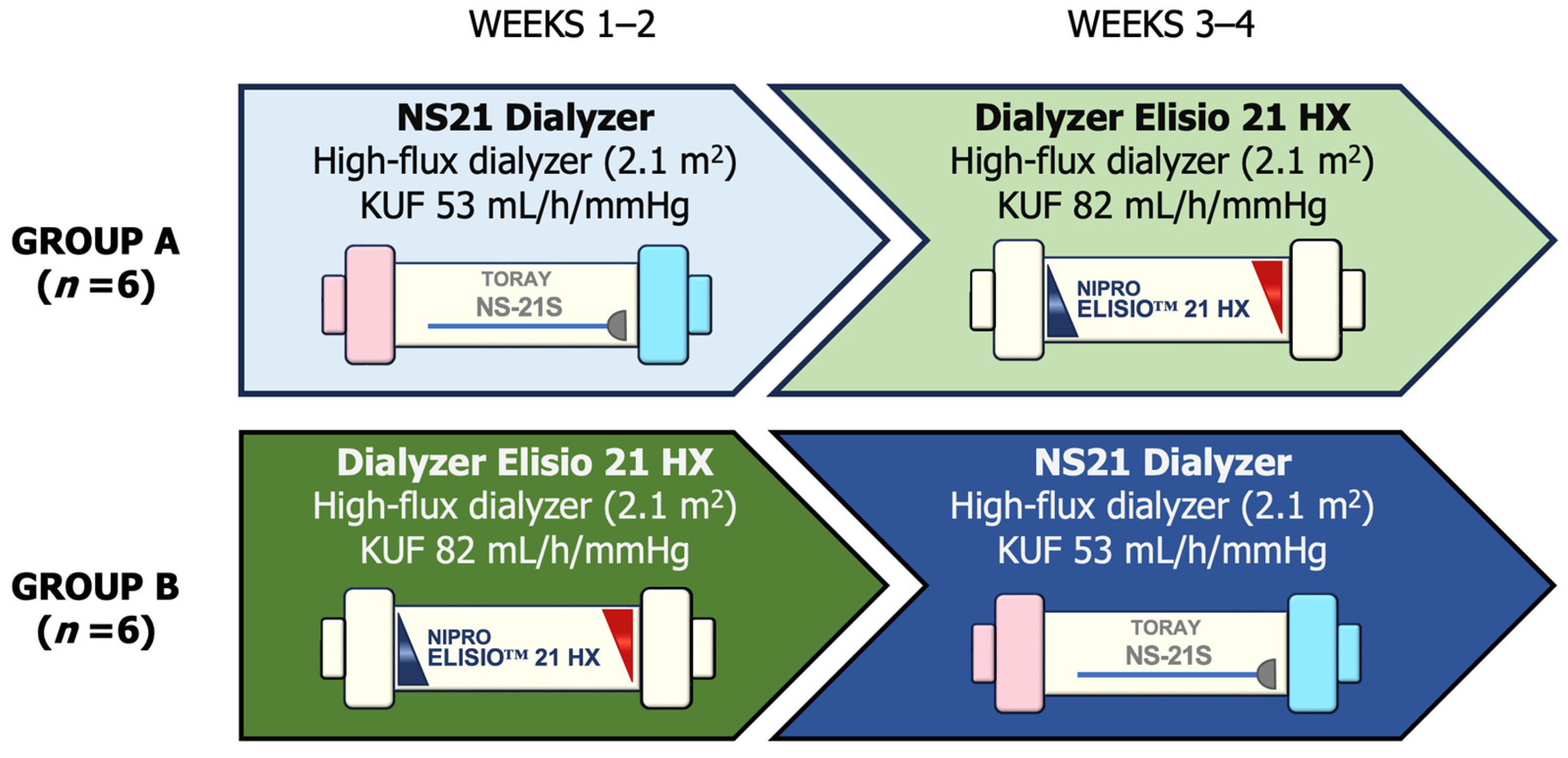
The study followed a prospective crossover design over four weeks. Patients were randomly assigned in a 1:1 ratio to one of two treatment sequences. The randomization sequence was generated by an independent investigator not involved in the clinical care of the patients, using a computer-generated permuted block design. To ensure allocation concealment, the assignment was kept in sealed, sequentially numbered envelopes, which were opened only at the time of patient enrollment. This process ensured that both the recruitment and the assignment were balanced between study arms and protected against selection bias. The only intervention was a change in dialyzer. Group A used the Toraylight NS-21S (Toray Industries, Inc., Tokyo, Japan) high-flux dialyzer (2.1 m2; Ultrafiltration Coefficient (KUF) 53 mL/h/mmHg) during the first two weeks, then switched to the MCO ELISIO™ 21HX dialyzer (2.1 m2; KUF 82 mL/h/mmHg) for the third and fourth weeks. Group B followed the reverse order: the MCO ELISIO™ 21HX dialyzer in weeks one and two, and the Toraylight NS-21S high-flux dialyzer in weeks three and four. No washout period was used; the interdialytic intervals (48–72 h) served as a natural washout. The treatment scheme is illustrated in Figure 1.
The single-blind integrity was maintained by positioning the dialysis equipment behind the patients’ field of vision, preventing them from identifying the dialyzer brands or models. Although a double-blind design was not feasible—as the clinical staff performing the setup were required to identify the membranes for safety and procedural reasons—all data were pseudonymized using alphanumeric codes. This ensured that the subsequent statistical analysis was conducted without knowledge of the specific treatment allocation, thereby minimizing investigator bias.
All patients followed a standard thrice-weekly hemodialysis schedule. Study measurements and blood sampling were uniformly conducted during the third session of the week to minimize the impact of the interdialytic interval. Pre-dialysis blood samples were collected immediately prior to patient connection, and post-dialysis samples were obtained at the end of the session without any waiting period for solute rebound. The dialysis prescription is registered in Table 1. The paired differences between treatments were analyzed using a paired t-test due to the crossover design.
The study is listed on the ISRCTN registry with study registration number ISRCTN10242184.

2.4. Data Collection

Demographic data, including age, sex, and comorbidities such as diabetes mellitus and hypertension, were recorded. Adverse events during dialysis and health events were documented throughout the study period.
The laboratory analyses pre- and post-dialysis included urea (mg/dL), creatinine (mg/dL), albumin (g/dL), creatine kinase (U/L), phosphorus (mg/dL), parathyroid hormone (pg/mL), C-reactive protein (CRP, mg/L), procalcitonin (ng/mL), interleukin 6 (IL-6, pg/mL), and β2-microglobulin (mg/L). Ferritin (ng/mL) and hemoglobin (g/dL) were also analyzed pre-dialysis. Intravenous iron, when required (though not necessary for the majority of patients), was administered at the end of the dialysis session to ensure a minimum 48-h lag time before the next pre-dialysis ferritin measurement.

2.5. Ethical and Legal Aspects

The study protocol was approved by the local ethics committee (Comité de Ética de la Investigación Provincial de Almería, code 110/2022, 28 September 2022) and was conducted in accordance with the Declaration of Helsinki.

2.6. Statistical Analysis

For each session, post-dialysis laboratory values were adjusted for hemoconcentration based on the patient’s weight loss, according to the correction formula described by Campbell [26]. The absolute change between pre- and post-dialysis parameters was calculated (Absolute Δ = Pre-value − Post-value), along with the reduction rate (RR = 100 × [(Pre-value − Post-value)/Pre-value]). Data are presented as mean and standard deviation (SD). Comparisons between the mean differences for the two dialyzers were conducted using the paired Student’s t-test, as appropriate for a crossover study design.
Given the crossover design, we conducted a dedicated assessment of potential period effects, defined as differences attributable to the temporal sequence of interventions rather than to the treatment itself. Outcomes were analyzed using a linear mixed-effects model with a random intercept for each subject and fixed effects for treatment and period, and subject as a random effect to account for within-subject correlation. Regression coefficients with 95% confidence intervals were reported, and statistical significance was set at p < 0.05. A potential carryover effect was examined in a separate model by including the treatment administered in the preceding period as an additional fixed effect.
The non-inferiority of the ELISIO™ HX dialyzer compared to the Toraylight NS-21S was assessed using a one-sided 90% confidence interval (CI), with a type I error rate (α) of 0.05. Non-inferiority was confirmed if the lower limit of the 95% CI for the difference (ELISIO™ HX minus Toraylight NS-21S) was above the pre-specified margin of −10%. This margin was defined based on clinical relevance, considering that a 10% variation falls within the intrinsic inter-subject and inter-session variability of the hemodialysis procedure. Furthermore, this threshold guarantees clinical efficacy, as international guidelines (National Kidney Foundation Kidney Disease Outcomes Quality Initiative, KDOQI) define adequacy based on a minimum target (spKt/V > 1.2) rather than the indefinite maximization of removal; this ensures that the delivered dose remains compliant with safety standards despite potential variations within the margin. This approach also aligns with non-inferiority criteria used in similar nephrological research [27,28].

2.7. Artificial Intelligence Utilization Declaration

Google Gemini (Google LLC, Mountain View, CA, USA) was used to improve the clarity and readability of the final draft.

3. Results

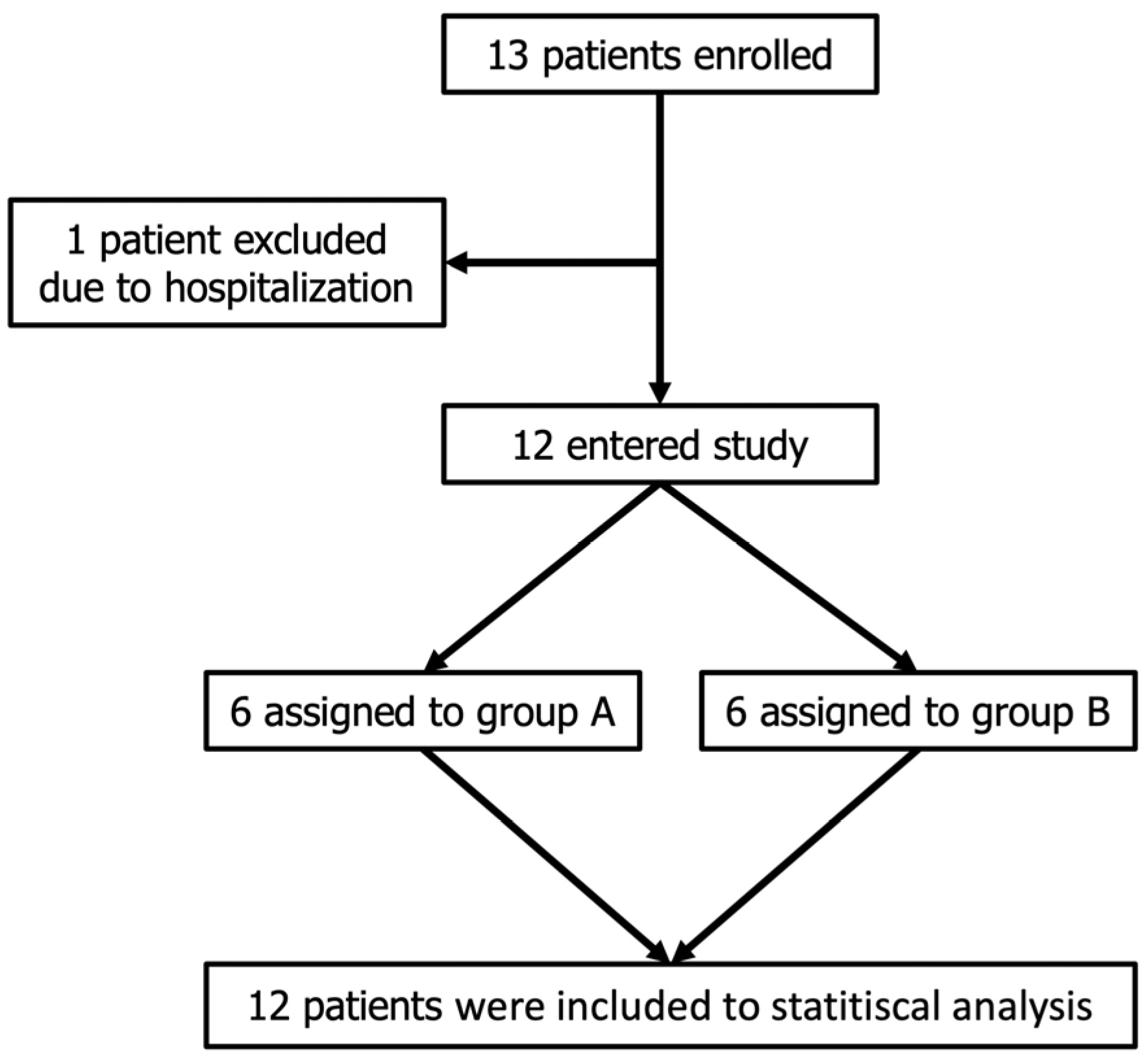
The study initially included 13 patients, of whom 12 completed all scheduled sessions. One patient was excluded from the final analysis because of hospitalization prior to completing the treatment protocol. A research flowchart illustrating patient progression is shown in Figure 2.
The final cohort was predominantly male (66.7%, n = 8), with a mean age of 62.0 years (SD 16.3). All patients were hypertensive, and 33.3% (n = 4) had diabetes mellitus. Most patients (58.3%, n = 7) were dialyzed through a native arteriovenous fistula (AVF) under a high-flow regimen (≥500 mL/min). A summary of patient demographic and clinical characteristics is provided in Table 2.

3.1. Period-Effect and Carryover Analysis

A linear mixed-effects model was fitted with subject as a random effect and treatment and period as fixed effects. No evidence of a period effect was detected across any of the evaluated outcomes. Estimates for Δ creatinine (coefficient −0.29; 95% CI −0.91 to 0.32; p = 0.35), Δ urea (coefficient −0.0008; 95% CI −4.96 to 4.95; p = 1.00), Δ albumin (coefficient −0.059; 95% CI −0.17 to 0.06; p = 0.32), Δ CK (coefficient 37.82; 95% CI −4.25 to 79.88; p = 0.078), and Δ CRP (coefficient −0.022; 95% CI −0.08 to 0.04; p = 0.45), as well as for Δ β2-microglobulin (coefficient 0.87; 95% CI −1.17 to 2.92; p = 0.40), show confidence intervals spanning the null value, indicating that treatment order did not exert a measurable influence on these parameters.
Across all evaluated outcomes, no evidence of carryover was detected. For creatinine, the carryover coefficients were 0.11 (95% CI −1.97 to 2.20) and −0.70 (95% CI −2.78 to 1.38); for urea, 21.92 (95% CI −45.38 to 89.21); for albumin, 0.08 (95% CI −0.43 to 0.59); for C-reactive protein, 0.01 (95% CI −0.20 to 0.23); for creatine kinase, −4.81 (95% CI −99.55 to 89.93); and for β2-microglobulin, 0.54 (95% CI −15.01 to 16.09). All confidence intervals spanned the null value, and p-values were uniformly non-significant, indicating that the washout period was adequate and that no residual treatment effects influenced outcomes in the subsequent period.

3.2. Pre-Post Differences Between Dialyzers

The pre–post reductions for key biochemical parameters were compared using Student’s t-test for paired samples. For any of the parameters studied, no statistically significant differences were observed between the two dialyzers (p > 0.05). The detailed comparative results are presented in Table 3.

3.3. Non-Inferiority Analysis

ELISIO™ HX was non-inferior to Toraylight NS-21S for creatinine (difference: +0.57%; lower 90% CI bound: −2.47%), urea (+0.31%; −1.81%), phosphorus (+0.88%; −2.33%), procalcitonin (+1.97%; −0.74%), and β2-microglobulin (+0.61%; −1.86%). Non-inferiority was not demonstrated for CK (+0.57%; −19.20%) and PTH (+10.60%; −11.37%), and the results were inconclusive for albumin, CRP, and IL-6 because, for these outcomes, the 90% CIs included both the null value and the non-inferiority margin, precluding definitive conclusions. Data are shown in Table 4.
Regarding ferritin, pre-dialysis levels were 314.4 ng/mL (CI 115.7–446.2) during the ELISIO™ HX period and 383.3 ng/mL (CI 122.6–570.8) during the Toraylight NS-21S period (p = 0.01). Pre-dialysis hemoglobin levels were 11.4 g/dL (SD 1.7) for the ELISIO™ HX period and 11.3 g/dL (SD 1.9) for the Toraylight NS-21S period (p = 0.58).

3.4. Adverse Events

Seven adverse events were recorded: four episodes of hypotension, one case of coagulation, one allergic reaction, and another event classified in the “other” category. Three events occurred in patients treated with the ELISIO™ HX dialyzer and four in patients treated with Toraylight NS-21S. A proportion comparison analysis showed no significant differences between the two groups (p > 0.05), suggesting similar tolerability between the two dialyzers.

4. Discussion

4.1. Dialysis Efficiency and Molecular Clearance

This pilot study suggests that the ELISIO™ HX membrane is not inferior to a high-flux dialyzer, in this case, Toraylight NS-21S. We selected the Toraylight NS-21S dialyzer because it represents high-flux dialyzers that allow HD and HDF, and it is the most widely used dialyzer in the dialysis unit where the study was conducted.
The reduction rate in substances and markers such as urea, creatinine, albumin, creatine kinase, phosphorus, parathyroid hormone, C-reactive protein (CRP), procalcitonin, interleukin 6 (IL-6), and β2-microglobulin was similar between the two dialyzers, with no significant differences in their reduction rate. A significant difference was observed in the absolute variation (Δ) of urea, while the reduction rate (RR%) showed no significant differences between the two dialyzers. This suggests that the difference in absolute values might be influenced by slight variations in pre-dialysis levels.
Regarding the inflammatory profile, although reduction rates for IL-6 and CRP were slightly lower with ELISIO™ HX, no statistically significant differences were observed between the two dialyzers. While previous research, such as the work by Cozzolino et al. [29], has hypothesized that MCO membranes might mitigate long-term inflammatory burden and infection risk, our data do not provide evidence to support this observation in our cohort. Further research is required to determine whether the theoretical advantages of MCO membranes translate into measurable clinical outcomes, as our current findings remain exploratory due to the small sample size and limited statistical power.
Analysis of baseline parameters revealed a statistically significant difference in pre-dialysis ferritin levels between the two study periods (p = 0.01). Although this difference could potentially suggest a more favorable inflammatory profile for the ELISIO™ HX, the absence of significant differences in other inflammatory markers (IL-6, CRP) and the lack of a detectable carryover effect for the primary removal outcomes suggest that this finding should be interpreted with caution. Given that hemoglobin levels remained stable (p = 0.58) and no residual treatment effects were detected in primary variables, this difference is likely a baseline imbalance resulting from the small sample size and intrinsic clinical variability, rather than a direct effect of the dialyzer itself.
The Kt/V values obtained with both dialyzers met the dialysis adequacy criterion recommended by the National Kidney Foundation Kidney Disease Outcomes Quality Initiative (KDOQI) [30]. The absence of a significant difference between dialyzers indicates that both provide an adequate and comparable dialysis dose according to international standards.

4.2. Safety Profile and Protein Homeostasis

Albumin loss was not measured in the dialysis effluent, which is the most direct method to quantify protein leakage. To partially address the potential bias caused by hemoconcentration, we applied a weight-based correction to all post-treatment values. While we recognize that this is only an indirect estimation, this adjustment allowed for a more cautious assessment of the albumin reduction rate within our clinical routine. These preliminary data suggest that the ELISIO™ HX might maintain an acceptable safety profile regarding albumin levels in this small cohort, although further studies with direct effluent quantification are needed to confirm these observations.
MCO dialyzers ensure safety by limiting the pore size to minimize albumin loss to less than 5 g per session [23,31]. Available studies indicate that MCO membranes involve greater albumin loss than HD and do not provide conclusive results regarding HDF [9,17,21,29,32,33]. While our study showed that the ELISIO™ HX dialyzer had an albumin reduction rate comparable to Toraylight NS-21S—suggesting a high safety profile—it is important to contextualize these findings. Emerging evidence, particularly from Japan and Europe [34,35,36,37,38], suggests that a controlled, slightly higher albumin leakage may be associated with a better prognosis, as it indicates more effective removal of large uremic toxins. In this sense, the minimal loss observed in our study confirms the membrane’s safety without compromising the potential benefits of expanded hemodialysis. Nonetheless, while MCO membranes are optimized for HD, their use in HDF is generally not recommended due to the risk of excessive protein loss [39] that could outweigh these prognostic advantages.
The frequency of adverse events with ELISIO™ HX was similar to that of Toraylight NS-21S, which highlights its tolerability and safety profile, as also stated by Maduell et al. [22] In particular, the absence of allergic reactions in the ELISIO™ HX group suggests a better biocompatibility profile. Future research should evaluate hard clinical endpoints, including hospitalization rates, cardiovascular events, infection incidence, and patient-reported outcomes (PROs), to further define the clinical utility of MCO membranes within personalized dialysis strategies.

4.3. Strengths and Limitations

This study has several strengths. It utilized a crossover design without a formal washout period between dialyzers, a methodology previously adopted in dialysis research [40,41]. To ensure the validity of this approach, specific evaluations for period and carryover effects were performed across all evaluated outcomes. No evidence of a period effect was detected, and similarly, no evidence of carryover was found. All confidence intervals spanned the null value, and p-values were uniformly non-significant, indicating that the interdialytic intervals served as an adequate washout and that no residual treatment effects influenced the results in the subsequent period.
The crossover design minimizes patient variability by allowing each to act as its own control, enhancing the reliability of the findings by comparing the ELISIO™ HX and Toraylight NS-21S dialyzers. The non-inferiority analysis suggested that ELISIO™ HX met the non-inferiority thresholds for urea, creatinine, phosphorus, procalcitonin, and beta-2 microglobulin, indicating comparable performance to Toraylight NS-21S in clearing these molecules. This strengthens the evidence supporting the efficacy of ELISIO™ HX for low- and medium-molecular-weight molecules. On the other hand, larger molecules such as IL-6, albumin, and CRP showed minimal shifts and were primarily influenced by hemoconcentration. This physiological effect accounts for the negative values observed in their absolute variation and reduction rates.
To provide a comprehensive assessment of the ELISIO™ HX membrane, this study evaluated a wide array of solutes across the entire molecular weight spectrum. The molecules analyzed ranged from small water-soluble solutes like urea and creatinine (<0.5 kDa) to middle molecules such as β2-microglobulin (11.8 kDa) and PTH (~9.5 kDa). Furthermore, the removal of larger middle molecules was represented by procalcitonin (~13–14.5 kDa) and IL-6 (~21–26 kDa). While other studies [42,43,44] in the literature frequently utilize markers such as myoglobin (~17 kDa) or prolactin (~23 kDa) to define the medium-large range, the inclusion of IL-6 in our protocol serves as a comparable surrogate for assessing the clearance of these higher-molecular-weight proteins. Finally, albumin (~66 kDa) was monitored as the primary safety marker to ensure that the increased permeability for larger middle molecules did not result in clinically significant removal.
However, this study has several limitations. It is an exploratory pilot study with a small sample size and a short duration, which prevents the inference of long-term clinical outcomes. The small sample size (n = 12) has limited the statistical power to detect minor differences. The single-center nature of the study affects its generalizability to other populations. Additionally, the study focused on short-term outcomes without assessing long-term effects on inflammatory markers or cardiovascular health. The exclusion of patients requiring hospitalization may introduce selection bias, limiting its applicability to more stable dialysis populations.
Moreover, post-dialysis laboratory values were adjusted for hemoconcentration based on weight loss following the method described by Campbell [26]. This approach is less precise than adjustments based on hematocrit or total protein levels; however, these parameters were not available for the present analysis.

5. Conclusions

This exploratory study provides a preliminary comparison between the Toraylight NS-21S and ELISIO™ HX membranes. Our initial observations suggest that ELISIO™ HX might offer a reduction rate and a safety profile comparable to those of standard high-flux membranes in this small cohort, which would be consistent with several previous reports. However, given the limited sample size (n = 12) and a calculated statistical power of approximately 52%, these findings must be interpreted with caution and serve primarily as a basis for further research. These results highlight the need for larger, adequately powered multicenter trials. Such future research should move beyond surrogate markers and explicitly evaluate hard clinical endpoints, including hospitalization rates, cardiovascular events, infection incidence, and patient-reported outcomes (PROs), to better define the role of MCO membranes in individualizing dialysis prescriptions.

Author Contributions

Conceptualization, M.P.F.-P. and J.R.-S.; methodology, M.P.F.-P. and J.R.-S.; validation, M.P.F.-P.; formal analysis, P.L.-S. and J.R.-S.; investigation, M.P.F.-P. and J.R.-S.; data curation, M.P.F.-P., L.G.-G., M.D.S.-M., M.E.P.-G., and F.J.G.-M.; writing—original draft preparation, M.P.F.-P. and J.R.-S.; writing—review and editing, M.P.F.-P. and J.R.-S.; supervision, M.P.F.-P.; project administration, M.P.F.-P.; funding acquisition, M.P.F.-P. and F.J.G.-M. All authors have read and agreed to the published version of the manuscript.

Funding

This study was supported by Nipro (Grant number PS22/132LB), which provided a specific allocation of dialyzers and financial support to the principal investigator to cover defined research expenses. The funder had no role in the study design, data collection, data analysis, or the decision to publish the results.

Institutional Review Board Statement

This study was conducted in accordance with the Declaration of Helsinki; Law 14/2007 of 3 July on Biomedical Research; Regulation (EU) 2016/679 of the European Parliament and Council of 27 April 2016; and Law 3/2018 of 5 December on Personal Data Protection and Guarantee of Digital Rights. This study was approved by the local ethics committee (Comité de Ética de la Investigación Provincial de Almería, code 110/2022, 28 September 2022).

Informed Consent Statement

Informed consent was obtained from all subjects involved in the study. Data obtained from the digital records were anonymized by removing identifying information, ensuring that those responsible for data analysis could not know the patients’ identities.

Data Availability Statement

Data supporting the findings of this study are available online on the database Mendeley Data. https://doi.org/10.17632/ct8fmgnmn8.1.

Acknowledgments

The authors would like to thank all participants and the dialysis unit team at Torrecárdenas University Hospital in Almería for their collaboration and enthusiasm in the study. Google Gemini (Google LLC, CA, USA, 2025, version 1.5 Pro) was used to improve the clarity and readability of the final draft.

Conflicts of Interest

The authors declare that this study received financial support from Nipro, who provided the dialyzers. Maria Paloma Flores Paloma, Llenalia Gordillo García, and María Eugenia Palacios-Gómez received consultancy and lecture fees from AstraZeneca, Sandoz, Medtronic, Nipro, Palex, Abbott, and Vifor. Paula López-Sánchez received consultant fees from Nipro. Francisco Javier González-Martínez received lecture fees from AstraZeneca and GSK. The remaining authors declare no conflicts of interest.

References

  1. Zhang, Q.-L.; Rothenbacher, D. Prevalence of Chronic Kidney Disease in Population-Based Studies: Systematic Review. BMC Public Health 2008, 8, 117. [Google Scholar] [CrossRef] [PubMed]
  2. Otero, A.; de Francisco, A.; Gayoso, P.; García, F.; EPIRCE Study Group. Prevalence of Chronic Renal Disease in Spain: Results of the EPIRCE Study. Nefrologia 2010, 30, 78–86. [Google Scholar] [CrossRef] [PubMed]
  3. Sarnak, M.J. Cardiovascular Complications in Chronic Kidney Disease. Am. J. Kidney Dis. 2003, 41, 11–17. [Google Scholar] [CrossRef] [PubMed]
  4. Vanholder, R.; De Smet, R.; Glorieux, G.; Argilés, A.; Baurmeister, U.; Brunet, P.; Clark, W.; Cohen, G.; De Deyn, P.P.; Deppisch, R.; et al. Review on Uremic Toxins: Classification, Concentration, and Interindividual Variability. Kidney Int. 2003, 63, 1934–1943. [Google Scholar] [CrossRef]
  5. Jung, H.-Y.; Choi, H.; Choi, J.-Y.; Cho, J.-H.; Park, S.-H.; Kim, C.-D.; Ryu, D.-R.; Kim, Y.-L. Dialysis Modality-Related Disparities in Sudden Cardiac Death: Hemodialysis versus Peritoneal Dialysis. Kidney Res. Clin. Pract. 2019, 38, 490–498. [Google Scholar] [CrossRef]
  6. Kadatane, S.P.; Satariano, M.; Massey, M.; Mongan, K.; Raina, R. The Role of Inflammation in CKD. Cells 2023, 12, 1581. [Google Scholar] [CrossRef]
  7. Selim, G.; Stojceva-Taneva, O.; Ivanovski, N.; Zafirovska, K.; Sikole, A.; Trajcevska, L.; Asani, A.; Polenakovic, M. Inflammation and Anaemia as Predictors of Cardiovascular Mortality in Hemodialysis Patients. Hippokratia 2007, 11, 39–43. [Google Scholar]
  8. Lekawanvijit, S. Cardiotoxicity of Uremic Toxins: A Driver of Cardiorenal Syndrome. Toxins 2018, 10, 352. [Google Scholar] [CrossRef]
  9. Belmouaz, M.; Bauwens, M.; Hauet, T.; Bossard, V.; Jamet, P.; Joly, F.; Chikhi, E.; Joffrion, S.; Gand, E.; Bridoux, F. Comparison of the Removal of Uraemic Toxins with Medium Cut-off and High-Flux Dialysers: A Randomized Clinical Trial. Nephrol. Dial. Transplant. 2020, 35, 328–335. [Google Scholar] [CrossRef]
  10. Locatelli, F.; Martin-Malo, A.; Hannedouche, T.; Loureiro, A.; Papadimitriou, M.; Wizemann, V.; Jacobson, S.H.; Czekalski, S.; Ronco, C.; Vanholder, R. Effect of Membrane Permeability on Survival of Hemodialysis Patients. J. Am. Soc. Nephrol. 2009, 20, 645–654. [Google Scholar] [CrossRef]
  11. Battaglia, Y.; Shroff, R.; Meijers, B.; Nistor, I.; Alfano, G.; Franssen, C.; Luyckx, V.; Liakopoulos, V.; Mantovani, A.; Baciga, F.; et al. Haemodiafiltration versus High-Flux Haemodialysis—A Consensus Statement from the EuDial Working Group of the ERA. Nephrol. Dial. Transplant. 2025, 40, 1590–1614. [Google Scholar] [CrossRef] [PubMed]
  12. Nubé, M.J.; Peters, S.A.E.; Blankestijn, P.J.; Canaud, B.; Davenport, A.; Grooteman, M.P.C.; Asci, G.; Locatelli, F.; Maduell, F.; Morena, M.; et al. Mortality Reduction by Post-Dilution Online-Haemodiafiltration: A Cause-Specific Analysis. Nephrol. Dial. Transplant. 2016, 32, 548–555. [Google Scholar] [CrossRef] [PubMed]
  13. Marshall, M.R. Measuring the Patient Response to Dialysis Therapy: Hemodiafiltration and Clinical Trials. Kidney Int. 2017, 91, 1279–1282. [Google Scholar] [CrossRef] [PubMed]
  14. Vilar, E.; Wellsted, D.; Chandna, S.M.; Greenwood, R.N.; Farrington, K. Residual Renal Function Improves Outcome in Incremental Haemodialysis despite Reduced Dialysis Dose. Nephrol. Dial. Transplant. 2009, 24, 2502–2510. [Google Scholar] [CrossRef]
  15. Chandna, S.M.; Farrington, K. Reviews: Residual Renal Function: Considerations on Its Importance and Preservation in Dialysis Patients. Semin. Dial. 2004, 17, 196–201. [Google Scholar] [CrossRef]
  16. Lindgren, A.; Fjellstedt, E.; Christensson, A. Comparison of Hemodialysis Using a Medium Cutoff Dialyzer versus Hemodiafiltration: A Controlled Cross-Over Study. Int. J. Nephrol. Renovasc. Dis. 2020, 13, 273–280. [Google Scholar] [CrossRef]
  17. Thammathiwat, T.; Tiranathanagul, K.; Limjariyakul, M.; Chariyavilaskul, P.; Takkavatakarn, K.; Susantitaphong, P.; Meesangnin, S.; Wittayalertpanya, S.; Praditpornsilpa, K.; Eiam-Ong, S. Super High-flux Hemodialysis Provides Comparable Effectiveness with High-volume Postdilution Online Hemodiafiltration in Removing Protein-bound and Middle-molecule Uremic Toxins: A Prospective Cross-over Randomized Controlled Trial. Ther. Apher. Dial. 2021, 25, 73–81. [Google Scholar] [CrossRef]
  18. Cordeiro, I.S.F.; Cordeiro, L.; Wagner, C.S.; Araújo, L.K.R.P.; Pereira, B.J.; Abensur, H.; Elias, R.M.; Silva, B.C. High-Flux versus High-Retention-Onset Membranes: In Vivo Small and Middle Molecules Kinetics in Convective Dialysis Modalities. Blood Purif. 2020, 49, 8–15. [Google Scholar] [CrossRef]
  19. Belmouaz, M.; Diolez, J.; Bauwens, M.; Duthe, F.; Ecotiere, L.; Desport, E.; Bridoux, F. Comparison of Hemodialysis with Medium Cut-off Dialyzer and on-Line Hemodiafiltration on the Removal of Small and Middle-Sized Molecules. Clin. Nephrol. 2017, 89, 50–56. [Google Scholar] [CrossRef]
  20. Boschetti-de-Fierro, A.; Voigt, M.; Storr, M.; Krause, B. Extended Characterization of a New Class of Membranes for Blood Purification: The High Cut-off Membranes. Int. J. Artif. Organs 2013, 36, 455–463. [Google Scholar] [CrossRef]
  21. Maduell, F.; Rodas, L.; Broseta, J.J.; Gomez, M.; Xipell, M.; Guillen, E.; Montagud-Marrahi, E.; Arias-Guillén, M.; Fontseré, N.; Vera, M.; et al. Medium Cut-Off Dialyzer versus Eight Hemodiafiltration Dialyzers: Comparison Using a Global Removal Score. Blood Purif. 2019, 48, 167–174. [Google Scholar] [CrossRef]
  22. Maduell, F.; Broseta, J.J.; Rodríguez-Espinosa, D.; Del Risco-Zevallos, J.; Gómez, M.; Rodas, L.M.; Arias-Guillén, M.; Vera, M.; Fontseré, N.; Salgado, M.d.C.; et al. Efficacy and Safety of the Medium Cut-Off Elisio HX Dialyzer. Blood Purif. 2023, 52, 68–74. [Google Scholar] [CrossRef] [PubMed]
  23. Boschetti-de-Fierro, A.; Voigt, M.; Storr, M.; Krause, B. MCO Membranes: Enhanced Selectivity in High-Flux Class. Sci. Rep. 2015, 5, 18448. [Google Scholar] [CrossRef] [PubMed]
  24. Ronco, C.; La Manna, G. Expanded Hemodialysis: A New Therapy for a New Class of Membranes; S.Karger AG: Basel, Switzerland, 2017; pp. 124–133. [Google Scholar] [CrossRef]
  25. Nipro Medical Europe. ELISIOTM HX A Novel Sharp Cut-off Dialyzer. Available online: https://www.nipro-group.com/en/our-offer/products-services/elisiotm-hx (accessed on 27 July 2022).
  26. Campbell, N.R.C.; Purchase, L.H.; Longerich, L.L.; Gaultb, M.H. Prediction of Reduction in Predialysis Concentrations due to Interdialysis Weight Gain. Nephron 1995, 71, 65–74. [Google Scholar] [CrossRef] [PubMed]
  27. Meijers, B.; Metalidis, C.; Vanhove, T.; Poesen, R.; Kuypers, D.; Evenepoel, P. A Noninferiority Trial Comparing a Heparin-Grafted Membrane plus Citrate-Containing Dialysate versus Regional Citrate Anticoagulation: Results of the CiTED Study. Nephrol. Dial. Transplant. 2017, 32, 707–714. [Google Scholar] [CrossRef]
  28. François, K.; De Clerck, D.; Tonnelier, A.; Cambier, M.L.; Orlando, C.; Jochmans, K.; Cools, W.; Wissing, K.M. Dialyzer Performance During Hemodialysis Without Systemic Anticoagulation Using a Heparin-Grafted Dialyzer Combined With a Citrate-Enriched Dialysate: Results of the Randomized Crossover Noninferiority EvoCit Study. Am. J. Kidney Dis. 2022, 79, 79–87.e1. [Google Scholar] [CrossRef]
  29. Cozzolino, M.; Magagnoli, L.; Ciceri, P.; Conte, F.; Galassi, A. Effects of a Medium Cut-off (Theranova®) Dialyser on Haemodialysis Patients: A Prospective, Cross-over Study. Clin. Kidney J. 2021, 14, 382–389. [Google Scholar] [CrossRef]
  30. Rocco, M.; Daugirdas, J.T.; Depner, T.A.; Inrig, J.; Mehrotra, R.; Rocco, M.V.; Suri, R.S.; Weiner, D.E.; Greer, N.; Ishani, A.; et al. KDOQI Clinical Practice Guideline for Hemodialysis Adequacy: 2015 Update. Am. J. Kidney Dis. 2015, 66, 884–930. [Google Scholar] [CrossRef]
  31. Potier, J.; Queffeulou, G.; Bouet, J. Are All Dialyzers Compatible with the Convective Volumes Suggested for Postdilution Online Hemodiafiltration? Int. J. Artif. Organs 2016, 39, 460–470. [Google Scholar] [CrossRef]
  32. García-Prieto, A.; Vega, A.; Linares, T.; Abad, S.; Macías, N.; Aragoncillo, I.; Torres, E.; Hernández, A.; Barbieri, D.; Luño, J. Evaluation of the Efficacy of a Medium Cut-off Dialyser and Comparison with Other High-Flux Dialysers in Conventional Haemodialysis and Online Haemodiafiltration. Clin. Kidney J. 2018, 11, 742–746. [Google Scholar] [CrossRef]
  33. Weiner, D.E.; Falzon, L.; Skoufos, L.; Bernardo, A.; Beck, W.; Xiao, M.; Tran, H. Efficacy and Safety of Expanded Hemodialysis with the Theranova 400 Dialyzer. Clin. J. Am. Soc. Nephrol. 2020, 15, 1310–1319. [Google Scholar] [CrossRef]
  34. Abe, M.; Kikuchi, K.; Wada, A.; Nakai, S.; Kanda, E.; Hanafusa, N. Current Dialyzer Classification in Japan and Mortality Risk in Patients Undergoing Hemodialysis. Sci. Rep. 2024, 14, 10272. [Google Scholar] [CrossRef] [PubMed]
  35. Okada, K.; Tashiro, M.; Michiwaki, H.; Yamaguchi, S.; Inoue, T.; Kuragano, T.; Minakuchi, J. Improved Survival with High Albumin Leakage in Patients with Protein-Energy Wasting and Inflammation on Hemodialysis and Online Hemodiafiltration. Sci. Rep. 2025, 15, 28090. [Google Scholar] [CrossRef] [PubMed]
  36. Van Gelder, M.K.; Abrahams, A.C.; Joles, J.A.; Kaysen, G.A.; Gerritsen, K.G.F. Albumin Handling in Different Hemodialysis Modalities. Nephrol. Dial. Transplant. 2018, 33, 906–913. [Google Scholar] [CrossRef] [PubMed]
  37. Tashiro, M.; Okada, K.; Tanaka, Y.; Michiwaki, H.; Shima, H.; Inoue, T.; Doi, T.; Minakuchi, J. Impact of Albumin Leakage on the Mortality of Patients Receiving Hemodialysis or Online Hemodiafiltration. J. Clin. Med. 2024, 13, 1865. [Google Scholar] [CrossRef]
  38. Ward, R.A.; Beck, W.; Bernardo, A.A.; Alves, F.C.; Stenvinkel, P.; Lindholm, B. Hypoalbuminemia: A Price Worth Paying for Improved Dialytic Removal of Middle-Molecular-Weight Uremic Toxins? Nephrol. Dial. Transplant. 2019, 34, 901–907. [Google Scholar] [CrossRef]
  39. Cuvelier, C.; Tintillier, M.; Migali, G.; Van Ende, C.; Pochet, J.-M. Albumin Losses during Hemodiafiltration: All Dialyzers Are Not Created Equal—A Case Report. BMC Nephrol. 2019, 20, 392. [Google Scholar] [CrossRef]
  40. Armenta-Alvarez, A.; Lopez-Gil, S.; Osuna, I.; Grobe, N.; Tao, X.; Ferreira Dias, G.; Wang, X.; Chao, J.; Raimann, J.G.; Thijssen, S.; et al. Removal of Middle Molecules and Dialytic Albumin Loss: A Cross-over Study of Medium Cutoff and High-Flux Membranes with Hemodialysis and Hemodiafiltration. Kidney360 2023, 4, 1095–1102. [Google Scholar] [CrossRef]
  41. Lim, P.S.; Lin, Y.; Chen, M.; Xu, X.; Shi, Y.; Bowry, S.; Canaud, B. Precise Quantitative Assessment of the Clinical Performances of Two High-Flux Polysulfone Hemodialyzers in Hemodialysis: Validation of a Blood-Based Simple Kinetic Model Versus Direct Dialysis Quantification. Artif. Organs 2018, 42, E55–E66. [Google Scholar] [CrossRef]
  42. Leypoldt, J.K.; Storr, M.; Agar, B.U.; Boschetti-de-Fierro, A.; Bernardo, A.A.; Kirsch, A.H.; Rosenkranz, A.R.; Krieter, D.H.; Krause, B. Intradialytic Kinetics of Middle Molecules during Hemodialysis and Hemodiafiltration. Nephrol. Dial. Transplant. 2019, 34, 870–877. [Google Scholar] [CrossRef]
  43. Maduell, F.; Ojeda, R.; Rodas, L.; Rico, N.; Fontseré, N.; Arias, M.; Vera, M.; Massó, E.; Jiménez-Hernández, M.; Rossi, M.F.; et al. Hemodiafiltración On-Line Con Autosustitución: Valoración de Los Cambios Del Flujo de Sangre Sobre El Volumen Convectivo y Eficacia. Nefrologia 2015, 35, 50–57. [Google Scholar] [CrossRef]
  44. Maduell, F.; Broseta, J.J.; Rodríguez-Espinosa, D.; Hermida-Lama, E.; Cuadrado-Payán, E.; Rodas, L.M.; Gómez, M.; Arias-Guillén, M.; Fontseré, N.; Vera, M.; et al. Efficacy and Safety of the Clearum Dialyzer. Artif. Organs 2021, 45, 1195–1201. [Google Scholar] [CrossRef]
Figure 1. Study scheme. KUF: ultrafiltration coefficient.
Kidneydial 06 00010 g001
Figure 2. Research flow chart.
Kidneydial 06 00010 g002
Table 1. Dialysis prescription parameters by dialyzer.
VariableToraylight NS-21SELISIO™ HXp-Value
Prescription parameters
Monitor typeNikkiso DBB-EXANikkiso DBB-EXA
Duration (min)240 ± 0240 ± 0
Dialysate Flow Rate (Qd, mL/min)500 ± 0500 ± 0
Anticoagulation (Enoxaparin, mg)22.5 ± 17.9822.5 ± 17.98
Session parameters
Kt/V1.59 ± 0.261.61 ± 0.250.425
Blood Flow Rate (Qb, mL/min)387.04 ± 29.14392.64 ± 21.490.759
Ultrafiltration Volume (L)2276.39 ± 891.192219.44 ± 984.330.564
Data are expressed as mean ± standard deviation. p-values represent the comparison between the ELISIO™ HX and Toraylight NS-21S periods using a paired-samples analysis. The paired Student’s t-test was applied to all variables except for blood flow (Qb), where the Wilcoxon signed-rank test was used due to its non-normal distribution.
Table 2. Descriptive data of patients.
Variablen%Mean (SD)
Total Patients12100.0Total Patients
Gender
  Male866.7
  Female433.3
Age (years)62.0 (16.3)
Hypertension12100.0
Diabetes Mellitus433.3
Dialysis Access
  Native AV Fistula758.3
  Other Access541.7
Table 3. Decrease (absolute variation; Δ) and reduction rate (RR; %) in laboratory parameters grouped by dialyzer.
Toraylight NS-21SELISIO™ HXp-Value
n1212
Δ Creatinine (mg/dL)6.5 (2)6.4 (1.9)0.80
Creatinine RR (%)69.3 (8.1)69.9 (6.4)0.74
Δ Albumin (g/dL)−0.2 (0.3)−0.3 (0.3)0.45
Albumin RR (%)−6.5 (7.4)−8 (7.4)0.43
Δ Urea (mg/dL)98.3 (32.7)88.4 (31.1)0.003
Urea RR (%)77.1 (7.8)77.4 (5.3)0.80
Δ CK (U/L)17.4 (43.7)23 (75.6)0.87
CK RR (%)11 (24.7)11.6 (30.4)0.96
Δ Phosphorus (mg/dL)3.3 (1.1)3.6 (1.5)0.25
Phosphorus RR (%)61.7 (12.9)62.6 (11.8)0.63
Δ PTH (pg/mL)78.1 (136)120.6 (116.8)0.16
PTH RR (%)20.7 (44.1)31.3 (26.8)0.41
Δ C-Reactive Protein (mg/L)−0.03 (0.1)−0.04 (0.1)0.91
C-Reactive Protein RR (%)−2.5 (9.2)−13.7 (26.2)0.14
Δ Procalcitonin (ng/mL)0.5 (0.3)0.5 (0.3)0.86
Procalcitonin RR (%)61.5 (9)63.4 (10.9)0.27
Δ β2-microglobulin (mg/L)21.5 (8.1)20.4 (6.8)0.35
β2-microglobulin RR (%)76.6 (6.7)77.2 (6.9)0.67
Δ Interleukin 6 (pg/mL)−1.6 (3.2)−2.1 (5.8)0.79
Interleukin 6 RR (%)−5.3 (25.6)−13.9 (33.7)0.78
Data are shown as mean (standard deviations) and p-value (paired t-Student). Positive values indicate a reduction in serum concentration, while negative values indicate a post-treatment increase, typically associated with hemoconcentration.
Table 4. Comparison of reduction rate (%) between dialyzers (ELISIO™ HX vs. Toraylight NS-21S) and non-inferiority analysis (δ = −10).
ELISIO™ HXToraylight NS-21SDifference ELISIO-NS2190% CINon Inferiority
Creatinine reduction rate (%)69.85 (6.36)69.28 (8.10)+0.57−2.47 to 3.62Yes
Albumine reduction rate (%)−7.99 (7.42)−6.55 (7.43)−1.44−4.58 to 1.70
Urea reduction rate (%)77.41 (5.29)77.10 (7.81)+0.31−1.81 to 2.42Yes
CK reduction rate (%)11.57 (30.40)10.99 (24.65)+0.57−19.20 to 20.34No
Phosphorus reduction rate (%)62.61 (11.82)61.72 (12.93)+0.88−2.33 to 4.09Yes
PTH reduction rate (%)31.28 (26.76)20.68 (44.06)+10.60−11.37 to 32.57No
CRP reduction rate (%)−13.66 (26.24)−2.48 (9.21)−11.18−23.68 to 1.32
Procalcitonin reduction rate (%)63.45 (10.90)61.48 (9.03)+1.97−0.74 to 4.68Yes
β2-microglobulin reduction rate (%)77.23 (6.86)76.62 (6.70)+0.61−1.86 to 3.08Yes
IL-6 reduction rate (%)−13.95 (33.74)−5.27 (25.60)−8.68−22.84 to 5.48
Disclaimer/Publisher’s Note: The statements, opinions and data contained in all publications are solely those of the individual author(s) and contributor(s) and not of MDPI and/or the editor(s). MDPI and/or the editor(s) disclaim responsibility for any injury to people or property resulting from any ideas, methods, instructions or products referred to in the content.