Article

Regional Analysis of Household Income and Milk Spending During the COVID-19 Pandemic in Mexico

by
Marisol López-Romero
1,2,
Stephanie Sophia Alva-Ruiz
3,
Ulises Macias-Cruz
1 and
José Alejandro Roque-Jiménez
1,*
1
Instituto de Ciencias Agrícolas, Universidad Autónoma de Baja California, Ejido Nuevo León 21705, Mexico
2
Centro de Incubación y Desarrollo de Agronegocios CIDEA, Universidad Autónoma de Baja California, Ejido Nuevo León 21705, Mexico
3
Departamento de Economía, Instituto Tecnológico Autónomo de México, México 01080, Mexico
*
Author to whom correspondence should be addressed.
COVID 2025, 5(4), 43; https://doi.org/10.3390/covid5040043
Submission received: 19 February 2025 / Revised: 8 March 2025 / Accepted: 19 March 2025 / Published: 21 March 2025
(This article belongs to the Section COVID Public Health and Epidemiology)

Abstract

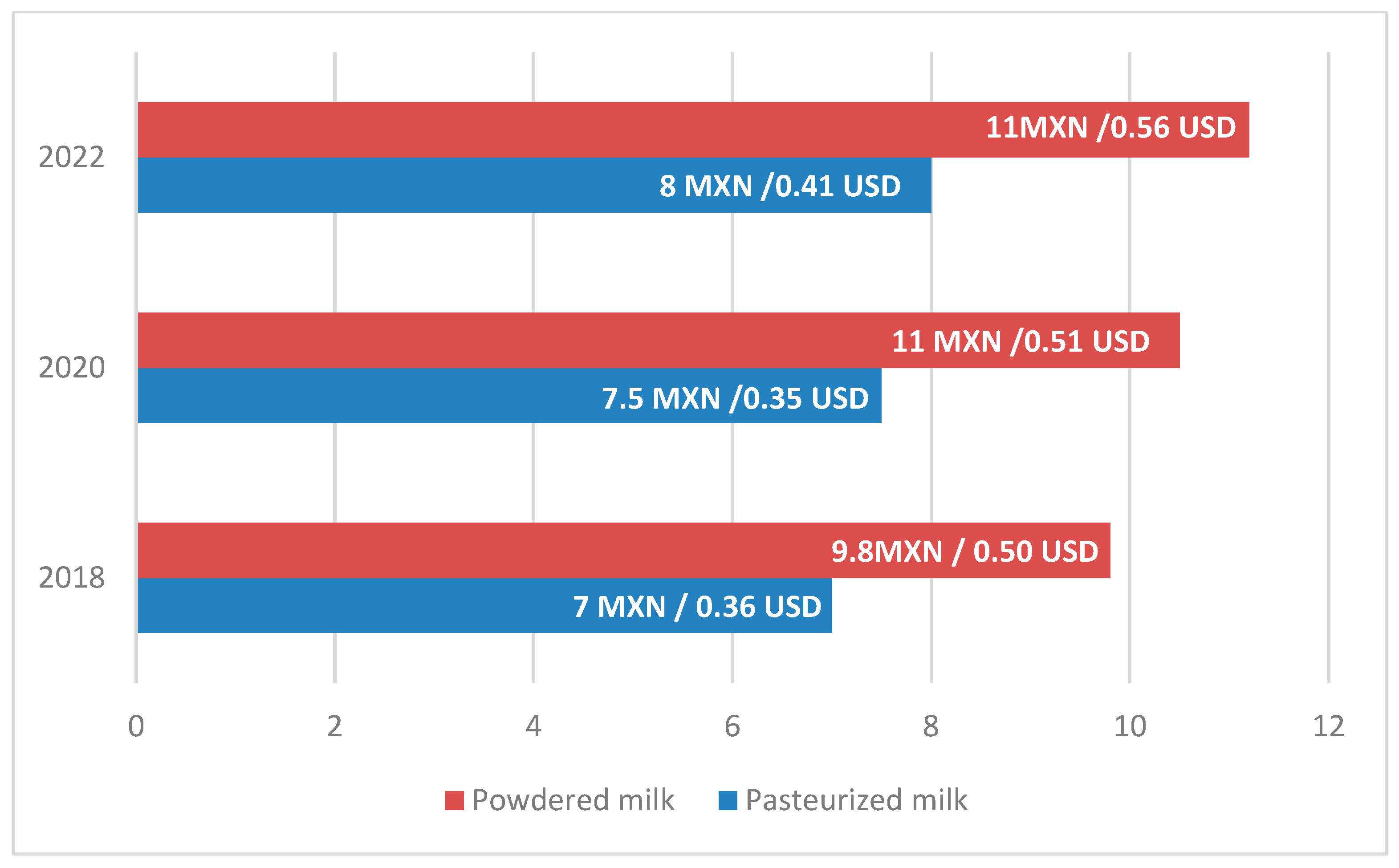
This analysis was conducted in the context of the crisis caused by the COVID-19 pandemic, when the uncertainty and demand for food modified consumption patterns. Therefore, this study aimed to analyze variations in the expenditures allocated to pasteurized and powdered milk during and after the pandemic, considering the socioeconomic and demographic factors influencing these choices. A cross-sectional ordinary least squares (OLS) regression model was implemented using data from the National Household Income and Expenditure Survey for 2018, 2020, and 2022. The model evaluated variables such as income, household size, educational level, and gender of the household head, as well as the presence of minors and older adults at the regional level. The findings demonstrated that, in 2020, expenditure on pasteurized milk exhibited an elasticity of 0.888, suggesting heightened sensitivity to income during the pandemic period. In contrast, the elasticity of powdered milk was lower, with a value of 0.013 between 2018 and 2020, and negative values by 2022. Additionally, households headed by women, households with a higher level of education, and households with children spent more on pasteurized milk. These findings confirm the importance of milk as an essential commodity and highlight the substitute role of powdered milk in low-income households.
Keywords: elasticity; ENIGH; fluid milk; powdered milk; consumer elasticity; ENIGH; fluid milk; powdered milk; consumer