
Strategic Human Resource Management in the Digital Era: Technology, Transformation, and Sustainable Advantage




Abstract
1. Introduction
- (1)
- How do emerging digital technologies reshape the strategic role of human resource management in organizations?
- (2)
- In what ways can technology-enabled SHRM practices contribute to sustainable competitive advantage in the Industry 4.0–5.0 context?
- (3)
- What lessons can be drawn from organizational cases (e.g., IBM, Walmart, Unilever, UiPath) to inform both future research and managerial practice?
2. Materials and Methods
3. Results
3.1. Theoretical Foundations of Strategic Human Resource Management
3.2. Emerging Technologies Transforming Human Resource Management
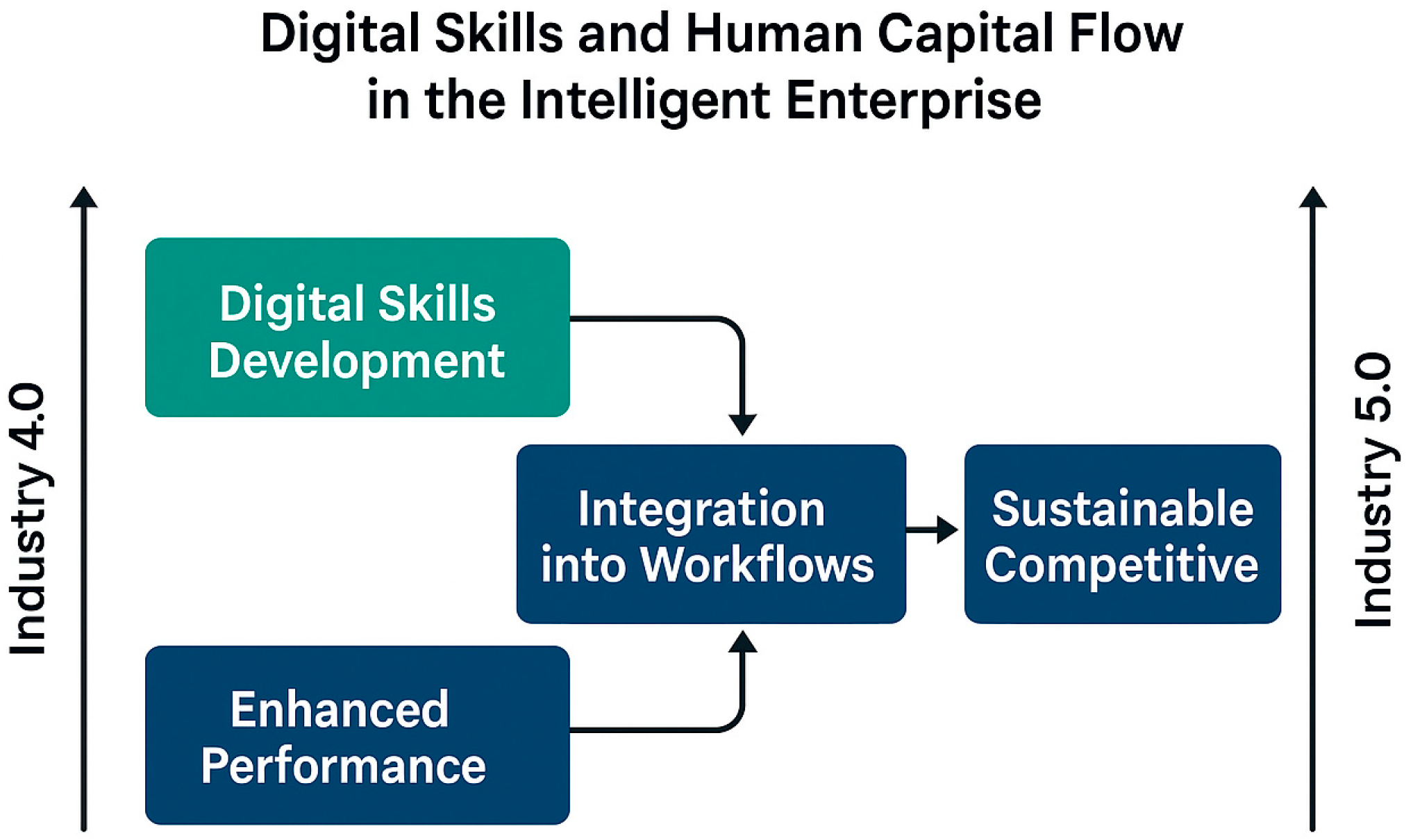
3.3. Human Capital Transformation in the Digital Era (Industry 4.0 and 5.0)
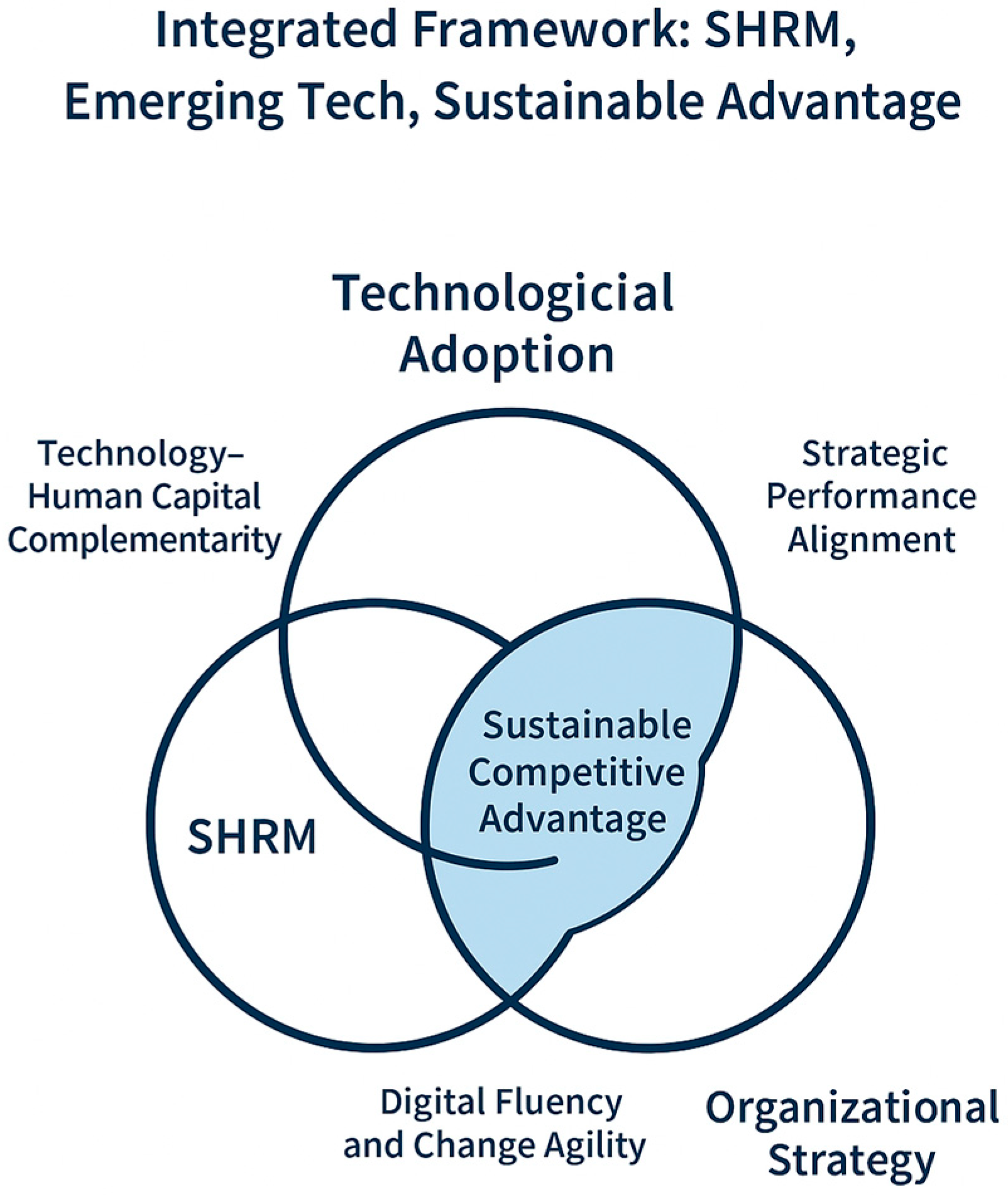
3.4. Strategic HR–Technology Synergy for Sustainable Competitive Advantage
3.5. Cases Based Evidence on Emerging Technologies and Strategic Human Resource Management in Redefining Competitive Advantage
3.5.1. Walmart: Virtual Reality for Scalable Experiential Learning
3.5.2. IBM: Predictive Analytics for Talent Retention
3.5.3. Unilever: AI-Enhanced Recruitment for Speed and Diversity
3.5.4. UiPath: Robotic Process Automation in HR Operations
4. Discussion
4.1. Cross-Case Insights
- Acceleration of HR Processes Third
- Third Quality and Inclusivity Gains.
- Cost Efficiency with Strategic Impact.
- Human–Technology Complementarity.
4.2. Implications for Strategic HR–Technology Integration
- 1.
- First, embedding technology–human capital complementarity as a core design principle.
- 2.
- Second, institutionalizing continuous learning and change agility.
- 3.
- Third, establishing strategic performance alignment mechanisms.
4.3. Challenges and Ethical Considerations
- 1.
- Data Privacy and Security
- 2.
- Algorithmic Bias and Fairness
- 3.
- Workforce Displacement and Job Redesign
- 4.
- Transparency, Accountability, and Trust
- 5.
- Ethical Governance and ESG Alignment
4.4. Limitations and Future Research
5. Conclusions
Author Contributions
Funding
Institutional Review Board Statement
Informed Consent Statement
Data Availability Statement
Acknowledgments
Conflicts of Interest
Abbreviations
| HR | Human Resources |
| SHRM | Strategic Human Resource Management |
| AI | Artificial Intelligence |
| AV/RV | Augmented and Virtual Reality |
| IoT | Internet of Things |
| RPA | Robotic Process Automation |
Appendix A

| Author(s), Year | Focus of Study | Methodology | Key Findings |
|---|---|---|---|
| Bondarouk & Brewster, 2016 | Digital HRM and e-HRM adoption | Conceptual review | HRM shifted from administrative functions to strategic integration of digital tools |
| Marler & Boudreau, 2017 | HR analytics adoption | Empirical survey | HR analytics improves decision-making but requires organizational readiness |
| Strohmeier, 2018 | Digital transformation in HR | Conceptual synthesis | HRM must align digitalization withstrategic objectives |
| Kaushik & Guleria, 2020 | AI in HRM | Case-based analysis | AI enhances recruitment efficiency but raises ethical challenges |
| Meijerink et al., 2021 | HR technology and value creation | Empirical study | Technology supports sustainable value only when paired with people-centered practices |
| Di Vaio et al., 2022 | HRM in Industry 4.0/5.0 | Systematic review | Highlights skill transformation and SHRM’s strategic role in Industry 4.0–5.0 |
| CIPD, 2023 | People analytics in practice | Institutional report | Predictive analytics improves retention, engagement, and decision quality |
| WEF, 2023 | Future of Jobs | Global survey | Shows that technological disruption creates jobsbut demands large-scale reskilling |
References
- McKinsey & Company. How COVID-19 Has Pushed Companies over the Technology Tipping Point—And Transformed Business Forever; McKinsey & Company: New York, NY, USA, 2020; Available online: https://www.mckinsey.com/~/media/McKinsey/Business%20Functions/Strategy%20and%20Corporate%20Finance/Our%20Insights/How%20COVID%2019%20has%20pushed%20companies%20over%20the%20technology%20tipping%20point%20and%20transformed%20business%20forever/How-COVID-19-has-pushed-companies-over-the%20technology%20tipping-point-final.pdf (accessed on 8 May 2025).
- World Economic Forum. The Future of Jobs Report 2023; World Economic Forum: Geneva, Switzerland, 2023; Available online: https://www.weforum.org/publications/the-future-of-jobs-report-2023/ (accessed on 26 August 2025).
- Deloitte. Thriving Beyond Boundaries: Human Performance in a Boundaryless World; 2024 Global Human Capital Trends; Deloitte Insights. 2024. Available online: https://www.deloitte.com/us/en/insights/topics/talent/human-capital-trends/2024/prioritizing-human-performance.html (accessed on 26 August 2025).
- European Commission: Directorate-General for Research and Innovation; Breque, M.; De Nul, L.; Petridis, A. Industry 5.0—Towards a Sustainable, Human-Centric and Resilient European Industry, Publications Office of the European Union. 2021. Available online: https://data.europa.eu/doi/10.2777/308407 (accessed on 26 August 2025).
- Asif, A.; Muzammil, M.; Shafi, K.; Rehman, F. The Impact of Digital Transformation on HR Practices: A Systematic Literature Review. SSRN Working Paper, 2025. Available online: https://papers.ssrn.com/sol3/papers.cfm?abstract_id=5376835 (accessed on 26 August 2025).
- World Economic Forum. Why It’s Time to Revisit the Value and Meaning of Work; World Economic Forum: Geneva, Switzerland, 2025; Available online: https://www.weforum.org/stories/2025/01/why-it-s-time-to-revisit-the-value-and-meaning-of-work/ (accessed on 26 August 2025).
- Barney, J. Firm Resources and Sustained Competitive Advantage. J. Manag. 1991, 17, 99–120. [Google Scholar] [CrossRef]
- Ulrich, D. Human Resource Champions: The Next Agenda for Adding Value and Delivering Results; Harvard Business Press: Boston, MA, USA, 1997. [Google Scholar]
- Wright, P.M.; McMahan, G.C.; Snell, S.A. Strategic Human Resource Management: Building Human Capital and Organizational Capability. Hum. Resour. Manag. 2023, 62, 5–22. [Google Scholar] [CrossRef]
- Deloitte. 2025 Global Human Capital Trends: Turning Tensions into Triumphs—Helping Leaders Transform Uncertainty into Opportunity; Deloitte Insights. 2025. Available online: https://www.deloitte.com/us/en/insights/topics/talent/human-capital-trends.html?icid=disubnav_human-capital-trends#ai-revolutionizing-work (accessed on 26 August 2025).
- McKinsey & Company. The State of AI in 2023. Generative AI’s Breakout Year; McKinsey & Company: New York, NY, USA, 2023; Available online: https://www.mckinsey.com/capabilities/quantumblack/our-insights/the-state-of-ai-in-2023-generative-ais-breakout-year (accessed on 26 August 2025).
- European Commission: Directorate-General for Research and Innovation; Renda, A.; Schwaag Serger, S.; Tataj, D.; Morlet, A. Industry 5.0, a Transformative Vision for Europe—Governing Systemic Transformations Towards a Sustainable Industry, Publications Office of the European Union. 2021. Available online: https://data.europa.eu/doi/10.2777/17322 (accessed on 26 August 2025).
- Skobelev, P.O.; Borovik, S.Y. On the Way from Industry 4.0 to Industry 5.0: From Digital Manufacturing to Digital Society. Ind. 4.0 2017, 2, 307–311. Available online: https://stumejournals.com/journals/i4/2017/6/307 (accessed on 26 August 2025).
- Vong, K.C. Strategic Human Resource Development for Industry 4.0 Readiness: Bridging Digital Transformation and Workforce Capabilities. Sustainability 2025, 17, 6988. [Google Scholar] [CrossRef]
- Minbaeva, D.; Collings, D.G. Seven Myths of Global Talent Management. Int. J. Hum. Resour. Manag. 2013, 24, 1762–1776. [Google Scholar] [CrossRef]
- Strohmeier, S.; Parry, E. Digital Human Resource Management: A Conceptual Clarification. Int. J. Hum. Resour. Manag. 2021, 32, 3305–3332. [Google Scholar] [CrossRef]
- Nigar, M.; Juli, J.F.; Golder, U.; Alam, M.J.; Hossain, M.K. Artificial Intelligence and Technological Unemployment: Understanding Trends, Technology’s Adverse Roles, and Current Mitigation Guidelines. J. Open Innov. Technol. Mark. Complex. 2025, 11, 100607. [Google Scholar] [CrossRef]
- IBM. AI in HR Talent: Transforming Human Resources with Artificial Intelligence. 2024. Available online: https://www.ibm.com/think/topics/ai-in-hr-talent (accessed on 26 August 2025).
- Unilever. A Beacon of Diversity and Inclusion; Unilever: London, UK, 2025; Available online: https://www.unilever.com/sustainability/equity-diversity-and-inclusion/a-beacon-of-diversity-and-inclusion/ (accessed on 26 August 2025).
- UiPath. State of the Automation Professional 2024. UiPath Inc.: New York, NY, USA, 2024; Available online: https://downloads.ctfassets.net/5965pury2lcm/6OHFo9HHsTbShADYLNE789/348f16780742d9c29449aed6a7863750/State_of_the_automation_professional_2024.pdf (accessed on 26 August 2025).
- Siderska, J. The Adoption of Robotic Process Automation Technology to Ensure Business Processes during the COVID-19 Pandemic. Sustainability 2021, 13, 8020. [Google Scholar] [CrossRef]
- Abdelhay, S.; Mohamed, H.; Farouk, M. The Role of Virtual Reality in Employee Training and Development: Mediating Role of Engagement and Immersion, Moderating Role of Organizational Culture. Int. J. Res. Hum. Resour. Manag. 2024, 6, 292–300. [Google Scholar] [CrossRef]
- Meijerink, J.; Bondarouk, T. The Duality of Algorithmic Management: Toward a Research Agenda on HRM Algorithms, Autonomy and Value Creation. Hum. Resour. Manag. Rev. 2023, 33, 100876. [Google Scholar] [CrossRef]
- Ncube, T.R.; Sishi, K.K.; Skinner, J.P. The Impact of Artificial Intelligence on Human Resource Management Practices: An Investigation. SA J. Hum. Resour. Manag. 2025, 23, A2960. [Google Scholar] [CrossRef]
- CIPD. Emerging & Future Work: Factsheet; Chartered Institute of Personnel and Development: London, UK, 2024; Available online: https://www.cipd.org/uk/knowledge/factsheets/emerging-future-work-factsheet/ (accessed on 26 August 2025).
- Eurofound (Litardi, C.; Widera, S.). Tech Employment in the EU—What Happened after 2023’s Big Redundancy Wave? Eurofound: Dublin, Ireland, 2025; Available online: https://www.eurofound.europa.eu/en/resources/article/2025/tech-employment-eu-what-happened-after-2023s-big-redundancy-wave (accessed on 26 August 2025).
- OECD. Artificial Intelligence and Wage Inequality; OECD Publishing: Paris, France, 2024; Available online: https://www.oecd.org/content/dam/oecd/en/publications/reports/2024/04/artificial-intelligence-and-wage-inequality_563908cc/bf98a45c-en.pdf (accessed on 26 August 2025).
- United Nations & International Labour Organization. Mind the AI Divide: Shaping a Global Perspective on the Future of Work; United Nations: Geneva, Switzerland, 2024. [Google Scholar] [CrossRef]
- World Bank. Future Jobs: Robots, Artificial Intelligence, and Digital Platforms in East Asia and Pacific; World Bank: Washington, DC, USA, 2025; Available online: https://www.worldbank.org/en/region/eap/publication/future-jobs (accessed on 26 August 2025).
- INSEAD; Descartes Institute for the Future; Human Capital Leadership Institute. The Global Talent Competitiveness Index 2023; INSEAD: Fontainebleau, France, 2023; Available online: https://www.insead.edu/system/files/2023-11/gtci-2023-report.pdf (accessed on 26 August 2025).
- Boxall, P.; Purcell, J. Strategy and Human Resource Management, 5th ed.; Palgrave Macmillan: London, UK, 2023. [Google Scholar]
- Armstrong, M. Armstrong’s Handbook of Strategic Human Resource Management, 7th ed.; Kogan Page: London, UK, 2022. [Google Scholar]
- CIPD. Learning at Work Survey 2023; Chartered Institute of Personnel and Development: London, UK, 2023; Available online: https://www.cipd.org/globalassets/media/knowledge/knowledge-hub/reports/2023-pdfs/2023-learning-at-work-survey-report-8378.pdf (accessed on 26 August 2025).
- World Economic Forum. The Future of Jobs Report 2025; World Economic Forum: Geneva, Switzerland, 2025; Available online: https://www.weforum.org/publications/the-future-of-jobs-report-2025/ (accessed on 26 August 2025).
- Bersin, J. HR Technology 2023: Defining the Market; The Josh Bersin Company: Oakland, CA, USA, 2023. [Google Scholar]
- Wilmers, N. Generative AI and the Future of Inequality; An MIT Exploration of Generative AI; MIT: Cambridge, MA, USA, 2024. [Google Scholar] [CrossRef]
- World Economic Forum. Redesigning Trust: Blockchain Deployment Toolkit; World Economic Forum: Geneva, Switzerland, 2023. [Google Scholar]
- Schwab, K. The Fourth Industrial Revolution; Crown Business: New York, NY, USA, 2017. [Google Scholar]
- McKinsey Global Institute (Milken Institute Review). Automation and the Future of Work; McKinsey & Company: New York, NY, USA, 2018; Available online: https://www.mckinsey.com/mgi/overview/in-the-news/automation-and-the-future-of-work (accessed on 26 August 2025).
- Frey, C.B.; Osborne, M.A. The Future of Employment: How Susceptible Are Jobs to Computerisation? Technol. Forecast. Soc. Change 2017, 114, 254–280. [Google Scholar] [CrossRef]
- OECD. OECD Skills Outlook 2023: Skills for a Resilient Green and Digital Transition; OECD Publishing: Paris, France, 2023. [Google Scholar] [CrossRef]
- Chartered Institute of Personnel and Development (CIPD) and Sustainable HRM Skillnet. Sustainable People Practices: A Framework to Empower Tomorrow’s Workforce to Be Net Better Off; Chartered Institute of Personnel and Development: London, UK, 2024; Available online: https://sustainablehrmskillnet.ie/wp-content/uploads/2024/05/Sustainable-People-Practices-May-2024.pdf (accessed on 26 August 2025).
- Bondarouk, T.; Brewster, C. Conceptualising the Future of HRM and Technology Research. Int. J. Hum. Resour. Manag. 2023, 34, 219–241. [Google Scholar] [CrossRef]
- Gartner. The Future of Workforce Planning. 2024. Available online: https://www.gartner.com/en/human-resources (accessed on 26 August 2025).
- Alenezi, M. Digital Learning and Digital Institution in Higher Education. Educ. Sci. 2023, 13, 88. [Google Scholar] [CrossRef]
- World Economic Forum. Shaping the Future of the Digital Economy. 2025. Available online: https://www3.weforum.org/docs/WEF_Shaping_the_Future_of_Digital_Economy_and_Society_2P_190916.pdf (accessed on 26 August 2025).
- McKinsey & Company. Technology and the Future of Work. 2024. Available online: https://www.mckinsey.com/featured-insights/future-of-work (accessed on 26 August 2025).
- Vargas-Hernández, J.G.; Vargas-González, M.C.O.C. Emerging Disruptive Digital Technologies and Their Impacts on Unemployment and Wage Inequalities in an Era of Artificial Intelligence. In Economic Slowdown, Unemployment, and Inflation; Apple Academic Press: London, UK, 2025; 22p, ISBN 978-1-77964-346-9. Available online: https://www.taylorfrancis.com/chapters/edit/10.1201/9781779643469-7/emerging-disruptive-digital-technologies-impacts-unemployment-wage-inequalities-era-artificial-intelligence-jos%C3%A9-vargas-hern%C3%A1ndez-omar-vargas-gonz%C3%A1lez (accessed on 26 August 2025).
- Lengnick-Hall, C.A.; Beck, T.E.; Lengnick-Hall, M.L. Developing a Capacity for Organizational Resilience through Strategic Human Resource Management. Hum. Resour. Manag. Rev. 2011, 21, 243–255. [Google Scholar] [CrossRef]
- Jamali, D.; El Dirani, A.; Harwood, I.A. Exploring Human Resource Management Roles in Corporate Social Responsibility: The CSR–HRM Co-Creation Model. Bus. Ethics Eur. Rev. 2015, 24, 125–143. [Google Scholar] [CrossRef]
- Delery, J.E.; Roumpi, D. Strategic Human Resource Management, Human Capital and Competitive Advantage: Is the Field Going in Circles? Hum. Resour. Manag. J. 2017, 27, 1–21. [Google Scholar] [CrossRef]
- Bader, V.; Kaiser, S. Algorithmic Decision-Making? The User Interface and Its Role for Human Involvement in Decisions Supported by Artificial Intelligence. Organization 2019, 26, 655–672. [Google Scholar] [CrossRef]
- Barocas, S.; Hardt, M.; Narayanan, A. Fairness and Machine Learning: Limitations and Opportunities in HR Applications; MIT Press: Cambridge, MA, USA, 2023; ISBN 978-0-262-04861-3. Available online: https://fairmlbook.org (accessed on 26 August 2025).
- Chhatre, R.; Singh, S. Mitigating Bias in AI-Driven Recruitment: Ethical Challenges and Governance Solutions. J. Inf. Syst. Eng. Manag. 2025, 10. [Google Scholar] [CrossRef]
- Bessen, J.E.; Goos, M.; Salomons, A.; van Den Berge, W. Automation: A Guide for Policymakers. Labour Econ. 2022, 76, 102178. [Google Scholar] [CrossRef]
- Harvard Business Review. Artificial Intelligence at Work: Enhancing Employee Engagement and Business Success; Sponsored by Zoom; Harvard Business Review: Boston, MA, USA, 2024; Available online: https://www.hbr.org/sponsored/2024/01/artificial-intelligence-at-work-enhancing-employee-engagement-and-business-success (accessed on 26 August 2025).
- Doshi-Velez, F.; Kim, B. Towards a Rigorous Science of Interpretable Machine Learning. arXiv 2017, arXiv:1702.08608. [Google Scholar] [CrossRef]
- Moreira, A. Where Is Human Resource Management in Sustainability Reporting? Exploring Sustainable HRM Practices through the Lens of ESG and GRI. Sustainability 2025, 17, 3033. [Google Scholar] [CrossRef]
- Deloitte. 2025 Global Human Capital Trends: Navigating Complex Tensions and Choices in the Worker-Organization Relationship; Deloitte Insights: New York, NY, USA, 2025; Available online: https://www.deloitte.com/us/en/insights/topics/talent/human-capital-trends.html (accessed on 26 August 2025).
- Accenture. The CHRO as a Growth Executive: Focusing the Power of Data, Technology and People to Accelerate Reinvention—And a New Vision for Growth; Accenture: New York, NY, USA, 2023; Available online: https://www.accenture.com/content/dam/accenture/final/capabilities/strategy-and-consulting/talent-and-organization/document/Accenture-CHRO-Growth-Executive.pdf (accessed on 26 August 2025).
- European Commission: Directorate-General for Research and Innovation; Dixson-Declève, S.; Dunlop, K.; Renda, A.; Charveriat, C.; Sitra, M.; Nascimento, S.; Plepys, A.; Butter, M.; Bodin, J.; et al. Industry 5.0 and the Future of Work—Making Europe the Centre of Gravity for Future Good-Quality Jobs, Publications Office of the European Union. 2023. Available online: https://data.europa.eu/doi/10.2777/685878 (accessed on 26 August 2025).
- McKinsey & Company. The State of AI in Early 2024: Gen AI Adoption Spikes and Starts to Generate Value; McKinsey & Company: New York, NY, USA, 2024; Available online: https://www.mckinsey.com/capabilities/quantumblack/our-insights/the-state-of-ai-2024 (accessed on 26 August 2025).


| Traditional HRM | SHRM in the Digital Era |
|---|---|
| Administrative personnel tasks | Strategic business partner |
| Reactive recruitment | Proactive talent analytics |
| Cost control focus | Value creation focus |
| Manual HR processes | Emerging technologies (AI, RPA, digital tools) |
| Compliance and control | Agility, innovation, and adaptability |
| Technology | HR Applications | Key Benefits |
|---|---|---|
| AI | Talent Management (including Talent Acquisition, Development, Retention, and Career Planning): AI-driven screening, chatbot interviews, predictive attrition models, career development recommendations; Performance Management: Sentiment analysis, trend evaluation | Automates decision-making, provides data-driven insights, enhances personalization at scale |
| RPA | Administrative processes: Payroll processing, data entry, onboarding documentation | Improves efficiency, reduces administrative costs, enables HR to focus on strategic activities |
| Blockchain | Credential verification, smart contracts for HR agreements | Enhances transparency, reduces background check costs, secures HR transactions |
| AR/VR | Training simulations, virtual onboarding experiences | Increases learning retention, scales training programs, improves onboarding engagement |
| People Analytics & Big Data | Workforce planning, real-time feedback, performance optimization | Enables predictive insights, identifies performance trends, supports personalized HR strategies |
| Dimension | Industry 4.0 | Industry 5.0 |
|---|---|---|
| Primary Objective | Efficiency, automation, productivity | Human-centric innovation, personalization, sustainability |
| Role of Technology | Automating processes, optimizing systems | Augmenting human creativity, enabling co-creation |
| Human Capital Focus | Technical skills for system implementation and oversight | Hybrid skills: technical + creativity, empathy, critical thinking |
| Workforce Interaction | Humans supervise and manage automated systems | Humans collaborate directly with robots/cobots |
| Skill Development | Digital skills, data analytics, AI literacy | Interdisciplinary skills, design thinking, innovation capability |
| Strategic HR Implications | Reskilling for digital operations; agile workforce models | Lifelong learning; human-centered leadership; sustainability |
| KPI Category | Example Indicators | Technological Link |
|---|---|---|
| Talent Acquisition | Time-to-hire, diversity ratio, predictive candidate fit | AI recruitment tools, applicant tracking systems |
| Talent Development | Training completion rate, skill gap closure time | Learning management systems (LMS), VR training modules |
| Retention & Engagement | Voluntary turnover rate, engagement score | People analytics dashboards, sentiment analysis |
| Productivity & Innovation | Revenue per employee, new product launches | RPA automation, innovation platforms |
| ESG & Social Impact | Employee well-being index, carbon footprint per employee | HR–sustainability data integration |
| Company | Technology/Initiative | HR Domain | Strategic Outcomes |
|---|---|---|---|
| Walmart | VR simulation training (Black Friday scenario) | Training & Development | +30% training satisfaction; 80% time reduction per module; improved service readiness [22] |
| IBM | AI-driven predictive attrition model | Talent Management (Retention & Development) | 95% prediction accuracy; USD 300M turnover savings; protection of critical skills [23] |
| Unilever | AI-based cognitive games + video interview screening | Talent Acquisition (Recruitment & Diversity) | 75% faster hiring; +16% diversity in hires; enhanced candidate experience [24] |
| UiPath | RPA bots for HR processes | HR Operations & Administration | 85% process time reduction; redeployment of HR capacity to strategic roles [20,21] |
Disclaimer/Publisher’s Note: The statements, opinions and data contained in all publications are solely those of the individual author(s) and contributor(s) and not of MDPI and/or the editor(s). MDPI and/or the editor(s) disclaim responsibility for any injury to people or property resulting from any ideas, methods, instructions or products referred to in the content. |
© 2025 by the authors. Licensee MDPI, Basel, Switzerland. This article is an open access article distributed under the terms and conditions of the Creative Commons Attribution (CC BY) license (https://creativecommons.org/licenses/by/4.0/).
Share and Cite
Nastase, C.; Adomnitei, A.; Apetri, A. Strategic Human Resource Management in the Digital Era: Technology, Transformation, and Sustainable Advantage. Merits 2025, 5, 23. https://doi.org/10.3390/merits5040023
Nastase C, Adomnitei A, Apetri A. Strategic Human Resource Management in the Digital Era: Technology, Transformation, and Sustainable Advantage. Merits. 2025; 5(4):23. https://doi.org/10.3390/merits5040023
Chicago/Turabian StyleNastase, Carmen, Andreea Adomnitei, and Anisoara Apetri. 2025. "Strategic Human Resource Management in the Digital Era: Technology, Transformation, and Sustainable Advantage" Merits 5, no. 4: 23. https://doi.org/10.3390/merits5040023
APA StyleNastase, C., Adomnitei, A., & Apetri, A. (2025). Strategic Human Resource Management in the Digital Era: Technology, Transformation, and Sustainable Advantage. Merits, 5(4), 23. https://doi.org/10.3390/merits5040023