Article

Targeted Biological Therapy and Germline Mutation Prevalence in Advanced Ovarian Cancer Patients


by
Anne-Marie Mosbæk Ellegaard
,
Tim Svenstrup Poulsen
and
Estrid Høgdall
*
Department of Pathology, Herlev Hospital, DK-2730 Herlev, Denmark
*
Author to whom correspondence should be addressed.
Submission received: 30 October 2025 / Revised: 4 December 2025 / Accepted: 12 December 2025 / Published: 16 December 2025

Abstract

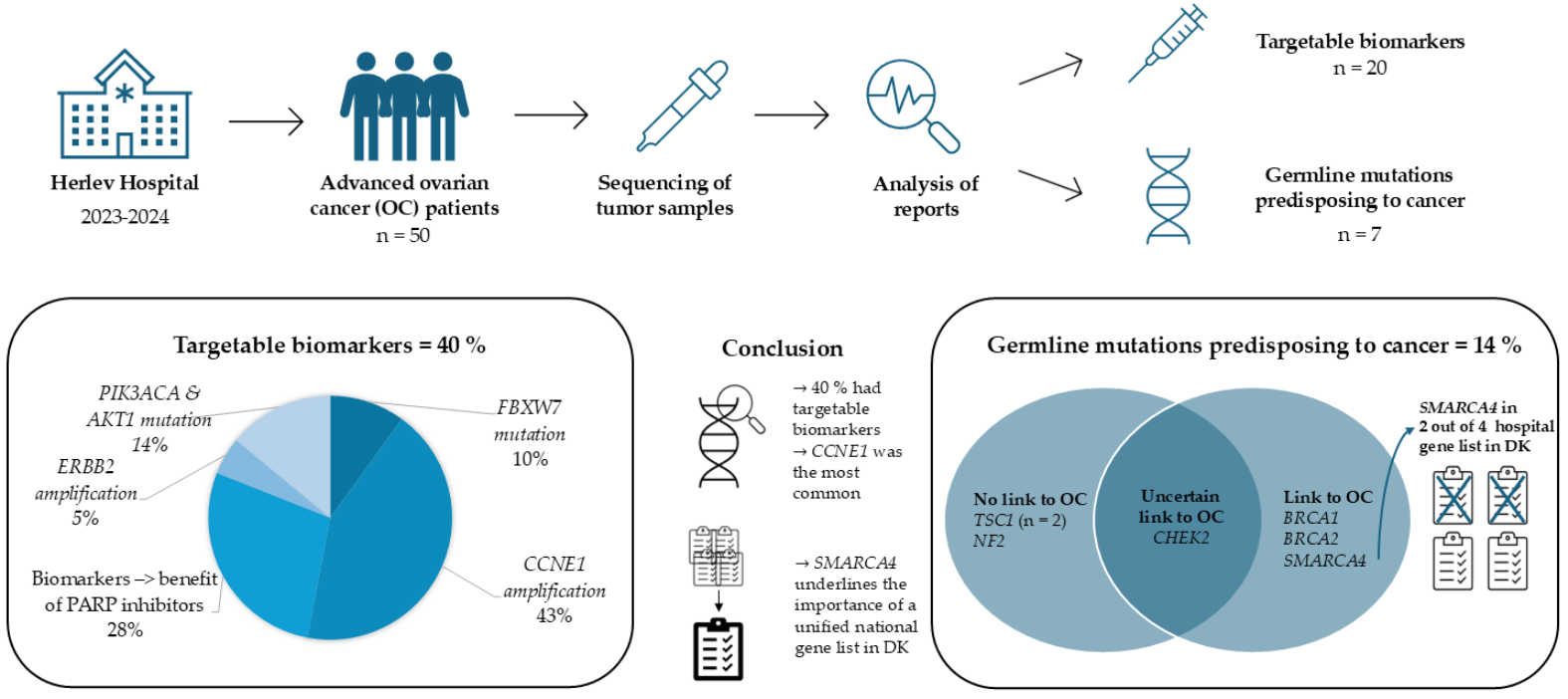
Background: Ovarian cancer is one of the most lethal gynecological malignancies, often diagnosed at an advanced stage. The prognosis is generally poor, with high recurrence rates and limited long-term survival. Understanding the genetic and molecular mechanisms underlying ovarian cancer is crucial for improving early diagnosis, developing targeted therapies, and enhancing patient outcomes. Methods: In this study, the clinical molecular reports of 50 ovarian cancer patients referred to the experimental cancer unit at Herlev Hospital were analyzed. The aim was to assess the number of patients being potential candidates for targeted biological therapy. Additionally, using the reports, we aimed to identify patients with potential germline mutations in cancer-predisposing genes. The possible consequences were annotated using gene lists from four hospitals in Denmark. Each hospital had its own distinct, published gene list, reflecting the genes that it considered potential carriers of germline mutations predisposing to cancer. Results: A total of twenty out of fifty patients (40%) had targetable biomarkers for biological treatment. CCNE1 amplification was identified as the most frequent variant (43%). Seven out of fifty patients (14%) had potential germline mutations in cancer-predisposing genes. Conclusions: In conclusion, the finding of a potential germline mutation in the SMARCA4 gene highlights how differences in hospital-specific gene lists may impact patient referral for genetic counseling.

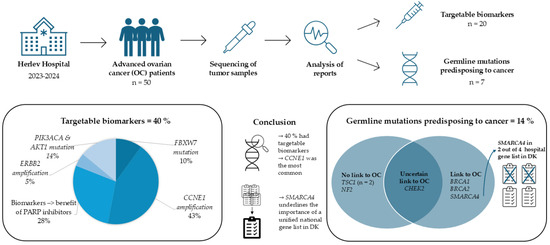
Graphical Abstract

1. Introduction

Ovarian cancer (OC) is the second most common cause of gynecologic cancer-related deaths among women worldwide. At the time of diagnosis, approximately 75% of OC patients present with either local spreading or advanced stage, classified as stage III-IV according to the International Federation of Gynecology and Obstetrics (FIGO) staging system. This is mainly due to the presence of unspecific symptoms in the early stages of the disease [1,2].
Malignant tumors of the ovary exhibit high morphological diversity. More than 90% of OC cases are of the epithelial type [3].
In many cases, the cause of cancer in the ovary remains unclear, as its etiology is often multifactorial. However, 10–20% of OC cases can be attributed to hereditary genetic conditions [4]. The most common genetic cause of hereditary OC is related to a mutation in the BRCA1 or BRCA2 (BRCA1/2) tumor suppressor genes [5]. In Denmark, all patients diagnosed with OC meet the criteria for referral for genetic evaluation. The recommendations from the Danish Society of Medical Genetics (DSMG) for genes to be tested include BRCA1/2, MMR-genes (MLH1, MSH2, and MSH6), STK11, RAD51C, RAD51D, BRIP1, and DICER1 [6].
The first choice for treatment is primary cytoreductive surgery, aiming for complete removal of all tumor tissue, followed by adjuvant chemotherapy [7]. The recommended chemotherapy treatment regimen is a combination of paclitaxel–carboplatin or carboplatin as monotherapy [8,9]. Furthermore, molecular testing should be conducted in all cases of high-grade non-mucinous tubo-ovarian carcinoma to determine BRCA1/2 status. If BRCA1/2 is shown to be wildtype, homologous recombination deficiency (HRD) status should be determined. Tumors harboring BRCA1/2 mutations, as well as BRCA1/2 wildtype tumors exhibiting homologous recombination deficiency (HRD-positive), may benefit from treatment with PARP inhibitors [10].
For some patients, the approved standardized treatment regimens will not be sufficient to cure the cancer. When all options are exhausted, patients who are candidates for experimental treatment can be referred to a phase I unit, where comprehensive molecular analysis of the tumor tissue is carried out to assess whether any relevant biomarker across organs can be considered for individualized treatment [11].
In this study, we aimed to determine the number of OC patients qualifying for targeted biological therapy. The analysis was based on a real-world cohort of patients referred to the Experimental Cancer Therapy Unit (Phase I) at Herlev Hospital using results from reports performed in clinical routine. Furthermore, we sought to identify patients with potential germline mutations in cancer-predisposing genes. For this purpose, results from the somatic analysis of the tumor tissue were reviewed and compared with published gene lists from four different hospitals in Denmark, describing differences if any. This study presents data from a unique real-world patient cohort as it is patients with no more standardized treatment possibilities who enter the Phase I unit. The study therefore supports relevant research with an overview of possibilities that should be taken into consideration for treatment.

2. Materials and Methods

2.1. Patients

The cohort consisted of all OC patients referred to the Experimental Cancer Therapy Unit at Herlev Hospital between 14 September 2023 and 28 August 2024 (n = 50). The histological types of the patients were high-grade serous adenocarcinoma (HGSC) (n = 39), endometroid adenocarcinoma (n = 3), clear cell carcinoma (n = 2), carcinosarcoma (n = 2), and undifferentiated adenocarcinoma not otherwise specified (n = 4). Clinical molecular reports of all patients were included, all drawn on 4 September 2024. The protocol for this study was approved by the Danish Ethical Committee in compliance with the rules of the International Conference on Harmonisation/Good Clinical Practice (ICH/GCP) recommendations as well as the Helsinki and Tokyo conventions (Approval Number: No. KF01-227/03).

2.2. Sequencing Results of Tumor Samples

Results from the reports emerged through the combination of pathological data and reports describing comprehensive molecular analyses, which were carried out on tumor tissues from all patients using the panel Oncomine Comprehensive Assay Plus (Thermo Fisher Scientific, Waltham, MA, USA) [12]. Results from these reports were used in the present study.
Data analyses were conducted using Ion Reporter version 5.18 with the human reference genome hg19. Somatic variants were identified and annotated using ClinVar at ncbi.nlm.nih.gov/clinvar/ or VarSome.com version (v.11.8.0–v.12.1.0), following ACMG guidelines [13]. The molecular results were summed up in a report generated by the software Oncomine Reporter v.5.7–v.5.9 ® for each of the 50 patients and were used at the Danish National Tumor Board [13]. The reports list pathogenic and likely pathogenic gene variants and relevant clinical trials/treatments accessible in Denmark. Age and report details (gene variants, allele frequencies, relevant gene amplifications/deletions, tumor tissue percentage, and potential targeted treatments/clinical trials) were registered. Descriptive statistics were then compiled to determine how many patients were candidates for treatment, and the most frequent gene variants potentially leading to treatment were identified.

2.3. Germline Mutations

To identify patients with potential germline mutations, public gene lists from four Danish hospitals (Hospital 1, Hospital 2, Hospital 3, and Hospital 4) were obtained (Supplementary Materials, S1–S4). The number of genes included in the hospital lists varied, from 23 to more than 300 genes (Hospital 4 and Hospital 2, respectively).
Not all genes on the four lists are covered by Oncomine Comprehensive Assay Plus [12]. However, the genes associated with hereditary OC as described by DSMG are all included in the panel (BRCA1/2, MMR-genes (MLH1, MSH2, and MSH6), STK11, RAD51C, RAD51D, BRIP1, and DICER1) [6].
To identify the potential germline mutations, the workflow illustrated in Figure 1 was used. Only mutations in genes that were present on at least one hospital list were included. TP53 mutations were excluded, despite being on all four gene lists from the hospitals, as over 80% of OC’s exhibit TP53 mutations, with a significant proportion being somatic [14]. Thereafter, the variant allele frequency was compared to the tumor percentage included in the report. Only variants with an allele frequency higher than 45% were considered as potential germline candidates [15]. The genes AKT1, PIK3CA, and KRAS present on some of the gene lists were excluded since they function as oncogenes.

3. Results

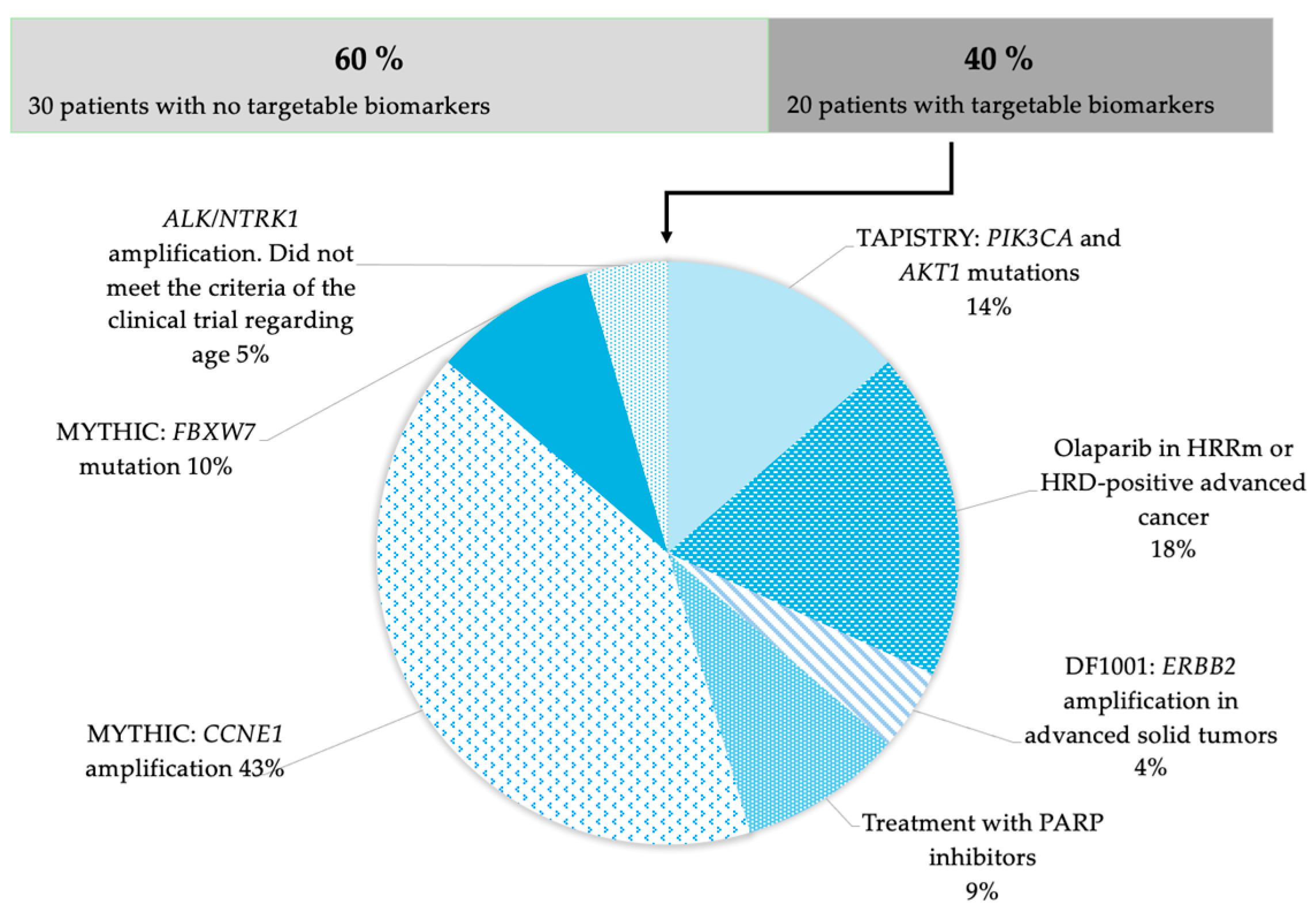
Twenty out of fifty patients (40%) had biomarkers predicting that they could be potential candidates for molecular targeted therapy (Figure 2). One patient, Patient 17, had a targetable finding involving both ALK and a NTRK1 amplification but that patient was too old to meet the inclusion criteria for the associated clinical trial. Overall, in this study we registered biological treatment options in four ongoing clinical trials and one approved treatment in Denmark (the PARP inhibitors Olaparib and Niraparib).
The most common alteration was an amplification of the CCNE1 gene [16]. Nine patients exhibited this alteration, all of whom were HRD-negative and thus did not qualify for PARP inhibitor therapy, which in Denmark is restricted to BRCA1/2-mut or HRD-positive cancers [10]. The CCNE1 amplification level varied (Copy Number Variation (CNV) range 7–104) (Table 1). The inclusion criterion for the MYTHIC trial [17] is “non-equivocal” CCNE-1 amplification [17]. It is not specified further, but conventionally, if the copy number of a gene is five or more, it is classified as amplified [18]. Patient 2 and Patient 45, both with a mutation in the FBXW7 gene, were also eligible for the MYTHIC trial [17].
Three patients were eligible for the TAPISTRY trial [19]. Two had a mutation in the PIK3CA gene and one had a mutation in the AKT1 gene. The inclusion criterion for the two patients with a PIK3CA mutation is that the tumors are “PIK3CA multiple mutant-positive” [19]. Both patients presented gene amplification (CNV = 6) in addition to the mutation (Patients 2 and 16). Whether this would be accepted as “multiple mutant-positive” is not specified.
Four patients had mutations in genes associated with HRD (Table 2). They were candidates for biological treatment (ClinicalTrial: ID NCT03742895) investigating the efficacy and safety of Olaparib in participants with previously treated, homologous recombination repair mutation (HRRm) or HRD-positive advanced cancer [20]. An inclusion criterion was the absence of prior treatment with a PARP inhibitor. All four patients were HRD-negative (Table 2) and thereby potential candidates for the trial [10].
Patient 24 had an amplification of the ERBB2 gene (CNV 39), thereby being a potential candidate for treatment with the immunotherapy agent DF-1001 through the clinical trial “Study of DF1001 in Patients with Advanced Solid Tumors” [21].
Patients 30 and 41 both harbored mutations in the BRCA1 or BRCA2 genes, classifying them as HRD-positive and eligible PARP inhibitor treatment. In Denmark, BRCA1/2 and HRD testing are routinely performed in patients with FIGO stage III/IV HGSC. They may therefore already have received PARP inhibitor treatment due to a histological subtype of HGSC [10].

Germline Mutations

A total of seven out of fifty patients (14%) were found to have potential germline mutations in cancer-predisposing genes based on the somatic analysis of tumor tissue. One of these patients, Patient 3, carried a mutation in SMARCA4, related to OC. Loss of the SMARCA4 protein is associated with a rare subtype “small cell carcinoma of the ovary, hypercalcemic type” (SCCOHT). It is common that a bi-allelic inactivation occurs through a single mutation in one allele along with loss of heterozygosity (LOH) in the SMARCA4 locus, which could very well be the case with this patient [22]. Due to the high allelic frequency and the nature of the mutation described in the literature, the mutation is likely a germline mutation [23]. The gene is on the lists from Hospital 1 and Hospital 2 (Table 3).
Patient 14 had a CHEK2 founder mutation (c.1100delC) [24]. The variant has been associated with an increased risk of breast and prostate cancer. Currently, there is no evidence that this mutation contributes to the etiology of OC. However, genetic evaluation is relevant [25]. This gene is found on the lists of three out of four hospitals (Table 3).
Patient 30 had a BRCA1 mutation with high allelic frequency, indicating that it could be a germline mutation. Patient 41 was found to have a BRCA2 mutation with a slightly lower allelic frequency (Table 3). Two patients had a mutation in the TSC1 gene (Table 3). An autosomal dominant mutation in this gene is linked to tuberous sclerosis, a disease that causes benign tumors in multiple organs [26]. Patient 17 had an NF2 mutation with high allelic frequency, suggesting a germline origin. However, germline NF2 mutations cause neurofibromatosis type 2, a fully penetrant autosomal dominant disorder unrelated to OC [27].

4. Discussion

Overall, we found that 40% of the patients had targetable biomarkers. However, the actual number of patients receiving treatment in the experimental cancer unit may be lower, due to different exclusion criteria, such as performance score and prior treatments, which are not considered in this study. The latter especially applies to BRCA1/2-mutated/HRD-positive HGSC patients, as they could already have received PARP inhibitor treatment due to national guidelines [10].
CCNE1 gene amplification was the most frequently observed alteration in patients diagnosed with OC. This does not necessarily indicate that this is a common genetic alteration in OC in the primary treatment setting, since the cohort in this study is not representative of all newly diagnosed OC patients, but exclusively reports real-world data for patients entering the experimental cancer unit. However, it might indicate that this genetic alteration is a predictor of poor prognosis for OC patients since the patients being referred may not have responded well to standard chemotherapy treatment. This is supported by CCNE1 amplifications being reported as a predictor of resistance to platinum-based chemotherapy, as well as these patients being often found to be HRD-negative [28], an observation in concordance with results obtained in our study. Preliminary results of the MYTHIC study report an overall response rate of 37.5% in platinum-resistant OC and emphasize the importance of comprehensive molecular analysis of patients resistant to standard treatment to identify experimental treatment options for this subgroup [29]. Therefore, it is important in multidisciplinary team conferences to decide when to carry out comprehensive testing to ensure the best patient treatment plan. Results from a large study including 10.478 cancer genomes were investigated by Kinnersley et al. and included whole-genome sequencing across 35 different cancer types. In total, they reported 330 candidate driver genes and estimated that 55% of patients harbored a clinically relevant variant. Of these, approximately 30–40% of the OC tissues analyzed harbored a clinical variant for potential treatment, which is in agreement with our results [30].
The growing importance of precision medicine is highlighted by ESMO in their special article “Recommendations for the use of next-generation sequencing (NGS) for patients with advanced cancer in 2024: a report from the ESMO Precision Medicine Working Group”. In their 2024 recommendations, Next-Generation Sequencing (NGS) screening for BRCA1/2 mutations, as well as HRD testing, is recommended as routine practice for patients with advanced OC. Here they also conclude that “Tumor NGS is increasingly expanding its scope and application within oncology with the aim of enhancing the efficacy of precision medicine for patients with cancer” [31]. It should therefore be ensured that the analysis platforms and assays used can be continuously developed and expanded so that new initiatives can be implemented quickly.
The lists from four hospitals in Denmark include different genes considered as possible carriers of germline mutations predisposing to cancer. For some of the patients included in this study, all of whom belonged to the same hospital, the outcome regarding genetic counseling could possibly have been different at another hospital. The patient with a mutation in the SMARCA4 gene, likely to be germline, would potentially have been referred to genetic counseling at only two of the four hospitals. The prognosis of this OC subtype, SCCOHT, linked to this mutation is very poor, and it is often found in young adults [32]. This mirrors the importance of a national alignment of gene lists to ensure that all patients across the country have the same offer regarding genetic counseling.
Based on the cases described in our study, it may be relevant to consider the inclusion of SMARCA4 in the list of genes potentially predisposing individuals to cancer. However, there are also examples of genes that should be removed (oncogenes KRAS, PIK3CA, and AKT1) due to the nature of oncogenes. The genes PIK3CA and AKT1 are present on the lists from two hospitals, and the gene KRAS is present on the list from one hospital.
Moreover, some genes are worth including in a list of potentially hereditary cancer-predisposing genes, but in most cases, they should not require referral for genetic counseling, even if found at high allelic frequency. An example is TP53, which is mutated in more than 80% of HGSC, with a large proportion of somatic origin [14]. In our study, 42 out of 50 patients (84%) presented with a TP53 mutation, corresponding to the majority of patients with HGSC. A pathogenic monoallelic germline mutation in the TP53 gene is associated with Li–Fraumeni syndrome, which is a rare condition [33]. The likelihood that any of the patients in this cohort have the syndrome is very low, and referring them all for genetic counseling would cause unnecessary distress and be a misuse of resources. For that reason, such patients are not included in the section on germline mutations in this study. However, the gene is included in the lists from all four hospitals since it can be linked to a very serious condition, making it crucial to consider if genetic counseling is relevant when observing a TP53 mutation.
It is important to take factors such as uncertainty about phenotype and penetrance into consideration. In many cases, more research is needed to fully understand the mechanisms behind mutations in genes associated with an increased risk of hereditary cancer. Research is also necessary to confirm the link between certain genes and specific types of cancer. These aspects may explain the significant variation observed between the lists from the four hospitals included in this study. The identification of a potential germline mutation in the SMARCA4 gene illustrated how differences in gene lists across the four hospitals in Denmark may potentially lead to unequal access to genetic evaluation for patients. This highlights the need for a unified national gene list for genetic counseling in Denmark. Such a list would require ongoing national revision in accordance with new research findings and knowledge.

Limitations and Advantages

This cohort was selected to include only patients referred to experimental treatment. It is known that around 20% of OC patients, if tested at diagnosis, present with a BRCA1/2 mutation, either somatic or germline [4]. In this study, only two out of fifty patients presented with a BRCA1/2 mutation, corresponding to 4%. It is established that BRCA1/2-mutated patients have a significantly better prognosis than those without a BRCA1/2 mutation. This is partly due to the additional treatment options with PARP inhibitors that are available for these patients [34]. Due to the study design, we, unfortunately, do not have the possibility to report patient outcomes for groups with or without targets. Due to the sample size, the results would not be conclusive. The relatively small number of patients included in this real-world cohort may not be representative of OC at diagnosis, as some of the treatments are currently approved for up-front treatment. It may be the case, if a larger cohort was possible, that the results would slightly differ, but due to the limitation in the size of the cohort, this study only reports descriptive data. Furthermore, the reliance on high variant allele frequency (VAF) to infer germline mutations, without confirmatory testing, is a limitation, and for future studies with a gene list for all hospitals, this list should be used as a national recommendation for germline validation. On the other hand, a key benefit of this study is the representation of a real-world cohort of patients referred to the experimental cancer unit. Therefore, the results may predict biomarkers being associated with poor prognosis and resistance to standard treatment.

5. Conclusions

Among fifty advanced OC patients, twenty had targetable biomarkers, making them potential candidates for therapy. The most common variant identified was CCNE1 amplification. Seven out of fifty patients (14%) had potential germline mutations in cancer-predisposing genes. Additionally, the finding of a potential germline mutation in the SMARCA4 gene highlights how differences in gene lists can impact patients and their access to genetic evaluation, and emphasizes the importance of a national gene list for hereditary OC.

Supplementary Materials

The following supporting information can be downloaded at: https://www.mdpi.com/article/10.3390/onco5040052/s1, S1: Germline mutations Hospital 1; S2: Germline mutations Hospital 2; S3: Germline mutations Hospital 3; S4: Germline mutations Hospital 4.

Author Contributions

Conceptualization, T.S.P. and E.H.; methodology, A.-M.M.E., T.S.P., and E.H.; formal analysis, A.-M.M.E.; investigation, A.-M.M.E., T.S.P., and E.H.; resources, E.H.; data curation, T.S.P.; writing—original draft, A.-M.M.E.; writing—review and editing, T.S.P. and E.H.; supervision, T.S.P. and E.H. All authors have read and agreed to the published version of the manuscript.

Funding

This research received no external funding.

Institutional Review Board Statement

The study was approved by the Danish Ethical Committee in compliance with the rules of the International Conference on Harmonisation/Good Clinical Practice (ICH/GCP) recommendations as well as the Helsinki and Tokyo conventions (Approval Number: No. KF01-227/03; Approval Date: 23 May 2016).

Informed Consent Statement

Informed consent was obtained from all subjects involved in the study.

Data Availability Statement

Due to sensitive information and the EU data protection legislation, we are unable to disclose the next-generation sequencing datasets for this study. Nonetheless, should a researcher have an interest in our data, they are welcome to contact us and collaborate. The data that support the findings of this study can be requested from The National Secretariat for Bio- and Genome Bank Denmark, RBGB.sekretariat.herlev-og-gentofte-hospital@regionh.dk, Herlev Hospital, Borgmester Ib Juuls Vej 73, 2730 Herlev, Denmark.

Acknowledgments

The authors would like to thank the staff at the Department of Pathology at Herlev Hospital for their assistance with the molecular analysis of the tumor samples.

Conflicts of Interest

The authors declare no conflicts of interest.

References

  1. Lheureux, S.; Braunstein, M.; Oza, A.M. Epithelial ovarian cancer: Evolution of management in the era of precision medicine. CA Cancer J. Clin. 2019, 69, 280–304. [Google Scholar] [CrossRef] [PubMed]
  2. Society of Gynecologic Oncology. FIGO-Ovarian-Cancer-Staging_1.10.14. 2014. Available online: https://www.sgo.org/wp-content/uploads/2012/09/FIGO-Ovarian-Cancer-Staging_1.10.14.pdf (accessed on 10 February 2025).
  3. Kumar, V.; Abbas, A.K. Basic Pathology, 11th ed.; Elsevier: Amsterdam, The Netherlands, 2023; pp. 614–618. [Google Scholar]
  4. Konstantinopoulos, P.A.; Norquist, B.; Lacchetti, C.; Armstrong, D.; Grisham, R.N.; Goodfellow, P.J.; Kohn, E.C.; Levine, D.A.; Liu, J.F.; Lu, K.H.; et al. Germline and Somatic Tumor Testing in Epithelial Ovarian Cancer: ASCO Guideline. J. Clin. Oncol. 2020, 38, 1222–1245. [Google Scholar] [CrossRef] [PubMed]
  5. National Cancer Institute. 2024. Available online: https://www.cancer.gov/about-cancer/causes-prevention/genetics/brca-fact-sheet (accessed on 10 February 2025).
  6. Roed Nielsen, H. Hereditaer Disposition Til Ovariecancer, HOC Dansk Selskab for Medicinsk Genetik (DSMG) Guideline. 2019. Available online: https://dsmg.dk/wp-content/uploads/2022/07/Hereditaer-disposition-til-ovariecancer-HOC.pdf (accessed on 10 October 2024).
  7. Mosgaard, B.; Pedersen, L.; Mikkelsen, M. Kirurgisk Behandling af Epiteliale Ovarietumorer. 2024. Available online: https://www.dgcg.dk/images/retningslinier/Ovariecancer/DGCG_kir_beh_epi_ovari_v3.2_AdmGodk_190624.pdf (accessed on 24 July 2024).
  8. Mosgaard, B.; Pedersen, L.; Bjørn, S. Ovariecancer—Medicinsk Behandling af Primær Ovariecancer Stadie I-IIA. 2022. Available online: https://www.dgcg.dk/images/retningslinier/Ovariecancer/DGCG_Med_beh_primr_c_ovarii_stadie%20I-IIA%20_v2.0_AdmGodk_031025.pdf (accessed on 24 July 2024).
  9. Hæe, M.; Raza Mizar, M. Ovariecancer—Medicinsk Behandling af Primær Ovariecancer Stadie IIB-IV. 2023. Available online: https://www.dgcg.dk/images/retningslinier/Ovarie/DGCG_Med_beh_c_ovarie%20IIIb-IV_V.%202.0_AdmGodk_100125.pdf (accessed on 24 July 2024).
  10. Høgdall, E.; Steniche, T. Ovariecancer: BRCA1/2 og HRD-Testning Med Henblik på Selektion af Patienter til PARP-Hæmmer Behandling. 2023. Available online: https://www.dgcg.dk/images/retningslinier/Ovariecancer/DGCG_BRCA12_HRD_testning_ovariecancer_V.1.0_AdmGodk_0201235719.pdf (accessed on 24 July 2024).
  11. Herlev Hospital. Fase 1 Behandlingsforsøg. Available online: https://www.herlevhospital.dk/undersoegelse-og-behandling/find-undersoegelse-og-behandling/Sider/Fase-1-behandlingsforsoeg-23217.aspx (accessed on 21 February 2025).
  12. Key Highlights of the Oncomine Comprehensive Assay Plus. 2024. Available online: https://www.thermofisher.com/dk/en/home/clinical/preclinical-companion-diagnostic-development/oncomine-oncology/oncomine-cancer-research-panel-workflow/oncomine-comprehensive-assay-plus.html (accessed on 9 November 2024).
  13. Richards, S.; Aziz, N.; Bale, S.; Bick, D.; Das, S.; Gastier-Foster, J.; Grody, W.W.; Hegde, M.; Lyon, E.; Spector, E.; et al. ACMG Laboratory Quality Assurance Committee. Standards and guidelines for the interpretation of sequence variants: A joint consensus recommendation of the American College of Medical Genetics and Genomics and the Association for Molecular Pathology. Genet. Med. 2015, 17, 405–424. [Google Scholar] [CrossRef] [PubMed]
  14. Ghezelayagh, T.S.; Pennington, K.P.; Norquist, B.M.; Khasnavis, N.; Radke, M.R.; Kilgore, M.R.; Garcia, R.L.; Lee, M.; Katz, R.; Leslie, K.K.; et al. Characterizing TP53 mutations in ovarian carcinomas with and without concurrent BRCA1 or BRCA2 mutations. Gynecol. Oncol. 2021, 160, 786–792. [Google Scholar] [CrossRef] [PubMed]
  15. Kuzbari, Z.; Bandlamudi, C.; Loveday, C.; Garrett, A.; Mehine, M.; George, A.; Hanson, H.; Snape, K.; Kulkarni, A.; Allen, S.; et al. Germline-focused analysis of tumour-detected variants in 49,264 cancer patients: ESMO Precision Medicine Working Group recommendations. Ann. Oncol. 2023, 34, 215–227. [Google Scholar] [CrossRef] [PubMed]
  16. Au-Yeung, G.; Mileshkin, L.; Bowtell, D.D. CCNE1 Amplification as a Therapeutic Target. J. Clin. Oncol. 2023, 41, 1770–1773. [Google Scholar] [CrossRef] [PubMed]
  17. Repare Therapeutics Study of RP-6306 Alone or in Combination with RP-3500 or Debio 0123 in Patients with Advanced Solid Tumors (MYTHIC). NIH; April 2024. Available online: https://clinicaltrials.gov/study/NCT04855656 (accessed on 24 September 2024).
  18. COSMIC CNV—Overview. 2010. Available online: https://cancer.sanger.ac.uk/cosmic/help/cnv/overview (accessed on 2 October 2024).
  19. Hoffmann-La, R. Tumor-Agnostic Precision Immuno-Oncology and Somatic Targeting Rational for You (TAPISTRY) Platform Study. 2024. Available online: https://clinicaltrials.gov/study/NCT04589845 (accessed on 24 September 2024).
  20. Merck, S.; Dohme, L. Efficacy and Safety of Olaparib (MK-7339) in Participants with Previously Treated, Homologous Recombination Repair Mutation (HRRm) or Homologous Recombination Deficiency (HRD) Positive Advanced Cancer (MK-7339-002/LYNK-002). NIH; August 2024. Available online: https://clinicaltrials.gov/study/NCT03742895 (accessed on 24 September 2024).
  21. Dragonfly Therapeutics Study of DF1001 in Patients with Advanced Solid Tumors. NIH; January 2024. Available online: https://clinicaltrials.gov/study/NCT04143711#collaborators-and-investigators (accessed on 24 September 2024).
  22. Auguste, A.; Blanc-Durand, F.; Deloger, M.; Le Formal, A.; Bareja, R.; Wilkes, D.C.; Richon, C.; Brunn, B.; Caron, O.; Devouassoux-Shisheboran, M.; et al. Small Cell Carcinoma of the Ovary, Hypercalcemic Type (SCCOHT) beyond SMARCA4 Mutations: A Comprehensive Genomic Analysis. Cells 2020, 9, 1496. [Google Scholar] [CrossRef] [PubMed]
  23. Ramos, P.; Karnezis, A.N.; Craig, D.W.; Sekulic, A.; Russell, M.L.; Hendricks, W.P.D.; Corneveaux, J.J.; Barrett, M.T.; Shumansky, K.; Yang, Y.; et al. Small cell carcinoma of the ovary, hypercalcemic type, displays frequent inactivating germline and somatic mutations in SMARCA4. Nat. Genet. 2014, 46, 427–429. [Google Scholar] [CrossRef] [PubMed]
  24. Zhang, S.; Phelan, C.M.; Zhang, P.; Rousseau, F.; Ghadirian, P.; Robidoux, A.; Foulkes, W.; Hamel, N.; McCready, D.; Trudeau, M.; et al. Frequency of the CHEK2 1100delC mutation among women with breast cancer: An international study. Cancer Res. 2008, 68, 2154–2157. [Google Scholar] [CrossRef]
  25. Stolarova, L.; Kleiblova, P.; Janatova, M.; Soukupova, J.; Zemankova, P.; Macurek, L.; Kleibl, Z. CHEK2 Germline Variants in Cancer Predisposition: Stalemate Rather than Checkmate. Cells 2020, 9, 2675. [Google Scholar] [CrossRef] [PubMed]
  26. Ebrahimi-Fakhari, D.; Mann, L.L.; Poryo, M.; Graf, N.; Von Kries, R.; Heinrich, B.; Ebrahimi-Fakhari, D.; Flotats-Bastardas, M.; Gortner, L.; Zemlin, M.; et al. Incidence of tuberous sclerosis and age at first diagnosis: New data and emerging trends from a national, prospective surveillance study. Orphanet J. Rare Dis. 2018, 13, 117. [Google Scholar] [CrossRef]
  27. Skovby, F.; Larsen, E.P. Neurofibromatose Type 2. 2023. Available online: https://www.sundhed.dk/sundhedsfaglig/laegehaandbogen/sjaeldne-sygdomme/sjaeldne-sygdomme/neurofibromatose-type-2/ (accessed on 2 October 2024).
  28. Gorski, J.W.; Ueland, F.R.; Kolesar, J.M. CCNE1 amplification as a predictive biomarker of chemotherapy resistance in epithelial ovarian cancer. Diagnostics 2020, 10, 279. [Google Scholar] [CrossRef] [PubMed]
  29. Repare Therapeutics Announces Positive Results of the Lunresertib and Camonsertib Combination from the MYTHIC Phase 1 Gynecologic Expansion Clinical Trial. 2024. Available online: https://www.linkedin.com/company/repare-therapeutics/ (accessed on 24 September 2024).
  30. Kinnersley, B.; Sud, A.; Everall, A.; Cornish, A.J.; Chubb, D.; Culliford, R.; Gruber, A.J.; Lärkeryd, A.; Mitsopoulos, C.; Wedge, D.; et al. Analysis of 10,478 cancer genomes identifies candidate driver genes and opportunities for precision oncology. Nat. Genet. 2024, 56, 1868–1877. [Google Scholar] [CrossRef] [PubMed]
  31. Mosele, M.F.; Westphalen, C.B.; Stenzinger, A.; Barlesi, F.; Bayle, A.; Bièche, I.; Bonastre, J.; Castro, E.; Dienstmann, R.; Krämer, A.; et al. Recommendations for the use of next-generation sequencing (NGS) for patients with advanced cancer in 2024: A report from the ESMO Precision Medicine Working Group. Ann. Oncol. 2024, 35, 588–606. [Google Scholar] [CrossRef] [PubMed]
  32. Callegaro-Filho, D.; Gershenson, D.M.; Nick, A.M.; Munsell, M.F.; Ramirez, P.T.; Eifel, P.J.; Euscher, E.D.; Marques, R.M.; Nicolau, S.M.; Schmeler, K.M.; et al. Small cell carcinoma of the ovary-hypercalcemic type (SCCOHT): A review of 47 cases. Gynecol. Oncol. 2016, 140, 53–57. [Google Scholar] [CrossRef] [PubMed]
  33. Aedma, S.K.; Kasi, A.; Affiliations, K.; Fraumeni, L. Li-Fraumeni Syndrome Continuing Education Activity; StatPearls: Treasure Island, FL, USA, 2024. Available online: https://www.ncbi.nlm.nih.gov/books/NBK532286/?report=printable (accessed on 24 September 2024).
  34. O’Malley, D.M.; Krivak, T.C.; Kabil, N.; Munley, J.; Moore, K.N. PARP Inhibitors in Ovarian Cancer: A Review. Target. Oncol. 2023, 18, 471–503. [Google Scholar] [CrossRef] [PubMed]
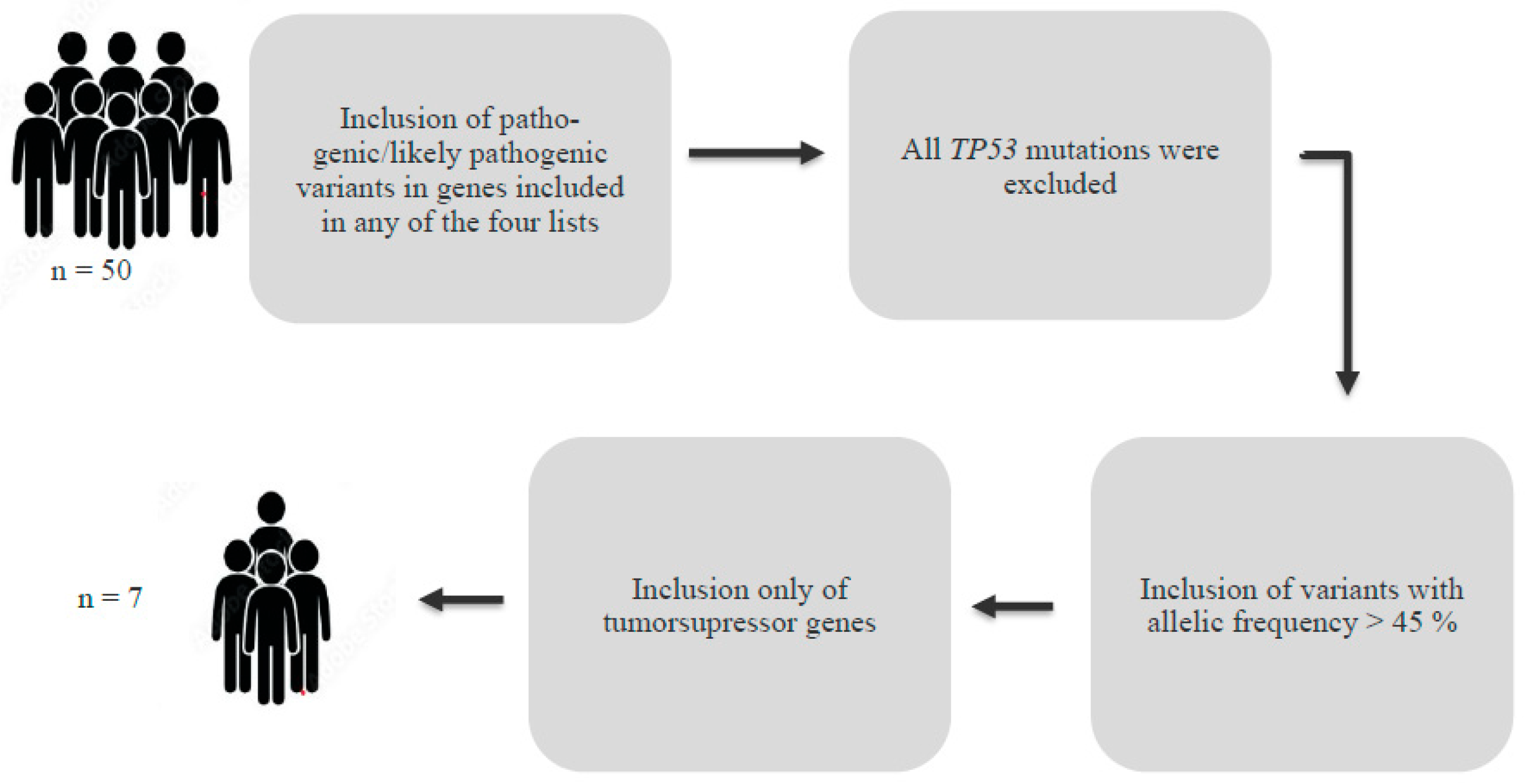
Figure 1. Flow chart illustrating how patients with potential germline mutations in cancer-predisposing genes were identified.
Onco 05 00052 g001
Figure 2. The proportion of patients with targetable biomarkers is shown along with the distribution of treatment options across ongoing trials and one approved treatment (PARP inhibitors). The most frequent trial, MYTHIC, is further divided by somatic variants providing access to it. Patients 2 and 14 met criteria for two different trials/treatments due to multiple mutations/amplifications and are included in the statistics for both.
Onco 05 00052 g002
Table 1. The copy number variations among the patients with a CCNE1 amplification in the tumor tissue.
PatientCopy Number Variation
377
338
189
1410
1010
616
821
1128
31104
Table 2. Mutations with relation to the homologous recombination repair mechanism.
P.MutationHRD Status
14CHEK2 p.(T367Mfs*15) c.1100delCNegative
15CDK12 p.(G1092Afs*11) c.3275delGNegative
25PALB2 p.(S565I) c.1694G>TNegative
36CDK12 p.(S318Lfs*20) c.952delTNegative
Table 3. Possible germline mutations and the hospital gene list on which they are present.
PatientVariant (Mutation)Gene TypePossible Association with Predisposition to Ovarian CancerAllelic Frequency (%)Tumor Percentage (%)
3SMARCA4Tumor supressorYes5456
14CHEK2Tumor supressorUncertain7640
17NF2Tumor supressorNo5460
30BRCA1Tumor supressorYes7050
32TSC1Tumor supressorNo4530
41BRCA2Tumor supressorYes4772
48TSC1Tumor supressorNo4551
Onco 05 00052 i001 Hospitals 1, 2, 3 and 4; Onco 05 00052 i002 Hospitals 1 and 2; Onco 05 00052 i003 Hospitals 1, 2 and 3.
Disclaimer/Publisher’s Note: The statements, opinions and data contained in all publications are solely those of the individual author(s) and contributor(s) and not of MDPI and/or the editor(s). MDPI and/or the editor(s) disclaim responsibility for any injury to people or property resulting from any ideas, methods, instructions or products referred to in the content.