


Abstract
Teacher training should promote a social understanding of disability to support effective inclusive practices and reduce barriers. This study surveyed 150 pre-service primary and secondary teachers at one German university using a mixed-methods design to examine their attitudes toward inclusive education and their agreement with the social model of disability. It was found that participants held neutral to slightly positive attitudes toward inclusion and partially agreed with the social model of disability. Structural equation modeling revealed that social contact, even if limited, influenced the agreement with the social model of disability, but not the attitudes toward the inclusion of pupils with special educational needs in mainstream schools (CMIN/df = 1.50, CFI = 0.96, IFI = 0.96, TLI = 0.94, RMSEA = 0.06). Interview data showed that participants have concerns about working with these pupils, citing a lack of training in special education and inclusive practices.
1. Introduction
Inclusive education aims to improve both education quality for all children and social integration by strengthening understanding, removing barriers and reducing prejudice [1]. Although most countries have developed policy frameworks that support the implementation of inclusive practices in mainstream schools, the transition from a segregated support system to an inclusive system is still a challenge worldwide [1,2]. While most European countries have adopted inclusive education policies and changed their school systems, significant variation exists in how these are defined, implemented, and experienced in practice [3].
Unlike other European countries, whose inclusive school systems allow and promote pupils with special educational needs to attend classes in regular schools [4,5], Germany has a differentiated special education system in which there is an extensive range of special needs schools for almost every form of special educational need and disability [6]. Even if empirical research shows that pupils with special educational needs who attend regular schools perform better academically than those who stay in special schools [7,8,9], the German educational system maintains this exclusion and selection of pupils. Although Germany is committed to international frameworks such as the Salamanca Statement [10], inclusion is not regulated through a single national law; instead, each federal state defines its own guidelines and requirements for implementing inclusive schooling. Since the first UN convention, the inclusion figures in Germany have not increased significantly, increasing only by 2.4% in the last 12 years [11]. Additionally, 44% of the 581,265 pupils with special educational needs are taught in special schools and not in mainstream schools [12]. Behind these results, there are different factors involved: no clear inclusive policies, deficiencies in teacher training, limited resources, teachers’ willingness to work in inclusive classrooms, and low self-efficacy, among other reasons [13,14].
Effective inclusionary practices and teaching hang partially on the beliefs of teachers about their roles and responsibilities in working with pupils with disabilities [15,16]. However, teachers at regular schools still think that special schools are better for pupils with special educational needs and are skeptical about inclusion in regular schools [17]. Research suggests that pre-service teachers who are trained in special education have more contact with people with disabilities, have fewer concerns about working with these pupils and tend to have more positive attitudes toward inclusive education [18,19,20,21,22]. Furthermore, new research in the topic of disability studies and advocacy shows that pre-service teachers who agree with a social understanding of disability hold more positive attitudes toward inclusion [23].
Nevertheless, training in special education is still oriented toward special education programs, while regular school teachers only attend a few hours of seminars on inclusive education and have less practical experience in dealing with children with special educational needs [24]. In light of these issues, the attitudes of pre-service teachers of primary and secondary education from one German university were examined using a mixed-methods design to achieve a deeper and more comprehensive understanding of their points of view on inclusive education, their interactions with individuals with disabilities and their previous experience working with pupils with special educational needs. First, 150 pre-service teachers took part in a survey in which their attitudes toward inclusive education of pupils with special educational needs and their agreement with the social model of disability were assessed. Additionally, a small group of surveyed participants was interviewed to more deeply explore their attitudes toward inclusive education, toward disability, and toward working with children with special educational needs, as well as their previous experience working with them.
1.1. Pre-Service Teachers’ Attitudes Toward Inclusive Education
Attitudes are psychological tendencies that evaluate an object as positive or negative, and they differentiate themselves from other psychological constructs, such as emotions, based on their stability [25]. Attitudes toward inclusive education differ largely, while most studies showed that in-service and pre-service teachers tend to have neutral to slightly positive attitudes toward inclusive education [26,27,28], not all teachers are keen to include a pupil with special educational needs in their classroom, and most of them expressed concerns about lacking the time, the skills and the resources to implement an inclusive classroom [9]. This tendency was also found in a systematic review that analyzed results from more than 30 studies of in-service teachers and pre-service teachers in Germany [29]. Understanding the origins of these attitudes is crucial to designing effective interventions and improving teachers’ inclusive behavior. If inclusion is effectively addressed during teacher training programs, teachers would be more prepared to work with pupils with special educational needs, have fewer concerns and discomfort, and hold more positive attitudes toward inclusive practices [22,30,31].
Several studies have conducted targeted analyses to explain the formation of attitudes and how they can be influenced. Contact with individuals with disabilities can enhance the formation of positive attitudes toward them and reduce prejudice and acts of discrimination [32]. In a systematic review [33] with more than 40 different intervention studies, it was found that contact with persons with disabilities promotes positive attitudes toward them and enhances the social participation of students with disabilities. Their results indicate that combining contact with information is especially effective in fostering more positive attitudes. In-service teachers [21,34,35,36,37] and pre-service teachers [38,39,40], who have contact with people with disabilities within social circles, hold more positive attitudes toward inclusion. Teacher training programs that contain systematic contact with this population have been shown to reduce pre-service teachers’ concerns about inclusive education, discomfort around pupils with special educational needs and improve their understanding of disabilities [20,22,41]. Attitudes toward the inclusion of children with special educational needs into regular schools can be improved during training programs for pre-service teachers [28,34,41,42]. Research suggests that young teachers are more trained in inclusive education and have a better disposition than their older colleagues, who had less exposure to inclusive practices during their studies [39,43,44].
Among attitudinal variables, interest and self-efficacy were found to influence attitudes. Interest is mainly understood as the object of attitudes and has a large effect on teachers’ efficacy beliefs [45]. Self-efficacy is teachers’ confidence in their individual capability to influence pupils’ learning process and outcomes [46]. Teachers with low self-efficacy not only have difficulties in teaching and higher stress but also hold fewer positive attitudes toward inclusive education [16,26,47]. Other influential variables are sociodemographic characteristics. A higher socioeconomic status [48] and weak religiosity [49] correlated with lower levels of prejudice against minorities, although the effects were small. Likewise, other findings suggest that younger female teachers tend to have more positive attitudes toward people with disabilities than their male counterparts [28,50,51].
1.2. Social Model of Disability
Terms such as “handicapped” and “disabled” have been widely used in the medical and educational fields in the last century and it was not until the early 2000s that the term “individuals with disability” was adopted [52]. Even though there is no agreement on how disability should be defined [53], a change in mindset and in formal definitions may lead to a change in policies around persons with disability. People’s own understanding of disabilities is referred to as concepts of disability [23] which are subjective views of disability based partially on formal theoretical models. Therefore, theoretical models of disability influence how people with disabilities interpret their own experiences and shape how individuals without disabilities perceive and interact with them [54,55,56].
Of the main theoretical models of disability, the individual-medical and the social model are the most widely recognized. According to the medical model, persons with disabilities are defined by the characteristics of their impairment [53], and how far they deviate from the “norm”. Based on this, institutions decide what is best for the person, taking their decision-making power away and limiting the person’s autonomy and perpetuating the patient role [57]. The social model emerged as a critique of the medical model for the discrimination and isolation that persons with disabilities face on a daily basis, restricting their full participation in society. The social approach does not deny the nature of the impairment but instead emphasizes that the impairment is not the cause of the social and economic disadvantages that persons with disabilities experience; instead, it highlights the physical, political and social barriers that society has set up [58]. By adopting a social understanding of disability, not only should prejudice and discrimination be reduced, but also disabling effects in the environment as a consequence of a new inclusive mindset [59].
The way disability is understood shapes not only approaches to inclusion, but also educational policies. While the inclusion of children with physical impairments is often seen as a matter of removing barriers, the inclusion of children with intellectual or behavioral disabilities is still framed in a medical way [60]. The social model of disability instead emphasizes how barriers in the environment (physical and social) restrict participation. However, resource allocation in education and teaching still relies on labeling and assessment, instead of addressing diverse needs more inclusively [61]. Thus, adopting a social perspective not only impacts organizational practices but also promotes more positive attitudes among teachers and peers, fostering greater acceptance of all children in educational settings [62].
2. Research Questions
Understanding pre-service teachers’ attitudes and identifying which factors influence them could contribute to improving teachers’ training and encourage them to work with pupils with special educational needs. Considering the diverse results and the lack of theoretical models that explain pre-service teachers’ attitudes toward inclusion, more empirical research is necessary. The aim of the study was to test if social contact, interest, training or personal characteristics influence pre-service teachers’ attitudes toward inclusion and the social model of disability using a mixed-methods design. Therefore, our main research questions were:
Q1: How does agreement with the social model of disability differ from attitudes toward inclusive education in pre-service teachers?
Q2: To what extent does contact of pre-service teachers with individuals with special educational needs influence their attitudes toward inclusive education and their agreement to the social model of disability?
Q3: Does previous practical experience influence attitudes toward inclusive teaching of children with special educational needs?
Q4: Does interest in further training in special education influence attitudes toward inclusive teaching of children with special educational needs?
Q5: Do sociodemographic characteristics such as age, gender, socioeconomic status, and religiosity influence attitudes toward inclusive teaching of children with special educational needs?
3. Materials and Methods
3.1. Participants
At least 85 participants were needed to run a regression model that can detect significant effects according to G*Power—Version 3.1 [63]. The inclusion criteria were being enrolled as a student in teacher training who has completed at least one semester. A total of 150 pre-service teachers from regular primary and secondary schools were surveyed, and four students participated in the interviews. For the analysis, no difference between groups was made. Participants’ mean age was 21.74 years (SD = 2.3), and 121 respondents identified as female. The highest educational level in households was usually high-school degrees (M = 5.0, SD = 1.4), and most participants (62.3%) declared themselves to be non-religious (M = 3.1, SD = 1.9). A total of 89% did an internship which lasted around four months (M = 4.7, SD = 6.3). Moreover, half of the participants completed one seminar in inclusive education and 65% expressed interest in following a specialization in this area. In the same way, interviews were conducted with a small group of students (n = 4), who voluntarily wanted to participate.
3.2. Procedure
Pre-service teachers of primary and secondary schools from one university in Germany were invited to participate in the study during their optional seminars between May and July 2023. All enrolled students received a printed declaration of consent prior to the completion of the survey, which they reviewed and signed before completing the survey. Furthermore, it was explained that they could withdraw their participation at any point if they wanted. The survey itself was conducted in groups and required between 10 and 15 min to complete. In the same way, after the survey, participants were invited to join a short interview. Those who agreed stayed briefly after the survey to arrange a suitable date for the interview. Out of twelve students who initially showed interest in participating, only four were able to participate due to time constraints. These interviews took place between June and July 2023. Participants did not receive any kind of compensation, and anonymity and confidentiality were guaranteed throughout the study.
A parallel quantitative and qualitative mixed-methods study was designed to get a better understanding of influential factors on attitudes toward inclusion, as well as to get deeper insights in participants’ experiences in schools and in their views about inclusion and disability. For the quantitative part, a comparative cross-sectional design was chosen to assess attitudes and identify possible influential factors on pre-service teachers. For the qualitative part, a semi-structured interview was designed to explore, in more detail, theoretical concepts, attitudes, and experiences.
3.3. Instruments
Agreement with the social model of disability was operationalized as the “tendency to respond positively or negatively toward the idea that disability is a social construction and not an inherent condition to the person”. The instrument chosen for its measurement was the subscale “Social concept (SoC)” from the “Questionnaire on the Concepts of Disability” [64]. The five-question subscale has a Cronbach’s alpha of 0.80 and a 5-point rating scale. It was modified to have seven ratings that went from “strongly disagree” to “strongly agree”. Additionally, four open questions were selected for the interviews with the aim of stimulating pupils to critically deal with the term of disability and its assumptions. The questions were: “What does disability mean to you?”, “Disability is the result of congenital or acquired damage and disorders. Please, explain to what extent you agree or disagree with it and why”, “A person is not disabled, the person is made disabled. Please, explain to what extent you agree or disagree with it and why”, and “Disability is the result of an unfair distribution of rights and opportunities. Please, explain to what extent you agree or disagree with it and why”.
Attitudes toward inclusive education were operationalized as the “multidimensional disposition encompassing pre-service teachers’ cognitive beliefs about inclusion, affective responses to working with children with disabilities and behavioral intentions to implement inclusive practices in mainstream school classrooms”. The questionnaire EZI [65] was chosen to assess these attitudes. The six-point-Likert-scale is one of the most used scales in the German language because of its short length (only 11 items) and good psychometric qualities. A seventh level was added to have a good balance between the points of discrimination. The scale has two dimensions: “Student promotion and support (SCH)” and “Social integration (SI)”. The SCH subscale measures the approval of support and individual assistance that pupils with special educational needs should receive in mainstream schools, as well as the impact on their classmates who do not have a disability. Similarly, the SI subscale measures teachers’ perception of acceptance of pupils with special educational needs in regular schools. In the same way, participants’ understanding of inclusion was evaluated in the qualitative part with two open questions: “what is your idea of inclusion?” and “how would you define your attitudes toward children with disabilities and why?”.
Social contact (SC) was operationalized as the “the frequency of direct or indirect interactions with individuals with special educational needs across personal different social contexts, which may shape familiarity and beliefs about inclusion”. To assess this, participants were asked three questions regarding their contact with individuals with special educational needs within their family circle, their circle of friends, and other social networks. The frequency of contact was measured on a 7-point Likert scale ranging from “never” to “very often”.
Sociodemographic data was collected using four questions. Gender was collected using a closed question with three options (male, female and diverse). Age was addressed as an open question to be answered with whole numbers. Religiosity was presented as a 7-point Likert scale (from non-religious to very religious) and socioeconomic status was addressed with the question “What is the highest level of education in your household?” and eight options were given based on the German educational levels: no school diploma, primary school diploma, intermediate school diploma, high school diploma, incomplete university studies, bachelor’s degree, master’s degree and PhD.
The attitudinal variable “Interest” was operationalized as “pre-service teachers’ self-reported motivational orientation toward learning about inclusive and/or special education during their training” with a closed-ended question, so participants could choose if they would or would not like to specialize in this area. Likewise, training was operationalized as “the amount of formal coursework, seminars and training components within teacher education programs that provide pre-service teachers with theoretical knowledge and strategies to teach pupils with special educational needs” with four questions. Participation in seminars related to inclusive education was asked with a closed question, in which respondents indicated if they had or had not attended a related seminar. If they had, the training subject should have been indicated.
Similarly, “Practice experience” was conceptualized as the extent and nature of structured practical exposure to inclusive or special education settings during their training. It was measured with a closed question in which participants indicated if they had completed an internship. If the respondent had practical experience, they were to specify the duration of their internship in months. For the qualitative part, this subject was addressed with an open question about participants’ practical experience and whether they would assess the experience as positive or negative.
4. Results
Analyses were conducted using the software SPSS Statistics Version 29 [66] and SPSS AMOS Version 29 [67]. Interviews were recorded, then transcribed and later analyzed using the MAXQDA Software Version 2022 [68]. All data and syntax could be found in the OSF.io project. A missing value analysis was conducted to determine the pattern of missing data. All variables had acceptable values of missing data, with SCH_2 being the item with the highest proportion (3.3%).
4.1. Descriptive Findings
Half of the respondents described that their contact with individuals with disabilities took place within their circle of acquaintances (M = 2.8, SD = 1.6). One quarter described having contact within their friend circle (M = 1.9, SD = 1.3), while only 18% reported that it was within their family (M = 1.8, SD = 1.4).
Pre-service teachers were shown to have neutral to slightly positive attitudes on all the measures on a scale from 1 to 7. Agreement with SoC was neutral to slightly negative in general (M = 3.66, SD = 1.8). The most agreed-on item was B4, “Disability arises from prejudices and attitudes of people without disabilities”, while the other four items were rejected, with B2 being the most rejected one: “One is not disabled, but one becomes disabled” (M = 3.38, SD = 2). Regarding attitudes toward inclusive education, respondents agreed more on the idea of integrating pupils with special educational needs in regular schools, as measured by the SI subscale (MSI = 5.12, SDSI = 0.9), than they agreed on integration bringing benefits to everyone (MSCH = 4.1, SDSCH = 0.9). The most agreed-on item was SI_3: “If these children were to spend much of their day in a regular classroom, they would end up becoming friends with nondisabled students in that room” (M = 5.46, SD = 1.2). On the contrary, the most disputed item was SCH_6: “If these children were to spend much of the day in a regular classroom, they would end up getting all the necessary special services that would be provided in special education classrooms” (M = 3.1, SD = 1.5). Consequently, attitudes toward inclusion differed from participants’ agreement with the social model of disability (Q1).
4.2. Structural Equation Modeling (SEM)
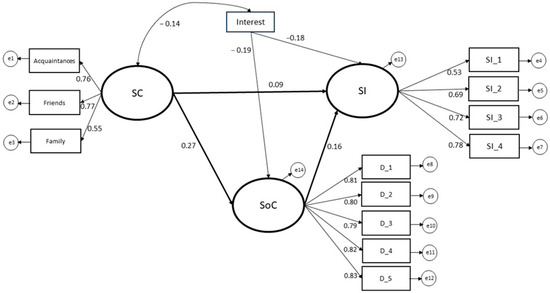
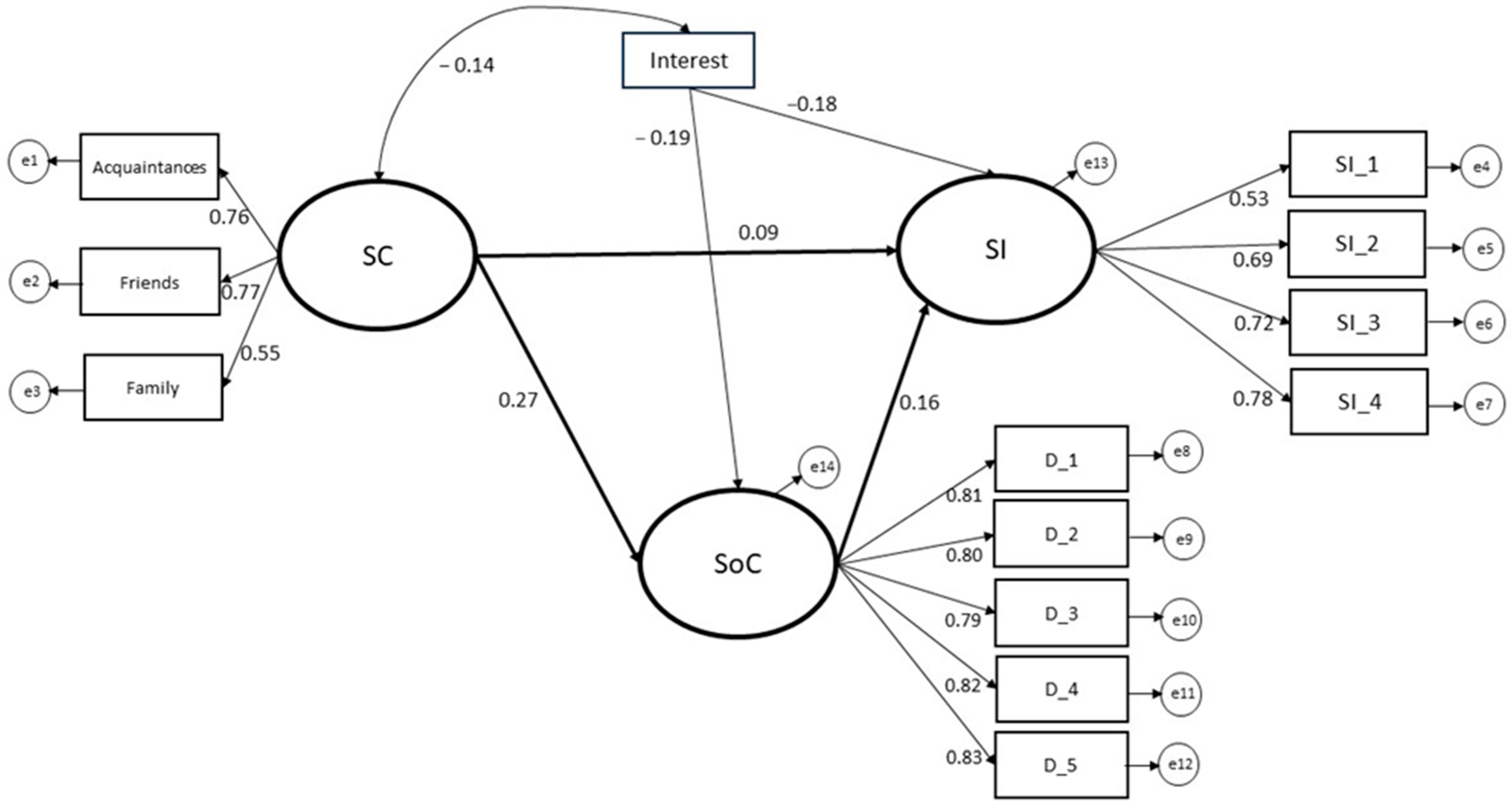
Figure 1 displays SEM with all the relationships. The model assesses the impact of SC on SI and on SoC, while SoC was tested as a mediator between SC and SI. The variable SCH was erased from the model to increase fit values, and “Interest” was added as a covariate. Other variables, such as sociodemographic factors or experience, did not have a significant effect and were not considered in the model. Regression lines were drawn on the variables that should be controlled for the effect of the covariate Interest.
Figure 1.
Structural equation modeling. SC = social contact; SI = social integration; SoC = social concept.
All fit indices were significant and good: CMIN/df = 1.50, CFI = 0.96, IFI = 0.96, TLI = 0.94, RMSEA = 0.06. The impact of SC on SoC was positive and significant (b = 0.27, t = 2.64, p = 0.001), but its influence on SI was insignificant (b = 0.09, t = 0.80, p = 0.42). Moreover, SoC had a positive but insignificant effect on SI (b = 0.16, t = 1.51, p = 0.13). Interest had a weak significant negative effect on attitudes toward the SoC (b = −0.19, t = −2.32, p = 0.02) but not on SI (b = −0.18, t = −1.83, p = 0.07). A detailed description with all coefficients can be found in Table 1. To summarize, contact with individuals with special educational needs influenced agreement with the social model of disability, but no significant influence was found on attitudes toward inclusion (Q2), and this relationship was mediated by interest in further training (Q4). Neither previous practical experience (Q3) nor any sociodemographic characteristics such as age, gender, religiosity, and socioeconomic status (Q5) influenced attitudes.
Table 1.
Parameter estimates and regression weights for the Structural Equation Modeling (SEM).
4.3. Interview Analysis
The analysis followed the principles of qualitative content analysis [69] and consisted of 10 structured questions, followed by clarifying questions, in case participants did not answer the question directly. Half of the questions were developed based on the questionnaire Concepts of Disability, CoD [64], and the other half were adapted questions that addressed topics such as participants’ practical experiences with inclusion, their perceived self-efficacy in working with pupils with special educational needs, and their perspectives on the future of inclusive education. Participants listened to statements first, then indicated their agreement or disagreement with the statement and explained their reasoning. Although only four people participated in this part, these semi-structured interviews allowed us to gain a deeper understanding of how pre-service teachers understood relevant topics in inclusive education, which was not completely captured through the survey. An initial coding system with categories and subcategories (Section 4.3.1—Views of Inclusion, Section 4.3.2 Internalized Model of Disability, Section 4.3.3—Attitudes Toward Working with Children with Special Educational Needs, Section 4.3.4—Practical Experience with Children with Special Educational Needs, Section 4.3.5—Self-Efficacy Regarding Working with Children with Special Educational Needs), was established before the interviews took place. After the completion of the interviews, this system was tailored to consider participants’ broader points of view. To ensure quality criteria, two interviews were independently coded by a second examiner. In almost all cases, the labeling of statements coincided with the initial coding, indicating a high level of consistency in the analysis.
4.3.1. Views of Inclusion
Statements on inclusive education were assessed using two categories: perceived positive aspects (2 statements) and perceived negative aspects (3 statements). While participants generally endorsed inclusion, they also anticipated challenges in its practical implementation. For example, they declared inclusion is only possible “when it’s correctly implemented, because if it’s implemented poorly, it can make more difficult to teach for everyone” (Interviewee 2), that “It’s a dream because it demands a place in which everyone have the exact same of opportunities to learn and that’s really difficult to make it happened” (Interviewee 3) or that “it depends of the type of impairment they have because that can make it difficult” (Interviewee 2).
4.3.2. Internalized Model of Disability
During interviews, participants discussed both the individual-medical model and the social model of disability. Participants used the medical model of disability to explain their own definition of disability and to later justify their answers to other questions. For example, Interviewee 4 said, “Disability is a nasty word because it’s related to impairments, but there are people who simply aren’t cognitively or physically the same as someone without impairments”. Furthermore, three participants agreed fully with the statement that “Disability is the result of congenital or acquired damage and disorders” because “It’s simply a factual scientific approach and there’s nothing to speak against the statement because there are diseases like trisomy 21, or after an accident some people simply can’t read or write anymore” (Interviewee 4). Only Interviewee 1 partially disagreed, stating, “I think society is also to blame because every disability doesn’t stop you from doing something, but society does”.
Participants also commented on statements related to the social model of disability. Two interviewees fully agreed with the statement, “You are not disabled, you become disabled” because “pupils are treated very separately (…) and for example there are some schools in which children who are now in wheelchairs simply can’t take part in normal lessons because the classrooms are on higher floors and there’s no lift” (Interviewee 2). Furthermore, three of the four interviewees agreed with the phrase “Disability is the result of an unfair distribution of rights and opportunities” and explained that “although there have been some changes in this matter, certain opportunities are simply not granted” (Interviewee 2).
4.3.3. Attitudes Toward Working with Children with Special Educational Needs
Participants’ attitudes toward children with special educational needs were directly explored. Interviewee 1 stated that she had positive attitudes, but her concerns were directed towards pupils without special educational needs because “inclusion can make the other pupils feel disadvantaged and it may also have negative effects on them”. The other three interviewees reported neutral attitudes, but they expressed that they were not consider working with pupils with “because of the stress and difficulties linked to working with them. They are children who need so much support and patience. Every child has different requirements but I just somehow don’t have the capacity to support them as perfectly as they should actually be supported.” (Interviewee 3). Interviewee 2 added: “I try to be really neutral, but I should say that having one child like that in the classroom is really difficult.”
4.3.4. Practical Experience with Children with Special Educational Needs
Participants’ described experiences were mixed. Half of the participants described their experience as negative because of incidents that involved pupils with special educational needs and the classroom management of the teacher. For example, one student observed physical violence during her one-week practice in a special educational school: “I found my experience extremely gross because they threw chairs out of the window and the teacher was trying to stop it. Everything escalated so quickly, and it was crazy” (Interviewee 1). On the other hand, the other two respondents’ experiences were positive because “pupils only needed help for some things, but then they participated with the group without problems” (Interviewee 4).
4.3.5. Self-Efficacy Regarding Working with Children with Special Educational Needs
To work with children with special educational needs participants expressed a need for more training. One participant specified that they would only work with pupils with physical disabilities and not with ones with intellectual disabilities. Teachers in inclusive classrooms should have “the capacity somehow to support every child as perfectly as they should actually be supported.” (Interviewee 3). Another participant criticized teachers with years of teaching experience who are also not prepared to work with children with special educational needs because they did not receive proper training for it back then and usually deal with it by following advice from other colleagues.
5. Discussion
5.1. Relationship Between Social Contact and Agreement to the Social Model
Participants reported relatively few encounters with individuals with special educational needs across all their social circles. Although “contact” influenced participants’ agreement with the social model of disability, this effect was weak (r < 0.3), indicating that contact alone does not influence perspectives on disability. Due to sample and design constraints, the SEM findings should be best understood as exploratory regarding potential associations. The effect of contact on attitudes toward integration was assessed and no statistically significant relationship was found. This outcome does not align with the results of other studies in which contact with individuals with disabilities had an effect on attitudes toward inclusion [20,22,33,38]. A possible explanation for this outcome could be that these encounters reported by participants were relatively rare and their current teacher training for regular schools did not provide them with the opportunity to have more meaningful encounters with individuals with special educational needs. This study did not consider the way in which these interactions took place and how they were evaluated by the participants, which could be negative rather than positive. Negative experiences could negatively impact attitudes toward inclusion and the understanding that individuals have about disability [22].
Similarly, sociodemographic, attitudinal and profession-related variables were included as control variables. Interestingly, only “interest in further training on inclusive or special education” showed a significant but negative effect on the acceptance of the social model of disability, with which some participants showed a slight rejection in the survey. In other words, the stronger a participant’s interest in further training on inclusion or special education was, the stronger their rejection of the social model of disability. One possible interpretation is that this interest may reflect a desire for more knowledge of diagnostics to identify children who “should not” attend regular schools, reinforcing the existing exclusive practice that places most pupils with special educational needs in special schools. No significant effect was found on the variable social integration (SI). This result contradicts the assumption that interest in a topic goes hand in hand with more favorable attitudes toward it [70]. Another plausible explanation could rely on a social-desirability bias: teachers may want to show their support to appear progressive or professionally competent, while privately maintaining skepticism. Lüke & Grosche [71] found that teachers’ responses are significantly influenced by social context and can outperform other variables in predicting attitudes toward inclusion. Such discrepancies can mask underlying discomfort or perceived inadequacy, which are often linked to low self-efficacy or limited practical experience [22]. This dissonance may reflect a broader systemic issue: inclusion is often framed as an additional expectation layered onto teachers’ existing duties rather than as an integral pedagogical principle. With the prevalence of structural barriers, inclusion can be perceived less as a collective educational goal and more as an individual burden [72].
This finding could also suggest that participants who expressed greater interest in training may already feel less prepared, which in turn contributed to more negative attitudes toward inclusion. During the interviews, participants reported feeling inadequately prepared because their current training neither provides theoretical knowledge nor fosters meaningful and positive interactions with pupils with special educational needs, often evoking feelings of insecurity and self-doubt about their own professional competence. Likewise, participants highlighted the extra effort required to adapt materials and instruction for diverse learners. These perceptions align with results from a systematic review that found teachers’ concerns extend beyond classroom management to encompass the emotional labor associated with the implementation of inclusive practices [73]; however, due to the sample constraints, a bigger sample is needed to make inferences about these results.
As mentioned before, the survey results showed neutral attitudes toward the social model of disability, aligning with the qualitative findings. Although participants agreed mostly with the statements from the social model of disability, their personal definitions of disability revealed a strong influence of the individual-medical model, emphasizing the “impairments” or “special characteristics” that set people with disabilities apart. In addition, attitudes toward working with children with special educational needs appeared to depend on experiences in prior internships. Participants who had negative or challenging experiences expressed disinterest in working with children with special educational needs in the future.
Following Görandsson and Nilholm [74] and Qvortrup and Qvortrup [75], we believe that inclusion is a multidimensional concept that addresses the diverse needs of children while promoting equitable participation for all. This understanding aligns with our findings, which show that although participants endorse inclusive ideals, their views often remain shaped by individualized and deficit-oriented views, highlighting the continued need for teacher education to link inclusion more strongly to human rights and social justice principles.
To sum up, the outcomes highlight that inclusion is presented too generally and briefly during seminars, hindering pre-service predisposition and confidence in working with pupils with special educational needs, a pattern that serves as evidence of internalized exclusionary views normalized within the German educational system, where regular school teachers receive no specialized training in inclusion or special education. Contact with children with different types of educational needs during internships is necessary to reduce their discomfort around them, to enhance their self-efficacy, and to reduce prejudice and misconceptions about disability. Based on the results of this study and other studies where contact positively influenced attitudes towards people with disabilities [44], it would be optimal that during teacher training, contact with this population is reinforced more in a meaningful and systematic way.
5.2. Limitations
While structural equation modeling was employed to explore theoretical relationships among the constructs, the results must be interpreted with caution due to the modest sample size and limitations of the cross-sectional design. To extrapolate the results, students from other universities in Bavaria should be considered in the future. Moreover, differences between teachers from primary and secondary schools were not examined because participants came from mixed elective seminars that had fewer than 15 participants. Research shows that primary school teachers tend to have more positive attitudes than secondary school teachers [76], so future research should compare both groups. We focused on attitudes toward pupils with special educational needs in general and did not differentiate types of disabilities. Findings suggest that teachers tend to include children with mild impairments more than pupils with severe intellectual or behavioral disadvantages [41,60].
The qualitative component of this study is based on a very small sample, which limits the interpretative scope of the findings. Accordingly, the interview data are presented as illustrative and explanatory, serving to contextualize the quantitative results rather than to support generalizable conclusions. Based on our results, there is a big potential for future studies to address this topic using a mixed-methods design with a bigger sample.
Another important consideration is that, within the survey, participants were not asked to qualify their contact experiences as either positive or negative. This distinction is relevant, since previous research has shown that negative experiences may foster more critical or even resistant attitudes toward inclusion [22] and may also shape participants’ underlying concepts of disability in less favorable ways. In the future, research on pre-service teachers’ attitudes toward children with special educational needs should assess specific types of disability. Finally, most participants had little practical experience, so experience and contact with pupils with special educational needs was low. Hence, future studies should consider pre-service teachers who have passed at least one of their state exams.
6. Conclusions
The findings suggest that pre-service German teachers from regular schools hold neutral to slightly positive attitudes toward inclusive education and show partial agreement with the social model of disability. These attitudes warrant concern, as they indicate a mindset that is not yet fully inclusive, with participants tending to prioritize student classification by ability or needs over the required changes for genuine inclusion. Moreover, our results indicate that social contact plays a meaningful role in shaping these attitudes. However, the implementation of inclusive classrooms is seen by regular teachers as an additional challenging task they want to avoid due to structural and personal reasons. In view of the significant influence that teachers hold in either enacting or undermining inclusive practices, our findings underscore the need for teacher education and professional development to address beliefs about disability and inclusion and to support teachers in developing both the competence and commitment required to realize inclusive education in practice. Teacher education should actively promote contact with pupils with special educational needs and critically address future teachers’ beliefs and concerns about disabilities and inclusive education. Accordingly, these findings should be viewed as theoretical and policy-oriented reflections. Beyond changes in curricula, the structural features of the German educational system also sustain exclusive practices and influence teachers’ preparedness for inclusion. While these systemic considerations were not examined here, they form an important contextual framework for interpreting our results. Future research has the potential to explore these contextual factors to strengthen inclusive practice and address persistent gaps in teacher training.
Author Contributions
Conceptualization, M.A.C., A.G. and M.G.; methodology, M.A.C., A.G. and M.G.; data analysis, M.A.C.; writing—original draft preparation, M.A.C.; writing—review and editing, M.A.C., A.G. and M.G.; administration and supervision, M.G. and A.G.; visualization, M.A.C. All authors have read and agreed to the published version of the manuscript.
Funding
This research received no external funding for the research, authorship or publication of this article.
Institutional Review Board Statement
Ethical review and approval were waived by the Ethics Committee of the University of Augsburg because the study did not cause any conceivable physical or mental harm or discomfort to the participants beyond what they experience in everyday life. The study was based on data collected anonymously from sources and it relied on archival material, making it no longer possible to retrospectively link the data to a specific individual.
Informed Consent Statement
Informed consent was obtained from all participants involved in the study.
Data Availability Statement
Data and Syntax are available on the Open Science Framework (OSF): https://osf.io/vsg3f, accessed on 23 February 2026.
Conflicts of Interest
The authors declare no conflicts of interest.
Disability Language/Terminology Positionality Statement
This article uses the terms “individuals with disabilities” and “pupils with special educational needs” following person-first language conventions. This choice aligns with the legal and educational frameworks in Germany and Europe, where person-first terminology is standard in teacher education and inclusive education research. It reflects the intention to emphasize the person before the impairment and to avoid defining individuals solely by their disability. The term “special educational needs” is used in accordance with international educational policy and research, such as those of UNESCO and the European Agency for Special Needs and Inclusive Education, to describe learners requiring additional pedagogical support, who may or may not also have a disability.
References
- United Nations. Leaving no one behind: The imperative of inclusive development. In Report on the World Social Situation 2016; United Nations: New York, NY, USA, 2017. [Google Scholar]
- Ainscow, M. Promoting inclusion and equity in education: Lessons from international experiences. Nord. J. Stud. Educ. Policy 2020, 6, 7–16. [Google Scholar] [CrossRef] [Scilit]
- Kefallinou, A.; Symeonidou, S.; Meijer, C.J.W. Understanding the value of inclusive education and its implementation: A review of the literature. Prospects 2020, 49, 135–152. [Google Scholar] [CrossRef] [Scilit]
- Gebhardt, M. Einstellungen von Lehrkräften zur schulischen Inklusion in Deutschland. In Leistung und Wohlbefinden in der Schule: Herausforderung Inklusion; Rathmann, K., Hurrelmann, K., Eds.; 1. Auflage; Beltz Juventa: Weinheim, Germany, 2018; pp. 338–349. [Google Scholar]
- Schwab, S. Inclusive and special education in Europe. In Oxford Research Encyclopedia of Education. Oxford Encyclopedia of Inclusive and Special Education; Sharma, U., Salend, S.J., Eds.; Oxford University Press: Oxford, UK, 2021. [Google Scholar] [CrossRef] [Scilit]
- Autorengruppe Bildungsberichtserstattung. Bildung in Deutschland 2014: Ein indikatorengestützter Bericht mit einer Analyse zur Bildung von Menschen mit Behinderungen. 2014. Available online: https://www.bildungsbericht.de/de/bildungsberichte-seit-2006/bildungsbericht-2014#0 (accessed on 23 February 2026).
- Kocaj, A.; Kuhl, P.; Kroth, A.J.; Pant, H.A.; Stanat, P. Wo lernen Kinder mit sonderpädagogischem Förderbedarf besser? Ein Vergleich schulischer Kompetenzen zwischen Regel- und Förderschulen in der Primarstufe. KZfSS Kölner Z. Für Soziologie Und Sozialpsychologie 2014, 66, 165–191. [Google Scholar] [CrossRef] [Scilit]
- Krämer, S.; Möller, J.; Zimmermann, F. Inclusive Education of Students with General Learning Difficulties: A Meta-Analysis. Rev. Educ. Res. 2021, 91, 432–478. [Google Scholar] [CrossRef] [Scilit]
- Lindner, K.-T.; Schwab, S.; Emara, M.; Avramidis, E. Do teachers favor the inclusion of all students? A systematic review of primary schoolteachers’ attitudes towards inclusive education. Eur. J. Spec. Needs Educ. 2023, 38, 766–787. [Google Scholar] [CrossRef] [Scilit]
- UNESCO. The Salamanca Statement and Framework for Action on Special Needs Education. 1994. Available online: https://unesdoc.unesco.org/ark:/48223/pf0000098427 (accessed on 23 February 2026).
- Statistisches Bundesamt. Bildung, Forschung und Kultur: Schulen. 2023. Available online: https://www.destatis.de/DE/Home/_inhalt.html (accessed on 23 February 2026).
- Lepper, C.; Steinmann, V. Status quo: Inklusion an Deutschlands Schulen; Bertelsmann Stiftung: Gütersloh, Germany, 2024. [Google Scholar] [CrossRef]
- Klemm, K. Inklusion in Deutschlands Schulen: Eine Bildungsstatistische Momentaufnahme 2020/21; Bertelsmann Stiftung: Gütersloh, Germany, 2022. [Google Scholar] [CrossRef]
- Sarimski, K. Behinderte Kinder in Inklusiven Kindertagesstatten; Kohlhammer Verlag: Stuttgart, Germany, 2020. [Google Scholar]
- Jordan, A.; Schwartz, E.; McGhie-Richmond, D. Preparing teachers for inclusive classrooms. Teach. Teach. Educ. 2009, 25, 535–542. [Google Scholar] [CrossRef] [Scilit]
- Woodcock, S.; Gibbs, K.; Hitches, E.; Regan, C. Investigating teachers’ beliefs in inclusive education and their levels of Teacher Self-Efficacy: Are teachers constrained in their capacity to implement inclusive teaching practices? Educ. Sci. 2023, 13, 280. [Google Scholar] [CrossRef] [Scilit]
- Gebhardt, M.; Schwab, S.; Nusser, L.; Hessels, M.G.P. Einstellungen und Selbstwirksamkeit von Lehrerinnen und Lehrern zur schulischen Inklusion in Deutschland: Eine Analyse mit Daten des Nationalen Bildungspanels Deutschland (NEPS). Empirische Pädagogik 2015, 29, 211–229. [Google Scholar]
- Gigante, J.; Gilmore, L. Australian preservice teachers’ attitudes and perceived efficacy for teaching in inclusive classrooms. Int. J. Incl. Educ. 2020, 24, 1568–1577. [Google Scholar] [CrossRef] [Scilit]
- Hassanein, E.E.A.; Alshaboul, Y.M.; Ibrahim, S. The impact of teacher preparation on preservice teachers’ attitudes toward inclusive education in Qatar. Heliyon 2021, 7, e07925. [Google Scholar] [CrossRef] [Scilit] [PubMed]
- Hsiao, Y.-J. The Impact of Interaction with Adults with Disabilities on Preservice General Education Students’ Attitudes towards Disability and Inclusion. Int. J. Disabil. Dev. Educ. 2020, 69, 1373–1388. [Google Scholar] [CrossRef] [Scilit]
- Kessels, U.; Erbring, S.; Heierman, L. Implizite Einstellungen von Lehramtsstudierenden zur Inklusion. Psychol. Erzieh. Und Unterr. 2014, 61, 189–202. [Google Scholar] [CrossRef] [Scilit]
- Sharma, U.; Forlin, C.; Loreman, T. Impact of training on pre-service teachers’ attitudes and concerns about inclusive education and sentiments about persons with disabilities. Disabil. Soc. 2008, 23, 773–785. [Google Scholar] [CrossRef] [Scilit]
- Gebhardt, M.; Schurig, M.; Suggate, S.; Scheer, D.; Capovilla, D. Social, Systemic, Individual-Medical or Cultural? Questionnaire on the Concepts of Disability Among Teacher Education Students. Front. Educ. 2022, 6, 701987. [Google Scholar] [CrossRef] [Scilit]
- Lutz, S.; Frey, A.; Rank, A.; Gebhardt, M. InClass—An instrument to assess classroom management in inclusive and special education with a focus on heterogeneous learning groups. Front. Educ. 2024, 9, 1316059. [Google Scholar] [CrossRef] [Scilit]
- Eagly, A.H.; Chaiken, S. The Advantages of an Inclusive Definition of Attitude. Soc. Cogn. 2007, 25, 582–602. [Google Scholar] [CrossRef] [Scilit]
- Avramidis, E.; Norwich, B. Teachers’ attitudes towards integration/inclusion: A review of the literature. Eur. J. Spec. Needs Educ. 2002, 17, 129–147. [Google Scholar] [CrossRef] [Scilit]
- Dignath, C.; Rimm-Kaufman, S.; Van Ewijk, R.; Kunter, M. Teachers’ Beliefs About Inclusive Education and Insights on What Contributes to Those Beliefs: A Meta-analytical Study. Educ. Psychol. Rev. 2022, 34, 2609–2660. [Google Scholar] [CrossRef] [Scilit]
- van Steen, T.; Wilson, C. Individual and cultural factors in teachers’ attitudes towards inclusion: A meta-analysis. Teach. Teach. Educ. 2020, 95, 103127. [Google Scholar] [CrossRef] [Scilit]
- Ruberg, C.; Porsch, R. Einstellungen von Lehramtsstudierenden und Lehrkräften zur schulischen Inklusion. Ein systematisches Review deutschsprachiger Forschungsarbeiten. Z. Für Pädagogik 2017, 63, 393–415. [Google Scholar] [CrossRef]
- Donath, J.L.; Lüke, T.; Graf, E.; Tran, U.S.; Götz, T. Does professional development effectively support the implementation of inclusive Education? A Meta-Analysis. Educ. Psychol. Rev. 2023, 35, 30. [Google Scholar] [CrossRef] [Scilit]
- Yada, A.; Leskinen, M.; Savolainen, H.; Schwab, S. Meta-analysis of the relationship between teachers’ self-efficacy and attitudes toward inclusive education. Teach. Teach. Educ. 2021, 109, 103521. [Google Scholar] [CrossRef] [Scilit]
- Pettigrew, T.F.; Tropp, L.R. A meta-analytic test of intergroup contact theory. J. Personal. Soc. Psychol. 2006, 90, 751–783. [Google Scholar] [CrossRef] [Scilit] [PubMed]
- Rademaker, F.; De Boer, A.; Kupers, E.; Minnaert, A. Applying the Contact Theory in Inclusive Education: A Systematic review on the impact of contact and information on the social participation of students with Disabilities. Front. Educ. 2020, 5, 602414. [Google Scholar] [CrossRef] [Scilit]
- Boyle, C.; Topping, K.; Jindal-Snape, D. Teachers’ attitudes towards inclusion in high schools. Teach. Teach. 2013, 19, 527–542. [Google Scholar] [CrossRef] [Scilit]
- Forlin, C.; Earle, C.; Loreman, T.; Sharma, U. The Sentiments, Attitudes, and Concerns about Inclusive Education Revised (SACIE-R) Scale for Measuring Pre-Service Teachers’ Perceptions about Inclusion. Except. Educ. Int. 2011, 21, 50–65. [Google Scholar] [CrossRef] [Scilit]
- Kuhl, J.; Redlich, H.; Schäfer, L. Einstellungen verschiedener Lehrergruppen gegenüber Menschen mit geistiger Behinderung. Z. Für Bild. 2014, 4, 271–287. [Google Scholar] [CrossRef] [Scilit]
- Wilkerson, S.E. Assessing Teacher Attitude Toward the Inclusion of Students with Autism. Ph.D. Thesis, University of Louisville, Louisville, KY, USA, 2012. [Google Scholar]
- Emmers, E.; Baeyens, D.; Petry, K. Does intense contact with people with disabilities lead to more inclusive behaviour within professional practice? Educ. Stud. 2022, 49, 492–506. [Google Scholar] [CrossRef] [Scilit]
- Goddard, C.; Evans, D. Primary Pre-Service Teachers’ Attitudes Towards Inclusion Across the Training Years. Aust. J. Teach. Educ. 2018, 43, 122–142. [Google Scholar] [CrossRef] [Scilit]
- Kunz, A.; Luder, R.; Kassis, W. Beliefs and Attitudes Toward Inclusion of Student Teachers and Their Contact With People With Disabilities. Front. Educ. 2021, 6, 650236. [Google Scholar] [CrossRef] [Scilit]
- Subban, P.; Sharma, U. Primary school teachers’ perceptions of inclusive education in Victoria, Australia. Int. J. Spec. Educ. 2006, 21, 42–52. [Google Scholar]
- Ahsan, M.T.; Deppeler, J.M.; Sharma, U. Predicting pre-service teachers’ preparedness for inclusive education: Bangladeshi pre-service teachers’ attitudes and perceived teaching-efficacy for inclusive education. Camb. J. Educ. 2013, 43, 517–535. [Google Scholar] [CrossRef] [Scilit]
- Forlin, C.; Chambers, D. Teacher preparation for inclusive education: Increasing knowledge but raising concerns. Asia-Pac. J. Teach. Educ. 2011, 39, 17–32. [Google Scholar] [CrossRef] [Scilit]
- Sharma, U.; Loreman, T.; Forlin, C. Measuring teacher efficacy to implement inclusive practices. J. Res. Spec. Educ. Needs 2012, 12, 12–21. [Google Scholar] [CrossRef] [Scilit]
- Ekstam, U.; Korhonen, J.; Linnanmäki, K.; Aunio, P. Special education pre-service teachers’ interest, subject knowledge, and teacher efficacy beliefs in mathematics. Teach. Teach. Educ. 2017, 63, 338–345. [Google Scholar] [CrossRef] [Scilit]
- Klassen, R.M.; Tze, V.M.C.; Betts, S.M.; Gordon, K.A. Teacher Efficacy Research 1998–2009: Signs of Progress or Unfulfilled Promise? Educ. Psychol. Rev. 2011, 23, 21–43. [Google Scholar] [CrossRef] [Scilit]
- Saloviita, T. Attitudes of Teachers Towards Inclusive Education in Finland. Scand. J. Educ. Res. 2018, 64, 270–282. [Google Scholar] [CrossRef] [Scilit]
- Velásquez, P. Higher Education and the Evolution of Prejudice. Ph.D. Thesis, Sociologiska institutionen, Umeå Universitet, Umea, Sweden, 2023. Volume 89. [Google Scholar]
- Weisel, A.; Zaidman, A. Attitudes of Secular and Religious Israeli Adolescents Towards Persons with Disabilities: A multidimensional analysis. Int. J. Disabil. Dev. Educ. 2003, 50, 309–323. [Google Scholar] [CrossRef] [Scilit]
- Ahmmed, M.; Sharma, U.; Deppeler, J. Variables affecting teachers’ intentions to include students with disabilities in regular primary schools in Bangladesh. Disabil. Soc. 2014, 29, 317–331. [Google Scholar] [CrossRef] [Scilit]
- Avramidis, E.; Bayliss, P.; Burden, R. A survey into mainstream teachers’ attitudes towards the inclusion of children with special educational needs in the ordinary school in one local education authority. Educ. Psychol. 2000, 20, 191–221. [Google Scholar] [CrossRef] [Scilit]
- Tripp, A.; Rizzo, T.L. Disability Labels Affect Physical Educators. Adapt. Phys. Act. Q. 2006, 23, 310–326. [Google Scholar] [CrossRef] [Scilit]
- Michailakis, D. The Systems Theory Concept of Disability: One is not born a disabled person, one is observed to be one. Disabil. Soc. 2003, 18, 209–229. [Google Scholar] [CrossRef] [Scilit]
- Dirth, T.P.; Branscombe, N.R. Disability Models Affect Disability Policy Support through Awareness of Structural Discrimination. J. Soc. Issues 2017, 73, 413–442. [Google Scholar] [CrossRef] [Scilit]
- Dirth, T.P.; Branscombe, N.R. Recognizing Ableism: A Social identity analysis of disabled people perceiving discrimination as illegitimate. J. Soc. Issues 2019, 75, 786–813. [Google Scholar] [CrossRef] [Scilit]
- Graham, L.J. Inclusive Education for the 21st Century: Theory, Policy and Practice; Routledge: London, UK, 2023. [Google Scholar]
- Finkelstein, V. The ‘Social Model of Disability’ and the Disability Movement. 2007. Available online: https://disability-studies.leeds.ac.uk/wp-content/uploads/sites/40/library/finkelstein-The-Social-Model-of-Disability-and-the-Disability-Movement.pdf (accessed on 23 February 2026).
- Oliver, M.; Barnes, C. Disability studies, disabled people and the struggle for inclusion. Br. J. Sociol. Educ. 2010, 31, 547–560. [Google Scholar] [CrossRef] [Scilit]
- Shakespeare, T. Disability Rights and Wrongs; Routledge: London, UK, 2006. [Google Scholar] [CrossRef] [Scilit]
- Moberg, S.; Muta, E.; Korenaga, K.; Kuorelahti, M.; Savolainen, H. Struggling for inclusive education in Japan and Finland: Teachers’ attitudes towards inclusive education. Eur. J. Spec. Needs Educ. 2020, 35, 100–114. [Google Scholar] [CrossRef] [Scilit]
- Selisko, T.J.; Eckert, C.; Perels, F. Models of disability as distinguishing factor: A theoretical framework of inclusive education and the application to a literature review. Cogent Educ. 2024, 11, 2379681. [Google Scholar] [CrossRef] [Scilit]
- Robertson, Z.S.; Jaswal, V.K. Barriers to inclusion: Incorporating the social model in the study of children’s understanding of disability. Cogn. Dev. 2024, 70, 101435. [Google Scholar] [CrossRef] [Scilit]
- Heinrich-Heine-Universität Düsseldorf. G*Power, Version 3.1.9.7; Computer Software; Heinrich-Heine-Universität Düsseldorf: Düsseldorf, Germany, 2020. Available online: https://www.psychologie.hhu.de/arbeitsgruppen/allgemeine-psychologie-und-arbeitspsychologie/gpower (accessed on 23 February 2026).
- Gebhardt, M.; Schurig, M.; Suggate, S.; Scheer, D.; Capovilla, D. Fragebogen zum Konstrukt Behinderung 0.2 (Concepts of Disability, Cod); University of Regensburg: Regensburg, Germany, 2021. [Google Scholar] [CrossRef]
- Kunz, A.; Luder, R.; Moretti, M. Die Messung von Einstellungen zur Integration (EZI). Empirische Sonderpädagogik 2010, 2, 83–94. [Google Scholar] [CrossRef]
- IBM Corp. IBM SPSS Statistics, Version 29.0; Computer software; IBM Corp: Armonk, NY, USA, 2022.
- Arbuckle, J.L. IBM SPSS Amos for Structural Equation Modeling, Version 29.0; Computer software; IBM Corp: Armonk, NY, USA, 2021.
- VERBI Software. MAXQDA 2022, VERBI Software: Berlin, Germany, 2022. Available online: https://maxqda.com (accessed on 23 February 2026).
- Hsieh, H.-F.; Shannon, S.E. Three approaches to qualitative content analysis. Qual. Health Res. 2005, 15, 1277–1288. [Google Scholar] [CrossRef] [Scilit]
- Krapp, A.; Prenzel, M. Research on Interest in Science: Theories, methods, and findings. Int. J. Sci. Educ. 2011, 33, 27–50. [Google Scholar] [CrossRef] [Scilit]
- Lüke, T.; Grosche, M. What do I think about inclusive education? It depends on who is asking. Experimental evidence for a social desirability bias in attitudes towards inclusion. Int. J. Incl. Educ. 2018, 22, 38–53. [Google Scholar] [CrossRef] [Scilit]
- Saiz-González, P.; De La Fuente-González, S.; Sierra-Díaz, J.; Uría-Valle, P. Inclusive Education and Physical Education in Spain: A Qualitative analysis of teachers’ perspectives. Educ. Sci. 2025, 15, 108. [Google Scholar] [CrossRef] [Scilit]
- Calandri, E.; Mastrokoukou, S.; Marchisio, C.; Monchietto, A.; Graziano, F. Teacher Emotional Competence for Inclusive Education: A Systematic review. Behav. Sci. 2025, 15, 359. [Google Scholar] [CrossRef] [Scilit] [PubMed]
- Göransson, K.; Nilholm, C. Conceptual diversities and empirical shortcomings—A critical analysis of research on inclusive education. Eur. J. Spec. Needs Educ. 2014, 29, 265–280. [Google Scholar] [CrossRef] [Scilit]
- Qvortrup, A.; Qvortrup, L. Inclusion: Dimensions of inclusion in education. Int. J. Incl. Educ. 2017, 22, 803–817. [Google Scholar] [CrossRef] [Scilit]
- Chiner, E.; Cardona, M.C. Inclusive education in Spain: How do skills, resources, and supports affect regular education teachers’ perceptions of inclusion? Int. J. Incl. Educ. 2013, 17, 526–541. [Google Scholar] [CrossRef] [Scilit]

Disclaimer/Publisher’s Note: The statements, opinions and data contained in all publications are solely those of the individual author(s) and contributor(s) and not of MDPI and/or the editor(s). MDPI and/or the editor(s) disclaim responsibility for any injury to people or property resulting from any ideas, methods, instructions or products referred to in the content. |
© 2026 by the authors. Licensee MDPI, Basel, Switzerland. This article is an open access article distributed under the terms and conditions of the Creative Commons Attribution (CC BY) license.