1. Introduction
Developmental disabilities refer to a group of chronic conditions that appear during early childhood due to mental and/or physical impairments. These conditions limit an individual’s functioning in three or more areas of life, including communication (expressive and receptive language), self-care skills, independent living skills, learning, mobility, and employment [
1]. The Diagnostic and Statistical Manual of Mental Disorders (5th ed.; DSM-5) categorizes these conditions under the term “neurodevelopmental disorders,” which includes Autism Spectrum Disorder (ASD), Intellectual Disability (ID), communication disorders, motor disorders, specific learning disabilities, and Attention-Deficit/Hyperactivity Disorder (ADHD) [
2].
Recently, the prevalence rate of individuals with developmental disabilities has significantly increased and was estimated in the US to be 16.65%, ranging between 16.03% and 17.26% [
3]. Globally, the prevalence rate of this population was between 4.70% and 88.50%, according to an analysis of 17 studies [
4]. As a result, developing intervention programs is necessary to meet the needs of this population and their families by enhancing access to support services to promote their social, behavioral, and life skills through the provision of training to their families, teachers, and other service providers in accordance with the World Health Organization Declaration (WHO) recommendations [
5].
Due to the nature and severity of their conditions, individuals with developmental disabilities often face difficulties performing daily living skills independently. These difficulties can restrict their participation in social activities; increase their reliance on parents, caregivers, and teachers; hinder employment opportunities; and lead to emotional challenges such as low self-esteem and reduced self-worth [
6]. Consequently, their quality of life may decline, limiting opportunities for social and academic inclusion. Without effective early intervention and strong home–school collaboration, these difficulties can persist into adulthood [
7]. Moreover, parents of children with developmental disabilities tend to experience higher levels of depression and other mental health issues than parents of typically developing children [
8]. Rea-Amaya et al. [
9] reported that many parents view their children with Autism Spectrum Disorder as highly dependent and requiring ongoing assistance in performing everyday activities at home, school, or in community settings.
Teaching students with developmental disabilities also presents several challenges within school environments. Common barriers include inadequate teacher training, insufficient instructional resources, and classrooms that are not fully adapted to accommodate students’ diverse needs [
10]. Teachers frequently report obstacles, such as limited special education knowledge, lack of professional support, large class sizes, and difficulties associated with students’ behavioral, emotional, and developmental needs [
11]. Additional issues include time constraints, heavy workloads, and adapting curricula to diverse learner needs [
12].
Modeling, grounded in Bandura’s social learning theory, posits that individuals acquire new behavior through observing others [
13]. This observational learning process encompasses four interrelated components: attention, retention, reinforcement, and motor reproduction. Modeling can occur through live demonstrations (in vivo modeling), video representations featuring animated or real models, self-modeling videos depicting the learner’s own behavior, or recordings captured from a first-person viewpoint (point-of-view modeling). A related instructional strategy, video prompting, is a refined form of video modeling in which tasks are divided into discrete segments. Learners observe and execute each step sequentially, which enhances comprehension and memory retention [
14].
Within Applied Behavior Analysis (ABA)–based instruction, a task analysis involves breaking a complex skill into smaller, teachable steps that can be systematically taught and assessed. These components can then be taught using structured instructional procedures in which all steps of the task are presented during each session, rather than through a chaining procedure. During instruction, reinforcement is provided—such as praise or other positive consequences—to increase the likelihood of future correct behavior. When the learner struggles or makes errors, error correction is implemented to support accurate responding and guide the learner toward independent completion of each step [
15,
16]. Modeling and video prompting are often incorporated throughout these procedures to provide visual demonstrations of the target skills.
1.1. Prior Research
A substantial body of research has examined the impact of video-based interventions, including point-of-view (POV) modeling and video prompting, on teaching daily living and personal care skills to individuals with Autism Spectrum Disorder and other developmental disabilities. For instance, POV modeling has been successfully applied to enhance personal hygiene skills such as handwashing and toothbrushing [
17], as well as broader daily living activities, including mailing letters, setting a table, caring for pets, and preparing juice [
18]. Additional research has extended these findings to tasks like cooking, folding laundry, cleaning, and organizing, consistently demonstrating positive outcomes across participants [
19,
20].
The use of portable and digital devices has further increased the practicality of video modeling for promoting independence among adolescents with Autism Spectrum Disorder. For example, Campbell et al. [
21] found that handwashing skills improved significantly when video modeling was delivered via handheld devices. Similarly, Lee et al. [
22] reported that a multi-component intervention—including POV modeling, video self-modeling, picture prompts, and reinforcement—effectively taught toileting skills, which were both maintained over time and generalized to different environments. Comparative research indicates that video modeling often outperforms alternative instructional approaches. Anderson [
23] stated that video modeling was more effective than visual task analysis for teaching hygiene and kitchen-related skills. In contrast, Dudley [
24] found that although daily routines improved, participants did not consistently achieve mastery across all targeted tasks.
Research has also explored the effectiveness of parent-implemented interventions and technology-assisted delivery of video-based programs. McLay et al. [
25] showed that animated video modeling delivered via iPad, combined with prompting and reinforcement, enabled parents to successfully teach toileting skills, with participants retaining and generalizing these skills across multiple contexts for several months. Drysdale et al. [
26] similarly demonstrated that both animated and live-action video modeling, when paired with chaining procedures, effectively taught toileting skills, with participants maintaining and generalizing their performance in both school and home settings.
Other research has focused on functional and vocational skills. Olsen [
27] found that live video modeling combined with task analysis facilitated dressing skills, though one participant required additional prompting to reach mastery. Weng and Bouck [
28] reported that video prompting via iPad improved financial decision-making skills, although generalization was inconsistent among participants. Likewise, video prompting, task analysis, and reinforcement—with or without error correction—effectively taught household tasks such as dishwashing, cooking, and bed-making, although maintenance and generalization were not consistently achieved across participants [
29,
30]. More recently, Yalçın et al. [
31] and Köse and Sönmez-kartal [
32] confirmed the effectiveness of video-based prompting for kitchen and vocational tasks, though long-term retention and generalization remained limited for some learners.
Overall, these studies provide substantial evidence that video modeling and video prompting, especially when combined with task analysis, systematic instructional procedures, and reinforcement, are effective methods for teaching a wide range of daily living skills to individuals with Autism Spectrum Disorder and other developmental disabilities. However, several limitations still exist, as maintenance and generalization are not always consistently achieved, and relatively few studies have examined the combination of video prompting with error correction procedures, particularly for personal hygiene. Considering the vital role of hygiene skills in promoting health, independence, and social participation, this is a significant gap in the literature.
To address this gap, the present study evaluated an intervention package that combines video prompting, task analysis, error correction, and reinforcement to teach personal hygiene skills to two participants with Autism Spectrum Disorder and Intellectual Disability. A nonconcurrent multiple-baseline design across participants and skills, including baseline, intervention, maintenance, and generalization phases, was used to assess intervention effects. Social validity data were also collected to evaluate the perspectives of participants, families, and teachers regarding the program’s feasibility and effectiveness. Based on these objectives, the study aimed to answer the following research questions:
1.2. Research Questions
To what extent is an intervention package combining video prompting and error correction procedures effective in teaching personal hygiene skills to individuals with developmental disabilities?
To what extent are the skills acquired through the intervention maintained at two-, three-, and four-week follow-up assessments?
To what extent do participants generalize the acquired personal hygiene skills across different settings?
2. Materials and Methods
A nonconcurrent multiple baseline design across participants and behaviors [
33,
34] was employed to examine the effectiveness of the intervention. The study aimed to examine changes in personal hygiene performance associated with the implementation of an intervention package consisting of video prompting, task analysis, error correction procedures, and putative reinforcement. To structure a staggered introduction of the intervention, implementation for Participant B occurred only after Participant A showed improvement in handwashing performance. Additionally, toothbrushing for Participant B was introduced as a second skill only after satisfactory mastery of handwashing, creating a multiple baseline across behaviors. This design allowed for visual examination of whether changes in performance systematically followed intervention introduction across participants and skills [
34]. The study consisted of three phases, including baseline, intervention, and follow-up (maintenance and generalization). Follow-up sessions were conducted at 2, 3, and 4 weeks after the participants reached satisfactory mastery of the targeted skills, without using any of the intervention package’s techniques. Three replicated demonstrations of intervention-associated performance change were observed—two across participants (handwashing) and one across behaviors (toothbrushing).
2.1. Participants
Parental consent was signed by the parents prior to the implementation of the intervention. Two 12-year-old male students with developmental disabilities participated in this study. Both had been diagnosed with Autism Spectrum Disorder and Intellectual Disability by a licensed clinical psychologist using the Portage Scale, the Finland Assessment, and evaluations of current performance levels. The Portage Scale assesses developmental skills across cognitive, motor, self-help, and social domains, while the Finland Assessment evaluates adaptive functioning and daily living skills. Participants were enrolled in a private classroom for students with Autism Spectrum Disorder within an inclusive school (North City Academy) in Amman, Jordan. Inclusion criteria required participants to be able to: (i) visually perceive video content; (ii) attend to and observe the video; (iii) comprehend the language used in the video; (iv) follow verbal instructions and cues; (v) imitate actions presented in the video; and (vi) match physical items with their representations in the video [
35]. Descriptions of the participants are as follows:
2.1.1. Participant A
Abdullah had a mental age of approximately 10 years and a co-occurring diagnosis of Down syndrome. He was the youngest of three children, with two older sisters. No family history of medical or psychological disorders was reported. Abdullah experienced mild visual and auditory perception difficulties and displayed repetitive and stereotypic behavior, including hand-fluttering and self-directed speech. He had previously received medication to support behavioral regulation and academic performance; however, discontinuation led to increased social and behavioral difficulties. Abdullah experienced academic difficulties with identifying letters, shapes, and numbers. Based on non-formal assessment, Abdullah was unable to read but demonstrated the ability to understand and follow verbal instructions and reliably respond using nonvocal-verbal communication. During the study, he was receiving occupational therapy, behavioral interventions, speech therapy, and academic support in mathematics and language.
2.1.2. Participant B
Adam had a mental age of 10 years and severe Autism Spectrum Disorder and Intellectual Disability. He was the youngest of eleven siblings, with no hereditary health conditions reported. Adam is non-verbal and communicates primarily through sign language. He exhibited repetitive behavior, heightened sensitivity to auditory and tactile stimuli, frequent crying and screaming, and difficulties with visual and auditory processing. Adam struggled to recognize or organize letters, numbers, or shapes and required verbal and physical prompts for daily living activities such as eating and using the restroom. Based on non-formal assessment, Adam was unable to read but demonstrated the ability to understand and follow verbal instructions and reliably respond using nonvocal-verbal communication. At the time of the study, he received behavioral modification therapy, occupational therapy, and speech therapy. Handwashing and toothbrushing were selected as target skills for intervention.
2.1.3. Interventionist
The interventionist held a diploma in the diagnosis and assessment of autism and a bachelor’s degree in learning disabilities. She had five years of experience working with individuals with developmental disabilities, including autism and Intellectual Disability. She is currently employed as a Special Education teacher at North City Academy, where she is responsible for the education and care of three students with Autism Spectrum Disorder and Intellectual Disability, two of whom are participants in the current study.
2.2. Setting and Materials
The study was conducted at North City Academy, a private inclusive school providing specialized classrooms for students with developmental disabilities. Training sessions took place in a student-accessible school bathroom equipped with a sink at student height, a mirror, handwashing liquid, a towel, a hand dryer, a toothbrush, and toothpaste. Generalization sessions were conducted in participants’ homes, where bathrooms contained similar materials.
The video models used in this study were created specifically for the intervention. Each video was recorded by the classroom teacher in the school bathroom using an iPad (Apple Inc., Cupertino, CA, USA). The primary researcher then edited the footage using iMovie software (version 10.3.9, Apple Inc., Cupertino, CA, USA) to create short, single-step clips that matched the task analyses for handwashing and toothbrushing. An older student from the same school, who had already mastered both routines, served as the model and demonstrated each step exactly as defined in the task analyses. The videos were filmed from a third-person perspective, clearly showing the model performing each step. During instruction, the edited clips were presented to participants on the same iPad immediately before they attempted each step.
2.3. Procedures
2.3.1. Pre-Baseline
A task analysis was developed for both skills, consisting of 15 steps for the handwashing skill and 17 steps for the toothbrushing skill (i.e., the skill was divided into smaller components to teach each step systematically; see
Supplementary Tables S1 and S2 for the full task analyses). To evaluate the progress of the participants, three aspects were recorded: (i) the number of steps that were performed correctly by the participants; (ii) the number of sessions that were needed to reach the mastery level; and (iii) the type of prompting required to perform each step (verbal, physical, or model). A response was scored as correct if the participant initiated and completed the step independently within 30 s after the instruction or video model was presented. If the participant did not begin or complete the step within 30 s, the error-correction procedure was implemented. All steps were presented in every session, allowing participants to practice the entire routine rather than following a chaining procedure.
2.3.2. Baseline Phase
Participants were individually taken to the school bathroom and asked to perform the targeted skills without receiving formal instructions, additional assistance, or prompts. The trainer guided each participant to the bathroom and provided a single verbal instruction: “Wash your hands, please.” The number of correctly performed steps within 30 s was recorded using a task analysis developed by a clinical psychologist to monitor each student’s progress. During the baseline phase, performance was measured for five consecutive sessions, continuing until each participant’s behavior demonstrated stability based on visual analysis of the data.
2.3.3. Intervention Phase
Mastery criterion was defined operationally as completing each step correctly within 30 s, with an overall accuracy of ≥90% considered mastery. However, if a step continued to require prompting, the participant’s performance was considered partial participation. Participants were escorted individually to the training area (bathroom), where the task analysis videos were uploaded to an iPad and played sequentially. The iPad was positioned next to the sink so that participants could watch the video and perform each step immediately. Each video demonstrated a single step of the task analysis, with a total of 15 videos for handwashing and 17 for toothbrushing. The trainer instructed the participant to face the sink and said, “You are going to watch a video clip, e.g., washing hands.” After viewing the video, the trainer prompted the participant to perform the step by saying, “Now, perform the step.” Correct responses were reinforced verbally with praise, such as “Excellent, well done” (putative reinforcement was used to strengthen correct responding). The trainer then proceeded to the next video, prompting, “Let’s watch the next step,” and repeated the same procedure for each subsequent step. All steps were presented and practiced in every session, allowing participants to perform the entire routine rather than following a sequential chaining procedure.
If a participant performed a step incorrectly, the trainer implemented a graduated error correction procedure. First, the trainer provided verbal feedback, stating, “Sorry, that was not correct,” then replayed the video and asked the participant to try again. If the response remained incorrect, the trainer replayed the video a third time and modeled the step for the participant before prompting them to perform it. Continued errors led to a fourth repetition of the video with physical guidance to complete the step. After each correct performance, the trainer provided putative reinforcement. This process continued until all steps were completed correctly or the participant required prompting, at which point the intervention session concluded.
Progression through the intervention was based on participants’ observed performance. A step was considered mastered when it was completed independently or with minimal verbal/visual/gesture prompting (score of 3 or 4). Steps requiring continuous or intermittent physical prompting (scores 0–2) were repeated until the mastery criterion was achieved. All steps continued to be practiced in each session, and advancement was based on step-level mastery rather than sequential chaining. While overall progression depended on mastery or partial mastery of steps, some individual steps continued to require prompting even at the end of the intervention, as reflected in session accuracy scores.
Notably, performance data collected during the intervention phase were obtained under instructional conditions that included video modeling and systematic prompting; therefore, independence was primarily assessed at the step level and further evaluated during baseline, maintenance, and generalization sessions conducted without assistance.
Intervention sessions were conducted twice per day, four times a week, with each session lasting approximately 20 to 25 min, and the intervention continued for a total of 8 weeks. The teacher implemented the intervention sessions during scheduled behavioral intervention periods only, ensuring that the sessions were distinct from other clinical care the participants were receiving. Step-level mastery and session progress are quantified in
Section 2.4.
2.3.4. Maintenance and Generalization Phase
Maintenance and generalization sessions served as post-intervention assessments of independent task performance, conducted after the withdrawal of video modeling, prompting, putative reinforcement, and other instructional supports.
During the maintenance phase, participants were asked to perform the task independently at two-, three-, and four-week post-intervention assessments, without any assistance or use of intervention techniques. To assess generalization, three additional sessions were conducted in a different setting—the participants’ homes—to determine whether the skills could be successfully applied across environments. Parents were not trained in the intervention procedures. For the generalization sessions, they were provided with simple instructions to observe their child performing the task and to record whether each step was completed correctly, without offering any prompts, assistance, or feedback. The purpose of this arrangement was to evaluate whether the participants could perform the routines independently in a natural home environment.
2.4. Response Measurement
Step-level assessment was conducted during the intervention, with handwashing divided into 15 steps and toothbrushing into 17 steps. Each step was scored from 0 to 4, where 0 = not completed even with prompting, 1 = continuous physical prompting, 2 = intermittent physical prompting, 3 = completed with verbal, visual, or gesture prompting, and 4 = completed independently. Steps scoring 3 or 4 were considered mastered, whereas those scoring 0–2 were repeated until mastery was achieved. Step-level mastery was tracked individually for each step.
Mastery for each skill was expressed as a percentage, calculated by dividing the total step scores by the maximum possible score (60 for handwashing [15 steps × 4] and 68 for toothbrushing [17 steps × 4]) and multiplying by 100. Task-level independence was also evaluated during baseline, maintenance, and generalization sessions conducted without instructional support. Details of how steps were presented and practiced during each session are described in the Intervention Phase.
2.5. Interobserver Agreement
Interobserver agreement (IOA) was assessed to evaluate the reliability of data collection. A random sample of 25% of sessions was selected across all phases (baseline, intervention, and maintenance). Two observers— the primary researcher and another special education teacher from the same school—independently recorded the data for the selected sessions immediately after each instructional session, on the same day the sessions occurred. IOA was calculated using the formula: IOA = (Agreements/(Agreements + Disagreements)) × 100.
2.6. Social Validity Assessment
To assess the social validity of the intervention package, three questionnaires were administered to students, teachers, and parents. Teachers’ and parents’ questionnaires used a 4-point Likert scale ranging from 0 (Totally Disagree) to 4 (Totally Agree). The teachers’ questionnaire consisted of five items assessing feasibility, student engagement, contribution to daily living skills, applicability with other students, and recommendation to colleagues. The parents’ questionnaire included five items examining perceived improvements in the child’s hygiene and daily routines, the child’s enjoyment, the importance of such interventions, and willingness to recommend the program to other parents.
To accommodate the students’ limited reading and comprehension skills, the students’ questionnaire was administered individually by their teacher. The teacher read each item aloud and provided two pictorial response options: a happy face for “Satisfied” or an unhappy face for “Unsatisfied.” This approach enabled students to indicate their perceptions meaningfully, despite limited verbal or reading abilities. The questionnaire included six items evaluating improvements in personal hygiene skills, learning outcomes, enjoyment, satisfaction with teacher support, willingness to participate again, and overall satisfaction.
3. Results
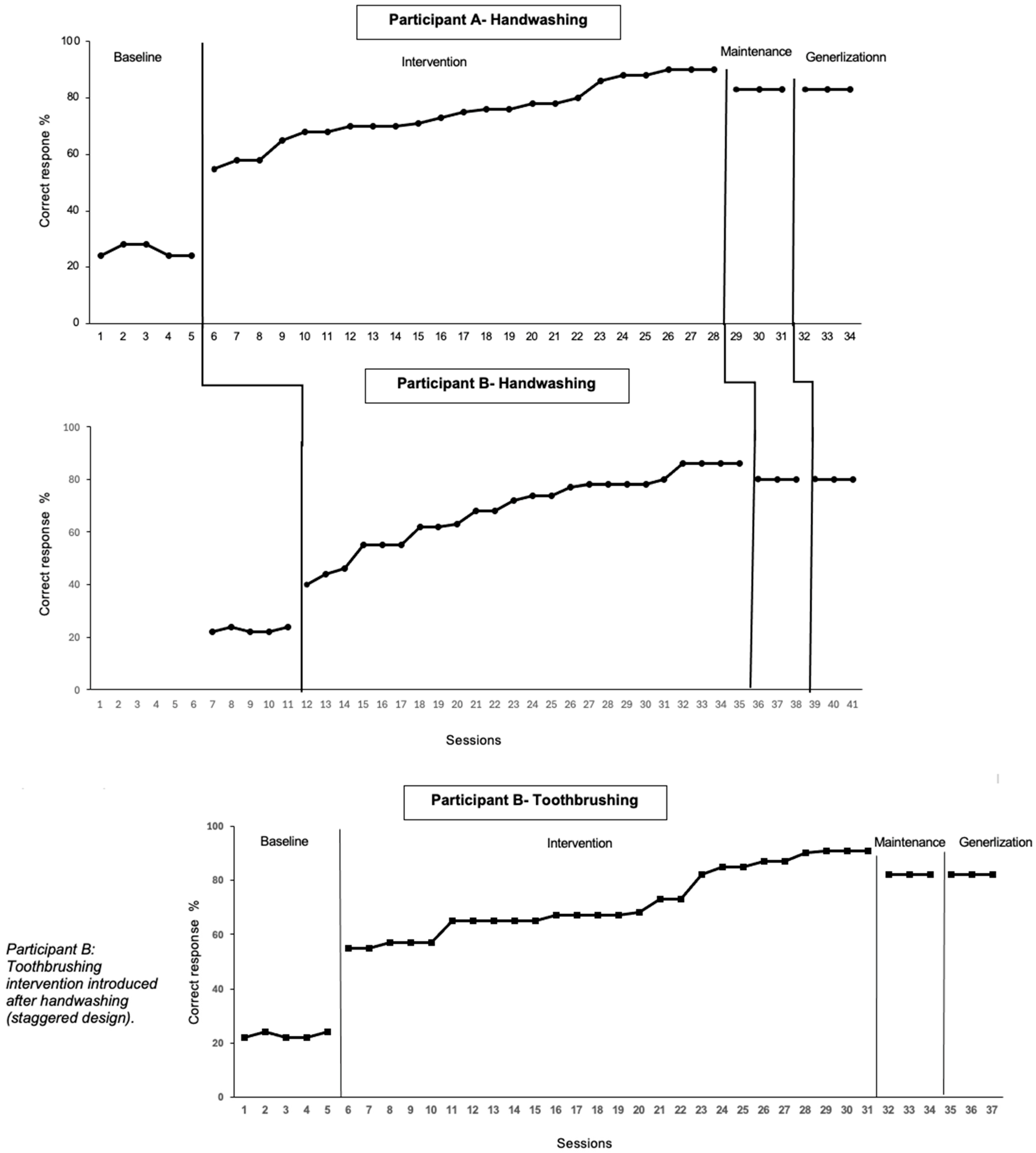
All data were recorded by the interventionist (teacher) using assessment sheets for handwashing and toothbrushing. Performance was coded based on the level of prompting required: not complete = 0, physical prompting (continuous) = 1, physical prompting (intermittent) = 2, verbal/visual/gesture prompting = 3, and complete independently = 4. The mastery percentage for handwashing was calculated using the formula (Sum/60) × 100, and for toothbrushing, using (Sum/68) × 100. Data were analyzed in Microsoft Excel and presented in APA-style graphs (
Figure 1).
Participant A—Handwashing. During the baseline phase, Participant A’s performance remained low, ranging from 24% to 28%. With the introduction of the handwashing intervention, accuracy increased steadily, reaching 88–90% by the final intervention sessions. In both the maintenance and generalization phases, performance was stable at 83% across all sessions. Despite these improvements, Participant A required continuous or intermittent physical or verbal prompting for four steps—cleaning both thumbs, cleaning the backs of the hands, rubbing the fingers on the palms, and cleaning the wrists—which were not completed independently during maintenance or generalization.
Participant B—Handwashing. In the baseline, Participant B demonstrated consistently low performance (22–24%). Accuracy improved during intervention, reaching 86% in the final four sessions. At maintenance and generalization, performance was stable at 83% across all sessions. However, Participant B required continuous physical prompting to complete five steps: scrubbing between the fingers, cleaning both thumbs, cleaning the backs of the hands, rubbing the fingers on the palms, and cleaning the wrists, which were not completed independently during maintenance or generalization (
Figure 1).
Participant B—Toothbrushing. Participant B’s baseline performance in toothbrushing was low (22–24%). With the intervention, accuracy increased, reaching 90–91% by the final sessions. At maintenance and generalization, accuracy was consistently 82% across all sessions. Despite progress, the participant required physical or verbal prompts (continuous or intermittent) to complete three steps: closing the toothpaste, brushing the backs of the top teeth, and brushing the backs of the bottom teeth, which were not completed independently during maintenance or generalization (
Figure 1).
Overall, across both participants and skills, improvements were observed following the staggered introduction of the intervention, suggesting a consistent association between intervention implementation and increased task performance (
Figure 1). Significant gains were observed following the intervention, with accuracy consistently reaching the high 80% to low 90% range. These improvements were maintained over time and successfully generalized across contexts, although some individual task steps continued to require prompting. These results indicate that the multi-component intervention was associated with increased functional participation in hygiene tasks, even though complete independence was not consistently achieved.
3.1. Study Reliability
The analysis indicated perfect agreement between observers. IOA was 100% for both participants on the handwashing task and 100% on the toothbrushing task.
3.2. Social Validity
As shown in
Table 1, both teachers and parents generally expressed high satisfaction with the intervention, although some variability was observed in their responses. Teachers rated the feasibility and enjoyment items slightly lower (
M = 3.00,
SD = 0.00), while one teacher also gave a lower rating for the item on improving daily living skills, increasing variability somewhat (
M = 3.50,
SD = 0.50). Parents consistently rated most items at the highest level, though one parent rated the importance of the intervention and recommending it to others slightly lower (
M = 3.50,
SD = 0.50). Despite these minor differences, the overall mean across all respondents was high (
M = 3.65,
SD = 0.20), indicating very high satisfaction with the feasibility, acceptability, and effectiveness of the intervention.
Furthermore, both students reported being satisfied with every aspect of the intervention. As shown in
Table 2, all six items received unanimous “Satisfied” responses, indicating that the intervention was perceived as enjoyable, supportive, and effective in improving personal hygiene skills.
4. Discussion
This study investigated whether a structured teaching package was associated with improvements in two fundamental hygiene routines—handwashing and toothbrushing—for students with Autism Spectrum Disorder. The results indicated notable performance improvements: both learners increased their performance accuracy, sustained these skills beyond the intervention, and successfully applied them in settings outside the training environment. Importantly, these improvements were achieved alongside gradual reductions in the level of assistance required, rather than through complete independence alone.
During the baseline phase, participants’ performance remained consistently low, indicating that these skills were not being acquired without support. The staggered introduction of the intervention—first with Participant A, then with Participant B, and across two behaviors for Participant B—allowed for visual examination of whether performance changes systematically coincided with intervention implementation, rather than with extraneous variables. Once the intervention was introduced, accuracy levels increased progressively until mastery criteria were met, and these gains continued to be observed during maintenance checks. This pattern is consistent with a systematic association between the intervention procedures and skill acquisition, aligning with prior research showing that video-based instructional strategies are associated with improvements in self-care and daily living routines [
17,
18,
21].
One of the strongest outcomes was the high accuracy achieved during generalization probes. Both students successfully transferred the acquired skills to new contexts, suggesting that the program supported flexible skill use rather than strictly context-bound responding. These findings align with research emphasizing deliberate strategies to encourage generalization of functional skills [
22,
25,
26], contrasting with earlier studies reporting mixed results [
28,
29,
30]. The systematic use of error correction in the present study may have contributed to the strong and consistent generalization outcomes.
Another notable aspect of the intervention was the structured prompting sequence combined with video prompting. This allowed learners to gradually reduce reliance on external assistance. Although full independence was not achieved for all task steps, both participants demonstrated meaningful reductions in the level of prompting required to complete the hygiene routines. For example, steps that initially required physical or modeled prompts increasingly transitioned to minimal verbal or gestural support, reflecting increased autonomy in task engagement.
These reductions in assistance represent an important outcome that is often underemphasized in the intervention literature, where complete independence is frequently treated as the primary indicator of success. For individuals with Autism Spectrum Disorder and significant support needs, expecting full independence across all daily living skills may be unrealistic or inappropriate; instead, decreasing reliance on adult support can meaningfully promote autonomy, dignity, and participation in daily routines. Such incremental gains may also have ancillary benefits, including reduced caregiver burden, increased opportunities for independent practice, and improved feasibility of skill performance in natural environments.
Prior research supports the effectiveness of such systematic prompting procedures in supporting the acquisition of functional and self-care skills in children with Autism Spectrum Disorder [
36,
37]. However, few studies explicitly highlight reductions in assistance as a socially meaningful outcome. The present findings contribute to this gap by illustrating how instructional procedures can support autonomy along a continuum of independence, even when ongoing support remains necessary. Importantly, participants maintained their accuracy during follow-up, suggesting durable skill performance, and addressing a limitation often noted in earlier studies where long-term retention was less consistent [
31,
32].
The social validity findings provided further evidence of the program’s acceptability. Parents and teachers generally rated the intervention highly, describing it as feasible, practical, and useful. Minor variations in ratings suggest that perceptions may differ across individuals, highlighting the importance of considering participant and caregiver perspectives when implementing interventions in natural settings. Although the participants had limited verbal comprehension, their responses were collected using simple pictorial options, ensuring that their perspectives could still be meaningfully captured. Students themselves reported satisfaction, indicating enjoyment, perceived improvement, and willingness to participate again. These findings are consistent with previous work showing that technology-assisted and caregiver-supported video interventions are effective and well-received [
17,
25]. Moreover, minor variations in students’ responses suggest that some adaptations may be needed when applying the intervention to more diverse populations or settings.
From a practical perspective, the study highlights the value of integrating personal hygiene instruction into school and clinical programs for individuals with Autism Spectrum Disorder. The acquisition and maintenance of essential routines, such as toothbrushing and handwashing, not only promote health but also contribute to greater independence and social participation. By demonstrating that video prompting combined with error correction was systematically associated with skill acquisition, maintenance, generalization, and meaningful reductions in required assistance, this study addresses a gap in the literature and offers a practical approach for educators and practitioners seeking to build functional independence in learners with developmental disabilities.
Limitations and Future Directions
While the results are promising, several limitations should be considered. First, although the study was conceptualized as a nonconcurrent multiple baseline design across participants and skills, the staggered introduction of the intervention across two skills for one participant and a single skill for another may visually resemble multiple A–B demonstrations, despite the inclusion of maintenance and generalization phases as follow-up conditions. As a result, the design does not permit strong causal inferences or definitive claims of experimental control. Greater variation in baseline lengths and clearer visual depiction of the nonconcurrent initiation of tiers would allow for stronger inferences regarding systematic relations between intervention introduction and performance change. Future research could enhance methodological rigor by incorporating baseline probes during intervention phases, employing a multiple-probe design, and ensuring greater variability in baseline durations across participants and behaviors. Additionally, independent task performance following a single global task directive was not intermittently assessed during the intervention phase; instead, independence was evaluated at the step level during intervention and at the task level during baseline, maintenance, and generalization assessments.
Second, the study included only two participants, which limits the generalizability of the findings. Both participants were adolescent males, and outcomes may differ for females or children of other ages with developmental disabilities. Third, all data were collected by the interventionist (teacher), and although interobserver agreement (IOA) was calculated for a portion of sessions to enhance reliability, future studies could further improve accuracy by involving additional independent observers or using automated data collection methods. Fourth, the intervention addressed only two self-care routines, limiting the scope of skills examined. Additionally, the study was conducted in a single educational setting, which may limit its generalizability to other schools or cultural contexts. Finally, follow-up assessments were limited to two to four weeks post-intervention; longer-term follow-ups are needed to determine the durability of skill acquisition over several months.
Future research should explore the effects of extended follow-up durations, parent- or caregiver-led implementations, and a broader range of daily living skills. Such efforts would provide a more comprehensive understanding of the intervention’s applicability and inform strategies for promoting sustained independence across diverse populations and contexts.