Article

Research and Evaluation of Acoustic Panels from Clothing Industry Waste


Institute of Architecture and Construction, Kaunas University of Technology, 44405 Kaunas, Lithuania
*
Author to whom correspondence should be addressed.
Textiles 2026, 6(1), 11; https://doi.org/10.3390/textiles6010011
Submission received: 20 October 2025 / Revised: 22 December 2025 / Accepted: 5 January 2026 / Published: 9 January 2026

Abstract

The problem of textile industry waste has become increasingly relevant. Recycling clothing industry waste to build acoustic panels is one of the most popular and relatively inexpensive ways to use clothing industry waste. We see a lack of information on the acoustic properties of panels made from waste from the clothing industry. The aim of this research is to determine the acoustic properties of a wide range of clothing industry waste recycled into acoustic panels. The acoustic panels were made from clothing industry waste, a different composition of textile and paper residues generated during digital printing processes. We see that panels made from square-cut scraps knitted and woven fabrics, and from yarns and fibers have relatively good acoustic properties. The panel made only of paper had good acoustic properties, the production of panels from paper and textile resulted in similar acoustic properties. Analyzing the acoustic properties of the double specimen, it was found that testing the double-layered panels, the insertion loss is better; by tripling the samples, it was found that although the acoustic properties improved, they were only marginal. Cellulose fiber boards were characterized by significantly higher air resistance. The air resistance of the boards made from fabric scraps was lower.

1. Introduction

Fast fashion trends, population growth, and their increasing purchasing power are driving the production and consumption of clothing, footwear, and household textiles. In 2022, 7.6 million tonnes of finished textile products were produced in the EU-27, with consumption reaching 19 kg per person [1]. By 2030, textile production is predicted to increase to 145 million tonnes [2]. The textile sector has a huge impact on the environment and climate, in terms of greenhouse gas emissions, waste generation, water and land use, pollution from the use of chemicals, as well as microplastic pollution [2,3,4,5,6,7]. Environmental challenges are one of the factors driving the transformation of the sector in order to implement the European Green Deal, the updated EU Industrial Strategy, the 2030 Agenda for Sustainable Development, and the EU Strategy for Sustainable and Circular Textiles [8,9,10,11]. The transformation of the textile sector is related to the transition from a linear economic model to a circular one, in which sustainable waste management practices are particularly important [12,13,14,15,16,17,18]. Alongside other textile waste management initiatives, recycling is an important step toward reducing the environmental impact and conserving resources, as well as supporting a circular economy by transforming waste into valuable resources. The integration of textile recycling products into the supply chains of other sectors strengthens industrial symbiosis and promotes sustainable economic models. A comprehensive scientometric and systematic analysis of the literature review revealed that there is a growing interest in the use of textile waste in the construction and building sector for several years [19], considering environmental pressures and the need for sustainable solutions in this sector [20].
In addition to other areas such as the use of textile waste in concrete constructions, reinforcement, and thermal insulation, much attention is being paid to the transformation of this type of waste into acoustic panels, seeking a sustainable alternative to traditional materials.
Research on the latter topic shows that materials produced from textile waste have good sound performance. A study of the sound absorption properties of nonwoven composites made from recycled cotton/polyester fibers mixed with rigid polyurethane foam as a binder revealed that these materials have excellent absorption of high frequency sound waves and can be used as sound barriers [21]. Panels made from the combination of textile fibers and rubber crumbs were obtained and showed a good characteristic of loss of sound transmission, especially at high frequencies [22]. The investigation of eco-friendly acoustic panels made from recycled textile waste and thermoplastic polypropylene fiber showed that natural and regenerated fibers with high cellulose content had the best sound absorption coefficients [23]. Several researchers are specifically focusing on the use of denim waste as an effective material for soundproofing. The successful design and production of sustainable fire-resistant panels from discarded post-consumer denim for sound was demonstrated in a study [24]. When developing an interior finishing panel from denim waste with an ecological binder, it was found that waste with different structures provides different sound insulation, and a panel made from fabric threads had better sound insulation properties than a panel made of square-cut scraps [25]. High value-added composite materials by combining denim fabric and packaging waste, such as polypropylene and polyethylene bottle caps, food and cleaning containers, were investigated in [26]. The results show that the textile-based composite panels developed are applicable as commercial support materials and have good thermal and acoustic insulation properties. There are several other studies that examine panels made from textiles in conjunction with other categories of waste. Ružickij et al. produced and tested 16 different composite panels from tire textile fiber and paper sludge [27]. The researchers found that such panels have good acoustic parameters. Similar results of a good absorption coefficient were obtained for scraps of wool and paper panels in [28]. Also, a good thermal and acoustic behavior was found during the investigation of panels produced by scrap paper and textile fibers, joined by glue [29]. However, the results of the preliminary life cycle assessment showed that these panels cause relatively large energy consumption and a high potential for global warming.
Comparisons of acoustic panels made from textile waste with commercial products for similar purposes show the advantage of textile-based panels. A group of researchers who have studied the acoustic and mechanical properties of eco-composites made from jute, hemp, coconut, biaxial linen fibers, and fibers obtained from textile waste claim that these materials are a real and effective alternative to traditional composites of synthetic matrices and fiberglass reinforcement [30]. When investigating the design possibilities of an acoustic panel with macro-openings, a panel made from shredded unsorted textile waste showed excellent results of sound absorption coefficient, demonstrating that such a panel can replace commonly used Plexiglas panels [31]. The results indicated that a composite produced from used and discarded denim bound with phenolic resin can successfully compete with commercial glass wool products for noise control [32]. Similar findings, namely that denim shoddy effectively absorbs sound, with better results than glass wool, were obtained in the study by Raj et al. [33]. After research and comparison with commercially available acoustic insulation material (gypsum board), it was concluded that recycled denim fiber products with Sorona® or PLA binder fiber had better insulation properties [34]. In the study [35], the test results showed that the sound insulation properties of samples made with mixed cotton/polypropylene waste and natural rubber as a binder were comparable to commercially available sound insulation boards. It was found that their sound insulation increases with increasing thickness. Rubino et al. conducted extensive research on the development of nonwoven materials for construction applications from textile waste and bicomponent fibers as a binder, from prototype to industrial scale-up, and the study of the possibilities of using these materials in conjunction with existing building structures [36,37,38,39]. The results showed promising sound absorption properties of these nonwovens, which allow them to be used to improve the sound insulation of buildings.
It should be noted that even if the properties of acoustic textile-based panels are not the best, their use is relevant due to other factors, such as reducing the environmental burden, good thermal insulation characteristics, and more. The study revealed [40] that household materials at their end of life, including clothing, are suitable for the production of acoustic panels, while highlighting that such panels are an effective solution to the problem of acoustic discomfort for low-income households. When semifinished panels of different compositions (mainly polyester, cotton, and mixed fabrics) obtained from post-consumer textile waste were tested, medium acoustic performances were observed. Considering this, as well as good thermal insulation properties, such panels can be used in building partitions and interior spaces [41]. However, the acoustic panel, made from non-separated textile waste mixed with a mixture of water-based and PVA adhesives, isotonic solution and sodium bicarbonate, needs to be upgraded by improving its porosity, surface texture and binder to achieve better acoustic properties [42].
As the analysis of the scientific literature shows, most studies have been conducted with post-consumer textile waste, but there are some studies that focus on the incorporation of waste generated during the manufacturing process of textiles and clothing. Acoustic panels were produced from waste from the spinning and weaving industry [43], insulation blankets for roofs and internal walls of buildings were made from polyester cutting waste [44], waste from the production of safety footwear was used to make acoustic and thermal insulation material [45]. The results of these works show similar insulation characteristics or higher compared to conventional materials. Using industrial PET nonwoven textile waste, which is generally a clean and high-quality material, thermal insulation boards with a noise reduction coefficient of more than 0.2 were produced, so they can be effectively used as sound absorbent elements [46]. Sewn-in label edge waste, typically composed of PES, has been used to create insulation panels. In the case of the thickest panel, excellent acoustic insulation was achieved [47]. The acoustic properties of boards made from woolen yarn waste, generated in various yarn production processes, are very similar to those of conventional thermal insulating and sound absorbing materials [48].
Islam et al., discussing the current progress in the use of industrial and post-consumer recycled textiles in insulation materials, emphasize that research in this area is still in its initial stages [49]. Textile waste has the potential to be used as an environmentally friendly insulation material, but well-focused research is needed.
The analysis of the scientific literature has shown that great attention to environmental awareness and the tightening of sustainability requirements in the construction and textile sectors determine the relevance of scientific research on the use of textile waste as secondary raw materials for the creation of building materials. Although environmental benefit is the main value of soundproof panels made from textile waste, it is equally important that the results of scientific research contribute to solving vital tasks such as reducing noise pollution and creating a healthier indoor environment. Many studies have demonstrated that textile-based composites exhibit favorable sound absorption properties; however, the scientific problem of determining the optimal combinations of matrix (binder) and reinforcement components, as well as the appropriate production parameters, remains unsolved. This is particularly relevant in order to maximize the share of textile waste in the panel, while expanding the effective range of acoustic properties.
Existing studies have focused mainly on post-consumer textile waste, with a predominance of single fiber waste streams, often with an emphasis on sound absorption coefficients alone. Meanwhile, industrial textile waste, although relatively clean, abundant and diverse in composition, has not been systematically investigated in the context of acoustic building products. There is a lack of systematic acoustic evaluation of various pre-consumer knitted/woven scraps, yarns and mixed paper–textile waste. Furthermore, most research focusses on determining the sound absorption coefficient, which is important for the attenuation of architectural materials, but for building materials used for soundproofing, insertion loss, which characterizes the ability of a material to attenuate noise levels, is more informative. Comparative datasets on insertion loss (not only absorption) using waste streams from the garment industry according to a consistent production protocol are lacking.
The aim of this study is to conduct a systematic evaluation of the acoustic properties (insertion loss and total insertion loss) of composite panels produced from waste generated during garment production. By applying a uniform production method and comparing different waste compositions, the study provides new insights into the acoustic behavior of understudied pre-consumer textile waste streams and their potential applications in sustainable acoustic building materials.

2. Materials and Methods

The acoustic panels were made from clothing industry waste, different compositions of textiles and paper, of which large quantities remain after the sublimation process; a mix of them has been investigated in this research. The list of test specimens used in this research is given in Table 1.
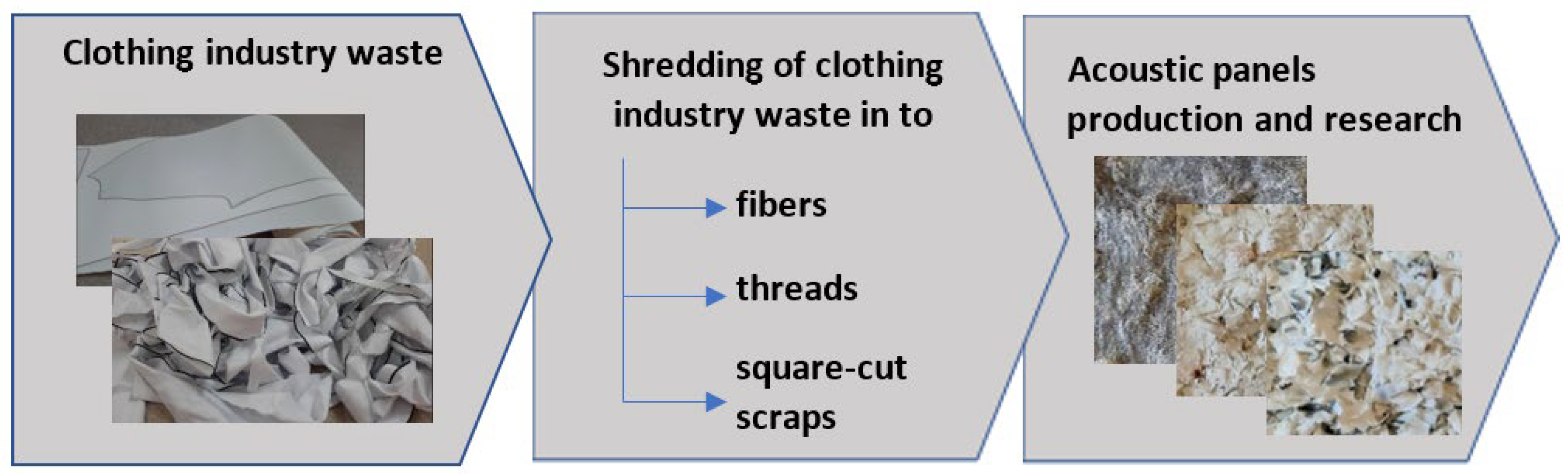
The panels were made from pre-consumer textile and paper waste of different structures. The textile and paper components of the composite were prepared separately and mechanically mixed with a binder. Corn starch was chosen as the binder due to its good structural compatibility. A 1:1 mass ratio of waste material to dry corn starch was used, the starch was dissolved in 1 L of warm water and the mixture was stirred mechanically until the mass became homogeneous. The material and binder mixtures were pressed into a circular mold with a diameter of 315 mm and heated for 24 h at a temperature of 40 °C in a ventilated oven. It is known from previous experiments [25] that this time is sufficient for the panels to dry completely (the mass of the sample remains constant). A constant external load of 967 Pa was applied to all samples during pressing in the mold and heating. The thickness of the panels depends on the material composition and compression. After heating, the load was removed, and the panels were conditioned for at least 24 h at a temperature of 23 ± 2 °C and 50 ± 5% humidity before testing. Recycling of waste from the clothing industry into acoustic panels is presented in Figure 1.
The insertion loss is the acoustic property of the materials, which were determined in this investigation following the recommendations of ISO 7235 and ISO 5135 [50,51]. This property characterizes the materials capability of attenuation of sound. The higher the values of insertion loss, it means that materials better reduce the sound level.
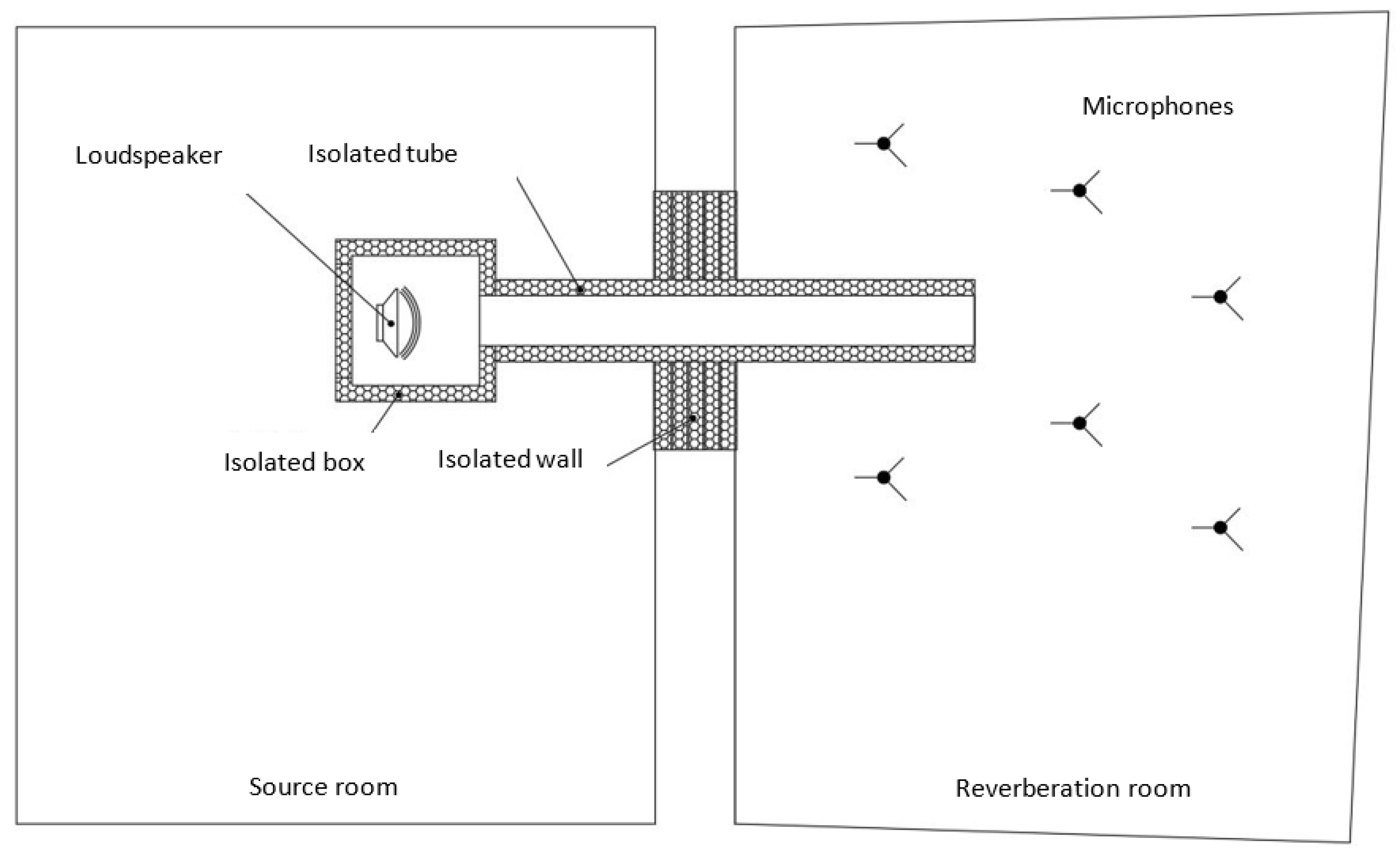
The insertion loss was determined on a custom-made test bench. The test bench was installed in the acoustic laboratory premises. For this purpose, two adjacent rooms with window testing openings were used between them. The principal scheme (plan view) of the test bench is given in Figure 2.
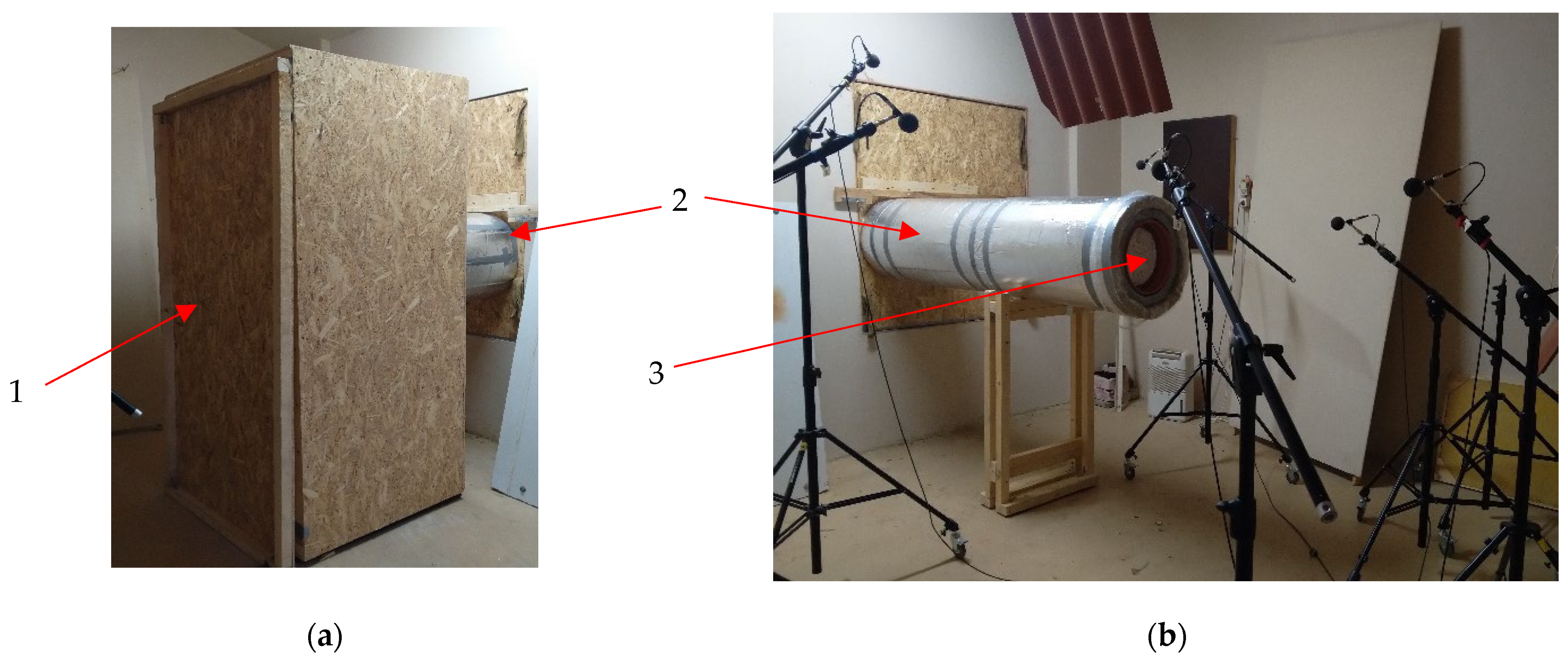
The test bench consists of an isolated box with one-way Yamaha CZR12 loudspeaker installed inside to generate sound located in the source room. The box was constructed using a wooden plank and OSB boards (Figure 3). The entire inner surface of the box was covered with mineral wool (density 130 kg/m3) of 100 mm thickness that to eliminate sound reflection from the box walls. The isolated box was connected with a 3000 mm length and 315 mm diameter PVC tube. The PVC tube was isolated with 100 mm thick mineral wool mat (density 45 kg/m3). The tube goes through an isolated window opening and connects the sound source box in the source room with the reverberation room (Figure 3). The window test opening was isolated using 6 layers of high density (120–165 kg/m3) mineral wool slabs and 4 layers of OSB boards (density 600 kg/m3).
The six fixed microphone positions for measurements were used inside the reverberation room. Measurements in each microphone position were repeated three times. The sound pressure level was measured in the 100–5000 Hz frequency range. The measurements were performed using Norsonic Nor850 acoustic system which is verified in an accredited laboratory. This system is the first accuracy class. The expanded uncertainty of the system is ±0.19–0.26 dB in the 100–5000 Hz frequency range. Before and after each measurement session, all microphones were calibrated with a verified calibrator Nor1251. The pink noise was used in this research. The measurement procedure was as follows: first, the noise was turned on and the sound level measured in the reverberation room without a test specimen on the test bench, the tube with open end. Second, the test specimen was installed on the test bench (at the open end of the tube), the noise was turned on, and the sound level was measured.
This procedure was repeated for all test specimens. After all test specimens were measured, the insertion loss (Di) was calculated according to the following formula [50]:
Di = L2L1 (dB)
there:
  • L2—sound level in the reverberation room without specimen in the test bench;
  • L1—sound level in the reverberation room with specimen in test bench.
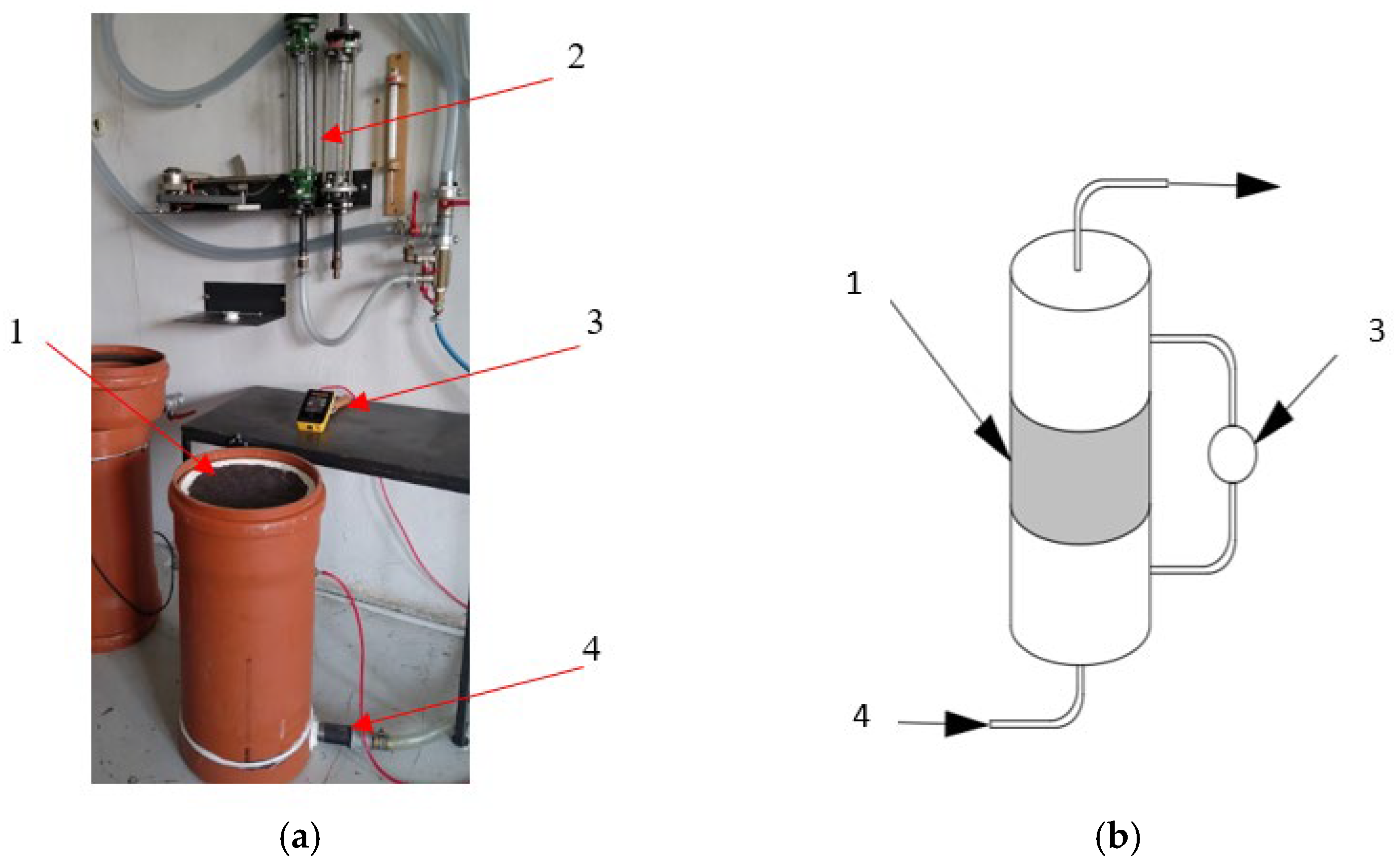
Airflow resistance is a property that was determined according to ISO 9053-1 [52] in this investigation. This property characterizes the permeability of the materials of the air. The higher the values, it means that materials stop airflow better. Airflow resistance was determined on a custom-made test bench (Figure 4). The test bench consists of a cylinder PVC tube (diameter 315 mm) with several measurement cells, device to produce airflow (air compressor), device to measure volumetric airflow (rotameter RM-2.5 GUZ), device to measure differential pressure (calibrated dual channel digital micromanometer Retrotec DM32) (Figure 4).
The measurement procedure was the following: the test specimen was placed in the measurement cell and the perimeter was sealed. After that, the air compressor was turned on for airflow generation. Using a rotameter, the airflow rate of airflow was changed from 0.2 m3/h to 1.6 m3/h. The change in air flow rate was measured by measuring the pressure difference using a micromanometer. Using measurement data (airflow rate and pressure difference), airflow resistance (R) is calculated according to the following formula:
R = p q v
there:
  • p—air pressure difference, across the test specimen with respect to the atmosphere, Pa;
  • qv—volumetric airflow rate, passing through the test specimen, m3/s.
The airflow resistance measurement equipment is calibrated, the RM-2.5 GUZ rotameter with an uncertainty of ±0.01 m3/h, and micromanometer Retrotec DM32 micromanometer with an uncertainty of ±0.6 Pa. All tests were carried out under laboratory conditions (20 °C, 50% RH).
Statistical analysis was performed using the mean ± 95% confidence interval (CI) based on repetitions. The number of repetitions (n) was as follows: n = 3 for insertion loss measurements, and n = 5 for airflow resistance measurements for each panel variant. CI were computed assuming approximately normal distribution of the repeated measurements and using a two-sided t-interval due to the limited sample size.

3. Results and Discussion

In the context of textile waste, according to the ISO 5157:2022 standard [53], waste is divided into categories to ensure clarity and consistency in recycling processes, circular economy and sustainability evaluation. Key categories include the following:
  • Pre-consumer textile waste, that is, waste from the production process that has not yet been used by the end user, as spinning residues, weaving by-products, dyeing sludge, short fibers, garment cutting waste, defective products, surplus fabric rolls, deadstock from textile production, as well as trims, yarns, belt, buttons, and other items used in the manufacturing. His category also included items returned unused by the consumer to the retailer. Postindustrial textile is often used as synonymous with pre-consumer textile waste. Postindustrial textile waste refers to textile waste generated during the production of intermediate or final products in the textile and clothing industry. This category includes cutting scraps, rejected fabric batches, and off-spec garments that have not reached the customer;
  • Post-consumer textile waste, that is, products that have already served their purpose for the end user and are discarded because they are no longer needed. This includes used clothing, used home textiles (furniture upholstery, curtains), or end-of-life industrial textile products;
  • Textile process waste, i.e., waste generated during the manufacturing or processing of textile materials and products. This is waste from spinning, weaving, dyeing, finishing processes, and other by-products of textile production. This is a more general term that includes all waste from fiber to the final product in the production stages, with an emphasis on production processes. The generation of waste in textile and clothing production processes is inevitable, depending on the stage of production, it amounts to 5–20% [43,54,55], although, for example, leftovers can reach 40% of the total amount of fabric used in products [56].
This study focuses on waste from the clothing manufacturing process, whose recycling has received less attention in scientific research compared to other categories of waste. It can be assumed that more attention is paid to post-consumer waste because the latter represents the majority of waste, corresponding to 87% in EU countries [57]. Although the amounts of pre-consumer waste are relatively small compared to consumer waste, it still amounts to more than a million tons of waste per year. Furthermore, a growing population and increasing consumption of fashion products mean increased production volumes. Textile process waste has several advantages compared to post-consumer textile waste. These are often clean, unused textile products eliminated directly from the production process, free from external contamination due to long-term use (detergents, sweat, and smells). The material characteristics of these kinds of waste are known (fiber composition, surface density of the material, finish), which is very important for implementing targeted recycling. Waste from the same production line usually has similar properties, allowing consistency in the development of new products. In the case of post-consumer textile waste, determining the fiber composition of a product can be difficult, especially when using manual sorting, because composition labels can be removed, worn out, and it is also a slow process. Meanwhile, industrial waste, due to its uniform composition and cleaner form, is more easily adapted to mechanical or chemical recycling, without the need for intensive sorting, cleaning, or disinfection. Often, this waste is continuously generated and can be supplied in large quantities as secondary raw materials at a low cost or free of charge, while part of consumer textile waste remains uncollected, despite the efficiency of the collection process. With proper regulation of legal regulations and management of collection processes, the quantities and content of collected production waste are predicted, which is very relevant in order to ensure industrial flows of innovative products from textile waste. In order to achieve the goals of circular economy and waste reduction, the environmental responsibility and requirements of manufacturers are increasing, determining the interest in participating in waste management.
All of the advantages listed emphasize the relevance of scientific research in identifying and substantiating the potential of pre-consumer textile waste for the creation of valuable products. The interest of the scientific community in textile process waste is demonstrated by the fact that in recent years, in addition to these conventional macro-sized textile wastes, attention has been paid to microfiber waste [5]. The textile industry also contributes significantly to microplastic pollution, with most microfibers released during the manufacture of textile products [58]. In the search for solutions to contribute to sustainable waste management in the textile industry, efforts are also being made to find applications for this waste [59].
In addition to the use of textile process waste, the study performed also focused on non-fibrous waste generated in the textile value chain. The study examined the possibilities of using paper waste in the development of acoustic panels, specifically sublimation transfer paper residues generated during digital printing processes in the textile industry. The widespread use of dye-sublimation printing technologies in the fashion and sportswear sectors creates a significant waste stream of sublimation paper, which is currently not explored in waste utilization studies. By integrating sublimation paper waste into prototypes of acoustic composite panels, together with textile production waste, the aim is to unlock the circular economy potential of this underutilized resource and contribute to the development of innovative materials for the construction and soundproofing sectors.
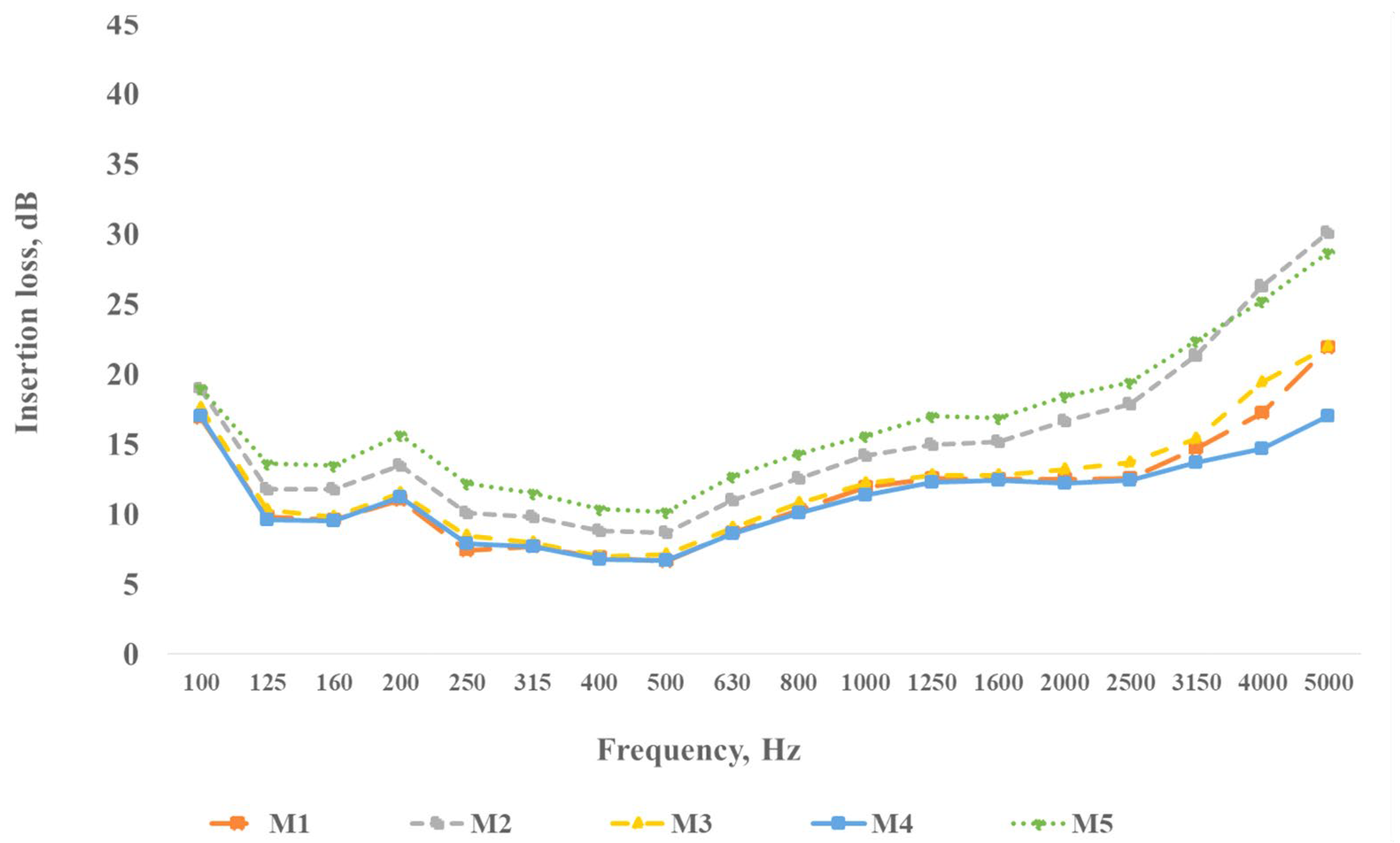
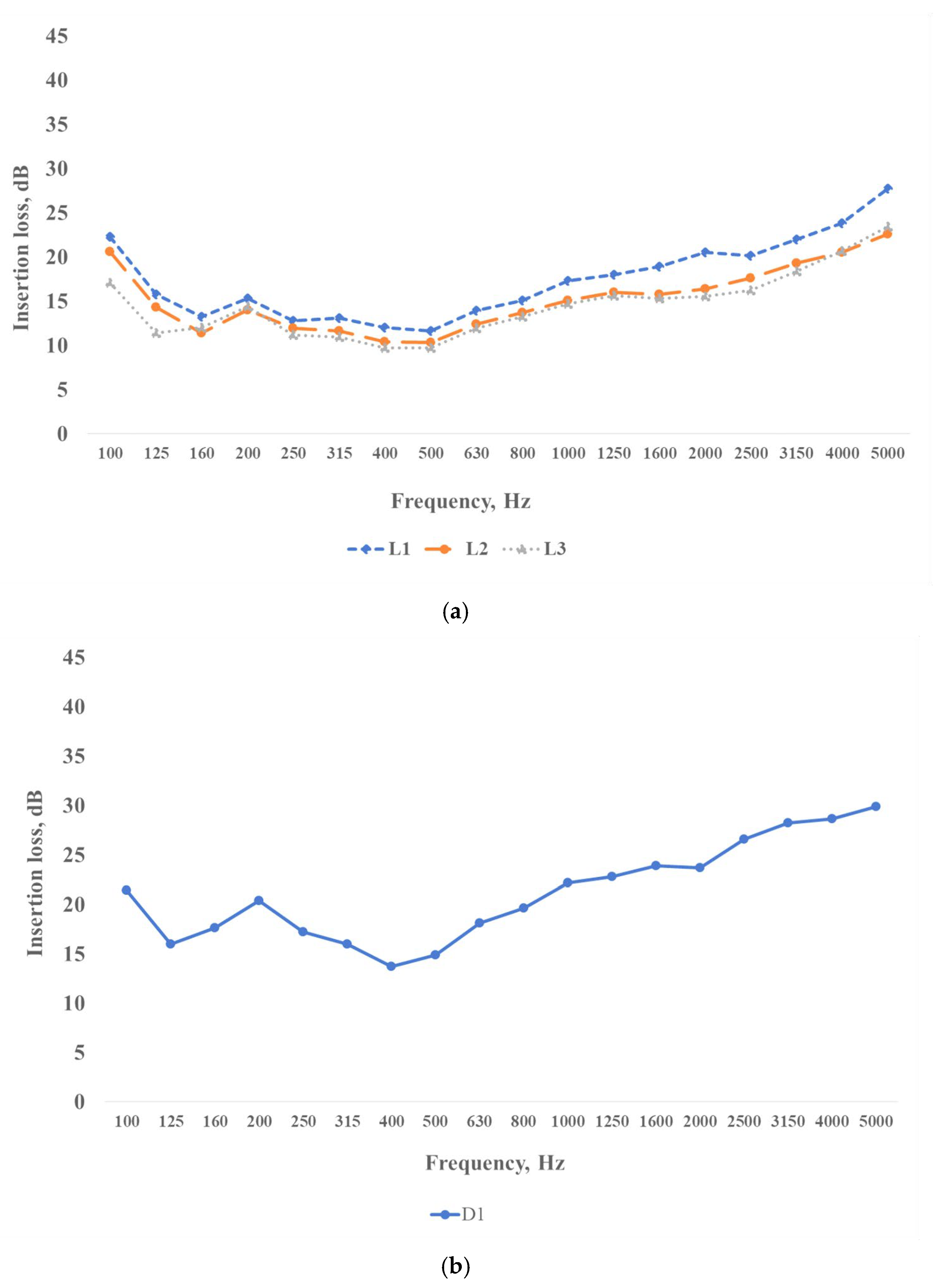
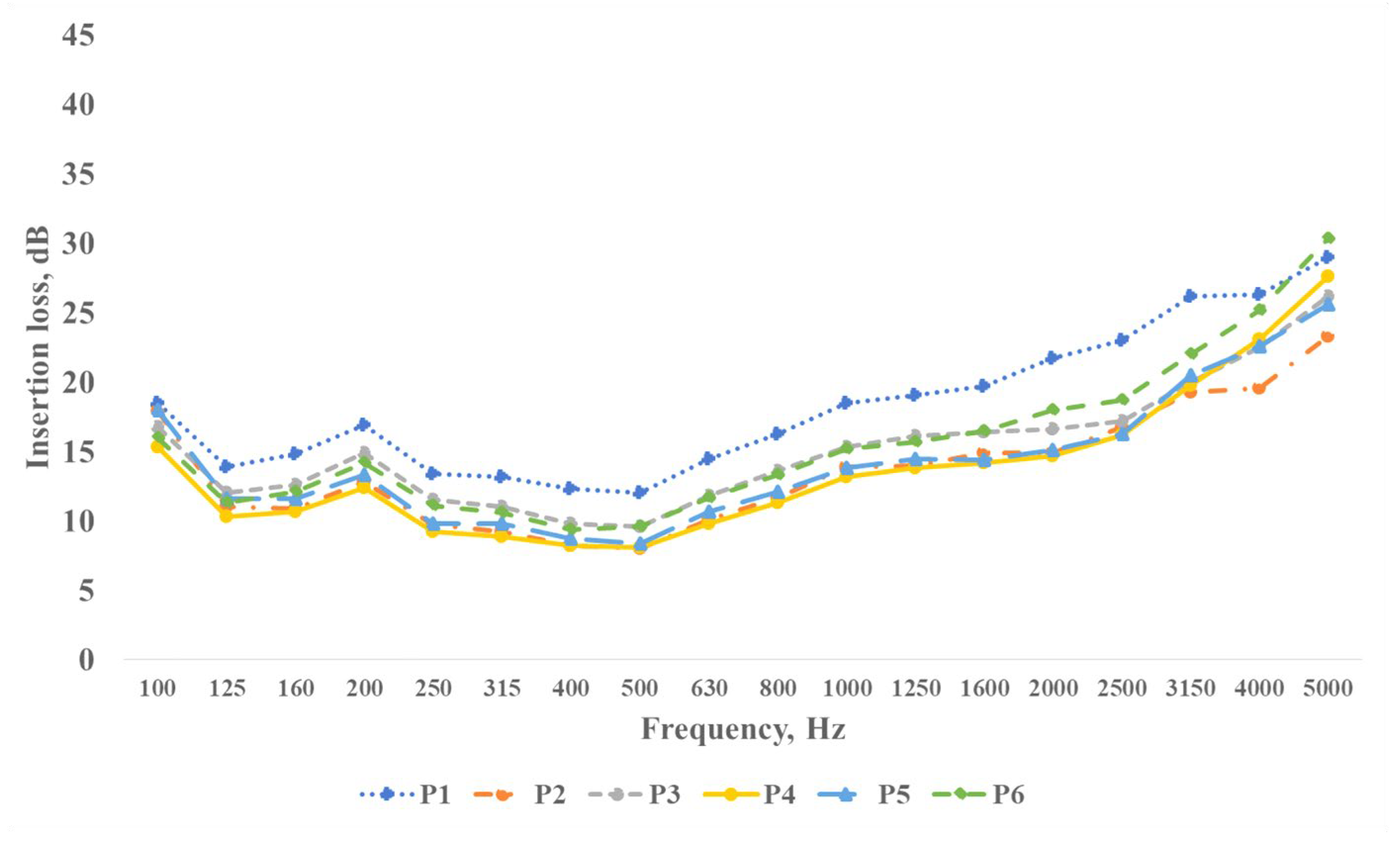
Figure 5, Figure 6 and Figure 7 present the average insertion loss results of the tested panels in the frequency range 100–5000 Hz, obtained based on three repeated measurements. The mean with a 95% confidence interval was calculated for each frequency, and the resulting range of CI from 0.0 to 1.2 indicates high measurement accuracy.
When evaluating the variation in the insertion loss of the plates in the frequency range from 100 to 5000 Hz of textile scrap panels (Figure 5), we see that in virtually all cases, the insertion loss from 100 to 500 Hz does not have a constant trend. Although the insertion loss tends to decrease in the 125–500 Hz frequency range, a sharp increase is observed at 200 Hz in all cases studied. From 500 Hz onwards, the insertion loss increases in all cases, in means that sound is better attenuated at higher frequencies.
On evaluation of the obtained results, we see that panels made from square-cut scraps knitted and woven scraps have relatively good acoustic properties. The best results in this group are the panel M5, which is knitted fabric, surface density 139 g/m2, composition: 92% Recycled coffee ground polyester, 8% Spandex. Similarly to M5 performance, we have M2. M2 have 2–3 dB lower attenuation than M5 in the 100–2500 Hz frequency range, but from 3150 Hz is almost the same (difference up to 1 dB). Panels M1, M3, and M4, which have a higher surface density, have very similar acoustic properties, yielding almost identical results. Their insertion loss is up to 5 dB worse compared with M5 in the 100–1600 Hz frequency range and up to 15 dB in the frequency range 2000–5000 Hz. This means that panels with lower surface density better absorb sound as a result of their more porous structure—more cavities inside inner structure, so the noise could be better attenuated.
Although pore size distribution and tortuosity were not directly measured in this study, density and airflow resistance are indirect but informative indicators of the internal structure. Lower density specimens generally exhibited lower airflow resistance, indicating a more open and interconnected pore network. The type and shape of the textile waste play a key role in shaping this effective pore structure. Knitted fabrics tend to deform more easily under compression than woven fabrics, and woven structures may collapse more under load, resulting in denser areas and reduced permeability.
Panels made from cellulose fibers (Figure 6) also exhibited similar acoustic properties and curve character as square cut scraps knitted and woven fabrics. In the analyzed frequency range, the curve is more of the L type than the M type.
This means that attenuation of sound is similar in all frequency ranges due to the structure of the panels. In this group, we can distinguish the L1 panel, made of flax fiber; insertion loss of this panel was the highest (Figure 6a). The other two flax panels, made from flax yarn (L2) and made from square cut scraps of flax woven fabric (L3), had slightly lower (up to 5 dB) insertion loss. A panel made from shredded denim threads also had good acoustic properties. (Figure 6b) and performs similarly to L1 acoustic performance. These panels (L and D) are stiffer than M, and this also influences curve character and attenuation level.
Considering that the clothing industry generates a lot of paper production waste, a panel made entirely of paper and a panel made using 50% paper and 50% textile scraps from group M were produced. On the basis of the results obtained, we see that the panel made only of paper had the highest insertion loss in this group (Figure 7).
The insertion loss value of P1 comparing with other P group specimens is up to 5 dB. The panels of paper and textile resulted in very similar acoustic properties (difference between P2–P6 is 2–3 dB). In this case, as in previous results, the composite of paper and M5 panel had better acoustic properties. The acoustic performance of these panels is similar to M type panels and means that the textile structure influences sound attenuation and influences insertion loss value.
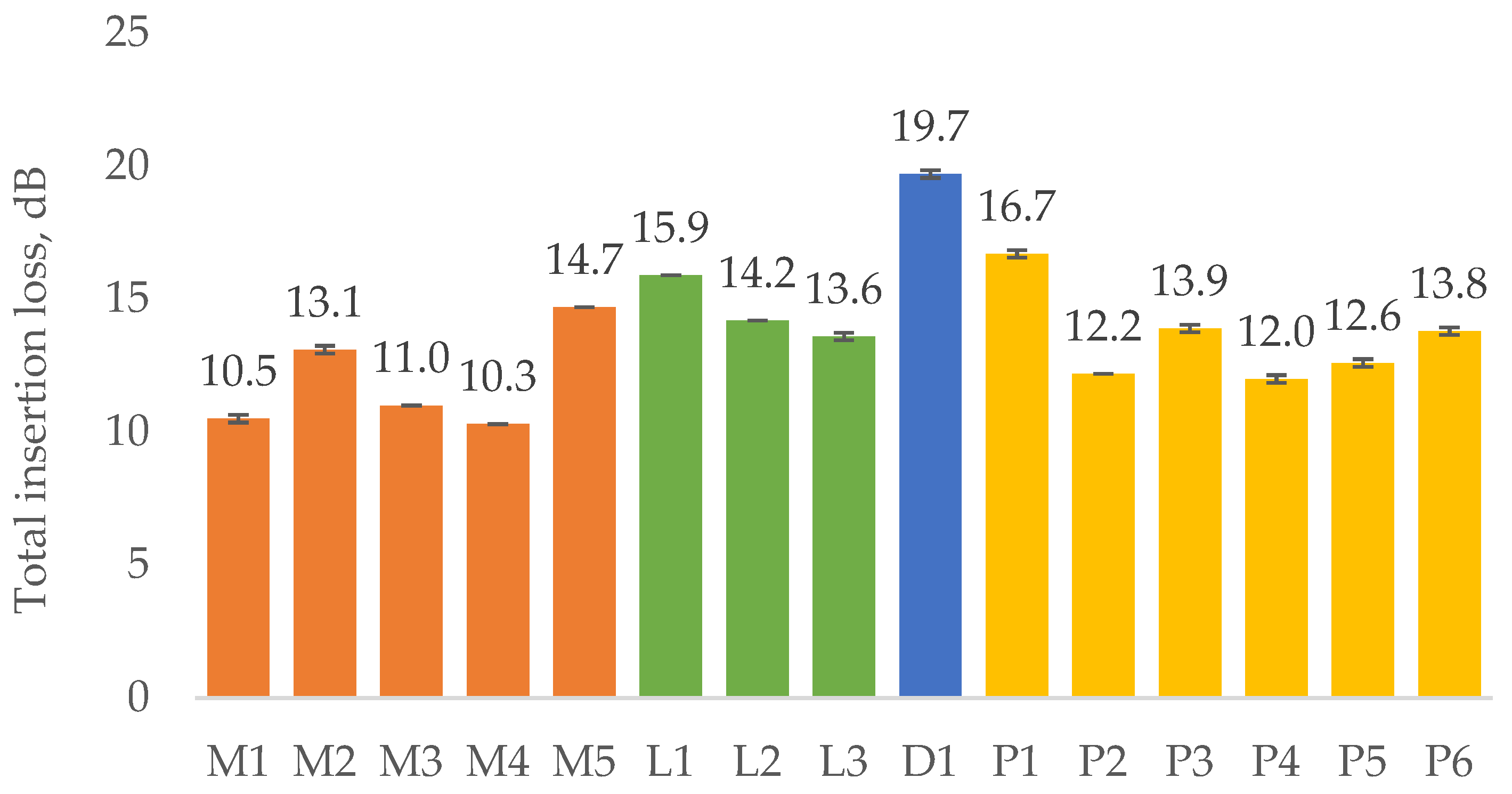
The results of the total insertion loss (mean value with 95% CI) of each panel tested are given in Figure 8.
The CI ranged from 0 to 0.14 dB, indicating precision of the results. Analyzing the results of total insertion loss of a single panel of each variant, it was found that the highest attenuation was achieved, respectively, with M5, L1, D1, and P1 panels.
Therefore, these panels were chosen for further research. The combination of double and triple specimens was made (Table 2). The measurements were performed according to the same procedure as with single specimens.
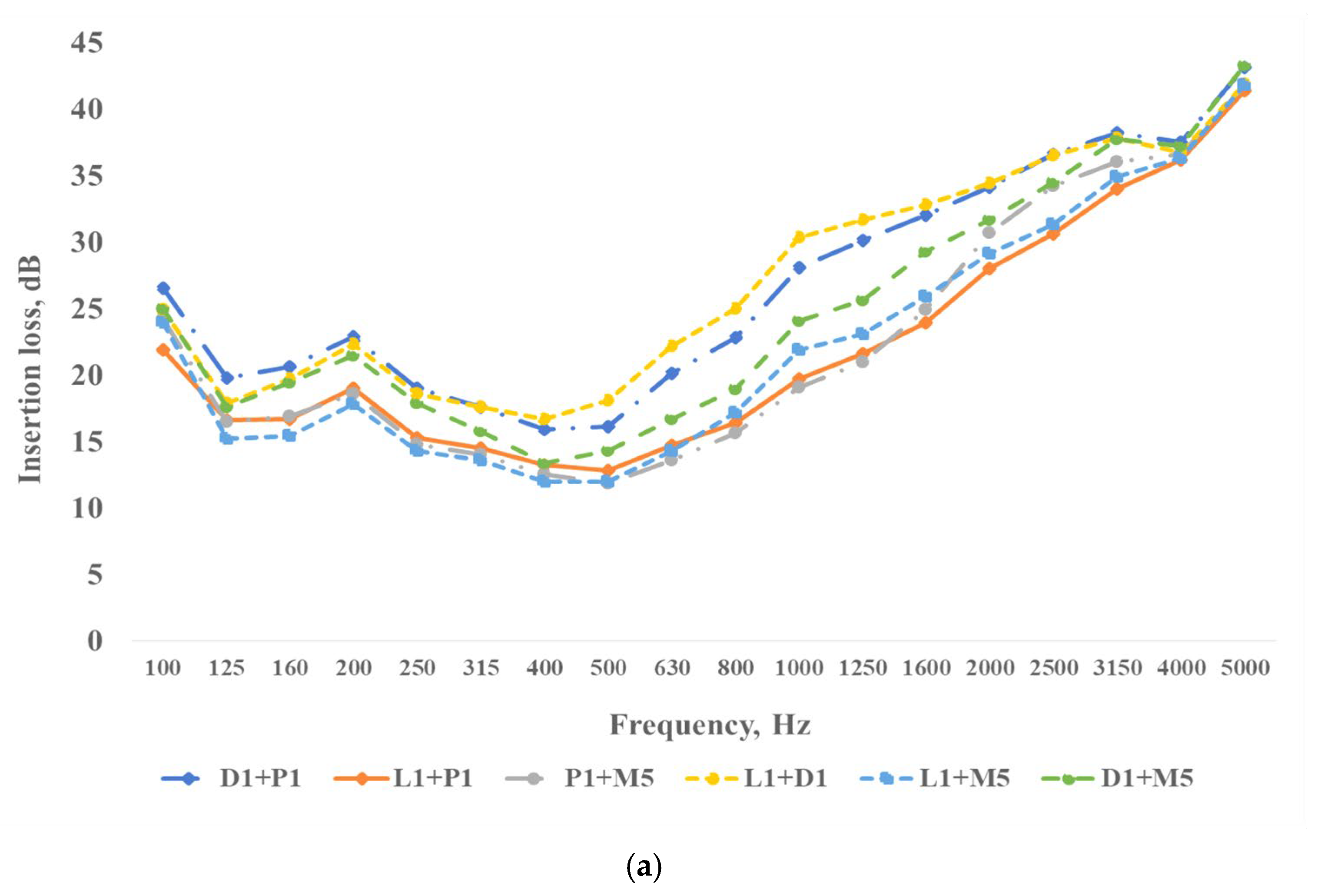
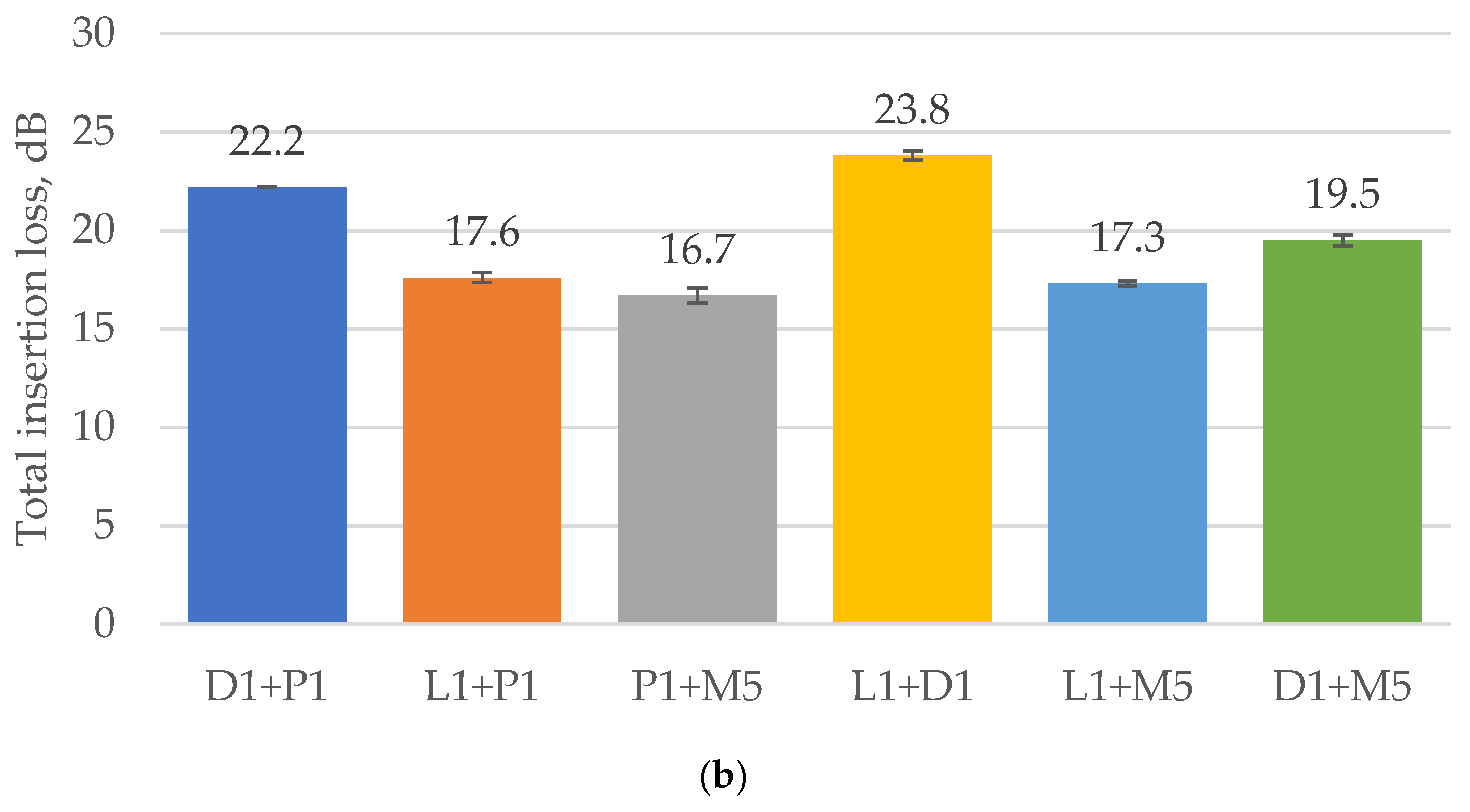
Analyzing the acoustic properties of the double specimen (Figure 9), it was found that when testing the double-layered panels, the insertion loss is better compared to single. Analyzing the dependence of insertion loss on frequency (Figure 9a), we can see that the character of the curve remains the same as in the case of the single specimen: decrement in the 100–630 Hz frequency range except at 200 Hz and increment from 800 to 5000 Hz. However, results are better (higher attenuation of sound) in panels up to 10 dB in analyzed frequency range compared with single panels. Analyzing the total insertion loss (the mean value with 95% CI, CI ranged from 0 dB to 0.38 dB) (Figure 9b), we see that in this case, also, better results (higher attenuation of sound) are obtained. The highest total insertion loss, 23.8 dB, was determined with L1 + D1 (panel made from Flax fibers with lengths ranging from 1 to 5 cm + panel made from cotton thread with lengths ranging from 1 to 5 cm) panels. The total insertion loss of the combination of D1 + P1 panels is similar (difference 1.2 dB), reaching 22.2 dB. The combination consisting of other panels had worse acoustic performance up to 7 dB compared with L1 + D1. The P1 + M5 panel had the worst acoustic properties of all double specimens. This difference can be explained by the structure and stiffness differences in the materials used.
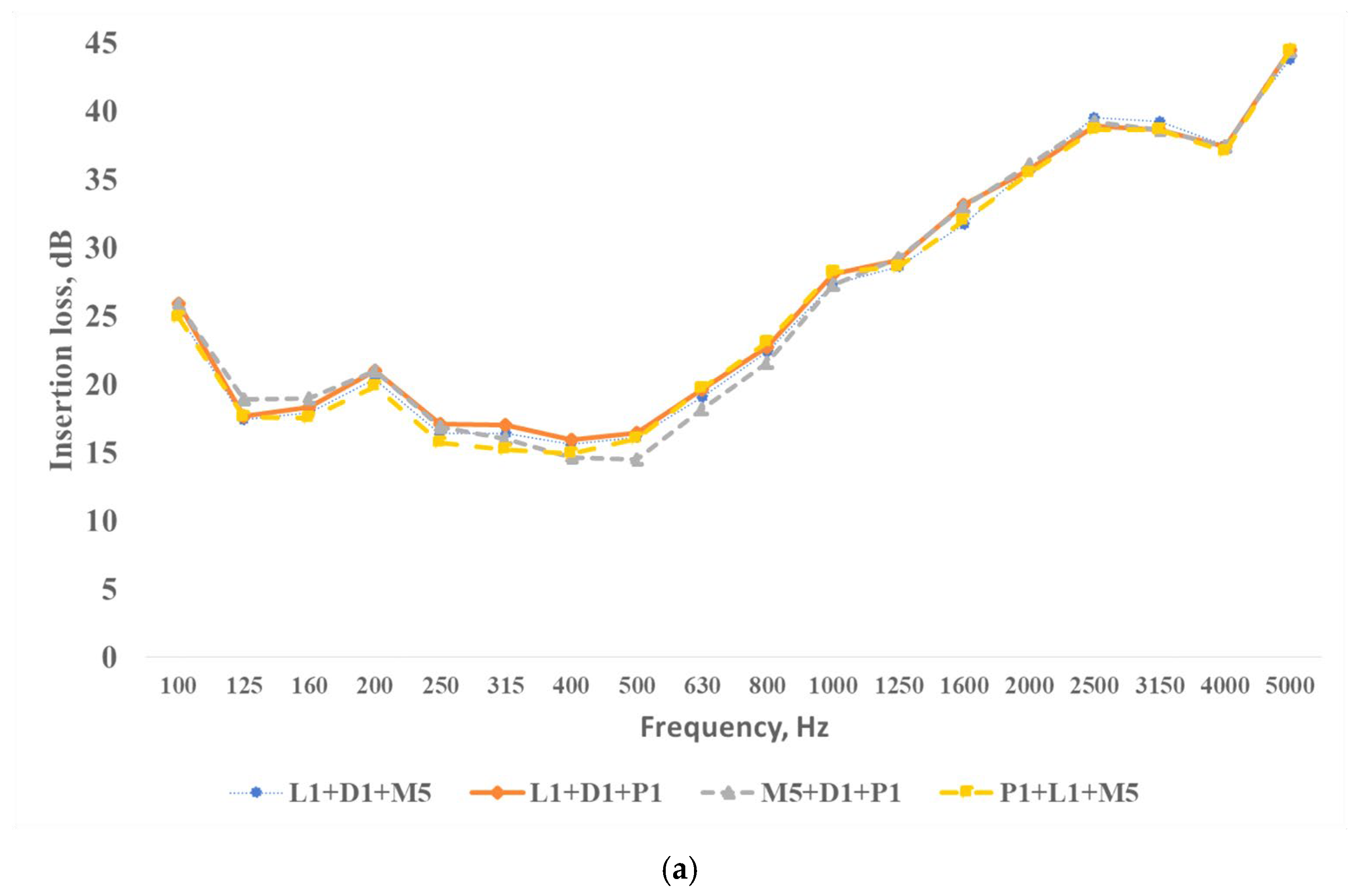
By tripling the samples and measuring the possible combinations of panels under study (Figure 10), it was found that although acoustic performance improved, it was only marginal. The trend of the dependence of the insertion loss on the frequency remained the same as in the previous variants.
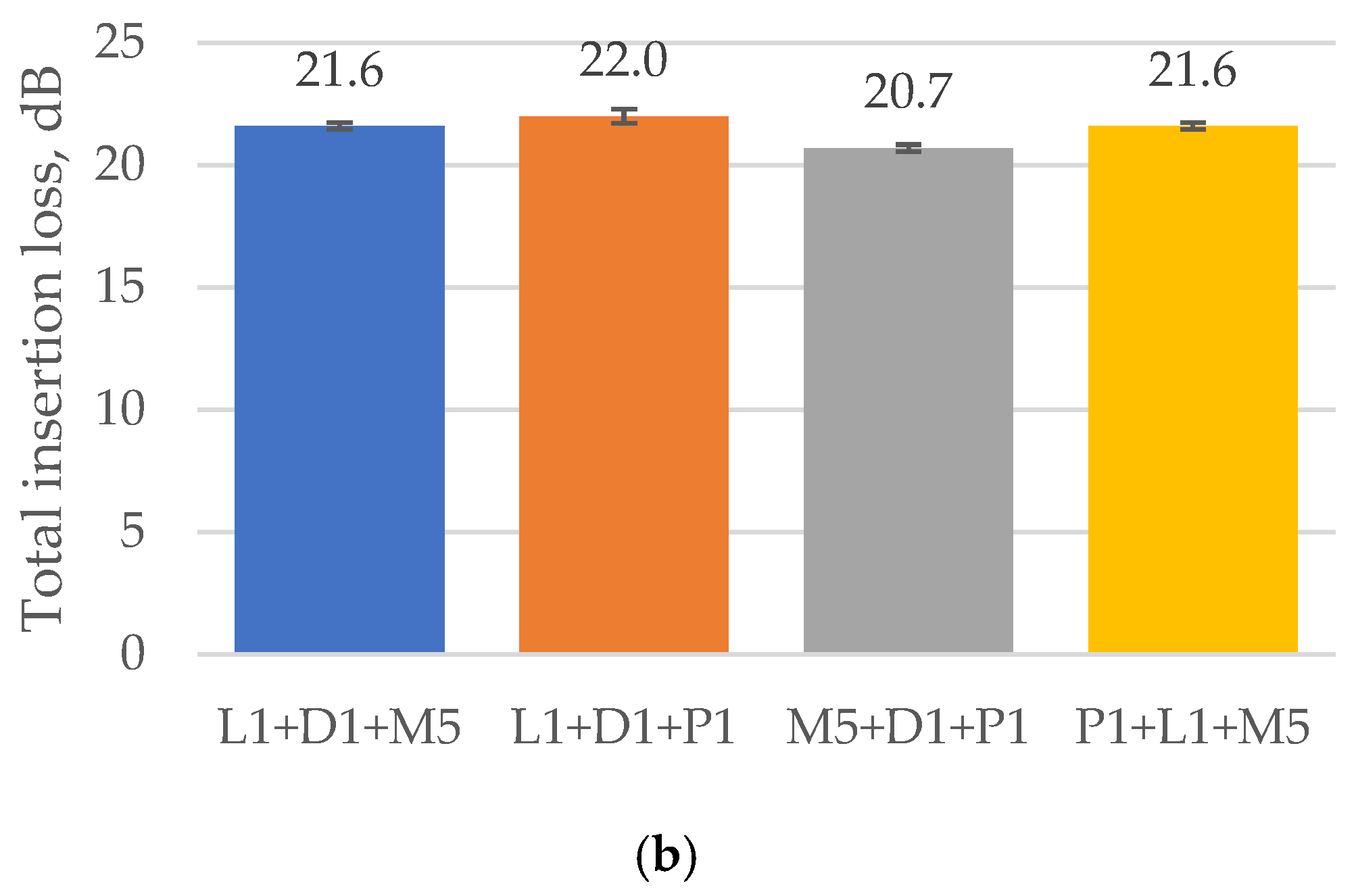
And when analyzing the total insertion loss (the mean total insertion loss with 95% CI, ranged from 0.14 dB to 0.29 dB), it was found that adding a third panel, in some cases, even worsened the acoustic properties (Figure 10b). Studies have shown that the addition of another board combination of L1 + D1 boards reduced the loss of insertion most in both cases. This difference in triple specimens compared to double specimens could be influenced by impedance mismatch between layers of different materials, reduced beneficial pore connectivity, and increased stiffness, leading to different transmission pathways. Also, this could influence the type of specimen which first is orientated to the source side. Softer specimens vibrate more than rigid and attenuate more noise, but some combination of them could have resonances, which increases sound transmission. For example, adding the M5 panel to L1 + D1 reduced the insertion loss from 23.8 dB to 21.6 dB, and adding the P1 paper panel to the aforementioned combination reduced it to 22 dB.
In the case of doubled P1 + M5 panels, the opposite result was obtained; when the D1 panel was added to this combination, the total insertion loss increased from 16.7 dB to 20.7 dB, and when the L1 panel was added, it increased to 21.6 dB. In general, in this case, it was found that the total insertion loss of all combinations is quite similar and ranges from 20.7 to 22 dB. Thus, in this case, adding a third panel does not always give a positive result. This could be influenced by the structure and the stiffness difference. The best results are obtained by combining panels with the D1 panel, as this panel has the highest insertion loss among the tested panels and determines the best properties of the entire combination.
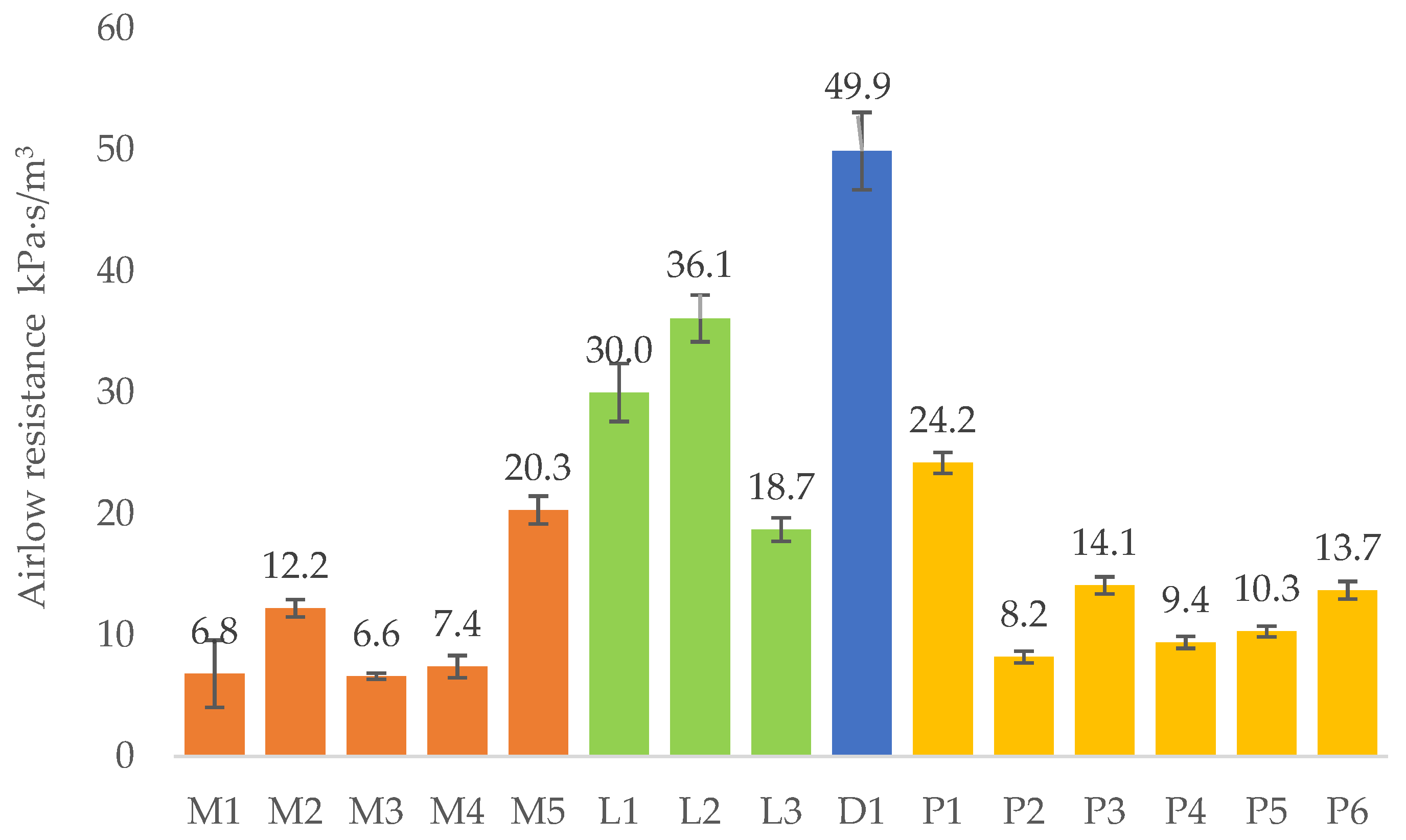
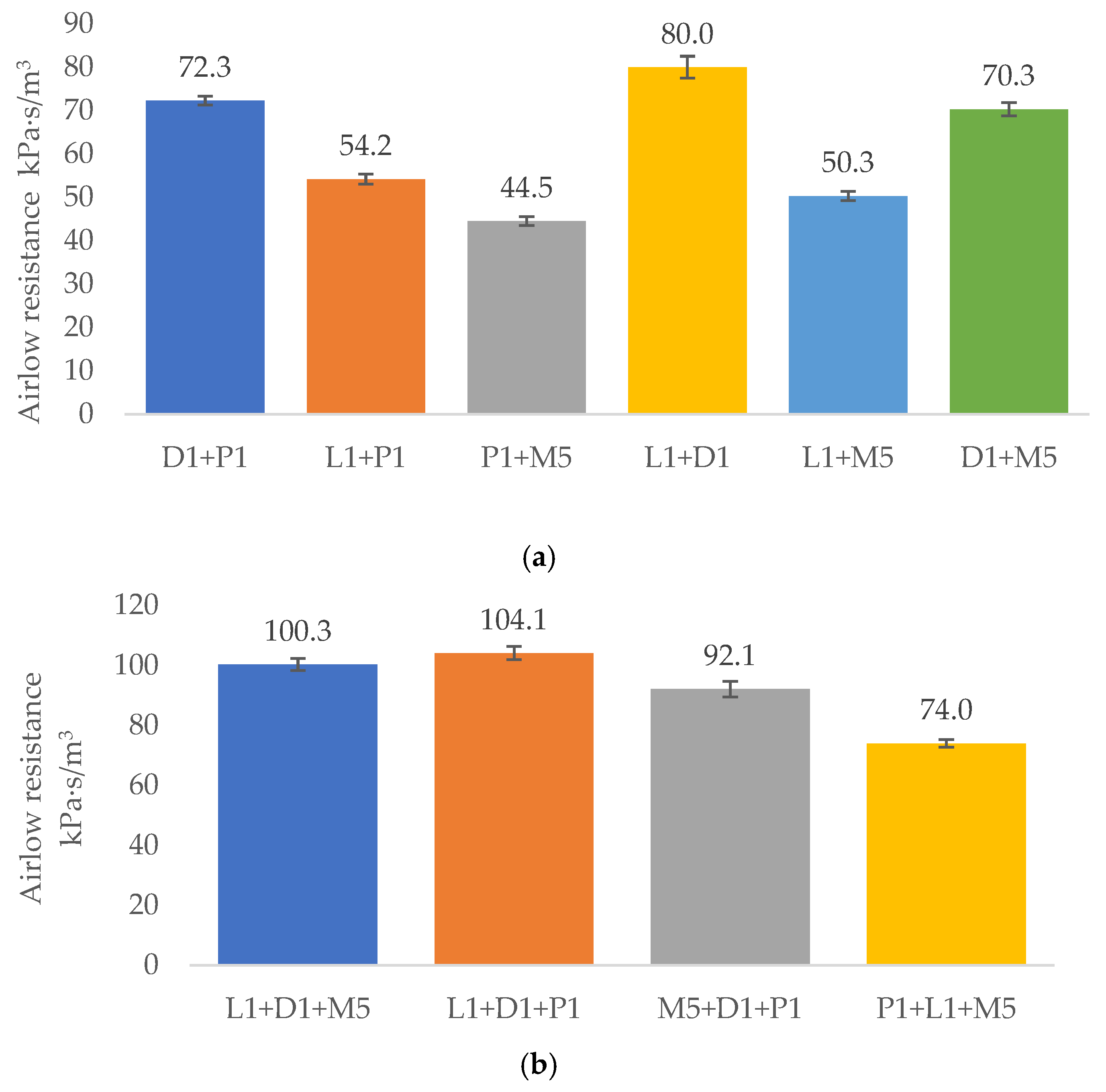
The airflow resistance results of the tested panels are presented in Figure 11 and Figure 12. The data from five measurements show low variability, with ID in the range of 0.23–3.18, confirming high precision of the measurements.
Analyzing the air flow resistance of the panels, it was found that different panels have different air conductivity (Figure 11). When evaluating the air resistance of panels made from textile scraps, it was found that the highest resistance, 20.3 kPa/s/m3, was observed in panel M5, which was made from square-cut scraps of knitted fabric (surface density 139 g/m2), composition: 92% Recycled coffee ground Polyester, 8% Spandex. The highest air permeability resistance of 12.2 kPa/s/m3 is for panel M2, which was also made from square-cut scraps of knitted fabric, but with a surface density of 270 g/m2, composition: 94% Polyester, 6% Polyurethane. The air permeability of panels M1, M3, and M4 was almost the same, reaching approximately 7 kPa/s/m3.
Cellulose fiber boards were characterized by significantly higher air conductivity resistance. When evaluating linen boards, high air conductivity resistance was determined for boards made of fibers (36.1 kPa/s/m3) and yarns (30 kPa/s/m3). The air resistance of the boards made of fabric scraps was significantly lower. There are fewer gaps between the threads and fibers, and the fabric has a spatial structure, which means that air permeability is higher. The highest airflow resistance of all the panels tested is that of a panel made of denim fabric (Figure 11); in this case, the airflow resistance reaches 49.9 kPa/s/m3. The low air permeability characteristics of cellulose panels can also be explained by the swelling of cellulose fibers during panel production, as a result of which the panel is more uniform, there are no gaps, and it is characterized by impermeability.
When analyzing the panels made of paper, textile scraps and paper (Figure 11), it was found that the highest resistance to air conductivity was observed only in the panel made of paper (24.2 kPa/s/m3). When comparing panels made of only textile waste and paper with textile waste, we see that the additional paper only slightly changed the air conductivity of the panels. This could be explained by the fact that textile materials are spatial and allow larger gaps between their structures. Paper is flat, does not have a strongly expressed spatial structure, and therefore, it adheres better to the plate and is less permeable to air flow.
When evaluating the air conduction resistance of samples from two (Figure 12a) and three (Figure 12b) samples, we see that the results are similar. The samples that were paired with the D1 plate had higher air resistance (D1 + P1, L1 + D1 and D1 + M5), which ranged from 72.3 to 70.3 kPa/s/m3. The air resistance of the other pairs of plates was about three times lower. Analogous results were obtained with samples from three plates.
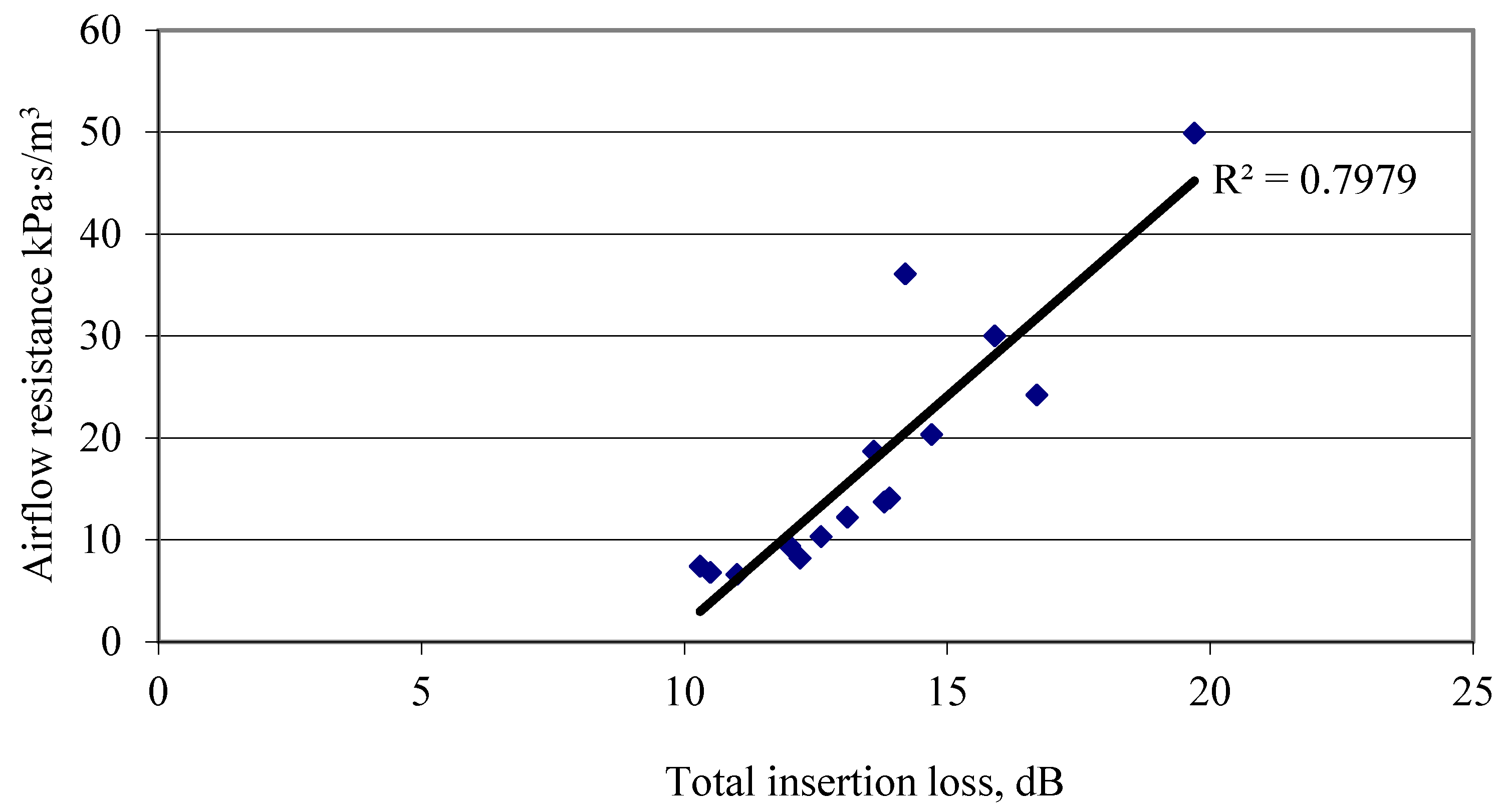
As airflow resistance shows the specimens resistance to air passing through it and can be linked with insertion loss of tested material. The relationship between total insertion loss and airflow resistance was established in Figure 13. From the relationship, it could be seen that specimens with low airflow resistance have lower insertion loss value (worse isolate sound) and the panels with higher airflow resistance value have higher insertion loss (better isolate sound). These two properties depend on specimen porosity. It means that specimens M and P type except M5 and P1 have more open porosity as air as well as sound easily pass through these specimens (pores are interconnected and connected to the surface). The specimens L type, except L3, D1, and P1, have more closed porosity and tight pores (pores are sealed off from one another) as the air and sound are more attenuated in these specimens. The specimens M5, L3, and P1 have similar amounts of closed and open pores as their air flow resistivity is in the middle. The specimens made of textile and paper + textile material are themselves more porous than specimens made of just paper, flax, and denim, and have worse airflow resistance and insertion loss.
Thus, after evaluating the results of the conducted research, it can be seen that the use of various wastes from the clothing industry in acoustic panels is possible and textile waste is the main component in these panels. Thus, after evaluating the results of the conducted research, it can be seen that the use of various wastes from the clothing industry in acoustic panels is possible and textile waste is the main component in these panels. Therefore, the research presented shows that clothing production can be waste-free by introducing acoustic panel production.

4. Conclusions

When evaluating the variation in the insertion loss of the plates, we see that in all cases from 500 Hz onwards, the insertion loss increases in all cases. Evaluating the results obtained, we see that panels made from square-cut scraps knitted and woven fabrics have relatively good acoustic properties.
Panels made from cellulose fibers exhibited similar acoustic properties, we can distinguish the panel, made of flax fiber; the acoustic properties of this panel were the best. The other two flax panels, made from flax yarn and made from flax woven fabric square-cut scraps, had slightly lower insertion loss. A panel made from shredded denim threads also had good acoustic properties.
On the basis of the results obtained, we see that the panel made only of paper had good acoustic properties. The production of panels from paper and textile resulted in very similar acoustic properties.
Analyzing the acoustic properties of the double specimen, it was found that when testing the double-layered panels, the insertion loss is better. Analyzing the total insertion loss, we see that better results are obtained. The highest total insertion loss was determined after doubling the panel made of flax fibers and the panel made of cotton thread panels.
By tripling the samples and measuring the possible combinations of panels under study, it was found that although the acoustic properties improved, they were only marginal, and it was found that adding a third panel, in some cases, even worsened the acoustic properties. Thus, in this case, adding a third panel does not always give a positive result.
When evaluating the air conduction resistance of the panels, it was found that the cellulose fiber boards were characterized by significantly higher air conductivity resistance. High air conductivity resistance was determined for boards made of flax fibers and flax yarns. The highest airflow resistance of all the tested panels is that of a panel made of denim fabric yarns.
When the panels made of paper, textile scraps and paper were analyzed, it was found that the highest air conductivity resistance was observed in the panel made only of paper. The additional paper changed the air conductivity of the panels only slightly. When evaluating the air conduction resistance of samples from two and three samples, we see that the results are similar.
In all cases, a relationship was established between total insertion loss and airflow resistance, and the panels with a higher airflow resistance have better acoustic properties.

Author Contributions

Conceptualization, M.J. and V.D.; methodology, M.J., V.D., K.M. and V.P.; validation, M.J., V.D. and K.M.; formal analysis, M.J., V.D. and K.M.; investigation, M.J., V.D., K.M. and V.P.; resources, M.J., V.D., K.M. and V.P.; data curation, M.J., V.D., K.M. and V.P.; writing—original draft preparation, M.J., V.D., K.M. and V.P.; writing—review and editing, M.J., V.D., K.M. and V.P.; visualization, M.J., V.D. and K.M.; supervision, M.J., V.D. and K.M.; project administration, M.J. All authors have read and agreed to the published version of the manuscript.

Funding

This research received no external funding.

Institutional Review Board Statement

Not applicable.

Data Availability Statement

The raw data supporting the conclusions of this article will be made available by the authors on request.

Conflicts of Interest

The authors declare no conflicts of interest.

References

  1. Manshoven, S.; Smeets, A.; Christis, M.; Duhoux, T.; Lingås, D.; Grossi, F.; Mortensen, L.F.; Clarke, J. Textiles and the Environment The Role of Digital Technologies in Europe’s Circular Economy; ETC CE Report 2025/6. Available online: https://www.eionet.europa.eu/etcs/etc-ce/products/etc-ce-report-2025-6-textiles-and-the-environment-2013-the-role-of-digital-technologies-in-europe2019s-circular-economy (accessed on 8 July 2025).
  2. European Parliament. The Impact of Textile Production and Waste on the Environment (Infographics). 2023. Available online: https://www.europarl.europa.eu/news/en/headlines/society/20201208STO93327/the-impact-of-737-textile-production-and-waste-on-the-environment-infographic (accessed on 8 July 2025).
  3. Niinimäki, K.; Peters, G.; Dahlbo, H.; Perry, P.; Rissanen, T.; Gwilt, A. The Environmental Price of Fast Fashion. Nat. Rev. Earth Environ. 2020, 1, 189–200. [Google Scholar] [CrossRef]
  4. Moazzem, S.; Crossin, E.; Daver, F. Environmental Impact of Apparel Supply Chain and Textile Products. Environ. Dev. Sustain. 2022, 24, 9757–9775. [Google Scholar] [CrossRef]
  5. Manshoven, S.; Smeets, A.; Malarciuc, C.; Tenhunen-Lunkka, A.; Mortensen, L.F. Microplastic Pollution from Textile Consumption in Europe; Eionet Report ETC/CE 2022/1; European Environment Agency (EEA): Copenhagen, Denmark, 2022. [Google Scholar]
  6. Duhoux, T.; Smeets, A.; Kress, L.; Mortensen, L.F. Measuring Europe’s Textiles Circularity—Through the Lenses of the EEA Circularity Metrics Lab; ETC CE Report 2025/7. Available online: https://www.eionet.europa.eu/etcs/etc-ce/products/etc-ce-report-2025-7-measuring-europe2019s-textiles-circularity-2013-through-the-lenses-of-the-eea-circularity-metrics-lab (accessed on 8 July 2025).
  7. Velmurugan, G.; Chohan, J.S.; Rupa, B.; Priyankka, A.L.; Thirunavukarasu, P.; Abinaya, M.; Jaswanth, V.; Kodanda Sai Anvesh, M.D.V. A Brief Analysis of the Production of Building Materials Utilizing Waste-Based Reinforcements and Recycled Textiles. Int. Res. J. Multidiscip. Technovation 2024, 6, 116–132. [Google Scholar] [CrossRef]
  8. The European Green Deal. COM(2019) 640 Final. Brussels. 11 December 2019. Available online: https://eur-lex.europa.eu/legal-content/EN/TXT/?uri=COM%3A2019%3A640%3AFIN (accessed on 8 July 2025).
  9. Updating the 2020 New Industrial Strategy: Building a Stronger Single Market for Europe’s Recovery. COM(2021) 350 Final. Brussels. 5 May 2021. Available online: https://eur-lex.europa.eu/legal-content/EN/TXT/?uri=COM%3A2021%3A350%3AFIN (accessed on 8 July 2025).
  10. United Nations. Transforming Our World: The 2030 Agenda for Sustainable Development, A/RES/70/1. Available online: https://sdgs.un.org/2030agenda (accessed on 8 July 2025).
  11. European Commission. EU Strategy for Sustainable and Circular Textiles. COM(2022) 141 Final. Brussels. 30 March 2022. Available online: https://environment.ec.europa.eu/publications/textiles-strategy_en (accessed on 8 July 2025).
  12. Das, A.K.; Hossain, M.F.; Khan, B.U.; Rahman, M.M.; Asad, M.A.Z.; Akter, M. Circular Economy: A Sustainable Model for Waste Reduction and Wealth Creation in the Textile Supply Chain. SPE Polym. 2025, 6, e10171. [Google Scholar] [CrossRef]
  13. Alves, D.I.; Barreiros, M.; Fangueiro, R.; Ferreira, D.P. Valorization of Textile Waste: Non-Woven Structures and Composites. Front. Environ. Sci. 2024, 12, 1365162. [Google Scholar] [CrossRef]
  14. Huang, X.; Tan, Y.; Huang, J.; Zhu, G.; Yin, R.; Tao, X.; Tian, X. Industrialization of Open- and Closed-Loop Waste Textile Recycling Towards Sustainability: A Review. J. Clean. Prod. 2024, 436, 140676. [Google Scholar] [CrossRef]
  15. Papamichael, I.; Voukkali, I.; Economou, F.; Loizia, P.; Demetriou, G.; Esposito, M.; Naddeo, V.; Liscio, M.C.; Sospiro, P.; Zorpas, A.A. Mobilisation of Textile Waste to Recover High Added Value Products and Energy for the Transition to Circular Economy. Environ. Res. 2024, 242, 117716. [Google Scholar] [CrossRef]
  16. Kamble, Z.; Behera, B.K. Upcycling Textile Wastes: Challenges and Innovations. Text. Prog. 2021, 53, 65–122. [Google Scholar] [CrossRef]
  17. Zhou, Q.; Le, Q.V.; Meng, L.; Yang, H.; Gu, H.; Yang, Y.; Peng, W. Environmental Perspectives of Textile Waste, Environmental Pollution and Recycling. Environ. Technol. Rev. 2022, 11, 62–71. [Google Scholar] [CrossRef]
  18. Lee, J.; Park, C.H.; Yun, C. Textile Waste Management and Its Sustainability: A Review. J. Mater. Cycles Waste Manag. 2025, 27, 2183–2197. [Google Scholar] [CrossRef]
  19. Aghimien, L.; Aghimien, E.; Aghimien, D. Where Should the Old Clothes Go? Promoting Circularity in Sub-Saharan Construction Through Textile Waste. Sustain. Dev. 2025, 33, 6436–6455. [Google Scholar] [CrossRef]
  20. United Nations Environment Programme; Global Alliance for Buildings and Construction. Global Status Report for Buildings and Construction. 2024. Available online: https://wedocs.unep.org/handle/20.500.11822/45095 (accessed on 8 July 2025).
  21. Sakthivel, S.; Kumar, S.S.; Melese, B.; Mekonnen, S.; Solomon, E.; Edae, A.; Abedom, F.; Gedilu, M. Development of Nonwoven Composites from Recycled Cotton/Polyester Apparel Waste Materials for Sound Absorbing and Insulating Properties. Appl. Acoust. 2021, 180, 108126. [Google Scholar] [CrossRef]
  22. El Messiry, M.; Ayman, Y. Investigation of Sound Transmission Loss of Natural Fiber/Rubber Crumbs Composite Panels. J. Ind. Text. 2022, 51, 5347S–5369S. [Google Scholar] [CrossRef]
  23. Yalcin-Enis, I.; Sezgin, H. Investigation of Structural Parameters of Acoustic Panels Produced from Post-Industrial Textile Wastes Containing Different Raw Materials. Prog. Rubber Plast. Recycling Technol. 2024, 40, 121–135. [Google Scholar] [CrossRef]
  24. Hassani, P.; Soltani, P.; Taban, E.; Amininasab, S. Development and Optimization of Sustainable High-Performance Acoustic and Fire Retardant Building Panels Using Recycled Discarded Denim. J. Build. Eng. 2024, 98, 111209. [Google Scholar] [CrossRef]
  25. Juciene, M.; Dobilaitė, V.; Albrektas, D.; Bliūdžius, R. Investigation and Evaluation of the Performance of Interior Finishing Panels Made from Denim Textile Waste. Text. Res. J. 2022, 92, 4666–4677. [Google Scholar] [CrossRef]
  26. Sezgin, H.; Kucukali-Ozturk, M.; Berkalp, O.B.; Yalcin-Enis, I. Design of Composite Insulation Panels Containing 100% Recycled Cotton Fibers and Polyethylene/Polypropylene Packaging Wastes. J. Clean. Prod. 2021, 304, 127132. [Google Scholar] [CrossRef]
  27. Ružickij, R.; Kizinievič, O.; Grubliauskas, R.; Astrauskas, T. Development of Composite Acoustic Panels of Waste Tyre Textile Fibres and Paper Sludge. Sustainability 2023, 15, 2799. [Google Scholar] [CrossRef]
  28. Buratti, C.; Belloni, E.; Lascaro, E.; Merli, F.; Ricciardi, P. Rice Husk Panels for Building Applications: Thermal, Acoustic and Environmental Characterization and Comparison with Other Innovative Recycled Waste Materials. Constr. Build. Mater. 2018, 171, 338–349. [Google Scholar] [CrossRef]
  29. Ricciardi, P.; Belloni, E.; Cotana, F. Innovative Panels with Recycled Materials: Thermal and Acoustic Performance and Life Cycle Assessment. Appl. Energy 2014, 134, 150–162. [Google Scholar] [CrossRef]
  30. Fontoba-Ferrándiz, J.; Juliá-Sanchis, E.; Crespo Amorós, J.; Segura Alcaraz, J.; Gadea Borrell, J.; Parres García, F. Panels of Eco-Friendly Materials for Architectural Acoustics. J. Compos. Mater. 2020, 54, 3743–3753. [Google Scholar] [CrossRef]
  31. Fridrichová, L.; Němeček, P.; Knížek, R.; Buczkowska, K.E. Opportunities to Use Textile Waste for the Production of Acoustic Panel Production. Text. Res. J. 2024, 94, 2667–2681. [Google Scholar] [CrossRef]
  32. Hassani, P.; Soltani, P.; Ghane, M.; Zarrebini, M. Porous Resin-Bonded Recycled Denim Composite as an Efficient Sound-Absorbing Material. Appl. Acoust. 2021, 173, 107710. [Google Scholar] [CrossRef]
  33. Raj, M.; Fatima, S.; Tandon, N. Recycled Materials as a Potential Replacement to Synthetic Sound Absorbers: A Study on Denim Shoddy and Waste Jute Fibers. Appl. Acoust. 2020, 159, 107070. [Google Scholar] [CrossRef]
  34. Islam, S.; El Messiry, M.; Sikdar, P.P.; Seylar, J.; Bhat, G. Microstructure and Performance Characteristics of Acoustic Insulation Materials from Post-Consumer Recycled Denim Fabrics. J. Ind. Text. 2022, 51, 6001S–6027S. [Google Scholar] [CrossRef]
  35. Dissanayake, D.G.K.; Weerasinghe, D.U.; Thebuwanage, L.M.; Bandara, U.A.A.N. An Environmentally Friendly Sound Insulation Material from Post-Industrial Textile Waste and Natural Rubber. J. Build. Eng. 2021, 33, 101606. [Google Scholar] [CrossRef]
  36. Rubino, C.; Liuzzi, S.; Stefanizzi, P.; Martellotta, F. Characterisation of Sustainable Building Materials Obtained from Textile Waste: From Laboratory Prototypes to Real-World Manufacturing Processes. J. Clean. Prod. 2023, 390, 136098. [Google Scholar] [CrossRef]
  37. Rubino, C.; Bonet Aracil, M.; Liuzzi, S.; Martellotta, F. Wool Waste Used as Sustainable Nonwoven for Building Applications. J. Clean. Prod. 2021, 278, 123905. [Google Scholar] [CrossRef]
  38. Rubino, C.; Bonet Aracil, M.A.; Gisbert-Payá, J.; Liuzzi, S.; Stefanizzi, P.; Zamorano Cantó, M.; Martellotta, F. Composite Eco-Friendly Sound Absorbing Materials Made of Recycled Textile Waste and Biopolymers. Materials 2019, 12, 4020. [Google Scholar] [CrossRef]
  39. Rubino, C.; Bonet Aracil, M.A.; Liuzzi, S.; Martellotta, F. Preliminary Investigation on the Acoustic Properties of Absorbers Made of Recycled Textile Fibers. In Proceedings of the the 23rd International Congress on Acoustics, Aachen, Germany, 9–13 September 2019; pp. 3450–3457. [Google Scholar] [CrossRef]
  40. Neri, M.; Levi, E.; Cuerva, E.; Pardo-Bosch, F.; Zabaleta, A.G.; Pujadas, P. Sound Absorbing and Insulating Low-Cost Panels from End-of-Life Household Materials for the Development of Vulnerable Contexts in a Circular Economy Perspective. Appl. Sci. 2021, 11, 5372. [Google Scholar] [CrossRef]
  41. Dama, A.; Khoshtinat, S.; Alongi, A.; Marano, C.; Angelotti, A. Hygro-Thermal and Acoustic Performances of Recycled Textile-Based Materials for Building Applications. Dev. Built Environ. 2025, 22, 100657. [Google Scholar] [CrossRef]
  42. Siltumens, K.; Grinfelde, I.; Znots, G.; Golubovs, R.; Brencis, R. Recycling of Textile Waste into Sound-Absorbing Acoustic Plates. Environ. Technol. Res. 2024, 3, 295–299. [Google Scholar] [CrossRef]
  43. El Messiry, M.; Eid, E.; Ayman, Y. Sound Contour Map of Absorber Panels from Industrial Spinning and Weaving Wastes. J. Ind. Text. 2024, 54, 1–30. [Google Scholar] [CrossRef]
  44. Trajković, D.; Jordeva, S.; Tomovska, E.; Zafirova, K. Polyester Apparel Cutting Waste as Insulation Material. J. Text. Inst. 2017, 108, 1238–1245. [Google Scholar] [CrossRef]
  45. Alves, D.I.; Carvalho, Ó.; Fernandes, N.A.T.C.; Cosentino, L.T.; Paula Junior, A.C.; Fangueiro, R.; Ferreira, D.P. Upcycling of Industrial Footwear Waste into Nonwoven Fibrous Structures with Thermal and Acoustic Insulation Properties. J. Environ. Manag. 2024, 363, 121363. [Google Scholar] [CrossRef]
  46. Antolinc, D.; Filipič, K.E. Recycling of Nonwoven Polyethylene Terephthalate Textile into Thermal and Acoustic Insulation for More Sustainable Buildings. Polymers 2021, 13, 3090. [Google Scholar] [CrossRef]
  47. Sezgin, H. Innovating Sustainability: A Holistic Approach to Insulation Panel Design from Woven Sewn-in Label Selvedge Wastes. J. Text. Inst. 2024, 116, 2031–2037. [Google Scholar] [CrossRef]
  48. Vėjelis, S.; Vaitkus, S.; Kremensas, A.; Kairytė, A.; Šeputytė-Jucikė, J. Reuse of Textile Waste in the Production of Sound Absorption Boards. Materials 2023, 16. [Google Scholar] [CrossRef]
  49. Islam, S.; Bhat, G. Environmentally-Friendly Thermal and Acoustic Insulation Materials from Recycled Textiles. J. Environ. Manag. 2019, 251, 109536. [Google Scholar] [CrossRef]
  50. ISO 7235:2003; Laboratory Measurement Procedures for Ducted Silencers and Air-Terminal Units Insertion Loss, Flow Noise and Total Pressure Loss. International Organization for Standardization: Geneva, Switzerland, 2003.
  51. ISO 5135:2020; Determination of Sound Power Levels of Noise from Air-Terminal Devices, Air-Terminal Units, Dampers and Valves by Measurement in a Reverberation Test Room. International Organization for Standardization: Geneva, Switzerland, 2020.
  52. ISO 9053-1:2018; Determination of Airflow Resistance. Part 1: Static Airflow Method. International Organization for Standardization: Geneva, Switzerland, 2018.
  53. ISO 5157:2022; Environmental Aspects. Vocabulary. International Organization for Standardization: Geneva, Switzerland, 2022.
  54. Dobilaite, V.; Mileriene, G.; Juciene, M.; Saceviciene, V. Investigation of Current State of Pre-Consumer Textile Waste Generated at Lithuanian Enterprises. Int. J. Cloth. Sci. Technol. 2017, 29, 491–503. [Google Scholar] [CrossRef]
  55. Schmutz, M.; Som, C. Identifying the Potential for Circularity of Industrial Textile Waste Generated Within Swiss Companies. Resour. Conserv. Recycl. 2022, 182, 106132. [Google Scholar] [CrossRef]
  56. Aus, R.; Moora, H.; Vihma, M.; Unt, R.; Kiisa, M.; Kapur, S. Designing for Circular Fashion: Integrating Upcycling into Conventional Garment Manufacturing Processes. Fash. Text. 2021, 8, 34. [Google Scholar] [CrossRef]
  57. Huygens, D.; Foschi, J.; Caro, D.; Patinha Caldeira, C.; Faraca, G.; Foster, G.; Solis, M.; Marschinski, R.; Napolano, L.; Fruergaard Astrup, T.; et al. Techno-Scientific Assessment of the Management Options for Used and Waste Textiles in the European Union; Publications Office of the European Union: Luxembourg, 2023. [Google Scholar] [CrossRef]
  58. Lim, J.; Choi, J.; Won, A.; Kim, M.; Kim, S.; Yun, C. Cause of Microfibers Found in the Domestic Washing Process of Clothing: Focusing on the Manufacturing, Wearing, and Washing Processes. Fash. Text. 2022, 9, 24. [Google Scholar] [CrossRef]
  59. Akyildiz, S.H.; Sezgin, H.; Özen, M.S.; Enis, I.Y. Upcycling Microfiber Waste from Wastewater into Acoustic Panels: A Sustainable Solution for Sound Absorption. Environ. Res. Lett. 2024, 20, 054010. [Google Scholar] [CrossRef]
Figure 1. Recycling of waste from the clothing industry waste into acoustic panels.
Textiles 06 00011 g001
Figure 2. Scheme of the acoustic test bench.
Textiles 06 00011 g002
Figure 3. Insertion loss test bench: (a) view from the sound source room side, (b) view from the reverberation room side. 1—isolated box with sound source inside; 2—isolated tube; 3—test specimen.
Textiles 06 00011 g003
Figure 4. Airflow resistance test bench: (a) general view, (b) principal scheme. 1—test specimen; 2—rotameter; 3—micromanometer; 4—air flow.
Textiles 06 00011 g004
Figure 5. Insertion loss in the 100–5000 Hz frequency range of textile scrap panels.
Textiles 06 00011 g005
Figure 6. Insertion loss in the 100–5000 Hz frequency range of cellulose fiber panels: (a) flax panels, (b) denim panel.
Textiles 06 00011 g006
Figure 7. Insertion loss in the 100–5000 Hz frequency range of panels containing paper.
Textiles 06 00011 g007
Figure 8. The total insertion loss of panels tested; error bars represent 95% CI of the mean.
Textiles 06 00011 g008
Figure 9. Insertion loss of double panels: (a) insertion loss in 100–5000 Hz frequency range, (b) total insertion loss; error bars represent 95% CI of the mean.
Textiles 06 00011 g009aTextiles 06 00011 g009b
Figure 10. Insertion loss of triple panels: (a) insertion loss in 100–5000 Hz frequency range, (b) total insertion loss, error bars represent 95% CI of the mean.
Textiles 06 00011 g010aTextiles 06 00011 g010b
Figure 11. Airflow resistance of the tested panels, error bars represent 95% CI of the mean.
Textiles 06 00011 g011
Figure 12. Airflow resistance: (a) double panels, (b) triple panels, error bars represent 95% CI of the mean.
Textiles 06 00011 g012
Figure 13. Relationship between total insertion loss and airflow resistance.
Textiles 06 00011 g013
Table 1. Type and description of the sample material.
NoSpecimen/Material TypeDescription of Specimen
1M1Knitted or woven fabric
Textiles 06 00011 i001
Knitted fabric, surface density 225 g/m2, composition: 85% Recycled Polyester, 15% Elastane.
Panel was made from square-cut scraps, ranging in area from 0.5 to 1.5 cm2, panel thickness ~1.65 cm, density 491 kg/m3.
2M2Textiles 06 00011 i002Knitted fabric, surface density 270 g/m2, composition: 94% Polyester, 6% Polyurethane.
Panel was made from square-cut scraps, ranging in area from 0.5 to 1.5 cm2, panel thickness ~1.74 cm, density 402 kg/m3.
3M3Textiles 06 00011 i003Woven fabric, surface density 144 g/m2, composition: 85% Recycled Polyester, 15% Elastane.
Panel was made from square-cut scraps, ranging in area from 0.5 to 1.5 cm2, panel thickness ~1.53 cm, density 464 kg/m3.
4M4Textiles 06 00011 i004Knitted fabric, surface density 190 g/m2, composition: 78% Recycled Polyester, 22% Elastane.
Panel was made from square-cut scraps, ranging in area from 0.5 to 1.5 cm2, panel thickness ~1.40 cm, density 509 kg/m3.
5M5Textiles 06 00011 i005Knitted fabric, surface density 139 g/m2, composition: 92% Recycled coffee ground Polyester, 8% Spandex.
Panel was made from square-cut scraps, ranging in area from 0.5 to 1.5 cm2,
panel thickness ~1.60 cm, density 474 kg/m3.
6L1Flax
Textiles 06 00011 i006
Panel made from Flax fibers with lengths ranging from 1 to 5 cm,
panel thickness ~1.40 cm, density 559 kg/m3.
7L2Textiles 06 00011 i007Panel made from Flax thread with lengths ranging from 1 to 5 cm, panel thickness ~1.17 cm, density 540 kg/m3.
8L3Textiles 06 00011 i008Woven fabric, composition 100% Flax, surface density 182 g/m2.
Panel was made from square-cut scraps, ranging in area from 0.5 to 1.5 cm2, panel thickness ~1.45 cm, density 546 kg/m3.
9D1Denim
Textiles 06 00011 i009
Panel made from cotton thread with lengths ranging from 1 to 5 cm, panel thickness ~0.87 cm, density 511 kg/m3.
10P1Paper
Textiles 06 00011 i010
Paper, surface density 100 g/m2.
Panel was made from square-cut scraps, ranging in area from 0.5 to 1.5 cm2, panel thickness ~1.40 cm, density 617 kg/m3.
11P2Paper + textile
Textiles 06 00011 i011
Panel was made from 50% Paper and 50% Knitted fabric (85% Recycled Polyester, 15% Elastane, surface density 225 g/m2). Panel was made from square-cut scraps, ranging in area from 0.5 to 1.5 cm2, panel thickness ~1.62 cm, density 504 kg/m3.
12P3Textiles 06 00011 i012Panel was made from 50% Paper and 50% Knitted fabric (78% Recycled Polyester, 22% Elastane, surface density 190 g/m2). Panel was made from square-cut scraps, ranging in area from 0.5 to 1.5 cm2, panel thickness ~1.58 cm, density 522 kg/m3.
13P4Textiles 06 00011 i013Panel was made from 50% Paper and 50% Knitted fabric (94% Polyester, 6% Polyurethane, surface density 270 g/m2). Panel was made from square-cut scraps, ranging in area from 0.5 to 1.5 cm2, panel thickness ~1.57 cm, density 478 kg/m3.
14P5Textiles 06 00011 i014Panel was made from 50% Paper and 50% Woven fabric (85% Recycled Polyester, 15% Elastane, surface density 144 g/m2). Panel was made from square-cut scraps, ranging in area from 0.5 to 1.5 cm2, panel thickness ~1.73 cm, density 531 kg/m3.
15P6Textiles 06 00011 i015Panel was made from 50% Paper and 50% Knitted fabric (92% Recycled coffee ground Polyester, 8% Spandex, surface density 139 g/m2). Panel was made from square-cut scraps, ranging in area from 0.5 to 1.5 cm2, panel thickness ~1.46 cm, density 510 kg/m3.
Table 2. Combinations of specimens in tests.
Double SpecimenTriple Specimen
D1 + P1L1 + D1 + M5
L1 + P1L1 + D1 + P1
P1 + M5M5 + D1 + P1
L1 + D1P1 + L1 + M5
L1 + M5
D1 + M5
Disclaimer/Publisher’s Note: The statements, opinions and data contained in all publications are solely those of the individual author(s) and contributor(s) and not of MDPI and/or the editor(s). MDPI and/or the editor(s) disclaim responsibility for any injury to people or property resulting from any ideas, methods, instructions or products referred to in the content.