1. Introduction
Drought is a complex natural phenomenon that significantly impacts water resources, ecosystems, and socioeconomic activities. The term “drought” refers to a period of lower-than-normal precipitation over an extended period [
1,
2]. Unlike other hydrometeorological disasters, drought develops slowly, making it particularly challenging to detect and manage [
3,
4,
5]. Understanding the different types of droughts—meteorological, agricultural, and hydrological—is essential for effective water resource management and for planning adaptation policies. Among these types, the transition from meteorological to hydrological drought represents a critical phase where initial precipitation deficits begin to affect surface and groundwater [
6]. During this propagation, various complex processes, such as pooling, attenuation, lag, or elongation, may occur, resulting in distinct modifications to drought severity and intensity [
6]. This shift marks the point at which the impacts of drought become more evident and disruptive, particularly concerning water supply, agriculture, and ecosystem resilience [
7]. The propagation from meteorological to hydrological drought directly affects key components of the water system, including river discharge, groundwater resources, agricultural water availability, and ecosystem functioning [
8,
9,
10].
Meteorological drought is generally defined as a period of significantly reduced precipitation compared to average conditions for a specific region and time period [
11,
12]. It is primarily driven by atmospheric conditions, such as high-pressure systems that prevent cloud formation and precipitation [
13,
14]. When these precipitation deficits persist for a long enough period, they can lead to agricultural drought, characterized by soil moisture deficiencies for crops [
15], and hydrological drought, characterized by reductions in streamflow, reservoir levels, and groundwater levels [
16,
17]. Hydrological drought generally develops more slowly than meteorological drought due to the buffering capacity of groundwater and surface water, but its effects are often more severe and long-lasting [
18,
19]. For instance, recent large-scale analyses across hundreds of catchments have confirmed that hydrological droughts typically exhibit longer durations and higher severity compared to the meteorological droughts that trigger them [
20].
The dynamics of the transition from meteorological to hydrological drought are influenced by several factors, including soil moisture retention, land use, catchment characteristics, and climatic variability [
21,
22,
23]. Specifically, catchment properties such as soil type, slope, and vegetation coverage have been found to play a decisive role in governing these drought dynamics [
21,
24]. The trend towards increasing droughts in Europe is strongest in the southern and eastern regions of the continent [
25,
26]. According to data from the European Environment Agency [
27], in these areas, including Bulgaria, a reduction in precipitation of more than 20% in the last two decades has been accompanied by a long-term decline in river runoff levels. Additionally, studies by the World Meteorological Organization [
28] emphasize that changes in climatic conditions lead to faster depletion of water supplies in river channels when meteorological drought occurs. This increases the likelihood of a transition to hydrological drought, especially in regions with high water use. According to WMO [
28], a nearly 30% increase in the frequency of hydrological droughts was reported in Europe between 1990 and 2020.
In regions with high seasonal rainfall variability, the time lag between the onset of meteorological drought and the onset of hydrological drought can be shorter, increasing the risk of water scarcity [
29,
30,
31]. Understanding these processes is essential for early-warning systems and adaptive water-resource management strategies, especially in regions vulnerable to climate variability.
Bulgaria faces increasing challenges from meteorological and hydrological droughts due to its complex geographical and climatic conditions, characterized by diverse topography and significant spatial and temporal variability in precipitation. According to Koleva and Alexandrov [
32], the most vulnerable areas to meteorological and hydrological drought are the Danube Plain and the Thracian Lowland. These regions are characterized by high seasonal rainfall variability and intensive agricultural water use, which increases the risk of water deficits during prolonged droughts. In addition, analysis by Radeva et al. [
33] indicates that during the period 1961–2012, the frequency of meteorological droughts in the Danube Plain increased significantly. These trends are particularly critical in agricultural zones with high irrigation demand, as highlighted by Popova et al. [
34]. Vulnerability in these areas is also shaped by socioeconomic conditions; for instance, high population density in regions like Ruse increases pressure on water resources, thereby intensifying drought risk [
35]. The transition from meteorological to hydrological drought in Bulgaria varies depending on the geographical and hydrological characteristics of the catchments. In Eastern Bulgaria, particularly in the Dobrudzha region, this transition is the fastest, typically occurring within 2 to 4 months due to lower soil moisture retention and high agricultural water demand [
33]. In contrast, in the mountainous regions of Western Bulgaria, such as the Rila and Pirin, the transition may extend up to 6 months, reflecting the buffering capacity of karst aquifers, forested catchments, and seasonal snow accumulation [
35]. Beyond these spatial contrasts, recent assessments indicate a statistically significant intensification of the drought hazard in southwestern Bulgaria since the early 1990s, characterized by increased frequency, duration, and spatial extent of multi-seasonal drought events [
35]. This trend aligns with broader national observations of increasing drought persistence under climate change. According to Bocheva et al. [
36], the average annual precipitation in Bulgaria in 2022 was approximately 20% below the long-term climate norm, with critical deficits observed in spring and autumn. Recent studies indicate that compound hot and dry events have become more frequent across various regions worldwide [
9,
37], including Bulgaria [
38,
39], with southern Bulgaria identified as particularly vulnerable [
26].
Previous hydrological assessments indicate that prolonged drought and climatic variability in the Danube Plain of Northern Bulgaria have contributed to reduced groundwater recharge and are associated with declines in groundwater levels and baseflow during extended dry periods. Long-term analyses of climate and water balance show decreased groundwater recharge linked to rising air temperatures and potential evapotranspiration, with corresponding reductions in recharge relative to precipitation [
40,
41]. Historical drought periods have also been shown to significantly influence groundwater dynamics, including noticeable reductions in spring discharge and lowering of groundwater levels [
42]. The lack of adequate water management infrastructure further exacerbates these impacts, indicating the need for enhanced water storage and distribution systems. The increasing frequency and intensity of these transitions, with droughts lasting over six months doubling in recent decades, underscore the urgency of shifting from reactive to proactive management. This study aims to analyze the dynamics of the shift from meteorological to hydrological drought at a regional scale in Bulgaria, providing a scientific basis for sustainable water use and climate adaptation strategies.
2. Materials and Methods
2.1. Study Area, Data and Stations
This study investigates the transition from meteorological to hydrological drought across representative river basins in Bulgaria using monthly precipitation and river runoff data provided by the National Institute of Meteorology and Hydrology, Bulgaria. The analysis covers the period 1964–2023, further divided into two comparative sub-periods (1964–1993 and 1994–2023) to assess potential shifts in drought dynamics under changing climatic conditions.
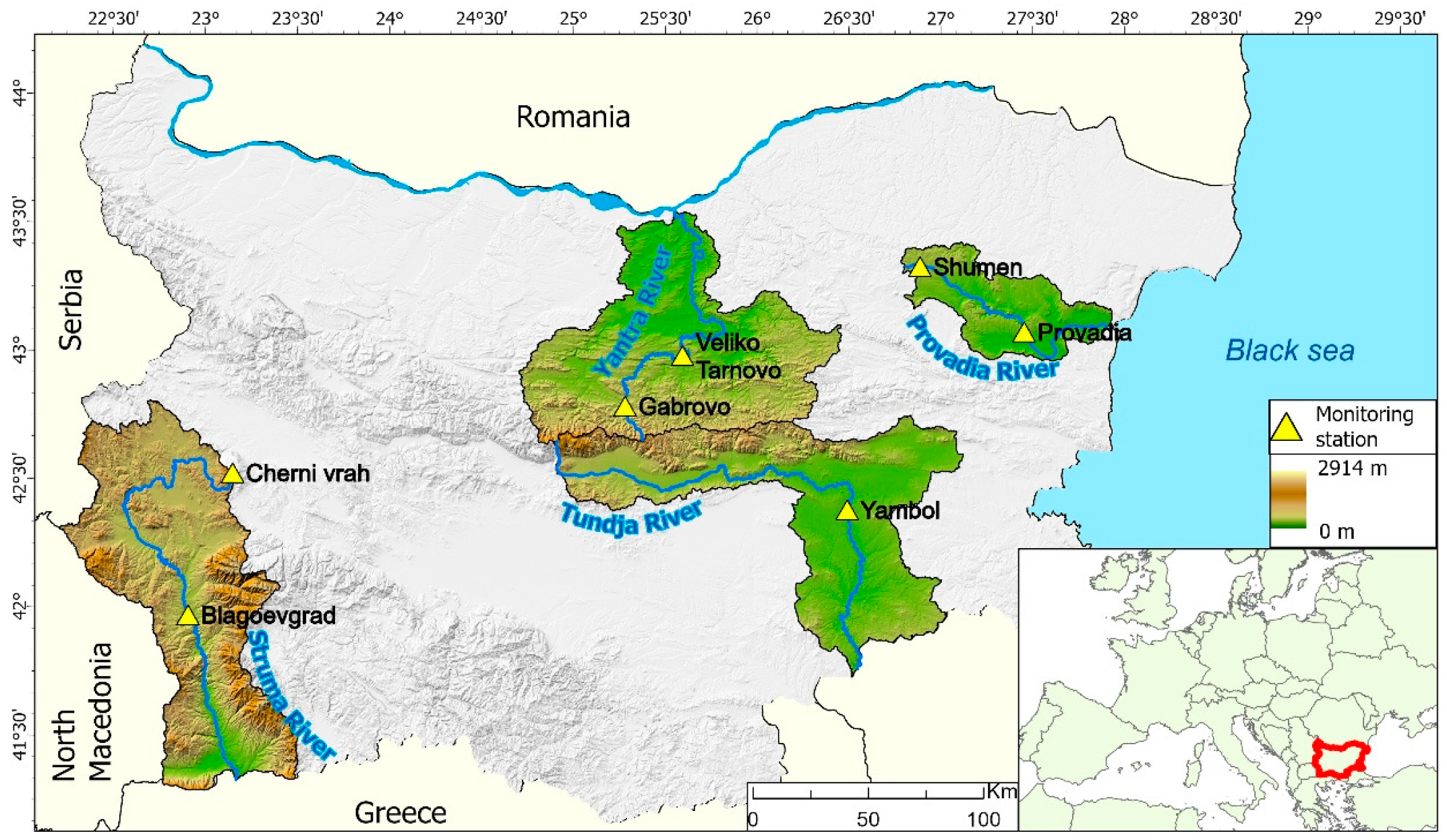
The research focuses on four representative Bulgarian river basins—Yantra River, Provadia River, Tundzha River, and Struma River—selected to reflect the country’s pronounced physiographic and hydro-climatic diversity (
Figure 1). These basins encompass mountainous headwaters, karst lowlands, continental plains, and Mediterranean-influenced valleys, allowing for a comprehensive assessment of drought propagation mechanisms under contrasting environmental conditions.
The Yantra River basin drains northward to the Danube and represents a typical North Bulgarian mountain–plain transition system. The Yantra catchment area is 7861.9 km2, and the river length is 285.5 km. The headwaters originate in the Central Balkan Mountains (Gabrovo station), where higher elevations, forest cover, and deeper soils enhance catchment storage and can moderate rapid runoff depletion during dry periods. Downstream, the basin transitions to hilly and lowland sectors (Veliko Tarnovo station) with lower relief and more rainfall-controlled runoff formation, where prolonged precipitation deficits are more readily expressed in streamflow. The Yantra River has several major tributaries, including the Rositsa, which is identified as an important contributor at the basin scale.
The Provadia basin is located in Eastern Bulgaria and drains towards the coastal lake system. The catchment area is 2132 km2, and the river length is 119 km, with a reported source elevation of 426 m. The basin is characterized by low-relief agricultural terrain and extensive karst/carbonate formations. These settings favor rapid infiltration and strong groundwater–surface water interactions, while near-surface storage can be limited during dry periods. Consequently, low-flow behavior reflects a balance between rapid reductions in surface runoff during rainfall deficits and delayed support from karst aquifers, with additional modification from water use in lowland sectors.
The Tundzha basin represents a large Southeastern Bulgarian system within the international Maritsa catchment. The Tundzha River is the largest tributary of the Maritsa, with a catchment area of 7883 km2 and a river length to the state border of 350 km; the mean catchment elevation is reported as 386 m. The river rises in the Central Balkan Mountains, flows eastward to the Yambol area, and then turns south. The basin includes extensive foothill and valley sectors, where tributary inflows and reservoir infrastructure can influence flow seasonality and provide partial buffering during prolonged dry periods.
The Struma basin represents Southwestern Bulgaria, combining high-elevation headwaters (including the Vitosha mountain) and valley sectors with stronger Mediterranean influence. The total Struma catchment is 17,330 km2, of which 8545 km2 lies in Bulgaria. The river originates in the Vitosha mountain (Cherni Vrah region), implying an important snow-related and seasonal storage component in the upper catchment. Hydrological behavior, therefore, varies along the longitudinal profile: mountain headwaters may provide temporary buffering through snow accumulation/melt and groundwater storage, whereas lower valley sectors are more rainfall-dependent and potentially more exposed to prolonged dry spells and intensive water use.
The empirical analysis is based on data from seven meteorological and hydrological stations: Gabrovo, Veliko Tarnovo, Shumen, Provadia, Yambol, Blagoevgrad, and Cherni Vrah. These stations capture altitudinal gradients ranging from lowland (35 m a.s.l.) to high-mountain conditions (2290 m a.s.l.), enabling assessment of vertical climatic differentiation (
Table 1). Climate classification follows the Köppen–Geiger system, reflecting the transition from humid continental climates in northern Bulgaria to transitional Mediterranean regimes in the southwest and alpine conditions at high elevations.
2.2. Drought Indices and Statistical Analysis
To quantify and compare meteorological and hydrological drought conditions across the selected river basins, two standardized indices were applied: the Standardized Precipitation Index (SPI) and the Streamflow Drought Index (SDI). Both indices are widely used in drought research due to their statistical robustness, comparability across climatic regions, and suitability for multi-temporal analysis [
11,
43,
44].
The Standardized Precipitation Index (SPI) was calculated using monthly precipitation totals following the original methodology of McKee et al. [
11]. The procedure involves fitting probability distribution to long-term precipitation records and transforming cumulative probabilities into a standard normal distribution. This normalization allows spatial and temporal comparison of precipitation anomalies across regions with different climatic regimes [
44,
45].
SPI was computed at monthly time steps for accumulation periods ranging from 1 to 12 months (SPI-1 to SPI-12) using the SPI Generator; Version 1.7.5 [
46]. Short accumulation scales (1–3 months) primarily reflect meteorological anomalies and short-term soil moisture variability, whereas intermediate and longer scales (6–12 months) are more closely associated with hydrological processes, including streamflow response and groundwater recharge [
19,
21].
Hydrological drought was assessed using the Streamflow Drought Index (SDI), a hydrological analogue of SPI, calculated from cumulative streamflow volumes [
43]. SDI has been widely applied in hydrological drought assessment and propagation studies [
47,
48]. In the present study, SDI-1 (monthly scale) was used to capture short-term deviations from normal flow conditions and to ensure temporal compatibility with SPI calculations. SDI-1 was calculated using the same methodology as SPI-1, but runoff data were used in place of precipitation data in the SPI Generator.
Drought events were identified using a threshold value of −1.0 for both SPI and SDI, consistent with widely adopted classification schemes [
11,
44]. Drought severity was categorized as:
Moderate drought: −1.0 ≥ index > −1.5
Severe drought: −1.5 ≥ index > −2.0
Extreme drought: index ≤ −2.0
This threshold-based approach ensures methodological consistency between meteorological and hydrological drought identification.
2.3. Drought Propagation Time
To evaluate the temporal propagation of drought from meteorological to hydrological systems, a correlation analysis was conducted between SPI (at different time scales) and SDI-1. The strength and direction of these relationships were quantified using the Pearson correlation coefficient (r), which measures the degree of linear association between two time series. The correlation was computed for each basin separately, thereby allowing identification of the characteristic time lags at which precipitation anomalies (SPI) translate into streamflow deficits (SDI). The accumulation period of the meteorological index with the highest correlation to the hydrological index is taken as the time required for meteorological drought conditions to manifest in hydrological responses [
24,
49].
This methodological framework enables the identification of the dominant drought propagation timescales in each basin and provides insight into how physiographic and hydrological characteristics influence the transition from meteorological to hydrological drought.
The correlation analysis between SPI-6 and SDI-1 for the period 1964–2023 reveals a spatially differentiated relationship between meteorological and hydrological drought during the cold (November–April) and warm (May–October) half-years. In this study, SPI-6 for April and SPI-6 for October were used to represent the accumulated precipitation deficit over the respective six-month periods, while SDI-1 values for April and October were applied to characterize the corresponding monthly streamflow conditions. In this way, the analysis evaluates the synchronicity between the accumulated precipitation deficit during the cold and warm half-years and the river discharge response at the end of each period.
2.4. Propagation Probabilities
To assess the relationship between meteorological and hydrological droughts, a conditional probability–based approach was applied. The conditional probability describes the likelihood of a hydrological drought occurring given that a meteorological drought has been observed, and it is used to analyse the temporal lag between the two processes. The relationship between meteorological and hydrological droughts was quantified using the conditional probability [
50,
51].
which expresses the probability of a hydrological drought (SDI
1 ≤ −1.0) occurring given the presence of a meteorological drought (SPI at time scale k ≤ −1.0). This framework allows the assessment of drought propagation and the temporal lag between meteorological and hydrological droughts by varying the SPI accumulation time scale k.
It should be noted that the conditional probability approach assumes stationarity in the underlying hydroclimatic processes and does not explicitly account for the effects of human interventions (e.g., reservoir regulation or water abstraction) or nonlinear catchment responses, which may influence the propagation of droughts from meteorological to hydrological domains.
For each SPI accumulation time scale (k = 1–12) and each temporal lag L (0–12 months), the conditional probability of meteorological drought propagating into hydrological drought was computed as follows:
where
N ( ) denotes the number of months for which the respective condition is satisfied;
k is the SPI accumulation time scale;
L is the temporal lag between meteorological and hydrological droughts.
3. Results
3.1. Frequency of Drought Occurrence
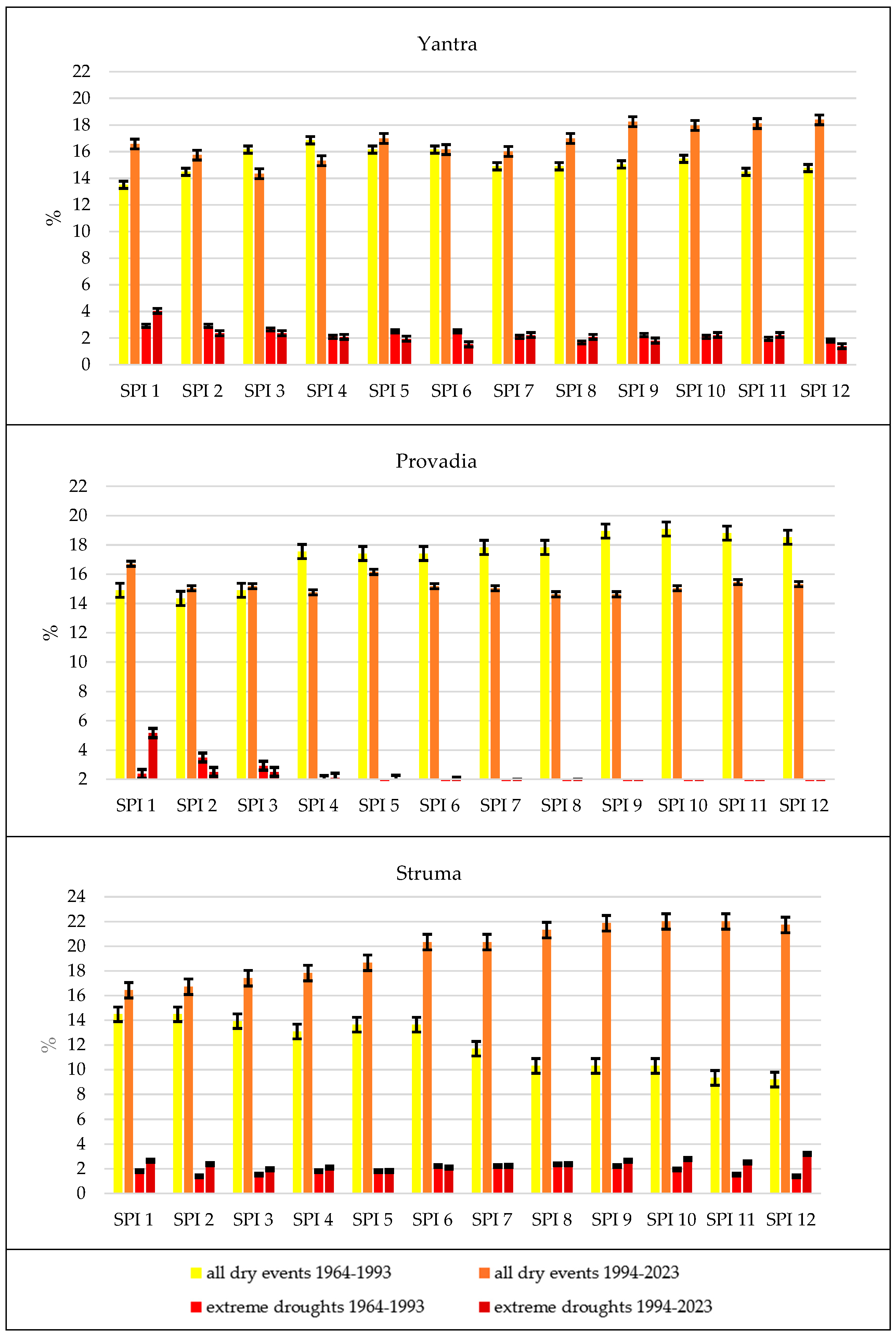
For the Yantra and Struma river basins, an increase in drought frequency is observed during the period 1994–2023 compared to 1964–1993 (
Figure 2). This increase is less pronounced for short-term indices (SPI-1–SPI-3) and becomes substantially more evident at longer time scales (SPI-6–SPI-12). During the period 1964–1993, drought frequency in the Struma River basin was the lowest compared to the other two basins, particularly for the long-term indices (SPI-9–SPI-12), with values ranging between 9 and 10%. However, during 1994–2023, a pronounced increase in drought frequency is observed across all time scales, with values reaching 20–22 for SPI-6–SPI-12. The frequency of dry events in the Yantra River basin, as determined by SPI-8 to SPI-12, reaches 17–18%. These results indicate that changes in precipitation regimes and in the accumulated water balance have led to a more frequent occurrence of persistent and prolonged drought conditions. The trend is particularly pronounced at the longest time scales, where drought frequency reaches its highest values in recent decades.
In contrast to the general trend toward increased drought frequency during the second study period, the Provadia basin shows a decrease and stabilization of drought frequency during the second 30-year period across all time scales. During 1994–2023, drought frequency across all time scales decreased from 18 to 19% in 1964–1993 to 15–17%. The decrease is most pronounced for the long-term indices (SPI-6–SPI-12). This contrasting situation highlights the role of regional climatic and physiographic factors in shaping drought regimes and demonstrates that the impacts of climate change are not spatially uniform.
The results of the extreme drought analysis indicate that over the past three decades, extreme drought events have become more frequent in the eastern and southern parts of the country (the Provadia and Struma River basins), whereas no clear unidirectional trend is identified in Central Northern Bulgaria (the Yantra River basin). During 1994–2023, a general trend toward increased frequency of extreme drought was observed; however, its magnitude varies across river basins and SPI time scales.
Compared to 1964–1993, the most substantial increase in extreme drought frequency during 1994–2023 is detected in the Provadia River basin (
Figure 2). Here, the number of extreme drought events rises across short-term (SPI-1–3), medium-term, and long-term scales (SPI-5–12), including the emergence of events at the longest accumulation periods, which were absent in the earlier reference period. In the Struma River basin, the increase is more moderate but clearly pronounced at longer time scales (SPI-9–12), indicating an intensification of prolonged drought conditions. In contrast, the Yantra River basin does not exhibit a consistent upward trend; instead, a slight increase is observed at shorter time scales, accompanied by stabilization or a minor decrease at longer SPI accumulation periods.
3.2. Drought Propagation
The analysis of the relationship between meteorological and hydrological drought revealed a strong connection, but with notable regional differences. The strongest correlations were found for SPI scales of 3 to 6 months, indicating that precipitation deficits over these timeframes are most impactful in triggering hydrological drought (
Table 2).
During the cold half-year, correlation coefficients range from 0.22 to 0.72, spanning weak to strong positive associations between accumulated precipitation deficits and end-of-period streamflow conditions. The strongest relationships are observed at Yambol (r = 0.72; Tundzha River) and Blagoevgrad (r = 0.65; Struma River), implying that winter precipitation deficits are reflected in reduced discharge by April in these catchments. High-to-moderate correlation coefficients (0.55) are observed in Veliko Tarnovo, Shumen, and Provadia, while a moderate value (0.43) is found in Gabrovo, suggesting a stable, consistent relationship between the two indices.
These results indicate that in most of the studied regions, the six-month precipitation deficit accumulated over November–April is clearly reflected in river discharge by the end of the period. The weaker relationship observed at the high-mountain station Cherni Vrah (r = 0.22) can be explained by the significant role of snow accumulation and delayed snowmelt, which disrupts the synchrony between the precipitation deficit and the streamflow response. The presence of a seasonal snow cover temporarily stores precipitation and shifts the hydrological response forward in time.
During the warm half-year, the correlation coefficients between SPI-6 (May–October) and SDI-1 (October) range from 0.27 to 0.71, with more pronounced spatial variability compared to the cold season (
Table 2). The strongest relationship between medium-term meteorological drought and the occurrence of hydrological drought is observed at Veliko Tarnovo and Blagoevgrad (r = 0.71), as well as a high correlation at Gabrovo (r = 0.66). This indicates a strong dependence of river discharge on precipitation conditions during the growing season in these regions. At Yambol (r = 0.56) and Cherni Vrah (r = 0.58), the correlation is moderately high. Notably, at Cherni Vrah, the relationship between meteorological and hydrological drought during the warm half-year is substantially stronger than in the cold season, which can be explained by the more direct dependence of summer streamflow on current precipitation after the completion of snowmelt. The relatively high correlation coefficients observed at several stations suggest that the accumulated precipitation deficit during the warm half-year (growing season) directly affects reduced river discharge in October. Under conditions of increased evaporation and active transpiration in summer, precipitation deficits are rapidly translated into decreased streamflow. The weakest relationship is observed at Shumen and Provadia (r = 0.27). These low correlation coefficients suggest a stronger influence of additional factors—such as geological characteristics, groundwater contributions, anthropogenic impacts, or greater catchment inertia—which reduce the direct linkage between short- to medium-term precipitation deficits and river discharge.
The results confirm that meteorological drought, as indicated by SPI-6, is a significant predictor of the onset of hydrological drought, as captured by SDI-1. However, the strength of this relationship varies considerably across seasons and between catchments. These findings underscore the need for a regionally tailored approach in monitoring and forecasting hydrological drought.
3.2.1. Yantra River Basin
The correlation analysis for the Yantra River basin (
Table 3) demonstrates a strong link between precipitation and streamflow, especially at medium time scales. For the stations in Gabrovo and Veliko Tarnovo, the strongest correlations between SPI and SDI-1 for the period 1964–2023 are observed at SPI-3 and SPI-4 for Gabrovo (0.63 and 0.62) and at SPI5 for Veliko Tarnovo (0.68). This suggests that a precipitation deficit lasting for 3–5 months is the primary driver of hydrological drought in this region. Interestingly, when comparing the two sub-periods (1964–1993 and 1994–2023), a shift in the correlation peak is observed. For Gabrovo, the strongest correlation moves from SPI-2/SPI-3 in the first period to SPI-4/SPI-5 in the second. This change indicates a potential increase in the lag time between meteorological and hydrological drought, which might be linked to changes in land use, soil moisture retention, or other catchment characteristics that have altered the basin’s response to rainfall.
3.2.2. Provadia River Basin
As shown in
Table 4, the data from the Provadia River basin indicate a slower response of streamflow to precipitation deficits compared to the Yantra basin. The highest correlation between SPI and SDI-1 is consistently observed at longer SPI time scales, peaking at SPI-12 (0.46) for the Provadia station and SPI11 (0.56) for Shumen. This suggests that the basin’s hydrological system has a larger “memory,” requiring a more prolonged precipitation deficit to be reflected in streamflow. The stronger correlation at longer time scales in the later period (1994–2023) further highlights this trend, which may be linked to increased agricultural water extraction, particularly in this region. This extraction could be exacerbating the effects of long-term drought, as the basin’s natural buffering capacity is diminished.
3.2.3. Tundzha River Basin
In the Tundzha River basin, for the full period (1964–2023), the Yambol station exhibits peak correlations between SPI and SDI-1 at longer time scales (SPI9–SPI11), with a maximum value of r = 0.64 (
Table 5). This indicates that hydrological drought in the basin emerges primarily after prolonged precipitation deficits. A comparison of the two sub-periods shows that the peak correlation consistently occurs at long time scales, though the maximum shifts from SPI1-1 in the first period to SPI-9–SPI-10 in the second. The correlation indicates a strengthening linkage between meteorological and hydrological droughts in the more recent decades.
3.2.4. Struma River Basin
The Struma River basin is the most vulnerable of all the regions studied. The correlation analysis for the Blagoevgrad station, shown in
Table 6, demonstrates clear spatial differences. Blagoevgrad exhibits consistently higher correlations (0.44–0.68), with peak values at SPI-3–SPI-6, indicating a relatively rapid and strong propagation of meteorological drought into hydrological drought. In contrast, Cherni Vrah shows weaker correlations (0.23–0.41) and a more gradual increase with longer SPI accumulation periods, suggesting a time-lagged, weaker hydrological response.
The correlation analysis for the two 30-year periods (1964–1993 and 1994–2023) in the Struma River Basin reveals distinct temporal patterns at the two monitoring stations. At Cherni Vrah, the earlier period exhibits higher correlations at short accumulation scales (SPI-1–SPI-4), whereas the post-1994 period shows higher correlations at longer accumulation periods (SPI-7–SPI-12), indicating a shift toward a more delayed hydrological response. In contrast, at Blagoevgrad, correlations are generally higher during 1964–1993 across most time scales, reflecting a weakening of the linkage between meteorological and hydrological droughts in 1994–2023.
3.3. Probability of Meteorological to Hydrological Drought Propagation
The conditional probability of meteorological-to-hydrological drought propagation provides a quantitative assessment of the relationship between precipitation deficits and streamflow across different river basins. Based on the lag analysis, we determined the optimal lag, which represents the time delay at which this probability reaches its maximum, i.e., the point of strongest dependence between the two processes.
In the Yantra basin, both in Gabrovo and in Veliko Tarnovo (
Table 7), the highest conditional probabilities of transitions from meteorological to hydrological drought occur at SPI6 (0.40–0.44), followed by SPI-5, SPI-7, and SPI-8. The optimal lag is zero months across all significant time scales, indicating an almost immediate hydrological response to precipitation deficits. Shorter scales (SPI1) show lower probabilities (≈0.28), while even the longest scale (SPI12) at Veliko Tarnovo remains high (0.43), reflecting a strong and rapid linkage between meteorological and hydrological droughts.
In the Provadiiska River basin (Shumen station), the strongest linkage between meteorological and hydrological drought is observed at longer time scales, particularly SPI12 (conditional probability P = 0.39 at lag 0), followed by SPI-9 and SPI-10 (P = 0.36;
Table 6). Unlike the Yantra basin, several indices exhibit longer optimal lags (e.g., SPI-8 and SPI-7 with 4-month lags, SPI-5 with a 5-month lag, and SPI-2–SPI-4 with 10–11-month lags), indicating a delayed and cumulative hydrological response. A similar, though weaker, pattern is observed at Provadia station, where the highest probabilities occur at SPI-12 (0.36, lag 0) and SPI-11 (0.32, lag 0). Shorter time scales show smaller probabilities (0.19–0.27) with lags of 1–2 months, reflecting a more limited and slower linkage between precipitation deficits and streamflow.
In the Tundzha basin at Yambol, the highest conditional probabilities occur at longer time scales—SPI-11 (0.39), SPI-12 (0.38), and SPI-10 (0.37)—all at lag 0. This highlights the importance of long-term precipitation deficits in driving hydrological drought. At shorter scales, the probability decreases (e.g., SPI-4–0.22 at a 7-month lag), indicating a more complex and delayed hydrological response (
Table 7).
The situation is markedly different in the Struma basin at Cherni Vrah station, where conditional probabilities are much lower, peaking at 0.13 (SPI-7 and SPI-8, lag 0) and generally ranging between 0.08 and 0.12 across most indices. Various lags of up to 3 months are observed, suggesting a weak and unstable link between meteorological and hydrological drought, likely due to the basin’s complex mountainous hydrology. In contrast, at Struma–Blagoevgrad, the strongest drought linkage is observed among the studied stations. The maximum conditional probability reaches 0.52 at SPI-10 (lag 0), followed by SPI-12 (0.50) and SPI-11 (0.49). Nearly all optimal lags are zero months, indicating a rapid and direct streamflow response to accumulated precipitation deficits. Even at short time scales (SPI-1–SPI-2), probabilities remain relatively high (0.36) (
Table 7).
4. Discussion
Across all investigated river systems, analysis based on SPI (1–12 months) and SDI-1, derived from monthly precipitation and streamflow data for the period 1964–2023, shows that the highest conditional probabilities for the onset of hydrological drought occur at a short lag of 0–1 month, indicating that once a critical precipitation deficit has accumulated, a discharge response may occur within the same or the following month. At the same time, the results demonstrate that medium- to long-term deficits (SPI ≥ 6 months) are substantially more influential than short-term anomalies [
9,
10,
19,
44]. In the Yantra and Tundzha basins, conditional probabilities under these conditions reach 35–44%, while in the middle and lower Struma (Blagoevgrad–Kresna), they exceed 50%, identifying this river section as the most drought-sensitive among the analyzed systems. In contrast, the Provadia basin and the upper Struma (near Pernik) exhibit weaker drought transformation, with probabilities rarely exceeding 35% even during prolonged deficits, suggesting stronger buffering by storage or other modulating factors.
With increasing lag, the dependence between meteorological and hydrological drought generally weakens, and conditional probabilities decline below ~20% after 5–6 months. However, the Tundzha and the middle/lower Struma exhibit distinct behavior, with probabilities remaining stable or increasing again at longer lags, particularly under prolonged deficits of 10–12 months. This pattern indicates cumulative and delayed effects consistent with the role of deeper storage components (e.g., groundwater and basin-scale retention) and with findings that hydrological drought often persists longer and recovers more slowly than its meteorological precursor [
20].
The seasonal SPI-6–SDI-1 results provide additional evidence that drought propagation is season-dependent and spatially heterogeneous. Consistent with previous studies conducted in other regions worldwide [
9,
10,
37], the present study demonstrates pronounced seasonal characteristics in the relationship between meteorological and hydrological drought, as well as in the associated propagation time, driven by local geographic and climatic factors. Differences between the cold (November–April) and warm (May–October) half-years suggest that the strength of the statistical relationship between precipitation deficits and streamflow anomalies varies with dominant runoff-generation mechanisms and climatic controls [
6,
51,
52]. In high-elevation conditions (e.g., Cherni Vrah), the weaker cold-season relationship is consistent with snow storage and delayed melt that can shift discharge response in time, whereas stronger warm-season relationships are consistent with increased evaporative demand and soil moisture depletion shaping low-flow conditions toward the end of the growing season. Conversely, in lowland catchments such as Shumen and Provadia, low warm-season correlations indicate that hydrogeological setting, groundwater contributions, abstractions, and catchment inertia may reduce the linear correspondence between precipitation deficits and discharge anomalies at seasonal endpoints. Overall, these results reinforce the central role of local physiographic and hydrogeological controls in drought-propagation pathways [
1] and are consistent with the broader concept that human influence can modify storage–release dynamics and drought response [
3].
From a risk perspective, hydrological drought can generate important secondary impacts, including links between low flows (e.g., 7Q10) and elevated forest fire risk in Bulgaria [
53]. When considered alongside CMIP5 projections of a 10–20% reduction in future precipitation, the identified propagation lags and elevated probabilities under SPI ≥ 6 months define a practical early-warning window. These findings support a shift from reactive response to proactive risk reduction through basin-specific and season-aware monitoring frameworks [
54,
55].
At the basin scale, distinct drought responses emerge. In the Yantra basin, a longer precipitation deficit appears to be required to trigger a marked reduction in streamflow, potentially reflecting changing land–soil–water interactions. The Provadia basin shows sensitivity to long-term anomalies combined with pronounced short-term variability, consistent with reduced buffering under intensive water use. The Struma basin remains the most vulnerable, with karst buffering in the headwaters insufficient to offset downstream drought intensification, whereas the Tundzha basin appears comparatively better buffered, supported by reservoir regulation, tributary inflows, and favorable hydrogeological conditions. Overall, the results indicate increasing drought risk across Bulgaria and underline the need for adaptation measures that explicitly account for local storage controls, seasonal regime, and basin-specific propagation characteristics.
Despite providing robust insights, this study has several limitations. First, relying on the Standardized Precipitation Index (SPI) excludes the effects of temperature and evaporative demand; future research should utilize the Standardized Precipitation Evapotranspiration Index (SPEI) to account for regional warming. Second, the Streamflow Drought Index (SDI) primarily captures surface water dynamics, limiting the assessment of deep groundwater depletion in karst systems like the Provadia basin. Finally, our probability models assume hydroclimatic stationarity, which overlooks human interventions such as irrigation and reservoir management. For these reasons, a more complete understanding of drought propagation in Bulgaria will require interdisciplinary approaches that integrate hydroclimatic datasets with quantitative information on water use and management practices at the basin scale.
5. Conclusions
This study assesses drought propagation from meteorological to hydrological drought across representative Bulgarian basins using SPI (1–12 months), SDI-1, correlation analysis, and conditional probability modelling.
Drought propagation is primarily controlled by the accumulation of precipitation deficits and by basin-specific storage characteristics, and directly affects river discharge, groundwater availability, and water-related sectors. A common propagation lag of 7–9 months across the studied basins is identified, while the strongest precipitation–streamflow relationships occur at multi-seasonal accumulation scales (SPI-3 to SPI-6). At the same time, the analysis shows that once critical precipitation deficits are reached, hydrological drought may develop rapidly, with lags of 0–1 month. This indicates that drought propagation proceeds through a cumulative phase, followed by a rapid response under severe deficit conditions, thereby limiting the time available for reactive water management. Seasonal differences are clearly expressed, as the precipitation–streamflow relationship varies between the cold (November–April) and warm (May–October) half-years. These differences reflect the role of dominant hydroclimatic processes, including snow storage in mountain areas and increased evapotranspiration in lowland regions. The results further show that drought propagation is spatially heterogeneous. The middle and lower Struma basin exhibits the highest drought-transition probabilities (>50%), indicating higher vulnerability, while the Tundzha basin appears more buffered and the Provadia basin shows delayed and weaker responses.
Overall, the findings indicate that drought propagation in Bulgaria cannot be described by a single uniform response but depends on the interaction between climatic forcing, seasonal conditions, and catchment characteristics. This supports the need for basin-specific, season-aware, and proactive drought management approaches to reduce impacts on water availability, agriculture, and aquatic ecosystems, particularly amid increasing climate variability and projected reductions in precipitation.