Article

The Identity of Crambe suecica (Brassicaceae), an Obscure Garden Plant That Caused Nomenclatural Chaos in Taxonomic Botany


by
Alexander Sennikov
1,* and
Stoyan Stoyanov
2
1
Botanical Museum, Finnish Museum of Natural History, University of Helsinki, 00014 Helsinki, Finland
2
Institute of Biodiversity and Ecosystem Research, Bulgarian Academy of Sciences, 1113 Sofia, Bulgaria
*
Author to whom correspondence should be addressed.
Taxonomy 2026, 6(1), 14; https://doi.org/10.3390/taxonomy6010014
Submission received: 5 January 2026 / Revised: 18 January 2026 / Accepted: 28 January 2026 / Published: 2 February 2026

Abstract

Plant species established on the basis of early garden cultivation may have lacked the original information about their native geographical origin. Crambe suecica was originally described from its 18th-century cultivation in the Chelsea Physic Garden in London, raised from seeds without provenance that were sent from Saint Petersburg. This species has been misunderstood as native to the Baltic Sea coasts and, consequently, misinterpreted as a taxonomic synonym of C. maritima. We infer from plant morphology and the history of Russian botany that seeds of C. suecica were originally collected by Johann Christian Buxbaum in 1726 when he travelled across the Ottoman Empire and then-Russian Transcaucasia, most likely in the Gilan or Mazandaran provinces of present-day Iran. According to the morphology of its type specimen, this taxon represents a glabrous variant of C. orientalis and is hereby reduced to a synonym of the latter species. The name C. pinnatifida has been misapplied to a species native to south-eastern Europe and the north-western Caucasus. This species name is nomenclaturally superfluous and illegitimate because its protologue includes a reference to C. suecica, which is to be treated as its type-bearing synonym. This case underlines the importance of historical research in nomenclatural studies, which may be required to reach a correct taxonomic decision.

1. Introduction

According to the definition by Botanic Gardens Conservation International, “botanic gardens are institutions holding documented collections of living plants for the purpose of scientific research, conservation, display, and education” (https://www.bgci.org/about/botanic-gardens-and-plant-conservation/ (accessed on 1 June 2025)). As botanical gardens are primarily scientific institutions, their basic research function has recently been stressed [1].
The first botanical gardens were established in Europe during the Renaissance period in the 16th century [2]. During that period, the aesthetic value of garden collections dominated, with a strong emphasis on the rarity and diversity of their objects. These gardens became collections of ornamental plants and originated as a combined product of enlightenment and luxury; their scientific descriptions, richly illustrated florilegia, radically expanded the scope and quality of early botanical guides and, therefore, contributed to the scientific development of and education in botany [3]. In Central Europe, exotic plants were sourced not only from the neighbouring Mediterranean but also from the Middle East, India and the Americas, largely through other scientifically curated collections, contemporary vendors and royal gifts [4].
Introductions into botanical gardens enabled the appearance and facilitated the dispersal of valuable plant species in Europe, establishing or promoting the cultivation of many edible, ornamental and technical plants. For example, the widespread historical ornamental cultivation of the wild tulip, Tulipa sylvestris L., was strongly supported through seed exchanges between botanical gardens in Central and Northern Europe [5].
On the dark side of their history, botanical gardens served as a source of unintentional plant invasions. Most notably, Galinsoga parviflora Cav., G. quadriradiata Ruiz & Pav., Impatiens parviflora DC. and Matricaria discoidea DC., all recognised as the most common invasive plants in Europe [6], are regarded as intentionally introduced in botanical gardens but later escaped cultivation and dispersed into the surrounding environment [7]. The early cultivation of another noxious weed, Erigeron annuus (L.) Desf., in European botanical gardens [8] may be indicative of the same introduction pathway.
The scientific role of botanical gardens became prominent in the 18th century, with the taxonomic reform of C. Linnaeus. At the species level, the Linnaean system of plant classification had germinated with the description of a private botanical garden (and an herbarium collection) at Hartecamp in the Netherlands, which belonged to G. Clifford, a wealthy Amsterdam banker, then one of the directors of the Dutch East India Company. This work [9] allowed Linnaeus to expand his taxonomic classification from Sweden to exotic countries, which he had never seen, and became the foundation for his classification of plant genera [10] and, ultimately, species diversity [11] worldwide [12].
During his life-time work in Sweden, Linnaeus curated the Uppsala Botanical Garden (now at Uppsala University), in which he cultivated many plants that were subsequently used for taxonomic descriptions in Species Plantarum [13]. A scientific catalogue of that garden [14] provided the documentation for that living collection, which also contributed to the original material of many new taxa described in Species Plantarum. After that, academically curated botanical gardens played a major role in discovering and documenting global plant diversity during the period of its primary exploration that continued up to the beginning of the 20th century in many parts of the world.
Among such examples, the role of the botanical gardens in Saint Petersburg, Russia is remarkable in the primary botanical exploration of remote and newly conquered lands in the Russian Empire. In the first half of the 18th century, when the Academy of Sciences and its “Cabinet of curiosities”, the forerunner of museums of natural history, had the leading role in the Russian science, their short-lived botanical garden, established and supervised by J. Amman, contributed plant seeds and herbarium specimens from European Russia and Siberia to Linnaeus [15]. Many early explorers of remote Russian lands were employed by or associated with the Academy of Sciences and its first botanical garden, most notably J.C. Buxbaum, J.G. Gmelin, S.G. Gmelin, J.J. Lerche, D.G. Messerschmidt and S.P. Krascheninnikov, who were famous for their travels to the Lower Volga Region, Siberia, the Caucasus and Iran [16]. With the uprise of the Medical, then Imperial Botanical Garden in Saint Petersburg (now part of the Komarov Botanical Institute), which became a scientific institution under the directorship of J.G. Siegesbeck, its scientific botanical activity overshadowed that of the Academy and, eventually, took the leading role in botany in Imperial Russia [17,18].
The Russian botanical exploration of the Caucasus (in the beginning of the 19th century) and Central Asia (in the second half of the 19th century), directed by the Saint Petersburg Botanical Garden, was well documented, with unambiguous references to the provenance of cultivated plants. This reasonable precision was based on academic training and the detailed instructions that were provided to the collectors who procured seeds and specimens from exotic locations for scientific use [19]. This practice established the basis for the firm knowledge of plant distributions, which contrasted with the 18th-century habit of acquiring accessions of living plants with obscure origin or without any provenance whatsoever, leading to long-standing gross misinterpretations of plant species laconically described from old botanical gardens [20].
During the second half of the 19th century and the first half of the 20th century, another strong player emerged in the field of scientific botanical gardens. Commercial nurseries and arboreta, typically privately owned and run as businesses, dispatched plant hunters rather than academically trained botanists to procure and enrich their stock, whose value was based not only on the diversity of their offers but also on the number of exotic holdings and, ultimately, their uniqueness. Such nurseries exploited botanically unexplored areas to obtain valuable and attractive curiosities and, therefore, competed with academic botanical gardens. Their catalogues contained quite a number of taxonomic novelties, usually poorly described and undocumented, which are commonly considered disruptive to the plant names in current use [21,22], but are sometimes found to be useful as the lucky sole names for local endemic plants [23]. When the provenance of seeds and bulbs obtained by plant hunters for commercial distribution was imprecisely recorded by pointing to a vast and taxonomically diverse area, and sometimes even to a wrong one, their subsequent use as original material for new plant taxa would have produced a puzzle that could only have been solved by thorough research on the history of botanical explorations and with precise knowledge of the local taxonomic diversity, which may have become available a century after the original discovery [24]. Non-commercial, small private collections of living plants promoted a broader cultivation of newly introduced exotic taxa, but eventually contributed to the confusion, as the provenance records of their accessions were usually not retained [25].
This brief overview highlights the role of academic botanical gardens in primary botanical explorations, but also stresses the importance of documentation for historical garden collections, which should have not only been vouchered for taxonomic accuracy but also supplied with the precise provenance. The lack of compliance with the modern requirements for such documentation eventually led to increasing lists of taxonomically unresolved (unplaced) plant names, which currently constitute a significant burden on global botanical databases [26,27].
Philip Miller (1691–1771) was a British botanist, employed as chief gardener of the Chelsea Physic Garden in London, United Kingdom, which belonged to the Worshipful Society of Apothecaries, a guild of apothecaries and medical practitioners. His activity in procuring seeds from all over the world turned the former medical garden into one of the greatest living plant collections ever [28]. The strong point of this collection was its scientific descriptions in Miller’s The Gardeners Dictionary, which went through many editions and formats, with the latest published in 1768 [29]. Its entries were scientific diagnoses of plant species with their native areas, uses and directions for garden cultivation; they either referenced previously published species descriptions or were produced entirely by Miller, assuming that the plant species were new to science.
In his Dictionary, Miller regularly described the native distribution areas of his species but also, in a very scholarly manner, provided provenance of the seeds from which his living plants were raised. This was, however, not the case when the provenance was referenced to a botanical garden, like with Crambe suecica Mill. [29]. This particular plant was noted by Miller for its morphological distinction from C. maritima L., which was maintained in side-by-side cultivation together with other representatives of the same genus, but its native distribution area remained unknown to the writer.
Prina [30], in his taxonomic revision of C. sect. Crambe worldwide, left the species name C. suecica unassessed because of the brevity of its original publication and the lack of clues for its subsequent interpretation, although he alleged that Miller’s plant may be possibly identical with C. maritima. Modern taxonomic databases [31] reduced C. suecica to a plain synonym of C. maritima, despite the clear discriminating statement of the original author. The species name C. suecica does not appear to have been accepted after its original publication by any major authority, but its synonymisation has been attempted several times. Most notably, C. suecica was included as a synonym in the original publication (protologue) of C. pinnatifida W.T.Aiton [32], which was based on the cultivation at Kew Botanic Gardens but nomenclaturally appears to be a superfluous renaming for Miller’s plant. Despite the apparent illegitimacy of this species name under the current rules of botanical nomenclature [33], it has been recently accepted for a species distributed in south-eastern Europe and the north-western Caucasus [30,31,34,35].
The uncertainty surrounding the taxonomic identity and geographical origin of C. suecica, which caused the illegitimacy of C. pinnatifida, has prompted us to delve into the history of the first species name and its taxonomic identity. To unravel the long-standing enigma of C. suecica, we combine the morphological information, available in the original publication [29] and historical herbarium collections, with the history of botany in the Russian Empire. Historical reconstructions, based on the history of botanical collections and collectors within diverse political contexts, have proven useful in uncovering the origin of old specimens lacking any direct documentation [36]. Among early Russian collections, this method was successfully applied to the earliest academic herbaria that survived in the Sloane Herbarium at the British Museum [37].
In the present contribution, we aim to uncover, explain and resolve the historical, taxonomic and nomenclatural complications connected with C. suecica and, consequently, its younger nomenclatural synonym, C. pinnatifida. A formal taxonomic revision of the plants currently known as C. pinnatifida is provided in a dedicated study [38].

2. Materials and Methods

We consulted a broad variety of literature regarding the history of herbarium collections and botanical institutions, and various published sources regarding the political context of the time period preceding the introduction of Crambe suecica, i.e., before 1759 [32], in order to uncover information about the collection locality, collection date and collector of the seeds of C. suecica.
We matched the morphological characters from the type specimen and the original description of C. suecica [29] against those in the species of Crambe described and classified in the taxonomic literature, in order to establish the current taxonomic identity of this taxon.
Finally, we analysed the historical elements of the protologue of C. pinnatifida [32] and established their taxonomic identity. We evaluated this protologue according to the current rules of botanical nomenclature [33].

3. Results

3.1. Protologue of Crambe suecica

Miller [29] indicated in the protologue of C. suecica that this species differs greatly from C. maritima in several characters: (1) the basal leaves are oblong, irregularly cut on their sides into acute segments almost to the midrib, with a sea green colour (whereas leaves of C. maritima are broad, deeply jugged on their sides into obtuse segments and not half so deeply cut, with a greyish colour); (2) the stems are more than twice taller than those of C. maritima; and (3) the stems are more profusely branching, and the branches are more erect.
Miller had no information on the native distribution area of his C. suecica. Instead, he noted that he received seeds of the plants from Petersburg. His choice of the species epithet apparently indicates that Miller assumed the species to be native to the Baltic coast. As this species featured first in the seventh edition of Miller’s Dictionary [39], it was introduced into the Chelsea Physic Garden before 1759 [32].

3.2. Original Material of Crambe suecica

The only surviving original material associated with the species name C. suecica was found in the BM herbarium [40]. This specimen was curatorially labelled as the type of this species name because of its association with the cultivated material possessed by Miller, although it has no label with information about the date, provenance of the plant or collectors.
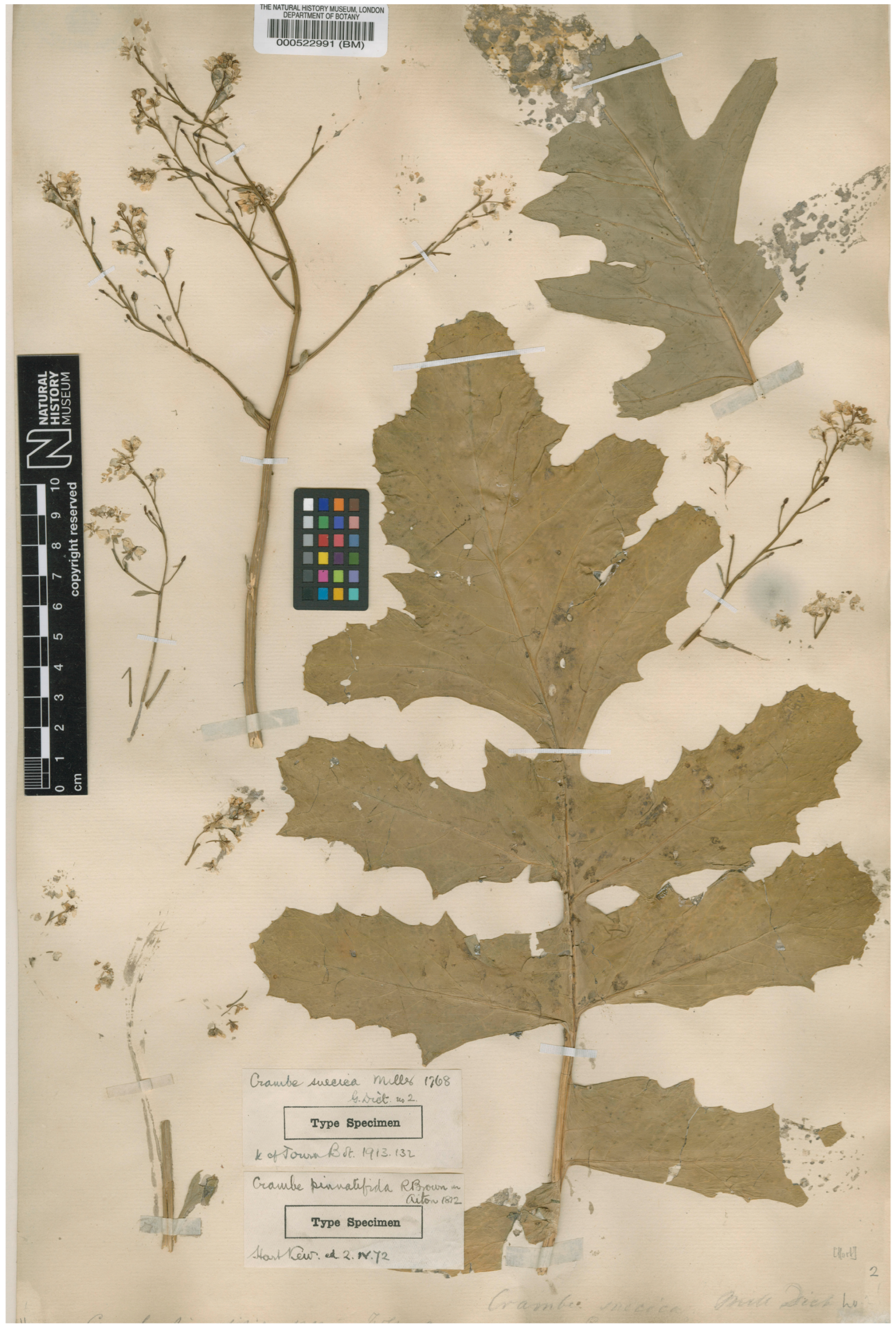
The herbarium sheet (Figure 1) contains two well-preserved leaf fragments and four inflorescence fragments in poor condition. The larger leaf, probably a basal one, is deeply pinnatifid, with oblong serrate-dentate lobes, while the smaller one, probably a stem leaf, is slightly pinnately lobed. The best-preserved inflorescence fragment, at the top left of the sheet, is of the late anthesis stage. The generative structures observable on the specimen include loosely flowered racemes with pedicels being suberect to loosely appressed to the axis of racemes, and petals ca. 4.5–5 mm long in dry state. No fruits, even immature ones, are developed.

3.3. Protologue of Crambe pinnatifida

The species Crambe pinnatifida was described as new to science in an early catalogue of vascular plants cultivated in the Royal Botanic Gardens at Kew [32]. The new species was therefore established on the basis of locally cultivated plants.
The species described at Kew was characterised by pinnatifid leaves with oblong dentate lobes; the leaves and the stem were described as glabrous [32]. This description agrees with the plants of C. suecica described by Miller [29]. As the original publication (protologue) of C. pinnatifida included a direct reference to Miller’s C. suecica (this species name was cited in synonymy with a reference to the original publication), the species name C. pinnatifida is a nomenclaturally superfluous, illegitimate replacement of C. suecica, which is formally based on the type of the latter species name [33].
In addition, a reference to a brief description and illustration of “Crambe orientalis” by N.J. Jacquin [41] was included in the protologue. This reference may have served for the species’ interpretation but has no bearing on its formal nomenclature and typification.

3.4. Formal Nomenclature of Crambe suecica
Crambe orientalis var. glaberrima (Bornm.) O.E.Schulz in Engler, Pflanzenreich 70: 239 (1919) ≡ Crambe persica var. glaberrima Bornm. in Bull. Herb. Boiss., ser. 2, 5: 56 (1905) ≡ Crambe glaberrima (Bornm.) Mouterde, Nouv. Fl. Liban & Syrie 2: 121 (1970).
Lectotype (designated here): Iran. “Persia borealis: in valle Scheheristanek [Shahrestanak] montium Elburs, c. 2200 m.s.m.”, 5 June 1902, J. & A. Bornmüller 6305 (LE, isolectotypes JE00006053, JE00006054).
= Crambe suecica Mill., Gard. Dict., ed. 8, Crambe no. 2 (1768), syn. nov.Crambe pinnatifida W.T.Aiton, Hort. Kew., ed. 2, 4: 72 (1812), nom. illeg. superfl. ≡ Crambe maritima var. pinnatifida Alef., Landw. Fl.: 257 (1866) ≡ Crambe maritima subsp. pinnatifida Schmalh., Fl. Sredn. Yuzhn. Rossii 1: 83 (1895) ≡ Crambe maritima var. suecica (Mill.) O.E.Schulz in Engler, Pflanzenreich 70: 231 (1919).
Lectotype (designated here): [Cultivated in Chelsea Physic Garden in London, United Kingdom] (BM000522991).
Figure 1. Lectotype of Crambe suecica Mill. Image source: https://data.nhm.ac.uk/object/041e61e7-156b-46ce-a20d-96b4f4a941e1/1760005475174 (accessed on 25 December 2025). Licensed under CC-BY-4.0 (https://creativecommons.org/licenses/by/4.0) (accessed on 25 December 2025).
Taxonomy 06 00014 g001
The lectotype of Crambe persica var. glaberrima Bornm. was ineffectively designated by Prina [30] because of the lack of the phrase “designated here”, which has been required since 2001 [33]. For this reason, the lectotypification is formally effected here.
The lectotype of Crambe suecica Mill. is the only specimen in existence that is associated with the protologue. It fully agrees with the original description in its diagnostic characters (deeply laciniate, glabrous leaves with acute dentation; large, branched inflorescence). The lectotype specimen is annotated as “type” curatorially.

4. Discussion

4.1. Taxonomic System of Crambe in Eastern Europe and the Caucasus
The first complete monographic revision of the genus Crambe was published by Khalilov [42]. In this system, two main taxonomic groups were established for Eastern Europe and the Caucasus: C. sect. Crambe with large upper fruit segments and C. sect. Orientecrambe I.I.Khalilov with small upper fruit segments. These groups received some support from the molecular phylogeny [43,44], albeit with considerable limitations regarding the sampling density and incongruent phylogenetic signal from different markers, so that the phylogenetic position of certain taxa (the C. cordifolia group: C. cordifolia Steven, C. kotschyana Boiss.) remain uncertain. The latest inventory and taxonomic system of Crambe in Eastern Europe and the Caucasus was provided by Dorofeev [34,35], who updated the species distributions.
According to our critical revision of the previous taxonomic treatments [30,34,35,42], the following species groups can be noted in Eastern Europe and the Caucasus. Crambe sect. Crambe includes C. maritima L. with glabrous stems and glabrous, shallowly lobate leaves; C. pinnatifida with glabrous stems and nearly glabrous, prominently dissected leaves; C. tataria s.l. (C. aspera M.Bieb., C. gibberosa Rupr., C. litwinowii K.Gross, C. tataria Sebeók) with smaller upper fruit segments and very narrowly dissected leaves, which are variously hairy; and C. grandiflora s.l. (C. grandiflora DC., C. steveniana Rupr.) with larger upper fruit segments and broader dissections of leaves, which are nearly glabrous. In all these species, the leaf lobes are broadly dentate or untoothed.
Crambe sect. Orientecrambe is comprised solely by the C. orientalis group. The taxonomic complexity of this group has led researchers to radically different opinions: Hedge [45] combined its whole diversity into a single polymorphic species, whereas other researchers recognised a variable number of segregate taxa. The most detailed revisions [34,35,42] separated the taxa with the basal leaves shortly and evenly pubescent (C. orientalis L. s.str.), or with longer sparse hairs (C. juncea M.Bieb., C. koktebelica N.Busch, C. mitridatis Juz.), or bristles (C. aculeolata (N.Busch) Czerniak.), or totally glabrous (C. armena N.Busch, C. orientalis var. glaberrima). Similar taxa may be distinguished by the size of petals (e.g., larger in C. juncea and smaller in C. grossheimii I.I.Khalilov) or fruits (larger in C. koktebelica, smaller in C. mitridatis).
The plants belonging to the C. orientalis group occur in Eastern Europe only in the Crimea, except for recent casual alien occurrences in the central part of European Russia [35]. Its distribution in the Caucasus is broad, covering the whole of Transcaucasia, with a small area in the Russian North Caucasus and adjacent plains [34]. The large distribution fragment in Central Asia (Kazakhstan, Kyrgyzstan, Uzbekistan) resulted from multiple human introductions during the 20th century [46,47].
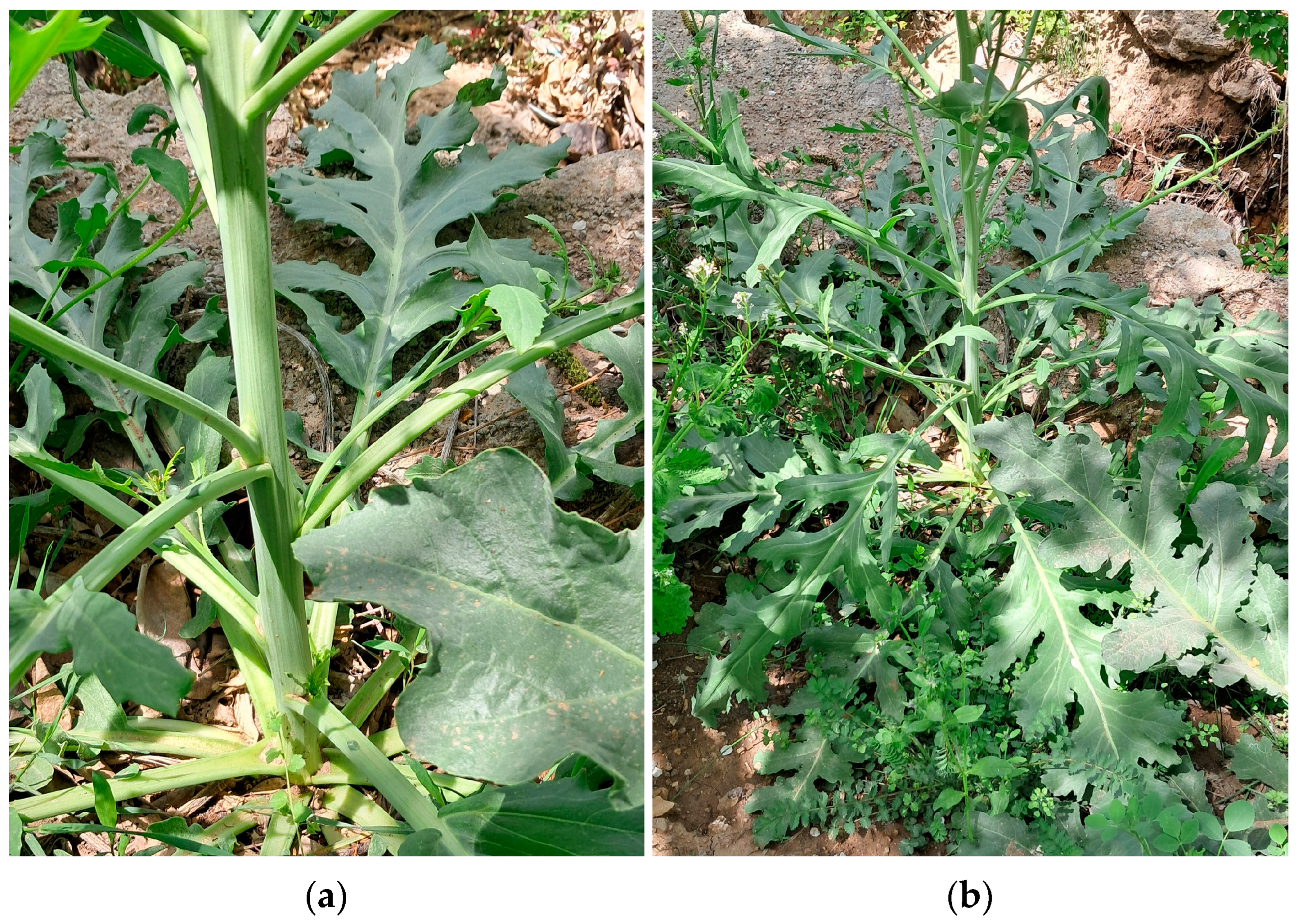
There are three taxa of this group whose basal leaves are totally glabrous or nearly so, like in C. suecica. Crambe armena has a limited distribution in Central Transcaucasia and is associated with inland saline habitats; it is characterised by small, lyrately dissected leaves [48]. Crambe orientalis is widespread in Transcaucasia, Iran, Turkey and the Near East; in the Alborz Mts., this species has a glabrous variety, C. orientalis var. glaberrima (Figure 2), which co-occurs with the type variant [49]. This white-flowered variety was incorrectly synonymised with the yellow-flowered C. orientalis subsp. sulphurea (Stapf ex O.E.Schulz) Prina [30]. One more nearly glabrous taxon with a narrowly restricted distribution, C. tchalenkoae Popovich & Zernov, has been recently described from north-western Transcaucasia [50].
Figure 2. Crambe orientalis var. glaberrima (Bornm.) O.E.Schulz in Veskāreh, Tehran Province, Iran: (a) Glabrous stem base; (b) glabrous basal leaves. Image source: https://www.inaturalist.org/observations/225138725 (accessed on 1 June 2025). Licensed under CC-BY-4.0 (https://creativecommons.org/licenses/by/4.0) (accessed on 1 June 2025).
Taxonomy 06 00014 g002

4.2. Taxonomic Position of Crambe suecica

Miller [29] provided no particular information on fruits of Crambe suecica, only alluding to its similarity with C. maritima, and the fruit characters cannot be inferred from his herbarium material. However, all the major classifications and identification keys [30,42] used the fruit shape and size as the only diagnostic characters for the primary subdivision of C. sect. Crambe. Without fruit characters in the original material, C. suecica remained taxonomically unassessed [30]. In the absence of such characters available for C. suecica, we shall use other features to infer its taxonomic position (Table 1).
The leaves of C. suecica are very broadly lobate, dissected to the rachis. Among the C. maritima group (C. sect. Crambe), this character immediately excludes many species with narrowly dissected leaves (C. grandiflora DC. s.l., C. tataria s.l.) and subentire to broadly sinuate leaves (C. maritima) [30,42]. The only species from Eastern Europe and the Caucasus with broadly lobate leaves is C. pinnatifida, but the basal leaves in the latter species are pinnately lobed rather than pinnatipartite (usually not divided up to the rachis), with oblong to linear lobes and broad to indistinct dentation (vs. broad subentire lobes and serrate dentation). We conclude that C. suecica is not a member of the C. maritima group.
Among the C. orientalis group, C. suecica fits well due to its broadly dissected leaves and serrate dentation. The inflorescence of C. suecica agrees with the characters of the C. orientalis group because of the elongated slender branches with sparsely situated flowers and pedicels suberect to appressed to the axis of racemes. The whole complex of vegetative and generative characters of C. suecica indicates its taxonomic position in the C. orientalis group.
Among the glabrous-leaved taxa of the C. orientalis group, C. armena can be excluded from comparisons because of the different leaf shape (lyrate in C. armena vs. pinnatisect in C. suecica). Two other taxa have (nearly) glabrous pinnatisect leaves, which are similar to those of C. suecica: C. tchalenkoae, a recently described narrow endemic of the north-western Transcaucasia with sparsely ciliate leaves, and C. orientalis var. glaberrima, totally glabrous plants described from northern Iran. The latter taxon matches the morphology of C. suecica without disagreements.

4.3. Geographic Origin of Crambe suecica

As this species was described from cultivation, its seed provenance (Saint Petersburg) was indicated in place of its native origin. Misleadingly, the plant was named “suecica”, apparently alluding to its presumed native occurrence along the Baltic Sea shores, but the only Crambe species known from that area is C. maritima [30], which is strikingly dissimilar from C. suecica in its leaf morphology.
Regarding the actual origin of C. suecica, only two facts are known with certainty: its seeds were received from Saint Petersburg and the plant was in cultivation by 1759. Nevertheless, this scarce information dramatically narrows our search for the seed source because the history of mid-18th-century botany in the Russian Empire is relatively well known [51,52]. Moreover, the territory accessible to botanists in Russian government service was rather limited because, in those times prior to the conquest of the Crimean Khanate by Catherine the Great and the re-conquest of the Caucasus and Transcaucasia during the first third of the 19th century, the country’s borders did not include the southern arid mountains with neighbouring steppes, and foreign travels were extremely difficult to organise because of the constant political hostilities.
Among the territories in which representatives of the C. orientalis group occur, the Crimea was not freely accessible to botanists because it was governed by the Crimean Khanate, which remained in constant wars with the Russian Empire until the latter took control over the Crimea with the Treaty of Küçük Kaynarca in 1774 and subsequently annexed the peninsula in 1783. Moreover, the only glabrous-leaved Crambe in the Crimea is C. pinnatifida, which readily differs from C. suecica in its leaves, with broadly acute teeth (vs. narrowly attenuate teeth in C. suecica).
Karavaev [51] noted that, in the first half of the 18th century, the academic botanical garden in Saint Petersburg already possessed numerous plant species from the Don River, Caspian Sea, Siberia and Persia, which potentially included a species of Crambe known from this vast area. We shall examine the activities of all early botanists in Russia who might have had a chance to collect plants in Transcaucasia and northern Iran.
Gottlieb Schober (1670–1739), a medical doctor from Saxonia, was the first naturalist in Russian service who visited the Caucasus. From 1717 to 1720, Schober was directed to explore the prospected medical use of hot springs in the North Caucasus [53], and travelled as far as the northern and north-western shores of the Caspian Sea. He collected and distributed seeds and herbarium specimens [52], but did not visit the distribution area of C. orientalis s.l. A reference that Schober participated in the Russian diplomatic mission to Persia, which was headed by Colonel Artemy P. Volynski from 1715 to 1718, and collected plants in the Gilan and Mazandaran provinces of Iran [54] is unsubstantiated, because Schober was not included in the staff of the mission [55]. Instead, John Bell (1691–1780), a medical doctor of Scottish origin, was involved in the mission but his botanical activities have never been mentioned in the literature.
Johann Christian Buxbaum (1693–1730), a prominent Saxonian physician and naturalist, was invited to Saint Petersburg by Peter the Great as the first Russian academic botanist [56]. During 1724–1727, Buxbaum was dispatched to Constantinople (Istanbul) with Count Alexander I. Rumiantsev (envoy plenipotentiary for ratification of the Treaty of Constantinople) and travelled extensively across the Ottoman Empire, through Greece, and then Asia Minor and the Caucasus up to the contemporary Russian–Persian border (including the territories occupied by Peter the Great during 1722–1723, together with the Gilan, Mazandaran and Astrabad [Golistan] provinces of Iran), then back via Baku, Derbent and Astrakhan [57]. During these travels, Buxbaum visited the vast mountainous territories in present-day Azerbaijan and northern Iran, where C. orientalis is known to occur [45,58]. As the founder and director of the academic botanical garden in Saint Petersburg, Buxbaum was especially interested in procuring seeds for garden cultivation. His rich collections and manuscripts were delivered to the Academy of Sciences in Saint Petersburg [56].
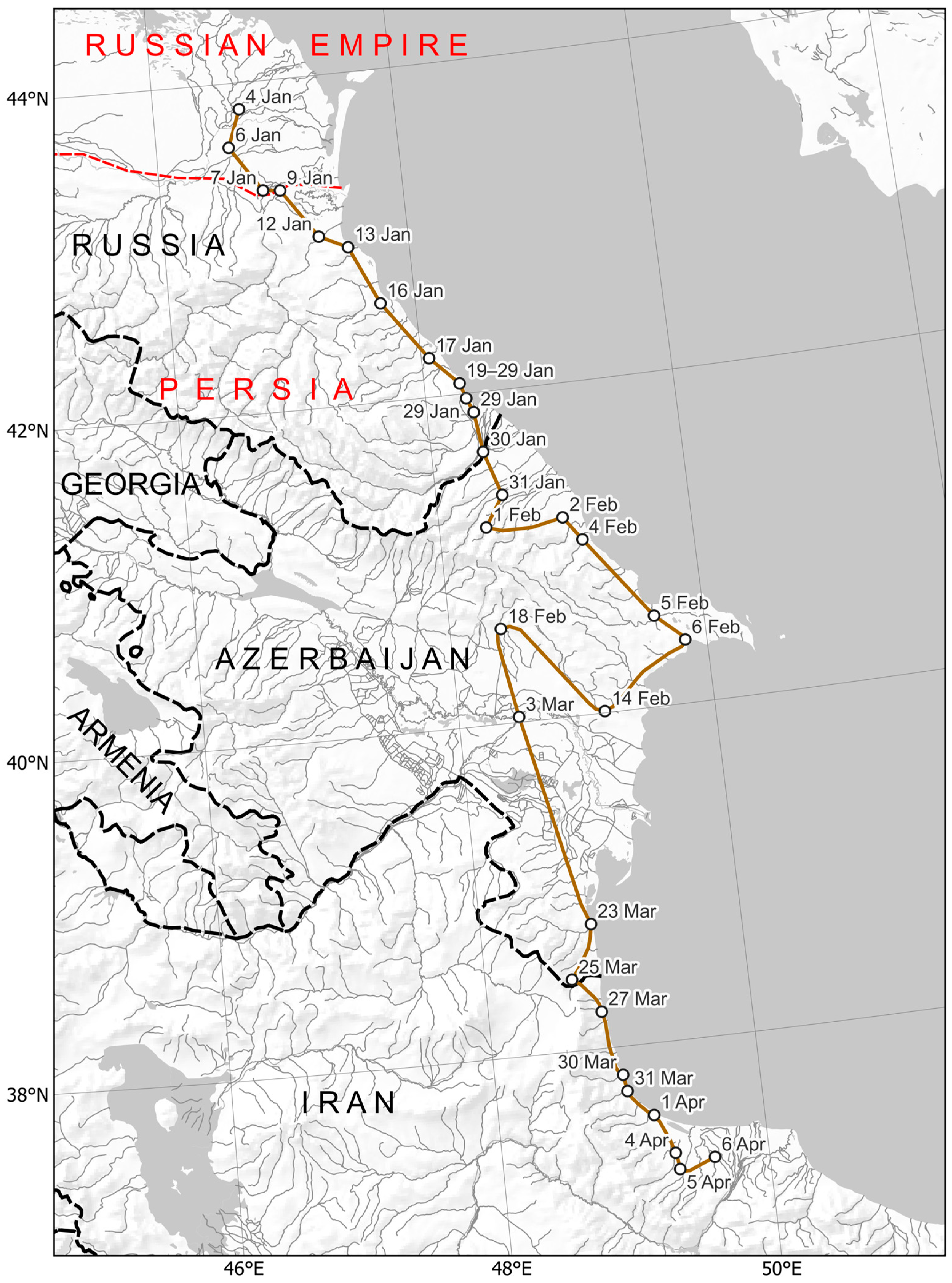
According to the Treaty of Ganja, concluded in 1735, the border between the Russian Empire and the Persian (Safavid) Empire was established along the Sulak River (now in Daghestan Republic, Russia). In this treaty, Russia returned large territories in the Caucasus and Transcaucasia, which had been conquered by Peter the Great in 1723. Johann Jakob Lerche (1708–1780), a Prussian medical doctor who served in the Russian army as a staff physician, was included in the Russian diplomatic mission to Persia during 1745–1748, which was headed by Prince Mikhail M. Golitsyn (younger). Lerche travelled with the mission along the Caspian Sea to Rasht (and returned back by sea); on his way, he collected seeds and specimens [51,52] but did not see C. orientalis because his route (Figure 3) avoided the areas of its occurrence in Azerbaijan and Iran [45,58]. This conclusion is confirmed by the lack of mentions of any Crambe in Lerche’s botanical observations [59].
While the current taxonomic knowledge indicates that “C. suecica” (i.e., C. orientalis var. glaberrima) is distributed in northern Iran and, probably, the neighbouring areas of Azerbaijan, the historical evidence suggests that such plants were collected for cultivation in the academic botanical garden in Saint Petersburg during the early Russian exploration of the Caspian Sea region, most likely by J.C. Buxbaum in 1726.

4.4. Taxonomic Identities of Crambe pinnatifida
The nomenclatural illegitimacy of Crambe pinnatifida has been completely neglected, as evident from the currently common use of this species name in taxonomic revisions [30,34,35,42], synoptic checklists [60] and taxonomic databases [31,61]. No researchers have examined the original material (designated lectotype) of C. suecica, which establishes the nomenclatural identity of C. pinnatifida, and this fact has caused considerable confusion in the taxonomy of Crambe.
Figure 3. Travel route (solid brown line) of Johann Jakob Lerche in the Transcaucasia in 1747. Contemporary country borders are red dashed lines; current country borders are black dashed lines. Contemporary country names are in red font; current country names are in black font. Travel points and dates are based on Lerche’s memoires [62] and were digitised by the authors (Table S1).
Taxonomy 06 00014 g003
Due to the neglect of C. suecica and the practical unavailability of its original material, the taxonomic identity of C. pinnatifida has been historically determined by interpretations of its protologue [32]. However, the information provided in the protologue appears to be most controversial and completely unreliable because of the highly eclectic composition of the original sources, from which the protologue was compiled, and which were largely misinterpreted.
To start with, the protologue [32] states that the plant is a “native of Siberia”. This statement is puzzling as we know that no species of Crambe is native to Siberia [42]. It can be explained from the context of 18th-century botany, when Siberian plants were considered especially valuable and actively sought after by Linnaeus, and academic circles in Saint Petersburg were the main provider of Siberian seeds and herbarium specimens to Europe [16]. This legendary provenance has not been taken seriously by subsequent researchers.
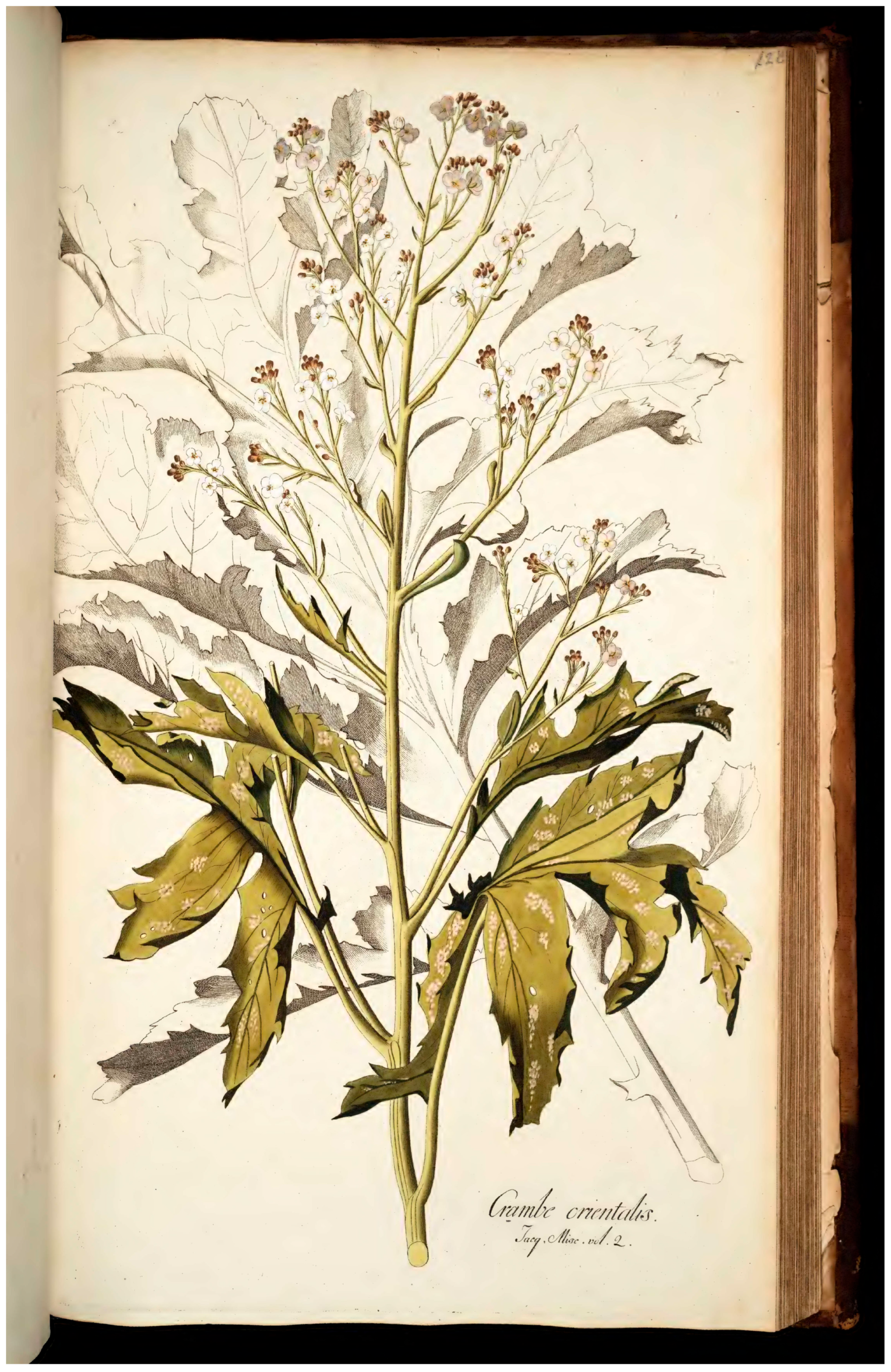
Neglecting Miller’s work [29], which was another garden source without a certain provenance that was mentioned in the protologue, researchers based their interpretations on the high-quality illustration of “Crambe orientalis” (Figure 4) provided by Jacquin [41], which was cited in the protologue of C. pinnatifida. This reference is taxonomic rather than nomenclatural because Jacquin [41] published no new taxon; instead, he re-described and illustrated a previously known species (i.e., C. orientalis).
Figure 4. A copper engraving of “Crambe orientalis” originally published as Table 128 in Jacquin’s Icones plantarum rariorum [41]. Courtesy: Missouri Botanical Garden. Public domain image, no copyright.
Taxonomy 06 00014 g004
This illustration was based on a plant cultivated in the botanical garden of Vienna University [63]. Jacquin stated that the native provenance of this garden cultivation was Buda, according to the personal communication of J.A.J. Winterl, who was a professor at the Royal University of Buda (now Eötvös Loránd University, Budapest, Hungary) and a founder of its botanical garden. This information provided the basis for later assumptions that C. pinnatifida was described from Hungary and occurred in this country [34,64,65,66]. Nevertheless, Busch [67] clearly doubted the presence of this species in Hungary, and current knowledge indicates that C. tataria is the only species of the genus occurring in Hungary [68].
The leaves of “Crambe orientalis”, which were illustrated [41] and described [63] by Jacquin, are apparently dissimilar to those of C. tataria. These leaves are dissected almost to the rachis, with broadly oblong lobes and coarse, attenuate teeth. Such a shape unambiguously rejects the placement of this plant in the C. maritima group, but suggests its belonging to the C. orientalis group. The leaves were described as pubescent along the main nerves [63], thus matching the characters of C. juncea rather than C. orientalis s.str. [65,66,67]. These leaves are superficially similar to those of C. pinnatifida in the Russian literature [65,66,67], and this similarity determined the application of this species name to a species occurring in the Crimea and north-western Caucasus. This superficial similarity is nevertheless misleading, as the plant described by Jacquin clearly differs from the species in the Russian literature in its leaf dentation. Moreover, its flowered racemes are lax, with pedicels being suberect to loosely appressed to the axis, unlike in C. pinnatifida in the Russian literature [65,66,67]. This means that the name C. pinnatifida has been misapplied to this species.
There are two infraspecific combinations which were based on the name C. pinnatifida. Alefeld [69] recognised a variety of C. maritima, which he clearly linked with the species name C. pinnatifida and the illustration published by Jacquin; the taxonomic circumscription of this variety was broad and very vague as it was solely based on the literature sources [32,64]. Schmalhausen [70] accepted this taxon for a subspecies of C. maritima, which he distinguished by pinnatifid or bipinnatifid leaves with occasional pubescence along the leaf nerves. Although this subspecies name was misapplied to some other species, it is to be treated as nomenclaturally based on the type of C. pinnatifida and, ultimately, the type of C. suecica, which was not excluded by Schmalhausen when he published his new combination.
On the other hand, Schulz [71], who recognised C. tataria var. pinnatifida O.E.Schulz in present-day Hungary and Romania, placed the nomenclatural type of C. pinnatifida into a separate taxon, C. maritima var. suecica, although he misapplied the latter name to a lobed-leaved variant of C. maritima. By doing so, he published a legitimate varietal name, which is nomenclaturally independent from C. pinnatifida and belongs to the synonymy of C. tataria. The identity and synonymisation of this varietal name will be considered in our forthcoming work, dealing with the disentangling of the taxonomical confusion around “Crambe pinnatifida” in Eastern Europe and the North Caucasus [38].

5. Conclusions

New taxa established on the basis of historical garden cultivation create a real challenge in botanical nomenclature [72]. When the provenance was not indicated in the original publication, special effort may be required to uncover the historical background, which may eventually lead to the revelation of the collection area, or even some (if not all) characteristics of the original information (collection locality, collection date and collector). This information may be critically important in unveiling the current taxonomic identity of historical materials (herbarium specimens and illustrations), which served as the basis for scientific descriptions of new taxa and whose identity (as type material) can establish the precise application of plant names. Neglecting the historical background may lead to a long-standing obscurity of some plant species names or, even worse, to their gross misinterpretations, causing nomenclatural instability and taxonomic chaos.
Crambe suecica has been a long-standing source of trouble in the taxonomic literature. This obscure species name is very old and therefore threatens nomenclatural stability in the genus because of being potentially applicable to some of the currently accepted taxa. Our examination of the morphology and botanical history of this plant strongly suggests that the species described by Miller does not belong to a Swedish taxon but originated from northern Iran. It belongs to C. orientalis var. glaberrima, a glabrous variant of this otherwise densely hairy-leaved species. The species name C. suecica can be synonymised with the latter variety without any nomenclatural disruption. On the other hand, the species name C. pinnatifida is illegitimate because of the nomenclatural inclusion of C. suecica, and has been misapplied to a species occurring in the Crimea and north-western Caucasus. Its taxonomic identity and correct nomenclature will be resolved in a dedicated publication.

Supplementary Materials

The following supporting information can be downloaded at: https://www.mdpi.com/article/10.3390/taxonomy6010014/s1, Table S1: Travel route of Johann Jakob Lerche in Transcaucasia in 1747.

Author Contributions

Conceptualisation, A.S.; methodology, A.S.; investigation, A.S. and S.S.; resources, A.S.; writing—original draft preparation, A.S.; writing—review and editing, A.S. and S.S.; supervision, A.S.; project administration, A.S. All authors have read and agreed to the published version of the manuscript.

Funding

This research received no external funding.

Data Availability Statement

The data are available within the text.

Acknowledgments

This study was carried out within the project ‘Flora, vegetation and natural habitats of Bulgaria and the Balkan Peninsula’ of the Institute of Biodiversity and Ecosystem Research, Bulgarian Academy of Sciences. Sampsa Lommi (Helsinki) is warmly thanked for the map design.

Conflicts of Interest

The authors declare no conflicts of interest.

References

  1. Peruzzi, L. Some claim for the end of Botany… but what is Botany today? Ital. Bot. 2025, 19, 15–20. [Google Scholar] [CrossRef]
  2. Rakow, D.A.; Lee, S.A. Western botanical gardens: History and evolution. Hortic. Rev. 2015, 43, 269–310. [Google Scholar]
  3. Chen, J.-H. Everlasting Flowers Between the Pages: Forms of Knowledge and the Making of Seventeenth-Century Florilegia; University of Utrecht: Utrecht, The Netherlands, 2023; ISBN 978-90-04-73513-2. [Google Scholar]
  4. Barker, N. Hortus Eystettensis: The Bishop’s Garden and Besler’s Magnificent Book; H.N. Abrams: New York, NY, USA, 1994; ISBN 978-0-8109-3424-5. [Google Scholar]
  5. Colangelo, G.; Offerhaus, A.; van Andel, T.; Stefanaki, A. How the wild tulip (Tulipa sylvestris L.) found its way in Northern Europe in the 17th to 19th century: A search through historical gardens and archives. Bot. Lett. 2025, 172, 283–301. [Google Scholar] [CrossRef]
  6. Lambdon, P.W.; Pyšek, P.; Basnou, C.; Hejda, M.; Arianoutsou, M.; Essl, F.; Jarošík, V.; Pergl, J.; Winter, M.; Anastasiu, P.; et al. Alien flora of Europe: Species diversity, temporal trends, geographical patterns and research needs. Preslia 2008, 80, 101–149. [Google Scholar]
  7. Galera, H.; Sudnik-Wójcikowska, B. Central European botanic gardens as centres of dispersal of alien plants. Acta Soc. Bot. Pol. 2010, 79, 147–156. [Google Scholar] [CrossRef]
  8. Sennikov, A.N.; Kurtto, A. The taxonomy and invasion status assessment of Erigeron annuus s.l. (Asteraceae) in East Fennoscandia. Memo. Soc. Fauna Fl. Fenn. 2019, 95, 40–59. [Google Scholar]
  9. Linnaeus, C. Hortus Cliffortianus: Plantas Exhibens quas in Hortis tam Vivis Quam Siccis, Hartecampi in Hollandia; Privately Published: Amsterdam, The Netherlands, 1738. [Google Scholar] [CrossRef]
  10. Linnaeus, C. Genera Plantarum; C. Wishoff: Leiden, The Netherlands, 1737. [Google Scholar]
  11. Linnaeus, C. Species Plantarum; L. Salvius: Stockholm, Sweden, 1753. [Google Scholar]
  12. Stafleu, F.A. Linnaeus and the Linnaeans: The Spreading of THEIR Ideas in Systematic Botany, 1735–1789; Oosthoek: Utrecht, The Netherlands, 1971; ISBN 90-6046-064-2. [Google Scholar]
  13. Jarvis, C. Order out of Chaos. Linnean Plant Names and Their Types; The Linnean Society of London & the Natural History Museum: London, UK, 2007; ISBN 978-0-9506207-7-0. [Google Scholar]
  14. Linnaeus, C. Hortus Upsaliensis L.; Salvius: Stockholm, Sweden, 1748. [Google Scholar]
  15. Rowell, M. Linnaeus and botanists in eighteenth-century Russia. Taxon 1980, 29, 15–26. [Google Scholar] [CrossRef]
  16. Bryce, W.J. A Botanist’s Paradise: The Establishment of Scientific Botany in Russia in the Eighteenth Century; W.J. Bryce: Sketty Swansea, UK, 2008; ISBN 978-0-9560-3580-6. [Google Scholar]
  17. Fischer von Waldheim, A.A. (Ed.) Imperial Botanical Garden in Saint Petersburg During Its 200 Years (1713–1913); Imperial Botanical Garden: Saint Petersburg, Russian Empire, 1913. (In Russian) [Google Scholar]
  18. Shetler, S.G. The Komarov Botanical Institute: 250 Years of Russian Research; Smithsonian Institution Press: Washington, DC, USA, 1967. [Google Scholar] [CrossRef]
  19. Sennikov, A.N. The history and nomenclatural significance of herbarium collections made by Alexander A. Tatarinow in North China and Mongolia in 1841–1850. Taxon 2024, 73, 556–572. [Google Scholar] [CrossRef]
  20. Verloove, F.; Sennikov, A.N.; Reyes-Betancort, J.A. Taxonomy and nomenclature of Abutilon albidum (Malvaceae, Malvoideae), a cryptic Saharo-Canarian species recently rediscovered in Tenerife. PhytoKeys 2023, 221, 41–60. [Google Scholar] [CrossRef]
  21. Smith, G.; Figueiredo, E. Out with the old, in with the new? Historical names recorded in Agave L. (Agavaceae/Asparagaceae). Bradleya 2014, 32, 64–69. [Google Scholar] [CrossRef]
  22. Smith, G.; Klopper, R.R.; Figueiredo, E.; Crouch, N.R.; Barkworth, M.E. A note on four historical names recorded in Aloe L. (Asphodelaceae: Alooideae). Bradleya 2013, 31, 128–132. [Google Scholar] [CrossRef][Green Version]
  23. Calonje, M.; Sennikov, A.N. In the process of saving plant names from oblivion: The revised nomenclature of Ceratozamia fuscoviridis (Zamiaceae). Taxon 2017, 66, 158–164. [Google Scholar] [CrossRef]
  24. Sennikov, A.N.; Khassanov, F.O.; Lazkov, G.A. The nomenclatural history of Iris orchioides (Iridaceae). Memo. Soc. Fauna Fl. Fenn. 2022, 98, 1–8. [Google Scholar]
  25. Lazkov, G.A.; Sennikov, A.N. Taxonomy of two blue-flowered juno irises (Iris subgen. Scorpiris, Iridaceae) from the Western Tian-Shan. Ann. Bot. Fennici 2017, 54, 297–305. [Google Scholar] [CrossRef]
  26. Govaerts, R.; Nic Lughadha, E.; Black, N.; Turner, R.; Paton, A. The World Checklist of Vascular Plants, a continuously updated resource for exploring global plant diversity. Sci. Data 2021, 8, e215. [Google Scholar] [CrossRef] [PubMed]
  27. Schellenberger Costa, D.; Boehnisch, G.; Freiberg, M.; Govaerts, R.; Grenié, M.; Hassler, M.; Kattge, J.; Muellner-Riehl, A.N.; Rojas Andrés, B.M.; Winter, M.; et al. The big four of plant taxonomy—A comparison of global checklists of vascular plant names. New Phytol. 2023, 240, 1687–1702. [Google Scholar] [CrossRef]
  28. Le Rougetel, H. The Chelsea Gardener: Philip Miller, 1691–1771; Natural History Museum Publications: London, UK, 1990; ISBN 0565011014. [Google Scholar]
  29. Miller, P. Gardener’s Dictionary, 8th ed.; Printed for the Author: London, UK, 1768. [Google Scholar]
  30. Prina, A. Taxonomic review of the genus Crambe sect. Crambe (Brassicaceae, Brassiceae). An. Jard. Bot. Madr. 2009, 66, 7–24. [Google Scholar] [CrossRef][Green Version]
  31. POWO. Plants of the World Online. Facilitated by the Royal Botanic Gardens, Kew. Available online: https://powo.science.kew.org/ (accessed on 3 May 2025).
  32. Aiton, W.T. Hortus Kewensis, 2nd ed.; Longman, Hurst, Rees, Orme & Brown: London, UK, 1812; Volume 4. [Google Scholar]
  33. Turland, N.J.; Wiersema, J.H.; Barrie, F.R.; Gandhi, K.N.; Gravendyck, J.; Greuter, W.; Hawksworth, D.L.; Herendeen, P.S.; Klopper, R.R.; Knapp, S.; et al. (Eds.) International Code of Nomenclature for Algae, Fungi, and Plants (Madrid Code); Regnum Vegetabile 162; University of Chicago Press: Chicago, IL, USA, 2025. [Google Scholar]
  34. Dorofeev, V.I. Brassicaceae Burnett. In Caucasian flora Conspectus; Takhtajan, A.L., Ed.; KMK Scientific Press: Moscow, Russia; Saint Petersburg, Russia, 2012; Volume 3, part 2; pp. 371–469. (In Russian) [Google Scholar]
  35. Dorofeev, V.I. Brassicaceae Burnett. In Conspectus florae Europae Orientalis; Tzvelev, N.N., Ed.; KMK Scientific Press: Moscow, Russia; Saint Petersburg, Russia, 2012; Volume 1, pp. 364–437. (In Russian) [Google Scholar]
  36. De Natale, A.; Cellinese, N. Imperato, Cirillo, and a series of unfortunate events: A novel approach to assess the unknown provenance of historical herbarium specimens. Taxon 2009, 58, 963–970. [Google Scholar] [CrossRef]
  37. Bryce, W.J. Russian collections in the Sloane Herbarium. Arch. Nat. Hist. 2005, 32, 26–33. [Google Scholar] [CrossRef]
  38. Stoyanov, S.; Sennikov, A.N. Taxonomic evaluation of the illegitimate and ill-defined Crambe pinnatifida (Brassicaceae), with new synonymy and the description of C. euxina, a new species of the northern Pontic distribution. Nordic J. Bot. 2026; submitted. [Google Scholar]
  39. Miller, P. Gardener’s Dictionary, 7th ed.; Printed for the Author: London, UK, 1759. [Google Scholar]
  40. Natural History Museum. Crambe pinnatifida R.Br. (from Collection Specimens) [Photograph]. Natural History Museum. Available online: https://data.nhm.ac.uk/object/041e61e7-156b-46ce-a20d-96b4f4a941e1/1760005475174 (accessed on 25 December 2025).
  41. Jacquin, N.J. Icones Plantarum Rariorum; Wappler: Wien, Austria; B. White et Filium: London, UK; S. et J. Luchtmans: Leiden, The Netherlands; A. König: Strasbourg, France, 1784; Volume 1. [Google Scholar]
  42. Khalilov, I.I. A synopsis of the genus Crambe (Braccicaceae). Bot. Zhurn. 1993, 78, 107–115. (In Russian) [Google Scholar]
  43. Francisco-Ortega, J.; Fuertes-Aguilar, J.; Gómez-Campo, C.; Santos-Guerra, A.; Jansen, R.K. Internal transcribed spacer sequence phylogeny of Crambe L. (Brassicaceae): Molecular data reveal two Old World disjunctions. Mol. Phylogenet. Evol. 1999, 11, 361–380. [Google Scholar] [CrossRef]
  44. Hacioğlu, B.T.; Özgişi, K. Haplotype diversity and molecular phylogeny of wild Crambe L. (Brassicaceae) taxa of Turkey. Turk. J. Bot. 2023, 47, 278–290. [Google Scholar] [CrossRef]
  45. Hedge, I. Cruciferae–Brassiceae. In Flora Iranica; Rechinger, K.H., Ed.; Akademische Druck- u. Verlagsanstalt: Graz, Austria, 1968; Volume 57, pp. 33–62. [Google Scholar]
  46. Sennikov, A.N.; Lazkov, G.A. Alien plants of Kyrgyzstan: The first complete inventory, distributions and main patterns. Plants 2024, 13, 286. [Google Scholar] [CrossRef] [PubMed]
  47. Sennikov, A.N.; Lazkov, G.A.; German, D.A. The first checklist of alien vascular plants of Kyrgyzstan, with new records and critical evaluation of earlier data. Contribution 3. Biodivers. Data J. 2025, 13, e145624. [Google Scholar] [CrossRef] [PubMed]
  48. Busch, N.A. Cruciferae asiaticae novae. Vĕstn. Tiflissk. Bot. Sada Nov. Ser. 1927, 3–4, 1–12. (In Russian) [Google Scholar]
  49. Bornmüller, J. Beiträge zur Flora der Elbursgebirge Nord-Persiens. Bull. Herbier Boissier 2 Ser. 1905, 5, 49–57. [Google Scholar]
  50. Popovich, A.V.; Zernov, A.S. A new nothospecies of Crambe L. (Cruciferae) from the North-Western Transcaucasia. Turczaninowia 2019, 22, 155–163. [Google Scholar] [CrossRef]
  51. Karavaev, M.N. At the sources of floristics and herbarium art in Russia (according to the materials of the Moscow University Herbarium). Byull. Mosk. Obshch. Ispyt. Prir. Biol. 1981, 86(5), 126–133. (In Russian) [Google Scholar]
  52. Sokoloff, D.D.; Balandin, S.A.; Gubanov, I.A.; Jarvis, C.E.; Majorov, S.R.; Simonov, S.S. The history of botany in Moscow and Russia in the 18th and early 19th centuries in the context of the Linnean Collection at Moscow University. Huntia 2002, 11, 129–191. [Google Scholar]
  53. Polievktov, M.A. European Travellers of 13th–18th centuries in the Caucasus; Academy of Sciences of the USSR: Tiflis, USSR, 1935. (In Russian) [Google Scholar]
  54. Fedtschenko, B.A. The investigators of the flora of Iran. Bot. Zhurn. 1945, 30, 31–43. (In Russian) [Google Scholar]
  55. Bushev, P.P. The Diplomatic Mission of Artemy Volynski to Iran in 1715–1718; Science Publishers: Moscow, USSR, 1978. (In Russian) [Google Scholar]
  56. Lipsky, V.I. Flora of the Caucasus, a Compendium of the Botany in the Caucasus During its 200-Years History, from Tournefort Till the 19th Century; Herold: Saint Petersburg, Russian Empire, 1899. (In Russian) [Google Scholar]
  57. von Richter, W.M. Geschichte der Medicin in Russland; N.S. Wsewolojsky: Moscow, Russian Empire, 1817; Volume 3. [Google Scholar]
  58. Grossheim, A.A. Flora of the Caucasus, 2nd ed.; Academy of Sciences of the USSR: Moscow, USSR; Leningrad, USSR, 1950; Volume 4. (In Russian) [Google Scholar]
  59. Lerche, J.J. Descriptio plantarum quarundam partim minus cognitarum astrachanensium et Persiae provinciarum Caspio Mari adiacentium iuxta methodum sexualem excellentissimi domini archiatri Caroli de Linne, accedit plantarum catalogus istarum regionum cum variis observationibus Io. Iac. Lerche. Nova Acta Phys.-Medica Acad. Caesareae Leopold.-Carol. Naturae Curiosorum 1773, 5, 161–206. [Google Scholar]
  60. Czerepanov, S.K. Vascular Plants of Russia and Adjacent States (the Former USSR); Cambridge University Press: Cambridge, UK; New York, NY, USA; Melbourne, Australia, 1995. [Google Scholar]
  61. Marhold, K. Brassicaceae. Euro+Med PlantBase—The Information Resource for Euro-Mediterranean Plant Diversity. Available online: https://europlusmed.org/ (accessed on 3 May 2025).
  62. Lerche, J.J. Lebens-und Reise-Geschichte, von Ihm Selbst Beschrieben; C. Witwe: Halle, Germany, 1791. [Google Scholar]
  63. Jacquin, N.J. (Ed.) Observationes botanicae. In Miscellanea austriaca ad Botanicam, Chemiam, et Historiam Naturalem Spectantia, cum Figuris; Officina Krausiana: Vienna, Austria, 1781; Volume 2, pp. 292–379. [Google Scholar]
  64. de Candolle, A.P. Regni Vegetabilis Systema Naturale; Treuttel & Würtz: Paris, France, 1821; Volume 2. [Google Scholar]
  65. Czerniakowska, E.G. Crambe L. In Flora of the USSR; Busch, N.A., Ed.; Academy of Sciences of the USSR: Moscow, USSR; Leningrad, USSR, 1939; Volume 8, pp. 474–491. (In Russian) [Google Scholar]
  66. Kotov, M.I. Brassicaceae Burnett. In Flora of the European Part of the USSR; Fedorov, A.A., Ed.; Science Publishers: Leningrad, USSR, 1979; Volume 4, pp. 30–148. (In Russian) [Google Scholar]
  67. Busch, N.A. Cruciferae. In Flora Caucasica Critica; Kuznetsov, N., Busch, N., Fomin, A., Eds.; Mattiesen: Yuriev, Russian Empire, 1908; Volume 3, part 4. (In Russian) [Google Scholar]
  68. Barina, Z. Brassicaceae (Cruciferae). In Új Magyar Füvészkönyv. Magyarország Hajtásos Növényei. Határozókulcsok és Ábrák, 2nd ed.; Király, G., Virók, V., Takács, A., Szmorad, F., Molnár, V.A., Eds.; Aggteleki Nemzeti Park Igazgatóság: Jósvafő, Hungary, 2025; pp. 188–212. [Google Scholar]
  69. Alefeld, F. Landwirthschaftliche Flora: Oder Die Nutzbaren Kultivirten Garten-und Feldgewächse Mitteleuropa’s in Allen Ihren Wilden und Kulturvarietäten für Landwirthe, Gartner, Gartenfreunde und Botaniker Insbesondere für Landwirthschaftliche Lehranstalten; Wiegandt & Hempel: Berlin, Germany, 1866. [Google Scholar]
  70. Schmalhausen, I.F. Flora of Central and Southern Russia, the Crimea and the Caucasus; Saint Vladimir University: Kiev, Russian Empire, 1895; Volume 1. (In Russian) [Google Scholar]
  71. Schulz, O.E. Cruciferae–Brassiceae. Pars prima. Subtribus I. Brassicinae et II. Raphaninae. In Das Pflanzenreich. Regni Vegetabilis Conspectus; Engler, A., Ed.; W. Engelmann: Leipzig, Germany, 1919; Volume 70, pp. 1–290. [Google Scholar]
  72. Lack, H.W. The discovery and naming of Papaver orientale s.l. (Papaveraceae) with notes on its nomenclature and early cultivation. Candollea 2019, 74, 47–64. [Google Scholar] [CrossRef]

Table 1. Morphological comparisons of the Crambe maritima group and C. orientalis group (the diagnostic characters of C. suecica are highlighted in bold). Based on the revisions of Khalilov [42] and Prina [30], with our personal observations.
CharacterCrambe maritima GroupCrambe orientalis Group
Fruits, upper segment4–10 mm in diameter2.5–3(4) mm in diameter
Basal leaves, primary dissectionEntire to shallowly lobate, lobate to narrowly lobate, usually not pinnatisectEntire to broadly lobate or pinnatisect
Basal leaves, secondary dissectionLobes oblong to nearly linear, often further subdividedLobes oblong to broadly oblong, mostly undivided
Basal leaves, dentationMargin undivided or with broad blunt to acute teethOften serrate, with acute-to-acuminate teeth
Inflorescence branchesCompact, rather thickLax, slender
PedicelsPatent to divaricateSuberect to appressed to the axis of racemes
Disclaimer/Publisher’s Note: The statements, opinions and data contained in all publications are solely those of the individual author(s) and contributor(s) and not of MDPI and/or the editor(s). MDPI and/or the editor(s) disclaim responsibility for any injury to people or property resulting from any ideas, methods, instructions or products referred to in the content.