Article

Beneath the Feathers: Hidden Burden of Serratospiculum and Other Endoparasites in Falcons Raised in Captivity in Serbia


1
Department of Forensic Veterinary Medicine, Faculty of Veterinary Medicine, University of Belgrade, 11000 Belgrade, Serbia
2
Department of Parasitology, Faculty of Veterinary Medicine, University of Belgrade, 11000 Belgrade, Serbia
3
Belgrade Zoo Garden, 11000 Belgrade, Serbia
4
Scientific Institute of Veterinary Medicine of Serbia, 11000 Belgrade, Serbia
*
Author to whom correspondence should be addressed.
Birds 2025, 6(4), 63; https://doi.org/10.3390/birds6040063
Submission received: 21 October 2025 / Revised: 21 November 2025 / Accepted: 2 December 2025 / Published: 4 December 2025

Simple Summary

This study represents the first report on parasitic infections in falcons in Serbia, with emphasis on the pathogenic nematode Serratospiculum spp. More than half of the examined birds were infected with endoparasites, predominantly Caryospora spp. The prevalence of infections was significantly reduced in individuals maintained under preventive health management, including routine hygiene and deworming protocols. These results highlight the necessity of implementing preventive strategies as an essential component of falcon health management in captivity and falconry, particularly considering the clinical relevance of parasites such as Serratospiculum spp. that pose a severe respiratory threat.

Abstract

Parasitic infections represent an important health challenge in falcons (Falconidae), where they may negatively influence survival, reproduction, and performance. This study is the first investigation in Serbia assessing the prevalence and diversity of endoparasites in captive falcons, with special emphasis on Serratospiculum spp. A total of 145 live birds (hybrid falcon, Falco peregrinus, F. cherrug, F. rusticolus) and 1 dead individual were examined. Diagnostic procedures included necropsy, coprological analysis, and molecular detection. Endoparasites were confirmed in 55.2% of fecal samples. The most frequent were Caryospora spp. (41.4%), followed by Porrocaecum spp. (18.6%), Capillaria spp. (3.4%), and Serratospiculum spp. (2.8%). Statistically significant differences were observed between sexes, locations, and preventive health management. Falcons kept under preventive measures showed a markedly lower prevalence compared with those lacking such care. These findings highlight the persistent occurrence of endoparasites in Serbian falcons and underscore the importance of preventive programs. Regular deworming, strict hygiene, and vector control represent essential strategies for minimizing infections, particularly of Serratospiculum spp., which poses a serious respiratory health threat.

1. Introduction

The earliest traces of falconry date back to around 5000 B.C., originating from the archeological site of Tell Chuera in northeastern Syria. However, captive breeding techniques for peregrine falcons were not developed until the 1960s [1]. Falcons, as top predators, possess unique morphological, physiological, and behavioral adaptations that make them highly efficient hunters; for example, the peregrine falcon has been measured to reach dive speeds of over 320 km/h (200 mph) [2].
Falconry birds may be susceptible to various diseases, including parasitic infections [3,4]. Ascarid infections are indicated as more pathogenic for young birds and a potential problem in breeding centers for birds of prey [4]. Another nematode infecting birds of prey are Capillaria spp., which can cause fatal infections in species such as Gyrfalcons (Falco rusticolus), Red-necked Falcons (Falco chicquera), and Peregrine Falcons (Falco peregrinus) [4]. Also, infections with coccidia are recognized as most common in captive falcons. In a study by Al-Kharkhi et al. [5], retrospective analysis of the fecal records revealed that 35.7% of the samples examined were positive for one or more endoparasites. The most common findings were oocysts of Caryospora spp., detected in 53.6% birds, while serratospiculiasis had a prevalence of 7.7%, with the highest rate of 10.8% in November, declining to 3.25% by April 2012.
Serratospiculiasis is a disease of air sacs caused by filariid nematodes of genus Serratospiculum and Serratospiculoides, the family Diplotriaenidae [6,7]. This disease has been reported mainly in falconiform birds, but it has been reported in another species [8]. These parasites have an indirect life cycle which includes arthropodes, primarily coprophagous beetles, as intermediate hosts. After the ingestion of infected arthropodes, larvae are released into the gastrointestinal tract of the bird. Larvae then migrate to the air sacs where they mature and form adults [9,10]. Adult parasites, larvae, and embryoted eggs that are present in air sacs cause tissue damage and inflammation. Secondary bacterial infections can lead to pneumonia, airsaculitis, and aspergillosis [11]. Clinical signs include lethargy, dyspnoea, and poor body conditions [10].
Serratospiculiasis is a common disease among captive falcons in the Arabic Penninsula, predominantly caused by Serratospiculum seurati [12,13]. In Europe, Serratospiculum spp. has been reported in Switzerland, Iceland, Italy, Poland, Germany, and Slovakia [13,14,15,16,17]. Serratospiculum tendo has been identified in free-living peregrine falcons in Germany, Poland, and Italy [14,15,16,17,18]. In addition to S. tendo, both S. amaculata and S. guttatum have been documented in European bird species, specifically in the Gyrfalcon and Great Tit (Parus major) [8,15].
The aim of this study was to assess the presence of endoparasites in falcons across Serbia and to evaluate key risk factors, including sex, age, type, location, and preventive measures.

2. Materials and Methods

2.1. Study Design

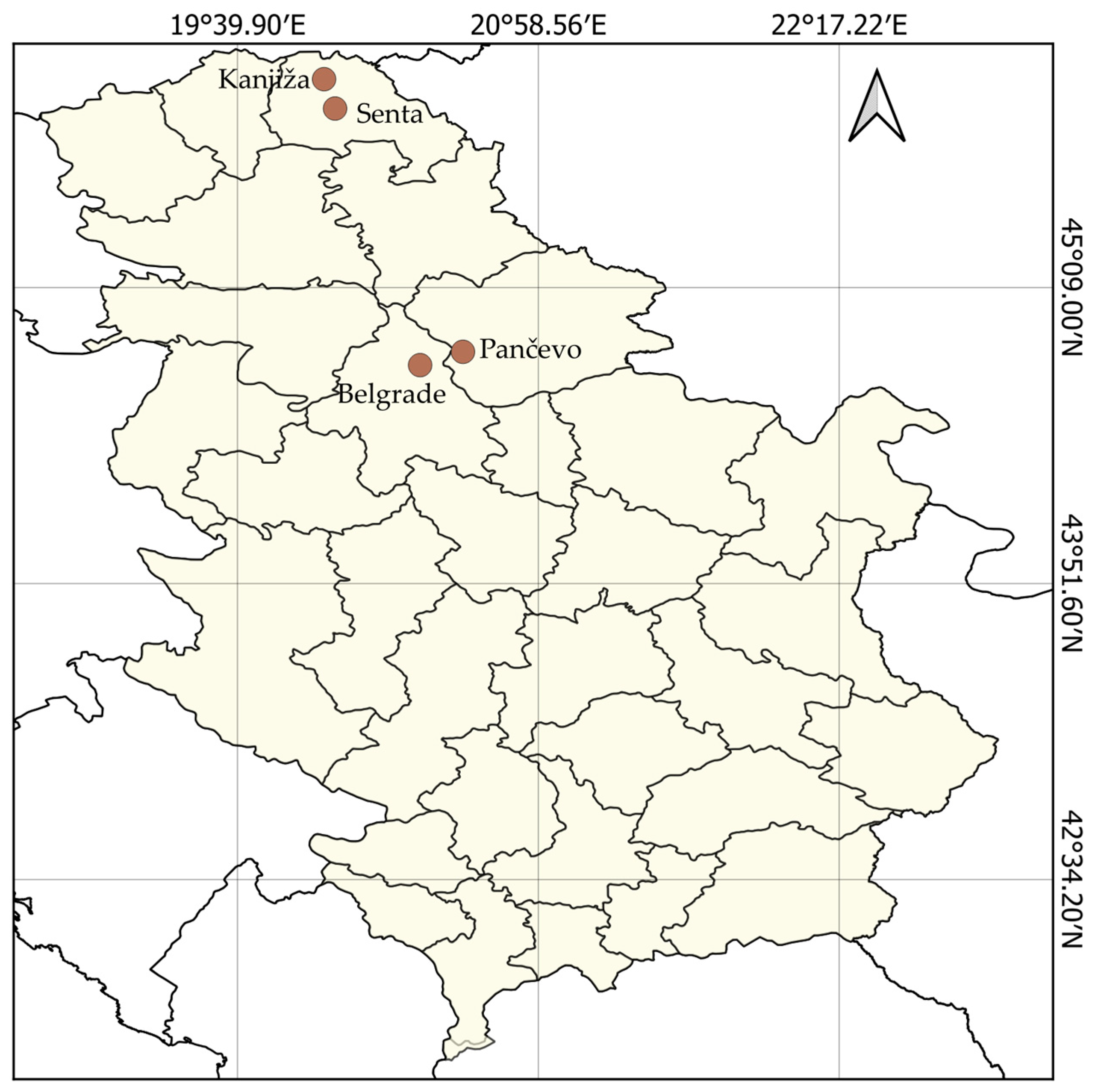
The study was conducted from March 2023 to August 2024 on 145 falcons raised in captivity in Belgrade Zoo Garden, Kanjiža, Pančevo, and Senta (Figure 1). In this study, we investigated 5 hybrids (gyr × peregrine), 23 gyrfalcons, 71 peregrine and 46 Saker Falcons (Falco cherrug), and 1 peregrine falcon that died during the sampling period. In all birds, parasitological and molecular detection of samples was performed. Also, the influence of various individual and environmental variables was investigated. The analysis of variables encompassed the following parameters: sex (male or female), age (juvenile, subadults, and adults), type (hybrid falcon, gyrfalcon, peregrine falcon, and saker falcon), location (Belgrade Zoo, Kanjiža, Pančevo, and Senta), and prevention (yes or no).

2.2. Parasitological Examination

A total of 145 fecal samples were collected from birds. The samples were stored at +4 °C in labeled disposable containers and transported to the Department of Parasitology at the Faculty of Veterinary Medicine, University of Belgrade, for parasitological analysis. For microscopic examination, samples were prepared using qualitative coprological diagnostic procedures—centrifugal flotation with saturated zinc sulfate solution (with a specific density of 1.18 at 20 °C). Each fecal sample was examined in duplicate under a light microscope (Olympus CX 23, Olympus, Tokyo, Japan) at magnifications of 100× and 400×. All eggs found were photographed and identified according to their morphological characteristics [4].

2.3. Post Mortem Examination

In March 2023, an adult female peregrine falcon that died in Belgrade Zoo Garden was examined. The bird was transported to the Faculty of Veterinary Medicine, Department of Forensic Medicine, University of Belgrade, where necropsy was performed. The recovered parasites were washed in saline solution and subsequently fixed in 70% ethanol.

2.4. Molecular Detection of Serratospiculum spp.

Molecular analyses were performed to detect DNA of Serratospiculum spp. From the dead bird, DNA was isolated from the parasite samples that were found in air sacs, using Thermo Scientific DNA Blood and Tissues Kit (Thermo Scientific, Paisley, UK) according to the manufacturer’s recommendations. From the other live birds, feces was used as a material for DNA extraction. Before extraction, parasites were mixed up in TissueLyser with 200 μL elution buffer (Qiagen, Hilden, Germany). Extracted DNA samples were stored at –20 °C until use. All PCR amplifications were performed using a T100 BIO-RAD Thermal Cycler (Dubai Biotechnology and Research Park, Dubai, United Arab Emirates). PCR reaction mix was prepared using KAPA Taq Polymerase. DNA amplifications were carried out in a final volume of 25 μL containing 2.5 μL of nuclease-free water, 1.25 μL of each primer, 10 μL of Taq-polymerase and 10 μL of DNA template. To detect Serratospiculum spp., all samples were subjected to PCR using forward and reverse set of primers D-1F (GCCTATAATGGTGAAACCGCGAAC) and D-1R (CCGGTTCA AGCCACTGCGATTA) [20]. The thermal protocol involved 2 min of initial denaturation at 93 °C, followed by 45 cycles of denaturation (93 °C, 30 s), primer annealing (48 °C, 15 s), extension (72 °C, 45 s), and a final extension step at 72 °C for 5 min. PCR products were visualized with UV light after staining the 2% agarose gel with Midori Green Direct (Nippon Genetics, Tokyo, Japan). A commercial O’RangeRulerTM 100bp DNA Ladder (Thermo Fisher Scientific, Waltham, MA, USA) was used as size marker. Parasites found in the dead falcon served as positive control, while negative control was dH2O.

2.5. Statistical Analyses

Results were analyzed using Graph Pad Prism software, version 9 (GraphPad, San Diego, CA, USA). Risk factors (sex, age, type, location, prevention) associated with parasitism were analyzed using the Chi-Square (χ2) test. A 95% confidence interval was established in all tables, with statistical significance set at p < 0.05 and, p < 0.01, p < 0.001 levels.

3. Results

3.1. Prevalence of Endoparasites

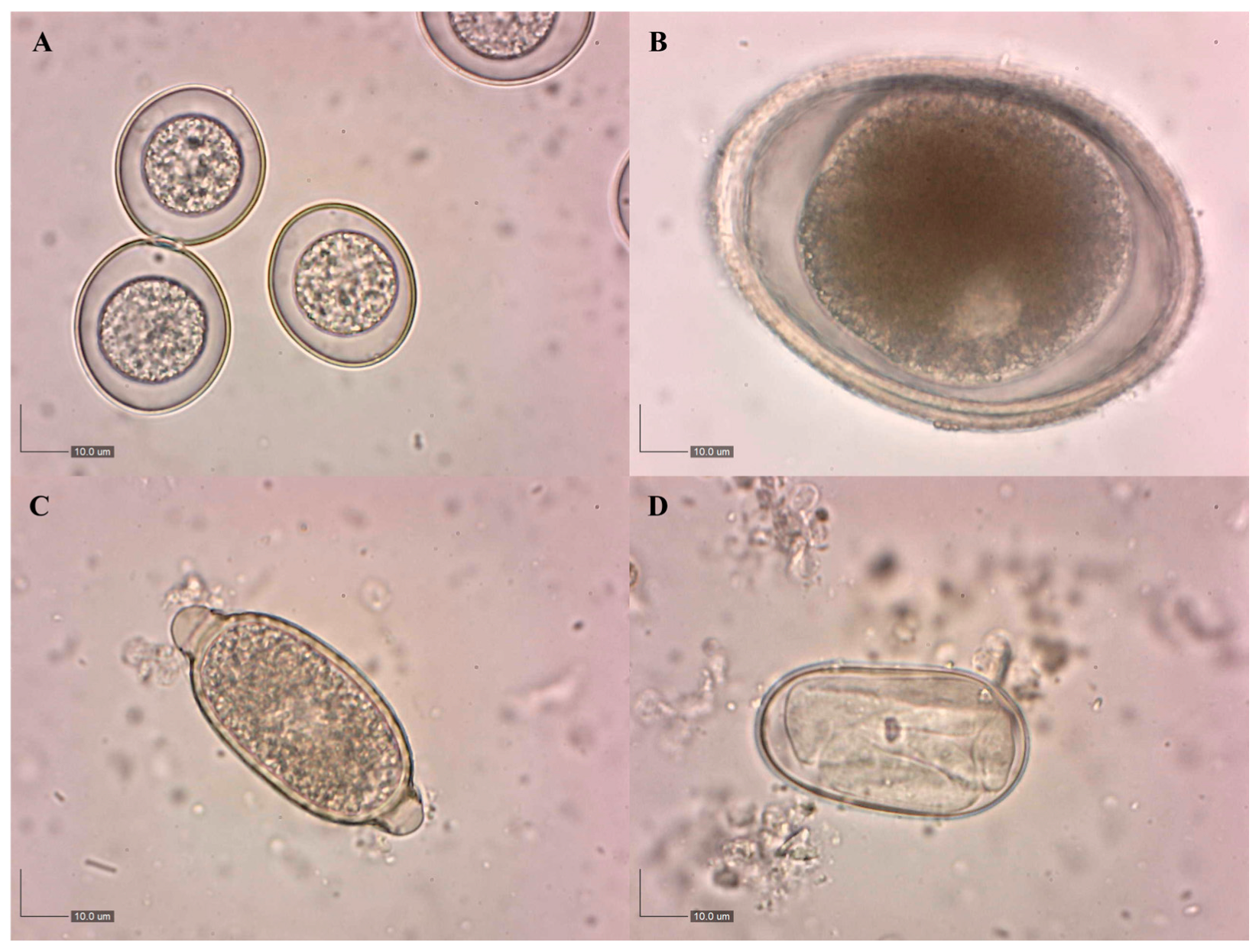
In the total sample of 145 individuals, endoparasites (Figure 2) were detected in 80 birds (55.2%; 95% CI: 47.1–63.0) (Table 1). The most frequently recorded were Caryospora spp. (41.4%; 95% CI: 33.69–49.52), followed by Porrocaecum spp. (18.6%; 95% CI: 13.12–25.74) and Capillaria spp. (3.4%; 95% CI: 1.48–7.82). Overall, 4 of 145 (2.8%; 95% CI: 1.08–6.88) fecal samples were confirmed as positive for Serratospiculum spp. by PCR.
At the level of overall infection (Table 2), prevalence was significantly higher (p < 0.05) in males (69.4%; 95% CI: 50.68–74.38) than in females (44.6%; 95% CI: 34.36–55.27). Age groups did not differ. Across falcon species, no difference was detected. Significant differences (p < 0.001) were observed with respect to location: 85.7% in Belgrade Zoo, 87.5% in Pančevo, 45.3% in Senta, while in Kanjiža, no positive findings were recorded. The application of preventive measures was associated (p < 0.001) with lower prevalence (51.5%; 95% CI: 43.11–59.79) compared with the non-prevention group (100.0%; 95% CI: 74.12–100.00).
The occurrence of Caryospora spp. was significantly higher (p < 0.001) in males (61.3%; 95% CI: 50.68–74.38) than in females (22.0%; 95% CI: 50.68–74.38). Age and species did not show statistically significant differences. With regard to prevention, 44.8% (95% CI: 36.62–53.22) of birds with implemented measures tested positive, significantly higher (p < 0.001) compared to birds without prevention (Table 3).
For infections with Porrocaecum spp., no differences were observed by sex or age. The highest prevalence was recorded in gyrfalcons (39.1%; 95% CI: 22.16–59.21), lower in peregrines (16.9%; 95% CI: 9.94–27.26), and in Saker falcons (13.0%; 95% CI: 6.19–25.67). Preventive measures were associated with lower prevalence (15.7%; 95% CI: 10.48–22.77) compared with the non-prevention group (54.5%; 95% CI: 28.01–78.73) (Table 4).
Infections with Capillaria spp. were rare and limited to females (6.0%; 95% CI: 2.60–13.39) and to the group younger than 2 years (16.7%; 95% CI: 7.38–33.57), with absence of positives in older categories (p < 0.001). Differences by species/type did not reach statistical significance; positive findings were recorded only in peregrine falcons (7.0%; 95% CI: 3.05–15.45), exclusively in those without prevention (45.5%; 95% CI: 21.27–71.99) (Table 5).
Serratospiculum spp. were recorded with low overall frequency; no significant differences were established by sex, age, or species. Significant differences (p < 0.001) were confirmed in birds without preventive measures. Positive findings were noted exclusively in birds without prevention (36.4%; 95% CI: 21.27–71.99) (Table 6).

3.2. Necropsy

The bird was in a poor body condition (body score 3/5) considering the absence of fat tissue. The feathers were dry and few wing feathers were broken. During the necropsy, the trachea, lungs, air sacs, kidneys, spleen, liver, heart, gallbladder, and the whole digestive tract (esophagus, proventriculus, ventriculus, intestines) were examined. Adult nematode specimens were found in the air sacs and counted (51 adult worms was found). Nematodes were elongated, thin and yellow in color. Identification of parasites was carried out using the morphological criteria for Serratospiculum species described by Skrjabin [21], with particular emphasis on the characteristic lengths of the small and large male spicules.

4. Discussion

The results of this study indicate that parasitic infections in falcons remain a significant concern, both in terms of animal health and in the context of managing populations in captivity and falconry centers. The overall prevalence of endoparasites was 55.2%, confirming that these pathogens are persistently present, with four groups standing out as the most important—Caryospora spp., Porrocaecum spp., Capillaria spp., and Serratospiculum spp. The most frequent finding in our investigation was Caryospora spp., detected in 41.4% of individuals. This high prevalence aligns with previous studies, although some have reported lower values. For example, in Saudi Arabia, prevalence was 10.7% [22], while Germany reported 12% [23], the UK 24% [24], the UAE 27% [25] and the USA 31% [26]. Recent studies in Italy reported prevalence of 28.6% [27], while in Poland it was 4% [28]. Even when considering the highest reported prevalence of 40% in a specific clinical series in Saudi Arabia [29], our findings are slightly higher, suggesting the influence of local risk factors. One of the key factors explaining such variation is the genetic background and species identity of the host. Mateuta et al. [25] demonstrated that gyr × peregrine hybrids and pure gyrfalcons exhibited significantly higher prevalence rates (25–27%) compared with peregrines (20%) and sakers (16.5%), whereas kestrels (Falco tinnunculus) showed almost no infection (< 1%). Our observation of higher prevalence in males also points toward the potential influence of biological and management-related factors. The role of the environment should not be underestimated. Juárez et al. [30] emphasized that Caryospora oocysts can persist in water and substrates, with significantly higher contamination observed in enclosed chambers compared with open aviaries. This is highly relevant to our findings, as differences in prevalence among locations, along with the observed association with preventive measures, underline the importance of hygiene and biosecurity. The wide distribution of this parasite has also been documented in wild raptors, highlighting the risk of introducing infections into falconry centers [31].
The second most common parasite identified was Porrocaecum spp., found in 18.6% of falcons examined. In a Polish falconry population, Porrocaecum was the dominant parasite, with a prevalence of 27% [28]. The authors indicate the importance of diet—particularly feeding raw prey—and exposure to contaminated soil as key drivers of transmission. Because Porrocaecum spp. require intermediate hosts such as earthworms, and small mammals may serve as paratenic hosts [32,33], it is evident that feeding practices and environmental exposure strongly shape prevalence patterns. The clinical importance of these parasites should not be underestimated [34] due to intestinal obstructions and severe cachexia. Our findings, showing a link between reduced prevalence and the implementation of preventive measures, underscore the value of strict biosecurity protocols and careful food source control in minimizing infection risks.
Capillaria spp. were less common, with a prevalence of 3.4%. Interestingly, infections were recorded only in females and in birds under two years of age, all of which belonged to the group without preventive care. These findings highlight younger birds as a particularly vulnerable category. Anderson [35] noted that certain Capillaria species have a direct life cycle, whereas others require intermediate hosts (e.g., earthworms), thereby increasing the likelihood of infection in environments where birds have contact with soil and invertebrates. The clinical significance of Capillaria spp. has been documented through reports of severe gastrointestinal disturbances in raptors. Tarello [36] described a favorable therapeutic response to ivermectin in falconids with marked capillariasis. In our sample, although rare, Capillaria infection was clearly associated with age and the absence of preventive measures, emphasizing once more the importance of controlled feeding and biosecurity.
The least frequently detected parasite in this study was Serratospiculum spp., with a prevalence of 2.8%. Although this percentage appears relatively low, it is noteworthy that positive cases were recorded exclusively among birds without preventive care, again highlighting the strong role of management practices. The literature reports higher prevalence rates in certain contexts [10,11,12,13]. The pathogenic potential of Serratospiculum spp. is considerable, as it can cause severe respiratory symptoms, airsacculitis, granulomatous lesions, and, in more severe cases, even mortality. Similarly to other studies, infections in several birds were associated with pneumonia, airsacculitis, and early aspergillosis lesions, with gross examination revealing unilateral or bilateral lung congestion and pale yellow to green fluid in the air sacs [11]. The life cycle of these nematodes involves arthropods as intermediate hosts, most often beetles, and studies further confirmed the importance of this transmission pathway in birds of prey [11].

5. Conclusions

The results of this study clearly demonstrate the importance of preventive measures in controlling parasitic infections in falcons raised in captivity. Such measures are not only statistically associated with lower prevalence but also represent a practical cornerstone in reducing risk, particularly in the case of nematodes with complex life cycles. The environment clearly serves as the primary reservoir for coccidia, while diet and intermediate hosts play a decisive role in the maintenance and transmission of nematodes. The observed sex-related differences in prevalence, particularly with Caryospora spp., require further investigation, as the existing literature has not consistently confirmed such patterns. These findings emphasize the necessity not only of regular deworming but also of implementing measures to control potential vectors in the environment.

Author Contributions

Conceptualization, D.D., V.N. and N.M.J.; formal analysis, N.M.J.; Funding acquisition, T.I.; investigation, S.S., D.D., M.V. and N.M.J.; resources, M.V., S.S.; Supervision, T.I.; visualization, S.S. and V.N.; writing—original draft preparation, D.D.; writing—review and editing, T.I. and V.N. All authors have read and agreed to the published version of the manuscript.

Funding

The study was supported by the Ministry of Science, Technological Development and Innovation of the Republic of Serbia (Contract Numbers 451-03-136/2025-03/200143 for Faculty of Veterinary Medicine University of Belgrade, and 451-03-136/2025-03/200030 for Scientific Institute of Veterinary Medicine of Serbia).

Institutional Review Board Statement

Approval (No. 02-11/2023) of this study was obtained from the Ethical Commission for the Protection of Animal Welfare, Faculty of Veterinary Medicine, University of Belgrade.

Informed Consent Statement

Written informed consent was obtained from the owner of the animals involved in this study.

Data Availability Statement

The data presented in this study are available on request from the corresponding author.

Conflicts of Interest

The authors declare no conflicts of interest.

References

  1. Puchała, K.O.; Nowak-Życzyńska, Z.; Sielicki, S.; Olech, W. Evaluation of the impact of the peregrine falcon (Falco peregrinus peregrinus) reintroduction process on captive-bred population. Genes 2022, 13, 1487. [Google Scholar] [CrossRef]
  2. Ponitz, B.; Schmitz, A.; Fischer, D.; Bleckmann, H.; Brücker, C. Diving-Flight Aerodynamics of a Peregrine Falcon (Falco peregrinus). PLoS ONE 2014, 9, e86506. [Google Scholar] [CrossRef]
  3. Zhan, X.; Pan, S.; Wang, J.; Dixon, A.; He, J.; Muller, M.G.; Ni, P.; Hu, L.; Liu, Y.; Hou, H.; et al. Peregrine and saker falcon genome sequences provide insights into evolution of a predatory lifestyle. Nat. Genet. 2013, 45, 563–566. [Google Scholar] [CrossRef]
  4. Krone, O. Endoparasites. In Raptor, Research and Management Techniques; Hancock House Publishers: Surrey, BC, Canada, 2007; pp. 318–328. [Google Scholar]
  5. Al-Kharkhi, I.; Joseph, W.; Deb, A. Prevalence of faecal endoparasite ova in falcons in Qatar. Newsl. Middle East Falcon Res. Group 2013, 41, 15. [Google Scholar]
  6. Anderson, R.C.; Bain, O. Keys to the Genera of the Order Spirurida. Part 3. Diplotriaenoidea, Aproctoidea and Filarioidea; Commonwealth Agricultural Bureaux: Farnham Royal, UK, 1976. [Google Scholar]
  7. Skrijabin, K.J. Nematodes des oiseaux du Turkestan russe. Ann. Mus. Zool. Acad. Imp. Sci. Petrograd 1916, 20, 457. [Google Scholar]
  8. Königová, A.; Molnár, L.; Hrčková, G.; Várady, M. The first report of serratospiculiasis in great tit (Parus major) in Slovakia. Helminthologia 2013, 50, 254–260. [Google Scholar] [CrossRef]
  9. Anderson, R.C. On the development, morphology, and experimental transmission of Diplotriaena bargusinica (Filarioidea: Diplotriaenidae). Can. J. Zool. 1962, 40, 1175–1186. [Google Scholar] [CrossRef]
  10. Sterner, M.C.; Cole, R.A. Diplotriaena, Serratospiculum and Serratospoiculoides. In Parasitic Diseases of Wild Birds; Atkinson, C.T., Thomas, N.J., Hunter, D.B., Eds.; Wiley-Blackwell: Oxford, UK, 2008; pp. 434–438. [Google Scholar]
  11. Samour, J.H.; Naldo, J.N. Serratospiculiasis in captive falcons in the Middle East: A review. J. Avian Med. Surg. 2001, 15, 2–9. [Google Scholar] [CrossRef]
  12. Al-Timimi, F.; Nolosco, P.; Al-Timimi, B. Incidence and treatment of serratospiculosis in falcons from Saudi Arabia. Vet. Rec. 2009, 165, 408–410. [Google Scholar] [CrossRef]
  13. Tarello, W. Serratospiculosis in falcons from Kuwait: Incidence, pathogenicity and treatment with melarsomine and ivermectin. Parasite 2006, 13, 59–63. [Google Scholar] [CrossRef] [PubMed]
  14. Azmanis, P.N.; Krautwald-Junghanns, M.-E.; Schmidt, V. Suspected toxicity by biological waste and air sac nematode infestation in a free-living peregrine falcon (Falco peregrinus). J. Hell. Vet. Med. Soc. 2017, 65, 243–256. [Google Scholar] [CrossRef]
  15. Christensen, N.D.; Skirnisson, K.; Nielsen, Ó.K. The parasite fauna of the gyrfalcon (Falco rusticolus) in Iceland. J. Wildl. Dis. 2015, 51, 929–933. [Google Scholar] [CrossRef] [PubMed]
  16. Kalisińska, E.; Kavetska, K.M.; Okulewicz, A.; Sitko, J. Helminths of Falco peregrinus Tunstall, 1771 from Szczecin area. Wiad. Parazytol. 2008, 54, 143–145. [Google Scholar] [PubMed]
  17. Santoro, M.; Tripepi, M.; Kinsella, J.M.; Panebianco, A.; Mattiucci, S. Helminth infestation in birds of prey (Accipitriformes and Falconiformes) in southern Italy. Vet. J. 2010, 186, 119–122. [Google Scholar] [CrossRef] [PubMed]
  18. Veiga, I.B.; Schediwy, M.; Hentrich, B.; Frey, C.F.; Marreros, N.; Stokar-Regenscheit, N. Serratospiculosis in captive peregrine falcons (Falco peregrinus) in Switzerland. J. Avian Med. Surg. 2017, 31, 250–255. [Google Scholar] [CrossRef]
  19. QGIS Geographic Information System (Version 3.36). Open Source Geospatial Foundation Project. 2024. Available online: http://qgis.org (accessed on 18 November 2024).
  20. Wijová, M.; Moravec, F.; Horák, A.; Lukeš, J. Evolutionary Relationships of Spirurina (Nematoda: Chromadorea: Rhabditida) with Special Emphasis on Dracunculoid Nematodes Inferred from SSU rRNA Gene Sequences. Int. J. Parasitol. 2006, 36, 1067–1075. [Google Scholar] [CrossRef]
  21. Skrjabin, K.J. The Nematodes of Animals and Men/Essentials of Nematodology; Akademia Nauk: Moscow, Russia, 1968; Volume 12, pp. 182–183. [Google Scholar]
  22. Alfaleh, F.; Alyousif, M.; Elhaig, M. The emergence of Caryospora neofalconis in falcons in central Saudi Arabia. J. Adv. Vet. Anim. Res. 2020, 7, 530–536. [Google Scholar] [CrossRef]
  23. Boer, B. A survey of the prevalence of coccidial oocysts and sporocysts in faecal samples of birds of prey (Falconiformes) and investigations into the biology of two Caryospora species (C. neofalconis n.sp. and C. kutzeri n.sp.). Ph.D. Thesis, University of Hohenheim, Stuttgart, Germany, 1982; 83p. [Google Scholar]
  24. Forbes, N.A.; Simpson, G.N. Caryospora neofalconis: An emerging threat to captive-bred raptors in the United Kingdom. J. Avian Med. Surg. 1997, 11, 110–114. [Google Scholar]
  25. Mateuta, V.D.S.; Samour, J.H. Prevalence of Caryospora species (Apicomplexa: Eimeriidae) in falcons in the United Arab Emirates. J. Avian Med. Surg. 2017, 31, 327–334. [Google Scholar] [CrossRef]
  26. Lindsay, D.S.; Blagburn, B.L. Caryospora uptoni n. sp. (Apicomplexa: Eimeriidae) from Red-Tailed Hawks (Buteo jamaicensis borealis). J. Parasitol. 1986, 72, 762–765. [Google Scholar] [CrossRef]
  27. Allievi, C.; Zanzani, S.A.; Bottura, F.; Manfredi, M.T. Investigating Endoparasites in Captive Birds of Prey in Italy. Animals 2024, 14, 3579. [Google Scholar] [CrossRef]
  28. Prątnicka, A.; Sokół, R.; Iller, M. Parasitic survey of birds of prey used for falconry in Poland. Pol. J. Vet. Sci. 2024, 27, 567. [Google Scholar] [CrossRef]
  29. Naldo, J.L.; Samour, J.H. Causes of morbidity and mortality in falcons in Saudi Arabia. J. Avian Med. Surg. 2004, 18, 229–241. [Google Scholar] [CrossRef]
  30. Juárez, A.; Martinez García, Y.; Perez Sauza, R.; Morales Luna, J.C.; Samour, J. Prevalence of Caryospora (Apicomplexa: Eimeriidae) oocysts in the environment of a gyrfalcon (Falco rusticolus) breeding center in the United Arab Emirates. J. Avian Med. Surg. 2020, 34, 152–157. [Google Scholar] [CrossRef] [PubMed]
  31. Santana-Sánchez, G.; Flores-Valle, I.T.; González-Gómez, M.; Vega-Sánchez, V.; Salgado-Miranda, C.; Soriano-Vargas, E. Caryospora neofalconis and other enteroparasites in raptors from Mexico. Int. J. Parasitol. Parasites Wildl. 2015, 4, 351–355. [Google Scholar] [CrossRef] [PubMed]
  32. Osche, G. On Intermediate and Accidental Hosts, and on the Ontogeny of the Labial Region in Species of Porrocaecum and Contracaecum. Z. Parasitenkd. 1959, 19, 458–484. (In German) [Google Scholar]
  33. Mozgovoi, A.A. Ascaridata of Animals and Man and the Diseases Caused by Them (Askaridaty Zhivotnykh i Cheloveka i Vyzyvaemye imi Zabolevaniya); Israel Program for Scientific Translations: Jerusalem, Israel, 1968; pp. 335–389. [Google Scholar]
  34. Mawson, P.M. Ascaroid Nematodes from Canadian Birds. Can. J. Zool. 1956, 34, 35–47. [Google Scholar] [CrossRef]
  35. Anderson, R.C. Nematode Parasites of Vertebrates: Their Development and Transmission, 2nd ed.; CABI Publishing: Wallingford, UK, 2000. [Google Scholar]
  36. Tarello, W. Efficacy of Ivermectin (Ivomec®) against Intestinal Capillariosis in Falcons. Parasite 2008, 15, 171–174. [Google Scholar] [CrossRef][Green Version]
Figure 1. Map of Serbia with places where the survey was conducted. The map was generated by using QGIS v3.36 (Zürich, Switzerland) [19].
Birds 06 00063 g001
Figure 2. Parasitic elements detected in fecal samples, zinc sulfate flotation (×400): (A)—Caryospora spp. oocyst; (B)—Porrocaecum spp. egg; (C)—Capillaria spp. egg; (D)— Serratospiculum spp. egg.
Birds 06 00063 g002
Table 1. Prevalence of endoparasites detected in studied falcons.
Endoparasitesn = 145
Positive Samples%95% CI
Caryospora spp.6041.433.69–49.52
Porrocaecum spp.2718.613.12–25.74
Capillaria spp.53.41.48–7.82
Serratospiculum spp.42.81.08–6.88
Legend: n—number of tested birds; CI—confidence interval.
Table 2. Risk factors associated with parasitic infections in studied falcons.
VariableNn%95% CIχ2p
Sex
Male624369.457.03–79.428.809<0.05
Female833744.634.36–55.27
Age
<2 years301963.345.51–78.131.210.545
2–5 years794354.443.50–64.95
>5 years361850.034.47–65.53
Type
Hybrid falcon5360.023.07–92.894.080.253
Gyrfalcon231773.953.53–87.45
Peregrine falcon713752.139.93–64.05
Saker falcon462350.036.12–63.88
Location
Belgrade Zoo353085.770.62–93.7428.97<0.001
Kanjiža700.0
Pančevo8787.552.91–99.36
Senta954345.335.63–55.26
Prevention
Yes1346951.543.11–59.799.671<0.001
No1111100.074.12–100.00
Legend: N—number of tested birds; n—number of positive birds; CI—confidence interval.
Table 3. Distribution of prevalences and risk factors associated with Caryospora spp. in studied falcons.
VariableNn%95% CIχ2p
Sex
Male623861.350.68–74.3817.7<0.001
Female832222.01.89–11.75
Age
<2 years30930.016.66–47.883.4850.1751
2–5 years793848.137.43–58.95
>5 years361336.122.48–52.42
Type
Hybrid falcon5360.023.07–92.903.5880.3095
Gyrfalcon231356.536.81–74.36
Peregrine falcon712738.027.63–49.66
Saker falcon461737.024.52–51.40
Preventive
Yes1346044.836.62–53.228.402<0.001
No1100.0
Legend: N—number of tested birds; n—number of positive birds; CI—confidence interval.
Table 4. Distribution of prevalences and risk factors associated with Porrocaecum spp. infection in studied falcons.
VariableNn%95% CIχ2p
Sex
Male621219.411.43–30.850.038520.8444
Female831518.111.27–27.70
Age
<2 years30826.714.18–44.491.7410.4187
2–5 years791215.29.47–25.23
>5 years36719.49.75–35.03
Type
Hybrid falcon5008.611<0.05
Gyrfalcon23939.122.16–59.21
Peregrine falcon711216.99.94–27.26
Saker falcon46613.06.19–25.67
Preventive
Yes1342115.710.48–22.7710.14<0.01
No11654.528.01–78.73
Legend: N—number of tested birds; n—number of positive birds; CI—confidence interval.
Table 5. Distribution of prevalences and risk factors associated with Capillaria spp. infection in studied falcons.
VariableNn%95% CIχ2p
Sex
Male6200.03.868<0.05
Female8356.02.60–13.39
Age
<2 years30516.77.38–33.5719.85<0.001
2–5 years7900.0
>5 years3600.0
Type
Hybrid falcon5005.3970.1449
Gyrfalcon2300.0
Peregrine falcon7157.03.05–15.45
Saker falcon4600.0
Preventive
Yes13400.063.08<0.001
No11545.521.27–71.99
Legend: N—number of tested birds; n—number of positive birds; CI—confidence interval.
Table 6. Distribution of prevalences and risk factors associated with Serratospiculum spp. infection in studied falcons.
VariableNn%95% CIχ2p
Sex
Male62003.0730.0796
Female8344.81.89–11.75
Age
<2 years3026.71.18–21.324.9990.0821
2–5 years7900
>5 years3625.60.99–18.14
Type
Hybrid falcon5004.5280.2098
Gyrfalcon2328.71.55–26.80
Peregrine falcon7122.80.49–9.45
Saker falcon4600
Preventive
Yes1340063.08<0.001
No11436.421.27–71.99
Legend: N—number of tested birds; n—number of positive birds; CI—confidence interval.
Disclaimer/Publisher’s Note: The statements, opinions and data contained in all publications are solely those of the individual author(s) and contributor(s) and not of MDPI and/or the editor(s). MDPI and/or the editor(s) disclaim responsibility for any injury to people or property resulting from any ideas, methods, instructions or products referred to in the content.