Review

Molecular Perspective on Proteases: Regulation of Programmed Cell Death Signaling, Inflammation and Pathological Outcomes


1
Tata Memorial Hospital & Cancer Research Center, The Advanced Centre for Treatment, Research and Education in Cancer (ACTREC), Tata Memorial Center, Navi Mumbai 410210, India
2
Department of Pathology, School of Medicine, Yale University, New Haven, CT 06511, USA
3
Department of Pharmacology, Yale University, New Haven, CT 06511, USA
4
MGM School of Biomedical Sciences, MGM Institute of Health Sciences, Navi Mumbai 410209, India
*
Author to whom correspondence should be addressed.
J. Mol. Pathol. 2025, 6(4), 32; https://doi.org/10.3390/jmp6040032
Submission received: 19 September 2025 / Revised: 5 November 2025 / Accepted: 8 December 2025 / Published: 12 December 2025

Abstract

Proteases are essential enzymes that regulate numerous physiological processes and cellular signaling networks to maintain homeostasis and cellular fate. This regulation is mediated by a group of proteases with the primary function of cleaving peptide bonds, thereby modulating the activity of proteins for vital functions and influencing various cellular and physiological functions including digestion, absorption, cellular signaling, apoptosis, inflammation, immune response, cell growth, differentiation, cell death, and reproduction. Proteases define the fate of cells by modulating the downstream signal transduction pathways for modalities of cell death known as apoptosis, necroptosis, pyroptosis, and autophagy. Similarly, during inflammatory stimulation, proteases orchestrate a cascade of pathways that optimize the immune response to pathogens. Proteases play a crucial role in the pathogenesis of various human diseases, including cancer, metabolic, inflammatory, and neurological disorders. The activation of specific proteases determines the outcomes of different forms of cell death inflammation and imbalance may cause various pathological manifestations highlighted in this review. Understanding protease-mediated signaling mechanisms is therefore vital for elucidating disease pathogenesis and identifying potential therapeutic targets.

1. Introduction

Proteases are evolutionarily conserved alongside the evolution of proteins for catabolism and the generation of amino acids through the cleavage of peptide bonds, serving as executors of biochemical reactions in various physiological and cellular processes. However, a vital function of proteases has been identified as being of greater importance in constructing protein synthesis, maturation, and cellular regulation to delineate various cellular processes and signal transduction mechanisms in all living organisms [1]. Proteases significantly influence cell fate through the localization and cleavage of peptide bonds facilitating activation and degradation of various proteins, orchestrating protein–protein interactions, and transducing downstream molecular signal transduction pathways to maintain cellular communication and function. Additionally, they are involved in cell growth and differentiation, DNA replication and transcription, immune response, tissue formation and remodeling, responses to heat shock and protein misfolding, the formation of blood vessels, the development of the nervous system, ovulation, fertilization, wound healing, mobilization of stem cells, blood clotting, inflammation, immune responses, cellular aging, anti-viral and anti-cancer activities, as well as regulation of various forms of programmed cell death, including apoptosis, autophagy, pyroptosis, and necrosis [2].
Proteases are initially synthesized as inactive proenzymes, known as zymogens, which necessitate proteolytic cleavage for activation. Following activation, proteases cleave specific target proteins, initiating trigger the typical morphological changes associated with apoptosis, including cell shrinkage, membrane blebbing, and DNA fragmentation. Proteases are categorized into two main types, exopeptidases and endopeptidases, based on their mechanism of hydrolyzing peptide bonds. These enzymes constitute a significant category of hydrolytic agents that facilitate the breakdown of proteins into smaller peptides or individual amino acids by cleaving the peptide bonds present in the polypeptide chain [3].
According to degradome databases, a total of 588 human proteases have been identified, which are classified into five categories based on the nature of their catalytic subunit within the active site: 192 metalloproteases, 84 serine proteases, 64 cysteine proteases, 27 threonine proteases, and 21 aspartyl proteases. Among the identified proteases, 21 are categorized as specific proteases unique to humans [4,5]. The various types of human proteases and their corresponding genes are presented in the Supplementary Information Table S1.
Exopeptidases perform their enzymatic functions by hydrolyzing the nitrogen or carbon terminal ends of the polypeptide chains of their substrates. Aminopeptidases act on the unbound N-terminal of proteins, facilitating the liberation of mono-amino acid residues, dipeptides, or tripeptides as byproducts. In contrast, carboxy peptidases function at the C-terminal end of protein sequences. Carboxypeptidases can be further classified into serine carboxypeptidases, cysteine carboxypeptidases, and metallo-carboxypeptidases, depending on the type of residual amino acid in the protein chain [6]. Endopeptidases primarily facilitate the cleavage of non-terminal amino acids and are classified based on the chemical groups involved in the catalytic activity. Endopeptidases are categorized into six distinct groups: (i) cysteine proteases, (ii) threonine proteases, (iii) serine proteases, (iv) glutamic acid proteases, (v) aspartic acid proteases, and (vi) metalloproteases [7].
The classification of proteases is also based on several additional criteria, including substrate specificity, and structural characteristics. Proteases can be categorized according to the specific types of peptide bonds they hydrolyze, as well as the size and sequence of the peptide substrates they preferentially target. For instance, trypsin, a serine protease, cleaves peptide bonds at the C-terminal of basic amino acid residues, primarily lysine and arginine, during protein digestion, while chymotrypsin, also a serine protease, cleaves peptide bonds within aromatic amino acid residues. The structural features of proteases are categorized according to particular domains or motifs. For example, papain is categorized as a cysteine protease and is distinguished by its unique papain-like structure, while matrix metalloproteinases belong to a group of metalloproteases characterized by a common zinc-binding motif. These biological “scissors” are imperative for regulating various cellular and physiological processes that maintain homeostasis and determine cellular fate.

2. Proteases in Regulating Homeostasis and Programmed Cell Death

Proteases contribute to the regulation of homeostasis and programmed cell death via their localization, activation, and cleavage of other proteins. They facilitate protein–protein interactions, maturation, degradation, and the activation of various enzymes thereby regulating cellular physiological responses and programmed cell death to balance the homeostasis. It is widely considered that proteases contribute to cellular homeostasis by regulating protein turnover and facilitating the degradation and removal of damaged, misfolded, or excess proteins, which can accumulate and disrupt normal cellular function. Proteases govern various signaling pathways essential for cell proliferation, differentiation, and apoptosis [2,8]. Proteases also modulate cellular and immunological responses through the processes of inflammation and other forms of programmed cell death, including necrosis, autophagy, pyroptosis, necroptosis, and mitophagy [9]. Hence, understanding protease-mediated signaling associated with different modalities of programmed cell death is essential for elucidating their roles in the pathogenesis of various diseases. The different types of proteases involved in cell death are summarized in Table 1.

2.1. Proteases in Apoptosis

Apoptosis is an evolutionarily conserved programmed process of cell death that maintains homeostasis by enabling cells to undergo self-destruction in response to various stimuli [33,34]. Damaged cells utilize two distinct mechanisms to arrest their progression in order to maintain homeostasis; either injured cells may relaying inflammatory signals through the secretion of chemical mediators to initiate necrosis, or they may activate a cascade of programmed cell death to selectively eliminate damaged cells without adversely affecting neighboring cells. Apoptotic cells exhibit distinct morphological and biochemical characteristics. During the process of programmed cell death, a cell loses microvilli and severs connections with neighboring cells. Concurrently, the cytoplasm undergoes condensation, and the endoplasmic reticulum experiences dilation, leading to a net loss of water from the cytoplasm. These processes culminate in the formation of vesicles that exhibit a characteristic bubbling appearance. Additionally, the nuclear membrane is associated with rapidly formed, dense, crescent-shaped aggregates of chromatin [35]. The apoptotic pathway is initiated by aspartate-specific cysteine proteases, commonly referred to as ‘caspases’ (cysteinyl-directed aspartate-specific protease). These caspases are majorly grouped as initiator (caspase-8, 9, and 10), effector caspases (caspase-3, 6, and 7), and non-apoptotic caspases (caspase-1, 4, 5, and 11) [36] as shown in Table 1.
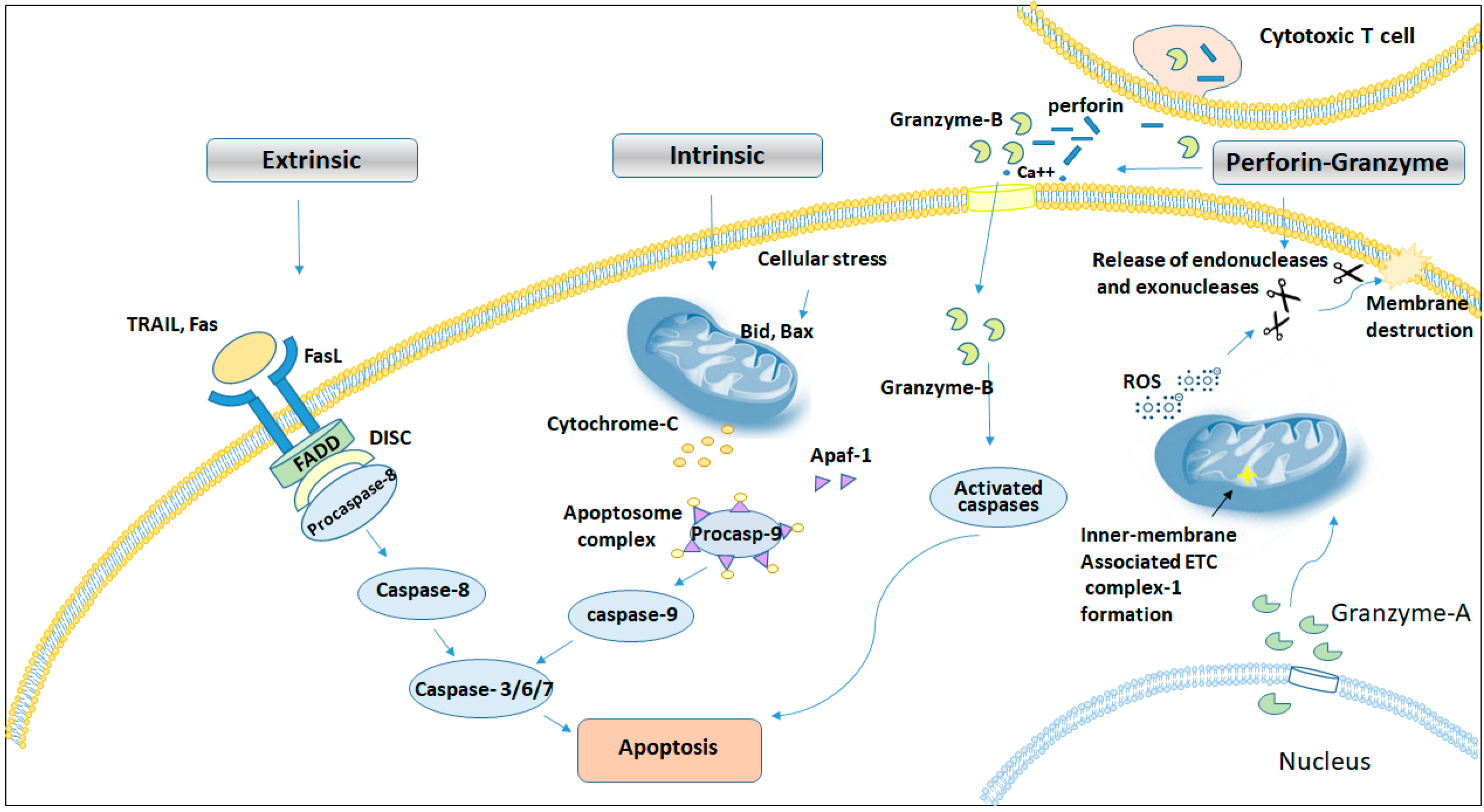
The extrinsic pathway is the external stimuli dependent pathway of apoptosis, initiated by the binding of specific death ligand to the members of tumor necrosis factor receptor superfamily (TNFRSF). These interactions transduce cell death signaling. Generally, these receptors are expressed on the surface of cells such as cytotoxic T lymphocytes. TNFRSF oligomerizes in response to TNFSF ligand; however, some TNFRSF members exist in an oligomeric form even in the absence of ligand binding. Apoptosis induced by TNFRSF involves a death domain of approximately 80 amino acids in length. This death domain facilitates the binding of FADD and cFLIP, which can switch the activation or inactivation of caspase-8 and the formation of the death-inducing signaling complex (DISC) to execute a downstream caspase cascade for regulation of cell death [33,37,38]. Upon activation, they exhibit proteolytic activity, cleaving intracellular proteins, which may lead to the breakdown of other cellular component for commencement of downstream cell death signaling. The activation of DISC occurs through oligomeriazation along with procaspase-8, which acts as an initiator caspase in the extrinsic apoptotic signaling pathway, activating caspase-8. This subsequently cleaves various substrates, converting procaspase-3 into caspase-3, which then activates the executioner caspases, caspase-6 and caspase-7 [39,40]. These executioner caspases facilitate DNA degradation by cleaving nuclear proteins, including lamins, actin, and the inhibitor of deoxyribonuclease (DNase). The cleavage of lamins disrupts nuclear function, while the cleavage of actin has implications for cell division. The response elicited by this canonical apoptotic pathway may vary according to the specific receptors and ligands involved in the associated processes [22,41].
The intrinsic pathway of cell death is regulated by Bcl-2 family proteins in response to intracellular stimuli, such as severe DNA damage, which activate pro-apoptotic factors such as Bax and Bid. This activation results in the release of cytochrome c from the mitochondria. Upon release, cytochrome c binds to protein Apaf-1 and the initiator pro-caspase-9 to form the apoptosome complex, which subsequently activates caspase-9 followed by processing of effector procaspase-3 into active caspase-3 [34]. Caspase-3 triggers the activation of nucleases, leading to the apoptotic degradation of the nucleus and ultimately resulting in cell death. In conjunction with the apoptosome, the simultaneous release of the protein Smac (second mitochondrial-derived activator of caspases) from the mitochondria impedes the function of the caspase-inhibitory IAP (IAPs) [36,41,42]. The association of proteases in the modulation of apoptosis signaling is illustrated in Figure 1. Although, other different types of proteases are known to involve in the cell death.

2.1.1. Calpains in Cell Death

Calpains belong to a family of cysteine proteases and activated upon release of Ca2+ ions, which are found in the mitochondria and cytoplasm of cells. These proteases are essential in regulating apoptosis and necrosis. Calpains exist in an inactive state as proenzymes in the cytoplasm of a normal cell. An increase in the levels of intracellular free Ca2+ ions triggers the activation of calpains. Under pathological conditions, the initiation of calpains release appears to be induced by transient localized increases in cytosolic Ca2+ concentration, a process that is tightly regulated by an endogenous inhibitory protein known as calpastatin. Since calpains are proteases that depend on Ca2+, any disruption in Ca2+ balance can cause improper regulation of their release, resulting in tissue damage [43].
When endothelial cells are overloaded with Ca2+, this condition triggers the activation of mitochondrial calpain-1. The activated calpain-1 subsequently initiates the activation of a Bcl-2 family protein, known as BH3-interacting domain (Bid). Bid in turn facilitates the release of cytochrome c, ultimately leading to apoptosis [20]. During spinal cord injury, calpains have been demonstrated to be involved in neuronal apoptosis in experimental models utilizing rats [44]. The inhibition of apoptosis by calpain inhibitors in various neuronal types, including motor neurons from adult mouse spinal cord segments, chicken spinal motor neurons, and dorsal root ganglion neurons, underscores the crucial role of calpains in the apoptosis machinery [45,46].

2.1.2. Cathepsins and Their Role in Cell Death

Cathepsins, which are classified as lysosomal proteolytic enzymes, are divided into three distinct categories based on the amino acid present at their active sites. The group consists of cysteine proteases (cathepsins B, C, H, K, L, S, and T), serine proteases (cathepsins A and G), and aspartate proteases (cathepsins D and E). Among these categories, Cathepsin B and Cathepsin D are particularly significant in the context of apoptosis; these cathepsins are often referred to as “suicidal bags” due to their elevated concentrations of hydrolases. Studies demonstrated that Cathepsins B and D are largely involved in terminal protein degradation, which occurs within the lysosomal compartment. Furthermore, these proteases are implicated in cellular motility and the aggressive invasion of cancer cells beyond the lysosomal environment, where they facilitate the degradation of extracellular matrix (ECM) proteins, including collagen, laminin, fibronectin, and proteoglycans [47]. Moreover, cathepsins have been shown to target the X-chromosome-linked inhibitor of apoptosis (XIAP) protein, further supporting the notion of cathepsin-mediated apoptosis occurring downstream of mitochondrial pathways [18].

2.1.3. Perforin-Granzyme Pathway in Cell Death

Granzyme A initiates a caspase-independent cell death pathway that exhibits morphological characteristics reminiscent of apoptosis, albeit with distinct substrate involvement. Granzyme A, a type of tryptase, along with Granzyme B, a homologous serine protease, facilitates independent activation of apoptotic cell death when delivered into target cells alongside perforin (PFN). Perforin is a protein, which helps in pore formation in the plasma membrane of the target cells and is also referred to as cytoplasmic granule toxin [12]. Upon entering into the mitochondria, Granzyme A disrupts the electron transport chain (ETC) complex I associated with the inner membrane by cleaving the NADH dehydrogenase (ubiquinone) Fe-S protein 3 (NDUFS3), which is situated in the neck of the complex I stalk extending into the matrix. The disturbance of complex I leads to the generation of reactive oxygen species (ROS), which disrupts the electron transport chain, mitochondrial transmembrane potential (MMP), and ATP production. Consequently, this activation augments endonucleases and exonucleases activity, leading to the breakdown of the nuclear membrane and degradation of DNA, thereby resulting in cell death [48].
Cytotoxic T lymphocytes (CTLs) induce apoptosis in target cells through the release of perforin and granzyme B. In the presence of Ca2+, perforin facilitates the entry of granzyme B into target cells by forming pores in their plasma membranes. Granzyme B, a serine esterase, can activate certain members of the caspase family generally caspase 3 and 9 [49]. Upon entering into the cell, granzyme B triggers the activation of proteases, resulting in cell death through the activation of caspase cascades. This mechanism is similar to apoptosis induced by death receptors, as well as mitochondrial or endoplasmic reticulum disruption. In addition to caspases, other proteases such as calpains and cathepsins also play an active role in the process of apoptosis [10,36].

2.2. Proteases in Autophagy

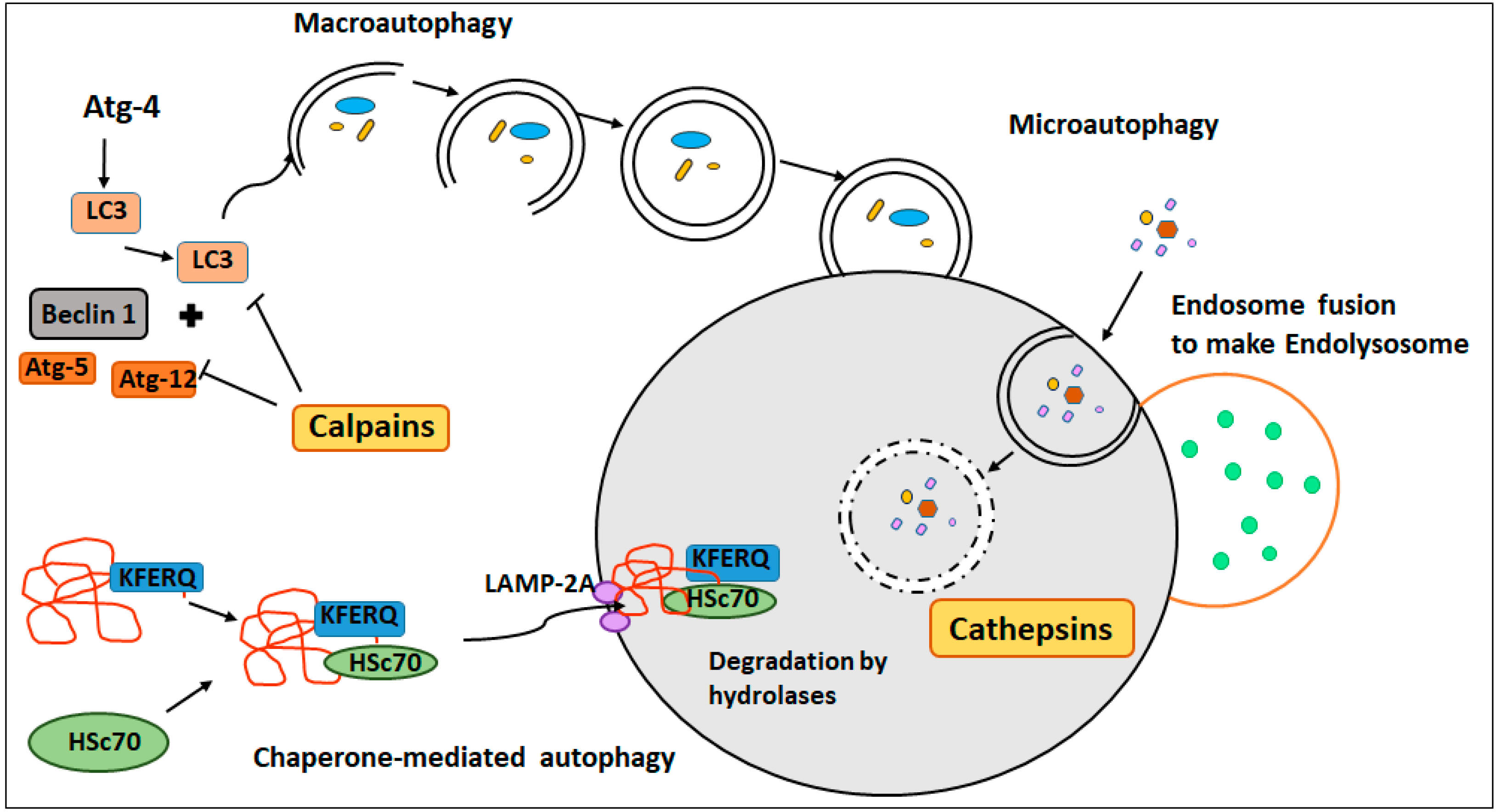
Autophagy, also referred to as type II cell death, represents the major mechanism for the degradation of entire organelles and large macromolecules within lysosomes. This process is intricately regulated by proteases and functions as an adaptive system essential for the maintenance of cellular homeostasis. It represents a well-organized mechanism of cell death that responds to both intrinsic and extrinsic stimuli (Figure 2). In mammalian cells, autophagy can be induced under specific conditions of nutrient deprivation; however, cells frequently exhibit a preference for undergoing apoptosis more rapidly than transitioning to autophagy. Lysosomal proteases, including cysteine, aspartyl, and serine cathepsins, contributed significantly to the autophagic process. Notably, cathepsins B, L, and D are the primary proteases found in lysosomes that actively facilitate autophagy within the cell [50]. Furthermore, various forms of autophagy have been discovered within the cell.

2.2.1. Macroautophagy

Macroautophagy (also referred to as autophagy) is a multistage cellular process responsible for the degradation and recycling of cellular components. This process involves the formation of double-membrane vesicular entities termed autophagosomes, a process initiated by Atg4, a specific protease enzyme that facilitates the cleavage and activation of LC3 (microtubule-associated protein 1A/1B-light chain 3), which is a crucial protein in the formation of autophagosomes. Further, autophagosomes are transported to lysosomes, where they undergo fusion to create the autophagolysosome complex, facilitated by calpains [51]. The contents of the autophagolysosome are subsequently degraded and utilized by the cell as nutrients. LC3-dependent autophagy significantly contributes to the regulation of infections in eukaryotic cells and contributes to the proteolytic degradation of pathogens, a process referred to as xenophagy. Moreover, this form of autophagy may modulate phagocytosis and is associated with the activation of host defense mechanisms, including the production of IL-1β and the activation of the inflammasome complex [52]. During chronic infections, such as those initiated by parasitic Leishmania species [53] and cases of gut dysbiosis [54], macroautophagy is regulated by genes specifically associated with autophagy that are essential for the degradation of various organelles. These organelles include mitochondria (mitophagy), endoplasmic reticulum (reticulophagy), peroxisomes (pexophagy), and ribosomes (ribophagy). Moreover, macroautophagy is involved in the degradation of macromolecules, protein aggregates, lipids, ribosomal RNA, and carbohydrates [50].

2.2.2. Chaperone-Mediated Autophagy (CMA)

Chaperone-mediated autophagy (CMA) is a unique protease-controlled autophagic process that facilitates the degradation of a specific subset of cytosolic proteins within lysosomes during prolonged periods of starvation. In contrast to macroautophagy, which involves the formation of autophagosomes for the degradation of macromolecules or entire organelles characterized by substantial cytoplasmic volumes, CMA specifically targets the degradation of individual cytosolic proteins. Proteins containing a specific amino acid motif (KFERQ) are recognized by HSC-70, which binds to this motif and forms a complex with the target protein. This HSC-70-target protein complex is subsequently unfolded and transported to the lysosomal membrane via the lysosomal-associated membrane protein type 2A (LAMP-2A) receptor. Upon arrival at the lysosomal membrane, the complex undergoes degradation by lysosomal hydrolases. LAMP-2A exists as a multimeric protein complex within the lysosomes. The cytosolic protein HSC-70 plays a critical role in disassembling LAMP-2A complexes, a process essential for maintaining CMA function, while Hsp90 contributes to the stabilization of LAMP-2A at the lysosomal membrane [55,56].

2.2.3. Microautophagy

Microautophagy was first investigated in rat liver and subsequently evaluated in yeast, where this mechanism is utilized for the collection and degradation of peroxisomes when the organism transitions to utilize glucose as an energy source [57]. In vitro micro-autophagy reconstitution with isolated vacuoles has facilitated further investigating into the molecular mechanism underlying the autophagic pathway. Microautophagy serves as a mechanism for the degradation of intracellular proteins and organelles, mediated by lysosomal or vacuolar engulfment of cargo vesicles in yeast. Various terms have emerged to describe the specific types of cargo being engulfed, such as micro-pexophagy for peroxisomes, micro-mitophagy for mitochondria, and micro-lipophagy for lipid droplets [58]. The specificity of microautophagy has been reinforced by the identification of Nvj1p, a cargo receptor specific for piecemeal microautophagy, which involves the digestion of nuclear components. Activation of microautophagy has been observed in Drosophila following more than 24 h of starvation, contrasting with mammals, in which such microautophagy is absent under similar conditions. Atg1 and Atg13 are downstream components of the TOR (target of rapamycin) signaling pathway, a crucial nutrient sensor that may become activated in response to nutrient starvation in Drosophila, whereas TOR and EGO have been identified as regulators of yeast microautophagy and lipophagy [59]. Moreover, 5′ AMP-activated protein kinase and Atg14 also play a role inthe activation of macrolipophagy [60].
The detection of microautophagy in mammals has been a protracted process, primarily due to the challenges associated with observing lysosomal invagination and the potential lack of conserved functions of genes implicated in yeast micro-autophagy within mammalian cells. Nonetheless, recent studies have demonstrated that a comparable degradative process occurs within the late endosomes and multivesicular bodies of mammals. Endosomal micro-autophagy relies on the assembly of endosomal sorting complexes required for transport (ESCRT), which is integral to the delivery of endocytosed proteins to the intraluminal vesicles of late endosomes. Furthermore, it has been found that cytosolic HSC-70 does not play a significant role in the regulation of autophagy [50].

2.3. Proteases in Necrosis/Necroptosis

Necroptosis represents a distinct form of programmed necrosis marked by cellular rounding, an increase in cell size, rupture of the plasma membrane, and the release of intracellular components. This process can be triggered by several stimuli including members of the death receptor family, Toll-like receptors, Fn14, calcium ions (Ca2+), T cell receptors (TCRs), TNF receptor 2 (TNF-R2), proteasome inhibitors, intracellular RNA and DNA sensors, interferons (IFNs), ROS, as well as various forms of cellular stress such as ionizing radiation. These stimuli may allow induction of Necropstosis through the involvement of receptor interacting serine-threonine protein kinase 3 (RIPK3) and receptor engaging protein kinase 1 (RIPK1), as along with the pseudokinase mixed-lineage kinase domain-like protein (MLKL). In response to necroptotic stimuli, RIPK1 recruits RIPK3, thereby initiating necrosome formation and subsequently activating RIPK3 through phosphorylation. Activated RIPK3 then recruits phosphorylated MLKL, which oligomerizes and translocate to the plasma membrane. This translocation of MLKL enhances its plasma membrane permeability. Some hypotheses propose that MLKL could affect the permeability by opening ion channels forming pores within the membrane [61]. Although MLKL is designated as a key effector in the necroptosis pathway, the specific mechanisms driving necroptosis and its role in inflammation and various cellular responses remain unexplored. Inhibitors of necroptosis include Necrostatin-1s (Nec-1s), RIPK3 inhibitors (such as GSK′840, GSK′843, GSK′872, GW′39B, and dabrafenib), MLKL inhibitors (including necrosulfonamide and NSA, which inhibits human MLKL), as well as various viral and bacterial proteins, such as M45, IE1, ICP6, ICP10, and NleB1. Notably, low or negligible protease activity seems to facilitate necroptosis, whereas elevated protease activity generally promotes apoptotic cell death signaling. Consequently, proteases play a limited role in the regulation of necroptosis [41,62].

3. Proteases in Pyroptosis and Inflammation

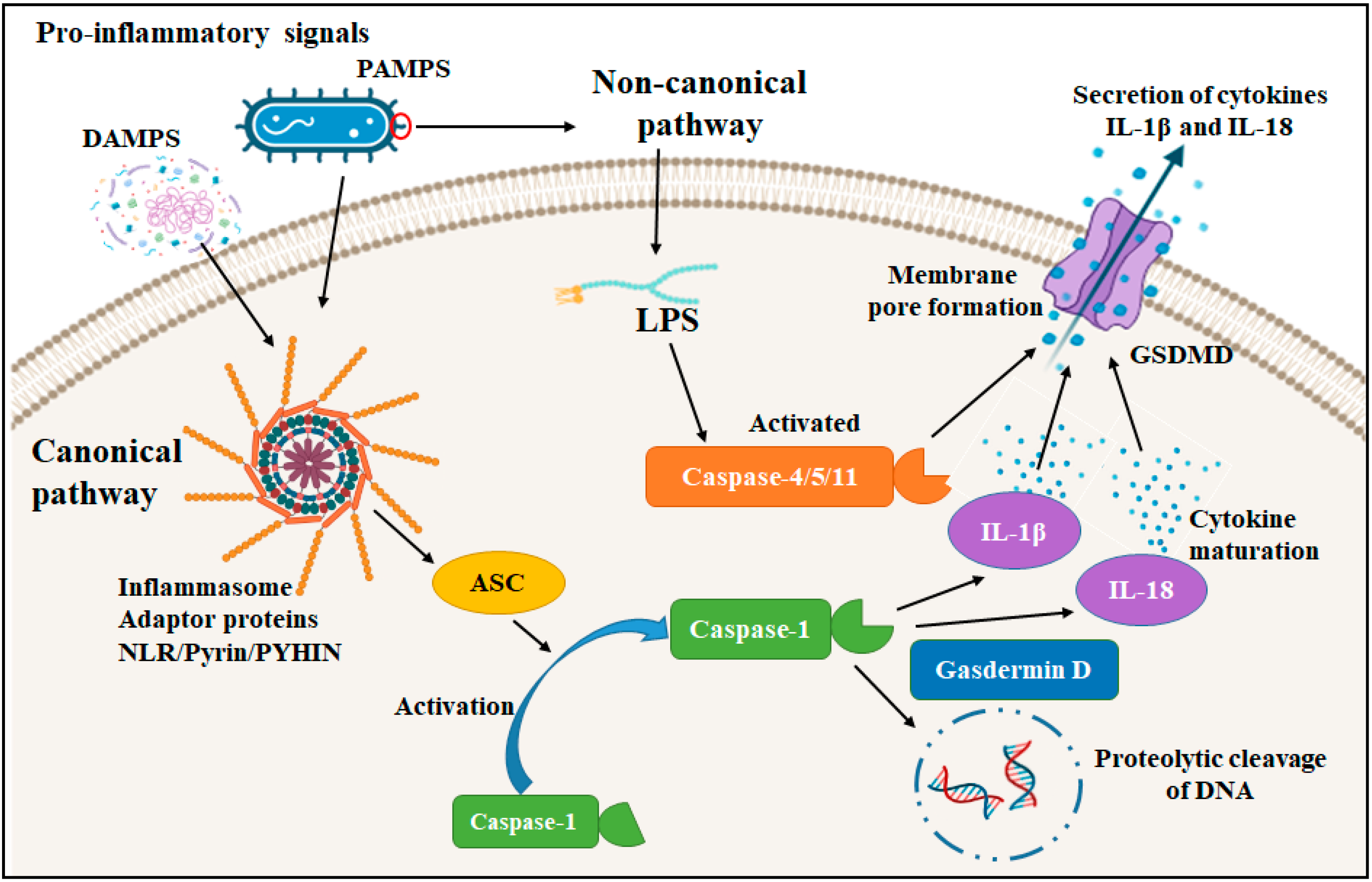
Pyroptosis, derived from the Greek terms “pyro,” meaning “fire,” and “ptosis,” meaning “falling,” represents a specific form of programmed cell death similar to apoptosis [63]. It is triggered by pro-inflammatory signals, specifically Pathogen-Associated Molecular Patterns (PAMPs) and Damage-Associated Molecular Patterns (DAMPs), which act as a danger signals that instigate inflammation through the formation of a heterogeneous protein complex known as inflammasomes [64,65,66,67]. The inflammasomes activation initiates with the recruitment of inflammatory caspases. Notably, several inflammatory caspases, specifically caspase-1, 4, 5, and 12, are encoded by the human genome, whereas caspase-11 is co-encoded with caspase-4 and caspase-5 in the mouse genome, in addition to caspase-1. Inflammasomes function as a platform for the recruitment of caspase-1 and promote the surrounding environment to induce pyroptosis. However, caspase -4, -5, and -11 do not necessitate such molecular complexes for their activation [21].
Pyroptosis follows either the canonical pathway, characterized by caspase 1 activation, or the non-canonical route, characterized by the activation of caspase 4/5 or 11 [68]. The canonical pathway of Pyroptosis is influenced by activation of caspase-1, inflammasomes, and the aggregation of gasdermin on the membrane, triggered by pathogen-associated molecular patterns (PAMPs), damage-associated molecular patterns (DAMPs), and infections from pathogens. Mechanistically, the activation of caspase-1 takes place via assembly of a supramolecular complex composed of NOD-like receptor (NLR) proteins, Pyrin proteins, and PYHIN proteins. These NLR proteins facilitate the activation of inflammasome adaptor protein ASC, which is instrumental in converting procaspase-1 into its active form, caspase-1. The active caspase-1 is essential for the processing and maturation of pro-inflammatory cytokines and activation of gasdermins specially gasdermin-D (GSDMD, facilitating the release of IL-1β and IL-18 from the cell, via the process of pore formation in the plasma membrane [68,69]. During the pryoptosis, DAPMS such as high mobility group box 1 (HMGB1), dsDNA, ATP also released. Therefore, regulation of pyroptosis in various inflammatory disease conditions and anti-tumor therapy has been demonstrated in clinical perspective [70].
A recent report highlighted that various isoforms of the GSDMB protein and proteolytic cleavage by distinct caspases differentially regulate pyroptotic cell death and mitochondrial injury in cancer cells [71]. Gasdermins (GSDMs) represent a diverse structural family of proteins implicated in pyroptosis and are commonly referred to as execution proteins of this form of programmed cell death. In addition to their role in pyroptosis, GSDMs are involved in the regulation of various cellular processes, including coagulation, inflammation, necrosis, tumorigenesis, and differentiation [72]. Caspases are primarily identified as the proteolytic enzymes acting on GSDMB, which is closely linked to the transmission of inflammatory and apoptotic signals. The cleavage of GSDMD by caspases-1, 4, 5, and 11 and release of inflammatory cytokines IL-1β and IL-18 represents a critical event that initiates pyroptosis and exuberating inflammatory disease condition, warranting extensive research within the Gasdermin family regarding their mediation of inflammation and cell death [73]. Furthermore, GSDMD can be activated not only via caspase cleavage but also by serine proteases derived from neutrophils. These proteases are notable for their ability to cleave microbial toxins or structural proteins, as well as host cytokines or chemokines, thereby influencing inflammatory responses during infections [74]. Recent studies have indicated that pyroptosis can exacerbate the toxicity of chemotherapeutic agents, contributing to cell death through gasdermin-mediated programmed necroptosis [75]. The involvement of GSDMs in cell death and inflammatory processes is increasingly recognized as a potential avenue for therapeutic intervention [76].
The non-canonical pyroptosis pathway is initiated directly initiated by lipopolysaccharide (LPS) derived from extracellular Gram-negative bacteria, which facilitates the activation of caspases -4, -5, and -11, ultimately leading to cell death [77]. Pyroptosis is illustrated in Figure 3.

3.1. Eryptosis

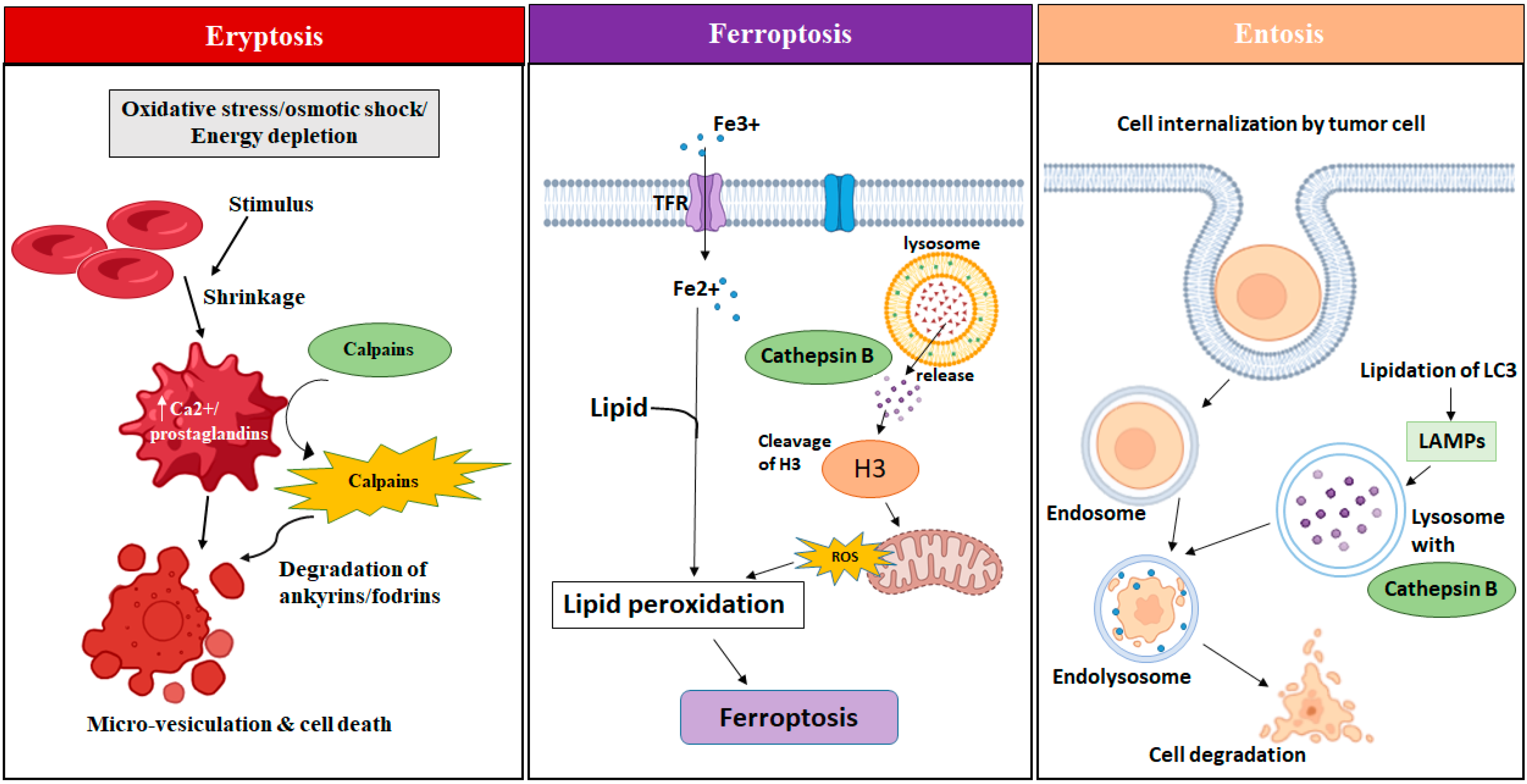
Erythrocytes, or red blood cells, are produced in considerable quantities within the human body to meet the requisite demand for oxygen. The organism must maintain a delicate equilibrium between the proliferation of erythrocytes and the removal of aged and damaged cells through established cellular death mechanisms. The elimination of senescent and compromised erythrocytes occurs via the processes of eryptosis or hemolysis. Given that erythrocytes are enucleated and devoid of organelles, they cannot undergo traditional apoptotic pathways. Instead, they emulate apoptosis through a programmed cell death mechanism known as eryptosis, which can be induced by factors such as oxidative stress, osmotic shock, or energy depletion [78]. Processes such as cell shrinkage, microvesiculation of the plasma membrane (blebbing), and the externalization of phosphatidylserine occur in a manner analogous to apoptosis; however, these processes do not initiate the activation of the caspase protease cascade. Rather, they result in the activation of cysteine proteases known as calpains [79,80,81]. Calpains are modulated by an increase in intracellular Ca2+ levels or by the release of prostaglandins. Activated calpains mediate the cleavage of fodrin and the degradation of ankyrin-R. Calpain-mediated eryptosis has been reported by various research groups [82,83]. Furthermore, it has been reported that in erythroid progenitor cells, interferon-γ induces the activation of caspase-1, caspase-3, and caspase-8, facilitating apoptosis during early differentiation [84]. However, these procaspases cannot be activated even by prolonged exposure to various caspase activators, including ionomycin or hyperosmotic shock [81]. Erythrocytes also undergo the typical process of cellular senescence; however, this process differs from programmed cell death in that the latter occurs over a timescale of minutes, whereas erythrocyte clearance from the circulatory system necessitates several days.

3.2. Ferroptosis

Ferroptosis represents a form of regulated necrotic cell death characterized by the inactivation of the glutathione system and the subsequent accumulation of excess iron, which is accompanied by lipid peroxidation. This phenomenon was first described by Dixon et al. in 2012 as an iron-dependent, non-apoptotic mechanism of cell death that is driven by lipid ROS [85]. Although there is no reported significant role of caspases in ferroptosis, Nagakannan et al. (2021) demonstrated the involvement of Cathepsin B protease, which is located in the lysosome, in promoting the cleavage of histone protein H3 and eliciting certain mitochondrial alterations that induce ferroptosis [86]. These findings were further validated by the knockout of the cathepsin B gene in primary fibroblast cells, which exhibited an unaltered response to various inducers of ferroptosis. Cathepsin B appears to induce ferroptosis through its translocation from the lysosome to the nucleus, which is mediated by lysosomal-nuclear DNA damage [87].

3.3. Entosis

Entosis is a non-apoptotic cell death mechanism observed in human tumors, which is triggered when a cell loses its attachment to the ECM. This process is initiated by the engulfment of one cell by another, followed by the degradation and processing of the internalized cell by lysosomal enzymes. Entosis exhibits cytological features characteristic of ‘cannibalism’ or ‘cell-in-cell’ phenomena, which are frequently observed in human tumor cells that are in the process of metastasis during carcinogenesis [88,89]. The engulfed cell undergoes degradation through lysosomal processes, which are initiated by the lipidation of LC3. This lipidation process further recruits lysosome-associated membrane glycoproteins (LAMPs), resulting in the acidification of the degradation compartment and the deposition of lysosomal proteases, primarily Cathepsin B, which facilitate the complete degradation of the internalized cell within the hostile environment. Additionally, under certain conditions, the internalized cell may experience nutrient deprivation within the vacuole, potentially leading to its own apoptosis. In both scenarios, whether through apoptotic or non-apoptotic pathways, the host cell is subjected to invasion [90].

3.4. Oncosis

Oncosis is a form of accidental cell death characterized specifically by ischemic cell death, which is accompanied by cellular swelling resulting from the failure of ionic channels and pumps in the plasma membrane. This process is distinct from necrosis, as cell swelling is a prominent feature of oncosis, whereas it is not a characteristic of necrosis [91]. Calpains, a family of Ca2+-dependent cysteine proteases, are known to be involved in oncotic cell death [92]. However, the existing literature on the role of calpains in oncotic cell death is limited, and the involvement of other proteases in oncosis warrants further investigation. The different forms of pyroptosis are illustrated in Figure 4.

4. Proteases in ER Stress-Mediated Cell Death

Endoplasmic reticulum (ER) stress-mediated cell death represents an emerging mechanism in context to proteostasis. The ER balances protein quality control involves ER-associated degradation, chaperone proteins, and autophagy. ER stress occurs when proteostasis is disrupted, leading to the accumulation of misfolded and unfolded proteins in the ER [93]. The ER serves as the primary site for the assembly of polypeptide chains within the cell, facilitating their proper folding and subsequent localization to various cellular compartments. Exposure to stressors, such as tunicamycin, brefeldin A, or thapsigargin, can lead to the misfolding or unfolding of these polypeptide chains [54,94,95,96]. In response to such stress, the cell increases the transcription of genes encoding molecular chaperones of the ER, including GRP78, a chaperone that assists in protein folding within the lumen of the ER; any perturbations may lead to pathological consequences [97,98]. The accumulation of unfolded protein response (UPR) is associated with various human diseases including cancer, diabetes, obesity, autoimmunity, and neurodegeneration [93]. This cellular response to unfolded proteins is mediated by IRE1α (Inositol-requiring transmembrane kinase/endoribonuclease 1α), PERK (Protein kinase R-like ER kinase) and ATF6 (Activating transcription factor 6), which are stress sensor proteins located in the ER [94,97]. The ER serves as a primary hub for the regulation of protein folding; consequently, a significant concentration of misfolded and unfolded proteins is translocated from the ER to the cytoplasmic environment for degradation via the ubiquitin-proteasome system, a process referred to as the ER-associated degradation (ERAD) system [95,99]. However, if the amount of malfolded proteins increases due to prolong stress it leads to the activation of various apoptotic cell death pathways. One of the important pathways is the c-Jun N-terminal kinase (JNK) pathway that triggers the release of cytochrome c from the mitochondria, further activating apoptosis [95,100]. In addition to cytochrome c, excess ER stress induces the activation of caspase-12 via the inositol-requiring enzyme 1 (Ire1) in rodent models. Furthermore, the elevated release of Ca2+ ions triggers the activation of calpains, which subsequently activate caspase-12 [101]. Although, Caspase-12 is absent in the majority of humans, the significance of caspase-12-driven apoptosis in the context of ER stress is still uncertain. In this context, human caspase-4 may be involved in ER-mediated cell death, as it is a close paralog of caspase-12. Nonetheless, this premise is still under examination and needs additional investigation in forthcoming studies on ER-mediated cell death [102].

5. Pathological Consequences of Protease Dysregulation

Proteases are mainly used by cells to cleave or degrade the proteins to accomplish distinct cellular and physiological processes, most notably to activate or deactivate the target proteins. Protease dysregulation has significant pathological consequences and progression of various human diseases including Cancer, Inflammatory, cardiovascular, Neurological disorders, etc. Protease dysregulation arises from inadequate regulation of protease activity and impacting various cellular processes and vital physiological processes, which may lead progression of the various diseases in humans. The intricate roles of proteases extend beyond simple protein degradation, influencing critical signaling pathways and contributing to disease pathogenesis. For instance, proteolytic enzymes, such as Caspases and Calpains, orchestrate the process of cell homeostasis through the cleavage of key cellular components. These enzymes regulate apoptosis, necroptosis, pyroptosis, and other forms of programmed cell death. Altered proteolytic activity of proteases lead to implications of various pathological conditions such as cancer progression, inflammation and neurodegeneration. Proteases also contribute to the progression of inflammatory diseases by influencing different biological processes through the activation of cytokine and chemokine secretion. Their dysregulation can result in increased inflammation and tissue injury, thereby playing a significant role in both acute and chronic inflammatory disorders. Thus, proteases are essential components in regulating inflammation and have both protective and detrimental roles in inflammation and cell death. This discourse presents insights into the pathological consequences associated with dysregulation of proteases, aiming to elucidate the origins of human diseases.

5.1. Proteases in Cancer and Tumor Progression

The progression of tumor, angiogenesis or metastasis involves multiple alteration including attachment to basement of the cell membrane, proteolysis, degradation of extracellular matrices by proteolytic cleavage, move out from the vasculature and invade into the surrounding tissue to proliferate [103]. A growing body of evidence revealed that dysregulation or dysfunction of proteases disrupts cellular homeostasis, affecting various processes such as cell cycle regulation, transcription, translation, and cargo of protein quality control. Numerous proteases have been recognized extracellularly for their involvement in breaking down the ECM, thereby facilitating tumor cells in their invasion through different proteolytic cascade mechanisms highlighted in Table 1. There is a positive correlation between cell proliferation, inhibition of cell death, and the limited activation of proteases within the tumor microenvironment. Compelling evidence emphasize that while proteases in normal cells perform various essential homeostatic biological functions, however their dysfunction or altered activity in transformed or tumor cells can lead to significant tissue damage due to varied cell death response [103]. The prognostication of tumors becomes challenging in the presence of specific proteases, which are not exclusively expressed by tumor cells. In many instances, tumor cells influence the expression of these proteases in non-neoplastic cells, thereby hijacking their growth mechanisms to facilitate tumor expansion. The development of tumors is an intricate process that involves numerous alterations in normal cellular functions. Tumor progression encompasses a series of sequential steps characterized by mutations and natural selection. A specific group of peptidases are actively involved in the progression of mutation that are collectively referred to as the cancer “degradome.” Although, an invasion and metastasis have been considered the terminal stages of cancer development, where proteases contribute a crucial role antitumor immune response, influencing the growth and development of cancer stem cells and the shift between epithelial and mesenchymal cell types. However, compiling evidence indicates that invasion and metastasis may also occur during the early stages of tumor development [13]. The following proteases shape tumor progression through complex signaling mechanisms.

5.1.1. Serine Proteases

Among proteases, approximately one-third of human proteases are classified as serine proteases. These enzymes are typically anchored to the plasma membrane and are thus referred to as type II transmembrane serine proteases (TTSPs). Dysregulation of these proteases is implicated in tumor progression, with altered expression levels of TTSPs serving as biomarkers for various forms of malignancies. In vertebrates, notable examples of these proteases include matriptase, hepsin, TMPRSS-2/4 (transmembrane protease/serine), fibroblast-activating protein α (FAP α or seprase), urokinase plasminogen activator (uPA)/urokinase, and kallikrein-related peptidases (KLKs), among others [11].
Matriptase, a protease expressed by epithelial cells across various tissues, has been identified as being overexpressed in numerous epithelial tumors (carcinomas), including those of the skin, breast, cervix, prostate, ovary, and uterus. Conversely, some studies indicate a downregulation of matriptase in colorectal cancer. A critical observation regarding matriptase in several cancers is its increased ratio relative to its endogenous inhibitors, hepatocyte growth factor activator inhibitors (HAI-1 and HAI-2), which disrupts the balance of protease activity. This alteration results in heightened matriptase activity, contributing to a pro-carcinogenic microenvironment. Matriptase has been shown to play a role in the initiation of the c-Met signaling pathway through the proteolytic cleavage of pro-HGF into active HGF, a paracrine growth factor. Active HGF subsequently initiates downstream signaling cascades, including the PI3K/AKT pathway and the c-Met docking protein Gab1 [11,104].
Hepsin, a serine protease, is significantly overexpressed in breast cancer tissues. Studies indicate that the overexpression of Hepsin in mammary epithelial organoids correlates with the downregulation of HAI-1 and the enhancement of HGF/c-Met signaling pathways. Furthermore, Hepsin plays a critical role in the invasion of breast cancer cells by cleaving extracellular laminin-332, a crucial component of hemidesmosomes located at cell–cell junctions. Additionally, urokinase plasminogen activator (uPA), another extracellular serine protease, is synthesized and secreted as pro-uPA, an inactive zymogen [105]. Other proteases, including cathepsin B and L, Kallikrein, trypsin, and tryptase activate pro-uPA into uPA [105]. Active uPA, upon binding to the urokinase-type plasminogen activator receptor (uPAR) on the cell membrane, efficiently transforms plasminogen into plasmin. This receptor is abundantly present in numerous solid tumors, including those present in the breast, brain, prostate, and head and neck. Plasmin, an unspecific protease, participates in the degradation of laminin, fibronectin, collagen IV, vitronectin, and various blood coagulation factors, either directly or indirectly associated with other proteases, such as MMPs -3 and 9 [104].

5.1.2. Cysteine Proteases

Caspases, calpains, and cathepsins constitute three distinct categories of cysteine proteases that recognizedfor their roles in tumor suppression or tumor promotion during oncogenesis. Beyond the apoptosis, Caspases may seem paradoxical in the context of tumor progression and malignancy. While genetic mutations are predominantly implicated in the etiology of various types of cancer, these mutations are not typically associated with the caspase family [106]. The expression of caspases and cancer prognosis often present contradictory findings. For instance, in patients undergoing curative surgery for gastric cancer, the expression of caspase-3 is associated with a lower recurrence rate compared to those who exhibit a deficiency in caspase-3 [24,107]. In contrast, patients with advanced gastric cancer (stage IV), expression of caspase-3 associated with poorer overall survival [23]. In addition to their role in apoptosis, caspases also mediate a range of non-apoptotic functions, including cellular proliferation, immune response, cellular migration, and plasticity [108].
Calpains, a class of calcium-dependent proteases typically found in an inactive state within the cytosol, have been shown to be overexpressed in various malignancies. Specifically, the overexpression of calpain-1 has been documented in meningiomas, schwannomas, and oral squamous cell carcinoma, whereas the overexpression of calpain-2 has been observed in colorectal cancer and non-small cell lung cancer [109,110,111]. Tumor migration and invasion are facilitated by calpains, which are implicated in the cleavage of various cytoskeletal and focal adhesion proteins. Although the role of calpains in tumor development and metastasis are well established; however, their contribution in the process of apoptosis is not yet fully elucidated [112].
The mechanisms through which cysteine cathepsins contribute to cancer pathogenesis remain a subject of ongoing investigation. Elevated expression and activity of cysteine cathepsins, particularly cathepsin B, have been documented in a variety of human tumors, including those of the lung, breast, brain, prostate, and gastrointestinal tract, suggesting a correlation with the presence of aggressive cancer cell phenotypes [113,114]. Numerous studies have demonstrated that cysteine cathepsins play a critical role in the remodeling of the ECM within the tumor microenvironment, thereby facilitating invasion and metastasis [115]. Pericellular cysteine cathepsins are essential for (i) initiating the proteolytic cascade by activating other proteases, such as pro-uPA (urokinase plasminogen activator), (ii) directly proteolyzing ECM components, including laminin, fibronectin, and type IV collagen, and (iii) inactivating cell adhesion proteins, such as E-cadherin [19].
A substantial body of evidence supports the role of cysteine cathepsins in the execution of programmed cell death in various tumor cell lines, elicited by death ligands such as TNF-α (tumor necrosis factor α) [116] or TRAIL (TNF-related apoptosis-inducing ligand) [117]. For instance, it has been demonstrated that cysteine cathepsins participate in TNF-α-induced programmed cell death in murine fibrosarcoma WEHI-S and human cervical carcinoma ME180 [116], as well as in ovarian cancer OV-90, hepatoma SMMC-7721, and prostatic cancer PC-3 [113]. In recent years, the apoptosis-inducing properties of TRAIL, which selectively targets cancer cells while sparing normal cells and tissues, have attracted considerable interest among researchers in the field of cancer therapy.

5.1.3. Matrix Metalloproteinases (MMPs) in Cancer

Matrix metalloproteinases (MMPs) are constituents of a family of zinc-dependent endopeptidases that have been associated with various physiological processes, including wound healing, uterine involution, and organogenesis. Additionally, they are implicated in several pathological conditions, such as inflammatory, vascular, autoimmune, and neoplastic disorders [118,119,120]. The role of MMPs in tumorigenesis, particularly as promoters of tumor growth is well established in the literature. MMPs primarily contribute to signaling pathways that facilitate tumor growth through the release of activated growth factors. Specifically, MMPs have the capacity to modify the bioavailability of growth factors and influence the activity of cell-surface receptors implicated in tumor cell proliferation. This process involves members of the disintegrin and metalloproteinase (ADAM) family, which is categorized into two subgroups: the membrane-bound ADAMs and those characterized by the presence of thrombospondin motifs, referred to as ADAMs with thrombospondin motifs (ADAMTS) [121,122]. Rocks et al., reported that the expression levels of ADAM and ADAMTS proteins are altered across various tumor types, indicating their potential involvement in multiple stages of cancer progression, including carcinogenesis. Conversely, ADAMTS proteins exhibit some contradictory effects; for instance, ADAMTS-1 and ADAMTS-12 display antimetastatic and antiangiogenic properties. One potential explanation for these divergent outcomes is that molecules such as ADAMTS-1 may undergo autoproteolytic cleavage or proteolytic modification of their catalytic sites, which could elucidate these effects [123].
Studies indicate that the roles of matrix metalloproteinase (MMP) family proteases differ at various stages of cancer progression, influenced by the specific type of cancer. Their effects can either promote or inhibit cancer progression, influenced by factors such as tumor site, stage, enzyme localization, and substrate availability. MMP-8 has been shown to provide protection against metastasis in breast cancer and to enhance survival in squamous cell carcinoma of the tongue. Conversely, MMP-9 may facilitate tumor progression during the process of carcinogenesis, although it may also exhibit anticancer properties in certain contexts during the later stages of cancer progression [124,125]. This dual role of MMP-9 is substantiated by findings from various animal model studies, which demonstrated that MMP-9 knockdown in mouse models resulted in reduced incidence of carcinogenesis. However, tumors that developed in MMP-9 deficient mice exhibited significantly greater malignancy. In addition to their function as proteolytic enzymes, MMPsalso fulfill additional roles in cancer [126,127]. One of the functions of MMP-12 is its involvement in antimicrobial activity. Similarly, MMP-14 has been characterized as exhibiting DNA-binding effects, which result in significant reprogramming of macrophage function [126].

5.1.4. Aspartyl Proteases

Cathepsin D, a dimeric enzyme composed of heavy and light chains linked by disulfide bridges, is classified as a lysosomal aspartyl protease. Mutations in the gene encoding cathepsin D have been implicated in the pathogenesis of various cancer types. Notably, the overexpression of this gene is associated with adverse prognostic outcomes in both prostate and breast cancer [15,128]. Initial evidence demonstrating the direct involvement of cathepsin D in cancer metastasis was derived from studies utilizing rat tumor cells, which exhibited an increased in vivo metastatic potential following the overexpression induced by transfection of cathepsin D [30].
Cathepsin D has been implicated in the activation of growth factors, such as basic fibroblast growth factor (bFGF), which are acknowledged for their ability to facilitate the growth and angiogenesis of cancer cells [15]. In addition to its proteolytic activity, cathepsin D also promotes cell proliferation and tumor angiogenesis. For example, Liaudet-Coopman and colleagues demonstrated in their study that human cathepsin D, when overexpressed by cancer cells, significantly augmented tumor angiogenesis in tumor xenografts utilizing an athymic mouse model [30].
Procathepsin, a zymogen secreted by neoplastic cells, has been demonstrated to function as a mitogen in both malignant and stromal cell populations, intriguingly, even in the presence of mutations that lead to the loss of catalytic activity. A substantial body of research indicates that procathepsin D influences various stages of tumorigenesis. Additionally, the inhibition of this protease has been shown to obstruct cancer cell proliferation in both in vitro and in vivo models, thereby suggesting the potential clinical applicability of procathepsin D suppression in oncological practice [129].

5.2. Proteases in Neurological and Neurodegenerative Disorders

Dysregulation of protease is implicated in protein misfolding and aggregation, leading to cellular dysfunction and exacerbates neurodegenerative disorders including Alzheimer’s and Parkinson’s diseases [130]. It is well documented that the ubiquitin-proteasome system (UPS) has a vital role in protein regulation, whereas dysregulation of UPS contributes to neurodegenerative diseases and other pathological conditions. Cysteine Proteases are known to be involved in neuronal cell death (apoptosis and necrosis) with calpains and cathepsins acts as key players in neuronal necrosis and cell death during conditions such as Alzheimer’s disease and stroke [131]. Proteases contribute to the production of toxic peptides and peptide neurotransmitters in neurological and neurodegenerative disorders. Aspartic proteases, specifically Cathepsin D and Cathepsin B have been linked to Alzheimer’s pathology; where Cathepsin D augments amyloid precursor protein processing, while Cathepsin B acts as a β-secretase, facilitating the production of neurotoxic β-amyloid peptides. Studies suggest that the inhibition of Cathepsin B reduces neurotoxic Aβ peptide levels [132]. A growing body of evidence indicates that proteases, particularly mitochondrial proteases (mitoproteases), are essential for preserving neuronal protein homeostasis, with their impairment increasingly associated with various neurodegenerative disorders. Defects in mitoprotease function or mutations in their encoding genes lead to the accumulation of misfolded proteins and impaired mitophagy, contributing to mitochondrial dysfunction, which has been considered as a trait of Parkinson’s disease (PD). In PD, defects in ATP-dependent proteases like the mAAA protease, which includes subunits AFG3L2 and SPG7, result in neurodegenerative conditions such as hereditary spastic paraplegia, cerebellar ataxia, and chronic ophthalmoplegia. Experimental models deficient in these proteases exhibit cerebellar degeneration, impaired mitochondrial protein synthesis, tau hyperphosphorylation, and Purkinje cell loss, underscoring their essential role in neuronal survival and mitochondrial homeostasis [133]. Thus, mitochondrial proteases are emerging as significant factors in health, aging and diseases [134]. Moreover, the crucial roles of metalloproteinases have been noted in neurological and neurodegenerative disorders like Alzheimer’s disease and autism spectrum disorders. Their dysregulation affects neurogenesis, synaptogenesis, and axon guidance, highlighting their potential as therapeutic targets for these conditions [135].
In Huntington’s disease (HD) and amyotrophic lateral sclerosis (ALS), impaired caspase activity contributes to neuronal cell death. In HD, the mutant huntingtin protein undergoes cleavage into toxic N-terminal fragments by caspase-1 and caspase-3, leading to protein aggregation and the activation of the intrinsic apoptotic pathway via Bid and caspase-9. This caspase cascade culminates in widespread neuronal degeneration, particularly in the neostriatum and cortex [136]. Similarly, in ALS, mitochondrial dysfunction and oxidative stress often linked to mutant superoxide dismutase 1 (SOD1), initiates apoptosis through alteration in BCL-2 family protein expression. Reduced anti-apoptotic BCL-2 and increased pro-apoptotic BAX, along with caspase activation, drive motor neuron loss in both human patients and animal models. Collectively, these findings highlight how dysregulated proteolytic activity contributes to the onset and progression of diverse neurodegenerative disorders [137]. Recent advances in research on protease inhibitors are being explored as potential therapeutic agents to mitigate neurodegenerative processes by specifically targeting specific protease pathways. Consequently, Proteases may emerge as a critical therapeutic target for the development of novel drug discovery to modulate peptide neurotransmission and mitigate neurodegenerative effects in the Alzheimer’s disease and Huntington’s disease [130,132].

5.3. Proteases in Metabolic Disorders (Diabetes, Nonalcoholic Fatty Liver Disease and Nonalcoholic Steatohepatitis)

Proteases play a pivotal role in the pathophysiology of metabolic disorders, particularly those associated with diabetes and cardiovascular diseases by mediating biochemical processes. In the context of metabolic syndrome, proteases encompass components such as obesity, insulin resistance, and hypertension. Although caspases are known for their role in apoptosis, they also mediate inflammation linked to obesity and nonalcoholic fatty liver disease (NAFLD) [138]. Proteases such as MMPs, calpains, cathepsins, and caspases are implicated in the development of atherosclerosis and heart disease. MMPs and cathepsins contribute to cardiometabolic dysfunction by remodeling the extracellular matrix and also by targeting intracellular proteins that regulate vascular and metabolic integrity [2]. Ubiquitin-specific proteases (USPs) play critical roles in metabolic disorders by regulating protein stability and activity. Dysregulation of USPs influences conditions such as diabetes, obesity, and non-alcoholic fatty liver disease, thereby affecting glucose metabolism, adipocyte differentiation, and inflammation in various tissues [139]. A key unresolved question pertains to whether increased protease activity is a driver or a consequence of metabolic dysfunction. It is hypothesized that inflammatory cytokines and ROS may activate proteases, leading to the degradation of substrates essential for metabolic homeostasis. Conversely, protease activity may exacerbate inflammation, creating a self-perpetuating cycle of tissue damage and metabolic impairment. Further research into protease-mediated mechanisms in metabolic disorders could uncover novel therapeutic strategies to mitigate disease progression [140]. Moreover, onset of diabetes progresses to diabetic nephropathy (DN), which is the leading cause of kidney failure in patients suffering from the disease. In the early stages of type I diabetes, kidney enlargement occurs primarily due to protein accumulation resulting from reduced catabolism and/or enhanced synthesis processes regulated by proteases. Protease activated receptor (PAR)-2 has been shown to exacerbate disease progression in DN [141]. PAR2 is also referred to as coagulation factor II (thrombin) receptor-like 1 (F2RL1) or G-protein coupled receptor 11 (GPR11), is a protein encoded in humans by the F2RL1 gene. PAR2 regulates inflammation, metabolism, obesity, diabetes, fatty liver disease, insulin resistance, lipid metabolism. An importantly, it serves as a sensor for proteolytic enzymes produced during infections [142]. The activation of PAR2 triggers inflammation and potentially disrupting cellular metabolism, leading to insulin resistance, and fostering obesity and diabetes [143].
Lysosomal proteases, particularly cathepsins B and L, are essential for protein degradation through autophagy. However, studies in streptozotocin-induced diabetic rats have shown a significant decrease in cathepsin activity in the kidneys, despite renal hypertrophy, suggesting impaired proteolysis. Interestingly, liver cathepsin activity was elevated, indicating tissue-specific regulation. These findings suggest that reduced protease activity, especially that of cathepsins, may contribute to kidney dysfunction in diabetes by disrupting protein turnover and promoting pathological remodeling [144]. Moreover, recent studies have shown that convincible role of neutrophil serine proteases (NSPs), specially proteinase-3 (PR3) and neutrophil elastase (NE), in non-alcoholic fatty liver disease (NAFLD) and type 2 diabetes [145].
Caspases also play a significant role in the pathogenesis of obesity and its advancement to nonalcoholic steatohepatitis (NASH), influencing inflammation and metabolic dysfunction along with modulation of programmed cell death signaling mechanism. In the adipose tissue of obese individual, increased expression and activity of caspase-3, -7, -8, and -9 have been observed, accompanied by reduced phosphorylation of the anti-apoptotic Bcl-2 protein [138]. These changes reflect the activation of both the intrinsic and extrinsic apoptotic pathways. In the context of NASH, this mechanism promotes hepatocyte apoptosis and contributes to liver injury. Simultaneously, intrinsic apoptosis is triggered by cellular stressors, including lipid toxicity, mitochondrial dysfunction, and endoplasmic reticulum (ER) stress, which are commonly associated with obesity. These stressors lead to the release of cytochrome c from the mitochondria, the formation of the apoptosome via apoptotic protease activating factor 1 (APAF1), and the subsequent activation of caspase-9, which in turn activates the executioner caspase-3. The combined activation of these proteolytic cascades exacerbates inflammation, cell death, and tissue remodelling in the liver [146]. Additionally, the activation of caspase-2 has been found to promote obesity, metabolic syndrome, and nonalcoholic fatty liver disease, whereas its inhibition has shown a protective response [147].
Some deubiquitinating enzymes (DUBs) such as ubiquitin-specific proteases (USPs), play a crucial role in the regulation of liver metabolism and the progression of liver diseases. USPs are involved in modulating protein stability and signaling pathways through the removal of ubiquitin chains, thereby influencing various cellular processes. In the liver, several USPs have been implicated in either ameliorating or exacerbating metabolic dysfunction. For example, USP4, USP10, and USP18 in hepatocytes have been shown to exert protective effects against non-alcoholic fatty liver disease (NAFLD), potentially through their anti-inflammatory and metabolic regulatory functions [139,148]. Conversely, the hepatic overexpression of USP2, USP11, USP14, USP19, and USP20 has been associated with worsening of NAFLD, promoting lipid accumulation and insulin resistance [149]. The functions of other USPs, such as USP7 and USP22, in liver disorders remain controversial, indicating a context-dependent role that may vary according to disease stage or cell type. These findings underscore the complex and sometimes dualistic role of proteases in liver pathology. Targeting specific USPs may represent a promising therapeutic strategy for the treatment of liver diseases such as NAFLD and non-alcoholic steatohepatitis (NASH) [139]. Apart from that genetic mutation or inherited mutation may lead to deficiency or dysfunction of caspases attribute disruption of metabolic pathways and pathological manifestation shown in Table 2. Thus, proteases are emerging as significant players in various metabolic disorders and pathological conditions.

5.4. Proteases in Lung Disease: COPD and Pulmonary Emphysema

Proteases play a critical role in the pathogenesis of chronic obstructive pulmonary disease (COPD) and pulmonary emphysema, largely through the imbalance between proteases and their inhibitors. This imbalance leads to the degradation of extracellular matrix components, particularly elastin, resulting in irreversible lung damage. COPD is characterized by chronic airway inflammation and progressive destruction of lung parenchyma, often triggered by cigarette smoke. Neutrophil elastase and matrix metalloproteinases such as MMP-9 and MMP-12 are particularly implicated in lung tissue destruction [165]. Recent studies have demonstrated that neutrophil-derived peptidyl arginine deiminase (PAD) heightens elastin’s susceptibility to proteolytic degradation, thereby contributing to decline in lung function among individuals affected by COPD [166]. A key mechanism in this process is the apoptosis of structural cells, such as alveolar epithelial and endothelial cells, which, when not sufficiently compensated by adequate cell proliferation, leads to tissue loss and the development of emphysema. Lung proteases, including serine and metalloproteases, contribute to this pathology not only by degrading matrix components but also by modulating inflammatory and immune responses [167]. They activate specific cell surface receptors, promote cytokine receptor shedding, and regulate cytokine and chemokine activity, thereby amplifying local inflammation. Additionally, caspases play a significant role in the activation of the inflammasome and the secretion of pro-inflammatory mediators, influencing cell death and survival within the inflammatory context, notably through canonical and non-canonical NF-κB signaling pathways [168,169]. While these processes are vital for host defense, their dysregulation results in tissue injury and significantly contributes to the development and progression of lung diseases such as COPD [170].

6. Therapeutic Implications of Proteases

Proteases play a vital role in regulating various cellular and physiological processes to maintain homeostasis. Dysfunction of proteases hinders proteolytic activity and the degradation of proteins, results in progression of various pathological conditions. The inhibition or regulation of protease activity by developing protease specific inhibitors may offer potential therapeutic applications for treating various diseases including viral, bacterial, fungal, and parasitic infections, as well as cancer, immunological, neurodegenerative, and cardiovascular diseases, by regulating excessive proteolytic activity that contributes to these ailments [171,172]. An understanding of the pathological roles of proteases across various organ systems has revealed potential therapeutic avenues; however, translating these findings into effective treatments remains challenging. Dysregulated function of proteases is known to facilitate cancer progression, invasion, and metastasis; thus, their inhibitors may hinder tumor invasion and metastasis. Protease inhibitors can be designed to target specific pathways involved in cancer by blocking proteases that facilitate tumor growth. This targeted action aids in managing disease progression and improving patient outcomes, necessitating demonstration of efficacy in preclinical studies [173]. Recently, various aspartic protease inhibitors, such as those targeting renin, HIV-1 protease, plasmepsins, beta-secretase, and HTLV-I protease, have suggested their potential as therapeutic agents for managing hypertension, AIDS, malaria, Alzheimer’s disease, adult T-cell leukemia, HTLV-I associated myelopathy/tropical spastic paraparesis, and various other related conditions [174].
In metabolic disorders such as diabetes and obesity, targeting proteases, specifically cathepsins and caspases, may facilitate the modulation of tissue remodeling and cell death, potentially slowing complications like nephropathy and nonalcoholic steatohepatitis (NASH) [136]. In the context of liver disease, particularly nonalcoholic fatty liver disease (NAFLD) and NASH, the modulation of deubiquitinating enzymes (USPs) such as USP4, USP10, and USP18 offers a novel avenue for therapeutic intervention [175]. In pulmonary disorders like COPD, where proteases contribute to tissue destruction and inflammation, therapeutic strategies targeting serine and metalloproteases could reduce disease severity. However, given that proteases also play a crucial role in regulating immune responses and cytokine signaling, such approaches must be finely tuned to avoid impairing essential host defense mechanisms [174]. In neurodegenerative diseases, protease-targeting therapies have shown mixed outcomes. Caspase-mediated apoptosis is central to neuronal loss in conditions such as Huntington’s disease, amyotrophic lateral sclerosis (ALS), and Parkinson’s disease, suggesting that inhibiting apoptotic proteases could be neuroprotective [176]. While protease inhibitors hold great promise for therapeutic intervention, their specificity and potential side effects present challenges that necessitate further investigation to enhance efficacy and minimize adverse effects, thereby paving the way for broader therapeutic applications.

7. Conclusions

Proteases are integral to the maintenance of cellular homeostasis by regulating immune responses, inflammation and programmed cell death mechanisms, encompassing a wide array of cellular, physiological, and pathological functions. Their roles extend beyond mere protein degradation to include the modulation of signaling pathways that govern inflammation, apoptosis, autophagy, necroptosis, pyroptosis, and other forms of cell death. Protease families including caspases, calpains, cathepsins, and metalloproteinases, function as both initiators and effectors within these complex molecular frameworks. The dysregulation of protease activity has increasingly been recognized as a critical factor in the pathogenesis of various diseases such as cancer, metabolic, neurodegenerative, and chronic inflammatory disorders. A comprehensive understanding of the intricate balance of proteolytic activity opens promising avenues for the development of targeted therapies aimed at modulating protease function to mitigate disease progression. Thus, proteases represent an essential element of various cellular functions extending beyond protein degradation. They can serve as a promising therapeutic target. Future, more extensive research is needed to gain insight the role of proteases in molecular etiology of human diseases and identifying their therapeutic targets.

Supplementary Materials

The following supporting information can be downloaded at: https://www.mdpi.com/article/10.3390/jmp6040032/s1, Table S1: Different types of Human Proteases and their Gene.

Author Contributions

Conceptualization, C.P., A.A. and K.R.; software, C.P. and A.A.; validation, C.P., A.A. and K.R.; resources, C.P. and K.R.; data curation, A.A. and A.K.; writing—original draft preparation, C.P. and A.A.; writing—review and editing, A.A., C.P., A.K. and K.R.; visualization, C.P., A.A. and K.R.; supervision, C.P.; project administration, NA; funding acquisition, NA. All authors have read and agreed to the published version of the manuscript.

Funding

This research received no external funding.

Institutional Review Board Statement

Not applicable.

Informed Consent Statement

Not applicable.

Data Availability Statement

The original contributions presented in this study are included in the article/Supplementary Material. Further inquiries can be directed to the corresponding author(s).

Conflicts of Interest

Author Chandramani Pathak was employed by the MGM Institute of Health Sciences. The remaining authors declare that the research was conducted in the absence of any commercial or financial relationships that could be construed as a potential conflict of interest.

References

  1. Bond, J.S. Proteases: History, discovery, and roles in health and disease. J. Biol. Chem. 2019, 294, 1643–1651. [Google Scholar] [CrossRef]
  2. Lopez-Otin, C.; Bond, J.S. Proteases: Multifunctional enzymes in life and disease. J. Biol. Chem. 2008, 283, 30433–30437. [Google Scholar] [CrossRef] [PubMed]
  3. Patel, T.; Gores, G.J.; Kaufmann, S.H. The role of proteases during apoptosis. FASEB J. 1996, 10, 587–597. [Google Scholar] [CrossRef] [PubMed]
  4. Pérez-Silva, J.G.; Español, Y.; Velasco, G.; Quesada, V. The Degradome database: Expanding roles of mammalian proteases in life and disease. Nucleic Acids Res. 2016, 44, D351–D355. [Google Scholar] [CrossRef]
  5. Quesada, V.; Ordonez, G.R.; Sanchez, L.M.; Puente, X.S.; Lopez-Otin, C. The Degradome database: Mammalian proteases and diseases of proteolysis. Nucleic Acids Res. 2009, 37, D239–D243. [Google Scholar] [CrossRef]
  6. Neurath, H.; Walsh, K.A.; Winter, W.P. Evolution of structure and function of proteases. Science 1967, 158, 1638–1644. [Google Scholar] [CrossRef]
  7. Gurumallesh, P.; Alagu, K.; Ramakrishnan, B.; Muthusamy, S. A systematic reconsideration on proteases. Int. J. Biol. Macromol. 2019, 128, 254–267. [Google Scholar] [CrossRef] [PubMed]
  8. Neurath, H.; Walsh, K.A. Role of proteolytic enzymes in biological regulation (a review). Proc. Natl. Acad. Sci. USA 1976, 73, 3825–3832. [Google Scholar] [CrossRef]
  9. Vicencio, J.M.; Galluzzi, L.; Tajeddine, N.; Ortiz, C.; Criollo, A.; Tasdemir, E.; Morselli, E.; Ben Younes, A.; Maiuri, M.C.; Lavandero, S.; et al. Senescence, apoptosis or autophagy? When a damaged cell must decide its path—A mini-review. Gerontology 2008, 54, 92–99. [Google Scholar] [CrossRef]
  10. Rousalova, I.; Krepela, E. Granzyme B-induced apoptosis in cancer cells and its regulation (Review). Int. J. Oncol. 2010, 37, 1361–1378. [Google Scholar] [CrossRef]
  11. Tagirasa, R.; Yoo, E. Role of Serine Proteases at the Tumor-Stroma Interface. Front. Immunol. 2022, 13, 832418. [Google Scholar] [CrossRef] [PubMed]
  12. Trapani, J.A.; Smyth, M.J. Functional significance of the perforin/granzyme cell death pathway. Nat. Rev. Immunol. 2002, 2, 735–747. [Google Scholar] [CrossRef]
  13. Kos, J. Proteases: Role and Function in Cancer. Int. J. Mol. Sci. 2022, 23, 4632. [Google Scholar] [CrossRef]
  14. Willbold, R.; Wirth, K.; Martini, T.; Sultmann, H.; Bolenz, C.; Wittig, R. Excess hepsin proteolytic activity limits oncogenic signaling and induces ER stress and autophagy in prostate cancer cells. Cell Death Dis. 2019, 10, 601. [Google Scholar] [CrossRef]
  15. Zhu, S.; Li, Z. Proteases and Cancer Development. In Role of Proteases in Cellular Dysfunction; Dhalla, N.S., Chakraborti, S., Eds.; Springer: New York, NY, USA, 2014; pp. 129–145. [Google Scholar]
  16. Suzuki, Y.; Imai, Y.; Nakayama, H.; Takahashi, K.; Takio, K.; Takahashi, R. A serine protease, HtrA2, is released from the mitochondria and interacts with XIAP, inducing cell death. Mol. Cell 2001, 8, 613–621. [Google Scholar] [CrossRef] [PubMed]
  17. Kummari, R.; Dutta, S.; Chaganti, L.K.; Bose, K. Discerning the mechanism of action of HtrA4: A serine protease implicated in the cell death pathway. Biochem. J. 2019, 476, 1445–1463. [Google Scholar] [CrossRef]
  18. Droga-Mazovec, G.; Bojic, L.; Petelin, A.; Ivanova, S.; Romih, R.; Repnik, U.; Salvesen, G.S.; Stoka, V.; Turk, V.; Turk, B. Cysteine cathepsins trigger caspase-dependent cell death through cleavage of Bid and antiapoptotic Bcl-2 homologues. J. Biol. Chem. 2008, 283, 19140–19150. [Google Scholar] [CrossRef]
  19. Vizovisek, M.; Fonovic, M.; Turk, B. Cysteine cathepsins in extracellular matrix remodeling: Extracellular matrix degradation and beyond. Matrix Biol. 2019, 75–76, 141–159. [Google Scholar] [CrossRef]
  20. Hu, H.X.; Li, X.P.; Li, Y.; Wang, L.F.; Mehta, S.; Feng, Q.P.; Chen, R.Z.; Peng, T.Q. Calpain-1 induces apoptosis in pulmonary microvascular endothelial cells under septic conditions. Microvasc. Res. 2009, 78, 33–39. [Google Scholar] [CrossRef]
  21. Kesavardhana, S.; Malireddi, R.K.S.; Kanneganti, T.D. Caspases in Cell Death, Inflammation, and Pyroptosis. Annu. Rev. Immunol. 2020, 38, 567–595. [Google Scholar] [CrossRef] [PubMed]
  22. Huo, J.; Luo, R.H.; Metz, S.A.; Li, G. Activation of caspase-2 mediates the apoptosis induced by GTP-depletion in insulin-secreting (HIT-T15) cells. Endocrinology 2002, 143, 1695–1704. [Google Scholar] [CrossRef]
  23. Amptoulach, S.; Lazaris, A.C.; Giannopoulou, I.; Kavantzas, N.; Patsouris, E.; Tsavaris, N. Expression of caspase-3 predicts prognosis in advanced noncardia gastric cancer. Med. Oncol. 2015, 32, 416. [Google Scholar] [CrossRef] [PubMed]
  24. Huang, K.H.; Fang, W.L.; Li, A.F.Y.; Liang, P.H.; Wu, C.W.; Shy, Y.M.; Yang, M.H. Caspase-3, a key apoptotic protein, as a prognostic marker in gastric cancer after curative surgery. Int. J. Surg. 2018, 52, 266–271. [Google Scholar] [CrossRef] [PubMed]
  25. Kajiwara, Y.; Schiff, T.; Voloudakis, G.; Gama Sosa, M.A.; Elder, G.; Bozdagi, O.; Buxbaum, J.D. A critical role for human caspase-4 in endotoxin sensitivity. J. Immunol. 2014, 193, 335–343. [Google Scholar] [CrossRef]
  26. Shalini, S.; Dorstyn, L.; Dawar, S.; Kumar, S. Old, new and emerging functions of caspases. Cell Death Differ. 2015, 22, 526–539. [Google Scholar] [CrossRef]
  27. Agnew, A.; Nulty, C.; Creagh, E.M. Regulation, Activation and Function of Caspase-11 during Health and Disease. Int. J. Mol. Sci. 2021, 22, 1506. [Google Scholar] [CrossRef]
  28. Van Opdenbosch, N.; Lamkanfi, M. Caspases in Cell Death, Inflammation, and Disease. Immunity 2019, 50, 1352–1364. [Google Scholar] [CrossRef]
  29. Berchem, G.; Glondu, M.; Gleizes, M.; Brouillet, J.P.; Vignon, F.; Garcia, M.; Liaudet-Coopman, E. Cathepsin-D affects multiple tumor progression steps in vivo: Proliferation, angiogenesis and apoptosis. Oncogene 2002, 21, 5951–5955. [Google Scholar] [CrossRef]
  30. Liaudet-Coopman, E.; Beaujouin, M.; Derocq, D.; Garcia, M.; Glondu-Lassis, M.; Laurent-Matha, V.; Prébois, C.; Rochefort, H.; Vignon, F. Cathepsin D: Newly discovered functions of a long-standing aspartic protease in cancer and apoptosis. Cancer Lett. 2006, 237, 167–179. [Google Scholar] [CrossRef]
  31. Wolosowicz, M.; Prokopiuk, S.; Kaminski, T.W. The Complex Role of Matrix Metalloproteinase-2 (MMP-2) in Health and Disease. Int. J. Mol. Sci. 2024, 25, 13691. [Google Scholar] [CrossRef] [PubMed]
  32. Berg, G.; Barchuk, M.; Miksztowicz, V. Behavior of Metalloproteinases in Adipose Tissue, Liver and Arterial Wall: An Update of Extracellular Matrix Remodeling. Cells 2019, 8, 158. [Google Scholar] [CrossRef] [PubMed]
  33. Ranjan, K.; Pathak, C. Cellular Dynamics of Fas-Associated Death Domain in the Regulation of Cancer and Inflammation. Int. J. Mol. Sci. 2024, 25, 3228. [Google Scholar] [CrossRef]
  34. Ranjan, K.; Surolia, A.; Pathak, C. Apoptotic potential of Fas-associated death domain on regulation of cell death regulatory protein cFLIP and death receptor mediated apoptosis in HEK 293T cells. J. Cell Commun. Signal 2012, 6, 155–168. [Google Scholar] [CrossRef]
  35. Sukharev, S.A.; Pleshakova, O.V.; Sadovnikov, V.B. Role of proteases in activation of apoptosis. Cell Death Differ. 1997, 4, 457–462. [Google Scholar] [CrossRef]
  36. Kidd, V.J.; Lathi, J.M.; Teitz, T. Proteolytic regulation of apoptosis. Semin. Cell Dev. Biol. 2000, 11, 191–201. [Google Scholar] [CrossRef]
  37. Yanumula, A.; Cusick, J.K. Biochemistry, Extrinsic Pathway of Apoptosis. 31 July 2023. In StatPearls; Ineligible Companies: Treasure Island, FL, USA, 2025. [Google Scholar]
  38. Ranjan, K.; Waghela, B.N.; Vaidya, F.U.; Pathak, C. Cell-Penetrable Peptide-Conjugated FADD Induces Apoptosis and Regulates Inflammatory Signaling in Cancer Cells. Int. J. Mol. Sci. 2020, 21, 6890. [Google Scholar] [CrossRef]
  39. Ranjan, K.; Pathak, C. Expression of FADD and cFLIP(L) balances mitochondrial integrity and redox signaling to substantiate apoptotic cell death. Mol. Cell. Biochem. 2016, 422, 135–150. [Google Scholar] [CrossRef] [PubMed]
  40. Ranjan, K.; Pathak, C. FADD regulates NF-kappaB activation and promotes ubiquitination of cFLIPL to induce apoptosis. Sci. Rep. 2016, 6, 22787. [Google Scholar] [CrossRef]
  41. Chico, J.F.; Saggau, C.; Adam, D. Proteolytic control of regulated necrosis. BBA-Mol. Cell Res. 2017, 1864, 2147–2161. [Google Scholar]
  42. Ranjan, K.; Sharma, A.; Surolia, A.; Pathak, C. Regulation of HA14-1 mediated oxidative stress, toxic response, and autophagy by curcumin to enhance apoptotic activity in human embryonic kidney cells. Biofactors 2014, 40, 157–169. [Google Scholar] [CrossRef] [PubMed]
  43. Smith, M.A.; Schnellmann, R.G. Calpains, mitochondria, and apoptosis. Cardiovasc. Res. 2012, 96, 32–37. [Google Scholar] [CrossRef]
  44. Wingrave, J.M.; Schaecher, K.E.; Sribnick, E.A.; Wilford, G.G.; Ray, S.K.; Hazen-Martin, D.J.; Hogan, E.L.; Banik, N.L. Early induction of secondary injury factors causing activation of calpain and mitochondria-mediated neuronal apoptosis following spinal cord injury in rats. J. Neurosci. Res. 2003, 73, 95–104. [Google Scholar] [CrossRef]
  45. Rami, A.; Agarwal, R.; Botez, G.; Winckler, J. μ-Calpain activation, DNA fragmentation, and synergistic effects of caspase and calpain inhibitors in protecting hippocampal neurons from ischemic damage. Brain Res. 2000, 866, 299–312. [Google Scholar] [CrossRef]
  46. Momeni, H.R. Role of Calpain in Apoptosis. Cell J. 2011, 13, 65–72. [Google Scholar] [PubMed]
  47. Chwieralski, C.E.; Welte, T.; Bühling, F. Cathepsin-regulated apoptosis. Apoptosis 2006, 11, 143–149. [Google Scholar] [CrossRef] [PubMed]
  48. Lieberman, J. Granzyme A activates another way to die. Immunol. Rev. 2010, 235, 93–104. [Google Scholar] [CrossRef]
  49. Nirmala, J.G.; Lopus, M. Cell death mechanisms in eukaryotes. Cell Biol. Toxicol. 2020, 36, 145–164. [Google Scholar] [PubMed]
  50. Kaminskyy, V.; Zhivotovsky, B. Proteases in autophagy. Biochim. Biophys. Acta 2012, 1824, 44–50. [Google Scholar] [CrossRef]
  51. Ranjan, K.; Pathak, C. Expression of cFLIPL Determines the Basal Interaction of Bcl-2 With Beclin-1 and Regulates p53 Dependent Ubiquitination of Beclin-1 During Autophagic Stress. J. Cell Biochem. 2016, 117, 1757–1768. [Google Scholar]
  52. Shibutani, S.T.; Saitoh, T.; Nowag, H.; Munz, C.; Yoshimori, T. Autophagy and autophagy-related proteins in the immune system. Nat. Immunol. 2015, 16, 1014–1024. [Google Scholar] [CrossRef]
  53. Duque, T.L.A.; Serrao, T.; Goncalves, A.; Pinto, E.F.; Oliveira-Neto, M.P.; Pirmez, C.; Pereira, L.O.R.; Menna-Barreto, R.F.S. Leishmania (V.) braziliensis infection promotes macrophage autophagy by a LC3B-dependent and BECLIN1-independent mechanism. Acta Trop. 2021, 218, 105890. [Google Scholar] [CrossRef]
  54. Kang, J.W.; Yan, J.; Ranjan, K.; Zhang, X.; Turner, J.R.; Abraham, C. Myeloid Cell Expression of LACC1 Is Required for Bacterial Clearance and Control of Intestinal Inflammation. Gastroenterology 2020, 159, 1051–1067. [Google Scholar] [CrossRef]
  55. Kaushik, S.; Bandyopadhyay, U.; Sridhar, S.; Kiffin, R.; Martinez-Vicente, M.; Kon, M.; Orenstein, S.J.; Wong, E.; Cuervo, A.M. Chaperone-mediated autophagy at a glance. J. Cell Sci. 2011, 124, 495–499. [Google Scholar] [CrossRef]
  56. Bandyopadhyay, U.; Kaushik, S.; Varticovski, L.; Cuervo, A.M. The chaperone-mediated autophagy receptor organizes in dynamic protein complexes at the lysosomal membrane. Mol. Cell. Biol. 2008, 28, 5747–5763. [Google Scholar] [CrossRef]
  57. Mortimore, G.E.; Lardeux, B.R.; Adams, C.E. Regulation of Microautophagy and Basal Protein-Turnover in Rat-Liver—Effects of Short-Term Starvation. J. Biol. Chem. 1988, 263, 2506–2512. [Google Scholar] [CrossRef]
  58. Pathak, C.; Vaidya, F.U.; Waghela, B.N.; Jaiswara, P.K.; Gupta, V.K.; Kumar, A.; Rajendran, B.K.; Ranjan, K. Insights of Endocytosis Signaling in Health and Disease. Int. J. Mol. Sci. 2023, 24, 2971. [Google Scholar] [CrossRef] [PubMed]
  59. Numrich, J.; Péli-Gulli, M.P.; Arlt, H.; Sardu, A.; Griffith, J.; Levine, T.; Engelbrecht-Vandré, S.; Reggiori, F.; De Virgilio, C.; Ungermann, C. The I-BAR protein Ivy1 is an effector of the Rab7 GTPase Ypt7 involved in vacuole membrane homeostasis. J. Cell Sci. 2015, 128, 2278–2292. [Google Scholar] [CrossRef]
  60. Tekirdag, K.; Cuervo, A.M. Chaperone-mediated autophagy and endosomal microautophagy: Jointed by a chaperone. J. Biol. Chem. 2018, 293, 5414–5424. [Google Scholar] [CrossRef] [PubMed]
  61. Sendler, M.; Mayerle, J.; Lerch, M.M. Necrosis, Apoptosis, Necroptosis, Pyroptosis: It Matters How Acinar Cells Die During Pancreatitis. Cell Mol. Gastroenterol. Hepatol. 2016, 2, 407–408. [Google Scholar] [CrossRef]
  62. Cai, Z.Y.; Zhang, A.L.; Choksi, S.; Li, W.H.; Li, T.; Zhang, X.M.; Liu, Z.G. Activation of cell-surface proteases promotes necroptosis, inflammation and cell migration. Cell Res. 2016, 26, 886–900. [Google Scholar] [CrossRef]
  63. Vasudevan, S.O.; Behl, B.; Rathinam, V.A. Pyroptosis-induced inflammation and tissue damage. Semin. Immunol. 2023, 69, 101781. [Google Scholar] [CrossRef] [PubMed]
  64. Patel, P.; Karch, J. Regulation of cell death in the cardiovascular system. Int. Rev. Cell Mol. Biol. 2020, 353, 153–209. [Google Scholar] [PubMed]
  65. Pathak, C.; Vaidya, F.U.; Waghela, B.N.; Chhipa, A.S.; Tiwari, B.S.; Ranjan, K. Advanced Glycation End Products Mediated Oxidative Stress and Regulated Cell Death Signaling in Cancer. In Handbook of Oxidative Stress in Cancer: Mechanistic Aspects; Chakraborti, S., Ray, B.K., Roychowdhury, S., Eds.; Springer: Singapore, 2020; pp. 1–16. [Google Scholar]
  66. Waghela, B.N.; Vaidya, F.U.; Ranjan, K.; Chhipa, A.S.; Tiwari, B.S.; Pathak, C. AGE-RAGE synergy influences programmed cell death signaling to promote cancer. Mol. Cell. Biochem. 2021, 476, 585–598. [Google Scholar] [CrossRef]
  67. Chandrasekar, S.A.; Palaniyandi, T.; Parthasarathy, U.; Surendran, H.; Viswanathan, S.; Wahab, M.R.A.; Baskar, G.; Natarajan, S.; Ranjan, K. Implications of Toll-like receptors (TLRs) and their signaling mechanisms in human cancers. Pathol. Res. Pract. 2023, 248, 154673. [Google Scholar] [CrossRef]
  68. Jia, C.; Chen, H.W.; Zhang, J.; Zhou, K.L.; Zhuge, Y.Z.; Niu, C.; Qiu, J.X.; Rong, X.; Shi, Z.W.; Xiao, J.; et al. Role of pyroptosis in cardiovascular diseases. Int. Immunopharmacol. 2019, 67, 311–318. [Google Scholar] [CrossRef]
  69. Cheng, K.T.; Xiong, S.Q.; Ye, Z.M.; Hong, Z.G.; Di, A.K.; Tsang, K.M.; Gao, X.P.; An, S.J.; Mittal, M.; Vogel, S.M.; et al. Caspase-11-mediated endothelial pyroptosis underlies endotoxemia-induced lung injury. J. Clin. Investig. 2017, 127, 4124–4135. [Google Scholar] [CrossRef] [PubMed]
  70. Liu, Y.; Pan, R.; Ouyang, Y.; Gu, W.; Xiao, T.; Yang, H.; Tang, L.; Wang, H.; Xiang, B.; Chen, P. Pyroptosis in health and disease: Mechanisms, regulation and clinical perspective. Signal Transduct. Target. Ther. 2024, 9, 245. [Google Scholar] [CrossRef]
  71. Oltra, S.S.; Colomo, S.; Sin, L.; Perez-Lopez, M.; Lazaro, S.; Molina-Crespo, A.; Choi, K.H.; Ros-Pardo, D.; Martinez, L.; Morales, S.; et al. Distinct GSDMB protein isoforms and protease cleavage processes differentially control pyroptotic cell death and mitochondrial damage in cancer cells. Cell Death Differ. 2023, 30, 1366–1381. [Google Scholar] [CrossRef]
  72. Zou, J.; Zheng, Y.; Huang, Y.; Tang, D.; Kang, R.; Chen, R. The Versatile Gasdermin Family: Their Function and Roles in Diseases. Front. Immunol. 2021, 12, 751533. [Google Scholar] [CrossRef]
  73. Wang, K.; Sun, Q.; Zhong, X.; Zeng, M.; Zeng, H.; Shi, X.; Li, Z.; Wang, Y.; Zhao, Q.; Shao, F.; et al. Structural Mechanism for GSDMD Targeting by Autoprocessed Caspases in Pyroptosis. Cell 2020, 180, 941–955.e20. [Google Scholar] [CrossRef]
  74. Clancy, D.M.; Sullivan, G.P.; Moran, H.B.T.; Henry, C.M.; Reeves, E.P.; McElvaney, N.G.; Lavelle, E.C.; Martin, S.J. Extracellular Neutrophil Proteases Are Efficient Regulators of IL-1, IL-33, and IL-36 Cytokine Activity but Poor Effectors of Microbial Killing. Cell Rep. 2018, 22, 2937–2950. [Google Scholar] [CrossRef]
  75. Shi, J.; Gao, W.; Shao, F. Pyroptosis: Gasdermin-Mediated Programmed Necrotic Cell Death. Trends Biochem. Sci. 2017, 42, 245–254. [Google Scholar] [CrossRef]
  76. Zhu, C.; Xu, S.; Jiang, R.; Yu, Y.; Bian, J.; Zou, Z. The gasdermin family: Emerging therapeutic targets in diseases. Signal Transduct. Target. Ther. 2024, 9, 87. [Google Scholar] [CrossRef] [PubMed]
  77. Wei, X.; Xie, F.; Zhou, X.X.; Wu, Y.C.; Yan, H.Y.; Liu, T.; Huang, J.; Wang, F.W.; Zhou, F.F.; Zhang, L. Role of pyroptosis in inflammation and cancer. Cell. Mol. Immunol. 2022, 19, 971–992. [Google Scholar] [CrossRef] [PubMed]
  78. Qadri, S.M.; Bissinger, R.; Solh, Z.; Oldenborg, P.A. Eryptosis in health and disease: A paradigm shift towards understanding the (patho)physiological implications of programmed cell death of erythrocytes. Blood Rev. 2017, 31, 349–361. [Google Scholar] [CrossRef]
  79. Föller, M.; Huber, S.M.; Lang, F. Erythrocyte programmed cell death. IUBMB Life 2008, 60, 661–668. [Google Scholar] [CrossRef]
  80. Lang, F.; Gulbins, E.; Lerche, H.; Huber, S.M.; Kempe, D.S.; Föller, M. Eryptosis, a Window to Systemic Disease. Cell. Physiol. Biochem. 2008, 22, 373–380. [Google Scholar] [CrossRef]
  81. Dreischer, P.; Duszenko, M.; Stein, J.; Wieder, T. Eryptosis: Programmed Death of Nucleus-Free, Iron-Filled Blood Cells. Cells 2022, 11, 503. [Google Scholar] [CrossRef] [PubMed]
  82. Matarrese, P.; Straface, E.; Pietraforte, D.; Gambardella, L.; Vona, R.; Maccaglia, A.; Minetti, M.; Malorni, W. Peroxynitrite induces senescence and apoptosis of red blood cells through the activation of aspartyl and cysteinyl proteases. FASEB J. 2005, 19, 416. [Google Scholar] [CrossRef]
  83. Velásquez, F.C.; Maté, S.; Bakás, L.; Herlax, V. Induction of eryptosis by low concentrations of E. coli alpha-hemolysin. Biochim. Biophys. Acta (BBA)—Biomembr. 2015, 1848, 2779–2788. [Google Scholar] [CrossRef]
  84. Berg, C.P.; Engels, I.H.; Rothbart, A.; Lauber, K.; Renz, A.; Schlosser, S.F.; Schulze-Osthoff, K.; Wesselborg, S. Human mature red blood cells express caspase-3 and caspase-8, but are devoid of mitochondrial regulators of apoptosis. Cell Death Differ. 2001, 8, 1197–1206. [Google Scholar] [CrossRef]
  85. Dixon, S.J.; Lemberg, K.M.; Lamprecht, M.R.; Skouta, R.; Zaitsev, E.M.; Gleason, C.E.; Patel, D.N.; Bauer, A.J.; Cantley, A.M.; Yang, W.S.; et al. Ferroptosis: An Iron-Dependent Form of Nonapoptotic Cell Death. Cell 2012, 149, 1060–1072. [Google Scholar] [CrossRef] [PubMed]
  86. Nagakannan, P.; Islam, M.I.; Conrad, M.; Eftekharpour, E. Cathepsin B is an executioner of ferroptosis. Biochim. Biophys. Acta Mol. Cell Res. 2021, 1868, 118928. [Google Scholar] [CrossRef]
  87. Chen, X.; Yu, C.H.; Kang, R.; Kroemer, G.; Tang, D.L. Cellular degradation systems in ferroptosis. Cell Death Differ. 2021, 28, 1135–1148. [Google Scholar] [CrossRef] [PubMed]
  88. Overholtzer, M.; Mailleux, A.A.; Mouneimne, G.; Normand, G.; Schnitt, S.J.; King, R.W.; Cibas, E.S.; Brugge, J.S. A nonapoptotic cell death process, entosis, that occurs by cell-in-cell invasion. Cell 2007, 131, 966–979. [Google Scholar] [CrossRef] [PubMed]
  89. Krishna, S.; Overholtzer, M. Mechanisms and consequences of entosis. Cell. Mol. Life Sci. 2016, 73, 2379–2386. [Google Scholar] [CrossRef]
  90. Durgan, J.; Florey, O. Cancer cell cannibalism: Multiple triggers emerge for entosis. BBA-Mol. Cell Res. 2018, 1865, 831–841. [Google Scholar] [CrossRef]
  91. Guo, J.; Yang, W.T.; Mai, F.Y.; Liang, J.R.; Luo, J.; Zhou, M.C.; Yu, D.D.; Wang, Y.L.; Li, C.G. Unravelling oncosis: Morphological and molecular insights into a unique cell death pathway. Front. Immunol. 2024, 15, 1450998. [Google Scholar] [CrossRef]
  92. Liu, X.L.; Van Vleet, T.; Schnellmann, R.G. The role of calpain in oncotic cell death. Annu. Rev. Pharmacol. 2004, 44, 349–370. [Google Scholar] [CrossRef] [PubMed]
  93. Hetz, C.; Papa, F.R. The Unfolded Protein Response and Cell Fate Control. Mol. Cell 2018, 69, 169–181. [Google Scholar] [CrossRef]
  94. Ranjan, K.; Hedl, M.; Abraham, C. The E3 ubiquitin ligase RNF186 and RNF186 risk variants regulate innate receptor-induced outcomes. Proc. Natl. Acad. Sci. USA 2021, 118, e2013500118. [Google Scholar] [CrossRef] [PubMed]
  95. Ranjan, K.; Hedl, M.; Sinha, S.; Zhang, X.; Abraham, C. Ubiquitination of ATF6 by disease-associated RNF186 promotes the innate receptor-induced unfolded protein response. J. Clin. Investig. 2021, 131, e145472. [Google Scholar] [CrossRef]
  96. Kim, I.; Xu, W.J.; Reed, J.C. Cell death and endoplasmic reticulum stress: Disease relevance and therapeutic opportunities. Nat. Rev. Drug Discov. 2008, 7, 1013–1030. [Google Scholar] [CrossRef]
  97. Huang, C.; Hedl, M.; Ranjan, K.; Abraham, C. LACC1 Required for NOD2-Induced, ER Stress-Mediated Innate Immune Outcomes in Human Macrophages and LACC1 Risk Variants Modulate These Outcomes. Cell Rep. 2019, 29, 4525–4539.e4. [Google Scholar] [CrossRef] [PubMed]
  98. Ranjan, K. Intestinal Immune Homeostasis and Inflammatory Bowel Disease: A Perspective on Intracellular Response Mechanisms. Gastrointest. Disord. 2020, 2, 246–266. [Google Scholar] [CrossRef]
  99. Ferri, K.F.; Kroemer, G. Organelle-specific initiation of cell death pathways. Nat. Cell Biol. 2001, 3, E255–E263. [Google Scholar] [CrossRef]
  100. Momoi, T. Caspases involved in ER stress-mediated cell death. J. Chem. Neuroanat. 2004, 28, 101–105. [Google Scholar] [CrossRef]
  101. Nakagawa, T.; Yuan, J.Y. Cross-talk between two cysteine protease families: Activation of caspase-12 by calpain in apoptosis. J. Cell Biol. 2000, 150, 887–894. [Google Scholar] [CrossRef]
  102. Saleh, M.; Vaillancourt, J.P.; Graham, R.K.; Huyck, M.; Srinivasula, S.M.; Alnemri, E.S.; Steinberg, M.H.; Nolan, V.; Baldwin, C.T.; Hotchkiss, R.S.; et al. Differential modulation of endotoxin responsiveness by human caspase-12 polymorphisms. Nature 2004, 429, 75–79. [Google Scholar] [CrossRef]
  103. Koblinski, J.E.; Ahram, M.; Sloane, B.F. Unraveling the role of proteases in cancer. Clin. Chim. Acta 2000, 291, 113–135. [Google Scholar] [CrossRef] [PubMed]
  104. Martin, C.E.; List, K. Cell surface-anchored serine proteases in cancer progression and metastasis. Cancer Metast. Rev. 2019, 38, 357–387. [Google Scholar] [CrossRef]
  105. Goretzki, L.; Schmitt, M.; Mann, K.; Calvete, J.; Chucholowski, N.; Kramer, M.; Gunzler, W.A.; Janicke, F.; Graeff, H. Effective Activation of the Proenzyme Form of the Urokinase-Type Plasminogen-Activator (Pro-Upa) by the Cysteine Protease Cathepsin-L. FEBS Lett. 1992, 297, 112–118. [Google Scholar] [CrossRef] [PubMed]
  106. Hua, T.; Robitaille, M.; Roberts-Thomson, S.J.; Monteith, G.R. The intersection between cysteine proteases, Ca2+signalling and cancer cell apoptosis*. BBA-Mol. Cell Res. 2023, 1870, 119532. [Google Scholar]
  107. Zhou, M.; Liu, X.J.; Li, Z.H.; Huang, Q.; Li, F.; Li, C.Y. Caspase-3 regulates the migration, invasion and metastasis of colon cancer cells. Int. J. Cancer 2018, 143, 921–930. [Google Scholar]
  108. Nakajima, Y.I.; Kuranaga, E. Caspase-dependent non-apoptotic processes in development. Cell Death Differ. 2017, 24, 1422–1430. [Google Scholar] [CrossRef]
  109. Kimura, Y.; Koga, H.; Araki, N.; Mugita, N.; Fujita, N.; Takeshima, H.; Nishi, T.; Yamashima, T.; Saido, T.C.; Yamasaki, T.; et al. The involvement of calpain-dependent proteolysis of the tumor suppressor NF2 (merlin) in schwannomas and meningiomas. Nat. Med. 1998, 4, 915–922. [Google Scholar] [CrossRef]
  110. Lakshmikuttyamma, A.; Selvakumar, P.; Kanthan, R.; Kanthan, S.C.; Sharma, R.K. Overexpression of -calpain in human colorectal adenocarcinomas. Cancer Epidemiol. Biomark. Prev. 2004, 13, 1604–1609. [Google Scholar] [CrossRef]
  111. Xu, F.K.; Gu, J.; Lu, C.L.; Mao, W.; Wang, L.; Zhu, Q.L.; Liu, Z.H.; Chu, Y.W.; Liu, R.H.; Ge, D. Calpain-2 Enhances Non-Small Cell Lung Cancer Progression and Chemoresistance to Paclitaxel via EGFR-pAKT Pathway. Int. J. Biol. Sci. 2019, 15, 127–137. [Google Scholar] [CrossRef]
  112. Storr, S.J.; Carragher, N.O.; Frame, M.C.; Parr, T.; Martin, S.G. The calpain system and cancer. Nat. Rev. Cancer 2011, 11, 364–374. [Google Scholar] [CrossRef]
  113. Vasiljeva, O.; Turk, B. Dual contrasting roles of cysteine cathepsins in cancer progression: Apoptosis versus tumour invasion. Biochimie 2008, 90, 380–386. [Google Scholar] [CrossRef]
  114. Soond, S.M.; Kozhevnikova, M.V.; Townsend, P.A.; Zamyatnin, A.A. Cysteine Cathepsin Protease Inhibition: An update on its Diagnostic, Prognostic and Therapeutic Potential in Cancer. Pharmaceuticals 2019, 12, 87. [Google Scholar] [CrossRef]
  115. Fonovic, M.; Turk, B. Cysteine cathepsins and extracellular matrix degradation. Biochim. Biophys. Acta 2014, 1840, 2560–2570. [Google Scholar] [CrossRef]
  116. Foghsgaard, L.; Wissing, D.; Mauch, D.; Lademann, U.; Bastholm, L.; Boes, M.; Elling, F.; Leist, M.; Jäättelä, M. Cathepsin B acts as a dominant execution protease in tumor cell apoptosis induced by tumor necrosis factor. J. Cell Biol. 2001, 153, 999–1009. [Google Scholar] [CrossRef]
  117. Nagaraj, N.S.; Vigneswaran, N.; Zacharias, W. Cathepsin B mediates TRAIL-induced apoptosis in oral cancer cells. J. Cancer Res. Clin. 2006, 132, 171–183. [Google Scholar] [CrossRef]
  118. Egeblad, M.; Werb, Z. New functions for the matrix metalloproteinases in cancer progression. Nat. Rev. Cancer 2002, 2, 161–174. [Google Scholar] [CrossRef]
  119. Parks, W.C.; Wilson, C.L.; López-Boado, Y.S. Matrix metalloproteinases as modulators of inflammation and innate immunity. Nat. Rev. Immunol. 2004, 4, 617–629. [Google Scholar] [CrossRef]
  120. Page-McCaw, A.; Ewald, A.J.; Werb, Z. Matrix metalloproteinases and the regulation of tissue remodelling. Nat. Rev. Mol. Cell Biol. 2007, 8, 221–233. [Google Scholar] [CrossRef]
  121. Noël, A.; Jost, M.; Maquoi, E. Matrix metalloproteinases at cancer tumor-host interface. Semin. Cell Dev. Biol. 2008, 19, 52–60. [Google Scholar] [PubMed]
  122. Cal, S.; López-Otín, C. ADAMTS proteases and cancer. Matrix Biol. 2015, 44–46, 77–85. [Google Scholar] [CrossRef] [PubMed]
  123. Rocks, N.; Paulissen, G.; El Hour, M.; Quesada, F.; Crahay, C.; Gueders, M.; Foidart, J.M.; Noel, A.; Cataldo, D. Emerging roles of ADAM and ADAMTS metalloproteinases in cancer. Biochimie 2008, 90, 369–379. [Google Scholar] [CrossRef] [PubMed]
  124. Decock, J.; Hendrickx, W.; Thirkettle, S.; Gutiérrez-Fernández, A.; Robinson, S.D.; Edwards, D.R. Pleiotropic functions of the tumor- and metastasis-suppressing matrix metalloproteinase-8 in mammary cancer in MMTV-PyMT transgenic mice. Breast Cancer Res. 2015, 17, 38. [Google Scholar] [CrossRef] [PubMed]
  125. Deryugina, E.I.; Quigley, J.P. Pleiotropic roles of matrix metalloproteinases in tumor angiogenesis: Contrasting, overlapping and compensatory functions. BBA-Mol. Cell Res. 2010, 1803, 103–120. [Google Scholar] [CrossRef]
  126. Shay, G.; Lynch, C.C.; Fingleton, B. Moving targets: Emerging roles for MMPs in cancer progression and metastasis. Matrix Biol. 2015, 44–46, 200–206. [Google Scholar] [CrossRef] [PubMed]
  127. Gialeli, C.; Theocharis, A.D.; Karamanos, N.K. Roles of matrix metalloproteinases in cancer progression and their pharmacological targeting. FEBS J. 2011, 278, 16–27. [Google Scholar] [CrossRef]
  128. Rodríguez, J.; Vázquez, J.; Corte, M.D.; Lamelas, M.; Bongera, M.; Corte, M.G.; Alvarez, A.; Allende, M.; Gonzalez, L.; Sánchez, M.; et al. Clinical significance of cathepsin D concentration in tumor cytosol of primary breast cancer. Int. J. Biol. Marker 2005, 20, 103–111. [Google Scholar] [CrossRef]
  129. Vetvicka, V.; Fusek, M. Procathepsin D as a tumor marker, anti-cancer drug or screening agent. Anticancer Agents Med. Chem. 2012, 12, 172–175. [Google Scholar] [CrossRef]
  130. Apoorva, O.S.; Shukla, K.; Khurana, A.; Chaudhary, N. Proteases: Role in Various Human Diseases. Curr. Pharm. Biotechnol. 2025, 26, 2257–2269. [Google Scholar] [CrossRef]
  131. Yagami, T.; Yamamoto, Y.; Koma, H. Pathophysiological Roles of Intracellular Proteases in Neuronal Development and Neurological Diseases. Mol. Neurobiol. 2019, 56, 3090–3112. [Google Scholar] [CrossRef]
  132. Hook, V.Y. Neuroproteases in peptide neurotransmission and neurodegenerative diseases: Applications to drug discovery research. BioDrugs 2006, 20, 105–119. [Google Scholar] [CrossRef] [PubMed]
  133. Almajan, E.R.; Richter, R.; Paeger, L.; Martinelli, P.; Barth, E.; Decker, T.; Larsson, N.G.; Kloppenburg, P.; Langer, T.; Rugarli, E.I. AFG3L2 supports mitochondrial protein synthesis and Purkinje cell survival. J. Clin. Investig. 2012, 122, 4048–4058. [Google Scholar] [CrossRef]
  134. Quiros, P.M.; Langer, T.; Lopez-Otin, C. New roles for mitochondrial proteases in health, ageing and disease. Nat. Rev. Mol. Cell Biol. 2015, 16, 345–359. [Google Scholar] [CrossRef]
  135. Saftig, P.; Bovolenta, P. Proteases at work: Cues for understanding neural development and degeneration. Front. Mol. Neurosci. 2015, 8, 13. [Google Scholar] [CrossRef]
  136. Friedlander, R.M. Apoptosis and caspases in neurodegenerative diseases. N. Engl. J. Med. 2003, 348, 1365–1375. [Google Scholar] [CrossRef]
  137. Moujalled, D.; Strasser, A.; Liddell, J.R. Molecular mechanisms of cell death in neurological diseases. Cell Death Differ. 2021, 28, 2029–2044. [Google Scholar] [CrossRef] [PubMed]
  138. Wilson, C.H.; Kumar, S. Caspases in metabolic disease and their therapeutic potential. Cell Death Differ. 2018, 25, 1010–1024. [Google Scholar] [CrossRef]
  139. Kitamura, H. Ubiquitin-Specific Proteases (USPs) and Metabolic Disorders. Int. J. Mol. Sci. 2023, 24, 3219. [Google Scholar] [CrossRef]
  140. Cwilichowska, N.; Swiderska, K.W.; Dobrzyn, A.; Drag, M.; Poreba, M. Diagnostic and therapeutic potential of protease inhibition. Mol. Asp. Med. 2022, 88, 101144. [Google Scholar] [CrossRef]
  141. Waasdorp, M.; Duitman, J.; Florquin, S.; Spek, C.A.; Spek, A.C. Protease activated receptor 2 in diabetic nephropathy: A double edged sword. Am. J. Transl. Res. 2017, 9, 4512–4520. [Google Scholar]
  142. Lee, S.E.; Jeong, S.K.; Lee, S.H. Protease and protease-activated receptor-2 signaling in the pathogenesis of atopic dermatitis. Yonsei Med. J. 2010, 51, 808–822. [Google Scholar] [CrossRef] [PubMed]
  143. Samad, F.; Ruf, W. Inflammation, obesity, and thrombosis. Blood 2013, 122, 3415–3422. [Google Scholar] [CrossRef] [PubMed]
  144. Peres, G.B.; Juliano, M.A.; Simoes, M.J.; Michelacci, Y.M. Lysosomal enzymes are decreased in the kidney of diabetic rats. Biochim. Biophys. Acta 2013, 1832, 85–95. [Google Scholar] [CrossRef]
  145. Mirea, A.M.; Toonen, E.J.M.; van den Munckhof, I.; Munsterman, I.D.; Tjwa, E.; Jaeger, M.; Oosting, M.; Schraa, K.; Rutten, J.H.W.; van der Graaf, M.; et al. Increased proteinase 3 and neutrophil elastase plasma concentrations are associated with non-alcoholic fatty liver disease (NAFLD) and type 2 diabetes. Mol. Med. 2019, 25, 16. [Google Scholar] [CrossRef]
  146. Ma, K.; Zhang, Y.; Zhao, J.; Zhou, L.; Li, M. Endoplasmic reticulum stress: Bridging inflammation and obesity-associated adipose tissue. Front. Immunol. 2024, 15, 1381227. [Google Scholar] [CrossRef]
  147. Machado, M.V.; Michelotti, G.A.; Jewell, M.L.; Pereira, T.A.; Xie, G.; Premont, R.T.; Diehl, A.M. Caspase-2 promotes obesity, the metabolic syndrome and nonalcoholic fatty liver disease. Cell Death Dis. 2016, 7, e2096. [Google Scholar] [CrossRef]
  148. Machado, M.V.; Cortez-Pinto, H. Cell death and nonalcoholic steatohepatitis: Where is ballooning relevant? Expert Rev. Gastroenterol. Hepatol. 2011, 5, 213–222. [Google Scholar] [CrossRef]
  149. Liu, B.; Zhang, Z.; Hu, Y.; Lu, Y.; Li, D.; Liu, J.; Liao, S.; Hu, M.; Wang, Y.; Zhang, D.; et al. Sustained ER stress promotes hyperglycemia by increasing glucagon action through the deubiquitinating enzyme USP14. Proc. Natl. Acad. Sci. USA 2019, 116, 21732–21738. [Google Scholar] [CrossRef]
  150. Arvio, M.; Mononen, I. Aspartylglycosaminuria: A review. Orphanet J. Rare Dis. 2016, 11, 162. [Google Scholar] [CrossRef] [PubMed]
  151. Cuinat, S.; Rollier, P.; Grand, K.; Sanchez-Lara, P.A.; Allen-Sharpley, M.; Levade, T.; Vanier, M.T.; Lion Francois, L.; Chemaly, N.; de Lattre, C.; et al. Acid Ceramidase Deficiency: New Insights on SMA-PME Natural History, Biomarkers, and In Cell Enzyme Activity Assay. Neurol. Genet. 2025, 11, e200243. [Google Scholar] [CrossRef] [PubMed]
  152. Matalon, R.; Surendran, S.; Rady, P.L.; Quast, M.J.; Campbell, G.A.; Matalon, K.M.; Tyring, S.K.; Wei, J.; Peden, C.S.; Ezell, E.L.; et al. Adeno-associated virus-mediated aspartoacylase gene transfer to the brain of knockout mouse for canavan disease. Mol. Ther. 2003, 7, 580–587. [Google Scholar] [CrossRef] [PubMed]
  153. Bao, X.; Liang, Y.; Chang, H.; Cai, T.; Feng, B.; Gordon, K.; Zhu, Y.; Shi, H.; He, Y.; Xie, L. Targeting proprotein convertase subtilisin/kexin type 9 (PCSK9): From bench to bedside. Signal Transduct. Target. Ther. 2024, 9, 13. [Google Scholar] [CrossRef] [PubMed]
  154. Annunziata, I.; d’Azzo, A. Galactosialidosis: Historic aspects and overview of investigated and emerging treatment options. Expert Opin. Orphan Drugs 2017, 5, 131–141. [Google Scholar] [CrossRef]
  155. Wang, L.; Zhang, D.; Fan, C.; Zhou, X.; Liu, Z.; Zheng, B.; Zhu, L.; Jin, Y. Novel Compound Heterozygous TMPRSS15 Gene Variants Cause Enterokinase Deficiency. Front. Genet. 2020, 11, 538778. [Google Scholar] [CrossRef]
  156. Mirzaei, M.; Kavosi, A.; Sharifzadeh, M.; Mahjoub, G.; Faghihi, M.A.; Habibzadeh, P.; Yavarian, M. A novel stop-gain mutation in DPYS gene causing Dihidropyrimidinase deficiency, a case report. BMC Med. Genet. 2020, 21, 138. [Google Scholar] [CrossRef]
  157. Darin, N.; Leckstrom, K.; Sikora, P.; Lindgren, J.; Almen, G.; Asin-Cayuela, J. gamma-glutamyl transpeptidase deficiency caused by a large homozygous intragenic deletion in GGT1. Eur. J. Hum. Genet. 2018, 26, 808–817. [Google Scholar] [CrossRef]
  158. Eni-Aganga, I.; Lanaghan, Z.M.; Balasubramaniam, M.; Dash, C.; Pandhare, J. PROLIDASE: A Review from Discovery to its Role in Health and Disease. Front. Mol. Biosci. 2021, 8, 723003. [Google Scholar] [CrossRef] [PubMed]
  159. Ishida, Y.; Zhang, S.; Kuninaka, Y.; Ishigami, A.; Nosaka, M.; Harie, I.; Kimura, A.; Mukaida, N.; Kondo, T. Essential Involvement of Neutrophil Elastase in Acute Acetaminophen Hepatotoxicity Using BALB/c Mice. Int. J. Mol. Sci. 2023, 24, 7845. [Google Scholar] [CrossRef]
  160. Caballero, T. Angio-oedema due to hereditary C1 inhibitor deficiency in children. Allergol. Immunopathol. 2013, 41, 45–53. [Google Scholar] [CrossRef] [PubMed]
  161. Carpenter, S.L.; Mathew, P. Alpha2-antiplasmin and its deficiency: Fibrinolysis out of balance. Haemophilia 2008, 14, 1250–1254. [Google Scholar] [CrossRef]
  162. Goldberg, D.M. Proteases in the evaluation of pancreatic function and pancreatic disease. Clin. Chim. Acta 2000, 291, 201–221. [Google Scholar] [CrossRef] [PubMed]
  163. Tanase, D.M.; Valasciuc, E.; Anton, I.B.; Gosav, E.M.; Dima, N.; Cucu, A.I.; Costea, C.F.; Floria, D.E.; Hurjui, L.L.; Tarniceriu, C.C.; et al. Matrix Metalloproteinases: Pathophysiologic Implications and Potential Therapeutic Targets in Cardiovascular Disease. Biomolecules 2025, 15, 598. [Google Scholar] [CrossRef]
  164. Miyazaki, T. Calpain and Cardiometabolic Diseases. Int. J. Mol. Sci. 2023, 24, 16782. [Google Scholar] [CrossRef] [PubMed]
  165. Pandey, K.C.; De, S.; Mishra, P.K. Role of Proteases in Chronic Obstructive Pulmonary Disease. Front. Pharmacol. 2017, 8, 512. [Google Scholar] [CrossRef] [PubMed]
  166. Murphy, M.P.; Hunt, D.; Herron, M.; McDonnell, J.; Alshuhoumi, R.; McGarvey, L.P.; Fabre, A.; O’Brien, H.; McCarthy, C.; Martin, S.L.; et al. Neutrophil-Derived Peptidyl Arginine Deiminase Activity Contributes to Pulmonary Emphysema by Enhancing Elastin Degradation. J. Immunol. 2024, 213, 75–85. [Google Scholar] [CrossRef] [PubMed]
  167. McKelvey, M.C.; Brown, R.; Ryan, S.; Mall, M.A.; Weldon, S.; Taggart, C.C. Proteases, Mucus, and Mucosal Immunity in Chronic Lung Disease. Int. J. Mol. Sci. 2021, 22, 5018. [Google Scholar] [CrossRef]
  168. McIlwain, D.R.; Berger, T.; Mak, T.W. Caspase functions in cell death and disease. Cold Spring Harb. Perspect. Biol. 2013, 5, a008656. [Google Scholar] [CrossRef]
  169. Man, S.M.; Kanneganti, T.D. Converging roles of caspases in inflammasome activation, cell death and innate immunity. Nat. Rev. Immunol. 2016, 16, 7–21. [Google Scholar] [CrossRef]
  170. Demedts, I.K.; Demoor, T.; Bracke, K.R.; Joos, G.F.; Brusselle, G.G. Role of apoptosis in the pathogenesis of COPD and pulmonary emphysema. Respir. Res. 2006, 7, 53. [Google Scholar] [CrossRef]
  171. Shoari, A. From Bench to Bedside: Transforming Cancer Therapy with Protease Inhibitors. Targets 2025, 3, 8. [Google Scholar] [CrossRef]
  172. Rudzinska, M.; Daglioglu, C.; Savvateeva, L.V.; Kaci, F.N.; Antoine, R.; Zamyatnin, A.A., Jr. Current Status and Perspectives of Protease Inhibitors and Their Combination with Nanosized Drug Delivery Systems for Targeted Cancer Therapy. Drug Des. Dev. Ther. 2021, 15, 9–20. [Google Scholar] [CrossRef]
  173. Hamada, Y.; Kiso, Y. New directions for protease inhibitors directed drug discovery. Biopolymers 2016, 106, 563–579. [Google Scholar] [CrossRef]
  174. Dey, T.; Kalita, J.; Weldon, S.; Taggart, C.C. Proteases and Their Inhibitors in Chronic Obstructive Pulmonary Disease. J. Clin. Med. 2018, 7, 244. [Google Scholar] [CrossRef] [PubMed]
  175. Xian, Y.; Ye, J.; Tang, Y.; Zhang, N.; Peng, C.; Huang, W.; He, G. Deubiquitinases as novel therapeutic targets for diseases. MedComm 2024, 5, e70036. [Google Scholar] [CrossRef] [PubMed]
  176. Newman, C.E.; de la Torre Juarez, M.; Pla-Garcia, J.; Wilson, R.J.; Lewis, S.R.; Neary, L.; Kahre, M.A.; Forget, F.; Spiga, A.; Richardson, M.I.; et al. Multi-model Meteorological and Aeolian Predictions for Mars 2020 and the Jezero Crater Region. Space Sci. Rev. 2021, 217, 20. [Google Scholar] [CrossRef] [PubMed]
Figure 1. Proteases in the regulation of apoptosis signaling. The activation of caspases in apoptosis signaling is majorly governed by extrinsic, intrinsic and Perforin-Granzyme pathways. The extrinsic signaling activates Caspase-8, 3, 6, 7 and intrinsic signaling activates Caspase-9, 3, 7 and Granzyme activates Caspase-3, 9 for apoptosis.
Jmp 06 00032 g001
Figure 2. Proteases in the regulation of autophagy signaling. Autophagy encompasses three distinct pathways for the degradation of cellular components: macro-autophagy, chaperone-mediated autophagy, and micro-autophagy. Beclin-1, initiates the nucleation of the phagophore membrane during the early stages of autophagy, ATG-4 cleaves the precursor form of LC3 to LC3-1 that helps in expansion of autophagosomal membrane expansion in macro-autophagy. The process is regulated by Calpains through inhibiting the interaction of Beclin1 and LC-3 for autophagosome formation. The lysosomal enzymes Cathepsins take part in cleanup process of degradation during autophagy.
Jmp 06 00032 g002
Figure 3. Proteases in the regulation of Pyroptosis: Canonical pathway triggers activation of pattern recognition receptors (PRRs) leading to activation of inflammasome and caspase-1, which in turn cleaves gasdermin D. This cleavage takes place in the central linker area between the N-terminal and C-terminal regions of GSDMD. It unveils the N-terminal domain, which subsequently oligomerizes and creates pores in the plasma membrane, resulting in cell lysis during pyroptosis and secretion of pro-inflammatory cytokines IL-1β, IL-18. Non canonical pathway is triggered by intracellular LPS during infection to instigate pyroptosis.
Jmp 06 00032 g003
Figure 4. Proteases in the regulation of different forms of Pyroptosis, triggered by different cellular environments. Eryptosis: explains RBCs death triggered by different factors, calpains activated by Ca2+/prostaglandins release results in Eryptosis. Ferroptosis: iron-dependent regulated cell death characterized by excessive lipid peroxidation and membrane damage. Entosis is a form of cell death that can be either by apoptotic or non-apoptotic to invade or engulf similar type of living cells.
Jmp 06 00032 g004
Table 1. Proteases in the regulation of Cell death.
ProteaseRole in Cell DeathReferences
Serine Proteases
Granzyme BCatalyse the cleavage and activation of various downstream caspases, leading to apoptotic changes in target cell.[10]
Granzyme HFound to induce the release of pro-apoptotic proteins from the cell mitochondria. It can also catalyse DFF45/ICAD directly by proteolytic process.[11]
Granzyme AGrA does not triggers caspase-cascade, but appears to take part in cell death by targeting nuclear envelope protein and chromatin structural proteins.[11]
Granzyme KAccelerates rapid ROS generation and collapse inner membrane potential of mitochondria. It targets mitochondria by activating Bid into t-Bid which disrupts the outer membrane of mitochondria leading to cytochrome c release.[12]
Granzyme MInvolved in both a caspase-dependent and a caspase-independent forms of apoptotic cell death in humans. Gzm M executes its cytotoxic function through cleavage of Fas-associated protein with death domain (FADD). Cleaved FADD self-oligomerizes and associates with caspase-8, which is then processed into its active state to initiate the caspase cascade.[12]
HepsinUsing cyclin B, cyclin A, and a p53-dependent mechanism, hepsin causes cell cycle arrest at the G2/M phase.
Hepsin also shows inhibitory effect on tumor cell growth.
[13,14]
HtrA2Increases apoptosis through a protease activity–dependent, caspase-mediated mechanism, which involves degradation of a critical anti-apoptotic molecule, XIAP (X-chromosome-linked inhibitor of apoptosis protein).
Promotes cell death by two distinct pathways. One involves direct interaction with IAPs (Inhibitor of Apoptotic Proteins) and inhibition of those molecules, which is accompanied by a marked increase in caspase activity. The other is via a serine protease activity-dependent, caspase-independent, and IAP inhibition-independent pathway.
[15,16]
HtrA4HtrA4 cleaves XIAP and induces apoptosis. XIAP is an anti-apoptotic protein, which interacts with downstream caspase-3 to stop the activation of the caspase cascade.[17]
Cysteine Proteases
Cathepsins
(B, C, F, H, K, L, O, S, V, X, W)
Known to cleave Bid protein involved in apoptosis. Also, cysteine cathepsins acts on anti-apoptotic family members of Bcl-2. Cathepsins were found to degrade E-cadherin, a cell adhesion molecule in cancer cells.[18,19]
Caspase-1An inflammatory caspase that triggers pyroptosis
Cleave pro-IL-1β during initiation of pyroptosis.
[20,21]
Caspase-2Involved in initiation of GTP-depletion induced apoptosis, in pancreatic β cells, also has a role in cancer cell death.
Plays as an effector enzyme in activation of caspase-3 in DNA damage induced apoptosis.
[22]
Caspase-3Plays a major role in both extrinsic and intrinsic pathway, it can cleave more than 500 cellular substrates. Also helps in apoptotic chromatin condensation and cell dismantling.[23,24]
Caspase-4Belong to family of Inflammatory caspases, play a critical role in interleukin-1β (IL-1β) and interleukin-18 (IL-18) secretion, also associated with cell death.[25]
Caspase-5A class of cytosolic cysteine protease, may play a role in innate immune response and inflammation.[26,27,28]
Caspase-6An executioner caspase that mediates innate immunity and inflammasome activation.
It is known to play role in activation of pyroptosis, apoptosis and necroptosis.
Caspase-7In intrinsic cell death pathway caspase-7 may be responsible for ROS production, accumulation and cell detachment.
Caspase-8Play a role in execution of extrinsic apoptosis, inflammasome formation and inhibition of necroptosis.
Caspase-9Increase ROS production and mitochondrial uncoupling in intrinsic pathway.
Caspase-11Caspase-11 is homologous to Caspase-1. It activate
Inflammasome, cleaves Gasdermin D during pyroptosis
Caspase-12Also an inflammatory caspase that seems to mediate ER-stress-induced apoptosis. Exact function of Caspase-12 is poorly understood.
Aspartic Proteases
Cathepsin DCathepsin D has been shown to mediate apoptosis in p53-dependent tumor suppression. Overexpression of Cathepsin D activates growth factors and promote angiogenesis.[29,30]
Matrix metalloproteinases (MMPs)
MMP-1 (Collagenase 1)Can kill cells of CNS when activated through mechanism of S-nitrosylation.[31,32]
MMP-2 (Gelatinase A)Known to increase invasion and metastasis by degrading ECM components, promotes angiogenesis and tissue remodeling.
May have a role in triggering neuronal apoptosis.
MMP-3 (Stromelysin-1)Involved in neuronal apoptosis. Increased expression of MMP-3 may have anti-apoptotic effect.
MMP-7
(Matrilysin)
MMP-7 (Matrilysin) is able to release membrane-bound Fas Ligand (FasL), released FasL induces apoptosis of neighboring cells.
MMP-9 (Gelatinase B)Involved in degradation of ECM proteins (Laminins, fibronectin, vitronectin) to induce apoptosis in developing cerebellum and retinal ganglion cells.
MMP-11 (Stromelysin 3)Increases apoptosis during tissue remodelling and development or may inhibit apoptosis of cancer cells in animal models, promote tumor generation and metastasis.
Table 2. (A) Hereditary Metabolic Disorders and Proteases. (B) Non- Hereditary Metabolic Disorders and Proteases.
(A)
ProteaseGeneLocusDiseaseFunctionRef.
GlycosylasparaginaseAGA4q34AspartylglucosaminuriaLoss[150]
Acid ceramidaseASAH18p22Farber lipogranulomatosisLoss[151]
Aspartoacylase (np)ASPA17p13Canavan diseaseLoss[152]
Proprotein convertase 9PCSK91p32Hyperlipoproteinemia type III(Gain)[153]
Lysosomal carboxypeptidase APPGB20q13GalactosialidosisLoss[154]
EnteropeptidasePRSS721q21Enteropeptidase deficiencyLoss[155]
Dihydropyrimidinase (np)DPYS8q22Dihydropyrimidinase deficiencyLoss[156]
Gamma-glutamyltransferase 1GGT122q11Gamma-glutamyltransferase deficiencyLoss[157]
Prolidase (peptidase D)PEPD19q13Prolidase deficiencyLoss[158]
(B)
ProteaseDisorderAcquired MechanismKey FeatureRef.
Neutrophil elastase (regulated by AAT)α1-Antitrypsin functional deficitReduced inhibitor activity → protease overactivityEmphysema, liver dysfunction[159]
C1 esterase inhibitorAcquired C1-INH deficiencyAutoimmune or malignant consumption/inhibitionRecurrent angioedema (non-hereditary)[160]
Plasmin inhibitor (serine protease inhibitor)α2-Antiplasmin deficiencyDeficiency from systemic disease or amyloidBleeding due to excess fibrinolysis[161]
Trypsin, chymotrypsin, elastasePancreatic protease deficiencyPancreas damage or atrophyProtein malabsorption, diarrhea, weight loss[162]
Various proteases: MMPs, cathepsins, calpain, caspase Overactivity in the bodyUpregulated in metabolic syndrome and inflammationTissue remodeling, insulin resistance, CV disease[163,164]
Disclaimer/Publisher’s Note: The statements, opinions and data contained in all publications are solely those of the individual author(s) and contributor(s) and not of MDPI and/or the editor(s). MDPI and/or the editor(s) disclaim responsibility for any injury to people or property resulting from any ideas, methods, instructions or products referred to in the content.