
The First Year of Remission: A Systematic Review and Meta-Analysis of 12-Month Diabetic Foot Ulcer Recurrence



Abstract
1. Introduction
2. Research Gap and Aim
3. Materials and Methods
3.1. Study Design
3.2. Eligibility Criteria
- –
- Enrolled adults (≥18 years) with diabetes and a healed DFU at baseline (defined as remission);
- –
- Were randomized trials or prospective or retrospective cohort studies with a remission sample size of at least 10 participants.
- –
- Enrolled only patients with active ulcers;
- –
- Did not clearly distinguish recurrent from incident ulceration;
- –
- Were case reports, reviews, protocols, editorials, or conference abstracts without full data;
- –
- Were preclinical or non-human studies.
3.3. Information Sources and Search Strategy
3.4. Study Selection
3.5. Data Extraction
3.6. Risk of Bias and Certainty Assessment
3.7. Outcome Measure
3.8. Statistical Analysis
4. Results
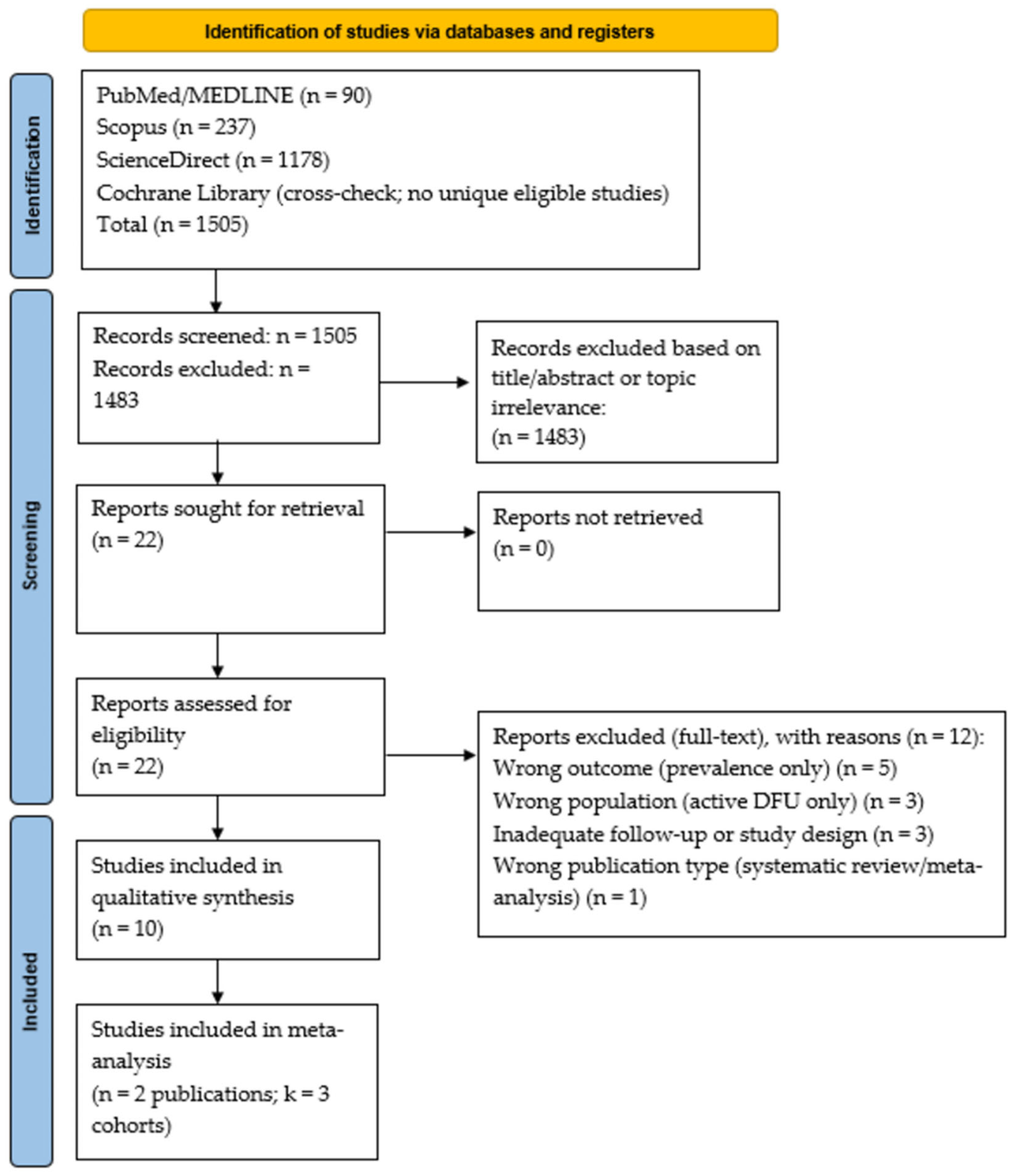
4.1. Study Selection
4.2. Study Characteristics
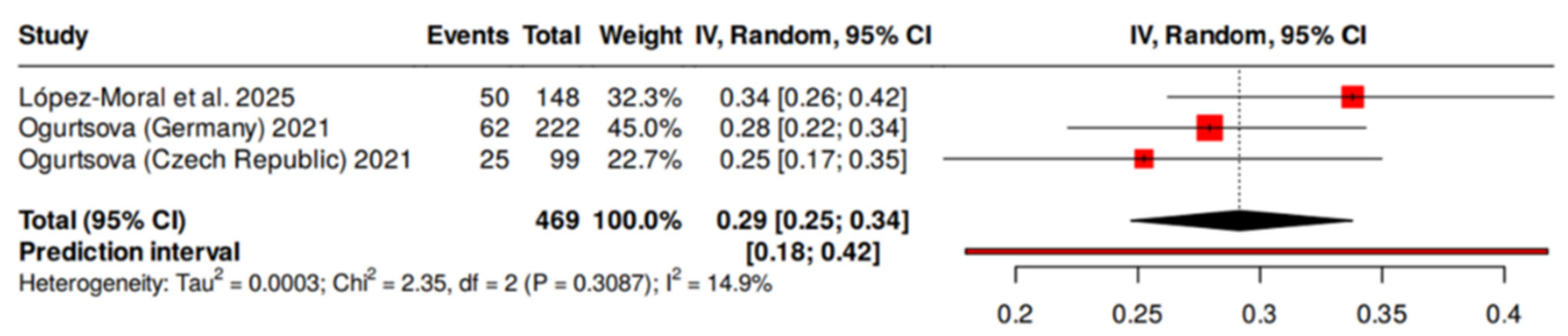
4.3. Pooled 12-Month Recurrence Estimate
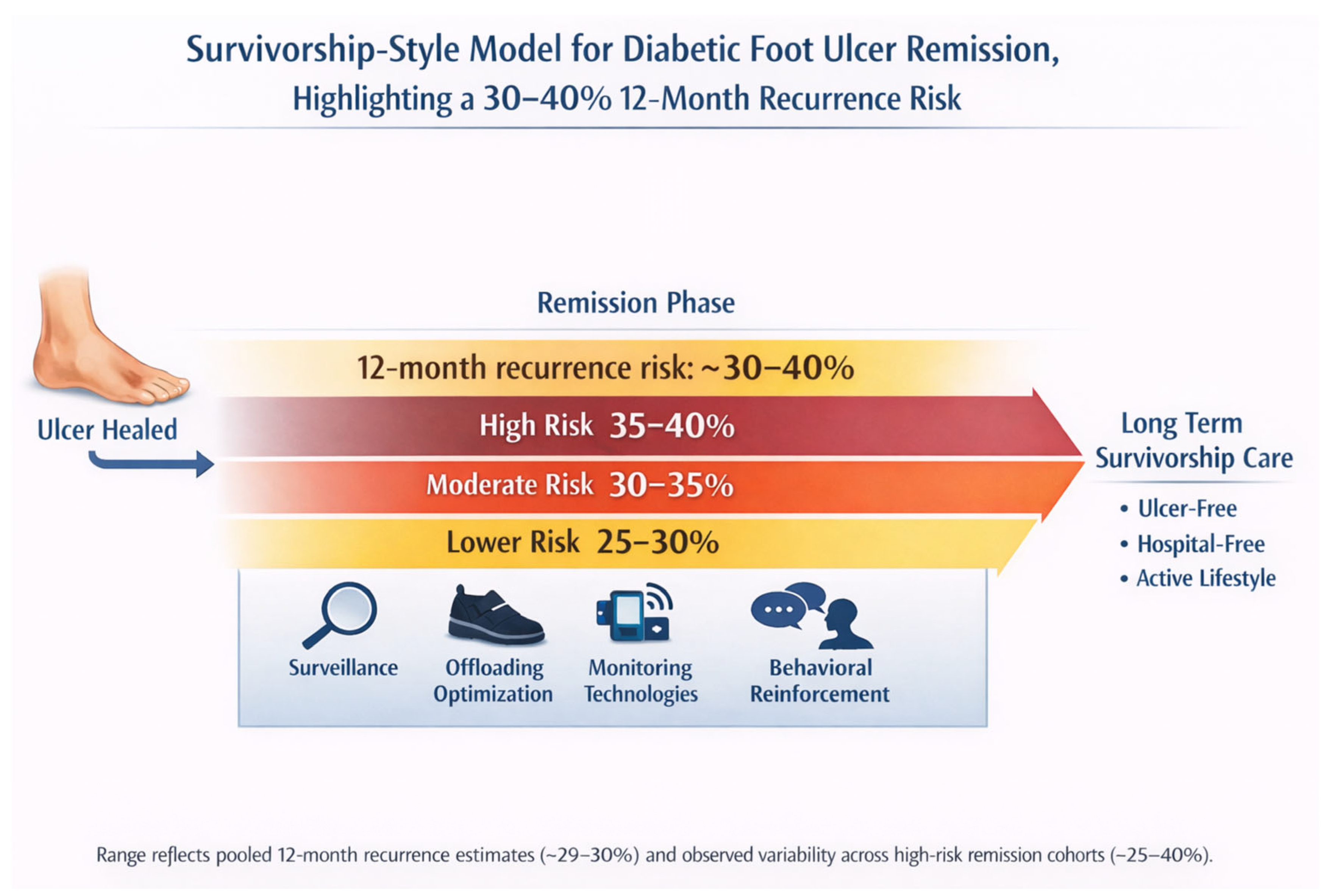
5. Discussion
6. Conclusions
Supplementary Materials
Author Contributions
Funding
Institutional Review Board Statement
Informed Consent Statement
Data Availability Statement
Acknowledgments
Conflicts of Interest
Abbreviations
| CASP | Critical Appraisal Skills Program (RCT checklist) |
| CI | Confidence Interval |
| CPTS | Cumulative Plantar Tissue Stress |
| CLTI | Chronic Limb-Threatening Ischemia |
| DFD | Diabetes-Related Foot Disease |
| DFU | Diabetic Foot Ulcer |
| GRADE | Grading of Recommendations Assessment, Development and Evaluation |
| IWGDF | International Working Group on the Diabetic Foot |
| I2 | Inconsistency Statistic (percentage of variability due to heterogeneity) |
| JBI | Joanna Briggs Institute (cohort appraisal tool) |
| k | Number of Included Studies/Cohorts in a Meta-Analysis |
| KM | Kaplan–Meier (12-month estimate) |
| LOPS | Loss of Protective Sensation |
| MEDLINE | Medical Literature Analysis and Retrieval System Online (via PubMed) |
| N | Sample Size |
| ORC | Oxidized Regenerated Cellulose (in collagen–ORC dressings) |
| PAD | Peripheral Arterial Disease |
| PI | Prediction Interval |
| PRISMA | Preferred Reporting Items for Systematic Reviews and Meta-Analyses |
| Q | Cochran’s Q (heterogeneity statistic) |
| RCT | Randomized Controlled Trial |
| RR | Risk Ratio |
| τ2 | Between-Study variance (random-effects) |
References
- Kiliç, M.; Olgun, N.; Dündar, M.; Celik Advan, S.; Kücük, F.Z.; Okcuoglu, S.; Sahin, S.; Kır Bicer, E.; Ülker, Y.; Sahin, P.; et al. Prevalence, risk level and risk factors of diabetic foot ulcer among adult individuals with diabetes in the Southeastern Anatolia Region of Turkiye. J. Tissue Viabil. 2025, 34, 100839. [Google Scholar] [CrossRef]
- Adiewere, P.; Gillis, R.B.; Imran Jiwani, S.; Meal, A.; Shaw, I.; Adams, G.G. A systematic review and meta-analysis of patient education in preventing and reducing the incidence or recurrence of adult diabetes foot ulcers (DFU). Heliyon 2018, 4, e00614. [Google Scholar] [CrossRef] [PubMed]
- Alahakoon, C.; Singh, T.P.; Galappaththy, C.; Charles, J.; Fernando, M.; Lazzarini, P.; Moxon, J.V.; Golledge, J. Risk Factors for Hospital Re-admission for Diabetes Related Foot Disease: A Prospective Cohort Study. Eur. J. Vasc. Endovasc. Surg. 2023, 66, 221–228. [Google Scholar] [CrossRef] [PubMed]
- Shih, C.D.; Scholten, H.J.; Ripp, G.; Srikanth, K.; Smith, C.; Ma, R.; Fu, J.; Reyzelman, A.M. Effectiveness of a Continuous Remote Temperature Monitoring Program to Reduce Foot Ulcers and Amputations: Multicenter Postmarket Registry Study. JMIR Diabetes 2024, 9, e46096. [Google Scholar] [CrossRef]
- Ogurtsova, K.; Morbach, S.; Haastert, B.; Dubský, M.; Rümenapf, G.; Ziegler, D.; Jirkovska, A.; Icks, A. Cumulative long-term recurrence of diabetic foot ulcers in two cohorts from centres in Germany and the Czech Republic. Diabetes Res. Clin. Pract. 2021, 172, 108621. [Google Scholar] [CrossRef]
- Armstrong, D.G.; Todd, W.F.; Lavery, L.A.; Harkless, L.B.; Bushman, T.R. The natural history of acute Charcot’s arthropathy in a diabetic foot specialty clinic. Diabet. Med. 1997, 14, 357–363. [Google Scholar] [CrossRef]
- Armstrong, N.S.; Armstrong, A.A.; Mills, J.L.; Conte, M.S.; Tan, T.W.; Swanson, R.S.; Armstrong, D.G. Three-Year Recurrence in People with Diabetic Foot Ulcers and Chronic Limb Threatening Ischemia Is Comparable to Cancer. Int. Wound J. 2025, 22, e70724. [Google Scholar] [CrossRef]
- Pham, H.; Armstrong, D.G.; Harvey, C.; Harkless, L.B.; Giurini, J.M.; Veves, A. Screening techniques to identify people at high risk for diabetic foot ulceration: A prospective multicenter trial. Diabetes Care 2000, 23, 606–611. [Google Scholar] [CrossRef] [PubMed]
- Bus, S.A.; Sacco, I.C.N.; Monteiro-Soares, M.; Raspovic, A.; Paton, J.; Rasmussen, A.; Lavery, L.A.; van Netten, J.J. Guidelines on the prevention of foot ulcers in persons with diabetes (IWGDF 2023 update). Diabetes Metab. Res. Rev. 2024, 40, e3651. [Google Scholar] [CrossRef]
- López-Moral, M.; García-Madrid, M.; García-Morales, E.; García-Álvarez, Y.; Álvaro-Afonso, F.J.; Lázaro-Martínez, J.L. Comparison of 4, 8, and 12 week screening and foot care frequencies in persons in remission: The DIATIME comparative efficacy study—A randomized clinical trial. Diabetes Res. Clin. Pract. 2025, 230, 112962. [Google Scholar] [CrossRef]
- Armstrong, D.G.; Boulton, A.J.M.; Bus, S.A. Diabetic Foot Ulcers and Their Recurrence. N. Engl. J. Med. 2017, 376, 2367–2375. [Google Scholar] [CrossRef]
- Keukenkamp, R.; Busch-Westbroek, T.E.; Barn, R.; Woodburn, J.; Bus, S.A. Foot ulcer recurrence, plantar pressure and footwear adherence in people with diabetes and Charcot midfoot deformity: A cohort analysis. Diabet. Med. 2021, 38, e14438. [Google Scholar] [CrossRef]
- Armstrong, D.G.; Lavery, L.A. Elevated peak plantar pressures in patients who have Charcot arthropathy. J. Bone Joint Surg. Am. 1998, 80, 365–369. [Google Scholar] [CrossRef]
- Armstrong, D.G.; Lavery, L.A.; Kimbriel, H.R.; Nixon, B.P.; Boulton, A.J. Activity patterns of patients with diabetic foot ulceration: Patients with active ulceration may not adhere to a standard pressure off-loading regimen. Diabetes Care 2003, 26, 2595–2597. [Google Scholar] [CrossRef]
- Abbott, C.A.; Chatwin, K.E.; Foden, P.; Hasan, A.N.; Sange, C.; Rajbhandari, S.M.; Reddy, P.N.; Vileikyte, L.; Bowling, F.L.; Boulton, A.J.M.; et al. Innovative intelligent insole system reduces diabetic foot ulcer recurrence at plantar sites: A prospective, randomised, proof-of-concept study. Lancet Digit. Health 2019, 1, e308–e318. [Google Scholar] [CrossRef]
- Rovers, F.J.; van Netten, J.J.; Busch-Westbroek, T.E.; Aan de Stegge, W.B.; Bus, S.A. Adherence to at-Home Monitoring of Foot Temperatures in People with Diabetes at High Risk of Ulceration. Int. J. Low. Extrem. Wounds 2025, 24, 691–699. [Google Scholar] [CrossRef] [PubMed]
- Hajizadeh, M.; Matijevich, E.; Bray, E.; Minty, E.; Liden, B. Exploring the Value of Continuous Plantar Temperature Monitoring for Diabetic Foot Health Management: Observational, Prospective Cohort Study. JMIR mHealth uHealth 2025, 13, e73187. [Google Scholar] [CrossRef]
- Hulshof, C.M.; van Netten, J.J.; Oosterhof, C.M.; van der Poel, J.; Pijnappels, M.; Bus, S.A. New biomechanical models for cumulative plantar tissue stress assessment in people with diabetes at high risk of foot ulceration. J. Biomech. 2024, 163, 111940. [Google Scholar] [CrossRef] [PubMed]
- Lavery, L.A.; Higgins, K.R.; Lanctot, D.R.; Constantinides, G.P.; Zamorano, R.G.; Armstrong, D.G.; Athanasiou, K.A.; Agrawal, C.M. Home monitoring of foot skin temperatures to prevent ulceration. Diabetes Care 2004, 27, 2642–2647. [Google Scholar] [CrossRef] [PubMed]
- Page, M.J.; McKenzie, J.E.; Bossuyt, P.M.; Boutron, I.; Hoffmann, T.C.; Mulrow, C.D.; Shamseer, L.; Tetzlaff, J.M.; Akl, E.A.; Brennan, S.E.; et al. The PRISMA 2020 statement: An updated guideline for reporting systematic reviews. BMJ 2021, 372, n71. [Google Scholar] [CrossRef]
- Critical Appraisal Skills Programme (CASP). CASP Randomised Controlled Trial Checklist. Available online: https://casp-uk.net/ (accessed on 30 January 2026).
- Joanna Briggs Institute. Critical Appraisal Checklist for Cohort Studies. JBI, 2017. Available online: https://jbi.global/ (accessed on 30 January 2026).
- Schünemann, H.; Brożek, J.; Guyatt, G.; Oxman, A. (Eds.) GRADE Handbook for Grading the Quality of Evidence and the Strength of Recommendations; Updated October 2013. Available online: https://gradepro.org/handbook/ (accessed on 30 January 2026).
- Fekete, J.T.; Győrffy, B. MetaAnalysisOnline.com: Web-Based Tool for the Rapid Meta-Analysis of Clinical and Epidemiological Studies. J. Med. Internet Res. 2025, 27, e64016. [Google Scholar] [CrossRef]
- Akturk, A.; van Netten, J.J.; Scheer, R.; Vermeer, M.; van Baal, J.G. Ulcer-free survival days and ulcer healing in patients with diabetic foot ulcers: A prospective cohort study. Int. Wound J. 2019, 16, 1365–1372. [Google Scholar] [CrossRef]
- Kitano, T.; Sakakibara, S.; Kitano, I.; Tsuji, Y.; Takekawa, A.; Terashi, H. Long-term Recurrence Risk of Diabetic Foot Ulcers After Healing: A 5-Year Retrospective Cohort Study on the Influence of Hemodialysis and Amputation Levels. Int. J. Low. Extrem. Wounds 2025, 15347346251315220. [Google Scholar] [CrossRef] [PubMed]
- Fournier, C.; Singbo, N.; Morissette, N.; Thibeault, M.M. Outcomes of Diabetic Foot Ulcers in a Tertiary Referral Interdisciplinary Clinic: A Retrospective Canadian Study. Can. J. Diabetes 2021, 45, 255–260. [Google Scholar] [CrossRef]
- Tan, T.-W.; Shih, C.-D.; Concha-Moore, K.C.; Diri, M.M.; Hu, B.; Marrero, D.; Zhou, W.; Armstrong, D.G. Disparities in outcomes of patients admitted with diabetic foot infections. PLoS ONE 2019, 14, e0211481. [Google Scholar] [CrossRef]
- Keukenkamp, R.; van Netten, J.J.; Busch-Westbroek, T.E.; Bus, S.A. Custom-made footwear designed for indoor use increases short-term and long-term adherence in people with diabetes at high ulcer risk. BMJ Open Diabetes Res. Care 2022, 10, e002593. [Google Scholar] [CrossRef] [PubMed]
- Bus, S.A.; aan de Stegge, W.B.; van Baal, J.G.; Busch-Westbroek, T.E.; Nollet, F.; van Netten, J.J. Effectiveness of at-home skin temperature monitoring in reducing the incidence of foot ulcer recurrence in people with diabetes: A multicenter randomized controlled trial (DIATEMP). BMJ Open Diabetes Res. Care 2021, 9, e002392. [Google Scholar] [CrossRef]
- Chatwin, K.E.; Abbott, C.A.; Rajbhandari, S.M.; Reddy, P.N.; Bowling, F.L.; Boulton, A.J.M.; Reeves, N.D. An intelligent insole system with personalised digital feedback reduces foot pressures during daily life: An 18-month randomised controlled trial. Diabetes Res. Clin. Pract. 2021, 181, 109091. [Google Scholar] [CrossRef]
- Vedhara, K.; Brewin, D.; Game, F.; Sheehan, C.; Ayling, K.; Bradbury, K.; Slodkowska-Barabasz, J.; Joseph, J.; Hart, R.; Mitchell, N.; et al. The REDUCE Intervention: The Development of a Person-Centred Cognitive Behavioural Intervention to Improve Ulcer Outcomes in People at Risk of Diabetic Foot Ulceration. Health Expect. 2025, 28, e70434. [Google Scholar] [CrossRef] [PubMed]



| Author, Year | Population | Methods | 12-Month Recurrence Rate (or Follow-up Data) | Key Findings (Recurrence/Prevention) |
|---|---|---|---|---|
| Hajizadeh, M., et al., 2025 [17] | 43 high-risk patients with peripheral neuropathy and a history of a previous plantar foot ulcer. | 90-day observational, prospective cohort study using continuous plantar temperature monitoring insoles. | N/A (90-day study). | This study critiques how recurrence is prevented. It found that 82% of intraday temperature asymmetry signals were nonstationary and 44% of these fluctuated above and below the 2.2 °C hotspot threshold, suggesting that once-daily measurements are unreliable and risk false-positives/negatives. |
| Rovers, F.J., et al., 2025 [16] | 151 high-risk participants in the enhanced therapy arm of the DIATEMP trial. | 18-month cohort analysis assessing adherence to at-home daily foot temperature monitoring. | Of 83 patients with a hotspot, 29.1% (44 participants) developed an ulcer during the 18-month follow-up | A total of 94 patients (62.3%) adherent to measuring foot temperatures at 1–3 months vs. 4–18: 118 (78.1%) versus 78 (57.4%; p < 0.001). |
| Kilic, M., et al., 2025 [1] | 357 adult individuals with diabetes. | Multi-centered descriptive cross-sectional study. | This is a prevalence study, not a post-remission recurrence study. | DFU prevalence was 17.1% (95% CI 13.2–21.5). In regression analysis, peripheral arterial disease, history of ulcer, edema, and interdigital fungus were all linked to higher DFU risk (ORs ≈ 3.78, 26.1, 9.78, and 5.28), with especially strong effects for edema and prior ulcer. |
| Shih, C.D., et al., 2024 [4] | 115 high-risk patients; 52.2% had a history of ulcers. | Retrospective, multi-center, before-and-after registry study of a continuous remote temperature monitoring (smart sock). | Data is reported as a rate per patient-year, not a 12-month cohort percentage. | The continuous remote monitoring program resulted in a 68% relative risk reduction in the foot ulceration rate. It also reduced the amputation rate by 83% and the hospitalization rate by 63%. |
| Hulshof, C.M., et al., 2024 [18] | 52 high-risk patients with diabetes. | Cross-sectional study to develop and compare biomechanical models for cumulative plantar tissue stress (CPTS). | N/A (biomechanical modeling study). | This study identifies a key mechanism for recurrence. It found that standing (both barefoot and shod) is a major contributor to CPTS and must be included in risk models, not just walking strides. Barefoot walking (39%) and barefoot standing (31%) were the largest contributors. |
| Alahakoon, C., et al., 2023 [3] | 190 patients admitted to hospital for DFD (diabetes-related foot disease). | Prospective cohort study with 12-month follow-up after hospital admission. | 52.6% (100 participants) were re-admitted to the hospital for DFD within 12 months. | The 1-year DFD-related hospital re-admission rate after a DFD-related admission is extremely high (52.6%). Absent pedal pulses and Loss of Protective Sensation (LOPS) were the only independent risk factors, each doubling the risk of re-admission. |
| Keukenkamp, R., et al., 2021 [12] | 20 patients with Charcot midfoot deformity (and ulcer history) vs. 118 non-Charcot high-risk patients. | 18-month cohort analysis (from DIAFOS trial) comparing plantar pressure and footwear adherence. | 40% (Charcot) and 47% (non-Charcot) ulcerated over 18 months. | Patients with Charcot had exceptionally high adherence to their custom footwear (94.4% at-home). Despite this, their 18-month recurrence rate remained high (40%) and was not statistically different from the non-Charcot group (47%). |
| Abbott, C.A., et al., 2019 [15] | 58 high-risk patients with peripheral neuropathy and a recent history of plantar foot ulceration. | 18-month prospective RCT of an intelligent insole (providing real-time pressure alerts) vs. a control (non-alerting) insole. | Not reported as a 12-month rate (18-month follow-up). | Real-time pressure alerts reduced DFU site incidence (ulcers per person-day) by 71% over 18 months. For patients with good adherence (n = 40), the reduction was 86%. |
| Author, Year | Population | Methods | 12-Month Recurrence Rate (or Follow-up Data) | Key Findings (Recurrence/Prevention) |
|---|---|---|---|---|
| López-Moral, M., et al., 2025 [10] | 148 high-risk patients in remission with a healed plantar foot ulcer. | Randomized controlled trial (RCT) comparing 4, 8, and 12-week screening for prevention of plantar DFUs and remission. | 33.8% overall 1-year recurrence 18 (18.4%) (4-week group) 14 (28.6%) (8-week group) 27 (46%) (12-week group) | More frequent (4-week) screening and podiatric care intervals significantly reduced 1-year DFU recurrence rates compared to 8 or 12-week intervals. |
| Ogurtsova, K., et al., 2021 [5] | 321 patients (222 German, 99 Czech) with an active DFU who entered remission. | Prospective long-term follow-up of two distinct cohorts. | 28% (German cohort) 25% (Czech cohort). | 1-year crude cumulative recurrence was 25–28%. The risk was significantly higher for patients having a consecutive ulcer compared to those healing their first-ever ulcer. |
| Study/Cohort | How Remission/Healing Was Defined | How Baseline (Time Zero) Was Set |
|---|---|---|
| López-Moral, M., et al., 2025 [10] | International Working Group on the Diabetic Foot risk 3; in remission with a healed plantar DFU | Baseline at trial entry; healed at exam (active ulcer excluded) |
| Ogurtsova, K., et al., 2021 GER [5] | Full epithelialization, closed ≥4 weeks | Baseline at documented healing date (or unilateral major amputation as endpoint) |
| Ogurtsova, K., et al., 2021 CZ [5] | Full epithelialization, closed ≥6 weeks | Baseline at documented healing date; if not seen, first patient-reported ulcer-free date used (10–15%) |
Disclaimer/Publisher’s Note: The statements, opinions and data contained in all publications are solely those of the individual author(s) and contributor(s) and not of MDPI and/or the editor(s). MDPI and/or the editor(s) disclaim responsibility for any injury to people or property resulting from any ideas, methods, instructions or products referred to in the content. |
© 2026 by the authors. Licensee MDPI, Basel, Switzerland. This article is an open access article distributed under the terms and conditions of the Creative Commons Attribution (CC BY) license.
Share and Cite
Theodorakopoulos, G.; Armstrong, D.G. The First Year of Remission: A Systematic Review and Meta-Analysis of 12-Month Diabetic Foot Ulcer Recurrence. Diabetology 2026, 7, 61. https://doi.org/10.3390/diabetology7030061
Theodorakopoulos G, Armstrong DG. The First Year of Remission: A Systematic Review and Meta-Analysis of 12-Month Diabetic Foot Ulcer Recurrence. Diabetology. 2026; 7(3):61. https://doi.org/10.3390/diabetology7030061
Chicago/Turabian StyleTheodorakopoulos, George, and David G. Armstrong. 2026. "The First Year of Remission: A Systematic Review and Meta-Analysis of 12-Month Diabetic Foot Ulcer Recurrence" Diabetology 7, no. 3: 61. https://doi.org/10.3390/diabetology7030061
APA StyleTheodorakopoulos, G., & Armstrong, D. G. (2026). The First Year of Remission: A Systematic Review and Meta-Analysis of 12-Month Diabetic Foot Ulcer Recurrence. Diabetology, 7(3), 61. https://doi.org/10.3390/diabetology7030061