
Article

Impact of Cumulative Social Determinants of Health on Odds of Diabetes Incidence in US Veterans

by
Lewis J. Frey
1,*,†,
Mulugeta Gebregziabher
2,3,†,
Kinfe G. Bishu
2,4,*,
Brianna Youngblood
2,
Jihad S. Obeid
3,
Jianlin Shi
5,
Patrick R. Alba
5 and
Chanita Hughes Halbert
6,7
1
Department of Internal Medicine, Division of Gastroenterology and Hepatology, Saint Louis University, Saint Louis, MO 63104, USA
2
Health Equity and Rural Outreach Innovation Center (HEROIC), Ralph H. Johnson VAMC, 109 Bee Street, Charleston, SC 29401, USA
3
Department of Public Health Sciences, Medical University of South Carolina, Charleston, SC 29425, USA
4
Department of Medicine, Medical University of South Carolina, Charleston, SC 29425, USA
5
VA Informatics and Computing Infrastructure, George E. Wahlen VAMC, Salt Lake City, UT 84148, USA
6
Department of Population and Public Health Sciences, University of Southern California, Los Angeles, CA 90032, USA
7
USC Norris Comprehensive Cancer Center, University of Southern California, Los Angeles, CA 90033, USA
*
Authors to whom correspondence should be addressed.
These authors contributed equally to this work.
Diabetology 2026, 7(2), 37; https://doi.org/10.3390/diabetology7020037
Submission received: 18 December 2025 / Revised: 23 January 2026 / Accepted: 5 February 2026 / Published: 11 February 2026

Abstract

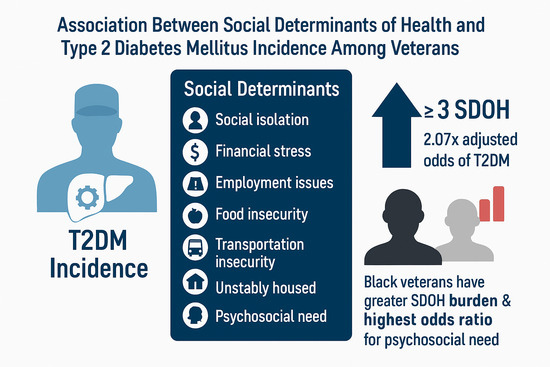
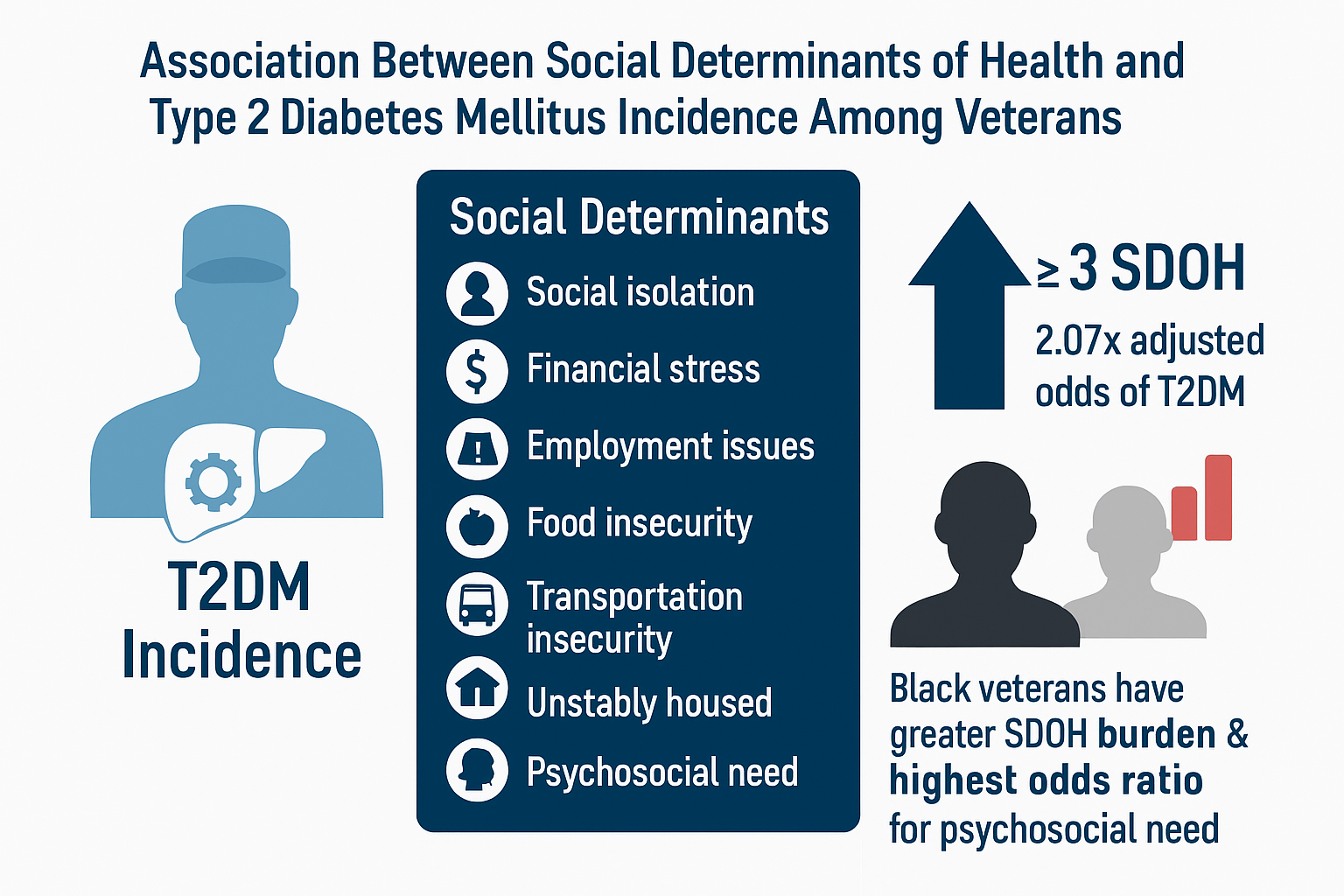
Background: Type 2 diabetes mellitus (T2DM) is a chronic condition that has been attributed to social factors; however, the cumulative effect of social determinants of health (SDOH) on T2DM incidence is not known. Objective: The aim of the present study was to examine the association between T2DM and the cumulative burden of multiple SDOH. Design: The study is a retrospective cohort study with a baseline between 2008 and 2009 and a ten-year follow-up between 2010 and 2019. Setting: The study was conducted using data from the United States Veterans Health Administration (VHA). Participants: Out of 10,537,027 patients treated in the VHA between 2010 and 2019, 6,518,102 patients were selected who had no evidence of T2DM or Elixhauser comorbidities at baseline (2008–2009). Measurements: Over 10 years following baseline, the exposure consisted of seven types of SDOH occurring in structured data: social isolation, financial stress, employment issues, food insecurity, transportation insecurity, unstably housed, and psychosocial need. Incidence of T2DM in the ten-year follow-up window was the primary outcome. Results: Veterans with ≥3 SDOH doubled their adjusted odds of T2DM (2.07; CI: 2.05–2.09). There were significant racial differences in cumulative SDOH, with 8.8% of Black individuals having the highest burden of ≥3 SDOH compared with 3.8% of White individuals. Transportation insecurity, psychosocial need, and financial stress significantly increased the odds of T2DM across all racial and ethnic groups. Black individuals had the highest T2DM odds ratio for psychosocial need (OR = 1.58; CI: 1.56, 1.60). Limitations: The Veteran population is predominantly male, limiting generalization to the wider population. Conclusions: With each additional SDOH burden, the odds of T2DM increased, and ≥3 SDOH doubled the odds. The cumulative SDOH burden and associated disparities warrant investigation to reduce T2DM incidence.

Graphical Abstract

1. Introduction

Social determinants of health (SDOH) capture components of behavioral, economic, and social experiences that impact people’s lives and have been shown to have significant effects on the chronic disease of type 2 diabetes mellitus (T2DM) [1,2,3,4]. T2DM affects over 37 million Americans [5], and is 2.5 times more likely in United States Veterans than in the general population, with approximately 25% of Veterans having T2DM [6]. Prevalence of T2DM is higher in Hispanic and Black Veterans compared with White Veterans [7]. Despite the Veterans Healthcare Administration (VHA) Medical Centers being part of an equal access healthcare system that establishes policies to reduce disparities, racial disparities continue to exist [8,9]. For the US Veteran population, there are significant racial disparities in clinical outcomes, with Black Veterans having a higher mortality rate with a diagnosis of T2DM and having an increased risk of cardiovascular-related mortality [8,9]. Given that the VHA has tracked SDOH for over a decade [10], it is possible to study the association between SDOH and T2DM in a large cohort with a racially and ethnically diverse population. Understanding the association between SDOH and health outcomes is important to inform policy, program design, and manage limited resources.
There are several studies that track the impact of specific SDOH on T2DM outcomes. Brady et al. [11] examined the odds ratio of having diabetes and reporting a social need. Using a screen of multiple SDOH, they found higher odds of those with diabetes reporting transportation insecurity, food insecurity, housing instability, and lack of companionship [11]. Other studies examining food insecurity have found relationships between poor diabetes glucose control and food insecurity [4,12]. Housing instability has also been associated with poor glucose control, with differences across racial groups [12,13,14]. Other studies have found that patients with transportation insecurity are more likely to have food insecurity and unmet healthcare needs [15]. Combined measures show an impact on glycemic control in diabetes, with the strongest cluster including housing security, material needs, and lack of transportation contributing the largest risk score, increasing the likelihood of uncontrolled T2DM [16]. Such findings indicate that studies are needed that provide information on SDOH cumulative burden instead of only specific SDOH on the risk of T2DM.
The burden of having multiple SDOH associated with T2DM is not well understood, especially for racial and ethnic minorities. Research tends to focus on the evaluation of specific types of individual SDOH (e.g., food insecurity) [17], and the results are mixed, with White, Black, and Hispanic individuals having larger or smaller risk depending upon the study and type of SDOH [18,19]. Some of the differences in SDOH, particularly if we examine combinations of types of SDOH, could reflect structural racism, which consists of interconnected systems in a society that reinforce inequality and collectively increase odds of adverse health outcomes [20,21]. The World Health Organization (WHO) conceptual framework for SDOH has been used to relate structural racism as an antecedent to SDOH that impacts diabetes outcomes [22,23]. The framework includes structural determinants such as social and public policies that influence SDOH, which aligns with VHA goals of establishing policies to reduce health disparities [24]. The comprehensive dataset on Veterans with social needs provides a consistent resource to examine both specific and cumulative odds of SDOH stratified by race and ethnicity that can inform policy to reduce the burden of SDOH and associated disparities.
In the VHA, SDOH has been associated with mortality of Veterans [25], and there is evidence of cumulative effects from SDOH on suicide ideation and attempts, with risk increasing from an accumulation of SDOH burden [10]. Even though interventions that target SDOH to improve T2DM outcomes are an active area of research [26], the cumulative burden of different types of SDOH on the incidence of T2DM is not well understood and needs to be investigated. The present study extends work in the field by examining the incidence of T2DM on a large scale with sufficient data to examine race and ethnicity subgroups over a ten-year observational period using the VHA infrastructure for tracking SDOH. This study is timely, given that programs are currently being implemented to address different SDOH [27].

2. Methods

Data Source: A retrospective cohort of Veterans 18 years or older, with and without T2DM, was constructed using the data resources of the VA Informatics and Computing Infrastructure (VINCI). This data were extracted from the VHA Corporate Data Warehouse (CDW) using SQL Server Management Studio 20 and include records from 172 medical centers national level.
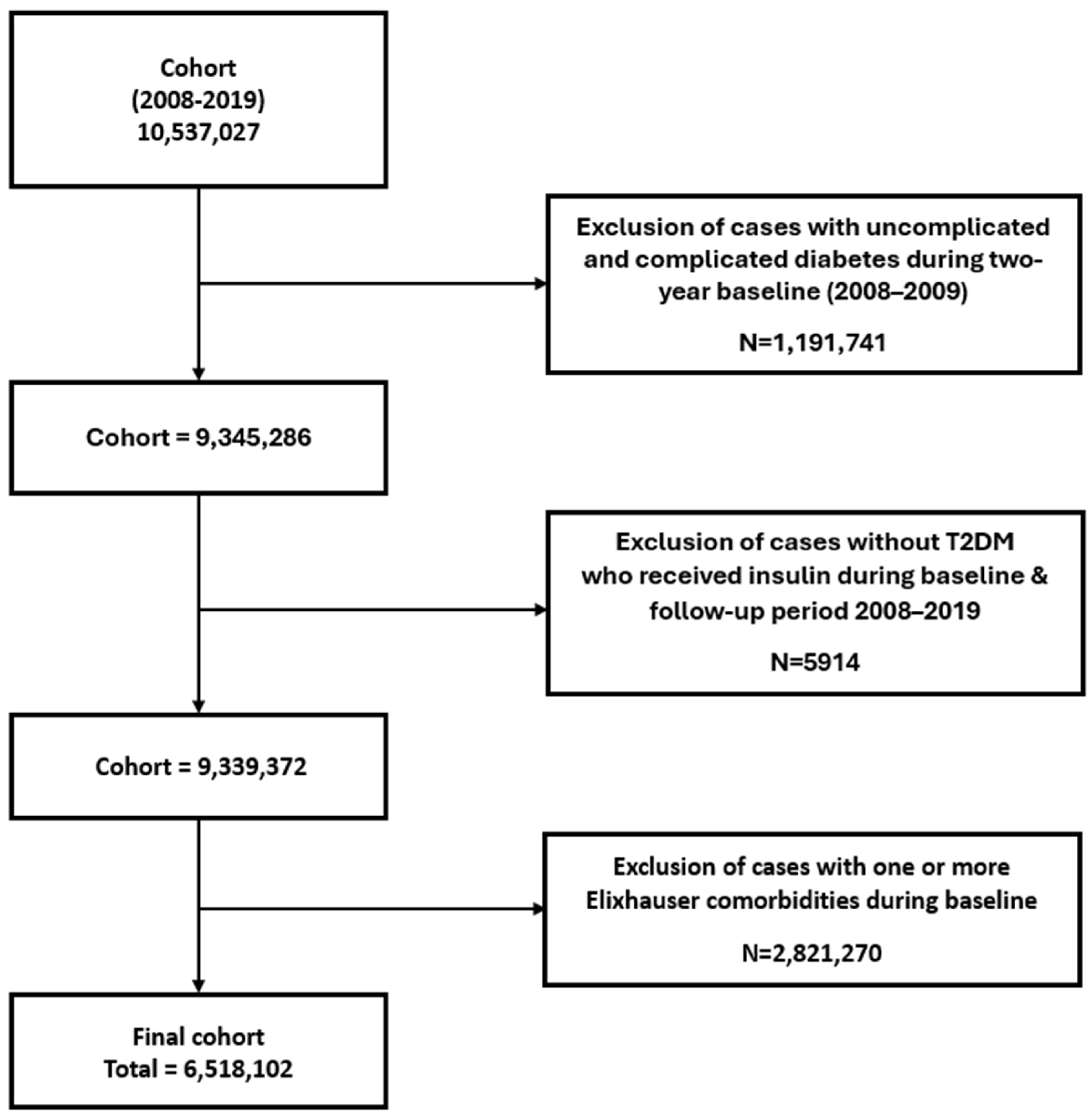
Study Population: Primary care patients were selected from the national VA population who were treated in the VHA between 1 January 2008 and 31 December 2019 and had no evidence of T2DM during a baseline window starting 1 January 2008 through 31 December 2009. The baseline cohort was defined between 1 January 2008 and 31 December 2009, and the follow-up period extended from 1 January 2010 through 31 December 2019. Out of the total patient cohort of 10,537,027 individuals (T2DM = 2,418,345 and non-T2DM = 8,118,682), we excluded 1,191,741 patients from the diabetes group who had uncomplicated or complicated diabetes at baseline, and 31,719 patients from the non-diabetes group who had uncomplicated or complicated diabetes at baseline or during follow-up. In addition, we excluded 5914 non-diabetic patients who received insulin at baseline or during follow-up. The purpose of excluding individuals with a diabetes diagnosis during the baseline window was to rule out any prevalent cases of T2DM (identified via ICD-9 codes or medications). Furthermore, we excluded patients with one or more Elixhauser comorbidities during the baseline window of 2008–2009. The diabetes incidence was extracted during the follow-up period from 1 January 2010 to 31 December 2019. Finally, a total of 6,518,102 participants were included in the study (see Figure 1). The methods used to construct the cohort were consistent with our prior involvement in establishing other VHA T2DM cohorts [28].
Exposure and Covariates: The primary exposure variables were seven SDOH that include food insecurity, employment issues, financial stress, unstably housed, social isolation, transport insecurity, and psychosocial need that were captured in the 10-year follow-up window. We followed a similar method used by Blosnich and colleagues, consisting of a list of codes, sources of data, and definitions of the adverse SDOH [10]. For details on the sources of social determinants of health, see the Supplementary Materials.
The covariates consisted of demographic and clinical data [29]. Sex was coded as ‘female’ and ‘male’ (reference group). Age was separated into the groups of ≥65 years, 50–64 years, and <50 years (reference group). Race and ethnicity were coded as non-Hispanic Black (hereafter, Black), Hispanic, Other (consisting of Asian, American Indian, Alaskan Native, Native Hawaiian and Other Pacific Island individuals), and non-Hispanic White (hereafter, White), analyzed as reference group given the large number of White individuals in the cohort, according to a previously proposed definition combining Veterans Affairs (VA) and Center for Medicare and Medicaid Services (CMS) data [30]. To code for rurality, we aggregated highly rural and rural census tracks based on population density and commuting patterns and coded them as ‘rural’ and urbanized census track areas defined by the census as ‘urban’ (reference group) [31]. The status of marriage was coded as ‘married’ or ‘non-married’ (reference group). Whether a primary care visit (PCV) occurred in the baseline window was coded with a value of ‘Yes’ or ‘No’ (reference group). Service-connected disability (SCD) was coded as ‘Yes’ if the percentage of military-related disability was greater than ≥50% and ‘No’ (reference group) if less than 50%. The status of smoking was coded as ‘smoker’ or ‘non-smoker’ (reference group).
Outcome: A diagnosis of T2DM consisting of two or more ICD9/10 codes of diabetes (250.x0, 250.x2, 357.2, 362.0, or 366.41, E11*) occurring in the follow-up window was the primary outcome. The outcome was coded as a binary value: T2DM = 1 and no-T2DM = 0 (reference group).
Statistical Analysis: Descriptive statistics were computed for each of the demographic and adverse SDOH variables. The distribution of categorical variables between the outcome of T2DM and no-T2DM was compared using chi-square tests. To account for the correlation of repeated measures within individuals and clustering, we used generalized estimating equation (GEE) [32] with an exchangeable correlation structure for estimating the association between the outcome (diabetes status) and the primary exposure (adverse social determinants of health) with adjustment for covariates. GEE was used to model the cumulative burden of SDOH using a category variable denoting burden stratified by race and ethnicity. A separate GEE model was used to assess the individual SDOH stratified by race and ethnicity. Odds ratios (OR) and 95% confidence intervals (CIs) were computed.
The variance inflation factor (VIF) was used to assess collinearity, and the correlation structure was assessed for goodness of fit using the quasi-likelihood information criterion (QIC) [33,34]. Furthermore, we did a sensitivity analysis by fitting the same models for the cohort with and without Elixhauser comorbidities at baseline. The results were consistent between the main analysis and the sensitivity analysis. A p-value of 0.05 was used for statistical significance, and Stata (ver. 17) was used to conduct analysis, including the xtgee procedure [35].
Role of funding source: The funders of the study had no role in the study design, data collection, analysis, interpretation, writing, or submission of the report.

3. Results

The study population included a total of 6,518,102 patients with a T2DM incidence rate of 12.8% over the 10-year follow-up window (Table 1). All adverse SDOH were more likely among those who developed T2DM. Black individuals had the highest cumulative burden of three or more SDOH at 8.8%, compared with 5.4% for Hispanic, 4.3% for Other, and 3.8% for White individuals. All the GEE logistic regression models in the tables present the variables in the adjusted logistic regression model for the odds of first occurrence of diabetes over the 10-year follow-up window (diabetes status) adjusted for the following demographic and clinical characteristics covariates: race, ethnicity, sex, rurality, age, marital status, PCV, SCD, and smoking status.
Table 2 depicts the adjusted GEE logistic regression models examining how diabetes status differs across SDOH burden, race and ethnicity; the odds of having T2DM for patients who had one adverse SDOH were 1.5 times higher (OR = 1.50; CI: 1.49, 1.51), and the odds for patients who had three or more (≥3) adverse SDOH were 2.07 times higher (OR = 2.07; CI: 2.05; 2.09) than for those who had no adverse SDOH. Black patients had 1.55 times higher odds of T2DM compared with White patients, while Hispanic and Other patients had odds 1.47 and 1.35 times higher, respectively, than White patients. Patients between 50 and 64 years had 4.13 times higher (OR = 4.13; CI: 4.11, 4.16), and patients 65 or older had 3.35 times higher (OR = 3.35; CI: 3.32, 3.37) odds of T2DM compared with patients younger than 50 years old. When stratified by race and ethnicity, White patients with ≥3 SDOH had 2.20 times higher odds (OR = 2.20; CI: 2.16, 2.23), and Black patients had 1.80 times higher odds (OR = 1.80; CI: 1.76, 1.83) compared with the reference group of no SDOH.
Table 3 depicts the adjusted logistic regression models for the seven types of SDOH by race and ethnicity. All seven types of SDOH were significantly associated with T2DM incidence over the ten-year window, with the top three being transportation insecurity (1.60; CI: 1.58–1.62), psychosocial need (1.55; CI: 1.54–1.56), and financial stress (1.21; CI: 1.19–1.22). Adjusting for race and ethnicity on SDOH, Black patients had 58% increased odds of T2DM, and Hispanic patients had 47% increased odds compared to White patients. Compared to no transportation insecurity, patients with transportation insecurity had the largest increased odds of T2DM across race and ethnicity, with both Hispanic (1.76; CI: 1.68–1.85) and Other (1.76; CI: 1.64–1.88) patients having significantly higher odds of T2DM compared with Black (1.60, CI: 1.56–1.64) and White (1.57, CI: 1.54–1.59) patients. White patients with financial stress had increased odds of T2DM (1.22; CI: 1.20; 1.24), as well as Black (1.17; CI: 1.15; 1.20) and Hispanic (1.19; CI: 1.14; 1.25) patients; Other patients had the greatest odds (1.27; CI: 1.18; 1.35). Patients with psychosocial needs had higher odds of T2DM, with Black patients having the highest odds ratio (OR = 1.58; CI: 1.56; 1.60). Social isolation increases odds of T2DM across all racial and ethnic groups and is largest in White (1.21; CI: 1.18–1.23) patients, compared with Black (1.10; CI: 1.07–1.14) and Hispanic (1.06; CI: 1.00–1.13) patients. Food insecurity increased the odds of T2DM for White (1.21; CI: 1.18–1.26) and Hispanic (1.16; CI: 1.07–1.27) patients, while there was no significant change in odds for Black (1.03; CI: 0.89–1.07) patients. Other (1.16; CI: 1.11; 1.21) patients who were unstably housed had the largest odds of T2DM compared with White, Black, and Hispanic patients. The SDOH of unstably housed increased the odds of T2DM for White (1.11, CI: 1.10–1.12) and Hispanic (1.09; CI: 1.06–1.12) patients, while Black patients had lower odds of T2DM (0.89; CI: 0.87–0.90) when unstably housed.
Table 4 shows the cumulative burden of SDOH by race and ethnicity. Compared with other groups, Black patients had consistently higher rates of SDOH burden across all levels.

4. Discussion

T2DM is one of the most prevalent chronic conditions among adults in the US [5,36]. Previous research has shown that one out of four Veterans have this disease [6]. In evaluating the cumulative burden of SDOH, we found that the odds of T2DM increased with a greater number of SDOH in a national sample of Veterans from diverse racial/ethnic backgrounds; specifically, the odds of T2DM increased with the number of SDOH reported by patients. For instance, patients who had ≥3 SDOH had doubled odds of T2DM compared to those who had no social risk factors. With respect to individual SDOH, T2DM incidence was most strongly associated with transportation insecurity, psychosocial issues, financial stress, and social isolation. We also found significant racial/ethnic disparities in the cumulative number of SDOH among patients. Black individuals were most likely to have ≥3 SDOH (8.8%) compared to White (3.8%) and Hispanic (5.4%) individuals. Disparities in exposure to SDOH among the racial and ethnic groups are likely a reflection of differences in the lived experiences among Black, White, Hispanic, and Other individuals. Recent research has shown that Black prostate cancer patients are more likely than White patients to live in geographic areas that have high levels of social deprivation [37]. Recent reports describe the connection between structural racism, SDOH, and diabetes outcomes based on structural determinants in the World Health Organization (WHO) SDOH Framework and SDOH of health equity [22,23,38,39]. The WHO Framework focuses on structural determinants, including policy that can reinforce structural racism and its influence on SDOH that impact health outcomes. The WHO Framework can be used to support the VHA’s commitment to eliminating racial disparities and achieving equity across all vulnerable groups through enacting policies that reduce structural determinants that reinforce structural racism and associated SDOH [24]. Our findings highlight the importance of social factors in relation to T2DM incidence and describe how they are associated with the odds of occurrence. The findings emphasize the wider context in which the social factors are intimately entwined with diabetic complications and outcomes. For example, a range of studies have shown social factors impacting diabetic foot outcomes and degraded quality of life [40,41,42]. Current guidelines of the CMS for screening patients for SDOH include identifying multiple types of unmet needs [43]. Existing CMS tools ask patients about their transportation, housing, financial strain, food insecurity, and other issues [43]. Our findings underscore the importance of understanding the cumulative burden of SDOH among patients. However, we also found that when individual SDOH are stratified by race and ethnicity, there are differences in the prevalence of unmet needs, and the odds ratios of T2DM also differ across groups. For instance, among Hispanic individuals, the odds of T2DM were 1.76 (CI: 1.68, 1.85) for patients who had unmet transportation needs, whereas the odds were 1.6 (CI: 1.56, 1.64) among Black and 1.57 (CI: 1.54, 1.59) among White patients. Similarly, among Black patients, the odds of T2DM were 1.58 (CI: 1.56, 1.60) for patients who had unmet psychosocial needs, whereas odds were 1.55 (CI: 1.54, 1.57) among White patients and 1.47 (CI: 1.44, 1.51) among Hispanic patients. The finding that Black Veterans, when unstably housed, had lower odds of incident T2DM could be influenced by such factors as the variability of SDOH coding, survivor bias, or different usage patterns of VHA programs. Future research should examine such factors, given the different relationships between SDOH and T2DM across race and ethnicity groups. Overall, the findings from the present study underscore the importance of developing integrated programs that address more than one SDOH simultaneously to address the cumulative burden of these factors on T2DM.
An important first step in developing integrated approaches to address the cumulative burden of SDOH among Veterans is to ensure that current programs are used and expanded to those who are at increased risk for developing chronic conditions such as T2DM based on their SDOH risk profile. For instance, wartime Veterans who are 65 and older can qualify for pension and transportation benefits to attend healthcare visits [44,45]; however, Veterans who are 50–64 are less likely to be eligible for this benefit. Policies about eligibility requirements are based on many different factors (e.g., cost-effectiveness); to our knowledge, SDOH are not currently considered as part of establishing policies for program eligibility. Our findings allude to the importance of considering SDOH as part of determining eligibility for socially informed programs. Food insecurity is another actionable leverage point that could be addressed in the VHA. Hager et al. [26] found that when healthcare providers gave produce prescriptions that included a monthly food stipend to those with food insecurity, glucose control improved in a racially mixed population. Our data suggest that implementing this type of program in the VHA could be beneficial and should be assessed across racial and ethnic groups to determine optimum benefit.
Previous research has shown that there are racial/ethnic differences in uptake of public health programs that have been developed to address social factors. For instance, Allen et al. (2016) found that Black individuals who report food insecurity are more likely than White individuals to use the Supplemental Nutrition Assistance Program [46]. Our findings describe the distribution and impact of SDOH at the population level; however, SDOH impact individual patients, and clinicians need to take into consideration the specifics of individual cases when choosing an intervention. Additional research is needed to identify best practices for identifying patient preferences for offering programs to address multiple SDOH.
A limitation of the study is that the population is predominantly male, which limits the generalization of the findings to the wider population. We used ICD codes to identify the outcome of T2DM, and the codes are known to have associated bias [29]. The data on SDOH served as risk factor proxies derived from the International Classification of Diseases (ICD), stop codes, and health factors, all of which are dependent upon the coding system. The variability of SDOH encoding is another limitation of the study and is a caveat that should be taken into consideration when interpreting the results. SDOH were measured during the follow-up period along with the incidence of T2DM, so causality was not assessed; only associations of SDOH with the outcome of T2DM were assessed. Since the SDOH occurred during the ten-year observation period, it is not clear if SDOH got worse after the occurrence of T2DM, resulting in reverse causation. Future research is needed to assess the causal inference of SDOH and T2DM incidence. Those getting treatment in the VHA were included in the study, which could introduce bias since those with more comorbidities get more treatment. Although all patients started with no Elixhauser comorbidities, the selection processes potentially introduced bias. Sensitivity analysis was performed and demonstrated the consistency of the results when patients with comorbidities were included. Veterans can get financial support when unstably housed, which could mitigate effects and cause bias in our study, with more involvement in healthcare of unstably housed patients than in the general population [47,48]. The impact of such programs in the VHA could result in underrepresenting the association of SDOH with T2DM incidence compared with the general population.
A strength of our study is the large retrospective Veteran population that addresses a need in the field to construct models using multiple SDOH adjusted for covariates, including race and ethnicity. Taking these differences into account could result in improved health outcomes and more efficient use of resources in the complex interactions of SDOH that emerge when stratified by race and ethnicity. Additional study is warranted to examine how benefits that address SDOH for Veterans impact T2DM incidence.

5. Conclusions

Our analysis of transportation insecurity, psychosocial need, financial stress, social isolation, food insecurity, employment issues, and unstable housing showed that the burden of SDOH cumulatively was associated with increased odds of T2DM. The result speaks to the need to mitigate the impact of structural racism, given the disparities in minority groups, with Black patients having higher levels of cumulative SDOH burden. The finding of overarching SDOH like transportation insecurity, psychosocial needs, financial stress, and social isolation that affect racial and ethnic groups broadly suggests the need for programs that address combinations of these SDOH to reduce T2DM incidence risk on a wide scale. Our finding that the effects of SDOH on the outcome of T2DM incidence vary by race and ethnicity provides insight into the complex interactions that have been observed in the field. The data and analysis of SDOH tracked over multiple years in the VHA offer information that can be considered when targeting resources to patients, providers, and communities to improve T2DM outcomes. Supporting groups with higher risk in specific SDOH could engage patients in their areas of highest need and potentially increase the efficacy of programs.
In conclusion, our findings regarding differential effects of specific SDOH components on T2DM incidence across racial and ethnic subgroups provide insight into complex interactions that have not been well-defined in the field. In addition, this study of a large national VHA cohort over ten years adds novel evidence that the cumulative burden of multiple SDOH is a strong predictor of T2DM incidence.

Supplementary Materials

The following supporting information can be downloaded at: https://www.mdpi.com/article/10.3390/diabetology7020037/s1, File S1: Sources of social determinates of health; Table S1: ICD-9 and ICD-10 Codes for SDH in VHA databases; Table S2: Health factors for SDH in VHA databases; Table S3: Stop Codes for SDH in VHA databases.

Author Contributions

L.J.F. and C.H.H. conceived the research concept and design of the study. K.G.B. and M.G. contributed to the design and performed statistical analysis. B.Y., J.S.O., J.S. and P.R.A. contributed to the interpretation of the data and results. All authors contributed to the drafting and revisions of the important intellectual content of the manuscript. All authors have read and agreed to the published version of the manuscript.

Funding

This research was funded by Veterans Affairs Health Systems Research Merit Grant 1I01HX003379 (PIs: L.J.F. and M.G.).

Institutional Review Board Statement

The Ralph H. Johnson VA Research and Development Committee and the Medical University of South Carolina institutional review board approved the study, Pro00110786, on the 5 August 2021.

Informed Consent Statement

Our data is de-identified and obtained from medical records without any direct contact with subjects. Thus, our study is exempt from informed consent requirements.

Data Availability Statement

Veterans Affairs policy does not allow the data for the study to be shared publicly. The data is available with the VINCI system and can be accessed with appropriate approvals.

Conflicts of Interest

The authors declare no conflicts of interest.

Abbreviations

AbbreviationDefinition
T2DMType 2 Diabetes Mellitus
SDOHSocial Determinants of Health
VHAVeterans Health Administration
VINCIVA Informatics and Computing Infrastructure
CDWCorporate Data Warehouse
VAVeterans Affairs
CMSCenter for Medicare and Medicaid Services
PCVPrimary Care Visit
SCDService-Connected Disability
GEEGeneralized Estimating Equation
OROdds Ratio
CIsConfidence Intervals
QICQuasi-Likelihood Information Criterion
WHOWorld Health Organization
ICDInternational Classification of Diseases

References

  1. Walker, R.J.; Gebregziabher, M.; Martin-Harris, B.; Egede, L.E. Independent effects of socioeconomic and psychological social determinants of health on self-care and outcomes in Type 2 diabetes. Gen. Hosp. Psychiatry 2014, 36, 662–668. [Google Scholar] [CrossRef]
  2. Walker, R.J.; Gebregziabher, M.; Martin-Harris, B.; Egede, L.E. Quantifying Direct Effects of Social Determinants of Health on Glycemic Control in Adults with Type 2 Diabetes. Diabetes Technol. Ther. 2015, 17, 80–87. [Google Scholar] [CrossRef]
  3. Walker, R.J.; Strom Williams, J.; Egede, L.E. Influence of Race, Ethnicity and Social Determinants of Health on Diabetes Outcomes. Am. J. Med. Sci. 2016, 351, 366–373. [Google Scholar]
  4. Walker, R.J.; Williams, J.S.; Egede, L.E. Pathways between food insecurity and glycaemic control in individuals with type 2 diabetes. Public Health Nutr. 2018, 21, 3237–3244. [Google Scholar] [CrossRef] [PubMed]
  5. Department of Health and Human Services. National Diabetes Statistics Report Estimates of Diabetes and Its Burden in the United States; Centers for Disease Control and Prevention: Atlanta, GA, USA, 2019.
  6. Diabetes Mellitus Federal Health Data Trends [Internet]. Federal Practitioner. Available online: https://www.mdedge.com/fedprac/article/152642/diabetes/diabetes-mellitus-federal-health-data-trends-full (accessed on 12 July 2020).
  7. Liu, Y.; Sayam, S.; Shao, X.; Wang, K.; Zheng, S.; Li, Y.; Wang, L. Prevalence of and Trends in Diabetes Among Veterans, United States, 2005–2014. Prev. Chronic Dis. 2017, 14, E135. [Google Scholar] [CrossRef] [PubMed]
  8. Peterson, K.; Anderson, J.; Boundy, E.; Ferguson, L.; McCleery, E.; Waldrip, K. Mortality Disparities in Racial/Ethnic Minority Groups in the Veterans Health Administration: An Evidence Review and Map. Am. J. Public Health 2018, 108, e1–e11. [Google Scholar]
  9. Wong, M.S.; Hoggatt, K.J.; Steers, W.N.; Frayne, S.M.; Huynh, A.K.; Yano, E.M.; Saechao, F.S.; Ziaeian, B.; Washington, D.L. Racial/Ethnic Disparities in Mortality Across the Veterans Health Administration. Health Equity 2019, 3, 99–108. [Google Scholar] [CrossRef] [PubMed]
  10. Blosnich, J.R.; Montgomery, A.E.; Dichter, M.E.; Gordon, A.J.; Kavalieratos, D.; Taylor, L.; Ketterer, B.; Bossarte, R.M. Social Determinants and Military Veterans’ Suicide Ideation and Attempt: A Cross-sectional Analysis of Electronic Health Record Data. J. Gen. Intern. Med. 2020, 35, 1759–1767. [Google Scholar] [CrossRef]
  11. Brady, E.; Bridges, K.; Murray, M.; Cheng, H.; Liu, B.; He, J.; Woodward, J. Relationship between a comprehensive social determinants of health screening and type 2 diabetes mellitus. Prev. Med. Rep. 2021, 23, 101465. [Google Scholar] [CrossRef] [PubMed]
  12. Berkowitz, S.A.; Meigs, J.B.; DeWalt, D.; Seligman, H.K.; Barnard, L.S.; Bright, O.J.M.; Schow, M.; Atlas, S.J.; Wexler, D.J. Material need insecurities, control of diabetes mellitus, and use of health care resources: Results of the Measuring Economic Insecurity in Diabetes study. JAMA Intern. Med. 2015, 175, 257–265. [Google Scholar] [CrossRef]
  13. Axon, R.N.; Gebregziabher, M.; Dismuke, C.E.; Hunt, K.J.; Yeager, D.; Ana, E.J.S.; Egede, L.E. Differential Impact of Homelessness on Glycemic Control in Veterans with Type 2 Diabetes Mellitus. J. Gen. Intern. Med. 2016, 31, 1331–1337. [Google Scholar] [CrossRef]
  14. Hill-Briggs, F.; Adler, N.E.; Berkowitz, S.A.; Chin, M.H.; Gary-Webb, T.L.; Navas-Acien, A.; Thornton, P.L.; Haire-Joshu, D. Social Determinants of Health and Diabetes: A Scientific Review. Diabetes Care 2020, 44, 258–279. [Google Scholar] [CrossRef]
  15. Verdecias, N.; Garg, R.; Steensma, J.; McQueen, A.; Greer, R.; Kreuter, M.W. Expressed and unexpressed social needs in low-income adults in the. U.S. Health Soc. Care Community 2021, 29, e184–e191. [Google Scholar] [CrossRef]
  16. Wan, W.; Li, V.; Chin, M.H.; Faldmo, D.N.; Hoefling, E.; Proser, M.; Weir, R.C. Development of PRAPARE Social Determinants of Health Clusters and Correlation with Diabetes and Hypertension Outcomes. J. Am. Board. Fam. Med. 2022, 35, 668–679. [Google Scholar] [CrossRef] [PubMed]
  17. Kreuter, M.W.; Thompson, T.; McQueen, A.; Garg, R. Addressing Social Needs in Health Care Settings: Evidence, Challenges, and Opportunities for Public Health. Annu. Rev. Public Health 2021, 42, 329–344. [Google Scholar] [CrossRef]
  18. Kreuter, M.W.; Garg, R.; Li, L.; McNulty, L.; Thompson, T.; McQueen, A.; Luke, A.A. How Do Social Needs Cluster Among Low-Income Individuals? Popul. Health Manag. 2021, 24, 322–332. [Google Scholar]
  19. Heller, C.G.; Parsons, A.S.; Chambers, E.C.; Fiori, K.P.; Rehm, C.D. Social Risks Among Primary Care Patients in a Large Urban Health System. Am. J. Prev. Med. 2020, 58, 514–525. [Google Scholar] [CrossRef] [PubMed]
  20. Bailey, Z.D.; Krieger, N.; Agénor, M.; Graves, J.; Linos, N.; Bassett, M.T. Structural racism and health inequities in the USA: Evidence and interventions. Lancet 2017, 389, 1453–1463. [Google Scholar] [CrossRef]
  21. Bailey, Z.D.; Feldman, J.M.; Bassett, M.T. How Structural Racism Works—Racist Policies as a Root Cause of, U.S. Racial Health Inequities. N. Engl. J. Med. 2021, 384, 768–773. [Google Scholar] [PubMed]
  22. Egede, L.E.; Campbell, J.A.; Walker, R.J.; Linde, S. Structural Racism as an Upstream Social Determinant of Diabetes Outcomes: A Scoping Review. Diabetes Care 2023, 46, 667–677. [Google Scholar] [CrossRef]
  23. Solar, O.; Irwin, A. A Conceptual Framework for Action on the Social Determinants of Health; WHO Document Production Services: Geneva, Switzerland, 2010. [Google Scholar]
  24. Department of Veterans Affairs, Office of Health Equity (U.S.). National Veteran Health Equity Report—FY 2013; Government Printing Office: Washington, DC, USA, 2017.
  25. Blosnich, J.R.; Montgomery, A.E.; Taylor, L.D.; Dichter, M.E. Adverse social factors and all-cause mortality among male and female patients receiving care in the Veterans Health Administration. Prev. Med. 2020, 141, 106272. [Google Scholar] [CrossRef]
  26. Hager, K.; Du, M.; Li, Z.; Mozaffarian, D.; Chui, K.; Shi, P.; Ling, B.; Cash, S.B.; Folta, S.C.; Zhang, F.F. Impact of Produce Prescriptions on Diet, Food Security, and Cardiometabolic Health Outcomes: A Multisite Evaluation of 9 Produce Prescription Programs in the United States. Circ. Cardiovasc. Qual. Outcomes 2023, 16, e009520. [Google Scholar] [CrossRef]
  27. Basu, S.; Berkowitz, S.A.; Davis, C.; Drake, C.; Phillips, R.L.; Landon, B.E. Estimated Costs of Intervening in Health-Related Social Needs Detected in Primary Care. JAMA Intern. Med. 2023, 183, 762–774. [Google Scholar] [CrossRef] [PubMed]
  28. Gebregziabher, M.; Ward, R.C.; Taber, D.J.; Walker, R.J.; Ozieh, M.; Dismuke, C.E.; Axon, R.N.; Egede, L.E. Ethnic and geographic variations in multimorbidty: Evidence from three large cohorts. Soc. Sci. Med. 2018, 211, 198–206. [Google Scholar] [CrossRef]
  29. Frey, L.J.; Gebregziabher, M.; Bishu, K.G.; Youngblood, B.; Obeid, J.S.; Shi, J.; Alba, P.R.; DuVall, S.L.; Blasy, C.D.; Halbert, C.H. Multimorbidity Burden in Veterans with and without Type 2 Diabetes Mellitus: A Comparative Retrospective Cohort Study. Diabetology 2025, 6, 88. [Google Scholar] [CrossRef]
  30. Taber, D.J.; Ward, R.; Axon, R.N.; Walker, R.J.; Egede, L.E.; Gebregziabher, M. The Impact of Dual Health Care System Use for Obtaining Prescription Medications on Nonadherence in Veterans with Type 2 Diabetes. Ann. Pharmacother. 2019, 53, 675–682. [Google Scholar] [CrossRef]
  31. Wallace, A.E.; MacKenzie, T.A.; Wright, S.M.; Weeks, W.B. A Cross-Sectional, Multi-Year Examination of Rural and Urban Veterans Administration Users: 2002–2006. Mil. Med. 2010, 175, 252–258. [Google Scholar] [CrossRef]
  32. Rabe-Hesketh, S.; Skrondal, A. Multilevel and Longitudinal Modeling Using Stata, 2nd ed.; Stata Press: College Station, TX, USA, 2008. [Google Scholar]
  33. Pan, W. Akaike’s information criterion in generalized estimating equations. Biometrics 2001, 57, 120–125. [Google Scholar] [CrossRef] [PubMed]
  34. Cui, J. QIC Program and Model Selection in GEE Analyses. Stata J. 2007, 7, 209–220. [Google Scholar] [CrossRef]
  35. StataCorp. Stata Statistical Software: Release 17; StataCorp LLC.: College Station, TX, USA, 2021. [Google Scholar]
  36. Raghupathi, W.; Raghupathi, V. An Empirical Study of Chronic Diseases in the United States: A Visual Analytics Approach to Public Health. Int. J. Environ. Res. Public Health 2018, 15, 431. [Google Scholar]
  37. Babatunde, O.A.; Pearce, J.L.; Jefferson, M.S.; Frey, L.J.; Angel, P.M.; Drake, R.R.; Allen, C.G.; Lilly, M.B.; Savage, S.J.; Hughes Halbert, C. Racial Distribution of Neighborhood-Level Social Deprivation in a Retrospective Cohort of Prostate Cancer Survivors. Diseases 2022, 10, 75. [Google Scholar] [CrossRef] [PubMed]
  38. Hassan, S.; Gujral, U.P.; Quarells, R.C.; Rhodes, E.C.; Shah, M.K.; Obi, J.; Lee, W.H.; Shamambo, L.; Weber, M.B.; Narayan, K.V. Disparities in diabetes prevalence and management by race and ethnicity in the USA: Defining a path forward. Lancet Diabetes Endocrinol. 2023, 11, 509–524. [Google Scholar] [CrossRef] [PubMed]
  39. World Health Organization. World Report on Social Determinants of Health Equity; World Health Organization: Geneva, Switzerland, 2025. [Google Scholar]
  40. Costa, D.; Ielapi, N.; Caprino, F.; Giannotta, N.; Sisinni, A.; Abramo, A.; Ssempijja, L.; Andreucci, M.; Bracale, U.M.; Serra, R. Social aspects of diabetic foot: A scoping review. Soc. Sci. 2022, 11, 149. [Google Scholar] [CrossRef]
  41. Fuentes-Merlos, Á.; Orozco-Beltrán, D.; Quesada Rico, J.A.; Reina, R. Quality-of-life determinants in people with diabetes mellitus in Europe. Int. J. Environ. Res. Public Health 2021, 18, 6929. [Google Scholar] [CrossRef]
  42. Zhong, J.; Zhang, Y.; Zhu, K.; Li, R.; Zhou, X.; Yao, P.; Franco, O.H.; Manson, J.E.; Pan, A.; Liu, G. Associations of social determinants of health with life expectancy and future health risks among individuals with type 2 diabetes: Two nationwide cohort studies in the UK and USA. Lancet Healthy Longev. 2024, 5, e542–e551. [Google Scholar] [CrossRef]
  43. Centers for Medicare and Medicaid Services. The Accountable Health Communities Health-Related Social Needs Screening Tool [Internet]. CMS.gov. Available online: https://innovation.cms.gov/files/worksheets/ahcm-screeningtool.pdf (accessed on 16 March 2024).
  44. Eligibility for Veterans Pension [Internet]. Veterans Affairs 2024. Available online: http://va.gov/pension/eligibility (accessed on 31 July 2024).
  45. VA Travel Pay Reimbursement [Internet]. VA Benefits and Health Care. Available online: https://www.va.gov/health-care/file-travel-pay-reimbursement/ (accessed on 31 July 2024).
  46. Allen, A.J.; Kuczmarski, M.F.; Evans, M.K.; Zonderman, A.B.; Waldstein, S.R. Race Differences in Diet Quality of Urban Food-Insecure Blacks and Whites Reveals Resiliency in Blacks. J. Racial Ethn. Health Disparities 2016, 3, 706–712. [Google Scholar] [CrossRef]
  47. O’Toole, T.P.; Johnson, E.E.; Aiello, R.; Kane, V.; Pape, L. Tailoring Care to Vulnerable Populations by Incorporating Social Determinants of Health: The Veterans Health Administration’s “Homeless Patient Aligned Care Team” Program. Prev. Chronic Dis. 2016, 13, E44. [Google Scholar] [CrossRef] [PubMed]
  48. Crone, B.; Metraux, S.; Sbrocco, T. Health Service Access Among Homeless Veterans: Health Access Challenges Faced by Homeless African American Veterans. J. Racial Ethn. Health Disparities 2022, 9, 1828–1844. [Google Scholar] [CrossRef]
Figure 1. Flow chart for Veterans with and without type 2 diabetes mellitus.
Diabetology 07 00037 g001
Table 1. Descriptive and social determinants of health.
TotalDiabetesNon-Diabetesp-Value
Patients, n (%)6,518,102 (100)831,700 (12.8)5,686,402 (87.2)
Rurality <0.001
Urban4,559,561 (69.95)540,420 (64.98)4,019,141 (70.68)
Rural 1,936,137 (29.70)289,189 (34.77)1,646,948 (28.96)
Missing22,404 (0.34)2091 (0.25)20,313 (0.36)
Sex <0.001
Male5,430,599 (83.32)790,284 (95.02)4,640,315 (81.60)
Female1,087,456 (16.68)41,416 (4.98)1,046,040 (18.40)
Missing47 (0)0 (0)47 (0)
Race/ethnicity <0.001
NHW4,087,637 (62.71)581,363 (69.90)3,506,274 (61.66)
NHB929,418 (14.26)154,404 (18.56)775,014 (13.63)
Hispanic398,014 (6.11)55,827 (6.71)342,187 (6.02)
Other208,903 (3.20)29,593 (3.56)179,310 (3.15)
Missing894,130 (13.72)10,513 (1.26)883,617 (15.54)
Marital status <0.001
Non-Married2,566,163 (39.37)310,735 (37.36)2,255,428 (39.66)
Married3,184,348 (48.85)511,891 (61.55)2,672,457 (47.00)
Missing767,591 (11.78)9074 (1.09)758,517 (13.34)
Age <0.001
<50 years2,997,058 (45.98)168,213 (20.23)2,828,845 (49.75)
50–64 years1,944,936 (29.84)412,955 (49.65)1,531,981 (26.94)
≥65 years1,343,672 (20.61)250,176 (30.08)1,093,496 (19.23)
Missing232,436 (3.57)356 (0.04)232,080 (4.08)
PCV <0.001
No5,804,240 (89.05)752,119 (90.43)5,052,121 (88.85)
Yes713,862 (10.95)79,581 (9.57)634,281 (11.15)
SCD (≥50%) <0.001
No6,482,131 (99.45)826,333 (99.35)5,655,798 (99.46)
Yes35,971 (0.55)5367 (0.65)30,604 (0.54)
Smoking status § <0.001
Non-smoker6,238,522 (95.71)803,104 (96.56)5,435,418 (95.59)
Smoker279,580 (4.29)28,596 (3.44)250,984 (4.41)
SDH Individual *
Food insecurity51,738 (0.79)8967 (1.08)42,771 (0.75)<0.001
Employment issue296,572 (4.55)42,154 (5.07)254,418 (4.47)<0.001
Financial stress291,727 (4.48)63,483 (7.63)228,244 (4.01)<0.001
Unstable housed716,685 (11.0)115,899 (13.94)600,786 (10.57)<0.001
Social isolation117,289 (1.80)25,088 (3.02)92,201 (1.62)<0.001
Transport insecurity179,745 (2.76)53,034 (6.38)126,711 (2.23)<0.001
Psychosocial need966,365 (14.83)192,358 (23.13)774,007 (13.61)<0.001
SDH score * <0.001
0 4,940,777 (75.80)545,913 (65.64)4,394,864 (77.29)
1974,688 (14.95)164,139 (19.74)810,549 (14.25)
2329,476 (5.05)64,684 (7.78)264,792 (4.66)
≥3273,161 (4.19)56,964 (6.85)216,197 (3.80)
SDH binary * <0.001
No 4,940,777 (75.80)545,913 (65.64)4,394,864 (77.29)
Yes1,577,325 (24.20)285,787 (34.36)1,291,538 (22.71)
* Individual, accumulated, and binary occurrence of social determinants of health score at follow-up, 2010–2019. Annual primary care visit at baseline, 2008–2009. Service-connected disability at baseline, 2008–2009. § Smoking status at baseline, 2008–2009.
Table 2. Odds ratio of T2DM with cumulative exposure to SDOH by race and ethnicity.
TotalNon-Hispanic WhiteNon-Hispanic BlackHispanicOther
Odds Ratio
(95%CI)
Odds Ratio
(95%CI)
Odds Ratio
(95%CI)
Odds Ratio
(95%CI)
Odds Ratio
(95%CI)
Patients (n)5,230,3993,817,871862,294367,029183,205
Exposure
SDOH Burden *
0 (Ref.)1.50 (1.49, 1.51)
11.79 (1.77, 1.81)1.55 (1.55, 1.57)1.34 (1.32, 1.36)1.44 (1.40, 1.47)1.42 (1.37, 1.47)
22.07 (2.05, 2.09)1.88 (1.86, 1.91)1.55 (1.52, 1.58)1.78 (1.72, 1.85)1.89 (1.79, 1.99)
≥3 2.20 (2.16, 2.23)1.80 (1.76, 1.83)2.14 (2.06, 2.23)2.29 (2.16, 2.42)
Covariates
Race/ethnicity
Non-Hispanic White (Ref.)
Non-Hispanic Black1.55 (1.54, 1.56)
Hispanic1.47 (1.45, 1.48)
Other1.35 (1.33, 1.37)
Sex
Male (Ref.)
Female0.53 (0.52, 0.53)0.48 (0.48, 0.49)0.63 (0.62, 0.64)0.47 (0.45, 0.49)0.47 (0.44, 0.49)
Rurality
Urban (Ref.)
Rural1.16 (1.15, 1.16)1.16 (1.15, 1.17)1.17 (1.15, 1.19)1.08 (1.05, 1.06)1.14 (1.11, 1.18)
Age
<50 years (Ref.)
50–64 years4.13 (4.11, 4.16)4.53 (4.49, 4.57)2.94 (2.90, 2.98)5.52 (5.40, 5.64)4.26 (4.13, 4.39)
≥65 years3.35 (3.32, 3.37)3.50 (3.47, 3.53)2.98 (2.93, 3.03)4.82 (4.69, 4.95)3.42 (3.30, 3.55)
Marital Status
Non-married (Ref.)
Married1.24 (1.23, 1.24)1.19 (1.18, 1.19)1.36 (1.34, 1.38)1.32 (1.29, 1.35)1.41(1.37, 1.45)
PCV
No (Ref.)
Yes0.72 (0.71, 0.73)0.68 (0.67, 0.69)0.88 (0.86, 0.90)0.77 (0.75, 0.80)0.75 (0.71, 0.79)
SCD (≥50%)
No (Ref.)
Yes1.20 (1.17, 1.24)1.18 (1.14, 1.23)1.26 (1.17, 1.36)1.30 (1.14, 1.48)1.25 (1.08, 1.45)
Smoking status §
Non-smoker (Ref.)
Smoker0.74 (0.73, 0.75)0.74 (0.72, 0.75)0.74 (0.71, 0.76)0.83 (0.78, 0.88)0.80 (0.74, 0.87)
The odds of having any diabetes compared to non-diabetes (ref. group). * Accumulated social determinants of health score at follow-up, 2010–2019 (zeros are ref. group). Primary care visit at baseline, 2008–2009. Service-connected disability at baseline, 2008–2009. § Smoking status at baseline, 2008–2009.
Table 3. Odds ratio of T2DM with exposure to each SDOH by race and ethnicity.
TotalNon-Hispanic WhiteNon-Hispanic BlackHispanicOther
Odds Ratio
(95% CI)
Odds Ratio
(95% CI)
Odds Ratio
(95% CI)
Odds Ratio
(95% CI)
Odds Ratio
(95% CI)
Patients (n) 3,817,871862,294367,029183,205
Exposure
SDOH Individual *
Food insecurity1.13 (1.10, 1.15)1.21 (1.18, 1.26)1.03 (0.89, 1.07)1.16 (1.07, 1.27)1.20 (0.98, 1.28)
Employment issue1.02 (1.00, 1.03)1.00 (0.99, 1.02)1.06 (1.04, 1.08)1.13 (1.08, 1.18)1.12 (1.05, 1.20)
Financial stress1.21 (1.19, 1.22)1.22 (1.20, 1.24)1.17 (1.15, 1.20)1.19 (1.14, 1.25)1.27 (1.18, 1.35)
Unstable housed1.04 (1.03, 1.05)1.11 (1.10, 1.12)0.89 (0.87, 0.90)1.09 (1.06, 1.12)1.16 (1.11, 1.21)
Social isolation1.17 (1.15, 1.19)1.21 (1.18, 1.23)1.10 (1.07, 1.14)1.06 (1.00, 1.13)1.12 (1.02, 1.23)
Transport insecurity1.60 (1.58, 1.62)1.57 (1.54, 1.59)1.60 (1.56, 1.64)1.76 (1.68, 1.85)1.76 (1.64, 1.88)
Psychosocial need1.55 (1.54, 1.56)1.55 (1.54, 1.57)1.58 (1.56, 1.60)1.47 (1.44, 1.51)1.45 (1.40, 1.51)
Covariates
Race/ethnicity
Non-Hispanic White (Ref.)
Non-Hispanic Black1.58 (1.57, 1.59)
Hispanic1.47 (1.46, 1.48)
Other1.38 (1.34, 1.38)
Sex
Male (Ref.)
Female 0.52 (0.52, 0.53)0.48 (0.47, 0.49)0.61 (0.60, 0.62)0.46 (0.44, 0.48)0.46 (0.44, 0.49)
Rurality
Urban (Ref.)
Rural 1.15 (1.15, 1.16)1.16 (1.15, 1.16)1.14 (1.13, 1.16)1.07 (1.05, 1.10)1.14 (1.11, 1.18)
Age
<50 years (Ref.)
50–64 years4.06 (4.03, 4.08)4.42 (4.39, 4.47)2.90 (2.86, 2.94)5.56 (5.34, 5.58)4.21 (4.08, 4.35)
≥65 years3.17 (3.15, 3.20)3.34 (3.31, 3.37)2.71 (2.66, 2.76)4.59 (4.46, 4.71)3.27 (3.15, 3.40)
Marital Status
Non-married (Ref.)
Married 1.21 (1.20, 1.21)1.16 (1.15, 1.17)1.30 (1.28, 1.31)1.29 (1.27, 1.32)1.39 (1.35, 1.43)
PCV
No (Ref.)
Yes0.72 (0.71, 0.73)0.68 (0.67, 0.69)0.87 (0.85, 0.89)0.77 (0.75, 0.80)0.75 (0.71,0.79)
SCD (≥50%)
No (Ref.)
Yes1.19 (1.15, 1.22)1.17 (1.13, 1.21)1.24 (1.15, 1.34)1.28 (1.13, 1.46)1.23 (1.06, 1.43)
Smoking status §
Non-smoker (Ref.)
Smoker0.74 (0.73, 0.75)0.74 (0.72, 0.75)0.74 (0.72, 0.77)0.83 (0.79, 0.88)0.80 (0.74, 0.88)
The odds of having any diabetes compared to non-diabetes (ref. group). * Individual social determinants of health at follow-up, 2010–2019 (zeros are ref. group). Primary care visit at baseline, 2008–2009. Service-connected disability at baseline, 2008–2009. § Smoking status at baseline, 2008–2009.
Table 4. Social determinants of health score by race/ethnicity for all patients.
Non-Hispanic WhiteNon-Hispanic BlackHispanicOther
Patients (n)4,087,637929,418398,014208,903
Number of Adverse SDOH *n%n%n%n%
03,099,79575.83579,26062.33274,95669.08154,38273.90
1631,70115.45187,64120.1975,45018.9634,16816.36
2201,0054.9281,1568.7326,1596.5711,4495.48
388,3402.1643,8954.7212,0143.0251752.48
446,1061.1324,2652.6164771.6325711.23
517,0050.4210,2511.1024350.619460.45
633830.0826340.284800.121900.09
73020.013160.03430.01220.01
* Social determinants of health at follow-up, 2010–2019.
Disclaimer/Publisher’s Note: The statements, opinions and data contained in all publications are solely those of the individual author(s) and contributor(s) and not of MDPI and/or the editor(s). MDPI and/or the editor(s) disclaim responsibility for any injury to people or property resulting from any ideas, methods, instructions or products referred to in the content.