Article

Finite Element Simulation on Irradiation Effect of Nuclear Graphite with Real Three-Dimensional Pore Structure


1
Key Laboratory of Beam Technology (MOE), School of Physics and Astronomy, Beijing Normal University, Beijing 100875, China
2
Key Laboratory of Advanced Materials (MOE), School of Materials Science and Engineering, Tsinghua University, Beijing 100084, China
3
CNNC Key Laboratory on Fabrication Technology of Reactor Irradiation Special Fuel Assembly, Baotou 014035, China
4
China North Nuclear Fuel Co., Ltd., Baotou 014035, China
*
Authors to whom correspondence should be addressed.
J. Nucl. Eng. 2026, 7(1), 4; https://doi.org/10.3390/jne7010004
Submission received: 15 October 2025 / Revised: 10 December 2025 / Accepted: 16 December 2025 / Published: 31 December 2025

Abstract

The structural integrity of nuclear graphite is paramount for the lifespan of High-Temperature Gas-Cooled Reactors. The nuclear graphite components operate under extreme conditions involving high temperature, pressure, and intense neutron irradiation, leading to complex service behavior that is difficult to characterize only by experimental methods. This study employs the finite element method (FEM) to assess component stress and failure risk. The ManUMAT simulation method was first validated against irradiation data for Gilsocarbon graphite from an Advanced Gas-Cooled Reactor and was subsequently applied to stress–strain analysis of the nuclear graphite bricks in the HTR-PM side reflector layer. The 3D micropore structure of nuclear graphite was obtained via X-μCT and reconstructed in Avizo to establish an FEM model based on the actual pore geometry. Simulations of nuclear graphite over a 30 full-power-year service period predicted a significant contraction on the core-side and minimal thermal expansion on the out-side driven by the neutron doses. This research establishes a finite element framework that extends the ManUMAT approach by integrating a realistic pore structure model, thereby providing a foundation for quantifying the microstructural effects on macroscopic performance.

1. Introduction

High-temperature gas-cooled reactors (HTGRs) are a pivotal technology in the development of fourth-generation nuclear energy systems [1]. In HTGRs, carbon and nuclear graphite materials are extensively used as fuel element matrix materials, moderators, reflector layers and structural materials [2]. In a typical high-temperature gas-cooled reactor, the reactor coolant helium has an outlet temperature of 750 °C and a pressure of 7 MPa. During its design lifetime, the graphite in the reflector layer receives a total fast neutron irradiation dose of up to 3 × 10²² n/cm2 (E > 0.1 MeV) [3]. Nuclear graphite components endure an extreme condition, including high temperature, high pressure, steep temperature and dose gradients, and intense neutron irradiation. Given their critical role, the structural integrity and service life of these graphite components are paramount to the safe operation and longevity of the entire reactor.
Owing to the complex operating environment of HTGRs, traditional experimental methods face limitations in studying the performance of advanced nuclear graphite under synergistic conditions of irradiation, temperature, and stress. The finite element method (FEM) provides an effective alternative to allow the simulation of stress and strain in graphite components under reactor conditions. It could account for more realistic interactions between graphite aging effects and mechanical properties, heat transfer, neutron irradiation, and oxidation, which help further evaluate the structural integrity and in-service behavior of nuclear graphite components.
However, current applications of FEM in nuclear graphite research remain limited. Tsang and Marsden in 2005, utilized the ManUMAT method of ABAQUS 2016 finite element software and the UMAT (User MATerial) subroutine to simulate the stress–strain state of AGR nuclear graphite components during service. Their simulations were based on neutron irradiation experimental data from the Gilsocarbon material within the Harwell PLUTO material testing reactor [4,5,6,7]. Yu S and colleagues performed stress analyses of FEM on HTR-10 graphite components [8,9,10,11,12,13,14,15]. These studies developed the INET-GRA3D finite element model using the nonlinear finite element code MSC.MARC. This model was integrated with the German KTA3232 safety standard [16], ASME standards [17], and Weibull probabilistic failure models [18,19] to assess the reliability of typical HTR graphite brick designs. However, these models, along with other current FEM simulations for HTGR graphite, face several challenges. These include the need to establish accurate physical models that link neutron dose with mechanical properties, to bridge microstructure modeling with stress analysis, and to account for chronic or irradiation-induced oxidation [20]. Additionally, most FEM simulation models treat nuclear graphite as a uniformly dense structure, and their pore structure significantly influences graphite service performance [21,22,23]. Recent work by Wang Y also highlights the importance of microstructural features in graphite performance, further underscoring the need for models that incorporate realistic geometries [24].
To address the challenge of bridging microstructure modeling with stress analysis, several methods have been developed to incorporate microstructure into finite element models. These include the following: (1) Using 2D micrographs (from XCT: X-ray Computed Tomography; SEM: Scanning Electron Microscopy; TEM: Transmission Electron Microscopy, etc.) to extract graphite flake data, then reconstructing 3D microstructural models via imaging software [25,26,27]. (2) The Random Finite Element Method is used to incorporate randomness in both geometry and material properties, which uses the experimental data (e.g., Young’s modulus, CTE) to compute statistical parameters, then generates random fields via Monte Carlo simulation [27,28,29,30]. (3) A multi-scale hyper-element model with hierarchical nesting is capable of simulating diverse porosity, pore shapes, and their distributions [31,32].
In this paper, the finite element simulation is used to study the service behavior of nuclear graphite in HTGRs. We first implemented the ManUMAT method based on nuclear graphite components and in-service data in AGR reactor, which proposed by Tsang D K L et al. ABAQUS software was used to simulate the stress–strain distribution of nuclear graphite components. Then, Finite Element Method (FEM) models were conducted on graphite bricks from the side reflector layer of HTGRs. To account for the three-dimensional structural characteristics of nuclear graphite, its pore structure was obtained via X-μCT, followed by 3D reconstruction, image processing, and mesh generation using Avizo software 9.1. Finally, the reconstructed pore structure was incorporated into the finite element model, and the simulations over a 30 full-power-year (fpy) service period was used to predict stress and relevant properties on the core-side and out-side driven by the neutron doses.

2. Materials and Methods

2.1. Nuclear Graphite and XCT Testing

IG-110, a type of petroleum coke-based nuclear graphite developed by TOYO TANSO of Osaka, Japan, is formed via isostatic pressing, with an average grain size of ~20 μm, impurity content below 20 ppm, an apparent density of 1.77 g/cm3, and a total porosity of ~21.6%. Compared to traditional graphite used in AGR, IG-110 represents a new type of graphite characterized by fine grain size and high purity [33]. Its primary properties are summarized in Table 1.
The three-dimensional pore structure of IG-110 graphite was characterized using the Bruker SkyScan2211 multi-scale X-ray nanoCT system (Billerica, MA, USA). During 3D reconstruction, the system filters automatically scan data into 8-bit images and removes air peaks. The resulting 2D images had a pixel size of 1.00 μm and an inter-slice spacing of 1 μm, yielding an isotropic voxel size of 1 μm3 in the reconstructed volume. Each image measures 1720 × 1720 pixels, and 1935 images are obtained for each sample scan. After the acquisition of the nuclear graphite’s three-dimensional pore structure, Avizo software was utilized to complete 3D reconstruction and image processing combined with ABAQUS software. Then, FEM of the porous nuclear graphite was achieved to evaluate the stress state of nuclear graphite.

2.2. ManUMAT Simulation Method and Constitutive Equation

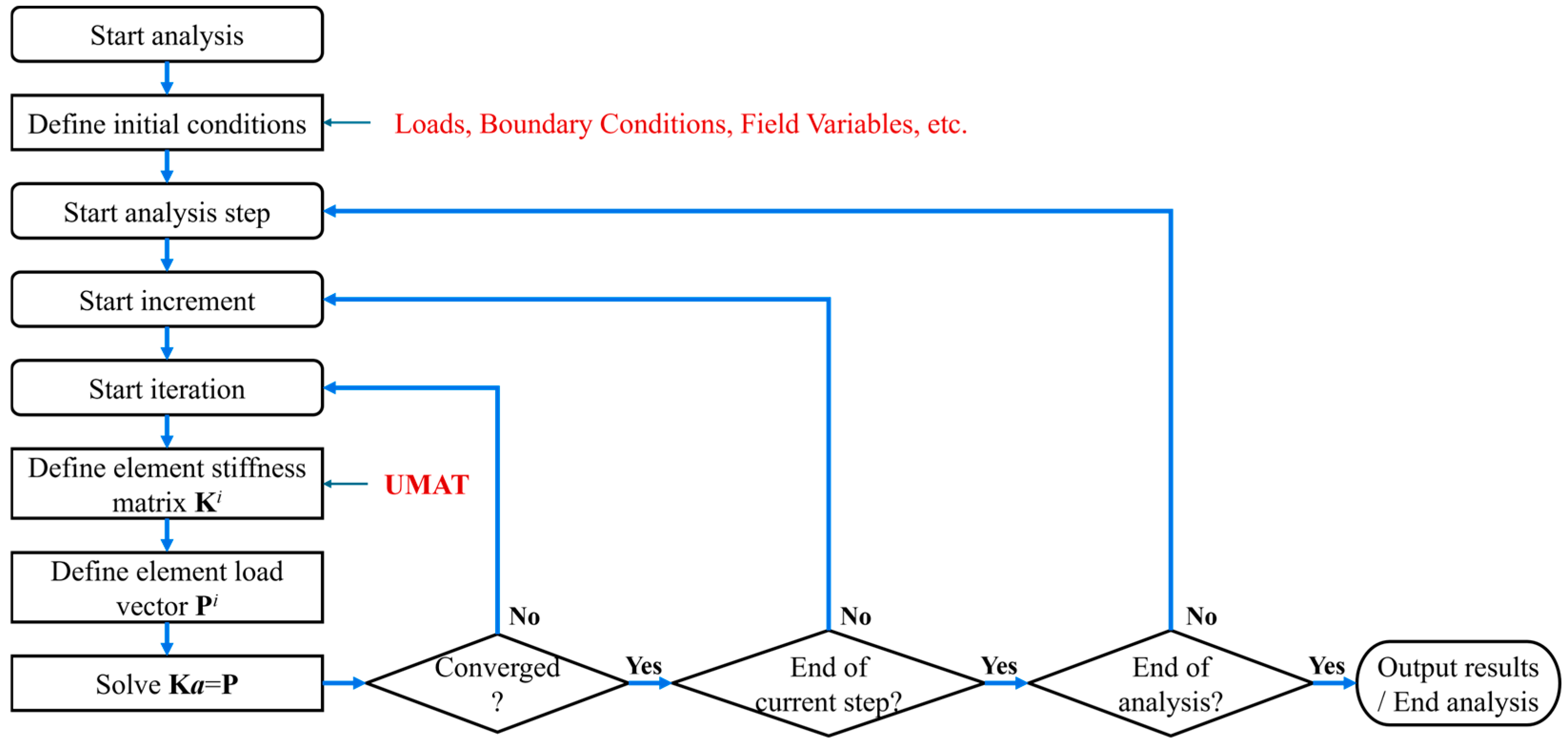
The ManUMAT method is based on the neutron irradiation experimental data of Gilsocarbon materials in the PLUTO materials testing reactor at Harwell [4]. It utilizes the UMAT subroutine [5,6] to define the constitutive equation for the stress–strain relationship of nuclear graphite materials. The workflow for solving the finite element model using ABAQUS is shown in Figure 1. Prior to each incremental step, the ABAQUS main program estimates the total strain for the increment, and then invokes the UMAT subroutine. The UMAT subroutine first updates the current stress value at the end of the previous increment based on the estimated total strain. It then provides the Jacobian matrix Δ σ / Δ ε e of the nuclear graphite to the constitutive model, where Δ σ and Δ ε e represent the changes in stress and elastic strain at the end of current increment, respectively. This method describes the constitutive equation increment to meet the operational requirements of the UMAT subroutine.
Based on the Maxwell-Kelvin linear viscoelastic creep model, this model expresses the total strain Δ ε total as the linear combination of its individual strain components:
Δ ε total = Δ ε e + Δ ε th + Δ ε dc + Δ ε pc + Δ ε sc + Δ ε ith + Δ ε idc ,
The elastic strain Δ ε e , thermal strain Δ ε th , radiation-induced dimensional strain Δ ε dc are represented. Δ ε pc and Δ ε sc represents first-stage and second-stage radiation creep strain. Δ ε ith and Δ ε idc represent thermal and dimensional interaction strains induced by creep, respectively. The calculation methods for these strain components will be detailed below.
(1)
Elastic strain
The relationship between total strain and elastic strain can be derived from Hooke’s law in its generalized form:
σ = D ε e ,
where D is the material matrix, determined by the dynamic elastic modulus E and Poisson’s ratio ν :
D = E 1 ν 1 + ν 1 2 ν 1 ν 1 ν ν 1 ν 0 0 0 1 ν 1 ν 0 0 0 1 0 0 0 1 2 ν 2 1 ν 0 0 * 1 2 ν 2 1 ν 0 1 2 ν 2 1 ν ,
In the ManUMAT method simulation, the Poisson’s ratio ν is set as a constant value, while the elastic modulus is a function of irradiation dose (γ) and temperature (T).
The incremental form of Hooke’s generalized law is
Δ σ = D ˜ Δ ε e + Δ D ε ˜ e ,
The tilde (~) indicates the average value of variables during the current increment step.
(2)
Thermal strain
Thermal strain is calculated on the thermal expansion coefficient. The variation in the linear thermal expansion coefficient of nuclear graphite is a function of temperature. The linear thermal expansion coefficient α i at temperature T is given by
α i T = d ε th d T ,
The subscript i denotes the instantaneous value. For isotropic graphite, the thermal expansion coefficient is nearly identical in all directions, and thermal strain is also isotropic, expressed as
ε th T = T ref T α i θ d θ ,
where θ is the integration variable, and T ref (°C) is the reference temperature. Since graphite’s CTE varies with temperature, the average CTE over a specific temperature range is considered. With the reference temperature T ref = 20   ° C , the instantaneous thermal expansion coefficient CTE α i at temperature T can be expressed as
α i = α ¯ 20 T = α ¯ 20 120 + B T ,
where B T is the adjustment factor for CTE due to differences in temperature range [38]:
B T = ( 2.66343 × 10 1 + 4.03616 × 10 3 T + 1.67126 × 10 7 T 2   3.37798 × 10 9 T 3 + 1.57676 × 10 12 T 4 ) × 10 6 ,
Therefore, thermal strain can be expressed as a vector:
ε th = α i T T ref ,
Differentiating the above equation allows the thermal strain to be expressed in an incremental form:
Δ ε th Δ α ¯ 20 120 T T ref + α i Δ T ,
Based on the thermal expansion coefficient, the thermal strain of the graphite core can be calculated.
(3)
Dimensional change strain
The volumetric strain of nuclear graphite can be calculated from the measured data without regard to mass loss:
Δ ε dc d ε dc d γ Δ γ ,
where d ε dc / d γ is the slope of the curve.
(4)
Irradiation creep
Under irradiation dose gradients and temperature effect, nuclear graphite develops changes in dimension and stresses. If not mitigated by irradiation creep, these stresses may accumulate to levels exceeding the graphite fracture strength. The creep coefficient is generally assumed equal in the tension and compression. Thus, irradiation creep consists of a transient phase followed by a linear phase, allowing the total creep strain to be decomposed into two corresponding components.
ε creep = ε pc + ε sc
where ε pc and ε sc represent the irradiation creep strains for the first and second stages, respectively. According to the UKAEA model, ε pc and ε sc can be expressed in an incremental form as shown in Equations (13) and (14):
Δ ε pc = 4 φ D ˜ c σ ˜ ε ˜ pc Δ γ
Δ ε sc = ξ D ˜ c σ ˜ Δ γ
Among these, φ and ξ are both set as constants with values of 1.0 and 0.23, respectively [6]. D c represents the creep material matrix with the form expressed as follows:
D c = 1 E c 1 ν c ν c 0 0 0 1 ν c 0 0 0 1 0 0 0 2 1 + ν c 0 0 * 2 1 + ν c 0 2 1 + ν c ,
The creep elastic modulus E c is a function of irradiation dose and temperature, and the creep Poisson’s ratio ν c is set to ν c = ν = 0.2 in the simulation.
(5)
Interaction strain
For smaller creep strains, the irradiation-averaged thermal expansion coefficient α ^ 20 120 may be corrected using the following linear relationship:
α ^ 20 120 = κ ε ec
where κ is the slope at the origin of the CTE/creep curve, ε ec is the effective creep strain and expressed as
ε ec = 1 μ μ 0 0 0 1 μ 0 0 0 1 0 0 0 1 + μ 0 0 * 1 + μ 0 1 + μ ε 1 creep ε 2 creep ε 3 creep ε 12 creep ε 13 creep ε 23 creep
where μ = 0.5 is the transverse coefficient. Once α ^ 20 120 is determined, the increment of the interaction thermal strain can be obtained:
Δ ε ith Δ α ˜ 20 120 T T ref + α ^ 20 120 Δ T
According to research by Kelly B T and Burchell T D et al. [39], the increment of size-change interaction strain can be expressed as
Δ ε idc α 20 120 α c α a d X T d γ Δ γ ,
where α 20 120 is the average value of the corrected CTE at the current time step, α a and α c are the microcrystalline CTE in the a and c directions, respectively. X T is the shape factor of polycrystalline graphite, which is a function of irradiation dose and temperature and can be obtained from irradiation experiments of HOPG graphite.

2.3. Numerical Calculation Method

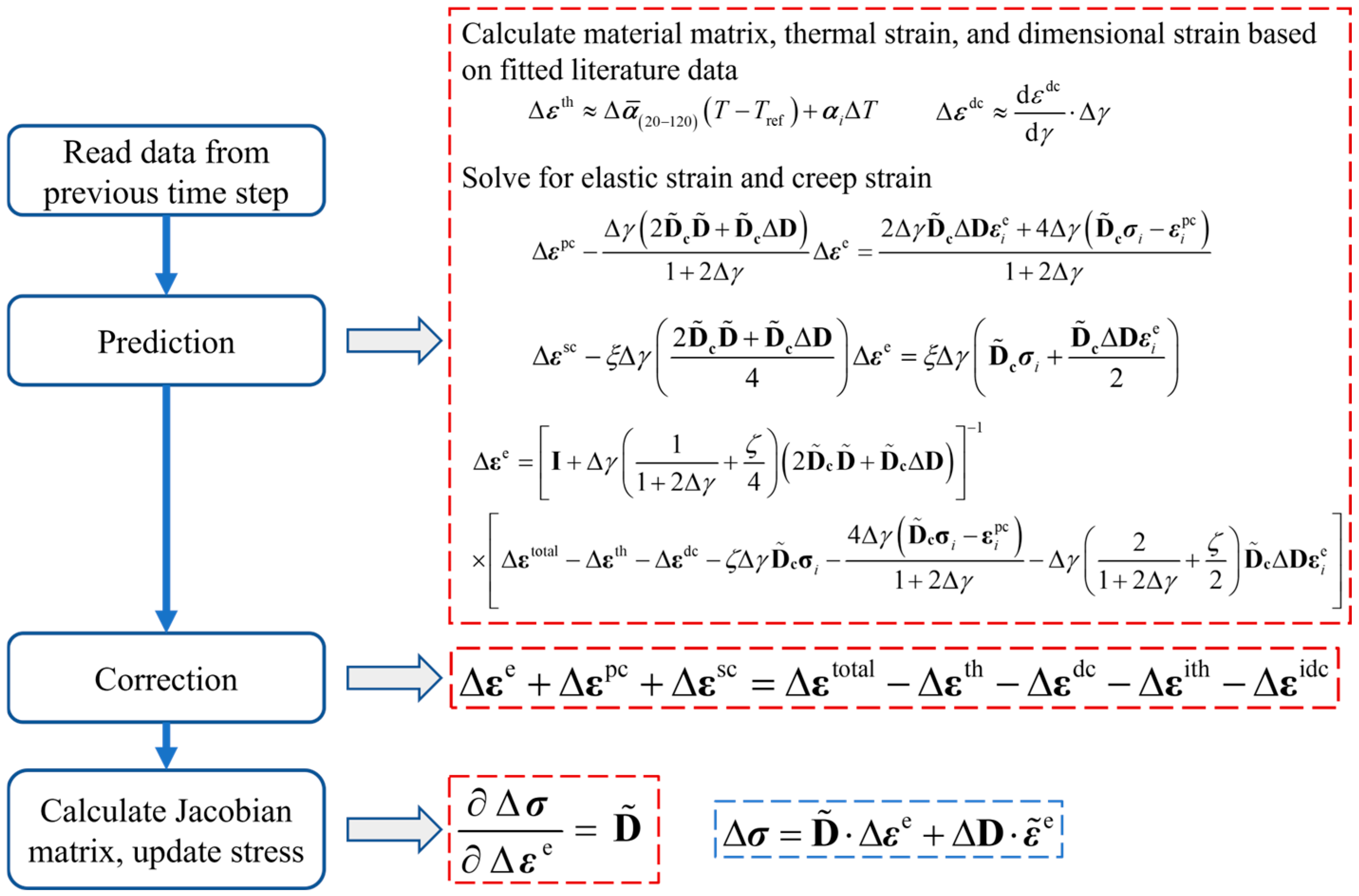
Both interaction strains are implicit functions of irradiation creep strain. The UMAT subroutine employs a prediction-correction algorithm to compute the interaction strains. The overall computational flow of the UMAT subroutine is illustrated in Figure 2.
Given the known values of all variables at step i (input as known values), the current time step i + 1 proceeds as follows: First, thermal strain and dimensional change strain are determined. Then, average values of variables (including stress, strain, CTE, etc.) are approximately using the central difference method. In the prediction step, based on Equation (4), the first-stage and second-stage irradiation creep strains in Equations (13) and (14) can be expressed as
Δ ε pc Δ γ 2 D ˜ c D ˜ + D ˜ c Δ D 1 + 2 Δ γ Δ ε e = 2 Δ γ D ˜ c Δ D ε i e + 4 Δ γ D ˜ c σ i ε i pc 1 + 2 Δ γ ,
Δ ε sc ξ Δ γ 2 D ˜ c D ˜ + D ˜ c Δ D 4 Δ ε e = ξ Δ γ D ˜ c σ i + D ˜ c Δ D ε i e 2 ,
Regardless of interaction strain, the expression for elastic strain can be obtained:
Δ ε e = I + Δ γ 1 1 + 2 Δ γ + ζ 4 2 D ˜ c D ˜ + D ˜ c Δ D 1   × Δ ε total Δ ε th Δ ε dc ζ Δ γ D ˜ c σ i 4 Δ γ D ˜ c σ i ε i pc 1 + 2 Δ γ Δ γ 2 1 + 2 Δ γ + ζ 2 D ˜ c Δ D ε i e ,
where I is the unit matrix. After calculating the value of elastic strain, the first-stage irradiation creep strain Δ ε pc and second-stage irradiation creep strain Δ ε sc can be computed. Subsequently, the interaction strains Δ ε ith and Δ ε idc can be determined, and the Jacobian matrix required for ABAQUS main program calculations has the following simplified form:
Δ σ Δ ε e D ˜

3. Results and Discussion

3.1. FEM of AGR Graphite Brick Case

Prior to simulating the graphite bricks, the ManUMAT methodology was validated using individual 2D and 3D elements (see Supporting Information). Figure S1 exemplifies the 3D solid element case, depicting itsgeometric nodes, boundary conditions, and load settings. The comparison between theoretical calculations and ABAQUS simulation results is presented in Tables S1 and S2. The theoretical incremental displacement and strain components at each node, show close agreement with the simulation outcomes, thereby corroborating the accuracy of the ManUMAT method for simulating AGR graphite bricks.
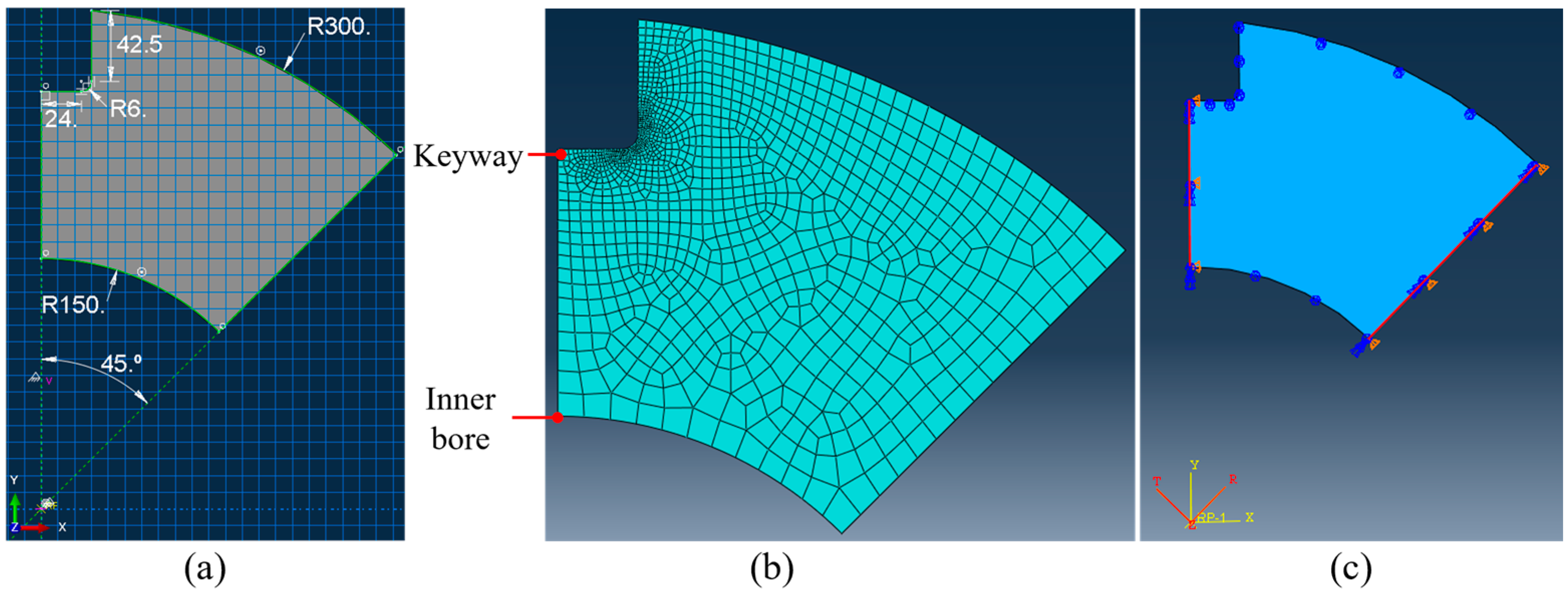
The stress–strain state of 1/8 of the brick after 22 full-power years was modeled using symmetry for the 2D simulation. An 8-node second-order generalized plane strain quadrilateral mesh (CPEG8) was used, with the reference node at the origin. The setup of the two-dimensional graphite brick model is shown in Figure 3. Temperature and irradiation dose settings at inner and outer apertures across different stages are provided in Table 2. Irradiation dose varies quadratically along the radius, reaching a maximum of 160 × 1020 n/cm2 EDND (Equivalent DIDO Nickel Dose), while temperature varied linearly, with a maximum of 500 °C. Boundary conditions were set as follows: both radial boundaries were symmetric, and the plane could move freely axially while restricted from rotating about the reference point. As shown in Figure 3c, in the cylindrical coordinate system, the two red boundaries represent symmetric conditions, and rotation about the z-axis was constrained to zero.
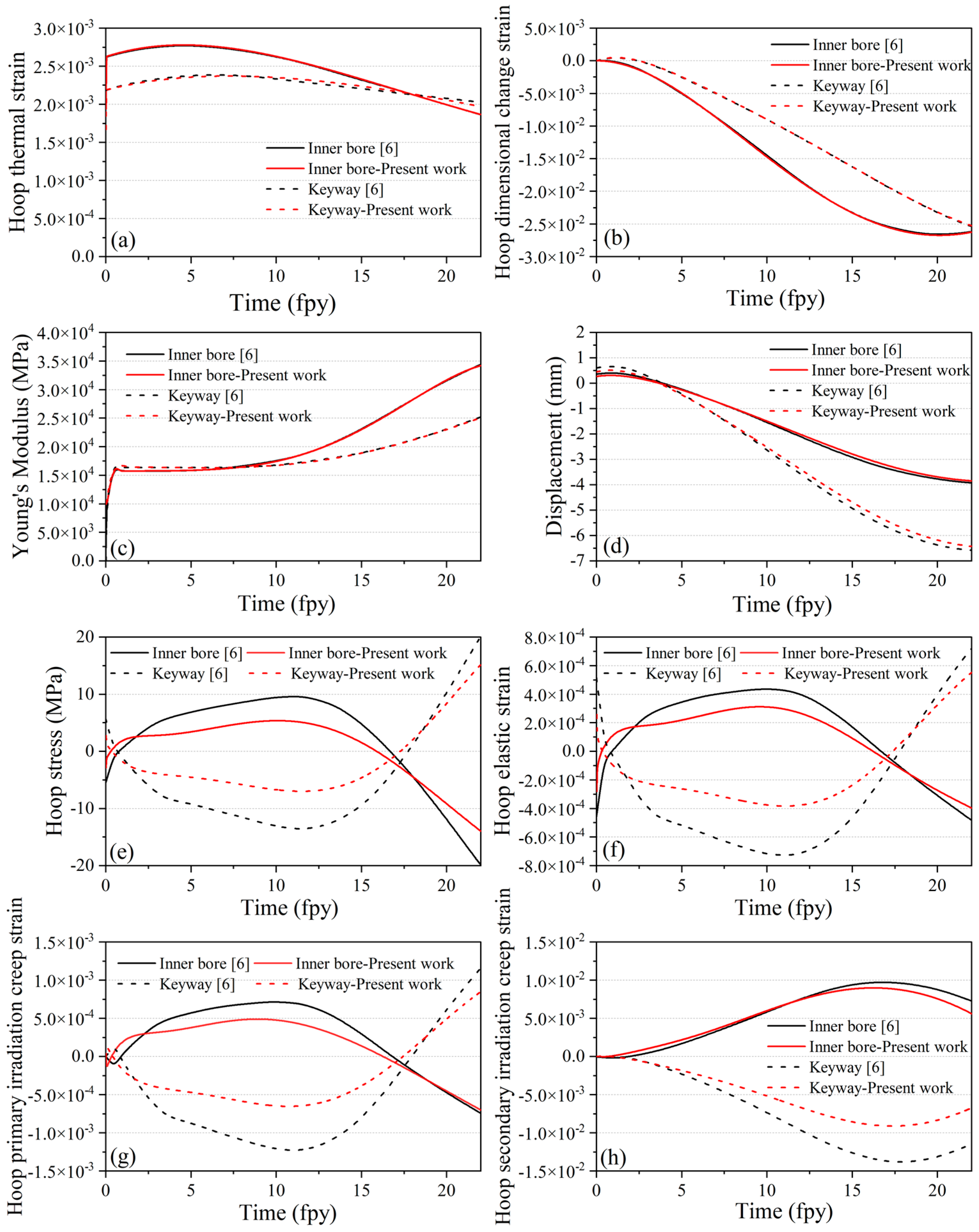
Upon completion of the simulation, key parameters at the keyway and inner bore were extracted for comparison, and the red solid and dashed lines correspond to the inner bore and keyway with references (shown in black) [6], as shown in Figure 3 and Figure 4. The simulated results for thermal strain, dimensional change strain, Young’s modulus, and displacement show good agreement with the reference data (Figure 4a–d). In contrast, discrepancies are observed in elastic strain, as well as in derived hoop stress and irradiation creep strain (Figure 4e–h). As seen in Figure 4e, hoop stress at the inner bore reaches maximum tension near 10.1 fpy and transitions to compression around 15.9 fpy. Similarly, Figure 4f shows elastic strain at the inner bore peaking in tension at about 9.6 fpy and shifting to compression near 16.2 fpy. This trend closely mirrors the variation in hoop stress at the inner bore, indicating that the generalized Hooke’s law expressed in Equation (2) is correctly applied. The changes in the hoop stress and hoop elastic strain at the keyway also follow a similar pattern.
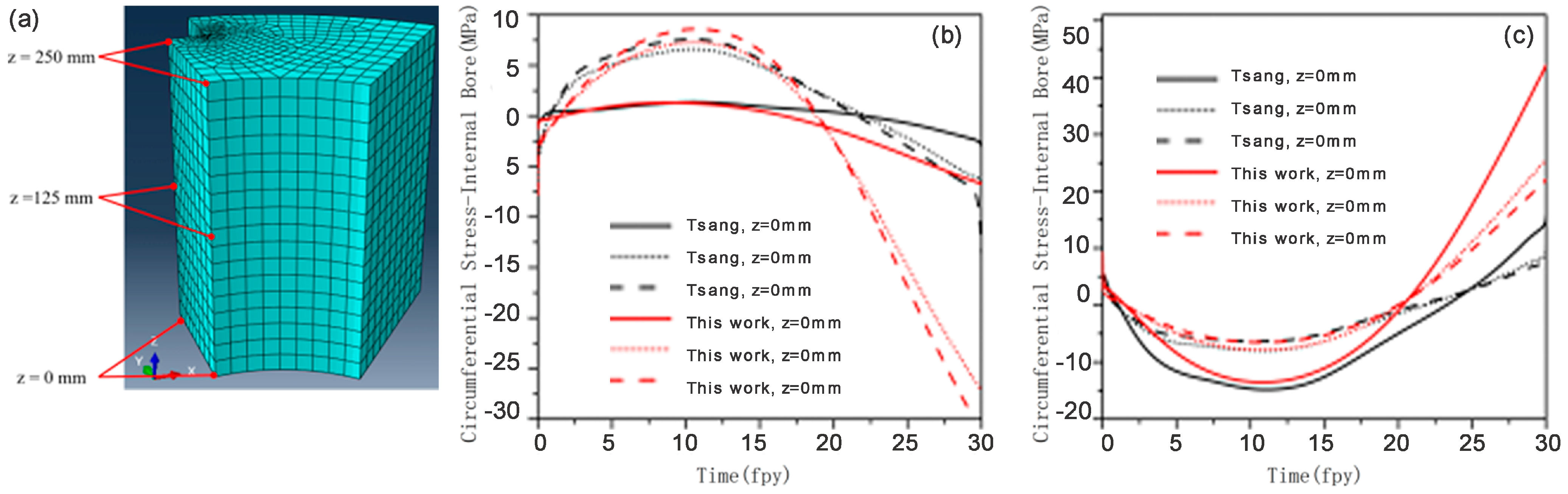
For the 3D graphite brick model, the irradiation dose was assumed to vary quadratically along the radius, and change linearly with temperature. Both the dose and temperature were uniform along the height. The simulation covers 30 full-power years, with a maximum dose of 180 × 1020 n/cm2 EDND and maximum temperature of 500 °C. Symmetry boundary conditions were applied on both radial boundaries and top surface. The external geometry and mesh configuration of the 3D graphite brick model are shown in Figure 5, employing a 20-node second-order mesh (C3D20). Irradiation temperature and dose values at inner and outer surfaces over time are shown in Table 2. The irradiation doses for inner ri and outer surfaces re at 30 fpy and after shutdown are 180 × 1020 n/cm2 EDND and 90 × 1020 n/cm2 EDND, respectively.
For the FEM model of 3D graphite brick, hoop stresses at three heights along the keyway and inner bore were extracted (red curves) and compared with Reference (black curves) [5] in Figure 5. The results show a close agreement during 0–15 fpy, while some discrepancies are observed in the 15–30 fpy period. The potential reasons for discrepancies between both the 2D and 3D simulation results compared to literature include differences in input data, initial conditions, and potential inconsistencies in the assigned initial material properties.

3.2. Simulation of Nuclear Graphite Components in High-Temperature Gas-Cooled Reactors

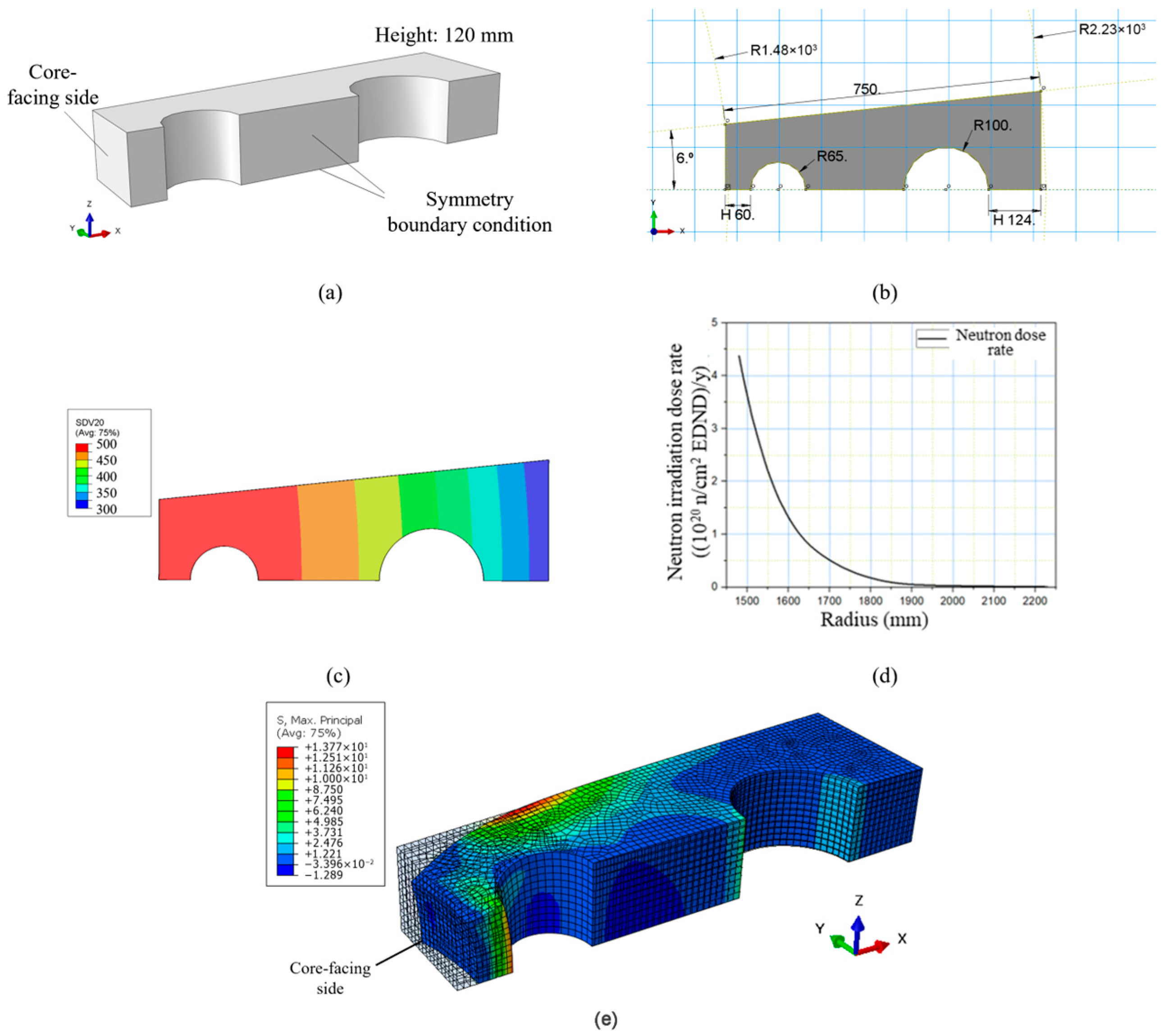
Using the ManUMAT method, this study conducts finite element simulations on graphite brick components in the HTR-PM. Based on the INET-GRA3D model [15], the geometry of the side reflector graphite brick was simplified by retaining only two channels: an inner channel (core side) for control rod insertion and an outer channel for coolant flow [40]. Considering symmetry, only one-quarter of the brick was modeled, with the geometry shown in Figure 6a,b.
The simulated graphite brick is assumed to be located at the position of maximum neutron dose rate (approximately 1/3–1/4 of the core height from the top). Specific distributions of temperature and dose rate are shown in Figure 6c,d. Temperature exhibits a quadratic distribution along the radius and remains constant along the height, with the highest temperature of 500 °C near the core side. Neutron dose rate decreases exponentially along the radius, but constant along the height.
Under reactor conditions, the graphite bricks in the HTR-PM side reflector layer undergo elastic strain, thermal strain, irradiation-induced dimensional strain, and creep strain. After defining field variables of irradiation dose and temperature, the resulting stress distribution and deformation of the graphite brick are shown in Figure 6e. It is magnified by a factor of 10 for easier observation. It is evident that nuclear graphite components undergo significant deformation when exposed to high temperatures and neutron irradiation over extended periods. The graphite brick contracts noticeably near the core side and expands slightly away from the core. This is because irradiation-induced shrinkage dominates over thermal expansion in the high-dose region near the core, while only minor thermal expansion occurs in the low-dose region farther away. These simulation results agree well with those reported in reference [15].
It is important to clarify that the 2D and 3D simulations served different purposes and were not direct comparisons of the same scenario. The 2D model was used for initial validation of the ManUMAT method against established benchmark data from AGR graphite bricks [6]. The 3D model, however, applies the validated method to the specific case of an HTR-PM side reflector brick, which has a different geometry and operates under different temperature and neutron flux distributions (as defined in Section 3.2 and Figure 6). Therefore, the differences in input conditions are inherent to the different objectives of the simulations. The discrepancies observed in the later service period (15–30 fpy) likely stem from the increased complexity of the 3D geometry and stress state, which cannot be fully captured in a 2D approximation.

3.3. Finite Element Simulation of Nuclear Graphite Based on XCT Three-Dimensional Pore Structure

Graphite, as a porous material, contains complex pore networks that significantly affect its mechanical properties and irradiation behavior. Recent studies have employed random field theory to generate the microscopic pore structure of graphite, while utilizing XCT (X-ray Computed Tomography) methods to create the geometric structure of finite element models, thereby evaluating the validity of RFEM (random finite element method) results [27]. Experimental research [40] shows that uniform low-temperature oxidation may be particularly detrimental in HTGRs, as it creates new pores that diffuse uniformly and penetrate deeply, leading to widespread graphite degradation. The microstructural simulation like RFEM can help quantify the effects of microstructural heterogeneity and property degradation, and provide key input parameters for macroscopic component-scale simulations.
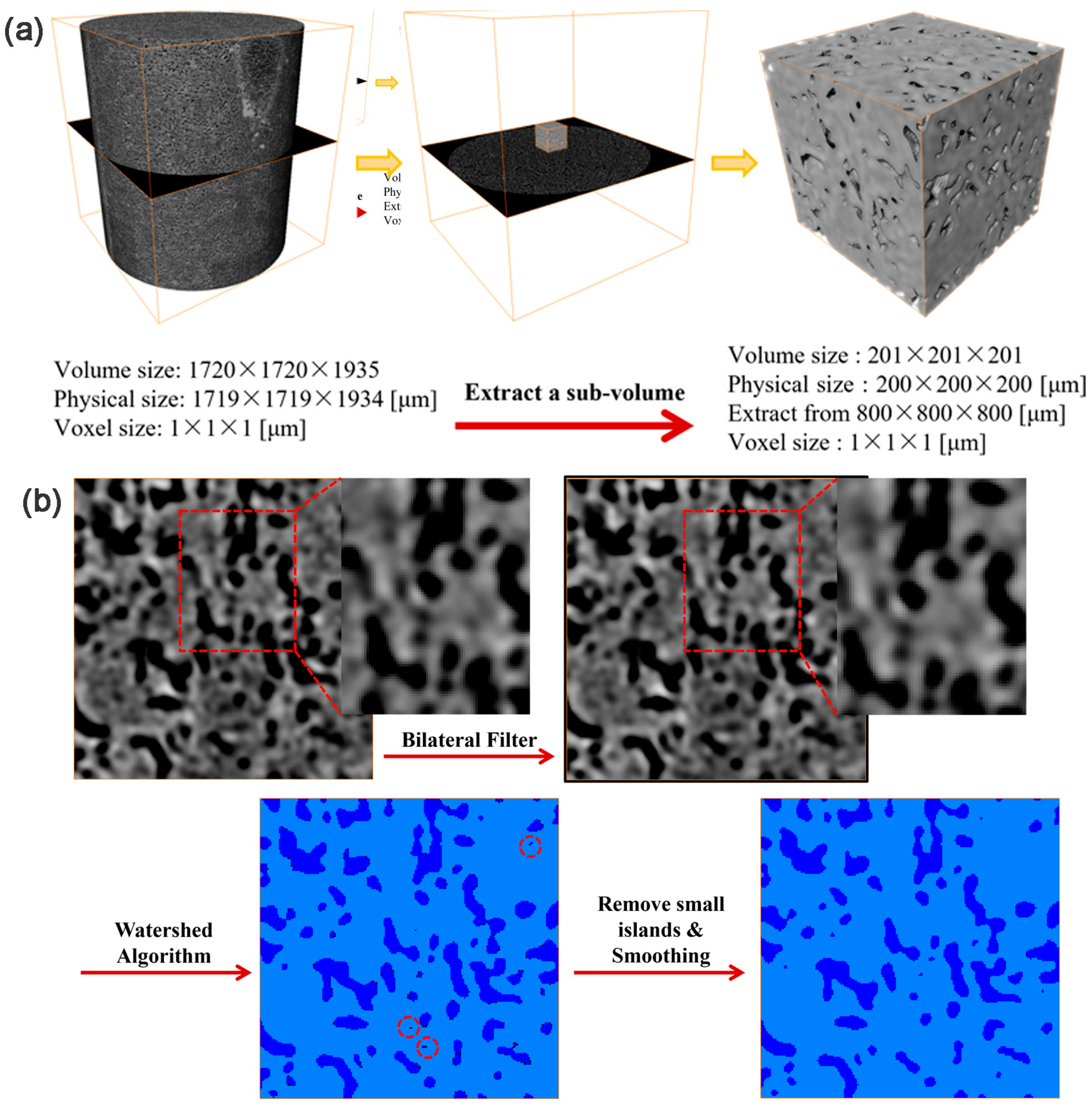
The original IG-110 graphite core was processed into small granular samples with 2 mm × 2 mm × 1.5 mm. The SkyScan2211 instrument scanned and automatically reconstructed select samples, producing 3D cylindrical images. Each sample yielded 1935 X-μCT images, with a voxel size of 1 μm3 in the reconstructed volume. Due to limited computational resources, the original X-μCT images were processed in Avizo to extract a representative subvolume. The subvolume size must balance computational feasibility with accurate representation of nuclear graphite’s microscopic pore structure [27]. Then, a 200 μm3 block was taken from the 800 μm3 region of the original image, as shown in Figure 7a. It was determined to be sufficiently larger than the characteristic pore size and the graphite grain size (~20 μm) to capture a statistically representative distribution of the microstructure, thus approximating a Representative Volume Element (RVE) [27], while remaining within the limits of our computational resources for meshing and solving.
The limited accuracy of micro-CT scanning can lead to imprecise mapping of pore shapes in nuclear graphite. A key challenge in 3D reconstruction from X-μCT images is to compensate for such inaccuracies in numerical modeling of deformation in heterogeneous materials. To address this, we adopted pore structure processing methods with reference for porous materials. Following the acquisition of X-μCT images, the 3D reconstruction and image processing were performed in Avizo Fire, as shown in Figure 7b. Specifically, a bilateral filter was applied with spatial and range sigma values set to 1.5 and 50, respectively, to reduce noise while preserving pore boundaries. Segmentation of the graphite matrix and pore phases was achieved using the watershed algorithm, with a threshold grayscale value typically in the range of 40–60 (on a 0–255 scale) determined by histogram analysis to best distinguish the two phases. Isolated features with a volume of less than 10 voxels were removed to eliminate noise. A tetrahedral mesh was then generated from the segmented volume. Mesh quality was controlled by ensuring a maximum element skewness of less than 0.8 and a minimum dihedral angle greater than 10 degrees to guarantee numerical stability in the subsequent finite element analysis.
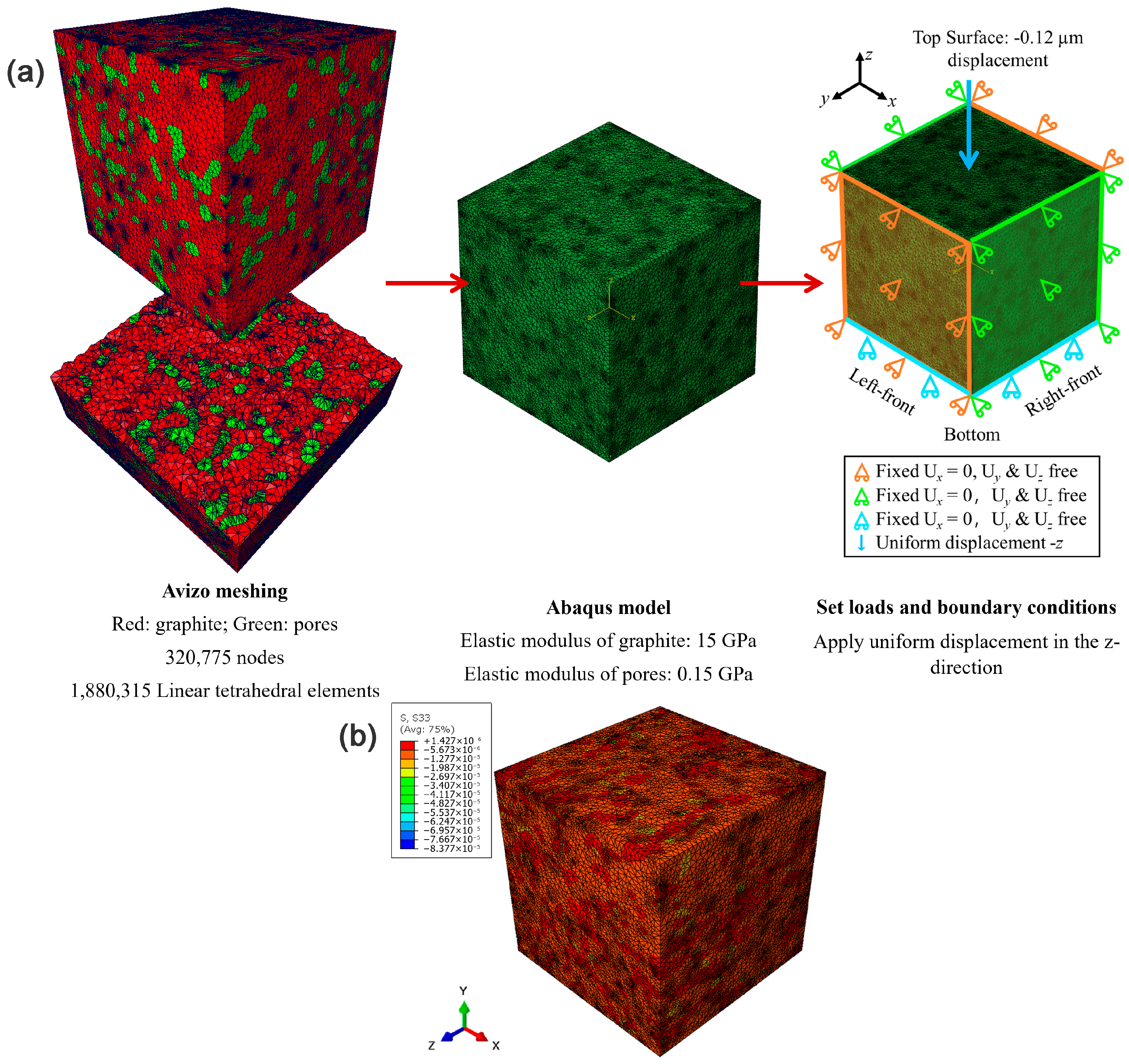
Following 3D image reconstruction and processing in Avizo, a tetrahedral finite element mesh was generated, which was imported into ABAQUS. Then, material properties and boundary conditions were assigned to establish a finite element model incorporating the 3D pore structure of nuclear graphite. Based on the workflow, a simulation case of nuclear graphite with 3D pore structure was developed (Figure 8). The graphite matrix was assigned an elastic modulus of 15 GPa, while the pore region (theoretically with zero stiffness) was set to 0.15 GPa. This value, approximately 1/100th of the matrix modulus, was chosen to prevent numerical singularity in the finite element solver while minimizing its mechanical contribution. This approach is a standard numerical technique for modeling porous materials, ensuring computational stability with a negligible effect on the overall stress distribution compared to treating pores as perfect voids, which can lead to convergence issues. For loading conditions, a uniform downward displacement was applied to the upper surface of the graphite block, with corresponding boundary conditions applied to the remaining surfaces.
The computational results reveal the stress and strain distribution within the nuclear graphite in Figure 8. This enables the determination of the effective elastic modulus or other mechanical parameters for the entire graphite block, thereby supplying refined inputs for component-scale simulations. The primary insight from integrating the XCT-derived pore structure is the ability to visualize and quantify stress concentrations at the microstructural level, particularly around pore boundaries and in regions of high porosity. This reveals heterogeneity that is entirely absent in homogeneous models. While the current simulation is a preliminary mechanical analysis, the framework demonstrates the potential to link specific microstructural evolution (e.g., pore coalescence due to oxidation) directly to the degradation of macroscopic properties like the effective elastic modulus, providing a more physics-based input for component-scale models.

4. Conclusions

This study systematically uses finite element simulations to evaluate the service behavior of nuclear graphite components in high-temperature gas-cooled reactors. The ManUMAT method, originally developed for AGR graphite, has been successfully extended to the FEM analysis of IG-110 graphite in HTR-PM reactors, demonstrating the transferability of the constitutive model on graphite materials. FEM results over a 30-year design life reveal that irradiation shrinkage is the dominant deformation mechanism in high-neutron-flux region. Furthermore, a model incorporating the real 3D pore structure obtained from XCT imaging was developed. This approach provides a pathway to quantify the degradation of mechanical properties, such as the effective elastic modulus, by directly linking microstructural features to macroscopic behavior. By correlating microstructural evolution with macroscopic mechanical behavior, this study provides more realistic material parameters for macroscopic models that evolve with service history. This integrated approach provides a new pathway for quantifying the direct impact of microstructural heterogeneity and its evolution on macroscopic mechanical behavior, moving beyond the limitations of assuming homogeneous material properties in life prediction models for nuclear graphite.

Supplementary Materials

The following supporting information can be downloaded at: https://www.mdpi.com/article/10.3390/jne7010004/s1, Figure S1: Single three-dimensional solid element. (a) Element geometry and node numbering; (b) Element boundary conditions and load settings; Table S1: Displacement values at each node; Table S2: Incremental values of each strain component.

Author Contributions

Conceptualization and supervision, S.L., Y.Z. and Z.L.; methodology and software, Y.Z. and C.T.; validation and formal analysis, S.L., J.G., Y.M., C.T. and Y.Z.; resources and data curation, S.L., J.G., Y.Z., C.T. and Y.M.; writing—original draft preparation, S.L. and Y.Z.; writing—review and editing, visualization, S.L., J.G., Y.M., Y.Z. and Z.L. All authors have read and agreed to the published version of the manuscript.

Funding

This research was funded by National Natural Science Foundation of China grant (U23B2096 and 12375270).

Data Availability Statement

The original contributions presented in this study are included in the article. Further inquiries can be directed to the corresponding authors.

Conflicts of Interest

Author Yumeng Zhao was employed by the company China North Nuclear Fuel Co., Ltd. The remaining authors declare that the research was conducted in the absence of any commercial or financial relationships that could be construed as a potential conflict of interest.

References

  1. U.S. Department of Energy Office of Nuclear Energy, Science and Technology. A Technology Roadmap for Generation IV Nuclear Energy Systems; USDOE: Washington, DC, USA, 2002.
  2. Zhang, Z.; Wu, Z.; Sun, Y.; Li, F. Design Aspects of the Chinese Modular High-Temperature Gas-Cooled Reactor HTR-PM. Nucl. Eng. Des. 2006, 236, 485–490. [Google Scholar] [CrossRef]
  3. Zhou, X.; Tang, Y.; Lu, Z.; Zhang, J.; Liu, B. Nuclear Graphite for High Temperature Gas-Cooled Reactors. New Carbon Mater. 2017, 32, 193–204. [Google Scholar] [CrossRef]
  4. Brocklehurst, J.E.; Kelly, B.T. Analysis of the Dimensional Changes and Structural Changes in Polycrystalline Graphite under Fast Neutron Irradiation. Carbon 1993, 31, 155–178. [Google Scholar] [CrossRef]
  5. Tsang, D.K.L.; Marsden, B.J. The Development of a Stress Analysis Code for Nuclear Graphite Components in Gas-Cooled Reactors. J. Nucl. Mater. 2006, 350, 208–220. [Google Scholar] [CrossRef]
  6. Tsang, D.K.L. Material model for stress analysis of nuclear graphite component subject to irradiation. Sci. Sin. Phys. Mech. Astron. 2019, 49, 114609. [Google Scholar] [CrossRef]
  7. Tsang, D.K.L.; Marsden, B.J. A Mathematical Stress Analysis Model for Isotropic Nuclear Graphite under Irradiation Condition. J. Appl. Math. Mech. 2005, 4, 1–19. [Google Scholar]
  8. Wang, H.; Yu, S. Uncertainties of Creep Model in Stress Analysis and Life Prediction of Graphite Component. Nucl. Eng. Des. 2008, 238, 2256–2260. [Google Scholar] [CrossRef]
  9. Yu, S.; Li, H.; Wang, C.; Zhang, Z. Probability Assessment of Graphite Brick in the HTR-10. Nucl. Eng. Des. 2004, 227, 133–142. [Google Scholar] [CrossRef]
  10. Fang, X.; Yu, S.; Wang, H. Effect of In-Core Temperature on the Life Evaluation of Graphite Component. In Proceedings of the 17th International Conference on Nuclear Engineering, Brussels, Belgium, 12–16 July 2009; Volume 4, pp. 657–660. [Google Scholar]
  11. Fang, X.; Wang, H.; Yu, S. Effect of Irradiation Deformation and Graphite Varieties on the Irradiation Equivalent Stress and Life of Nuclear Graphite. In Proceedings of the 18th International Conference on Nuclear Engineering, Xi’an, China, 17–21 May 2010; Volume 5, pp. 697–700. [Google Scholar]
  12. Yu, S.; Fang, X.; Wang, H.; Li, C. Failure Probability Study of HTR Graphite Component Using Microstructure-Based Model. Nucl. Eng. Des. 2012, 253, 192–199. [Google Scholar] [CrossRef]
  13. Fang, X.; Wang, H.; Yang, X.; Yu, S. The Reliability Prediction of HTR’s Graphite Component in Various Temperature and Neutron Dose Levels. In Proceedings of the 2013 21st International Conference on Nuclear Engineering, Chengdu, China, 29 July–2 August 2013; Volume 2, p. V002T03A028. [Google Scholar]
  14. Fang, X.; Wang, H.; Yu, S. The Stress and Reliability Analysis of HTR’s Graphite Component. Sci. Technol. Nucl. Install. 2014, 2014, 964848. [Google Scholar] [CrossRef]
  15. Fang, X.; Yu, S.; Wang, H.; Li, C. The Mechanical Behavior and Reliability Prediction of the HTR Graphite Component at Various Temperature and Neutron Dose Ranges. Nucl. Eng. Des. 2014, 276, 9–18. [Google Scholar] [CrossRef]
  16. KTA-3232; HTR Ceramic Pressure for Vessels Internals. Nuclear Safety Standards Commission: Berlin, Germany, 1992.
  17. ASME III Division 5: High Temperature Reactors; ASME Boiler and Pressure Vessel Code; ASME: New York, NY, USA, 2015.
  18. Wang, H.; Shi, L.; Wang, X.; Sun, L.; Wu, X. Study on Application of Probabilistic Method in ASME Standard on Fine-grained Graphite. At. Energy Sci. Technol. 2017, 51, 6. [Google Scholar]
  19. Ding, D.; Gao, Y.; Yang, X.; Zhong, Y.; Zeng, G. Study on improved probability evaluation method of nuclear graphite based on ASME specification. Nucl. Tech. 2019, 42, 6. [Google Scholar]
  20. Arregui-Mena, J.D.; Worth, R.N.; Hall, G.; Edmondson, P.D.; Giorla, A.B.; Burchell, T.D. A Review of Finite Element Method Models for Nuclear Graphite Applications. Arch. Comput. Methods Eng. 2020, 27, 331–350. [Google Scholar] [CrossRef]
  21. Doroszko, M.; Seweryn, A. A New Numerical Modelling Method for Deformation Behaviour of Metallic Porous Materials Using X-Ray Computed Microtomography. Mater. Sci. Eng. A 2017, 689, 142–156. [Google Scholar] [CrossRef]
  22. Li, Z.; Chen, D.; Fu, X.; Miao, W.; Zhang, Z. The Influence of Pores on Irradiation Property of Selected Nuclear Graphites. Adv. Mater. Sci. Eng. 2012, 2012, 640462. [Google Scholar] [CrossRef]
  23. Matthews, A.C.; Kane, J.J.; Swank, W.D.; Windes, W.E. Nuclear Graphite Strength Degradation under Varying Oxidizing Conditions. Nucl. Eng. Des. 2021, 379, 111245. [Google Scholar] [CrossRef]
  24. Wang, Y.; Tsang, D.; Zhang, Y.; Zhang, Q.; Zhu, F.; Song, L.; Ma, X. Insights into Irradiation Creep Coefficient in Nuclear Graphite from Machine Learning. Nucl. Eng. Technol. 2025, 57, 103559. [Google Scholar] [CrossRef]
  25. Berre, C.; Fok, S.L.; Marsden, B.J.; Babout, L.; Hodgkins, A.; Marrow, T.J.; Mummery, P.M. Numerical Modelling of the Effects of Porosity Changes on the Mechanical Properties of Nuclear Graphite. J. Nucl. Mater. 2006, 352, 1–5. [Google Scholar] [CrossRef]
  26. Berre, C.; Fok, S.L.; Marsden, B.J.; Mummery, P.M.; Marrow, T.J.; Neighbour, G.B. Microstructural Modelling of Nuclear Graphite Using Multi-Phase Models. J. Nucl. Mater. 2008, 380, 46–58. [Google Scholar] [CrossRef]
  27. Arregui-Mena, J.D.; Griffiths, D.V.; Worth, R.N.; Torrence, C.E.; Selby, A.; Contescu, C.; Gallego, N.; Edmondson, P.D.; Mummery, P.M.; Margetts, L. Using Porous Random Fields to Predict the Elastic Modulus of Unoxidized and Oxidized Superfine Graphite. Mater. Des. 2022, 220, 110840. [Google Scholar] [CrossRef]
  28. Fenton, G.A.; Griffiths, D.V. Random Field Generation and the Local Average Subdivision Method. In Probabilistic Methods in Geotechnical Engineering; Griffiths, D.V., Fenton, G.A., Eds.; CISM Courses and Lectures; Springer: Vienna, Austria, 2007; Volume 491, pp. 201–223. ISBN 978-3-211-73365-3. [Google Scholar]
  29. Paiboon, J.; Griffiths, D.V.; Huang, J.; Fenton, G.A. Numerical Analysis of Effective Elastic Properties of Geomaterials Containing Voids Using 3D Random Fields and Finite Elements. Int. J. Solids Struct. 2013, 50, 3233–3241. [Google Scholar] [CrossRef]
  30. Margetts, L.; Mena, J.; Mummery, P. The Stochastic Finite Element Method and Its Possible Use in Thermo-Mechanical Drift Calculations. In Proceedings of the 2nd PACMAN Workshop, Debrecen, Hungary, 12–15 June 2016. [Google Scholar]
  31. Yang, X. Study on Material Properties of Nuclear Graphite and Stress Analysis of Nuclear Graphite Component in Molten Salt Reactor. Doctoral Dissertation, University of Chinese Academy of Sciences, Shanghai, China, 2019. [Google Scholar]
  32. Yang, X.; Wang, X.; Tsang, D.K.L. The Effect of Thermal Oxidation on the Coefficient of Thermal Expansion of Nuclear Graphite. J. Mater. Sci. 2020, 55, 7805–7815. [Google Scholar] [CrossRef]
  33. Arregui-Mena, J.D.; Griffiths, D.; Worth, R.N.; Torrence, C.E.; Selby, A.; Contescu, C.; Gallego, N.; Edmondson, P.D.; Mummery, P.M.; Margetts, L. Microstructural Characterization Data of as Received IG-110, 2114 and ETU-10 Nuclear Graphite Grades and Oxidation Characterization Data of IG-110. Data Brief 2022, 11, 108535. [Google Scholar] [CrossRef]
  34. Kane, J.; Karthik, C.; Butt, D.P.; Windes, W.E.; Ubic, R. Microstructural Characterization and Pore Structure Analysis of Nuclear Graphite. J. Nucl. Mater. 2011, 415, 189–197. [Google Scholar] [CrossRef]
  35. Kim, E.; No, H. Experimental Study on the Oxidation of Nuclear Graphite and Development of an Oxidation Model. J. Nucl. Mater. 2006, 349, 182–194. [Google Scholar] [CrossRef]
  36. Oh, C.H.; Kim, E.S. FY-09 Report: Experimental Validation of Stratified Flow Phenomena, Graphite Oxidation, and Mitigation Strategies of Air Ingress Accidents; Office of Scientific and Technical Information: Oak Ridge, TN, USA, 2009; p. 974349. [Google Scholar]
  37. Yan, R.; Dong, Y.; Zhou, Y.; Sun, X.; Li, Z. Investigation of Oxidation Behaviors of Nuclear Graphite Being Developed and IG-110 Based on Gas Analysis. J. Nucl. Sci. Technol. 2017, 54, 1168–1177. [Google Scholar] [CrossRef]
  38. Tsang, D.K.L.; Marsden, B.J. Constitutive Material Model for the Prediction of Stresses in Irradiated Anisotropic Graphite Components. J. Nucl. Mater. 2008, 381, 129–136. [Google Scholar] [CrossRef]
  39. Kelly, B.T.; Burchell, T.D. The Analysis of Irradiation Creep Experiments on Nuclear Reactor Graphite. Carbon 1994, 32, 119–125. [Google Scholar] [CrossRef]
  40. Tian, D.; Shi, L.; Sun, L.; Zhang, Z.; Zhang, Z.; Zhang, Z. Installation of the Graphite Internals in HTR-PM. Nucl. Eng. Des. 2020, 363, 110585. [Google Scholar] [CrossRef]
Figure 1. ABAQUS finite element model solving process.
Jne 07 00004 g001
Figure 2. UMAT subroutine calculation flow.
Jne 07 00004 g002
Figure 3. Two-dimensional graphite brick model setup. (a) Model dimensions; (b) mesh configuration; (c) boundary conditions.
Jne 07 00004 g003
Figure 4. Simulation results for two-dimensional AGR graphite bricks. (a) Hoop thermal strain. (b) Hoop dimensional change strain. (c) Young’s modulus. (d) Displacement. (e) Hoop stress. (f) Hoop elastic strain. (g) Hoop first-stage irradiation creep strain. (h) Hoop second-stage irradiation creep strain.
Jne 07 00004 g004
Figure 5. (a) External geometry and mesh configuration of the 3D graphite brick model. Simulation results for the 3D AGR graphite brick. (b) Hoop stress at three heights within the internal bore. (c) Hoop stress at three heights within the keyway.
Jne 07 00004 g005
Figure 6. Geometric configuration of graphite bricks in the HTR-PM side reflector layer. (a) Three-dimensional image. (b) Top view. Field variable configuration of graphite bricks in the HTR-PM side reflector layer. (c) Temperature distribution. (d) Neutron irradiation dose rate distribution. (e) Simulation results for HTR-PM graphite bricks in the side reflector layer after 30 years of operation.
Jne 07 00004 g006
Figure 7. (a) Extraction of nuclear graphite volume blocks from X-μCT images. (b) Avizo image processing workflow.
Jne 07 00004 g007
Figure 8. (a) Finite element simulation workflow of nuclear graphite with 3D pore structure based on three-dimensional pore structure. (b) The simulated stress and strain distribution.
Jne 07 00004 g008
Table 1. Main parameters for the IG-110 nuclear graphite.
GraphiteForming MethodGrain SizePorosityYoung’s ModulusThermal ConductivityCoefficient of Thermal Expansion
IG-110Isostatic pressure~20 μm [34]21.6% [35]9.8 GPa [36]120 W/(m·K) [36]4.06 × 10⁻⁶/K 1 [37]
1 Refers to the average thermal expansion coefficient between 20 and 120 °C.
Table 2. Irradiation temperature and irradiation dose values at different times.
Time (fpy)Before Startup22After Closing
Location (ri = 150 mm, re = 300 mm)rirerirerire
Temperature (°C)20205004002020
Neutron irradiation dose (1020 n/cm2 EDND)001608016080
Disclaimer/Publisher’s Note: The statements, opinions and data contained in all publications are solely those of the individual author(s) and contributor(s) and not of MDPI and/or the editor(s). MDPI and/or the editor(s) disclaim responsibility for any injury to people or property resulting from any ideas, methods, instructions or products referred to in the content.