Article

Partially Averaged Navier–Stokes k-ω Modeling of Thermal Mixing in T-Junctions

1
State Key Laboratory of Marine Thermal Energy and Power, Harbin Engineering University, Harbin 150001, China
2
Department of Nuclear Engineering, Pakistan Institute of Engineering and Applied Sciences, Islamabad 45650, Pakistan
*
Author to whom correspondence should be addressed.
J. Nucl. Eng. 2026, 7(1), 2; https://doi.org/10.3390/jne7010002
Submission received: 31 July 2025 / Revised: 17 December 2025 / Accepted: 17 December 2025 / Published: 24 December 2025

Abstract

The temperature fluctuations due to the mixing of two streams in a T-junction induce thermal stresses in the piping material, resulting in a pipe failure in Nuclear Power Plants. The numerical modeling of the thermal mixing in T-junctions is a challenging task in computational fluid dynamics (CFD) as it requires advanced turbulence modeling with scale-resolving capabilities for accurate prediction of the temperature fluctuations near the wall. One approach to address this challenge is using Partially Averaged Navier–Stokes modeling (PANS), which can capture the unresolved turbulent scales more accurately than traditional Reynolds-Averaged Navier–Stokes models. PANS modeling with k-ε closure gives encouraging results in the case of the Vattenfall T-junction benchmark case. In this study, PANS k-ω closure modeling is implemented for the WATLON T-junction Benchmark case. The momentum ratio (MR) for two inlet streams is 8.14, which is a wall jet case. The time-averaged and root mean square velocity and temperature profiles are compared with the PANS k-ε and LES results and with experimental data. The velocity and temperature field results for PANS k-ω are close to the experimental data as compared to the PANS k-ε for a given filter control parameter fk.

1. Introduction

High-cycle thermal fatigue is a mechanism that affects the structural material of nuclear power plant piping. This degradation primarily arises from thermal stresses within the pipe wall, induced by temperature fluctuations resulting from the mixing of cold and hot fluid streams in T-junctions, a phenomenon known as thermal mixing. Thermal mixing is inherently complex, unsteady, and three-dimensional. Consequently, accurately predicting temperature fluctuations near pipe walls remains a significant challenge in computational fluid mechanics (CFD), yet it is crucial for assessing the structural integrity and reliability of nuclear power plant components susceptible to high-cycle thermal fatigue.
Thermal mixing in T-junction piping has been extensively studied both experimentally and numerically. A CFD benchmark study was conducted at Vattenfall, which provides data to researchers to analyze different turbulence modeling approaches to predict the temperature fluctuations near the wall [1]. Different researchers analyze the benchmark using different turbulence modeling approaches, which include large eddy simulations (LES) and Unsteady Reynolds-Averaged Navier–Stokes (URANS) models [2,3,4,5]. LES generally gives better results for both temperature fluctuations, but it is computationally expensive in the case of high Reynolds numbers, and its computation cost can be a limiting factor [6,7]. On the other hand, the URANS turbulence model resolves the Reynolds-averaged flow velocity and mean temperature, but it is unable to model velocity and temperature variations near the wall. Some researchers also employed a hybrid turbulence model, detached eddy simulation (DES), for the thermal mixing [8]. DES combines the classical RANS method with the elements of LES. The impacts of the input velocity profile on the mixing region are further investigated with an improved delayed DES Shear stress Transport (IDDES-SST) model [9].
The MOTHER (Modeling T-junction Heat Transfer) is another benchmark case that also includes heat transfer data in the wall structure, along with the temperature fluctuations [10]. CFD simulations were performed by 29 participants. LES provided the most accurate results, but it needed long physical times to obtain data for the temperature fluctuations, which was computationally costly.
The Fluid Structure Interaction (FSI) facility was established for the study of the effects of high temperature differences between the inlets of a T-junction [11]. An LES study with conjugate heat transfer was employed for the study of piping material effects due to temperature fluctuations [12]. The study results showed incomplete mixing three diameters downstream, and the mixing process resulted in dynamic thermal stratification flow behavior.
A WATLON T-junction study was performed to study the mixing behavior and categorize the flow pattern induced by a branch jet using the momentum ratio (MR) [13]. The flow pattern can be predicted as the impinging jet (MR < 0.35), the deflecting jet (0.35 < MR < 1.35), and the wall jet (MR > 1.35). The deflection ratio in the wall jet is high, and the jet from the branch pipe is bent to the wall of the main pipe. Numerical simulations of the WATLON T-junction were performed to study the average temperature and velocity profiles using the SST k-w model [14]. Different URANS models were used for the simulations of the WATLON T-junction benchmark. A low Reynolds number cubic k-ε approach worked better than the linear k-ε model [7]. Numerical simulations of thermal mixing were carried out using various turbulence models, each offering different levels of accuracy and computational cost [15].
Apart from the benchmark studies, research was also performed to establish new turbulence modeling for the thermal mixing phenomenon at a computationally feasible cost. For this, a 2G-URANS model, named STRUCT, was established. The thermal mixing phenomenon was modeled using the STRUCT model and generally gave good results with less computational cost as compared to LES [16,17].
The Partially Averaged Navier–Stokes (PANS) is a method that bridges Reynolds-Averaged Navier–Stokes and Direct Numerical Simulation [18]. It is governed by two filter control parameters, unresolved-to-total turbulent kinetic (fk) and unresolved-to-total dissipation (fε). The values of these filter control parameters, along with the size of the computational grid, determine the amount of turbulence being resolved in a given case. As the fk value decreases, more scales of turbulence are resolved. The PANS method has been employed for different flow cases, such as flow in the reactor core [19,20] and mixing of flow in rectangular jets [21]. In the case of thermal mixing, PANS k-ε was used for the Vattenfall T junction case and showed comparable results with LES [22,23].
In this work, the PANS k-ω model is used for the simulation of a WATLON T-junction. The Reynolds number of WATLON is higher than the Vattenfall T-junction, which significantly increases the computation cost. PANS k-ε and LES were also performed. For LES, a WALE subgrid scale model is used. The results of the PANS models are compared with the LES and experimental data. The PANS k-ω model produces comparable results at less computational cost.

2. Benchmark Case and CFD Modeling

2.1. WATLON T-Junction

The WATLON T-junction was used to observe the thermal mixing phenomenon in T-junction piping. It comprised a main horizontal pipe with a diameter of 150 mm that connects to a branch pipe with a diameter of 50 mm, buffer tanks, and an array of thermocouples [13]. A thermocouple array was employed to measure the fluid temperature within the main pipe. Fifteen thermocouples were positioned radially at a 5 mm interval from the pipe’s center, while two additional thermocouples were placed in a comb-like configuration at distances of 1 mm and 3 mm from the wall. The Particle Image Velocimetry (PIV) technique was utilized to quantify the distribution of flow velocity within the tee. The sample frequency for the velocity field measurement was 15 Hz over a 17 s period, whereas for the temperature field, it was 100 Hz over 100 s.

2.2. Computational Domain

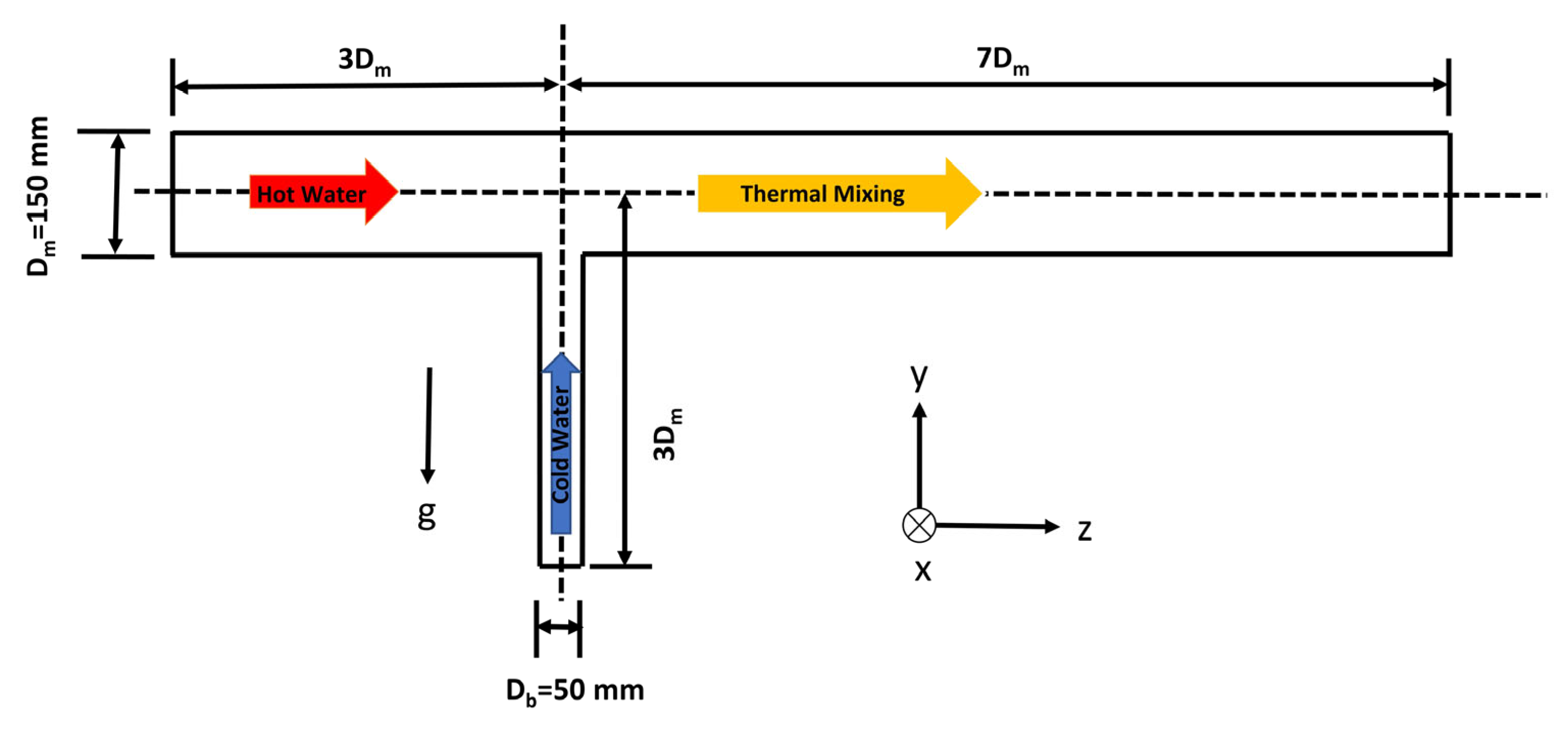
A uniform computational domain was used for all computations. The T-junction segment of the WATLON facility, as illustrated in Figure 1, was replicated. The computational domain comprised the main and the branch pipes. Both pipes located upstream of the junction exhibited identical lengths, measuring three times the diameter of the main pipe (3Dm). The length of the pipe located downstream of the junction was seven times the diameter of the main pipe (7Dm). The longer length of the outlet section effectively inhibited the reverse flow.
Table 1 shows the details of the WATLON benchmark case. Considering the comparatively low ΔT of the case under consideration, the physical characteristics of the fluid were assumed to remain uniform throughout all computations and were equal to the properties of liquid water at a temperature of 313.5 K, as presented in Table 2.
The aforementioned properties are indicative of a molecular Prandtl number of Pr = 4.42. The adiabatic no-slip boundary conditions were considered for the pipe walls. Empirical evidence suggested that this thermal boundary condition was a viable approximation for fluid-only simulations, as the wall of the WATLON facility used acrylic resin as a structural material [24]. A pressure outlet boundary condition was utilized for the outlet section. The velocity and turbulence of both the main and branch inlet sections were subjected to fully developed profiles. In order to obtain the entry flow profiles, supplementary calculations were performed using the RANS k-ω SST [25] model for both the primary inlet pipe and the branch inlet pipe, which possessed lengths of 25Dm and 30Db, respectively. Uniform temperature values, as mentioned in Table 1, were employed for both inlet sections.
The Reynolds number of the main pipe had a value of approximately 3.26 × 10⁵. The Richardson number was approximately 0.004, indicating a significantly low value. Therefore, the CFD model did not incorporate buoyancy effects. In the current computations, the temperature could be regarded as a passive scalar.

2.3. Turbulence Modeling

2.3.1. LES

The LES models the small eddies while effectively resolving the large eddies completely. LES modeling is based on the filtered Navier–Stokes equations, where the filtering operation effectively separates the large, energy-containing scales from the small, dissipative scales. In LES simulations, the WALE mode is used for subgrid-scale (SGS) modeling. The WALE model better predicts the wall behavior. The SGS turbulent viscosity in the WALE model is given by the equation
μ t = ρ L s 2 S i j d S i j d 3 2 S ¯ i j S ¯ i j 5 2 + S i j d S i j d 5 4    
where Ls and S i j d are defined as
L s = min ( κ d , C w V 1 / 3 )
S i j d = 1 2 g ¯ i j 2 + g ¯ j i 2 1 3 δ i j g ¯ k k 2
g ¯ i j = u ¯ i x j
In Equation (2), κ is the Von Kármán constant, d is the distance to the wall, V is the volume of the cell, Cw is the WALE model constant, and its value used in the calculations is 0.325. The conservation of energy is given as Equation (5).
ρ h ¯ t + ρ h ¯ u ¯ j x j = x j k e f f T ¯ x j
h ¯ and T ¯ represent the filtered enthalpy and the temperature, respectively.

2.3.2. Partially Averaged Navier–Stokes

The PANS model is a hybrid approach designed to provide a seamless transition between Reynolds-averaged Navier–Stokes (RANS) and large eddy simulation/direct numerical simulation (LES/DNS) methods [18,26]. Two closure modeling k-ε and k-ω are employed in this paper. The unsteady, incompressible Navier–Stokes equation is given as follows:
V i t + V j V i x j = p x i + ν 2 V i x j x j
where Vi is the instantaneous velocity, and p is the pressure. An arbitrary generalized filter operator <·> is applied to the Navier–Stokes equations to decompose the instantaneous velocity field Vi into the resolved (filtered) Ui and unresolved (unfiltered) ui parts.
The flow variables in the case of PANS are partially averaged, and the resulting resolved velocity is given by
U i = < V i >
The velocity field is related to the resolved and unresolved variables by
V i = U i + u i
The partially averaged Navier–Stokes equation is now given by
U i t + U j U i x j + τ ( V i , V j ) x j = p x i + ν 2 U i x j x j
where τ ( V i , V j ) is the central second moment of instantaneous velocity. This leads to a closure problem in the PANS equations.
The PANS k-ε was already employed in the case of the Vattenfall T-junction case and provided good results [23]. The PANS k-ω model is based on the same underlying principles as the PANS k-ε model [27]. The turbulent frequency of the PANS model is characterized by the unresolved scales of motion.
ω u = ε u β * k u
The variables ku and εu refer to the unresolved kinetic energy and unresolved dissipation rate in the PANS method. The parameter β* (=0.09) is a fixed model parameter.
The variables k, ε, and β are used to represent the kinetic energy, dissipation, and turbulent frequency of the overall fluctuations. The control of filter width in PANS can be achieved through the specification of either the ratios of unresolved-to-total kinetic energy (fk) and unresolved-to-total turbulent frequency (fω) or the ratios of unresolved-to-total kinetic energy (fk) and unresolved-to-total dissipation rate (fε). The aforementioned parameters are formally defined as:
f ω = ω u ω = ε u β * k u ε β * k = f ε f k
The PANS k-ω model commences with the RANS equations as presented by Wilcox [28]:
k t + U ¯ j k x j = P β * k ε + x j ν t σ k k x j
ω t + U ¯ j ω x j = α P ω k β k ω 2 + x j ν t σ ω ω x j
where U ¯ is the mean velocity, P is the production of kinetic energy, ω is the RANS turbulent frequency, and vt is the total eddy viscosity. The standard k-ω turbulence model has three coefficients: β, α, and β*. The two-equation PANS k-ω model can be described as follows:
k u t + U ¯ j k u x j = P u β * k u ω u + x j ν u σ k u k u x j
ω u t + U ¯ j ω u x j = α P u ω u k u β ω u 2 + x j ν u σ ω υ ω u x j
where
β = α β * α β * f ω + β f ω
The PANS k-ω model’s parameters, namely fk and fω, can be adjusted to achieve the appropriate level of energy resolution, which is contingent upon the Reynolds number of the flow and the necessary physical resolution. The width of the model filter ought to be proportionate to the numerical resolution. For the present work, a static formulation [29] for fk is used. The simulations are performed for fk = 0.6 and fk = 0.3 in the case of both PANS k-ε and PANS k-ω formulations.

2.4. Meshing and Convergence Study

The meshing of the domain was performed using hexahedral cells. A very fine mesh was generated close to the wall to capture the significant temperature gradients that were anticipated within the boundary layer. Taylor microscales (λ) and energy length scales (LR) were calculated using the precursor RANS calculations [30]. The precursor RANS calculations gave an energy length scale of 3.38 mm and a turbulent intensity of 4.06% at the cold inlet, and 8.52 mm and 3.12% at the hot inlet, respectively. Also, the calculation gave the values of λ and LR, which are 0.4 mm and 17 mm, respectively, at section 0.5Dm.
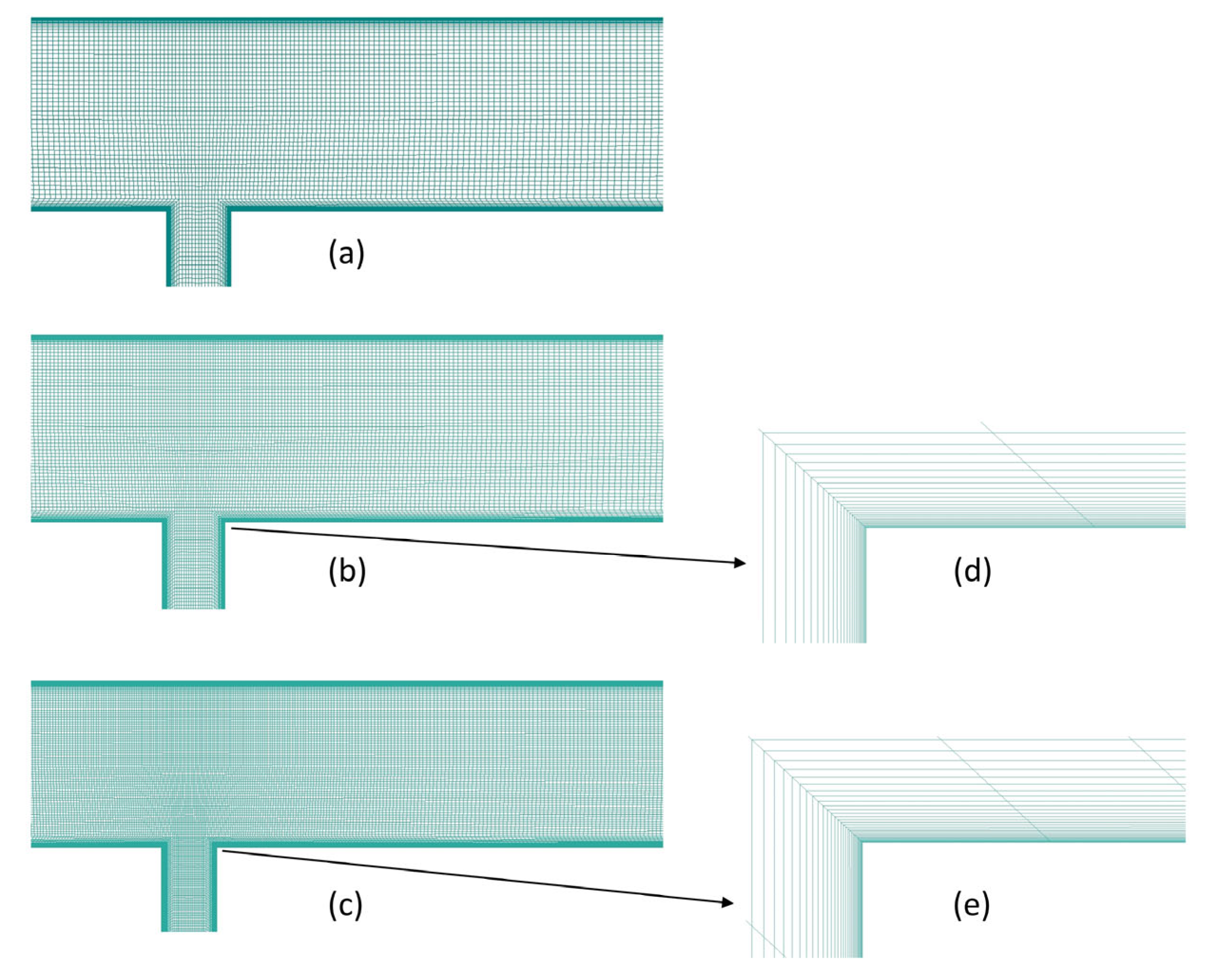
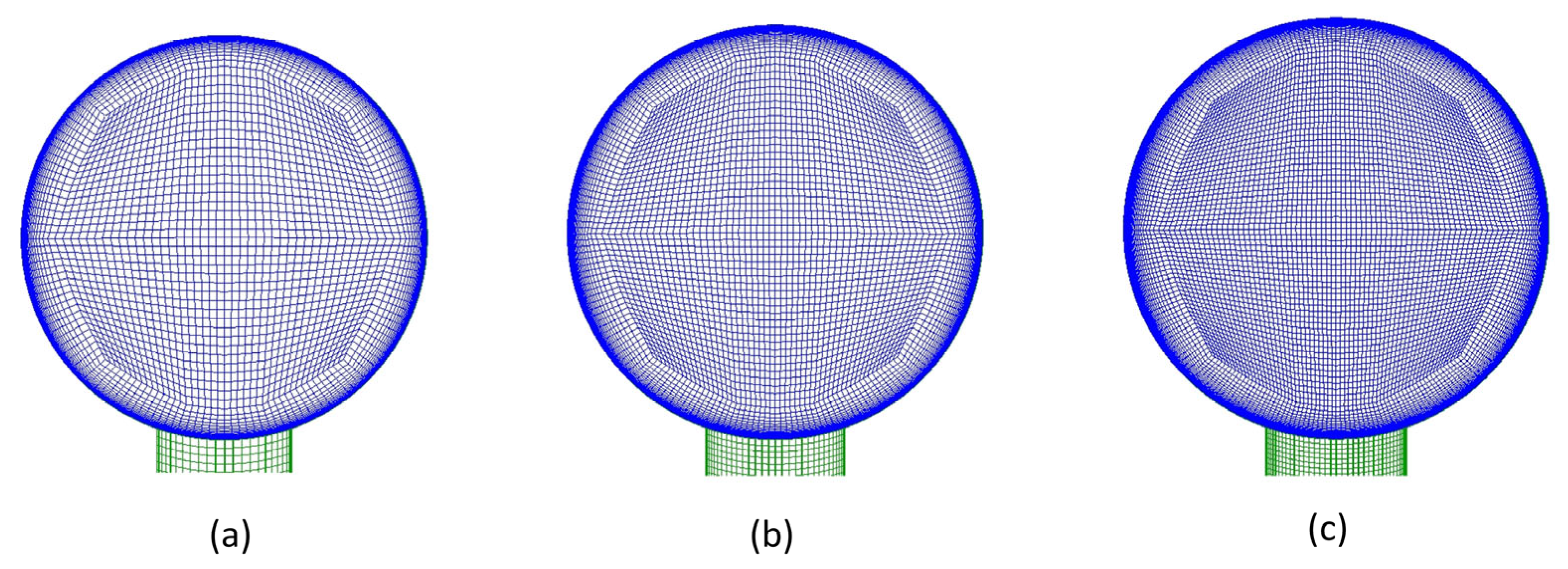
Figure 2 displays a cross-sectional representation of the mesh located on the symmetry plane of the domain, while Figure 3 displays the front view of the meshing at the main inlet section. The impact of mesh size on the results was evaluated through steady-state computations utilizing the standard k-ε model. Three distinct meshes were utilized, comprising cumulative cell counts of approximately 2.2, 4.5, and 8.4 million cells with base cell sizes of 2.9 mm, 2.2 mm, and 1.76 mm, respectively. All numerical grids within the computational domain adhered to the condition of y+ < 1 at the wall. Table 3 gives the details of all three meshes, including the first cell heights.
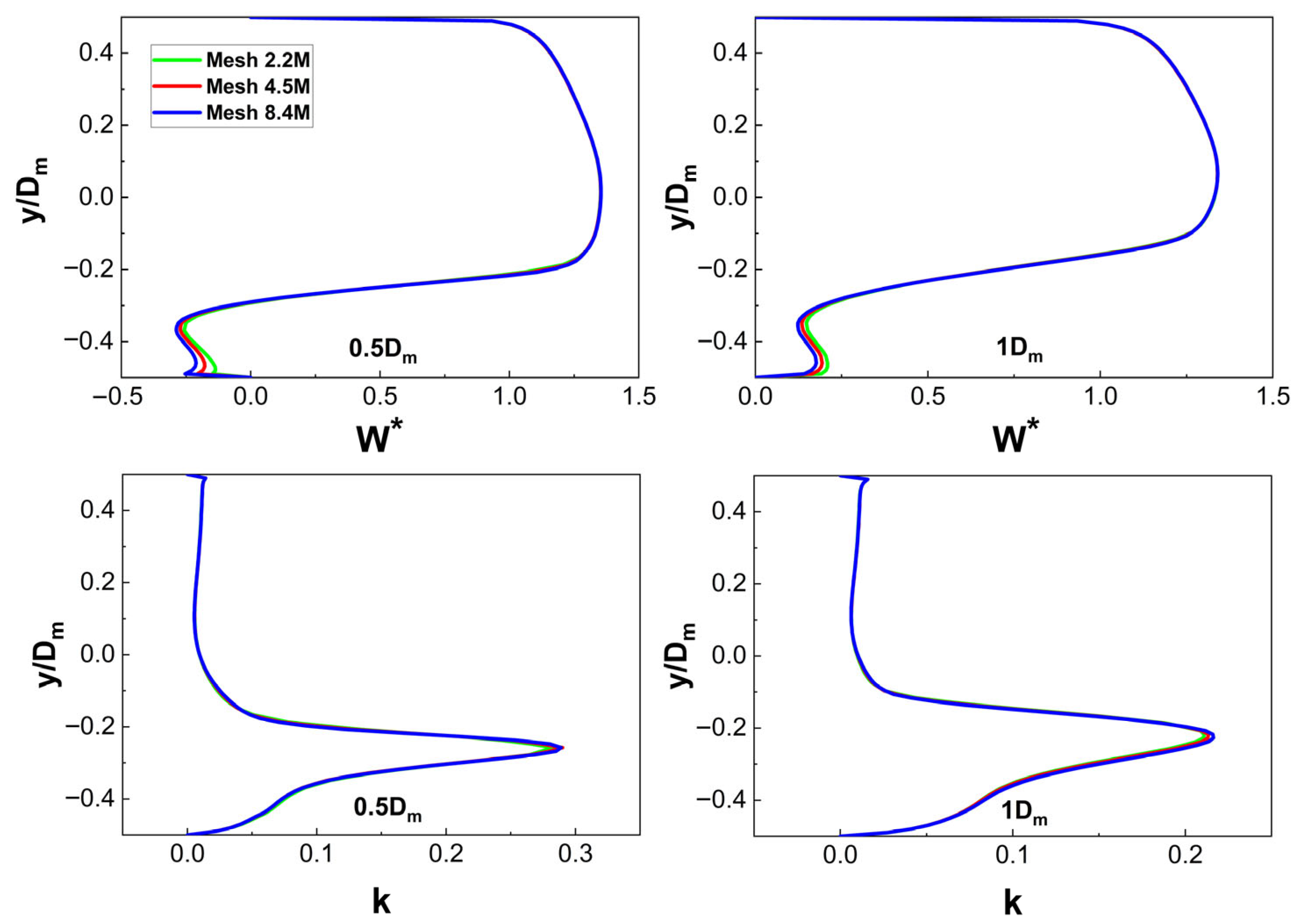
Figure 4 displays the outcomes acquired for the mean streamwise velocity component and the turbulent kinetic energy at 0.5Dm and 1Dm. Minor variations were noted in the profiles of mean streamwise velocity in the region of thermal mixing among the three meshes. The turbulent kinetic energy exhibited a high degree of similarity in the predictions obtained from all three meshes. Mesh 1 of 2.2 M cells was used for the PANS-0.6 k-ε and PANS-0.6 k-ω simulations. Mesh 2 of 4.5 M cells was used for the PANS-0.3 k-ε and PANS-0.3 k-ω simulations, and Mesh 3 of 8.4 M cells was used for LES. fω was given by Equation (11), and in the case of PANS-0.6 and PANS-0.3, its value was 1.667 and 3.333, respectively.

2.5. Numerical Settings

The Simple algorithm is used for the pressure–velocity coupling to solve the flow equations. In the PANS simulations, this study employed second-order temporal discretization alongside third-order spatial discretization, specifically utilizing the third-order hybrid Monotonic Upwind Scheme for Conservation Laws (MUSCL). A bounded central-differencing scheme for spatial discretization, along with a second-order temporal discretization scheme, was implemented for the LES model. This was implemented to guarantee the robustness of the numerical scheme.
The time steps chosen for each of the simulations and the subsequent average Courant number are given in Table 4. The convergence criterion is set to less than 10−4 for each time step. Transient simulations needed four to five flow passes to produce statistically stationary turbulence conditions. Then, for around 8 sec, the velocity and temperature transient data were recorded.

3. Results and Discussion

This section provides a thorough analysis of the results obtained through the application of PANS and LES turbulence modeling. An assessment of the results is performed in relation to the current experimental data, alongside a comparison with the turbulence models analyzed in the study.
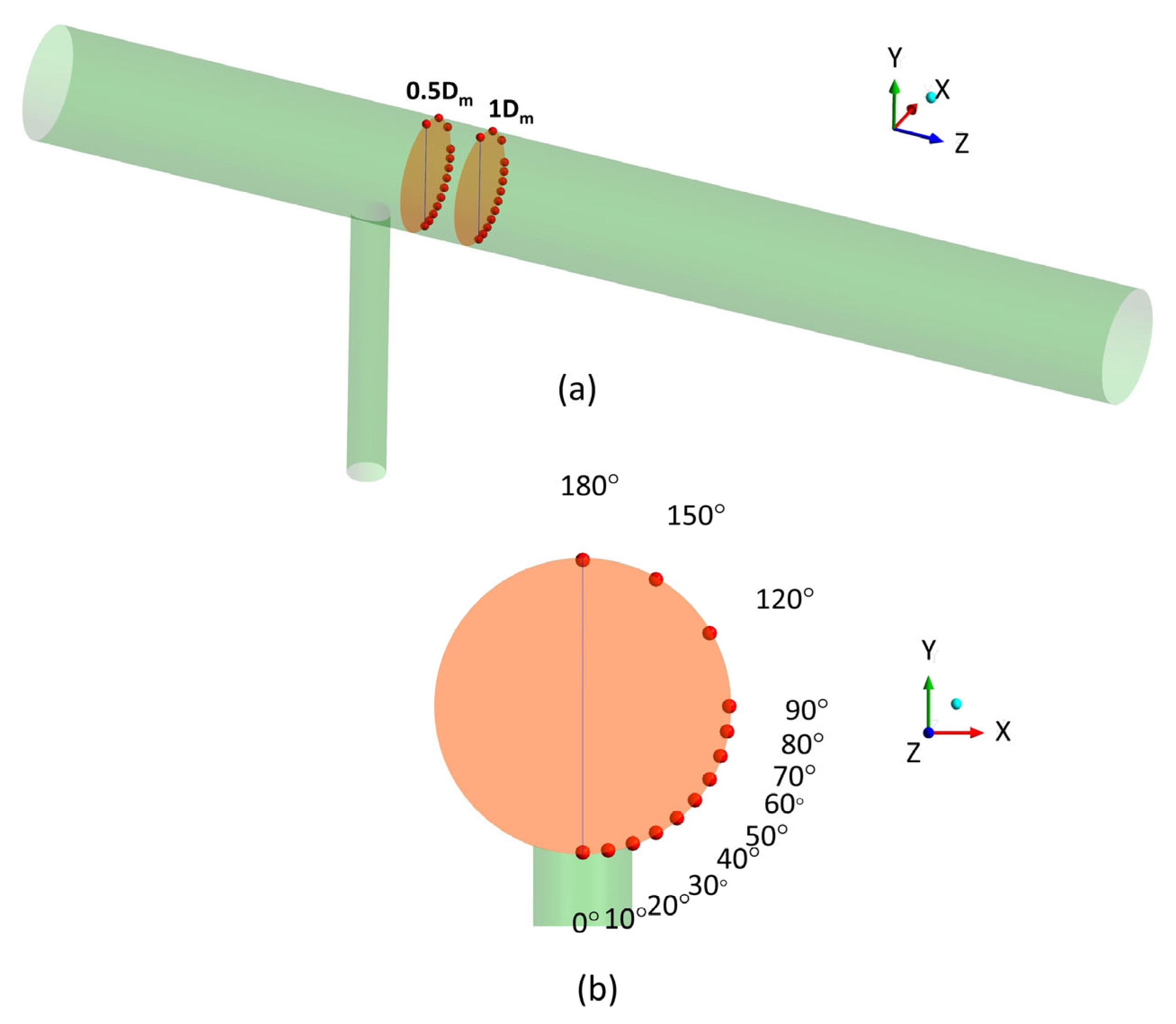
Figure 5 represents the data sampling points of the domain downstream the junction area (0.5Dm and 0.1Dm) and along the circumference of pipe (0°, 10°, 20°, 30°, 40°, 50°, 60°, 70°, 80°, 90°, 120°, 150°, and 180°) during the simulation as experimental data from literature is available on these locations [13]. As the case considered is a wall jet where the mixing region is attached to the main pipe so more points are considered in that area along the circumferential direction.
The velocity and temperature data are provided in a nondimensionalized format. The time-averaged and RMS velocities were normalized using the average velocity in the main pipe (Wm = 1.46 m/s), as demonstrated in the following equation.
W * = W W m ;                     W r m s * = 1 W m i W i W 2 N
In Equation (17), N is the number of measurement data points. Temperature and its RMS fluctuations are normalized as follows.
T * = T T b T m T b ;                         T r m s * = 1 T m T b i N T i T 2 N
Here, T is the time-averaged temperature at a certain point, Tm (=48°) is the inlet temperature in the main pipe, Tb (=33°) is the inlet temperature of the branch pipe, and N is the total number of data points.

3.1. PANS Model Consistency Criteria

The closure relation of the PANS model exhibited grid size independence. To ensure the accuracy of numerical solutions from the PANS k-ε and k-ω models, an internal consistency criterion was employed. The best internal consistency test is imposed-to-calculated eddy viscosity. Due to global filtering, the eddy viscosity was fundamental to the governing equations and bridges the filtered and unfiltered domains. The recovery ratio, the ratio of PANS turbulent viscosity vu to RANS νt, is assessed in all PANS simulations [31].
ν u = C μ k u 2 ε u = k u ω u
ν t = C μ k 2 ε u = k ω
f ν = ν u ν = f k 2 f ε
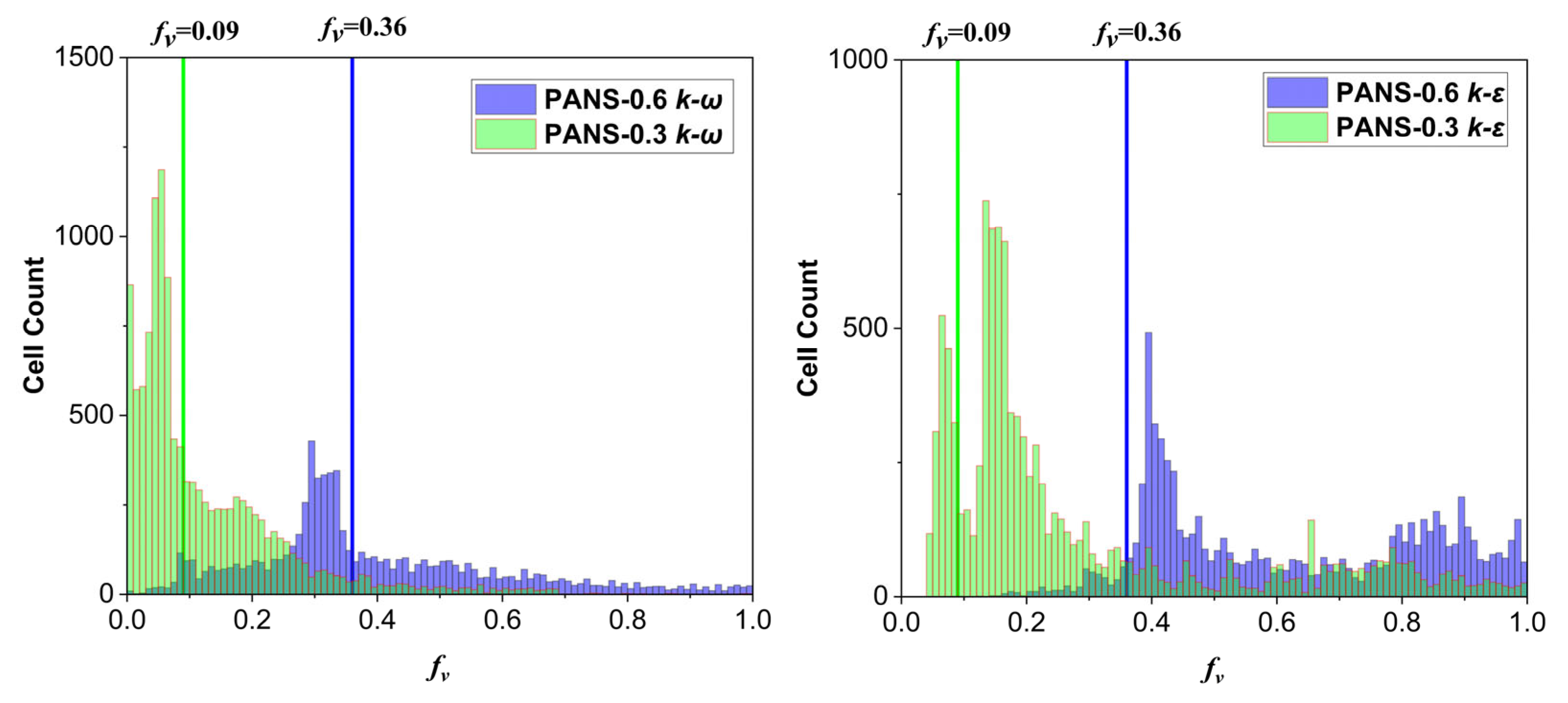
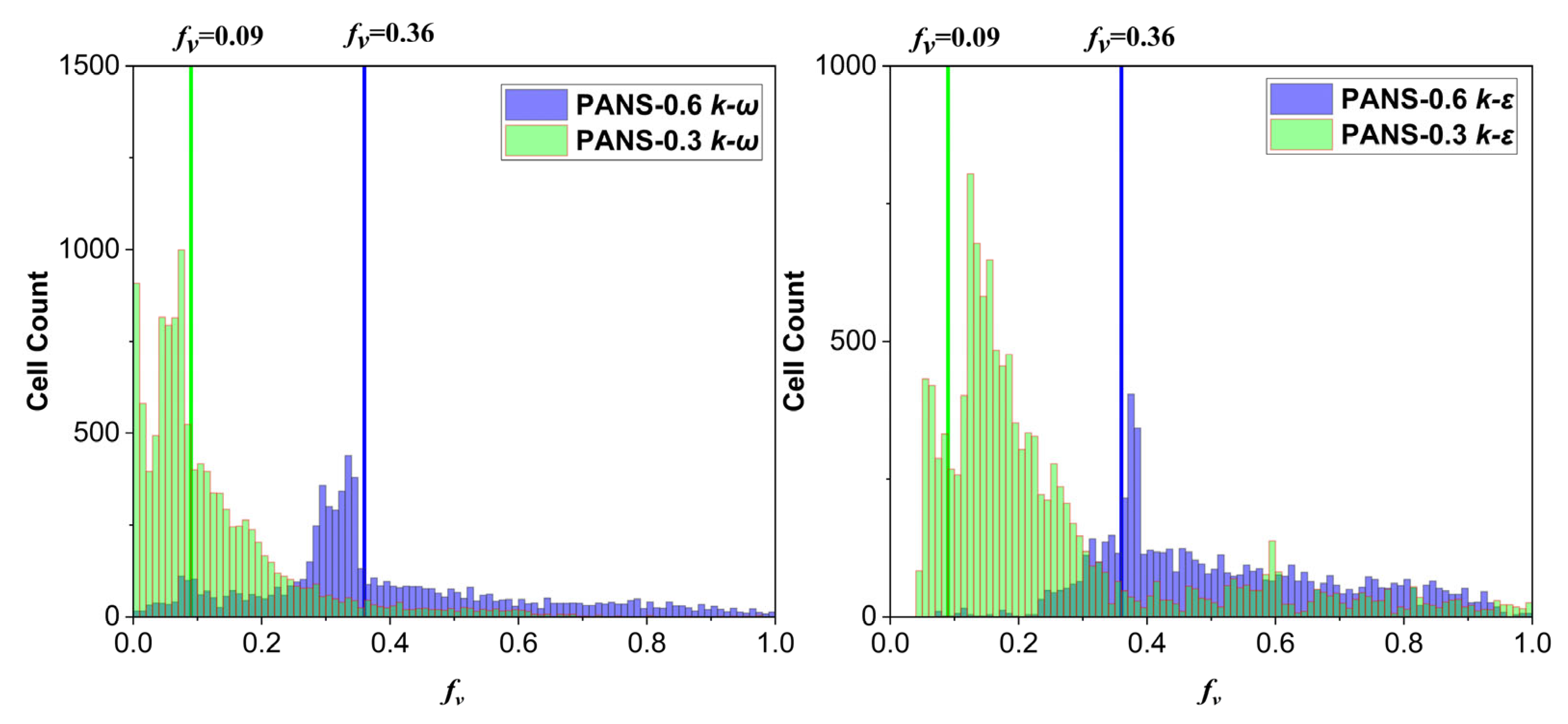
The dissipation filter during the simulations is fε = 1, and therefore, the recovery ratio becomes fv = fk2. Two PANS filters (fk = 0.6 and fk = 0.3) used in the simulation resulted in a recovery ratio of fv = 0.36 and fv = 0.09. These recovery ratios were used for the internal consistency of PANS simulations. Then, 0.5Dm and 1Dm planes downstream of the junction area were selected for the PANS consistency test, as these planes are particularly important for experimental validation.
Figure 6 and Figure 7 show the distribution of recovery ratio along 0.5Dm and 1Dm for both PANS k-ε and k-ω simulations. The recovery ratio is represented by the vertical lines for both PANS filters, while the distribution of the recovery ratio is depicted by the histograms. For both PANS k-ε and k-ω simulations, the recovery ratio peaks were around or less than the externally applied ratio. PANS k-ω showed slightly less recovery ratio as compared to the PANS k-ε simulations. It is worth noting that as the value of fk was reduced from 0.6 to 0.3, both the histograms shifted to the left side, indicating a significant reduction in the recovery ratios.

3.2. Vortex Structures

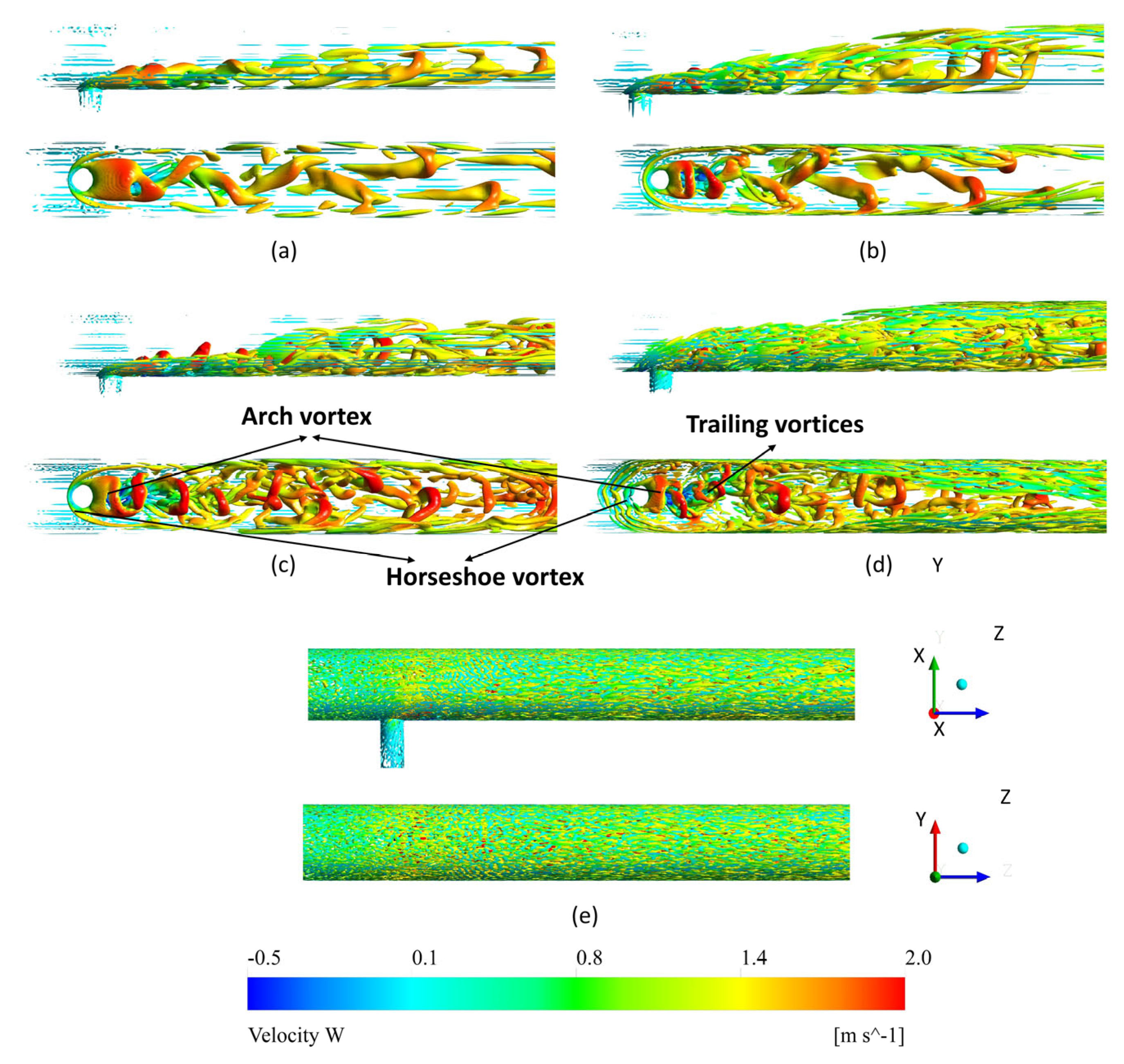
Figure 8 showcases the iso-surfaces that correspond to Q = 200 s−2, where Q represents the second invariant of the velocity gradient tensor and emphasizes the resolved coherent vortical structures. The LES method was capable of resolving a greater number of flow structures, owing to the finely resolved grid in the bulk region and close to the wall. On the other hand, the PANS simulations were effective in resolving the larger unsteady flow structures. The PANS-0.6 simulations conducted on the coarse mesh only resolve the large-scale flow structures. The PANS-0.3 simulations predicted flows exhibited a resemblance to those obtained through LES as the grid resolution was refined and the filter control parameter was reduced to 0.3.

3.3. Velocity Field

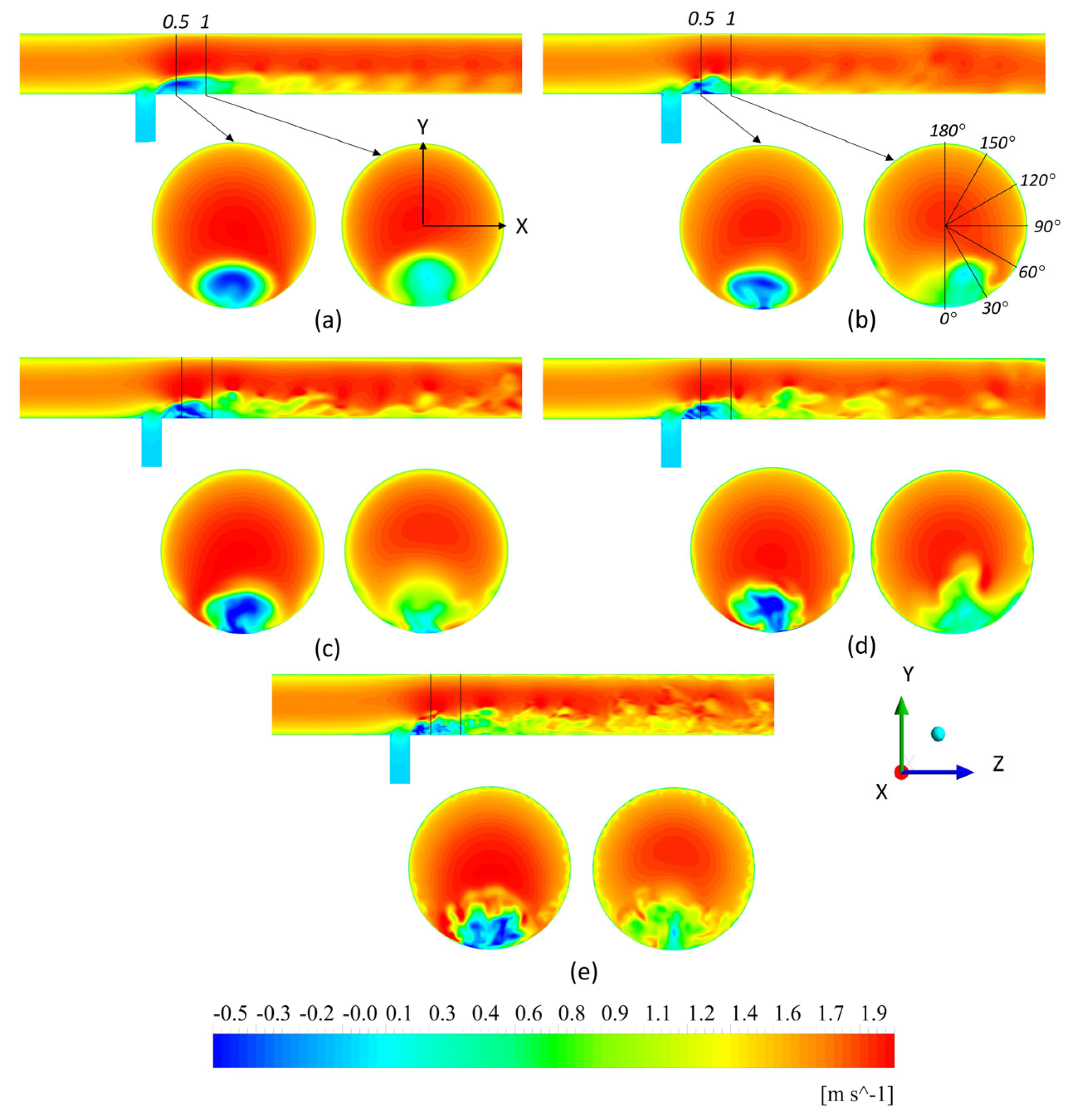
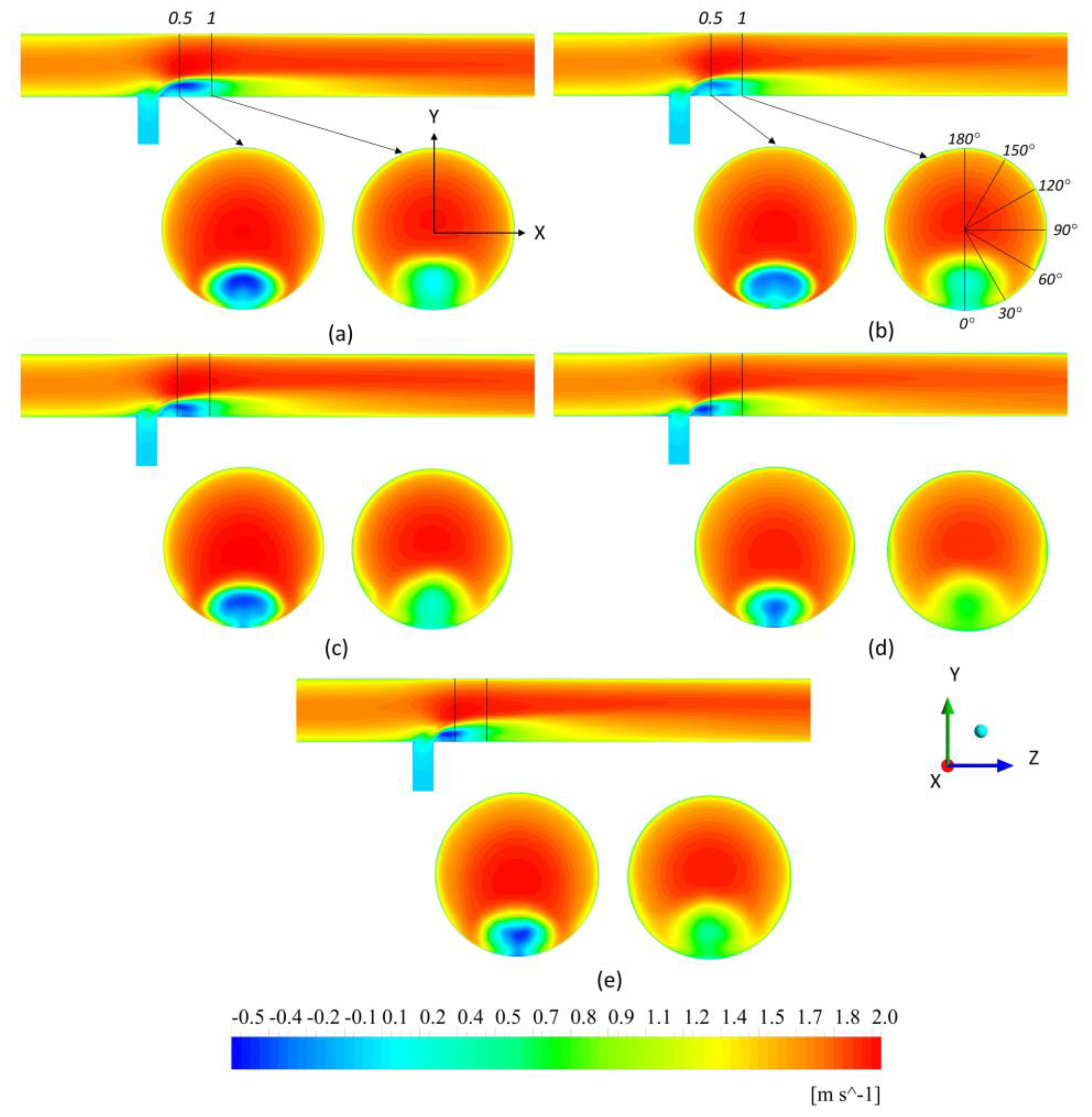
Figure 9 and Figure 10 illustrate the contours of the streamwise velocity component W on the symmetry plane at x = 0 and at 0.5Dm and 1Dm locations, showing the instantaneous and time-averaged values, respectively, for all simulations. The contour graphs illustrate the qualitative behavior of streamwise velocity in thermal mixing. The fluid stream from the branch pipe did not reach the opposing wall of the main pipe. Instead, it was deflected by the robust momentum flow associated with the main pipe. According to the empirical findings, PANS-0.3 k-ε and k-ω models, combined with the LES model, indicated the existence of a recirculating flow in the immediate wake region of the jet, extending up to 1Dm.
The analysis of the instantaneous and mean W contours revealed that both PANS-0.3 k-ε and k-ω and PANS-0.6 k-ω simulations demonstrated the anticipated unsteady characteristics of the flow in the area following the junction in a qualitative manner. On the contrary, it seemed that the fk = 0.6 in the PANS-0.6 k-ε simulation was inadequate in its ability to apprehend the fluctuating nature of the mixing process downstream of the junction.
As the value of fk was reduced to 0.3, more fluctuations were resolved in the mixing zone and showed a strong variation in the instantaneous velocity. PANS-0.6 k-ε resolved the most prominent structures detected in the wake region. Furthermore, it predicted a large recirculation zone in comparison to the other simulations. LES simulation predicted the most fluctuations, as depicted in Figure 9, followed by PANS-0.3 k-ω, PANS-0.3 k-ε, PANS-0.6 k-ω, and PANS-0.6 k-ε, showing the least amount of turbulence during the mixing of two flow streams.
All the simulations showed comparable results for time-averaged velocity contours, as depicted in Figure 10. It is worth noting that PANS-0.3 k-ω showed similar results as compared to the LES. As depicted in the contour plots at 0.5Dm and 1Dm, the area of the recirculation zone in the k-ε closure modeling was more significant than in the k-ω model. The reason for this was the inherent difference between the two closure models. In regions of strong shear or flow separation, the k-ε model overestimated the turbulence levels, which led to a large recirculation zone. The k-ω model better captured the flow separation in the free stream, which resulted in a smaller predicted recirculation zone. Table 5 shows the recirculation length calculated along the midplane at the y = −55 mm line.
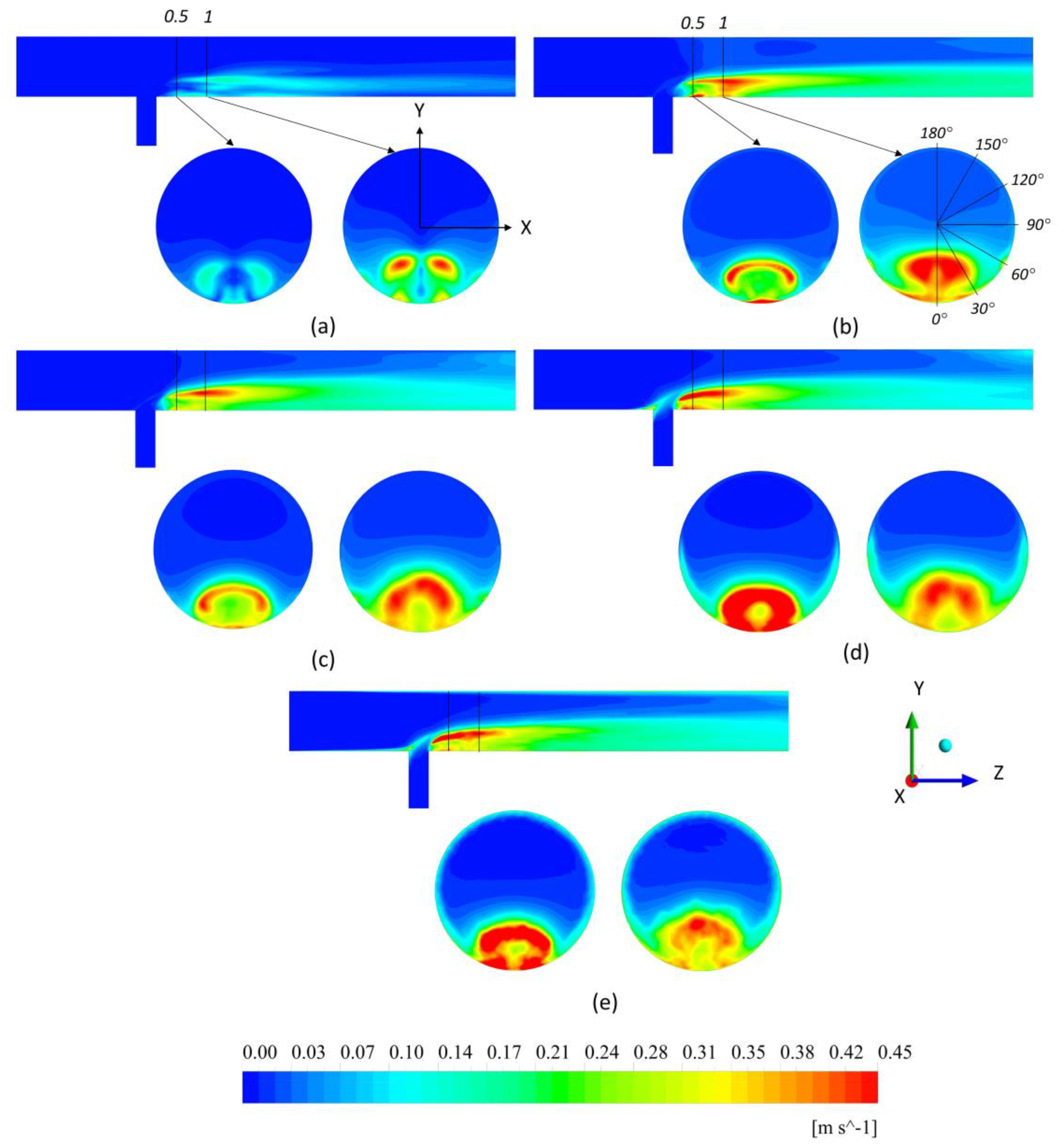
The above observations are substantiated by the contour plots of calculated RMS fluctuations of the streamwise velocity W, as shown in Figure 11. Except for PANS-0.6 k-ε, which showed some fluctuations at 1Dm, all other simulations showed the presence of a region of high velocity fluctuations in the shear layer that separated the primary flow from the wake region. This region started at 0.5Dm for PANS-0.6 k-ω and PANS-0.3 k-ε and extended beyond 1Dm. In the case of PANS-0.3 k-ω and LES, the high velocity fluctuation region started before the 0.5Dm, indicating strong mixing behavior near the junction area.
A small velocity fluctuation area was observed in proximity to the wall near 0.5Dm in all simulations except for PANS-0.6 k-ε. The mentioned fluctuation area was more pronounced in k-ω and the LES as compared to the k-ε simulations. Again, the LES and PANS-0.3 k-ω simulation showed similar contour plots for RMS fluctuations. Moreover, PANS-0.3 k-ω and LESs also showed the fluctuating velocities near the backend of the junction area, indicating a penetrating flow in the branch pipe. This penetrating flow was not present in the rest of the simulations performed.
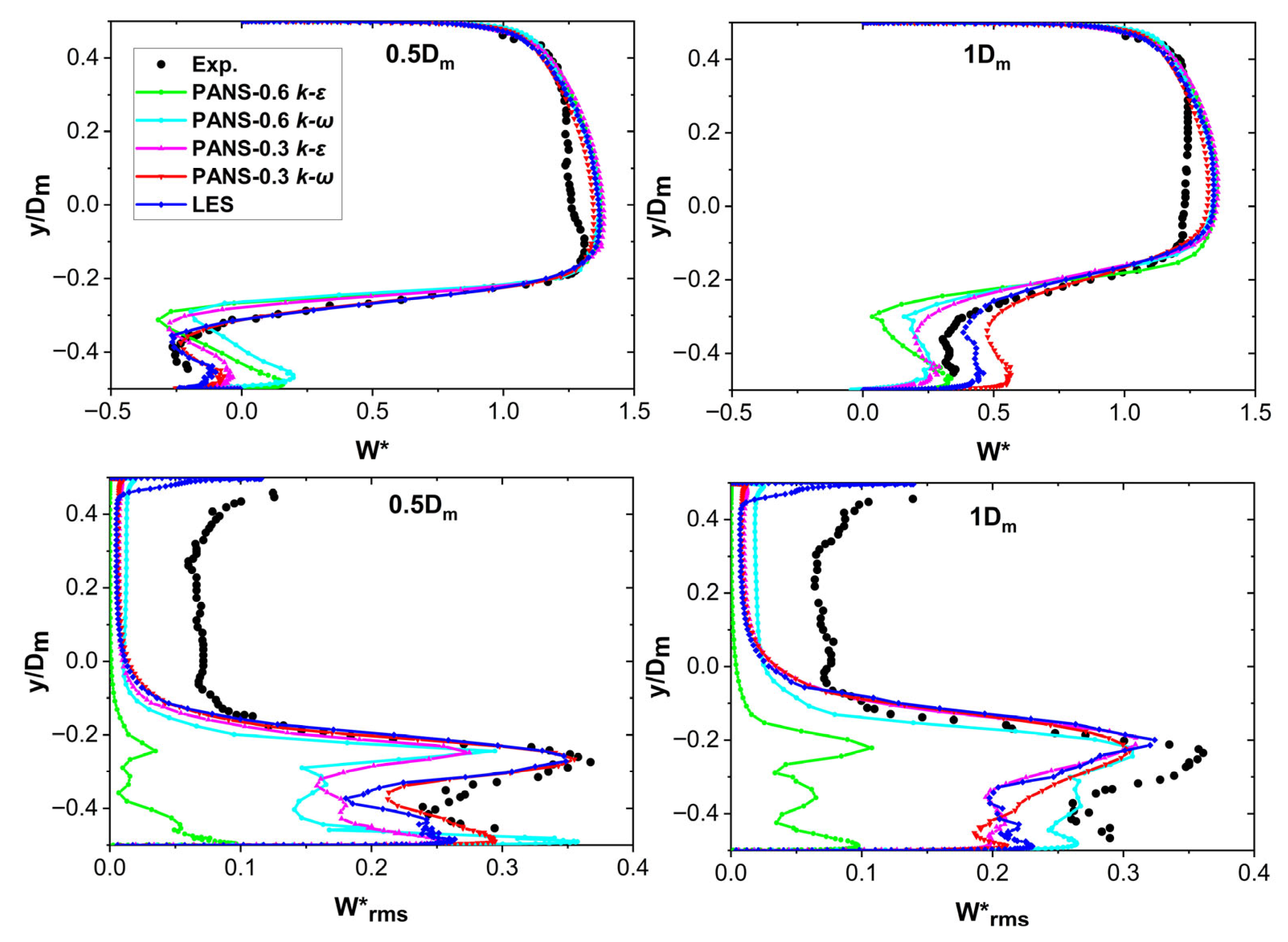
Figure 12 presents a comparison of the time-averaged and fluctuating streamwise velocity profiles at 0.5Dm and 1Dm, between the calculated and experimental results. At 0.5Dm, it was evident that the PANS-0.3 k-ω and LES exhibited a satisfactory level of agreement with the experimental results for time-averaged velocity W. PANS k-ε and PANS-0.6 k-ω overestimated the height of the recirculation zone. At 1Dm, the k-ε closure modeling overestimated the recirculation zone, which is in line with the contour plots. LES and PANS-0.3 k-ω predictions were slightly underestimated in the recirculation zone. Nevertheless, the results of the simulations were in good agreement with the experimental data, especially for LES and PANS-0.3 k-ω.
Apart from PANS-0.6 k-ε, all the simulations effectively represented the qualitative trends observed in the experiments for streamwise velocity fluctuations. It was observed that the levels of fluctuations in the vicinity of the junction were significantly underestimated by PANS-0.6 k-ε. This was attributed to the high turbulent viscosity values due to a high fk value.

3.4. Temperature Field

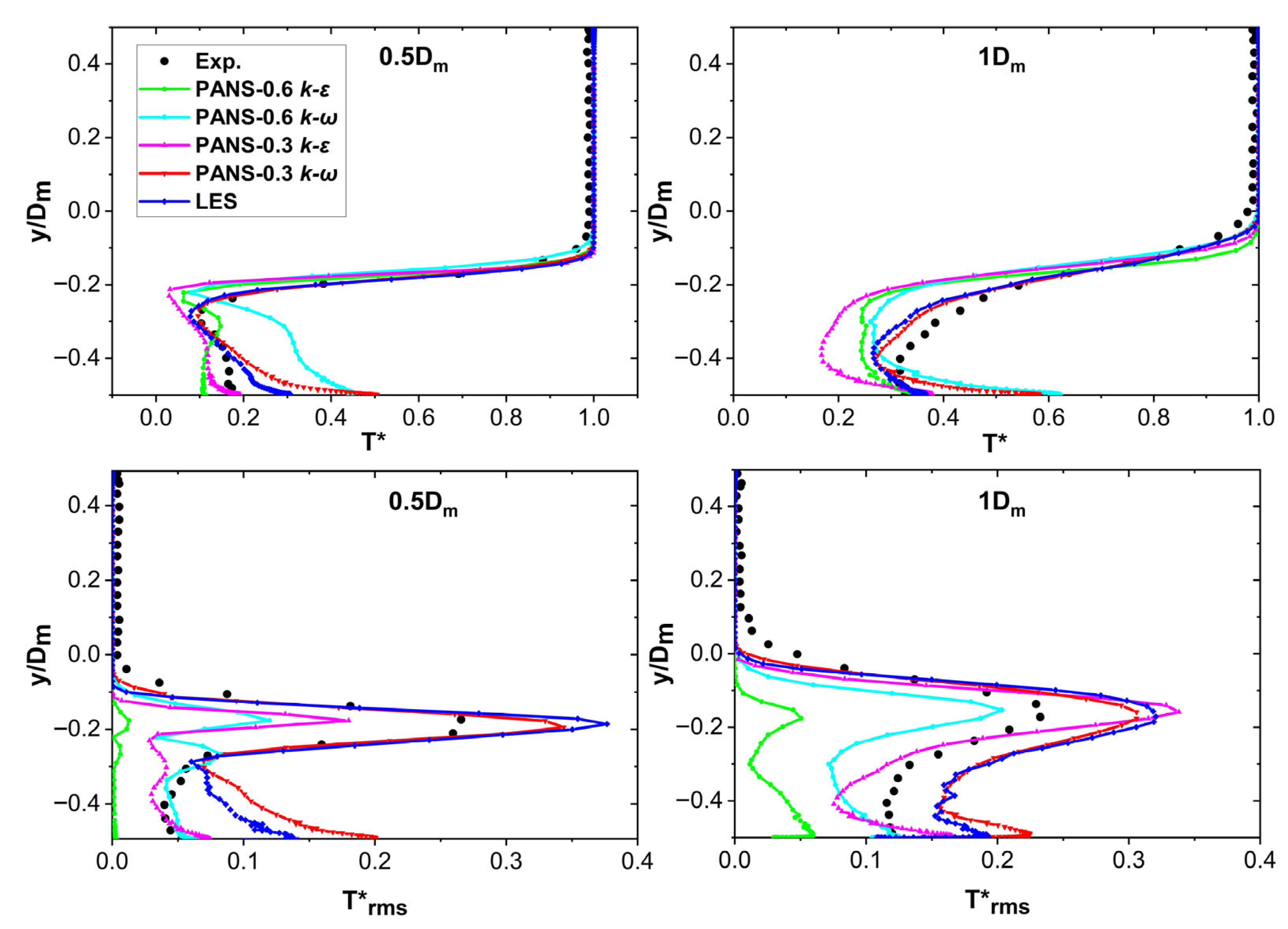
One peak of RMS fluctuations was detected in close proximity to the wall, while a subsequent peak was identified within the shear layer. At 0.5Dm, PANS-0.3 k-ω and LES predictions of RMS fluctuations at the wake region and near the wall were in good agreement with the experimental observations. PANS-0.3 k-ε and PANS-0.6 k-ω slightly underestimated the RMS fluctuations in the wake region. At 1Dm, apart from PANS-0.6 k-ε, all the simulations showed similar trends, and RMS fluctuations were slightly underestimated at the wake and near the wall region.
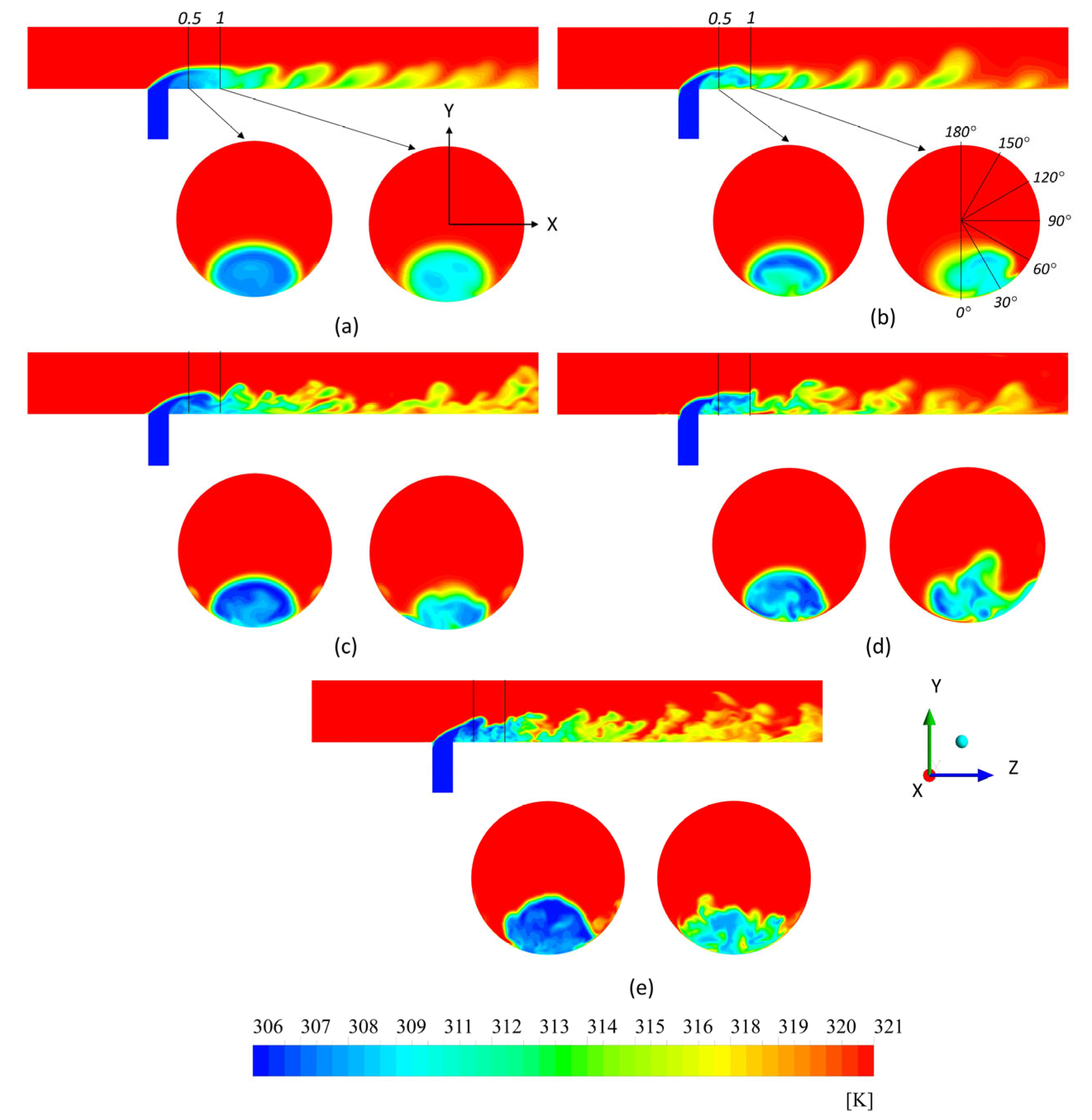
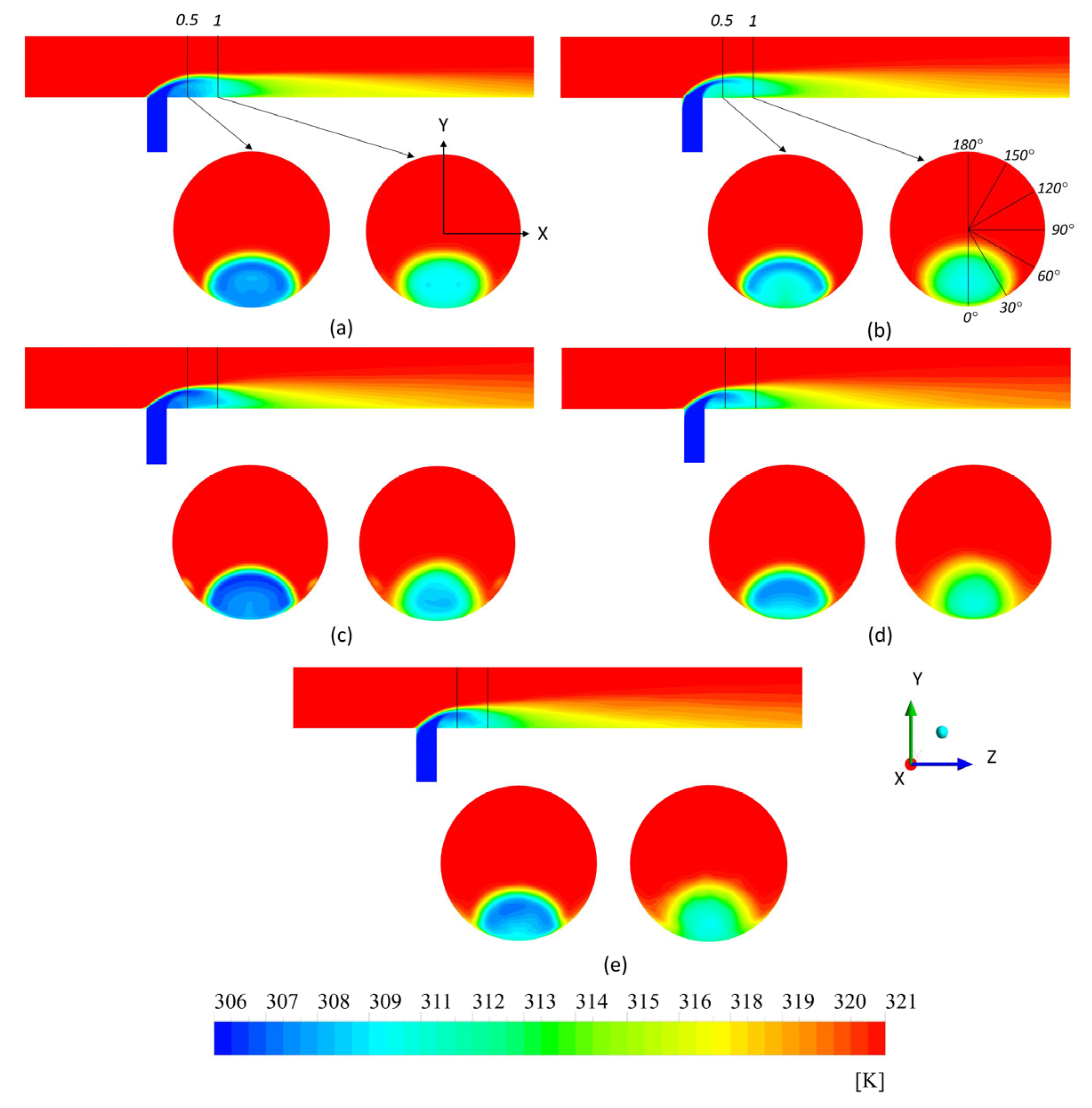
Figure 13 and Figure 14 display the temperature contours, both instantaneous and time-averaged, along the symmetry plane at x = 0 and along 0.5Dm and 1Dm obtained through the implementation of various turbulence models. The cold flow emanating from the branch pipe was redirected by the high-momentum main flow, resulting in the formation of a wall jet subsequent to the junction.
All the simulations showed the fluctuating pattern in the thermal field beyond the junction, particularly as it progressed downstream within the wake zone. As expected, LES and PANS-0.3 simulations showed more unsteadiness in the thermal field when compared to the PANS-0.6 results. A disparity existed in the length of the low temperature core within the wake region between the k-ε and k-ω models, with the former exhibiting a greater length of the low temperature core that extends up to 1Dm. In all other cases, this low-temperature region was slightly beyond 0.5Dm. The contour plots indicated that the PANS k-ω model exhibited greater thermal mixing between the cold and hot flow streams in comparison to the PANS k-ε model.
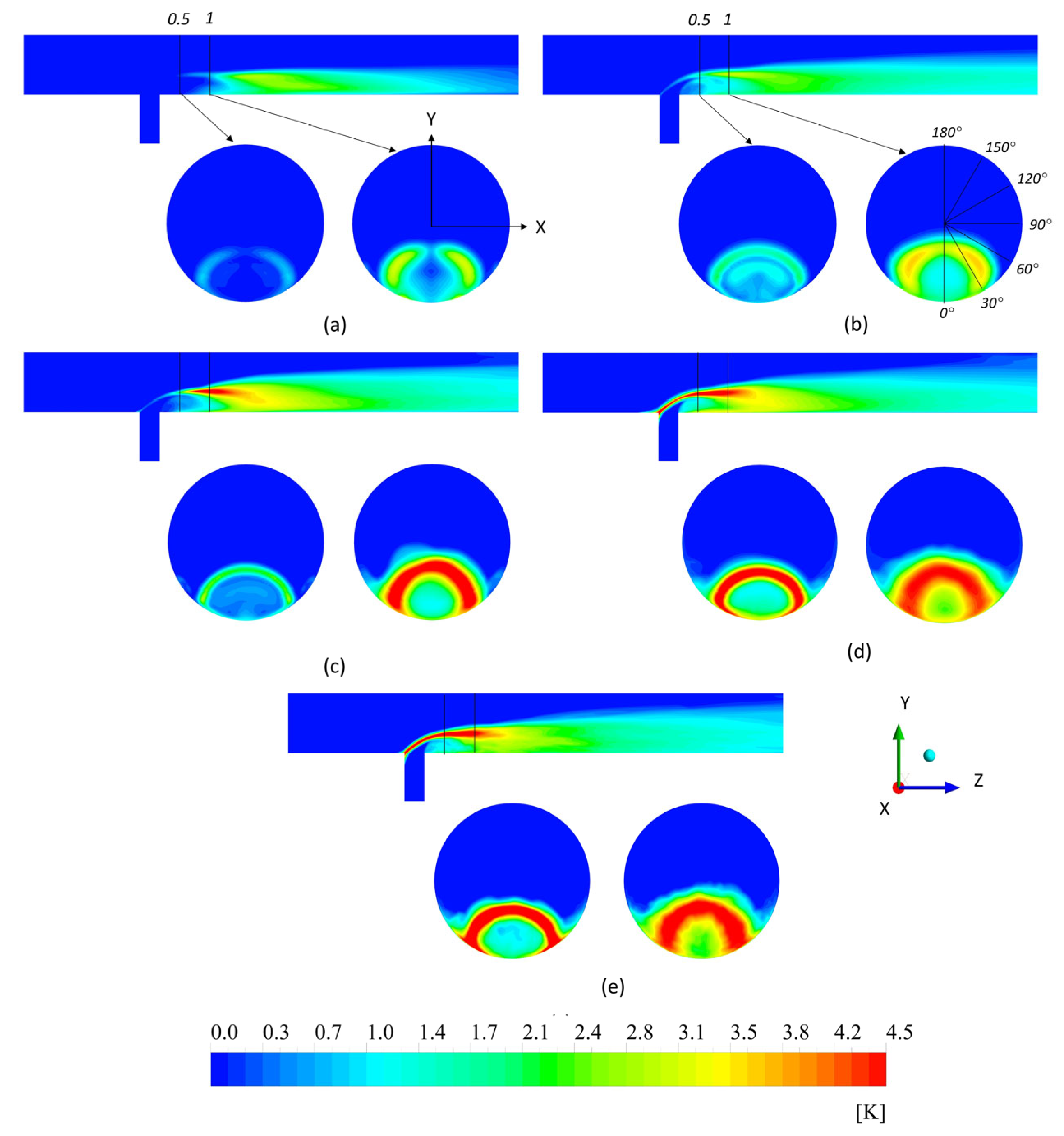
Figure 15 displays the contour plots of RMS temperature fluctuations. The plots revealed a noteworthy observation regarding the thermal mixing region where the cold and hot flow streams converge. Specifically, significant temperature fluctuations were observed within the shear layer. This phenomenon was particularly pronounced in the case of PANS-0.3 and LES. In the case of PANS-0.3 k-ω and LES, these high fluctuations started near the backend of the junction region and went beyond 1Dm. In the case of PANS-0.3 k-ε, this region began at 0.5Dm and extended beyond the results of PANS-0.3 k-ω and LES. This phenomenon was attributed to the significant turbulent flow field unsteadiness. Both PANS-0.6 simulations were unable to produce these higher fluctuations in the wake region.
Figure 16 depicts the computed time-averaged and RMS magnitudes of the streamwise velocity components, along with a comparison to the experimental data at 0.5Dm and 1Dm. The analysis of the time-averaged temperature revealed a satisfactory level of concurrence among the models and experimental data in the junction area, especially for y/Dm > −0.2. Upon approaching the wall, it was observed that the PANS-0.3 k-ω and LES overestimated the time-averaged temperature values. At 1Dm, PANS-0.3 k-ω and LES exhibited a satisfactory level of conformity with the empirical data. Conversely, the remaining simulations, especially PANS-0.3 k-ε, exhibited a tendency to underestimate the temperature within the wake region.
Regarding temperature fluctuations, PANS-0.3 k-ω and LES accurately predicted the temperature RMS profiles at 0.5Dm but tended to overestimate the RMS fluctuations close to the wall. Other simulations underestimated the RMS fluctuation in the bulk region at y/Dm = −0.2. PANS-0.6 k-ε failed to predict a reasonable fluctuation at both 0.5Dm and 1Dm and was unable to resolve the turbulence structures in the mixing region.
At the downstream site at 1Dm, PANS-0.3 and LES overestimated the RMS fluctuations in the bulk region and close to the wall. Again, PANS-0.6 k-ε failed to predict the RMS fluctuations, while PANS-0.6 k-ω showed good results both in the bulk region and close to the wall, although it underestimates the fluctuations in the bulk region. Both PANS-0.3 k-ω and LES showed similar results for time-averaged and RMS temperature fluctuations.
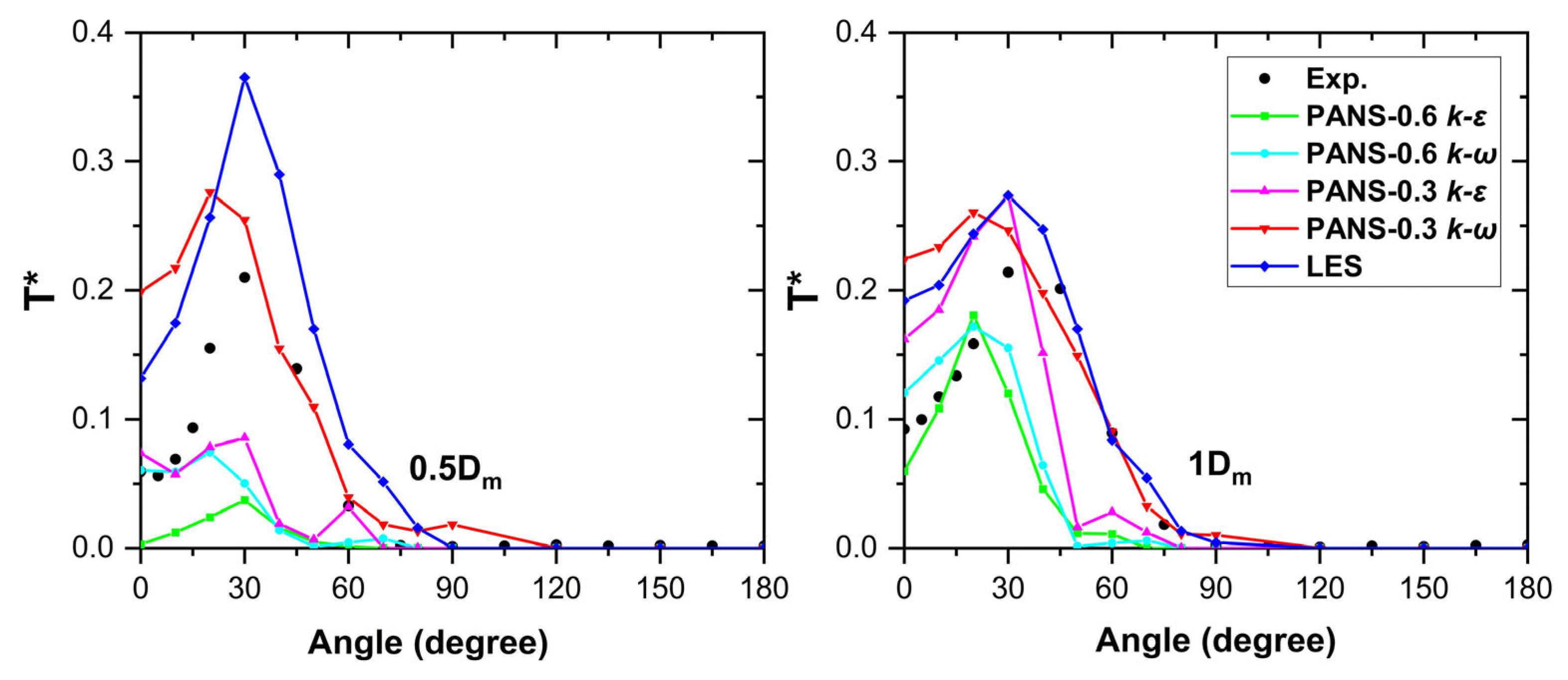
The circumferential distribution of the RMS temperature fluctuations at distances of 0.5Dm and 1Dm is depicted in Figure 17. The obtained results were compared with the empirical findings. The data was obtained at a distance of 1 mm from the wall in accordance with the experimental conditions. According to the experimental findings, the wall jet case had a peak at θ = 35°, and the value reached up to 0.25. The RMS fluctuations were underestimated by PANS-0.6 and PANS-0.3 k-ε at a distance of 0.5Dm. The PANS-0.3 k-ω and LES models exhibited an overestimation of the fluctuations, with the former demonstrating a superior agreement with the empirical findings. The LES simulations had yielded a peak value of 0.35. The simulation outcomes of LES and PANS-0.3 at 1Dm were consistent with the empirical observations. The LES attained a peak value of 0.27 at an angle of 30°. The PANS-0.6 simulation exhibited satisfactory outcomes in the vicinity of the junction region; however, the findings indicated a sharp decrease as the circumferential angle increases. The cause appeared to be the flow’s inability to extend further in the circumferential direction. Similar observations were made for the PANS-0.6 k-ε simulation, wherein a marked reduction in the RMS fluctuations was noted beyond an angle of 30°. However, it is noteworthy that the PANS-0.3 k-ω and LES models demonstrated the experimental behavior quite well.
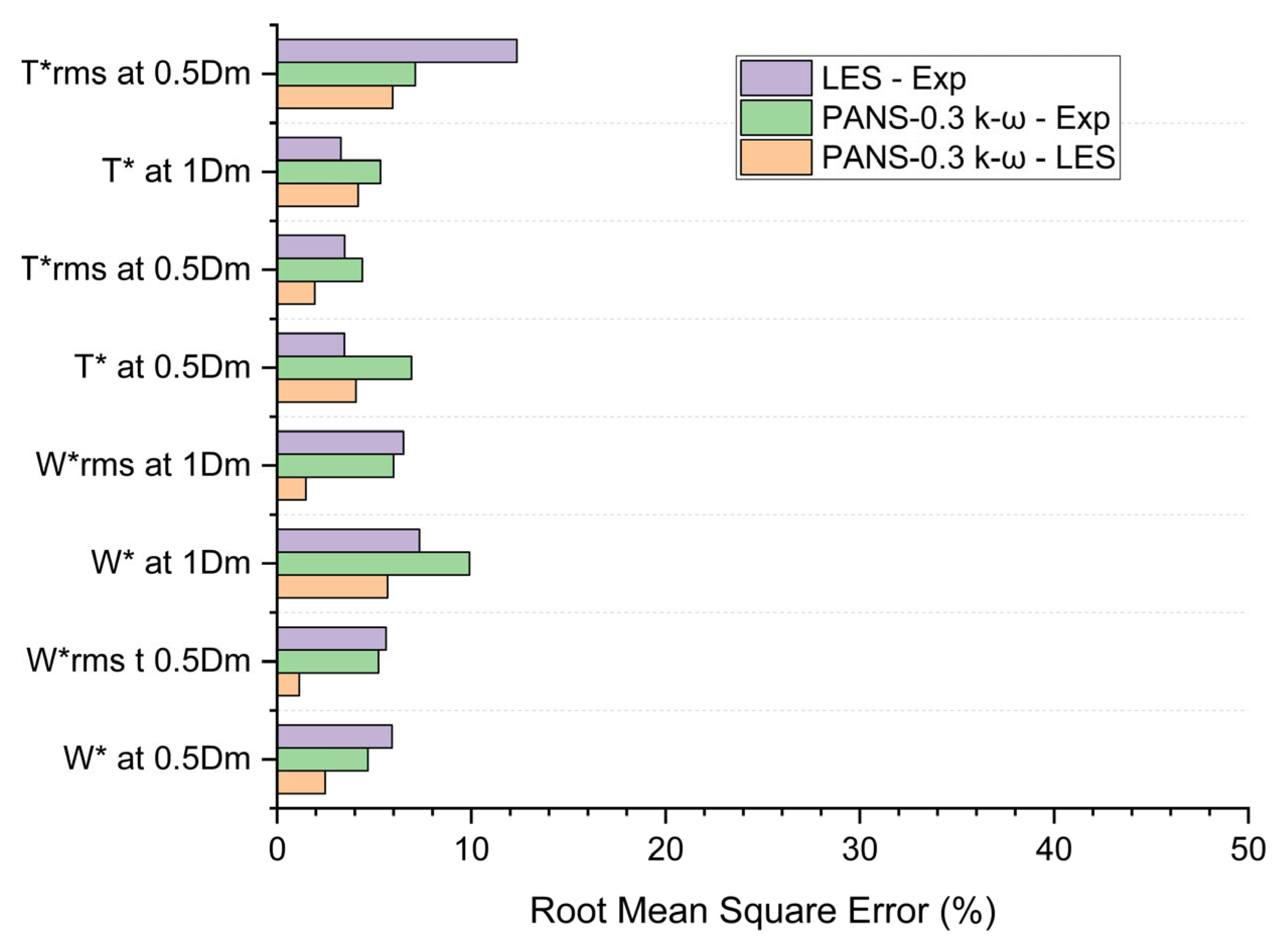
Furthermore, validation metrics utilizing the root mean square error were established to evaluate the differences between the simulation results and the experimental data. Figure 18 presents three metrics: LES–Exp, PANS-0.3 k-ω–Exp, and PANS-0.3 k-ω–LES. The root mean square error for both the temperature and velocity values was below 10%.

3.5. Spectral Analysis

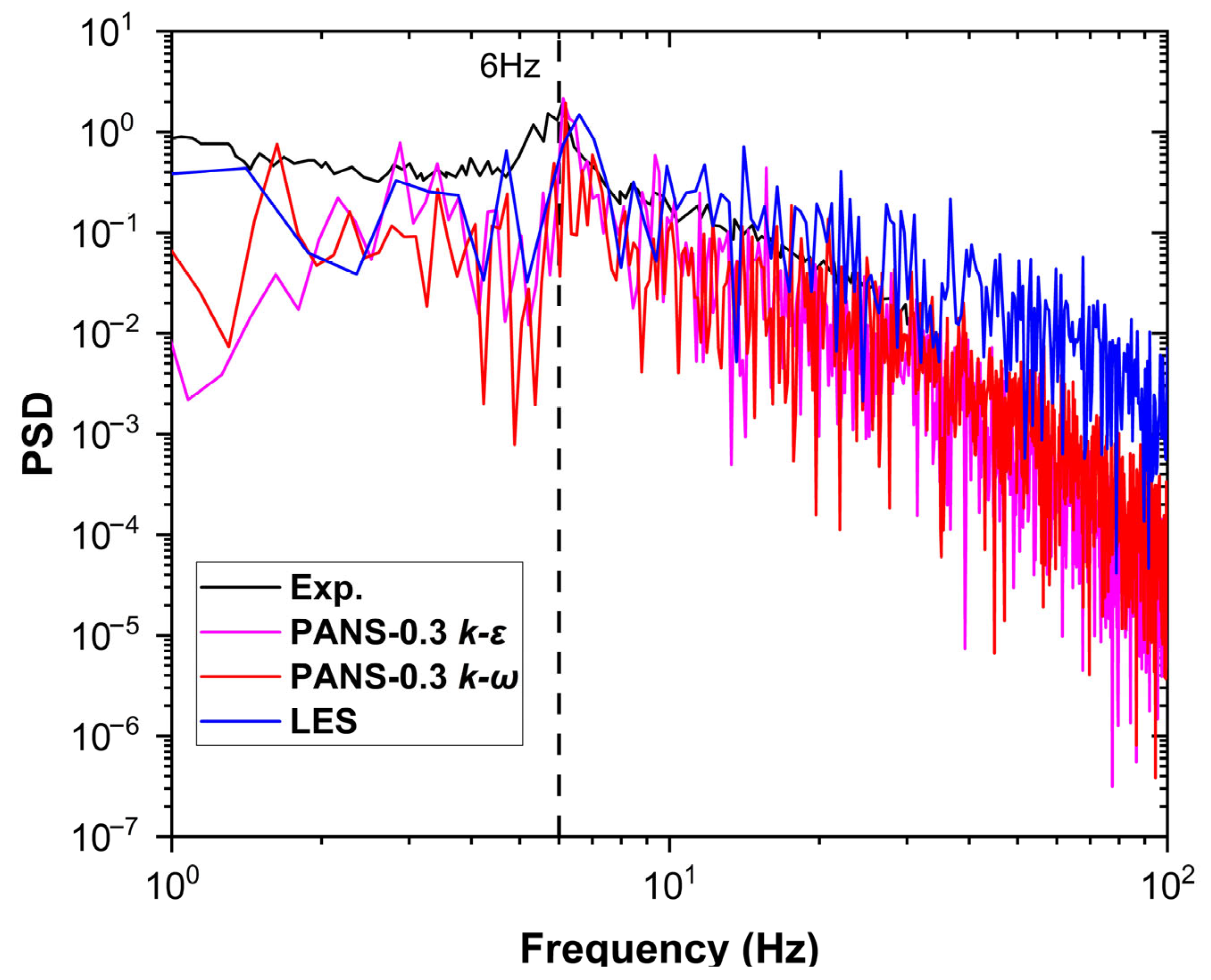
In order to assess the cyclic thermal stress that the solid pipe experiences, it was essential to accurately forecast temperature variations near the wall. The temperature signal’s power spectral density (PSD) was calculated for this investigation. The evaluation was conducted for PANS-0.3 and LES at a distance of 1 mm from the wall at 1Dm and at an angle of 30°. The results of the evaluation are presented in Figure 19. The findings indicated a strong concurrence between the numerical calculations and experimental results, particularly with regard to the prominent peak detected at a frequency of approximately 6 Hz.
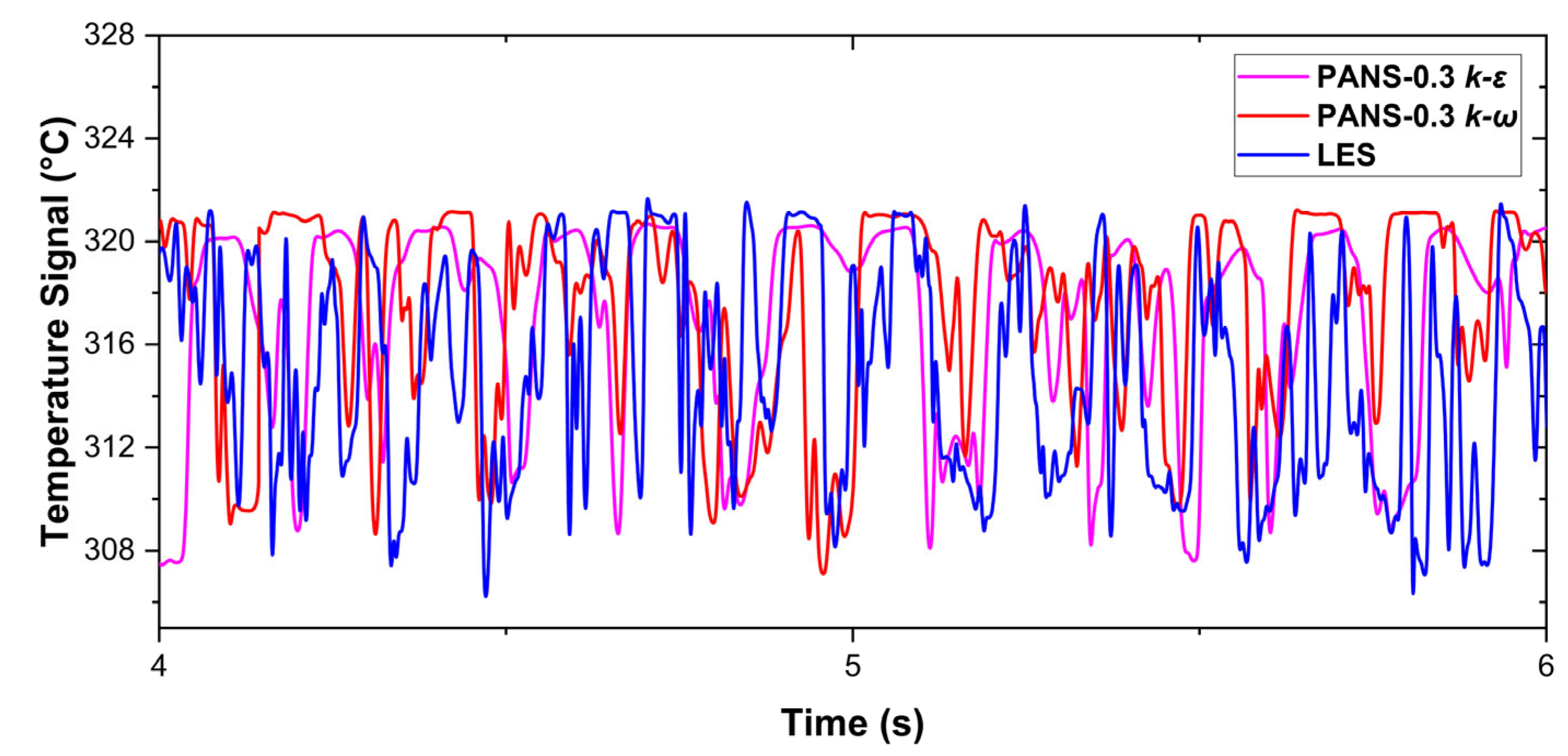
The temperature signal at the same location utilized in the PSD analysis was depicted over time in Figure 20. A disparity in the time series plot of PANS-0.3 and LES was demonstrated by plotting solely 2 s of data. The similarity in magnitude of peak amplitudes between PANS simulations and LES could be observed.

3.6. Cost–Benefit Analysis

All the simulations were performed on cloud computing using EPCYTM ROME 7542 processors with a base frequency of 2.6–2.9 GHz. Table 6 presents the total computational time, measured in CPU-hours, for each case.
As anticipated, the PANS simulations with a high fk value exhibited a faster convergence rate due to the reduced resolution of the turbulent field and higher time step used during the course of the simulations. The computing cost rose as the number of cells increased, and the value of fk decreased. The increase in the computational cost was due to the increase in the mesh resolution to conform the filter control parameter to the mesh, and also due to the decrease in the time step.
The LES case computational cost was higher due to increased mesh resolution and subsequently, a decrease in the time step to 0.4 msec so that the Courant number was below unity during the course of a simulation. The computational cost of the LES case was very high compared to the PANS simulations. Significant computational savings were achieved in the case of the PANS simulations. The results of PANS-0.3 k-ω simulations were comparable to LES results at a reduced computational cost.

4. Conclusions

This paper provides further development of the PANS methodology for thermal mixing in a high-Reynolds-number WATLON T-junction benchmark case. Standard k-ε and k-ω models were used for PANS closure. LES with the WALE subgrid scale model were also performed. The PANS simulations were performed for two different values of the filter control parameter, fk = 0.6 and fk = 0.3.
For the PANS simulations, more turbulence structures and energy scales were resolved in the case of a decrease in the value of fk from 0.6 to 0.3. This was also depicted in the contour plots of velocity and temperature fields, as well as vortex structures. However, only the PANS-0.6 k-ε simulation failed to predict the near-wall temperature fluctuations.
PANS k-ω closures performed better as compared to PANS k-ε in the case of thermal mixing due to their superior capability in modeling the near-wall flow. In the case of PANS-0.3 k-ω simulations, temperature and velocity fluctuations were comparable to LES with low mesh size and less computational cost.
The PSD analysis for temperature fluctuations also depicted the capability of the PANS k-ω model in the estimation of thermal fatigue in the piping material, as it exhibited strong correlation with the WATLON experimental data.

Author Contributions

Conceptualization, A.B. and P.G.; data curation, A.B., P.G., M.I.K., A.H. and A.M.; formal analysis, A.B., P.G., M.I.K. and A.H.; funding acquisition, P.G.; investigation, A.B., P.G. and A.M.; methodology, A.B., P.G. and M.I.K.; project administration, A.B. and P.G.; software, A.B.; supervision, A.B., P.G. and A.M.; validation, A.B.; visualization, A.B., M.I.K. and A.H.; writing—original draft, A.B., P.G., M.I.K., A.H. and A.M.; Writing—review and editing, A.B., P.G., M.I.K., A.H. and A.M. All authors have read and agreed to the published version of the manuscript.

Funding

This research received no external funding.

Data Availability Statement

The primary datasets generated during this study are large (several gigabytes) and cannot be publicly archived. Processed or summary data supporting the conclusions are included in the article, and full datasets are available from the corresponding author upon reasonable request.

Conflicts of Interest

The authors declare no conflicts of interest.

References

  1. Smith, B.L.; Mahaffy, J.H.; Angele, K. A CFD benchmarking exercise based on flow mixing in a T-junction. Nucl. Eng. Des. 2013, 264, 80–88. [Google Scholar] [CrossRef]
  2. Höhne, T. Scale resolved simulations of the OECD/NEA–Vattenfall T-junction benchmark. Nucl. Eng. Des. 2014, 269, 149–154. [Google Scholar] [CrossRef]
  3. Ayhan, H.; Sökmen, C.N. CFD modeling of thermal mixing in a T-junction geometry using LES model. Nucl. Eng. Des. 2012, 253, 183–191. [Google Scholar] [CrossRef]
  4. Kuczaj, A.K.; Komen, E.M.J. An Assessment of Large-Eddy Simulation Toward Thermal Fatigue Prediction. Nucl. Technol. 2017, 170, 2–15. [Google Scholar] [CrossRef]
  5. Timperi, A. Comparison of Wall Treatments and Meshes in Large-Eddy Simulations of Mixing Tees. Nucl. Technol. 2018, 204, 25–40. [Google Scholar] [CrossRef]
  6. Feng, J.; Xu, L.; Baglietto, E. Assessing the Applicability of the Structure-Based Turbulence Resolution Approach to Nuclear Safety-Related Issues. Fluids 2021, 6, 61. [Google Scholar] [CrossRef]
  7. De Santis, A.; Shams, A. Assessment of different URANS models for the prediction of the unsteady thermal mixing in a T-junction. Ann. Nucl. Energy 2018, 121, 501–512. [Google Scholar] [CrossRef]
  8. Kang, D.G.; Na, H.; Lee, C.Y. Detached eddy simulation of turbulent and thermal mixing in a T-junction. Ann. Nucl. Energy 2019, 124, 245–256. [Google Scholar] [CrossRef]
  9. Lampunio, L.; Duan, Y.; Eaton, M.D. The effect of inlet flow conditions upon thermal mixing and conjugate heat transfer within the wall of a T-Junction. Nucl. Eng. Des. 2021, 385, 111484. [Google Scholar] [CrossRef]
  10. Shams, A.; Edh, N.; Angele, K.; Veber, P.; Howard, R.; Braillard, O.; Chapuliot, S.; Severac, E.; Karabaki, E.; Seichter, J.; et al. Synthesis of a CFD benchmarking exercise for a T-junction with wall. Nucl. Eng. Des. 2018, 330, 199–216. [Google Scholar] [CrossRef]
  11. Kuschewski, M.; Kulenovic, R.; Laurien, E. Experimental setup for the investigation of fluid–structure interactions in a T-junction. Nucl. Eng. Des. 2013, 264, 223–230. [Google Scholar] [CrossRef]
  12. Selvam, P.K.; Kulenovic, R.; Laurien, E. Large eddy simulation on thermal mixing of fluids in a T-junction with conjugate heat transfer. Nucl. Eng. Des. 2015, 284, 238–246. [Google Scholar] [CrossRef]
  13. Kamide, H.; Igarashi, M.; Kawashima, S.; Kimura, N.; Hayashi, K. Study on mixing behavior in a tee piping and numerical analyses for evaluation of thermal striping. Nucl. Eng. Des. 2009, 239, 58–67. [Google Scholar] [CrossRef]
  14. Baranova, T.A.; Zhukova, Y.V.; Chorny, A.D.; Skrypnik, A.; Popov, I.A. Non-Isothermal Vortex Flow in the T-Junction Pipe. Energies 2021, 14, 7002. [Google Scholar] [CrossRef]
  15. Nuruzzaman, M.; Pao, W.; Ejaz, F.; Ya, H. A preliminary numerical investigation of thermal mixing efficiency in T-junctions with different flow configurations. Int. J. Heat Technol. 2021, 39, 1590–1600. [Google Scholar] [CrossRef]
  16. Feng, J.; Baglietto, E.; Tanimoto, K.; Kondo, Y. Demonstration of the STRUCT turbulence model for mesh consistent resolution of unsteady thermal mixing in a T-junction. Nucl. Eng. Des. 2020, 361, 110572. [Google Scholar] [CrossRef]
  17. Feng, J.; Frahi, T.; Baglietto, E. STRUCTure-based URANS simulations of thermal mixing in T-junctions. Nucl. Eng. Des. 2018, 340, 275–299. [Google Scholar] [CrossRef]
  18. Girimaji, S.S. Partially-averaged Navier-Stokes model for turbulence: A Reynolds-averaged Navier-Stokes to direct numerical simulation bridging method. J. Appl. Mech. 2006, 73, 413–421. [Google Scholar] [CrossRef]
  19. Busco, G. Spatio-Temporal Turbulent Characterization of a Nuclear Reactor Fuel Assembly with Spacer Grid. Ph.D. Thesis, Texas A&M University, College Station, TX, USA, 2020. [Google Scholar]
  20. Busco, G.; Hassan, Y.A. Space and energy-based turbulent scale-resolving simulations of flow in a 5 × 5 nuclear reactor core fuel assembly with a spacer grid. Int. J. Heat Fluid Flow 2018, 71, 420–441. [Google Scholar] [CrossRef]
  21. Li, H.; Anand, N.K.; Hassan, Y.A. Computational study of turbulent flow interaction between twin rectangular jets. Int. J. Heat Mass Transf. 2018, 119, 752–767. [Google Scholar] [CrossRef]
  22. Bilal, A.; Gao, P. Partially Averaged Navier Stokes Simulations of Turbulent Thermal Mixing in T-Junction. In Proceedings of the 2022 29th International Conference on Nuclear Engineering, Shenzhen, China, 8–12 August 2022. [Google Scholar]
  23. Bilal, A.; Gao, P. Numerical study of thermal mixing phenomenon using partially averaged Navier-Stokes. Nucl. Eng. Des. 2023, 408, 112321. [Google Scholar] [CrossRef]
  24. Utanohara, Y.; Nakamura, A.; Miyoshi, K.; Kasahara, N. Numerical simulation of long-period fluid temperature fluctuation at a mixing tee for the thermal fatigue problem. Nucl. Eng. Des. 2016, 305, 639–652. [Google Scholar] [CrossRef]
  25. Menter, F.R. Two-equation eddy-viscosity turbulence models for engineering applications. AIAA J. 1994, 32, 1598–1605. [Google Scholar] [CrossRef]
  26. Girimaji, S.S.; Srinivasan, R.; Jeong, E. PANS turbulence model for seamless transition between RANS and LES: Fixed-point analysis and preliminary results. In Proceedings of the Fluids Engineering Division Summer Meeting, Honolulu, HI, USA, 6–10 July 2003; pp. 1901–1909. [Google Scholar]
  27. Lakshmipathy, S.; Girimaji, S. Partially-averaged Navier-Stokes method for turbulent flows: k-w model implementation. In Proceedings of the 44th AIAA Aerospace Sciences Meeting and Exhibit, Reno, Nevada, 9–12 January 2006. [Google Scholar]
  28. Wilcox, D.C. Multiscale model for turbulent flows. AIAA J. 1988, 26, 1311–1320. [Google Scholar] [CrossRef]
  29. Abdol-Hamid, K.S.; Girimaji, S.S. A Two-Stage Procedure Toward the Efficient Implementation of PANS and Other Hybrid Turbulence Models; BiblioGov: Asheville, NC, USA, 2004. [Google Scholar]
  30. Addad, Y.; Gaitonde, U.; Laurence, D.; Rolfo, S. Optimal unstructured meshing for large eddy simulations. In Quality and Reliability of Large-Eddy Simulations; Springer: Berlin/Heidelberg, Germany, 2008; pp. 93–103. [Google Scholar]
  31. Razi, P.; Tazraei, P.; Girimaji, S. Partially-averaged Navier–Stokes (PANS) simulations of flow separation over smooth curved surfaces. Int. J. Heat Fluid Flow 2017, 66, 157–171. [Google Scholar] [CrossRef]
Figure 1. Computational domain of WATLON T-junction.
Jne 07 00002 g001
Figure 2. Cross-sectional view of meshing. (a) 2.2 M mesh; (b) 4.5 M mesh; (c) 8.4 M mesh; (d) near-wall meshing in 4.5 M mesh; (e) near-wall meshing in 8.4 M mesh.
Jne 07 00002 g002
Figure 3. Front view of meshing. (a) 2.2 M mesh; (b) 4.5 M mesh; (c) 8.4 M mesh.
Jne 07 00002 g003
Figure 4. Mean streamwise velocity W and turbulent kinetic energy k profiles on three meshes.
Jne 07 00002 g004
Figure 5. Locations for data sampling. (a) Isometric view; (b) side view.
Jne 07 00002 g005
Figure 6. Recovery ratio fv distribution on 0.5Dm for PANS k-ω (left) and PANS k-ε (right).
Jne 07 00002 g006
Figure 7. Recovery ratio fv distribution on 1Dm for PANS k-ω (left) and PANS k-ε (right).
Jne 07 00002 g007
Figure 8. Contours of Q-criterion (Q = 200 s−2) colored with the streamwise velocity W. (a) PANS-0.6 k-ε; (b) PANS-0.6 k-ω; (c) PANS-0.3 k-ε; (d) PANS-0.3 k-ω; (e) LES.
Jne 07 00002 g008
Figure 9. Contours of instantaneous streamwise velocity W along the yz-plane at x = 0 and along 0.5Dm and 1Dm. (a) PANS-0.6 k-ε; (b) PANS-0.6 k-ω; (c) PANS-0.3 k-ε; (d) PANS-0.3 k-ω; (e) LES.
Jne 07 00002 g009
Figure 10. Contours of time-averaged streamwise velocity W along the yz-plane at x = 0 and along 0.5Dm and 1Dm. (a) PANS-0.6 k-ε; (b) PANS-0.6 k-ω; (c) PANS-0.3 k-ε; (d) PANS-0.3 k-ω; (e) LES.
Jne 07 00002 g010
Figure 11. Contours of RMS fluctuations of the streamwise velocity W along the yz-plane at x = 0 and along 0.5Dm and 1Dm. (a) PANS-0.6 k-ε; (b) PANS-0.6 k-ω; (c) PANS-0.3 k-ε; (d) PANS-0.3 k-ω; (e) LES.
Jne 07 00002 g011
Figure 12. Experimental and calculated time-averaged (top) and RMS (bottom) streamwise velocity W along the y-axis.
Jne 07 00002 g012
Figure 13. Contours of instantaneous temperature T along the yz-plane at x = 0 and along 0.5Dm and 1Dm. (a) PANS-0.6 k-ε; (b) PANS-0.6 k-ω; (c) PANS-0.3 k-ε; (d) PANS-0.3 k-ω; (e) LES.
Jne 07 00002 g013
Figure 14. Contours of time-averaged temperature T along the yz-plane at x = 0 and along 0.5Dm and 1Dm. (a) PANS-0.6 k-ε; (b) PANS-0.6 k-ω; (c) PANS-0.3 k-ε; (d) PANS-0.3 k-ω; (e) LES.
Jne 07 00002 g014
Figure 15. Contours of RMS fluctuations of temperature T along the yz-plane at x = 0 and along 0.5Dm and 1Dm. (a) PANS-0.6 k-ε; (b) PANS-0.6 k-ω; (c) PANS-0.3 k-ε; (d) PANS-0.3 k-ω; (e) LES.
Jne 07 00002 g015
Figure 16. Experimental and calculated time-averaged (top) and RMS (bottom) temperature T along the y-axis.
Jne 07 00002 g016
Figure 17. Azimuthal distribution of RMS fluctuations of temperature T.
Jne 07 00002 g017
Figure 18. Validation metrics for numerical simulations.
Jne 07 00002 g018
Figure 19. Experimental and calculated power spectral density of the temperature signal 1 mm away from the wall at 1Dm and at 30°.
Jne 07 00002 g019
Figure 20. Calculated time series of the temperature signal.
Jne 07 00002 g020
Table 1. Details of WATLON benchmark.
InletTemperature [°C]Pipe Diameter [mm]Inlet Velocity [m/s]Flow Regime
Main481501.46Turbulent
Branch33501.0Turbulent
Table 2. Physical properties of water at 313.5 K.
QuantityValueUnits
Density992.09[kg/m3]
Specific heat4178.55[J/(kg·K)]
Thermal conductivity0.6311[W/(m·K)]
Dynamic viscosity6.652 × 10−4[N·s/m2]
Table 3. Meshing details.
MeshNumber of Cells [Million]Δaxial (z = 0) [mm]Δaxial (z = 7Dm) [mm]Δtangential [mm]Δnormal [mm]
Mesh 12.22.95.92.90.01
Mesh 24.52.24.72.20.008
Mesh 38.41.763.61.760.0055
Table 4. Time step and Courant number of all the simulations.
CaseTime Step [s]Average Courant Number
PANS-0.6 k-ε0.0010.3416
PANS-0.6 k-ω0.0010.3480
PANS-0.3 k-ε0.000750.3298
PANS-0.3 k-ω0.000750.3334
LES0.00040.2212
Table 5. Recirculation length along the midplane at y = −55 mm.
CaseRecirculation Length (mm)
PANS-0.6 k-ε20.4
PANS-0.6 k-ω19.8
PANS-0.3 k-ε18.9
PANS-0.3 k-ω15.3
Table 6. Computational cost of simulations.
CaseNo. of CoresCPU-HoursWall Clock (h)
PANS-0.6 k-ε323200100
PANS-0.6 k-ω32280087.5
PANS-0.3 k-ε326700209.4
PANS-0.3 k-ω325300165.6
LES6424,000375
Disclaimer/Publisher’s Note: The statements, opinions and data contained in all publications are solely those of the individual author(s) and contributor(s) and not of MDPI and/or the editor(s). MDPI and/or the editor(s) disclaim responsibility for any injury to people or property resulting from any ideas, methods, instructions or products referred to in the content.