Next Article in Journal
Institutional Resilience and Democratic Sustainability in Post-Transition Europe: Lessons from Romania and Central-Eastern Europe
Previous Article in Journal
The Influence of Family Directors on Internationalization Strategies in Family Businesses
 
 
Due to scheduled maintenance work on our servers, there may be short service disruptions on this website between 11:00 and 12:00 CEST on March 28th.
Article

Threefold Environmental Inequality: Canopy Cover, Deprivation, and Cancer-Risk Burdens Across Baltimore Neighborhoods


by
Chibuike Chiedozie Ibebuchi
1,2,* and
Itohan-Osa Abu
3
1
Center for Urban and Coastal Climate Science Research, Morgan State University, Baltimore, MD 21251, USA
2
Department of Mathematics, Morgan State University, Baltimore, MD 21251, USA
3
Department of Remote Sensing, Institute of Geography and Geology, University of Würzburg, John-Skilton-Straße 4a, 97074 Würzburg, Germany
*
Author to whom correspondence should be addressed.
Submission received: 25 November 2025 / Revised: 25 December 2025 / Accepted: 5 January 2026 / Published: 7 January 2026
(This article belongs to the Section Climate Transitions and Ecological Solutions)

Abstract

Urban tree canopy is increasingly recognized as a health-protective form of green infrastructure, yet its distribution remains uneven across socioeconomically stratified neighborhoods. This study quantifies fine-scale tree-canopy inequity across Census Block Groups (CBGs) in Baltimore and examines associations with socioeconomic deprivation and modeled pollution-related cancer risk. We integrated (i) 2023 US Forest Service canopy estimates aggregated to CBGs, (ii) Area Deprivation Index (ADI) national and state ranks, (iii) American Community Survey 5-year population counts, and (iv) EPA NATA/HAPs cancer-risk estimates aggregated to CBGs using population-weighted means. Associations were assessed using Spearman correlations and visualized with LOESS smoothers. Canopy was negatively associated with ADI national and state ranks (ρ = −0.509 and −0.503), explaining 29–31% of canopy variation. Population-weighted canopy declined from 47–51% in the least deprived decile to 13–15% in the most deprived (3.4–4.1× disparity). Beyond socioeconomic gradients, overall distributional inequity was quantified using a population-weighted Tree Canopy Inequality Index (TCI; weighted Gini), yielding TCI = 0.312, indicating substantial inequality. The population-weighted Atkinson index rose sharply under increasing inequality aversion (A0.5 = 0.084; A2 = 0.402), revealing extreme canopy deficits concentrated among the most disadvantaged neighborhoods. Canopy was also negatively associated with modeled cancer risk (ρ = −0.363). We constructed a Triple Burden Index integrating canopy deficit, deprivation, and cancer risk, identifying spatially clustered high-burden neighborhoods that collectively house over 86,000 residents. These findings demonstrate that canopy inequity in Baltimore is structurally concentrated and support equity-targeted greening and sustained maintenance strategies guided by distributional justice metrics.

1. Introduction

Urban communities across the United States face growing exposure to environmental hazards, including air pollution, extreme heat, and rising household energy burdens—pressures that are tightly coupled with socioeconomic disadvantage and structural inequality [1,2,3,4]. As climate change intensifies, these overlapping stressors increasingly shape patterns of environmental health and vulnerability [5]. Households in socially and economically marginalized neighborhoods often experience higher ambient temperatures, poorer air quality, and greater energy insecurity, exacerbating health risks and reducing adaptive capacity [5,6,7].
These patterns reflect a broader “city divide” in which environmental amenities and burdens are unevenly distributed across urban space in ways that mirror long-standing processes of territorial ordering, segregation, and uneven development [1]. Urban inequality scholarship has long emphasized that cities are not merely socially stratified but territorially structured, such that access to public goods, environmental quality, and health-protective infrastructure becomes spatially patterned through housing markets, planning regimes, and racialized investment priorities [1,2]. Within this framework, tree canopy is not simply a biophysical feature but an urban amenity whose uneven distribution reflects deeper socio-spatial hierarchies embedded in metropolitan development trajectories.
Urban tree canopy plays a central role in moderating these environmental burdens. Trees lower local temperatures through shading and evapotranspiration, improve air quality by removing pollutants, reduce stormwater runoff, enhance mental and physical wellbeing, and lower residential energy demand by improving cooling efficiency [8,9]. For these reasons, urban forestry has become a cornerstone of contemporary climate adaptation, public health planning, and equity-focused environmental policy [10,11]. Yet the distribution of tree canopy in U.S. cities is highly uneven, tracing—and often reinforcing—the legacy of segregation, redlining, and uneven municipal investment [12,13]. Numerous studies have documented that structurally disadvantaged and predominantly Black or low-income neighborhoods consistently exhibit lower tree canopy and poorer maintenance compared to more affluent areas [14,15,16]. Such disparities matter not only for aesthetic or ecological reasons but because they materially shape exposure to heat, pollution, and chronic disease risk.
Importantly, canopy inequalities are not only the outcome of neighborhood socioeconomic composition but also reflect historically embedded governance arrangements and uneven institutional capacities across metropolitan space. Large metropolitan regions are governed through fragmented, multi-level systems in which planning authority, fiscal capacity, and maintenance responsibilities are unevenly distributed across jurisdictions [10,11,15,16]. Drawing on Le Galès and Vitale’s [17] conceptualization of governing large metropolises, urban environmental patterns can be understood as the cumulative product of historically layered governance arrangements, planning discontinuities, and uneven socio-spatial coordination. From this perspective, contemporary canopy landscapes emerge not simply from present-day planting decisions, but from long-term differences in municipal capacity, maintenance regimes, and political prioritization across neighborhoods and jurisdictions.
Baltimore, Maryland, represents one of the most well-studied and stark examples of environmental inequity in the United States. Historical land-use policies, institutional disinvestment, and racial segregation have produced a highly unequal spatial distribution of environmental amenities and hazards [18,19,20]. Studies of Baltimore have shown clear divides in tree canopy between majority-White, wealthier northern neighborhoods and historically Black central and east-side communities [21,22]. Together, this region provides a compelling case for examining how ecological benefits align with social vulnerability at fine-grained spatial scales.
The existing literature offers important insights into the social–ecological determinants of canopy distribution in Baltimore. For instance, ref. [23] showed that sustainability discourses in Baltimore often emphasize tree planting over care, perpetuating inequities in tree survival and maintenance in under-resourced Black communities. However, three significant gaps remain. First, few studies directly link tree canopy to multidimensional deprivation measures, such as the Area Deprivation Index (ADI), which captures income, education, employment, and housing disadvantage in a standardized, policy-relevant way [24]. Second, the relationship between canopy distribution and pollution-related health risk—specifically cancer risk from hazardous air pollutants—has rarely been examined jointly with social vulnerability, despite growing recognition that these risks cluster spatially. Third, most analyses operate at the census tract or neighborhood level; far fewer studies leverage the census block group (CBG) scale, which better captures micro-spatial inequalities relevant to daily lived experience (e.g., [25]).
Moreover, while inequities in environmental amenities are widely acknowledged, they are seldom quantified using formal distributional metrics. Gini coefficients and Lorenz curves—common in income inequality research—provide a rigorous way to quantify how unevenly an environmental asset (e.g., tree canopy) is distributed across a population [26]. Yet their use in urban forestry and environmental justice studies remains limited, particularly in assessments that combine ecological, social, and health dimensions at fine spatial resolution.
This study addresses these gaps by integrating CBG-level data on tree canopy, social deprivation (ADI national and state ranks), and EPA-modeled cancer risk from hazardous air pollutants. We examine how canopy varies across gradients of social disadvantage and environmental health risk and quantify the degree of canopy inequality using a population-weighted Gini coefficient and Lorenz curve. Unlike other studies focusing mostly on Baltimore city, the analysis here includes Baltimore City and County, which serve as a unified region, enabling a cross-jurisdictional assessment of environmental inequity spanning an urban core and its suburban periphery.
Importantly, environmental inequality in urban tree canopy should not be understood as an inevitable by-product of urbanization or neighborhood composition alone. Rather, it reflects historically embedded policy choices, institutional capacities, and discontinuous planning efforts that have unevenly shaped access to environmental amenities across metropolitan space [1,2,15]. Contemporary canopy patterns thus represent the cumulative outcome of zoning regimes, infrastructure siting, housing and lending practices, and fragmented urban governance—making tree canopy a policy-produced socio-ecological configuration rather than a neutral biophysical backdrop [22,23].
Therefore, our study contributes to literature in six primary ways:
  • First, we provide a more spatially detailed (CBG-level) analysis of tree canopy inequity across Baltimore City and County, capturing heterogeneity that tract-level studies cannot resolve.
  • Second, we link canopy patterns directly to a standardized and widely used deprivation index (ADI), offering insights relevant to health equity research and federal environmental justice frameworks.
  • Third, we incorporate pollution-related cancer risk, revealing how environmental benefits and environmental hazards co-occur spatially and contribute to cumulative disadvantage across neighborhoods.
  • Fourth, we apply the Lorenz–Gini framework to quantify inequality in population-weighted tree canopy distribution, advancing methodological approaches in environmental justice research.
  • Fifth, we extend distributional inequality analysis by incorporating the Atkinson index, a severity-sensitive inequality metric that allows differential ethical weighting of canopy deficits among disadvantaged populations, complementing conventional Gini-based approaches.
  • Sixth, we introduce a Triple Burden Index integrating canopy deficit, socioeconomic deprivation, and modeled cancer risk, providing a unified framework for identifying neighborhoods experiencing compounded environmental disadvantage and quantifying the population potentially affected by intersecting social and environmental burdens.

2. Materials and Methods

2.1. Study Area

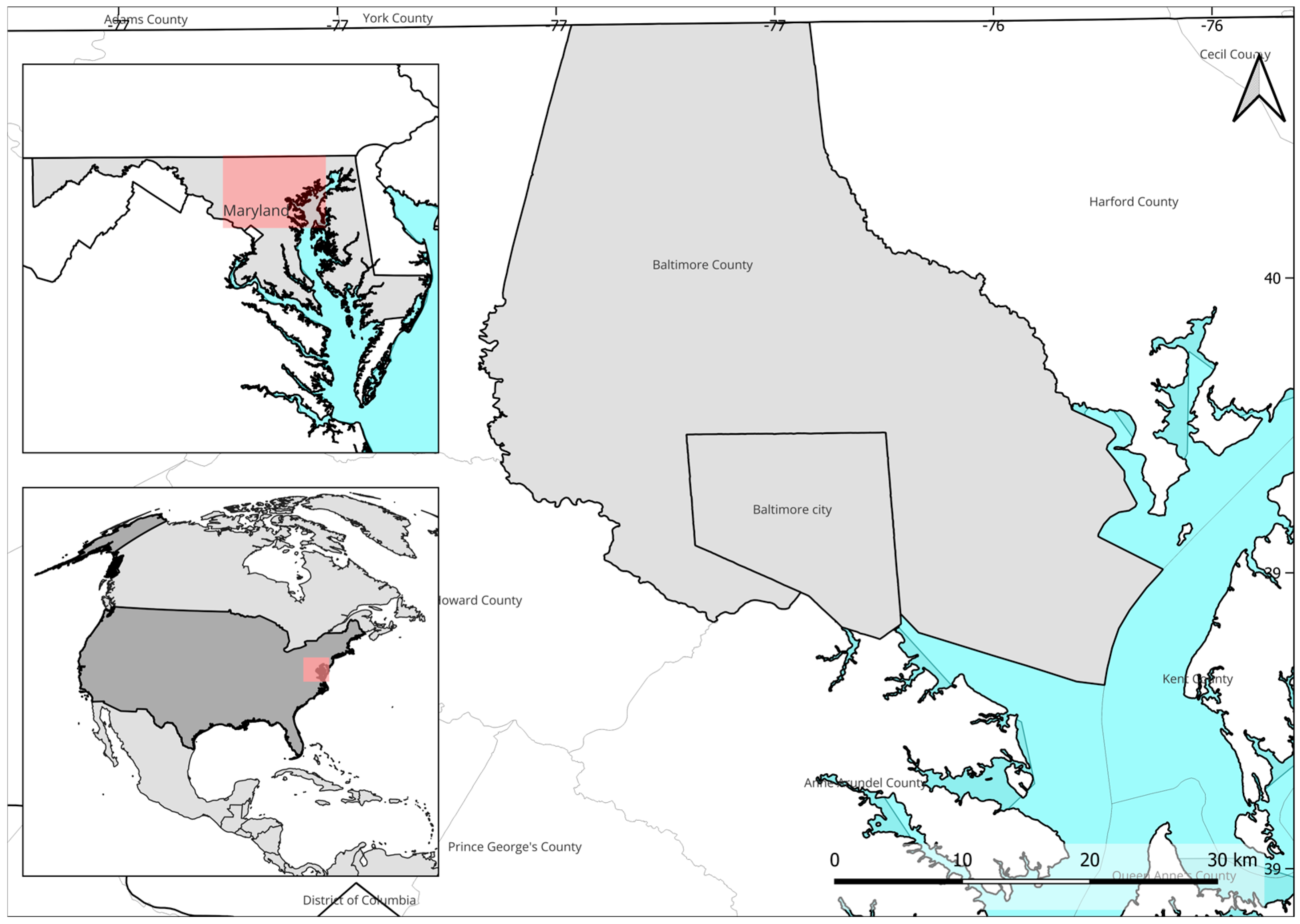
This study focuses on Baltimore City and Baltimore County (Figure 1), Maryland, US. Together, the two jurisdictions encompass approximately 1180 Census Block Groups (CBGs). Baltimore City is a dense urban core characterized by long-standing patterns of racial segregation, infrastructure disinvestment, and environmental risk, while Baltimore County contains a mix of suburban, peri-urban, and semi-rural communities with substantially higher average tree canopy cover and lower deprivation levels (Figure 1). This combined geography provides a useful social–ecological gradient for assessing environmental inequity across diverse neighborhood contexts and administrative boundaries.
The CBG scale analysis also enables high-resolution evaluation of environmental disparities relative to coarser units such as census tracts or ZIP codes.

2.2. Data Sources

We integrated four primary datasets, each selected to represent a core dimension of environmental and social conditions in Baltimore. These included tree canopy percent, socioeconomic deprivation, population count, and pollution-related cancer risk.
Tree Canopy Cover (TCC) was obtained from U.S. Forest Service/Multi-Resolution Land Cover (MRLC) 2023 canopy raster aggregated to CBGs [27]. The MRLC canopy layer is a high-resolution raster product (30 m) for 2023; we spatially summarized raster cells to CBG polygons using the mean canopy percentage per CBG, which serves as the key indicator of urban ecosystem health and heat mitigation capacity.
To capture neighborhood multidimensional disadvantages, including income, education, employment, and housing conditions, we obtained ADI data from the University of Wisconsin Neighborhood Atlas [24]. ADI is available at the CBG level for the 2020 dataset (v3.1), released in 2023. The variables used included CBG level ADI NATRANK (1–100) showing National percentile rank of socioeconomic deprivation and ADI STATERNK (1–10) showing State-level decile ranking of deprivation. ADI is widely used in public health, environmental justice, and healthcare resource planning [28,29].
CBG-scale total population count data was obtained from U.S. Census Bureau, American Community Survey (ACS) 5-year estimates [30], 2019–2023, which the most recent version as of the time of this analysis. The total population count per CBG was used to compute population-weighted metrics such as the Gini coefficient.
Block-level-modeled total Cancer Risk (per million) from hazardous air pollutants was obtained from U.S. Environmental Protection Agency (EPA) NATA/HAPs dataset—Region 3 Cancer Risk by Census Block [31]. Block-level values were aggregated to CBGs using population-weighted means. The EPA modeled Cancer Risk serves as a measure of environmental hazard for evaluating how canopy distribution aligns with pollution-related health risk.

2.3. Methods

The overarching goal of this study is to quantify fine-scale environmental inequity in Baltimore City and County by examining how tree canopy cover varies across gradients of social deprivation and pollution-related cancer risk, and by formally measuring the distributional inequality of canopy using population-weighted metrics.
Analyses proceed in three steps: first we assess socioeconomic gradients in tree canopy (e.g., canopy differences across ADI deciles); second, we evaluate statistical associations between canopy and deprivation measures and then quantify distributional inequality of canopy relative to population.
All datasets were harmonized to the CBG level using the 12-digit GEOID. CBGs with missing canopy or population values were excluded from statistical analysis resulting in 1140 CBGs.
Spearman rank correlation (ρ), which is a non-parametric measure robust to monotonic relationships was used to estimate the strength and direction of association between canopy and socioeconomic disadvantage as well as between Canopy and cancer risk.
Population-weighted Tree Canopy Inequality Index
To quantify inequality in the distribution of urban tree canopy across Baltimore neighborhoods, we computed a population-weighted Tree Canopy Inequality Index (TCI), which is mathematically equivalent to a weighted Gini coefficient. For each CBG i , let x i denote its tree-canopy percentage and w i its total population. Following the Lerman–Yitzhaki formulation [32], the cumulative population share, and cumulative canopy share are obtained by sorting block groups in ascending order of canopy and computing:
C i = j i x j w j ,   W i = j i w j
W = i w i is the total population, and X W = i x i w i is the population-weighted total canopy. Then:
T C I = 1 i w i ( 2 C i x i w i ) W X W
The index ranges from 0 to 1, where T C I = 0 indicates perfectly equal distribution (every resident has the same level of canopy exposure), while T C I = 1 represents maximum possible inequality, with all canopies concentrated in a single, minimally populated area. Unlike mean comparisons across deprivation deciles, TCI summarizes the entire distribution and is sensitive to whether a large share of residents live in low-canopy neighborhoods even when citywide average canopy appears moderate. Population-weighting is critical in environmental justice contexts because exposure is experienced by people rather than land area; thus, canopy deficits in dense neighborhoods contribute more to inequality than similar deficits in sparsely populated areas.
In environmental inequality research, T C I values rarely approach 1; instead, values typically fall between 0.1 and 0.4 because canopy, like most environmental amenities and disamenities, is partially present across all neighborhoods. Thus, values above 0.30 are widely interpreted as substantial inequality, indicating that a relatively small share of the population resides in high-canopy neighborhoods while a much larger share occupies low-canopy areas.
Triple Burden Index
While the TCI summarizes the overall distributional inequity of canopy across Baltimore, it does not explicitly capture how canopy deficits co-occur spatially with social deprivation and modeled health risk. To quantify compounded environmental disadvantage, we constructed a Triple Burden Index (TBI) that integrates three standardized components at the CBG level: (i) canopy deficit, (ii) socioeconomic deprivation, and (iii) pollution-related cancer risk.
For each CBG i, canopy deficit was defined as the inverse standardized canopy value (–z of canopy percent), such that higher values represent worse canopy conditions. Socioeconomic disadvantage was represented by the national ADI rank, and health burden by the population-weighted cancer-risk estimate. Each component was standardized using z-scores, and the TBI was computed as the arithmetic mean using Equation (2):
TBI i = 1 3 z ( Canopy i ) + z ( ADI i ) + z ( CancerRisk i )
Higher TBI values therefore indicate neighborhoods experiencing simultaneously low canopy, high deprivation, and elevated modeled cancer risk. To identify communities facing the most severe compounded burdens, CBGs were classified into deciles of TBI, and those in the highest decile were designated as triple-burden neighborhoods. The population residing within these high-burden CBGs was computed to quantify the number of residents affected by compounded environmental disadvantage.
This integrated index enables the identification of spatial clusters where multiple environmental and social inequities intersect, thereby extending beyond univariate inequality metrics and providing a spatially explicit framework for equity-focused greening and health-risk mitigation strategies.
Atkinson Index
To complement the Gini-based TCI, which is most sensitive to inequality around the center of the distribution, we additionally computed the population-weighted Atkinson inequality index [33] for tree canopy. The Atkinson index incorporates an explicit inequality-aversion parameter (ε), allowing greater ethical weight to be placed on deficits experienced by the most disadvantaged populations.
For canopy exposure values x i with population weights w i , the Atkinson index A ( ε ) is defined as
A ( ε ) = 1 i w i x i 1 ε / i w i 1 / ( 1 ε ) i w i x i / i w i , ε 1
and for ε = 1 :
A ( 1 ) = 1 exp i w i l n ( x i ) / i w i i w i x i / i w i
We evaluated Atkinson indices for ε = 0.5, 1.0, and 2.0 to assess inequality under increasing ethical concern for low-canopy populations. Larger ε values place progressively greater weight on deficits among the most canopy-deprived neighborhoods. Whereas TCI captures overall canopy inequality, the Atkinson index reveals whether inequality is driven primarily by extreme deprivation among a subset of neighborhoods—an essential distinction for environmental justice analysis.

2.4. Ecological Analytical Framework and Inference

This study adopts an ecological analytical framework in which all variables are measured and analyzed at the level of CBGs. Following established methodological guidance on ecological analysis in urban studies (e.g., Pratschke et al. [34]), the unit of inference in this study is the neighborhood rather than the individual. Accordingly, all statistical relationships are interpreted as associations between area-level characteristics, and no individual-level behavioral or health claims are made. This explicitly avoids ecological fallacy by restricting inference to spatial units rather than persons.
Aggregation and choice of spatial unit.
Spatial aggregation can introduce aggregation bias when heterogeneous micro-environments are averaged into larger areal units. We mitigate this risk by selecting Census Block Groups, which represent the smallest census geography for which consistent socioeconomic and population data are available nationally. CBGs are substantially smaller and more socially homogeneous than census tracts, allowing finer representation of intra-urban inequality while retaining statistical reliability. This scale therefore provides an appropriate compromise between spatial resolution and data stability for environmental justice analysis.
Modifiable areal unit problem (MAUP).
As with all spatially aggregated analyses, results may be sensitive to the choice of spatial unit (MAUP). Our findings should therefore be interpreted as CBG-level patterns rather than universal spatial truths. However, by using a fine-grained and policy-relevant geography that is widely employed in urban planning, public health, and environmental justice monitoring, we maximize the interpretability and policy relevance of observed gradients.
Non-linear estimation and LOESS.
In addition to rank correlations, locally estimated scatterplot smoothing (LOESS) curves are used to visualize non-linear relationships between canopy, deprivation, and pollution risk. LOESS does not impose parametric functional forms and therefore allows empirical gradients to emerge directly from the data. This strengthens inference by revealing monotonic but potentially non-linear socio-environmental gradients that would be obscured by linear regression alone.
Conceptual hierarchical structure.
Although formal multilevel modeling is not estimated, the analytical strategy can be conceptualized hierarchically: (1) spatial units (CBGs) constitute the structural layer; (2) social deprivation (ADI) represents the social vulnerability layer; and (3) tree canopy and modeled cancer risk represent environmental amenity and hazard layers, respectively. This layered conceptual structure clarifies the separation of spatial, social, and environmental dimensions and supports interpretation of canopy inequality as an outcome of socio-spatial configuration rather than individual behavior.

3. Results

3.1. Relationship Between Tree Canopy and Socioeconomic Deprivation

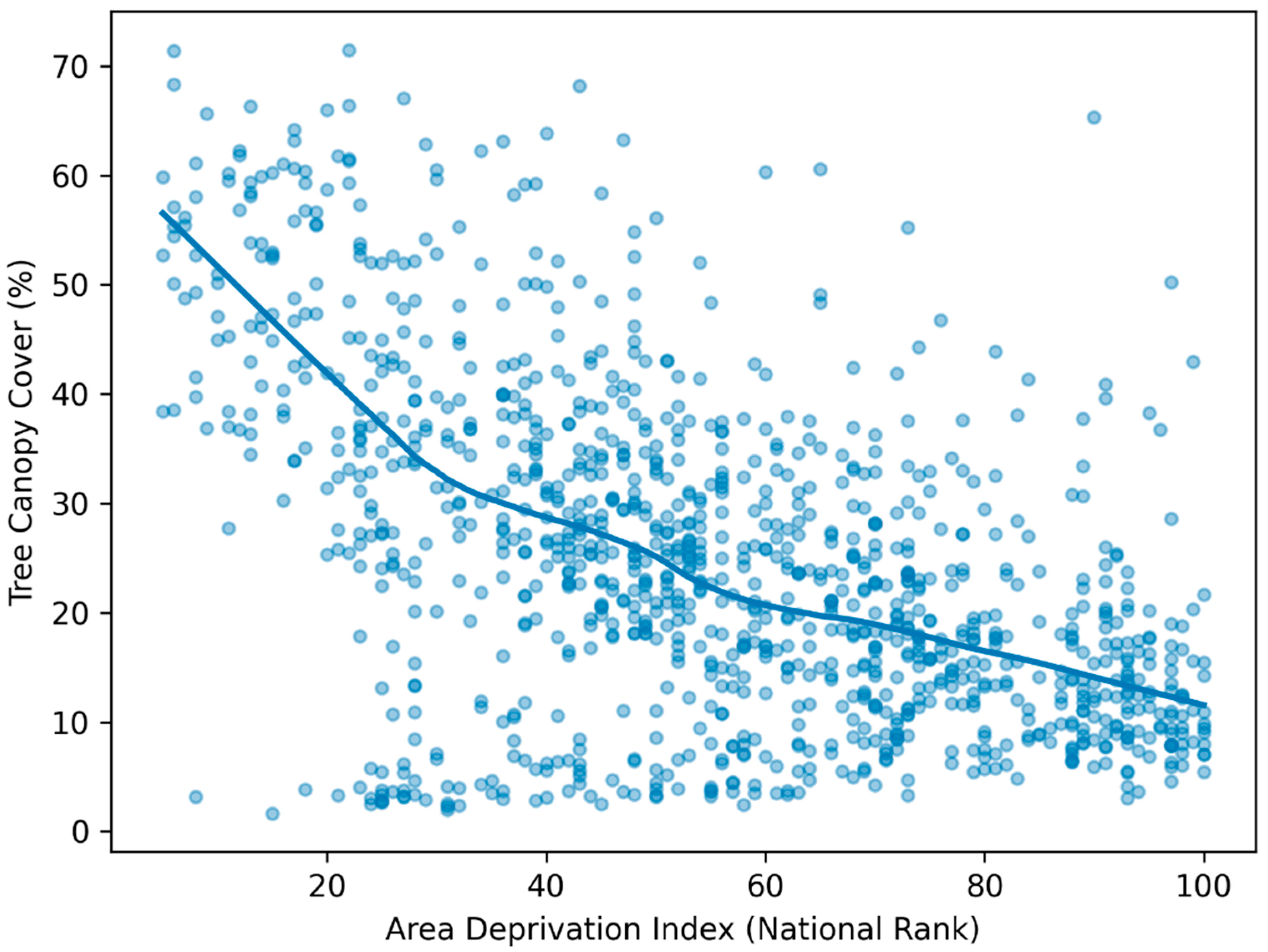
Across the 1140 CBGs in Baltimore City and Baltimore County with complete socioeconomic and canopy attributes, tree canopy cover exhibited a strong and consistently negative association with neighborhood deprivation. Figure 2 illustrates this relationship using a scatterplot with a LOESS smoother, revealing a clear monotonic decline in canopy cover as ADI increases. Statistically, canopy cover was moderately correlated with ADI, with a Spearman correlation of –0.509 (p < 0.05), corresponding to an R2 of 0.29. Using the state-specific ADI rank produced similar statistically significant results at a 95% confidence level (Spearman = –0.503; R2 = 0.31). These results indicate that deprivation explains roughly one-third of the variation in canopy cover across Baltimore neighborhoods.

3.2. Tree Canopy by ADI Decile

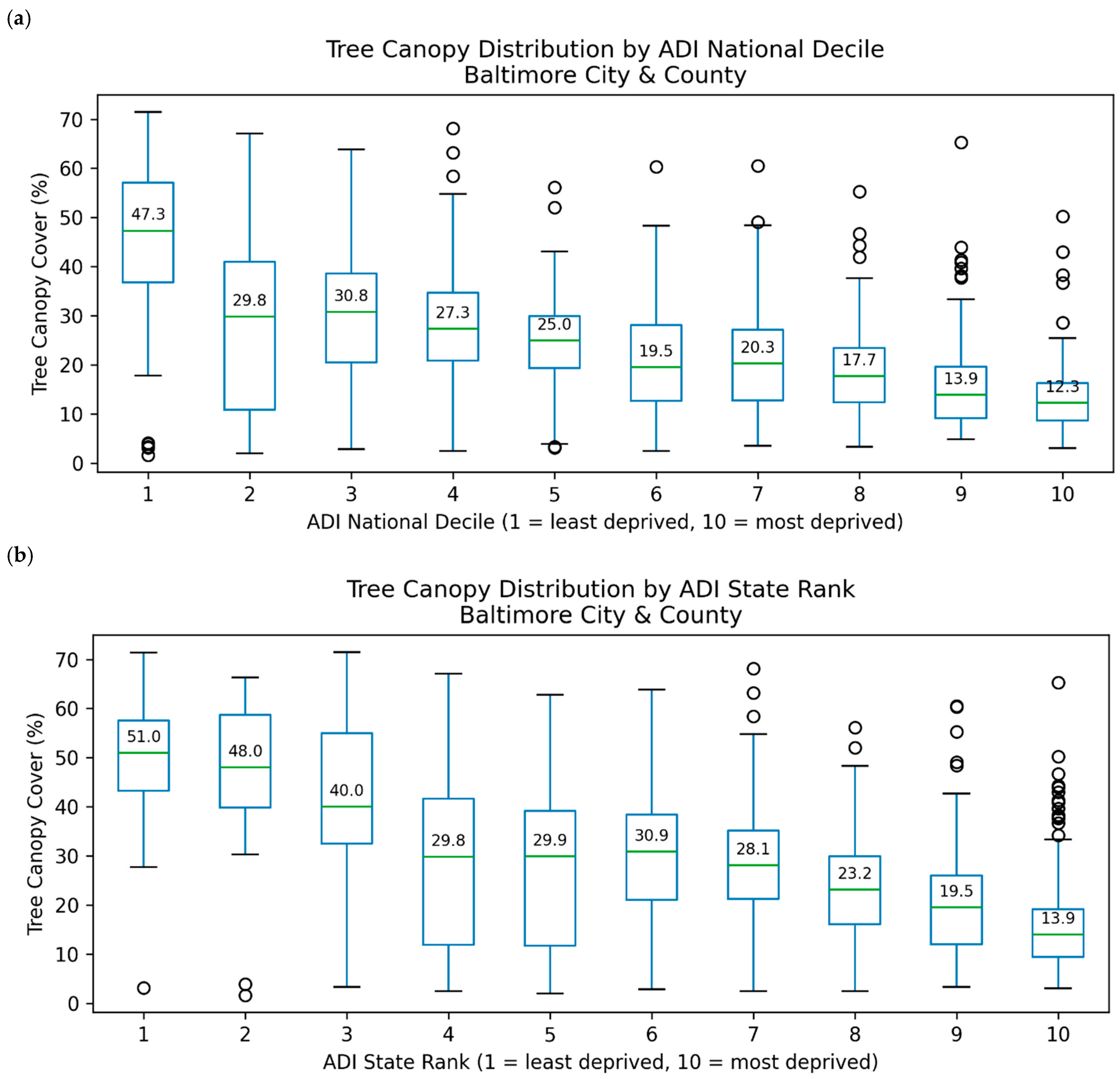
To further characterize inequality, canopy cover was aggregated by ADI national and state deciles (Figure 3). Population-weighted mean canopy generally decreased sharply across the deprivation gradient, from ≈47–51% in the least deprived neighborhoods (decile 1) to ≈12–14% in the most deprived neighborhoods (decile 10), corresponding to an equity gap of roughly 3.4–4.1 times more canopy in the most advantaged areas than in the most deprived ones. The boxplots (Figure 3a,b) confirm that this pattern persists across both national and state-level ADI rankings: disadvantaged deciles generally show consistently lower medians, narrower interquartile ranges, and a concentration of CBGs below 20% canopy, whereas advantaged deciles display a broader distribution extending above 40–50% canopy. The large vertical separation and minimal overlap between the lower and upper deciles indicate a structurally entrenched canopy divide.

3.3. Inequality in Tree Canopy Distribution

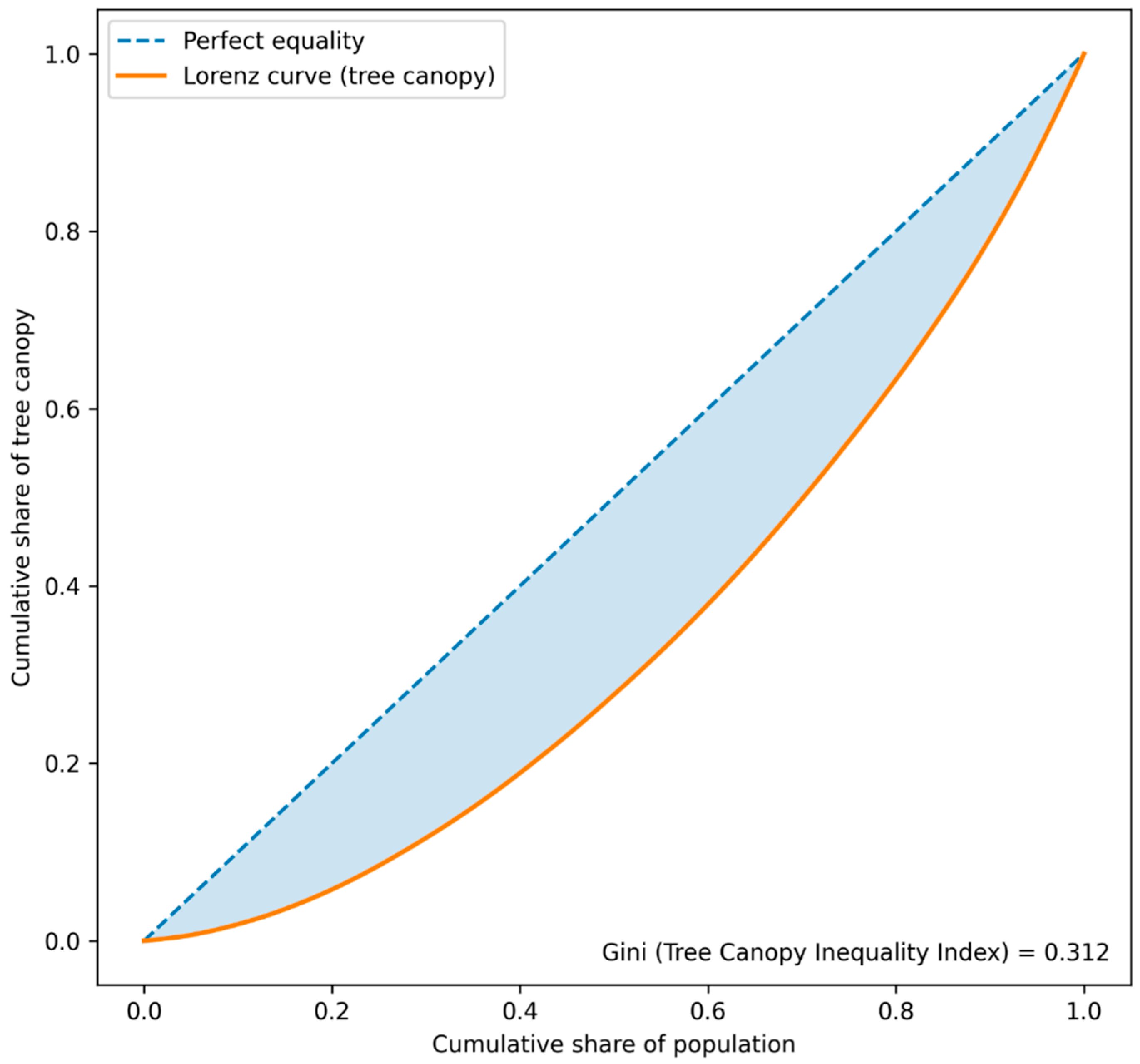
Figure 4 presents the Lorenz curve for population-weighted tree canopy distribution across Baltimore CBGs. The curve lies substantially below the line of perfect equality, indicating disproportionate concentration of canopy in a subset of neighborhoods. The population-weighted TCI, equivalent to a Gini coefficient, was 0.312, signifying a notable level of canopy inequity by environmental standards. In urban environmental justice applications, TCI values above 0.30 generally reflect pronounced segregation of environmental amenities; thus, Baltimore exhibits substantial inequality in access to tree canopy when canopy exposure is weighted by the number of residents affected.
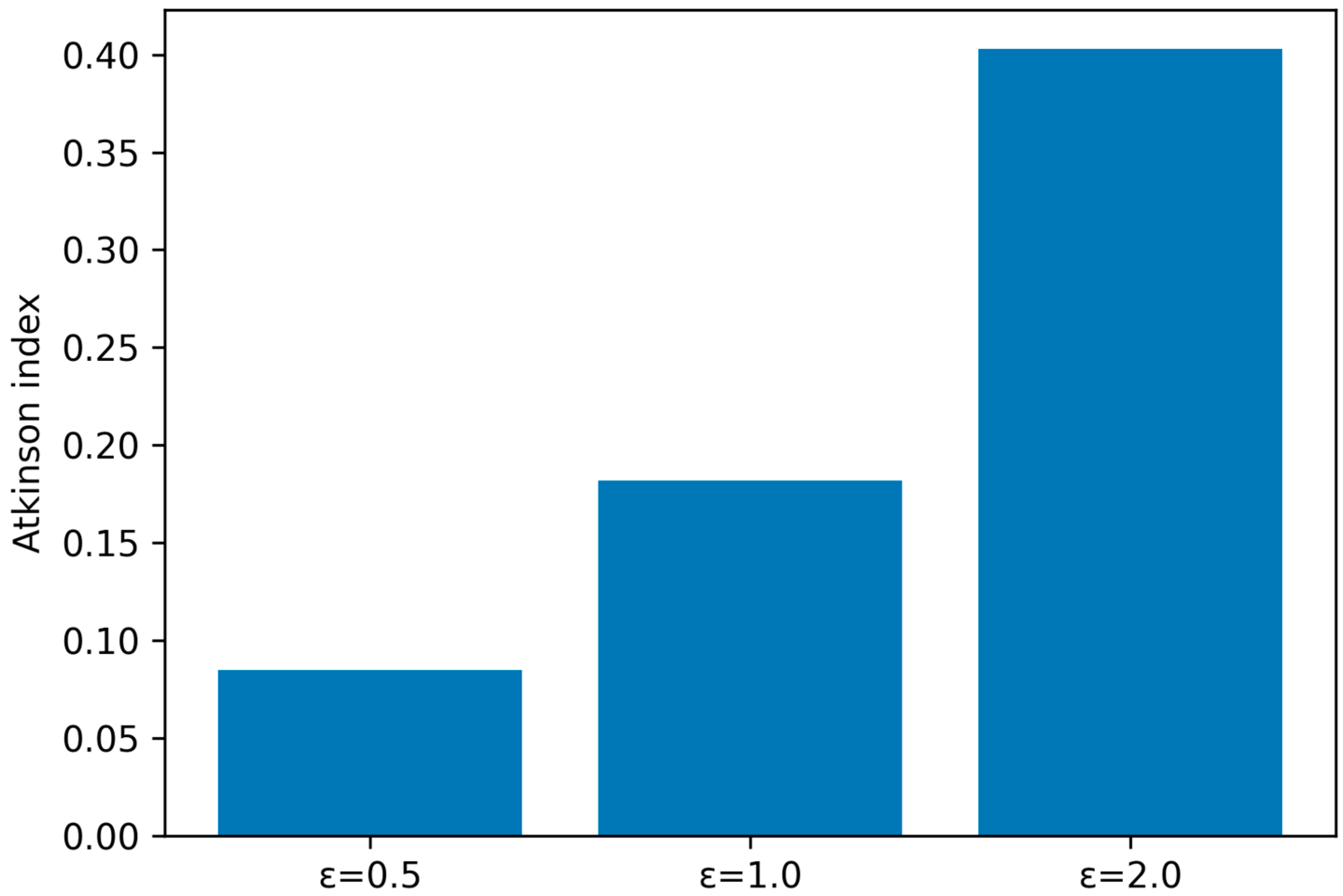
Figure 5 shows the population-weighted Atkinson inequality of tree canopy across Baltimore neighborhoods under increasing degrees of inequality aversion (ε = 0.5, 1.0, and 2.0). The Atkinson index rises sharply from 0.084 at ε = 0.5 to 0.182 at ε = 1.0 and reaches 0.402 at ε = 2.0, indicating that canopy inequality becomes substantially more severe when greater ethical weight is assigned to the most canopy-deprived populations.
This pattern reveals that overall canopy inequality in Baltimore is not driven solely by moderate differences across the city but is strongly amplified by extreme deficits experienced by a subset of highly disadvantaged neighborhoods. The rapid escalation of the Atkinson index at higher ε values indicates that residents in the lowest-canopy neighborhoods bear a disproportionate share of canopy deprivation, highlighting a concentrated environmental injustice that is not fully captured by average-based or center-weighted inequality measures such as the Gini-based TCI.
Together, the Atkinson results demonstrate that canopy inequality in Baltimore is structurally skewed toward the most disadvantaged communities, reinforcing the presence of compounded environmental inequity across the metropolitan region.

3.4. Spatial Distribution of Deprivation, Canopy, and Cancer Risk

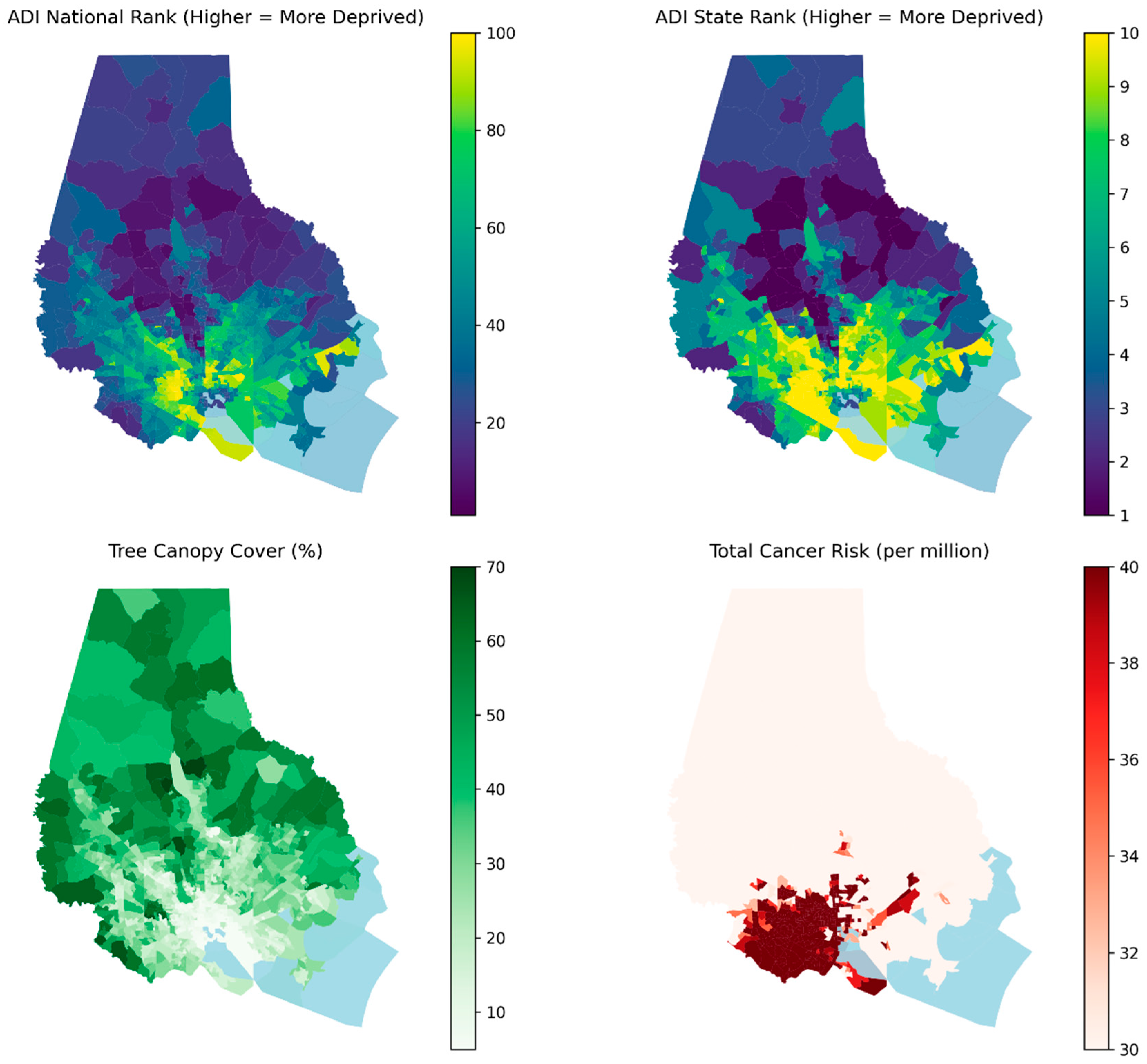
The spatial pattern in Figure 6 highlights the geographic structure underlying these statistical relationships. ADI national and state ranks show strong spatial clustering of deprivation in south to south-central neighborhoods. Tree canopy cover displays an inverse pattern, with highest canopy concentrations in the wealthier suburbs of Baltimore County and pockets of North Baltimore, while most inner-city neighborhoods of south to south-central Baltimore exhibit sparse canopy (<20%).
The north–south contrast in Figure 6 is consistent with long-run land-use and governance histories in the Baltimore region: low-canopy/high-deprivation clusters align with legacy industrial and transport corridors and areas of deferred maintenance, while high-canopy clusters correspond to northern and suburban neighborhoods where residential investment and long-term maintenance capacity are stronger.
Cancer risk shows modest variation (30–40 cases per million) but aligns spatially with deprivation: higher values cluster in south Baltimore, intersecting with most areas that also exhibit lower canopy and higher ADI levels. The correlation between neighborhood and total cancer risk indicated a negative association (Spearman ρ = –0.363) that is statistically significant at a 95% confidence level. Figure 6 shows the shared geography of environmental disadvantage, where low tree canopy, high deprivation, and elevated cancer risk co-occur. This co-location should be interpreted as cumulative environmental disadvantage rather than evidence that low canopy itself is the primary driver of cancer risk.
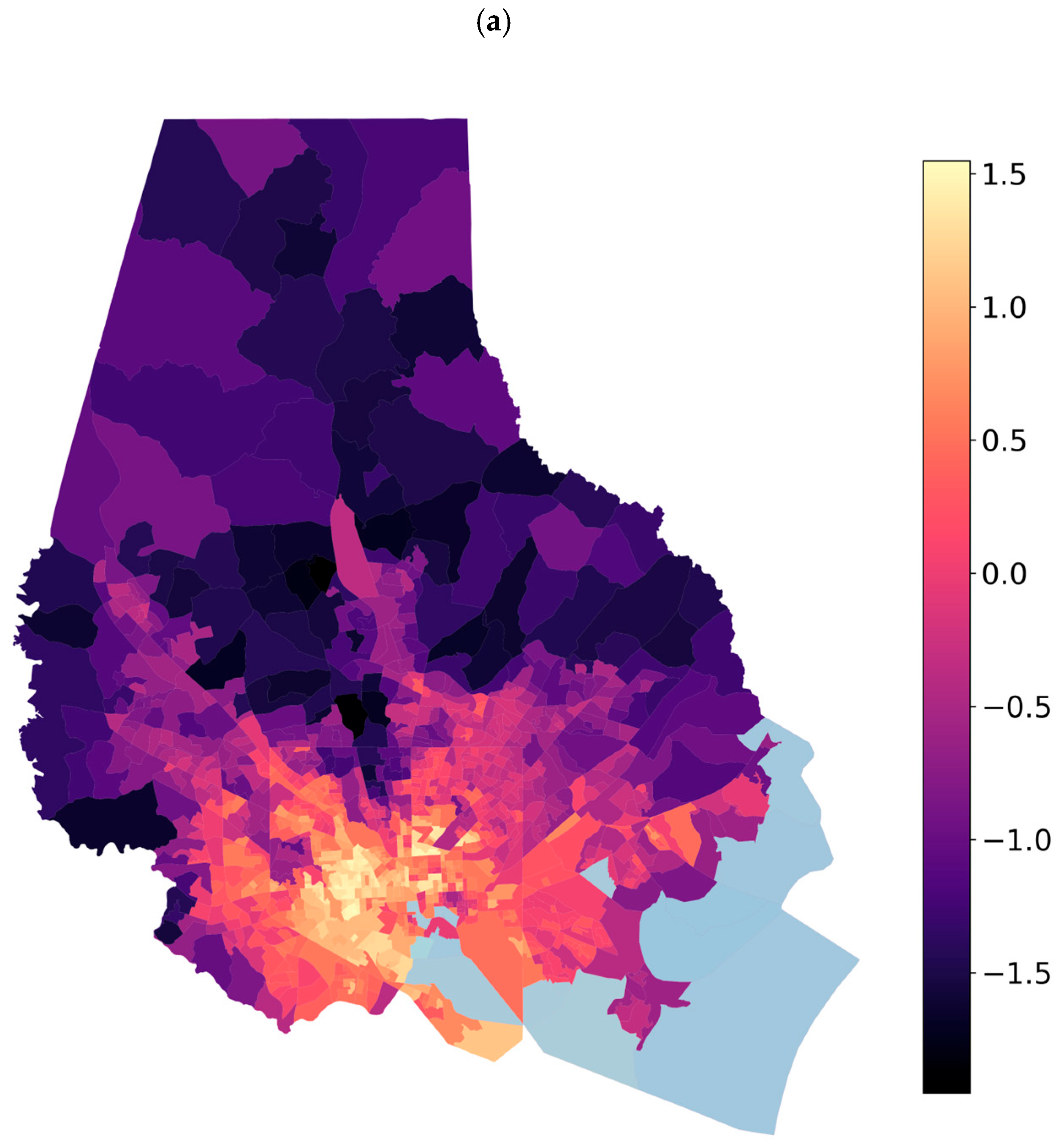
Figure 7a shows the spatial distribution of the TBI across CBGs in Baltimore City and County. TBI values are highly uneven across the metropolitan region, with pronounced clustering of high-burden neighborhoods in South and south-central Baltimore, while substantially lower burden levels characterize much of North Baltimore and the suburban portions of Baltimore County. These spatial gradients indicate that compounded disadvantage—defined by the co-occurrence of low tree canopy, high socioeconomic deprivation, and elevated modeled cancer risk—is not randomly distributed but is strongly geographically structured across the urban landscape.
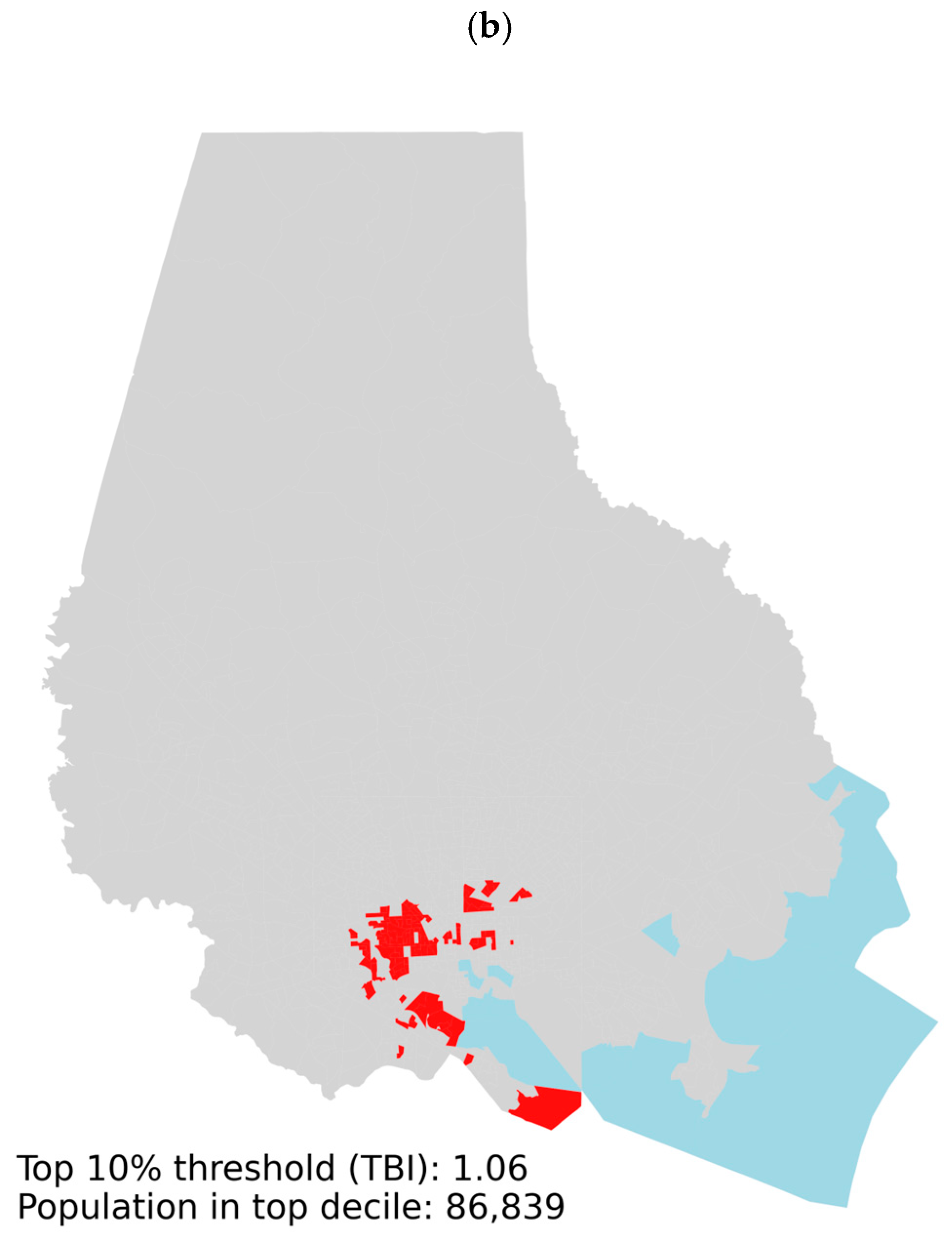
Figure 7b further isolates CBGs within the top decile of TBI, revealing a compact set of high-burden neighborhoods that collectively house approximately 86,839 residents. This indicates that a substantial share of Baltimore’s population resides within a relatively small subset of neighborhoods experiencing simultaneously elevated social vulnerability, diminished green infrastructure, and heightened modeled cancer risk. The spatial concentration of these high-burden block groups highlight that environmental disadvantage in Baltimore is not diffuse but is tightly localized within historically marginalized urban corridors.
The spatial concentration of high TBI values in south and south-central Baltimore (Figure 7) suggests that canopy deficits are not solely a function of present-day deprivation but reflect cumulative institutional processes. High-burden clusters align with legacy industrial corridors, highway infrastructure, and historically disinvested districts, indicating that zoning histories, deferred municipal maintenance, and fragmented service provision contribute to structurally persistent canopy loss. By contrast, higher-canopy neighborhoods in North Baltimore and Baltimore County coincide with areas characterized by stable homeownership, higher property values, and stronger local maintenance capacity, where canopy operates as a capitalized residential amenity that is actively protected and reproduced. These spatial contrasts imply that fiscal capacity, property regimes, and long-term governance arrangements mediate canopy accumulation and retention across the metropolitan region.

4. Discussion

The present analysis demonstrates that tree canopy in Baltimore constitutes a policy-shaped socio-ecological infrastructure that is unevenly produced across metropolitan space and systematically aligned with socioeconomic deprivation and modeled air-toxics cancer risk at the census block group scale (CBG). The negative correlations between canopy cover and the ADI − ρ = –0.509 for the national rank and ρ = –0.503 for the state rank—indicate that more deprived neighborhoods consistently have less tree cover [14,25]. These are moderate associations for cross-sectional neighborhood data and suggest that deprivation accounts for roughly 30% of the variance in canopy cover across block groups. This gradient is further reinforced by the decile results: population-weighted mean canopy declines from roughly 47–51% in the least deprived decile to 13–15% in the most deprived decile, yielding an equity gap of about 3.4–4.1 times between the two ends of the deprivation spectrum. Together, these findings confirm that tree canopy in Baltimore behaves as a spatially uneven socio-ecological infrastructure whose distribution reflects historically embedded policy choices and institutional capacity rather than neutral ecological processes [18,21].
The Tree Canopy Inequality Index (TCI), implemented here as a population-weighted Gini coefficient, provides a complementary, distribution-wide view of this imbalance. A TCI of 0.312 indicates a moderate level of inequality in canopy distribution: far from a perfectly even landscape (TCI = 0), but not at the extreme end where a small share of residents enjoys nearly all tree cover (TCI → 1). In the context of environmental equity, a TCI around 0.3 means that a non-trivial fraction of canopy is effectively withheld from a sizeable share of Baltimore’s residents, even before we condition on deprivation [35,36]. Because TCI is population-weighted, it emphasizes lived exposure rather than just spatial extent: block groups where many people live under sparse canopy contribute more to the index than sparsely populated regions with similar cover. This is particularly relevant for heat and air-quality burdens, which depend more on where people live than on how much land is forested in aggregate.
Beyond overall distributional imbalance, the Atkinson and Triple Burden indices reveal that canopy inequality in Baltimore is both severity-weighted and compounded by co-occurring social and health risks. The Atkinson inequality index rises sharply from 0.084 at ε = 0.5 to 0.182 at ε = 1.0 and 0.402 at ε = 2.0, indicating that canopy inequity becomes substantially more severe when greater ethical weight is assigned to the most canopy-deprived neighborhoods. This pattern demonstrates that a relatively small subset of highly disadvantaged communities experience extreme deficits that disproportionately drive inequality citywide. The Triple Burden Index further shows that these same neighborhoods also face elevated socioeconomic deprivation and modeled air-toxics cancer risk, with spatially clustered high-burden census block groups collectively housing over 86,000 residents. Together, these findings indicate that canopy deficits in Baltimore are not merely unevenly distributed but are structurally embedded within compounded environments of social vulnerability and pollution exposure, reinforcing patterns of cumulative environmental disadvantage rather than isolated amenity gaps.
Our spatial results (Figure 5) show that these abstract indices are tied to recognizable geographies in Baltimore. High ADI ranks, low tree canopy, and elevated modeled cancer risks cluster in south and south-central Baltimore, encompassing neighborhoods historically shaped by industrial land use, transportation infrastructure, and racial segregation. These spatial alignments echo the well-documented “legacy effects” of segregation and disinvestment on Baltimore’s urban ecosystem [18,37] and correspond with recent field-based measurements of elevated air-toxics and black carbon concentrations in Curtis Bay and adjacent corridors [20]. Previous work on Baltimore’s socio-ecological gradients has documented similar south–central “hotspots” of environmental burden and socio-economic disadvantage, contrasting with more affluent, greener areas in parts of North Baltimore and along park corridors [25,35]. The co-location of high deprivation, sparse canopy, and higher modeled cancer risk in these neighborhoods aligns with national evidence that structurally marginalized communities are more exposed to air toxics and other environmental hazards [38]. Our block-group aggregation of EPA air-toxics cancer risk to the same geographic units used for canopy and ADI reveals a moderate negative correlation (ρ = –0.363) between canopy and cancer risk. While this association is not sufficient to infer causality, it is consistent with the hypothesis that neighborhoods with less canopy tend to be more polluted and more deprived—a pattern shaped by historical zoning, industrial siting, highway placement, and discriminatory housing and lending practices. Trees can reduce pollutant concentration and mitigate heat in some contexts, but in heavily industrial or traffic-dominated environments their benefits may not fully offset high emission loads [39,40]. Moreover, we emphasize that the observed association between canopy and modeled air-toxics cancer risk does not imply that increasing canopy alone would meaningfully reduce cancer risk in these neighborhoods. Rather, low canopy appears to co-occur with land-use and infrastructure contexts that drive emissions and exposures, as well as broader social stressors. In this sense, canopy functions as one component of cumulative disadvantage and a potentially protective amenity, but it cannot substitute for pollution control, industrial regulation, and structural public-health interventions.

Canopy Inequality as an Embedded and Policy-Produced Urban Configuration

The spatial alignment of deprivation, sparse canopy, and elevated air-toxics cancer risk in Baltimore suggests that contemporary canopy landscapes are not merely descriptive environmental patterns but the cumulative product of historically embedded governance, planning, and property-regime dynamics. Building on work on embeddedness and the spatial reproduction of inequality [18,22,23], tree canopy emerges as a socially produced urban amenity whose distribution is shaped by durable institutional arrangements, neighborhood reputations, and place-based expectations that structure public and private investment decisions.
Recent scholarship on spatial governance and nature-based solutions emphasizes that urban greening policies are rarely implemented in linear or uniform ways, but instead unfold through discontinuous, partial, and often contested planning processes [10,11,15]. These dynamics are particularly visible in legacy industrial corridors and historically disinvested neighborhoods, where fragmented governance, land-use conflicts, and constrained municipal capacity limit both the uptake and long-term maintenance of canopy interventions. In such contexts, canopy expansion programs may be introduced rhetorically but remain weakly institutionalized, producing persistent gaps between planning goals and lived environmental conditions.
Economic perspectives further illuminate these dynamics by highlighting the role of property-rights regimes and residential asset behavior in shaping canopy distribution. Work in the economics of convention and property valuation (e.g., Barbot [41]) suggests that tree canopy functions as a capitalized neighborhood attribute that is differentially maintained and reproduced where home values, insurance incentives, and redevelopment pressures are strongest. In more deprived and rental-dominated neighborhoods, limited private incentives, insecure tenure, and weak public maintenance regimes can suppress long-term canopy accumulation, reinforcing the spatial reproduction of environmental disadvantage.
Viewed through this lens, the strong gradients observed across ADI deciles in Baltimore reflect not simply socioeconomic sorting, but a path-dependent metropolitan configuration produced by historically layered zoning regimes, infrastructure siting, fragmented municipal governance, property-rights arrangements, and uneven institutional capacity. Canopy inequality thus represents a territorialized outcome of urban governance rather than a naturally emerging feature of urban form.
Importantly, tree canopy is governed through a mixed public–private regime. A portion of canopy reflects public trees located in street rights-of-way, parks, and other publicly managed lands, while a substantial share is located on private parcels where planting and retention depend on property ownership, tenure security, and household or landlord investment. Because our data do not distinguish public from private canopy, we interpret these governance pathways as mechanisms consistent with the observed spatial patterns rather than as directly measured drivers.
These findings resonate strongly with a broader U.S. literature on urban tree-cover inequities. Multi-city analyses have shown that lower-income neighborhoods systematically have less tree cover and higher summertime temperatures than wealthier areas, even within the same city [42,43]. Our results indicate that Baltimore conforms to this national pattern while adding two important contributions: (1) a neighborhood-scale linkage between tree canopy and a composite deprivation index (ADI) that is widely used in public-health research, and (2) an explicit connection between canopy and modeled cancer risk from air toxics, aggregated to the same CBG units.
From an institutional perspective, these results suggest that closing canopy gaps requires not only planting programs but also structural reforms to tenure regimes, inter-jurisdictional coordination, and long-term maintenance financing that shape how nature-based solutions are institutionalized. Further, our results have practical implications for local climate, health, and equity initiatives. The steep decline in mean canopy across the ADI gradient suggests that efforts to expand tree cover in Baltimore should prioritize highly deprived deciles, particularly in the south and south-central neighborhoods where we observe the strongest clustering of low canopy and high cancer risk. Framing TCC as a form of “protective infrastructure” aligns with ongoing work to integrate nature-based solutions into heat-health and air-quality planning, but our findings caution against treating canopy expansion as a generic city-wide goal. Instead, a TCI-style inequality metric could be used as a planning target: for example, aiming to reduce the TCI and close the equity gap between the most and least deprived deciles over time, while tracking changes in both canopy and pollution exposures. Such an approach would align with emerging calls in U.S. urban forestry to explicitly center equity and environmental justice in canopy targets and to monitor distributional outcomes, not just aggregate gains.
At the same time, the study has several limitations that suggest directions for future work. First, our analysis is cross-sectional: we cannot distinguish whether low canopy contributes causally to higher cancer risk (e.g., through reduced pollution mitigation or heat-related pathways) or simply co-occurs with industrial land uses and traffic emissions driven by broader structural forces. Second, ADI, canopy, and cancer risk are each measured with their own uncertainties: ADI aggregates multiple socio-economic indicators; canopy estimates are derived from remote sensing; and cancer risk is modeled rather than observed. Third, we focus on census block groups, which are small enough to capture intra-neighborhood variation but still aggregate over diverse micro-environments. Future work could integrate longitudinal canopy change, finer-scale exposure metrics, and health outcome data (e.g., hospitalization or cancer registry records) to better disentangle mechanisms and time lags.
Furthermore, because CBGs are spatially clustered, spatial autocorrelation may inflate nominal significance by reducing the effective degrees of freedom; we therefore interpret results as descriptive ecological patterns rather than causal estimates. In addition, mean canopy within a resident CBG does not capture cross-boundary canopy access (e.g., canopy in adjacent CBGs); future work will compute buffer-based canopy exposure (e.g., within 250–500 m of population-weighted centroids) and apply spatial regression frameworks to account for spatial dependence.
Despite these caveats, the convergence of statistical, distributional, and spatial evidence in our analysis supports a coherent narrative: in Baltimore, structurally deprived neighborhoods have markedly less tree canopy, higher modeled cancer risk, and a disproportionate share of residents living under sparse green cover. By framing these patterns through both ADI-based gradients and a population-weighted TCI, we show that tree canopy is not merely an aesthetic amenity but a quantifiable dimension of environmental inequality. This neighborhood-scale integration of canopy, deprivation, and cancer risk highlights the potential for tree-focused interventions to contribute to broader environmental-justice agendas in Baltimore and offers a transferable template for other U.S. cities seeking to align urban forestry, health equity, and climate resilience.
More broadly, this study demonstrates how urban tree canopy operates as a politically and economically embedded form of socio-ecological infrastructure whose unequal distribution reflects the territorialization of environmental governance in contemporary U.S. cities.

5. Conclusions

This study examined how tree canopy cover, social deprivation, and pollution-related cancer risk align across neighborhoods in Baltimore City and County. Using harmonized census block group (CBG) data, we quantified spatial inequities in environmental benefits and burdens, assessed how strongly canopy relates to both Area Deprivation Index (ADI) ranks and modeled air-toxics cancer risk, and applied Lorenz–Gini and Atkinson frameworks to evaluate the inequality of canopy distribution across the population. We further constructed a Triple Burden Index to identify neighborhoods experiencing compounded social and environmental disadvantage.
Our key findings are:
Tree canopy is patterned by social disadvantage. Canopy cover declines sharply across the deprivation gradient, with population-weighted means falling from approximately 48–51% in the least deprived areas to 12–14% in the most deprived—indicating a three- to four-fold equity gap.
Tree canopy is unequally and severely distributed across the population. The population-weighted Tree Canopy Inequality Index (TCI ≈ 0.312) reveals substantial overall inequality, while the Atkinson index rises sharply under increasing inequality aversion (A0.5 = 0.084; A1 = 0.182; A2 = 0.402), demonstrating that canopy deficits are especially concentrated among the most disadvantaged neighborhoods.
Canopy scarcity co-occurs with compounded environmental burdens. Canopy is negatively associated with modeled cancer risk, and the Triple Burden Index identifies spatial clusters of neighborhoods simultaneously experiencing high deprivation, low canopy, and elevated cancer risk. These high-burden areas are concentrated in south and south-central Baltimore and collectively house over 86,000 residents, indicating a spatially concentrated form of cumulative environmental disadvantage.
Taken together, these results show that Baltimore’s canopy distribution reflects long-standing social and environmental inequalities, with disadvantaged neighborhoods receiving fewer environmental benefits while bearing greater pollution-related risks. Expanding and sustaining tree canopy in the most deprived CBGs—particularly in south and south-central Baltimore—offers a direct pathway to mitigating heat exposure, improving environmental health, and advancing environmental justice.

Author Contributions

Conceptualization, C.C.I. and I.-O.A.; methodology, C.C.I.; software, I.-O.A. and C.C.I.; validation, I.-O.A. and C.C.I.; formal analysis, C.C.I. and I.-O.A.; investigation, I.-O.A. and C.C.I.; resources, C.C.I.; data curation, I.-O.A. and C.C.I.; writing—original draft preparation, C.C.I.; writing—review and editing, I.-O.A. and C.C.I.; visualization, I.-O.A. and C.C.I.; supervision, C.C.I.; project administration, C.C.I.; funding acquisition, C.C.I. All authors have read and agreed to the published version of the manuscript.

Funding

This research received no external funding.

Institutional Review Board Statement

Not applicable.

Informed Consent Statement

Not applicable.

Data Availability Statement

Tree canopy data used in this study are publicly available from the U.S. Forest Service’s Tree Canopy Cover 2023 dataset, accessible through the Multi-Resolution Land Characteristics (MRLC) repository: https://www.mrlc.gov/data (accessed on 14 April 2025). Area Deprivation Index (ADI) data for census block groups were obtained from the University of Wisconsin School of Medicine and Public Health, which provides open-access ADI national and state percentile ranks: https://www.neighborhoodatlas.medicine.wisc.edu (accessed on 14 April 2025). Pollution-related cancer risk estimates were derived from the U.S. Environmental Protection Agency (EPA) National Air Toxics Assessment/AirToxScreen (Region 3) block-level dataset, available through EPA’s public data portal: https://www.epa.gov/airtoxscreen (accessed on 14 April 2025).

Conflicts of Interest

The authors declare no conflicts of interest.

Abbreviations

The following abbreviations are used in this manuscript:
ADIArea Deprivation Index
ADI_NATRANKNational percentile rank of the Area Deprivation Index
ADI_STATERNKState percentile rank of the Area Deprivation Index
CBGCensus Block Group
TCITree Canopy Inequality (population-weighted Gini coefficient for canopy distribution)
TCCTree Canopy Cover
EPAU.S. Environmental Protection Agency
NATA/AirToxScreenNational Air Toxics Assessment/Air ToxScreen (EPA’s air toxics risk assessment program)
LOESS/LOWESSLocally Estimated Scatterplot Smoothing
GEOIDGeographic Identifier (U.S. Census standardized identifier)
TBITripple Burden Index

References

  1. Gunn, W.L.; Rao, M. The Legacy of Redlining: A Geospatial Analysis of Environmental Burdens in Portland, Oregon. Bachelor’s Thesis, Portland State University, Portland, OR, USA, 2022. [Google Scholar]
  2. Li, D.; Newman, G.D.; Wilson, B.; Zhang, Y.; Brown, R.D. Modeling the relationships between historical redlining, urban heat, and heat-related emergency department visits: An examination of 11 Texas cities. Environ. Plan. B Urban Anal. City Sci. 2022, 49, 933–952. [Google Scholar] [CrossRef]
  3. Hsu, A.; Sheriff, G.; Chakraborty, T.; Manya, D. Disproportionate exposure to urban heat island intensity across major US cities. Nat. Commun. 2021, 12, 2721. [Google Scholar] [CrossRef]
  4. Azzouz, M.; Hasan, Z.; Rahman, M.M.; Gauderman, W.J.; Lorenzo, M.; Lurmann, F.W.; Eckel, S.P.; Palinkas, L.; Johnston, J.; Hurlburt, M.; et al. Does socioeconomic and environmental burden affect vulnerability to extreme air pollution and heat? A case-crossover study of mortality in California. J. Expo. Sci. Environ. Epidemiol. 2025, 35, 294–302. [Google Scholar] [CrossRef]
  5. Lewis, P.G.T.; Chiu, W.A.; Nasser, E.; Proville, J.; Barone, A.; Danforth, C.; Kim, B.; Prozzi, J.; Craft, E. Characterizing vulnerabilities to climate change across the United States. Environ. Int. 2023, 172, 107772. [Google Scholar] [CrossRef] [PubMed]
  6. Chakraborty, T.; Hsu, A.; Manya, D.; Sheriff, G. Disproportionately higher exposure to urban heat in lower-income neighborhoods: A multi-city perspective. Environ. Res. Lett. 2019, 14, 105003. [Google Scholar] [CrossRef]
  7. Wu, C.; Shui, W.; Yang, H.; Ma, M.; Zhu, S.; Liu, Y.; Li, H.; Wu, F.; Wu, K.; Sun, X. Heat adaptive capacity: What causes the differences between residents of xiamen island and other areas? Front. Public Health 2022, 10, 799365. [Google Scholar] [CrossRef]
  8. Meili, N.; Manoli, G.; Burlando, P.; Carmeliet, J.; Chow, W.T.; Coutts, A.M.; Roth, M.; Velasco, E.; Vivoni, E.R.; Fatichi, S. Tree effects on urban microclimate: Diurnal, seasonal, and climatic temperature differences explained by separating radiation, evapotranspiration, and roughness effects. Urban For. Urban Green. 2021, 58, 126970. [Google Scholar] [CrossRef]
  9. Pace, R.; De Fino, F.; Rahman, M.A.; Pauleit, S.; Nowak, D.J.; Grote, R. A single tree model to consistently simulate cooling, shading, and pollution uptake of urban trees. Int. J. Biometeorol. 2021, 65, 277–289. [Google Scholar] [CrossRef] [PubMed]
  10. Barron, S.; Rugel, E.; Cheng, Z.; Nesbitt, L.; Sheppard, S.; Czekajlo, A.; Girling, C. Achieving the urban tree trifecta: Scenario modelling for salubrious, resilient, and diverse urban forests in densifying cities. Arboric. Urban For. (AUF) 2023, 49, 313–328. [Google Scholar] [CrossRef]
  11. Alexandra, J.; Norman, B. The city as forest-integrating living infrastructure, climate conditioning and urban forestry in Canberra, Australia. Sustain. Earth 2020, 3, 10. [Google Scholar] [CrossRef]
  12. Morello-Frosch, R.; Jesdale, B.; Cushing, L. The Colorline Reflected in Green: The Distribution of Heat Risk—Related Land Cover in Relation to Racial Residential Segregation. In Proceedings of the ISEE Conference Abstracts 26, Seattle, WA, USA, 24–28 August 2014; Volume 2014, p. 2872. [Google Scholar]
  13. Francis, J.; Disney, M.; Law, S. Monitoring canopy quality and improving equitable outcomes of urban tree planting using LiDAR and machine learning. Urban For. Urban Green. 2023, 89, 128115. [Google Scholar] [CrossRef]
  14. Schwarz, K.; Fragkias, M.; Boone, C.G.; Zhou, W.; McHale, M.; Grove, J.M.; O’neil-Dunne, J.; McFadden, J.P.; Buckley, G.L.; Childers, D.; et al. Trees grow on money: Urban tree canopy cover and environmental justice. PLoS ONE 2015, 10, e0122051. [Google Scholar] [CrossRef]
  15. Locke, D.H.; Hall, B.; Grove, J.M.; Pickett, S.T.; Ogden, L.A.; Aoki, C.; Boone, C.G.; O’Neil-Dunne, J.P. Residential housing segregation and urban tree canopy in 37 US Cities. Npj Urban Sustain. 2021, 1, 15. [Google Scholar] [CrossRef]
  16. Kolosna, C.; Spurlock, D. Uniting geospatial assessment of neighborhood urban tree canopy with plan and ordinance evaluation for environmental justice. Urban For. Urban Green. 2019, 40, 215–223. [Google Scholar] [CrossRef]
  17. Le Galès, P.; Vitale, T. Governing the Large Metropolis. A Research Agenda. 2013. Available online: https://sciencespo.hal.science/hal-01070523/ (accessed on 14 April 2025).
  18. Grove, M.; Ogden, L.; Pickett, S.; Boone, C.; Buckley, G.; Locke, D.H.; Lord, C.; Hall, B. The legacy effect: Understanding how segregation and environmental injustice unfold over time in Baltimore. In Social Justice and the City; Routledge: Oxfordshire, UK, 2020; pp. 224–237. [Google Scholar]
  19. Burghardt, K.T.; Avolio, M.L.; Locke, D.H.; Grove, J.M.; Sonti, N.F.; Swan, C.M. Current street tree communities reflect race-based housing policy and modern attempts to remedy environmental injustice. Ecology 2023, 104, e3881. [Google Scholar] [CrossRef]
  20. Dickerson, R.R.; Stratton, P.; Ren, X.; Kelley, P.; Heaney, C.D.; Deanes, L.; Aubourg, M.; Spicer, K.; Dreessen, J.; Auvil, R.; et al. Mobile laboratory measurements of air pollutants in Baltimore, MD elucidate issues of environmental justice. J. Air Waste Manag. Assoc. 2024, 74, 753–770. [Google Scholar] [CrossRef] [PubMed]
  21. Chuang, W.C.; Boone, C.G.; Locke, D.H.; Grove, J.M.; Whitmer, A.; Buckley, G.; Zhang, S. Tree canopy change and neighborhood stability: A comparative analysis of Washington, DC and Baltimore, MD. Urban For. Urban Green. 2017, 27, 363–372. [Google Scholar] [CrossRef]
  22. Merse, C.L.; Buckley, G.L.; Boone, C.G. Street Trees And UrbanRenewal: A BaltimoreCase Study. Geogr. Bull. 2009, 50, 1. [Google Scholar]
  23. Shcheglovitova, M. Valuing plants in devalued spaces: Caring for Baltimore’s Street trees. Environ. Plan. E Nat. Space 2020, 3, 228–245. [Google Scholar] [CrossRef]
  24. University of Wisconsin School of Medicine and Public Health. Area Deprivation Index (ADI) 2020 (v3.1). Neighborhood Atlas. 2023. Available online: https://www.neighborhoodatlas.medicine.wisc.edu (accessed on 14 April 2025).
  25. Locke, D.H.; Ossola, A.; Schmit, J.P.; Grove, J.M. Sub-parcel scale analysis is needed to capture socially-driven canopy cover change in Baltimore, MD. Landsc. Urban Plan. 2025, 253, 105187. [Google Scholar] [CrossRef]
  26. Valbuena, R.; Vauhkonen, J.; Packalen, P.; Pitkänen, J.; Maltamo, M. Comparison of airborne laser scanning methods for estimating forest structure indicators based on Lorenz curves. ISPRS J. Photogramm. Remote Sens. 2014, 95, 23–33. [Google Scholar] [CrossRef]
  27. USDA Forest Service, Field Services & Innovation Center—Geospatial Office. USFS NLCD Percent Tree Canopy CONUS v2021-4 [Raster Dataset]. In Multi-Resolution Land Characteristics Consortium (MRLC). 2023. Available online: https://www.mrlc.gov/data/type/nlcd-tree-canopy-cover (accessed on 14 April 2025).
  28. Ingle, M.; Khatib, R.; Du, Y.; Valuckaite, V.; Singh, R.; Kong, S.; Williamson, T.; Baman, S. Area deprivation index predicts annual chronic kidney disease screening and chronic kidney disease development among patients with newly diagnosed hypertension and type 2 diabetes in a large midwestern health system: A retrospective cohort study. BMJ Public Health 2024, 2, e000679. [Google Scholar] [CrossRef] [PubMed]
  29. Knighton, A.J.; Savitz, L.; Belnap, T.; Stephenson, B.; VanDerslice, J. Introduction of an area deprivation index measuring patient socioeconomic status in an integrated health system: Implications for population health. EGEMs 2016, 4, 1238. [Google Scholar] [CrossRef]
  30. U.S. Census Bureau. American Community Survey 5-Year Data (2018–2022), Table B01003: Total Population [Data Set]; U.S. Department of Commerce: Washington, DC, USA, 2023. Available online: https://www.census.gov/data/developers/data-sets/acs-5year.html (accessed on 14 April 2025).
  31. U.S. Environmental Protection Agency. National Air Toxics Assessment (NATA): Modeled Ambient Concentrations and Cancer Risk from Hazardous Air Pollutants—Region 3 by Census Block [Data Set]; U.S. EPA, Office of Air Quality Planning and Standards: Research Triangle Park, NC, USA, 2023. Available online: https://www.epa.gov/national-air-toxics-assessment (accessed on 14 April 2025).
  32. Lerman, R.I.; Yitzhaki, S. A note on the calculation and interpretation of the Gini index. Econ. Lett. 1984, 15, 363–368. [Google Scholar] [CrossRef]
  33. Atkinson, A.B. On the measurement of inequality. J. Econ. Theory 1970, 2, 244–263. [Google Scholar] [CrossRef]
  34. Pratschke, J.; Vitale, T.; Morelli, N.; Cousin, B.; Piolatto, M.; Del Fabbro, M. Electoral support for the 5 Star Movement in Milan: An ecological analysis of social and spatial factors. J. Urban Aff. 2023, 45, 998–1021. [Google Scholar] [CrossRef]
  35. Nesbitt, L.; Meitner, M.J.; Girling, C.; Sheppard, S.R.; Lu, Y. Who has access to urban vegetation? A spatial analysis of distributional green equity in 10 US cities. Landsc. Urban Plan. 2019, 181, 51–79. [Google Scholar] [CrossRef]
  36. Schüle, S.A.; Hilz, L.K.; Dreger, S.; Bolte, G. Social inequalities in environmental resources of green and blue spaces: A review of evidence in the WHO European region. Int. J. Environ. Res. Public Health 2019, 16, 1216. [Google Scholar] [CrossRef] [PubMed]
  37. Boone, C.G.; Buckley, G.L.; Grove, J.M.; Sister, C. Parks and people: An environmental justice inquiry in Baltimore, Maryland. Ann. Assoc. Am. Geogr. 2009, 99, 767–787. [Google Scholar] [CrossRef]
  38. Alvarez, C.H.; Calasanti, A.; Evans, C.R.; Ard, K. Intersectional inequalities in industrial air toxics exposure in the United States. Health Place 2022, 77, 102886. [Google Scholar] [CrossRef] [PubMed]
  39. Salvalai, G.; Blanco Cadena, J.D.; Quagliarini, E. Greenery as a mitigation strategy to urban heat and air pollution: A comparative simulation-based study in a densely built environment. Tema 2023, 9, 1–19. [Google Scholar] [CrossRef]
  40. McDonald, R.I.; Biswas, T.; Sachar, C.; Housman, I.; Boucher, T.M.; Balk, D.; Nowak, D.; Spotswood, E.; Stanley, C.K.; Leyk, S. The tree cover and temperature disparity in US urbanized areas: Quantifying the association with income across 5723 communities. PLoS ONE 2021, 16, e0249715. [Google Scholar] [CrossRef] [PubMed]
  41. Barbot, M. When the history of property rights encounters the economics of convention. Some open questions starting from European history. Hist. Soc. Res. Hist. Sozialforschung 2015, 40, 78–93. [Google Scholar]
  42. Gerrish, E.; Watkins, S.L. The relationship between urban forests and income: A meta-analysis. Landsc. Urban Plan. 2018, 170, 293–308. [Google Scholar] [CrossRef]
  43. Riley, C.B.; Gardiner, M.M. Examining the distributional equity of urban tree canopy cover and ecosystem services across United States cities. PLoS ONE 2020, 15, e0228499. [Google Scholar] [CrossRef] [PubMed]
Figure 1. Study area showing the location of Baltimore city and County in Maryland, US.
World 07 00006 g001
Figure 2. Scatter plot showing relationship between Tree Canopy Cover and Area deprivation index in Baltimore Census Block Groups. The line in the graph is LOESS smoother.
World 07 00006 g002
Figure 3. Distribution of Canopy across Area deprivation Index deciles in Baltimore for National ADI rank (a) and State ADI rank (b).
World 07 00006 g003
Figure 4. Lorenz curve for population-weighted tree canopy distribution across Census Block Groups in Baltimore.
World 07 00006 g004
Figure 5. Population-weighted Atkinson inequality index of tree canopy cover across Baltimore City and County census block groups for three inequality-aversion parameters (ε = 0.5, 1.0, and 2.0). Higher ε values place greater ethical weight on canopy deficits experienced by the most disadvantaged neighborhoods.
World 07 00006 g005
Figure 6. Spatial patterns of Area deprivation index National Rank (top left), State Rank (top right), tree canopy percent (bottom left) and EPA modeled air-toxics cancer risk (bottom right) in Baltimore Census Block Groups. The light blue colors show water bodies overlayed on the map.
World 07 00006 g006
Figure 7. Spatial distribution of the Triple Burden Index (TBI) across census block groups in Baltimore City and County. Panel (a) shows the continuous TBI surface, where higher values indicate neighborhoods experiencing compounded disadvantage characterized by high socioeconomic deprivation, low tree canopy cover, and elevated modeled cancer risk. Panel (b) highlights census block groups in the top decile of TBI, identifying neighborhoods facing the most severe compounded burden. Red areas denote high-burden block groups, blue polygons represent major water bodies, and the population residing in the highest-burden decile is indicated. Grey areas in Panel (b) are regions that do not fall into the top decile of TBI.
World 07 00006 g007aWorld 07 00006 g007b
Disclaimer/Publisher’s Note: The statements, opinions and data contained in all publications are solely those of the individual author(s) and contributor(s) and not of MDPI and/or the editor(s). MDPI and/or the editor(s) disclaim responsibility for any injury to people or property resulting from any ideas, methods, instructions or products referred to in the content.