Article

Digital Footprint and Firm Performance: Evidence from Organic and Paid Traffic

1
International Laboratory for Finance and Financial Markets, Faculty of Economics, People’s Friendship University of Russia (RUDN University), Moscow 117198, Russia
2
Belgrade Banking Academy, 11070 Belgrade, Serbia
3
Business School, National Research Tomsk Polytechnic University, Lenina Avenue, 30, Tomsk 634050, Russia
4
School of Computer Science & Robotics, National Research Tomsk Polytechnic University, Lenina Avenue, 30, Tomsk 634050, Russia
5
School of Economics and Finance, University of the Witwatersrand, 1 Jan Smuts Avenue, Braamfontein, Johannesburg 2000, South Africa
*
Author to whom correspondence should be addressed.
World 2026, 7(1), 11; https://doi.org/10.3390/world7010011
Submission received: 8 December 2025 / Revised: 8 January 2026 / Accepted: 12 January 2026 / Published: 15 January 2026

Abstract

This study examines the influence of a firm’s digital footprint (organic and paid traffic) on its performance, assessing a sample of 151 Russian firms between 2017 and 2020. It shows a curvilinear association between a firm’s digital footprints (organic and paid) and its performance that varies across industries, moderated by the firm’s size and age. The study finds that organic and paid traffic have a diverse impact on firm performance. The impact of paid traffic is more complex and critical to understand. To gain full benefits from a digital footprint, firms need to innovate and utilize their resources strategically. The study findings are highly useful for other emerging markets that operate under a highly regulated, fragmented, and restricted environment.

1. Introduction

The widespread utilization of the internet as a platform for accessing information and establishing connections has become increasingly prevalent among firms for their brand visibility and to gain competitive advantages [1]. Today, the online presence (digital footprint) of a firm is not only essential to attract customers but it also has a significant impact on overall firm performance. As a result, in the last few years, a “digital footprint” has emerged as a useful proxy for measuring a firm’s digital engagement and market presence. The digital footprint of a firm is a non-tangible and strategically valuable resource [2,3]. Additionally, according to the digital trace theory, website visits (digital footprint) such as clicks, likes, or searches are intent-driven and reflect consumer intent [4,5]. The study by Debon et al. [6] confirms that the digital footprint derived from website traffic is a reliable proxy for brand visibility and customer interest and engagement. In addition, a considerable number of studies have also highlighted that a firm’s digital engagement has a direct link to the firm’s performance [7,8,9]. In that vein, this study is grounded on the resource-based view [10] and dynamic capabilities [11] theory, asserting that a firm’s web traffic (digital footprint) serves as a measurement for its online presence and a critical intangible resource in the digital economy. Specially, a firm’s organic traffic is based on strong search engine optimization (SEO), which is valuable, rare, inimitable, and non-substitutable (VRIN). In contrast, a firm’s paid traffic is valuable but not rare, as competitors can easily purchase it.
The existing literature often treats a digital footprint as a monolithic construct, overlooking the qualitatively different intents behind organic and paid sources of traffic. However, studies related to search engine optimization (SEO) recognize the strategic divergence between organic and paid traffic [12]. The former (organic traffic) is related to long-term engagement and represents the dynamic capabilities of the firm [13]. In contrast, paid traffic is often resource-driven based on advertisement expenses to gain the short-term benefits [14,15,16]. However, there is limited or inconclusive evidence of empirical research that extensively examines the impact of organic and paid traffic on financial performance, particularly using firm-level data [17]. The present study addresses this gap by conceptualizing both a firm’s organic (dynamic capabilities) and paid (resource-based) traffic as the measure for digital footprints to study their impact on financial performance. While most of the prior studies assume a linear relationship between digital engagement (e.g., website traffic) and firm performance, the present study questions such assumptions. Grounded on the resource-based view, utilizing more resources (e.g., paid traffic) may often lead to a curvilinear relationship due to diminishing marginal returns [18]. Similarly, a firm’s organic traffic may also show nonlinear increasing returns once its brand equity reaches the threshold. To examine such a nonlinear relationship that may exist between a firm’s digital footprint and its performance, a generalized additive model (GAM) is deployed. This advanced modeling technique excels at capturing intricate, nonlinear relationships with smooth functions for each predictor variable.
The prevailing studies also highlighted the significant role of the firm’s life cycle stages as a moderator between the firm’s digital footprint and its performance [19,20]. The larger firms possess more favorable resource endowments that integrate them into the greater networks [21,22]. These firms may not always require additional resources to improve their digital business footprints, unlike smaller firms. Drawing on organizational ecology and liability of newness theory, younger firms may lack reputation and networks, instead relying on paid traffic [23]. In addition, the resource dependency theory [24] suggests that smaller firms may face budget constraints and a lack of resources, leading to greater reliance on organic traffic to maintain the trade-off between the cost and benefits [25,26]. In contrast, older firms may benefit from cumulative brand capital, making organic strategies more effective [27]. Thus, these two moderators, namely, the firm’s age and size, are crucial, theoretically justified, and essential to be considered in empirical analysis to fill the empirical gaps in the existing literature. Our study considers them as moderating variables when analyzing the relationship between the digital footprints and firm performance. Also, the prior literature highlights the advantages of established reputation or resources, but our findings in a Russian context show that the firm’s age matters more in terms of capturing the benefits of organic web engagement [23,26]. Smaller firms gain more from organic traffic compared to larger ones, but this advantage does not depend on the maturity of the enterprise. Paid traffic, meanwhile, delivers less predictable gains and exhibits more obvious diminishing returns as investment rises [15,28].
This study focuses on this topic in a globally important emerging market, Russia. Russian firms operate under a highly regulated advertising landscape, fragmented digital infrastructure, and economic sanctions that create unique strategic constraints and adaptations in the digital space. This results in less reliance on international platforms and forces the Russian firms to optimize their organic traffic. Recent research on Russian firms operating under economic instability reveals that profitability depends on a mix of internal and external factors, including production efficiency, firm size, capital structure, and exposure to external shocks such as exchange rate fluctuations and international sanctions [29]. In these challenging conditions, companies are required to manage both their internal resources and their ability to respond to shifting market opportunities, which reflects the core principles of the resource-based view and dynamic capabilities theories. Effective resource management (particularly the ability to optimize digital footprints) has emerged as a key driver of sustained performance, especially in markets characterized by heavy regulation and fragmented digital infrastructures. Studying firms in this context can provide a better explanation of how digital strategies can shape firm performance within rapidly evolving and often constrained environments [30]. These dynamics also illustrate the relevance of institutional theory, and highlight how organizations adapt their strategies to address regulatory gaps and infrastructural challenges [31]. Thus, our study insights are highly useful to the other emerging nations with restricted digital space. A summary of the key contributions of this study is listed below.
Theoretically, the present study conceptualizes and separates a firm’s digital footprint into organic and paid website traffic, linking these to the resource-based view and dynamic capabilities theory to explain their distinct effects on profitability. Whereas most prior research treats digital engagement as a single construct, this distinction clarifies that SEO-driven organic traffic reflects dynamic capabilities, while paid traffic represents a resource-intensive and less sustainable approach.
Methodologically and empirically, the present study examines nonlinear and curvilinear effects of digital traffic on firm outcomes. Our study shows patterns that linear models often overlook, including diminishing returns from paid campaigns and threshold-driven gains from organic traffic.
Contextually, by focusing on Russia’s regulated, fragmented, and sanction-constrained digital market, our research offers rare empirical evidence from an emerging economy where firms must rely on organic channels while using paid efforts selectively. Our results provide insights applicable to other markets facing similar institutional and infrastructural challenges.
Finally, our research demonstrates that firm size, rather than age, amplifies the benefits of organic traffic, challenging the assumption that organizational maturity alone drives digital advantage.
The rest of the study is structured as follows: Section 2 covers the literature review in detail, Section 3 details the data and methodology used by the study, Section 4 includes the findings and discussions, Section 5 consist of robustness checks and tests for nonlinear dependencies, and the paper concludes with directions for future studies.

2. Literature Review

Digital platforms have become vital for firms looking to strengthen their visibility and stay competitive [1]. A key part of this is a firm’s digital footprint, made up of organic and paid website traffic, which has a direct impact on financial results. Drawing on the resource-based view [10] and dynamic capabilities theory [11], organic traffic reflects sustained engagement built through deliberate SEO efforts. Research shows that elements like well-structured content, quality backlinks, and technical features such as optimized site architecture and indexing are central to improving organic visibility, showing that this traffic stems from intentional, capability-driven strategies [32]. Paid traffic, while effective for quick exposure, is easy for competitors to match and often delivers diminishing returns as firms increase their spending [15].
Numerous studies state the positive correlation between digital footprints and financial performance. Yet, exploration of how organic and paid traffic distinctly impact firm outcomes remains comparatively underdeveloped [8]. Organic web traffic, through long-term engagement and continuous stakeholder interaction, raises increased brand equity and customer loyalty. On the other side, paid traffic strategies, regardless of their initial performance benefits, encounter diminishing marginal returns as advertising budgets expand, potentially reducing overall efficiency [33]. Even though previous research has examined the differences between organic and paid web traffic [17,28], such studies have not extensively contextualized their findings within the broader framework of resource dependence theory [24]. Resource dependence theory claims that firms strategically manage their dependencies on external resources to maintain autonomy and competitive advantage. Yang and Ghose [17] indicate that organic traffic provides a stable and predictable source of consumer engagement and effectively reduces dependence on external advertising platforms. On the other hand, Du et al. [28] describe the transient nature of paid traffic, where firms become increasingly dependent on continuous resource allocation to maintain visibility, potentially limiting long-term autonomy. Our study clarifies how organic and paid traffic strategies differently shape firms’ resource dependencies and their implications for sustainable firm performance. The present study fills a major gap in the existing literature by defining these two distinct mechanisms, according to the following:
Hypothesis 1: 
A firm’s organic and paid traffic have a varied impact on its performance.
Firm age plays a vital moderating role, often observed through theoretical lenses such as resource dependence and the liability of newness [23]. Young firms frequently lack established reputational capital and market networks, requiring paid traffic strategies to quickly build market visibility and legitimacy. In contrast, older firms can capitalize on their cumulative brand reputation, meaning that organic traffic strategies can be especially potent. However, the literature tends to neglect the distinct ways these moderating variables interact with digital footprint types. Therefore, the present study defines the following:
Hypothesis 2a: 
A firm’s organic traffic and its performance is moderated by the firm’s age.
Hypothesis 2b: 
A firm’s paid traffic and its performance is moderated by the firm’s age.
Initial investments in paid traffic can rapidly improve firm visibility and immediate sales. However, successive increases in investment might yield progressively lower returns, reflect increased competition, and raise advertising costs [17,28]. Smaller firms might quickly capitalize on paid traffic to increase initial market visibility, yet their limited budgets and resource constraints could restrict sustained long-term returns unless efficiently optimized through careful strategic planning [25].
Further complexity arises when considering firm size as a moderator. The extant literature mainly frames the discourse around established notions of “liability of smallness” [25]. Smaller enterprises typically display resource constraints and limited access to extensive networks, making digital platforms critical tools to level competitive disparities. However, existing discussions often overlook the significant limitations that small firms may face in terms of technical expertise or human capital, potentially restricting their ability to convert digital traffic into measurable financial outcomes. Younger firms can leverage paid traffic effectively to rapidly build their customer base and legitimacy in competitive markets; however, such strategies might not deliver lasting benefits without developing parallel organic capabilities. To address this limitation, the present study evaluates internal capabilities, providing a more inclusive perspective on how size influences digital effectiveness,
Hypothesis 3a: 
A firm’s organic traffic and its performance is moderated by the firm’s size.
Hypothesis 3b: 
A firm’s paid traffic and its performance is moderated by the firm’s size.
The industry’s role in shaping digital footprint strategies further supplements this discourse. Different sectors experience varying levels of digital infrastructure dependence, consumer behavior patterns, and regulatory complexities, with the influence on the efficacy of digital marketing approaches [34]. Industries heavily reliant on digital customer interactions, such as e-commerce and technology, could experience more benefits from both organic and paid traffic strategies. On the other hand, industries with lower digital adoption rates may encounter limited returns from extensive digital footprint investments [34]. Recognizing these, the present study underscores the need to explicitly incorporate industry-specific considerations:
Hypothesis 4: 
A firm’s digital footprint and its performance vary among industries.
Critically challenging the common assumption of linear relationships, our study adopts a more effective perspective on digital footprints’ impacts. From the resource-based viewpoint, significant investment in paid traffic might lead to diminishing returns due to heightened competition and costs. Conversely, organic traffic might exhibit nonlinear growth once critical brand equity has been achieved, suggesting a complex relationship that traditional linear analyses fail to capture. The initial stages of paid traffic investments typically result in substantial gains, yet continued investment may lead to diminished returns due to market saturation. In contrast, organic traffic growth may initially appear modest, but once a critical threshold of brand awareness is reached, the returns could accelerate significantly, which highlights the complex and nonlinear dynamics involved [13,33]. With this in mind, the present study develops the following hypothesis:
Hypothesis 5: 
There exists a curvilinear relationship between a firm’s digital footprint and its performance.

3. Data and Methodology

3.1. Data and Variables

The study employs a sample of firms operating in four prominent Russian industries characterized by substantial levels of internet traffic, including grocery supermarkets, electronics supermarkets, the food industry, and the IT sector. The sample comprises the firms that have provided yearly financial statements for the years 2017 to 2020, demonstrating a minimum annual revenue of 100 million rubles, and maintaining accessible websites during the defined timeframe. In total, the sample consists of 151 enterprises observed over a duration of time, resulting in a total of 604 observations. Our study relies on the firm-level datasets obtained from the SPARK Interfax (www.spark-interfax.ru/, accessed on 8 December 2021) a comprehensive database for Russian firms. In the Russian context, SE Ranking is reasonably better than Google services as it integrates the Yandex ecosystem (key SEO platform in Russia), which supports Russian language support, complies with Russian data regulations, and offers more precise local SEO tracking. That makes it more reliable for firms that operate in Russia. Subsequently, this study obtains website traffic metrics from the SE Ranking (https://seranking.com/, accessed on 8 December 2021).
The present study employs net return on assets (ROA) as the dependent variable. This is determined by dividing the net profit of the firm by its assets and multiplying the result by 100%. The independent variables are “traffic_organic” and “traffic_paid”, which represent the firm’s digital footprint. The former variable “traffic_organic” is quantified as the number of clicks received naturally by the respective firm’s website SEO. Within a dynamic capability framework, it reflects the realized outcome of firms’ sensing, seizing, and reconfiguring capabilities in the digital domain, as sustained organic clicks require continuous content adaptation, algorithmic learning, and strategic reallocation of digital resources rather than one-time investments.
Meanwhile, the latter is measured as the volume of paid internet traffic for the firms’ websites (advertising displayed). The models used in the study incorporate the natural logarithm of both the traffic variables. Additionally, the study also uses age and size of the firm as the moderator variables. Firms with different sizes and ages utilize digital traffic differently. Larger and older firms generally benefit from better resource redundancy and accumulated brand equity. These firms may face organizational inertia that limits rapid adaptation. In contrast, smaller and younger firms are more agile and exhibit stronger learning capabilities that operate under tighter resource constraints. The firm size is measured by taking the natural logarithm of sales and adjusting it for the inflation index. The study also utilizes several control factors to derive the conclusions. The various control variables are chosen based on the prior literature as follows: share of fixed assets in total assets (FATA); firm’s current liquidity ratio (CACL); leverage ratio; asset turnover; and sales growth. To capture the industry effect, a dummy variable is used for electronics supermarkets. The descriptive statistics and correlations among the variables are presented in Table 1. Table 1 estimates indicate that the correlation coefficients are within the acceptable limits.

3.2. Models

3.2.1. Panel Regression Models with Fixed Effects

Our study runs several panel fixed effects models (based on Hausman test) to examine the relationship between the firm’s digital footprints and its performance. The various panel fixed effects models used are explained below in equation format. Model 1 consists of only the control variables, permitting us to evaluate their impact on the dependent variable (See Equation (1)).
ROAit = Intercept + β1Growthit + β2Sizeit + β3FATAit + β4CACLit + β5Leverageit + β6Ageit + β7Turnoverit + β8Dummy_ Industryit + λt + Ɛit
Table 2 represents the various other models, along with their variable matrices, with the dependent variable as ROA.

3.2.2. The Generalized Additive Model

The assumption of a linear relationship between the independent variables and the ROA often oversimplifies the intricate nature of firm performance, particularly in contexts characterized by multifaceted interactions and numerous confounding variables. Firm performance encompasses complex relationships that cannot be adequately captured by traditional linear models. The GAM provides a robust solution to address these complexities by allowing for flexible, nonlinear relationships between variables [35]. This model enhances the analysis of firm performance by incorporating smooth functions for each predictor variable, thereby capturing nonlinear effects and interactions that linear models might overlook. The GAM is formulated and adopted for our study as shown in Equation (2):
R O A = β 0 + f 1 ( O r g a n i c   T r a f f i c ) + f 2 ( P a i d   T r a f f i c ) + f 3 ( S i z e ) + f 4 ( A g e ) + f 5 ( O r g a n i c   T r a f f i c × S i z e ) + f 6 ( O r g a n i c   T r a f f i c × A g e ) + f 7 ( P a i d   T r a f f i c × S i z e ) + f 8 ( P a i d   T r a f f i c × A g e ) + i = 1 K f i ( C o n t r o l   V a r i a b l e s ) + ϵ
where β0 is the Intercept term, f 1 O r g a n i c   T r a f f i c is the smooth function capturing the nonlinear effect of organic traffic on firm performance, f 2 ( P a i d   T r a f f i c ) is the smooth function capturing the nonlinear effect of paid traffic on firm performance, f 3 ( S i z e ) is the smooth function for the effect of firm size, f 4 ( A g e ) is the smooth function for the effect of firm age, f 5 ( O r g a n i c   T r a f f i c × S i z e ) is the smooth interaction term between organic traffic and firm size, f 6 O r g a n i c   T r a f f i c × A g e is the smooth interaction term between organic traffic and firm age, f 7 ( P a i d   T r a f f i c × S i z e ) is the smooth interaction term between paid traffic and firm size, f 8 ( P a i d   T r a f f i c × A g e ) is the smooth interaction term between paid traffic and firm age, i = 1 K f i ( C o n t r o l   V a r i a b l e s ) are functions for control variables such as sales growth, leverage, current liquidity ratio, asset turnover, and a dummy variable for the year 2020, and ϵ is the error term. The study applies thin plate splines (TPSs) smooth functions due to dealing with multi-dimensional smoothing. TPSs offer a good balance between flexibility and computational efficiency. These functions model complex, nonlinear relationships between predictors and the response variable. In our study, TPSs can help capture the nonlinear effects of organic and paid traffic on firm performance, moderated by firm size and age. For a single predictor variable X (e.g., Organic Traffic), the thin plate spline smooth univariate function f(X) can be expressed as shown in Equation (3):
f X = i = 1 k α i X X i + j = 1 k m β j b j ( X )
where f X is the radial basis function for f X =   X 2 l o g ( X ) , X i are the knots (data points) used in the spline, α i and β j are coefficients estimated from the data, and b j ( X ) are the basis functions for the polynomial part of the spline. For interactions between two predictor variables X 1 and X 2 (e.g., Organic Traffic and Size), bivariate thin plate spline smooth function f ( X 1 , X 2 ) can be expressed as shown in Equation (4):
f X 1 , X 2 = i = 1 k α i X 1 , X 2 X 1 i , X 2 i + j = 1 k m β j b j X 1 , X 2
where ( X 1 , X 2 ) are the knots in the two-dimensional space, α_i and β_j are coefficients, and b j X 1 , X 2 are the basis functions for the polynomial part.

4. Findings and Discussions

4.1. Estimates from Panel Fixed Effects Models

4.1.1. Organic Traffic

The various fixed effects models’ estimates are shown in Table 3 (ROAt). In Model 1 (includes only control variables), the variables growth, CACL, and turnover show a positive relationship with firm’s performance (ROA). This indicates that the firm’s sales growth, healthier liquidity position, and efficient usage of assets tend to be more profitable.
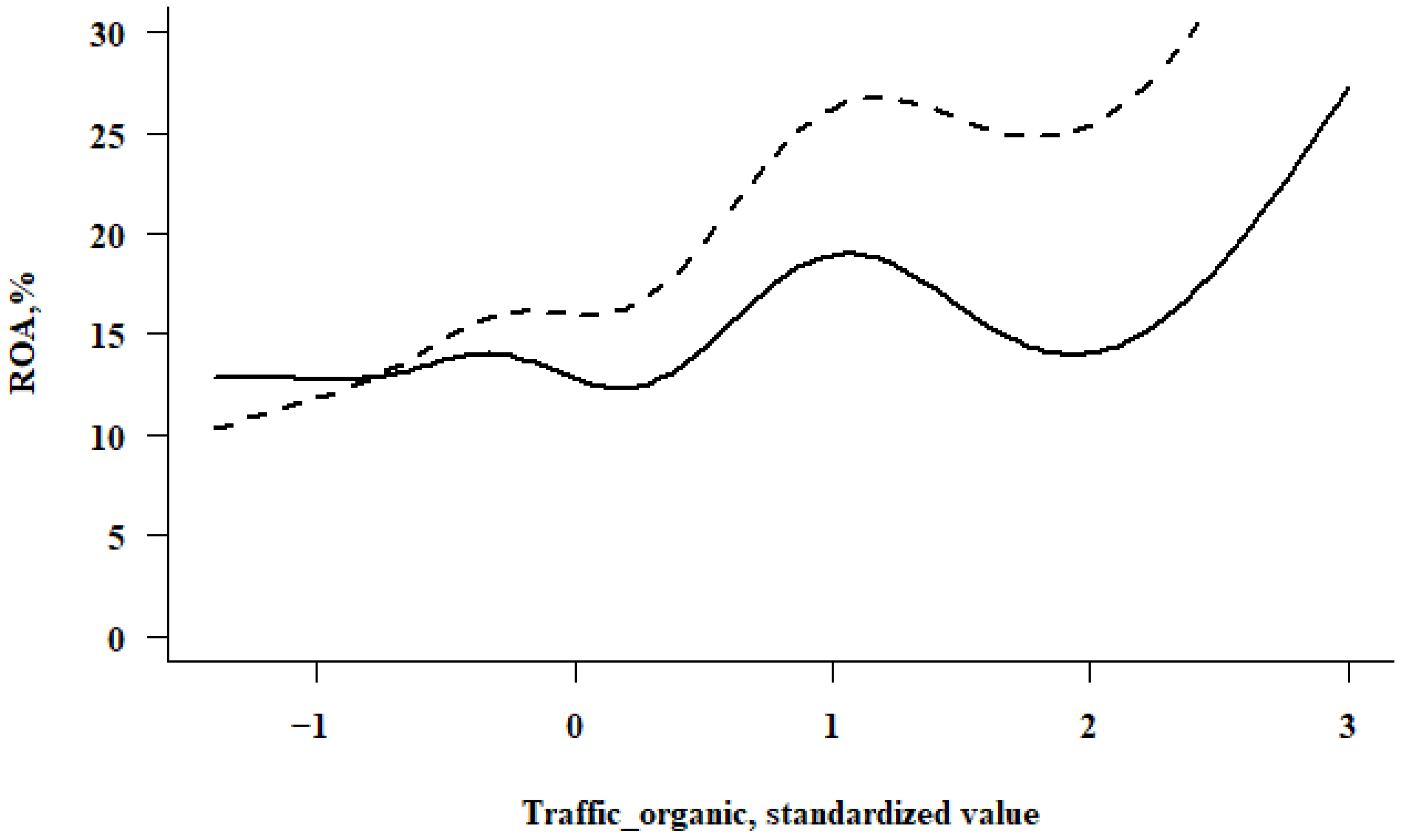
The variables size, FATA, leverage, and dummy_industry (electronics supermarkets) show a negative association. The significant electronics supermarkets dummy suggests the presence of industry-specific effects, with electronics supermarkets firms differing from the baseline industry in terms of the dependent variable. This shows possible bureaucratic inefficiencies, diminishing returns to scale, financial risks, and structural challenges. The “organic traffic” (Model 2.1) shows a positive association with the firm performance (ROA). This confirms that firms with more organic traffic tend to perform better financially. Model 3.1, with firm size as a moderating variable, shows a negative association with firm performance (ROA). This indicates that the smaller firms tend to benefit more from organic traffic in terms of ROA compared to larger firms (See Figure 1). This also supports the study hypothesis 3a. The inclusion of a moderator variable (size) enhances the efficacy of our regression model in comparison to the previous iteration (Adj. R2). Figure 1 illustrates a visual representation of the influence of organic traffic on the firm performance (ROA), considering firm size as a moderating factor.
Models 4.1 and 5.1 with firm age as a moderating variable find this variable to be statistically insignificant, which does not support study hypothesis 2a. Firm age is found to be statistically insignificant in explaining firm performance (ROA). This challenges the organizational learning theory and resource-based view that suggest that older firms perform better due to accumulated knowledge, routines, and reputation. However, it supports the dynamic capabilities theory that emphasizes innovation. The study also checks for the impact on the ROAt + 1, and the coefficients of organic traffic show significant increase (See Table A1). A firm that has achieved high organic traffic achieves an increase in profitability not only in the current year, but also in the following year. That is, high traffic attracts customers who stay the following year. The study findings support the resource-based view and dynamic capabilities theory that highlights the importance of establishing a firm’s long-term strategic values to gain comparative advantages.

4.1.2. Paid Traffic

Table 4 displays the various panel fixed effects models estimates on the influence of paid traffic on firm performance (ROA). The estimates are similar to those of the organic traffic, except in a few cases, as explained here. In the case of paid traffic, both the moderating variables age and size are found to be statistically insignificant. Thus, this does not support the study hypotheses 2b and 3b. In the case of paid traffic, the coefficient also slightly increases for ROAt + 1 (see Appendix A Table A2). A firm that has achieved high paid traffic achieves an increase in profitability not only in the current year, but also in the following year. That is, high paid traffic attracts customers who stay the following year. This aligns with the dynamic capability theory that the firm’s ability to innovate strategically in paid traffic impacts its financial performance (ROA). On the other hand, the organic traffic of the firm might reflect the resource-based view (VRIN framework). These findings support study hypothesis 1, which suggests that “the firm’s organic and paid traffic have a varied impact on its performance”. The estimates from Table 3 and Table 4 both support study hypothesis 4 regarding the effect of industry in defining the relationship between a firm’s digital footprints and its performance.

4.2. Discussion

Our research shows that the connection between web traffic and firm performance does not follow a simple straight line. Whether it is organic or paid traffic, the impact rises at first but then levels off as traffic grows. Earlier works typically model these effects as straightforward or uniform [8,9]. In contrast, our findings expose that both traffic types deliver diminishing returns at higher levels, a pattern made visible by applying generalized additive models. Our method finds patterns in how digital value is created that standard regression techniques often overlook [33], and both traffic types produce initial gains that taper as scale increases, especially for paid traffic (highlighting the risk of saturation effects).
Another finding lies in the distinct separation of organic and paid traffic, measured at the firm level within an emerging highly regulated market. The prior literature often treats digital engagement as a monolithic construct, or studies Western economies with fewer institutional constraints [8,17]. Here, the evidence shows that organic traffic consistently drives profitability, especially for smaller firms. Firm-level analysis in the Russian context shows that organic and paid website traffic are distinct resources that shape performance in fundamentally different ways.
Our results also challenge the assumption that older firms always benefit more from digital engagement. Although classic frameworks suggest that accumulated experience and reputation should make digital channels more effective for mature firms [23], the present study finds that age does not significantly moderate the organic traffic–performance link. Instead, firm size and internal digital capabilities prove more relevant, pointing out that a firm being large or digitally prepared matters more than being old. Our results also validate that organic web traffic, typically achieved through sustained search engine optimization, is consistently associated with increased profitability, and this effect is especially obvious among smaller firms. This challenges assumptions that digital engagement benefits all firms equally and clarifies that resource constraints heighten the value of organic channels in restricted environments [25,26]. In contrast, the influence of paid traffic is less predictable, and shows significant diminishing returns as spending increases. The recent literature has only recently begun to recognize this dynamic process [15,28,33].
Industry context emerges as another overlooked factor. Our study demonstrates that digital footprint effectiveness varies by sector, and supports the need to tailor digital strategies to industry realities [34]. This is particularly important in settings with fragmented infrastructure or sanctions, where optimal strategies differ from those found in integrated digital markets. Lastly, the present study finds that traffic effects do not disappear after a single period, but instead, continue to shape results over time. This points to digital strategy as a lasting influence on firm performance rather than just a series of isolated campaigns.

5. Robustness Checks and Tests for Nonlinear Dependencies

5.1. Robustness Checks

For additional checks, our study includes robust correction for heteroskedasticity in the data using the “white2” method with the “HC3”-type estimation (Model 5.1 and 5.2). Furthermore, to check the endogeneity issue it uses the total traffic (sum of organic and paid traffic) as the instrumental variable. The outcomes of the robustness examination are displayed in Table 5. Our calculations demonstrate that the results are stable.
The study deploys an instrumental variable (IV) test to check the endogeneity issue. It chooses paid traffic as the instrumental variable, and the suspected endogenous variable is organic traffic. The two-stage least squares (2SLS) method is utilized for the diagnostic test (See Table 6). The weak instrument test (p value of less than 0.05) confirms that the instrumental variable used is valid. Similarly, the Wu–Hausman test (p value of more than 0.05) confirms that there are no endogeneity issues with our study models. The present study also tests for multicollinearity (VIF test); the obtained values are low and within the accepted limit.

5.2. Tests for Nonlinear Dependencies

The study deploys GAMs to explore nonlinear dependencies between variables (See Table 7). GAMs provide us with an opportunity to capture the complex, nonlinear relationships that might exist, and giving us a chance to understand of how different predictors influence the outcomes. Table 7 presents the results of GAMs for Model 5.1 and Model 5.2, examining the nonlinear dependencies between various predictors and ROA. (edf) is a summary statistic of GAMs and reflects the degree of nonlinearity of a curve. Similarly, (Ref.df) is reference degrees of freedom used in computing the test statistic. The analysis shows that both organic and paid traffic have significant positive effects on ROA (edf = 6.32 for Model 5.1 and 7.78 for Model 5.2), indicating the crucial role of traffic in firm profitability.
Sales growth, fixed assets, current liquidity, leverage, firm age, and asset turnover all exhibit significant positive effects on ROA, emphasizing the importance of these factors in driving profitability. The interaction between traffic and firm size, as well as traffic and firm age, is significant, suggesting that the impact of traffic on ROA varies with firm size and age. Model 5.2, which includes paid traffic, performs slightly better with an adjusted R2 of 0.541 compared to Model 5.1’s adjusted R2 of 0.531. The GCV scores are 142.18 for Model 5.1 and 142.7 for Model 5.2, with lower values indicating better model fit. According to these findings, there is the necessity of considering nonlinear effects and interactions in analyzing firm performance.
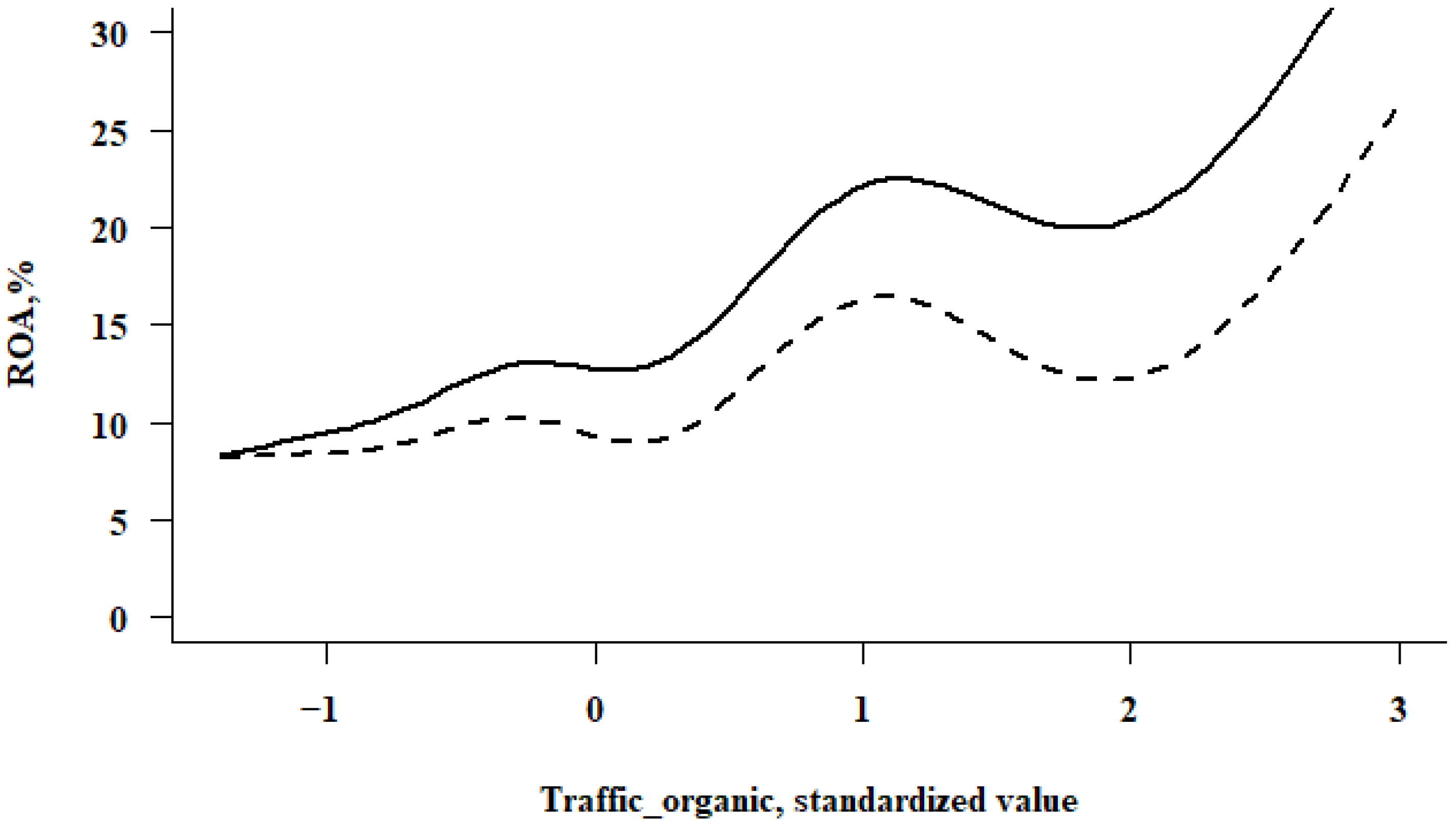
Next, the study visualizes the obtained dependencies using the following method: For the moderator variable size, all variables were held at their average values, except for traffic and size. This approach allows us to isolate and observe the interaction between traffic and firm size, resulting in Figure 2. Similarly, the figure for the moderator variable age in Model 5.1 was constructed by holding all other variables at their average values, except for traffic and age. This method provided a clear visualization of the interaction between traffic and firm age, as shown in Figure 3. With such visualization, we can elucidate the nuanced ways in which traffic impacts firm performance across different sizes and ages of firms.
The GAM smooth functions are directly comparable to empirical analogs of economic theory curves; the slope represents marginal effects, curvature reflects increasing or diminishing returns, and inflection points correspond to economic thresholds. For small firms, a steep positive slope (from −1 → 0 → 1… → 3) moves from below-average to above-average organic traffic strongly with increases in ROA. A flatter slope overall indicated that incremental organic traffic has a smaller impact on ROA due to brand maturity and established demand for large firms. Inflection points on the curves highlight thresholds where marginal returns to organic traffic begin to diminish, consistent with theory on learning, visibility, and capacity constraints (See Figure 2). In Figure 3, the older firms show a higher positive slope than younger firms. However, the overall patterns remain similar for both the newer and older firms. This implies that firm age does not materially alter the underlying relationship captured by the model. The GAM with nonlinear dependencies confirmed the significance of organic traffic on firm profitability (moderated by size). Thus, the observed threshold effect in the case of organic traffic can be explained by the cumulative nature of SEO-driven visibility, algorithmic ranking advantages, and network effects, all of which jointly enhance traffic effectiveness once a critical mass is reached. Consequently, hypothesis 3a regarding organic traffic is confirmed. The observed dependencies also support study hypothesis 5 that there exists a curvilinear relationship between a firm’s digital footprints and its performance. The findings from Figure 2 and Figure 3 align with Figure 1, reinforcing these conclusions. These results have been validated through both a robustness test and models accounting for nonlinear dependencies, ensuring the reliability of the findings. The visualization of the generalized additive model for paid traffic is presented in Figure 4 and Figure 5.
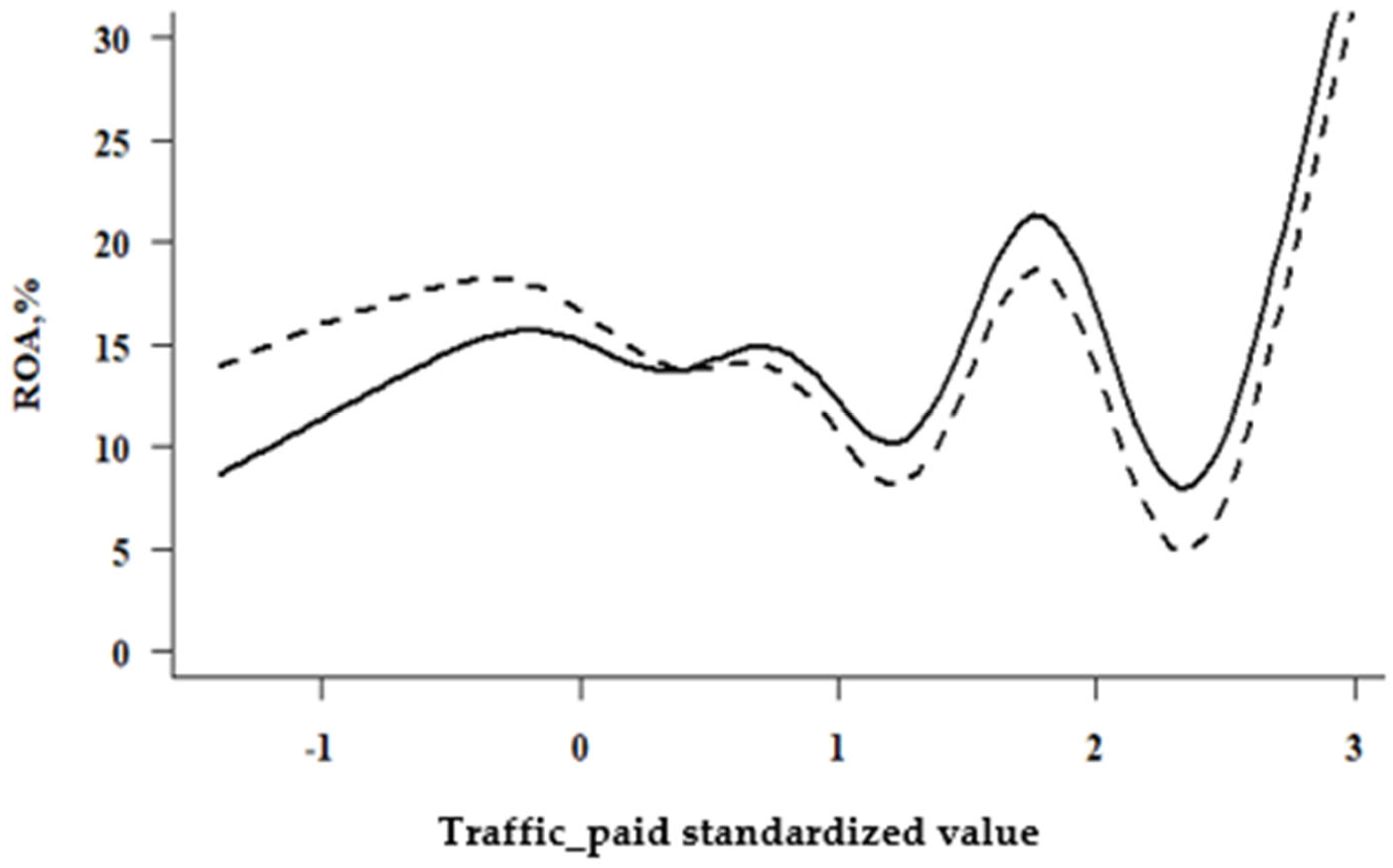
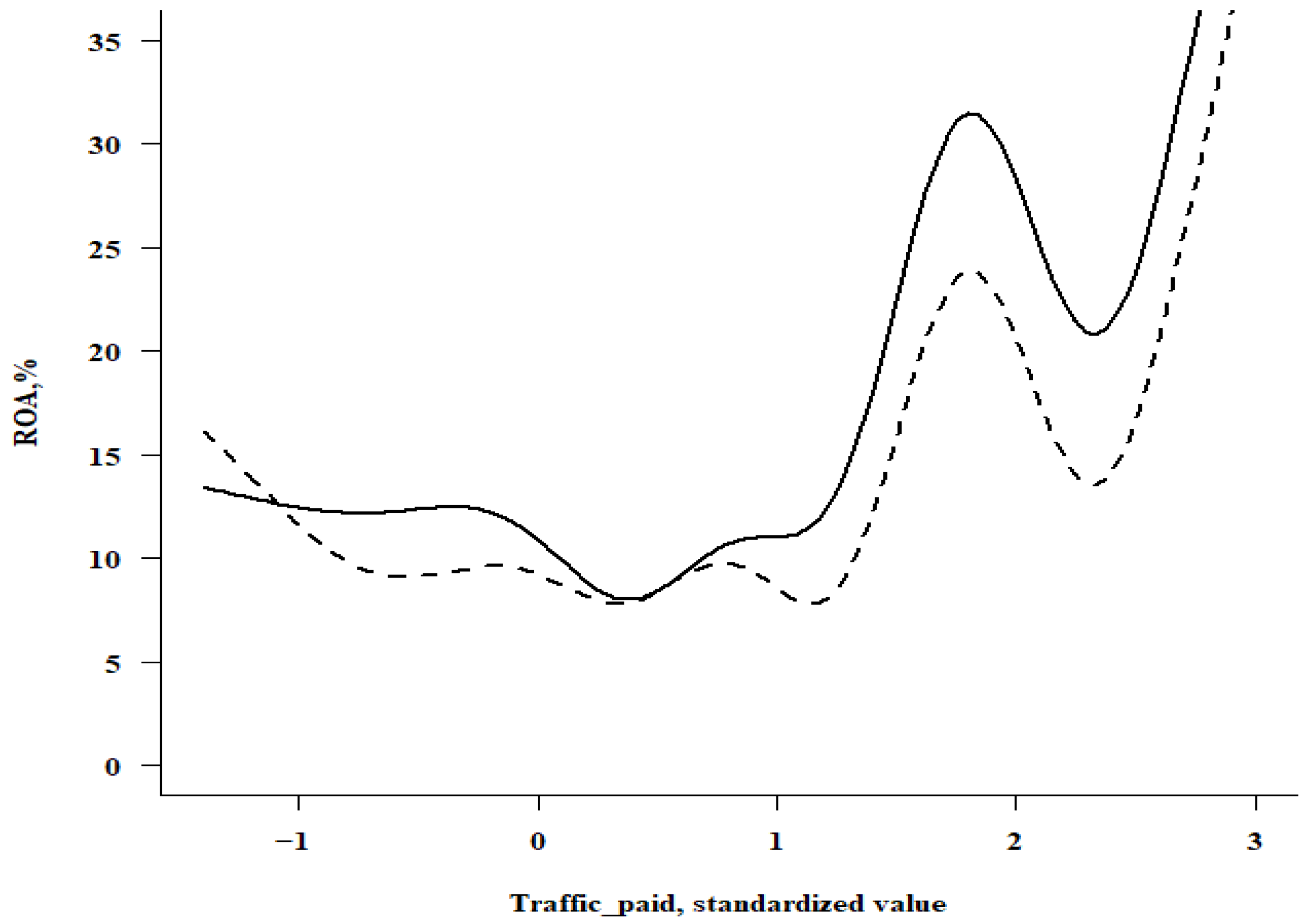
Similar interpretations can be made for Figure 4 and Figure 5. These graphs illustrate the nonlinear relationships between paid traffic and firm profitability, highlighting how the impact varies with different moderators. As illustrated in Figure 4 and Figure 5, one can interpret the effect in terms of positive or negative slopes. The diminishing returns here (paid traffic) can be interpreted as arising from rising marginal advertising costs and an audience overexposed to same advertisements, which reduce conversion efficiency beyond a certain spending level. In the case of paid traffic, the relationship with ROA shows a more complex pattern compared to organic traffic (See Figure 4 and Figure 5). Paid traffic in Russia is complex, possibly due to sanctions-driven isolation, regulatory control, data constraints, and platform concentration. Consequently, the GAM findings support study hypothesis 2b. Furthermore, the impact of paid traffic on ROA indicates a curvilinear relationship in nature. This also supports study hypothesis 1, that the impact of organic and paid traffic on firm performance differs.

6. Conclusions

The overall study findings indicate that a firm’s digital footprint has a significant impact on its performance that varies across the industries, consistent with the principles of a resource-based view and dynamic capability theory. The study also shows that the impact of organic and paid traffic on firm performance diverges. The study shows that there exists a curvilinear relationship between a firm’s digital footprint and its performance. This curvilinear association is moderated by the firm’s size and age, respectively. The study findings also indicate that the impact of paid traffic is more complex and difficult to predict. These results suggest that companies should tailor their digital strategies to fit their unique circumstances, making the most of organic traffic to improve profitability, and understanding how paid traffic influences performance in different ways. Policy makers in emerging and regulated markets should consider supporting programs that facilitate digital capability development among local firms. The insights from this study also highlight the importance of an intensified institutional setting (strict regulations, fragmented structures, and limited resources) that informs theory rather than a universally generalizable case. Thus, future studies may include more variables, alternative performance metrics, and multi-country analysis with longer periods of analysis.

Author Contributions

Conceptualization, D.B.V., L.S., V.S., I.L. and M.M.; methodology, D.B.V., L.S., V.S., I.L. and M.M.; software, L.S., V.S. and I.L.; validation, D.B.V., L.S., V.S., I.L. and M.M.; formal analysis, D.B.V., V.S. and M.M.; investigation, L.S. and I.L.; data curation, L.S.,V.S. and I.L.; writing—original draft preparation, D.B.V., L.S., V.S., I.L. and M.M.; writing—review and editing, V.S. and M.M.; visualization, L.S., V.S. and I.L. All authors have read and agreed to the published version of the manuscript.

Funding

This research received no external funding.

Institutional Review Board Statement

Not applicable.

Informed Consent Statement

Not applicable.

Data Availability Statement

The authors do not have permission to share data publicly. However, it can be obtained from SPARK Interfax and SE Ranking.

Conflicts of Interest

The authors declare no conflicts of interest.

Appendix A

Table A1. The outcomes of various panel fixed effects models with ROA(t + 1) for organic traffic.
Variables Model 1Model 2.1Model 3.1Model 4.1Model 5.1
Growth (Sales growth)0.9
(0.7)
0.65
(0.68)
0.56
(0.68)
0.64
(0.68)
0.55
(0.68)
Size (Firm size)−1.26
(0.83)
−3.04 ***
(0.87)
−2.09 *
(0.92)
−3.12 ***
(0.87)
−2.17 *
(0.92)
FATA (Share of fixed assets in total assets)−1.96 *
(0.82)
−1.81 *
(0.79)
−2.16 **
(0.8)
−1.75 *
(0.8)
−2.1 **
(0.8)
CACL (Current liquidity ratio)6.92 ***
(1.48)
6.89 ***
(1.44)
6.46 ***
(1.43)
6.86 ***
(1.44)
6.43 ***
(1.43)
Leverage (Total debt in assets)−5.08 ***
(0.77)
−4.62 ***
(0.76)
−4.56 ***
(0.75)
−4.65 ***
(0.76)
−4.59 ***
(0.75)
Age (Firm age)−0.16
(0.75)
−0.17
(0.73)
−0.14
(0.72)
0.05
(0.77)
0.08
(0.77)
Turnover (Asset turnover)0.7
(0.71)
0.5
(0.69)
0.32
(0.69)
0.53
(0.69)
0.35
(0.69)
Dummy_Industry−2.65 ***
(0.75)
−4.5 ***
(0.8)
−4.15 ***
(0.8)
−4.4 ***
(0.81)
−4.05 ***
(0.81)
Traffic_organic 4.25 ***
(0.78)
4.56 ***
(0.78)
4.29 ***
(0.78)
4.6 ***
(0.78)
Traffic_organic × Size −1.85 **
(0.63)
−1.86 **
(0.63)
Traffic_organic × Age 0.73
(0.9)
0.77
(0.89)
Intercept10.38 ***
(1.20)
10.86 ***
(1.17)
11.44 ***
(1.18)
10.89 ***
(1.17)
11.48 ***
(1.18)
Adj. R2 0.2200.2680.2810.2680.281
F-statistic17.27 on 8 and 442 DF19.6718 on 9 and 441 DF18.8907 on 10 and 440 DF17.7583 on 10 and 440 DF17.2322 on 11 and 439 DF
Probability<0.001<0.001<0.001<0.001<0.001
The dependent variable is the ROA(t + 1). † p < 0.10, * p < 0.05, ** p < 0.01, *** p < 0.001. Note: Estimation—Prais–Winsten regression, heteroskedastic panel corrected standard errors with AR-1 common autoregression.
Table A2. The outcomes of various panel fixed effects models with ROA(t + 1) for paid traffic.
Variables Model 1Model 2.2Model 3.2Model 4.2Model 5.2
Growth (Sales growth)0.9
(0.7)
0.69
(0.69)
0.69
(0.69)
0.68
(0.69)
0.69
(0.7)
Size (Firm size)−1.26
(0.83)
−1.93 *
(0.84)
−1.95 *
(0.87)
−1.91 *
(0.84)
−1.95 *
(0.87)
FATA (Share of fixed assets in total assets)−1.96 *
(0.82)
−1.96 *
(0.81)
−1.95 *
(0.81)
−1.98 *
(0.81)
−1.97 *
(0.82)
CACL (Current liquidity ratio)6.92 ***
(1.48)
7.25 ***
(1.46)
7.25 ***
(1.47)
7.27 ***
(1.47)
7.27 ***
(1.47)
Leverage (Total debt in assets)−5.08 ***
(0.77)
−5.15 ***
(0.76)
−5.15 ***
(0.77)
−5.14 ***
(0.77)
−5.14 ***
(0.77)
Age (Firm age)−0.16
(0.75)
−0.14
(0.74)
−0.14
(0.74)
−0.19
(0.76)
−0.19
(0.76)
Turnover (Asset turnover)0.7
(0.71)
0.62
(0.7)
0.63
(0.71)
0.62
(0.7)
0.63
(0.71)
Dummy_Industry −2.65 ***
(0.75)
−4 ***
(0.82)
−4 ***
(0.82)
−4.07 ***
(0.86)
−4.07 ***
(0.86)
Traffic_ paid 2.92 ***
(0.78)
2.9 ***
(0.8)
2.92 ***
(0.79)
2.89 ***
(0.81)
Traffic_ paid × Size 0.07
(0.63)
0.11
(0.65)
Traffic_paid × Age −0.21
(0.82)
−0.24
(0.84)
Intercept
10.38 **
(1.20)
10.46 ***
(1.19)
10.45 ***
(1.19)
10.43 ***
(1.19)
10.41 ***
(1.20)
Adj. R2 0.2210.2430.2410.2410.240
F-statistic17.27 on 8 and 442 DF17.3421 on 9 and 441 DF15.5741 on 10 and 440 DF15.5816 on 10 and 440 DF14.1361 on 11 and 439 DF
Probability<0.001<0.001<0.001<0.001<0.001
The dependent variable is the ROA. † p < 0.10, * p < 0.05, ** p < 0.01, *** p < 0.001. Note: Estimation—Prais–Winsten regression, heteroskedastic panel corrected standard errors with AR-1 common autoregression.

References

  1. Nallasivam, A.; KN, A.S.I.; Desai, K.; Kautish, S.; Ghoshal, S. Universal Access to Internet and Sustainability: Achieving the UN’s Sustainable Development Goals. In Digital Technologies to Implement the UN Sustainable Development Goals; Springer: Cham, Switzerland, 2024; pp. 235–255. [Google Scholar]
  2. Nikolaeva, R. Strategic determinants of web site traffic in on-line retailing. Int. J. Electron. Commer. 2005, 9, 113–132. [Google Scholar] [CrossRef]
  3. Filippou, G.; Georgiadis, A.G.; Jha, A.K. Establishing the link: Does web traffic from various marketing channels influence direct traffic source purchases? Mark. Lett. 2024, 35, 59–71. [Google Scholar] [CrossRef]
  4. Lazer, D.; Pentland, A.; Adamic, L.; Aral, S.; Barabási, A.L.; Brewer, D.; Christakis, N.; Contractor, N.; Fowler, J.; Gutmann, M.; et al. Computational social science. Science 2009, 323, 721–723. [Google Scholar] [CrossRef] [PubMed]
  5. Howison, J.; Wiggins, A.; Crowston, K. Validity issues in the use of social network analysis with digital trace data. J. Assoc. Inf. Syst. 2011, 12, 2. [Google Scholar] [CrossRef]
  6. Debón, A.; Domenech, J. Digital footprint approach for the study of competitiveness in wineries. Expert Syst. Appl. 2024, 257, 125049. [Google Scholar] [CrossRef]
  7. Homburg, C.; Wielgos, D.M. The value relevance of digital marketing capabilities to firm performance. J. Acad. Mark. Sci. 2022, 50, 666–688. [Google Scholar] [CrossRef]
  8. Rosamartina, S.; Giustina, S.; Angeloantonio, R. Digital reputation and firm performance: The moderating role of firm orientation towards sustainable development goals (SDGs). J. Bus. Res. 2022, 152, 315–325. [Google Scholar] [CrossRef]
  9. Chen, W.; Srinivasan, S. Going digital: Implications for firm value and performance. Rev. Account. Stud. 2024, 29, 1619–1665. [Google Scholar] [CrossRef]
  10. Barney, J. Firm resources and sustained competitive advantage. J. Manag. 1991, 17, 99–120. [Google Scholar] [CrossRef]
  11. Teece, D.J.; Pisano, G.; Shuen, A. Dynamic capabilities and strategic management. Strateg. Manag. J. 1997, 18, 509–533. [Google Scholar] [CrossRef]
  12. Baye, M.R.; De los Santos, B.; Wildenbeest, M.R. Search engine optimization: What drives organic traffic to retail sites? J. Econ. Manag. Strategy 2016, 25, 6–31. [Google Scholar] [CrossRef]
  13. Teece, D.J. The foundations of enterprise performance: Dynamic and ordinary capabilities in an (economic) theory of firms. Acad. Manag. Perspect. 2014, 28, 328–352. [Google Scholar] [CrossRef]
  14. Makadok, R. Toward a synthesis of the resource-based and dynamic-capability views of rent creation. Strateg. Manag. J. 2001, 22, 387–401. [Google Scholar] [CrossRef]
  15. Aslam, B.; Karjaluoto, H. Digital advertising around paid spaces, E-advertising industry’s revenue engine: A review and research agenda. Telemat. Inform. 2017, 34, 1650–1662. [Google Scholar] [CrossRef]
  16. Dolega, L.; Rowe, F.; Branagan, E. Going digital? The impact of social media marketing on retail website traffic, orders and sales. J. Retail. Consum. Serv. 2021, 60, 102501. [Google Scholar] [CrossRef]
  17. Yang, S.; Ghose, A. Analyzing the relationship between organic and sponsored search advertising: Positive, negative, or zero interdependence? Mark. Sci. 2010, 29, 602–623. [Google Scholar] [CrossRef]
  18. Xuhua, H.; Larbi-Siaw, O.; Thompson, E.T. Diminishing returns or inverted U? The curvilinear relationship between eco-innovation and firms’ sustainable business performance: The impact of market turbulence. Kybernetes 2024, 53, 4723–4746. [Google Scholar] [CrossRef]
  19. Hinds, J.; Joinson, A.N. What demographic attributes do our digital footprints reveal? A systematic review. PLoS ONE 2018, 13, e0207112. [Google Scholar] [CrossRef]
  20. Weiler, M.; Jansen, N.; Hinz, O. Can We Measure the Structural Dimension of Social Capital with Digital Footprint Data?—An Assessment of the Convergent Validity of an Indicator Extracted from Digital Footprint Data. Schmalenbach J. Bus. Res. 2024, 76, 159–195. [Google Scholar] [CrossRef]
  21. Audia, P.G.; Greve, H.R. Less likely to fail: Low performance, firm size, and factory expansion in the shipbuilding industry. Manag. Sci. 2006, 52, 83–94. [Google Scholar] [CrossRef]
  22. Casanueva, C.; Castro, I.; Galán, J.L. Informational networks and innovation in mature industrial clusters. J. Bus. Res. 2013, 66, 603–613. [Google Scholar] [CrossRef]
  23. Stinchcombe, A. Organization-creating organizations. Trans-Action 1965, 2, 34–35. [Google Scholar] [CrossRef]
  24. Pfeffer, J.; Salancik, G. The External Control of Organizations: A Resource Dependence Perspective; Routledge: London, UK, 2003; pp. 355–370. [Google Scholar]
  25. Ebben, J.; Johnson, A. Bootstrapping in small firms: An empirical analysis of change over time. J. Bus. Ventur. 2006, 21, 851–865. [Google Scholar] [CrossRef]
  26. Choi, Y.R.; Ha, S.; Kim, Y. Innovation ambidexterity, resource configuration and firm growth: Is smallness a liability or an asset? Small Bus. Econ. 2022, 58, 2183–2209. [Google Scholar] [CrossRef]
  27. Gimenez-Fernandez, E.M.; Sandulli, F.D.; Bogers, M. Unpacking liabilities of newness and smallness in innovative start-ups: Investigating the differences in innovation performance between new and older small firms. Res. Policy 2020, 49, 104049. [Google Scholar] [CrossRef]
  28. Du, R.Y.; Joo, M.; Wilbur, K.C. Advertising and brand attitudes: Evidence from 575 brands over five years. Quant. Mark. Econ. 2019, 17, 257–323. [Google Scholar] [CrossRef]
  29. Spitsin, V.; Ryzhkova, M.; Vukovic, D.; Anokhin, S. Companies profitability under economic instability: Evidence from the manufacturing industry in Russia. Econ. Struct. 2020, 9, 9. [Google Scholar] [CrossRef]
  30. Park, J.; Shin, B. Conceptualizing digital sanctions as a new type of economic sanctions in the digital era: Digital-related sanctions measures against Russia and their consequences. J. Eurasian Stud. 2025, 16, 44–59. [Google Scholar] [CrossRef]
  31. Saha, K.; Malesios, C.; Chowdhury, S.; Dey, P.K. Impact of institutional voids on the performance of small and medium-sized enterprises. J. Strategy Manag. 2023, 16, 1–27. [Google Scholar] [CrossRef]
  32. Mladenović, D.; Rajapakse, A.; Kožuljević, N.; Shukla, Y.S. Search engine optimization (SEO) for digital marketers: Exploring determinants of online search visibility for blood bank service. Online Inf. Rev. 2022, 47, 661–679. [Google Scholar] [CrossRef]
  33. Gordon, B.R.; Jerath, K.; Katona, Z.; Narayanan, S.; Shin, J.; Wilbur, K.C. Inefficiencies in digital advertising markets. J. Mark. 2021, 85, 7–25. [Google Scholar] [CrossRef]
  34. Zhao, X.; Dong, F. Digital infrastructure construction and corporate innovation efficiency: Evidence from Broadband China Strategy. Humanit. Soc. Sci. Commun. 2025, 12, 347. [Google Scholar] [CrossRef]
  35. Hastie, T.; Hastie, M.T. Package ‘gam’, R Package. Available online: https://cran.r-project.org/web/packages/gam/index.html (accessed on 7 December 2025).
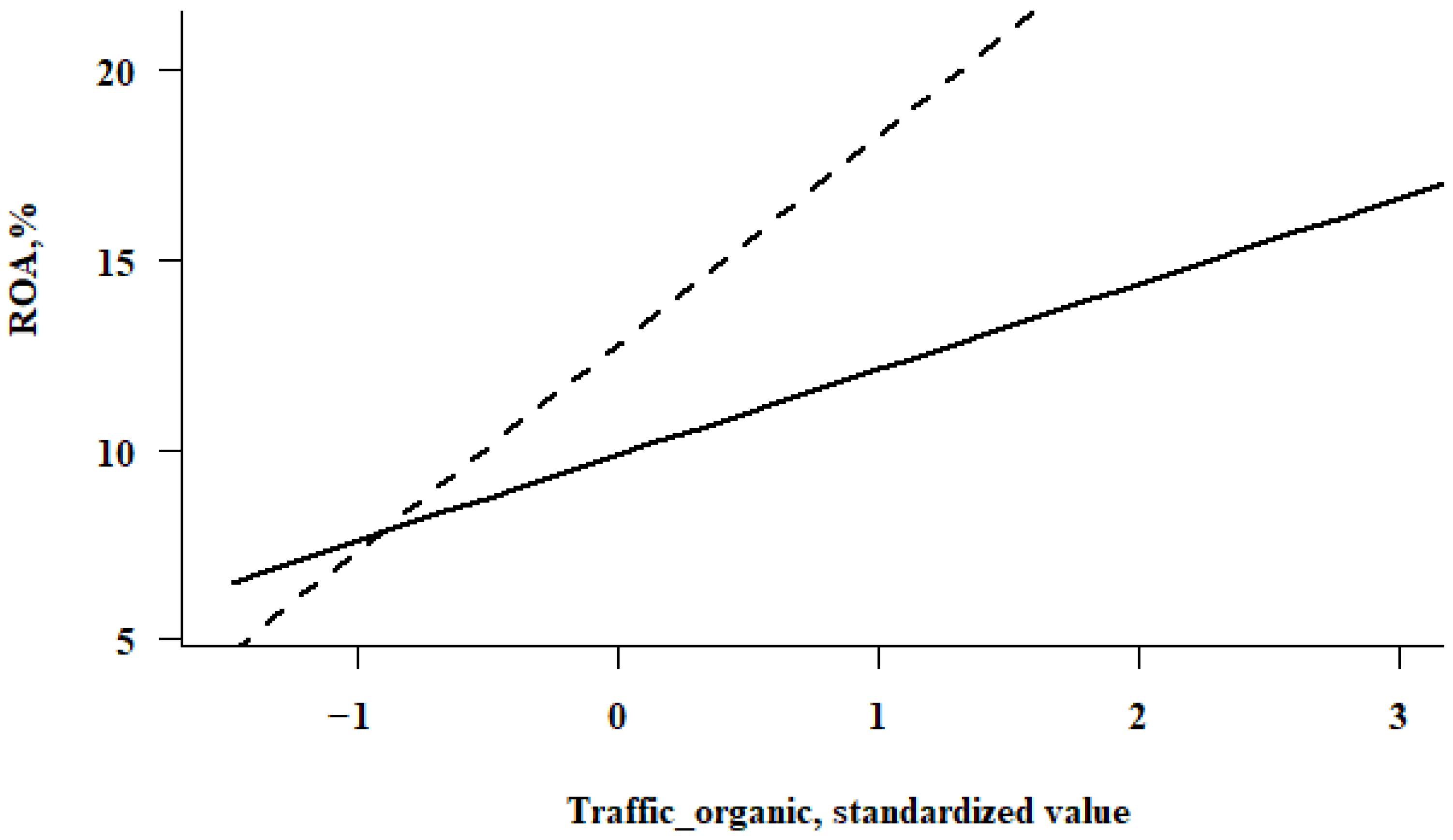
Figure 1. The impact of firm age as a moderating variable on its performance (ROA). Note: This figure illustrates the impact of organic internet traffic on enterprises’ profitability, considering the moderating factor of size. A solid line represents the size of 1 (Large), while a dashed line represents the size of −1 (Small). The figure illustrates that the variable of size has a diminishing impact on the positive relationship of the traffic variable. The influence of traffic on the financial performance of small-scale businesses is particularly evident. This indicates that smaller enterprises have the potential to experience more substantial improvements in profitability because of increasing internet traffic, in contrast to larger firms.
World 07 00011 g001
Figure 2. Nonlinear relationship between a firm’s organic traffic and its performance, moderated by size. Note: This figure illustrates the impact of organic internet traffic on enterprises’ profitability, considering the moderating factor of size with nonlinear dependencies (according to the GAM). A solid line represents the size of 1 (Large), while a dashed line represents the size of −1 (Small). The figure illustrates that the variable of size has a diminishing impact on the positive relationship of the traffic variable. The influence of traffic on the financial performance of small-scale businesses is particularly evident. This indicates that smaller enterprises have the potential to experience more substantial improvements in profitability because of increasing internet traffic, in contrast to larger firms.
World 07 00011 g002
Figure 3. Nonlinear relationship between a firm’s organic traffic and its performance, moderated by age. Note: Age = 1 for the solid line (Mature firms); −1 for the dashed line (Young firms). This figure demonstrates that age reinforces the positive effect of the variable traffic with nonlinear dependencies (according to the GAM). The impact of traffic on the profitability of mature companies is greater. This figure exhibits that mature companies can realize greater advantages in profitability from increased internet traffic than their younger counterparts.
World 07 00011 g003
Figure 4. Nonlinear relationship between a firm’s paid traffic and its performance, moderated by size. Note: This figure illustrates the impact of paid internet traffic on enterprises’ profitability, considering the moderating factor of size with nonlinear dependencies (according to the GAM). A solid line represents the size of 1 (Large), while a dashed line represents the size of −1 (Small).
World 07 00011 g004
Figure 5. Nonlinear relationship between a firm’s paid traffic and its performance, moderated by age. Note: Age = 1 for the solid line (Mature firms); −1 for the dashed line (Young firms). This figure demonstrates the impact of paid traffic with the moderating factor of age on ROA with nonlinear dependencies (according to the GAM).
World 07 00011 g005
Table 1. Descriptive statistics and correlations between variables.
NVariablesMeanStandard
Deviation
Correlations (r) and Their Significance (p)
123456789
1Growth 0.080.261
2Size 22.821.74−0.061
3FATA 17.1717.70−0.12 **0.48 ***1
4CACL 2.789.920.03−0.16 ***−0.10 *1
5Leverage 58.8625.670.030.14 ***−0.09 *−0.27 ***1
6Age 17.956.62−0.010.22 ***0.14 ***0.02−0.14 ***1
7Turnover 198.4291.690.07 †0.07 †−0.03−0.09 *0.19 ***−0.051
8Dummy_ Industry0.100.30−0.01−0.22 ***−0.23 ***0.09 *0.10 *−0.29 ***0.061
9Traffic_organic10.552.430.020.30 ***0.09 *0.07 †−0.0100.060.32 ***1
10Traffic_paid3.164.590.030.14 ***−0.0100.09 *−0.07 †0.050.41 ***0.73 ***
Source: authors’ calculation. Note: † p < 0.10, * p < 0.05, ** p < 0.01, *** p < 0.001.
Table 2. Summary of different panel regression fixed effects models used in the study.
NVariablesModel 1Model 2.1Model 3.1Model 4.1Model 5.1Model 2.2Model 3.2Model 4.2Model 5.2
1 Growth +++++++++
2 Size +++++++++
3 FATA +++++++++
4 CACL +++++++++
5 Leverage+++++++++
6Age +++++++++
7Turnover +++++++++
8Dummy_ Industry+++++++++
9Traffic_organic ++++
10Traffic_organic × Size + +
11Traffic_organic × Age ++
12Traffic_ paid ++++
13Traffic_ paid × Size + +
14Traffic_paid × Age ++
Table 3. The outcomes of various panel fixed effects models with ROA(t) for Traffic_organic.
Variables Model 1Model 2.1Model 3.1Model 4.1Model 5.1VIF
Growth (Sales growth)1.91 ***
(0.56)
1.77 **
(0.55)
1.67 **
(0.55)
1.78 **
(0.55)
1.68 **
(0.55)
1.03
Size (Firm size)−0.86
(0.67)
−2.36 ***
(0.71)
−1.46 †
(0.76)
−2.42 ***
(0.71)
−1.52 *
(0.76)
2.01
FATA (Share of fixed assets in to
tal assets)
−1.85 **
(0.66)
−1.8 **
(0.64)
−2.08 **
(0.64)
−1.76 **
(0.64)
−2.04 **
(0.65)
1.43
CACL (Current liquidity ratio)3.9 ***
(0.59)
3.65 ***
(0.58)
3.43 ***
(0.58)
3.64 ***
(0.58)
3.41 ***
(0.58)
1.14
Leverage (Total debt in assets)−6.07 ***
(0.61)
−5.73 ***
(0.6)
−5.65 ***
(0.59)
−5.75 ***
(0.6)
−5.67 ***
(0.59)
1.21
Age (Firm age)−0.17
(0.61)
−0.15
(0.59)
−0.13
(0.59)
−0.05
(0.61)
−0.01
(0.6)
1.21
Turnover (Asset turnover)1.54 **
(0.57)
1.42 *
(0.56)
1.27 *
(0.56)
1.44 *
(0.56)
1.29 *
(0.56)
1.06
Dummy_ Industry−2.18 ***
(0.6)
−3.63 ***
(0.64)
−3.34 ***
(0.65)
−3.57 ***
(0.65)
−3.27 ***
(0.65)
1.46
Traffic_organic 3.54 ***
(0.64)
3.87 ***
(0.65)
3.53 ***
(0.64)
3.86 ***
(0.65)
1.40
Traffic_organic × Size −1.61 **
(0.52)
−1.62 **
(0.52)
1.39
Traffic_organic × Age 0.55
(0.7)
0.6
(0.7)
1.08
Intercept10.40 ***
(1.12)
10.79 ***
(1.10)
11.32 ***
(1.10)
10.80 ***
(1.10)
11.33 ***
(1.10)
Adj. R2 0.2830.3170.3270.3170.327
F-statistic31.1682 on 8 and 592 DF32.456 on 9 and 591 DF30.592 on 10 and 590 DF29.2518 on 10 and 590 DF27.8664 on 11 and 589 DF
Probability<0.001<0.001<0.001<0.001<0.001
The dependent variable is the ROA. † p < 0.10, * p < 0.05, ** p < 0.01, *** p < 0.001. Note: Estimation—Prais–Winsten regression, heteroskedastic panel corrected standard errors with AR-1 common autoregression.
Table 4. The outcomes of various panel fixed effects models with ROA(t) for Traffic_paid.
Variables Model 1Model 2.2Model 3.2Model 4.2Model 5.2VIF
Growth (Sales growth)1.91 ***
(0.56)
1.81 **
(0.56)
1.83 **
(0.56)
1.8 **
(0.56)
1.82 **
(0.56)
1.03
Size (Firm size)−0.86
(0.67)
−1.41 *
(0.68)
−1.51 *
(0.71)
−1.41 *
(0.69)
−1.51 *
(0.71)
2.01
FATA (Share of fixed assets in total assets)−1.85 **
(0.66)
−1.82 **
(0.65)
−1.78 **
(0.65)
−1.83 **
(0.66)
−1.79 **
(0.66)
1.43
CACL (Current liquidity ratio)3.9 ***
(0.59)
3.9 ***
(0.58)
3.91 ***
(0.58)
3.9 ***
(0.58)
3.91 ***
(0.58)
1.14
Leverage (Total debt in assets)−6.07 ***
(0.61)
−6.09 ***
(0.6)
−6.08 ***
(0.6)
−6.08 ***
(0.6)
−6.07 ***
(0.6)
1.21
Age (Firm age)−0.17
(0.61)
−0.18
(0.6)
−0.18
(0.6)
−0.19
(0.61)
−0.2
(0.61)
1.21
Turnover (Asset turnover)1.54 **
(0.57)
1.52 **
(0.57)
1.56 **
(0.57)
1.52 **
(0.57)
1.57 **
(0.57)
1.06
Dummy_Industry −2.18 ***
(0.6)
−3.18 ***
(0.66)
−3.17 ***
(0.66)
−3.2 ***
(0.69)
−3.21 ***
(0.69)
1.46
Traffic_ paid 2.18 ***
(0.63)
2.09 **
(0.64)
2.18 ***
(0.63)
2.1 **
(0.65)
1.36
Traffic_ paid × Size 0.28
(0.51)
0.3
(0.52)
1.24
Traffic_paid × Age −0.05
(0.65)
−0.12
(0.66)
1.16
Intercept10.40 ***
(1.12)
10.44 ***
(1.11)
10.39 ***
(1.11)
10.43 ***
(1.12)
10.37 ***
(1.12)
Adj. R2 0.2830.2960.2950.2950.295
F-statistic31.1682 on 8 and 592 DF29.5629 on 9 and 591 DF26.6071 on 10 and 590 DF26.5623 on 10 and 590 DF24.1517 on 11 and 589 DF
Probability<0.001<0.001<0.001<0.001<0.001
The dependent variable is the ROA. † p < 0.10, * p < 0.05, ** p < 0.01, *** p < 0.001. Note: Estimation—Prais–Winsten regression, heteroskedastic panel corrected standard errors with AR-1 common autoregression.
Table 5. Robustness tests for Models 5.1 and 5.2.
VariablesROA t
Model 5.1
ROA t + 1
Model 5.1
ROA t
Model 5.2
ROA t + 1
Model 5.2
Growth (Sales growth)1.68 **
(0.55)
0.55
(0.72)
1.82 **
(0.57)
0.69
(0.74)
Size (Firm size)−1.52 *
(0.77)
−2.17 *
(0.97)
−1.51 *
(0.72)
−1.95 *
(0.91)
FATA (Share of fixed assets in total assets)−2.04 **
(0.65)
−2.1 *
(0.84)
−1.79 **
(0.67)
−1.97 *
(0.86)
CACL (Current liquidity ratio)3.41 ***
(0.62)
6.43 ***
(1.55)
3.91 ***
(0.62)
7.27 ***
(1.60)
Leverage (Total debt in assets)−5.67 ***
(0.60)
−4.59 ***
(0.79)
−6.07 ***
(0.61)
−5.14 ***
(0.81)
Age (Firm age)−0.01
(0.61)
0.08
(0.80)
−0.2
(0.62)
−0.19
(0.80)
Turnover (Asset turnover)1.29 *
(0.56)
0.35
(0.73)
1.57 **
(0.58)
0.63
(0.75)
Dummy_Industry
−3.27 ***
(0.66)
−4.05 ***
(0.85)
−3.21 ***
(0.70)
−4.07 ***
(0.91)
Traffic_organic
(Traffic_paid)
3.86 ***
(0.65)
4.6 ***
(0.82)
2.1 **
(0.65)
2.89 ***
(0.85)
Traffic_organic × Size
(Traffic_paid × Size)
−1.62 **
(0.52)
−1.86 **
(0.66)
0.3
(0.53)
0.11
(0.68)
Traffic_organic × Age
(Traffic_paid × Age)
0.6
(0.71)
0.77
(0.94)
−0.12
(0.67)
−0.24
(0.88)
Intercept11.33 ***
(1.10)
11.48 ***
(1.18)
10.37 ***
(1.12)
10.41 ***
(1.20)
Adj. R2 0.3270.2810.2950.240
F-statistic27.8664 on 11 and 589 DF17.2322 on 11 and 439 DF24.1517 on 11 and 589 DF14.1361 on 11 and 439 DF
p<0.001<0.001<0.001<0.001
Note: *** p < 0.001; ** p < 0.01; * p < 0.05; λ p < 0.10. ROA is dependent variable. Standard errors are shown in parentheses.
Table 6. Instrumental variable (IV) test estimates.
Variables OrganicTraffic ~ PaidTraffic + Growth + Size + FATA + CACL + Leverage + Age + Turnover + Dummy_Industry ivreg(ROA ~ OrganicTraffic + Growth + Size + FATA + CACL + Leverage + Age + Turnover + Dummy_Industry | PaidTraffic + Growth + Size + FATA + CACL + Leverage + Age + Turnover + Dummy_Industry)
Traffic_organic 3.32 **
(1.27)
PaidTraffic 0.66 ***
(0.03)
Growth (Sales growth)0.01
(0.03)
1.78 **
(0.63)
Size (Firm size)0.258 ***
(0.03)
−2.27 **
(0.73)
FATA (Share of fixed assets in to
tal assets)
0.00
(0.03)
−1.80 **
(0.57)
CACL (Current liquidity ratio)0.07 **
(0.03)
3.67 ***
(0.91)
Leverage (Total debt in assets)−0.10 ***
(0.03)
−5.75 ***
(0.66)
Age (Firm age)−0.01
(0.03)
−0.20
(0.55)
Turnover (Asset turnover)0.03
(0.03)
1.43 **
(0.53)
Dummy_ Industry0.11 ***
(0.03)
−3.55 ***
(0.75)
Intercept−0.10 †
(0.05)
10.41 ***
(0.54)
Adj. R2 0.6020.321
F-statistic/Wald test:102.766 on 9 and 591 DFWald test: 14.17 on 9 and 594 DF
Probability<0.001<0.001
Diagnostic test
Weak instruments<( 2 × 10 16 ) ***
Wu–Hausman0.832
Note: † p < 0.10, * p < 0.05, ** p < 0.01, *** p < 0.001.
Table 7. Generalized additive models for Model 5.1 and Model 5.2 (edf and Ref.df).
VariablesModel 5.1
Traffic_Organic
Model 5.2
Traffic_Paid
Growth (Sales growth)4.74 **
(5.88)
3.75 **
(4.73)
Size (Firm size)1.00 *
(1.00)
1.00
(1.00)
FATA (Share of fixed assets in total assets)2.79 ***
(3.48)
2.84 **
(3.54)
CACL (Current liquidity ratio)8.62 ***
(8.95)
8.76 ***
(8.98)
Leverage (Total debt in assets)8.54 ***
(8.93)
8.55 ***
(8.93)
Age (Firm age)4.35 **
(5.38)
4.55 *
(5.62)
Turnover (Asset turnover)2.80 ***
(3.52)
2.81 ***
(3.53)
Dummy_Industry−2.86 ***
(0.64)
−1.64 *
(0.74)
Traffic_organic
(Traffic_paid)
6.62 ***
(7.76)
7.89 *
(8.64)
Traffic_organic × Size
(Traffic_paid × Size)
1.00 ***
(1.00)
2.66 λ
(3.43)
Traffic_organic × Age
(Traffic_paid × Age)
1.00 λ
(1.00)
5.83 *
(6.99)
Intercept10.41 ***
(0.47)
10.41 ***
(0.47)
Adj. R2 0.4950.500
Deviance explained 53.1%54.1%
GCV 142.18142.7
Note: *** p < 0.001; ** p < 0.01; * p < 0.05; λ p < 0.10. ROA is dependent variable. Standard errors are shown in parentheses.
Disclaimer/Publisher’s Note: The statements, opinions and data contained in all publications are solely those of the individual author(s) and contributor(s) and not of MDPI and/or the editor(s). MDPI and/or the editor(s) disclaim responsibility for any injury to people or property resulting from any ideas, methods, instructions or products referred to in the content.