

Vitamin D Serum Status and Associated Factors Among Women with Cervical Lesions


Abstract
1. Introduction
2. Materials and Methods
2.1. Study Design, Setting, Population
2.2. Sampling Frame and Sample Size
2.3. Study Variables
2.4. Laboratory Investigations
2.5. Statistical Analysis
3. Results
3.1. Study Population Description
3.2. Serum Vitamin D Levels Among Women with Cervical Lesions
3.3. Factors Associated with Vitamin D Deficiency Among Women with Cervical Lesions
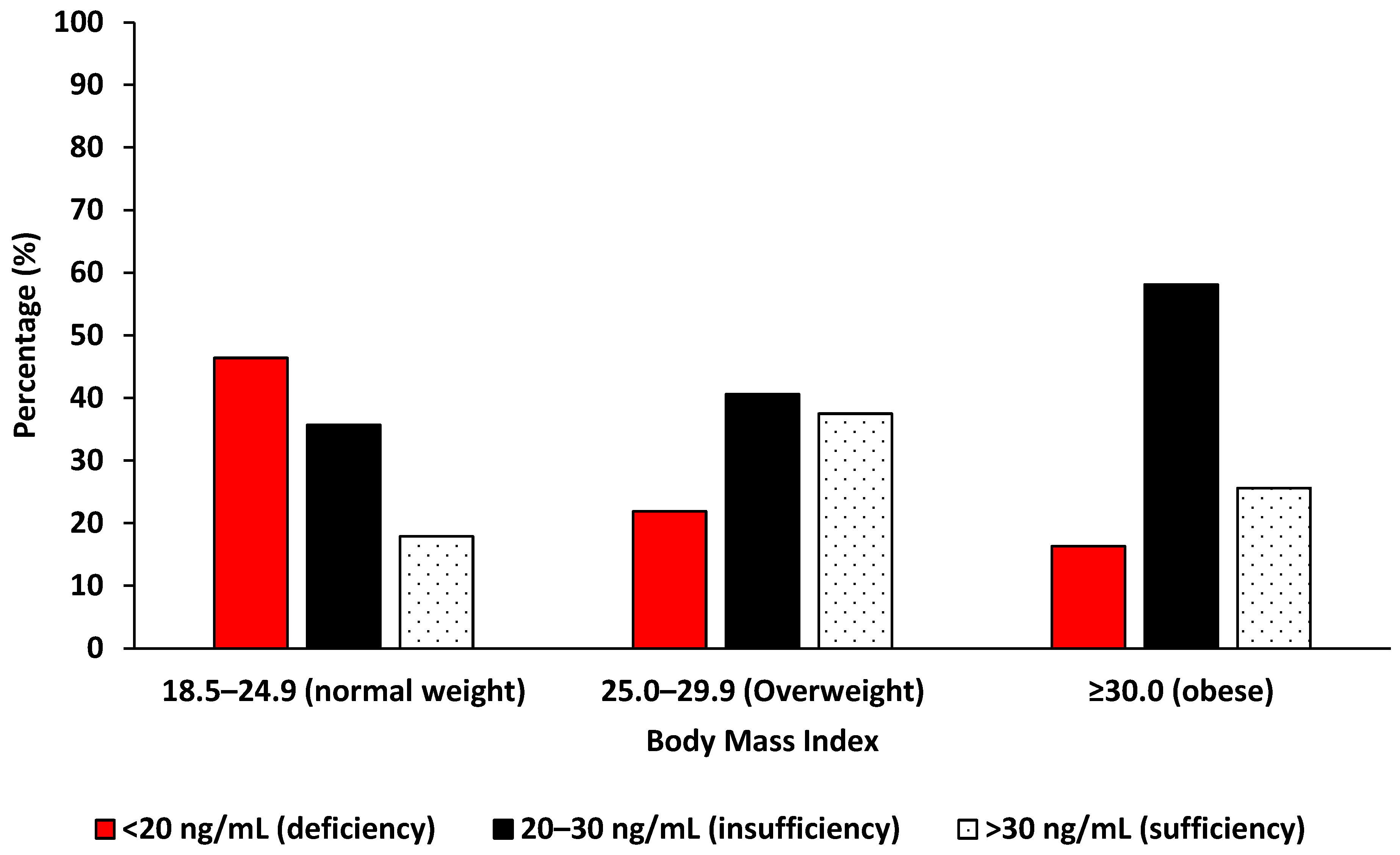
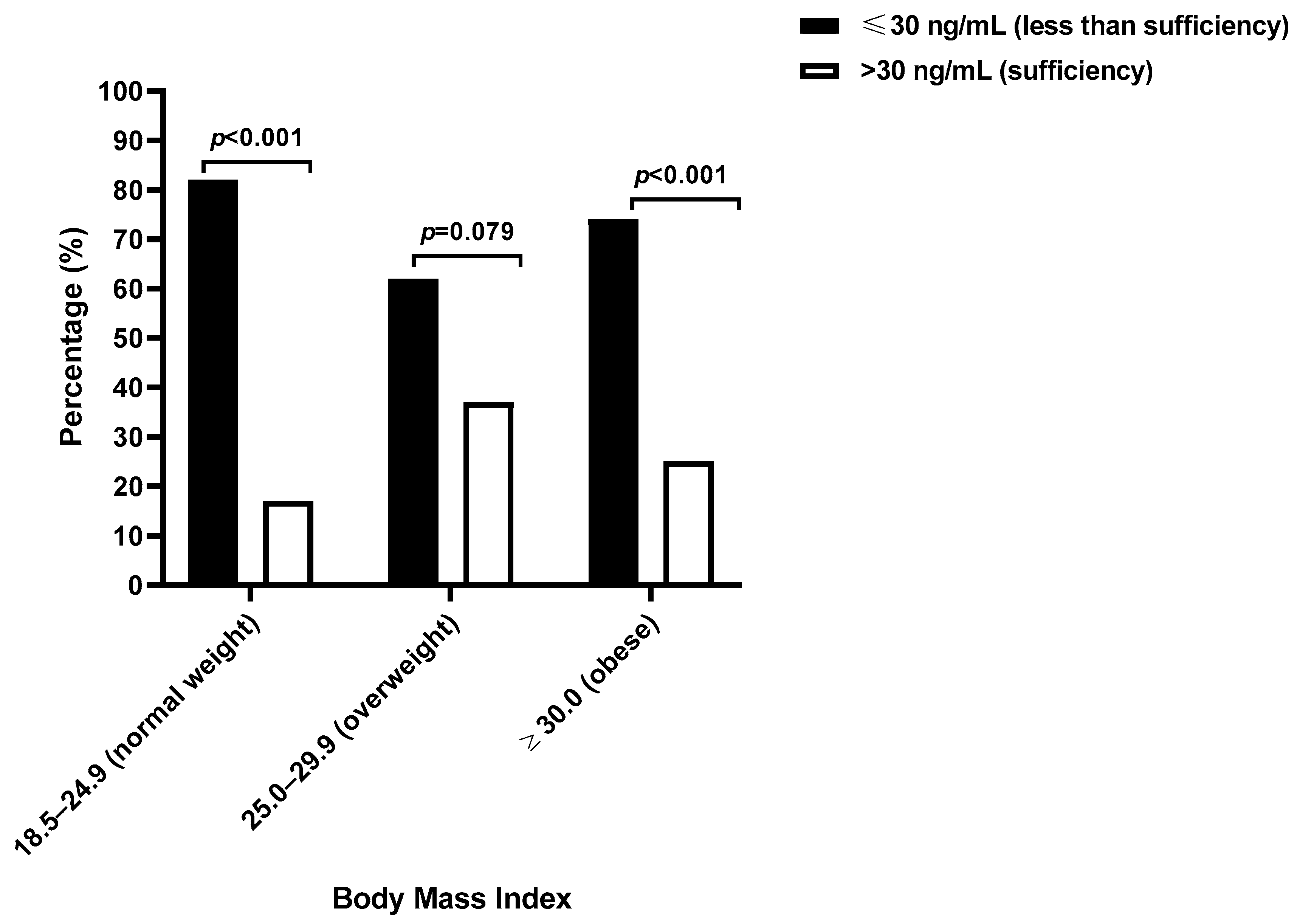
3.4. The Distribution of Vitamin D Levels by BMI Status Among Women with Cervical Lesions
4. Discussion
5. Conclusions
Author Contributions
Funding
Institutional Review Board Statement
Informed Consent Statement
Data Availability Statement
Acknowledgments
Conflicts of Interest
Abbreviations
| HPV | Human papillomavirus |
| HIV | Human immunodeficiency virus |
| LSIL | Low-grade squamous intraepithelial lesion |
| ASC-H | Atypical squamous cells, cannot exclude a high-grade lesion |
| ASC-US | Atypical cells of undermined significance |
| HSIL | High-grade squamous epithelial lesion |
| BMI | Body mass index |
References
- Jeon, S.M.; Shin, E.A. Exploring vitamin D metabolism and function in cancer. Exp. Mol. Med. 2018, 50, 1–14. [Google Scholar] [CrossRef]
- Dallavalasa, S.; Tulimilli, S.V.; Bettada, V.G.; Karnik, M.; Uthaiah, C.A.; Anantharaju, P.G.; Nataraj, S.M.; Ramashetty, R.; Sukoche-va, O.A.; Tse, E.; et al. Vitamin D in cancer prevention and treatment: A review of epidemiological, preclinical, and cellular studies. Cancers 2024, 16, 3211. [Google Scholar] [CrossRef]
- Punchoo, R.; Dreyer, G.; Pillay, T.S. 25-Hydroxycholecalciferol inhibits cell growth and induces apoptosis in SiHa cervical cells via autocrine vitamin D metabolism. Biomedicines 2023, 11, 871. [Google Scholar] [CrossRef]
- Zhou, E.; Bhoora, S.; Pillay, T.S.; Punchoo, R. Induction of cell death and regulation of autocrine vitamin D metabolism in cervical cancer by physiological and GI20 doses of 25-hydroxycholecalciferol. Int. J. Mol. Sci. 2025, 26, 4008. [Google Scholar] [CrossRef]
- Kučan, R.; Soltirovska Šalamon, A.; Andronikov, D.; Benedik, E. Dietary sources of vitamin D, vitamin D supplementation, and its bio-viability. Cent. Eur. J. Paediatr. 2018, 14, 115–122. [Google Scholar] [CrossRef]
- Darling, A.L. Vitamin D deficiency in western dwelling South Asian populations: An unrecognised epidemic. Proc. Nutr. Soc. 2020, 79, 259–271. [Google Scholar] [CrossRef]
- World Health Organization. WHO Antenatal Care Recommendations for a Positive Pregnancy Experience. Nutritional Interventions Update: Multiple Micronutrient Supplements During Pregnancy; World Health Organization: Geneva, Switzerland, 2020. [Google Scholar]
- Benedik, E. Sources of vitamin D for humans. International Journal for Vitamin and Nutrition Research. Sources of vitamin D for humans. Int. J. Vitam. Nutr. Res. 2021, 92, 118–125. [Google Scholar] [CrossRef]
- Wakeman, M. A literature review of the potential impact of medication on vitamin D status. Risk Manag. Healthc. Policy 2021, 14, 3357–3381. [Google Scholar] [CrossRef] [PubMed]
- Gopalkrishnan, K.; Karim, R. Addressing global disparities in cervical cancer burden: A narrative review of emerging strategies. Curr. HIV/AIDS Rep. 2025, 22, 18. [Google Scholar] [CrossRef] [PubMed]
- Denny, L.; Kuhn, L. Cervical cancer prevention and early detection from a South African perspective. S. Afr. Health Rev. 2017, 2017, 189–195. [Google Scholar]
- Bolon, J.; Samson, A.; Irwin, N.; Murray, L.; Mbodi, L.; Stacey, S.; Aikman, N.; Moonsamy, L.; Zamparini, J. An audit of adherence to cervical cancer screening guidelines in a tertiary-level HIV clinic. South. Afr. J. HIV Med. 2023, 24, 1490. [Google Scholar] [CrossRef]
- Porter, V.L.; Marra, M.A. The drivers, mechanisms, and consequences of genome instability in HPV-driven cancers. Cancers 2022, 14, 4623. [Google Scholar] [CrossRef]
- Punchoo, R.; Dreyer, G.; Pillay, T.S. 25-hydroxycholecalciferol serum level shows an inverse relationship with high-grade uterine cervical dysplasia in HIV-uninfected black women in South Africa. J. Clin. Med. 2025, 14, 3817. [Google Scholar] [CrossRef] [PubMed]
- Bowden, S.J.; Doulgeraki, T.; Bouras, E.; Markozannes, G.; Athanasiou, A.; Grout-Smith, H.; Kechagias, K.S.; Ellis, L.B.; Zuber, V.; Chadeau-Hyam, M.; et al. Risk factors for human papillomavirus infection, cervical intraepithelial neoplasia and cervical cancer: An umbrella review and follow-up Mendelian randomisation studies. BMC Med. 2023, 21, 274. [Google Scholar] [CrossRef]
- Holick, M.F.; Binkley, N.C.; Bischoff-Ferrari, H.A.; Gordon, C.M.; Hanley, D.A.; Heaney, R.P.; Murad, M.H.; Weaver, C.M. Evaluation, treatment, and prevention of vitamin D deficiency: An endocrine society clinical practice guideline. J. Clin. Endocrinol. Metab. 2011, 96, 1911–1930. [Google Scholar] [CrossRef]
- Adeniyi, O.V.; Masilela, C.; George, J.A. Prevalence of vitamin D deficiency and its association with cardiometabolic risk factors among healthcare workers in the Eastern Cape province, South Africa; cross-sectional study. Sci. Rep. 2024, 14, 4756. [Google Scholar] [CrossRef]
- Mogire, R.M.; Mutua, A.; Kimita, W.; Kamau, A.; Bejon, P.; Pettifor, J.M.; Adeyemo, A.; Williams, T.N.; Atkinson, S.H. Prevalence of vitamin D deficiency in Africa: A systematic review and meta-analysis. Lancet Glob. Health 2020, 8, 134–142. [Google Scholar] [CrossRef]
- Holick, M.F. The vitamin D deficiency pandemic: Approaches for diagnosis, treatment and prevention. Rev. Endocr. Metab. Disord. 2017, 18, 153–165. [Google Scholar] [CrossRef] [PubMed]
- Ginter, J.K.; Krithika, S.; Gozdzik, A.; Hanwell, H.; Whiting, S.; Parra, E.J. Vitamin D status of older adults of diverse ancestry living in the greater Toronto area. BMC Geriatr. 2013, 13, 66. [Google Scholar] [CrossRef] [PubMed][Green Version]
- Brouwer-Brolsma, E.M.; Vaes, A.M.; van der Zwaluw, N.L.; van Wijngaarden, J.P.; Swart, K.M.; Ham, A.C.; van Dijk, S.C.; Enne-man, A.W.; Sohl, E.; van Schoor, N.M.; et al. Relative importance of summer sun exposure, vitamin D intake, and genes to vitamin D status in Dutch older adults: The B-PROOF study. J. Steroid Biochem. Mol. Biol. 2016, 164, 168–176. [Google Scholar] [CrossRef]
- Carrillo-Vega, M.F.; García-Peña, C.; Gutiérrez-Robledo, L.M.; Pérez-Zepeda, M.U. Vitamin D deficiency in older adults and its associated factors: A cross-sectional analysis of the Mexican health and aging study. Arch. Osteoporos. 2017, 12, 8. [Google Scholar] [CrossRef] [PubMed]
- Giustina, A.; Bouillon, R.; Dawson-Hughes, B.; Ebeling, P.R.; Lazaretti-Castro, M.; Lips, P.; Marcocci, C.; Bilezikian, J.P. Vitamin D in the older population: A consensus statement. Endocrine 2023, 79, 31–44. [Google Scholar] [CrossRef] [PubMed]
- Lips, P.; de Jongh, R.T.; van Schoor, N.M. Trends in vitamin D status around the world. J. Bone Miner. Res. Plus 2021, 5, e10585. [Google Scholar] [CrossRef]
- Hovsepian, S.; Amini, M.; Aminorroaya, A.; Amini, P.; Iraj, B. Prevalence of vitamin D deficiency among adult population of Isfahan City, Iran. J. Health Popul. Nutr. 2011, 29, 149. [Google Scholar] [CrossRef]
- Zhou, Y.; Qin, S.; Zhu, Y.; Xu, P.; Gu, K. Inverse association between isoflavones and prediabetes risk: Evidence from NHANES 2007–2010 and 2017–2018. Front. Nutr. 2023, 10, 1288416. [Google Scholar] [CrossRef]
- Mehta, S.; Giovannucci, E.; Mugusi, F.M.; Spiegelman, D.; Aboud, S.; Hertzmark, E.; Msamanga, G.I.; Hunter, D.; Fawzi, W.W. Vitamin D status of HIV-infected women and its association with HIV disease progression, anemia, and mortality. PLoS ONE 2010, 5, e8770. [Google Scholar] [CrossRef]
- Botros, D.; Somarriba, G.; Neri, D.; Miller, T.L. Interventions to address chronic disease and HIV: Strategies to promote exercise and nutrition among HIV-infected individuals. Curr. HIV/AIDS Rep. 2012, 9, 351–363. [Google Scholar] [CrossRef]
- Jiménez, M.A.; Martínez, I.; Medrano, L.M.; Fernández, A.; Resino, S. Vitamin D in human immunodeficiency virus infection: Influence on immunity and disease. Front. Immunol. 2018, 9, 458. [Google Scholar] [CrossRef]
- Mansueto, P.; Seidita, A.; Vitale, G.; Gangemi, S.; Iaria, C.; Cascio, A. Vitamin D deficiency in HIV infection: Not only a bone disorder. BioMed Res. Int. 2015, 2015, 735615. [Google Scholar] [CrossRef]
- Yin, M.; Stein, E. The effect of antiretrovirals on vitamin D. Clin. Infect. Dis. 2011, 52, 406–408. [Google Scholar] [CrossRef] [PubMed]
- Mwango, S.; Carboo, J.; Ellis, C.; Cockeran, M.; Mels, C.M.; Kruger, H.S. The association between serum vitamin D and body composition in South African HIV-infected women. South. Afr. J. HIV Med. 2021, 22, a1284. [Google Scholar] [CrossRef]
- Troja, C.; Hoofnagle, A.N.; Szpiro, A.; Stern, J.E.; Lin, J.; Winer, R.L. Serum concentrations of emerging vitamin D biomarkers and detection of prevalent high-risk HPV infection in mid-adult women. Cancer Epidemiol. Biomark. Prev. 2020, 29, 1468–1474. [Google Scholar] [CrossRef] [PubMed]
- Troja, C.; Hoofnagle, A.N.; Szpiro, A.; Stern, J.E.; Lin, J.; Winer, R.L. Understanding the role of emerging vitamin D biomarkers on short-term persistence of high-risk human papillomavirus infection among mid-adult women. J. Infect. Dis. 2021, 224, 123–132. [Google Scholar] [CrossRef] [PubMed]
- Özgü, E.; Yılmaz, N.; Başer, E.; Güngör, T.; Erkaya, S.; İbrahim Yakut, H. Could 25-OH vitamin D deficiency be a reason for HPV infection persistence in cervical premalignant lesions? J. Exp. Ther. Oncol. 2016, 11, 177–180. [Google Scholar]
- Avila, E.; Noriega-Mejía, B.J.; González-Macías, J.; Cortes-Hernández, U.; García-Quiroz, J.; García-Becerra, R.; Díaz, L. The preventive role of the vitamin D endocrine system in cervical cancer. Int. J. Mol. Sci. 2023, 24, 8665. [Google Scholar] [CrossRef] [PubMed]
- Khalili, S.M.; Rafiei, E.H.; Havaei, M.; Alizadeh, L.; Ghahremani, F.; Keshavarz, Z.; Montazeri, A.; Riazi, H. Relationship between human papillomavirus and serum vitamin D levels: A systematic review. BMC Infect. Dis. 2024, 24, 80. [Google Scholar] [CrossRef]
- Căpraru, A.M.; Ardelean, S.; Zurbău-Anghel, N.; Dărăban, A.M.; Munteanu, M.; Rusu, A.I. Vitamin D as a preventive and therapeutic agent in cervical cancer: Insights from clinical studies. J. Exp. Pharmacol. Toxicol. 2025, 2, 4–6. [Google Scholar] [CrossRef]
- Tønnesen, R.; Hovind, P.H.; Jensen, L.T.; Schwarz, P. Determinants of vitamin D status in young adults: Influence of lifestyle, sociodemographic and anthropometric factors. BMC Public Health 2016, 16, 385. [Google Scholar] [CrossRef]
- Yang, L.; Zhao, H.; Liu, K.; Wang, Y.; Liu, Q.; Sun, T.; Chen, S.; Ren, L. Smoking behavior and circulating vitamin D levels in adults: A meta-analysis. Food Sci. Nutr. 2021, 9, 5820–5832. [Google Scholar] [CrossRef]
- Song, S.J.; Zhou, L.; Si, S.; Liu, J.; Zhou, J.; Feng, K.; Wu, J.; Zhang, W. The high prevalence of vitamin D deficiency and its related maternal factors in pregnant women in Beijing. PLoS ONE 2013, 8, e85081. [Google Scholar] [CrossRef]
- Hou, W.; Yan, X.T.; Bai, C.M.; Zhang, X.W.; Hui, L.Y.; Yu, X.W. Decreased serum vitamin D levels in early spontaneous pregnancy loss. Eur. J. Clin. Nutr. 2016, 70, 1004–1008. [Google Scholar] [CrossRef]
- Nimitphong, H.; Holick, M.F. Vitamin D status and sun exposure in Southeast Asia. Dermato-Endocrinology 2013, 5, 34–37. [Google Scholar] [CrossRef]
- Lisowska-Myjak, B.; Skarżyńska, E.; Wróbel, M.; Mańka, G.; Kiecka, M.; Lipa, M.; Warzecha, D.; Spaczyński, R.; Piekarski, P.; Banaszewska, B. Investigation of the changes in concentrations of vitamin D-binding protein and lactoferin in plasma and peritoneal fluid of patients with endometriosis. Int. J. Mol. Sci. 2023, 24, 7828. [Google Scholar] [CrossRef]
- George, J.A.; Norris, S.A.; van Deventer, H.E.; Pettifor, J.M.; Crowther, N.J. Effect of adiposity, season, diet and calcium or vitamin D supplementation on the vitamin D status of healthy urban African and Asian-Indian adults. Br. J. Nutr. 2014, 112, 590–599. [Google Scholar] [CrossRef]
- Norval, M.; Coussens, A.K.; Wilkinson, R.J.; Bornman, L.; Lucas, R.M.; Wright, C.Y. Vitamin D status and its conse-quences for health in South Africa. Int. J. Environ. Res. Public Health 2016, 13, 1019. [Google Scholar] [CrossRef]
- Hanel, A.; Carlberg, C. Skin colour and vitamin D: An update. Exp. Dermatol. 2020, 29, 864–875. [Google Scholar] [CrossRef] [PubMed]
- Black, L.J.; Burrows, S.A.; Jacoby, P.; Oddy, W.H.; Beilin, L.J.; Ping-Delfos, W.C.S.; Marshall, C.E.; Holt, P.G.; Hart, P.H.; Mori, T.A. Vitamin D status and predictors of serum 25-hydroxyvitamin D concentrations in Western Australian adolescents. Br. J. Nutr. 2014, 112, 1154–1162. [Google Scholar] [CrossRef]
- Cabral, M.; Araújo, J.; Lopes, C.; Barros, H.; Guimarães, J.T.; Severo, M.; Ramos, E. Relationship between dietary vitamin D and serum 25-hydroxyvitamin D levels in Portuguese adolescents. Public Health Nutr. 2018, 21, 325–332. [Google Scholar] [CrossRef]
- Cheteni, P.; Khamfula, Y.; Mah, G. Exploring food security and household dietary diversity in the Eastern Cape Province, South Africa. Sustainability 2020, 12, 1851. [Google Scholar] [CrossRef]
- Nxasana, N.; Oladimeji, K.E.; Pulido-Estrada, G.-A.; Apalata, T.R. Prevalence of micronutrient deficiency among people living with HIV in selected rural districts of the Eastern Cape Province of South Africa. Nutrients 2023, 15, 3017. [Google Scholar] [CrossRef] [PubMed]
- Vranić, L.; Mikolašević, I.; Milić, S. Vitamin D deficiency: Consequence or cause of obesity? Medicina 2019, 55, 541. [Google Scholar] [CrossRef]
- Vanlint, S. Vitamin D and obesity. Nutrients 2013, 5, 949–956. [Google Scholar] [CrossRef]
- Pereira-Santos, M.; Costa, P.d.F.; Assis, A.d.; Santos, C.d.S.; Santos, D.d. Obesity and vitamin D deficiency: A systematic review and meta-analysis. Obes. Rev. 2015, 16, 341–349. [Google Scholar] [CrossRef] [PubMed]
- Tsuji, K.; Maeda, T.; Kawane, T.; Matsunuma, A.; Horiuchi, N. Leptin stimulates fibroblast growth factor 23 expression in bone and suppresses renal 1α, 25-dihydroxyvitamin D3 synthesis in leptin-deficient ob/ob Mice. J. Bone Miner. Res. 2010, 25, 1711–1723. [Google Scholar] [CrossRef] [PubMed]
- Mlodawski, J.; Plusajska, J.; Detka, K.; Swiercz, G.; Mlodawska, M. Reproducibility of quantitative cervical strain elastography in nonpregnant patients and the effect of vaginal misoprostol on measured parameters. Sci. Rep. 2025, 15, 16857. [Google Scholar] [CrossRef] [PubMed]



| Variables | n/103 | Percent (%) |
|---|---|---|
| Age (years) | ||
| 18–30 | 6 | 5.83 |
| 31–40 | 17 | 16.50 |
| 41–50 | 37 | 35.92 |
| 51–60 | 18 | 17.48 |
| 61–81 | 25 | 24.27 |
| Marital status | ||
| Single | 55 | 53.40 |
| Married | 40 | 38.83 |
| Widowed | 7 | 6.80 |
| No response | 1 | 0.97 |
| Education level | ||
| Primary (Grade 1–7) | 29 | 28.16 |
| High school (Grade 8–12) | 46 | 44.66 |
| Tertiary | 21 | 20.89 |
| None | 7 | 6.80 |
| Employed | ||
| Yes | 16 | 15.53 |
| No | 87 | 84.47 |
| Monthly income | ||
| None | 4 | 3.88 |
| ZAR < 1000 | 9 | 8.74 |
| ZAR 1000–3999 | 72 | 69.90 |
| ZAR 4000–6999 | 9 | 8.74 |
| ZAR 7000–9999 | 4 | 3.88 |
| ZAR > 10,000 | 3 | 2.91 |
| No response | 2 | 1.94 |
| Smoking | ||
| Yes | 8 | 7.77 |
| No | 94 | 91.26 |
| No response | 1 | 0.97 |
| Drink alcohol | ||
| Yes | 7 | 6.80 |
| No | 88 | 85.44 |
| Past | 7 | 6.80 |
| Sexual debut | ||
| ≤16 years | 38 | 36.89 |
| 17–18 years | 30 | 29.13 |
| ≥19 years | 33 | 32.04 |
| No response | 2 | 1.94 |
| Lifetime sex partners | ||
| 1 | 19 | 18.45 |
| 2 | 23 | 22.33 |
| 3–4 | 33 | 32.04 |
| ≥5 | 25 | 24.27 |
| No response | 3 | 2.91 |
| Have been pregnant | ||
| No | 4 | 3.88 |
| Yes 1 time | 11 | 10.68 |
| Yes 2 times | 14 | 13.59 |
| Yes ≥ 3 times | 73 | 70.87 |
| No response | 1 | 0.97 |
| Vaginal itchiness or discharge history | ||
| Yes | 44 | 42.72 |
| No | 58 | 56.31 |
| No response | 1 | 0.97 |
| Genital ulcer/wart history | ||
| Yes | 7 | 42.72 |
| No | 95 | 56.31 |
| No response | 1 | 0.97 |
| HIV status | ||
| Positive | 69 | 66.99 |
| Negative | 30 | 29.13 |
| Unknown | 4 | 3.88 |
| Cervical cytology/histology status | ||
| HSIL/ASC-H | 61 | 59.22 |
| Cervical cancer | 32 | 31.07 |
| ASCUS/LSIL | 10 | 9.71 |
| Vitamin D levels | ||
| <20 ng/mL | 27 | 26.21 |
| 20–30 ng/mL | 48 | 46.60 |
| >30 ng/mL | 28 | 27.18 |
| Vitamin-D-containing foods | ||
| None | 5 | 4.85 |
| Daily | 20 | 19.42 |
| Weekly | 43 | 41.75 |
| Monthly | 35 | 33.98 |
| Skin complexion | ||
| Dark | 69 | 67.00 |
| Light | 34 | 33.00 |
| Days spent outdoors/week | ||
| Once | 10 | 9.71 |
| 2–3 days | 14 | 13.59 |
| 4–6 days | 15 | 14.56 |
| 7 days | 64 | 62.14 |
| BMI (kg/m2) | ||
| 18.5–24.9 (Normal) | 28 | 27.20 |
| 25.0–29.9 (Overweight) | 32 | 31.10 |
| ≥30.0 (Obese) | 43 | 41.70 |
| Vit D Levels | All Women (N = 103) | HIV-Negative, N = 30 | HIV-Positive N = 69 | PR (95% CI) * | p-Value * |
|---|---|---|---|---|---|
| % (95% CI) n | % (95% CI) n | % (95% CI) n | |||
| <20 ng/mL (deficiency) | 26.21 (18.64–35.49) 27 | 26.67 (13.98–44.65) 8 | 26.09 (17.11–37.58) 18 | 0.98 (0.50–2.03) | >0.999 |
| 20–30 ng/mL (insufficiency) | 46.60 (37.26–56.18) 48 | 36.67 (21.81–54.55) 11 | 52.17 (40.59–63.53) 36 | 1.42 (0.89–2.48) | 0.191 |
| ≤30 ng/mL (deficiency/ insufficiency) | 72.82 (63.48–80.51) 75 | 63.33 (45.45–78.19) 19 | 78.26 (67.07–86.47) 54 | 1.24 (0.95–1.75) | 0.141 |
| >30 ng/mL (sufficiency) | 27.18 (19.49–36.52) 28 | 37.67 (21.81–54.55) 11 | 21.74 (13.53–32.93) 15 | 0.59 (0.32–1.15) | 0.141 |
| p value # | <0.0001 | 0.070 | <0.0001 |
| Variables | N | Vit-D Deficiency n (%) | PR (95% CI) | p-Value |
|---|---|---|---|---|
| Age | ||||
| 18–30 years | 6 | 3 (50.00) | reference | |
| 31–40 years | 17 | 6 (35.30) | 0.71 (0.28–2.16) | 0.643 |
| 41–50 years | 37 | 7 (18.90) | 0.38 (0.15–1.18) | 0.127 |
| 51–60 years | 18 | 3 (16.70) | 0.33 (0.09–1.23) | 0.139 |
| 61–81 years | 25 | 8 (32.00) | 0.64 (0.27–1.19) | 0.638 |
| Marital status | ||||
| Single | 55 | 16 (29.10) | reference | |
| Married | 40 | 7 (17.50) | 0.60 (0.27–1.27) | 0.231 |
| Widowed | 7 | 3 (42.90) | 1.47 (0.51–3.15) | 0.665 |
| Separated/Divorced | 1 | 1 (100.00) | 3.44 (0.69–20.77) | 0.304 |
| Education level | ||||
| No education | 7 | 3 (42.90) | reference | |
| Primary (Grade 1–7) | 29 | 11 (37.90) | 0.89 (0.39–2.60) | >0.999 |
| High school (Grade 8–12) | 46 | 10 (21.70) | 0.51 (0.21–1.54) | 0.343 |
| Tertiary | 21 | 3 (14.30) | 0.33 (0.10–1.26) | 0.144 |
| Employed | ||||
| No | 87 | 21 (24.10) | reference | |
| Yes | 16 | 6 (37.50) | 1.55 (0.71–2.10) | 0.353 |
| Monthly income | ||||
| No income | 4 | 1 (25.00) | 0.45 (0.08–1.75) | 0.559 |
| <ZAR 1000 | 9 | 5 (55.60) | reference | |
| ≥ZAR 1000–3999 | 72 | 17 (23.60) | 0.43 (0.23–0.97) | 0.056 |
| ZAR 4000–6999 | 9 | 3 (33.30) | 0.60 (0.19–1.68) | 0.637 |
| ZAR 7000–9999 | 4 | 1 (25.00) | 0.45 (0.08–1.75) | 0.559 |
| ZAR > 10,000 | 3 | 0 (0.00) | 0.00 (0.00–1.24) | 0.205 |
| No response | 2 | 0 (0.00) | 0.00 (0.00–1.51) | 0.455 |
| Smoking | ||||
| No | 94 | 25 (26.60) | reference | |
| Yes | 8 | 2 (25.60) | 0.94 (0.26–2.45) | >0.999 |
| No response | 1 | 0 (0.00) | 0.00 (0.00–3.25) | >0.999 |
| Drink alcohol | ||||
| No | 88 | 24 (27.30) | reference | |
| Yes | 7 | 2 (28.60) | 1.05 (0.29–2.63) | >0.999 |
| Past | 7 | 1 (14.30) | 0.52 (0.09–2.03) | 0.671 |
| Sexual debut | ||||
| ≤16 years | 38 | 9 (23.70) | reference | |
| 17–18 years | 30 | 10 (34.50) | 1.41 (0.66–2.98) | 0.424 |
| ≥19 years | 33 | 8 (22.90) | 1.02 (0.45–2.29) | >0.999 |
| No response | 2 | 0 (0.00) | 0.00 (0.00–3.35) | >0.999 |
| Lifetime sex partners | ||||
| 1 | 20 | 4 (20.00) | reference | |
| 2 | 23 | 6 (26.10) | 1.30 (0.46–3.87) | 0.728 |
| 3–4 | 34 | 6 (17.60) | 0.88 (0.30–2.68) | >0.999 |
| ≥5 | 25 | 11 (26.20) | 2.20 (0.90–5.91) | 0.119 |
| Have been pregnant | ||||
| No | 4 | 1 (25.00) | reference | |
| Yes 1 time | 11 | 1 (9.10) | 0.36 (0.05–3.19) | 0.476 |
| Yes 2 times | 14 | 6 (42.90) | 1.71 (0.45- 10.01) | >0.999 |
| Yes ≥3 times | 73 | 19 (26.00) | 1.04 (0.33–5.87) | >0.999 |
| Vaginal itchiness and/or discharge history | ||||
| No | 58 | 13 (22.40) | reference | |
| Yes | 44 | 14 (31.80) | 1.42 (0.75–2.68) | 0.366 |
| No response | 1 | 0 (0.00) | 0.00 (0.00–4.19) | >0.999 |
| Genital ulcer/wart history | ||||
| No | 95 | 24 (25.30) | reference | |
| Yes | 7 | 3 (42.90) | 1.70 (0.60–3.44) | 0.378 |
| No response | 1 | 0 (0.00) | 0.00 (0.00–3.44) | >0.999 |
| HIV status | ||||
| Negative | 30 | 8 (26.70) | reference | |
| Positive | 69 | 18 (26.10) | 0.98 (0.50–2.03) | >0.999 |
| unknown | 4 | 1 (25.00) | 0.94 (0.16–3.45) | >0.999 |
| Cervical cytology/histology status | ||||
| ASC-US/LSIL | 10 | 2 (20.00) | reference | |
| HSIL/ASC-H | 61 | 16 (26.50) | 1.31 (0.45–4.87) | >0.999 |
| CA Cervix | 32 | 9 (28.10) | 1.41 (0.45–5.40) | >0.999 |
| Skin complexion | ||||
| Light | 34 | 6 (17.60) | reference | |
| Dark | 69 | 21 (30.40) | 1.73 (0.81–3.91) | 0.234 |
| Vitamin-D-containing food | ||||
| None | 5 | 0 (0.00) | 0.00 (0.00–1.70) | 0.289 |
| Daily | 20 | 6 (30.00) | reference | |
| Weekly | 43 | 14 (32.60) | 1.09 (0.52–2.47) | >0.999 |
| monthly | 35 | 7 (20.20) | 0.67 (0.27–1.69) | 0.513 |
| Days spent outdoors per week | ||||
| Once | 10 | 3 (30.00) | reference | |
| 2–3 days | 14 | 5 (35.70) | 1.19 (0.40–3.90) | >0.999 |
| 4–6 days | 15 | 5 (33.50) | 1.11 (0.37–3.64) | >0999 |
| 7 days | 64 | 14 (21.90) | 0.73 (0.30–2.19) | 0.687 |
| BMI (kg/m2) | ||||
| 18.5–24.9 (Normal) | 28 | 13 (46.40) | reference | |
| 25.0–29.9 (Overweight) | 32 | 7 (21.90) | 0.47 (0.22–0.98) | 0.058 |
| ≥30.0 (Obese) | 43 | 7 (16.30) | 0.35 (0.16–0.75) | 0.008 |
Disclaimer/Publisher’s Note: The statements, opinions and data contained in all publications are solely those of the individual author(s) and contributor(s) and not of MDPI and/or the editor(s). MDPI and/or the editor(s) disclaim responsibility for any injury to people or property resulting from any ideas, methods, instructions or products referred to in the content. |
© 2026 by the authors. Licensee MDPI, Basel, Switzerland. This article is an open access article distributed under the terms and conditions of the Creative Commons Attribution (CC BY) license.
Share and Cite
Simelane, Z.; Masika, L.S.; Businge, C.B.; Mbulawa, Z.Z.A. Vitamin D Serum Status and Associated Factors Among Women with Cervical Lesions. Epidemiologia 2026, 7, 40. https://doi.org/10.3390/epidemiologia7020040
Simelane Z, Masika LS, Businge CB, Mbulawa ZZA. Vitamin D Serum Status and Associated Factors Among Women with Cervical Lesions. Epidemiologia. 2026; 7(2):40. https://doi.org/10.3390/epidemiologia7020040
Chicago/Turabian StyleSimelane, Zinhle, Likhona S. Masika, Charles B. Businge, and Zizipho Z. A. Mbulawa. 2026. "Vitamin D Serum Status and Associated Factors Among Women with Cervical Lesions" Epidemiologia 7, no. 2: 40. https://doi.org/10.3390/epidemiologia7020040
APA StyleSimelane, Z., Masika, L. S., Businge, C. B., & Mbulawa, Z. Z. A. (2026). Vitamin D Serum Status and Associated Factors Among Women with Cervical Lesions. Epidemiologia, 7(2), 40. https://doi.org/10.3390/epidemiologia7020040