
Article

Multi-Objective Optimization of Rigid Pavement Concrete Using Industrial By-Products and Polypropylene Fibers


by
Sergii Kroviakov
1,
Vitalii Kryzhanovskyi
2,*,
Pavlo Shymchenko
1 and
Inna Aksyonova
3
1
Department of Highways and Airfields, Odessa State Academy of Civil Engineering and Architecture, Didrihsona Street 4, 65029 Odessa, Ukraine
2
Department of Building Materials, TU Dortmund, 44227 Dortmund, Germany
3
Department of Chemistry and Ecology, Odessa State Academy of Civil Engineering and Architecture, Didrihsona Street 4, 65029 Odessa, Ukraine
*
Author to whom correspondence should be addressed.
Modelling 2026, 7(2), 52; https://doi.org/10.3390/modelling7020052
Submission received: 4 February 2026 / Revised: 4 March 2026 / Accepted: 6 March 2026 / Published: 9 March 2026

Abstract

This study investigates the properties of concrete incorporating recycled aggregates (RAs) for rigid pavement applications. A 15-point three-level experimental design was used to vary three composition factors: Portland cement substitution with fly ash (FA), and dosages of a superplasticizer (SP) and polypropylene fibers (PFs). A set of experimental–statistical models (ES models) was developed to predict the concrete strength, abrasion and frost resistance (FR), water absorption (WA), and global warming potential (GWP). This study aimed to develop a material that achieves both adequate mechanical performance for pavement applications and enhanced environmental sustainability by incorporating RAs and FA. The results demonstrate that replacing up to 13% of cement with FA does not compromise the splitting tensile strength or FR. For non-fibrous concrete, this substitution increases FR by approximately 50 freeze–thaw cycles. Application of PFs (2.4–3 kg/m3) enhances splitting tensile strength by 14–16% and improves FR by about 50 cycles. Using response surface methodology (RSM), optimal concrete compositions were identified that meet all target criteria: compressive strength ≥ 40 MPa, flexural strength ≥ 5 MPa, FR ≥ F200 (cycles), and abrasion resistance (AR) ≤ 0.5 g/cm2, while simultaneously minimizing GWP. An additional optimum composition was determined by imposing a constraint on splitting tensile strength of ≥4.5 MPa. This graphical optimization approach, utilizing two-factor interaction diagrams, provides an effective and visual methodology for practical concrete mixture design. The novelty of the method lies in the discretization of the factor space, which enables efficient identification of optimal concrete mixture compositions.

1. Introduction

Concrete is the most widely used construction material in the world. The active development of infrastructure projects in most countries drives the significant consumption of concrete, specifically in transportation construction. Consequently, this results in substantial resource expenditure, which has economic and environmental implications.
An effective method to mitigate the environmental impact and promote sustainable development in concrete production is the use of RAs obtained from construction demolition waste and structures [1]. For Ukraine, the repurposing of this waste stream is particularly critical due to the immense scale of destruction caused by hostilities [2,3]. Numerous studies have demonstrated the feasibility of producing concrete with high strength and durability using such secondary aggregates [4,5,6].
Portland cement is the most energy-intensive component of concrete mixtures. Furthermore, the cement industry is a major contributor to CO2 emissions, and reducing these emissions constitutes a key strategic goal for sustainable development. Therefore, the use of industrial by-products capable of replacing a portion of cement is a highly viable strategy. One of the well-established and effective methods for resource conservation and carbon footprint reduction is partial cement replacement with FA [7,8]. In particular, numerous studies have confirmed the effectiveness FA in concrete for rigid pavement construction [9,10,11,12]. The influence of FA on concrete properties stems primarily from its pozzolanic activity and its role as a micro-filler in the composite matrix [10,13].
Given the demanding operational loading conditions of transportation structures, particularly rigid pavements, dispersed reinforcement is rationally employed to enhance the concrete’s performance [14,15]. The incorporation of fibers is particularly effective in concrete with RAs, as it mitigates their inherent drawbacks. Fibers enhance crack resistance, improve toughness, and reduce brittle fracture, thereby compensating for the potentially higher porosity and weaker interfacial transition zone associated with RAs [16,17,18]. Furthermore, the synergy between fiber reinforcement and RAs can further enhance concrete durability, particularly its FR. Fibers form a three-dimensional reinforcing skeleton that effectively bridges and arrests microcracks initiated by the internal pressure resulting from the expansion of freezing water, preventing their coalescence and propagation [19,20].
The practical integration of waste materials into concrete mixtures presents a multi-criteria optimization challenge: achieving significant resource conservation and reduced environmental footprint without compromising the requisite structural-grade properties. This challenge calls for an approach based on experimental design and statistical modeling to rationally derive composition designs that balance these competing objectives [21,22,23]. Consequently, the optimization process must be considered not only for target performance metrics but also for the specific material properties of all constituent inputs.
A universal and effective approach to the multi-criteria optimization of concrete as a composite material is the use of a system of experimental–statistical (ES) models. This system describes the influence of composition or technological factors varied in a designed experiment. Each ES model quantifies the effect of these factors on a specific physical, mechanical, or structural property. This unified framework, where all ES models are derived from a coherent experimental dataset, allows for the direct trade-off analysis and multivariate optimization of competing properties, as all predictions are consistent within the defined factor space [22,23].
The selection of optimal solutions considering multiple criteria based on a system of ES models is predominantly implemented using the RSM [24]. For instance, a system of three-factor models was utilized by [25] to select an optimal concrete composition incorporating secondary by-products. In [26], a five-factor experiment was conducted, and a corresponding system of models was developed to assess the load-bearing capacity of a concrete structure and chose the preferable engineering solution. The actual procedure for analyzing and selecting solutions is primarily carried out via graphical methods [5,22,23] or the Monte Carlo method [27,28]. For example, in [29], the Monte Carlo method was implemented using iterative random scanning of the factor space. This approach enabled the identification of optimal and compromised outcomes based on the results of a nine-factor designed experiment.
The Monte Carlo method, despite its precision in decision-making and powerful capability to model interdependencies among a large set of material properties [23,29], demands specific computational skills for effective implementation. Furthermore, its results are less readily interpretable than those derived from graphical RSM analysis, which offers direct visual guidance for selecting optimal parameters (e.g., concrete composition). Therefore, the graphical analysis of the RSM and optimization based on it can be considered more rational and user-friendly for practical engineering applications.
The relevance of this research is driven by the necessity to advance practical methodologies for designing and optimizing concrete mixtures incorporating industrial by-products: RA and FA. The challenge of maximizing the utilization of each waste material must be addressed by evaluating their combined impact on the mechanical properties and durability of concrete, alongside its environmental footprint.
Accordingly, the objective of this study is to determine the optimal compositions of fiber-reinforced concretes based on RA for rigid pavement applications. The aim is to achieve the specified levels of strength, FR, and AR while minimizing the GWP. This minimization is pursued through the synergistic use of FA, PFs, and SP.
To achieve this objective, the following research tasks were formulated:
-
The development of statistically adequate ES models from a designed three-factor experiment to quantify the impact of FA, SP, and PF content;
-
The application of response surfaces to investigate the individual and interactive effects on target strength and durability properties;
-
Graphical determination of optimal concrete compositions within the three-dimensional factor space using superimposed contour plots and graphical optimization techniques;
-
Numerical prediction of the performance characteristics for the selected optimal concrete compositions.

2. Materials and Methods

This study employs a symmetric 15-point D-optimal design [21,23] with three factor levels to investigate key composition parameters for recycled aggregate concrete:
X1—The level of Portland cement substitution with FA, ranging from 0 to 20% by mass. For all mixtures, a constant Portland cement content of 300 kg/m3 served as the baseline. The specific FA dosages at the experimental levels (10% and 20% cement replacement) were set at 70 kg/m3 and 140 kg/m3, respectively. These proportions, corresponding to cement reductions of 30 kg/m3 and 60 kg/m3, were derived from established methodologies [7] and were validated by earlier experimental data.
X2—The dosage of SP was set within the range of 3–4.8 kg/m3. Expressed relative to the 300 kg/m3 cement content in concrete mixtures, this equates to a dosage of 1–1.6% by mass of binder.
X3—PF, with a defined geometry of 36 mm in length and 0.68 mm in diameter, was incorporated at dosages ranging from 0 to 3 kg/m3.
The use of a 15-point, three-level experimental design ensures sufficient accuracy for constructing quadratic ES models. Such designs are widely used in construction materials research [5,7,22,25,29].
The constituent materials for concrete production included Portland cement CEM II/A-S 42.5 R manufactured by VIPCEM (Kyiv, Ukraine), FA (class C) sourced from the Darnytsia Thermal Power Plant (Kyiv, Ukraine), conforming to standard [30], quartz sand with a fineness modulus of 2.3, and RAs of the 5–20 mm fraction, obtained from processed reinforced concrete structures. The RAs had a bulk density of 1185 kg/m3 and a water absorption of 6.21%. All concrete mixtures were designed to achieve a consistent workability class S1 (slump 2–4 cm). This required a systematic adjustment of the water dosage, accompanied by compensatory changes in the aggregate proportions to preserve a constant total volume of the mixture.
A comprehensive characterization of the material properties and a detailed description of the experimental procedures are provided in our previous research [31]. The experimental design matrix and the corresponding concrete mixture proportions are presented in Table 1.
The following technological procedure was employed for the preparation of concrete and fiber-reinforced concrete mixtures based on RA:
-
Pre-wetting of RA to a saturated surface-dry (SSD) state is essential to prevent the absorption of free water from the cement matrix. In this procedure, the pre-wetting water was first added to the RA and mixed for 2 min, followed by a 5 min rest period to allow for complete absorption. Due to the high water absorption of RA (6.21%), the absence of pre-wetting would reduce the effective W/C ratio, compromising workability and mixture design accuracy, while also inducing shrinkage and microcracking from moisture gradients, ultimately impairing concrete strength and durability.
-
Addition of cement, FA, and sand to the pre-conditioned RA, followed by homogenization for 2 min.
-
Introduction of PF in 2–3 portions to prevent agglomeration and ensure uniform distribution, followed by mixing for 1–2 min.
-
Incorporation of mixing water and superplasticizer, with final mixing until a homogeneous mixture is achieved.
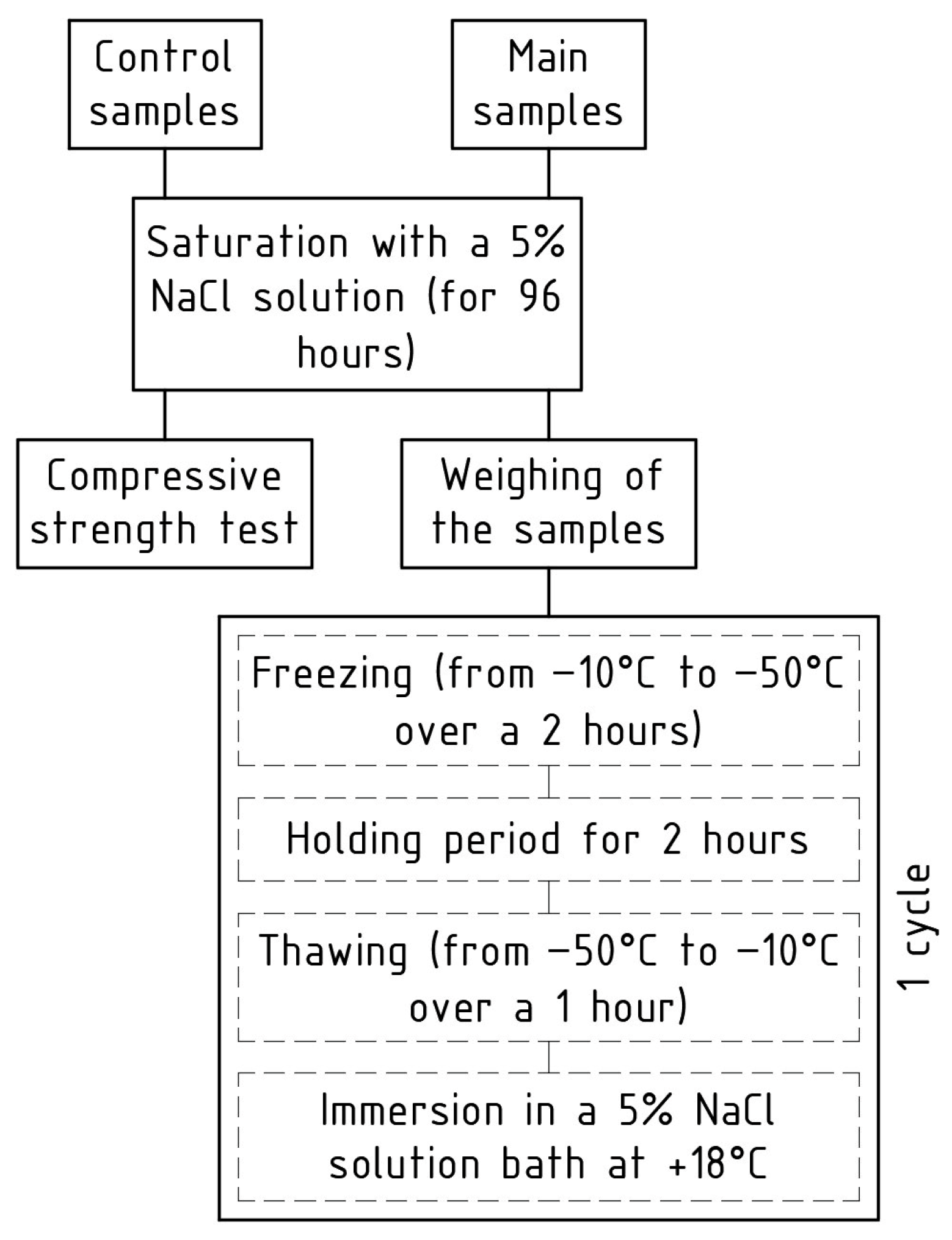
For each investigated concrete composition, the following mechanical properties were determined according to the referenced standards: compressive strength on 10 × 10 × 10 cm cubes [32], flexural strength on 10 × 10 × 40 cm prisms [33], splitting tensile strength on 10 × 10 × 10 cm cubes [34], and AR on 7 × 7 × 7 cm cubes [35]. Three specimens from each batch were tested for each property. FR was assessed using an accelerated method [36] on 10 × 10 × 10 cm cube specimens, employing six control and six main samples. The procedural scheme for this discrete accelerated FR testing methodology is illustrated in Figure 1.
Upon completion of the required number of freeze–thaw cycles, the mass of the test specimens is determined. For road concretes, the mass loss must not exceed 3%. Subsequently, the compressive strength of these specimens is tested. The resulting strength must not deviate from the compressive strength of the control (non-frost-exposed) specimens by more than 5%. Based on these discrete pass/fail criteria, the concrete is assigned a frost resistance grade (e.g., F200), where the number indicates the sustained number of freeze–thaw cycles.
The water absorption (WA) of the investigated concretes and fiber-reinforced concretes was determined using the gravimetric method [37]. Cube specimens (10 × 10 × 10 cm) were oven-dried at 105 °C for 24 h, and their constant mass (m1) was recorded. Subsequently, the specimens were immersed in a water bath for 48 h, after which their saturated surface-dry mass (m2) was measured. WA was calculated according to Equation (1):
W A = m 2 m 1 m 1 × 100 %
Furthermore, using the databases of [38,39] and manufacturers’ data, the GWP within the “cradle-to-gate” (A1–A3) system boundaries was calculated for each concrete mixture per 1 m3 of concrete (kg CO2 eq), following the standards [40,41,42,43]. The emission factors used for the constituent materials were as follows: cement—683 kg CO2 eq./t; FA—13.49 kg CO2 eq./t; RA—3.3 kg CO2 eq./t; sand—2.74 kg CO2 eq./t; SP—514 kg CO2 eq./t; and PF—2370 kg CO2 eq./t. It should be noted that within the applied system boundaries (A1–A3), transportation of raw materials to the production site (module A2) is included in aggregated form according to the datasets used [38,39]. Consequently, explicit transport distances were not modeled, as they are inherently project-specific and can vary substantially depending on regional supply chains. This approach is consistent with common practice in LCA studies of concrete and ensures that the results remain comparable and free from location-specific assumptions. The resulting data on the determined physical–mechanical properties and GWP values for the 15 experimental design points are presented in Table 2.
Based on the data presented in Table 2, a system of adequate ES models was calculated. These models describe the influence of the three varied composition factors on the properties of the investigated concretes. For model development, the natural levels of the variable factors (Xi) were coded into a dimensionless range (xi) from −1 to +1 [22,23]. The ES models are polynomials of the form given in Equation (2):
Y = b0 + b1x1 + b11x12 + b2x2 + b22x22 + b3x3 + b33x32 + b12x1x2 + b13x1x3 + b23x2x3
The calculation of the ES models and their regression analysis were performed considering a two-sided risk level of 0.2, corresponding to a one-sided risk of 0.1 (α = 0.1). This significance level is generally accepted in construction materials science for problems addressed using experimental design and experimental–statistical modeling methods [22,23]. Based on the specified risk level and the experimental error, the significance of the ES model coefficients was tested using the Gaussian precision criterion. Insignificant coefficients (bi) that were statistically indistinguishable from zero were sequentially excluded from the model, i.e., set to zero. After each exclusion of an insignificant coefficient, the ES model was recalculated without that term. This iterative procedure was repeated until all insignificant coefficients were removed. In the resulting polynomials, insignificant coefficients were recorded as zero. Following the sequential elimination of all insignificant coefficients, the ES models containing only significant coefficient estimates were tested for adequacy using Fisher’s F-criterion at the specified risk level, considering the respective degrees of freedom. When the calculated F-value was less than the critical value, the ES model was considered adequate and suitable for further analysis [21,23].

3. Results

Table 3 presents the coefficients of the adequate ES models, calculated from the data in Table 2. All models conform to the functional form defined in Equation (2).

3.1. Influence of Composition Variables on Concrete Performance

A detailed analysis examining the effect of the varied factors on compressive strength, flexural strength, and AR is presented in [31].

3.1.1. Compressive and Flexural Strength and AR

In summary, substituting 8–10% of the cement (24–30 kg/m3) with 56–70 kg/m3 of FA leads to an increase in compressive strength of 0.9–3.1 MPa and improves flexural strength by 0.1–0.15 MPa for both plain and fiber-reinforced concretes. However, a 20% cement replacement (60 kg/m3) with 140 kg/m3 of FA results in a decrease in compressive strength by 5.5–11 MPa and a reduction in flexural strength by 0.1–0.14 MPa. A higher SP dosage enhances concrete strength and simultaneously improves the efficacy of the cement–FA substitution. The influence of the SP content on flexural strength is non-linear, with maximum values of fctk observed at a dosage range of 4–4.4 kg/m3. The incorporation of PF shows a negligible effect on compressive strength, while flexural strength is enhanced by 0.4–0.45 MPa.
The amount of FA and SP has an insignificant influence on the AR of concrete, although a general trend of decreasing AR is observed with increasing SP dosage. The application of PF reduces the AR of concrete with RA by 0.032–0.041 g/cm2, which corresponds to an 8–9% growth.

3.1.2. Splitting Tensile Strength

Splitting tensile strength is a crucial quality indicator for concrete used in rigid pavements. While the fctn value is not explicitly regulated by current standards for road concrete, it is a key parameter governing the structural resistance to crack initiation under dynamic traffic loads and thermal fluctuations [44]. Furthermore, this property is critical for assessing the load-bearing capacity of slab edges, both in the vicinity of expansion joints and at pavement shoulders. This is particularly relevant for slabs on bridge and overpass approaches, where such localized stresses are pronounced.
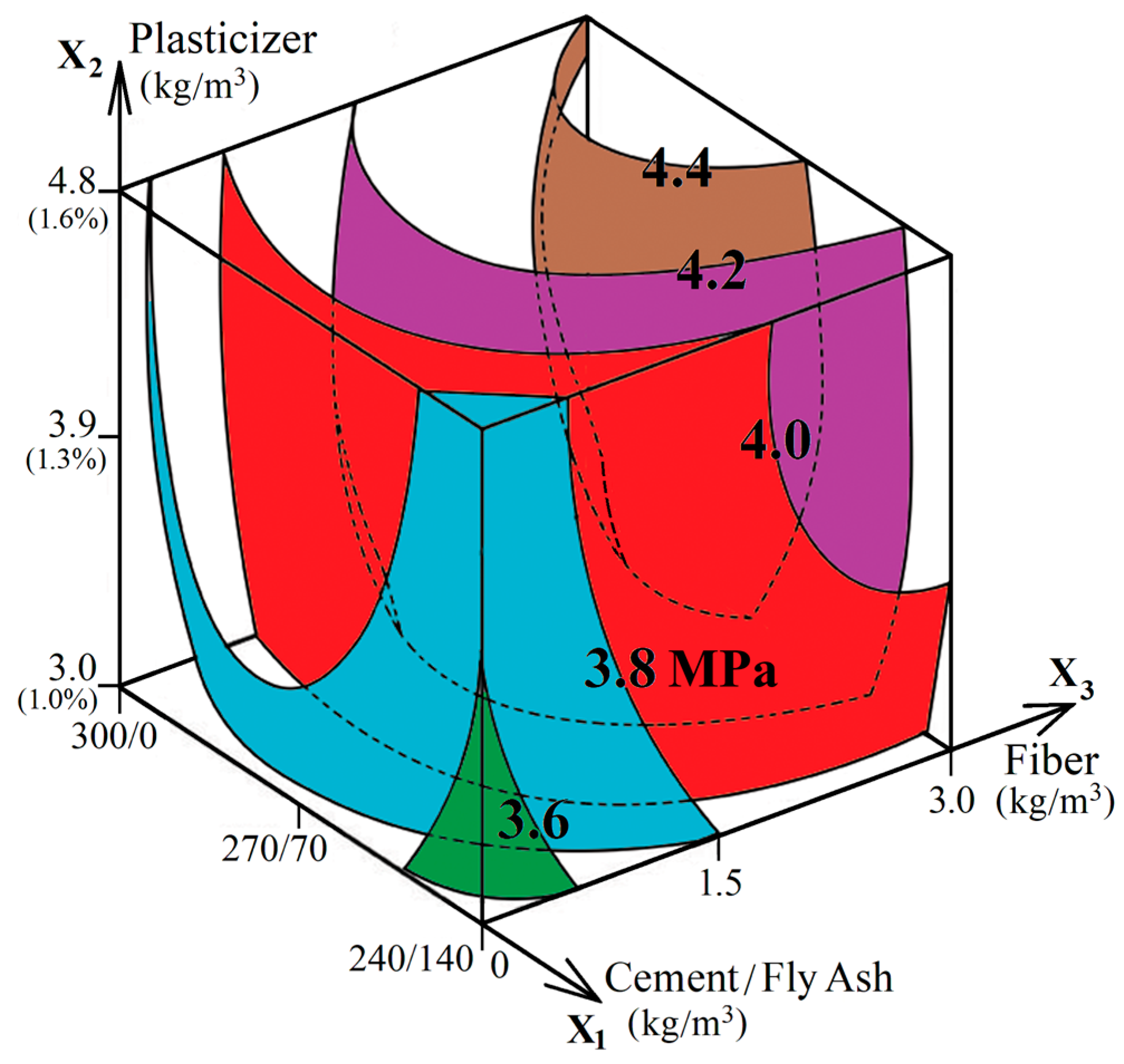
Based on the ES model of the form (2), with coefficients listed in the corresponding row for fctn in Table 3, a three-dimensional “cube” diagram was constructed (Figure 2). This visualization illustrates the simultaneous influence of all three varied factors on the splitting tensile strength of the investigated concrete and fiber-reinforced concretes with RA.
Analysis of the response surface in Figure 2 and the coefficients of the corresponding ES model reveals that incorporating 2.5–3 kg/m3 of PF into the concrete mixture increases its splitting tensile strength by 0.5–0.58 MPa, which corresponds to a 14–16% enhancement. Variation in the SP dosage within the experimental factor space generally has an insignificant effect on the fctn value. However, for plain concretes (without fiber reinforcement), increasing the SP content from 3 to 4.2–4.8 kg/m3 leads to a 5–6% improvement in splitting tensile strength.
The analysis reveals a clear trend: replacing 7–10% of the cement with FA increases splitting tensile strength by approximately 0.1 MPa relative to the control mixture. This property remains comparable to the control at 11–13% replacement. Conversely, a 20% cement replacement with FA leads to a noticeable reduction in splitting tensile strength by 0.2–0.3 MPa, which corresponds to a 6–7% decrease.

3.1.3. Frost Resistance (FR)

The climatic conditions in most European countries, including Ukraine, are characterized by a significant number of freeze–thaw cycles during the autumn–winter period. Consequently, FR is a primary indicator governing the durability of rigid pavements and transportation infrastructure. In Ukraine, for instance, the FR grade of concrete for road pavements must comply with the requirements of standard [45].
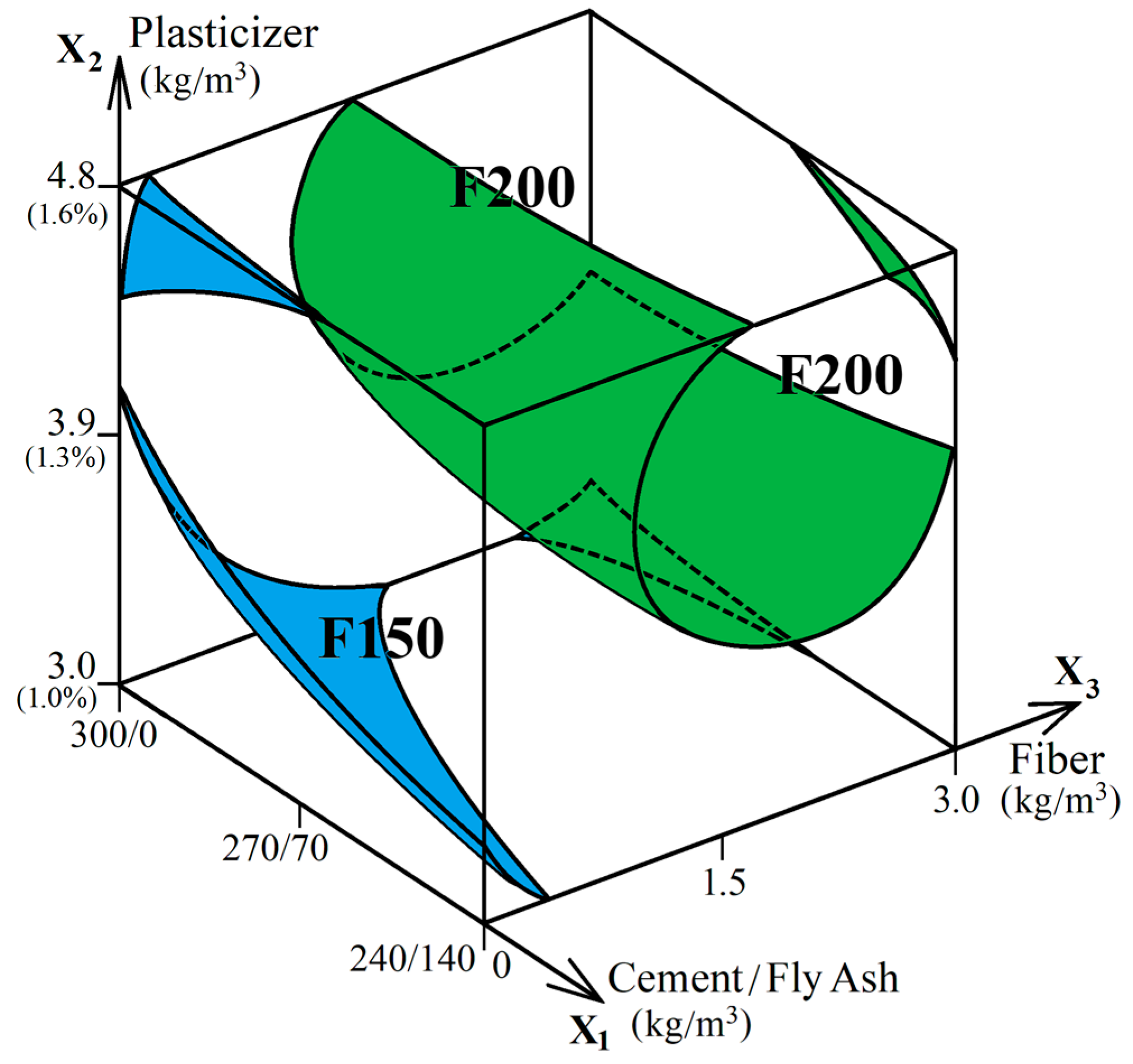
Figure 3 presents the response surface diagram constructed from the corresponding ES model, illustrating the influence of the varied composition factors on the FR of the studied concrete and fiber-reinforced concretes. The model coefficients are listed in the row labeled FR in Table 3. It should be noted that the accuracy of the ES model is inherently constrained by the significant discretization embedded in the standard FR testing methodology. According to [36], the accelerated method for determining the FR grade of road concretes only permits the assignment of discrete grades: F100, F150, F200, F300, F400, F500, F600, F800, and F1000. Consequently, the experimentally determined FR grades for the studied concretes fell within this range, and, in practice, corresponded to one of only three specific values: F100, F150, or F200. However, this limitation did not significantly impede the analysis of the general trends regarding the influence of composition variables on FR. This is evidenced by the deviation between the experimentally determined FR grade for each concrete type across the 15 experimental points and the value predicted by the ES model, which did not exceed 10 cycles. In 13 of the 15 points, this deviation was within seven cycles. Considering the specifics of the FR determination method, the ES model can be deemed adequate for engineering applications.
Analysis of the diagram indicates that with an optimized content of PF (1.6–3 kg/m3) and SP (4–4.8 kg/m3), the partial replacement of cement with FA exerts a negligible influence on the FR of recycled aggregate concrete. The effect of FA dosage on the FR is thus minimal within the precision limits of the standardized test. However, within the lower performance range, specifically for non-fibrous concretes, this partial replacement yields a discernible increase in the FR. This phenomenon can be explained by the modification of the capillary pore structure by FA, an effect that is most pronounced in the absence of PF and with sufficient SP dosage [46]. While it is established that FA can enhance FR [7,47], the implementation of other technological measures, namely PF, enables the concrete to achieve a grade of F200 independently of the FA content (factor X1). Moreover, the discrete nature of the standardized grading scale imposes an upper detection limit. Since the performance of all fiber-reinforced concretes exceeded the criterion for F200 but fell short of F300, they were uniformly assigned as F200 grade.
Within the experimental factor space, increasing the SP content (X2) and incorporating PF (X3) exert a similar positive influence on FR, with each factor contributing an improvement equivalent to approximately 50 freeze–thaw cycles. Their combined effect yields a synergistic improvement of nearly 100 freeze–thaw cycles. Furthermore, the region of the factor space ensuring a FR not lower than F200 is defined by an SP dosage of approximately 4 to 4.6 kg/m3 and a PF content ranging from 1.6 to 2.8 kg/m3.
In general, the concrete and fiber-reinforced concretes with RA investigated in this study demonstrated a satisfactorily high level of FR. This can be attributed to the use of a high-quality RA with a low content of fine particles and dust [31]. Furthermore, the inherent porosity at the surface of the RA contributes to enhanced FR. The structure contains a reserve of closed pores, a feature structurally analogous to that of lightweight aggregate concrete (e.g., expanded clay concrete). The presence of such reserve porosity, with appropriately sized pores, promotes increased resistance to freeze–thaw cycles [48].

3.1.4. Water Absorption (WA)

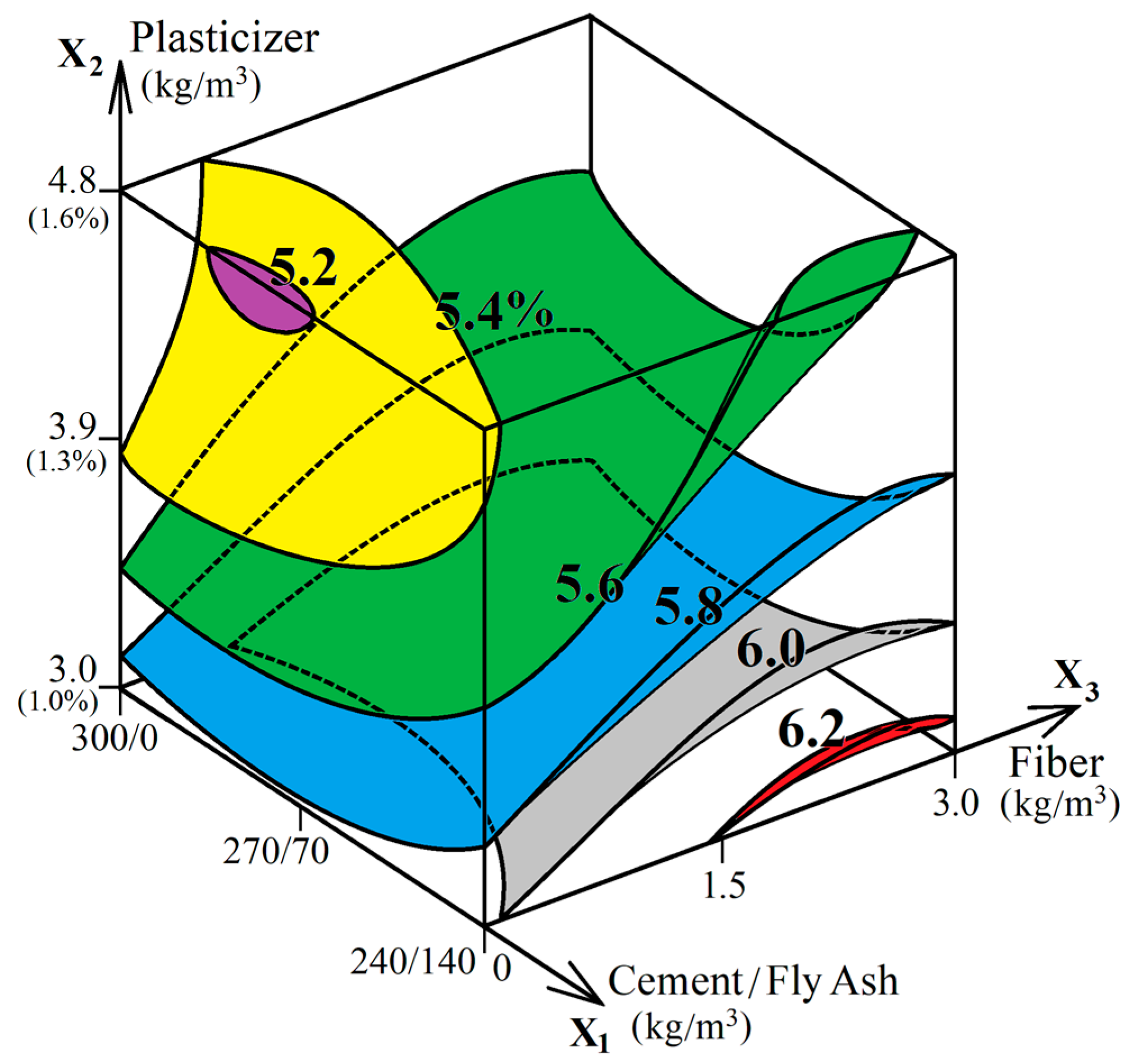
As an indirect measure for evaluating the influence of composition variables on the open porosity of the studied concrete, WA was determined. The resulting response surface, generated from the ES model (coefficients in Table 3), is presented in Figure 4.
Assessment of the diagram in Figure 4 and the corresponding ES model coefficients in Table 3 indicates that the SP content (X2) has the most pronounced influence on WA (open porosity). Increasing factor X2 from 3 to 4.5–4.8 kg/m3 leads to a 0.6% absolute reduction in WA, which corresponds to an approximately 10% decrease compared to the WA level at the lowest SP content. This effect is primarily attributed to the reduced water demand in mixtures of equal workability, as stipulated by the experimental conditions. The application of PF results in a marginal rise in WA, approximately 0.15%. This can be explained by the formation of additional capillaries in the concrete matrix upon PF addition, combined with a slight increase in the water demand in the fresh mixture when PFs are used.
The partial replacement of cement with FA has a negligible effect on the WA of both plain and fiber-reinforced concretes, with only a minor reduction in WA (up to 0.1%) observed at a 7–10% cement replacement level (21–30 kg/m3 replaced by 49–70 kg/m3 of FA). This can be explained by the dual role of FA, which acts simultaneously as a pozzolanic material and a fine filler [7,13].
Thus, the influence of each composition variable differs significantly not only in terms of the resulting concrete properties but also in the associated environmental footprint, as evidenced by earlier findings [31]. Consequently, identifying optimal concrete mixture designs for rigid pavements containing RA and FA becomes a critical task. This selection process must simultaneously satisfy the required performance criteria for physical and mechanical properties while minimizing its environmental impact.

4. Discussion

The effectiveness of PF reinforcement observed in this study is consistent with the findings reported in [49], where the behavior of concrete containing shredded e-waste aggregates reinforced with macro-synthetic fibers (MSFs) was investigated. This result demonstrated that incorporating 0.75% MSFs (by volume) significantly enhanced mechanical performance: splitting tensile strength increased by 152%, flexural strength by 98%, and compressive strength by 38% compared to fiber-free mixes. Notably, while this study focused on concrete with e-waste aggregates, the underlying mechanism—fiber bridging and crack control—is analogous to that observed in our RA-based systems. Furthermore, Ahmad et al. [49] reported an inverse relationship between MSF dosage and permeability-based durability, suggesting that higher fiber content may introduce additional interfacial zones that facilitate water ingress. This aligns with our observation of a marginal increase in water absorption upon PF incorporation (up to 3 kg/m3), attributed to the formation of microcapillaries at the fiber–matrix interface. Scanning electron microscopy in this study revealed that while e-waste aggregates tend to weaken the internal matrix, optimal MSF inclusion improves the microstructure. These complementary findings underscore the importance of optimizing fiber dosage to balance mechanical gains with durability considerations in recycled aggregate systems.
The effectiveness of disperse fiber reinforcement observed in this study aligns with broader trends in the development of advanced concrete composites. While the use of macro-PF (36 mm length) primarily enhances flexural performance and crack control at the structural level, recent research has demonstrated that reinforcement at a much finer scale can yield complementary benefits. For instance, Ahmad et al. [50] reported significant improvements in the compressive (up to 38.5%), flexural (up to 44.3%) and tensile splitting strength (up to 31.6%) of concrete composites incorporating nano-graphite platelets as a multi-functional filler. The enhancement mechanism, however, differs fundamentally: NGPs refine the pore structure and density of the cement matrix at the nanoscale, whereas PFs provide bridging action across macroscopic cracks. In addition to enhancing mechanical strength, nano-graphite platelets significantly improve concrete durability by reducing water absorption (up to 73.9%) and refining the pore structure. This microstructural refinement translates into superior resistance to sulfate attack: after 28 days of exposure to a sodium sulfate solution, NGP-modified specimens exhibited only a 9.22% loss in compressive strength, compared to a 37.43% loss for the control mix. This suggests that future research could explore a hybrid reinforcement strategy, combining macro-fibers for crack control with nano-inclusions for matrix densification and enhanced durability, potentially yielding synergistic improvements in both mechanical performance and long-term service life.

5. Optimization of Concrete Mixture Design for Rigid Pavements

For the concrete composition optimization, the following values of physical and mechanical properties were adopted as constraint criteria:
-
Compressive strength fcm ≥ 40 MPa (class C25/30);
-
Flexural strength fctk ≥ 5 MPa (class Bbtb4.0);
-
FR not lower than F200 (cycles);
-
AR ≤ 0.5 g/cm2 (class G3).
These performance levels were selected in accordance with the requirements of the Ukrainian national standards [45,51] for rigid pavement concrete intended for roads of categories II and III. The construction of such roads, primarily interregional highways, is considered the most viable domain for the mass application of RAs and industrial by-products, given their large scale.
GWP was employed as the primary optimization criteria, being a key indicator of a material’s environmental impact. The use of economic indicators was considered unsuitable for this specific optimization task. This decision is primarily due to the volatile market price of FA in Ukraine, a consequence of significant damage to thermal power plants caused by hostilities. Furthermore, a stable market price for high-quality RA has not yet been established in Ukraine.
A graphical optimization technique was applied to determine the optimal concrete mixture design. This method, highlighted previously for its intuitive visualization, is particularly effective in engineering practice [22,23,27].
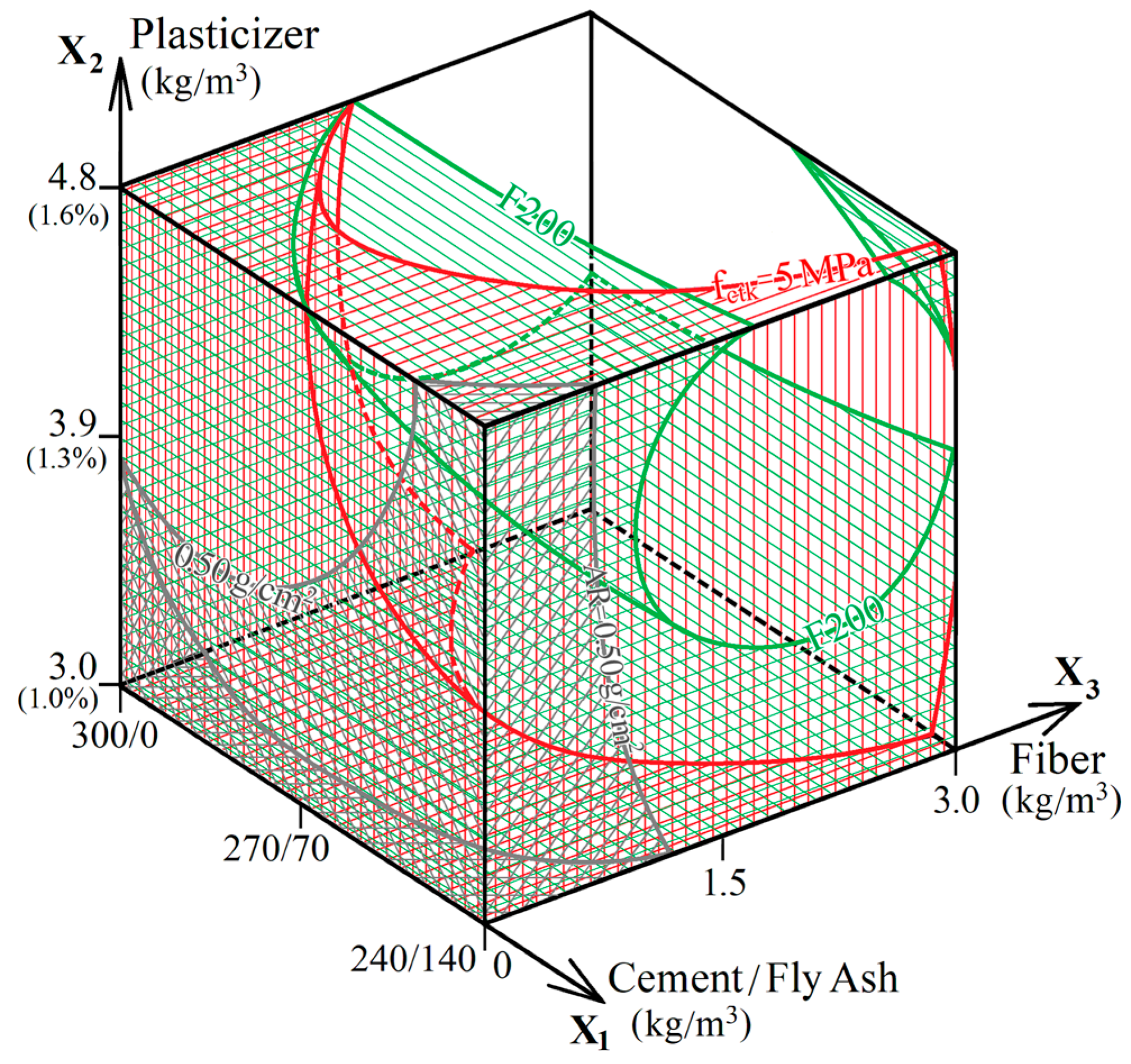
Selecting an optimal solution from a set of three-factor ES models can be facilitated using three-dimensional “cube” diagrams, as illustrated in Figure 2, Figure 3 and Figure 4. This methodology involves overlaying isosurfaces for multiple performance indicators on a single composite diagram. These superimposed isosurfaces visually represent the influence of the factors on the levels of each indicator that serve as constraints or optimization criteria. A key advantage of this analytical approach is its comprehensive coverage of the entire three-dimensional experimental factor space. However, the inherent challenge of projecting this three-dimensional space onto a two-dimensional plane (or screen) complicates the search for solutions and requires specific expertise from the researcher.
An illustrative example is given in Figure 5, which displays a 3D plot of superimposed isosurfaces based on the ES models from Table 3. These isosurfaces correspond to the constraint criteria levels for flexural strength (red), FR (green), and AR (gray). As demonstrated in previous research [31], all investigated concrete and fiber-reinforced concretes within the experimental factor space satisfied the compressive strength constraint (fcm ≥ 40 MPa). Therefore, the corresponding isosurface for compressive strength was omitted from the composite diagram. Regions within the factor space where the concrete mixture designs failed to meet a given constraint criterion are shaded in the color matching the respective isosurface.
Within the non-shaded region of the diagram in Figure 5, the optimal solution should be selected based on the defined optimization criterion, in this case, minimizing the GWP. As noted earlier, a visual selection of the coordinates for the optimal concrete composition in such a scenario, which involves interpreting the simultaneous influence of three factors, is a sufficiently complex task.
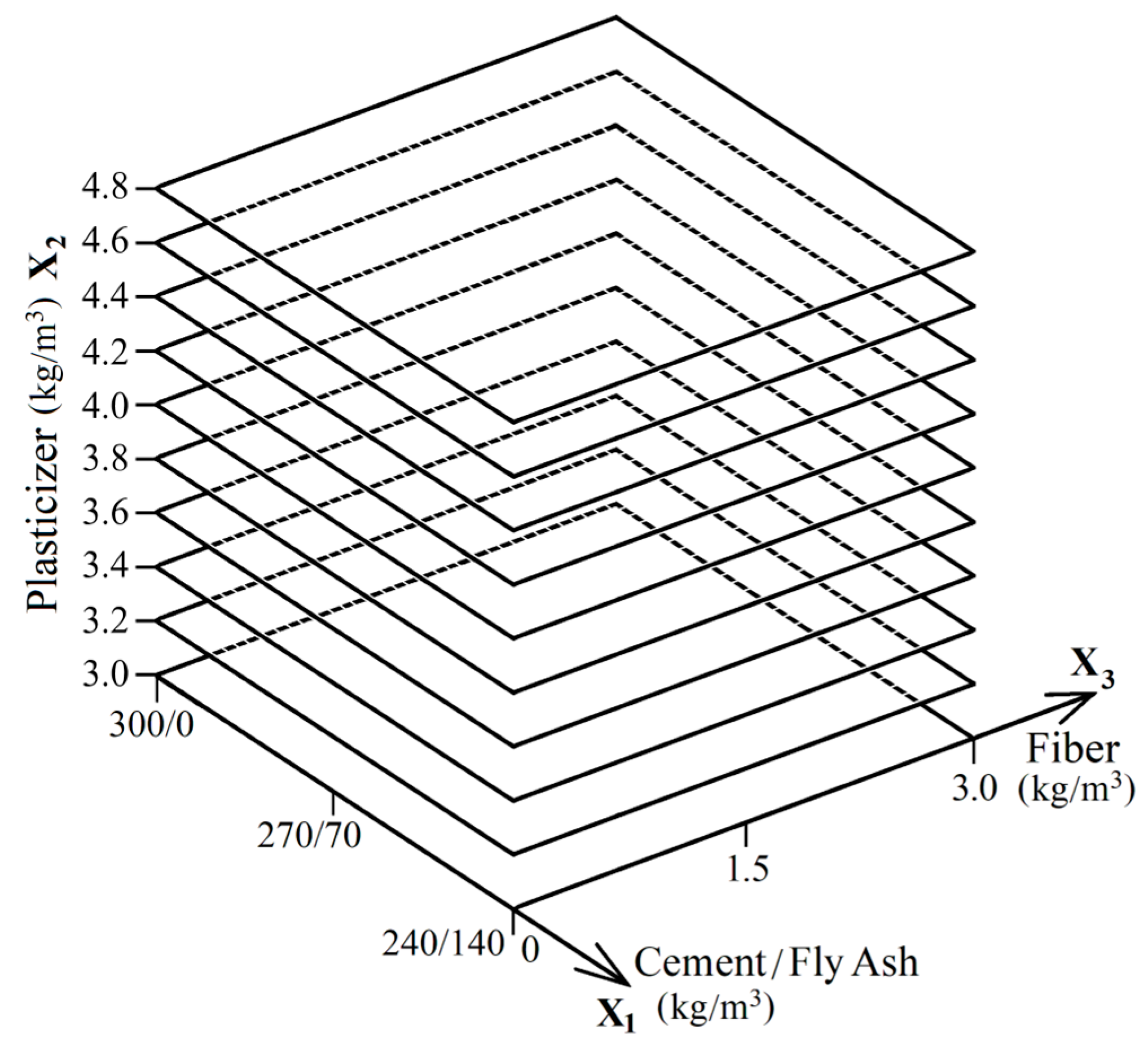
To facilitate a more convenient and transparent justification for selecting the optimal concrete mixture, a methodological approach was employed: the three-dimensional factor space was represented as a set of two-dimensional “square” diagrams. These 2D diagrams were constructed with axes X1 (FA content) and X3 (PF content), thus illustrating the influence of FA and PF dosage. For each individual square plot, the level of factor X2 (SP dosage) was fixed at intervals ranging from −1 to +1 in steps of 0.22(2). In natural units, this corresponds to SP content from 3 to 4.8 kg/m3 in increments of 0.2 kg/m3 (see Figure 6). It should be acknowledged that this discretization has a minor drawback: it does not consider concrete mixtures with intermediate SP dosages that are not multiples of 0.2 kg/m3. However, under actual industrial conditions, such a discretization step of 0.2 kg/m3, approximately 5% of the typical total admixture content in the concrete mixtures, is considered fully acceptable.
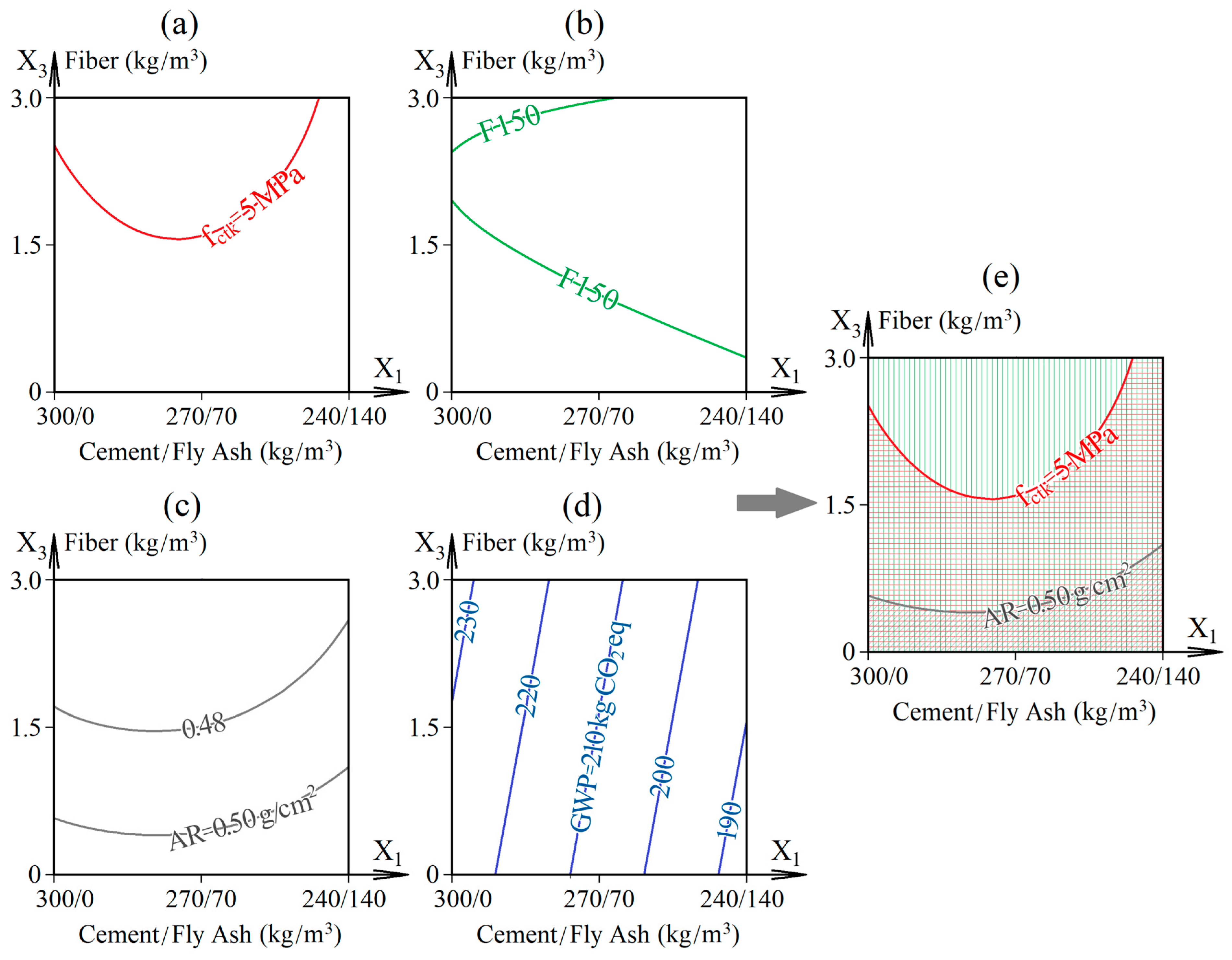
For each of the 10 fixed levels of factor X2, diagrams were constructed to illustrate the influence of factors X1 (the proportion of cement replaced by FA) and X3 (PF content) on flexural strength, FR, AR, and the GWP. The effect on compressive strength was omitted from visualization due to the fact that all concrete compositions satisfied the constraint fcm ≥ 40 MPa. Subsequently, these individual diagrams were superimposed. Regions within the factor space where the concrete compositions failed to meet the established constraint criteria were shaded with the corresponding color. An example of such a composite diagram for the factor level x2 = −1 (SP content of 3 kg/m3) is presented in Figure 7.
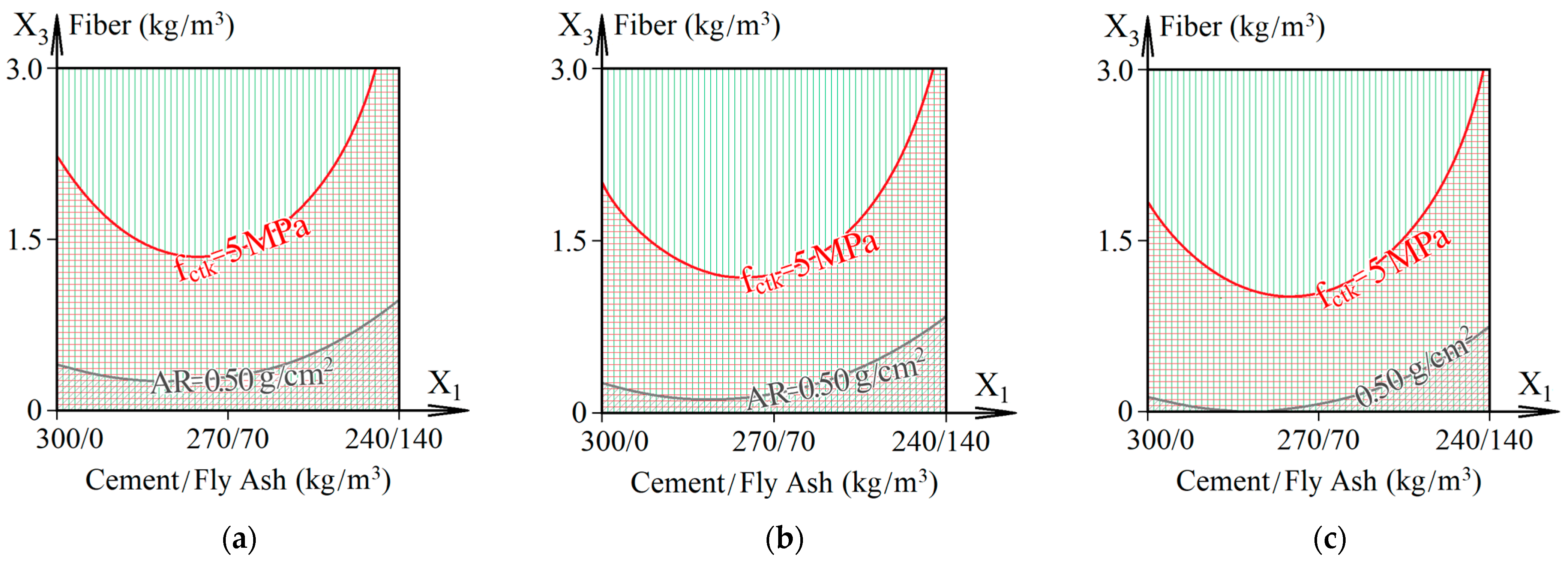
The search for the optimal composition was conducted through a stepwise analysis of the 10 constructed two-factor diagrams. It was established that no concrete mixture satisfying all specified constraint criteria could be designed at SP dosages up to 3.6 kg/m3 (Figure 8). In practice, at low SP content, all concretes exhibit FR below the F200 grade.
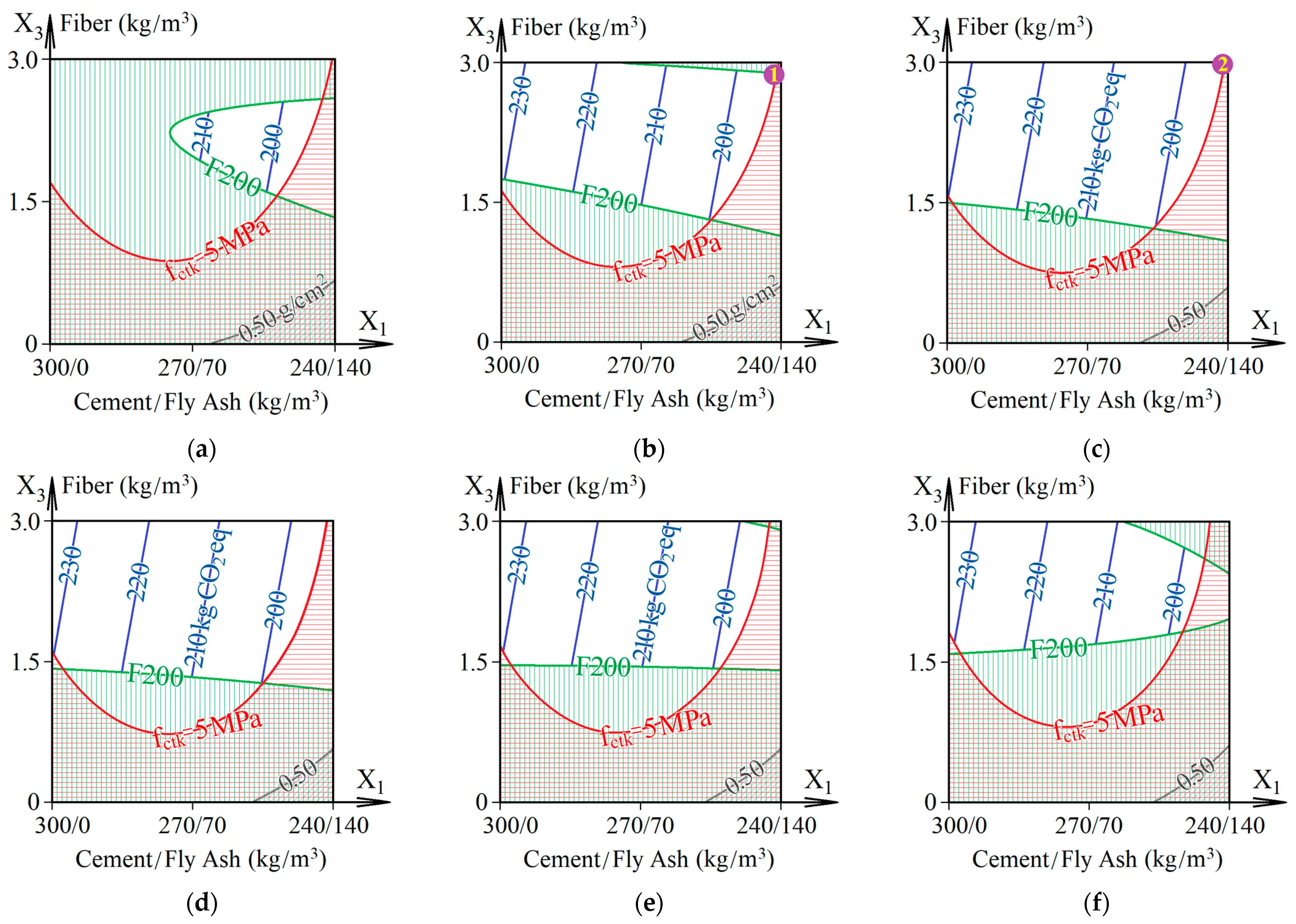
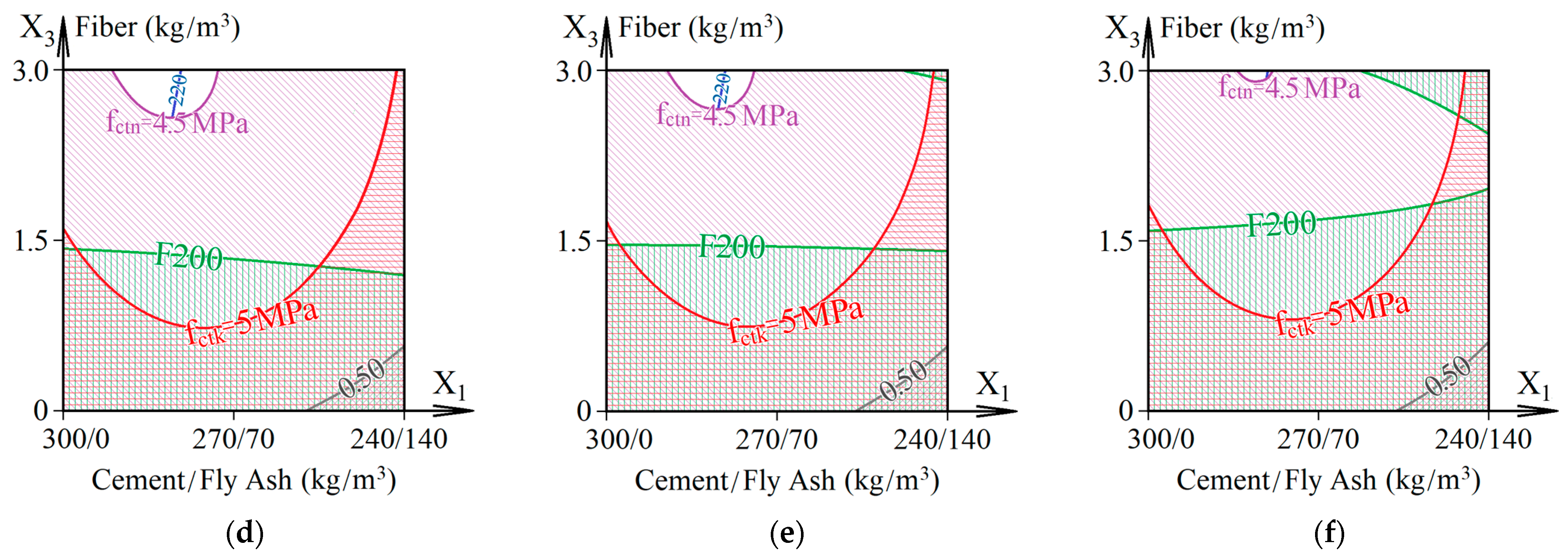
Figure 9 presents the two-factor diagrams used in the subsequent search for the optimal concrete composition. As evident from the figure, at an SP dosage of 3.8 kg/m3 or higher, a feasible region satisfying the entire set of constraint criteria emerges on each diagram (the corresponding unshaded area). Based on the defined optimization criterion, specifically the minimization of the GWP, optimal Composition No. 1 was selected. Its coordinates are indicated on the diagram in Figure 9b by a circle with a corresponding yellow label “1” (SP content = 4 kg/m3).
As an alternative solution, optimal Composition No. 2 was selected. It exhibits physical–mechanical properties quite similar to those of Composition No. 1 and a nearly identical GWP. The coordinates of this concrete mixture are indicated on the diagram in Figure 9c by a circle with a yellow label “2” (SP content = 4.2 kg/m3).
The coordinates of the selected optimal concrete compositions for rigid pavements within the factor space of the three-factor experiment, along with the corresponding mixture proportions and their predicted properties (calculated using the respective ES models), are presented in Table 4. The accuracy of the solutions obtained by the graphical method is confirmed by the fact that the property levels calculated from the ES models (model coefficients are provided in Table 2) correspond to the required constraint criteria. For flexural strength and frost resistance, these values matched the minimum allowable levels of the respective performance indicators. Any deviation from these optimal coordinates would either violate the constraint criteria or increase the GWP.

Optimization of Concrete Composition Based on Splitting Tensile Strength

Furthermore, the composition of rigid pavement concrete was optimized with a specific focus on splitting tensile strength (fctn). This mechanical property is a critical design parameter for ensuring the structural integrity and durability of slab edges, particularly in high-stress zones such as bridge approaches. The optimization was carried out subject to the full set of previously defined constraints (compressive strength fcm ≥ 40 MPa, flexural strength fctk ≥ 5.0 MPa, FR of at least F200, and AR ≤ 0.50 g/cm2), with the added requirement of fctn ≥ 4.5 MPa.
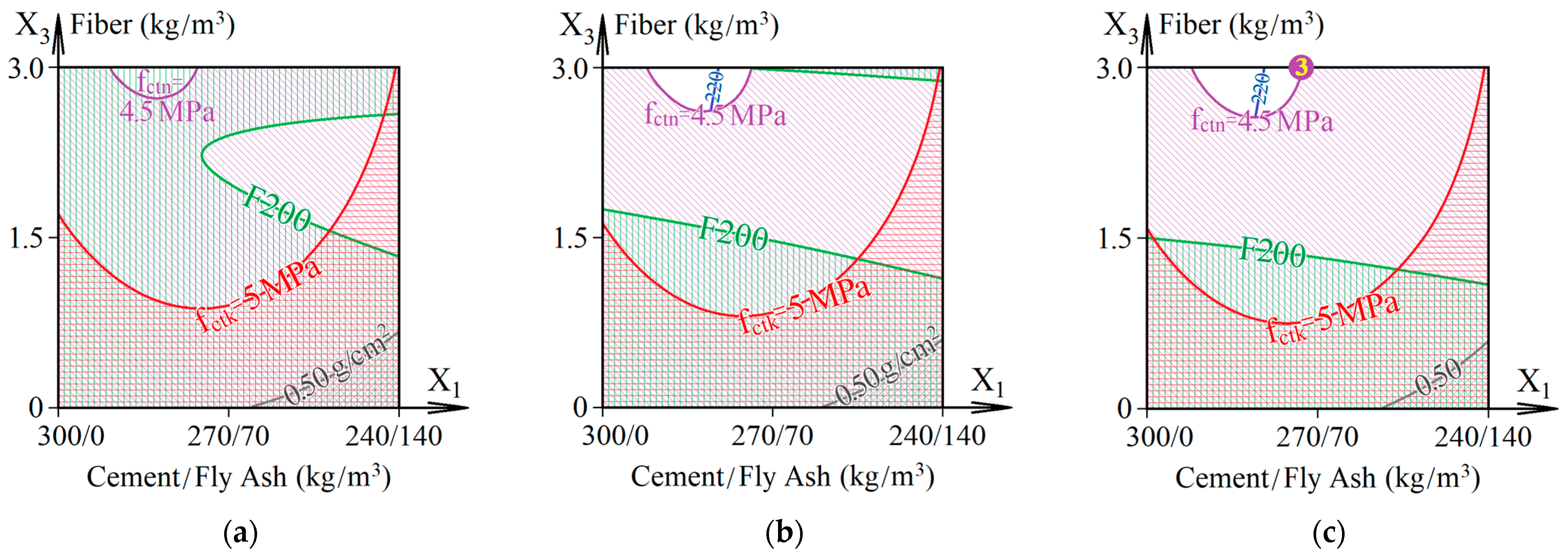
The optimal concrete composition was also determined using a graphical method (Figure 10). Introducing the additional criteria fctn ≥ 4.5 MPa significantly reduced the feasible solution space that satisfied all specified constraints. The location of the optimal composition (No. 3) in Figure 10c is indicated by a yellow circle labeled “3”. The factor space coordinates of this mixture, along with its composition proportions and model-predicted properties, are provided in Table 5.
It should be emphasized that the selected concrete compositions are defined specifically for their application in rigid pavements, using the minimization of GWP (carbon footprint minimization) as the optimality criterion. Altering the constraints or the optimality criterion would result in a different optimal composition.

6. Conclusions

Following the optimal symmetric three-level, three-factor experimental plan, the following findings were obtained:
-
Splitting tensile strength remains unchanged when replacing up to 11–13% of cement (33–36 kg/m3) with 77–84 kg/m3 of fly ash. Moreover, at a 7–10% cement replacement level, the splitting tensile strength is 0.1 MPa higher compared to the reference concrete composition produced with Portland cement only.
-
The effect of partial cement substitution with fly ash on frost resistance is marginal for fiber-reinforced concrete but substantial for plain concrete, improving its frost resistance by roughly 50 cycles.
-
The incorporation of polypropylene fiber reinforcement at a dosage of 2.4–3 kg/m3 enhances the splitting tensile strength of concrete with recycled aggregates by 14–16% and increases its frost resistance by approximately 50 cycles.
-
For optimal strength and frost resistance, the recommended dosage of the superplasticizer is 4–4.6 kg/m3.
A set of adequate experimental–statistical models was employed, along with the graphical analysis of response surfaces, to identify optimal concrete compositions for rigid pavements from the perspective of global warming potential. The optimal mixtures satisfy all specified constraints for strength, frost resistance, and abrasion resistance. An additional optimum was identified when a splitting tensile strength constraint was applied. Thus, the implemented multi-criteria optimization framework provides a robust methodological foundation for designing sustainable rigid pavement concrete, effectively balancing structural requirements with critical environmental objectives.

Author Contributions

Conceptualization, S.K. and V.K.; methodology, S.K.; formal analysis, S.K. and P.S.; investigation, I.A.; resources, V.K. and P.S.; data curation, P.S. and I.A.; writing—original draft preparation, S.K.; writing—review and editing, V.K., I.A. and P.S.; visualization, S.K. and I.A.; supervision, S.K. and V.K.; project administration, S.K. and P.S.; funding acquisition, V.K. All authors have read and agreed to the published version of the manuscript.

Funding

This research received no external funding.

Data Availability Statement

The data supporting this study are available from the author on request.

Conflicts of Interest

The authors declare no conflicts of interest.

References

  1. Peng, Y.; Cai, S.; Huang, Y.; Chen, X.-F. Recycled Aggregates for Sustainable Construction: Strengthening Strategies and Emerging Frontiers. Materials 2025, 18, 3013. [Google Scholar] [CrossRef] [PubMed]
  2. Troian, V.; Gots, V.; Keita, E.; Roussel, N.; Angst, U.; Flatt, R.J. Challenges in Material Recycling for Postwar Reconstruction. RILEM Tech. Lett. 2022, 7, 139–149. [Google Scholar] [CrossRef]
  3. Chystiakov, A.; Kroviakov, S.; Bershadskyi, A.; Medveď, I.; Slaný, M. Sustainable Effect of Using Recycled Aggregates for Road Concrete Production. Smart Innov. Syst. Technol. 2026, 113, 177–188. [Google Scholar] [CrossRef]
  4. Skocek, J.; Ouzia, A.; Vargas Serrano, E.; Pato, N. Recycled Sand and Aggregates for Structural Concrete: Toward the Industrial Production of High-Quality Recycled Materials with Low Water Absorption. Sustainability 2024, 16, 814. [Google Scholar] [CrossRef]
  5. Kryzhanovskyi, V.; Orlowsky, J. Sustainable Alkali-Activated Self Compacting Concrete for Precast Textile-Reinforced Concrete: Experimental–Statistical Modeling Approach. Materials 2024, 17, 6280. [Google Scholar] [CrossRef]
  6. Bhardwaj, A.; Rankavat, S. Treatment of Recycled Coarse Aggregate Using Hybrid Technique for Rigid Pavements Incorporating Fly Ash. Lect. Notes Civ. Eng. 2025, 621, 59–74. [Google Scholar] [CrossRef]
  7. Dvorkin, L.; Dvorkin, O.; Ribakov, Y. Construction Materials Based on Industrial Waste Products; Nova Publisher: New York, NY, USA, 2015; Volume 252. [Google Scholar]
  8. Sanytsky, M.A.; Rusyn, B.G.; Kropyvnytskyi, T.S.; Trefler, R.Y. Low-carbon nanomodified rapid-hardening high-performance concretes. Mater. Sci. 2025, 61, 23–27. [Google Scholar] [CrossRef]
  9. Kamplimath, H.; Dave, U. Mechanical Properties and Life Cycle Assessment of Sustainable Concrete Pavement Utilizing High Volume Fly Ash and Manufactured Sand. J. Struct. Des. Constr. Pract. 2026, 31, 04025122. [Google Scholar] [CrossRef]
  10. Mashaan, N.S.; Kibutu, S.; Dassanayake, C.; Ghodrati, A. Sustainable Utilisation of Mining Waste in Road Construction: A Review. J. Exp. Theor. Anal. 2025, 3, 19. [Google Scholar] [CrossRef]
  11. Tahir, M.F.M.; Abdullah, M.M.A.B.; Rahim, S.Z.A.; Mohd Hasan, M.R.; Sandu, A.V.; Vizureanu, P.; Ghazali, C.M.R.; Kadir, A.A. Mechanical and Durability Analysis of Fly Ash Based Geopolymer with Various Compositions for Rigid Pavement Applications. Materials 2022, 15, 3458. [Google Scholar] [CrossRef]
  12. Suryani, F.M.; Rizal, S.; Abdullah, A.; Isya, M. Fly Ash Substitution in Lightweight Concrete for Rigid Pavement Construction on Low-Bearing-Capacity Soil. Sustainability 2023, 15, 15239. [Google Scholar] [CrossRef]
  13. Sanytsky, M.; Kropyvnytska, T.; Ivashchyshyn, H. Sustainable modified pozzolanic supplementary cementitious materials based on natural zeolite, fly ash and silica fume. IOP Conf. Ser. Earth Environ. Sci. 2023, 1254, 012004. [Google Scholar] [CrossRef]
  14. Wang, L.; Zhang, H.; Zhao, B.; Wang, B.; Zhao, Q.; Sun, M. Experimental Investigation on Physical Properties of Concrete Containing Polypropylene Fiber and Water-Borne Epoxy for Pavement. Coatings 2023, 13, 452. [Google Scholar] [CrossRef]
  15. Kos, Z.; Kroviakov, S.; Kryzhanovskyi, V.; Crnoja, A. Influence of Fibres and Hardening Accelerator on Concrete for Rigid Pavements. Mag. Concr. Res. 2023, 75, 865–873. [Google Scholar] [CrossRef]
  16. Chan, R.; Santana, M.A.; Oda, A.M.; Paniguel, R.C.; Vieira, L.B.; Figueiredo, A.D.; Galobardes, I. Analysis of Potential Use of Fibre Reinforced Recycled Aggregate Concrete for Sustainable Pavements. J. Clean. Prod. 2019, 218, 183–191. [Google Scholar] [CrossRef]
  17. Hoy, M.; Ro, B.; Horpibulsuk, S.; Suddeepong, A.; Buritatum, A.; Arulrajah, A.; Yaowarat, T.; Chinkulkijniwat, A.; Horpibulsuk, J. Flexural Fatigue Performance of Hemp Fiber–Reinforced Concrete Using Recycled Concrete Aggregates as a Sustainable Rigid Pavement. J. Mater. Civ. Eng. 2024, 36, 04024378. [Google Scholar] [CrossRef]
  18. Nguyen, T.N.; Le, T.A.; Vo, H.V. The Enhancement of Recycled Aggregate Concrete by Steel Fiber Reinforcement for Rigid Pavement. Lect. Notes Civ. Eng. 2023, 268, 547–554. [Google Scholar] [CrossRef]
  19. Tan, Y.; Long, J.; Xiong, W.; Chen, X.; Zhao, B. Effects of Polypropylene Fibers on the Frost Resistance of Natural Sand Concrete and Machine-Made Sand Concrete. Polymers 2022, 14, 4054. [Google Scholar] [CrossRef]
  20. Yang, X.; Zhang, Z.; Tai, H.-W.; Li, B.; Li, J.; Zhang, W.; Su, T.; Liu, J. Frost Resistance and Life Prediction of Waste Polypropylene Fibre-Reinforced Recycled Aggregate Concrete. Coatings 2025, 15, 1070. [Google Scholar] [CrossRef]
  21. Jeff Wu, C.F.; Hamada, M.S. Experiments: Planning, Analysis, and Optimization, 3rd ed.; Wiley & Sons: Hoboken, NJ, USA, 2021; p. 736. [Google Scholar]
  22. Dvorkin, L.; Dvorkin, O.; Ribakov, Y. Multi-Parametric Concrete Compositions Design; Nova Science Publishers, Inc.: New York, NY, USA, 2013; p. 223. [Google Scholar]
  23. Lyashenko, T.V.; Voznesensky, V.A. Composition-Process Fields Methodology in Computational Building Materials Science; Astroprint: Odessa, Ukraine, 2017; p. 168. [Google Scholar]
  24. Li, Z.; Lum, D.; Gao, X. Optimization of mixture proportions by statistical experimental design using response surface method—A review. J. Build. Eng. 2021, 36, 102101. [Google Scholar] [CrossRef]
  25. Netesa, M.I.; Krasnyuk, A.V.; Netesa, A.M.; Nikiforova, N.A. Optimization of Concrete Compositions with Secondary Industrial Products. Bridges Tunn. Theory Res. Pract. 2021, 19, 51–61. [Google Scholar] [CrossRef]
  26. Kos, Z.; Klymenko, Y.; Karpiuk, I.; Grynyova, I. Bearing Capacity near Support Areas of Continuous Reinforced Concrete Beams and High Grillages. Appl. Sci. 2022, 12, 685. [Google Scholar] [CrossRef]
  27. Lyashenko, T.; Voznesensky, V.; Boko, S.; Shtakelberg, D. Analysis of Concrete Property Fields and Search for the Best Compositions using Monte Carlo Method. In Brittle Matrix Composites 7; Woodhead Publishing: Cambridge, UK, 2003; pp. 351–358. [Google Scholar] [CrossRef]
  28. Moskalova, K.; Lyashenko, T.; Aniskin, A.; Orešković, M. Modelling the Influence of Composition on the Properties of Lightweight Plaster Mortar and Multicriteria Optimisation. Materials 2023, 16, 2846. [Google Scholar] [CrossRef]
  29. Lyashenko, T. Composition-process fields methodology for design of composites structure and properties. In Brittle Matrix Composites 11; Institute of Fundamental Technological Research; Polish Academy of Sciences: Warsaw, Poland, 2015; pp. 289–298. Available online: https://www.researchgate.net/profile/V-Feldgun/publication/283292537_A_new_equation_of_state_for_cementitious_materials_-_a_multiscale_approach/links/565184cc08aefe619b161800/A-new-equation-of-state-for-cementitious-materials-a-multiscale-approach.pdf (accessed on 13 January 2026).
  30. ASTM C 618-22; Standard Specifiation for Coal Fly Ash and Raw or Calcined Natural Pozzolan for Use in Concrete. ASTM International: West Conshohocken, PA, USA, 2022.
  31. Kryzhanovskyi, V.; Kroviakov, S.; Shymchenko, P.; Aksyonova, I. Design of Recycled Aggregate Fiber-Reinforced Concrete for Road and Airfield Applications Using Polypropylene Fibers and Fly Ash. Constr. Mater. 2026, 6, 2. [Google Scholar] [CrossRef]
  32. DIN EN 12390-3:2019; Testing Hardened Concrete. Compressive Strength of Test Specimens. Deutsches Institut für Normung: Berlin, Germany, 2019.
  33. DIN EN 12390-5:2019; Testing Hardened Concrete. Flexural Strength of Test Specimens. Deutsches Institut für Normung: Berlin, Germany, 2019.
  34. DIN EN 12390-6:2024; Testing Hardened Concrete. Tensile Splitting Strength of Test Speciments. Deutsches Institut für Normung: Berlin, Germany, 2024.
  35. DSTU B V.2.7-212:2009; Building Materials. Concrete. Methods for Determining Abrasion Resistance. State Scientific Research Institute of Building Structures (NIISK): Kyiv, Ukraine, 2009. Available online: http://online.budstandart.com/ru/catalog/doc-page?id_doc=25953 (accessed on 14 January 2026).
  36. DSTU B V.2.7-49-96; Building Materials. Concretes. Accelerated Methods of Determining Frost Resistance During Repeated Freezing and Thawing. State Scientific Research Institute of Building Structures (NIISK): Kyiv, Ukraine, 1996. Available online: http://online.budstandart.com/ua/catalog/doc-page?id_doc=4950 (accessed on 14 January 2026).
  37. DSTU B V.2.7-170:2008; Building Materials. Concretes. Methods for Determining Average Density, Humidity, Water Absorption, Porosity and Water Resistance. State Scientific Research Institute of Building Structures (NIISK): Kyiv, Ukraine, 2008. Available online: https://online.budstandart.com/ua/catalog/doc-page?id_doc=24882 (accessed on 14 January 2026).
  38. ÖKOBAUDAT. German National Database for Life Cycle Assessment in the Construction Sector. Federal Ministry for Housing, Urban Development and Building (BMWSB). Available online: https://www.oekobaudat.de (accessed on 14 January 2026).
  39. Umweltbundesamt. The German Environment Agency. Available online: https://www.umweltbundesamt.de (accessed on 14 January 2026).
  40. ISO 14040:2006; Environmental Management-Life Cycle Assessment—Principles and Framework. International Organization for Standardization: Geneva, Switzerland, 2006.
  41. ISO 14044:2006; Environmental Management-Life Cycle Assessment—Requirements and Guidelines. 1st ed. International Organization for Standardization: Geneva, Switzerland, 2006.
  42. DIN EN 15804:2022; Sustainability of Construction Works—Environmental Product Declarations—Core Rules for the Product Category of Construction Products. Deutsches Institut für Normung: Berlin, Germany, 2022.
  43. DIN EN 16757:2023; Sustainability of Construction Works—Environmental Product Declarations—Product Category Rules for Concrete and Concrete Elements. Deutsches Institut für Normung: Berlin, Germany, 2022.
  44. Ndruru, H.; Simanjuntak, R.M.; Tampubolon, S.P. Utilization of Copper Fiber Waste to Increase Compressive Strength and Split Tensile Strength of Rigid Pavement. IOP Conf. Ser. Earth Environ. Sci. 2021, 878, 012052. [Google Scholar] [CrossRef]
  45. DSTU 8858:2019; Road Cement Concrete Mixtures and Road Cement Concrete. Technical specifications. Kharkiv National Automobile and Highway University: Kharkiv, Ukraine, 2019. Available online: https://online.budstandart.com/ua/catalog/doc-page.html?id_doc=82987 (accessed on 17 January 2026).
  46. Volchuk, V.M.; Kotov, M.A.; Plakhtii, Y.G.; Tymoshenko, O.A.; Zinkevych, O.H. Investigation of the influence of the heterogeneous structure of concrete on its strength. Results Mater. 2025, 25, 100659. [Google Scholar] [CrossRef]
  47. Xu, O.; Han, S.; Liu, Y.; Li, C. Experimental investigation surface abrasion resistance and surface frost resistance of concrete pavement incorporating fly ash and slag. Int. J. Pavement Eng. 2021, 22, 1858–1866. [Google Scholar] [CrossRef]
  48. Kroviakov, S.; Volchuk, V.; Zavoloka, M.; Kryzhanovskyi, V. Search for ranking approaches of expanded clay concrete quality criteria. Mater. Sci. Forum 2019, 968, 20–25. [Google Scholar] [CrossRef]
  49. Ahmad, Z.; Qureshi, M.I.; Ahmad, F.; El Ouni, M.H.; Asghar, M.Z.; Ghazouani, N. Effect of macro synthetic fiber (MSF) on the behavior of conventional concrete and the concrete containing e-waste aggregates. Mater. Struct. 2025, 58, 234. [Google Scholar] [CrossRef]
  50. Ahmad, F.; Jamal, A.; Iqbal, M.; Alqurashi, M.; Almoshaogeh, M.; Al Ahmadi, H.M.; Hussein, E.E. Performance Evaluation of Cementitious Composites Incorporating Nano Graphite Platelets as Additive Carbon Material. Materials 2022, 15, 290. [Google Scholar] [CrossRef]
  51. DBN V.2.3-4:2015; Highways. Part I. Design. Part II. Construction. National Institute for Infrastructure Development: Kyiv, Ukraine, 2015. Available online: https://online.budstandart.com/ua/catalog/doc-page.html?id_doc=62131 (accessed on 17 January 2026).
Figure 1. Scheme for determining the FR of modified road concretes.
Modelling 07 00052 g001
Figure 2. Response surface for the splitting tensile strength of concrete and fiber-reinforced concrete with RA.
Modelling 07 00052 g002
Figure 3. Influence of composition variables on the frost resistance of RA-based concretes and fiber-reinforced concretes.
Modelling 07 00052 g003
Figure 4. Response surface of the effect of composition variables on WA in RA-based concretes and fiber-reinforced concretes.
Modelling 07 00052 g004
Figure 5. Visualization of the multi-criteria optimization space: superimposed isosurfaces representing the limits for flexural strength (red), FR (green), and AR (gray).
Modelling 07 00052 g005
Figure 6. Series of two-factor diagrams (X1 and X3) representing slices of the three-factor experimental design at ten fixed SP (X2) dosages (3 to 4.8 kg/m3, step 0.2 kg/m3).
Modelling 07 00052 g006
Figure 7. Influence of partial cement replacement with FA and PF content on: (a) flexural strength, (b) FR, (c) AR, (d) GWP, and (e) the resulting composite diagram incorporating the specified constraint criteria. Factor level: x2 = −1 (SP dosage = 3 kg/m3).
Modelling 07 00052 g007
Figure 8. Search for the optimal composition using two-factor diagrams. Absence of concrete mixture designs satisfying the specified constraint criteria at SP dosages up to 3.6 kg/m3: (a) x2 = −0.7778 (SP = 3.2 kg/m3), (b) x2 = −0.5556 (SP = 3.4 kg/m3), (c) x2 = −0.3333 (SP = 3.6 kg/m3).
Modelling 07 00052 g008
Figure 9. Search for the optimal concrete composition using two-factor diagrams at fixed SP (X2) levels: (a) x2 = −0.1111 (3.8 kg/m3), (b) x2 = 0.1111 (4 kg/m3), (c) x2 = 0.3333 (4.2 kg/m3), (d) x2 = 0.5556 (4.4 kg/m3), (e) x2 = 0.7778 (4.6 kg/m3), (f) x2 = 1 (4.8 kg/m3).
Modelling 07 00052 g009
Figure 10. Optimization of concrete composition with an additional constraint based on splitting tensile strength: (a) x2 = −0.1111, SP dosage = 3.8 kg/m3; (b) x2 = 0.1111, SP dosage = 4 kg/m3; (c) x2 = 0.3333, SP dosage = 4.2 kg/m3; (d) x2 = 0.5556, SP dosage = 4.4 kg/m3; (e) x2 = 0.7778, SP dosage = 4.6 kg/m3; (f) x2 = 1, SP dosage = 4.8 kg/m3.
Modelling 07 00052 g010aModelling 07 00052 g010b
Table 1. Experimental matrix and corresponding mixture proportions for RA concretes.
Point NoFactor LevelsConcrete Composition (kg/m3)
X1, FAX2, SPX3, PFCementFARASandSPPFWater SSDWater
1−1−1−1300010957803058133
2−1−11300010957763358138
3−100300010957813.91.558134
4−11−1300010957894.8058132
5−111300010957874.8358128
60−1027070109075031.557.5138
700−12707010907553.9057.5128
80002707010907533.91.557.5131
90012707010907493.9357.5133
100102707010907574.81.557.5125
111−1−124014010807193057134
121−1124014010807153357140
1310024014010807233.91.557136
1411−124014010807264.8057128
1511124014010807224.8357129
Table 2. Physical–mechanical properties and GWP of the investigated concretes.
Point NoCompressive Strength, fcm Flexural Strength, fctk Splitting Tensile Strength, fctn (MPa)ARFR, (Cycles) WAGWP,
(kg CO2 eq)
Average
(MPa)
CoVAverage
(MPa)
CoVAverage
(MPa)
CoVAverage
(g/cm2)
CoVAverage
(%)
CoV
152.522.44.623.23.612.00.5140.8F1005.821.4225.88
250.942.74.972.84.361.70.4652.6F1506.322.7232.98
349.183.35.042.04.202.60.4692.5F2005.512.0229.90
455.993.14.733.43.681.90.4923.6F1505.350.9226.83
552.822.05.062.44.411.40.4613.9F2005.411.3233.93
649.151.74.882.74.110.90.4851.8F1505.911.8209.73
752.133.14.751.23.902.30.5052.0F1505.241.2206.65
855.422.55.132.24.381.10.4682.9F2005.512.2210.20
956.162.95.291.94.392.20.4523.3F2005.782.7213.74
1055.821.85.173.04.342.70.4661.4F2005.681.9210.67
1141.873.24.533.53.392.10.5152.8F1506.052.8186.38
1244.452.65.011.63.952.90.4793.4F1506.191.7193.48
1344.061.94.792.83.882.00.4902.2F2005.982.4190.41
1442.212.14.662.53.663.10.5091.9F1505.353.0187.33
1547.843.04.873.34.031.80.4772.5F2005.492.6194.43
Table 3. Coefficients of the calculated ES models describing the influence of varied composition factors on concrete properties.
Property (Y)b0b1b2b3b11b22b33b12b13b23
fcm53.17−4.101.580.75−6.1101.4101.620
fctk5.092−0.0560.0480.191−0.168−0.058−0.06300−0.036
fctn4.296 −0.1350.0700.290−0.235−0.050−0.1300.029−0.069−0.026
AR0.4710.007−0.005−0.0200.0080.0040.0070.00200.003
FR198.65.020.020.00−21.4−21.4−6.3−6.36.3
WA5.6100.065−0.3010.1380.1090.159−0.126000
GWP210.20−19.750.473.55−0.0400000
Table 4. Optimal concrete compositions and their predicted performance for rigid pavements.
No of MixtureMixture Coordinates in Factor SpaceMixture CompositionPredicted Concrete Properties
1

x1 = 0.960
x2 = 0.111
x3 = 0.933
Cement 241 kg/m3
FA 137.5 kg/m3
RA 1080 kg/m3
Sand 722 kg/m3
PF 2.90 kg/m3
SP 4 kg/m3
Water 134 L/m3

Compressive strength 47.2 MPa
Flexural strength 5 MPa
FR F200 (cycles)
AR 0.473 g/cm2
GWP 194.6 kg CO2 eq
2

x1 = 0.960
x2 = 0.333
x3 = 1
Cement 241 kg/m3
FA 137.5 kg/m3
RA 1080 kg/m3
Sand 723 kg/m3
PF 3 kg/m3
SP 4.2 kg/m3
Water 133 L/m3

Compressive strength 47.8 MPa
Flexural strength 5 MPa
FR F200 (cycles)
AR 0.473 g/cm2
GWP 194.9 kg CO2 eq
Table 5. Optimal concrete composition for rigid pavements considering splitting tensile strength.
No of MixtureMixture Coordinates in Factor SpaceMixture CompositionPredicted Concrete Properties
3

x1 = −0.07
x2 = 0.333
x3 = 1
Cement 272 kg/m3
FA 65.5 kg/m3
RA 1090 kg/m3
Sand 751 kg/m3
PF 3 kg/m3
SP 4.2 kg/m3
Water 131 L/m3
Compressive strength 55.9 MPa
Flexural strength 5.2 MPa
Splitting tensile strength 4.5 MPa
FR F200 (cycles)
AR 0.458 g/cm2
GWP 215.3 kg CO2 eq
Disclaimer/Publisher’s Note: The statements, opinions and data contained in all publications are solely those of the individual author(s) and contributor(s) and not of MDPI and/or the editor(s). MDPI and/or the editor(s) disclaim responsibility for any injury to people or property resulting from any ideas, methods, instructions or products referred to in the content.