

Article

Abattoir Survey of Dairy and Beef Cattle and Buffalo Haemonchosis in Greece and Associated Risk Factors


by
Konstantinos V. Arsenopoulos
1,*,
Athanasios I. Gelasakis
2 and
Elias Papadopoulos
3
1
Department of Veterinary Medicine, School of Veterinary Medicine, University of Nicosia, Engomi, 2414 Nicosia, Cyprus
2
Laboratory of Anatomy and Physiology of Farm Animals, Department of Animal Science, Agricultural University of Athens (AUA), Iera Odos 75 Str., 11855 Athens, Greece
3
Laboratory of Parasitology and Parasitic Diseases, School of Veterinary Medicine, Faculty of Health Sciences, Aristotle University of Thessaloniki, 54124 Thessaloniki, Greece
*
Author to whom correspondence should be addressed.
Dairy 2026, 7(1), 3; https://doi.org/10.3390/dairy7010003 (registering DOI)
Submission received: 3 November 2025 / Revised: 12 December 2025 / Accepted: 25 December 2025 / Published: 26 December 2025

Abstract

Although best known as a major parasite of sheep and goats, the blood-feeding abomasal nematode Haemonchus contortus can also infect cattle and buffaloes under the mixed-grazing Mediterranean conditions prevalent in Greece. The objectives of this study were as follows: (i) to determine the prevalence of H. contortus infections in dairy and beef cattle and buffaloes in Greece through an abattoir survey, (ii) to evaluate potential host- and farm-related risk factors including age, sex, management system, cattle productive orientation, and the co-existence of cattle and buffaloes on the occurrence of haemonchosis, and (iii) to assess the likelihood of detecting homozygous benzimidazole (BZ)-resistant H. contortus in large ruminant populations in relation to these determinants. A total of 213 abomasa (115, 55, and 43 from dairy, beef cattle, and buffaloes, respectively) were examined. A structured questionnaire provided additional animal- and farm-level information. Haemonchus-like helminths were collected and molecularly identified at the species level by amplifying a 321 bp fragment of the internal transcribed spacer 2 region of nuclear DNA. An allele-specific multiplex PCR, targeting codon 200 of the β-tubulin gene, was applied to detect BZ-resistant alleles. The prevalence of H. contortus infection was 21.2% in cattle and 69.8% in buffaloes. In cattle, multivariable analysis revealed that mixed-species farming (i.e., farms where cattle were the primary species and buffaloes were kept in smaller numbers), productive orientation, and slaughter age were significant predictors of increased H. contortus infection. Controversially, none of these factors were significantly associated with infection in buffaloes. Finally, multivariable modelling suggested that resistance patterns varied by host species, being more prevalent in intensively managed, older cattle, yet less common among older buffaloes and in herds where both species coexisted.

1. Introduction

Gastrointestinal parasitic infections pose a significant threat to the sustainability of the global ruminant industry [1,2]. In many countries, the primary nematodes infecting cattle [3,4] and buffaloes [5,6,7] include Ostertagia spp., Cooperia spp., and Haemonchus spp. Among these, Haemonchus spp. are particularly notorious for their pathogenicity, primarily through blood-feeding, which can cause severe anemia, weight loss, reduced productivity, and, even, death. Their impact on the livestock industry is considerable, causing substantial economic losses due to decreased milk and meat yields, increased veterinary expenses, and the frequent need for anthelmintic treatments [8,9,10].
Livestock farming is a fundamental component of the Greek agricultural sector, with cattle and buffalo (to a lesser extent) farming playing crucial roles in supporting rural economies [11]. The cattle industry comprises two main productive sectors: milk and meat. Milk production is the most advanced segment and typically relies on intensive management systems, whereas meat production generally follows semi-intensive management practices. In semi-intensive systems [12], beef cattle graze on natural pasturelands, which heightens the risk of parasitic exposure, while supplementary concentrates and roughages are also provided year-round to meet nutritional demands. Additionally, the warm and humid climate of Greece favors the life cycle of H. contortus, potentially contributing to an increased prevalence of this infection among grazing livestock [13].
Buffaloes are an important domestic livestock species, valued not only for their production of milk, meat [14,15], and leather, but also for their historical role in providing draft power for plowing and transportation [16]. Globally, only about 0.3% of the buffalo population is raised in Europe, with a small proportion located in the Balkan region [17]. In Greece, the buffalo population numbers approximately 2500 animals, with farms primarily concentrated in the provinces of Serres, Thessaloniki, and Trikala [18]. In contrast to central and southern Italy, where buffalo are raised under intensive management systems [19], buffalo farming in Greece is relatively underdeveloped and follows predominantly semi-intensive practices.
The study of epizootiology, disease patterns, and predisposing factors within animal populations is vital for understanding and effectively managing parasitic infections [20]. Investigating the prevalence of H. contortus and the associated risk factors in cattle and buffalo farms provides valuable insight into infection dynamics and informs the development of targeted control strategies. Identifying these factors is essential for implementing effective interventions aimed at improving animal health and productivity [21].
To date, comprehensive epidemiological studies on Haemonchus spp. parasitism in cattle and buffalo populations have not been conducted in Greece. Theodoropoulos et al. [22] recorded the presence of strongyle-type eggs in 10.7% of beef cattle fecal samples but identification was not performed at the species level. A similar lack of species-specific data is evident for buffaloes in many European countries, including Greece [7,23]. The only relevant reference is provided by Founta et al. [18], who detected strongylid eggs in 12.6% of the buffalo fecal samples examined.
In Greece, the control of gastrointestinal nematodes in ruminants relies largely on broad spectrum anthelmintics, mainly benzimidazole (BZ), often administered as whole-group treatments according to routine schedules [3,4,10]. Extensive use of these drugs, combined with climatic conditions that favor intense parasite transmission, has already been associated with the development of anthelmintic resistance in small ruminant farms in Greece [10,13]. Papadopoulos et al. [13] highlighted BZ-resistant H. contortus as a major constraint for sheep and goat production, while mixed grazing and communal pasture systems common in Greek ruminant farming [11,12,18,22,23] may facilitate the spread of resistant parasite populations between small and large ruminants. However, information on the BZ-resistance status of H. contortus in cattle and buffaloes and on the host- and farm-related factors associated with resistant genotypes in these species remains extremely limited.
Therefore, the objectives of the present study were as follows: (a) to determine the prevalence of the pathogenic nematode Haemonchus spp. in dairy and beef cattle and buffaloes, based on post-mortem examinations conducted in Greek abattoirs, (b) to investigate potential host- and farm-related risk factors, such as slaughter age, sex, management system, cattle productive orientation, and the co-existence of cattle and buffaloes within the herd of origin in relation to the occurrence of this parasitic infection, and (c) to determine how these risk factors influence the likelihood of homozygous benzimidazole-resistant Haemonchus spp. infections in large ruminant populations, through β-tubulin isotype-1 gene analysis.

2. Materials and Methods

2.1. Study Design—Methodology

This study was conducted in 2021–2022 to estimate the species-level prevalence of Haemonchus spp. in large ruminant populations in Greece. Post-mortem examinations were performed on abomasa collected from 29 abattoirs (Figure 1). These included 27 abattoirs (8 were visited for both cattle and buffaloes sampling) located in Thrace (Numbers 1 and 2 in Figure 1), Macedonia (Numbers 3 to 9, in Figure 1), Thessaly (Numbers 10 to 13, in Figure 1), and Epirus (Numbers 14 and 15, in Figure 1), representing continental Greece and 2 abattoirs located in Lesvos (Number 16, in Figure 1) and Naxos (Number 17, in Figure 1), representing the insular country.
These abattoirs were selected to provide broad geographic coverage of Greece while meeting strict logistical and zootechnical requirements for the collection of intact abomasa. The selection criteria encompassed the following: (i) accessibility for same-day retrieval and the transport of intact abomasa to the laboratory, (ii) high-throughput of large ruminant slaughter, including buffalo herds, and (iii) active cooperation from abattoir management in scheduled sampling and adherence to biosafety protocols. This strategy ensured representative sampling across continental and insular production systems, while minimizing post-mortem degradation and transport artefacts.
A total of 213 abomasa were collected, originating from 123 cattle herds (170 abomasa) and 18 buffalo herds (43 abomasa). All abomasa were examined for the presence of H. contortus. Overall, 115 (67.6%) out of 170 abomasa originated from dairy farms, while the remaining 55 (32.4%) originated from beef farms.

2.2. Collection and Post-Mortem Examination of Abomasa

During evisceration of the gastrointestinal tract by trained abattoir personnel, each abomasum was separated, opened with scissors, and its gross content was removed in order to reduce its volume and facilitate easier, more efficient shipment. Within 30 min post evisceration, all abomasa collected from the abattoirs, including those located on the islands, were placed immediately into portable, insulated containers to maintain appropriate temperature conditions (+4 °C) during transport. Samples from abattoirs situated close to the Laboratory of Parasitology and Parasitic Diseases at the Veterinary School of the Aristotle University of Thessaloniki arrived on the same day. For abattoirs on islands or at greater distances, transport required additional steps, but all samples were delivered no later than the following day, always within 24 h of collection. Upon arrival, the abomasal mucosa was carefully examined for the presence of adult Haemonchus spp. The detection of at least one adult Haemonchus nematode on the abomasal mucosa was considered indicative of haemonchosis. All abomasa harboring parasites other than Haemonchus. spp. were excluded from this study to ensure species-specific analyses.

2.3. Data Collection

Along with the collection of cattle and buffalo abomasa from the abattoirs, relevant data (Table 1) were recorded, including the abattoir location and the date of our visit, as well as the following information on the animals and their herds: (a) species, (b) age, (c) the sex, (d) management system, (e) the co-existence of cattle and buffaloes within the herd of origin, (f) anthelmintic treatment protocol, (g) farm altitude, and (h) productive orientation of the cattle. Farms were classified according to the following: (i) the altitude of their location (plain farms ≤ 300 m and semi-mountainous or mountainous farms > 300 m), (ii) management system (grazing and zero-grazing), (iii) the application of anthelmintic treatment (a. pro/benzimidazoles, b. macrocyclic lactones, c. combined use of pro/benzimidazoles and macrocyclic lactones, and d. no anthelmintic treatment), and (iv) the co-existence of cattle and buffaloes, while animals were grouped according to their species (cattle, buffalo), (v) sex (male, female), and (vi) productive orientation (for cattle: milk and meat).

2.4. Molecular Identification of H. contortus

Adult helminths that macroscopically resembled Haemonchus spp. and were attached to the mucosa of the examined abomasa were collected into vials containing 99% ethanol. Effort was made to collect as many worms as possible, although routine abattoir conditions and the prior removal of abomasal contents limited complete recovery. Consequently, the collection was intended for molecular analysis rather than for estimating parasitic burden. Samples were transported to the molecular laboratory, as described above, and stored at +4 °C until processing. For DNA extraction, a total of 5280 adult H. contortus worms (80 helminths per infected abomasum) were included. The anterior end of each individual helminth was dissected at the cervical papillae, excluding the uterus and eggs, to prevent contamination from the genetic material shared by male parasites. Whole genomic DNA was extracted following the protocol by Hillis et al. [24]. For species identification, a 321 bp fragment of the internal transcribed spacer 2 (ITS2) region of nuclear DNA was amplified using a pair of primers (Table 2) described by Arsenopoulos et al. [23] and produced by Eurofins Genomics GmbH (Ebersberg, Germany). Subsequent sequence and BLAST analysis confirmed that all examined Haemonchus spp. were H. contortus.

2.5. Estimation of Pro/Benzimidazole Resistance/Susceptibility Status of Haemonchus contortus

Samples confirmed as H. contortus by ITS2 sequencing were subsequently genotyped at β-tubulin isotype 1 codon 200. Genotyping of the β-tubulin isotype 1 F200Y locus was performed using a single-tube allele-specific multiplex PCR [25] with four primers designed to flank and interrogate codon 200. The outer primer pair (P1 and P4) amplifies an 827 bp fragment spanning codon 200 of the H. contortus β-tubulin isotype 1 gene and serves as an internal positive control for template quality and locus presence. The inner primer P2S is specific for the wild-type phenylalanine codon (TTC) at position 200; its 3′ terminal nucleotide is complementary to the C of TTC and includes an internal mismatch to enhance discrimination. In combination with P1, P2S produces a 635 bp amplicon only when the susceptible allele is present. The inner primer P3R is specific for the mutant tyrosine codon (TAC); together with P4 it yields a 242 bp amplicon only when the resistant allele is present (Table 3).
PCR amplification was performed in 10 μL reaction mixtures containing 1 μL of DNA; 5 μL of KARA Taq ReadyMix PCR kit (AppliChem Panreac, ITW Companies, Darmastadt, Germany) [which contains 1 unit per 50 μL of reaction KAPA Taq DNA polymerase, 0.2 mM of each deoxynucleoside triphosphate (dNTP), 1.5 mM of magnesium chloride, and some stabilizers]; 0.4 μL of each primer, P1 and P4 (Eurofins Genomics Germany GmbH, Ebersberg, Germany); 1 μL of each primer, P2S and P3R (Eurofins Genomics Germany GmbH, Ebersberg, Germany); and 1.2 μL of double distilled water. PCR amplification was performed using a Takara PCR Thermal Cycler Dice (Takara BIO INC., Kusatsu, Japan) under the following conditions: initial denaturation at 94 °C for 5 min, followed by 40 cycles of denaturation at 94 °C for 30 s, annealing at 57 °C for 30 s, and extension at 72 °C for 45 s. A final extension step was carried out at 72 °C for 5 min. PCR amplicons were analyzed by electrophoresis on 1.5% agarose gels stained with ethidium bromide and visualized on a UV transilluminator.

2.6. Data Handling—Statistical Analyses

Data were entered into Microsoft Excel and analyzed using SPSS v.21 (IBM Analytics, Armonk, NY, USA). Descriptive statistics were calculated, while two binary and two linear logistic regression [26] models were used to assess the contributions of potential risk factors to the likelihood of H. contortus infection and to benzimidazole resistance status (1–10) for cattle and buffaloes, respectively. In cattle, the selection of the aforementioned risk factors for both binary and linear regression models was guided by observed variability and included the co-existence of other ruminant species, age, sex, and management system, as described in Model 1:
Y = α + β1Χ1 + β2Χ2 + β3Χ3 + β4Χ4 (Model 1)
where Y = the likelihood of a cattle testing positive for H. contortus, and β1 to β4 are the regression coefficients of the co-existence of other ruminant species (X1, 2 levels, 0 = no other ruminant species, 1 = co-existence of cattle and buffaloes), age (X2, in months), sex (X3, 2 levels 0 = male, 1 = female), management system (X4, 2 levels, 0 = grazing, 1 = zero-grazing), and productive orientation (X5, 2 levels, 0 = milk, 1 = meat). In buffaloes, the same regression models were used, excluding management system and productive orientation from the set of independent variables forced into it (a semi-intensive system and mixed meat and milk production were used in all cases).
In the models, a backward stepwise regression approach [27] was used to identify the most parsimonious model by sequentially removing non-significant predictors, with a significance threshold set at 0.05. The statistical significance of individual predictors was assessed using the Wald χ2 statistic of their regression coefficients (βs), included in SPSS v.21. Model goodness-of-fit was evaluated using the Hosmer–Lemeshow (H-L) test, as well as the Cox and Snell R2 and Nagelkerke R2 indices [26].

3. Results

3.1. Molecular Identification of Haemonchus spp.

Blast analysis of the obtained sequences revealed a high nucleotide identity (99.8–100.0%) compatible with the H. contortus sequences available in GenBank and did not show matches consistent with H. placei or hybrid profiles, confirming species-level identification.

3.2. Prevalence of H. contortus Infection

The overall prevalence of H. contortus infection among the studied large ruminants was 31.0% (66/213). Infection rates were 21.2% (36/170) in cattle and 69.8% (30/43) in buffaloes. Within the cattle population, prevalence varied by productive orientation, with 10.4% (12/115) in dairy cattle and 43.6% (24/55) in beef cattle (Table 4).

3.3. Descriptive Results

The mean (±standard deviation) slaughter age of the examined animals was 96.0 (±53.6) months for dairy cattle, 23.5 (±18.7) months for beef cattle, and 22.3 (±1.3) months for buffaloes. Table 5 presents the numbers and percentages representing the proportion of dairy cattle, beef cattle, and buffaloes infected with H. contortus within each host category and factor level (i.e., the co-existence of cattle and buffaloes, anthelmintic treatment, altitude, management system, sex, and season). Most infected animals were raised in single-species herds. None of the infected dairy cattle had received anthelmintic treatment, compared to 60.0% of infected buffaloes and 45.8% of infected beef cattle. Lower infection rates were recorded at altitudes above 300 m. Among the intensively managed (zero-grazing) animals, haemonchosis affected 50.0% of dairy and 25.0% of beef cattle. The infected dairy cattle originated from herds that, according to the questionnaire data, reported at least some pasture access for specific categories of animals (e.g., young stock, heifers, or dry cows), indicating that H. contortus infections in dairy cows likely reflect exposure during earlier life stages rather than continuous grazing at the time of slaughter. Male animals showed higher infection rates than females. Seasonal patterns indicated that H. contortus infections peaked in dairy cattle during spring and summer, while infections in beef cattle and buffaloes were highest in autumn.

3.4. Risk Factors of Cattle and Buffaloes Infected by H. contortus

Table 6 summarizes the effects of the studied risk factors on the likelihood of H. contortus infection in cattle. Beef cattle were 11 times (95% CI: 4.06 to 29.54, p ≤ 0.001) more likely to be infected compared to dairy cattle. Likewise, the likelihood of H. contortus infection was increased by 2.7% (95% CI 1.02 to 1.04, p ≤ 0.001) for each additional month of slaughter age. Herds in which cattle and buffaloes co-existed had a 2.5-fold higher (95% CI 0.98 to 6.81, p = 0.055) likelihood of H. contortus infection compared to single-species herds. In contrast, neither the management system applied in the farms, nor the sex of the slaughtered animals had a significant (p > 0.05) effect on the likelihood of this infection.
In buffaloes, none of the examined variables (age, sex, and co-existence with cattle) showed a statistically significant (p > 0.05) association with H. contortus infection in the multivariable model.
Although descriptive data suggested some variation in the distribution of infected animals by altitude, altitude was not significantly associated with H. contortus infection in the multivariable model (p > 0.05) and was therefore not retained as an independent risk factor.

3.5. Risks Factors of H. contortus Isolated from Cattle and Buffaloes Carrying β-Tubulin Isotype 1 Gene with Homozygous Alleles

Table 7 summarizes the effects of the studied risk factors on the likelihood of infection by homozygous BZ-resistant β-tubulin genotypes at codon 200 of H. contortus in cattle and buffaloes. In cattle, the likelihood of infection by homozygous BZ-resistant β-tubulin genotypes was 1.85 units higher (95% CI 0.938 to 2.768, p ≤ 0.001) in intensively reared animals compared to semi-intensively reared ones. Additionally, a one-month increase in the slaughter age of cattle was associated with a 0.023-unit increase in the likelihood of infection (95% CI 0.014 to 0.033, p ≤ 0.001). In contrast, neither the co-existence of cattle and buffaloes within their herd of origin, nor the sex of the slaughtered animals had a significant effect (p > 0.05) on the likelihood of infection by homozygous BZ-resistant β-tubulin genotypes of H. contortus.
In buffaloes, the likelihood of infection by homozygous BZ-resistant β-tubulin genotypes of H. contortus decreased by 0.248 units for each one-month increase in slaughter age (95% CI −0.512 to 0.015, p = 0.054) and by 0.83 units in mixed herds compared to those rearing exclusively buffaloes. In contrast, the sex of the slaughtered animals did not significantly (p > 0.05) affect the likelihood of infection in buffaloes.

4. Discussion

To the best of our knowledge, this is the first abattoir survey investigating H. contortus infections in dairy and beef cattle and buffaloes in Greece. In addition, host- and farm-related risk factors (i.e., slaughter age, sex, management system, the productive orientation of cattle, and the co-existence of cattle and buffalo within the herd of origin) were evaluated for the first time as potential determinants of H. contortus infection. Finally, this study represents the first attempt to examine the association between these risk factors and the likelihood of infection with homozygous BZ-resistant β-tubulin genotypes at codon 200 of H. contortus in cattle and buffaloes.
In general, abattoir surveys are particularly well suited for this purpose, as they offer clear advantages over fecal egg counts (i.e., the most common method used). Unlike fecal diagnostics, which may underestimate infection levels and cannot reliably detect immature stages or differentiate among strongylid species, abattoir examinations allow the direct recovery and identification of worms, providing a more accurate measure of infection. Moreover, because such surveys can be integrated into routine slaughterhouse procedures, they represent a practical and cost-efficient approach for population-level surveillance [28,29,30]. In the present study, all adult H. contortus recovered from the abomasum were examined and molecularly identified by a single investigator (KVA) over a one-year period, ensuring consistency and comparability.
In cattle, Haemonchus placei is generally considered the dominant species worldwide and is often referred to as the “cattle barber’s pole worm.” In temperate regions, H. placei predominates in cattle, while H. contortus occurs only sporadically [6]. In contrast, buffaloes are more frequently infected with H. contortus, a species that primarily parasitizes sheep and goats but may readily establish itself in buffalo populations, particularly under tropical and subtropical conditions [6,7]. Field studies have shown that approximately 91% of cattle infections are caused by H. placei, whereas 77% of buffalo infections are attributable to H. contortus [6,7].
Unexpectedly, H. contortus was the only species of this genus identified in both cattle and buffaloes in the present study. This may be attributed to the prevailing management practices, particularly communal grazing. Thus, semi-intensive and extensive systems, which rely on natural pasturelands, strongly favor both infection and environmental dissemination of this parasite [23,31]. Furthermore, the grazing of shared pastures by different ruminant species facilitates the cross-transmission of H. contortus, a typical scenario under communal grazing practices in Greece [23]. Conversely, exclusive grazing by cattle tends to favor infection with H. placei [23].
To date, no comprehensive epidemiological data on Haemonchus spp. infections in cattle or buffalo populations have been available from Greece. The survey by Theodoropoulos et al. [22] detected strongyle-type eggs in 10.7% of beef cattle fecal samples, but no species-level identification was performed. Similarly, parasitological data for buffaloes remain limited not only in Greece but also across several European countries [7,23]. The only relevant information came from Founta et al. [18], who reported strongylid eggs in 12.6% of the examined fecal samples. In contrast, the present study revealed considerably higher H. contortus infection rates: 21.2% in cattle and 69.8% in buffaloes. Among the cattle, prevalence was markedly lower in dairy animals (10.4%) compared to beef cattle (43.6%).
Compared with earlier reports, our findings indicate a rising prevalence of haemonchosis, a trend likely driven by climate change and the increasing emergence of anthelmintic resistance. Warmer and more humid conditions, now frequently observed in Greece, enhance Haemonchus spp. survival, accelerate larval development, and increase pasture contamination, collectively intensifying infection pressure [32,33]. At the same time, the BZ mutation F200Y has been detected in H. contortus from both cattle and buffalo in Greece and Pakistan [31,34,35], demonstrating that resistance is spreading in large ruminants similarly to small ruminants. Communal grazing further amplifies this process. Molecular studies in Greece showed that H. contortus readily infects cattle and buffaloes as well as sheep and goats, with high haplotype diversity and substantial gene flow across host species, indicating minimal host barriers under mixed-grazing systems [23,31].
Abattoir-based prevalence of Haemonchus spp. in large ruminants has been reported in a few countries [36,37,38], with rates ranging from 6% to 12%. These moderate infection levels reflect the influence of climate, grazing intensity, and diagnostic approach, underscoring the value of abattoir surveys for accurately assessing parasite distribution. In our study, prevalence was considerably higher, particularly in buffaloes, which may be attributed to species-specific management and ecological differences. The buffaloes in Greece are exclusively raised under semi-intensive, pasture-based systems that increase contact with infective larvae [31], while dairy cattle are mainly intensively managed with minimal grazing. Moreover, buffaloes occupy warm, humid lowland habitats and exhibit thermoregulatory behaviors such as wallowing and grazing in marshy environments, all of which favor L3 survival and concentration [39,40,41]. These combined management, environmental, and behavioral factors likely explain the substantially greater prevalence of H. contortus recorded in buffaloes relative to cattle.
In Greece, the beef cattle sector operates under two distinct production systems that directly determine both grazing exposure and slaughter age, making them essential for interpreting our age-related findings. The first system comprises fattening units, where preferably male purebred or crossbred calves are purchased by multiple local breeding farms and introduced at approximately 6–8 months of age after weaning. These animals are then raised intensively, with ad libitum access to concentrates and wheat straw, before being slaughtered at a relatively young age [10,42]. The second system includes breeding herds, in which calves remain with their mothers for long hours of grazing until weaning and are subsequently either sold to fattening units or retained and intensively finished within the same herd. The reported mean slaughter age for beef cattle (i.e., 23.5 ± 18.7 months) reflects the combination of animals from both pathways and the large standard deviation captures the variability in management, weaning, and finishing durations across farms [42,43,44]. In contrast, dairy cattle, mainly Holsteins, are managed almost exclusively under intensive indoor systems, with limited or no access to pastures. Nevertheless, the questionnaire data indicate that a subset of these herds provides limited pasture access to specific categories of animals, such as heifers, replacement stock, or dry cows, so infections with H. contortus in dairy cattle are most likely acquired during these periods of early-life grazing exposure rather than through continuous pasture access at the end of life. The slaughter-age distribution in this group is bimodal: mainly young male calves are occasionally slaughtered early, while the majority of animals are older cull cows at the end of their productive life. This results in a very high mean age (i.e., 96 ± 53.6 months) and an extremely large standard deviation, reflecting the wide variability in ages [45,46]. Finally buffaloes, reared under semi-intensive, pasture-based systems, are slaughtered at a young age (i.e., 22.3 ± 1.3 months). The relatively uniform age at slaughter reflects both the small number of animals processed and the focus on meat quality demanded by the consumers, with older animals rarely entering the abattoir [7]. Consequently, the age distribution is narrow, and these animals experience substantial grazing exposure during their short lifespan.
Beef cattle in our study were approximately 11 times more likely to be infected with H. contortus compared to dairy cattle. This disparity reflects a combination of ecological, management, and host-related factors. The beef cattle in Greece are often raised in semi-intensive grazing systems, frequently shared with small ruminants, facilitating the spread of H. contortus, traditionally a parasite of sheep and goats [23,31,47]. These animals are also less likely to receive systematic anthelmintic treatments, further increasing infection pressure. Additionally, pre-weaned beef calves possess underdeveloped immune systems, making them more susceptible to high-dose exposure in heavily L3-contaminated pastures [10]. Previous studies indicate that post-weaned, intensively raised beef calves remain steadily infected until slaughter (approximately 15 months), likely due to limited immune capacity and re-infection from poor hygiene [10]. Adult cattle generally develop partial immunity to H. contortus [48], but under Greek semi-intensive conditions, continuous grazing combined with nutritional challenges may compromise this protection, maintaining a high risk of infection.
The likelihood of H. contortus infection increased by 2.7% for each additional month of slaughter age. Older animals experience cumulative exposure in pastures, particularly in Mediterranean systems where grazing is prolonged and often shared with small ruminants [49,50]. Unlike some gastrointestinal nematodes, immunity against H. contortus in cattle appears incomplete, especially when compounded by malnutrition in semi-intensive beef systems [48]. Warm Mediterranean climates further support year-round larval survival [51], ensuring that longer grazing periods translate into higher infection risk. Importantly, in abattoir-based studies, slaughter age often reflects management practices, as older dairy cows are mostly culled, whereas beef cattle and buffaloes are slaughtered young but have intensive grazing exposure, linking age and production system to infection dynamics.
Mixed-species farms, where cattle co-exist with smaller numbers of buffaloes, were associated with higher infection pressure than single-species herds. This may result from differences in anthelmintic pharmacokinetics, as buffaloes metabolize certain drugs (e.g., fenbendazole, triclabendazole) less efficiently than cattle [52,53]. Off-label dosing of cattle-targeted anthelmintics in buffaloes can lead to underdosing, allowing resistant H. contortus strains to survive and persist in the herd. Buffaloes can thus act as reservoirs, exposing co-grazing cattle to repeated infections. Additionally, mixed herds often lack synchronized parasite control programs, creating windows for pasture contamination. International studies confirm that the co-grazing of different ruminants increases parasite burdens, due to the continuous cycling of infective stages across hosts and shared pastures [54,55,56].
Benzimidazole resistance (BZr) in H. contortus is primarily associated with single amino acid substitutions in the isotype-1 β-tubulin gene, occurring at codons 200, 167, or 198. Mutations at codon 200 (TTC → TAC) or 167 (TTC → TAC) result in a phenylalanine-to-tyrosine substitution, while a codon 198 mutation (GCA → GAA) substitutes glutamate with alanine, all of which can confer resistance [31]. Among these, the codon 200 mutation is by far the most prevalent globally and is the primary driver of widespread BZr in helminths from ruminants [57,58,59], whereas mutations at codons 167 and 198 are rare or occur at lower frequencies [60,61,62,63,64]. For these reasons, our study focused specifically on the codon 200 mutation to assess the presence of homozygous BZ-resistant genotypes in large ruminant H. contortus populations.
In the present study, intensively reared cattle had a significantly higher likelihood of harboring homozygous BZ-resistant H. contortus genotypes than semi-intensively reared animals. Confinement and limited grazing in intensive systems reduce the size of the susceptible worm “refugia,” so frequent or uniform anthelmintic use selectively eliminates susceptible parasites, selecting individuals carrying resistance alleles in this nematode population [65,66]. Intriguingly, intensively reared cattle in Greece exhibited high frequencies of homozygous BZ-resistant worms despite receiving fewer treatments than small ruminants, suggesting that factors beyond direct selection pressure contribute to resistance. Resistant alleles may be introduced by small ruminants via shared pastures or indirectly through contaminated feed, water, fomites, or occasional outdoor access [10,23,28,31]. Once present in confined herds, even infrequent or suboptimal drug use can impose strong selection pressure within the small parasite population. In semi-intensive systems, by contrast, the large population of susceptible worms on pastures acts as a natural diluting factor, reducing the overall frequency of homozygous BZ-resistant genotypes even when treatments are applied [66]. Together, these mechanisms explain the higher prevalence of homozygous BZr in intensively reared cattle.
Age was a strong determinant of resistance in cattle: the likelihood of harboring homozygous BZ-resistant H. contortus increased progressively with slaughter age. This pattern reflects the cumulative impact of repeated anthelmintic exposure, whereby each treatment eliminates susceptible and heterozygous worms, leaving resistant individuals to dominate reproduction over time. Limited acquired immunity against H. contortus and potential nutritional stress in beef cattle further facilitate the persistence of homozygous BZ-resistant worms [67].
In contrast to cattle, older buffaloes were less likely to harbor homozygous BZ-resistant H. contortus. This inverse relationship differs from the typical trend observed in small ruminants and cattle, where resistance generally accumulates with age due to repeated drug exposure. The decline in resistance among older buffaloes is likely multifactorial, reflecting stronger acquired immunity and distinct management practices. As buffaloes grow older, they develop a robust immune response against gastrointestinal nematodes, effectively reducing total worm burdens in the abomasum [68]. This host resistance becomes the dominant force limiting infection, overshadowing any potential selective effects of anthelmintic use. Consequently, the absolute number and relative frequency of highly resistant worms decline in older, immune animals compared to the younger ones. Additionally, the generally lower production demands in buffaloes, compared with cattle, may support a more effective immune response to parasitism, as concluded by goat studies [69,70,71].
Mixed herds also influenced resistance dynamics. Buffaloes raised together with cattle exhibited a lower likelihood of infection with homozygous BZ-resistant H. contortus. Mixed-species grazing can alter parasite transmission patterns and, in some cases, reduce infection intensity. Previous studies showed that co-grazing of cattle with small ruminants can lower fecal egg counts and anemia scores in the latter [72]. By extrapolating evidence from studies in goats, it can be inferred that buffaloes grazing alongside cattle may experience a comparable “dilution effect”. Cattle in Greece often carry a substantial proportion of heterozygous BZ-resistant worms, which act as a reservoir of susceptible alleles [31]. When buffaloes and cattle co-graze, these susceptible alleles may dilute the overall resistant worm population, reducing the frequency of homozygous resistance in buffaloes. Thus, the observed decrease in resistance in mixed herds supports the hypothesis that interspecies grazing can mitigate the spread of anthelmintic resistance by altering transmission and selection dynamics [31].
A few limitations should be considered when interpreting the results from the present study. Firstly, the abattoir-based design restricts temporal inference, as only a single post-mortem timepoint per animal was assessed, potentially overrepresenting certain age groups or production types and limiting the ability to capture seasonal fluctuations in infection dynamics. Secondly, although molecular identification confirmed H. contortus at the species level, this study was not designed to estimate parasite burden or intensity, and therefore, conclusions are limited to presence/absence and prevalence data. Thirdly, some farm- and animal-level variables, such as detailed grazing patterns, nutritional status, or historical anthelmintic usage, were not comprehensively documented, which may have influenced infection risk and resistance patterns. Additionally, the relatively small sample size of buffaloes and limited geographic representation of insular herds may reduce the generalizability of the findings. Finally, the focus on a single codon (200) of the β-tubulin gene for BZr assessment, while epidemiologically relevant, does not capture other resistance-conferring mutations (e.g., codon 167 or 198) or potential polygenic contributions, limiting a full understanding of resistance dynamics. Collectively, these factors suggest that while this study provides important first insights into H. contortus prevalence and resistance in Greece, longitudinal, on-farm investigations are needed to validate and expand upon these results.

5. Conclusions

This abattoir-based study provided the first species-level, post-mortem evidence that H. contortus is a prevalent gastrointestinal nematode in large ruminants in Greece. Additionally, it elucidated key host- and farm-related factors shaping infection patterns and BZr. The overall prevalence of H. contortus was 31.0%, with buffaloes showing a higher prevalence (69.8%) compared to cattle (21.2%). Within cattle, beef animals exhibited a markedly higher prevalence compared to dairy animals, suggesting that production system and the associated management practices strongly influence exposure risk. The likelihood of H. contortus infection increased with age in cattle, while mixed-species farming appeared to further increase transmission potential. Molecular confirmation of H. contortus and the detection of BZ-resistant genotypes revealed distinct resistance dynamics between host species, with these being more frequent in intensively reared, older cattle, but less common in older buffaloes and in herds where cattle and buffalo coexisted. These findings indicate that H. contortus is an emerging and underrecognized threat to large ruminant health and productivity in Greece, particularly in grazing-dependent systems. Sustainable approaches should include the adoption of targeted selective treatment, the maintenance of refugia, accurate dosing (accounting for interspecies pharmacokinetic differences), and a judicious rotation of anthelmintic classes, alongside strengthened biosecurity measures to limit the dissemination of resistant alleles.

Author Contributions

Conceptualization, K.V.A. and E.P.; methodology, K.V.A. and E.P.; software, A.I.G.; validation, K.V.A., A.I.G. and E.P.; investigation, K.V.A.; writing—original draft preparation, K.V.A. and A.I.G.; writing—review and editing, E.P., K.V.A. and A.I.G.; visualization, E.P.; supervision, E.P. All authors have read and agreed to the published version of the manuscript.

Funding

This research was funded by a scholarship from the General Secretariat for Research and Technology and the Hellenic Foundation of Research and Innovation of Greece (funding number: 2361).

Institutional Review Board Statement

This study was conducted in accordance with the Declaration of Helsinki, and the protocol was approved by the Ethics Committee of the School of Veterinary Medicine of the Aristotle University of Thessaloniki (protocol code: 50) on 17 February 2015.

Informed Consent Statement

Informed consent for participation was obtained from all subjects involved in this study.

Data Availability Statement

The raw data supporting the conclusions of this article will be made available by the authors upon request.

Conflicts of Interest

The authors declare no conflicts of interest.

References

  1. Familton, A.S.; McAnulty, R.W. Life cycles and development of nematode parasites of ruminants. In Sustainable Control of Internal Parasites in Ruminants; Barrell, G.K., Ed.; Lincoln University: Canterbury, New Zealand, 1997; pp. 67–80. [Google Scholar]
  2. Perry, B.D.; Randolph, T.F. Improving the assessment of the economic impact of parasitic diseases and of their control in production animals. Vet. Parasitol. 1999, 84, 145–168. [Google Scholar] [CrossRef]
  3. Kenyon, F.; Jackson, F. Targeted flock/herd and individual ruminant treatment approaches. Vet. Parasitol. 2012, 186, 10–17. [Google Scholar] [CrossRef] [PubMed]
  4. Geurden, T.; Chartier, C.; Fanke, J.; Frangipane di Regalbono, A.; Traversa, D.; von Samson-Himmelstjerna, G.; Demeler, J.; Vanimisetti, H.B.; Bartram, D.J.; Denwood, M.J. Anthelmintic resistance to ivermectin and moxidectin in gastrointestinal nematodes of cattle in Europe. Int. J. Parasitol. Drugs Drug Resist. 2015, 5, 163–171. [Google Scholar] [CrossRef] [PubMed]
  5. Taylor, M.A.; Coop, R.L.; Wall, R.L. Veterinary Parasitology, 3rd ed.; Blackwell Publishing: Oxford, UK, 2007. [Google Scholar]
  6. Brasil, B.; Nunes, R.; Bastianetto, E.; Drummond, M.; Carvalho, D.; Leite, R.C.; Molento, M.; Oliveira, D. Genetic diversity patterns of Haemonchus placei and Haemonchus contortus populations isolated from domestic ruminants in Brazil. Int. J. Parasitol. 2012, 42, 469–479. [Google Scholar] [CrossRef] [PubMed]
  7. Williams, T. Gastrointestinal Nematodes Infecting Water Buffalo: A Comparison Between Australia and Pakistan Assessing Species Identification, Prevalence and Farming Systems. Ph.D. Thesis, Charles Sturt University, New South Wales, Australia, March 2019. [Google Scholar]
  8. Yadav, A.K.; Sharma, R.K. Prevalence of gastrointestinal parasites in Indian buffaloes. Vet. Parasitol. 1986, 20, 225–230. [Google Scholar]
  9. Sutherland, I.A.; Scott, I. Gastrointestinal Nematodes of Sheep and Cattle: Biology and Control, 1st ed.; Wiley-Blackwell: Oxford, UK, 2010. [Google Scholar]
  10. Arsenopoulos, K.V.; Katsarou, E.I.; Mendoza Roldan, J.A.; Fthenakis, G.C.; Papadopoulos, E. Haemonchus contortus parasitism in intensively managed cross-limousin beef calves: Effects on feed conversion and carcass characteristics and potential associations with climatic conditions. Pathogens 2022, 11, 955. [Google Scholar] [CrossRef]
  11. Hadjigeorgiou, I.; Osoro, K.; Fragoso de Almeida, J.P.; Molle, G. Southern European grazing lands: Production, environmental and landscape management aspects. Livest. Prod. Sci. 2005, 96, 51–59. [Google Scholar] [CrossRef]
  12. Zygoyiannis, D. Sheep Husbandry, 1st ed.; Contemporary Education: Thessaloniki, Greece, 2006. [Google Scholar]
  13. Papadopoulos, E.; Gallidis, E.; Ptochos, S. Anthelmintic resistance in sheep in Europe: A selected review. Vet. Parasitol. 2009, 164, 61–70. [Google Scholar] [CrossRef]
  14. Zicarelli, L. Buffalo milk: Its properties, dairy yield and mozzarella production. Vet. Res. Commun. 2004, 1, 127–135. [Google Scholar] [CrossRef]
  15. Infascelli, F.; Gigli, S.; Campanile, G. Buffalo meat production: Performance infra vitam and quality of meat. Vet. Res. Commun. 2004, 1, 143–148. [Google Scholar] [CrossRef]
  16. Somparn, P.; Gibb, M.J.; Markvichitr, K.; Chaiyabutr, N.; Thummabood, S.; Vajrabukka, C. Analysis of climatic risk for cattle and buffalo production in northeast Thailand. Int. J. Biometeorol. 2004, 49, 59–64. [Google Scholar] [CrossRef] [PubMed]
  17. Borghese, A. Situation and perspectives of buffalo in the world, Europe and Macedonia. Maced. J. Anim. Sci. 2011, 1, 281–296. [Google Scholar] [CrossRef]
  18. Founta, A.; Papazachariadou, M.; Papadopoulos, E.; Chliounakis, S.; Antoniadou-Sotiriadou, K.; Karamitros, A.; Efremidis, K. Fauna of gastrointestinal parasites of buffaloes in the area of Macedonia, Greece. Anim. Sci. Rev. 2007, 36, 15–21. [Google Scholar]
  19. Romano, E.; De Palo, P.; Tidona, F.; Maggiolino, A.; Bragaglio, A. Dairy buffalo life cycle assessment (LCA) affected by a management choice: The production of wheat crop. Sustainability 2021, 13, 11108. [Google Scholar] [CrossRef]
  20. Thrusfield, M.V. Veterinary Epidemiology, 4th ed.; Wiley-Blackwell: Oxford, UK, 2018; pp. 28–41. [Google Scholar]
  21. Gibbs, H.C. Mechanisms of survival of nematode parasites with emphasis on hypobiosis. Vet. Parasitol. 1982, 11, 25–48. [Google Scholar] [CrossRef]
  22. Theodoropoulos, G.; Peristeropoulou, P.; Kouam, M.K.; Kantzoura, V.; Theodoropoulou, H. Survey of gastrointestinal parasitic infections of beef cattle in regions under Mediterranean weather in Greece. Parasitol. Int. 2010, 59, 556–559. [Google Scholar] [CrossRef]
  23. Arsenopoulos, K.V.; Minoudi, S.; Symeonidou, I.; Triantafyllidis, A.; Fthenakis, G.C.; Papadopoulos, E. Extensive countrywide molecular identification and high genetic diversity of Haemonchus spp. in domestic ruminants in Greece. Pathogens 2024, 13, 238. [Google Scholar] [CrossRef]
  24. Hillis, D.; Mable, B.K.; Larson, A.; Davis, S.K.; Zimmer, E.A. Nucleic acids IV: Sequencing and cloning. In Molecular Systematics, 2nd ed.; Hills, D., Moritz, C., Mable, B.K., Eds.; Sinauer Associates: Sunderland, MA, USA, 1996; pp. 321–382. [Google Scholar]
  25. Humbert, J.H.; Elard, L. A simple PCR method for rapidly detecting defined point mutations. Tech Tips Online 1997, 2, 48–49. [Google Scholar] [CrossRef]
  26. Hosmer, D.W.; Lemeshow, S.; Sturdivant, R.X. Applied Logistic Regression, 3rd ed.; Wiley-Blackwell: Oxford, UK, 2013. [Google Scholar]
  27. Desboulets, L.D.D. A review on variable selection in regression analysis. Econometrics 2018, 6, 45. [Google Scholar] [CrossRef]
  28. Arsenopoulos, K.V.; Gelasakis, A.I.; Papadopoulos, E. Abattoir countrywide survey of dairy small ruminants’ haemonchosis in Greece and associated risk factors. Animals 2025, 15, 487. [Google Scholar] [CrossRef]
  29. Besier, R.B.; Kahn, L.P.; Sargison, N.D.; VanWyk, J.A. The pathophysiology, ecology and epidemiology of Haemonchus contortus infection in small ruminants. Adv. Parasitol. 2016, 93, 95–143. [Google Scholar] [PubMed]
  30. Barger, I.A. The role of epidemiological knowledge and grazing management for helminth control in small ruminants. Int. J. Parasitol. 1999, 29, 41–47. [Google Scholar] [CrossRef] [PubMed]
  31. Arsenopoulos, K.V.; Minoudi, S.; Symeonidou, I.; Triantafyllidis, A.; Katsafadou, A.I.; Lianou, D.T.; Fthenakis, G.C.; Papadopoulos, E. Frequency of resistance to benzimidazoles of Haemonchus contortus helminths from dairy sheep, goats, cattle and buffaloes in Greece. Pathogens 2020, 9, 347. [Google Scholar] [CrossRef] [PubMed]
  32. Van Dijk, J.; Sargison, N.D.; Kenyon, F.; Skuce, P.J. Climate change and infectious disease: Helminthological challenges to farmed ruminants in temperate regions. Animal 2010, 4, 377–392. [Google Scholar] [CrossRef]
  33. Polley, L.; Hoberg, E.; Kutz, S. Climate change, parasites and shifting boundaries. Acta Vet. Scand. 2010, 52, S1. [Google Scholar] [CrossRef]
  34. Ali, Q.; Rashid, I.; Shabbir, M.Z.; Aziz-Ul-Rahman Shahzad, K.; Ashraf, K.; Sargison, N.D.; Chaudhry, U. Emergence and the spread of the F200Y benzimidazole resistance mutation in Haemonchus contortus and Haemonchus placei from buffalo and cattle. Vet. Parasitol. 2019, 265, 48–54. [Google Scholar] [CrossRef]
  35. Chaudhry, U.; Redman, E.M.; Ashraf, K.; Shabbir, M.Z.; Rashid, M.I.; Ashraf, S.; Gilleard, J.S. Microsatellite marker analysis of Haemonchus contortus populations from Pakistan suggests that frequent benzimidazole drug treatment does not result in a reduction of overall genetic diversity. Parasites Vectors 2016, 9, 349. [Google Scholar] [CrossRef]
  36. Akkari, H.; Jebali, J.; Gharbi, M.; Mhadhbi, M.; Awadi, S.; Darghouth, M.A. Epidemiological study of sympatric Haemonchus species and genetic characterization of Haemonchus contortus in domestic ruminants in Tunisia. Vet. Parasitol. 2013, 193, 118–125. [Google Scholar] [CrossRef] [PubMed]
  37. Bisimwa, N.P.; Lugano, R.M.; Bwihangane, B.A.; Wasso, S.D.; Kinimi, E.; Banswe, G.; Bajope, B. Prevalence of gastrointestinal helminths in slaughtered cattle in Walungu territory, South Kivu Province, Eastern Democratic Republic of Congo. Austin J. Vet. Sci. Anim. Husb. 2018, 5, 1039. [Google Scholar]
  38. Rizwan, H.M.; Zohaib, H.M.; Sajid, M.S.; Tahir, U.B.; Kausar, R.; Nazish, N.; Ben Said, M.; Anwar, N.; Maqbool, M.; Fouad, D.; et al. Unveiling the hidden threat: Investigating gastrointestinal parasites and their costly impact on slaughtered livestock. Rev. Bras. Parasitol. Vet. 2024, 33, e007224. [Google Scholar] [CrossRef] [PubMed]
  39. Santos, M.C.; Silva, B.F.; Amarante, A.F.T. Environmental factors influencing the transmission of Haemonchus contortus. Vet. Parasitol. 2012, 188, 277–284. [Google Scholar] [CrossRef]
  40. Yáñez-Pizaña, A.; Alberto de la Cruz-Cruz, L.; Tarazona-Morales, A.; Roldan-Santiago, P.; Ballesteros-Rodea, G.; Pineda-Reyes, R.; Orozco-Gregorio, H. Physiological and behavioral changes of water buffalo in hot and cold systems: Review. J. Buffalo Sci. 2020, 9, 110–120. [Google Scholar] [CrossRef]
  41. Katwal, S.; Choudhary, S.; Sandhu, K.; Singh, Y. Wallowing in buffaloes: An overview of its impact on behaviour, performance, health and welfare. Indian J. Anim. Prod. Manag. 2024, 40, 58–67. [Google Scholar]
  42. Papanikolopoulou, V.; Dokou, S.; Tsitsos, A.; Priskas, S.; Vouraki, S.; Argyriadou, A.; Arsenos, G. Economic performance and meat quality traits of extensively reared beef cattle in Greece. Animals 2025, 15, 1601. [Google Scholar] [CrossRef]
  43. Kistopanidis, G.I. Economics of extensive beef cattle farming in Greece. New Medit 2004, 1, 32–36. [Google Scholar]
  44. Scientific Committee on Animal Health and Animal Welfare. The Welfare of Cattle Kept for Beef Production, 1st ed.; European Commission Health and Consumer Protection Directorate-General: Brussels, Belgium, 2001; pp. 17–22. [Google Scholar]
  45. van den Pol-van Dasselaar, A.; Hennessy, D.; Isselstein, J. Grazing of dairy cows in Europe—An in-depth analysis based on the perception of grassland experts. Sustainability 2020, 12, 1098. [Google Scholar] [CrossRef]
  46. Siafakas, S.; Tsiplakou, E.; Kotsarinis, M.; Tsiboukas, K.; Zervas, G. Identification of efficient dairy farms in Greece based on home grown feedstuffs, using the Data Envelopment Analysis method. Livest. Sci. 2019, 222, 14–20. [Google Scholar] [CrossRef]
  47. Chaundry, U.; Miller, M.; Yazwinski, T.; Kaplan, R.; Gilleard, J. The presence of benzimidazole resistance mutations in Haemonchus placei from US cattle. Vet. Parasitol. 2014, 204, 411–415. [Google Scholar]
  48. Kotze, A.C.; Prichard, R.K. Anthelmintic resistance in Haemonchus contortus: History, mechanisms and diagnosis. Adv. Parasitol. 2016, 93, 397–428. [Google Scholar] [PubMed]
  49. Lima, W.S. Seasonal infection pattern of gastrointestinal nematodes of beef cattle in Minas Gerais State-Brazil. Vet. Parasitol. 1998, 74, 203–214. [Google Scholar] [CrossRef]
  50. Honer, M.R.; Bianchin, I.; Nascimento, Y.A. The interpretation of the population dynamics of bovine gastrointestinal nematodes with the use of tracer animals. Rev. Bras. Parasitol. Vet 1992, 1, 97–103. [Google Scholar]
  51. Flay, K.J.; Hill, F.I.; Muguiro, D.H. A Review: Haemonchus contortus Infection in pasture-based sheep production systems, with a focus on the pathogenesis of anaemia and changes in haematological parameters. Animals 2022, 12, 1238. [Google Scholar] [CrossRef]
  52. Sanyal, P.K. Pharmacokinetic behavior of fenbendazole in buffalo and cattle. J. Vet. Pharmacol. Ther. 1994, 17, 1–4. [Google Scholar] [CrossRef] [PubMed]
  53. Sanyal, P.K. Kinetic disposition of triclabendazole in buffalo compared to cattle. J. Vet. Pharmacol. Ther. 1995, 8, 370–374. [Google Scholar] [CrossRef] [PubMed]
  54. Charlier, J.; van der Voort, M.; Kenyon, F.; Skuce, P.; Vercruysse, J. Chasing helminths and their economic impact on farmed ruminants. Trends Parasitol. 2014, 30, 361–367. [Google Scholar] [CrossRef] [PubMed]
  55. Khanyari, M.; Suryawanshi, K.R.; Milner-Gulland, E.J.; Dickinson, E.; Khara, A.; Rana, R.S.; Vineer, H.R.; Morgan, E.R. Predicting parasite dynamics in mixed-use trans-Himalayan pastures to underpin management of cross-transmission between Livestock and Bharal. Front. Vet. Sci. 2021, 8, 714241. [Google Scholar] [CrossRef]
  56. Beaumelle, C.; Toïgo, C.; Papet, R.; Benabed, S.; Beurier, M.; Bordes, L.; Brignone, A.; Curt-Grand-Gaudin, N.; Garel, M.; Ginot, J.; et al. Cross-transmission of resistant gastrointestinal nematodes between wildlife and transhumant sheep. Peer Community J. 2024, 4, e103. [Google Scholar] [CrossRef]
  57. Hoglund, J.; Gustafsson, K.; Ljungstrom, B.L.; Engstrom, A.; Donnan, A.; Skuce, P. Anthelmintic resistance in Swedish sheep flocks based on a comparison of the results from the faecal egg count reduction test and resistant allele frequencies of the betatubulin gene. Vet. Parasitol. 2009, 161, 60–68. [Google Scholar] [CrossRef]
  58. Kotze, A.C.; Cowling, K.; Bagnall, N.H.; Hines, B.M.; Ruffell, A.P.; Hunt, P.W.; Coleman, G.T. Relative level of thiabendazole resistance associated with the E198A and F200Y SNPs in larvae of a multi-drug resistant isolate of Haemonchus contortus. Int. J. Parasitol. Drugs Drug Resist. 2012, 2, 92–97. [Google Scholar] [CrossRef]
  59. Redman, E.; Whitelaw, F.; Tait, A.; Burgess, C.; Bartley, Y.; Skuce, P.J.; Jackson, F.; Gilleard, J.S. The emergence of resistance to the benzimidazole anthlemintics in parasitic nematodes of livestock is characterised by multiple independent hard and soft selective sweeps. PLoS Negl. Trop. Dis. 2015, 6, e0003494. [Google Scholar] [CrossRef]
  60. Ghisi, M.; Kaminsky, R.; Maser, P. Phenotyping and genotyping of Haemonchus contortus isolates reveals a new putative candidate mutation for BZ resistance in nematodes. Vet. Parasitol. 2007, 144, 313–320. [Google Scholar] [CrossRef] [PubMed]
  61. Barrère, V.; Álvarez, L.; Suárez, G.; Ceballos, L.; Moreno, L.; Lanusse, C.; Prichard, R.K. Relationship between increased albendazole systemic exposure and changes in single nucleotide polymorphisms on the β-tubulin isotype 1 encoding gene in Haemonchus contortus. Vet. Parasitol. 2012, 186, 344–349. [Google Scholar] [CrossRef]
  62. Barrère, V.; Falzon, L.C.; Shakya, K.P.; Menzies, P.I.; Peregrine, A.S.; Prichard, R.K. Assessment of benzimidazole resistance in Haemonchus contortus in sheep flocks in Ontario, Canada: Comparison of detection methods for drug resistance. Vet. Parasitol. 2013, 198, 159–165. [Google Scholar] [CrossRef]
  63. Barrère, V.; Keller, K.; von Samson-Himmelstjerna, G.; Prichard, R.K. Efficiency of a genetic test to detect benzimidazole resistant Haemonchus contortus nematodes in sheep farms in Quebec. Can. Parasitol. Int. 2013, 62, 464–470. [Google Scholar] [CrossRef]
  64. Rufener, L.; Kaminsky, R.; Maser, P. In vitro selection of Haemonchus contortus for benzimidazole resistance reveals a mutation at amino acid 198 of beta-tubulin. Mol. Biochem. Parasitol. 2009, 168, 120–122. [Google Scholar] [CrossRef]
  65. Greer, A.W.; Van Wyk, J.; Hamie, J.C.; Byaruhanga, C.; Kenyon, F. Refugia-based strategies for parasite control in livestock. Vet. Clin. N. Am. Food Anim. Pract. 2020, 36, 31–43. [Google Scholar] [CrossRef]
  66. Hodgkinson, J.E.; Kaplan, R.M.; Kenyon, F.; Morgan, E.R.; Park, A.W.; Paterson, S.; Babayan, S.A.; Beesley, N.J.; Britton, C.; Chaudhry, U.; et al. Refugia and anthelmintic resistance: Concepts and challenges. Int. J. Parasitol. Drugs Drug Resist. 2019, 10, 51–57. [Google Scholar] [CrossRef]
  67. Colditz, I.G.; Watson, D.L.; Gray, G.D.; Eady, S.J. Some relationships between age, immune responsiveness and resistance to parasites in ruminants. Int. J. Parasitol. 1996, 26, 869–877. [Google Scholar] [CrossRef] [PubMed]
  68. Ocampos, G.M.; Riquelme, J.M. New record of parasitic protozoan and helminths in buffaloes from Paraguay. J. Adv. Vet. Anim. Res. 2024, 11, 961–966. [Google Scholar] [CrossRef] [PubMed]
  69. Chartier, C.; Hoste, H. Response to challenge infection with Haemonchus contortus and Trichostrongylus colubriformis in dairy goats: Differences between high- and low-producers. Vet. Parasitol. 1997, 73, 267–276. [Google Scholar] [CrossRef]
  70. Hoste, H.; Chartier, C. Comparison of the effects on milk production of concurrent infection with Haemonchus contortus and Trichostrongylus colubriformis in high- and low- producing dairy goats. Am. J. Vet. Res. 1993, 54, 1886–1893. [Google Scholar] [CrossRef] [PubMed]
  71. Hoste, H.; Chartier, C. Response to challenge infection with Haemonchus contortus and Trichostronylus colubriformis in dairy goats: Consequences on milk production. Vet. Parasitol. 1998, 74, 43–54. [Google Scholar] [CrossRef] [PubMed]
  72. Arundel, J.H.; Hamilton, D. The effect of mixed grazing of sheep and cattle on worm burdens in lambs. Aust. Vet. J. 1975, 51, 436–439. [Google Scholar] [CrossRef] [PubMed]
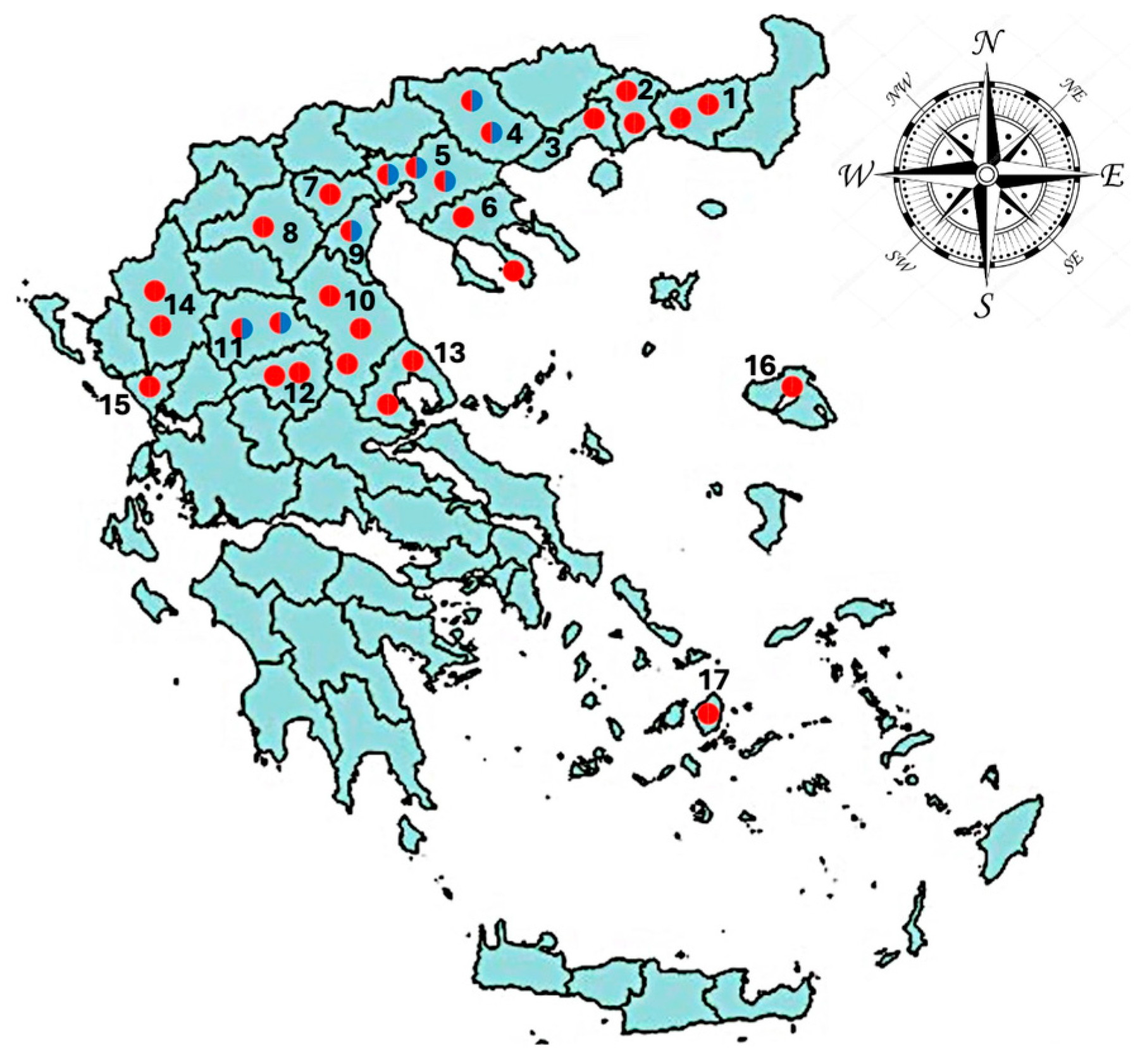
Figure 1. Location of the abattoirs around Greece, which were visited for the collection of cattle and buffalo abomasa. The classification of the colors among the two host species is as follows: the red color corresponds to cattle and the blue one to buffaloes. Numbers 1 to 17 represent the different prefectures/islands included in this study.
Dairy 07 00003 g001
Table 1. Categorized data included in the questionnaire.
1. Abattoir’s Information
Location of the abattoir
Visit day
Season
Spring
Summer
Autumn
Winter
2. Animal’s Information
Age
Months
Sex
Male
Female
Species
Cattle
Buffalo
Productive orientation
Milk
Meat
3. Farm’s Information
Management system
Grazing
Zero-grazing
Altitude
≤300 m a.s.l.
>300 m a.s.l.
Co-existence of cattle and buffaloes
Single-species farming
Mixed-species farming
Anthelmintic treatment
Exclusively pro/benzimidazoles
Exclusively macrocyclic lactones
Combination of pro/benzimidazoles
and macrocyclic lactones
No anthelmintic treatment
a.s.l.: above sea level.
Table 2. The primers used and the product size of Haemonchus spp., after the amplification of the internal transcribed spacer 2 (ITS2) sequence of nuclear DNA.
PrimerSequenceProduct Size (bp)
NC1-Fforward: 5′-ACGTCTGGTTCAGGGTTGTT-3′321
NC2-Rreverse: 5′-TTAGTTTCTTTTCCTCCGCT-3′
Table 3. Primers used for allele-specific PCR, targeting position 200 of the H. contortus β-tubulin isotype 1 sequence.
PrimerSequence
P1Fw: 5′-GTCCCACGTGCTGTTCTTG -3′
P2SRv: 5′-TACAGAGCTTCATTAATCGATGCAGA -3′
P3RFw: 5′-TTGGTAGAAAACACCGATGAAACATA -3′
P4Rv: 5′-GATCAGCATTCAGCTGTCCA -3′
Table 4. Prevalence of Haemonchus contortus infection among different large ruminant populations.
PopulationPrevalence (%)Hc-Infected abom./Total abom.
Large ruminants31.066/213
Cattle21.236/170
Buffaloes69.830/43
Dairy cattle10.412/115
Beef cattle43.624/55
Hc: Haemonchus contortus, abom.: abomasa.
Table 5. Numbers and percentages representing the proportion of dairy cattle, beef cattle, and buffaloes infected with H. contortus within each host category and factor level (i.e., the co-existence of cattle and buffaloes, anthelmintic treatment, altitude, management system, sex, and season).
Ruminants
Dairy Cattle *%Beef Cattle *%Buffaloes *%
Co-existence of cattle and buffaloes
Single-species farming1191.671354.172273.33
Mixed-species farming18.331145.83826.67
Anthelmintic treatment
Pro/benzimidazoles00.001041.67620.00
Macrocyclic lactones00.00312.50620.00
Pro/benzimidazoles and Macrocyclic lactones00.0000.0000.00
No anthelmintic treatment12100.001145.831860.00
Altitude
≤300 m a.s.l.1083.331770.8330100.00
>300 m a.s.l.216.67729.1700.00
Management system
Semi-intensive650.001875.0030100.00
Intensive650.00625.0000.00
Sex
Male650.001979.172066.67
Female650.00520.831033.33
Season
Spring650.00416.67826.67
Summer541.67312.50826.67
Autumn00.001354.171343.33
Winter18.33416.6713.33
a.s.l.: above sea level. * The total numbers of dairy, beef cattle, and buffaloes with Haemonchus contortus infection are 12, 24, and 30, respectively.
Table 6. Beta-coefficients (±standard errors), Wald test, p-values, and odds ratios with 95% confidence intervals of the risk factors of haemonchosis in cattle.
Risk FactorsBS.E.Waldp-ValueOdds Ratio95% C.I.
for Odds Ratio
LowerUpper
Mixed-species farming0.890.5212.960.0552.450.986.81
Single-species farmingRef.
Beef cattle2.390.50722.3200.00010.954.0629.54
Dairy cattleRef.
Animal age (months)0.030.00618.760.0001.031.021.04
Grazing0.740.5062.150.1422.100.785.67
Zero-grazingRef.
Male−0.590.5391.210.2710.550.221.40
FemaleRef.
Constant−3.530.51546.870.0000.03
Β: b-coefficient, S.E.: standard error, C.I.: confidence interval, Ref.: Reference category.
Table 7. β-coefficients (±standard errors), beta-coefficients, t test, p-values with 95% confidence intervals of the risk factors for homozygous benzimidazole-resistant β-tubulin genotypes at codon 200 in cattle and buffaloes.
RuminantRisk FactorBS.E.β-Coefficienttp-Value95% C.I. for B
LowerUpper
Cattle
25.0% RR
or
720/2880
Intensive1.8530.4580.3934.0470.0000.9382.768
Semi-intensiveRef.
Slaughter age (months)0.0230.0050.4744.8880.0000.0140.033
Female−0.3150.404−0.081−0.7790.439−1.1230.493
MaleRef.
Mixed-species farming−0.2830.399−0.071−0.7090.481−1.0800.515
Single-species farmingRef.
Constant0.5710.254 2.2450.0280.0631.079
Βuffaloes
8.3% RR
or
199/2400
Slaughter age (months)−0.2480.128−0.320−1.9330.054−0.5120.015
Mixed-species farming−0.8250.362−0.376−2.2780.031−1.568−0.082
Single-species farmingRef.
Female−0.4180.346−0.203−1.2080.238−1.1290.293
MaleRef.
Constant6.5972.854 2.3110.0290.74012.454
Β: b-coefficient, S.E.: standard error, β-coefficient: beta-coefficient, C.I.: confidence interval, Ref.: Reference category, RR: homozygous benzimidazole resistant β-tubulin genotypes at codon 200.
Disclaimer/Publisher’s Note: The statements, opinions and data contained in all publications are solely those of the individual author(s) and contributor(s) and not of MDPI and/or the editor(s). MDPI and/or the editor(s) disclaim responsibility for any injury to people or property resulting from any ideas, methods, instructions or products referred to in the content.


