

Article

In-Situ Monitoring and Prediction of Frost Growth on Plant Leaves Based on Dielectric Spectrum Analysis and an SWT-SSA-LSTM Model

1
School of Mechanical Engineering, North China University of Water Resources and Electric Power, Zhengzhou 450045, China
2
School of Agricultural Engineering, Jiangsu University, Zhenjiang 212013, China
*
Authors to whom correspondence should be addressed.
AgriEngineering 2026, 8(2), 67; https://doi.org/10.3390/agriengineering8020067
Submission received: 15 January 2026 / Revised: 7 February 2026 / Accepted: 11 February 2026 / Published: 14 February 2026

Abstract

Accurate and in-situ monitoring of frost growth on plant leaves is crucial for disaster prevention in smart agriculture. To address the limitations of traditional methods in quantification and continuity, this study proposes a novel monitoring paradigm integrating dynamic dielectric spectrum analysis with hybrid intelligent algorithms. A mesh-electrode-based capacitive sensor was designed to capture in-situ and continuous dielectric spectrum changes on leaf surfaces. Subsequently, a hybrid SWT-SSA-LSTM model was constructed for high-fidelity denoising and prediction of the original signals. Field experiments demonstrated that this system could quantify frost layer mass and thickness with high precision. The established nonlinear regression models achieved coefficients of determination of 0.924 and 0.975, respectively. The prediction model exhibited outstanding performance, with a root mean square error as low as 1.475. This study establishes a complete technical closed-loop from physical perception to intelligent prediction, providing an innovative solution for precise frost monitoring in agriculture.

1. Introduction

Frost is a major agro-meteorological disaster constraining agricultural production, posing a severe threat to the yield and quality of economic crops such as tea and fruit trees, as well as field crops like winter wheat and corn [1,2]. Statistics indicate that economic losses due to frost can amount to billions of euros annually in European grape-growing regions alone [3]. The effectiveness of traditional frost defense measures relies heavily on the accurate and timely perception of the frosting process, particularly in its early formation stage [4,5]. However, prevalent frost monitoring techniques, such as manual observation, temperature-threshold-based warnings from weather stations, or thermal imaging, struggle to achieve in-situ, quantitative, and continuous dynamic monitoring of frost layer growth on plant surfaces. This has become a core bottleneck in developing precise and intelligent disaster prevention technologies [6,7,8,9].
Existing technologies primarily face three major challenges. First, methods reliant on human observation are inefficient, subjective, and incapable of continuous recording, making it difficult to capture the complete trajectory of the dynamic phase-change process of frost formation [10,11,12]. Second, although machine vision-based methods [13,14] enable non-contact measurement, they are susceptible to interference from nocturnal lighting conditions, complex leaf backgrounds, and water mist. Their recognition accuracy plummets during the thin-frost stage (<0.5 mm). More critically, there is an inherent distinction between the morphological information they provide (e.g., coverage area) and the key parameters reflecting the actual thermophysical impact of the frost layer, such as mass and thickness. Third, high-precision sensors developed for industrial applications (e.g., refrigeration, aviation), such as resonator-based or photoelectric sensors [15], are often unsuitable for direct transplantation to agricultural field settings due to high costs, sensitivity to environmental dust, and, most importantly, the difficulty in effectively deploying and measuring on non-flat, fragile living plant leaf surfaces.
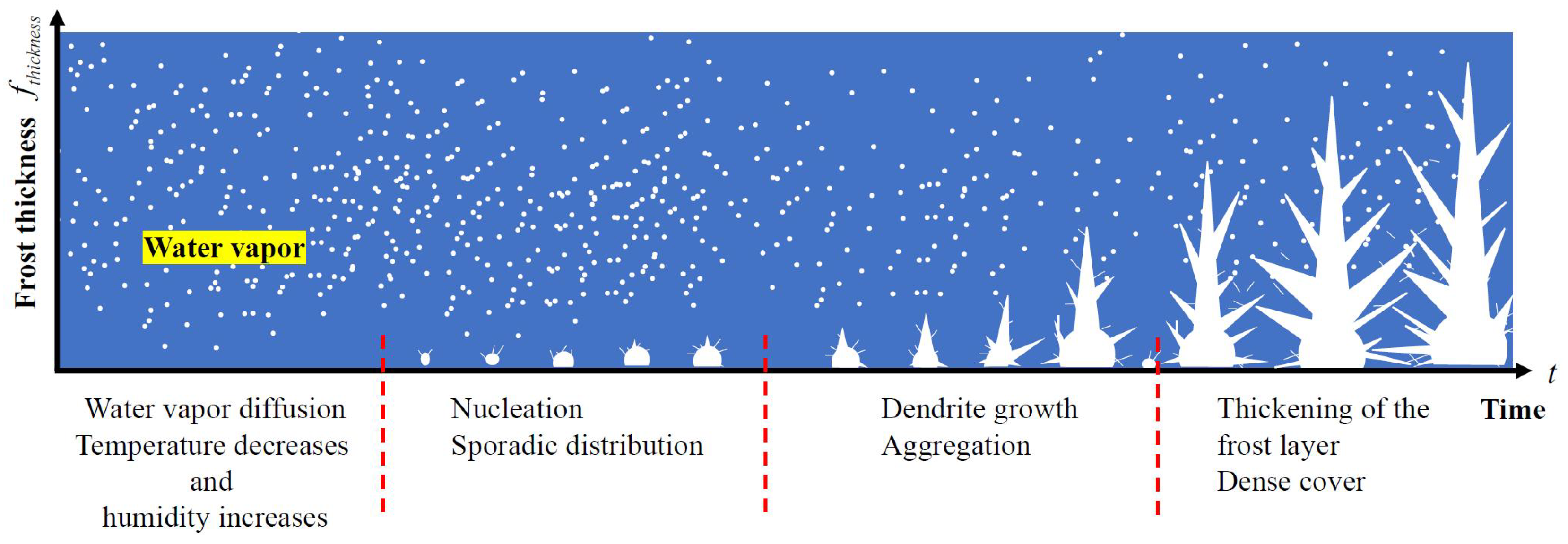
Considering water vapor, a necessary factor for frost formation, the mechanism of frost layer formation on natural object surfaces can generally be delineated into four periods [16] (Figure 1). (1) Water vapor diffusion, where the temperature drops to the frost point while humidity approaches saturation; (2) Nucleation, where sporadically distributed frost crystal particles become visible under microscopic observation; (3) Dendrite growth, where the morphology of crystals evolved from nuclei deforms into shapes like columns, needles, feathers, or leaves, primarily aggregating along leaf edges and veins. In this stage, dendrites already possess theoretical thickness but appear disordered on the horizontal plane, remaining difficult to identify macroscopically; (4) Frost layer thickening, where dendrites grow sufficiently, and older crystals are covered by new ones, leading to a higher density at the frost layer base than at the top. If temperature continues to drop and humidity increases, the Frost thickness further increases, presenting a densely covered distribution characteristic on the leaf surface during this final stage.
The formation of a frost layer is fundamentally a physical process where water vapor undergoes phase change (condensation or desublimation) on a cold surface, growing into a heterogeneous porous medium [17,18]. Therefore, the core of its accurate quantification lies in acquiring physical signals capable of characterizing the dynamic evolution of its internal physical properties (e.g., density, porosity), rather than merely its external morphology. The dielectric property, as a fundamental electrical attribute of matter, is closely related to a material’s molecular polarity and spatial structure. The dramatic change in dielectric constant from air (εr ≈ 1) to water/ice (εr ≈ 80/3.2) during frost growth provides a profound physical basis for non-destructively inverting the dynamics of frost growth through dielectric spectrum analysis [19,20]. Capacitive sensing technology, which measures changes in equivalent dielectric constant, is considered an ideal approach to achieve this goal. However, to successfully apply the capacitive method in complex and variable field environments, two key challenges must be addressed: (1) How to robustly extract features strongly correlated with frost growth from weak, non-stationary capacitive signals severely contaminated by environmental noise (e.g., wind, humidity fluctuations, electromagnetic interference); and (2) How to establish an intelligent model capable of understanding temporal dependencies and predicting the frost growth trend in advance to enable proactive warning. Consequently, this study is designed to address these two challenges by investigating the following core research questions: (1) How can we robustly extract frost-growth-correlated features from noisy, in-situ capacitive signals? (2) How can we build an intelligent model to understand the temporal dynamics and predict the continuous evolution of frost mass and thickness (not merely its occurrence) for early warning?
The accurate analysis of such in-situ signals necessitates advanced denoising techniques capable of handling non-stationary noise [21]. Furthermore, the effectiveness of deep learning models like Long Short-Term Memory (LSTM) networks for time-series prediction is highly contingent upon their hyperparameter configuration [22]. Therefore, an integrated approach that combines high-fidelity signal processing with adaptive model optimization is required to address these dual challenges for robust frost monitoring.
To address the aforementioned challenges, this study proposes a novel paradigm for in-situ monitoring and prediction of frost growth on plant leaves, integrating dynamic dielectric spectrum analysis with hybrid intelligent algorithms. The main contributions of this work are as follows: First, it transcends traditional capacitive “black-box” measurement in terms of sensing mechanism. By designing a dedicated mesh-electrode sensor, it achieves in-situ monitoring of the dynamic dielectric spectrum response during frost formation on plant leaves, providing a data foundation for revealing the physical mechanisms of phase change across all stages from dew condensation and nucleation to dendrite growth and frost layer thickening. Second, a novel SWT-SSA-LSTM hybrid prediction model is constructed. This model utilizes Synchrosqueezed Wavelet Transform (SWT) for high-resolution denoising and time-frequency analysis of the original capacitive signal, effectively suppressing complex field noise. It employs the Sparrow Search Algorithm (SSA) to adaptively optimize the key hyperparameters of the Long Short-Term Memory (LSTM) network, thereby building a powerful and robust temporal prediction engine that achieves accurate forecasting of the mid-to-late frosting process.
Finally, long-term nocturnal field experiments were conducted in a real tea plantation, systematically validating the effectiveness of this technical solution for quantifying frost mass and thickness. A high-precision regression model was established between the denoised capacitive signal and the frost amount. This work provides a novel technical pathway and theoretical support for advancing agricultural frost monitoring from “qualitative judgment” to “quantitative perception” and “intelligent prediction.”

2. Principle of Dynamic Dielectric Spectrum Monitoring and System Construction

This chapter elaborates on the physical mechanism of frost monitoring based on dielectric spectrum analysis, the dedicated sensing system designed to realize this mechanism, and the complete signal processing workflow from raw data to characteristic dielectric spectra. The combination of theoretical modeling, hardware innovation, and signal-chain design establishes the foundation for the reliability and advancement of this research.

2.1. Physical Mechanism of Monitoring Frost Growth via Dielectric Spectrum

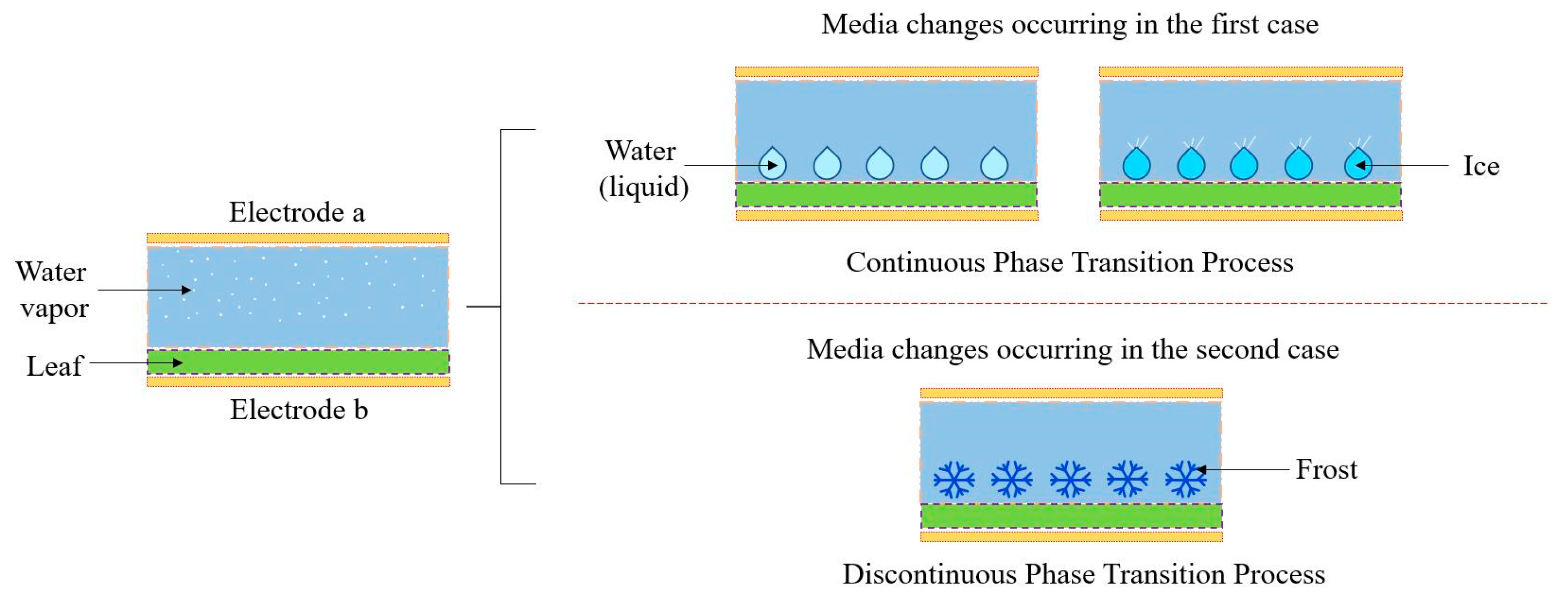
The growth of a frost layer on a plant leaf surface is, in essence, a process involving the dynamic evolution of the dielectric properties of substances adhering to the surface. This process typically undergoes either a continuous phase change from gaseous water vapor → liquid water → solid ice, or a non-continuous phase change from gaseous water vapor directly to solid frost [23,24]. As shown in Figure 2, significant differences exist in the dielectric constant (εr) among different phases (air ~1, water ~80, ice ~3.2, frost ~2.3). This substantial variation makes the dielectric constant an extremely sensitive physical parameter for characterizing phase-state evolution during frost formation.
Frost, as a heterogeneous porous medium, has an equivalent dielectric constant ϵ r , e f f that depends not only on the dielectric constants of ice crystals and air but is also closely related to the frost layer’s porosity ϕ (i.e., the air volume fraction). For such a mixed medium, the equivalent dielectric constant can be estimated using empirical formulas like the Lichtenecker mixing model:
log ϵ r , e f f = 1 ϕ log ϵ i c e + ϕ log ϵ a i r
where ϵ i c e and ϵ a i r are the dielectric constants of ice and air, respectively. This model indicates that during frost layer growth, as the porosity ϕ dynamically changes (typically decreasing with increasing frost thickness), ϵ r , e f f undergoes corresponding, nonlinear evolution. This theoretically explains that the capacitive signal can respond not only to the increase in frost layer thickness/mass but may also contain information about the evolution of the frost’s microstructure, providing a physical basis for in-depth quantification through dynamic dielectric spectrum analysis.
In the in-situ monitoring configuration of this study, the sensor’s mesh electrode and the plant leaf surface form a capacitive structure. The growth of frost introduces a dielectric layer with properties between air and ice, altering the system’s total capacitance. This configuration is highly sensitive to changes in surface dielectric properties, enabling sensitive in-situ monitoring.

2.2. Capacitive Sensing System Design and Implementation

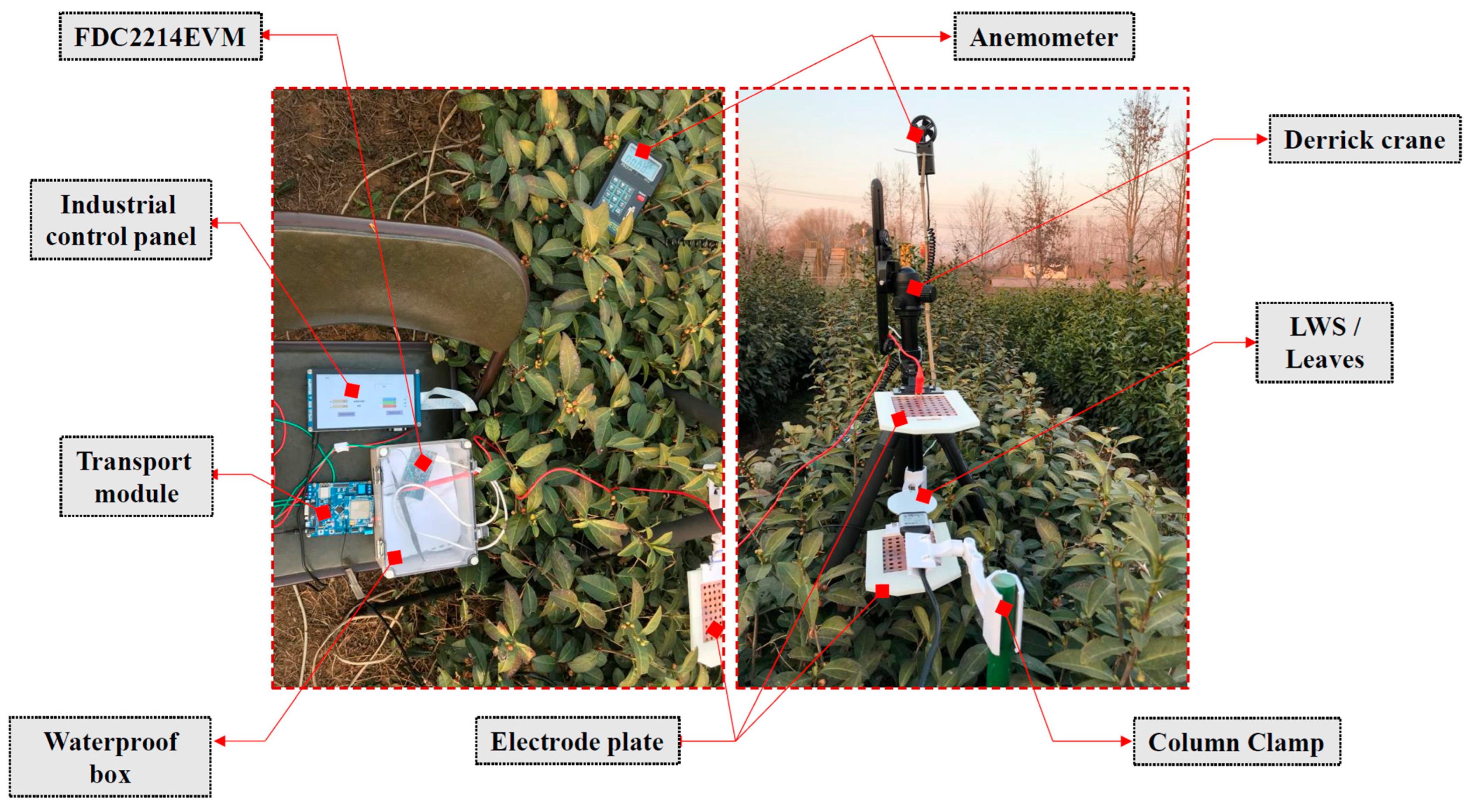
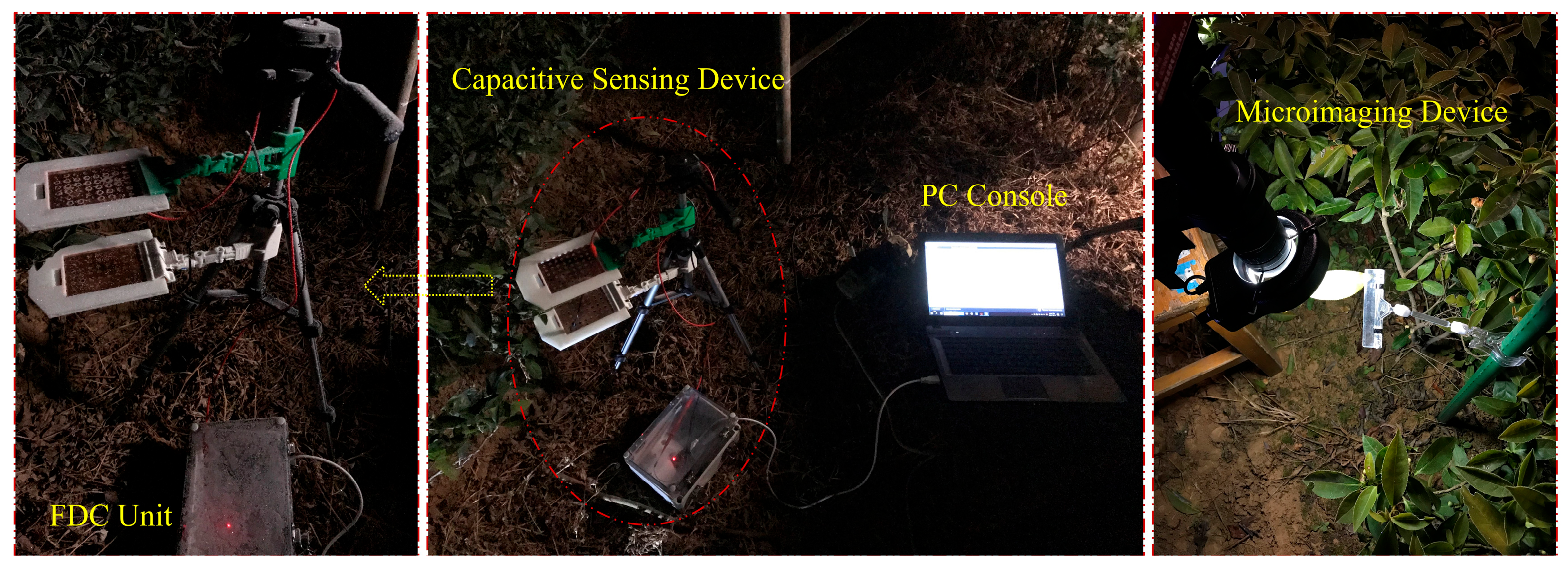
To translate the aforementioned physical mechanism into reliable field measurements, we designed and constructed an automated capacitive sensing system as shown in Figure 3.
The core of the system is Texas Instruments’ FDC2214 capacitance-to-digital converter. This chip utilizes LC resonator and Σ-Δ ADC technology, deducing the capacitance value Csensor by measuring the oscillation frequency fsensor of the sensor electrode. The relationship is as follows:
C s e n s o r = 1 L × 2 π × f s e n s o r 2 C

2.2.1. Key Component Selection and Performance Considerations

The FDC2214 was selected primarily for its exceptional resolution and noise immunity. Its 28-bit ΔΣ ADC architecture, combined with an external high-Q inductor, effectively suppresses interference from environmental parasitic capacitance and extends the detection limit down to the attofarad (aF, 10−18 F) level. This is crucial for detecting capacitance changes induced by microgram-level frost mass. The system is configured with a channel reference frequency fref = 40 MHz. The relationship between the sensor frequency fsensor and the digital output COUNT is:
f s e n s o r = C h _ f i n _ s e l × f r e f × C o u n t 2 28
Using the above formula, the chip output can be converted into a precise frequency value, which is then used to calculate the sensing capacitance Csensor via the LC resonance formula.

2.2.2. Innovative Mesh Electrode Design and Advantage Analysis

Compared to traditional solid metal electrodes, the high water-vapor-permeable copper mesh electrode employed in this study offers distinct advantages: it minimizes interference with the leaf’s microclimate by maximizing heat and mass exchange, and its microscopically rough structure enhances the stability of initial frost layer attachment. These features collectively ensure the authenticity and robustness of in-situ measurements on fragile leaf surfaces.
Optimized Fringe Field Effect: In the fringe-field capacitive sensing mode adopted in this study, the fringe field distribution of the mesh electrode is more conducive to capturing lateral variations in the dielectric properties of the leaf surface, thereby improving the characterization capability for non-uniform frost formation.

2.3. Signal Processing and System Calibration

2.3.1. Signal Processing

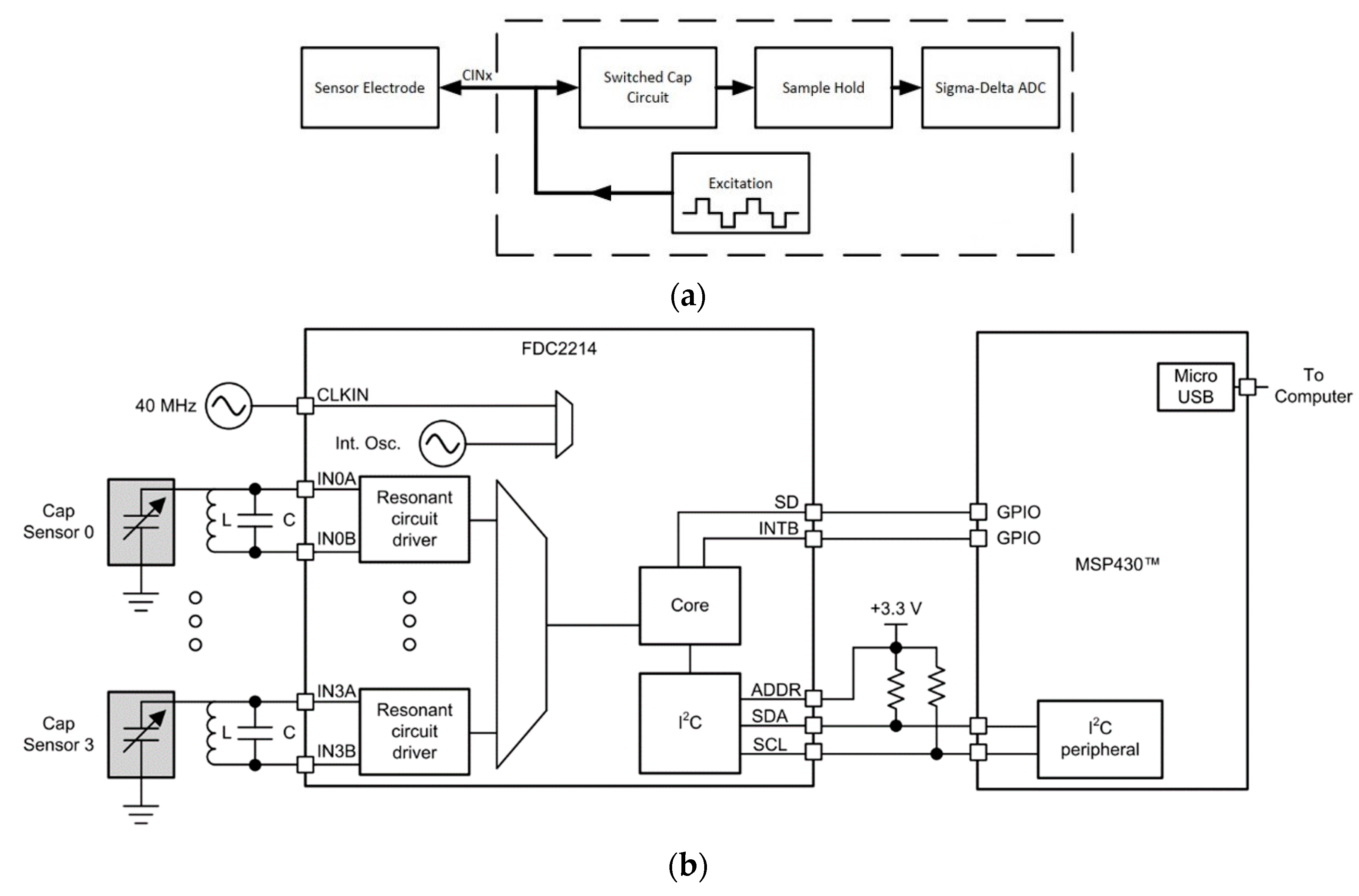
The system’s signal processing flow ensures the integrity and reliability of data from acquisition to analysis. As illustrated in Figure 4a. To eliminate the effects of baseline drift and initial variations, the initial capacitance value C0 under stable environmental conditions is recorded and stored before the commencement of each experiment. For subsequent analysis, the relative capacitance change ΔC = CC0 is adopted as the core feature. This effectively enhances the comparability of data across different experimental days.
The fundamental operation of the FDC2214 capacitance sensing is implemented via a switched-capacitor circuit, which transfers charge from the sensor electrode to a sigma-delta analog-to-digital converter (ADC), as depicted in Figure 4b. A 25 kHz step signal is driven on the sensor line, charging the electrode for a specific duration. After a predetermined period, the charge on the sensor is transferred to a sample-and-hold circuit. The ADC converts the analog voltage into a digital signal. Upon completion of the conversion, the result undergoes digital filtering and correction based on gain and offset calibration.

2.3.2. System Calibration

To verify the system’s quantification capability, preliminary calibration was conducted in a controlled laboratory environment prior to field experiments. Standard dielectric materials (e.g., plastic sheets) with known thicknesses were used to simulate frost layers at different growth stages, and the system’s capacitive response was measured. The calibration demonstrates a favorable linear relationship between the system’s capacitance and the medium’s thickness/equivalent dielectric constant, confirming the fundamental feasibility of this system for frost quantification.
When frost crystals accumulate on the plant leaf surface, this device, based on capacitive sensing technology, measures the capacitance between the electrode (made of copper mesh) and the cold surface. This measurement is possible because the dielectric constant of the substances attached to the leaf surface changes during the phase transition from air to frost. Concurrently, the frost amount undergoes stage-specific variations, and the capacitance correspondingly changes with the dielectric constant.
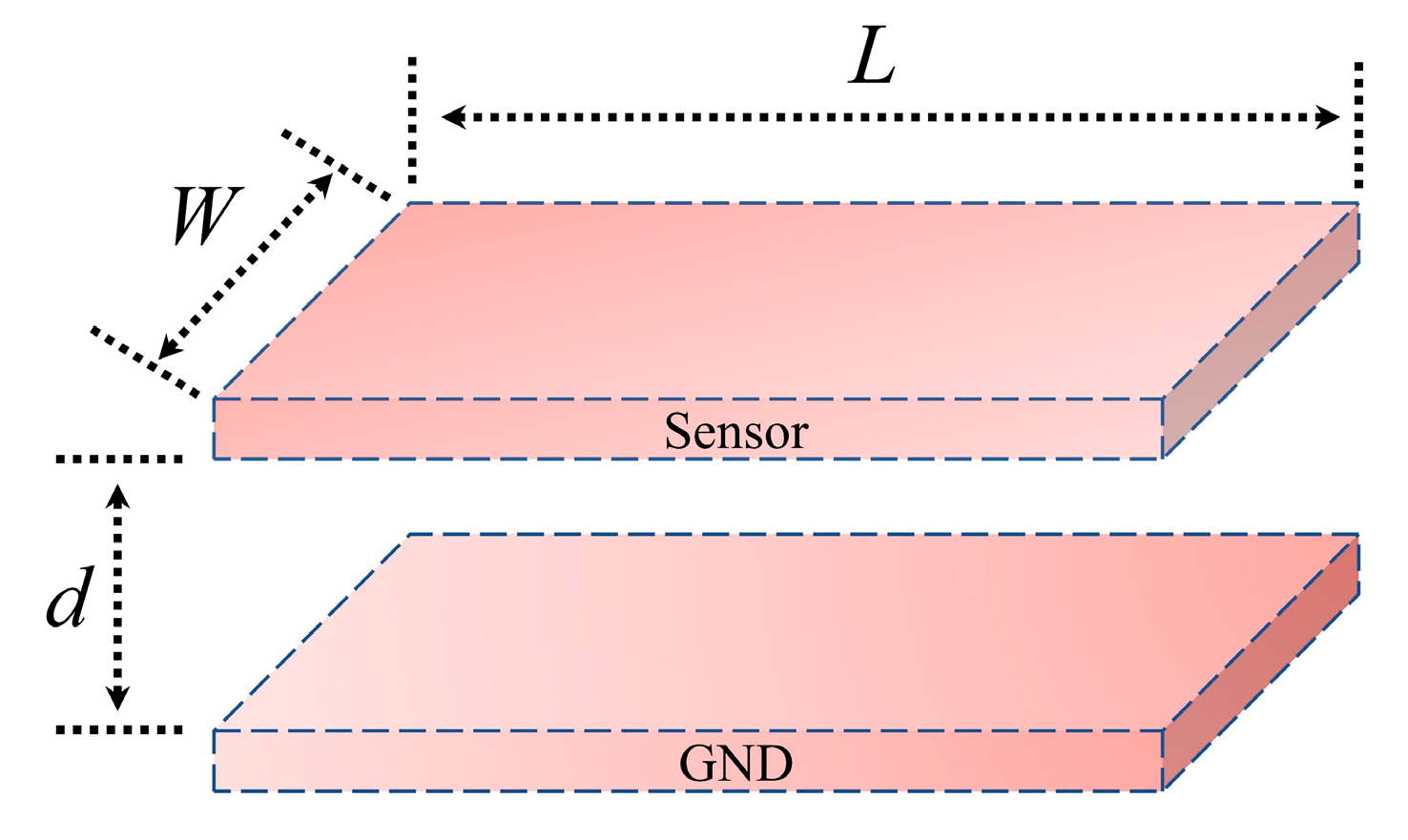
Capacitance characterizes a capacitor’s ability to store charge. This study utilizes a parallel-plate capacitor model. The capacitance C is given by C = Q V , where Q is the stored charge and V is the applied voltage. For a parallel-plate capacitor (Figure 5), the capacitance (in Farads) between two conductive plates is calculated as:
C = ε r ε 0 A d
Here, A is the area of the plates (in m2), ε r is the relative permittivity (dielectric constant) of the material between the plates, ε 0 is the vacuum permittivity ( 8.85 × 10 12   F / m ), and d is the distance between the plates (in m).
By altering one parameter while keeping others constant, the sensor’s capacitance can be detected. For this sensor, the inter-electrode capacitance varies not only over time but is also intrinsically linked to the phase changes in the material between the electrodes. In sensing the thickness of an accumulated material, the capacitance changes with the amount of material present between the plates. The difference between the original air gap and the final thickness occupied by the material (due to the change in the dielectric) allows for the calculation of capacitance based on known material properties and geometries.
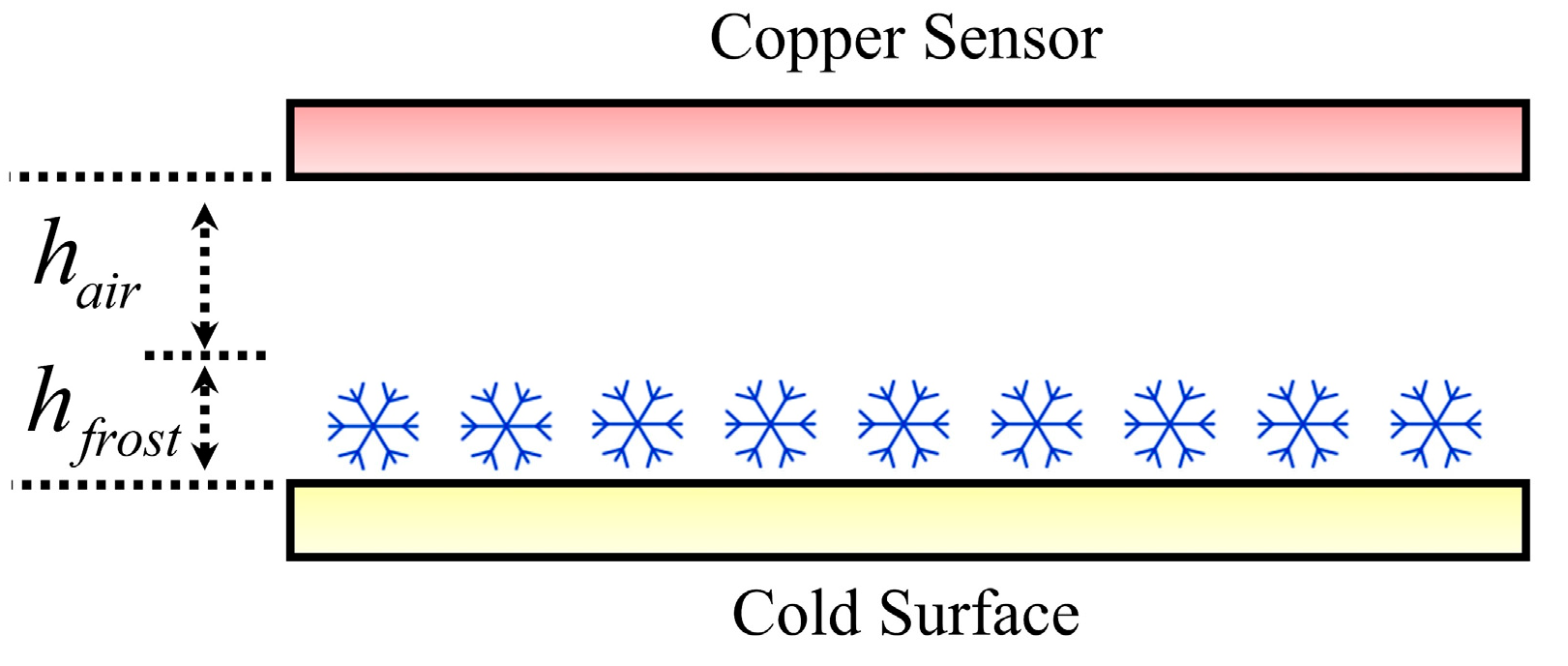
Following this principle, frost accumulation between the electrodes alters the equivalent dielectric constant, leading to a measurable change in capacitance. In the configured setup (Figure 5), one side is a metal cooling surface, and the other is the specially designed sensor electrode. A well-designed sensor incorporates conductive material fixed relative to the cooled surface (Figure 6). When parameters d, ε 0 , and A are held constant, the capacitance C becomes a function of the equivalent ε r . This forms the fundamental principle of frost detection.
When frost accumulates on a plant leaf surface, water vapor in the air undergoes phase changes as temperature decreases and humidity increases. Before reaching saturation, vapor condenses into fine water droplets upon encountering the cold surface. After saturation, vapor directly desublimates into frost crystals, alongside some of the pre-existing droplets. These condensed droplets can further freeze into ice crystals under sustained low temperatures. Consequently, the medium between the effective “plates” (sensor and leaf surface) sequentially involves: air, water vapor, water droplets, frost crystals, and ice crystals. The plant leaf acts as the substrate for frost formation. As the substances adhering to the leaf surface change, the effective dielectric constant changes accordingly. Therefore, this detection setup can effectively characterize the capacitance and its frequency-dependent behavior throughout the frost formation process on the leaf surface.
Table 1 shows that the dielectric constant of ice/frost is approximately three times that of air, while water has a significantly higher value. When ice/frost or water is present near the plates of a parallel-plate capacitor, the capacitance increases.
Since the area of the capacitor plates has a direct impact on the system’s sensitivity, the detection device employs two rectangular copper plates, each measuring 100 mm × 100 mm, serving as the upper and lower electrodes. Furthermore, to minimize the influence of the electrodes on the natural environmental conditions around the plant leaf during frost formation, a mesh electrode design is adopted. This ensures the sensor does not impede the natural frost formation process between the electrode and the plant leaf surface.
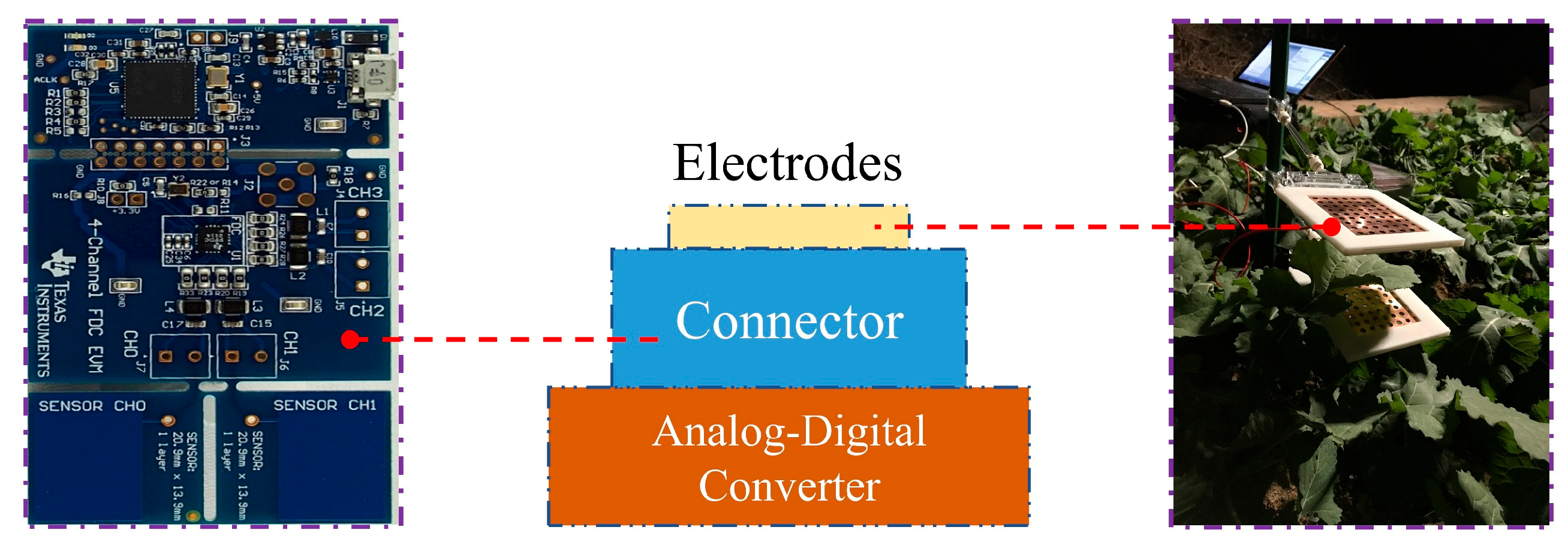
The fundamental working principle of this sensing device is based on differences in dielectric constants. During consecutive nights of natural radiative cooling, water vapor in the air directly desublimates into frost upon contacting cold surfaces, or condenses into small water droplets which then settle on the plant leaf surface due to gravity. By detecting the dielectric constants of these different substances, the sensor generates corresponding frequency signals. These frequency signals are then converted into readable capacitance values by a frequency conversion unit. A detailed breakdown of the sensor system’s key components is provided in the caption of Figure 7.
Capacitive sensing technology addresses the ambiguity associated with quantifying frost accumulation on cooling surfaces, particularly during the mid-to-late stages of frosting, by directly quantifying the frost amount rather than relying on assumptions common to other methods. The capacitance measured by this method inherently provides a rapid response to the thickness, mass, and dielectric constant of the material due to the arrangement of the material’s properties, which can be effectively captured by high-frequency capacitance measurements.

3. Field Experiment and Data Analysis

To investigate the trend relationship between the frost amount at different frosting stages and the response capacitance of the capacitive sensor during the natural frosting process on tea leaf surfaces, this section conducts capacitive sensing experiments on frosted tea leaves. The experiments analyze the frost mass, frost thickness, and the corresponding capacitive response across different time intervals.
Through meticulously designed field trials, this section aims to validate the quantification capability of the proposed dielectric spectrum monitoring system for the frost growth process on plant leaves under natural environmental conditions. It provides a detailed introduction to the experimental site, materials, and methodology. Furthermore, a systematic analysis is performed on the collected dielectric spectrum data and the physical parameters of the frost layer to reveal their intrinsic relationships.

3.1. Experimental Materials and Methods

3.1.1. Experimental Site and Samples

The experiments were conducted from December 2021 to January 2022 at the ‘Yinchun Biya’ tea plantation in Danyang City, Jiangsu Province, China (32°02′ N, 119°67′ E). This region experiences a subtropical monsoon climate, with frequent radiative frost events in winter, providing ideal natural conditions for this study.
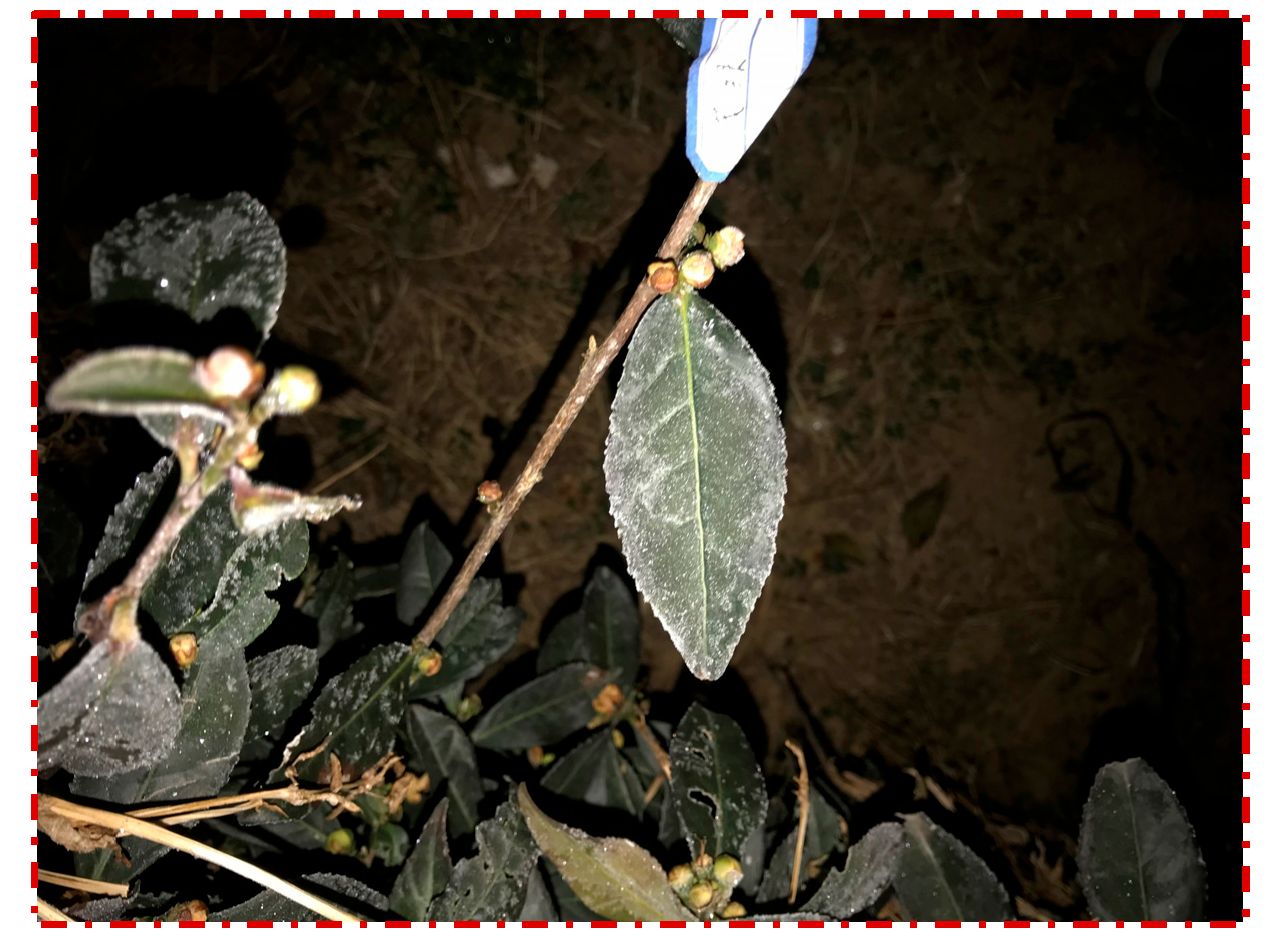
The experimental subjects were healthy, mature leaves from the locally predominant ‘Maolü’ tea plant cultivar (Camellia sinensis). All test leaves were uniformly selected from the top layer of the plant canopy (approximately 1.2 m above ground) to ensure consistency in light exposure and growth conditions. A representative leaf is shown in Figure 8.
The experimental plot was chosen for its flat, open terrain and the absence of artificial frost prevention facilities (e.g., frost fans) to guarantee the natural formation and spatial uniformity of the frost layer. To monitor the microclimate, a portable weather station was installed at the center and upwind side of the experimental area. It simultaneously recorded air temperature, relative humidity, leaf surface temperature (using a patch-type platinum resistance temperature sensor (Shenzhen Ligan Sensor Co., Ltd., Shenzhen, Guangdong, China), and wind speed at a sampling frequency of 1 Hz.
Given that the tea plant canopy height was approximately 1.2 m, plants in a relatively low-lying area with no surrounding obstructions (e.g., trees, frost fans) were selected as the test site to further favor frost formation. Concurrently, a control area for collecting temperature, humidity, and wind speed data was established within the canopy of tea plants on an adjacent ridge. It was assumed that the micro-meteorological characteristics of this control area were consistent with those of the test area and that the experiment did not affect the control area’s microclimate. A schematic of the experimental site and sensor deployment is presented in Figure 9.

3.1.2. Data Acquisition Protocol and Procedure

This experiment employed a multi-modal data synchronization strategy to acquire mutually verifiable datasets. Before each trial, the inner and outer surfaces of each sensing electrode were thoroughly cleaned with disinfectant alcohol. After the surfaces dried, they were covered with plastic film. The main stem bearing the target leaf was secured, and non-target leaves in the vicinity were removed to minimize extraneous noise interference. The FDC2214 circuit unit was housed in a waterproof enclosure. The capacitive sensing core was built around the FDC2214 capacitance-to-digital converter (Texas Instruments Inc., Dallas, TX, USA). This 28-bit ΔΣ ADC-based chip (Texas Instruments, Dallas, TX, USA), coupled with an external high-Q inductor, provides a high-resolution (down to attofarad level) and noise-immune measurement of the sensor electrode’s oscillation frequency, which is converted to capacitance via the LC resonance principle (as detailed in Section 2.2.1). Communication with the PC was established and verified. After all system parameters stabilized, the plastic film covering the sensor electrodes was removed, and data acquisition commenced.
To measure frost thickness, microscopic images of the frost-covered leaf surface were captured at 60-min intervals using a timer-controlled microscope (Keyence Corporation, Osaka, Japan). Concurrently, for frost mass quantification, a frost-covered leaf sample was carefully collected every hour using plastic tweezers (Local supplier, Zhenjiang, Jiangsu, China), weighed using an electronic balance (Shanghai Yueping Instrument Co., Ltd., Shanghai, China), and its mass recorded.
Dielectric Spectrum Data: The custom-built capacitive sensor served as the core device. Its output—the dielectric spectrum time series ΔC(t)—was continuously recorded at a frequency of 1 Hz via the FDC2214EVM module. The system’s fundamental quantification capability was verified through a pre-field calibration process using standard dielectric materials, as described in Section 2.3.2.
Frost Mass: To establish a calibration relationship between capacitance and frost amount, a destructive sampling and weighing method was designed as the benchmark. The specific procedure was as follows:
  • Several reserve leaves, physiologically consistent with the target leaves, were pre-selected near the sensor.
  • Every hour, one reserve leaf was carefully detached from the stem using plastic tweezers.
  • The leaf was immediately weighed using an electronic balance (Model: FA1204) with a precision of 0.1 mg to record the total mass Mtotal.
  • The leaf was then placed indoors. After the frost layer completely melted and evaporated, the leaf’s self-weight Mleaf was measured again.
  • The Frost Mass was calculated as Mfrost = MtotalMleaf. This procedure ensured the accuracy of the mass data.
Frost Thickness: A non-destructive measurement method based on microscopic image processing was employed. The protocol was as follows:
  • An industrial microscope camera equipped with a ring LED fill light (Ningbo Weifeng Equipment Group Co., Ltd., Ningbo, Zhejiang, China) was fixed beside the capacitive sensor (Jiangsu University, Zhenjiang, Jiangsu, China). Synchronized with the weighing, a high-resolution (5-megapixel) microscopic image of the leaf surface was automatically captured every hour.
  • Subsequently, an image processing algorithm based on Gaussian filtering and adaptive threshold segmentation was applied to process the images, separating the frost-covered areas from the leaf background.
  • Thickness was calculated using the formula:
h f r o s t = i = 1 n W i n · Y ,
where Wi is the number of frost-covered pixels in the i-th column, n is the total number of columns, and Y is the image calibration coefficient (pixels/mm). The average error of this method was below 5%.

3.1.3. Meteorological Conditions

The field experiments encompassed a total of 15 nocturnal observation sessions under clear-sky conditions conducive to radiative frost formation. Key meteorological parameters recorded by the portable weather station throughout the experimental period are summarized in Table 2. These conditions represent the typical radiative frost environment in the region during the study period.

3.2. Results and Analysis: Analysis of Dielectric Spectrum Dynamic Response and Frost Formation Process

3.2.1. Observation of Typical Parameters During a Representative Frost Night

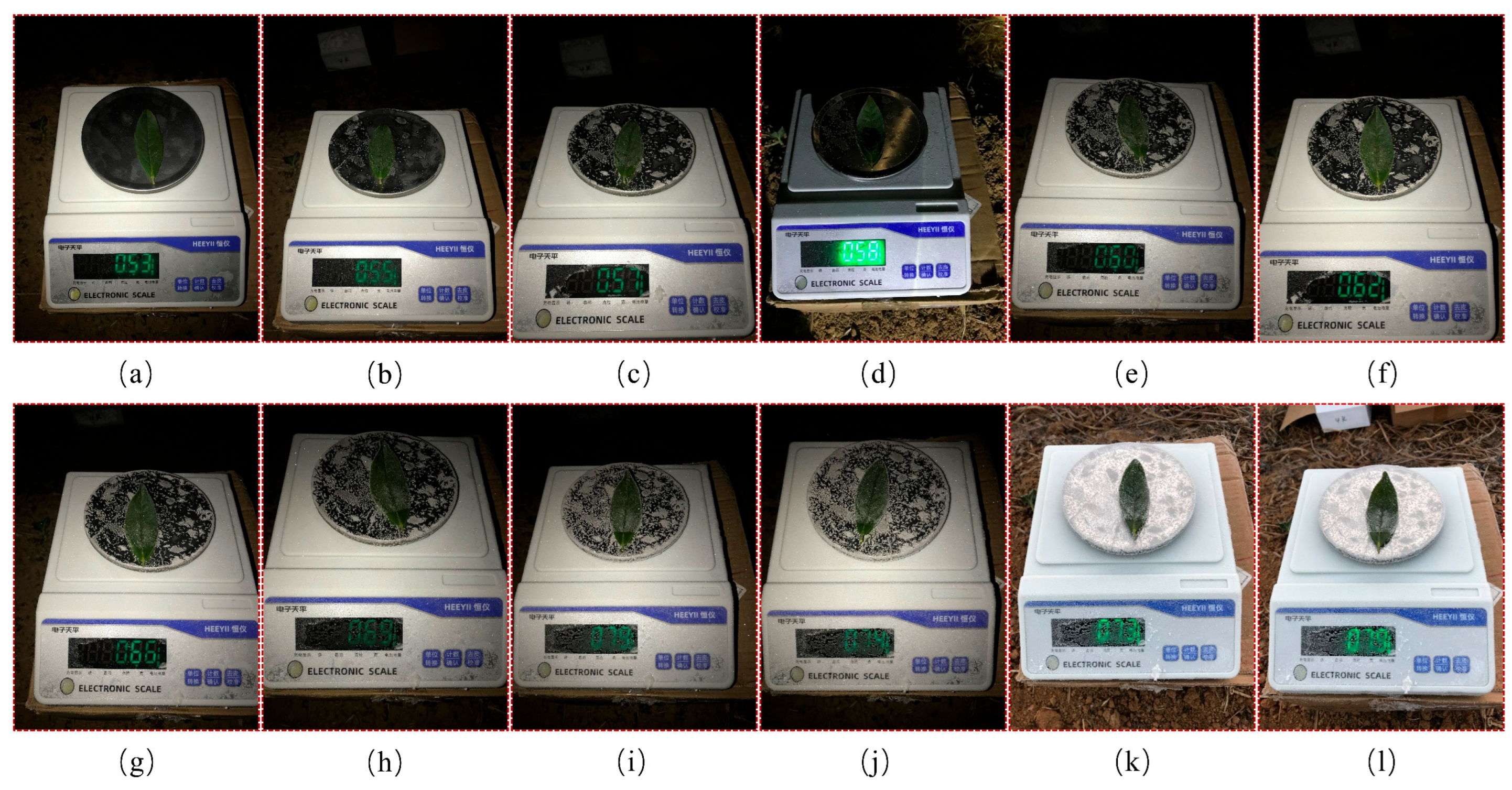
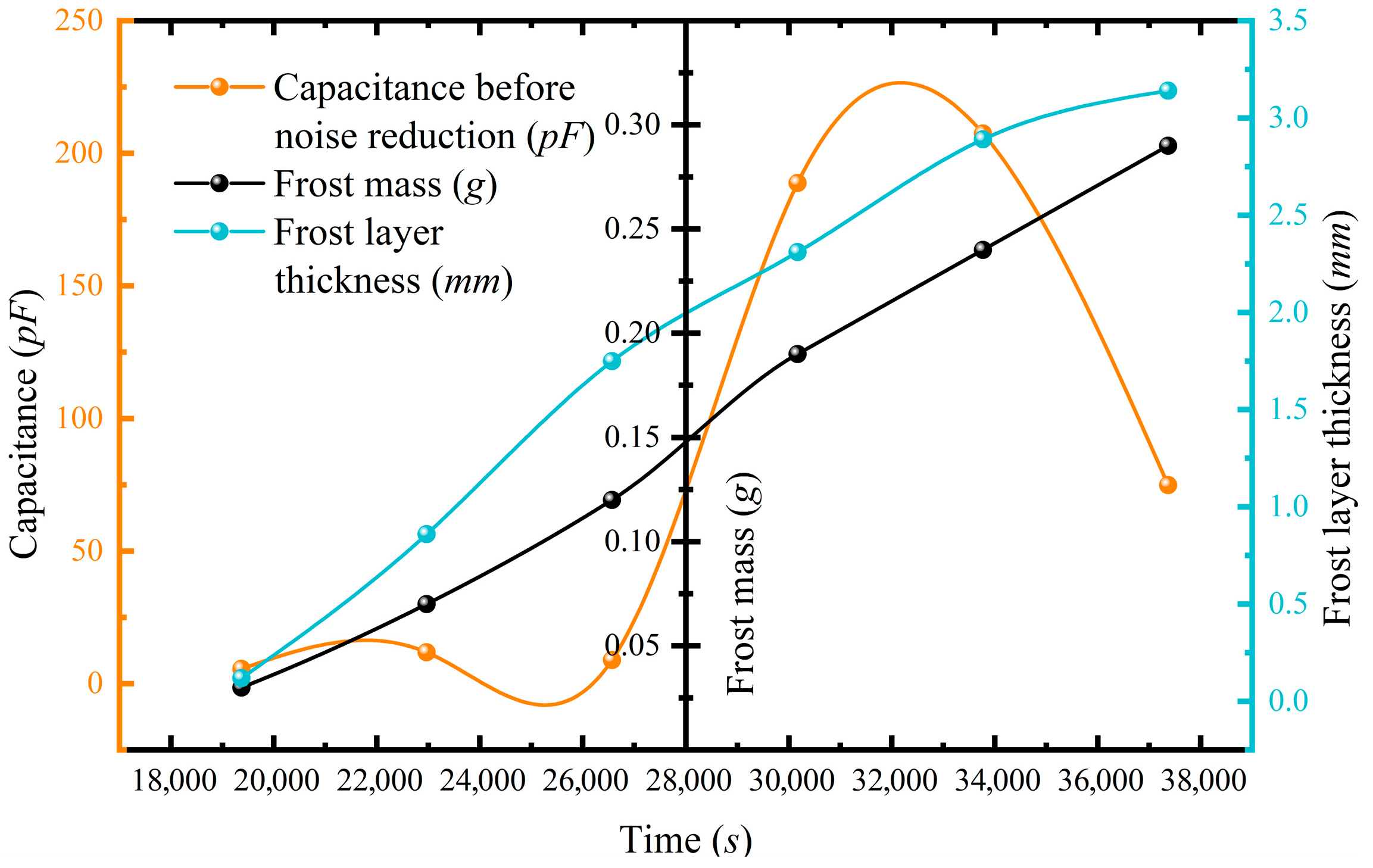
Data from a representative radiative frost night was selected for in-depth analysis. Figure 10 records and illustrates the complete evolution process of the measured Frost Mass throughout this typical frost night, alongside the accompanying changes in the dielectric spectrum (capacitance change ΔC).
During the weighing of experimental samples, considering that frost could also form on the weighing pan, the balance was tared before each measurement. This practice aimed to minimize errors caused by residual frost crystals left on the pan due to incomplete cleaning.
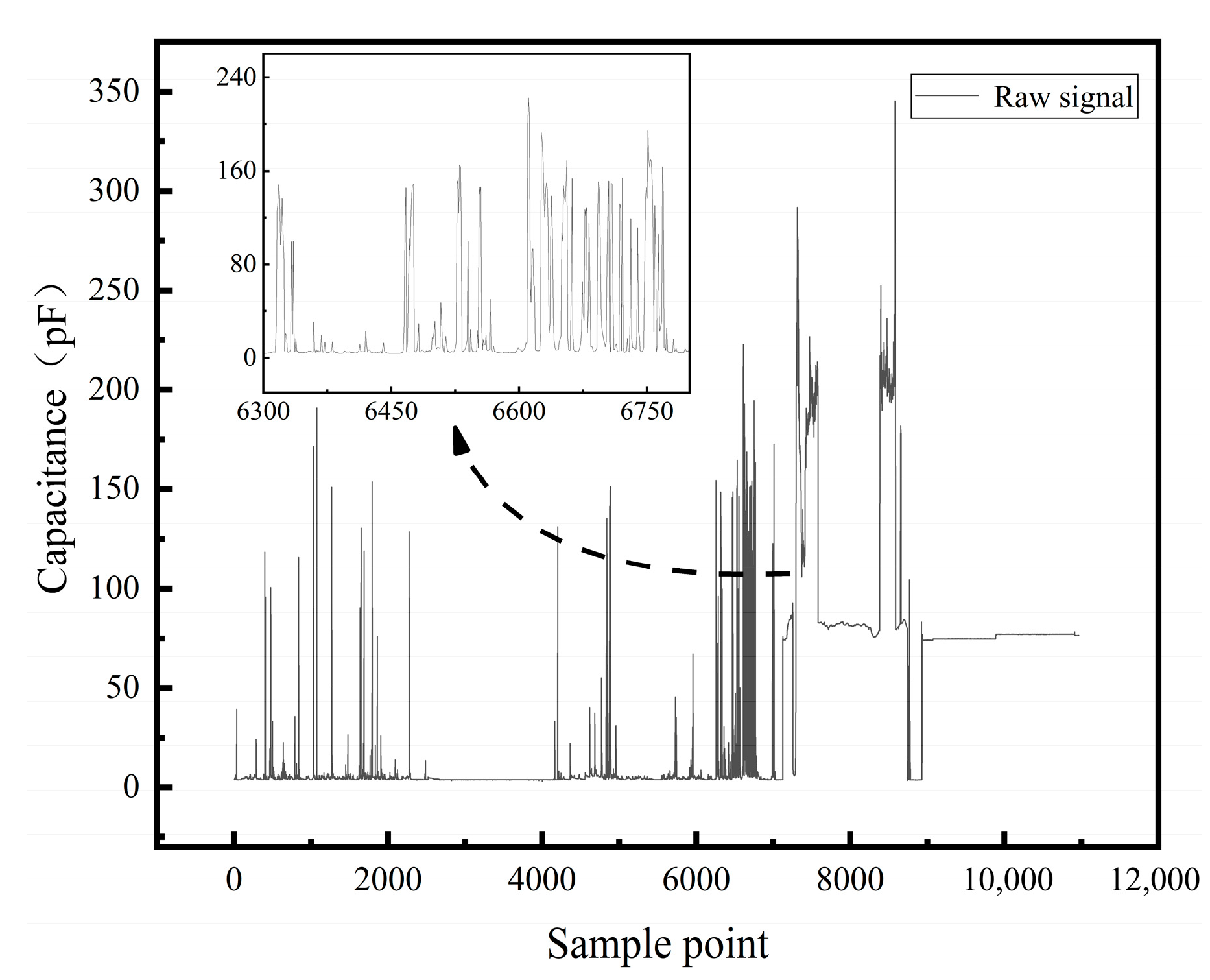
Taking the data from one night as a sample set, a total of 12 h of frosting data was selected. The trend of the response capacitance detected at different sample points is shown in the figure below. The plot shows that although some noise interference exists between data points 0~6000, the overall trend remains close to zero. This stage corresponds to the period before frost formation on the leaf surface. During data points 6000~7000, the data exhibits intense fluctuations, indicating the critical moment of frost initiation. In the period of data points 7000~9000, the average value of the capacitance data gradually increases, with Peaks 1, 2, and 3 showing a clear progressive relationship. This indicates that during this stage, both the mass and thickness of frost on the leaf surface are increasing. After the capacitance reaches its peak near 350 pF, it drops sharply to around 70 pF. This stage signifies that frost accumulation has ceased, tending towards saturation.
From Figure 11, the following can be observed, First, regarding environmental drivers, the night air temperature steadily decreased, relative humidity gradually increased and approached saturation, and wind speed was weak, constituting ideal conditions for radiative frost formation.
Second, regarding the dielectric spectrum response, the capacitance signal ΔC(t) demonstrated high sensitivity to the frosting process. The entire process can be divided into three distinct phases:
Latency Period (~22:00–00:40): The capacitance signal fluctuated slightly around the baseline. No visible frost layer was present on the leaf surface at this time, with fluctuations primarily induced by temperature and humidity variations.
Rapid Growth Period (~00:40–03:00): The capacitance signal began to rise sharply, exhibiting several distinct “step-like” peaks. This is closely related to the rapid growth of frost crystals and dendritic bridging, leading to a dramatic increase in the equivalent dielectric constant.
Stable/Saturation Period (~03:00 onward): After reaching its peak, the capacitance slightly decreased and then stabilized, indicating a slowdown in frost layer growth rate and suggesting that the structure may have reached a dynamic equilibrium due to densification or cessation of growth.
Finally, through physical quantity verification, the data points of measured frost mass and thickness perfectly overlay the capacitance change curve, visually demonstrating the strong correlation of “increase in capacitance value ↔ increase in Frost Mass/thickness.”

3.2.2. Frost Thickness Acquisition and Processing

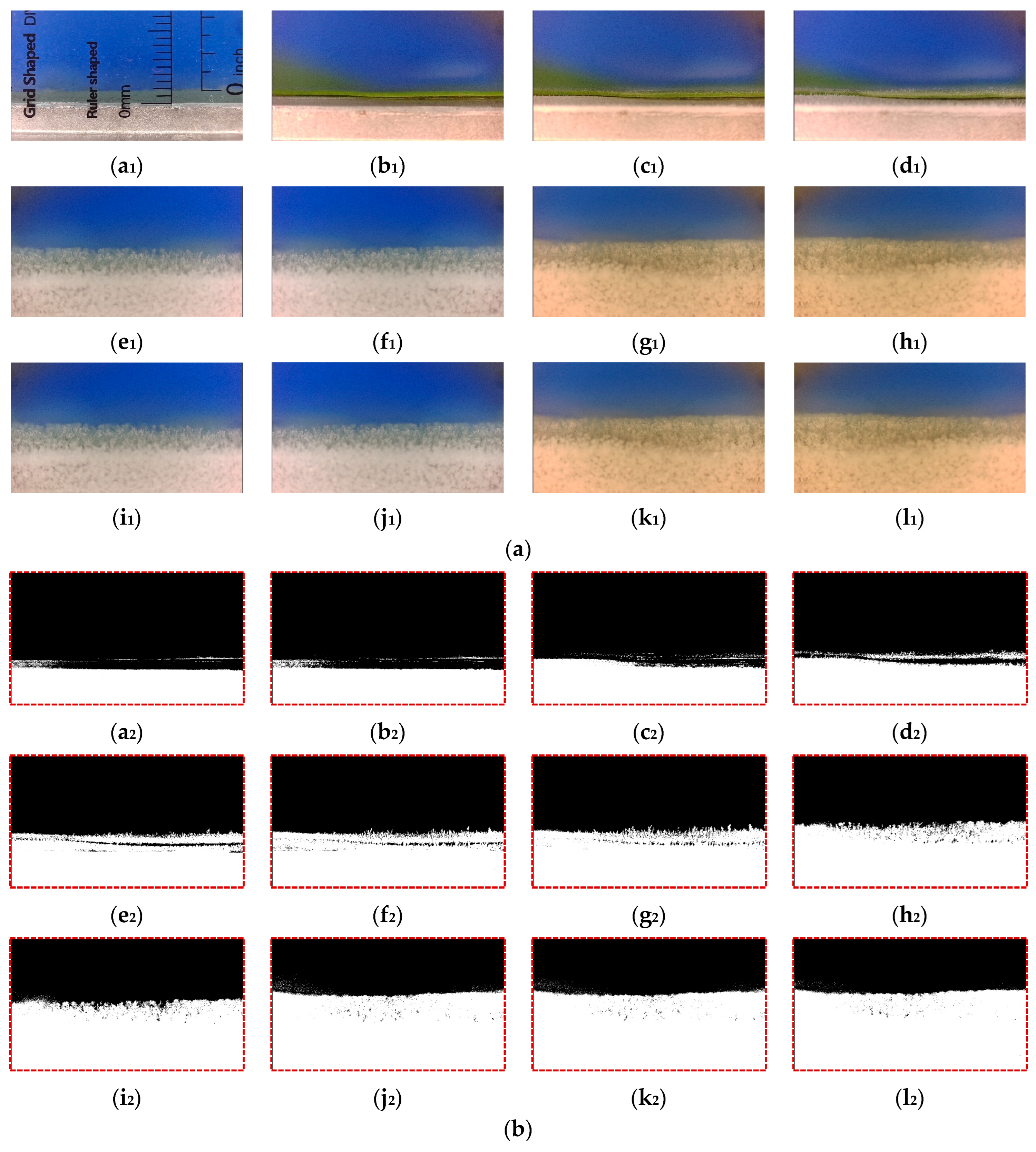
Based on image processing technology for measuring frost thickness, the acquired original images first underwent grayscale preprocessing. Gaussian filtering was then applied to denoise the grayscale images. Subsequently, an adaptive threshold segmentation algorithm was used to obtain the optimal threshold, finally converting the images to binary format. The calculation formula is as shown in Equation (6).
f t h i c k n e s s = i = 1 n W i n · Y
In the formula: f t h i c k n e s s is the average thickness of frost layer on leaf surface; W i is the number of pixels occupied by the frost layer in the i-th column; n is the number of columns in the image matrix; Y is the number of pixels occupied by 1 mm in the image.
The monitoring, segmentation and image processing of frost layer thickness at the microscopic scale are shown in Figure 12.

3.2.3. Quantitative Evaluation of Frost Segmentation Accuracy

To quantitatively evaluate the accuracy of the frost thickness segmentation algorithm, we compared the algorithm-derived thickness with manually annotated ground truth from 50 representative microscopic images. The key evaluation metrics are summarized in Table 3. The low MAE/RMSE confirm the robustness of the proposed segmentation method under nocturnal imaging conditions.

3.2.4. Quantitative Relationship Analysis Between Dielectric Spectrum and Frost Amount

To quantitatively characterize the relationship between the dielectric spectrum and the frost amount, scatter fitting was performed on all ΔC data collected during the night against the corresponding Mfrost and hfrost measurements. The results are shown in Figure 13. Data primarily from the mid-to-late stages of frost formation during the experiment were selected for this analysis. Specifically, data including capacitance, frost thickness, and mass were collected hourly from approximately 00:40 (around the onset of frosting) to 07:40 in the morning.
Analysis of Figure 13 reveals that capacitance exhibits a significant nonlinear positive correlation with both frost mass and thickness. In the early frost growth stage (low ΔC region), data points are more scattered. This confirms the discontinuous and uneven distribution characteristics of thin frost layers, leading to a degree of uncertainty in the capacitive response. As the frost amount increases, the data points converge into clear trend lines.
The high coefficients of determination (R2) for both relationships confirm that the denoised capacitive signal (ΔC) is a robust predictor for frost amount. The specific forms of the nonlinear regression models were selected after comparing multiple candidate functions, ensuring an optimal balance between fitting accuracy and model parsimony.
To further elucidate the trend characteristics of frost growth, the frosting process was divided into three phases based on ΔC trend: Phase I (Initial, ΔC < 50 pF), Phase II (Growth, 50 ≤ ΔC ≤ 200 pF), and Phase III (Saturation, ΔC > 200 pF). The average growth rates of frost mass and thickness in each phase are presented in Table 4. These quantitative results clearly demonstrate that the most rapid frost accumulation occurs during Phase II, aligning with the dendritic growth and bridging stage observed in the dielectric spectrum.
The coefficient of determination (R2) for capacitance versus frost thickness is slightly higher than that for capacitance versus mass, indicating that this system may be more sensitive to changes in the geometric morphology of the frost layer. This nonlinear relationship precisely reflects the complex physical nature of the frost layer as a porous medium, whose equivalent dielectric constant changes with thickness, density, and porosity simultaneously, rather than following a simple linear increase.

4. Capacitive Signal Denoising and Prediction Modeling Based on SWT-SSA-LSTM

Raw capacitive signals acquired in the field inevitably contain environmental noise and random interference, posing significant challenges for direct modeling and prediction. This chapter aims to construct an advanced hybrid intelligent analysis framework. It first performs high-fidelity denoising on the original dielectric spectrum signal, then utilizes an optimized deep learning model to capture its inherent temporal patterns, ultimately achieving high-precision prediction of the frosting process.
From the previous experimental results, it is evident that due to influences from field conditions such as wind speed, humidity, and human activity, the capacitive parameter time series data exhibit characteristics of nonlinearity, non-stationarity, and randomness. Furthermore, influences from the monitoring equipment and methods subject the capacitive time series to certain complex noise interference. To improve capacitive prediction accuracy, current research often employs signal decomposition techniques to preprocess and denoise the non-stationary original capacitive time series. This approach helps deeply excavate all features of the capacitance sequence and reduces the interference of noise on the sequence.

4.1. Overall Architecture of the Hybrid Prediction Model

The SWT-SSA-LSTM hybrid model proposed in this study is a collaborative analysis system integrating signal processing, intelligent optimization, and deep learning. The model utilizes Synchrosqueezed Wavelet Transform (SWT) to decompose the non-stationary original signal into time-frequency components, thereby filtering out noise. Subsequently, the Sparrow Search Algorithm (SSA) is employed to automatically seek the optimal combination of hyperparameters for the Long Short-Term Memory (LSTM) network. Finally, the structurally optimized LSTM network executes robust and accurate time-series prediction tasks.
The novelty of our proposed SWT-SSA-LSTM framework lies in this dedicated integration: (1) The Synchrosqueezed Wavelet Transform (SWT) provides superior time-frequency resolution for denoising non-stationary capacitive signals, outperforming conventional methods [25]. (2) The Sparrow Search Algorithm (SSA) automatically optimizes LSTM hyperparameters, enhancing prediction accuracy and avoiding manual trial-and-error [26]. (3) The optimized LSTM then captures the temporal dynamics of frost growth. This synergy specifically targets the shortcomings of applying generic models to noisy, field-based agricultural data.

4.2. (SWT) Signal Denoising: Synchrosqueezed Wavelet Transform (SWT)

Traditional Fourier Transform or Discrete Wavelet Transform often face challenges like insufficient resolution or mode mixing when processing non-stationary signals. Synchrosqueezed Wavelet Transform (SWT), as an advanced time-frequency reassignment technique, can focus on the intrinsic modes of a signal with higher time-frequency resolution.
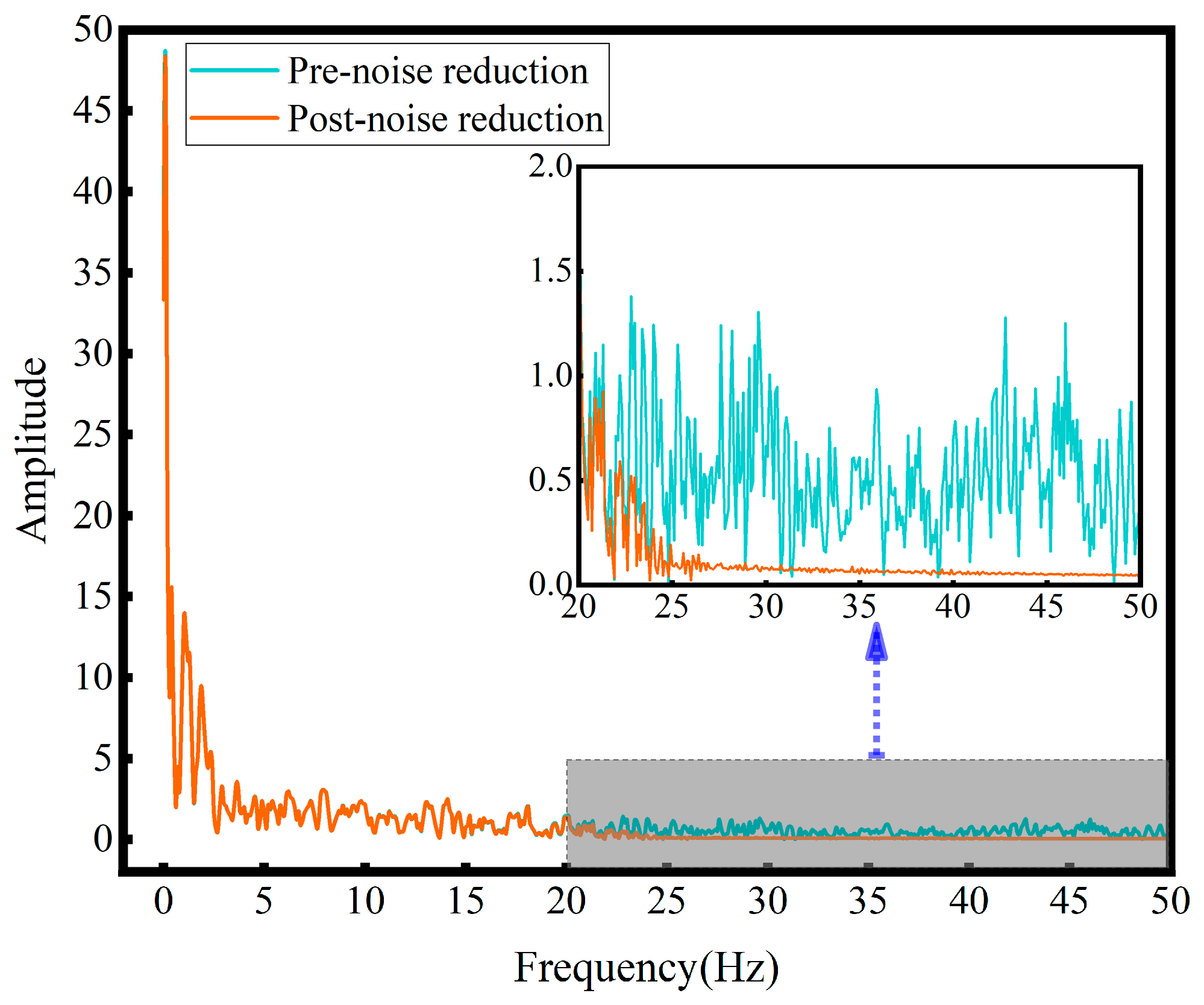
The implementation of SWT is a multi-step refinement process. First, it performs a Continuous Wavelet Transform (CWT) on the original capacitive signal s(t), obtaining its detailed coefficients W s   a , b in the wavelet domain. Next to, the algorithm calculates the instantaneous frequency ω s   a , b at each time-scale point, akin to creating a precise profile of the signal’s change rate. Finally, SWT intelligently “squeezes” and superimposes all wavelet coefficients belonging to the same instantaneous frequency, thereby forming clear, sharp time-frequency ridges on the time-frequency plane. Its mathematical expression is T s w l , b = ( Δ w ) 1 a k : w a k , b w l Δ w / 2 W s a k , b   a k 3 / 2 ( Δ a ) k . This process effectively separates the genuine signal components characterizing frost growth from scattered noise. Figure 14 visually demonstrates SWT’s superior time-frequency focusing and noise suppression capabilities.

4.3. (LSTM) Sequence Prediction: Long Short-Term Memory (LSTM) Network

For frost amount measurement under natural radiative frost night conditions, real-time detection is not only time-consuming and labor-intensive but also prone to significant errors. To meet the demand for more timely detection, or even to predict frost occurrence in advance, a predictive model is required. This prediction model is based on the capacitive sensor, establishing a calibration relationship through the rapid response to changes in frost thickness and mass, thereby providing predictions for the quantified stages occurring in the mid-to-late frosting period within a certain error margin. Therefore, this paper introduces the Long Short-Term Memory (LSTM) neural network to achieve capacitance prediction under different frost amounts.
LSTM is a special type of recurrent neural network featuring memory and forget mechanisms, addressing the vanishing and exploding gradient problems encountered during training with traditional recurrent neural networks using backpropagation through time [27,28,29,30]. In temporal processing, LSTM can fully utilize the temporal correlations of the original sequence, offering advantages over other machine learning methods [31,32].
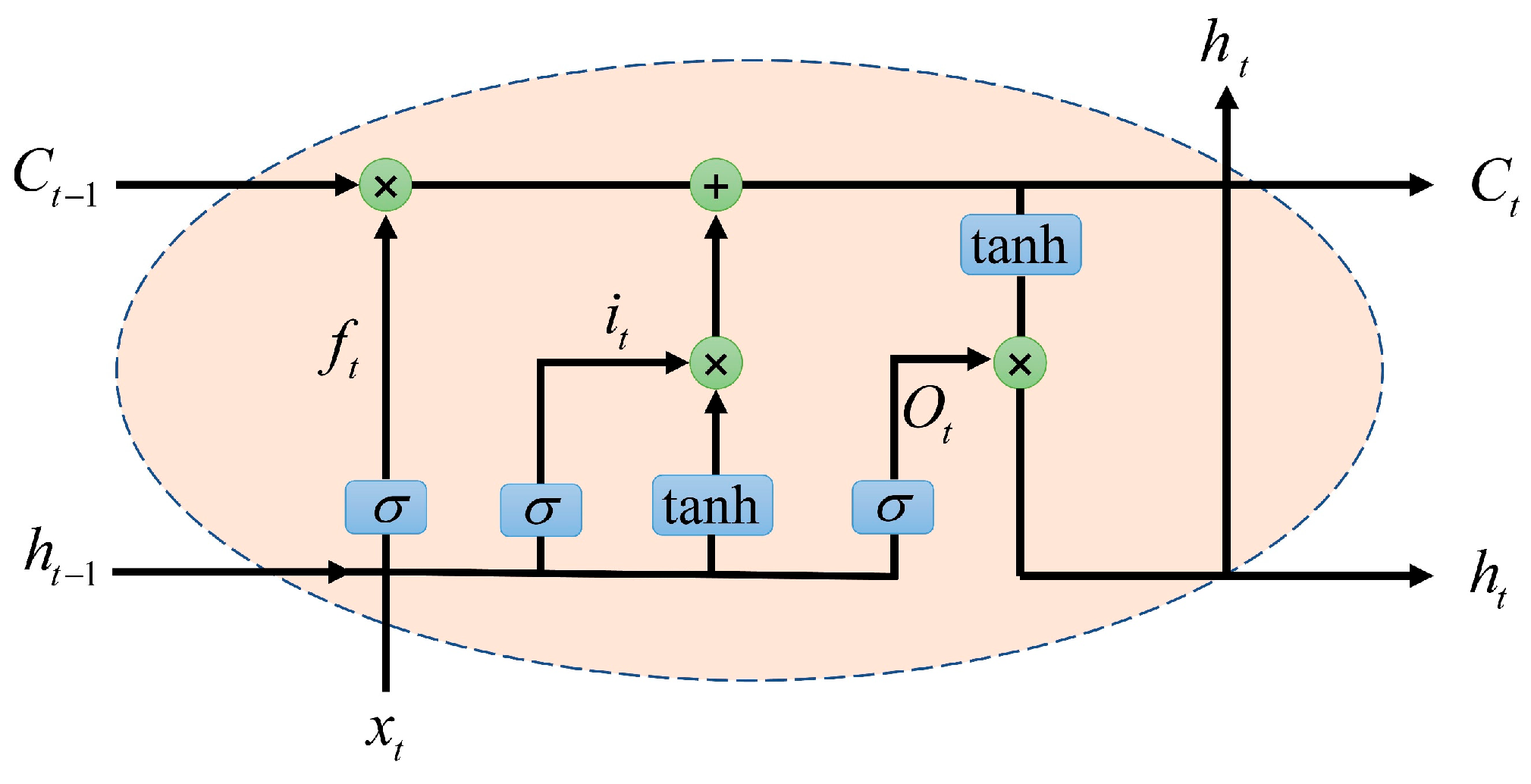
A standard LSTM memory cell is illustrated in the figure. In Figure 15, C represents the cell state of the LSTM memory, and h represents the hidden state of the node. Each memory cell contains one or more memory units and three types of “gates”. LSTM stores information in the cell state via memory units, while the gate structures are responsible for updating and maintaining the cell state. The three gates are the “forget gate”, “input gate”, and “output gate”.
Specifically, at each time step, the LSTM unit executes a series of precise internal operations. The forget gate ft is responsible for deciding which minor information should be discarded from the past memory Ct−1. The input gate it works in conjunction with a Tanh layer to jointly screen and update valuable new information C~t from the current input xt into the cell state. Subsequently, the cell state is updated to Ct = ftCt−1 + itC~t, achieving the discarding of old and incorporation of new memories. Finally, the output gate ot, based on the updated cell state, outputs the hidden state for the current time step ht = ot⊙tanh(Ct). This state contains both historical context and an understanding of the current input. This mechanism enables LSTM to effectively learn and remember long-term dependencies spanning several hours in the frosting process.

4.4. (SSA) Model Optimization: Sparrow Search Algorithm (SSA)

The performance of an LSTM model is highly dependent on its hyperparameter configuration. Manual tuning is not only inefficient but also often fails to find the optimal solution. The Sparrow Search Algorithm (SSA), which simulates the foraging and anti-predation behavior of sparrow populations, provides a novel solution for automated and efficient hyperparameter optimization.
The Sparrow Search Algorithm (SSA) is a novel intelligent algorithm designed based on the behavior of sparrows foraging and evading predators. SSA designates individuals with better fitness as “discoverers”, the remaining sparrows as “followers”, and randomly selects a certain proportion of sparrows from the population as “scouts” or “alert individuals”. The position of the i-th sparrow in the search space can be represented as X = [ x i , 1 , x i , 2 , · · · , x i , n ] T , where i = 1, 2, …, N, d is the spatial dimension, and N is the total number of sparrows. The position update formulas for producers, followers, and alert individuals are as follows respectively:
X i , j t + 1 = X i , j t · exp i α · i t e r max i f   R 2 < S T X i , j t + Q · L i f   R 2 S T
X i , j t + 1 = Q · exp X w o r s t   X i , j t i 2   i f   i > n / 2 X p t + 1 + X i , j t X P t + 1 · A + · L   o t h e r w i s e  
X i , j t + 1 = X b e s t t + β · X i , j t X b e s t t i f f i > f g X i , j t + K · X i , j t X w o r s t t f i f w + ε i f f i = f g
In the equations, j = 1, 2, …, d, t is the current iteration number, itermax is the maximum number of iterations, and α ( 0 , 1 ] . R2 and ST represent the warning value and safety threshold, respectively, where R2 ∈ [0, 1], ST ∈ [0.5, 1]. Q is a random number following a standard normal distribution. L is a 1 × d matrix with all elements equal to 1. Xworst is the global worst position, and x e t + 1 represents the best position occupied by a producer at generation t + 1. A is 1 × d matrix, with each element randomly assigned a value of 1 or −1, and A + = A T A A T 1 . X b e s t t is the global best position. Β is a step-size control parameter, following a normal distribution with a mean of 0 and a variance of 1. K is a step control parameter with K ∈ [−1, 1]. fg and fw are the global best and worst fitness values, respectively, and fi is the fitness value of the i-th sparrow.
Within the intelligent swarm of SSA, individuals are categorized into three roles: discoverers, followers, and vigilants. Discoverers, assumed by the sparrows with the best fitness, lead the population in exploring broader search areas. Their position update strategy balances global exploitation and local exploration. Followers, by observing and competing for the food sources found by discoverers, conduct fine-grained searches around promising areas. Vigilants are responsible for danger warning. They are randomly generated within the population with a certain probability and guide individuals to fly toward the global best position or escape from an unfavorable current area, effectively preventing the population from becoming trapped in local optima. Through this mechanism of division of labor, cooperation, and competition, SSA agilely and precisely locates the optimal parameter combination (including the number of neurons in LSTM hidden layers, learning rate, etc.) that minimizes the model’s prediction error within our hyperparameter space.

4.5. Algorithm Flow and Key Parameters

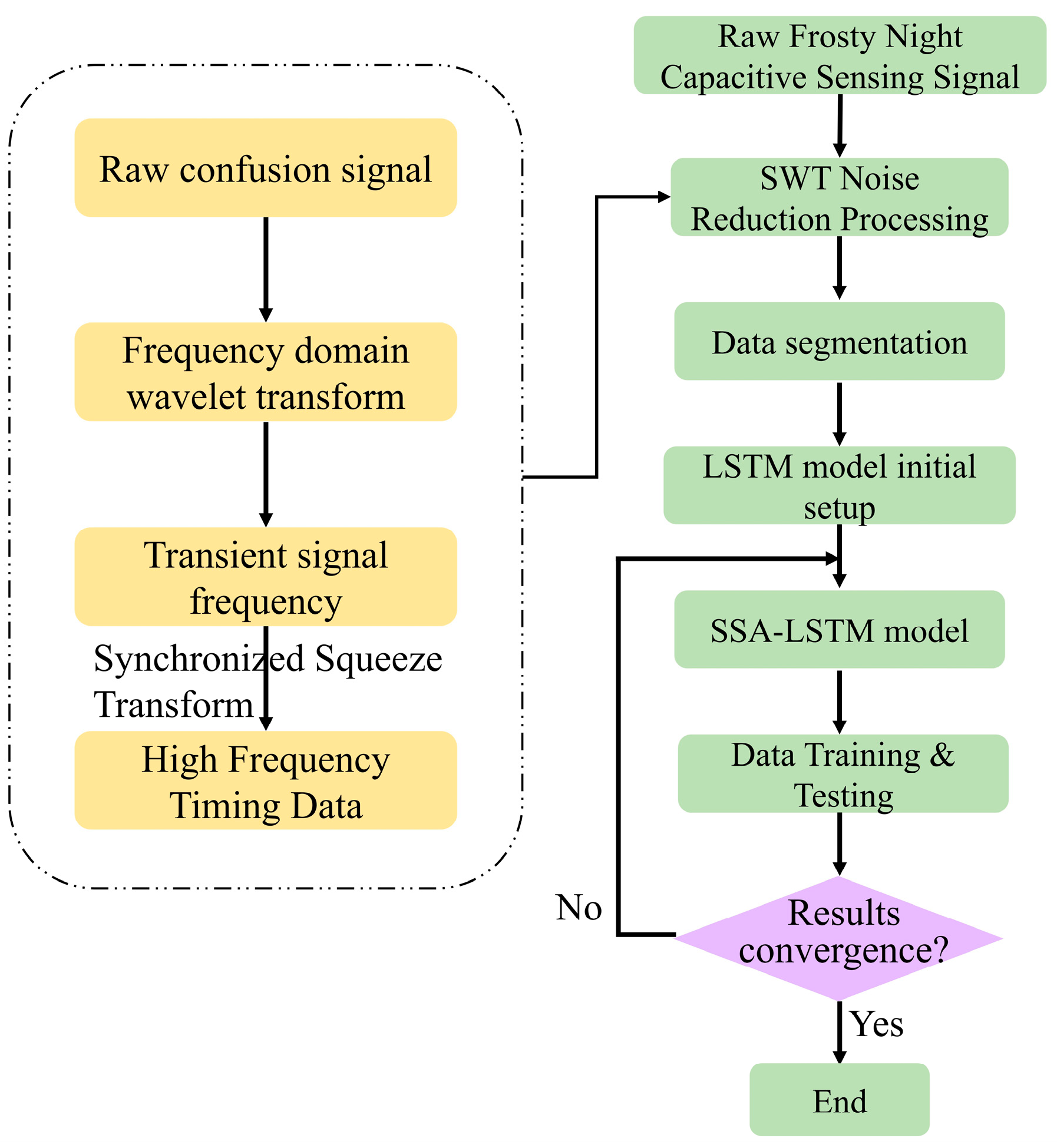
The flowchart of the capacitance parameter prediction model based on SWT-SSA-LSTM is shown in Figure 16. The algorithm’s operation process mainly includes the following steps:
(1)
Denoise the capacitive time-series data using the SWT method, which primarily consists of three sub-steps: Continuous Wavelet Transform (CWT), instantaneous frequency acquisition, and compression and reconstruction.
(2)
Optimize the LSTM model using SSA to construct the SSA-LSTM combined prediction model.
(3)
Input the SWT-denoised data into the SSA-LSTM model for rolling prediction. Compare the results with other methods using error evaluation metrics to analyze the predictive performance of the proposed model.
For the LSTM model selected in this paper, four parameters significantly impact algorithm performance: the number of neurons in the LSTM hidden layers L1 and L2 (where L1 and L2 refer to the number of LSTM units in the first and second layers, respectively), the learning rate ε, and the training iteration count k. Consequently, the optimization dimension for the Sparrow Search Algorithm is 4. The search ranges are set to [1, 100], [1, 100], [1, 50], and [0.001, 0.01] for these parameters, respectively. The remaining SSA parameters are configured as follows: sparrow population size = 10, discoverer proportion = 20%, vigilant proportion = 10%, maximum iterations = 30, and fitness function = Mean Squared Error (MSE). For the LSTM model used in comparison, the parameters are set as: number of neurons in the first hidden layer = 200, number in the second hidden layer = 200, and training epochs = 20. Seventy percent (70%) of the data was used as the training set, with the remaining 30% allocated as the test set.

4.6. Results and Analysis

Six metrics were employed to quantitatively evaluate the model performance: Mean Absolute Error (MAE), Mean Absolute Percentage Error (MAPE), Root Mean Square Error (RMSE), Coefficient of Determination (R2), Correlation Coefficient (CC), and Nash–Sutcliffe Efficiency Coefficient (NSC). These six metrics were selected to comprehensively evaluate the prediction accuracy (MAE, RMSE), relative error (MAPE), explanatory power (R2, NSC), and linear correlation (CC) of the models. The definitions of these metrics are as follows:
M A E = 1 n i = 1 n y ^ i y i
R M S E = 1 n i = 1 n y ^ i y i 2
R 2 = i = 1 n y ^ i y ¯ 2 i = 1 n y i y ¯ 2
C C = i = 1 n y ^ i y ^ i ¯ y i y i ¯ i = 1 n y ^ i y i ¯ 2 i = 1 n y i y i ¯ 2
N S C = 1 i = 1 n y i y ^ i 2 i = 1 n y i y i ¯ 2
where: n is the number of test samples; y ^ i and y i are the predicted and actual capacitance values at time i, respectively; y ¯ is the mean of the actual values.

4.6.1. SWT-SSA-LSTM Results

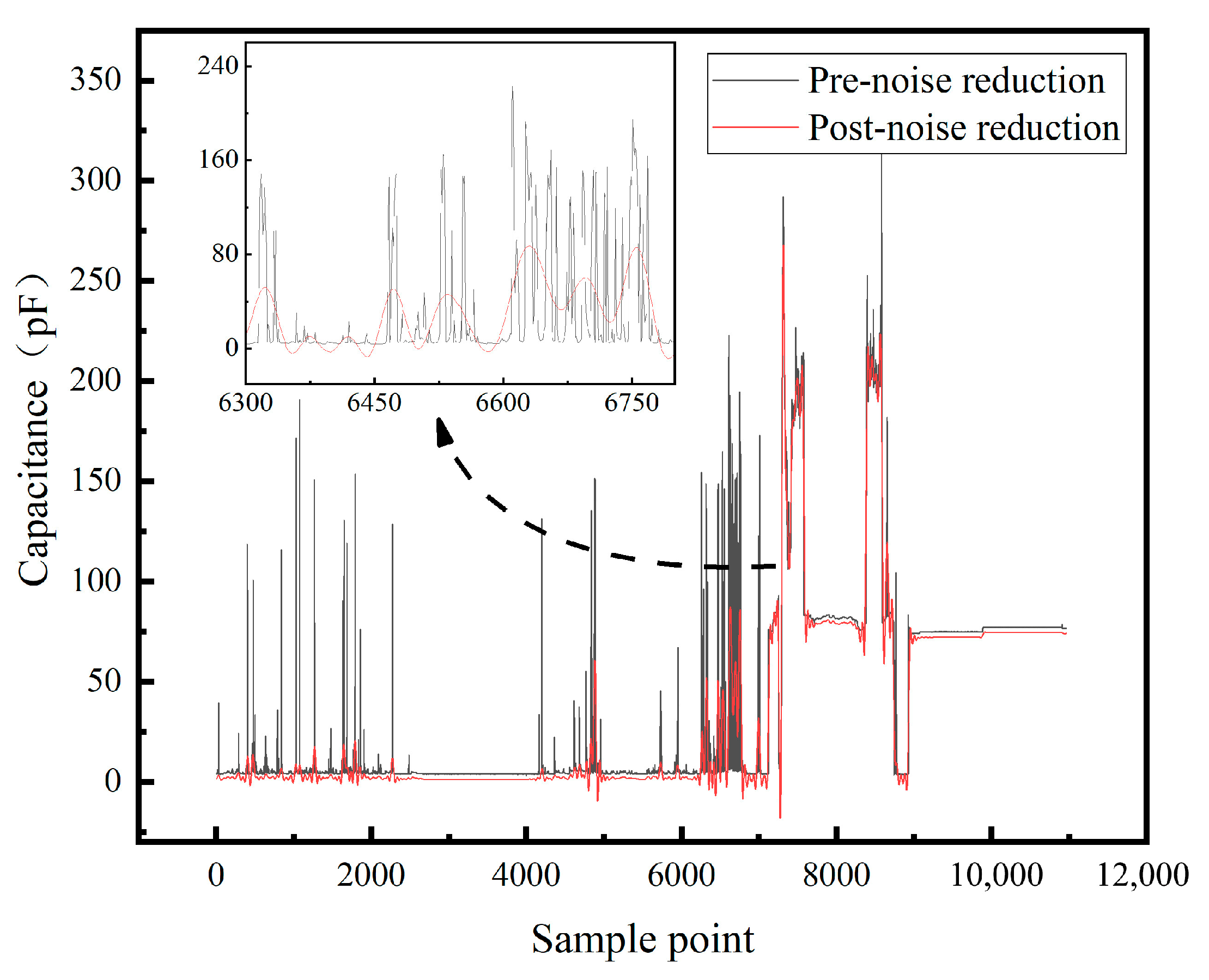
Figure 17 shows a comparison of the response capacitance data before and after denoising. It can be observed that after denoising with SWT, the anomalous noise present in the raw data has been effectively filtered out.
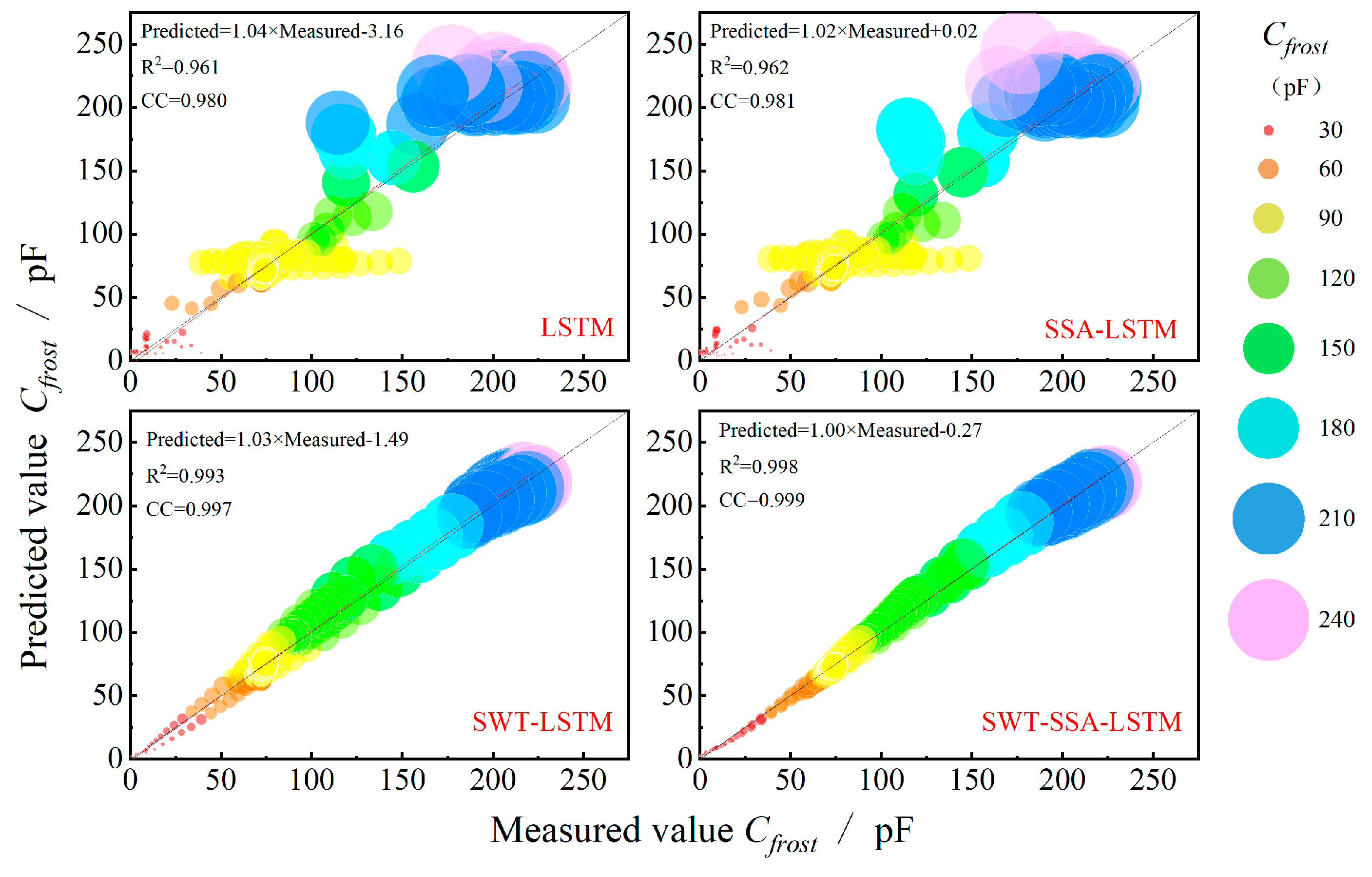
The correlation between the capacitance measurements and the predictions made by the applied algorithm is presented in Figure 18. The black and red lines represent the y = x reference line and the regression line, respectively. It can be seen that the predicted values from the SWT-SSA-LSTM model exhibit the highest degree of fit with the measured values. The close clustering of data points around the ideal line and the high R2 value (implied by the tight fit of the regression line) visually confirm the model’s high prediction accuracy.

4.6.2. Model Performance Analysis and Comparison

To objectively assess the superiority of the proposed SWT-SSA-LSTM model, a comprehensive comparison was conducted against several mainstream time-series prediction models, including the standard LSTM, SSA-LSTM, and SWT-LSTM.
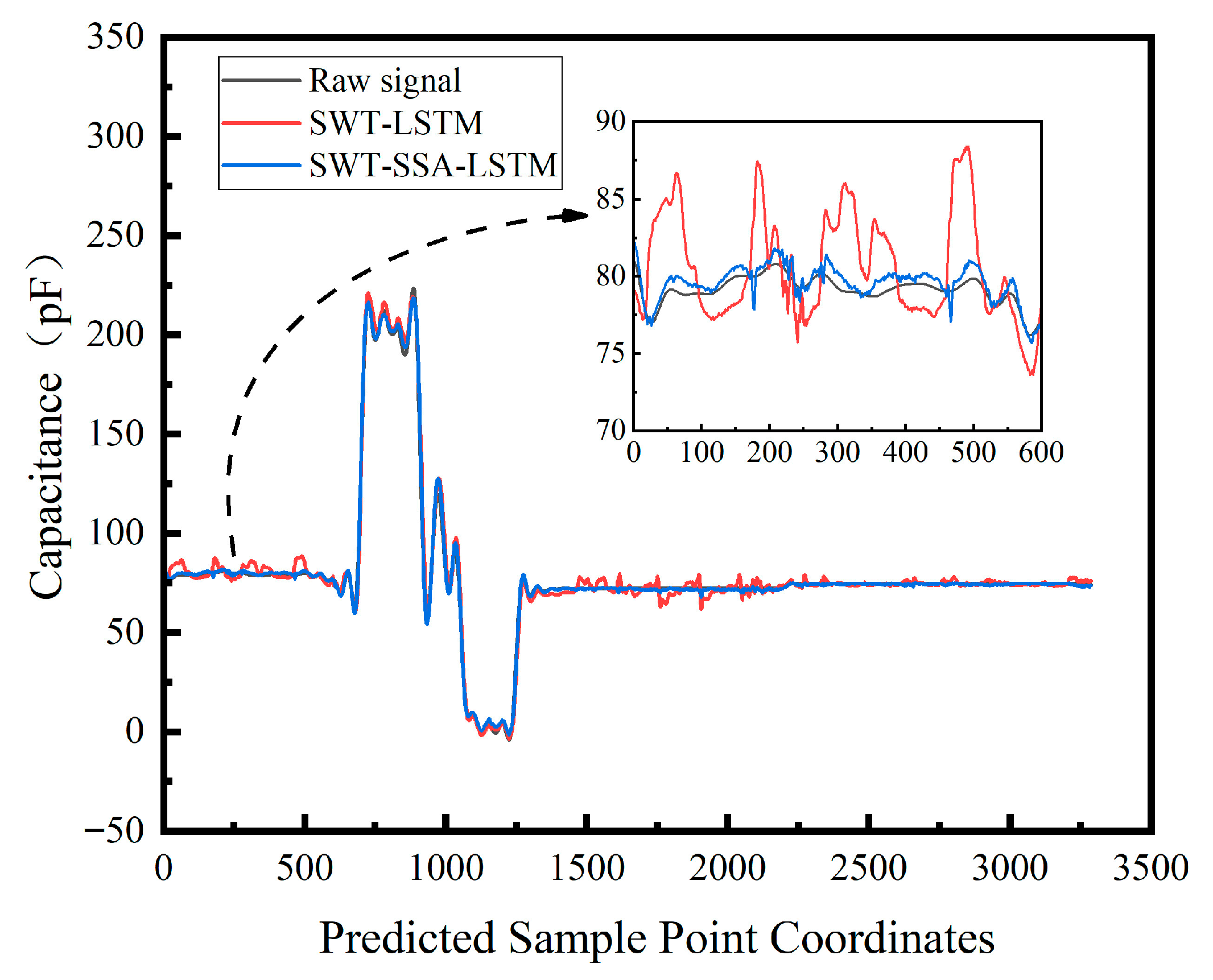
Figure 19 visually illustrates the fitting of the prediction curves from different models to the true values on the test set. It is clearly observable that the prediction trajectory of SWT-SSA-LSTM (red curve) adheres most closely to the true values (black curve), almost perfectly replicating the main fluctuations and trends of the capacitance signal.
Quantitative metrics further corroborate this visual conclusion. As shown in Table 2, the SWT-SSA-LSTM model achieved the best performance across all six evaluation metrics. Notably, it also significantly outperformed classical machine learning models such as Support Vector Regression (SVR), which, while powerful for many tasks, are less suited for capturing complex temporal dependencies in sequential data like our capacitance series. Its Root Mean Square Error (RMSE) was as low as 1.475, and its Mean Absolute Error (MAE) was merely 0.814, significantly lower than the other compared models. More importantly, its Coefficient of Determination (R2) reached 0.998, and the Nash-Sutcliffe Efficiency Coefficient (NSC) reached 0.998, A concise summary of the quantitative comparison is provided in Table 5. The SWT-SSA-LSTM model achieves the lowest error metrics (MAE, MAPE, RMSE) and the highest goodness-of-fit scores (R2, CC, NSC), demonstrating its superior performance against all baseline and comparison models. Indicating that this model could explain almost all of the variation information in the capacitance sequence, and the predicted values showed near-complete consistency with the actual values.

5. Frost Amount-Capacitance Regression Model and Validation

Based on the high-quality denoised dielectric spectrum data, this chapter aims to establish an accurate mathematical mapping from the capacitive signal to the physical parameters of the frost layer, i.e., constructing a frost amount-capacitance regression model. This model serves as the final bridge for transitioning frost quantification monitoring from “signal” to “application.” Nonlinear regression equations were established separately for frost mass and thickness, and independent field trials were designed to comprehensively validate the predictive performance of the models.

5.1. Nonlinear Frost Amount-Capacitance Regression Model

Scatter plots have clearly revealed a significant nonlinear relationship between the denoised capacitance value (x) and both Frost Mass (ym) and frost thickness (yt). This nonlinearity originates from the dynamic evolution of microstructural parameters such as density and porosity during frost layer growth. To accurately capture this complex relationship, we abandoned simple linear models and instead employed the nonlinear least squares method, coupled with a global optimization strategy, to fit and screen various functional forms.
After rigorous model comparison and goodness-of-fit testing, we determined the optimal regression equation forms for the two frost amount indicators.
y m = p 1 + p 2 · x + p 3 · x 2.5 + p 4 x + p 5 · ln ( x ) x
where the fitting parameter values are: p1 = −108.77, p2 = 0.203, p3 = −1.256, p4 = 1827.849, p5 = −2027.984. The model’s correlation coefficient (R) is as high as 0.961, indicating that the capacitive signal can extremely effectively explain the variation in Frost Mass.
For frost thickness (yt), the relationship is described by a rational function under a square root:
y t = p 1 + p 3 · x + p 5 · x 2 1 + p 2 · x + p 4 · x 2
where the fitting parameter values are: p1 = 1.126, p2 = −0.056, p3 = −0.081, p4 = 0.001, p5 = 0.001. This model exhibits superior fitting performance, with a correlation coefficient (R) of 0.987, nearly completely characterizing the intrinsic relationship between capacitance and frost thickness.
Table 6 shows the fitting results for the two frost amount indicators against capacitance, evaluated using five metrics: Root Mean Square Error (RMSE), Sum of Squared Errors (SSE), Correlation Coefficient (R), Coefficient of Determination (R2), and the Determination Coefficient (DC). It can be seen that both frost amounts exhibit high correlation with capacitance. The RMSE for the frost mass-capacitance model is lower than that for the thickness-capacitance model, indicating slightly better regression stability for the former. In terms of SSE, the former is closer to zero, suggesting smaller fitting errors compared to the latter. For the correlation coefficient (R) and the coefficient of determination (R2), the latter model’s values are closer to 1, indicating better performance. However, overall, the calibration of both frost amount indicators with capacitance demonstrates that both models have excellent predictive performance and can serve as regression equations for estimating frost amount.
The comprehensive evaluation metrics in Table 3 indicate that both regression models possess high prediction accuracy and reliability. The frost mass-capacitance model has lower RMSE and SSE, showing its predictions are more stable with less fluctuation. The frost thickness-capacitance model excels in correlation metrics, indicating a stronger linear association with the capacitive signal.

5.2. Independent Model Validation and Error Analysis

To test the generalization ability of the above regression models on unseen data, we collected a completely new set of 7 groups of field trial data on different dates to serve as an independent validation set. These data were collected on separate nights from the main experiment, covering a similar range of meteorological conditions (air temperature: −4.1 to 2.5 °C; humidity: 78% to 96%) to ensure representativeness. This dataset was entirely excluded from the training and fitting process of the aforementioned models.
Table 7 presents detailed validation results. Overall, the models performed excellently in most cases, especially during the mid-to-late stages when frost development was more substantial (e.g., groups 4, 5, 6, 7), where prediction errors were significantly reduced, even reaching zero error. However, during the initial frosting stage (e.g., groups 1, 2, 3), the errors were relatively larger.
The newly added error rate columns in Table 4 provide a direct measure of prediction accuracy. Excluding the initial growth stages (Groups 1–3, where thin and discontinuous frost distribution leads to higher uncertainty), the model achieves remarkably low error rates for both mass and thickness in the mid-to-late frost stages (Groups 4–7). The mean absolute error rate for frost mass prediction across all 7 groups is approximately 26.32%, and for thickness it is 21.28%. When focusing on the more stable mid-to-late stages (Groups 4–7), these rates drop to 13.03% for mass and 6.10% for thickness, respectively. This quantitative validation confirms that the regression models are not only fitted well to the training data but also generalize effectively to independent field measurements, with accuracy sufficient for practical monitoring applications during the critical frost accumulation period.

5.3. In-Depth Analysis of Error Sources

Non-uniformity and Measurement Uncertainty of Thin Frost Layers: In the initial frosting stage, frost crystals are sporadically and discontinuously distributed, resulting in a weak capacitive signal response and low signal-to-noise ratio. At this stage, minor fluctuations in capacitance measurement or noise interference can be amplified during calibration, leading to larger relative errors. Simultaneously, inherent pixel-level errors exist when measuring extremely thin frost layers using imaging methods.
Inherent Limitations of the Model: The established polynomial regression model’s predictive behavior in data-sparse regions (very low capacitance values) may be unstable, a common phenomenon in data-driven models.
Environmental Perturbations: Despite denoising, sudden intense environmental disturbances, such as strong gusts of wind, can still cause instantaneous changes in frost layer morphology or sensor readings, introducing random errors.
In summary, this study successfully constructed high-precision regression models between Frost Mass/thickness and the capacitive signal. Independent validation demonstrates that these models possess high prediction accuracy and reliability during the mid-to-late stages of frost growth, fully meeting the requirements of precision agriculture for quantitative frost amount monitoring. The errors in the initial frosting stage objectively reflect the worldwide challenge of thin frost layer monitoring and also point the way for future research to further optimize by incorporating more initial-stage samples or combining machine learning models.

6. Conclusions

Addressing the challenge of in-situ, quantitative monitoring of frost on plant leaf surfaces, this study proposed and validated a comprehensive technical solution integrating dielectric spectrum analysis with hybrid intelligent algorithms. The main conclusions are as follows:
A capacitive sensing system based on mesh electrodes was successfully developed. This system can in-situ and continuously capture the dynamic dielectric spectrum response on the leaf surface caused by frost growth without interfering with the natural frosting process, thereby enabling reliable, non-invasive monitoring in real field conditions.
An innovative SWT-SSA-LSTM hybrid intelligent model was constructed. This model effectively addresses the issues of non-stationarity and strong noise interference in field capacitive signals and achieves high-precision temporal prediction of the frosting process, which is crucial for providing early warning and enabling proactive frost defense.
Nonlinear regression models were precisely established between the denoised capacitive signal and the physical parameters of the frost layer (mass and thickness). Independent experiments verified their excellent reliability and generalization capability in quantifying mid-to-late-stage frost, directly translating the sensed signal into actionable quantitative metrics (mass and thickness) for farmers and decision-support systems.
This study realizes a complete technical closed-loop from physical perception and signal processing to intelligent prediction and final quantification. The integrated solution provides a practical and innovative technical pathway for precise frost disaster monitoring and early warning in smart agriculture, moving beyond qualitative judgment towards data-driven management.
Future work will focus on exploring the direct relationship between dielectric spectrum features and the microstructure of frost layers and investigating the model’s universality across different crop species and under more complex meteorological conditions, to advance this technology from experimental prototypes to large-scale field applications.

Author Contributions

Conceptualization, H.S.; methodology, H.S.; validation, Y.G. and L.W.; formal analysis, H.S. and L.W.; data curation, H.S.; writing—original draft preparation, H.S.; writing—review and editing, H.S. and B.T.; visualization, Y.G. and S.G.; supervision, H.S. and Y.H.; project administration, H.S.; funding acquisition, H.S. All authors have read and agreed to the published version of the manuscript.

Funding

This research was funded by National Natural Science Foundation of China, grant number (No. 32401692), Henan Province Science and Technology Research Project, grant number (No. 242102110336), Key Research Programs of Higher Education Institutions in Henan Province, (No. 25B416001).

Institutional Review Board Statement

Not applicable.

Informed Consent Statement

Not applicable.

Data Availability Statement

The original contributions presented in this study are included in the article. Further inquiries can be directed to the corresponding authors.

Conflicts of Interest

The authors declare no conflicts of interest.

References

  1. Kimura, K.; Kudo, K.; Maruyama, A. Spatiotemporal distribution of the potential risk of frost damage in tea fields from 1981–2020: A modeling approach considering phenology and meteorology. J. Agric. Meteorol. 2021, 77, 224–234. [Google Scholar] [CrossRef]
  2. Liu, T.; Zhang, S.; Sun, T.; Ma, C.; Xue, X. Review of active plant frost protection equipment and technologies: Current status, challenges, and future prospects. Agronomy 2025, 15, 1164. [Google Scholar] [CrossRef]
  3. Feng, X.; Zhang, X.; Tian, G. Recent advances in bioinspired superhydrophobic ice-proof surfaces: Challenges and prospects. Nanoscale 2022, 14, 5960–5993. [Google Scholar] [CrossRef] [PubMed]
  4. Wu, L.; Zhang, L.; Jiang, J.; Zhang, X.; Shen, J.; Song, M. Growth and behavior characteristics of frost crystals on a single micro-sized frozen droplet at different surface temperatures. Int. Commun. Heat Mass Transf. 2024, 159, 108040. [Google Scholar] [CrossRef]
  5. Zhao, Y.; Yang, C. Frost spreading on microscale wettability/morphology patterned surfaces. Appl. Therm. Eng. 2017, 121, 136–145. [Google Scholar] [CrossRef]
  6. Deng, Y.; Chen, H. Precision Pest Management: IoT and Remote Sensing in Tea Plant Protection. Mol. Entomol. 2024, 15, 209–220. [Google Scholar] [CrossRef]
  7. Aggarwal, K.; Reddy, G.S.; Makala, R.; Srihari, T.; Sharma, N.; Singh, C. Studies on energy efficient techniques for agricultural monitoring by wireless sensor networks. Comput. Electr. Eng. 2024, 113, 109052. [Google Scholar] [CrossRef]
  8. Cardamis, M.; Jia, H.; Qian, H.; Chen, W.; Yan, Y.; Ghannoum, O.; Hu, W. Leafeon: Towards Accurate Sensing of Leaf Water Content for Protected Crop, with mm Wave Radar. IEEE Internet Things J. 2025, 12, 19646–19659. [Google Scholar] [CrossRef]
  9. Shen, Y.; Wang, X. Real-time frost porosity detection using capacitance sensing approach. Int. J. Heat Mass Transf. 2019, 134, 1171–1179. [Google Scholar] [CrossRef]
  10. Hakobyan, D.; Hamdi, M.; Redon, O.; Ballestero, A.; Mayaudon, A.; Boyer, L.; Abraham, E. Non-destructive evaluation of ceramic porosity using terahertz time-domain spectroscopy. J. Eur. Ceram. Soc. 2022, 42, 525–533. [Google Scholar] [CrossRef]
  11. Su, Z.; Zhou, F.; Liang, J.; Liu, A.; Wang, J.; Liang, J.; Yang, J. Fractal theory based identification model for surface crack of building structures. Eng. Struct. 2024, 305, 117708. [Google Scholar] [CrossRef]
  12. Song, H.; Hu, Y. Detecting emerging frost crystals on leaf surfaces using microscopic imaging. Comput. Electron. Agric. 2023, 210, 107931. [Google Scholar] [CrossRef]
  13. Hosseini, S.H.; Valizadeh, M.; Zendehboudi, A.; Song, M. General correlation for frost thermal conductivity on parallel surface channels. Energy Build. 2020, 225, 110282.1–110282.9. [Google Scholar] [CrossRef]
  14. Qiu, G.; Li, S.; Shi, Y.; Fang, X.; Cai, W. Development and validation of a numerical model for frost growth based on nucleation theory. Int. J. Heat Mass Transf. 2024, 221, 125137. [Google Scholar] [CrossRef]
  15. Shen, Y.; Zou, H.; Wang, S. Detection of frost growth and distribution on louver and offset strip fins of a microchannel heat exchanger using capacitance sensing approach. Int. J. Heat Mass Transf. 2023, 217, 124650. [Google Scholar] [CrossRef]
  16. Song, H.; Hu, Y. A predictive model of frost formation on leaf surface and estimation of frost amount. Case Stud. Therm. Eng. 2023, 43, 102789. [Google Scholar] [CrossRef]
  17. Roell, Y.E.; Beucher, A.; Møller, P.G.; Greve, M.B.; Greve, M.H. Comparing a random forest based prediction of winter wheat yield to historical yield potential. Agronomy 2020, 10, 395. [Google Scholar] [CrossRef]
  18. Ullah, K.; Ahsan, M.; Hasanat, S.M.; Haris, M.; Yousaf, H.; Raza, S.F.; Ullah, Z. Short-term load forecasting: A comprehensive review and simulation study with CNN-LSTM hybrids approach. IEEE Access 2024, 12, 111858–111881. [Google Scholar] [CrossRef]
  19. Zhou, I.; Lipman, J.; Abolhasan, M.; Shariati, N.; Lamb, D.W. Frost monitoring cyber-physical system: A survey on prediction and active protection methods. IEEE Internet Things J. 2020, 7, 6514–6527. [Google Scholar] [CrossRef]
  20. Yao, Y.D.; Li, X.; Cui, Y.P.; Wang, J.J.; Wang, C. Energy-efficient routing protocol based on multi-threshold segmentation in wireless sensors networks for precision agriculture. IEEE Sens. J. 2022, 22, 6216–6231. [Google Scholar] [CrossRef]
  21. Shan, Z.; Wang, Z.; Yang, J.; Zhou, D.; Liu, H. Extracting non-stationary signal under strong noise background: Time-varying system analysis. J. Vib. Control 2023, 29, 4036–4045. [Google Scholar] [CrossRef]
  22. Alizadegan, H.; Rashidi Malki, B.; Radmehr, A.; Karimi, H.; Ilani, M.A. Comparative study of long short-term memory (LSTM), bidirectional LSTM, and traditional machine learning approaches for energy consumption prediction. Energy Explor. Exploit. 2025, 43, 281–301. [Google Scholar] [CrossRef]
  23. Diwakar, M.; Tripathi, A.; Joshi, K.; Sharma, A.; Singh, P.; Memoria, M. A comparative review: Medical image fusion using SWT and DWT. Mater. Today Proc. 2021, 37, 3411–3416. [Google Scholar] [CrossRef]
  24. Marashdih, A.W.; Zaaba, Z.F.; Suwais, K. Predicting input validation vulnerabilities based on minimal SSA features and machine learning. J. King Saud Univ.-Comput. Inf. Sci. 2022, 34, 9311–9331. [Google Scholar] [CrossRef]
  25. Alhatami, E.; Aslam, B.U.; Huang, M.; Feng, S. Advanced fuzzy denoising technique for agricultural remote sensing: Modified partition filter for suppressing impulsive. IEEE Access 2024, 12, 159025–159035. [Google Scholar] [CrossRef]
  26. Wu, M.; Wu, J.; Tan, X.; Huang, J.; Jansson, P.E.; Zhang, W. Simulation of dynamical interactions between soil freezing/thawing and salinization for improving water management in cold/arid agricultural region. Geoderma 2019, 338, 325–342. [Google Scholar] [CrossRef]
  27. Chatterjee, R.; Chaudhari, U.; Anand, S. How to select phase change materials for tuning condensation and frosting. Adv. Funct. Mater. 2023, 33, 2206301. [Google Scholar] [CrossRef]
  28. Láznička, M.; Tůma, L.; Vandírková, V.; Wohlmuthová, M.; Kotek, M.; Kumhála, F.; Kumhálová, J. Monitoring of winter wheat growth in categories of frost damage and production potential using SAR and optical images. Int. Agrophys. 2025, 39, 99–111. [Google Scholar] [CrossRef] [PubMed]
  29. Liu, Y.; Ban, S.; Wei, S.; Li, L.; Tian, M.; Hu, D.; Liu, W.; Yuan, T. Estimating the frost damage index in lettuce using UAV-based RGB and multispectral images. Front. Plant Sci. 2024, 14, 1242948. [Google Scholar] [CrossRef] [PubMed]
  30. Guo, Z.; Feng, L. Multi-step prediction of greenhouse temperature and humidity based on temporal position attention LSTM. Stoch. Environ. Res. Risk Assess. 2024, 38, 4907–4934. [Google Scholar] [CrossRef]
  31. Ahmed, S.F.; Alam, M.S.B.; Hassan, M.; Rozbu, M.R.; Ishtiak, T.; Rafa, N.; Gandomi, A.H. Deep learning modelling techniques: Current progress, applications, advantages, and challenges. Artif. Intell. Rev. 2023, 56, 13521–13617. [Google Scholar] [CrossRef]
  32. Diedrichs, A.L.; Bromberg, F.; Dujovne, D.; Brun-Laguna, K.; Watteyne, T. Prediction of frost events using machine learning and IoT sensing devices. IEEE Internet Things J. 2018, 5, 4589–4597. [Google Scholar] [CrossRef]
Figure 1. Schematic diagram of the frosting stages.
Agriengineering 08 00067 g001
Figure 2. Schematic diagram of phase change paths and dielectric constant variation during frost formation on a plant leaf surface.
Agriengineering 08 00067 g002
Figure 3. Structural diagram of the capacitive in-situ frost monitoring system.
Agriengineering 08 00067 g003
Figure 4. Working principle of FDC2214 capacitance sensing. (a) System signal flow diagram. (b) Switched-capacitor and ADC conversion schematic.
Agriengineering 08 00067 g004
Figure 5. Parallel Plate Capacitor Model.
Agriengineering 08 00067 g005
Figure 6. Model for Frost and Ice Detection Based on Capacitance.
Agriengineering 08 00067 g006
Figure 7. Schematic diagram of the capacitive sensor system and its encapsulation principle. (Left) Sensing circuit board, built around the FDC2214 capacitance-to-digital converter and an external high-Q inductor for resonant frequency measurement. (Middle) Encapsulation and connection structure, providing waterproofing and mechanical stability for field deployment. (Right) Cross-sectional view of the mesh electrode assembly in contact with a plant leaf, illustrating the dielectric layers (air/water/frost) between the electrode and leaf surface that modulate the capacitance.
Agriengineering 08 00067 g007
Figure 8. A leaf from the ‘Maolü’ tea plant cultivar.
Agriengineering 08 00067 g008
Figure 9. Schematic diagram of the experimental site and sensor deployment.
Agriengineering 08 00067 g009
Figure 10. Schematic diagram of frost-covered leaf mass measurement process. The diagram illustrates the destructive sampling and weighing method. (al) frost-covered leaf sampling and weighing process at 60-min intervals.
Agriengineering 08 00067 g010
Figure 11. Temporal evolution of the dielectric spectrum (ΔC) and key environmental parameters during a representative frost night. The plot shows the high sensitivity of ΔC(t) to the frosting process, which can be divided into three phases: Latency, Rapid Growth, and Stable/Saturation. The concurrent trends of air temperature (T_a), relative humidity (RH), and leaf temperature (T_leaf) provide the environmental context.
Agriengineering 08 00067 g011
Figure 12. Monitoring, segmentation and image processing of frost layer thickness at the microscopic scale. (a1l1) are the original images of frost layer thickness collected at 60-min intervals; (a2l2) are the image processing results of (a1l1). (a) Original microscopic image of the frost-covered leaf surface. (b) Result after grayscale conversion, Gaussian filtering, and adaptive threshold segmentation, where the white regions represent the detected frost layer. The average thickness is calculated based on the pixel occupancy of these white regions across the image width.
Agriengineering 08 00067 g012
Figure 13. Scatter plots and fitting curves of dielectric spectrum (ΔC) versus frost amount.
Agriengineering 08 00067 g013
Figure 14. FFT spectrum before and after SWT denoising.
Agriengineering 08 00067 g014
Figure 15. Structure of an LSTM unit.
Agriengineering 08 00067 g015
Figure 16. Flowchart of the algorithm based on SWT-SSA-LSTM.
Agriengineering 08 00067 g016
Figure 17. Comparison of response capacitance data before and after denoising.
Agriengineering 08 00067 g017
Figure 18. Correlation between measured and predicted capacitance values for the SWT-SSA-LSTM model. The black dashed line represents the ideal line (y = x). The red solid line is the linear regression fit.
Agriengineering 08 00067 g018
Figure 19. Comparison of prediction performance among different models.
Agriengineering 08 00067 g019
Table 1. Dielectric Constants of Different Materials on the Surface.
Material Dielectric   Constant   ( ε r ) Remarks
Air~1--
Water~80At 20 °C
Water vapor~1.00007At 0 °C
Frost~2.3--
Ice~3.2--
Table 2. Meteorological conditions during the field experiment period.
Meteorological ParameterRange (Mean ± SD)
Air Temperature−5.2 °C to 3.8 °C (−1.4 ± 2.1 °C)
Relative Humidity72% to 98% (89 ± 7%)
Wind Speed0.1 m/s to 1.8 m/s (0.5 ± 0.4 m/s)
Table 3. Accuracy evaluation of frost thickness segmentation based on image processing.
Evaluation MetricValueRemarks
Mean Absolute Error (MAE)0.03 mmAverage absolute error between algorithmic and manual measurements
Root Mean Square Error (RMSE)0.05 mmRoot mean square error
Table 4. Average growth rates of frost mass and thickness across different frosting phases.
Frosting PhaseΔC Range (pF)Frost Mass Growth Rate (mg/h)Frost Thickness Growth Rate (mm/h)
Initial (I)<500.120.03
Growth (II)50–2000.850.18
Saturation (III)>2000.090.02
Table 5. Performance comparison of each model.
ModelMAEMAPE (%)RMSER2CCNSC
LSTM4.452132.13217.75720.960720.980160.95465
SSA-LSTM3.635729.67137.45060.962370.9810.95816
SWT-LSTM2.267610.90633.29200.993220.996610.99183
SVR4.987635.12348.12340.951230.975300.94518
SWT-SSA-LSTM0.8143813.94581.47500.998410.99920.99836
Table 6. Goodness-of-fit for the regression models of two frost amount indicators versus capacitance.
Goodness of Fit MetricFrost Amount
Frost Mass-Capacitance ModelFrost Thickness-Capacitance Model
Root of Mean Square Error (RMSE)0.0250.198
Sum of Square Error (SSE)0.0040.273
Correlation Coef. (R)0.9610.987
R-Square(R2)0.9240.975
Determination Coef. (DC)0.9230.966
Table 7. Model prediction performance on the independent validation set.
Exp. GroupPredicted ValueMeasured ValueFrost Mass Error Rate (%)Frost Thickness Error Rate (%)
CapacitanceFrost MassFrost ThicknessCapacitanceFrost MassFrost Thickness
115.2850.0520.1225.4060.0500.304.0060.00
275.3100.1590.45011.3660.0900.45076.670.00
378.7080.0682.9698.5940.1401.8051.4364.58
4272.5870.1792.479181.2380.1802.2700.569.21
5260.7890.3302.485199.2090.3302.9300.0015.19
674.5880.1792.75071.9190.2802.75036.070.00
774.9290.1692.58074.0150.2002.58015.500.00
Disclaimer/Publisher’s Note: The statements, opinions and data contained in all publications are solely those of the individual author(s) and contributor(s) and not of MDPI and/or the editor(s). MDPI and/or the editor(s) disclaim responsibility for any injury to people or property resulting from any ideas, methods, instructions or products referred to in the content.