1. Introduction
The continuous evolution of financial markets and a deepening understanding of financial decision-making have elevated portfolio optimization and diversification to a position of significant importance. The central challenge is to select a portfolio that balances returns and risks to achieve long-term stable asset growth. A pivotal moment in addressing this challenge came in 1952 with Markowitz’s seminal Portfolio Choice Theory [
1], which inaugurated the systematic application of mathematical methods in economics. By introducing the statistical parameters of mean and variance to quantify expected return and potential risk, Markowitz provided a scientific and systematic framework for optimal fund allocation.
However, the mean-variance model has exposed several limitations in practical application, such as difficulties in estimating the covariance matrix, high computational costs, and high sensitivity to parameter changes [
2,
3,
4,
5]. Furthermore, it often leads to highly concentrated portfolios, which contradicts the principle of diversification [
6,
7,
8]. In response, subsequent research has explored alternative risk measures and diversification metrics to build more robust and stable portfolios.
Building upon the established literature on risk measures and diversification, this paper proposes a portfolio optimization model that minimizes the general risk for a given target expected return, while incorporating Shannon Entropy to ensure return stability. To address the gap in existing research, which often emphasizes either empirical studies or numerical simulations, this paper integrates both methodologies. Empirical data will be used to validate the effectiveness and practicality of the proposed model, while numerical simulations will explore portfolio performance under various conditions.
The rest of this paper is organized as follows.
Section 2 provides a comprehensive review of the relevant literature. In
Section 3, we introduce our proposed risk-diversified portfolio optimization model. In
Section 4, the numerical solution for the optimal portfolio is obtained using real-world stock data. In
Section 5, Monte Carlo simulations are used to discuss the performance of optimal portfolios under different parameters. Finally,
Section 6 concludes this paper.
For a random variable
, we denote by
the mathematical expectation of
throughout the paper. The space
is the set of all random variables defined on the probability space
for which the second moment is finite, i.e.,
In particular, the space
contains all constant random variables,
. The letter
will always stand for a constant in the real numbers
, and any (in)equalities between random variables are to be viewed in the sense of holding almost surely. We denote the positive part of the random variable
as
2. Literature Review
Following Markowitz’s mean-variance framework, significant efforts have been made to address its computational and practical limitations. In response to the computational difficulties associated with inverting a large covariance matrix, Konno and Yamazaki [
9] introduced the mean-absolute deviation model, which substitutes a linear objective for a quadratic one, making the optimization problem more computationally feasible.
Inspired by the absolute deviation risk measure, Cai et al. [
10] constructed a minimax risk function and derived an explicit analytical solution for the optimal portfolio. Subsequently, Rockafellar et al. [
11] proposed the generalized deviation measure, extending the concept of absolute deviation. Building on this foundation, Meng et al. [
12] generalized the risk function of Cai et al., providing a more universal framework for risk measurement that retains the analytical tractability of the original minimax model. Our work adopts this general
risk measure due to its flexibility and computational efficiency.
To address the issue of portfolio concentration, researchers have increasingly turned to entropy as a quantitative measure of diversification. The application of Shannon Entropy [
13] as a metric for portfolio diversification is a well-established method. Bera and Park [
14] proposed using an entropy measure as an objective function for portfolio diversification, which acts as a shrinkage estimator towards a predetermined portfolio. Further advancements in this area include the development of entropic risk measures. Ahmadi-Javid [
15] introduced the Entropic Value-at-Risk (EVaR) and defined a broader class of g-entropic risk measures. Pichler and Schlotter [
16] generalized EVaR by incorporating Renyi entropies, providing explicit relations and dual representations for these measures. More recently, Zaevski and Nedeltchev [
17] compared traditional risk measures with a novel expectile-based measure, deriving closed-form formulas under various financial models. Our model leverages the foundational Shannon Entropy measure [
14] to directly penalize portfolio concentration and promote stability. By promoting diversification across a broader range of assets, Shannon Entropy reduces the model’s reliance on the precise estimation of any single asset’s parameters, thereby making the overall portfolio allocation less sensitive to estimation errors.
3. Risk-Diversified Portfolio Optimization Model
In this section, we will present an portfolio optimization model that incorporates both entropy and a minimax rule. Throughout the paper, we denote by
the general deviation measure of
in the sense of [
11].
Definition 1 (General deviation measures). By a deviation measure will be meant any functional satisfying
- (D1)
for all and constants ,
- (D2)
and for all and ,
- (D3)
for all and ,
- (D4)
for all , with for nonconstant .
Remark 1. Some commonly used deviation measures are as follows:
- (a)
The standard deviation ;
- (b)
The absolute deviation ;
- (c)
The lower semi-absolute deviation ;
- (d)
The standard lower semi-deviation ;
- (e)
The lower range deviation ;
- (f)
The CVaR-deviation for some .
More derivation measures and their properties can be found in Rockafellar et al. [11]. Assuming the investor has an initial wealth of one unit, which he/she intend to allocate across
n possible risky assets
. Let
be the random return rate of
, and
be the proportion of the investor’s wealth allocated to
. In order to keep the statement simple, the following notations are used throughout the paper:
Moreover, the vector
satisfying
is called portfolio
x.
For a specified deviation measure
, it is intuitive to employ
as a metric for assessing the risk associated with the portfolio
x, in accordance with the work of Rockafellar et al. [
18]. However, motivated by Cai et al. [
10] and Meng et al. [
12], we will present a portfolio optimization model that is grounded in the
norm of the measured component risks. Specifically, throughout this paper, our risk function for a portfolio
x is given by
is the general
risk function introduced in Meng et al. [
12].
Remark 2. Due to axiom of , we haveThis indicates that when is small, will also be relatively small. Additionally, a portfolio
x with non-negative components that sum to one possesses an appropriate probability structure, which allows for the application of Shannon Entropy [
13] as a well-established metric for evaluating diversification [
14,
15,
16,
17]. The Shannon Entropy measure is defined as:
This formulation effectively quantifies diversification by measuring the dispersion within the portfolio’s weight distribution. As noted in Remark 3, the Equation (
2) is maximized when capital is uniformly allocated across all assets, signifying maximum diversification, and minimized when the portfolio is fully concentrated in a single asset. Consequently, the entropy value provides a direct and continuous measure of the evenness of capital distribution, making it a robust and intuitive tool for evaluating portfolio diversification.
Remark 3. The Shannon Entropy measure possesses the following properties (cf. Bera and Park [14]): - (1)
Continuity:
is a continuous function of its components , where ;
- (2)
Non-negativity:
with the definition that , it follows that ;
- (3)
Optimality:
attains its maximum value of when for all .
Furthermore, when there exists such that and all other components are 0, then .
Inspired by Bera and Park [
14], we believe the investor should determine their portfolio under the condition that the expected return reaches a certain level. Meanwhile, the investment risk measured by the general
risk function should be minimized, and the Shannon Entropy measure should be considered in order to achieve stable returns. Therefore, we establish the following risk-diversified portfolio optimization model in this paper:
Here,
is the balance coefficient for the two types of risks, which can be determined based on the investor’s risk preference. The non-negativity constraint, which prohibits short selling, is a realistic assumption that aligns with the regulatory mandates and risk-averse mandates of many institutional investors.
Due to the presence of non-negativity constraints, the general
risk function can be rewritten as
Here,
represents the downside risk faced when purchasing one unit of
. Consequently, the optimization model (
3) can be rewritten as
When the risk balance coefficient
and the investor chooses absolute deviation to construct the general
risk function, model (
4) becomes the portfolio optimization model under the maximin rule considered by Cai et al. [
10]. On the other hand, when the risk balance coefficient
, model (
4) becomes the maximum entropy model (cf. Bera and Park [
14]).
Remark 4. The problem (4) is a convex optimization problem, guaranteeing a global optimum. The objective function is a weighted sum of two convex terms: the risk function and the negative entropy . Furthermore, all constraints are linear. Consequently, standard numerical techniques for convex programming, such as interior-point methods, are guaranteed to find the unique global optimum, not merely a local one. 4. Numerical Solution of the Model
In this section, to demonstrate the specific values of the optimal portfolio components obtained by our model, we select seven stocks from the Hang Seng dataset in Hong Kong, China. This limited selection of assets allows for a clear and transparent illustration of the model’s mechanics and the resulting portfolio weights. This dataset can be publicly accessed at the website
https://www.francescocesarone.com/ (accessed on 1 August 2024) and the basic information of the stock data we use is shown in
Table 1.
Throughout this paper, we denote by
the closing price of stock
j at the
t-th recorded trading day. Let
be the number of trading days in the investment period, therefore
is the actual rate of return of stock
j of the
t-th record trading day. Moreover, let
be the number of in-sample observations, i.e., the size of the estimation. Thus, the sample estimate of
is
Additionally, we listed three commonly used deviation measures in Remark 1, including standard deviation, absolute deviation, and standard lower semi-deviation. Their sample estimates are abbreviated as
,
, and
, respectively. Specifically,
Example 1. Suppose the investor chooses 11 April 2016 as the investment date and the investment period is one month. By selecting 30-day return data closest to the investment date (following Delage and Ye [19]), the expected return, standard deviation, absolute deviation, and standard lower semi-deviation for each stock can be estimated. The parameter estimation values are shown in Table 2. If the investor hope the return rate of portfolio is not less than , i.e., . By solving with programming software, the optimal investment portfolios obtained from constructing risk functions based on standard deviation, absolute deviation, and standard lower semi-deviation are shown in Table 3, Table 4, and Table 5, respectively. From
Table 3,
Table 4 and
Table 5, it can be seen that when the minimum expected return rate
is fixed, the change in risk balance coefficient
will directly affect the distribution of optimal portfolio weight and the size of Shannon Entropy. When risk balance coefficient
, the investor only considers the investment risk measured by the general
risk function. At this point, the components of the optimal portfolio are negatively correlated with the estimated values of individual risks. As the risk balance coefficient
increases, the weight of the general
risk function gradually decreases, and the investor places increasing importance on the Shannon Entropy used to measure the diversification of portfolio. Since the Shannon Entropy reaches its maximum at the equal-weighted portfolio, as the risk balance coefficient
approaches 1 from zero, the Shannon Entropy of the optimal investment portfolio increases, and the weights of the optimal investment portfolio also tend to be evenly distributed.
Furthermore, as can be seen from
Table 2, the values of the standard deviation, absolute deviation, and standard lower semi-deviation estimated from real stock data are not the same. However, from
Table 3,
Table 4 and
Table 5, it can be observed that when both the minimum expected return
and the risk balance coefficient
are fixed, the optimal portfolios obtained from the general
risk function constructed with standard deviation, absolute deviation, and standard lower semi-deviation are similar. In practice, the choice of which deviation to use in constructing the general
risk function depends on the investor’s preference.
5. Numerical Experiment
In this section, numerical performance of optimal portfolios under different risk balance coefficients and different minimum expected returns will be tested using Monte Carlo simulation.
The Monte Carlo simulation will be conducted based on the following assumptions: the sampling distribution of
follows a normal distribution with a mean of the estimated expected return
and a standard deviation of the estimated individual risk
, i.e.
The specific values of
and
are shown in
Table 2, and
denotes the realized value of the random variable
at the
t-th random sampling.
To evaluate the performance of portfolio x, the following indicators will be used:
- (1)
, where N is the number of simulations, and is the number of times that is no less than ;
- (2)
, the Sample mean;
- (3)
, the sample standard deviation;
- (4)
, the ratio between sample mean and sample standard deviation;
- (5)
, the Shannon Entropy of portfolio x.
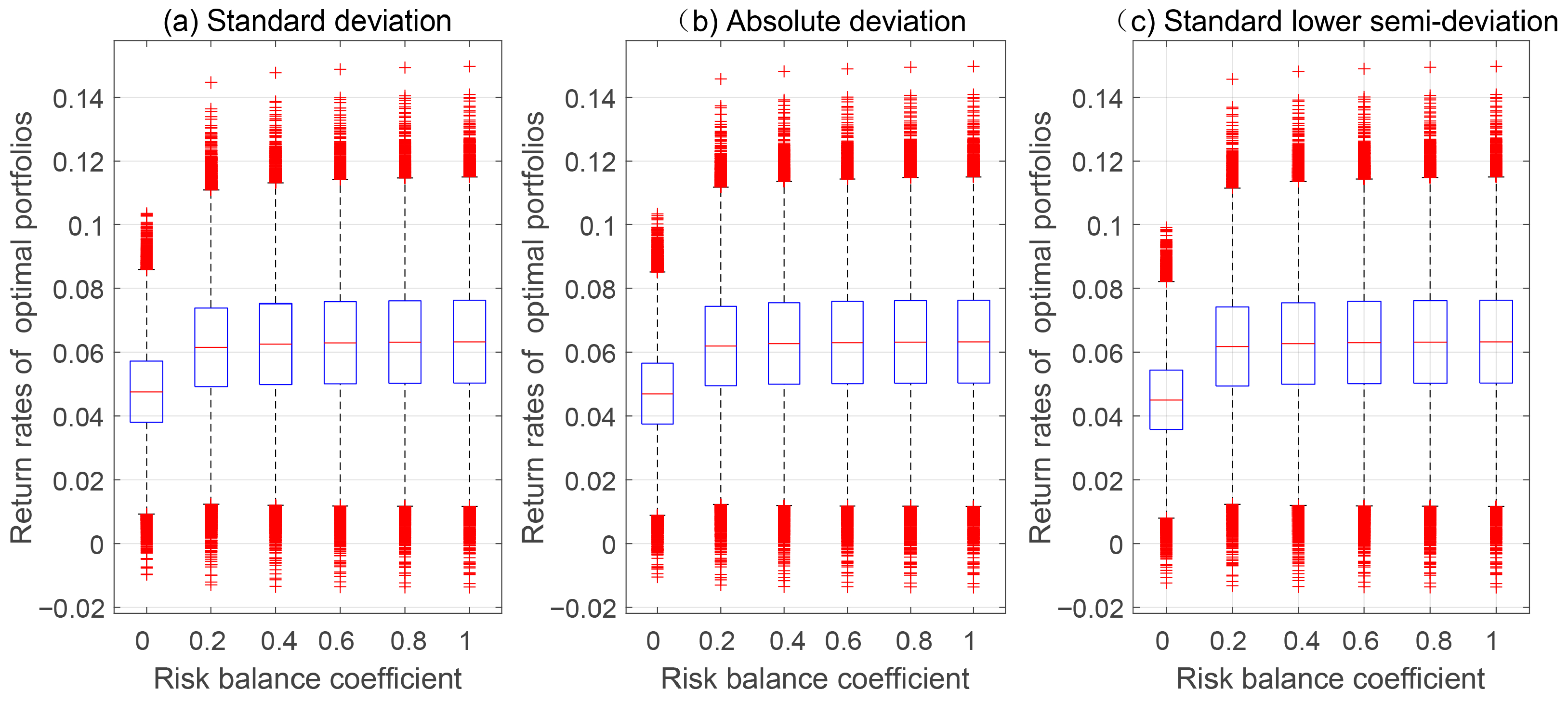
In order to more intuitively show the distribution of return rates of optimal portfolios in multiple simulation experiments, we plan to use box plots as a visualization tool. In box plots, the red lines represent the medians of portfolios’ return rates, and the heights of the boxes can reflect the volatility of return rates to some extent.
Experiment 1. Assume the minimum expected return rate is and the number of random samples is N = 100,000.
The numerical performance of optimal portfolios obtained from risk functions constructed based on standard deviation, absolute deviation, and standard lower semi-deviation are presented in Table 6, Table 7, and Table 8, respectively. The distributions of these return rates of these optimal portfolios are shown in Figure 1. It can be seen from
Table 6,
Table 7 and
Table 8 that when the minimum expected return
is fixed, as the risk balance coefficient
increases, all the indicators we use to evaluate the numerical performance of portfolios increase. Among them, the increase in Shannon Entropy of optimal portfolio is due to the increasing importance of Shannon Entropy to measure portfolio diversification. The sample mean and sample standard deviation of the optimal portfolio increase simultaneously, which confirms that the high return of investment is accompanied by high risk.
Additionally, the high similarity of the results from
Table 6,
Table 7 and
Table 8 and the subgraphs of
Figure 2 indicates that when both the minimum expected return
and the risk balance coefficient
are fixed, the distribution of the optimal portfolios’ return rates obtained by constructing the general
risk function using standard deviation, absolute deviation, and standard lower semi-deviation is almost identical. This also reflects that our model shows good robustness to small changes in parameters and can provide investors with a relatively stable investment strategy.
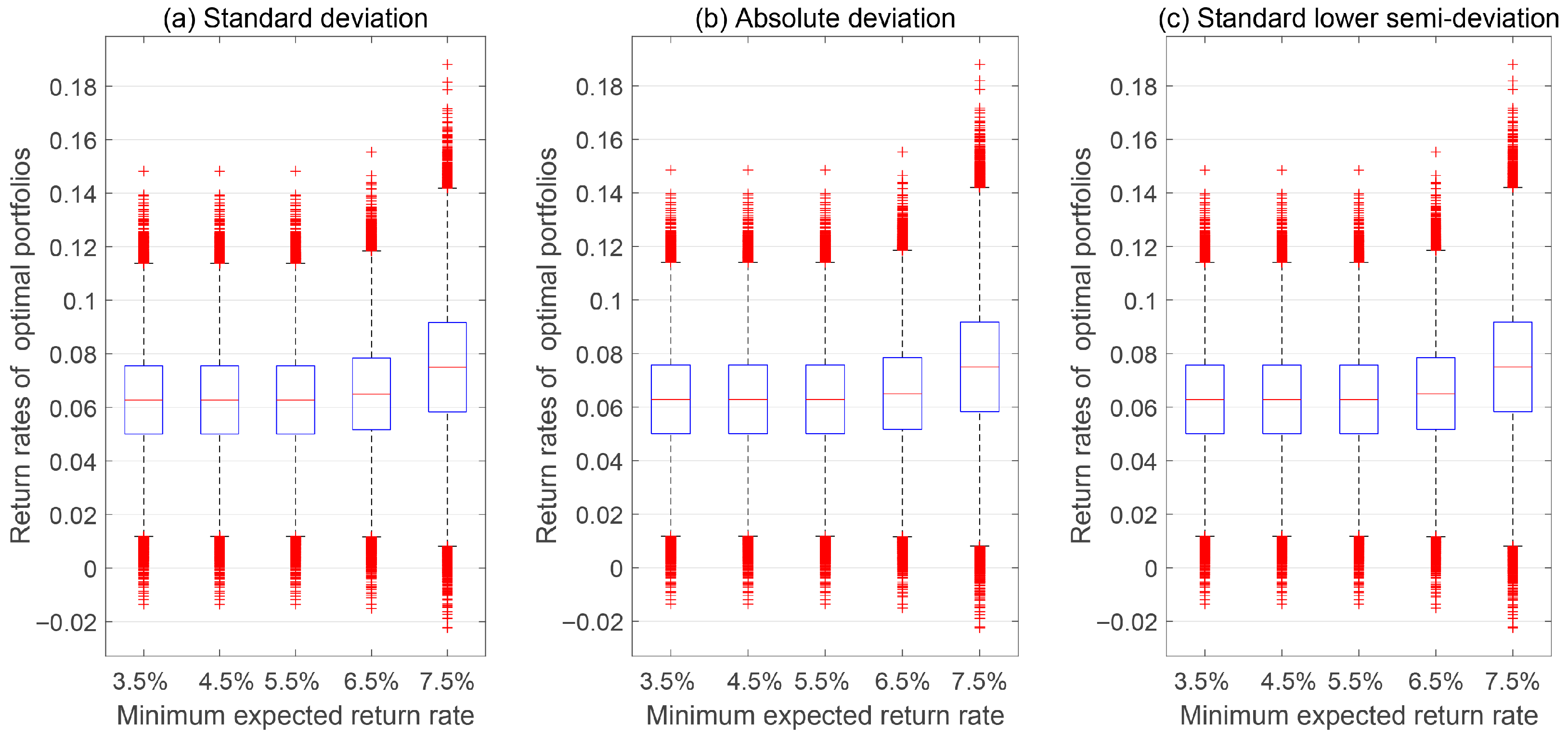
Experiment 2. Assume the risk balance coefficient is and the number of random samples is . The numerical performance of optimal portfolios obtained from risk functions constructed based on standard deviation, absolute deviation, and standard lower semi-deviation are presented in Table 9, Table 10, and Table 11, respectively. The distributions of these return rates of these optimal portfolios are shown in Figure 2. It can be observed from
Table 9,
Table 10 and
Table 11 and
Figure 2 that when the risk balance coefficient
is fixed, as the minimum expected return rate
increases, the sample mean and median of the optimal portfolio also increase. However, the frequency with which the return rate of the optimal portfolio reach
, denoted as
, tends to decrease. Meanwhile, with the increase in
, it can be observed that the Shannon Entropy of the optimal portfolio decreases, and the sample variance of the optimal portfolio’s return rate increases. In
Figure 2, the height of box also increases, which reflects the increasing volatility of return rates. This shows that when the investor excessively pursues investment returns, he/she will sacrifice the stability of returns.
6. Conclusions
This paper presents a risk-diversified portfolio optimization model based on Shannon Entropy. Due to the linearity of the constraints, the optimal portfolio can be determined using standard software after obtaining real stock data. Monte Carlo simulations were conducted to evaluate the performance of optimal portfolios under varying risk balance coefficients and minimum expected returns. Numerical results indicate that, for fixed values of the risk balance coefficient and minimum expected return, optimal portfolios and their return rate distributions were similar when using the general risk function with standard deviation, absolute deviation, or standard lower semi-deviation. This suggests that the model exhibits robustness to small parameter variations, providing a relatively stable investment strategy.
The study has several limitations. First, the model is based on a static, single-period framework and does not account for dynamic portfolio rebalancing. Second, the analysis assumes a specific distribution for asset returns, which may not fully capture the complexities of real-world financial markets. Third, while the model includes basic constraints, it does not incorporate other market frictions such as transaction costs or liquidity risk. Addressing these limitations represents a valuable direction for future research to enhance the model’s practical applicability.