Article

The Diffusion of Risk Management Assistance for Wildland Fire Management in the United States

by
Tyler A. Beeton
1,*,
Tyler Aldworth
1,
Melanie M. Colavito
2,
Nicolena vonHedemann
2,
Ch’aska Huayhuaca
1 and
Michael D. Caggiano
3
1
Department of Forest and Rangeland Stewardship, Colorado Forest Restoration Institute, Colorado State University, 1001 Amy Van Dyken Way, Fort Collins, CO 80525, USA
2
Ecological Restoration Institute, Northern Arizona University, 200 E Pine Knoll Drive, Flagstaff, AZ 86011, USA
3
United States Forest Service, Rocky Mountain Region, Lakewood, CO 80401, USA
*
Author to whom correspondence should be addressed.
Fire 2025, 8(12), 478; https://doi.org/10.3390/fire8120478
Submission received: 20 October 2025 / Revised: 11 December 2025 / Accepted: 12 December 2025 / Published: 17 December 2025
(This article belongs to the Section Fire Social Science)

Abstract

The wildland fire management system is increasingly complex and uncertain, which challenges suppression actions and increases stress on an already strained system. Researchers and managers have called for the use of strategic, risk-informed decision making and decision support tools (DSTs) in wildfire management to manage complexity and mitigate uncertainty. This paper evaluated the use of an emerging wildfire DST, the Risk Management Assistance (RMA) dashboard, during the 2021 and 2022 wildfire seasons. We used a mixed-method approach, consisting of an online survey and in-depth interviews with fire managers. Our objectives were the following: (1) to determine what factors at multiple scales facilitated and frustrated the adoption of RMA; and (2) to identify actionable recommendations to facilitate uptake of RMA. We situate our findings within the diffusion of innovations literature and use-inspired research. Most respondents indicated RMA tools were easy to use, accurate, and relevant to decision-making processes. We found evidence that the tools were used throughout the fire management cycle. Previous experience with RMA and training in risk management, trust in models, leadership support, and perceptions of current and future fire risk affected RMA adoption. Recommendations to improve RMA included articulating how the tools integrate with existing wildland fire DSTs, new tools that consider dynamic forecasting of risk, and both formal and informal learning opportunities in the pre-season, during incidents, and in post-fire reviews. We conclude with research and management considerations to increase the use of RMA and other DSTs in support of safe, effective, and informed wildfire decision making.

1. Introduction

The wildland fire management system in the United States (U.S.) is complex. Wildfire decision making is influenced by interactions between socio-political, institutional, individual, economic, operational, and environmental factors [1]. Climate variability has increased fire activity, severity, size, season length, and extreme fire weather and behavior [2,3,4,5,6,7,8,9]. The effects of a changing climate on fire are exacerbated by compounding biophysical disturbances (e.g., pest and pathogens), the expansion of development into fire-prone areas, the geographical and seasonal expansion of fires caused by human ignitions, and fuel buildup from a history of suppression [10,11,12,13,14,15]. When considered together, these factors add uncertainty to wildland fire management, amplify risks to people and societal values, and stress on an already strained system [16].
To address complexity and uncertainty, the wildland fire community has called for the development and use of strategic, risk-informed decision support tools (DSTs) [17,18,19]. The risk-informed decision-making paradigm encourages a strategic, science-based approach to enhance effective response while balancing resource and value protection, responder safety, and likelihood of success [20,21]. This paper builds on emerging research evaluating DST use during fire response [22,23,24,25,26], which is relatively underexplored compared to DST use for pre-fire planning and fuels mitigation [27]. We evaluated use of the Risk Management Assistance (RMA) dashboard that houses advanced spatial analytics for making risk-informed decisions during fire response. We used a mixed-method approach, consisting of an online survey and in-depth interviews with fire managers. Our objectives were the following: (1) to determine what factors at multiple scales facilitated or frustrated the use and usability of RMA; and (2) to identify actionable recommendations to improve RMA use and usability as a DST in wildfire response.
This paper adds to existing research on RMA and the development of new DSTs [24] in several ways. First, we focus on the use and utility of the virtual RMA dashboard after it evolved from an in-person coaching model to be fully online. Second, we extend the sample population of previous work from line officers to additionally include Incident Management Teams (IMTs) and local fire managers. Third, we situate our analysis within the diffusion of innovations [28,29,30] and use-inspired research [31,32,33] to explore the factors that influence the adoption of innovative DSTs and contribute to the knowledge of DST uptake.

1.1. The History and Status of RMA

RMA was created in 2016, in response to the findings from the U.S. Department of Agriculture Forest Service (Forest Service) Life First National Engagement Sessions, which emphasized a need to enhance firefighter safety and limit unnecessary firefighter exposure to risk [34]. RMA development brought together research and fire management experts and professionals that typically did not work together to develop and innovate DSTs and provide wildfire managers access to personnel with specialized training in risk management, fire operations, and spatial analytics [25]. The core principles of RMA are to (1) improve the quality of wildfire management decisions, (2) increase accountability of those decisions, and (3) minimize firefighter risk [25].
The Forest Service piloted RMA during the 2017 and 2018 fire seasons, during which Risk Management Assistance Teams (or RMAT) of Agency Administrators (AAs) (those with the necessary qualification, authority, and responsibility for wildfire decision making), IMT members, and analysts traveled to large fires to offer analytical support and guidance for making risk-informed strategic decisions. RMAT later dropped the team function, changed their name to RMA, and transitioned support to the dashboard to increase their scope. The Forest Service developed the RMA dashboard in 2020 [35]. It is a free, public-facing AGOL experience that houses information to promote awareness of potential fire impacts and fire management opportunities and challenges. Commonly used analytics include, but are not limited to the following: (1) Suppression Difficulty Index (SDI); (2) Potential Control Locations (PCL); (3) snag hazard; (4) estimated ground evacuation time; (5) Potential Operational Delineations (PODs); (6) Season Ending Analysis; and (7) Quantitative Wildfire Risk Assessments (QWRA) (Table 1). The RMA dashboard also houses information on aviation use, incident statistics, timelines, and current and historical fire weather information.
Table 1. Select Risk Management Assistance (RMA) analytics and relevant citations, if applicable.
ToolDescriptionCitation (If Applicable)
Suppression Difficulty Index (SDI)Identifies places where suppression actions are safer and easier by modeling fire behavior, topography, accessibility, penetrability, and fireline construction rate.Rodriquez y Silva et al. [36]
Potential Control Locations (PCL)Empirical model that uses machine learning to identify where fires were contained in the past and which factors influenced containment. Variables include the following: fire behavior; distance to roads, ridges, and non-burnable areas; SDI; and resistance to control. O’Connor et al. [37]
Snag HazardUses TreeMap [38], a gridded raster dataset of forest plot attributes across the conterminous U.S. to estimate low, moderate, high, and extreme snag hazard as a function of snag density and height. Riley et al. [39]
Ground evacuation timeEstimates the amount of time (in hours) to move from a given point on the landscape in the U.S. to a hospital.Campbell et al. [40]
Potential Operational DelineationsA collaborative spatial fire planning framework and DST. Local agency personnel and partners develop PODs in workshops, leveraging local knowledge and experience and advanced spatial fire analytics (SDI and PCL) in the pre-season to delineate natural and human-made features (e.g., roads, ridges, or rivers) that have a high likelihood of fire containment. Thompson et al. [41]
Season ending analysisUses fire perimeter and historical weather data to estimate when the fire season has typically ended. In development by Dr. Jolly, Fire Science Laboratory, Rocky Mountain Research Station
Quantitative Wildfire Risk Assessment (QWRA)QWRAs integrate modeling on the likelihood and intensity of wildfire with local knowledge and expertise to determine the susceptibility of Highly Valued Resources and Assets (HVRAs; e.g., structures and water resources) to wildfire. Scott et al. [42]

1.2. The Use of DSTs in Fire Management

While there is no single, well-established definition of DSTs in the literature [43], we refer to them here as the suite of different science-based platforms, models, analysis methods, and programs that analyze input data and provide higher-level analytical outputs that may inform decision making. DSTs can help decision makers such as fire managers navigate complex, quickly changing decision environments, as well as inform longer-term planning for forest management or fire recovery using the best available information and science [44]. However, applying DST outputs or other scientific information in a decision-making context can be complicated by numerous factors both internal and external to the decision context [27]. In fire management, there are numerous DSTs available, making it challenging for decision makers to effectively select and use DSTs to inform decision making. This is further exacerbated when a DST is not designed with end user needs in mind [45].
There is a growing body of research that evaluates the use of DSTs in fire management and provides recommendations for more effectively using DSTs in decision making. For example, Greiner et al. [46] explored the use of PODs, which are a collaborative, spatial approach to identifying fire response strategies prior to ignition and encourage managers to employ a risk-informed approach to decision making [41]. PODs facilitate a shift in behavior through pre-season fire planning that allows for a more effective, safe response when fires do occur [46]. PODs are also key communication tools to gain alignment among fire management staff, cooperators, and the public [47]. Other studies have looked at the Wildland Fire Decision Support System (WFDSS), which is a program for decision documentation and analytics on wildfires [48], and identified changes that could facilitate its use, including training and better matching of WFDSS to end user needs [23,26]. With respect to RMA, Schultz et al. [24] found that, while useful, the analytics themselves did not change decisions among line officers, though numerous factors contributed to the perceived value of RMA in decision making. Similarly, Rapp et al. [22] found that while DSTs are being used by IMTs, they are not dictating decisions. Frequent themes in research evaluating wildfire-related DSTs point to a common set of barriers and facilitators, including a need for a common language and strategy for developing and applying tools, connecting DST developers with the intended users, increasing opportunities for training and iterative improvement, and providing clear leadership intent.

1.3. Diffusion of Innovations

We define innovation as “the spread of abstract ideas and concepts, technical information, and actual practices within a social system” [28] (p. 297). In their seminal work on innovation diffusion, Rogers [29] identified five characteristics that influence the diffusion of innovative tools, practices, or ideas: (1) relative advantage (i.e., how much will a new innovation improve current practices?); (2) complexity (i.e., how difficult is it to understand and utilize the innovation?); (3) compatibility (i.e., how difficult is it to integrate the new innovation into existing decision-making processes?); (4) trialability (i.e., can individuals experiment with the innovation without committing to it?); and (5) observability (i.e., can individuals observe how to use and apply it?). Rogers also contributed to our understanding that the adoption rate by individuals followed a spectrum from innovators and early adopters to late adopters and laggards through time, as a function of individual, socio-cultural, and organizational factors [29].
Lemos [30] built on Rogers’ and other foundational works (see ref. [28] for a review) on innovation diffusion to posit that characteristics of the innovation itself (e.g., RMA dashboard), individuals, organizations, and the broader institutional and environmental context shape innovation uptake (Table 2). The framework also explicitly incorporates a rich body of scholarship on use-inspired science and knowledge co-production [31,32,49]. Specifically, Lemos [30] emphasizes the role of fit—the extent to which DSTs are perceived to meet needs—and interplay—how new DSTs interact with existing DSTs—in influencing innovation uptake [33].
One dominant factor that affects the usability of DSTs is how well the DST fits the needs and decision contexts of users. This includes its relevance to existing decision processes and protocols, congruence with other DSTs already in use, the real or perceived accuracy of the DST in specific settings, and its timeliness of delivery (Table 2) [32,50,51,52]. DSTs should be accessible—easy to access, interpret, and use—and should be available at spatio-temporal scales and resolutions required to inform decision making [32,53].
Table 2. Factors that affect DST use and relevant citations.
LevelCharacteristics That Affect DST UseRelevant Citations
Characteristics of the toolFit within decision context of users
Interplay with existing tools and information used
Ease of access, use, and interpretation
Perceived accuracy of conditions on the ground
Scale (resolution, extent) alignment with management decisions
Timeliness of delivery
[23,32,43,49,51,52,54]
IndividualPerceived alignment with organizational mission
Tolerance for change vs. routinization of information use
Risk perception and tolerance
Decision discretion and accountability
Experience with innovative tools
Perceived relevance, credibility, and legitimacy of tool
[22,24,30,31,43,49,50,51,54,55,56,57,58]
OrganizationalIncentives for risk taking vs. conservatism
Leadership direction, communication, and intent
Alignment with existing processes and protocols
Human, financial, and technical capacity to use and interpret
Past experiences with innovations
[24,26,28,30,33,43,46,47,50,51,56,57,58,59,60,61]
Broader institutional and environmental contextNature and complexity of problem
Infrastructure in place to manage the problem
Authorities, mandates, and protocols that cross jurisdictional or organizational boundaries
Policy windows and direction
[22,24,26,30,47,54,59]
Attributes that affect the adoption of innovation at the individual level include the following: individual beliefs and ideas on the congruence of innovations with the organizational mission; comfort with change relative to routines; professional background and networks; past experience with innovations; risk perception and tolerance; autonomy and accountability; and the perceived relevance, credibility, and legitimacy of DSTs (Table 2) [22,30,50,51,55]. Research has found that managers in the water and fire sectors felt that deploying new predictive information was riskier in terms of obtaining public and leadership support relative to using existing information use practices [54,55,56]. Rapp et al. [22] identified that differences in the uptake of fire behavior models were influenced by trust in models and professional background.
In the context of wildfire management, we interpret organizations broadly as encompassing fire management organizations (e.g., IMTs) and the Forest Service or other local, state, or federal agencies (e.g., National Park Service and state forestry agencies) with management authority on wildfires. Attributes that affect the adoption of an innovation at the organizational level include the following: cultures of risk and incentives for risk taking; past experience with innovations; clear leadership communication, direction, and intent; real or perceived compatibility and alignment with existing decision-making processes and protocols; and the human, financial, and technological capacity committed to supporting innovation use (Table 2) [28,33,50,51,56]. Organizational inertia and resistance to change can stifle innovation [62]. The national forest management system in the U.S. has historically incentivized risk aversion and lacked fire manager training in risk-based management that might better promote long term forest health and resilience [63]. Yet, the adoption rate of innovative tools manifests as a spectrum through time and can be expedited by clear leadership intent and direction within their organizational networks [28,46,47].
The diffusion of innovations at the broader institutional and environmental level is affected by the nature and complexity of the problem, built infrastructure to manage the problem, and institutional arrangements (e.g., multi-jurisdictions and authorities, and policy direction; Table 2) [22,30,51,54,59]. Novel changes to the system, such as climate-fueled changes to wildfire severity and damage, can open windows of opportunity to consider new ways to address a problem [64,65]. New legislation and changes in policy direction can also provide incentives and resources to consider innovative practices and technologies.
An important concept missing from Lemos’ framework but emphasized in subsequent use-inspired and co-production research is the quality and quantity of interaction between the users and producers of new DSTs in facilitating innovation uptake. Interaction emphasizes the role of iterative, two-way interactions and learning between information producers and users, boundary-spanning entities and functions, communities of practice, and/or trusted knowledge brokers to build trust in, and help to refine, interpret, and apply information within existing decision-making practices [31,32,66,67,68]. Interaction helps link the scales of the individual, organizational, and institutional social processes for engagement with, and learning about, innovative tools and applying them in local contexts. This is particularly important in the context of wildfire where interplay among organizations in cross-jurisdictional incidents results in additional complexity to fire management. We used the framework described here to inform our protocols and frame our analysis with the goal of illustrating how our findings contribute to the diffusions of innovation and use-inspired literature.

2. Materials and Methods

We employed mixed-method design consisting of two phases: (1) a survey focused on RMA use during the 2021 fire season; and (2) semi-structured interviews with key personnel that used RMA on two fires in 2022. Our survey was developed and administered in Qualtrics (https://www.qualtrics.com/, Seattle, WA, USA (accessed on 1 March 2022)). It consisted of twenty-seven fixed-response and six open-ended questions. The statements were informed by the relevant literature on RMA, diffusions of innovations, and use-inspired research [24,25,30,33]. For example, we asked survey participants about the extent to which tools were easy to interpret, accurate, timely, and applicable to their decision context. Survey respondents were also asked about the RMA tools they used, how the tools were used throughout the incident, the factors that influenced RMA use, and recommendations to improve use.
We co-developed the survey instrument and administration protocol with RMA leadership from the Forest Service’s Rocky Mountain Research Station Wildfire Risk Management Science (WRMS) team and the Strategic Analytics Branch, National Office, Fire and Aviation Management (henceforth the Strategic Analytics Branch). We piloted the survey with fire managers (n = 5), and feedback from the WRMS team and Strategic Analytics Branch was used to refine the survey. The survey was administered to fire analysts, line officers (AAs), Fire Directors, and IMTs through existing listservs. We worked with the Strategic Analytics Branch staff and RMA leadership to identify appropriate contacts and listservs for recruitment of our target audience of individuals mobilized to wildfires in 2021. The survey was sent out via email on 14 March 2022, and remained open for 4 weeks, closing on 11 April 2022, after two email reminders were sent to the listservs.
We received 94 total usable survey responses (58 complete; 36 responses were at least 30% complete), with qualitative comments from 56 respondents. Most respondents (83%) were Forest Service employees, with a few respondents representing state agencies (6%), the Department of the Interior (DOI, 6%), counties (2%), or universities (2%). Survey respondents reported on the use of RMA from 69 wildfire incidents in the western U.S. during the 2021 fire season (Figure 1). These incidents represented more than half of the total incidents that used RMA in 2021 (Stratton personal communication). Respondents represented 27 IMTs. In total, 53% of respondents were from Type 1 teams, 38% were from Type 2 teams, and 9% were from Type 3 teams, and represented nine Geographic Areas supported by Geographic Area Coordination Centers (GACCs, regional centers that coordinate resource allocation and mobilization). Type 1 and Type 2 IMTs (now collectively referred to as Complex Incident Management Teams, CIMTs) are certified at the state or national level. Type 1 teams have more training and experience than Type 2 IMTs. Type 3 IMTs are organized at state, regional, or local level and have comparably less experience and training than Type 1 and Type 2 IMTs.
The survey provided a snapshot of RMA use during the 2021 fire season. Several factors precluded our team from identifying a response rate or evaluate non-response bias. First, the use of RMA is voluntary and in 2021 the RMA dashboard was still relatively new. Thus, not all fire responders interfaced with or used RMA and records of the global population of RMA users do not exist. Further, the population of fire responders represents diffuse population networks across multiple agencies. We relied on partnerships with RMA leadership and their professional networks to support survey recruitment to potential respondents, many of whom may have not used RMA, and we worked closely with RMA leadership to determine when we obtained sufficient responses to reflect RMA use during the 2021 fire season.
We also conducted fourteen in-depth interviews with participants assigned to two fires in 2022—the Bear Trap Fire in New Mexico (n = 6) and the Cedar Creek Fire in Oregon (n = 8; Figure 1, Table 3). The Bear Trap Fire took place in a sparsely populated mountain range of west-central New Mexico with few values at risk or perceived potential containment opportunities. The Cedar Creek Fire occurred in west central Oregon and ignited in difficult terrain that challenged potential engagement and eventually forced the evacuation of the community of Oakridge during a significant, wind-driven run. We selected these fires as case studies because they offered opportunities to document RMA use in different GACCs and under different fire management environments.
Interview questions focused on what tools were used for what purposes throughout the incident, perceptions of factors that influenced use, and recommendations to improve use. Interviewers probed participants for specific examples across individual, organizational, and broader institutional and environmental scales, consistent with the diffusion of innovations framework. We used purposive and snowball sampling to identify an intentionally small number of key informants, i.e., individuals who used RMA to inform management decisions and who had extensive knowledge and experience relative to the research questions [69]. We identified and recruited all participants on both fires who were qualified to speak about how RMA was used to inform fire management decisions. The case studies were selected to provide context and feedback to leadership. Our interviews and survey responses were not meant to provide cross-case generalizations or representative perspectives of RMA use across all fire managers. The interviews lasted from 45 min to 2 h. The interviews were recorded and transcribed and then analyzed along with survey responses in Atlas.ti (https://atlasti.com/, Burlington, MA, USA (accessed on 1 December 2022)). All procedures were approved by our respective University Institutional Review Boards (#2652 and #1863678).
We developed a codebook through two rounds of coding based on our research questions, emergent themes from the data, and existing empirical and theoretical literature on the diffusion of innovations and use-inspired research as sensitizing concepts [70,71]. We first completed a round of descriptive coding based on research and interview questions. Next, we conducted another round of coding where we applied the diffusion of innovations framework. We allowed for codes to emerge from the data to capture concepts not included in the framework [71]. Three transcripts and ten survey responses were coded by two authors using the codebook, who then discussed, refined, and revised the codebook as necessary to maximize intercoder agreement [72,73]. The remaining transcripts and survey responses were coded by one author (TA). Fixed response items from the survey were analyzed using frequency distributions, and quotations add context to fixed response results.

3. Results

3.1. Factors Facilitating RMA Adoption

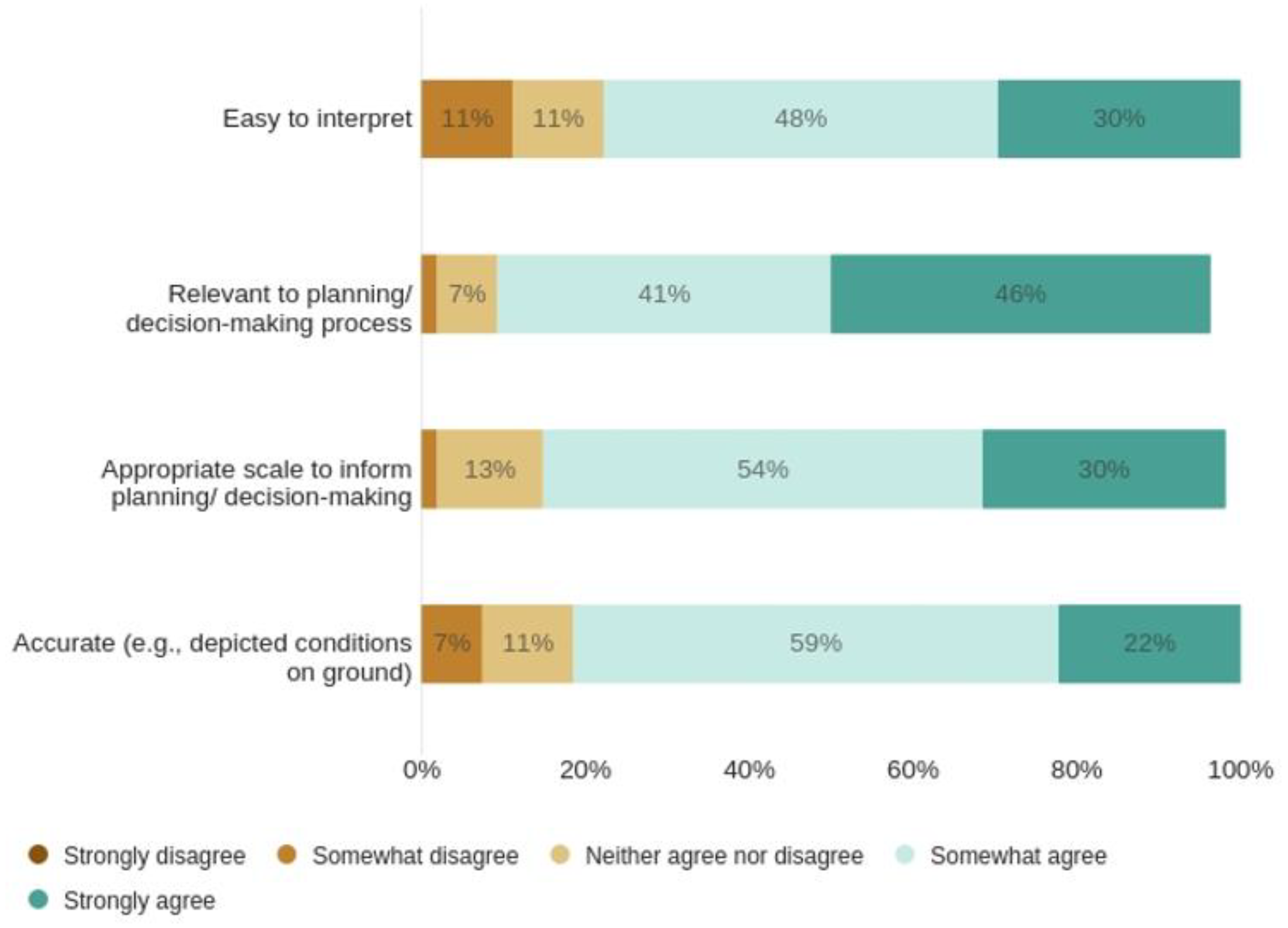
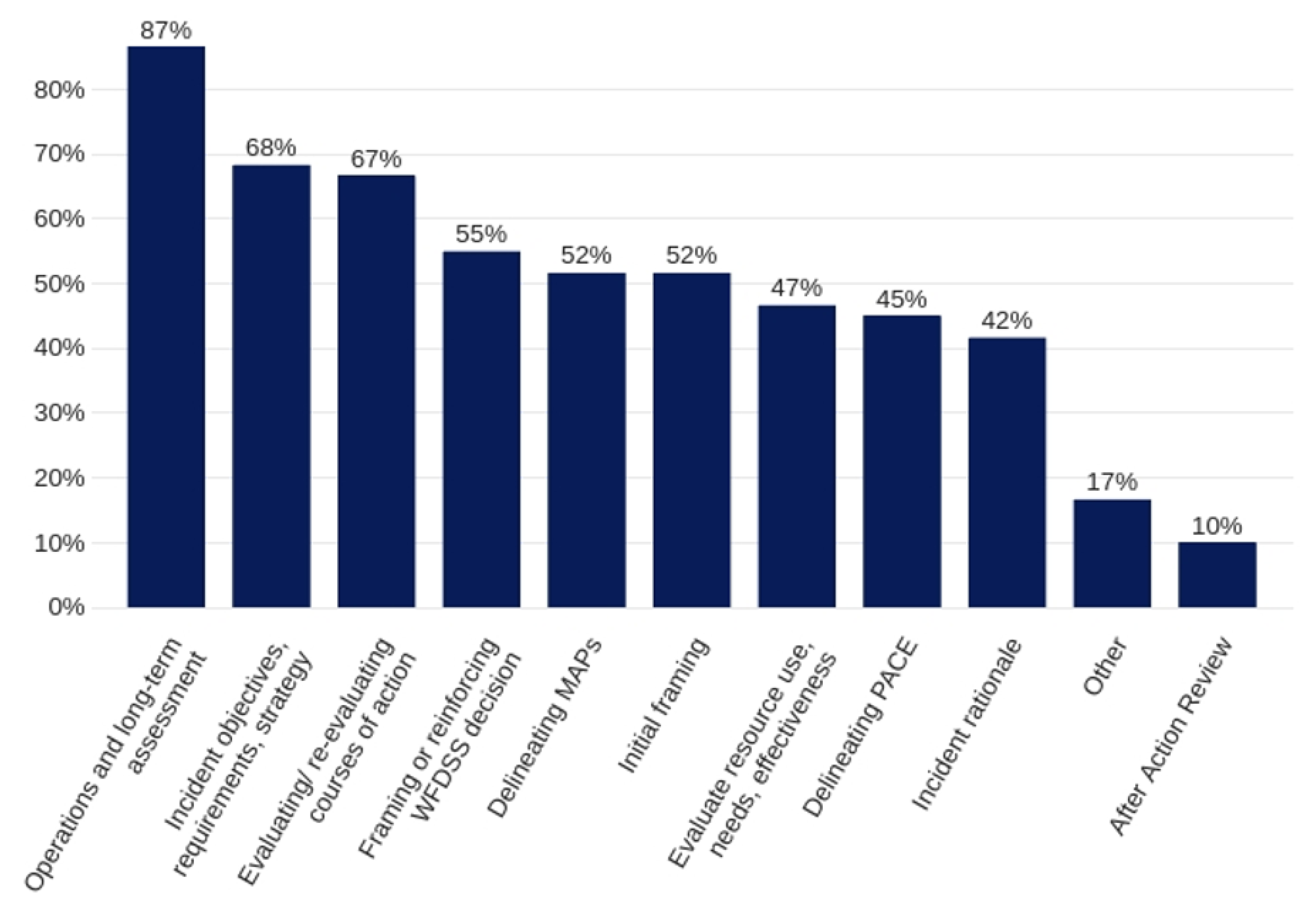
Factors that facilitated RMA use included characteristics of the tools, individuals, organizations, and the broader institutional or environmental context (Table 4). A majority of the survey respondents agreed that RMA tools were relevant to planning and decision-making processes, were provided at the appropriate scale to inform decisions, were accurate, and were easy to interpret (Figure 2). RMA tools were also used throughout the fire management cycle, most frequently for the following: (1) operations and long-term assessment; (2) incident objectives, requirements, and strategy; and (3) evaluating or re-evaluating different courses of action (Figure 3). Just over half of the survey respondents used RMA to frame WFDSS decisions, to delineate management action points (MAPs), and for initial framing of the incident (Figure 3). Participants indicated RMA tools were used by firefighters, agency staff, and others to quickly identify locations for containment lines, evaluate fire responder risks (e.g., snags and evacuation times), estimate the probability of containment success, and determine opportunities and challenges of alternative strategic actions. RMA products facilitated transparent dialog within IMTs and among IMTs, AAs, and local communities throughout incidents and team transitions to articulate strategic actions:
I think it helps out when you’re trying to talk to the local public and then with the teams coming in and the teams going out… It was very easy for me to grab that tool, put it up on a screen, and talk to folks about it and articulate what we were seeing and the “why” of what we were doing.
RMA was particularly useful to articulate why direct containment lines may not be appropriate and to justify the need for indirect containment tactics. One IMT member said the following:
Overlaying specific RMA products over possible suppression actions provided a strong depiction of the realistic challenges inherent in a proposed course of action.
Individuals’ receptivity to new tools and approaches facilitated RMA adoption and use. For example, several respondents indicated that they actively sought to improve their understanding of potential fire behavior and risks to fire responders using RMA. Additionally, previous experience with, or exposure to, RMA was noted as a facilitating factor, and respondents emphasized that seeing alignment between final fire perimeters and the analytics in the RMA dashboard increased trust in the tools. In many cases, respondents suggested having the requisite fire experience and analytical skillset to interpret the tools supported use.
Organizational factors also facilitated RMA use, including supportive leadership and champions who shared their knowledge of RMA, and local unit and IMT dynamics that were receptive to innovative approaches. Participants noted leadership support for using spatial analytics at the local unit facilitated use, especially in circumstances where rapid, full suppression tactics were not appropriate. One AA stated,
I think we also have good support from our leadership here on the forest to use those and from the region as well. [Our unit is] just really trying to figure out, “When we have fires on this landscape that we can’t get to quickly; what are some tools we can use?” The RMA dashboard seemed to us like the best place to go to try to answer some of those questions we have.
External factors that facilitated RMA use included challenging fire weather and fuel conditions, scale of management concerns (e.g., large, dynamic fires; fires without historical analogs), limited resources that precluded direct attack, and local acceptability of managing fires using indirect strategies and tactics. For example, some indicated that the unprecedented challenge of recent fire seasons, where fire modeling underpredicted observed fire behavior, and where the magnitude of incident complexity strained the fire management system’s capacity to manage fires, led them to seek out new tools to better understand suppression opportunities. One IMT member explained this:
The wildfires we are experiencing are not the same character of fires that occurred 50 years ago. I am looking for new approaches to this issue—so I’m open to seeing new tools.

3.2. Factors Frustrating RMA Adoption

Respondents also reported characteristics of the tools, individuals, organizations, and the broader institutional and environmental context that frustrated RMA use (Table 4). With respect to tool characteristics, some respondents felt the resolution of the tools was too coarse. Furthermore, commonly used RMA analytics, like SDI and PCL, are presented for static fire environment scenarios to simplify data production, storage, and distribution. They are not based on real-time or forecasted weather and fire conditions. Thus, some felt the models did not accurately represent conditions on the ground. For example, respondents noted RMA analytics were less useful in cases when fire weather conditions moderated and opened additional opportunities to directly engage a fire. In these cases, the SDI and PCL may depict areas as difficult to work in and with low probability of success whereas conditions on the ground may be different.
Individual factors that frustrated RMA use included individual hesitancy, resistance, and lack of trust in tool accuracy. One AA reported the following:
Using [the RMA tools] is not a problem. Having people believe in what is being shown is the biggest challenge I see. When the analytics (PCL, SDI, etc.) are showing a big box then they tend to get thrown out and replaced with [lines relying on] local knowledge or experience, and then we end up with yet another indirect line that will either get burned over or never used.
Less commonly reported were individuals’ lack of familiarity with RMA and their limited expertise and technical capacity to use the tools or time to invest in familiarizing themselves with new tools. At the organizational level, unsupportive leadership and key team members were reported to frustrate use. One IMT member noted,
In a team setting, you have to have your key players acknowledging that there’s value in these products. If you have an IC [Incident Commander] who’s skeptical, your long-standing operations [section chief] on your team who’s skeptical, your safety [officer] who’s skeptical, then these products are not going to be utilized.
Broader institutional and environmental contexts also frustrated usage. While the challenges of more dynamic and complex fire seasons encouraged some to pursue new tools, it could also have the opposite effect. In some cases, respondents reported that individuals revert to known practices in stressful conditions and may be less likely to use new analytics, as described by the following IMT member:
Folks are unfamiliar with products and default to what they are comfortable with. When stressed we default to what, [or] who, we know.
Respondents indicated that the lack of formal institutionalized training through the National Wildfire Coordinating Group (NWCG) made it difficult for those who were not early adopters to learn about and apply RMA tools to wildfire management. Finally, uncertainty with how RMA tools supplemented other mandated inter-agency products and processes, such as WFDSS, frustrated RMA use:
We are still at this point throughout the fire community where we’re forcing analysts and OPs [operations] chiefs to bounce between web-based tools. The RMA dashboard has a certain suite of layers, products, tools, but we still have people that jump into WFDSS and do all your fire behavior modeling there. That’s where you’re going to pull together the decision elements… It makes it a little bit challenging when you’re trying to round up all of these different pieces and assemble them.

3.3. Recommendations to Improve RMA Use and Adoption

Respondents provided several recommendations to improve RMA tools and the dashboard (Table 4). Some respondents recommended analytics that address both short-term and long-term risks and benefits in fire management. They felt that the current tools, including QWRA, were biased towards near-term risks and did not adequately capture long-term fire risks or benefits, which may, in turn, limit the types of actions considered. One IMT member stated the following:
There is no discussion or tool or anything to point to that longer-term risk of either having to put the same fire out for the next 20 years or not having to respond to a fire [in that area] for the next 20 years.
In a similar vein, respondents noted the need for RMA analytics that incorporated dynamic real-time and seasonal fire conditions. As one IMT member said:
Over the years we’ve had success at times in places where the products would say we couldn’t, for whatever reason. This is probably most often due to changing the weather or seasonality and nothing due to our heroic efforts… I’m sure there’s places that we could get better, continue to refine the data.
To address the individual-level hesitancy to adopt RMA, respondents emphasized the importance of local champions in socializing RMA tools. Respondents felt trusted champions’ credibility could help skeptical individuals build trust in RMA. In a similar vein, they recommended RMA subject matter experts continue to work one-on-one with users during incidents to coach them on how to apply the tools. An Incident Commander (IC) stated,
If you don’t have… one of these people that are really experts in this field [RMA]… the dots are probably not going to get connected… people are doing these incident management jobs as collateral responsibilities to a day job that they have that probably doesn’t involve the use of these tools very often.
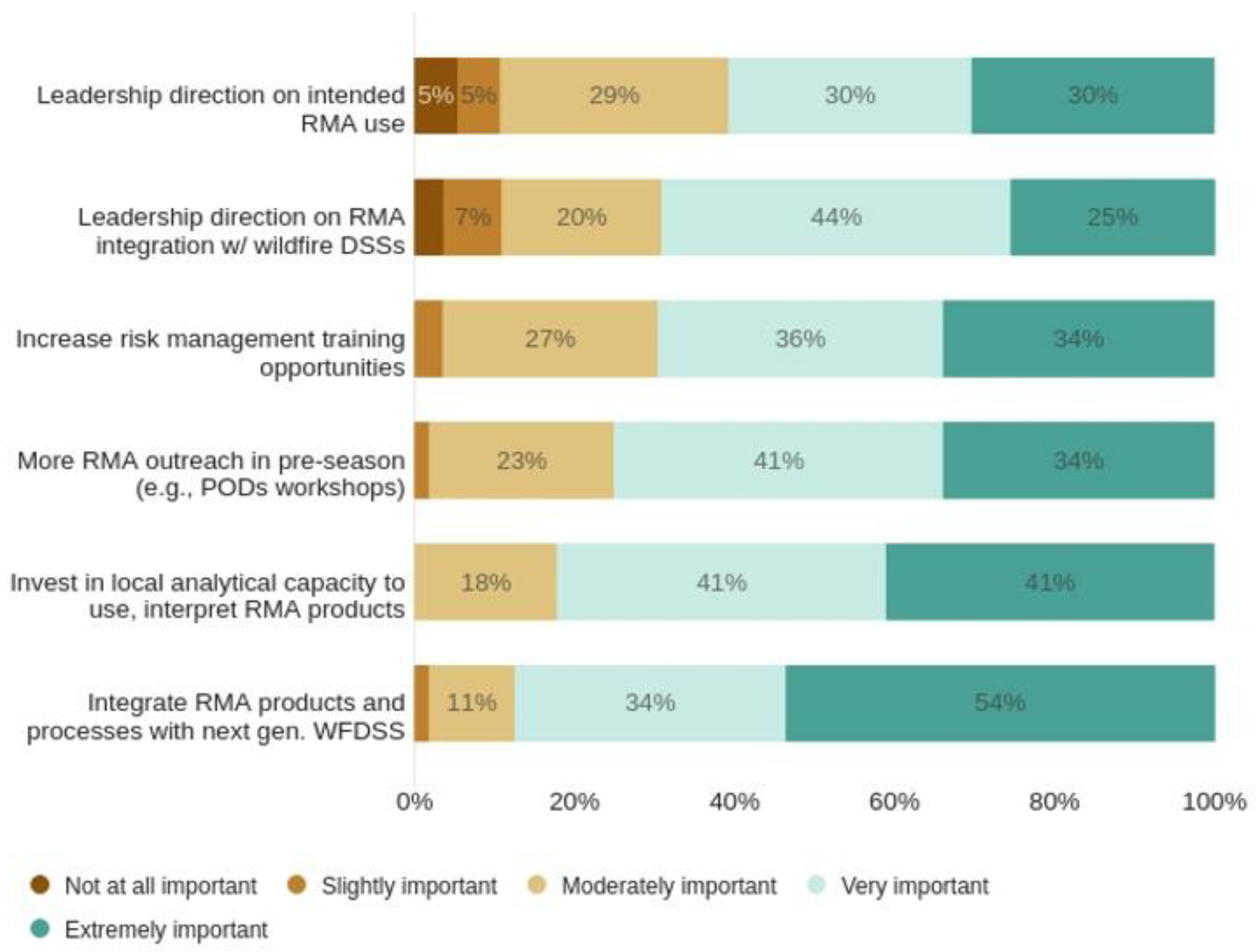
Figure 4 depicts participants’ perceived importance regarding six common recommendations to improve RMA. To help organizations better institutionalize RMA tools into their routines and procedures, respondents recommended clear leadership intent on how RMA should be used (Figure 4). For instance, respondents noted room for improvement in articulating the complementarity and linkages between the RMA dashboard with other DSTs, systems of record, and frameworks including WFDSS (Figure 4), the Inter-agency Fuel Treatment Decision Support System, and the risk and strategy dialogues part of the Incident Strategic Alignment Process (ISAP). They also recommended AA-focused RMA training through agencies’ (e.g., Forest Service, DOI, and state agencies) existing curricula. Most survey respondents recommended dedicated funding to hire qualified analysts to use, refine, and apply RMA analytics (Figure 4). For example, respondents suggested staffing strategic operational planners (SOPLs) on IMT rosters who can interpret and situate RMA tools within WFDSS and the ISAP.
Respondents also recommended increasing exposure to, and use of, RMA tools among fire staff and line officers during pre-season strategic planning exercises such as PODs workshops (Figure 4) or during annual cooperator meetings with county officials and first responders. One AA said the following:
I’m looking for better ways to explain that to our partners at our cooperator meetings, working with local officials. I think that the fire community is really grabbing onto the RMA dashboard, but other agency administrators, our state and private partners—I think that’s where there’s some more explanation needed.
Respondents indicated that the pre-season socialization of RMA tools with field-level unit staff and cooperators could help facilitate greater awareness and learning about the tools, how they inform decision making, and create an opportunity for providing feedback to RMA developers as the models are situated and ground-truthed in local systems. At the broader institutional and environmental level, respondents recommended formal training on the RMA application for IMTs, ground resources, and other response partners through courses standardized by NWCG.

4. Discussion

4.1. Considerations for Facilitating Fit and Interplay of Innovative Decision Support Tools for Individual Uptake

Below, we discuss how our findings enhance understanding of innovative DST adoption in wildfire management and public lands contexts and contribute to the diffusion of innovations framework adapted by Lemos [30]. Most respondents thought the RMA dashboard tools had strong fit and interplay with existing decision-making processes and protocols, which was evidenced by their observed use through the fire management cycle. Tools were generally easy to use, accurate, timely, and at the appropriate scale to inform decisions, which are all criteria for useful and usable tools and information [30,32].
Yet, opportunities for improving fit and interplay included better integration with WFDSS and risk-based analytics that incorporate real-time or forecasted conditions. Completing a WFDSS decision is required for fires that exceed initial attack or when the fire strategy entails protection and resource objectives, and WFDSS is codified in Federal Wildland Fire policy as the system of record for decision analysis and documentation [74]. At the time of our research, RMA tools were consulted separately from WFDSS. For the 2025 fire season, the Wildland Fire Management Research, Development, and Application program released an updated WFDSS version, which allowed for the incorporation of some RMA tools (e.g., PODs, SDI, and PCL) to inform analysis and decision documentation. It remains to be seen how the tools were adopted and used within WFDSS during the 2025 fire season, especially given the reported challenges regarding WFDSS use, namely that WFDSS was disconnected from operational decision making because outputs from WFDSS were not produced in a timely manner, were difficult to interpret, and the platform was complex to operate [23]. These findings indicate fit and interplay are dynamic, and users renegotiate the use and utility of tools as internal and external conditions change, for example, as new leadership, priorities, or, in this case, the complementary tools already in use and codified in policy for decision making change [29,33]. Thus, these findings underscore the needs for ongoing evaluation of DST uptake and their compatibility with the broader system of DSTs in use.
Results indicated a desire from some managers for tools that reflect current and forecasted fire behavior conditions. The PCL and SDI are static representations of control probability and suppression difficulty, respectively [36,37]. Other widely used risk-based analytics, including QWRA outputs, often reflect worst-case scenarios and do not accurately portray potential fire benefits to resources when burned under low- to moderate-conditions. Some emerging research and applications are working to address these needs, and there are lessons from the innovation and use-inspired research on the use of seasonal forecasts for fire and water applications to consider, which are explained below.
There are inherent tradeoffs between forecast accuracy, uncertainty, and complexity that interact to affect DST use. Sources of uncertainty challenge the ability to accurately model and predict wildfire behavior and response, ranging from an incomplete understanding of natural processes, the variability and unpredictability of wildfire behavior, or missing, incomplete, or inaccurate data [53]. Forecast accuracy is a key determinant of use, and, despite increases in its accuracy, many users still perceive accuracy to be low, which thus can limit the use of forecasts [54,67,75]. Probabilistic forecasts may be a more realistic approach to addressing and interpreting model uncertainty, yet some research has shown expert and novice users may misinterpret model results [32,75,76,77]. Complex models and DSTs may also limit the user base that can run, interpret, and use them effectively [26]. Adding more nuanced information to an already crowded information space may not result in better decisions and, in fact, may overwhelm users, especially if the type and timing of information sought is not well understood [68,78,79]. Innovators and early adopters may be quick to adopt new dynamic DSTs. Still, there is a need for clearly communicating how and when existing DSTs can be used, how they differ from the use of dynamic tools, and the inherent limitations of both. There is also a need to provide opportunities to test out and ground truth model results in local places, especially among those who may be risk adverse or slow to adopt tools [66,68].
Our findings indicate an interesting tension regarding how individuals perceive changing wildfire regimes and, ultimately, if they use wildfire DSTs. We found that some individuals adopted RMA tools to address non-analog fire and weather conditions. Past research suggests that large, destructive, and novel wildfire disturbances can open windows of opportunity to change behavior, e.g., [65]. Still, other respondents reported that hesitancy to use RMA analytics lies in the real or perceived inability of the tools to capture novel or extreme conditions. Rapp et al. [22] found that extreme and non-analog conditions challenged trust in fire behavior models. DSTs are just one part of the decision-making process. Fire management decisions are determined through intuition and experience, which are mediated through the social, political, and environmental milieu in local places and contexts, and then informed by DSTs [24,80]. Managers revert to actions based on intuition derived from years of experience and may discount the usefulness of fire behavior models if they do not align with held beliefs [22,81,82]. Research has shown that some experts can make reliable decisions with little information based on intuition [83]. Yet, as decision environments change, it is also reasonable to question whether fire managers’ past experiences and intuitions align with current and future conditions.

4.2. Opportunities for DST Adoption Through Effective Interaction at Individual, Organizational, and Broader Institutional Scales

The recommendations from participants in this study underscore the need for continued iterative, two-way interaction among RMA producers, users, and the broader wildfire management community across individual, organizational, and broader institutional scales to support DST adoption. We identified the need for both formal and informal interactions among boundary-spanning activities and entities, informal knowledge networks, and information brokers before, during, and after wildfire incidents. These types of interactions may help build trust and understanding in DST uses and limitations, build a workforce that can interpret and apply risk-based DSTs, and further facilitate the development and application of usable DSTs.
The lack of formal training in risk-based management and analytics in the Forest Service is a critical barrier to use [63]. Respondents indicated the need for standardized training through the inter-agency NWCG. Some advanced courses, for example, the Advanced Incident Management (S-520) and AA Advanced Wildland Fire (M582), have started to integrate training in risk-informed, structured decision making and DSTs. Still, introducing risk management concepts and tools early and often throughout the NWCG curriculum may help institutionalize risk management concepts and support the adoption of RMA among early- and late-career wildfire professionals, especially those who may be more risk averse or slow to adopt new practices. In a similar vein, there is a need for enhancing the analytical capacity of the fire management workforce to interpret and apply risk-based analytics [23,26,47]. Similar to Noble and Paveglio [23], respondents emphasized the need to staff SOPLs on fires. Depending on the fire complexity, SOPLs interface with AAs, the IMT command and general staff, and Long-Term Fire Analysts to conduct and interpret risk assessments, evaluate courses of action, and support WFDSS [84]. SOPLs with experience in RMA analytics could be valuable in integrating these tools across team functions, existing DSTs, and decision-making processes. Targeted training for SOPLs may help with consistency in approach and use.
Our results align with other research in this space with respect to a need for clear inter-agency leadership intent on the use of RMA analytics and integration with existing decision tools and processes, along with commitment to the requisite resources to learn and utilize RMA [23,24,43,46]. The incident management workforce is highly dispersed. Therefore, leadership intent and direction may be needed from many levels, including from ICs and users’ home units, as well as from regional and national levels. In combination with dedicated resources and capacity, leadership support might promote the use of RMA to align fire management strategies with land management goals, while protecting values at risk under resource and capacity constraints. We argue there is close alignment with current wildland fire management policy and guidance in the United States and the aim of RMA, with respect to, for example, prioritizing firefighter and public safety and guidance to employ risk management strategies on wildfires. Leadership can use language codified in policy to communicate direction and intent for using RMA and risk management principles. Clear leadership direction on DST application in decision contexts is necessary but not sufficient for DST adoption. Instead, the uptake of DSTs is mediated by both the formal educational and training opportunities described above and through the more informal, ground-up processes described below.
At the individual level, respondents advocated for trusted local champions and subject matter experts to support one-on-one coaching to apply RMA. This could be as simple as phoning a colleague who is knowledgeable about RMA or could require more formal support functions similar to the original RMAT. The importance of one-on-one communication with key knowledge brokers in providing and translating information to support decisions cannot be understated [85,86,87]. Furthermore, information is more likely to be used when it comes from a trusted source [66,67,85].
Informal and experiential learning opportunities about RMA applications before or after wildfire incidents could build a foundational understanding of RMA and how the tools may be used for decision making outside the fast-paced environments of fire incidents. Opportunities for this shared learning within and across organizational and institutional settings could include informal or formal communities of practice, such as the Incident Management Response Roundtable, National Line Officer Team, and Line Officer Academy. It is often valuable for users to observe how DSTs are used by their peers before adopting DSTs [67,88]. Communities of practice may provide a unique opportunity to allow for learning from early adopters about their experiences with new DSTs and consider how the DSTs may be locally relevant [88].
Collaborative spatial fire planning frameworks and processes, like PODs, offer another venue for interaction among individuals and organizations to situate RMA analytics within local decision contexts [24,46]. This may be especially prudent given the Infrastructure and Investment Jobs Act earmarked funding for federal agencies and their partners to coordinate PODs workshops. Pre-season POD workshops can be used as venues for articulating the interplay among RMA, WFDSS, and emerging DSTs and processes like ISAP, and demonstrating how these tools may be used to better integrate fire planning, mitigation, and response [18]. PODs workshops can provide a starting point for dialog among line officers, fire management staff, resource specialists, and cooperators. Yet, POD workshops typically involve multi-day collaborative mapping exercises, with little time for in-depth discussion of other topics. Furthermore, the level of inclusion of interested and affected entities varies from place to place. Other venues are needed to increase the socialization of innovative DSTs, including pre-season cooperator meetings or other collaborative and community-based settings. Our results indicated that individuals were more likely to trust and use models when they were able to see alignment between fire perimeters and the DSTs. In this vein, simulation exercises or systematic decision audits during pre-season cooperative fire planning meetings may provide a fruitful avenue to explore incident management decision making and how RMA tools might support risk-informed actions [16,89,90]. Again, this work may be enhanced through support from and resources for boundary-spanning individuals and organizations who can navigate varying interests and needs, and can clearly communicate risk management principles and applications [87].
The results corroborate Lemos’ [30] framework as a heuristic to organize and document the factors that facilitate and frustrate DST uptake. The results also provide a compendium of actions and adaptations at the individual, organizational, and broader institutional and environmental level that may be considered in facilitating the use of RMA tools. Our findings add to Lemos’ framework by emphasizing the role of two-way learning and interaction among users, producers, and other interested and affected entities through boundary-spanning functions in facilitating DST use. The results have broader implications for DST development and use as they offer a series of “watch out situations” that may frustrate DST use, and recommendations to improve the salience, credibility, and legitimacy of wildfire DSTs.

4.3. Limitations and Future Work

This research represents a purposive sample of case study participants, and the survey sample population and recruitment design precluded the opportunity to determine response rate and bias. Future work using systematic survey methods could make broader inferences about the U.S. wildfire manager population. Furthermore, this assessment represents a snapshot in time. The results demonstrate and corroborate that the fit and interplay of DSTs across scales is not static. Each year, new DSTs are introduced in the fire management space, and priorities and people change. There is a need for longitudinal research to evaluate the evolving use of wildfire DSTs and how they integrate with one another to continually improve DSTs in wildfire management. The RMA dashboard was still relatively new at the time of this study. Thus, the sample of participants was likely skewed towards early adopters. Future research could compare these findings to late adopters or non-users to document why tools are not used or valued and describe innovation uptake through time.

5. Conclusions

Wildland fire management is complex, and decisions are often made under intense time constraints with imperfect knowledge of, and uncertainties about, fire behavior, impacts, and outcomes. This work explored the use of RMA to better understand the utility and constraints of DSTs in increasingly complex wildfire environments. We found that fire managers used RMA analytics to inform decisions throughout the incident lifecycle. The tools were overwhelmingly considered usable; they were easy to access and interpret, fit within fire managers’ decision contexts, and were complementary to existing DSTs and information use in practice [30]. Opportunities to improve the tools included new analytics that capture incident- and seasonal-level fire behavior conditions and scenarios. As with any new tool or process, innovations take time to be broadly adopted and diffused [29]. Individuals adopt new innovations at variable rates, and there is a clear disconnect between the rate of technological innovations, e.g., RMA tools, and organizational and institutional innovations [91]. At the individual level, the growth of RMA use will require increased exposure to and learning from trusted champions or subject matter experts to increase the credibility and legitimacy of the tools. At the organizational and broader institutional context, formal learning opportunities, informal training, and experiential, scenario-based learning opportunities in pre-season spatial fire planning activities and after-action reviews could all facilitate RMA use. Boundary-spanning functions and entities will be important in supporting RMA adoption and use [87]. Continued longitudinal research into RMA and other DSTs is needed to improve their utility among a variety of users, their adaptability to a changing wildfire landscape, and their ability to meet wildfire management policies that prioritize firefighter safety and the deployment of risk management principles.

Author Contributions

Conceptualization, T.A.B., M.M.C. and M.D.C.; data curation, T.A.B., M.M.C., M.D.C., T.A. and N.v.; formal analysis, T.A.B., T.A., M.M.C., N.v., C.H. and M.D.C.; funding acquisition, T.A.B., M.M.C. and M.D.C.; investigation, T.A.B.; methodology, T.A.B., M.M.C., N.v., T.A. and M.D.C.; supervision, T.A.B.; writing—original draft, T.A.B. and T.A.; and writing—review and editing, T.A.B., T.A., M.M.C., N.v., C.H. and M.D.C. All authors have read and agreed to the published version of the manuscript.

Funding

Funding for this work was provided by the USDA Forest Service State, Private, and Tribal Forestry, Fire and Aviation Management (22-CA-11132543-056). The survey portion of this project and survey administration was supported by funding from the Arizona Board of Regents through the Technology, Research, and Innovation Fund (TRIF).

Institutional Review Board Statement

The study was conducted in accordance with the Declaration of Helsinki, and approved by the Institutional Review Board of Colorado State University (protocol code #2652) and Northern Arizona University (protocol code #1863678).

Informed Consent Statement

Informed consent was obtained from all subjects involved in the study.

Data Availability Statement

The datasets analyzed during the current study are not publicly available due to IRB requirements that protect the privacy and confidentiality of human subjects.

Acknowledgments

The authors would like to thank all the participants who took time to complete the questionnaire and interviews. The authors thank D. Calkin and M. Thompson for reviewing an earlier iteration of this manuscript, as well as the editorial and review board for constructive comments that helped improve the paper. We would also like to thank A. Heeren for help with developing Figure 1.

Conflicts of Interest

The authors declare no conflicts of interest. The funders had no role in the design of the study; in the collection, analyses, or interpretation of data; in the writing of the manuscript; or in the decision to publish the results.

Abbreviations

The following abbreviations are used in this manuscript:
RMARisk Management Assistance
DSTDecision Support Tool
U.S.United States
RMATRisk Management Assistance team
AAAgency Administrator
IMTIncident Management Team
SDISuppression Difficulty Index
PCLPotential Control Locations
PODsPotential Operational Delineations
ISAPIncident Strategic Alignment Process
WFDSSWildfire Decision Support System
DOIDepartment of the Interior
GACCGeographic Area Coordination Center
MAPManagement Action Point
ICIncident Commander
NWCGNational Wildfire Coord
QWRAQuantitative Wildfire Risk Assessment
SOPLStrategic Operations Planner

References

  1. Fillmore, S.D.; McCaffrey, S.; Bean, R.; Evans, A.M.; Iniguez, J.; Thode, A.; Smith, A.M.S.; Thompson, M.P. Factors Influencing Wildfire Management Decisions after the 2009 US Federal Policy Update. Int. J. Wildland Fire 2024, 33, WF23129. [Google Scholar] [CrossRef]
  2. Abatzoglou, J.T.; Williams, A.P. Impact of Anthropogenic Climate Change on Wildfire across Western US Forests. Proc. Natl. Acad. Sci. USA 2016, 113, 11770–11775. [Google Scholar] [CrossRef] [PubMed]
  3. Dennison, P.E.; Brewer, S.C.; Arnold, J.D.; Moritz, M.A. Large Wildfire Trends in the Western United States, 1984–2011. Geophys. Res. Lett. 2014, 41, 2928–2933. [Google Scholar] [CrossRef]
  4. Holden, Z.A.; Swanson, A.; Luce, C.H.; Jolly, W.M.; Maneta, M.; Oyler, J.W.; Warren, D.A.; Parsons, R.; Affleck, D. Decreasing Fire Season Precipitation Increased Recent Western US Forest Wildfire Activity. Proc. Natl. Acad. Sci. USA 2018, 115, E8349–E8357. [Google Scholar] [CrossRef] [PubMed]
  5. Jain, P.; Wang, X.; Flannigan, M.D. Trend Analysis of Fire Season Length and Extreme Fire Weather in North America between 1979 and 2015. Int. J. Wildland Fire 2017, 26, 1009–1020. [Google Scholar] [CrossRef]
  6. Parks, S.A.; Holsinger, L.M.; Blankenship, K.; Dillon, G.K.; Goeking, S.A.; Swaty, R. Contemporary Wildfires Are More Severe Compared to the Historical Reference Period in Western US Dry Conifer Forests. For. Ecol. Manag. 2023, 544, 121232. [Google Scholar] [CrossRef]
  7. Parks, S.A.; Abatzoglou, J.T. Warmer and Drier Fire Seasons Contribute to Increases in Area Burned at High Severity in Western US Forests From 1985 to 2017. Geophys. Res. Lett. 2020, 47, e2020GL089858. [Google Scholar] [CrossRef]
  8. Singleton, M.P.; Thode, A.E.; Meador, A.J.S.; Iniguez, J.M. Increasing Trends in High-Severity Fire in the Southwestern USA from 1984 to 2015. For. Ecol. Manag. 2019, 433, 709–719. [Google Scholar] [CrossRef]
  9. Westerling, A.L.; Hidalgo, H.G.; Cayan, D.R.; Swetnam, T.W. Warming and Earlier Spring Increase Western U.S. Forest Wildfire Activity. Science 2006, 313, 940–943. [Google Scholar] [CrossRef]
  10. Buma, B.; Wessman, C.A. Disturbance Interactions Can Impact Resilience Mechanisms of Forests. Ecosphere 2011, 2, art64. [Google Scholar] [CrossRef]
  11. Balch, J.K.; Bradley, B.A.; Abatzoglou, J.T.; Nagy, R.C.; Fusco, E.J.; Mahood, A.L. Human-Started Wildfires Expand the Fire Niche across the United States. Proc. Natl. Acad. Sci. USA 2017, 114, 2946–2951. [Google Scholar] [CrossRef]
  12. Kane, J.M.; Varner, J.M.; Metz, M.R.; van Mantgem, P.J. Characterizing Interactions between Fire and Other Disturbances and Their Impacts on Tree Mortality in Western U.S. Forests. For. Ecol. Manag. 2017, 405, 188–199. [Google Scholar] [CrossRef]
  13. Radeloff, V.C.; Helmers, D.P.; Kramer, H.A.; Mockrin, M.H.; Alexandre, P.M.; Bar-Massada, A.; Butsic, V.; Hawbaker, T.J.; Martinuzzi, S.; Syphard, A.D.; et al. Rapid Growth of the US Wildland-Urban Interface Raises Wildfire Risk. Proc. Natl. Acad. Sci. USA 2018, 115, 3314–3319. [Google Scholar] [CrossRef]
  14. Roos, C.I.; Rittenour, T.M.; Swetnam, T.W.; Loehman, R.A.; Hollenback, K.L.; Liebmann, M.J.; Rosenstein, D.D. Fire Suppression Impacts on Fuels and Fire Intensity in the Western U.S.: Insights from Archaeological Luminescence Dating in Northern New Mexico. Fire 2020, 3, 32. [Google Scholar] [CrossRef]
  15. Kreider, M.R.; Higuera, P.E.; Parks, S.A.; Rice, W.L.; White, N.; Larson, A.J. Fire Suppression Makes Wildfires More Severe and Accentuates Impacts of Climate Change and Fuel Accumulation. Nat. Commun. 2024, 15, 2412. [Google Scholar] [CrossRef]
  16. Thompson, M.P.; Belval, E.J.; Bayham, J.; Calkin, D.E.; Stonesifer, C.S.; Flores, D. Wildfire Response: A System on the Brink? J. For. 2023, 121, 121–124. [Google Scholar] [CrossRef]
  17. Dunn, C.J.; O’Connor, C.D.; Abrams, J.; Thompson, M.P.; Calkin, D.E.; Johnston, J.D.; Stratton, R.; Gilbertson-Day, J. Wildfire Risk Science Facilitates Adaptation of Fire-Prone Social-Ecological Systems to the New Fire Reality. Environ. Res. Lett. 2020, 15, 025001. [Google Scholar] [CrossRef]
  18. Stratton, R. The Path to Strategic Wildland Fire Management Planning. Wildfire 2020, 29, 10. [Google Scholar]
  19. Thompson, M.P.; MacGregor, D.G.; Calkin, D.E. Risk Management: Core Principles and Practices, and Their Relevance to Wildland Fire; U.S. Department of Agriculture, Forest Service, Rocky Mountain Research Station: Fort Collins, CO, USA, 2016; p. 39.
  20. Dunn, C.J.; Calkin, D.E.; Thompson, M.P. Towards Enhanced Risk Management: Planning, Decision Making and Monitoring of US Wildfire Response. Int. J. Wildland Fire 2017, 26, 551–556. [Google Scholar] [CrossRef]
  21. Thompson, M.P.; MacGregor, D.G.; Dunn, C.J.; Calkin, D.E.; Phipps, J. Rethinking the Wildland Fire Management System. J. For. 2018, 116, 382–390. [Google Scholar] [CrossRef]
  22. Rapp, C.; Rabung, E.; Wilson, R.; Toman, E. Wildfire Decision Support Tools: An Exploratory Study of Use in the United States. Int. J. Wildland Fire 2020, 29, 581–594. [Google Scholar] [CrossRef]
  23. Noble, P.; Paveglio, T.B. Exploring Adoption of the Wildland Fire Decision Support System: End User Perspectives. J. For. 2020, 118, 154–171. [Google Scholar] [CrossRef]
  24. Schultz, C.; Miller, L.F.; Greiner, S.; Kooistra, C. A Qualitative Study on the US Forest Service’s Risk Management Assistance Efforts to Improve Wildfire Decision-Making. Forests 2021, 12, 344. [Google Scholar] [CrossRef]
  25. Calkin, D.E.; O’Connor, C.D.; Thompson, M.P.; Stratton, R. Strategic Wildfire Response Decision Support and the Risk Management Assistance Program. Forests 2021, 12, 1407. [Google Scholar] [CrossRef]
  26. Fillmore, S.D.; Paveglio, T.B. Use of the Wildland Fire Decision Support System (WFDSS) for Full Suppression and Managed Fires within the Southwestern Region of the US Forest Service. Int. J. Wildland Fire 2023, 32, 622–635. [Google Scholar] [CrossRef]
  27. Hunter, M.E.; Colavito, M.M.; Wright, V. The Use of Science in Wildland Fire Management: A Review of Barriers and Facilitators. Curr. For. Rep. 2020, 6, 354–367. [Google Scholar] [CrossRef]
  28. Wejnert, B. Integrating Models of Diffusion of Innovations: A Conceptual Framework. Annu. Rev. Sociol. 2002, 28, 297–326. [Google Scholar] [CrossRef]
  29. Rogers, E.M. Diffusion of Innovations; Free Press: New York, NY, USA, 2003. [Google Scholar]
  30. Lemos, M.C. What Influences Innovation Adoption by Water Managers? Climate Information Use in Brazil and the United States. JAWRA J. Am. Water Resour. Assoc. 2008, 44, 1388–1396. [Google Scholar] [CrossRef]
  31. Cash, D.W.; Clark, W.C.; Alcock, F.; Dickson, N.M.; Eckley, N.; Guston, D.H.; Jäger, J.; Mitchell, R.B. Knowledge Systems for Sustainable Development. Proc. Natl. Acad. Sci. USA 2003, 100, 8086–8091. [Google Scholar] [CrossRef]
  32. Dilling, L.; Lemos, M.C. Creating Usable Science: Opportunities and Constraints for Climate Knowledge Use and Their Implications for Science Policy. Glob. Environ. Change 2011, 21, 680–689. [Google Scholar] [CrossRef]
  33. Lemos, M.C.; Kirchhoff, C.J.; Ramprasad, V. Narrowing the Climate Information Usability Gap. Nat. Clim. Change 2012, 2, 789–794. [Google Scholar] [CrossRef]
  34. Flores, D.; Haire, E.R. The US Forest Service Life First Safety Initiative: Exploring Unnecessary Exposure to Risk. Int. J. Wildland Fire 2022, 31, 927–935. [Google Scholar] [CrossRef]
  35. Stratton, R.D.; Miller, L.B.; Gannon, B. Risk Management Assistance Dashboard; USDA Forest Service, National Headquarters, Fire and Aviation Management: Washington, DC, USA, 2021; Available online: https://arcg.is/118Kzf (accessed on 5 May 2025).
  36. Rodriguez y Silva, F.; O’Connor, C.D.; Thompson, M.P.; Martínez, J.R.M.; Calkin, D.E. Modelling Suppression Difficulty: Current and Future Applications. Int. J. Wildland Fire 2020, 29, 739–751. [Google Scholar] [CrossRef]
  37. O’Connor, C.D.; Calkin, D.E.; Thompson, M.P. An Empirical Machine Learning Method for Predicting Potential Fire Control Locations for Pre-Fire Planning and Operational Fire Management. Int. J. Wildland Fire 2017, 26, 587. [Google Scholar] [CrossRef]
  38. Riley, K.L.; Grenfell, I.C.; Shaw, J.D.; Finney, M.A. TreeMap 2016 Dataset Generates CONUS-Wide Maps of Forest Characteristics Including Live Basal Area, Aboveground Carbon, and Number of Trees per Acre. J. For. 2022, 120, 607–632. [Google Scholar] [CrossRef]
  39. Riley, K.L.; O’Connor, C.D.; Dunn, C.J.; Haas, J.R.; Stratton, R.D.; Gannon, B. A National Map of Snag Hazard to Reduce Risk to Wildland Fire Responders. Forests 2022, 13, 1160. [Google Scholar] [CrossRef]
  40. Campbell, M.J.; Gannon, B.M.; Rahman, O.; Stratton, R.D.; Dennison, P.E. Wildland Firefighter Estimated Ground Evacuation Time Modeling to Support Risk-Informed Decision-Making. Fire 2024, 7, 292. [Google Scholar] [CrossRef]
  41. Thompson, M.P.; O’Connor, C.D.; Gannon, B.M.; Caggiano, M.D.; Dunn, C.J.; Schultz, C.A.; Calkin, D.E.; Pietruszka, B.; Greiner, S.M.; Stratton, R.; et al. Potential Operational Delineations: New Horizons for Proactive, Risk-Informed Strategic Land and Fire Management. Fire Ecol. 2022, 18, 17. [Google Scholar] [CrossRef]
  42. Scott, J.H.; Thompson, M.P.; Calkin, D.E. A Wildfire Risk Assessment Framework for Land and Resource Management; U.S. Department of Agriculture, Forest Service, Rocky Mountain Research Station: Ft. Collins, CO, USA, 2013; p. RMRS-GTR-315.
  43. Colavito, M. The Human Dimensions of Spatial, Pre-Wildfire Planning Decision Support Systems: A Review of Barriers, Facilitators, and Recommendations. Forests 2021, 12, 483. [Google Scholar] [CrossRef]
  44. Thompson, M.P.; Wei, Y.; Calkin, D.E.; O’Connor, C.D.; Dunn, C.J.; Anderson, N.M.; Hogland, J.S. Risk Management and Analytics in Wildfire Response. Curr. For. Rep. 2019, 5, 226–239. [Google Scholar] [CrossRef]
  45. Moser, S. Making a Difference on the Ground: The Challenge of Demonstrating the Effectiveness of Decision Support. Clim. Change 2009, 95, 11–21. [Google Scholar] [CrossRef]
  46. Greiner, S.M.; Schultz, C.A.; Kooistra, C. Pre-Season Fire Management Planning: The Use of Potential Operational Delineations to Prepare for Wildland Fire Events. Int. J. Wildland Fire 2020, 30, 170–178. [Google Scholar] [CrossRef]
  47. Buettner, W.C.; Beeton, T.A.; Schultz, C.A.; Caggiano, M.D.; Greiner, M.S. Using PODs to Integrate Fire and Fuels Planning. Int. J. Wildland Fire 2023, 32, 1704–1710. [Google Scholar] [CrossRef]
  48. Noonan-Wright, E.K.; Opperman, T.S.; Finney, M.A.; Zimmerman, G.T.; Seli, R.C.; Elenz, L.M.; Calkin, D.E.; Fiedler, J.R. Developing the US Wildland Fire Decision Support System. J. Combust. 2011, 2011, 168473. [Google Scholar] [CrossRef]
  49. Lemos, M.C.; Morehouse, B.J. The Co-Production of Science and Policy in Integrated Climate Assessments. Glob. Environ. Change 2005, 15, 57–68. [Google Scholar] [CrossRef]
  50. O’Connor, R.E.; Yarnal, B.; Dow, K.; Jocoy, C.L.; Carbone, G.J. Feeling at Risk Matters: Water Managers and the Decision to Use Forecasts. Risk Anal. 2005, 25, 1265–1275. [Google Scholar] [CrossRef]
  51. Kirchhoff, C.J. Understanding and Enhancing Climate Information Use in Water Management. Clim. Change 2013, 119, 495–509. [Google Scholar] [CrossRef]
  52. Wong-Parodi, G.; Mach, K.J.; Jagannathan, K.; Sjostrom, K.D. Insights for Developing Effective Decision Support Tools for Environmental Sustainability. Curr. Opin. Environ. Sustain. 2020, 42, 52–59. [Google Scholar] [CrossRef]
  53. Thompson, M.P.; Calkin, D.E. Uncertainty and Risk in Wildland Fire Management: A Review. J. Environ. Manag. 2011, 92, 1895–1909. [Google Scholar] [CrossRef]
  54. Rayner, S.; Lach, D.; Ingram, H. Weather Forecasts Are for Wimps: Why Water Resource Managers Do Not Use Climate Forecasts. Clim. Change 2005, 69, 197–227. [Google Scholar] [CrossRef]
  55. Miller, G.; Neale, T.; Griffin, A.L.; Dootson, P.; Begg, C.; Gardner, A. Putting Predictions in Public: Professional Perspectives on the Risks and Benefits of Changing Wildfire Warning Systems. Environ. Hazards 2025, 1–22. [Google Scholar] [CrossRef]
  56. Rice, J.L.; Woodhouse, C.A.; Lukas, J.J. Science and Decision Making: Water Management and Tree-Ring Data in the Western United States. J. Am. Water Resour. Assoc. 2009, 45, 1248–1259. [Google Scholar] [CrossRef]
  57. Pagano, T.C.; Hartmann, H.C.; Sorooshian, S. Using Climate Forecasts for Water Management: Arizona and the 1997–1998 El Niño. J. Am. Water Resour. Assoc. 2001, 37, 1139–1153. [Google Scholar] [CrossRef]
  58. Patt, A.; Gwata, C. Effective Seasonal Climate Forecast Applications: Examining Constraints for Subsistence Farmers in Zimbabwe. Glob. Environ. Change 2002, 12, 185–195. [Google Scholar] [CrossRef]
  59. Bolson, J.; Broad, K. Early Adoption of Climate Information: Lessons Learned from South Florida Water Resource Management. Weather Clim. Soc. 2013, 5, 266–281. [Google Scholar] [CrossRef]
  60. Callahan, B.; Miles, E.; Fluharty, D. Policy Implications of Climate Forecasts for Water Resources Management in the Paci¢c Northwest. Policy Sci. 1999, 32, 269–293. [Google Scholar] [CrossRef]
  61. Nelson, R.A.; Holzworth, D.P.; Hammer, G.L.; Hayman, P.T. Infusing the Use of Seasonal Climate Forecasting into Crop Management Practice in North East Australia Using Discussion Support Software. Agric. Syst. 2002, 74, 393–414. [Google Scholar] [CrossRef]
  62. Steelman, T.A. Implementing Innovation: Fostering Enduring Change in Environmental and Natural Resource Governance; Georgetown University Press: Washington, DC, USA, 2010. [Google Scholar]
  63. Calkin, D.C.; Finney, M.A.; Ager, A.A.; Thompson, M.P.; Gebert, K.M. Progress towards and Barriers to Implementation of a Risk Framework for US Federal Wildland Fire Policy and Decision Making. For. Policy Econ. 2011, 13, 378–389. [Google Scholar] [CrossRef]
  64. Michaels, S.; Goucher, N.P.; McCarthy, D. Policy Windows, Policy Change, and Organizational Learning: Watersheds in the Evolution of Watershed Management. Environ. Manag. 2006, 38, 983–992. [Google Scholar] [CrossRef]
  65. Mockrin, M.H.; Fishler, H.K.; Stewart, S.I. Does Wildfire Open a Policy Window? Local Government and Community Adaptation After Fire in the United States. Environ. Manag. 2018, 62, 210–228. [Google Scholar] [CrossRef] [PubMed]
  66. Wall, T.U.; Brown, T.J.; Nauslar, N.J. Spot Weather Forecasts: Improving Utilization, Communication, and Perceptions of Accuracy in Sophisticated User Groups. Weather Clim. Soc. 2017, 9, 215–226. [Google Scholar] [CrossRef]
  67. Page, R.; Dilling, L. The Critical Role of Communities of Practice and Peer Learning in Scaling Hydroclimatic Information Adoption. Weather Clim. Soc. 2019, 11, 851–862. [Google Scholar] [CrossRef]
  68. Baylis, K.; Lentz, E.C.; Caylor, K.; Gu, M.; Gundersen, C.; Haigh, T.; Hayes, M.; Lahr, H.; Maxwell, D.; Funk, C. Five Lessons for Closing the Last Mile: How to Make Climate Decision Support Actionable. Earth’s Future 2025, 13, e2024EF005799. [Google Scholar] [CrossRef]
  69. Patton, M.Q. Qualitative Research and Evaluation Methods; Sage Publications: Thousand Oaks, CA, USA, 2002. [Google Scholar]
  70. Bowen, G.A. Grounded Theory and Sensitizing Concepts. Int. J. Qual. Methods 2006, 5, 12–23. [Google Scholar] [CrossRef]
  71. Saldaña, J. Fundamentals of Qualitative Research; Oxford University Press: New York, NY, USA, 2011. [Google Scholar]
  72. Campbell, J.L.; Quincy, C.; Osserman, J.; Pedersen, O.K. Coding In-Depth Semistructured Interviews: Problems of Unitization and Intercoder Reliability and Agreement. Sociol. Methods Res. 2013, 42, 294–320. [Google Scholar] [CrossRef]
  73. Hemmler, V.L.; Kenney, A.W.; Langley, S.D.; Callahan, C.M.; Gubbins, E.J.; Holder, S. Beyond a Coefficient: An Interactive Process for Achieving Inter-Rater Consistency in Qualitative Coding. Qual. Res. 2022, 22, 194–219. [Google Scholar] [CrossRef]
  74. United States Department of the Interior; United States Department of Agriculture. Interagency Standards for Fire and Fire Aviation Operations; National Interagency Fire Center: Boise, ID, USA, 2025. [Google Scholar]
  75. Whateley, S.; Palmer, R.N.; Brown, C. Seasonal Hydroclimatic Forecasts as Innovations and the Challenges of Adoption by Water Managers. J. Water Resour. Plann. Manag. 2015, 141, 04014071. [Google Scholar] [CrossRef]
  76. Gerst, M.D.; Kenney, M.A.; Baer, A.E.; Speciale, A.; Wolfinger, J.F.; Gottschalck, J.; Handel, S.; Rosencrans, M.; Dewitt, D. Using Visualization Science to Improve Expert and Public Understanding of Probabilistic Temperature and Precipitation Outlooks. Weather Clim. Soc. 2020, 12, 117–133. [Google Scholar] [CrossRef]
  77. Walling, E.; Vaneeckhaute, C. Developing Successful Environmental Decision Support Systems: Challenges and Best Practices. J. Environ. Manag. 2020, 264, 110513. [Google Scholar] [CrossRef]
  78. McLennan, J.; Holgate, A.M.; Omodei, M.M.; Wearing, A.J. Decision Making Effectiveness in Wildfire Incident Management Teams. J. Conting. Crisis Manag. 2006, 14, 27–37. [Google Scholar] [CrossRef]
  79. Rapp, C.E.; Wilson, R.S.; Toman, E.L.; Jolly, W.M. Assessing the Role of Short-Term Weather Forecasts in Fire Manager Tactical Decision-Making: A Choice Experiment. Fire Ecol. 2021, 17, 35. [Google Scholar] [CrossRef]
  80. Pacheco, A.P.; Claro, J.; Fernandes, P.M.; De Neufville, R.; Oliveira, T.M.; Borges, J.G.; Rodrigues, J.C. Cohesive Fire Management within an Uncertain Environment: A Review of Risk Handling and Decision Support Systems. For. Ecol. Manag. 2015, 347, 1–17. [Google Scholar] [CrossRef]
  81. Hand, M.S.; Wibbenmeyer, M.J.; Calkin, D.E.; Thompson, M.P. Risk Preferences, Probability Weighting, and Strategy Tradeoffs in Wildfire Management. Risk Anal. 2015, 35, 1876–1891. [Google Scholar] [CrossRef]
  82. Wilson, R.S.; Winter, P.L.; Maguire, L.A.; Ascher, T. Managing Wildfire Events: Risk-Based Decision Making Among a Group of Federal Fire Managers. Risk Anal. 2011, 31, 805–818. [Google Scholar] [CrossRef] [PubMed]
  83. Kahneman, D.; Klein, G. Conditions for Intuitive Expertise: A Failure to Disagree. Am. Psychol. 2009, 64, 515–526. [Google Scholar] [CrossRef]
  84. McHugh, C.W.; Hoyt, S.; Fay, B. Strategic Operations Planning: It’s Not Just for Wilderness! How the Strategic Operations Planner Can Help. In Proceedings RMRS-P-73, Proceedings of the Large Wildland Fires Conference, Missoula, MT, USA, 19–23 May 2014; Keane, R.E., Jolly, M., Parsons, R., Riley, K., Eds.; U.S. Fish and Wildlife Service: Portland, OR, USA, 2015. [Google Scholar]
  85. Owen, G.; McLeod, J.D.; Kolden, C.A.; Ferguson, D.B.; Brown, T.J. Wildfire Management and Forecasting Fire Potential: The Roles of Climate Information and Social Networks in the Southwest United States. Weather Clim. Soc. 2012, 4, 90–102. [Google Scholar] [CrossRef]
  86. Ziaja, S. Role of Knowledge Networks and Boundary Organizations in Coproduction: A Short History of a Decision-Support Tool and Model for Adapting Multiuse Reservoir and Water-Energy Governance to Climate Change in California. Weather Clim. Soc. 2019, 11, 823–849. [Google Scholar] [CrossRef]
  87. Jagannathan, K.; Emmanuel, G.; Arnott, J.; Mach, K.J.; Bamzai-Dodson, A.; Goodrich, K.; Meyer, R.; Neff, M.; Sjostrom, K.D.; Timm, K.M.F.; et al. A Research Agenda for the Science of Actionable Knowledge: Drawing from a Review of the Most Misguided to the Most Enlightened Claims in the Science-Policy Interface Literature. Environ. Sci. Policy 2023, 144, 174–186. [Google Scholar] [CrossRef]
  88. Kalafatis, S.E.; Lemos, M.C.; Lo, Y.-J.; Frank, K.A. Increasing Information Usability for Climate Adaptation: The Role of Knowledge Networks and Communities of Practice. Glob. Environ. Change 2015, 32, 30–39. [Google Scholar] [CrossRef]
  89. Wei, Y.; Thompson, M.P.; Haas, J.R.; Dillon, G.K.; O’Connor, C.D. Spatial Optimization of Operationally Relevant Large Fire Confine and Point Protection Strategies: Model Development and Test Cases. Can. J. For. Res. 2018, 48, 480–493. [Google Scholar] [CrossRef]
  90. Pietruszka, B.; Calkin, D.; Thompson, M.; Fillmore, S. Rethinking Strategy in Wildfire Response. Wildfire Mag. 2024, 2, 24–33. [Google Scholar]
  91. Kiparsky, M.; Sedlak, D.L.; Thompson, B.H.; Truffer, B. The Innovation Deficit in Urban Water: The Need for an Integrated Perspective on Institutions, Organizations, and Technology. Environ. Eng. Sci. 2013, 30, 395–408. [Google Scholar] [CrossRef] [PubMed]
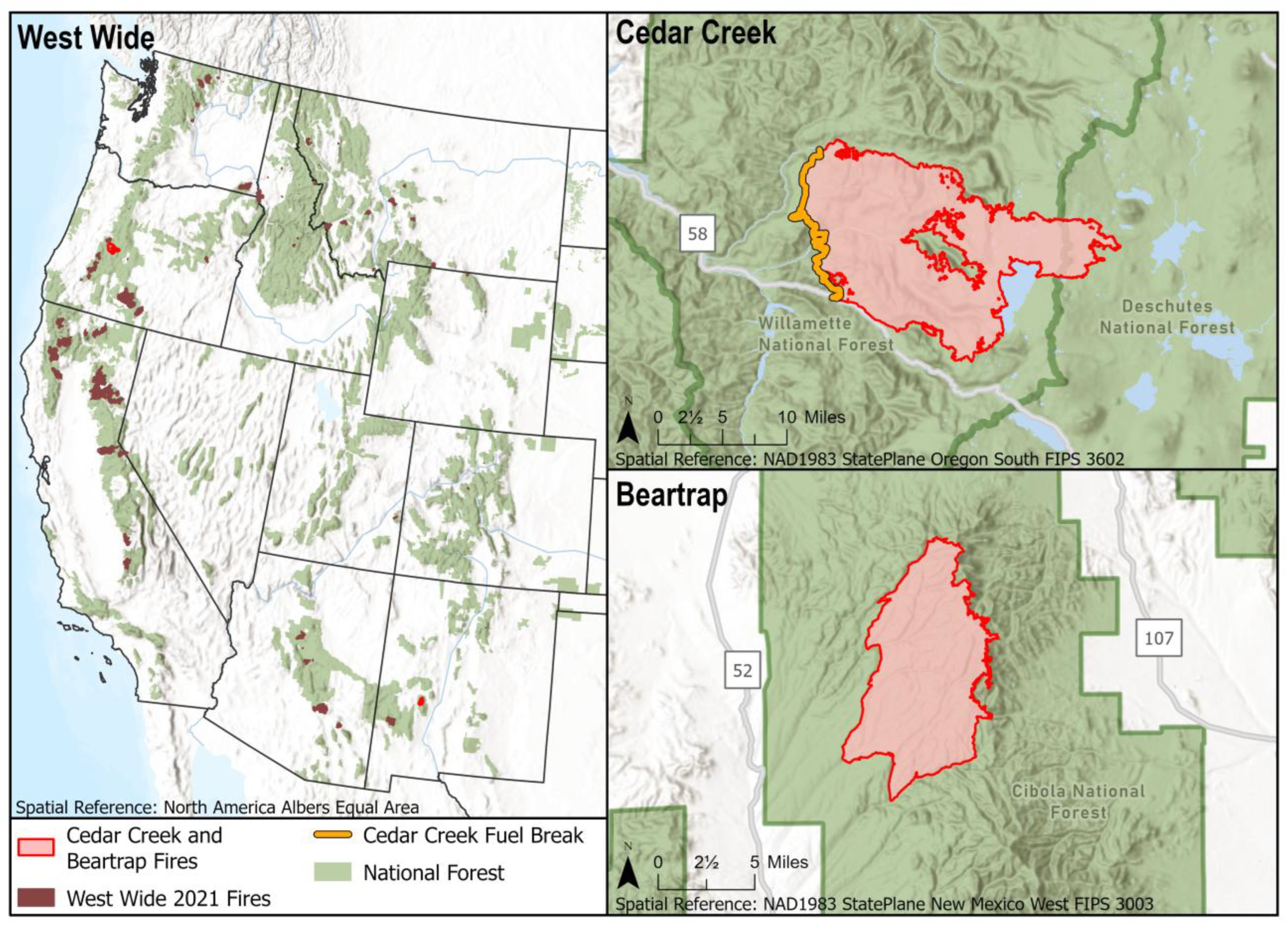
Figure 1. West wide map of fires represented in 2021 survey (dark red) and 2022 case studies (red). Cedar Creek fire and Bear Trap fire insets (right, top, and bottom panel, respectively).
Fire 08 00478 g001
Figure 2. Percent of survey respondents who agreed or disagreed that Risk Management Assistance (RMA) tools were easy to interpret, relevant, at the appropriate scale, and accurate.
Fire 08 00478 g002
Figure 3. Percent of survey respondents that used Risk Management Assistance (RMA) throughout the fire lifecycle. Abbreviations: WFDSS—Wildland Fire Decision Support System; MAPs—Management Action Points; PACE—primary, alternate, contingency, and emergency lines.
Fire 08 00478 g003
Figure 4. Percent of survey respondents who felt six common recommendations to improve Risk Management Assistance (RMA) identified by previous research were not-at-all to extremely important [24,25]. Abbreviations: DSS—decision support systems; PODs—Potential Operational Delineations; and WFDSS—Wildland Fire Decision Support System.
Fire 08 00478 g004
Table 3. Interviewee affiliations and number of interviews.
AffiliationNumber of
Participants
Incident Management Team member8
Agency Administrator2
Local fire staff3
Regional staff1
Total14
Table 4. Factors facilitating and frustrating RMA use, and recommendations to improve RMA adoption within tool, individual, organizational, and broader institutional levels. Abbreviations: NWCG—National Wildfire Coordinating Group; IMT—Incident Management Team.
LevelFacilitating FactorsFrustrating FactorsRecommendations
Characteristics of RMA tools
  • Easy to access
  • Accurate
  • Easy to use
  • Relevant to fire management context
  • Coarse resolution
  • Tools are static
  • Fire conditions or fire history limits tool applicability
  • Real-time and forecasted weather conditions
  • Fire’s potential risk reduction benefit
Characteristics of individuals
  • Previous experience with RMA
  • Expertise or capacity to interpret and use tools
  • Receptivity to new practices and tools
  • Resistance to use
  • Familiarity with, or knowledge of, RMA
  • Expertise or capacity to interpret and use tools
  • Target local, trusted leaders to share RMA tools and practices
  • Expert users or coaches to mentor new users
Characteristics of organizations
  • Leadership or dedicated champions
  • Team or agency culture embraces innovative tools
  • Lack of leadership and champions
  • Team or agency culture does not embrace tools
  • Identify or articulate potential for integrating RMA with other platforms and processes
  • Encourage local units to field test RMA
  • Incorporate RMA during pre-season and post-fire planning exercises
  • Increase RMA training for Agency Administrators
Broader institutional and environmental contexts
  • Uncharacteristic fire and/or weather conditions
  • IMT transitions
  • Lack of training or external support
  • Tool use competes with other products and requirements
  • Increase NWCG RMA training for fire responders
  • Increase inter-agency pre-season trainings
Disclaimer/Publisher’s Note: The statements, opinions and data contained in all publications are solely those of the individual author(s) and contributor(s) and not of MDPI and/or the editor(s). MDPI and/or the editor(s) disclaim responsibility for any injury to people or property resulting from any ideas, methods, instructions or products referred to in the content.