Article

Characteristics of Lightning Ignition and Spatial–Temporal Distributions Linked with Wildfires in the Greater Khingan Mountains


1
Ecology and Nature Conservation Institute, Chinese Academy of Forestry, Beijing 100091, China
2
Institute of Electrical Engineering, Chinese Academy of Sciences, Beijing 100190, China
*
Author to whom correspondence should be addressed.
Fire 2025, 8(12), 474; https://doi.org/10.3390/fire8120474
Submission received: 21 October 2025 / Revised: 4 December 2025 / Accepted: 6 December 2025 / Published: 11 December 2025

Abstract

Lightning-ignited wildfires represent a dominant natural disturbance agent in the Greater Khingan Mountains of northeastern China; however, the relationship between their occurrence and lightning characteristics remains insufficiently quantified. This study analyzed cloud-to-ground (CG) lightning data (2019–2024) and 417 lightning-ignited wildfires (2019–2024) using a full-waveform lightning detection network and spatial matching based on the Minimum Distance Method. Lightning activity shows pronounced spatiotemporal clustering, with more than 93% of flashes occurring in summer and a diurnal peak at 15:00. About 74.6% of wildfires ignited within 1 km of a lightning strike, and the holdover time exhibited clear seasonality, peaking in August (≈317 h). Negative CG (−CG) flashes dominated ignition events (56.5% multiple-stroke, average multiplicity = 2.60), and igniting flashes were concentrated within the −10 to −30 kA peak-current range, suggesting a key threshold for ignition. Vegetation type strongly influenced ignition efficiency: cold temperate and temperate coniferous forests recorded the highest lightning and fire counts, while alpine grasslands and sedge meadows showed the highest lightning ignition efficiency (LIE). These findings clarify how lightning electrical properties and vegetation conditions jointly determine ignition probability and provide a scientific basis for improving lightning-ignited wildfire risk monitoring and early-warning systems in boreal forest regions.

1. Introduction

Lightning is the most impressive, commonly experienced geophysical phenomenon. All lightning can be classified into (a) cloud-to-ground lightning (CG), (b) intracloud lightning, (c) cloud-to-cloud lightning, and (d) cloud-to-air lightning. As a natural hazard, lightning not only causes a significant loss of life and property but also triggers wildfires, thereby influencing the evolution of species and ecosystems within the Earth system. Lightning-ignited wildfires are influenced by a variety of factors, including lightning activity, weather conditions, and available fuel. Predicting lightning-ignited wildfires remains a significant challenge due to the complex interactions among these variables [1]. As a potent natural discharge event, lightning is a major source of wildfire ignition [2]. Fires caused by lightning tend to occur in large spatiotemporal clusters and often result in larger burned areas compared to those from other causes [3,4].
In temperate zones, the frequency of lightning flashes is increasing due to global warming. Consequently, lightning activity directly affects the occurrence of lightning-ignited wildfires, with a projected 11% increase in fire frequency for each 1 K rise in temperature [5,6,7]. Between 1992 and 2013, lightning-ignited wildfires accounted for 56% of the total burned area in the continental United States, despite comprising only 16% of all wildfires (12% during 2008–2012). The severe 2017 boreal wildfires in North America were mainly ignited by lightning [8,9,10]. Similarly, although lightning-ignited wildfires made up only 45% of all wildfires in Canada, they were responsible for up to 80% of the total burned area [11,12]. In Australia, only 30% of all wildfires were caused by lightning, yet they accounted for 90% of the total burned area [13]. About 45% of wildfires in China’s northeastern boreal forests were caused by lightning, with the Greater Khingan Mountains serving as a key hotspot, where 1651 lightning-ignited fires have been recorded since 1980. Notably, the frequency of lightning-ignited fires in this region has significantly increased since 2000 [14,15].
The occurrence of lightning-ignited wildfires is closely linked to the physical characteristics of lightning, including its intensity, density, and spatiotemporal distribution [16]. In the United States, high fire risk is defined by a ground flash density greater than 9 flashes/km−2 [17,18]. 81–88% of the 905 lightning-ignited wildfires that were documented between 2012 and 2015 had holdover times less than 14 days, with 52–60% having stay durations less than one day. 75% of these fires had peak current intensities of around −29.5 kA, and almost 90% of them were initiated by −CG [19,20]. Holdover times is typically defined as the interval between the time a lightning strike ignites a fire and the time the fire is detected [21]. A distinct spatial clustering of lightning density has been observed within a 1 km radius of ignition points [22]. However, studies conducted in Austria suggested that positive CG flashes accounted for a greater proportion of fire ignitions in that region [23].
In Tasmania, the average ignition efficiency of lightning flashes is 0.24% per flash, with variations depending on vegetation type. Southern button grass moorlands, in particular, show higher ignition efficiencies based on GPATS lightning data from Australia [24]. In western Canada, −CG flashes are responsible for 89% of lightning-ignited wildfires, with single-stroke lightning flashes accounting for 66% of these incidents [25].
Several factors influence the likelihood of lightning igniting wildfires, including flash frequency, polarity (positive or negative), multiplicity (the number of strokes per flash), and the presence of long-continuing current (LCC) in CG flashes [26,27,28]. However, due to limitations in lightning detection technology, comprehensive studies in China’s Greater Khingan Mountains on the relationship between the physical characteristics of lightning (such as polarity and continuous current) and ignition efficiency remain scarce.
In 2018, a VLF/LF lightning detection network was established in the Greater Khingan Mountains and later upgraded to a full-waveform detection system in 2021. Preliminary results from a study conducted during the 2022 spring fire season, based on a small sample (n = 22), indicated that −CG flashes were more frequently associated with fire ignitions, with an average current intensity of −22.72 kA and holdover times ranging from 0.56 to 17.62 h [29]. However, due to the small sample size, further research is required to assess the broader applicability of these findings.

2. Materials and Methods

2.1. Study Area

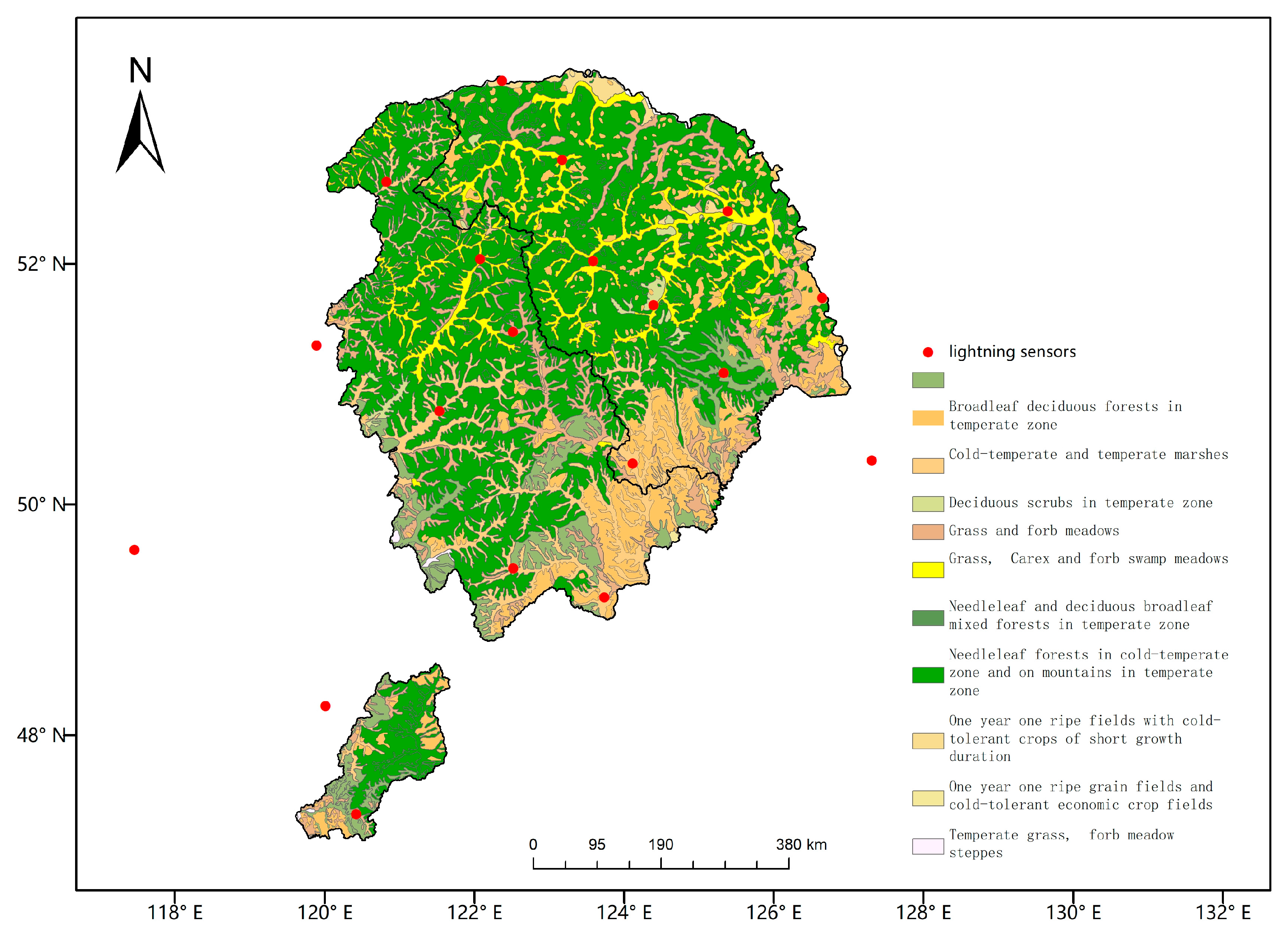
The Greater Khingan Mountains, the research region, cover Heilongjiang Province and the Inner Mongolia Autonomous Region in northeastern China (47°03′29–53°33′45 N, 119°36′28–127°01′29 E) (Figure 1) [30]. The climate of the area is cold temperate continental monsoon, with short, warm, rainy summers and long, cold, dry winters. The average annual temperature is less than −2 °C, and there is between 300 and 500 mm of precipitation. With altitudes ranging from 145 to 1744 m [31], the Greater Khingan Mountains are mostly made up of low- to mid-altitude mountains and undulating terrain. Coniferous and temperate broadleaf forests cover around 73.3% of the land area [32]. The Greater Khingan Mountains are one of China’s most fire-prone forest areas, with the highest frequency and concentration of lightning-ignited wildfires in China.

2.2. Lightning Data

A three-dimensional lightning monitoring system was constructed and deployed to detect lightning activity in the Greater Khingan Mountains. In 2021, the system was upgraded to a full-waveform three-dimensional lightning detection station (ADTD-3A). The system receives real-time very low-frequency (VLF) electromagnetic pulse signals emitted by lightning, classifies lightning types using a one-dimensional convolutional neural network (1D-CNN) algorithm [33], and employs waveform cross-correlation techniques to identify radiation sources associated with individual lightning events. With a horizontal positioning accuracy of <300 m, the system substantially enhances the recognition accuracy, detection efficiency, and spatial precision of lightning strokes [34]. For each lightning stroke, the system provides latitude, longitude, occurrence time, peak current intensity, polarity, type (cloud-to-cloud or cloud-to-ground), and cloud flash height in real time. Ground flash data recorded from 2019 to 2024 were used for analysis in this study.

2.3. Lightning-Ignited Fire

Data on 417 lightning-ignited fires occurring between 2019 and 2024, including ignition coordinates, discovery and suppression times, and the burned area of each fire, were obtained from the Greater Khingan Mountains’ wildfire prevention agency. The classification of lightning-caused fires was based on the Forestry Industry Standard of China: “Lightning-caused forest fire investigation and appraisal standards”, which considers meteorological factors such as precipitation, lightning activity, wind speed, and other relevant conditions.

2.4. Vegetation

China’s 1:1,000,000 vegetation dataset, officially released in 2001, offers a comprehensive depiction of the spatial distribution patterns of 796 vegetation units—comprising formations and sub-formations—across 11 vegetation type groups and 54 vegetation types nationwide. The dataset captures both horizontal and vertical zonality in vegetation distribution, reflecting ecological gradients across diverse climatic and topographic conditions. Furthermore, it maps the actual distributions of more than 2000 dominant plant species, major crops, and economically important plants, while also revealing significant associations between dominant species and underlying soil types or surface geological features [35].

2.5. Stroke-to-Flash Grouping Method

A CG flash may consist of one or more strokes. To minimize the influence of variations in stroke detection efficiency caused by system upgrades, the CG lightning stroke data were grouped prior to analysis. As there is currently no universally accepted method for lightning stroke classification, this study adopted the spatiotemporal grouping criteria specified in the Chinese National Standard General Guidelines for Ground Flash Density Based on Lightning Location System (LLS) (GB/T 37047-2018) [36]. The criteria are as follows: (1) the time interval between any subsequent stroke and the first stroke does not exceed 1 s; (2) the spatial distance between any subsequent stroke and the first stroke is within 10 km; and (3) the time interval between consecutive strokes is within 500 ms. These criteria enable the grouping of multiple strokes into a single flash.

2.6. Link Lightning with Fire Ignitions

To identify lightning candidates, a temporal window (holdover time) and a spatial buffer zone (location errors) were established around each fire point. The accuracy of lightning detection within the study area determined the specific parameters of these windows and buffers. Two approaches were applied to identify lightning flashes with the highest probability of igniting a fire: a single-parameter method and a composite-parameter method.
  • Single-parameter methods:
Minimum distance method: Chooses the lightning flash within the specified spatial buffer that is closest to the fire point [37]. Minimum Distance Method is a spatial analysis technique that determines the shortest distance between lightning strike locations and wildfire ignition points, to assess the proximity and correlation between lightning events and fire occurrences.
2.
Composite index method
The Maximum Proximity Index (A) method, which selects the CG lightning flash with the highest computed A value as the ignition source. A is defined as:
A = 1 T T m a x × S S m a x
where T is the holdover time, S is the spatial distance between the lightning flash and the fire point, Tmax is the maximum allowed holdover time, and Smax is the maximum buffer radius. The value of A ranges from 0 to 1, with values closer to 1 indicating a higher spatiotemporal proximity between the lightning flash and the fire. With a maximum lookback duration of 90 days, this study use the minimum distance method to identify lightning flashes linked to smoldering wildfires. Wildfires in the Greater Khingan Mountains typically occur from spring to autumn. Due to seasonal variations in fuel moisture, lightning-ignited fires often exhibit a delayed ignition pattern. The selection of time threshold refers to the previous study [38].

3. Results

3.1. Spatial Distribution of CG Lightning

In the Greater Khingan Mountains, a total of 1,667,786 CG strokes were recorded between 2019 and 2024. After stroke grouping, 793,403 CG flashes were identified, comprising 228,218 positive CG flashes and 565,185 −CG flashes, with −CG flashes accounting for 71.24% of the total.
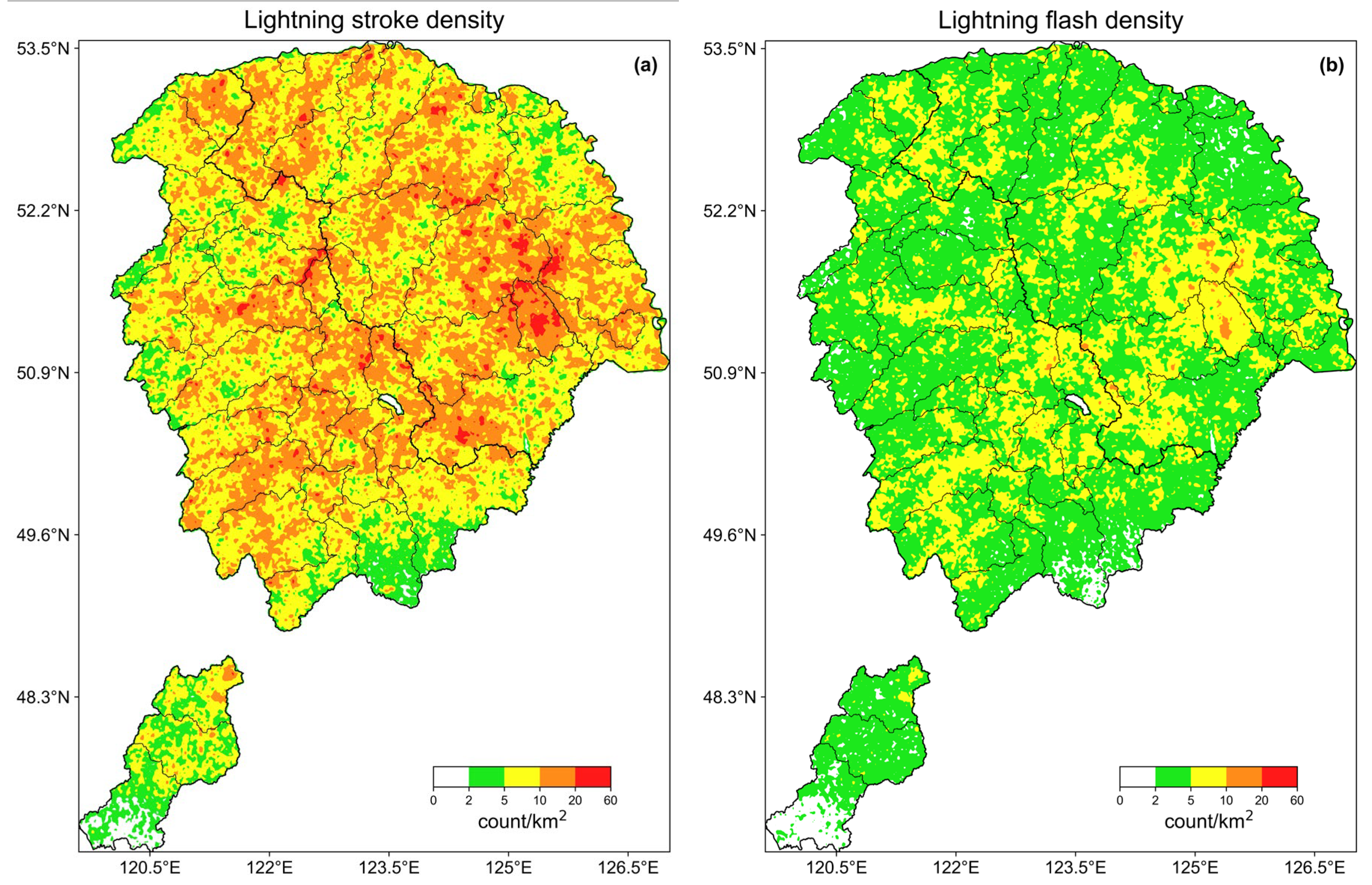
As shown in Figure 2, the study area was divided into grid cells of 2 km × 2 km, and the total numbers of flashes and strokes within each cell were counted. Based on grid-level statistics, the maximum stroke density reached 49.11 strokes/km2, while the maximum flash density was 17.89 flashes/km2. Spatially, the highest lightning activity was concentrated in the central part of the Greater Khingan Mountains in Inner Mongolia and the southeastern region in Heilongjiang Province.

3.2. Temporal Distribution of CGLightning

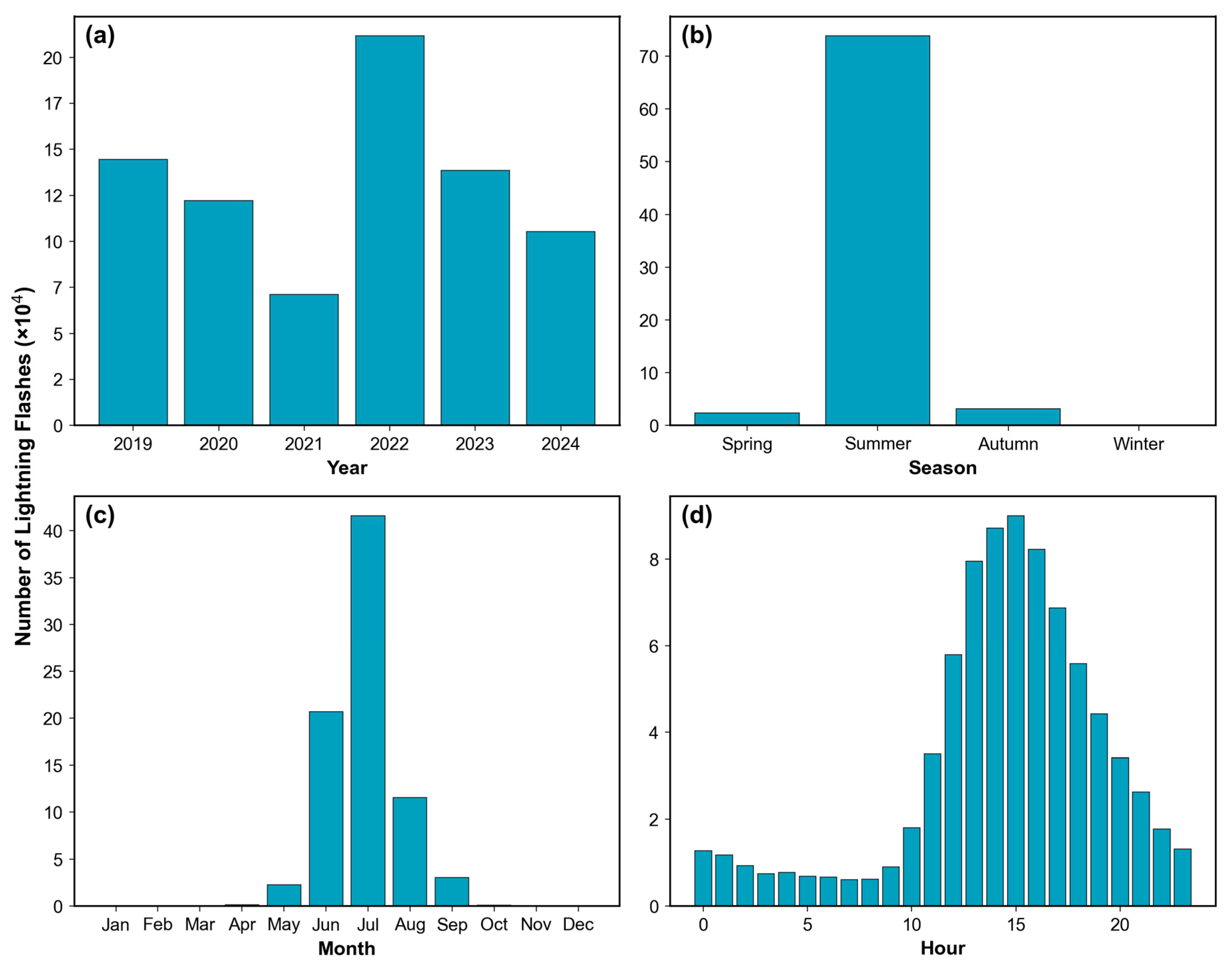
There were notable interannual variations in lightning activity during the study period (Figure 3a). The year 2022 recorded the highest lightning frequency, with a total of 211,595 flashes, followed by 2019 (144,571 flashes) and 2023 (138,579 flashes). In contrast, 2021 exhibited the lowest lightning activity. These interannual differences may be associated with climate variability and changes in atmospheric circulation patterns.
Lightning activity also exhibited a pronounced seasonal concentration (Figure 3b). Approximately 93.08% of all lightning flashes occurred during summer (June–August), indicating that lightning in the Greater Khingan Mountains is predominantly a summer phenomenon. The Greater Khingan Mountains region is located in the mid-to-high latitudes and has a cold temperate continental monsoon climate. Due to its latitude and continental climate, the atmospheric warming process in this area lags behind, and strong convective activity typically intensifies and fully develops during the summer months (June to August). This pattern is consistent with the findings of other studies [39,40]. In comparison, spring (March–May) and autumn (September–November) accounted for only 2.97% and 3.95% of the total flashes, respectively. However, the likelihood of lightning-ignited wildfires increases in spring due to the season’s typically dry climatic conditions. Winter (December–February) recorded minimal lightning activity, with only a single flash observed throughout the period.
The seasonal features of lightning activity are further refined by the monthly distribution data (Figure 3c). 52.45% of all lightning flashes occur in July, making it the month with the highest concentration of flashes. Contributions from June and August are 26.08% and 14.56%, respectively. In May, lightning activity starts to increase, and by September, it has drastically decreased. In April and October, there was only occasional lightning activity. Interestingly, there was just one lightning flash in January and none in February, November, or December.
Figure 3d illustrates a distinct unimodal diurnal pattern of lightning activity. The highest frequency occurred during the afternoon and early evening (12:00–18:00 Beijing time), peaking at 15:00 with 11.35% of all flashes. High activity levels were also observed at 14:00 (10.98%) and 16:00 (10.36%). Lightning frequency was lowest during the early morning hours (00:00–08:00), began increasing in the late morning (09:00–11:00), and gradually declined after sunset (19:00–23:00). This diurnal variation corresponds closely to the dynamics of thermal convection, as enhanced surface heating during the day promotes convective development, with the peak in lightning activity typically occurring shortly after the daily maximum temperature.

3.3. Spatial and Temporal Distribution of Lightning Relative to Wildfire

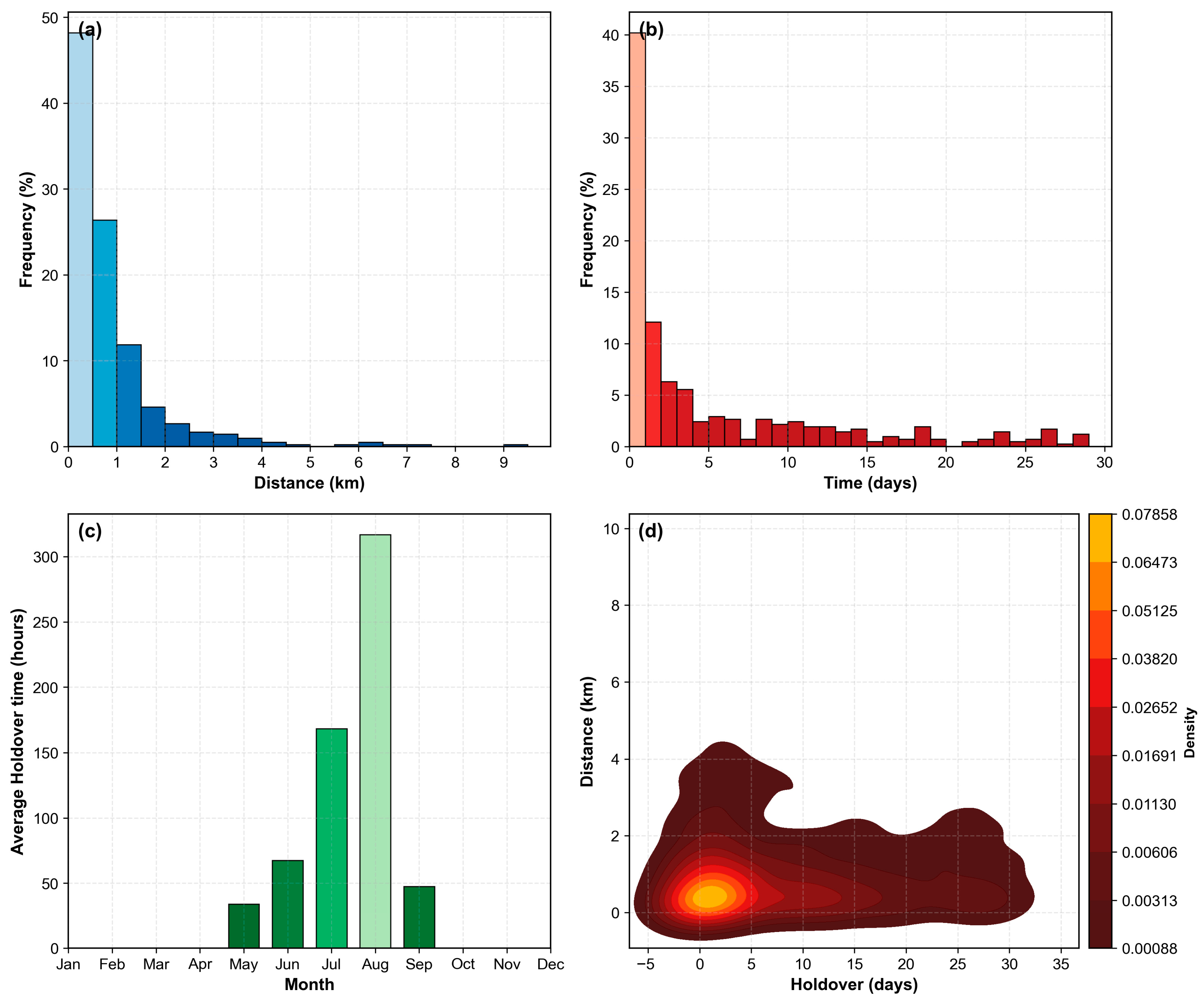
A total of 417 lightning-ignited wildfires were recorded between May and September. Using the Minimum Distance Method, 414 fires were successfully matched with lightning flashes. The distances between lightning flash locations and wildfire ignition points varied widely, ranging from 12 m to approximately 9.4 km. Most wildfires (74.58%) occurred within 1 km of a lightning flash, and 98.79% occurred within 5 km (Figure 4a).
Holdover time also varied substantially, from 0.06 h (approximately 3.6 min) to several tens of days (Figure 4b). Approximately 40.43% of the fires were detected within 24 h of the associated lightning flash. Kernel density estimation is a non-parametric method used to analyze the probability distribution of continuous variables. It produces a smooth estimate of the density function by summing kernel functions centered at each data point, thereby avoiding the discretization bias inherent in histograms [41,42]. In this study, two-dimensional kernel density estimation was applied to visualize the joint distribution of spatial distance and holdover time between lightning flashes and ignition points. Kernel density estimation (Figure 4d) further confirmed that the majority of lightning-ignited wildfires occurred within 0–2 km of lightning flashes and were detected within a short period (≤24 h).
The monthly distribution of holdover time exhibited a clear seasonal pattern (Figure 4c). From May to August, the median holdover time increased markedly, peaking in August at approximately 317 h, suggesting a prolonged smoldering phase for fires ignited during mid-to-late summer. Thereafter, the median holdover time declined sharply to 47.46 h in September. This seasonal variation is likely related to precipitation patterns, with dry conditions prevailing in spring and autumn and relatively abundant rainfall during summer.

3.4. Peak Current and Multiplicity of Wildfire-Igniting Lightning Flashes

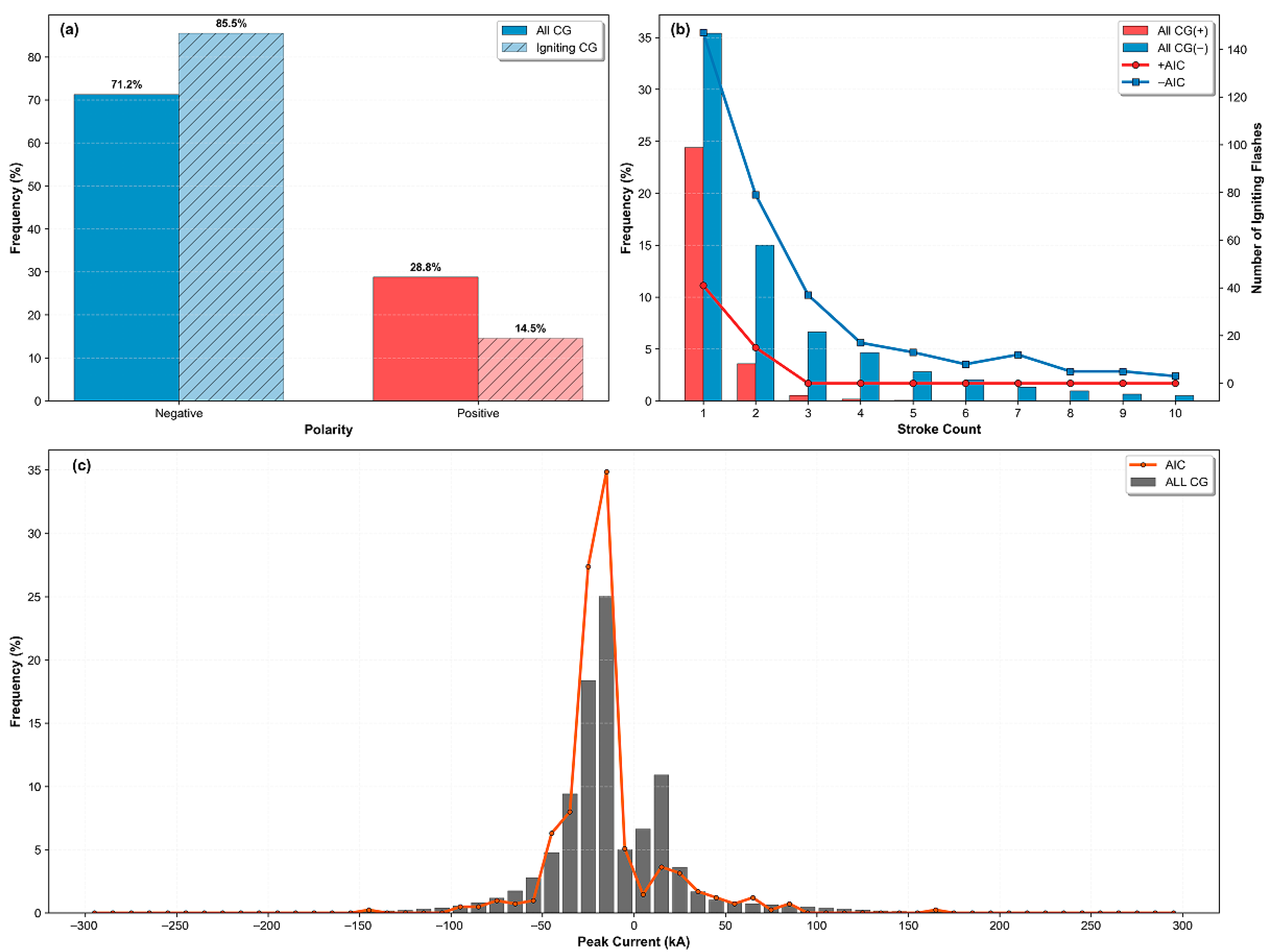
In the Greater Khingan Mountains, −CG lightning accounted for 65.72% of all flashes, while positive CG lightning comprised 34.28% (Figure 5a). Positive CG flashes were predominantly single-stroke events (84.81%), with an average multiplicity of 1.20, a maximum of 16, and an average inter-stroke distance of 0.34 km, indicating strong spatial clustering. In contrast, only 49.69% of −CG flashes were single-stroke, suggesting a higher prevalence of multiple-stroke events. Approximately 90.50% of −CG flashes exhibited multiplicities of five or fewer, with a maximum value of 41. The average multiplicity and inter-stroke distance for −CG flashes were 2.47 and 1.29 km, respectively (Table 1). The inter-stroke distance refers to the separation between each subsequent stroke and the first stroke.
Distinct differences were observed between lightning flashes that ignited wildfires (actual ignition candidate, AIC) and all lightning flashes. Among AIC flashes, multiple-stroke events accounted for 56.52%, whereas the proportion for positive AIC flashes was 26.92%—both higher than those of their non-igniting counterparts. The average multiplicity was 2.60 for AIC flashes and 1.27 for positive AIC flashes, with most positive igniting flashes containing no more than two strokes. The frequency distribution of stroke multiplicity (Figure 5b) shows broadly similar patterns for igniting and non-igniting flashes, though a secondary peak appeared for igniting flashes at a multiplicity of seven.
The peak current distribution of wildfire-igniting lightning flashes also exhibited distinct characteristics. Within the −10 to −30 kA range, the frequency of igniting flashes was substantially higher than that of non-igniting flashes (Figure 5c).

3.5. Lightning Ignition Efficiency by Vegetation Types

Analysis of lightning-ignited wildfire occurrences across different vegetation types in the Greater Khingan Mountains revealed distinct spatial and ecological patterns (Table 2). Cold-temperate and temperate coniferous forests recorded the highest numbers of lightning flashes (441,951) and wildfire ignitions (263), with a relatively high LIE of 0.06%.
Alpine grasslands and sedge meadows, despite experiencing comparatively fewer lightning flashes (58,041), exhibited the highest LIE (0.10%) among all vegetation types, suggesting greater susceptibility to lightning-ignited ignition—likely related to their lower moisture retention capacity. In contrast, temperate deciduous broadleaf forests, although frequently struck by lightning (84,901 flashes), showed a markedly lower LIE of 0.01%.

4. Discussion

The spatiotemporal distribution of lightning activity in the Greater Khingan Mountains exhibited pronounced seasonal and diurnal clustering, consistent with lightning–climate interactions observed in other boreal and temperate regions. The strong summer concentration and the 15:00 diurnal peak coincided with periods of maximum convective instability and surface heating, underscoring the dominant role of thermodynamic processes in triggering lightning. These findings corroborate previous observations from North American and Eurasian boreal forests, where 80–90% of lightning flashes also occur during summer afternoons [9,19].
The close spatial correspondence between lightning strike locations and wildfire ignition points confirms that lightning is the primary ignition source in this region. Approximately 75% of fires ignited within 1 km of lightning strikes, a pattern comparable to results from western Canada and Alaska [19,25]. The distinct seasonality of holdover time—particularly its August peak—suggests a delayed ignition process likely related to higher fuel moisture during the rainy season, which prolongs smoldering before surface flame emergence.
Electrical characteristics further distinguish igniting from non-igniting lightning. −CG flashes dominated wildfire ignition, consistent with previous studies showing that negative polarity, moderate peak current (−10 to −30 kA), and multiple-stroke flashes enhance ignition potential. The secondary multiplicity peak near seven strokes implies a possible relationship between repeated discharges and fuel preheating, warranting detailed waveform analysis in future research.
Vegetation-related differences in LIE underscore the ecological modulation of fire risk. Cold-temperate and temperate coniferous forests exhibited the highest lightning and fire frequencies, reflecting both abundant fuel loads and favorable microclimatic conditions. In contrast, alpine grasslands and sedge meadows showed the highest LIE, likely due to lower fuel moisture and high fine-fuel continuity—similar to ignition-prone tundra ecosystems in northern Canada.
In wildfire susceptibility and risk assessments, it is crucial to incorporate lightning factors into multi-criteria mathematical and machine learning models [43,44]. Lightning is a significant natural ignition source, especially in regions like the Greater Khingan Mountains, where lightning-ignited fires play a prominent role in shaping the local ecosystem. By integrating lightning-related data, such as strike density, intensity, and temporal distribution, into these models, we can substantially improve the accuracy of fire risk predictions. This approach allows for a more comprehensive evaluation of fire susceptibility, accounting for the dynamic and variable nature of lightning activity. Moreover, the inclusion of lightning variables enhances decision-making in wildfire prevention, detection, and management, providing a more holistic understanding of fire risk in areas frequently impacted by lightning events.

5. Conclusions

This study systematically analyzed the key characteristics of lightning activity associated with lightning-ignited wildfires in the Greater Khingan Mountains. The main conclusions are as follows:
Spatiotemporal distribution: Lightning activity exhibited pronounced seasonal and diurnal clustering, with summer (June–August) accounting for over 93% of all events. July recorded the highest frequency (52.45%). The diurnal pattern was unimodal, peaking at 15:00, coinciding with the period of strongest convective activity.
Spatial relationship and holdover time: The occurrence of lightning-ignited wildfires was strongly linked to the spatial distribution of lightning strikes. Approximately 74.6% of fires occurred within 1 km, and 98.8% within 5 km, of the corresponding strike points. Holdover time showed significant seasonal variation, peaking in August (mean ≈ 317 h), likely influenced by elevated summer precipitation and variable fuel moisture conditions.
Electrical characteristics: −CG flashes were the dominant ignition source. Multi-stroke events accounted for 56.5% of igniting −CG flashes, with an average multiplicity of 2.60—slightly higher than that of all −CG flashes (2.47). A secondary ignition-related peak occurred near a multiplicity of seven strokes.
Peak current: Wildfire-igniting flashes showed distinct selectivity in peak current. Flashes within the −10 to −30 kA range represented a significantly higher proportion of ignition events compared with non-igniting flashes, indicating that this range may constitute a critical threshold for ignition.
Vegetation influence: The risk of lightning-ignited wildfires varied notably among vegetation types. Cold temperate and temperate coniferous forests exhibited both the highest lightning density and the greatest number of wildfire ignitions, making them priority regions for preventing lightning-induced fires. Conversely, alpine grassland and sedge meadow ecosystems showed the highest LIE (0.10%), likely due to low moisture retention and high fuel flammability.
Overall, these findings provide a scientific basis for refining lightning-based indicators in wildfire risk early-warning systems in the Greater Khingan Mountains. They also offer practical guidance for enhancing lightning-ignited wildfire prevention and management in boreal forest ecosystems.

Author Contributions

Conceptualization, S.Y.; methodology, S.Y.; resources, M.W. and J.S.; data curation, X.Z., F.X. and J.W.; writing—original draft preparation, S.Y.; writing—review & editing, M.W.; visualization, S.Y.; project administration, L.S.; supervision, L.S. and Q.M.; funding acquisition, L.S. All authors have read and agreed to the published version of the manuscript.

Funding

This research was funded by the National Key R&D Program of China, NO. 2023YFD2202001.

Institutional Review Board Statement

Not applicable.

Informed Consent Statement

Not applicable.

Data Availability Statement

The original contributions presented in this study are included in the article. Further inquiries can be directed to the corresponding author.

Conflicts of Interest

The authors declare no conflicts of interest.

References

  1. Bates, B.C.; Dowdy, A.J.; McCaw, L. A Bayesian approach to exploring the influence of climate variability modes on fire weather conditions and lightning-ignited wildfires. Clim. Dyn. 2021, 57, 1207–1225. [Google Scholar] [CrossRef]
  2. Coogan, S.C.P.; Cai, X.; Jain, P.; Flannigan, M.D. Seasonality and trends in human- and lightning-caused wildfires ≥ 2 ha in Canada, 1959–2018. Int. J. Wildland Fire 2020, 29, 473. [Google Scholar] [CrossRef]
  3. Dowdy, A.J.; Mills, G.A. Characteristics of lightning-attributed wildland fires in south-east Australia. Int. J. Wildland Fire 2012, 21, 521. [Google Scholar] [CrossRef]
  4. Wotton, B.M.; Martell, D.L. A lightning fire occurrence model for Ontario. Can. J. For. Res. 2005, 35, 1389–1401. [Google Scholar] [CrossRef]
  5. Jolly, W.M.; Cochrane, M.A.; Freeborn, P.H.; Holden, Z.A.; Brown, T.J.; Williamson, G.J.; Bowman, D.M.J.S. Climate-induced variations in global wildfire danger from 1979 to 2013. Nat. Commun. 2015, 6, 7537. [Google Scholar] [CrossRef]
  6. Pérez-Invernón, F.; Gordillo-Vázquez, F.J.; Huntrieser, H.; Jöckel, P. Variation of lightning-ignited wildfire patterns under climate change. Nat. Commun. 2022, 14, 739. [Google Scholar] [CrossRef]
  7. Romps, D.M.; Seeley, J.T.; Vollaro, D.; Molinari, J. Projected increase in lightning strikes in the United States due to global warming. Science 2014, 346, 851–854. [Google Scholar] [CrossRef]
  8. Abatzoglou, J.T.; Kolden, C.A.; Balch, J.K.; Bradley, B.A. Controls on interannual variability in lightning-caused fire activity in the western US. Environ. Res. Lett. 2016, 11, 045005. [Google Scholar] [CrossRef]
  9. Ahrens, M. Lightning Fires and Lightning Strikes; National Fire Protection Association: Quincy, MA, USA, 2008. [Google Scholar]
  10. Veraverbeke, S.; Rogers, B.M.; Goulden, M.L.; Jandt, R.R.; Miller, C.E.; Wiggins, E.B.; Randerson, J.T. Lightning as a major driver of recent large fire years in North American boreal forests. Nat. Clim. Change 2017, 7, 529–534. [Google Scholar] [CrossRef]
  11. Li, C.; Liu, J.; Lafortezza, R.; Chen, J. Managing forest landscapes under global change scenarios. In Landscape Ecology in Forest Management and Conservation: Challenges and Solutions for Global Change; Li, C., Lafortezza, R., Chen, J., Eds.; Springer: Berlin/Heidelberg, Germany, 2011; pp. 3–21. [Google Scholar] [CrossRef]
  12. Wang, Y.; Anderson, K.R. An evaluation of spatial and temporal patterns of lightning- and human-caused forest fires in Alberta, Canada, 1980–2007. Int. J. Wildland Fire 2010, 19, 1059. [Google Scholar] [CrossRef]
  13. Egloff, B. Lightning strikes: Rethinking the nexus between Australian Indigenous land management and natural forces. Aust. For. 2017, 80, 275–285. [Google Scholar] [CrossRef]
  14. Li, W.; Shu, L.; Wang, M. Temporal and Spatial Distribution and Dynamic Characteristics of Lightning Fires in the Daxing’anling Mountains from 1980 to 2021. Sci. Silvae Sin. 2023, 59, 22–30. [Google Scholar]
  15. Song, Y.; Xu, C.; Li, X.; Oppong, F. Lightning-Induced Wild fires: An Overview. Fire 2024, 7, 79. [Google Scholar] [CrossRef]
  16. Gyawali, S.S.; Bhusal, R.J.; Sharma, S. Analysis of the Role of Lightning Activity in Triggering Forest Fires in Nepal. Amrit Res. J. 2024, 4, 64–71. [Google Scholar] [CrossRef]
  17. Hardy, C.C.; Bunnell, D.L.; Menakis, J.; Schmidt, K.; Long, D.; Simmerman, D.; Johnston, C. Coarse-Scale Spatial Data for Wildland Fire and Fuel Management. USDA Forest Service, Rocky Mountain Research Station, Fire Sciences Laboratory. 1999. Available online: http://www.fs.fed.us/fire/fuelman (accessed on 29 June 2006).
  18. Latham, D.J. Ignition Probabilities of Wildland Fuels Based on Simulated Lightning Discharges; US Department of Agriculture, Forest Service, Intermountain Research Station: Ogden, UT, USA, 1989; Volume 411.
  19. Schultz, C.J.; Nauslar, N.J.; Wachter, J.B.; Hain, C.R.; Bell, J.R. Spatial, Temporal and Electrical Characteristics of Lightning in Reported Lightning-Initiated Wildfire Events. Fire 2019, 2, 18. [Google Scholar] [CrossRef]
  20. MacNamara, B.R.; Schultz, C.J.; Fuelberg, H.E. Flash Characteristics and Precipitation Metrics of Western U.S. Lightning-Initiated Wildfires from 2017. Fire 2020, 3, 5. [Google Scholar] [CrossRef]
  21. Moris, J.V.; Álvarez-Álvarez, P.; Conedera, M.; Dorph, A.; Hessilt, T.D.; Hunt, H.G.; Libonati, R.; Menezes, L.S.; Müller, M.M.; Pérez-Invernón, F.J. A global database on holdover time of lightning-ignited wildfires. Earth Syst. Sci. Data 2023, 15, 1151–1163. [Google Scholar] [CrossRef]
  22. Vant-Hull, B.; Koshak, W. Spatial Structure of Lightning and Precipitation Associated with Lightning-Caused Wildfires in the Central to Eastern United States. Fire 2023, 6, 262. [Google Scholar] [CrossRef]
  23. Müller, M.M.; Vacik, H. Characteristics of lightnings igniting forest fires in Austria. Agricultural and Forest Meteorology 2017, 240-241, 26–34. [Google Scholar] [CrossRef]
  24. Nampak, H.; Love, P.; Fox-Hughes, P.; Watson, C.; Aryal, J.; Harris, R.M.B. Characterizing Spatial and Temporal Variability of Lightning Activity Associated with Wildfire over Tasmania, Australia. Fire 2021, 4, 10. [Google Scholar] [CrossRef]
  25. Aftergood, O.S.R.; Flannigan, M.D. Identifying and analyzing spatial and temporal patterns of lightning-ignited wildfires in Western Canada from 1981 to 2018. Can. J. For. Res. 2022, 52, 1399–1411. [Google Scholar] [CrossRef]
  26. Flannigan, M.D.; Wotton, B.M. Lightning-ignited forest fires in northwestern Ontario. Can. J. For. Res. 1991, 21, 277–287. [Google Scholar] [CrossRef]
  27. Price, C.; Rind, D. What determines the cloud-to-ground lightning fraction in thunderstorms? Geophys. Res. Lett. 1993, 20, 463–466. [Google Scholar] [CrossRef]
  28. Hall, B.L.; Brown, T.J. Climatology of positive polarity flashes and multiplicity and their relation to natural wildfire ignitions. In Proceedings of the 19th International Lightning Detection Conference, Tucson, AZ, USA, 24–25 April 2006; pp. 24–27. [Google Scholar]
  29. Wang, M.; Yuan, S.; Li, W.; Li, W.; Song, J.; Si, L.; Wang, Y.; Zhao, F.; Tian, X.; Li, X.; et al. Process and Influencing Factors of Mass Lightning Fires Caused by Dense Lightning in Daxing’ anling Mountains. Sci. Silvae Sin. 2022, 58, 10–20. [Google Scholar] [CrossRef]
  30. Li, W.; Si, L.; Yuan, S.; Song, J.; Li, W.; Si, L.; Zhao, F.; Wang, Y.; Wang, M. Temporal and Spatial Distribution Characteristics of Lightning in Daxing’ anling Mountains Based on VLF/LF 3D Lightning Location System. Sci. Silvae Sin. 2022, 58, 21–30. [Google Scholar] [CrossRef]
  31. Tian, X.; Shu, L.; Wang, M.; Zhao, F.; Chen, L. The fire danger and fire regime for the Daxing’anling region for 1987-2010. Procedia Eng. 2013, 62, 1023–1031. [Google Scholar] [CrossRef]
  32. Wang, X.; Huang, Y.; Zhang, J.; Wei, R.; Liu, L.; Zhang, M.; Chen, F. Research on daily prediction model of lightning fi res in Daxing’an ling Region based on lightning location data. J. Cent. South Univ. For. Technol. 2017, 37, 44–48. [Google Scholar] [CrossRef]
  33. Wang, J.; Huang, Q.; Ma, Q.; Chang, S.; He, J.; Wang, H.; Zhou, X.; Xiao, F.; Gao, C. Classification of VLF/LF Lightning Signals Using Sensors and Deep Learning Methods. Sensors 2020, 20, 1030. [Google Scholar] [CrossRef]
  34. Meng, X.; Wang, J.; Ma, Q.; Yuan, S.; Song, J.; Zhou, X.; Xiao, F.; Wang, Y. A dataset of lightning in China Based on VLF/LF Lightning Location Monitoring System. China Sci. Data 2022, 7, 31–44. [Google Scholar] [CrossRef]
  35. Editorial Committee of Vegetation Map of China, Chinese Academy of Sciences. 1:1 Million Vegetation Data Set in China. Available online: https://www.ncdc.ac.cn/portal/metadata/20d2728d-8845-4a8b-a546-5f4f50fb036d (accessed on 18 April 2025).
  36. GB/T 37047-2018; Lightning Density Based on Lightning Location Systems (LLS)—General Principles. Standardization Administration of China: Beijing, China, 2018.
  37. Moris, J.V.; Conedera, M.; Nisi, L.; Bernardi, M.; Cesti, G.; Pezzatti, G.B. Lightning-caused fires in the Alps: Identifying the igniting strokes. Agric. For. Meteorol. 2020, 290, 107990. [Google Scholar] [CrossRef]
  38. Li, W.; Shu, L.; Wang, M.; Si, L.; Li, W.; Song, J.; Yuan, S.; Wang, Y.; Zhao, F. Investigating the Latency of Lightning-Caused Fires in Boreal Coniferous Forests Using Random Forest Methodology. Fire 2025, 8, 84. [Google Scholar] [CrossRef]
  39. Yang, X.; Sun, J.; Li, W. An analysis of cloud-to-ground lightning in China during 2010–2013. Weather Forecast. 2015, 30, 1537–1550. [Google Scholar] [CrossRef]
  40. Zhao, Y.; Yan, J.; Tuo, Y.; Kong, X.; Bi, L. Analysis of the Relationship between the Spatiotemporal Distribution of Land Lightning and Atmospheric Environmental Factors in China. Chin. J. Atmos. Sci. 2025, 49, 313–324. [Google Scholar]
  41. Terrell, G.R.; Scott, D.W. Variable kernel density estimation. Ann. Stat. 1992, 20, 1236–1265. [Google Scholar] [CrossRef]
  42. Węglarczyk, S. Kernel density estimation and its application. In Proceedings of the ITM Web Conferences, Girne, Turkey, 4–6 May 2018; p. 00037. [Google Scholar]
  43. Sivrikaya, F.; Küçük, Ö. Modeling forest fire risk based on GIS-based analytical hierarchy process and statistical analysis in Mediterranean region. Ecol. Inform. 2022, 68, 101537. [Google Scholar] [CrossRef]
  44. Richi, S.M.; Maya, R.; Ghribi, M. Forest fire susceptibility modeling in the Eastern Mediterranean: A machine learning assessment. DYSONA-Appl. Sci. 2026, 7, 88–97. [Google Scholar]
Figure 1. Study area map showing the major vegetation groups and the distribution of lightning sensors.
Fire 08 00474 g001
Figure 2. Spatial distribution of lightning density. (a) flash density; (b) stroke density.
Fire 08 00474 g002
Figure 3. Temporal distribution of lightning activity in the Greater Khingan Mountains (2019–2024). (a) annual distribution; (b) seasonal distribution; (c) monthly distribution; (d) hourly distribution.
Fire 08 00474 g003
Figure 4. Distance between lightning flashes and lightning-ignited wildfires, and holdover time. (a) distance between lightning flashes and wildfire; (b) holdover time; (c) monthly variation in average holdover time; (d) kernel density analysis of distance and holdover time.
Fire 08 00474 g004
Figure 5. Polarity, stroke multiplicity, and peak current characteristics of CG lightning. (a) distribution of lightning polarity; (b) distributions of wildfire-igniting and all CG flashes under different stroke multiplicities; (c) distributions of wildfire-igniting and all CG flashes under different peak current intensities.
Fire 08 00474 g005
Table 1. Multiplicity characteristics of wildfire-igniting lightning flashes.
PopulationNumber of Lightning FlashesPercentage (%)Average MultiplicityProportion of Multiple-Stroke Flashes (%)Maximum Observed MultiplicityAverage Inter-Stroke Distance (km)
−AIC35384.862.6056.52251.45 km
+AIG6015.141.2726.9220.98 km
−CG565,18565.722.4750.31411.29 km
+CG228,21834.281.2015.19160.34 km
Table 2. LIE across different vegetation types.
VegetationNumber of Lightning FlashesNumber of WildfiresLIE (%)
Needleleaf forests in cold-temperate zone and on mountains in temperate zone441,9512630.06
Broadleaf deciduous forests in temperate zone84,901120.01
Cold-temperate and temperate marshes77,684380.05
Grass and forb meadows59,020230.04
Grass, Carex and forb swamp meadows58,041600.10
Deciduous scrubs in temperate zone825730.04
One year one ripe fields with cold-tolerant crops of short growth duration687020.03
Temperate grass, forb meadow steppes109000.00
One year one ripe grain fields and cold-tolerant economic crop fields52700.00
Needleleaf and deciduous broadleaf mixed forests in temperate zone10200.00
Disclaimer/Publisher’s Note: The statements, opinions and data contained in all publications are solely those of the individual author(s) and contributor(s) and not of MDPI and/or the editor(s). MDPI and/or the editor(s) disclaim responsibility for any injury to people or property resulting from any ideas, methods, instructions or products referred to in the content.