

Article

Early–Middle Holocene Evolution of Lake Ice Cover Duration in Northeast China
State Key Laboratory of Lithospheric and Environmental Coevolution, Institute of Geology and Geophysics, Chinese Academy of Sciences, Beijing 100029, China
*
Author to whom correspondence should be addressed.
Quaternary 2026, 9(1), 1; https://doi.org/10.3390/quat9010001
Submission received: 22 October 2025 / Revised: 9 December 2025 / Accepted: 22 December 2025 / Published: 23 December 2025

Abstract

Seasonal temperature reconstructions provide a critical approach for reconciling discrepancies between paleoclimate model simulations and proxy records. However, cold-season temperature variations remain poorly constrained due to the scarcity of robust cold-season temperature proxies. This study provides critical insights into lake ice-covered season temperature dynamics in Northeast China, a region where cold-season climate variability has remained poorly constrained in paleoclimate reconstructions. We collected total organic carbon sequences from seven closed lakes in Northeast China over the last 10,000 years to evaluate the lake ice cover duration as a proxy for lake ice-covered season temperature during the early–middle Holocene. Our results show that the lake ice cover duration decreased from ~8 ka BP, reaching a minimum at around 4 ka BP. This pattern is linked to ice-covered season temperature changes, with warmer ice-covered seasons leading to shorter ice cover durations and increased lake productivity, which were driven by orbital forcing (seasonal insolation changes) and greenhouse gas concentrations. Orbital forcing played a dominant role in winter warming between 8 and 4 ka BP, while greenhouse gas also contributed, but to a lesser extent.

1. Introduction

Temperature changes during the Holocene epoch offer valuable insights for understanding and predicting future climate trends in warming scenarios. However, the paleoclimate model results [1] showing a continual Holocene warming were in direct contradiction with results based on integrated paleotemperature records suggesting, which suggest a cooling trend during the middle and late Holocene [2]. The exploration of this Holocene temperature conundrum has driven notable advancements in paleoclimate indicators, emphasizing both the recognition of seasonal biases in paleoclimatic records and the crucial role of reconstructing seasonal temperature variations [3]. Summer cooling during the middle and late Holocene has been generally accepted due to the summer-season bias of biological indicators, such as pollen in terrestrial records and biomarkers in marine records [4,5,6]. However, the cold-season temperature variations during the Holocene remain unclear due to the limited availability of cold-season temperature indicators, although the contribution of winter temperatures was not negligible in proxy reconstruction [7], and winter temperature changes played an important role in climate changes [8,9,10].
The mid-latitude of the Northern Hemisphere is a pivotal region for temperature reconstruction, particularly in resolving ongoing discrepancies in Holocene temperature trends, because the differences between climate model simulations and proxy data in this region are most pronounced [11]. Therefore, we collected seven total organic carbon (TOC) sequences spanning the last 10 ka BP from seven small and closed lakes in Northeast (NE) China and evaluated their reliability as indicators of the lake ice cover duration. These sequences provide an opportunity for a deeper understanding of the history of cold-season temperature changes, the relationship between cold-season and summer temperatures, and the climate dynamics of cold-season temperature changes in NE China during the Holocene.

2. Study Sites and Methods

The TOC sequences were collected from the seven small lakes in NE China: Sihailongwan Maar Lake (SHL, 42°17′ N, 126°36′ E) [12], Xiaolongwan Maar Lake (XLW, 42°18′ N, 126°21′ E) [13], Erlongwan Maar Lake (ELW, 42°18.1′ N, 126°21.4′ E) [14], Buridun Lake (Buridun, 43°02′ N, 119°03′ E) [15], Kielguo Crater Lake (Kielguo, 47°30′ N, 120°52′ E) [16], Sifangshan Crater Lake (SFS, 49°22′ N, 123°28′ E) [17], and Nangelaqiu Lake (Nangelaqiu, 48°44′ N, 126°00′ E) [18].
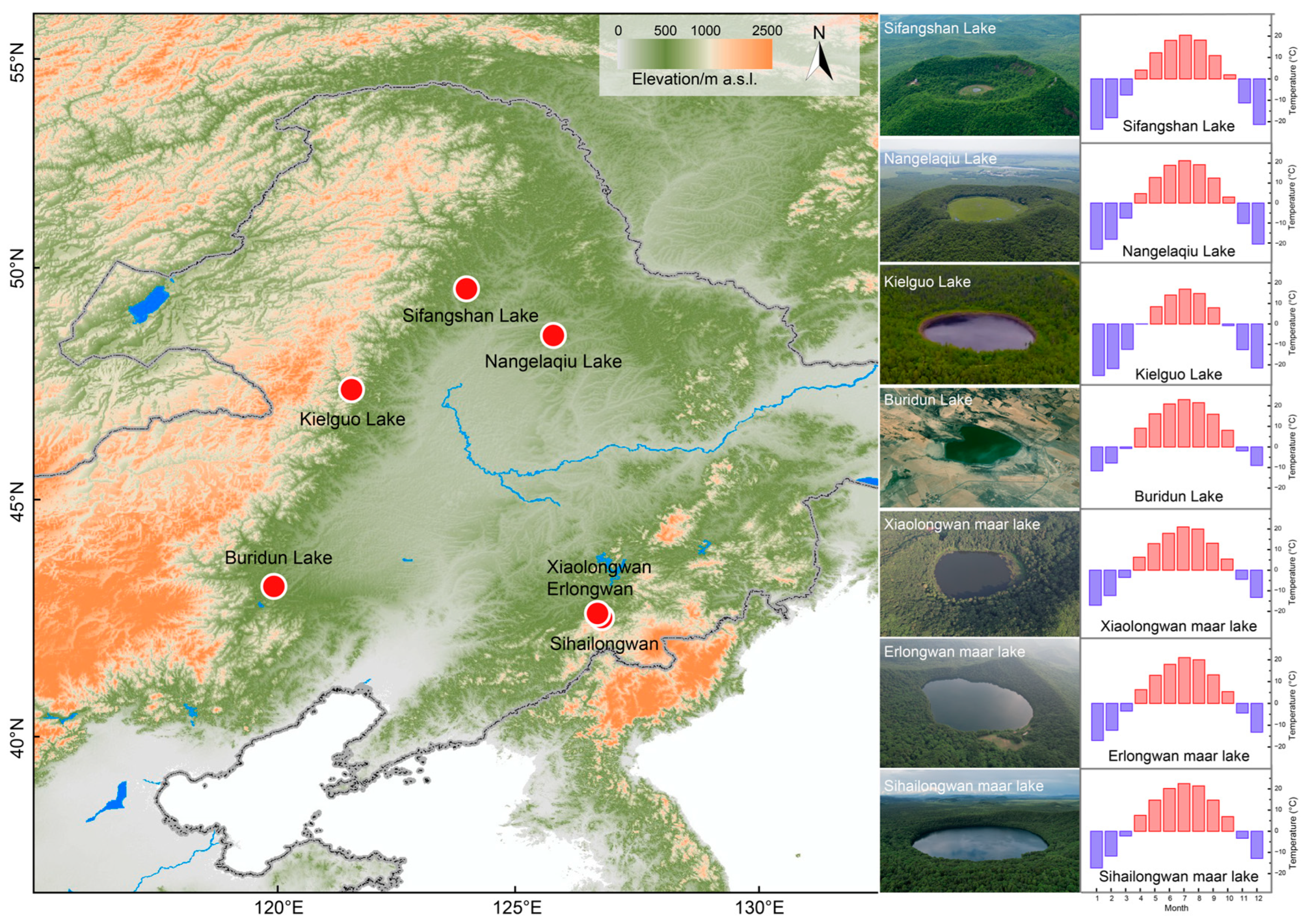
SHL, XLW, ELW, Kielguo, Nangelaqiu, and SFS, located in the eastern, western, and northern regions of NE China (Figure 1), are small volcanic lakes characterized by simple bowl-shaped morphologies, small catchment areas (0.7 km2, 0.16 km2, 0.4 km2, 0.2 km2, 0.07 km2 and 0.1 km2, respectively), and absence of inflows and outflows (Figure 1). The diameters of these closed lakes are approximately 750 m, 200–300 m, 500–750 m, 220 m, 300 m, and 26 m, with maximum water depths of approximately 50 m, 12 m, 36 m, 6.5 m, 3 m, and 2 m, respectively [13,14,17,19,20,21]. Buridun Lake, located in southwestern NE China, covers an area of approximately 1.9 km2 with a catchment area of 79 km2. Situated in the mid–high latitudes of northeast Asia, these lakes experience a climate characterized by pronounced seasonality, with cold winters and warm summers. The mean summer (June to August) and winter (December to February) temperatures for SHL, XLW (=ELW), Buridun, Kielguo, Nangelaqiu, and SFS are 19.6 °C, 21.4 °C, 21.8 °C, 15.4 °C, 19.8 °C, 8.8 °C and −11.5 °C, −13.9 °C, −9.5 °C, −19.8 °C, −20.1 °C, and 18.7 °C, respectively (Figure 1). Due to low winter temperatures, these lakes are completely frozen from October/November to April/May.
The methods for TOC analysis have been described in detail in the original articles [12,13,14,15,16,17,18]. The TOC sequences from seven lakes were stacked by normalization, interpolating to 10-year resolution, and averaging. TraCE-21ka [22] output data are available at https://gdex.ucar.edu/datasets/d651050/ (accessed on 10 December 2025). Seasonal and monthly mean temperatures under full forcings, as well as winter temperatures under single forcings, were extracted and averaged for the positions of the seven lakes. The duration (in months) of sub-zero temperatures, which was assumed as the lake ice cover duration, was calculated by extracting mean monthly temperatures for these positions, determining the duration (in months) of sub-zero temperatures, and averaging the results.

3. Results and Discussion

3.1. Interpretation of TOC Records from Hydrologically Closed Seasonal Frozen Lakes During the Holocene in Northeast China

3.1.1. TOC Records Changes During the Early–Middle Holocene in Northeast China

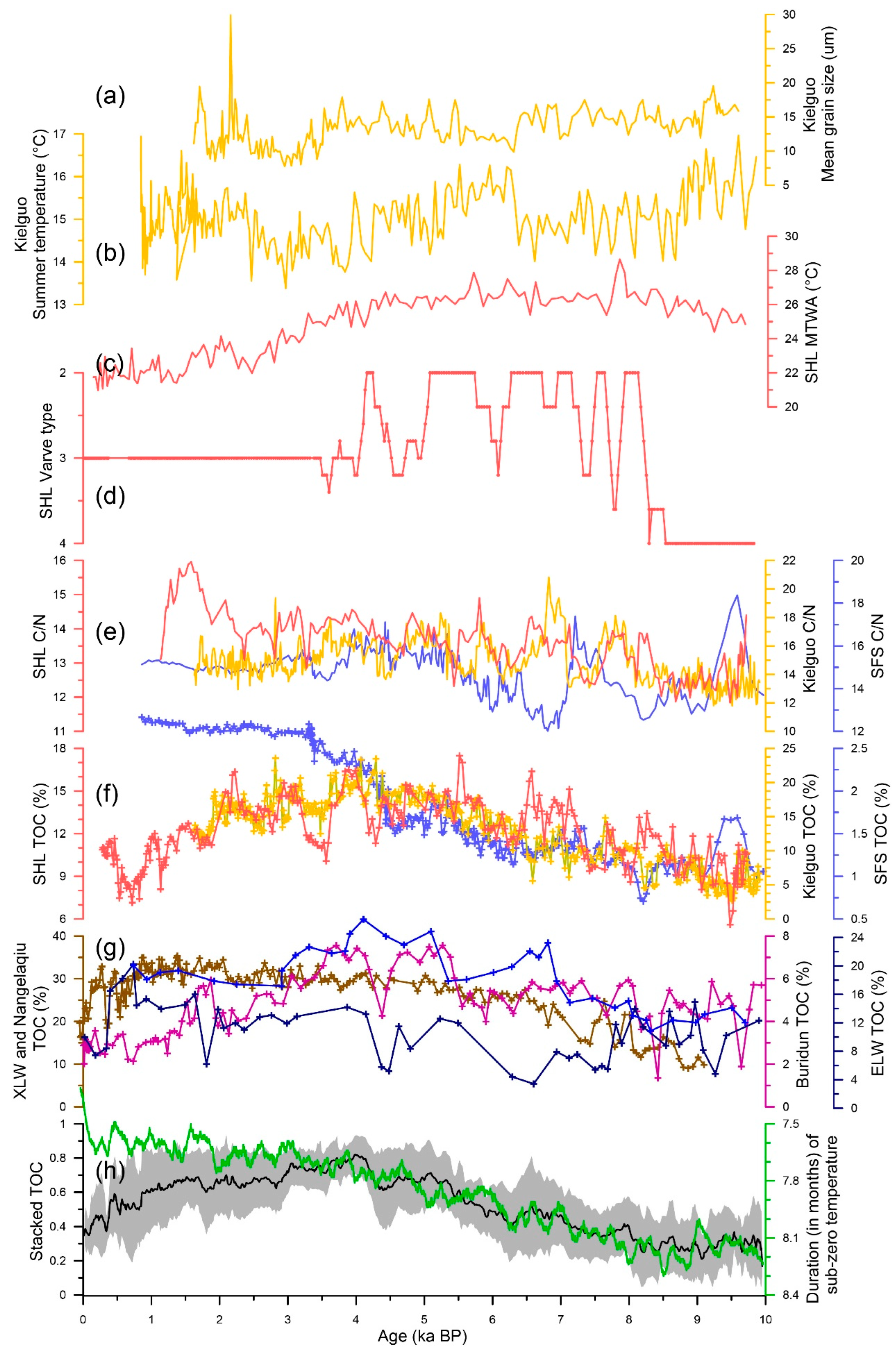
Lake TOC is shaped by multiple factors, including lake sedimentary processes, gross primary productivity [23], and regional climatic factors [24,25,26]. Nevertheless, it remains feasible to assess the dominant controlling factor at regional and temporal scales. All TOC records in small lakes in NE China exhibited a coherent pattern during the early–middle Holocene, characterized by stable values from ~10 to 8 ka BP followed by a sustained increase between ~8 and 4 ka BP (Figure 2f,g). The coherent TOC variations during the early–middle Holocene observed across multiple lakes are likely linked dominantly to autochthonous primary productivity changes driven by regional climatic forcing, rather than lake-specific sedimentary processes. Firstly, this interpretation is supported by the fact that these lakes exhibit substantial differences in bathymetry, redox conditions, and mixing regimes, yet display synchronous TOC patterns. For example, SHL is a seasonally stratified lake with thermal stratification at depths of ~10–20 m, where anaerobic conditions exist below ~20 m [27], whereas Kielguo and SFS have maximum depths of 6.5 m and 2 m, respectively, resulting in aerobic conditions in both. Buridun is a saltwater lake with modern sediments primarily composed of halite and mirabilite [15].
Secondly, the hypothesis that variations in terrestrial-derived organic material input drove the trends in TOC during the Holocene can be ruled out based on the following lines of evidence. The study about diatoms and TOC in ELW showed that the organic material input from terrestrial vegetation is very low because of the significant correlation between diatom and TOC flux [28]. Additionally, C/N ratios of organic materials in sediments are general indicators for the sources of organic materials in lake sediments. The C/N ratios of SHL, Kielguo, and SFS exhibited no significant variation (Figure 2e), indicating a consistent percentage of terrestrial organic material input throughout the Holocene. In addition, the analyses of branched glycerol dialkyl glycerol tetraethers (brGDGTs) in sediments from SHL and Kielguo reveal that soil-derived brGDGTs were not the principal contributors to brGDGTs in these lakes [20,21]. Furthermore, dust observations, combined with chemical and isotopic analyses of soils and sediments from SHL, indicate a minor sediment contribution from the lake rim throughout the Holocene [27,29,30]. Therefore, in situ primary production, rather than terrestrial-derived organic matter input, was the dominant driver of Holocene TOC variations in these lakes.
Additionally, the hypothesis that variations in nutrient availability drove primary productivity in these lakes can also be ruled out. Dust input, identified as a potential primary nutrient source, remained stable throughout the Holocene, as evidenced by the mean grain size in Kielguo sediments (Figure 2a). Furthermore, studies of maar lakes in the Longgang Volcanic area, including SHL and XLW, indicate limited external nutrient inputs via groundwater due to small catchment areas [27]. Therefore, we suggest that variations in nutrient availability were not the primary drivers of the in situ primary production and TOC increases in these lakes during the Holocene.
Although growing season temperatures are critical for the growth of primary producers, they also do not appear to be a primary driver of TOC changes in these lakes during the early–middle Holocene. The reconstructions of mean July temperatures (MTWA) for SHL [31] (Figure 2c) indicate peak warmth at ~8 ka BP, followed by cooling during the middle–late Holocene, a trend in anti-phase with TOC records. The summer temperatures based on pollen assemblages also suggest a cooling trend during the Holocene that differs from the TOC record [32]. In addition, the brGDGT-based reconstruction of mean lake water temperature in SHL and summer temperature in Kielguo also showed a different trend from the TOC sequence [21,33] (Figure 2b).
Lastly, eliminating these potential explanations, we propose that the TOC variations in these lakes during the early–middle Holocene primarily reflect autochthonous primary productivity driven by a progressive reduction in the lake ice cover duration. The first evidence is the SHL sediment varve types. The varve types of SHL sediments may reflect changes in lake productivity and dust accumulation during periods of ice cover due to the lake being permanently ice-covered in winter and experiencing diatom blooms in summer and autumn [12,27]. The SHL varve types transition from type 4 (well-defined minerogenic spring layer likely originating from aeolian dust) to type 2 (less expressed minerogenic spring layer and a thick diatom layer) during the early–middle Holocene and from type 2 to type 3 (well-expressed minerogenic spring layer and a thin diatom layer underneath) in the late Holocene (Figure 2d) [12]. Consequently, changes in SHL varve types during the Holocene indicate reduced winter deposits and increased summer and autumn diatom blooms in the early–middle Holocene, with the opposite pattern in the late Holocene, consistent with TOC changes in these lakes (Figure 2f). The second line of evidence comes from changes in diatom assemblages. Discostella species are the only planktonic diatoms that persist in abundance throughout summer thermal stratification in SHL [34]. They are also most abundant during summer stratification in Huguangyan Maar Lake [35,36]. Changes in the abundance of Discostella species have been used as an indicator of ice-free duration in ELW [37]. Diatom assemblage records from Kielguo [38] show that changes in the abundance of Discostella species closely correspond to the trends observed in the stacked TOC record. In summary, the TOC variations in these small seasonal frozen lakes reflected the autochthonous primary productivity during the early–middle Holocene. The similar trend between the stacked TOC sequence of NE China during the early–middle Holocene and the duration of sub-zero temperatures from the TraCE-21ka simulation (Figure 2h) also supported this point. In summary, we suggest that the observed TOC increases in these lakes in NE China during the early–middle Holocene resulted from enhanced lake productivity driven by a progressive reduction in the lake ice cover duration.

3.1.2. TOC Records Changes During the Late Holocene in Northeast China

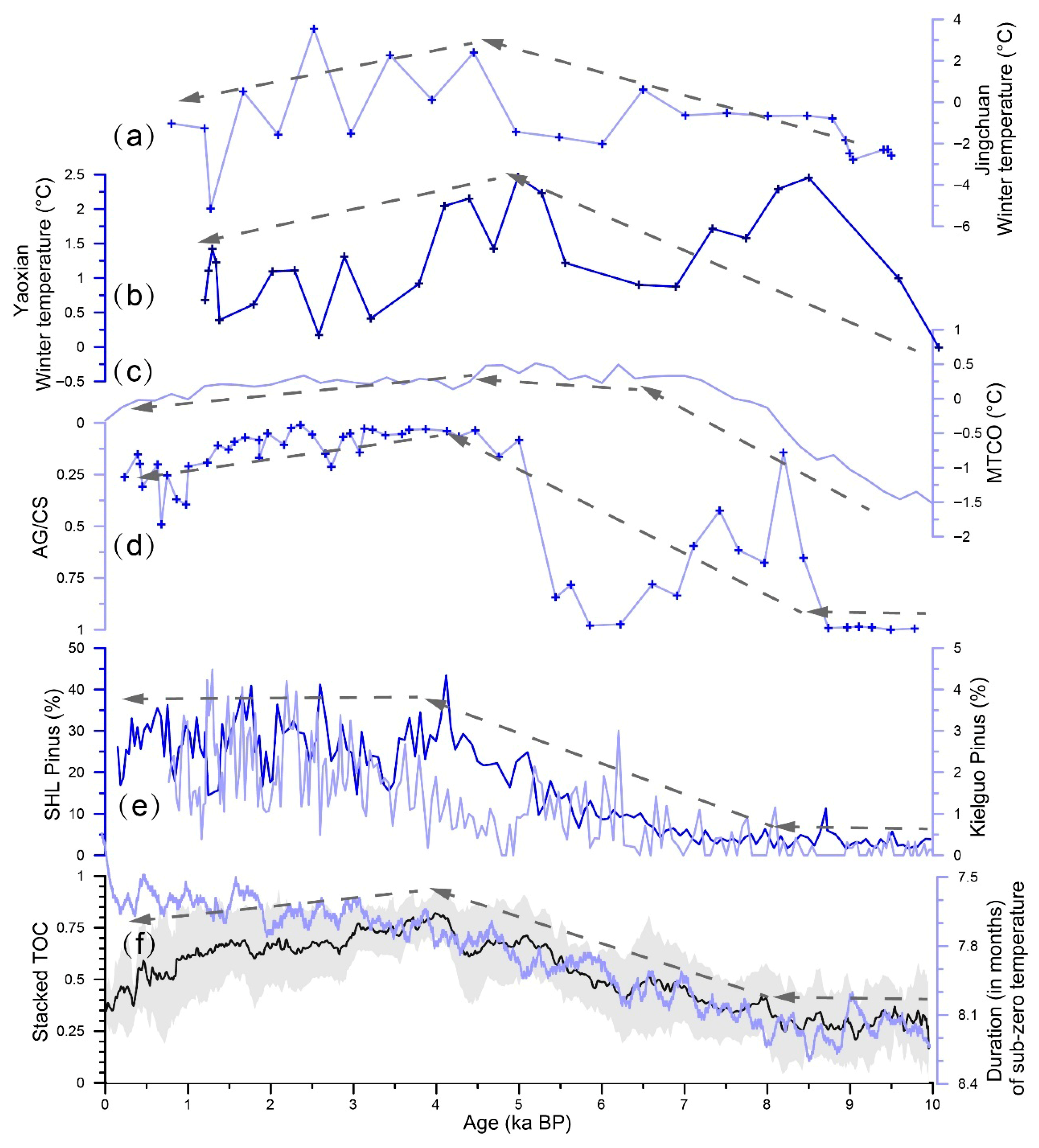
The TOC records during the late Holocene exhibited divergent trends among these lakes, contrasting with the relatively consistent patterns of the early–middle Holocene. Specifically, TOC decreased in SHL, Kielguo, Buridun, and Nangelaqiu, but remained stable in SFS, XLW, and ELW (Figure 2f,g). This divergence suggests that late Holocene TOC changes in these lakes of NE China cannot be explained solely by variations in lake ice cover duration. Two lines of evidence support this interpretation. First, the TOC decreases in SHL and Kielguo contrast with the stable Pinus percentages in the same lakes (Figure 3e) [31,39], implying that winter temperature changes were limited, since the expansion of Pinus into cold-temperate boreal forests is linked to rising winter temperatures [39,40]. Second, nearby lakes such as SHL, XLW, and ELW (within 20 km) displayed opposite TOC trends (Figure 2f,g), indicating that late Holocene TOC dynamics were dominated by local drivers rather than regional climate forcing.
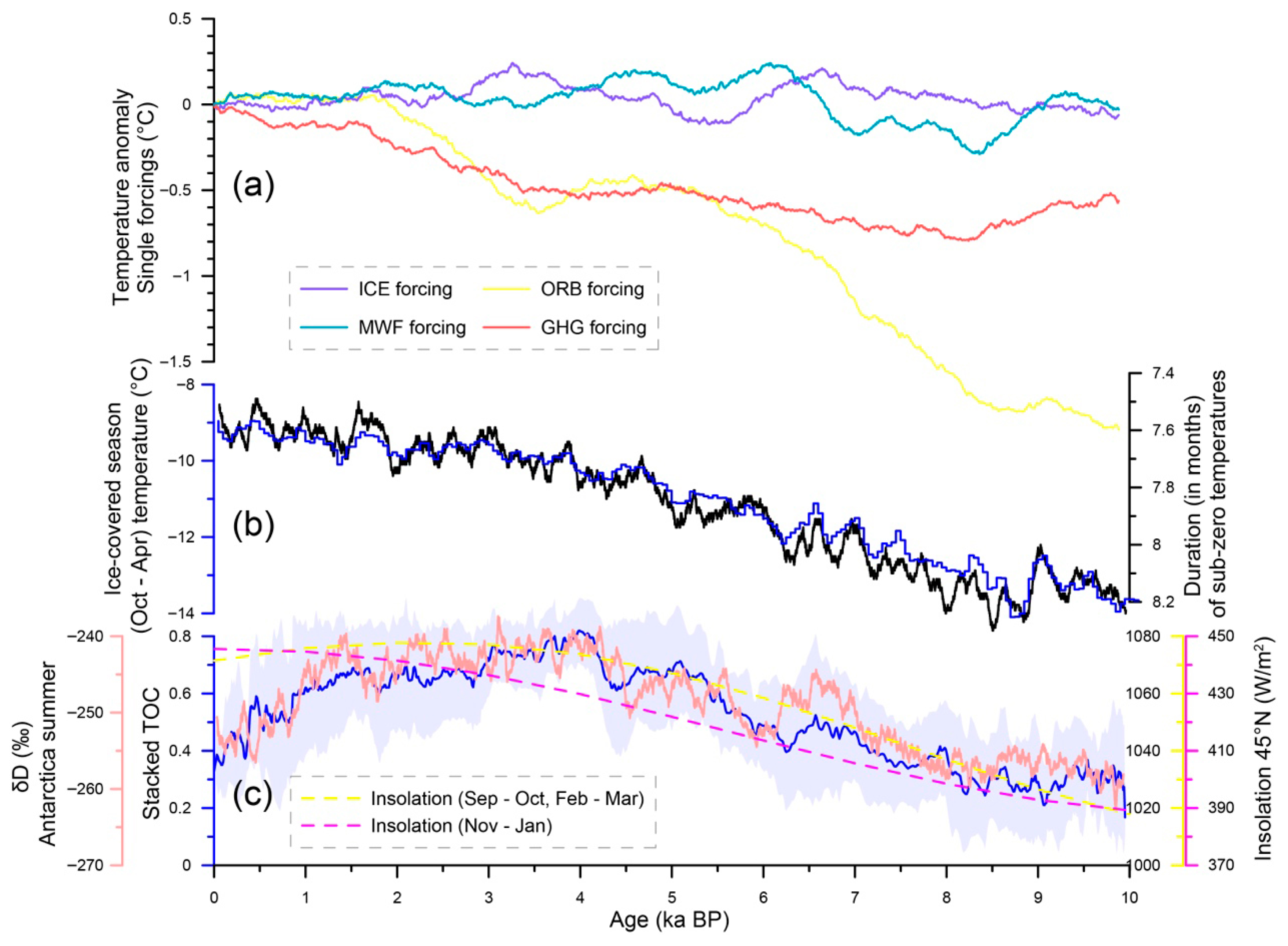
An important reason why late Holocene TOC changes in these lakes of NE China cannot be explained solely by variations in lake ice cover duration is that the variability of ice cover duration decreased relative to the middle Holocene, as evidenced by the reduced duration of sub-zero temperatures in the TraCE-21ka simulation (Figure 2h). The rate of increase in winter insolation at 45° N declined during the late Holocene compared to the middle Holocene, and insolation in the months preceding lake ice formation and melting (September–October and February–March) in Northeast China also decreased markedly (Figure 4c). Together, these factors diminished the variability of lake ice cover duration during the late Holocene.

3.2. Ice-Covered Season Temperature Changes During the Early–Middle Holocene in North China

The duration of sub-zero temperatures, which was assumed as the lake ice cover duration, demonstrated a high degree of consistency with the changes in monthly mean temperature below 0 °C derived from TraCE-21ka (Figure 4b). This consistency supports the conclusion that changes in lake ice cover duration are closely linked to ice-covered-season temperature variations. The stacked TOC record from seasonal frozen lakes in NE China revealed that lake ice cover duration decreased since ~8 ka BP, reaching its minimum at ~4 ka BP during the Holocene (Figure 3f). Evidence of this ice-covered-season temperature reduction since ~8 ka BP is also observed in other records. In NE China, the gradual increase in Pinus percentages at SHL and Kielguo since ~8 ka BP (Figure 3e) [31,39] suggests winter warming, as the migration of Pinus into cold temperate boreal forests is linked to rising winter temperatures [39,40]. Similarly, diatom assemblages in South China suggest that the intensity of the East Asian Winter Monsoon (EAWM) began to weaken at ~8.7 ka BP (Figure 3d), consistent with winter warming trends [36]. The winter temperatures and EAWM intensity [41] from TraCE-21ka model simulations further corroborate this observed winter warming from ~8 ka BP (Figure 3f).
The pronounced winter warming during ~8–4 ka BP is a common feature across various winter temperature-inferred records, despite differences in warming rates. For instance, stacked TOC increased gradually, while Pinus percentages rose more rapidly (Figure 3e). EAWM intensity inferred from diatom assemblages showed fluctuating decreases (Figure 3d). Fossil mollusk records from the Jingchuan profile in the Chinese Loess Plateau also indicate significant winter warming during ~8–4 ka BP (Figure 3a,b). However, winter temperatures at the Yaoxian profile peaked around ~6 ka BP, likely due to its more northerly location [7]. Furthermore, pollen-based reconstructions of winter temperatures for the Northern Hemisphere landmass exhibit continuous warming during ~10–4.5 ka BP, though the warming rate slowed after ~7 ka BP [42] (Figure 3c). In summary, winter warming during the early–middle Holocene was generally present across China, as evidenced by multiple proxies.
Figure 3. Comparison of winter temperature inferred records. (a,b) Fossil mollusk-based winter temperature reconstructions from the Yaoxian and Jingchuan profiles [7]. (c) Pollen-based mean temperature of the coldest month (MTCO) [42]. (d) The ratio of planktonic diatoms A. granulata and C. stelligera (AG/CS), used as an index of East Asian winter monsoon intensity [36]. (e) Pinus pollen percentage in SHL (blue line) [31] and Kielguo (light blue line) [39]. (f) Stacked TOC record from Northeast (NE) China (black line, grey shading is the standard deviation) (this study) and the duration (in months) of sub-zero temperatures extracted from TraCE-21ka simulation.
Quaternary 09 00001 g003
Figure 4. Climate dynamics and temperature evolution in Northeast China. (a) Winter temperature anomalies over NE China under individual forcings (ORB: orbital; GHG: greenhouse gases; WMF: Northern Hemisphere meltwater fluxes; and ICE: continental ice sheet) from the TraCE-21ka simulation. (b) Ice-covered season (from October to April) temperatures (blue line) and the duration of sub-zero temperatures (black line) in NE China, extracted from TraCE-21ka. (c) Stacked TOC record in NE China (blue line, with light blue shading indicating standard deviation), the insolation at 45° N for the sum of September, October, February, March (yellow dashed line), and November–January (pink dashed line), and West Antarctic Ice Sheet Divide ice core water-isotope record (δD), which was linked to the Antarctica summer temperatures [43].
Quaternary 09 00001 g004

3.3. Climate Dynamics Attribution to Ice-Covered Season Temperature Changes During the Early–Middle Holocene in NE China

Orbital-induced seasonal insolation changes are probably the critical forcing for seasonal temperature evolution during the Holocene in NE China. The high consistency between the stacked TOC and the Antarctica summer temperatures based on the West Antarctic Ice Sheet Divide ice core water-isotope record (δD) (Figure 4c) supported that seasonal insolation plays a primary role in the seasonal temperature evolution during the Holocene [43]. The parallel variation between the Southern Hemisphere summer temperature and ice-covered temperature during the early–middle Holocene provides further evidence for the influence of precession-driven seasonal insolation changes. The single forcing experiences of TraCE-21ka showed that orbital (ORB) forcing provided most (~1.1 °C) contributions to the winter warming compared to the other three single forcings in NE China during the early–middle Holocene (Figure 4a). Furthermore, the insolation during the months preceding lake ice formation and melting in Northeast China (i.e., September–October and February–March, the lakes in this region typically freeze in October/November-April/May, as described in the Study Sites and Methods Section) closely tracks the early–middle Holocene trends in the stacked TOC record (Figure 4c). Increased insolation in September–October could delay the onset of lake freezing, while enhanced insolation in February–March may promote earlier ice melt. Notably, the insolation variability during these four months (~60 W/m2) is greater than the winter insolation variation (~40 W/m2), highlighting their potential influence on the lake ice cover duration.
Atmospheric greenhouse gas (GHG) forcing is another important forcing for the winter warming in NE China, which contributed a ~0.3 °C winter temperature increase during ~8–4 ka BP (Figure 4a). The negative effect of GHG on winter warming prior to 8 ka BP offset the positive impact of seasonal insolation, resulting in little change in the lake ice cover duration (Figure 4a). However, the GHG increase influenced the winter and summer temperature increases simultaneously, but the summer cooling in this period indicated by the pollen and brGDGTs [21,31], rather than warming, suggested that the influence of GHG is weaker than that of seasonal insolation.
The meltwater (MWF) and ICE forcing exerted minor influences on the winter temperature changes in NE China. TraCE-21ka simulations accurately captured the stable winter temperatures prevailing before ~8 ka BP (Figure 4b,c). This thermal stability resulted from counteracting forcing effects: ORB provided slight warming, while GHG and MWF contributed modest cooling, effectively balancing the system (Figure 4a). Furthermore, the existence of the Laurentide ice sheet before ~8–7 ka BP probably played an important role in the winter non-warming before ~8 ka BP [44]. The ICE single-forcing experiments showed that there is no obvious winter temperature increase trend contributed by ICE forcing (Figure 4a), but the winter warming beginning at ~8 ka BP, rather than earlier, probably suggests that Northern Hemisphere ice sheet retreat paced winter temperature evolution [1,42,44].

4. Conclusions

This study investigates seasonal temperature variations, particularly cold-season temperature changes, during the early–middle Holocene by analyzing total organic carbon record from seven small lakes in NE China. The results show a close link between TOC variations and lake primary productivity, reflecting lake ice cover duration changes. Specifically, we found that lake ice cover duration significantly decreased from approximately 8 ka BP, reaching its minimum around 4 ka BP. We propose that cold-season temperature changes in NE China were primarily influenced by orbital forcing (seasonal insolation changes) and GHG concentrations. Orbital forcing played a dominant role in the cold-season warming between 8 and 4 ka BP, leading to reduced lake ice cover duration and increased cold-season temperatures in NE China. Additionally, the increase in GHG concentrations contributed to cold-season warming, though its impact was weaker compared to orbital forcing. This research provides new evidence for Holocene climate evolution, with particular emphasis on cold-season temperature changes. It underscores the importance of incorporating cold-season temperature variations into paleoclimate reconstructions and highlights the critical role of seasonal temperature changes in climate dynamics.

Author Contributions

Conceptualization, Z.Z., J.W. and G.C.; Methodology, Z.Z.; Investigation, J.W., L.W. and G.C.; Writing—original draft, Z.Z.; Writing—review and editing, Z.Z., J.W., L.W. and G.C.; Supervision, J.L.; Funding acquisition, J.L. All authors have read and agreed to the published version of the manuscript.

Funding

This work was funded by the National Natural Science Foundation of China (42302344, 42372352) and the National Key Research and Development Program of China (2023YFF0804702). We acknowledge the use of the refrigeration facility at the Beijing National Observatory of Space Environment, Institute of Geology and Geophysics, Chinese Academy of Sciences, Beijing, China.

Data Availability Statement

Data is available through the original articles [12,13,14,15,16,17,18].

Conflicts of Interest

The authors declare no conflict of interest.

References

  1. Liu, Z.; Zhu, J.; Rosenthal, Y.; Zhang, X.; Otto-Bliesner, B.L.; Timmermann, A.; Smith, R.S.; Lohmann, G.; Zheng, W.; Elison Timm, O. The Holocene Temperature Conundrum. Proc. Natl. Acad. Sci. USA 2014, 111, E3501–E3505. [Google Scholar] [CrossRef]
  2. Marcott, S.A.; Shakun, J.D.; Clark, P.U.; Mix, A.C. A Reconstruction of Regional and Global Temperature for the Past 11,300 Years. Science 2013, 339, 1198–1201. [Google Scholar] [CrossRef] [PubMed]
  3. Essell, H.; Esper, J.; Wanner, H.; Büntgen, U. Rethinking the Holocene Temperature Conundrum. Clim. Res. 2024, 92, 61–64. [Google Scholar] [CrossRef]
  4. Marsicek, J.; Shuman, B.N.; Bartlein, P.J.; Shafer, S.L.; Brewer, S. Reconciling Divergent Trends and Millennial Variations in Holocene Temperatures. Nature 2018, 554, 92–96. [Google Scholar] [CrossRef]
  5. Hou, J.; Li, C.-G.; Lee, S. The Temperature Record of the Holocene: Progress and Controversies. Sci. Bull. 2019, 64, 565–566. [Google Scholar] [CrossRef] [PubMed]
  6. Bova, S.; Rosenthal, Y.; Liu, Z.; Godad, S.P.; Yan, M. Seasonal Origin of the Thermal Maxima at the Holocene and the Last Interglacial. Nature 2021, 589, 548–553. [Google Scholar] [CrossRef]
  7. Dong, Y.; Wu, N.; Li, F.; Zhang, D.; Zhang, Y.; Shen, C.; Lu, H. The Holocene Temperature Conundrum Answered by Mollusk Records from East Asia. Nat. Commun. 2022, 13, 5153. [Google Scholar] [CrossRef]
  8. Denton, G.; Alley, R.; Comer, G.; Broecker, W. The Role of Seasonality in Abrupt Climate Change. Quat. Sci. Rev. 2005, 24, 1159–1182. [Google Scholar] [CrossRef]
  9. Chu, G.; Sun, Q.; Zhu, Q.; Shan, Y.; Shang, W.; Ling, Y.; Su, Y.; Xie, M.; Wang, X.; Liu, J. The Role of the Asian Winter Monsoon in the Rapid Propagation of Abrupt Climate Changes during the Last Deglaciation. Quat. Sci. Rev. 2017, 177, 120–129. [Google Scholar] [CrossRef]
  10. Zhu, Z.; Wu, J.; Chu, G.; Rioual, P.; Lu, J.; Wang, L.; Liu, J. Summer Warming during Heinrich Stadial 1 in Northeast China. Geology 2024, 52, 385–389. [Google Scholar] [CrossRef]
  11. Zheng, Y.; Liu, Z.; Zheng, W.; Liu, H. Northern Hemisphere Mid-Latitudes as a Key Region for Reconciling the Holocene Temperature Conundrum. Quat. Sci. Rev. 2025, 347, 109090. [Google Scholar] [CrossRef]
  12. Mingram, J.; Stebich, M.; Schettler, G.; Hu, Y.; Rioual, P.; Nowaczyk, N.; Dulski, P.; You, H.; Opitz, S.; Liu, Q.; et al. Millennial-Scale East Asian Monsoon Variability of the Last Glacial Deduced from Annually Laminated Sediments from Lake Sihailongwan, N.E. China. Quat. Sci. Rev. 2018, 201, 57–76. [Google Scholar] [CrossRef]
  13. Chu, G.; Sun, Q.; Xie, M.; Lin, Y.; Shang, W.; Zhu, Q.; Shan, Y.; Xu, D.; Rioual, P.; Wang, L.; et al. Holocene Cyclic Climatic Variations and the Role of the Pacific Ocean as Recorded in Varved Sediments from Northeastern China. Quat. Sci. Rev. 2014, 102, 85–95. [Google Scholar] [CrossRef]
  14. You, H.; Liu, J. High-Resolution Climate Evolution Derived from the Sediment Records of Erlongwan Maar Lake since 14 Ka BP. Chin. Sci. Bull. 2012, 57, 3610–3616. [Google Scholar] [CrossRef]
  15. Wang, J.; Zhang, G.; Zhang, W.; Zhou, X.; Liu, J.; Zhu, Z.; Yang, Y.; Yang, Q.; Zhao, K.; Li, X. Seesaw between the Westerlies and Asian Monsoon Regulates Vegetation and Climate during the Last Deglaciation in Southern Northeast China. Quat. Sci. Rev. 2024, 344, 109008. [Google Scholar] [CrossRef]
  16. Liu, Q.; Li, Q.; Wang, L.; Chu, G. Stable Carbon Isotope Record of Bulk Organic Matter from a Sediment Core at Moon Lake in the Middle Part of the Daxing’an Mountain Range, Northeast China during the Last 21 Ka. Quat. Sci. 2010, 30, 1069–1077. [Google Scholar]
  17. Liu, J.; Liu, Q.; Chu, G.; Wu, J.; Liu, J. Sediment Record at Lake Sifanshan in the Central-Northern Part of the Great Xing’an Range, Northeast China since 15.4 Ka B.P. Quat. Sci. 2015, 35, 901–912. [Google Scholar] [CrossRef]
  18. Jiang, S.; Zhou, X.; Zhan, T.; Tu, L.; Liu, X.; Cui, S.; Liu, X.; Chen, A.; Zhang, G.; Shen, Y. Increased Radiocarbon Age Offset of Crater Lake Sediments Linked to Cool-Dry Intervals during the Past 40,000 Yr. Catena 2024, 238, 107881. [Google Scholar] [CrossRef]
  19. Yao, Y.; Zhao, J.; Bauersachs, T.; Huang, Y. Effect of Water Depth on the TEX 86 Proxy in Volcanic Lakes of Northeastern China. Org. Geochem. 2019, 129, 88–98. [Google Scholar] [CrossRef]
  20. Zhu, Z.; Wu, J.; Rioual, P.; Mingram, J.; Yang, H.; Zhang, B.; Chu, G.; Liu, J. Evaluation of the Sources and Seasonal Production of brGDGTs in Lake Sihailongwan (N.E. China) and Application to Reconstruct Paleo-Temperatures over the Period 60–8 Ka BP. Quat. Sci. Rev. 2021, 261, 106946. [Google Scholar] [CrossRef]
  21. Zhu, Z.; Wu, J.; Lu, J.; Chu, G.; Rioual, P.; Wang, L.; Liu, J. Holocene Summer Temperature Record Based on Branched Tetraethers in Northeast China. Holocene 2023, 33, 1465–1473. [Google Scholar] [CrossRef]
  22. Liu, Z.; Otto-Bliesner, B.L.; He, F.; Brady, E.C.; Tomas, R.; Clark, P.U.; Carlson, A.E.; Lynch-Stieglitz, J.; Curry, W.; Brook, E.; et al. Transient Simulation of Last Deglaciation with a New Mechanism for Bølling-Allerød Warming. Science 2009, 325, 310–314. [Google Scholar] [CrossRef] [PubMed]
  23. Gao, Y.; Jia, J.; Lu, Y.; Yang, T.; Lyu, S.; Shi, K.; Zhou, F.; Yu, G. Determining Dominating Control Mechanisms of Inland Water Carbon Cycling Processes and Associated Gross Primary Productivity on Regional and Global Scales. Earth Sci. Rev. 2021, 213, 103497. [Google Scholar] [CrossRef]
  24. Marotta, H.; Pinho, L.; Gudasz, C.; Bastviken, D.; Tranvik, L.J.; Enrich-Prast, A. Greenhouse Gas Production in Low-Latitude Lake Sediments Responds Strongly to Warming. Nat. Clim. Chang. 2014, 4, 467–470. [Google Scholar] [CrossRef]
  25. Li, Y.; Zhang, X.; Zhang, Z.; Gao, M.; Xue, Y. Global Lake Carbon Burial from Endorheic Zones since the Last Glacial Maximum and the Future Projection. Innov. Geosci. 2025, 3, 100132. [Google Scholar] [CrossRef]
  26. Zhou, S.; Long, H.; Chen, W.; Qiu, C.; Zhang, C.; Xing, H.; Zhang, J.; Cheng, L.; Zhao, C.; Cheng, J.; et al. Temperature Seasonality Regulates Organic Carbon Burial in Lake. Nat. Commun. 2025, 16, 1049. [Google Scholar] [CrossRef]
  27. Mingram, J.; Allen, J.R.M.; Brüchmann, C.; Liu, J.; Luo, X.; Negendank, J.F.W.; Nowaczyk, N.; Schettler, G. Maar- and Crater Lakes of the Long Gang Volcanic Field (N.E. China)—Overview, Laminated Sediments, and Vegetation History of the Last 900 Years. Quat. Int. 2004, 123–125, 135–147. [Google Scholar] [CrossRef]
  28. Wang, L.; Mackay, A.W.; Leng, M.J.; Rioual, P.; Panizzo, V.N.; Lu, H.; Gu, Z.; Chu, G.; Han, J.; Kendrick, C.P. Influence of the Ratio of Planktonic to Benthic Diatoms on Lacustrine Organic Matter δ13C from Erlongwan Maar Lake, Northeast China. Org. Geochem. 2013, 54, 62–68. [Google Scholar] [CrossRef]
  29. Chu, G.; Sun, Q.; Gu, Z.; Rioual, P.; Liu, Q.; Wang, K.; Han, J.; Liu, J. Dust Records from Varved Lacustrine Sediments of Two Neighboring Lakes in Northeastern China over the Last 1400 Years. Quat. Int. 2009, 194, 108–118. [Google Scholar] [CrossRef]
  30. Zaarur, S.; Stein, M.; Adam, O.; Mingram, J.; Liu, J.; Wu, J.; Raveh-Rubin, S.; Erel, Y. Synoptic Stability and Anomalies in NE China Inferred from Dust Provenance of Sihailongwan Maar Sediments during the Past ∼80 Kyr. Quat. Sci. Rev. 2020, 239, 106279. [Google Scholar] [CrossRef]
  31. Stebich, M.; Rehfeld, K.; Schlütz, F.; Tarasov, P.E.; Liu, J.; Mingram, J. Holocene Vegetation and Climate Dynamics of NE China Based on the Pollen Record from Sihailongwan Maar Lake. Quat. Sci. Rev. 2015, 124, 275–289. [Google Scholar] [CrossRef]
  32. Wen, R.; Xiao, J.; Chang, Z.; Zhai, D.; Xu, Q.; Li, Y.; Itoh, S. Holocene Precipitation and Temperature Variations in the East Asian Monsoonal Margin from Pollen Data from Hulun Lake in Northeastern Inner Mongolia, China. Boreas 2010, 39, 262–272. [Google Scholar] [CrossRef]
  33. Li, P.; Chu, G.; Rioual, P.; Zhan, N.; Zhang, G.; Zhu, Z.; Li, Q.; Xie, M.; Ling, Y.; Sun, Q. Independent Temperature Records since the Last Deglaciation from the Varved Sediments of Sihailongwan Maar Lake, Northeastern China. Quat. Sci. Rev. 2025, 349, 109139. [Google Scholar] [CrossRef]
  34. Rioual, P.; Chu, G.; Li, D.; Mingram, J.; Han, J.; Liu, J. Climate-Induced Shifts in Planktonic Diatoms in Lake Sihailongwan (North-East China): A Study of the Sediment Trap and Palaeolimnological Records. In Proceedings of the 11th International Paleolimnology Symposium, Guadalajara, Mexico, 15–18 December 2009; Volume 120. [Google Scholar]
  35. Wang, L.; Lu, H.; Liu, J.; Gu, Z.; Mingram, J.; Chu, G.; Li, J.; Rioual, P.; Negendank, J.F.W.; Han, J.; et al. Diatom-Based Inference of Variations in the Strength of Asian Winter Monsoon Winds between 17,500 and 6000 Calendar Years B.P. J. Geophys. Res. 2008, 113, D21101. [Google Scholar] [CrossRef]
  36. Wang, L.; Li, J.; Lu, H.; Gu, Z.; Rioual, P.; Hao, Q.; Mackay, A.W.; Jiang, W.; Cai, B.; Xu, B.; et al. The East Asian Winter Monsoon over the Last 15,000 Years: Its Links to High-Latitudes and Tropical Climate Systems and Complex Correlation to the Summer Monsoon. Quat. Sci. Rev. 2012, 32, 131–142. [Google Scholar] [CrossRef]
  37. Wang, L.; Rioual, P.; Panizzo, V.N.; Lu, H.; Gu, Z.; Chu, G.; Yang, D.; Han, J.; Liu, J.; Mackay, A.W. A 1000-Yr Record of Environmental Change in NE China Indicated by Diatom Assemblages from Maar Lake Erlongwan. Quat. Res. 2012, 78, 24–34. [Google Scholar] [CrossRef]
  38. Chen, J.; Liu, J.; Rühland, K.M.; Smol, J.P.; Zhang, X.; Zhang, Z.; Zhou, A.; Shen, Z.; Chen, F. Aquatic Ecosystem Responses to Environmental and Climatic Changes in NE China since the Last Deglaciation (∼17, 500 Cal Yr BP) Tracked by Diatom Assemblages from Lake Moon. Quat. Sci. Rev. 2021, 272, 107218. [Google Scholar] [CrossRef]
  39. Wu, J.; Liu, Q.; Cui, Q.; Xu, D.; Wang, L.; Shen, C.; Chu, G.; Liu, J. Shrinkage of East Asia Winter Monsoon Associated With Increased ENSO Events Since the Mid-Holocene. J. Geophys. Res. Atmos. 2019, 124, 3839–3848. [Google Scholar] [CrossRef]
  40. Wu, J.; Ren, W.; Cui, Q.; Ma, Y.; Marquer, L.; Meng, H.; Zhu, Z.; Chu, G.; Liu, J. Mid-Holocene Pine Forest Expansion Caused by the Weakening of the East Asian Winter Monsoon and Linked to Climate Change in the North Atlantic Region. Quat. Sci. Rev. 2023, 320, 108349. [Google Scholar] [CrossRef]
  41. Wen, X.; Liu, Z.; Wang, S.; Cheng, J.; Zhu, J. Correlation and Anti-Correlation of the East Asian Summer and Winter Monsoons during the Last 21,000 Years. Nat. Commun. 2016, 7, 11999. [Google Scholar] [CrossRef]
  42. Zhang, W.; Wu, H.; Cheng, J.; Geng, J.; Li, Q.; Sun, Y.; Yu, Y.; Lu, H.; Guo, Z. Holocene Seasonal Temperature Evolution and Spatial Variability over the Northern Hemisphere Landmass. Nat. Commun. 2022, 13, 5334. [Google Scholar] [CrossRef] [PubMed]
  43. Jones, T.R.; Cuffey, K.M.; Roberts, W.H.G.; Markle, B.R.; Steig, E.J.; Stevens, C.M.; Valdes, P.J.; Fudge, T.J.; Sigl, M.; Hughes, A.G.; et al. Seasonal Temperatures in West Antarctica during the Holocene. Nature 2023, 613, 292–297. [Google Scholar] [CrossRef] [PubMed]
  44. Baker, J.L.; Lachniet, M.S.; Chervyatsova, O.; Asmerom, Y.; Polyak, V.J. Holocene Warming in Western Continental Eurasia Driven by Glacial Retreat and Greenhouse Forcing. Nat. Geosci. 2017, 10, 430–435. [Google Scholar] [CrossRef]
Figure 1. Geographic locations, photographs, and monthly mean temperatures of Sihailongwan Maar Lake (SHL), Xiaolongwan Maar Lake (XLW), Erlongwan Maar Lake (ELW), Kielguo Crater Lake (Kielguo), Sifangshan Crater Lake (SFS), Nangelaqiu Lake (Nangelaqiu), and Buridun Lake (Buridun).
Quaternary 09 00001 g001
Figure 2. Multi-proxy records from SHL, XLW, Kielguo, SFS, Nangelaqiu, and Buridun. (a) Mean grain size from Kielguo. (b) BrGDGT-based summer temperature from Kielguo. (c) Pollen-based mean July temperatures (MTWA) from SHL. (d) Varve types from SHL. (e) C/N ratio from SHL (red), Kielguo (yellow), and SFS (blue). (f,g) Total organic carbon (TOC) from SHL (red), Kielguo (yellow), SFS (blue), XLW (Green), ELW (dark blue), Nangelaqiu (blue), and Buridun (pink). (h) Stacked TOC record (black line, grey shading is the standard deviation) and the duration (in months) of sub-zero temperatures extracted from TraCE-21ka simulation.
Quaternary 09 00001 g002
Disclaimer/Publisher’s Note: The statements, opinions and data contained in all publications are solely those of the individual author(s) and contributor(s) and not of MDPI and/or the editor(s). MDPI and/or the editor(s) disclaim responsibility for any injury to people or property resulting from any ideas, methods, instructions or products referred to in the content.