


Abstract
Background: Hyperthyroidism, characterized by excessive thyroid hormone production, presents in diverse clinical forms, including overt and subclinical disease. Accurate and timely diagnosis is critical to prevent complications such as cardiac dysfunction, osteoporosis, and thyroid storm. Objective: To provide a comprehensive review of the clinical presentation, diagnostic methods, and management strategies for hyperthyroidism, focusing on current practices, advancements, and challenges in treatment. Methods: This review synthesizes findings from peer-reviewed literature on the diagnosis and management of hyperthyroidism. Results: Thyroid function tests (TFTs) are the cornerstone of hyperthyroidism diagnosis, with suppressed TSH levels and elevated T3 and/or T4 levels confirming overt disease. Thyroid receptor antibodies (TRAb) are critical for diagnosing autoimmune hyperthyroidism and predicting relapse risk. Iodine scintigraphy is utilized in specific cases, such as suspected toxic adenoma or multinodular goiter. Management strategies include beta-blockers for symptomatic relief, though side effects such as bradycardia and fatigue may occur. Antithyroid medications, including methimazole and propylthiouracil, inhibit hormone synthesis, with remission more likely in patients with low TRAb levels and small goiters. Definitive treatments include radioactive iodine therapy (RAI), which effectively reduces thyroid activity but often results in hypothyroidism, and thyroidectomy, a surgical option for large goiters or malignancy, with potential complications like hypocalcemia and recurrent laryngeal nerve injury. Conclusions: The management of hyperthyroidism necessitates a personalized approach integrating diagnostic precision, emerging innovations, and patient-centered care.
1. Case Scenario
Mrs. S, a 36-year-old previously healthy woman, presents to the clinic with a constellation of symptoms that have progressively worsened over the past three months. She reports significant, unexplained weight loss despite no changes in her diet, along with palpitations, heat intolerance, hand tremors, and an increase in bowel movement frequency.
In addition to these symptoms, Mrs. S notes a persistently elevated heart rate, nervousness, restlessness, and the recent onset of fatigue and muscle weakness, despite her weight loss. Her family history reveals a notable case of autoimmune disease, with her mother having a history of Graves’ disease. She denies any exposure to iodine-rich substances or recent changes in medication that could explain her thyroid dysfunction. On physical examination, her thyroid gland is found to be diffusely enlarged, without any nodules.
Suspecting a thyroid disorder, the physician orders thyroid function tests (TFTs), which confirm hyperthyroidism. Mrs. S’s serum TSH levels are markedly decreased, and her free T4 levels are elevated. Additionally, her thyroid peroxidase antibodies are significantly elevated, indicating an autoimmune etiology, likely Graves’ disease.
Question: Given the confirmed diagnosis of hyperthyroidism in Mrs. S, what is the best next step in her management?
- (A)
- Initiate beta-blockade: Symptomatic management is crucial in hyperthyroidism.
- (B)
- Start antithyroid medication: Medications like methimazole or propylthiouracil inhibit thyroid hormone synthesis.
- (C)
- Consider radioactive iodine therapy: This treatment selectively destroys thyroid tissue, reducing hormone production, and is a common approach for definitive treatment of Graves’ disease, especially when medications are contraindicated or ineffective.
- (D)
- Perform thyroidectomy: Surgical removal of part, or all, of the thyroid gland is another definitive treatment option, particularly in cases of large goiters, patient preference, or contraindications to radioactive iodine therapy.
- (E)
- Refer to an endocrinologist: Specialist input is essential for comprehensive management and treatment planning.
Answer:
A. The optimal initial management strategy for Mrs. S’s hyperthyroidism is the initiation of beta-blockers to rapidly alleviate distressing symptoms such as palpitations, tremors, and anxiety. This provides immediate symptomatic relief while a more comprehensive long-term management plan is formulated. Referral to an endocrinologist is recommended for further assessment and to tailor a definitive treatment strategy, considering her individual risks, benefits, and preferences.
While the presented case focuses on a straightforward diagnosis of Graves’ disease, more complex scenarios such as hyperthyroidism in pregnancy or in elderly patients with multiple comorbidities require additional considerations. For example, pregnancy-associated hyperthyroidism necessitates careful medication selection to minimize the fetal risks, and in the elderly, a balance between symptomatic relief and potential treatment-related complications is paramount.
2. Initial Approach
2.1. Overview of Hyperthyroidism
Hyperthyroidism is a condition characterized by the excessive production of thyroid hormones and is often associated with thyrotoxicosis—a state in which tissues are exposed to elevated levels of these hormones [1]. Although these terms are frequently used interchangeably, it is important to distinguish between them: hyperthyroidism refers to the overproduction of hormones, while thyrotoxicosis describes the resulting physiological effects [2]. Hyperthyroidism can present in both the overt and subclinical forms. Overt hyperthyroidism is defined by suppressed TSH levels with elevated T3 and/or T4, whereas ‘T3 toxicosis’ is identified by high T3, low TSH, and normal T4 [3]. Subclinical hyperthyroidism, on the other hand, is characterized by low TSH but normal T3 and T4 levels [4]. Both forms carry significant long-term risks, underscoring the need for careful and individualized management strategies [5].
Timely and accurate diagnosis of hyperthyroidism is essential in clinical practice. Early intervention to address symptoms like weight loss and anxiety not only improves patient well-being but also helps to prevent complications such as cardiac issues, osteoporosis, and thyroid storm. A precise diagnostic process is crucial for identifying the underlying causes, which forms the basis for tailored and targeted treatment plans. This is especially critical in pregnancy, where early detection of hyperthyroidism is vital to safeguarding both maternal and fetal health. Effective management strategies, guided by accurate diagnosis, are key to achieving optimal outcomes, which highlights the importance of proactive healthcare measures in this sensitive population [6].
2.2. Symptoms and Clinical Presentation of Hyperthyroidism
Hyperthyroidism, characterized by the overproduction of thyroid hormones, manifests through a diverse array of symptoms and clinical presentations. The variability in the severity and the combination of symptoms among individuals highlight the importance of a thorough clinical assessment to ensure accurate diagnosis and appropriate management. A deep understanding of the nuanced clinical spectrum of hyperthyroidism is essential for healthcare practitioners to effectively tailor interventions and optimize patient outcomes, as illustrated in Table 1 below.
Table 1.
Signs and symptoms of hyperthyroidism. Adapted from [3].
2.3. Laboratory Investigations and Diagnosis of Hyperthyroidism
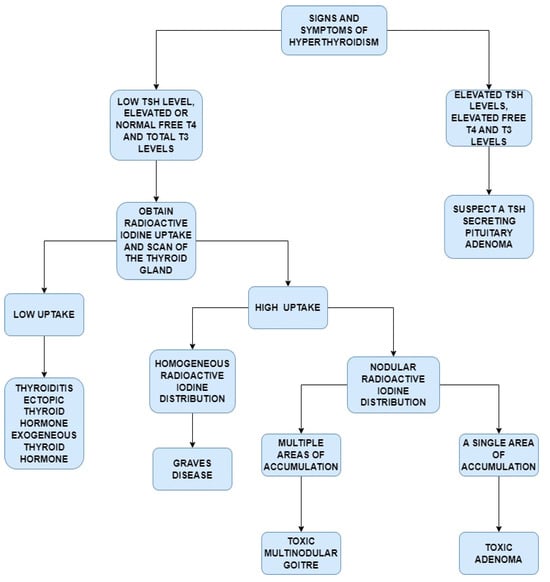
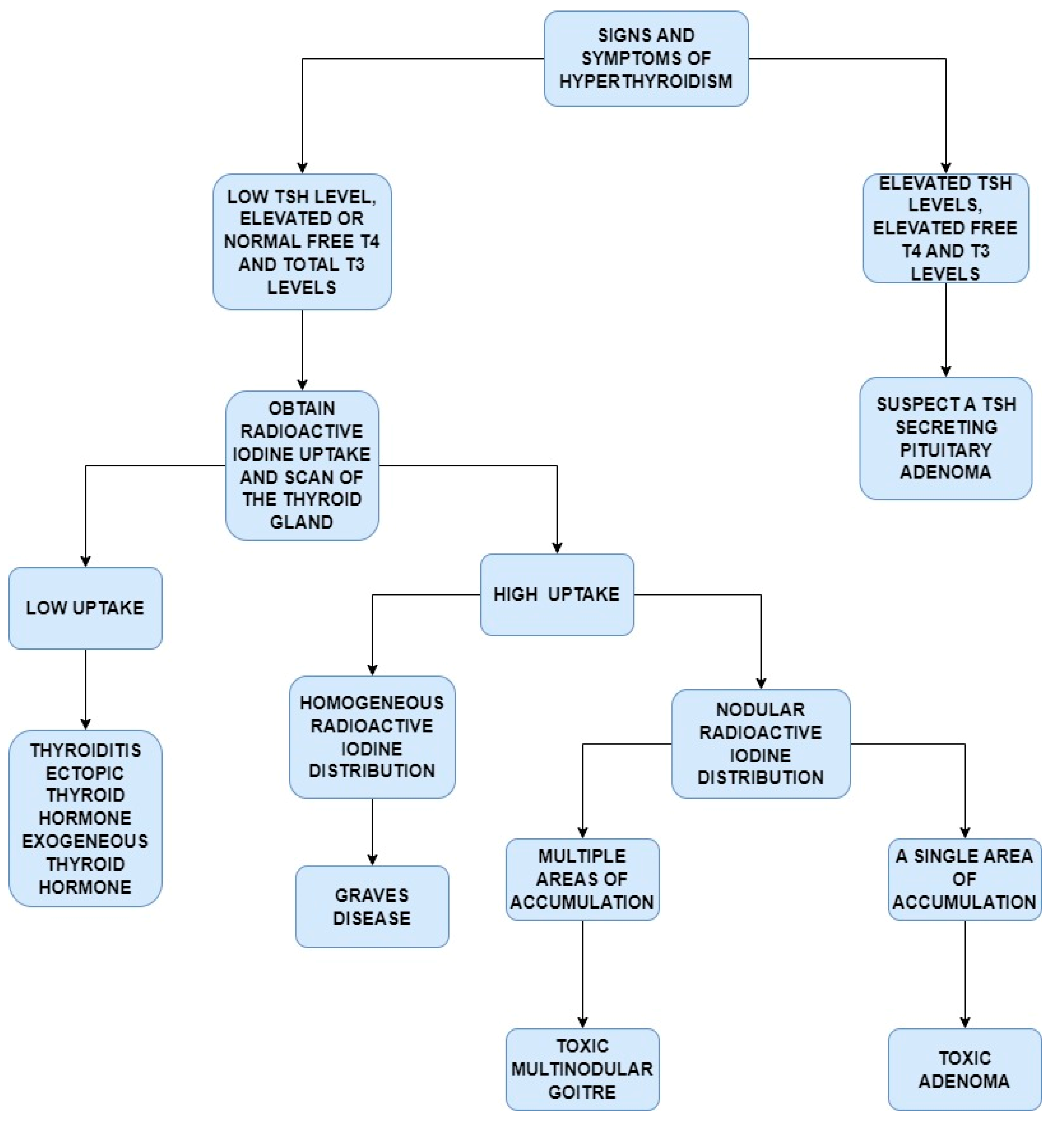
Laboratory investigations are crucial for diagnosing hyperthyroidism, with thyroid function tests being the primary tools. These tests typically involve measuring the thyroid-stimulating hormone (TSH), free thyroxine (FT4), and free triiodothyronine (FT3) levels. A low TSH level generally suggests hyperthyroidism, which is then confirmed by assessing the FT4 and FT3 levels. To accurately diagnose Graves’ disease, it is recommended to measure the thyrotropin receptor autoantibody (TRAb) count. This comprehensive approach ensures precise diagnosis and allows for tailored management, particularly in identifying the underlying cause of hyperthyroidism (Figure 1) [7,8,9,10,11,12].
Figure 1.
Summarizing the diagnosis of hyperthyroidism. Created by the authors based on information from [8,9,10,11,12,13]. Note: Iodine scintiscan is primarily recommended in cases of suspected toxic adenoma or multinodular goiter.
2.4. Interpretation of TFTs in Hyperthyroidism
Thyroid function tests (TFTs) are essential diagnostic tools for evaluating thyroid activity, particularly in detecting hyperthyroidism, where there is an overproduction of thyroid hormones. Interpreting these tests involves assessing the levels of thyroid hormones (T3 and T4) and thyroid-stimulating hormone (TSH). In hyperthyroidism, elevated levels of T3 and T4 are typically accompanied by suppressed TSH levels [13].
However, it is crucial to consider contextual factors and individual patient variables, such as medication use and the presence of non-thyroidal illnesses, as these can significantly influence the TFT results. Accurate interpretation of these outcomes requires consultation with healthcare professionals who have the expertise to analyze the results within the broader clinical context. This collaborative approach not only ensures precise diagnosis but also aids in developing personalized management plans that account for the specific complexities of each patient’s condition. This comprehensive and individualized strategy is vital for optimizing patient care and therapeutic interventions for the management of thyroid disorders [14].
2.5. Significance of Thyroid Antibodies in Hyperthyroidism
Thyroid antibodies, including antithyroid peroxidase (TPOAb) and antithyroglobulin (TgAb) antibodies, play a critical role in the context of hyperthyroidism, particularly in autoimmune thyroid disorders like Graves’ disease. The presence of these antibodies has significant implications for both prognosis and treatment outcomes. Research shows that patients with both TPOAb and TgAb antibodies are less likely to experience a relapse of hyperthyroidism after antithyroid drug treatment, while those without these antibodies have a higher risk of relapse [15]. Additionally, the detection of thyroid-stimulating hormone receptor (TRAb) antibodies not only aids in the diagnosis of Graves’ disease but also serves as a predictive marker of the treatment response. This highlights the dual importance of TRAb in both the diagnosis and prognosis in hyperthyroid patients [16].
3. Beyond the Initial Approach
Initial Management Steps
- Beta blockers: Beta-blockers are commonly used to alleviate the symptoms associated with hyperthyroidism. They work by blocking the effects of excess thyroid hormones on the body’s tissues, particularly the heart and nervous system. By antagonizing beta-adrenergic receptors, beta-blockers reduce the impact of adrenaline and other catecholamines, leading to a lower heart rate, reduced blood pressure, and relief from symptoms linked to increased sympathetic activity [17]. These medications effectively manage palpitations, tremors, and anxiety by normalizing the heart rate and counteracting the overstimulation caused by elevated thyroid hormones. Strategic use of beta-blockers significantly enhances the quality of life in individuals dealing with hyperthyroidism [18].
- Antithyroid medications: Medications such as methimazole or propylthiouracil are central to the management of hyperthyroidism as they inhibit thyroid hormone synthesis within the gland. The primary goal is to restore normal thyroid hormone levels, known as euthyroidism, thereby relieving hyperthyroid symptoms and preventing complications associated with excessive hormone production. These medications are often recommended as a first-line therapy, especially in cases of Graves’ disease, aiming to induce remission or prepare the patient for definitive treatments like radioactive iodine or surgery. By restoring the hormonal balance, antithyroid medications play a crucial role in managing hyperthyroidism and laying the groundwork for comprehensive treatment strategies [19].
- Radioactive iodine therapy: Radioactive iodine therapy (RAI) is a well-established treatment option for hyperthyroidism, particularly in conditions such as Graves’ disease, toxic multinodular goiter, and toxic adenoma. RAI works by delivering targeted radiation to the thyroid gland, effectively destroying overactive thyroid tissue. The thyroid absorbs radioactive iodine, which emits beta radiation that disrupts thyroid cells, thereby reducing hormone production [2].
- Thyroidectomy: Thyroidectomy, a surgical treatment for hyperthyroidism, involves the partial or complete removal of the thyroid gland. The extent of the surgery varies, with partial thyroidectomy (lobectomy) often used for solitary toxic nodules and total thyroidectomy for conditions such as Graves’ disease or toxic multinodular goiter. The indications for thyroidectomy include cases where radioactive iodine therapy is not viable or preferred, such as large goiters causing compression, suspected thyroid cancer, those who fail medical therapy, or when patients opt for surgery over other treatments. Thyroidectomy offers a tailored solution for complex cases of hyperthyroidism [20].
- Duration of medical treatment and transition to definitive therapy: The duration of antithyroid medication therapy typically ranges from 12 to 18 months. Remission rates vary, with predictors such as lower TRAb levels and smaller goiter sizes associated with a higher likelihood of success. Definitive treatments, including radioactive iodine therapy or thyroidectomy, are recommended in cases of relapse, intolerance of medications, or patient preference for permanent resolution [21].
- Recent advancements: The role of predictive markers such as TRAb levels in assessing the remission and relapse risk. Additionally, novel therapeutic approaches, including targeted molecular treatments, are emerging as potential alternatives to conventional therapies, particularly in patients with refractory disease. These innovations provide clinicians with tools to individualize treatment further and improve long-term outcomes [22].
- Patient-centered care: Incorporating patient values and preferences is a cornerstone of evidence-based medicine, particularly in chronic conditions such as hyperthyroidism. Patients’ individual circumstances, treatment goals, and concerns about potential side effects or long-term outcomes should guide the selection of management strategies. For example, while some patients may prioritize non-surgical options, others may prefer definitive treatments such as radioactive iodine or thyroidectomy based on their lifestyle, reproductive plans, or tolerance of medication [2]. A patient-centered approach ensures not only adherence to treatment but also improved satisfaction and quality of life.
- Updated controversies in hyperthyroidism management: Recent debates in hyperthyroidism management reflect the complexity of balancing treatment efficacy, safety, and patient-specific factors. For antithyroid drug (ATD) therapy, the optimal duration remains unclear, with guidelines suggesting a typical course of 12–18 months but with variable relapse rates. Radioactive iodine therapy (RAI) continues to raise questions, particularly in patients with large goiters or Graves’ ophthalmopathy, where concerns about worsening eye symptoms or inadequate responses exist. Partial thyroidectomy, though less common, has been revisited as a surgical option for Graves’ disease in select patients, offering the potential to retain partial thyroid function while minimizing long-term hypothyroidism. These controversies underscore the importance of personalized treatment decisions and shared decision-making with patients to optimize outcomes [21,23].
Hyperthyroidism, characterized by excessive thyroid hormone production, requires a comprehensive management approach. While hyperthyroidism management aims to restore euthyroidism, each treatment modality carries specific risks. For instance, beta-blockers primarily alleviate symptoms but may lead to bradycardia or fatigue in some patients. Antithyroid medications are effective but can cause rare, severe side effects such as agranulocytosis or hepatotoxicity. Similarly, radioactive iodine therapy offers a non-invasive definitive treatment but carries the risk of post-treatment hypothyroidism. Thyroidectomy, while effective for definitive management, poses surgical risks such as hypocalcaemia or recurrent laryngeal nerve injury. Table 2 below outlines the key strategies employed in the treatment of hyperthyroidism, along with these complications, highlighting various modalities and the need for individualized considerations.
Table 2.
Management of hyperthyroidism. Adapted from [19,20,21,22].
Author Contributions
Conceptualization, R.C.; methodology, R.C.; validation, R.C., S.T., J.A.S., J.H., S.B., D.Q., M.K. and L.H.; formal analysis, R.C.; investigation, R.C. and L.H.; data curation, R.C.; writing—original draft preparation, R.C.; writing—review and editing, R.C., S.T., J.A.S., J.H., S.B., D.Q., M.K. and L.H.; visualization, R.C.; supervision L.H.; project administration, R.C. All authors have read and agreed to the published version of the manuscript.
Funding
This research received no external funding.
Conflicts of Interest
The authors declare no conflicts of interest.
Correction Statement
This article has been republished with a minor correction to the Document Type. This change does not affect the scientific content of the article.
References
- Mathew, P.; Kaur, J.; Rawla, P. Hyperthyroidism. In StatPearls [Internet]; StatPearls Publishing: Treasure Island, FL, USA, 2023. Available online: https://pubmed.ncbi.nlm.nih.gov/30725738/ (accessed on 1 September 2024).
- Doubleday, A.R.; Sippel, R.S. Hyperthyroidism. Gland Surg. 2020, 9, 124–135. [Google Scholar] [CrossRef] [Scilit] [PubMed]
- De Leo, S.; Lee, S.Y.; Braverman, L.E. Hyperthyroidism. Lancet 2016, 388, 906–918. [Google Scholar] [CrossRef] [Scilit] [PubMed]
- McDermott, M.T. Hyperthyroidism. Ann. Intern. Med. 2020, 172, ITC49. [Google Scholar] [CrossRef] [Scilit] [PubMed]
- Maji, D. Hyperthyroidism. J. Indian Med. Assoc. 2006, 104, 563–564, 566–567. [Google Scholar]
- Rashid, M.; Rashid, M.H. Obstetric management of thyroid disease. Obstet. Gynecol. Surv. 2007, 62, 680–688. [Google Scholar] [CrossRef] [Scilit]
- Grebe, S.K.G.; Kahaly, G.J. Laboratory testing in hyperthyroidism. Am. J. Med. 2012, 125, S2. [Google Scholar] [CrossRef] [Scilit]
- D’aurizio, F. The role of laboratory medicine in the diagnosis of the hyperthyroidism. Q. J. Nucl. Med. Mol. Imaging 2021, 65, 91–101. [Google Scholar] [CrossRef] [Scilit]
- Arens, A.M.; Birmingham, M.; McHale, E.; Siegel-Richman, Y.; Driver, B.E. The utility of laboratory testing for suspected hyperthyroidism in the emergency department. Am. J. Emerg. Med. 2022, 54, 76–80. [Google Scholar] [CrossRef] [Scilit]
- Meng, W. Diagnosis of hyperthyroidism. Z. Arztl. Fortbild. Qualitatssich. 2001, 95, 51–60. [Google Scholar]
- Reid, J.R.; Wheeler, S.F. Hyperthyroidism: Diagnosis and treatment. Am. Fam. Physician 2005, 72, 623–630. [Google Scholar]
- Kravets, I. Hyperthyroidism: Diagnosis and treatment. Am. Fam. Physician 2016, 93, 363–370. [Google Scholar] [PubMed]
- Trainer, T.D.; Howard, P.L.; Rock, R.C. Thyroid function tests in thyroid and nonthyroid disease. CRC Crit. Rev. Clin. Lab. Sci. 1983, 19, 135–171. [Google Scholar] [CrossRef] [Scilit] [PubMed]
- Economidou, F.; Douka, E.; Tzanela, M.; Nanas, S.; Kotanidou, A. Thyroid function during critical illness. Hormones 2011, 10, 117–124. [Google Scholar] [CrossRef] [Scilit] [PubMed]
- Khanna, C.M.; Shanker, R.; Magdum, M.; Jain, S.K.; Jaggi, C.B. Prognostic significance of thyroid antibodies in hyperthyroid patients treated with antithyroid drugs. J. Assoc. Physicians India 1998, 46, 176–178. [Google Scholar] [PubMed]
- Vargas-Uricoechea, H.; Nogueira, J.P.; Pinzón-Fernández, M.V.; Schwarzstein, D. The usefulness of thyroid antibodies in the diagnostic approach to autoimmune thyroid disease. Antibodies 2023, 12, 48. [Google Scholar] [CrossRef] [Scilit]
- Feely, J.; Peden, N. Use of β-adrenoceptor blocking drugs in hyperthyroidism. Drugs 1984, 27, 425–446. [Google Scholar] [CrossRef] [Scilit]
- Geffner, D.L.; Hershman, J.M. β-Adrenergic blockade for the treatment of hyperthyroidism. Am. J. Med. 1992, 93, 61–68. [Google Scholar] [CrossRef] [Scilit]
- Hughes, K.; Eastman, C. Thyroid disease: Long-term management of hyperthyroidism and hypothyroidism. Aust. J. Gen. Pract. 2021, 50, 36–42. [Google Scholar] [CrossRef] [Scilit]
- Barczyński, M. Current approach to surgical management of hyperthyroidism. Q. J. Nucl. Med. Mol. Imaging 2021, 65, 124–131. [Google Scholar] [CrossRef] [Scilit]
- Bahn Chair, R.S.; Burch, H.B.; Cooper, D.S.; Garber, J.R.; Greenlee, M.C.; Klein, I.; Laurberg, P.; McDougall, I.R.; Montori, V.M.; Rivkees, S.A.; et al. Hyperthyroidism and other causes of thyrotoxicosis: Management guidelines of the American Thyroid Association and American Association of Clinical Endocrinologists. Thyroid. Off. J. Am. Thyroid. Assoc. 2011, 21, 593–646. [Google Scholar] [CrossRef] [Scilit]
- Karapanou, O.; Simeakis, G.; Vlassopoulou, B.; Alevizaki, M.; Saltiki, K. Advanced RAI-refractory thyroid cancer: An update on treatment perspectives. Endocr-Relat. Cancer 2022, 29, R57–R66. [Google Scholar] [CrossRef] [Scilit] [PubMed]
- Ross, D.S.; Burch, H.B.; Cooper, D.S.; Greenlee, M.C.; Laurberg, P.; Maia, A.L.; Rivkees, S.A.; Samuels, M.; Sosa, J.A.; Stan, M.N.; et al. 2016 American Thyroid Association Guidelines for Diagnosis and Management of Hyperthyroidism and Other Causes of Thyrotoxicosis. Thyroid. Off. J. Am. Thyroid. Assoc. 2016, 26, 1343–1421. [Google Scholar] [CrossRef] [Scilit] [PubMed]

Disclaimer/Publisher’s Note: The statements, opinions and data contained in all publications are solely those of the individual author(s) and contributor(s) and not of MDPI and/or the editor(s). MDPI and/or the editor(s) disclaim responsibility for any injury to people or property resulting from any ideas, methods, instructions or products referred to in the content. |
© 2024 by the authors. Licensee MDPI, Basel, Switzerland. This article is an open access article distributed under the terms and conditions of the Creative Commons Attribution (CC BY) license (https://creativecommons.org/licenses/by/4.0/).