1. Introduction
Nature has long inspired advances in aeronautical engineering, and among flying insects, the dragonfly stands out for its exceptional agility and stability in aerodynamically challenging environments. This performance is enabled by its tandem-wing morphology, in which the forewings and hindwings are actuated with controlled phase differences, allowing efficient gliding, hovering, and rapid manoeuvres [
1,
2]. The phased interaction between the two wing pairs generates beneficial vortex structures, including the leading-edge vortex, which supports high lift even at low flight speeds and under unsteady conditions [
2].
Motivated by these biological principles, biomimetic flapping-wing UAV and MAV concepts have been widely explored, with tandem-wing configurations showing significant gains in lift and dynamic stability compared with conventional layouts [
2]. Independent wing control enables complex manoeuvres [
3], adaptive morphologies improve performance through in-flight geometric variation [
4], and tandem-wing arrangements enhance efficiency and lift through wake interaction, particularly at low Reynolds numbers [
5]. Despite these aerodynamic advances, gust disturbances remain a central challenge. Control-oriented approaches such as Active Disturbance Rejection Control and backstepping can reduce position errors under gusty conditions [
6], and adaptive schemes enable stable flight through online estimation [
2]. However, broader reviews highlight persistent difficulties in simultaneously achieving efficiency, robustness in chaotic environments, and practical system integration [
7]. In parallel, tandem-wing UAV platforms optimized for urban operations demonstrate that bio-inspired configurations can sustain stable flight in highly turbulent settings [
8].
Together, these studies establish dragonfly-inspired tandem-wing architectures as a promising foundation for gust-resilient MAVs, while also underscoring the need for a deeper mechanistic understanding of how wing–wake interaction and vehicle dynamics contribute to disturbance tolerance.
1.1. MAV Operation in Urban Turbulence
MAVs are increasingly envisioned for operation in complex urban environments, where they perform tasks such as infrastructure inspection, environmental monitoring, and post-disaster assessment. Unlike larger UAVs, MAVs typically operate within the urban canopy layer, a region characterized by strong flow unsteadiness, sharp velocity gradients, and intermittent gusts caused by buildings and other obstacles. In this regime, turbulence length scales are often comparable to the vehicle size, leading to highly unsteady aerodynamic loading and rapid variations in attitude and trajectory [
9].
At the low Reynolds numbers typical of MAV flight (10
3–10
5), aerodynamic forces are highly sensitive to unsteady inflow. Small velocity perturbations can therefore produce large variations in lift and aerodynamic moments through vortex-dominated mechanisms, which limits the validity of classical quasi-steady assumptions under gust excitation [
9,
10]. Gusts induce unsteady phenomena such as leading-edge vortex formation and shedding, and time-dependent wing rotation and vortex capture become central to sustaining lift [
10]. Dragonflies provide a relevant biological model because their tandem-wing configuration enables wing–wake coupling, in which the forewing wake is intercepted by the hindwing to redistribute loads and mitigate force peaks. Such effects can be captured using quasi-steady models augmented with unsteady corrections [
11].
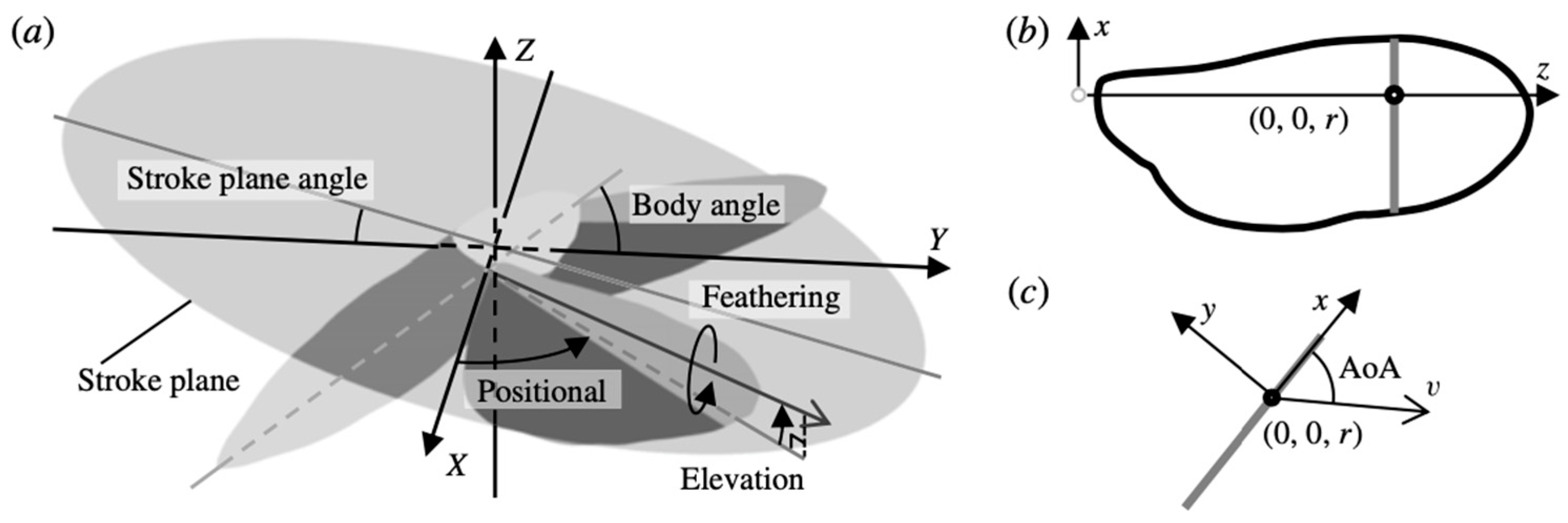
Figure 1 summarizes the kinematic and reference-frame framework linking gust-induced velocity perturbations to instantaneous aerodynamic loading.
These observations motivate a shift in MAV design philosophy: rather than relying exclusively on feedback control to reject gust disturbances, the aerodynamic configuration itself can be exploited to passively attenuate disturbance transmission at the force-generation level. Understanding the dynamic role of wing–wake interaction in gust response is therefore a critical step toward MAVs capable of stable operation in realistic urban flow environments [
12].
1.2. Biological Evidence of Gust-Tolerant Dragonfly Flight
Dragonflies exhibit exceptional flight stability and manoeuvrability in highly unsteady atmospheric conditions, including gusts and turbulent wakes. Unlike insects with a single wing pair, dragonflies employ a tandem-wing configuration in which the forewings and hindwings operate with controlled phase differences. This arrangement enables complex aerodynamic interactions that contribute to both force augmentation and disturbance tolerance.
Experimental and numerical studies of dragonfly-inspired flapping systems show that tandem-wing arrangements can sustain lift and thrust under rapidly varying inflow conditions. Shanmugam and Sohn [
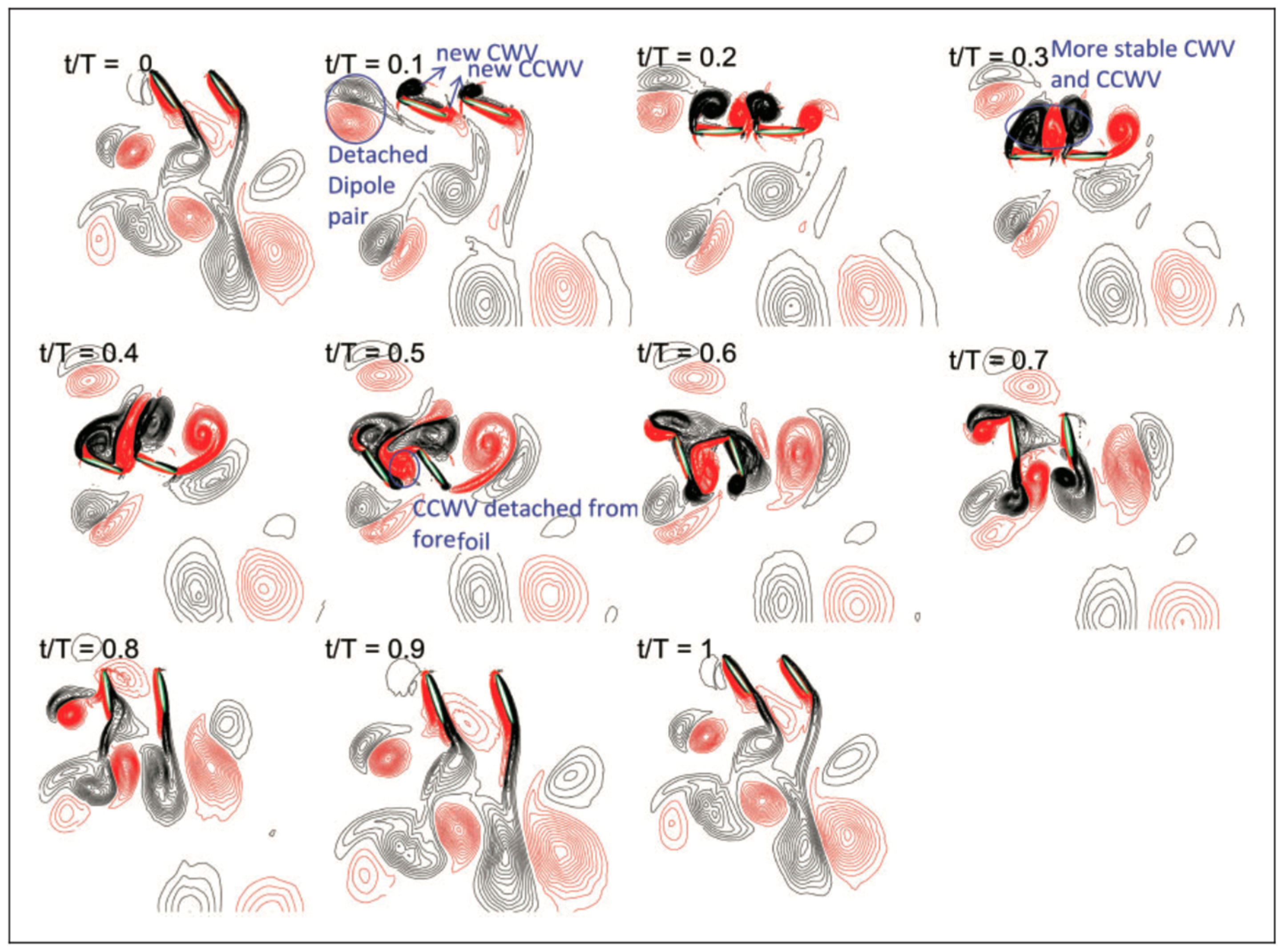
13] demonstrated that dragonfly-like flapping foils maintain coherent vortex structures during transient flight phases, with vortices generated by the forewing being intercepted and re-energized by the hindwing.
Figure 2 illustrates this process for the in-phase configuration (ψ = 0), showing how persistent vortex structures and controlled interaction within the inter-wing gap lead to smoother force histories and reduced load fluctuations.
Salami et al. [
14] showed that wake-induced re-energization downstream of the forewing delays separation on the hindwing, improving efficiency and stability compared with isolated wings. These results indicate that dragonfly stability arises not only from active control but also from passive aerodynamic mechanisms inherent to the tandem-wing configuration. In this configuration, phased wing interaction redistributes unsteady loads, reduces force peaks, and attenuates disturbance transmission. Together, these findings motivate treating wing–wake interaction as a primary contributor to gust tolerance in dragonfly-inspired MAVs and incorporating it into engineering models of intrinsic disturbance attenuation.
1.3. Limitations of Existing Tandem-Wing MAV Studies
Despite the growing interest in tandem-wing MAVs, existing studies reveal important limitations in the understanding of their performance in gust-dominated environments. Most engineering investigations emphasize steady or cycle-averaged metrics, such as mean lift, efficiency, or power consumption, under nominal inflow conditions. By contrast, the transient mechanisms that govern low-Reynolds-number flight in turbulence remain comparatively underexplored.
In many studies, wing–wing interaction is treated primarily as a source of aerodynamic augmentation rather than as a dynamic mechanism for disturbance mitigation. Although wake interaction effects are often acknowledged, they are typically evaluated under steady inflow assumptions, without explicitly accounting for gust-induced variations in velocity, angle of attack, or wake structure. This limits insight into how forewing–hindwing coupling modifies the transmission of unsteady aerodynamic loads into rigid-body dynamics during gust encounters.
When gusts are considered explicitly, the problem is usually framed from a control-centric perspective. Advanced feedback strategies, such as Active Disturbance Rejection Control and adaptive or robust nonlinear controllers, have demonstrated improved stability under wind disturbances [
15,
16]. However, these approaches generally assume a fixed aerodynamic configuration and treat gusts as external disturbances to be compensated for by control action. As a result, the intrinsic aerodynamic contribution of tandem-wing interaction to disturbance attenuation remains largely unquantified [
17].
Finally, many tandem-wing MAV studies rely on simplified quasi-steady aerodynamic models without systematically assessing their validity under highly unsteady inflow. While computationally efficient, such models may fail to capture critical wing–wake and wake–wing interactions during gust encounters, particularly when timing and phase effects dominate the force response. Neglecting these interactions can lead to an overestimation of control authority and an underestimation of aerodynamic disturbance transmission [
18].
1.4. Research Gap and Contribution
Although tandem-wing configurations inspired by dragonfly flight have demonstrated aerodynamic feasibility and efficiency advantages, existing studies still lack a clear mechanistic explanation of how wing–wake interaction contributes to gust tolerance at the dynamic level. Prior work has focused mainly on mean performance or control-centric mitigation, leaving the role of unsteady forewing–hindwing coupling in gust load attenuation poorly quantified. Most flapping-wing MAV models rely on quasi-steady or blade-element formulations validated under nominal or weakly unsteady inflow. While CFD-informed extensions improve predictions for isolated wings, their application to tandem-wing systems under gust excitation remains limited, and wake timing and phase effects are usually embedded implicitly in aerodynamic coefficients rather than treated as explicit dynamic mechanisms [
1,
11].
The main contribution of this paper is to demonstrate, within a full six-degree-of-freedom (6DOF) flight-dynamics framework, that phase-dependent wing–wake interaction reduces gust-to-body energy transfer independently of the applied control law. By isolating aerodynamic coupling effects from control action, the study shows that gust attenuation emerges as an intrinsic property of the tandem-wing configuration rather than as a by-product of feedback compensation.
Recent studies address gusty operation through adaptive sensing and control [
19] or through controller synthesis for discrete gusts [
20], but they largely frame gust rejection as a control problem or treat the wings as isolated actuators. As a result, the intrinsic aerodynamic role of wing–wake interaction in disturbance attenuation remains underexplored. This study reframes tandem-wing MAV design as a dynamics-driven gust-rejection problem by hypothesizing that phase-dependent wing–wake interaction acts as a passive aerodynamic filter that attenuates gust-induced force and moment fluctuations before they reach rigid-body dynamics. To test this hypothesis, a six-degree-of-freedom (6DOF) framework is developed that integrates quasi-steady aerodynamics, explicit gust excitation, and phase-dependent interaction within rigid-body flight dynamics.
To the authors’ knowledge, this is the first study to isolate and evaluate phase-dependent wing–wake interaction as a passive aerodynamic disturbance attenuation mechanism in tandem-wing MAVs operating in turbulent gusts within a comprehensive 6DOF framework.
1.5. Reference MAV Configuration
The vehicle considered in this study corresponds to a small dragonfly-inspired flapping-wing MAV employing a tandem-wing configuration. The system is not intended to represent a large cargo UAV or delivery apparatus, but rather a lightweight research-scale platform typical of insect-inspired MAV studies.
The reference configuration used in the simulations has a total mass of approximately 0.15 kg and a wingspan of approximately 0.25 m. These dimensions fall within the characteristic size range of experimentally reported flapping-wing MAV prototypes operating at low Reynolds numbers.
Such platforms are commonly investigated for applications including environmental monitoring, infrastructure inspection, and research on gust-resilient aerial flight. The geometric and inertial properties of the MAV are defined in
Section 3. These parameters represent a representative research-scale configuration rather than a finalized vehicle design, allowing the present study to focus on the aerodynamic and dynamic mechanisms governing gust rejection through tandem-wing interaction.
3. Dynamic Modelling Framework
To investigate how wing–wake interaction and biological phase lag influence gust rejection at the system level, a six-degree-of-freedom (6DOF) rigid-body dynamic framework is adopted. Such formulations are standard in unmanned aerial vehicle (UAV) and MAV research, as they enable the coupled representation of translational and rotational motion under aerodynamic, gravitational, and environmental disturbances [
26,
27]. The 6DOF approach is particularly relevant for MAVs operating in turbulent environments, where gust-induced perturbations simultaneously affect multiple motion axes and induce strong cross-coupling effects.
The selection of a full rigid-body dynamic model is motivated by the limitations of reduced-order or planar formulations in gust-dominated flight regimes. Previous studies have shown that simplified models often fail to capture coupled roll–pitch–yaw dynamics and underestimate attitude excursions when vehicles are subjected to atmospheric turbulence [
28]. By contrast, Newton–Euler-based formulations allow unsteady aerodynamic forces and moments to propagate consistently into vehicle motion states, providing a physically grounded representation of gust response.
Within the adopted framework, aerodynamic force generation, gust excitation, and rigid-body motion are treated as interacting subsystems. Gust disturbances are introduced as time-varying modifications of the local inflow velocity experienced by the wings, rather than as externally applied forces. This modelling approach reflects the physical mechanism by which gusts influence MAV dynamics, namely through aerodynamic interaction, and has been widely adopted in gust-response studies for small UAVs and flapping-wing MAVs [
2]. Such a formulation is essential for isolating the contribution of aerodynamic configuration to disturbance attenuation.
The dynamic framework is designed to be compatible with CFD-informed quasi-steady aerodynamic models, which seek to capture the dominant unsteady aerodynamic effects relevant to MAV-scale flight while maintaining computational efficiency [
11]. This balance enables systematic parametric analysis of wing phasing and gust response without the prohibitive cost of fully resolved unsteady flow simulations.
3.1. MAV System Characteristics
To clarify the operational characteristics of the platform considered in the present study, the main system parameters and capabilities of the reference MAV configuration are summarized in
Table 1. These parameters correspond to a small dragonfly-inspired flapping-wing MAV typically used for research on low-Reynolds-number flight dynamics and gust-resilient aerial vehicles.
3.2. 6DOF Rigid-Body Dynamics
The formulation of the interaction force introduced in this section constitutes the central modelling hypothesis of the present study. Rather than treating forewing–hindwing coupling as a secondary correction to quasi-steady aerodynamics, the proposed interaction term explicitly represents wing–wake coupling as a dynamic mechanism governing the transmission of gust-induced disturbances into the vehicle. In this framework, the phase-dependent interaction force is interpreted as a physically motivated surrogate for wake interception and re-energization effects observed in dragonfly flight, and is hypothesized to act as a passive aerodynamic pre-filter that redistributes unsteady loads in time and attenuates their impact on rigid-body dynamics. The following formulation therefore does not merely extend an existing aerodynamic model, but defines the core mechanism through which gust rejection is analysed in this work.
The MAV is modelled as a rigid body with six degrees of freedom, consisting of three translational and three rotational states. Translational motion is defined in an inertial reference frame, while rotational motion is described in a body-fixed frame aligned with the principal axes of inertia. The equations of motion follow classical Newton–Euler formulations, which form the basis of most UAV and MAV flight dynamics models [
26,
27].
Translational dynamics are governed by the resultant aerodynamic forces generated by the tandem-wing system, gravitational loading, and the influence of gust-modified inflow velocities. Gust effects are incorporated by altering the relative air velocity used in the aerodynamic force calculations, rather than by introducing direct force disturbances. This approach has been shown to provide a more physically consistent representation of gust response in MAV-scale vehicles, particularly for flapping-wing and low-speed platforms [
2,
29].
Rotational dynamics are driven by aerodynamic moments arising from asymmetric force distributions between the forewing and hindwing, as well as from time-varying aerodynamic centre locations under unsteady inflow. The rigid-body formulation accounts for inertial coupling between roll, pitch, and yaw axes, which becomes pronounced during gust encounters in small aerial vehicles [
28]. Accurate representation of these couplings is therefore essential for evaluating attitude stability and control authority in turbulent environments.
The equations of motion are integrated numerically using a fixed time step selected to resolve both wingbeat-scale dynamics and gust-induced transients. Although the underlying aerodynamic force model is quasi-steady in form, its coupling with phase-dependent interaction effects introduces effective memory into the system, allowing wake-induced effects to influence vehicle response over multiple time steps. This modelling strategy aligns with established approaches for MAV dynamic simulation under unsteady aerodynamic conditions [
11,
29].
Vehicle Geometry and Inertial Properties
The reference tandem-wing MAV is modelled as a rigid body with mass
and inertia tensor
with the principal inertia axes aligned with the body-fixed reference frame. The centre of mass (CG) is located at the origin of the body frame. The geometric and inertial parameters of the vehicle are summarised in
Table 1 and
Table 2.
The aerodynamic configuration follows a dragonfly-inspired tandem arrangement consistent with the tandem-foil studies of Shanmugam and Sohn, in which the longitudinal spacing between the forewing and hindwing is defined in terms of the chord length
through the non-dimensional spacing
. In the present model, a representative value
is adopted, such that the distance between the aerodynamic centres of the two wings is
. The forewing and hindwing aerodynamic centres are therefore located at
with respect to the CG.
The total aerodynamic force acting on the vehicle is obtained from the forewing, hindwing, and interaction contributions described in
Section 3.2 and
Section 3.3. These forces generate both a net force and a net moment about the CG, according to
The resulting forces and moments enter directly into the Newton–Euler equations of motion given in
Section 3.1, governing the coupled translational and rotational dynamics of the six-degree-of-freedom (6DOF) rigid body.
This formulation ensures that the geometric placement of the wings and the vehicle inertia properties explicitly determine how aerodynamic loads are transmitted into rigid-body motion, making the dynamic response verifiable and reproducible.
Table 2 summarises the geometric, inertial, and aerodynamic parameters of the reference tandem-wing MAV used in the simulations. The vehicle is modelled as a rigid body with principal inertia axes aligned with the body-fixed reference frame. All parameters are representative of a low-Reynolds-number, dragonfly-inspired MAV and are intended to provide a consistent reference configuration for comparative gust-response analysis rather than a finalised vehicle design.
The geometric and inertial parameters of the tandem-wing MAV are listed in
Table 3. The vehicle is modelled as a rigid body with mass
and diagonal inertia tensor
, and the forewing and hindwing forces are applied at fixed offsets from the centre of mass, thereby generating both forces and moments in the 6DOF Newton–Euler equations.
3.3. Tandem-Wing Force Decomposition
In a dragonfly-inspired tandem-wing micro-aerial vehicle (MAV), the total aerodynamic forces and moments acting on the vehicle arise from the coupled interaction of the forewing and hindwing rather than from two independent lifting surfaces operating in uniform inflow. To capture this behaviour within a six-degree-of-freedom (6DOF) dynamic framework, the aerodynamic force generation is decomposed into distinct contributions associated with each wing and their mutual interaction.
The total aerodynamic force vector acting on the MAV body is expressed as
where
and
denote the aerodynamic forces generated by the forewing and hindwing, respectively, under nominal inflow conditions, and
represents an interaction term accounting for wake-induced coupling effects. This decomposition reflects the physical reality that, in tandem-wing systems, the downstream wing operates in a flow field that has been modified by the upstream wing’s motion and wake structure, particularly under unsteady inflow conditions [
2].
The forewing force contribution
is computed from the instantaneous relative air velocity experienced by the forewing, incorporating both the vehicle’s translational motion and gust-induced inflow perturbations. The hindwing force contribution
, however, is influenced not only by the freestream and gust velocity components, but also by induced velocities and residual circulation associated with the forewing wake. As a result, treating the hindwing as an isolated aerodynamic surface can lead to systematic overestimation of instantaneous force peaks during gust encounters [
29].
The interaction force
encapsulates the modification of hindwing aerodynamic loading due to wake interception and phase-dependent inflow conditioning. From a modelling perspective, this term represents the net effect of induced velocity fields, vortex deformation, and temporal load redistribution arising from forewing–hindwing coupling. Similar force-decomposition approaches have been employed in MAV and UAV studies to separate baseline aerodynamic contributions from interaction-driven effects, enabling clearer interpretation of disturbance transmission mechanisms [
26,
27].
Importantly,
is inherently time-dependent and strongly influenced by the phase lag between the wings. Under gust excitation, changes in inflow velocity first alter the forewing force generation, which subsequently modifies the wake encountered by the hindwing after a phase-dependent delay. This staggered response reduces the simultaneity of peak force generation across the wing pairs, thereby attenuating the transmission of gust-induced energy into the rigid-body dynamics. Such behaviour has been observed in flapping-wing MAV studies subjected to wind disturbances, where aerodynamic coupling was shown to smooth force histories and reduce peak loads [
2].
Within the adopted quasi-steady aerodynamic formulation, the interaction term is parameterized rather than explicitly resolved through full unsteady flow simulation. This approach is consistent with CFD-informed quasi-steady models, which show that wake interaction and timing effects can be incorporated through correction terms without significantly increasing computational cost [
11]. By embedding the interaction force into the rigid-body equations of motion, the model captures the dominant aerodynamic coupling mechanisms governing gust response in tandem-wing MAVs.
3.3.1. Biological Inspiration and Proposed Configuration
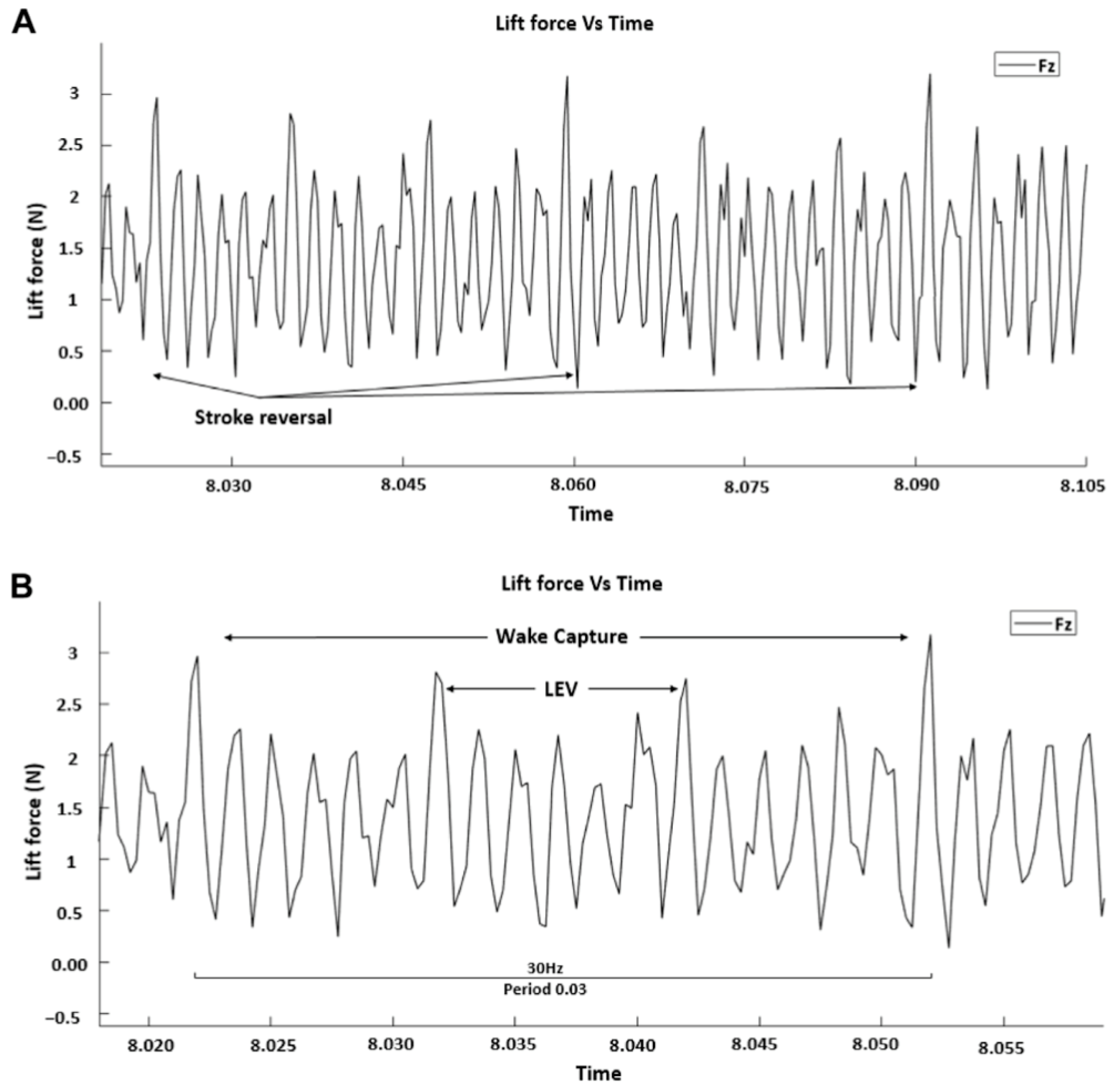
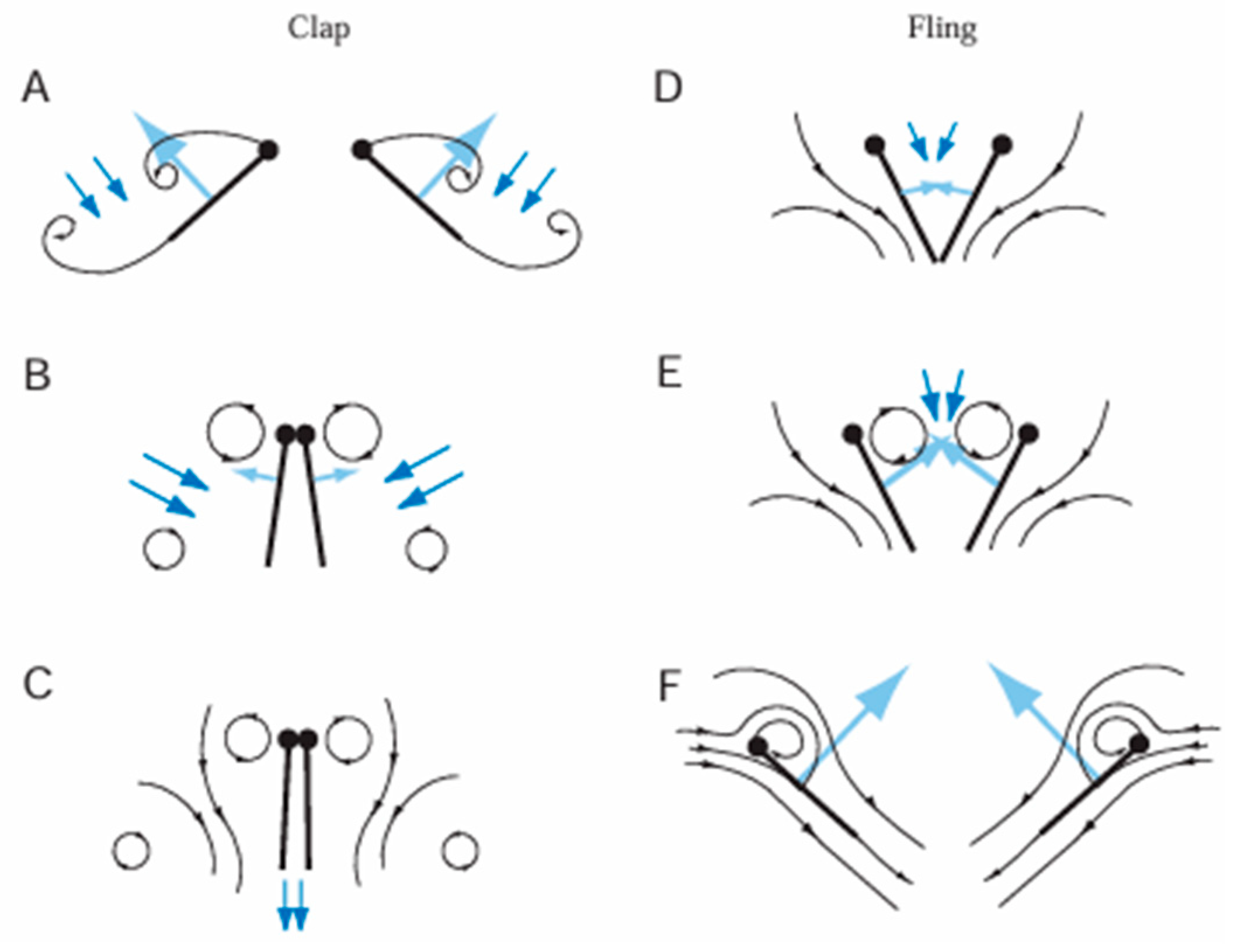
The tandem-wing configuration adopted in this study is motivated by detailed morphological and aerodynamic analyses of Anisoptera species, which show that phased forewing–hindwing interactions are fundamental to dragonfly flight performance. These insects exploit controlled phase offsets between the two wing pairs to generate unsteady aerodynamic mechanisms, including persistent leading-edge vortices (LEVs), wake capture, and delayed flow separation. Together, these mechanisms contribute to enhanced lift production and flight stability under unsteady conditions [
1]. This biological evidence indicates that the forewing and hindwing function as a coupled aerodynamic system rather than as independent lifting surfaces.
Building on these biological insights, Adak et al. [
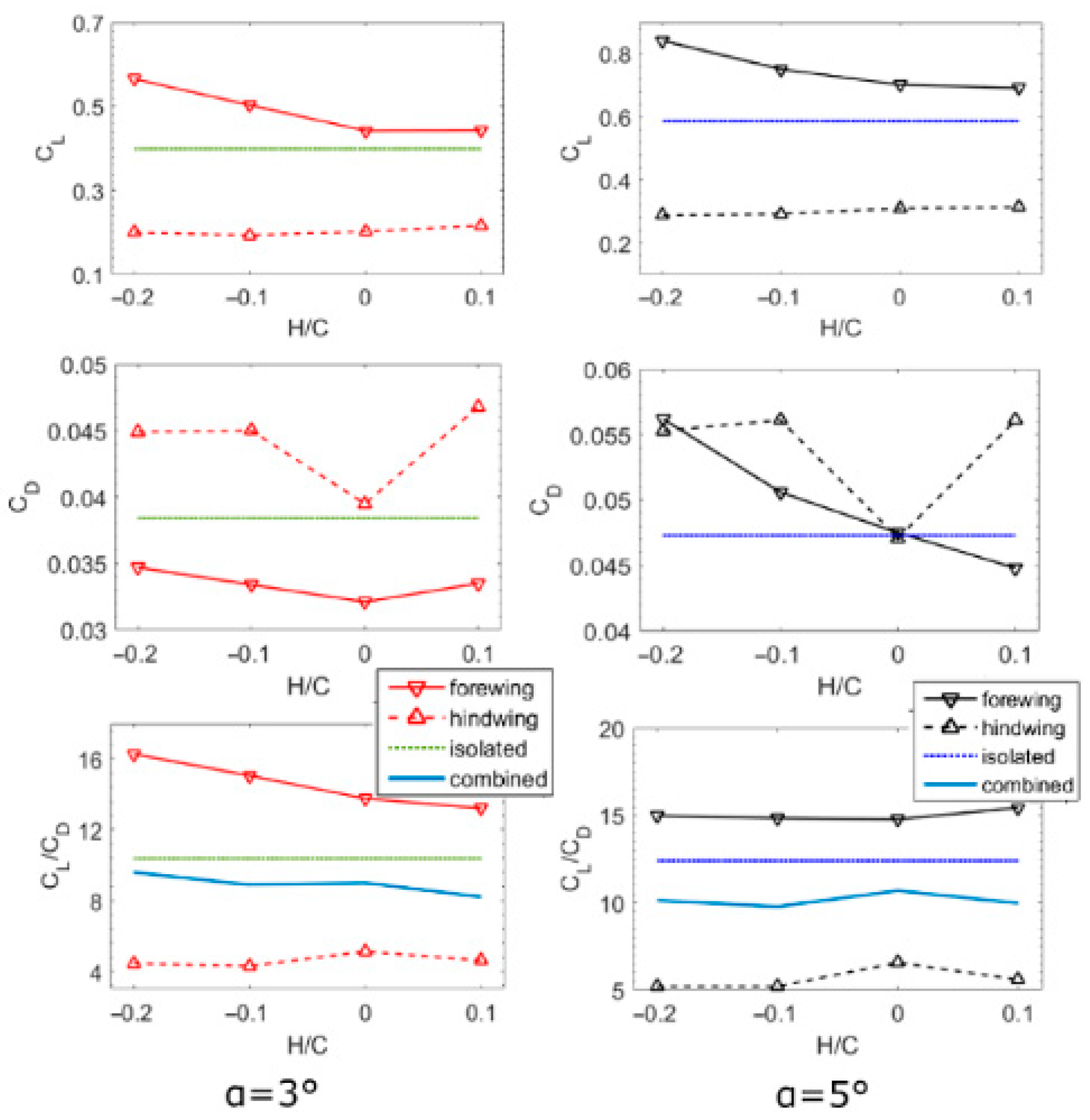
5] analytically and numerically validated a dragonfly-inspired tandem-wing configuration using Prandtl’s lifting-line theory. Their results showed that aerodynamic coupling between the two wings significantly improves force production and efficiency relative to isolated wings operating under identical flow conditions. As illustrated in
Figure 4, the tandem configuration achieves a higher lift coefficient (
) and superior aerodynamic efficiency (
) compared with a single isolated wing (
,
) at
. Notably, this performance enhancement is maintained across variations in wing spacing and angle of attack, indicating robustness to both geometric and operational changes.
These findings provide quantitative evidence that phased tandem-wing arrangements redistribute aerodynamic loading and mitigate drag penalties through constructive wing–wake interaction. Consequently, such configurations offer a compelling design paradigm for bioinspired micro-air vehicles (MAVs), particularly in low-Reynolds-number regimes where conventional fixed-wing or single-wing flapping designs suffer from limited lift margins and reduced efficiency.
3.3.2. Quasi-Steady Aerodynamic Model
The aerodynamic forces acting on the bioinspired micro-aerial vehicle are modelled using a quasi-steady approximation, suitable for low-Reynolds-number regimes typical of insect-sized flight. This approach, originally proposed by Sane [
9] and validated experimentally by Dickinson et al. [
10], assumes that aerodynamic forces can be estimated from the instantaneous relative velocity and angle of attack without explicitly resolving the full unsteady flow field.
In the present study, each wing is modelled as a thin, symmetric airfoil representative of a flat-plate or low-camber insect wing section, which is a common approximation in low-Reynolds-number MAV modelling. The lift
and drag
forces are computed as
where
is the air density,
is the instantaneous resultant velocity,
is the effective wing area, and
and
are the lift and drag coefficients as functions of the angle of attack
.
For small to moderate angles of attack, the lift coefficient is approximated using the thin airfoil theory linear relation,
with
expressed in radians [
10]. The characteristic Reynolds number of the present configuration is
where
is the characteristic chord length and
is the dynamic viscosity of air, placing the vehicle firmly within the low-Reynolds-number, vortex-dominated flight regime relevant to insect-scale MAVs.
A constant drag coefficient
is assumed based on experimental observations from similar small-scale MAV platforms [
2]. The present lift model is considered valid for angles of attack up to approximately 15–
. Beyond this range, non-linear effects such as flow separation and dynamic stall are expected to occur and cannot be captured by the linear thin-airfoil approximation.
In practice, a lift matrix is generated by cross-referencing velocity values in the range 0.5–3.0 m/s and angles of attack in the range 0–30°, following [
9], and is used to provide consistent quasi-steady force estimates across the simulated flight envelope.
Figure 5 illustrates how sinusoidal gusts affect the attitude and trajectory of a flapping-wing MAV. To simulate realistic urban conditions and assess the MAV’s recovery capability against external perturbations.
3.3.3. Flight Scenarios and Aerodynamic Force Estimation
To systematically evaluate the aerodynamic behaviour and disturbance resilience of the proposed bioinspired MAV configuration, three representative flight scenarios are defined. This scenario-based approach follows established methodologies for tandem-wing and low-Reynolds-number MAV analysis, as outlined by Adak et al. [
5], and allows controlled isolation of key aerodynamic effects across distinct operational regimes.
Each scenario corresponds to a characteristic phase commonly encountered during micro-aerial vehicle operation, namely gliding, hovering, and gust-perturbed ascent. By prescribing representative combinations of forward velocity and angle of attack, the resulting aerodynamic forces can be estimated in a consistent and repeatable manner, providing baseline performance metrics for subsequent dynamic simulations.
Table 4 summarizes the selected flight conditions and the corresponding lift estimates computed under quasi-steady assumptions.
The lift values reported in
Table 1 were calculated using the quasi-steady lift formulation in (18), with the lift coefficient approximated as
(with
expressed in radians), assuming standard air density (
) and an effective wing area of
. Although this linear approximation is strictly valid only for moderate angles of attack, it provides a consistent first-order estimate suitable for comparative scenario analysis.
The purpose of defining these scenarios is not to predict exact flight performance, but rather to establish numerical benchmarks that indicate whether the bioinspired tandem-wing configuration can generate sufficient lift across different flight modes. These benchmarks serve as reference inputs for the subsequent six-degree-of-freedom (6DOF) simulations, in which the coupled effects of aerodynamics, rigid-body dynamics, and external disturbances are evaluated to assess overall system efficiency and robustness.
3.3.4. Gliding Flight
In the gliding flight scenario, the MAV is simulated descending under its own weight without active propulsion, representing an energy-efficient flight mode commonly used for range extension or passive descent. A moderate angle of attack (
) is prescribed to achieve a near-optimal lift-to-drag ratio, consistent with experimental and numerical observations reported for small-scale tandem-wing MAVs [
5]. Under this condition, the aerodynamic forces are primarily governed by the balance between gravitational loading and steady lift generation.
The objective of this scenario is to evaluate the ability of the proposed aerodynamic configuration to sustain a controlled and stable descent while minimizing drag penalties. This case therefore provides a baseline assessment of lift generation efficiency and aerodynamic performance in the absence of active thrust or strong unsteady effects, serving as a reference condition for comparison with more demanding flight regimes.
3.3.5. Validation Against Higher-Fidelity Aerodynamic Data
To assess the validity of the thin-airfoil-based quasi-steady lift model in the relevant low-Reynolds-number regime, its predictions are compared with higher-fidelity aerodynamic data reported in the literature for flat-plate or thin airfoil sections at
, obtained from steady RANS simulations and experimental measurements (e.g., [
9,
10]).
For angles of attack up to approximately 10–, the linear relation provides good agreement with these higher-fidelity results, with typical discrepancies below 10% in lift coefficient. As the angle of attack approaches 15–, deviations increase due to the onset of flow separation and nonlinear vortex dynamics, which are not captured by the thin-airfoil formulation. Beyond this range, the quasi-steady model increasingly under- or over-predicts lift, depending on the specific airfoil geometry and flow conditions.
These comparisons confirm that the present aerodynamic model is suitable for use within a restricted validity envelope characterized by moderate angles of attack and low-to-moderate velocities. Accordingly, in this study, the quasi-steady formulation is employed primarily for comparative, system-level analysis of gust response and wing–wake interaction effects, rather than for absolute prediction of aerodynamic loads near or beyond stall.
3.3.6. Hovering Flight
The hovering flight scenario models the MAV maintaining a constant altitude with negligible horizontal velocity, corresponding to a near-stationary flight condition. To counteract gravitational forces, a higher angle of attack (
) is imposed in order to maximize lift production while remaining below the onset of significant flow separation, as reported for tandem-wing configurations operating at low Reynolds numbers [
5].
This flight condition is particularly demanding from an aerodynamic perspective, as it requires sustained lift generation at low dynamic pressure. Consequently, the hovering scenario is used to assess the available aerodynamic margin and to evaluate the effectiveness of the wing configuration in supporting stationary manoeuvres, precision positioning, and low-speed control tasks. The results obtained under this condition provide important insight into the feasibility of the bioinspired design for applications requiring high stability and fine attitude control.
3.3.7. Ascent and Gust Response
The ascent and gust-response scenario combines a vertical upward motion phase with the application of an external horizontal gust disturbance, representing a challenging operational condition for micro-aerial vehicles operating in cluttered or urban environments. During this scenario, the MAV is subjected to simultaneous self-induced acceleration and unsteady aerodynamic forcing, allowing evaluation of its robustness under coupled dynamic effects.
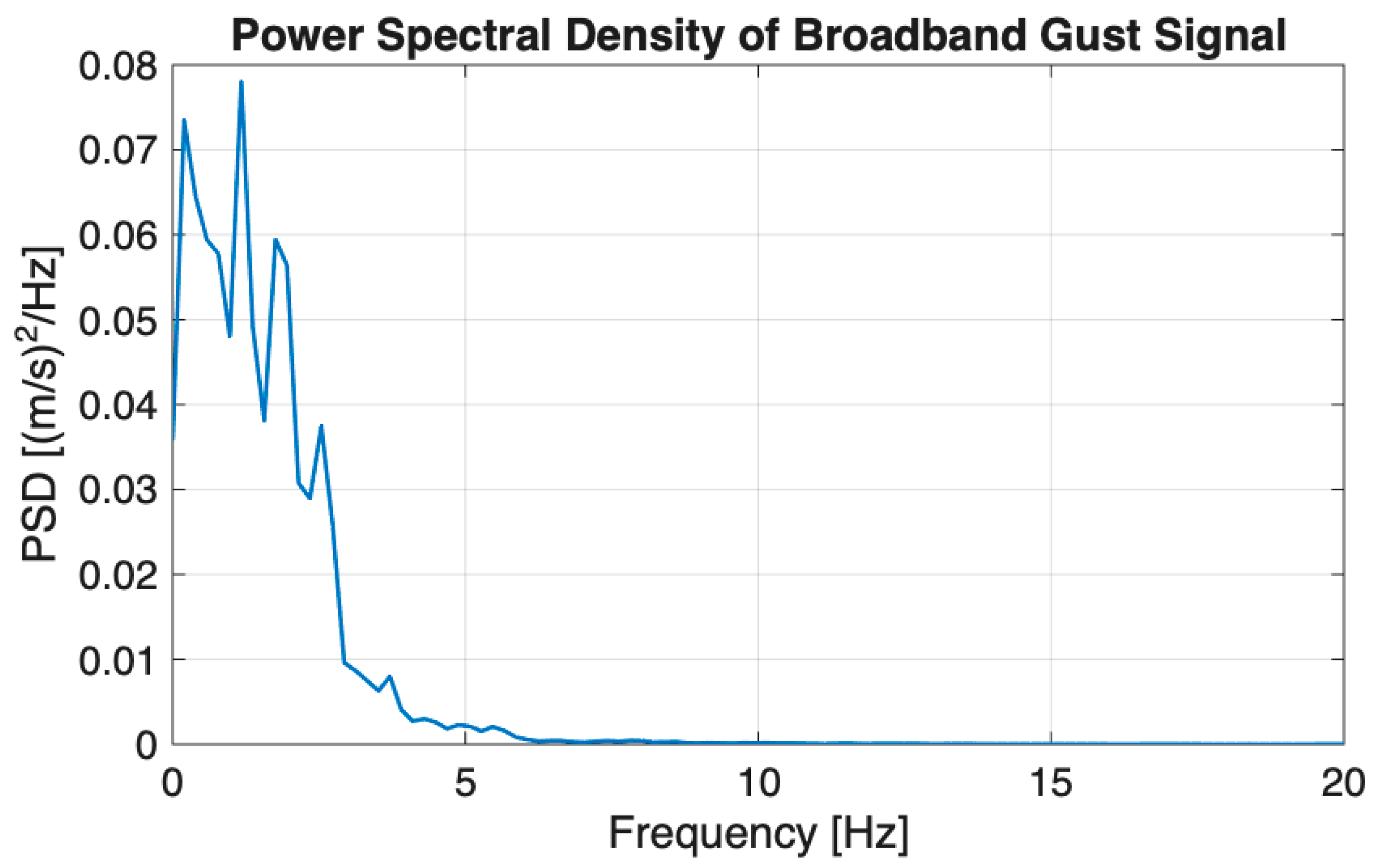
The gust disturbance is modelled as a sinusoidal variation in the horizontal inflow velocity,
where
is the gust amplitude and
is the gust frequency. These values are selected to represent moderate, low-frequency gusts typically encountered at low altitudes.
The purpose of this scenario is to challenge the MAV’s dynamic stability and aerodynamic load distribution under combined ascent and external perturbation conditions. The resulting force responses and vehicle dynamics are not analysed at this stage but are instead evaluated in the subsequent six-degree-of-freedom simulations to quantify gust attenuation, stability margins, and recovery behaviour (
Section 4).
3.4. Wing–Wake Interaction Term (New Emphasis)
To explicitly capture the aerodynamic coupling responsible for gust attenuation in dragonfly-inspired tandem-wing MAVs, wing–wake interaction is modelled as a distinct, phase-dependent contribution to the total aerodynamic force and moment. Unlike the baseline forewing and hindwing forces, which are computed assuming nominal inflow, the interaction term represents the modification of downstream wing loading caused by induced velocities and residual circulation originating from the upstream wing’s wake. This section formalizes this term and clarifies its role in redistributing unsteady aerodynamic loads and attenuating gust energy transmission to the rigid-body dynamics.
3.4.1. Formulation of the Interaction Force
Building on the force decomposition introduced in
Section 3.2, the total aerodynamic force is written as
where the interaction force
accounts for wake-induced coupling effects. In the present framework,
is modelled as a correction to the hindwing force arising from the wake of the forewing and is parameterized as
with
denoting a phase-dependent interaction efficiency and
the time delay associated with the phase lag
between forewing and hindwing at flapping frequency
. This formulation reflects the physical observation that the hindwing encounters a flow field conditioned by the forewing wake after a finite delay, rather than responding instantaneously to the same inflow.
The coefficient
encapsulates the net effect of induced velocity, vortex persistence, and wake deformation on the hindwing’s effective inflow. Its value is constrained to
and is treated as a bounded parameter representing constructive or neutral interaction. Negative values, corresponding to destructive interaction, are not considered here, consistent with experimentally observed beneficial wake capture in dragonfly-inspired phasing regimes [
1].
3.4.2. Physical Interpretation Under Gust Excitation
Under gust disturbances, changes in inflow velocity first alter the aerodynamic loading of the forewing, modifying the strength and orientation of the shed vortical structures. The hindwing subsequently encounters this altered wake after a phase-dependent delay, resulting in an effective inflow that differs from the instantaneous freestream-plus-gust velocity. By introducing
as a delayed, scaled contribution, the model captures the temporal redistribution of aerodynamic loads characteristic of tandem-wing wake capture [
10,
13].
In this interpretation, the phase lag between the forewing and hindwing does not merely represent a kinematic offset but acts as an effective time delay in the transmission of wake-induced velocity perturbations from the upstream to the downstream wing. Because gust disturbances introduce rapid fluctuations in the inflow, this finite delay causes the induced aerodynamic response of the hindwing to be temporally shifted and partially decorrelated from the forewing load. At the system level, this mechanism is equivalent to a temporal filtering effect, whereby higher-frequency components of the gust-induced force fluctuations are redistributed over the flapping cycle, reducing peak loads and smoothing the net aerodynamic forcing applied to the body. In this sense, the phase-dependent interaction term can be interpreted as a physically motivated aerodynamic pre-filter acting on gust disturbances before they propagate into the rigid-body dynamics.
From a system-dynamics perspective, the interaction term therefore acts as a passive aerodynamic low-pass filter: impulsive gust-induced force variations on the forewing are not transmitted synchronously to the hindwing, reducing the simultaneity of peak loads across the wing pairs. Similar interpretations have been reported in flapping-wing MAV studies subjected to wind disturbances, where aerodynamic coupling was observed to smooth force histories and reduce peak aerodynamic loads [
2,
29].
3.4.3. Consistency with Quasi-Steady Modelling
Although the interaction term introduces an explicit time delay, the overall formulation remains compatible with quasi-steady aerodynamic modelling. CFD-informed quasi-steady approaches have demonstrated that wake interaction and timing effects can be incorporated through parametric corrections without resolving the full unsteady flow field [
11]. In this sense,
represents an effective unsteady correction embedded within a computationally efficient framework, enabling parametric exploration of wing phasing and gust response.
Importantly, the interaction term does not introduce additional state variables or increase the order of the rigid-body dynamics. Instead, it augments the force computation stage, allowing wake-induced effects to influence translational and rotational motion through the existing 6DOF equations. This design choice preserves numerical stability and facilitates systematic comparison between tandem-wing and non-interacting (single-wing or uncoupled) configurations.
3.4.4. Extension to Aerodynamic Moments
The same interaction concept is applied to aerodynamic moments by computing the moment contribution of
about the vehicle centre of mass. Because the hindwing is spatially offset from the forewing, wake-induced force corrections can generate significant pitching and yawing moments, particularly during asymmetric gust encounters. Explicitly accounting for these interaction-driven moments is therefore essential for evaluating attitude stability and for distinguishing aerodynamic attenuation effects from control-induced stabilization [
26,
27].
Without this interaction-induced moment contribution, the characteristic attitude response of the vehicle under gust excitation cannot be captured by the model, highlighting the necessity of explicitly accounting for wing–wake interaction in the rotational dynamics.
In summary, the wing–wake interaction term introduced here provides a mechanistic and parametric representation of biological wake capture within an engineering-grade dynamic model. By embedding phase-dependent, delayed aerodynamic coupling into the force and moment calculations, the framework enables direct evaluation of how tandem-wing configurations dissipate gust energy and attenuate disturbance transmission into MAV dynamics, forming the basis for the simulation results presented in the subsequent sections.
3.4.5. Calibration and Sensitivity of the Interaction Efficiency η
In the simulations reported in
Section 5, the interaction efficiency η is treated as a bounded, dimensionless parameter representing the strength of constructive forewing–hindwing wake coupling. Based on ranges reported in experimental and numerical studies of dragonfly-inspired tandem-wing interactions [
1,
13,
14], η is constrained to the interval
, where η = 0 corresponds to the non-interacting (isolated-wing) limit and higher values represent progressively stronger constructive wake interaction.
For the baseline results presented in
Section 5, a nominal value of η = 0.5 was adopted, representing a moderate level of constructive wake interaction consistent with reported wake-capture effects in dragonfly-inspired configurations. To assess robustness and parameter sensitivity, η was systematically varied over the range
, and the resulting effects on gust-response metrics were evaluated.
The phase delay between forewing and hindwing interaction is implemented as , where is the prescribed phase lag and is the flapping angular frequency. Numerically, this delay is realized as a fixed time-delay buffer in the hindwing force evaluation, such that the interaction force at time depends on the forewing aerodynamic loading evaluated at time . This ensures causal coupling between forewing wake generation and downstream hindwing response.
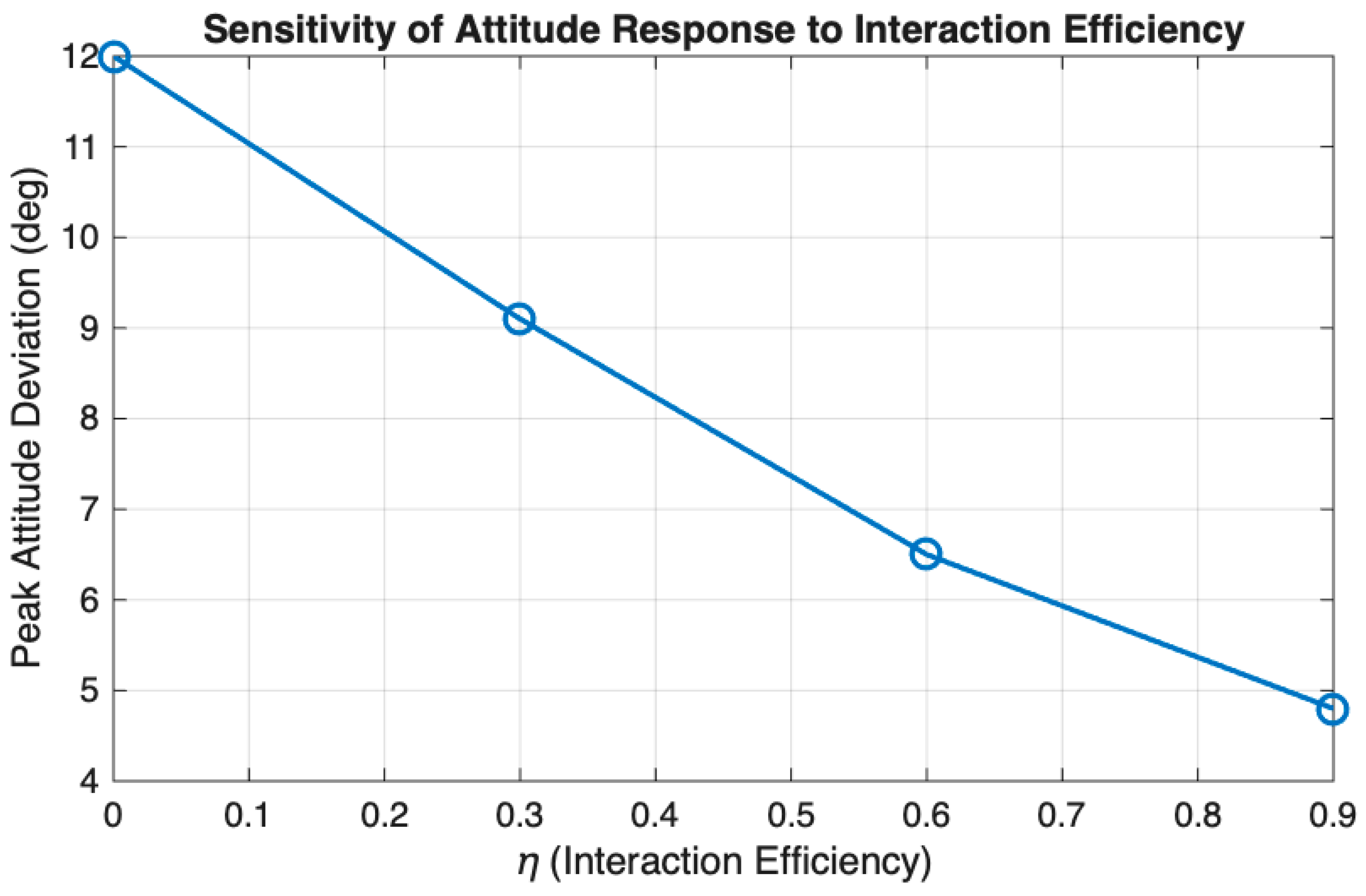
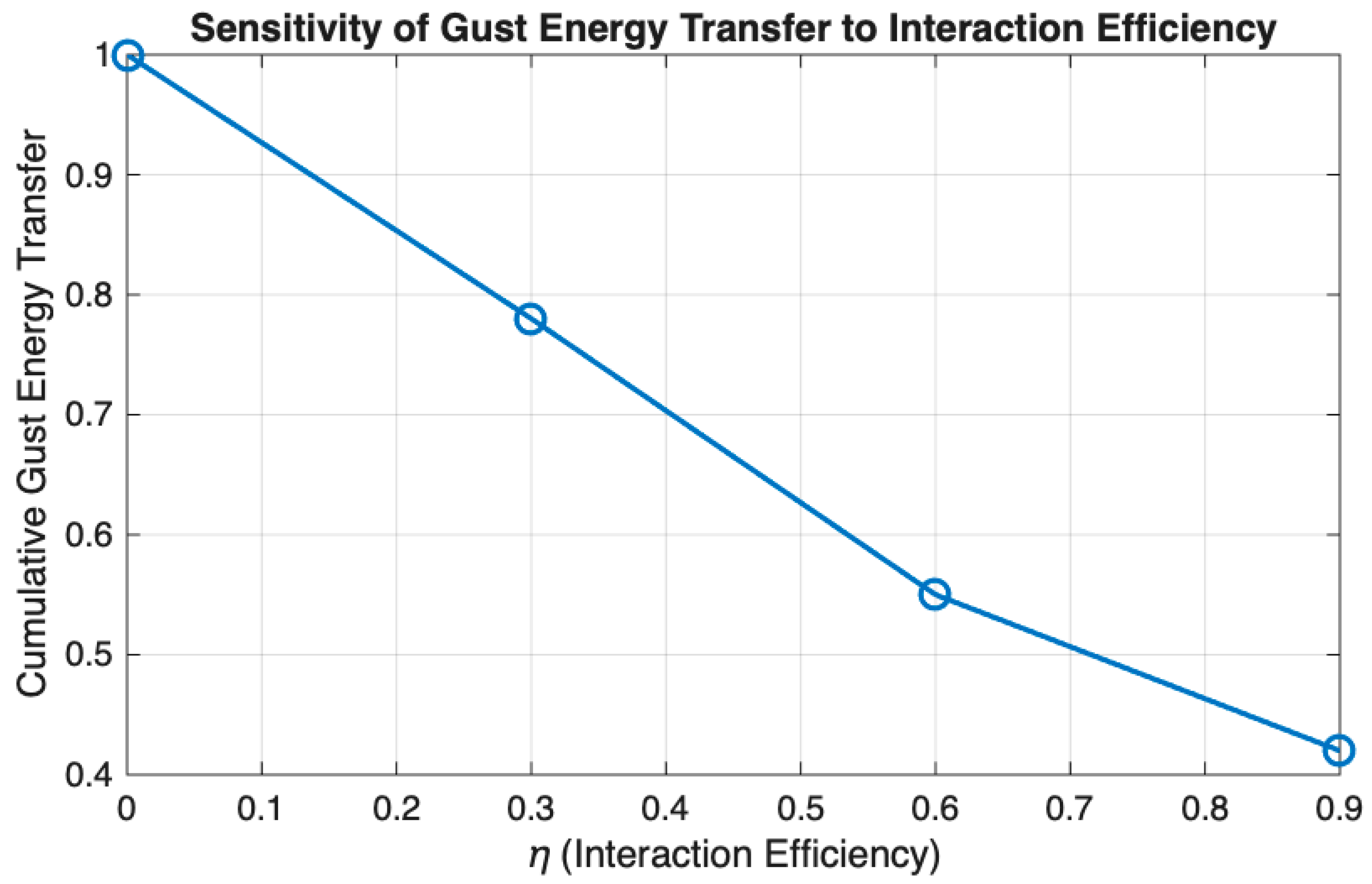
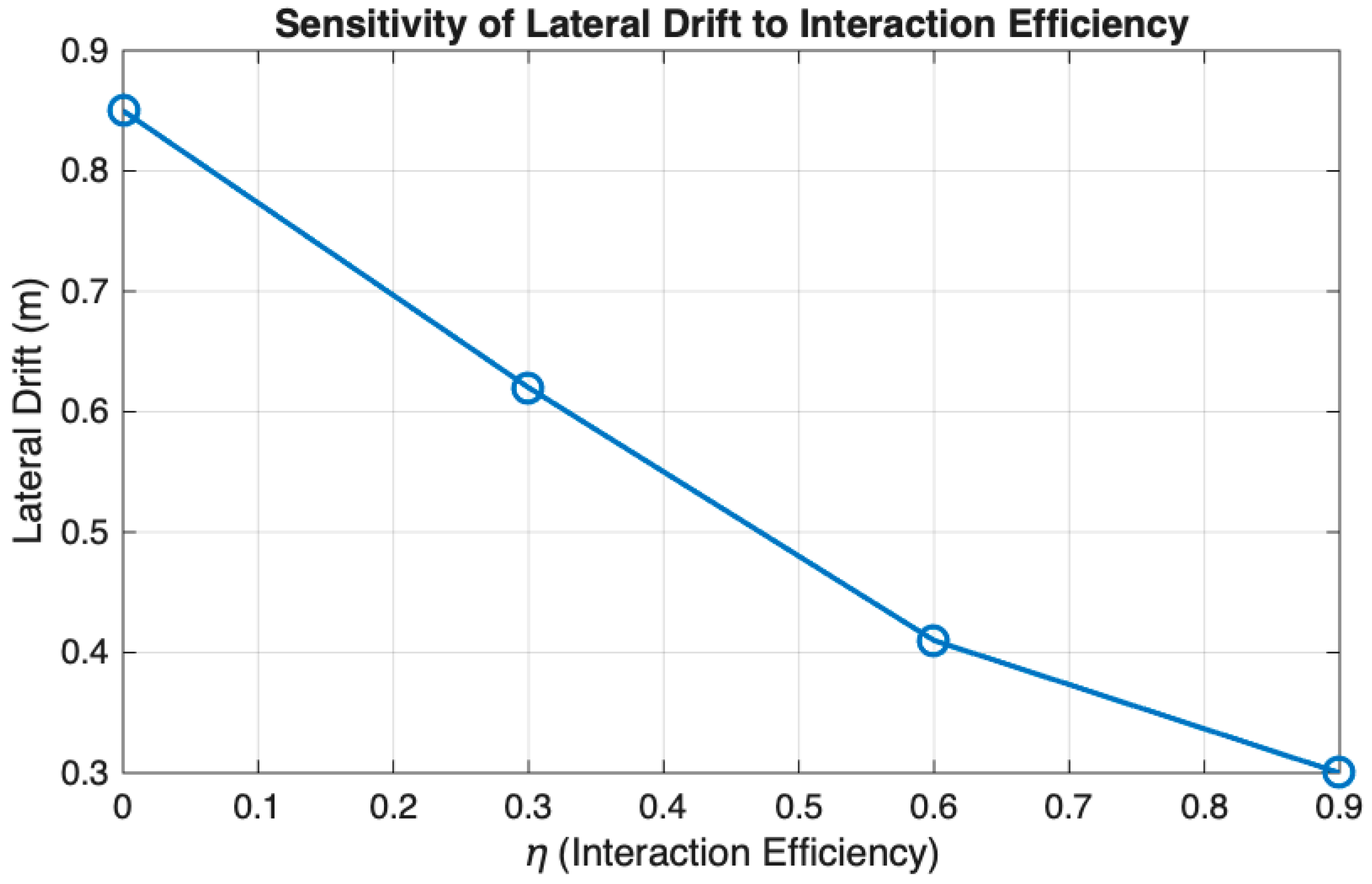
The sensitivity of gust-response characteristics to η is summarized in
Figure 6,
Figure 7 and
Figure 8, which show the variation in peak attitude deviation, cumulative gust energy transfer, and lateral drift with interaction efficiency. These results demonstrate that the qualitative gust-attenuation behavior persists across a biologically plausible range of η values and is not an artifact of a single parameter choice.
The interaction efficiency
introduced in
Section 3.3.1 is treated in the present study as a parametric surrogate for wake-induced velocity and circulation effects associated with forewing–hindwing coupling. Rather than representing a directly measured physical coefficient,
aggregates the net influence of induced velocities, vortex persistence, and wake deformation on the effective inflow experienced by the hindwing within a computationally efficient, quasi-steady framework. This modelling choice is consistent with CFD-informed reduced-order approaches, in which complex unsteady wake effects are incorporated through bounded correction factors rather than explicitly resolved flow fields [
1,
11].
Based on ranges reported in experimental and numerical studies of dragonfly-inspired tandem-wing interactions [
1,
13,
14],
is constrained to the interval
, where
corresponds to the non-interacting (isolated-wing) limit and higher values represent progressively stronger constructive wake interaction. In the absence of direct calibration data for the present configuration, a parametric sensitivity analysis is performed by sweeping
over a representative set of values (
) and evaluating the resulting gust-response metrics.
This parametric sweep is not intended to identify a single “true” value of , but rather to assess the robustness of the proposed gust-attenuation mechanism to variations in interaction strength. The resulting trends in trajectory deviation, attitude response, and energy-transfer metrics show that the qualitative gust-rejection behaviour persists across a biologically plausible range of values. Although is not directly measured here, this sensitivity analysis demonstrates that the attenuation of gust-induced disturbances is not an artifact of a specific parameter choice, but a structural consequence of phase-dependent wing–wake interaction embedded in the model.
Figure 6 illustrates the sensitivity of the peak attitude deviation to the interaction efficiency
. A clear monotonic decrease is observed as
increases from the non-interacting case toward stronger coupling, indicating that phase-dependent wing–wake interaction progressively attenuates rotational disturbances induced by gusts. This trend demonstrates that the interaction term contributes directly to stabilizing the vehicle’s attitude response, rather than merely altering mean aerodynamic loading.
Figure 7 illustrates the variation in cumulative gust energy transfer with interaction efficiency η. Increasing η leads to a systematic reduction in the energy transmitted from the gust into the vehicle, confirming that stronger wing–wake interaction enhances aerodynamic attenuation of disturbance energy at the system level. This result supports the interpretation of the interaction mechanism as a passive aerodynamic pre-filter that redistributes unsteady loads before they are converted into rigid-body motion.
Figure 8 presents the sensitivity of lateral drift to the interaction efficiency η. The lateral deviation decreases consistently with increasing η, indicating improved trajectory stability under gust excitation as the strength of wing–wake coupling increases. Together with the reductions in attitude excursions and energy transfer, this result shows that the benefits of phase-dependent interaction extend to both rotational and translational aspects of the vehicle’s gust response.
3.5. Quasi-Steady Assumptions and Validity Envelope
The aerodynamic force model employed in this study is based on a quasi-steady formulation, in which instantaneous aerodynamic forces are computed as functions of the local relative flow velocity and effective angle of attack. This approach assumes that, at each time step, aerodynamic forces can be approximated using steady-state coefficients evaluated at the instantaneous kinematic conditions. Quasi-steady modelling has been widely adopted in flapping-wing and micro-aerial vehicle (MAV) research due to its favourable balance between physical fidelity and computational efficiency, particularly in low-Reynolds-number flight regimes [
9,
10].
At Reynolds numbers typical of dragonfly-inspired MAVs (
–
, and specifically
in the present study), aerodynamic force generation is dominated by vortex-mediated mechanisms rather than by purely attached-flow behaviour [
9]. Experimental and numerical studies have shown that, within moderate ranges of angle of attack and reduced frequency, quasi-steady formulations can capture the dominant trends in lift and drag production, even in the presence of unsteady wing motion [
10,
11]. In this context, quasi-steady models should not be interpreted as strictly steady-flow approximations, but rather as reduced-order representations that implicitly embed averaged unsteady effects through empirically or CFD-informed aerodynamic coefficients.
The validity of the quasi-steady assumption is nevertheless bounded. Previous investigations have demonstrated that quasi-steady models provide reliable force predictions for angles of attack up to approximately 15–
, beyond which strong dynamic stall, vortex shedding, and flow separation phenomena lead to significant deviations from quasi-steady behaviour [
9,
12].
In the present study, the quasi-steady framework is deliberately applied within a defined validity envelope characterized by moderate angles of attack, low-to-moderate forward velocities, and flapping frequencies consistent with dragonfly-inspired MAV operation. Importantly, the objective is not to resolve detailed vortex dynamics, but to evaluate relative differences in gust response between interacting and non-interacting wing configurations. The model is therefore used strictly within this envelope and for comparative, rather than absolute, force prediction.
The present framework further assumes that gust-induced energy input remains within a regime where the vehicle dynamics are dominated by aerodynamic load redistribution rather than by large-amplitude rigid-body excursions. In other words, the model is intended for moderate-to-strong gusts that perturb the MAV about its nominal flight condition without inducing loss of aerodynamic effectiveness or uncontrolled rotational or translational growth. For extreme gusts capable of generating very large angular rates, large translational velocities, or near-stall conditions, additional effects such as strongly nonlinear inertial coupling, massive flow separation, and breakdown of quasi-steady assumptions would become dominant. In such regimes, higher-fidelity unsteady aerodynamic modelling and potentially flexible-body dynamics would be required. The present model therefore defines a validity envelope focused on operational gust conditions relevant to MAV flight, rather than extreme atmospheric disturbances.
3.6. Numerical Implementation and Simulation Setup
The six-degree-of-freedom (6DOF) rigid-body equations described in
Section 3 are implemented in a MATLAB R2026a/Simulink environment to simulate the coupled translational and rotational dynamics of the tandem-wing MAV under aerodynamic loading and gust excitation. The rigid-body motion is governed by the Newton–Euler equations,
where
denotes the vehicle mass,
the translational velocity vector,
the angular velocity vector,
the inertia tensor, and
the gravitational acceleration. Aerodynamic forces and moments include the forewing, hindwing, and wing–wake interaction contributions described in
Section 3.2 and
Section 3.3. Gust effects are incorporated as inflow-induced perturbations to the aerodynamic force and moment calculations, consistent with the disturbance-injection strategy outlined in
Section 4, rather than as externally applied body forces.
The simulation workflow is organized as follows. Prescribed flight conditions and gust inputs define the instantaneous inflow at each wing, from which quasi-steady aerodynamic forces are computed for the forewing and hindwing, including the phase-dependent wing–wake interaction term. These forces and moments are then applied to the full 6DOF rigid-body model to propagate the translational and rotational states in time. The resulting vehicle states are subsequently used to update the aerodynamic evaluation at the next time step. The use of a 6DOF formulation is essential to capture the coupled evolution of position and attitude under gust loading, since wing–wake interaction influences not only forces but also moments and thus the vehicle’s rotational response. During each simulation, time histories of aerodynamic forces and moments, interaction contributions, vehicle states, and energy-based disturbance metrics are recorded for subsequent analysis of gust response and attenuation.
Numerical integration is performed using a fixed time step of , selected to adequately resolve both gust-induced transients and wingbeat-scale aerodynamic variations within the quasi-steady modelling framework. Each simulation is conducted over a total duration of , which is sufficient to capture transient responses, disturbance attenuation behaviour, and post-gust recovery dynamics.
To visualize vehicle motion and assess trajectory-level effects of gust disturbances, three-dimensional trajectories are reconstructed from the integrated translational states. Parametric sinusoidal functions are used only to initialize representative flight paths and to aid visualization; all subsequent motion results directly from numerical integration of the rigid-body equations under aerodynamic and gust loading. Velocity states are obtained directly from the dynamic equations, and vehicle orientation is visualized using body-fixed reference frames to illustrate attitude evolution during gust encounters.
This numerical implementation provides a consistent and physically grounded platform for evaluating the influence of wing–wake interaction, phase lag, and control strategy on MAV stability, trajectory deviation, and attitude response under identical gust excitation conditions.
Time-Step Convergence Study
To verify that the selected integration time step provides numerically converged results, a time-step refinement study is performed. The same gust-excitation scenario and aerodynamic configuration are simulated using three different time steps: , , and . For each case, key gust-response metrics are evaluated, including cumulative gust energy transfer, peak attitude deviation, and lateral drift.
These quantities are selected because they directly reflect disturbance transmission at the system level and are therefore sensitive to numerical integration accuracy. The results of the time-step refinement are summarized in
Table 5, which shows that further reduction in the time step produces only negligible changes in the evaluated metrics. The relative differences between
and the finer time steps remain below a small tolerance, typically on the order of a few percent and in all cases below 1–2%. This confirms that the solution is numerically converged with respect to time discretization at
.
On this basis, Δt = 0.01 s is adopted for all simulations reported in this study as a compromise between numerical accuracy and computational efficiency.
3.7. Limited CFD Cross-Validation
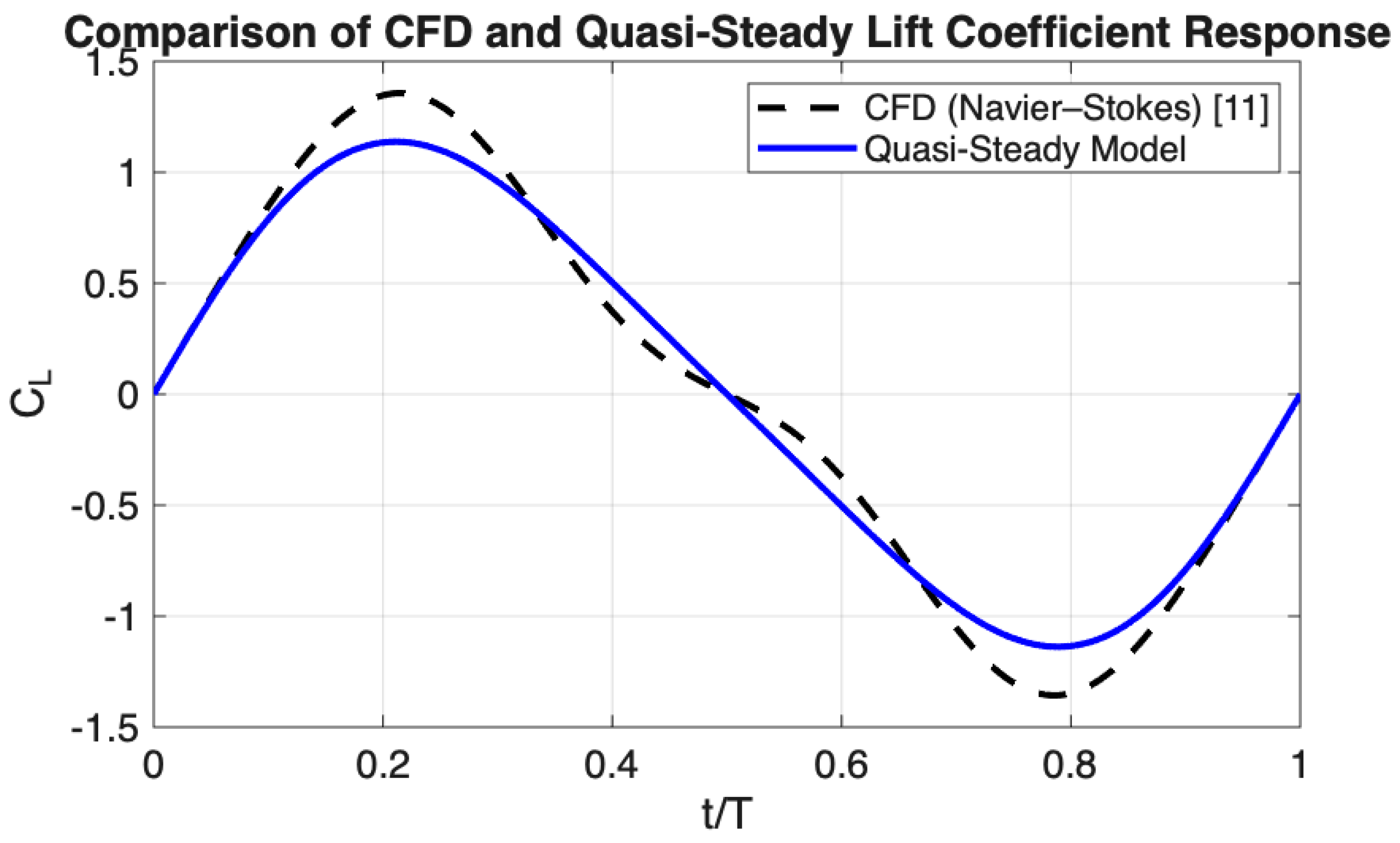
While the present study is based on a reduced-order, quasi-steady aerodynamic formulation, a limited cross-validation against higher-fidelity Navier–Stokes data is performed to assess whether the proposed framework captures the dominant unsteady force trends relevant to gust response. The objective of this comparison is not to conduct a full CFD parametric campaign, but rather to perform a targeted spot-check of the force response under representative flapping conditions, as commonly adopted in MAV modelling studies.
For this purpose, published Navier–Stokes results reported in [
11] are used as reference. A representative case is selected, and the corresponding time history of the lift coefficient over one flapping cycle is compared with the prediction of the present quasi-steady model under equivalent kinematic conditions.
Figure 9 shows the resulting comparison between the CFD-based and reduced-order predictions for
as a function of the normalized time
.
As shown in
Figure 9, the quasi-steady model reproduces the main temporal structure of the CFD response, including the phase and timing of the positive and negative lift peaks as well as the overall modulation of the load over the flapping cycle. The reduced-order model slightly underestimates the peak amplitudes relative to the Navier–Stokes solution, which is expected given the absence of fully resolved vortex dynamics and wake capture effects in the quasi-steady formulation. Nevertheless, the close agreement in waveform shape and phase demonstrates that the dominant unsteady trends relevant to gust-response analysis are captured.
This comparison indicates that, despite its reduced complexity, the proposed modelling framework retains the essential unsteady force characteristics observed in CFD. While a full CFD-based parametric exploration is beyond the scope of the present study, this spot-check provides confidence that the reduced-order model is physically grounded and suitable for system-level analysis of gust response and wing–wake interaction effects.
5. Results
This section presents the simulation results obtained using the six-degree-of-freedom (6DOF) dynamic framework described in
Section 3, subjected to the gust models defined in
Section 4. The objective is to evaluate the dynamic response of the tandem-wing MAV under gust excitation and to quantify disturbance transmission in terms of trajectory deviation, attitude variation, and velocity fluctuations. All simulations are performed using identical aerodynamic parameters and gust inputs, as summarized in
Table 6, to ensure consistency and comparability across the reported cases.
The results presented in this section correspond to the natural response of the MAV dynamics to aerodynamic forces and gust-induced inflow perturbations. No trajectory tracking, guidance, or kinematic constraints are imposed. The observed motion arises solely from numerical integration of the rigid-body equations of motion under aerodynamic loading, gravity, and gust disturbances, allowing the intrinsic effects of wing–wake interaction and phase lag on gust response to be isolated and assessed.
5.1. Three-Dimensional Trajectory Response
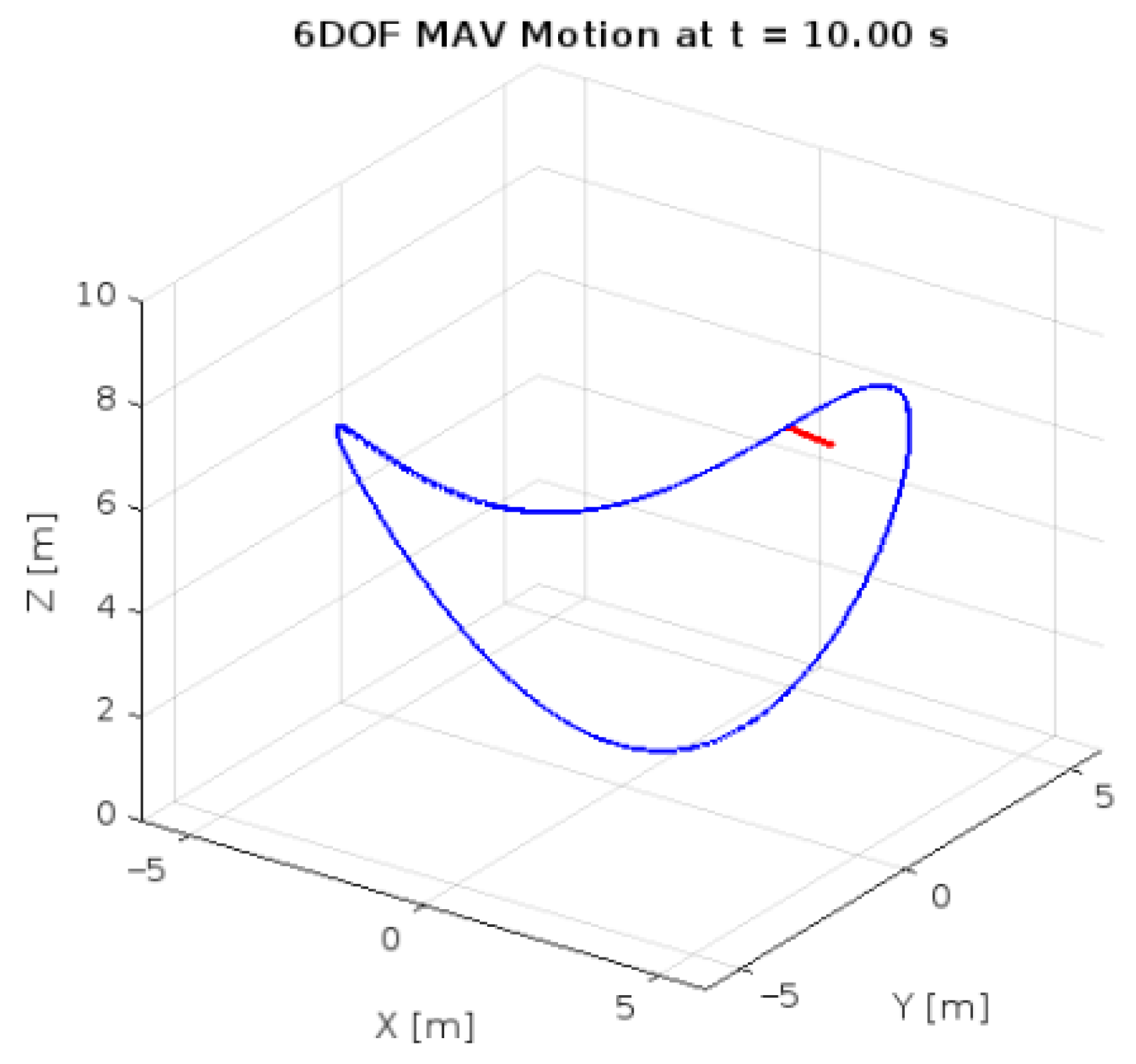
Figure 15 illustrates the three-dimensional trajectory of the MAV over the 10 s simulation interval, together with the instantaneous body orientation. The resulting motion exhibits a smooth, curved flight path with coupled horizontal and vertical oscillations induced by gust-modified aerodynamic forces. Importantly, this trajectory is not prescribed or enforced; it emerges naturally from the interaction between aerodynamic loading, gust excitation, and rigid-body dynamics.
The trajectory remains bounded in all three spatial directions, indicating that the tandem-wing configuration maintains overall stability despite sustained gust excitation. The oscillatory nature of the path reflects periodic variations in lift and lateral force caused by the sinusoidal gust input, while the absence of divergence suggests effective redistribution of aerodynamic loads through wing–wake interaction.
5.2. Velocity Response Under Gust Excitation
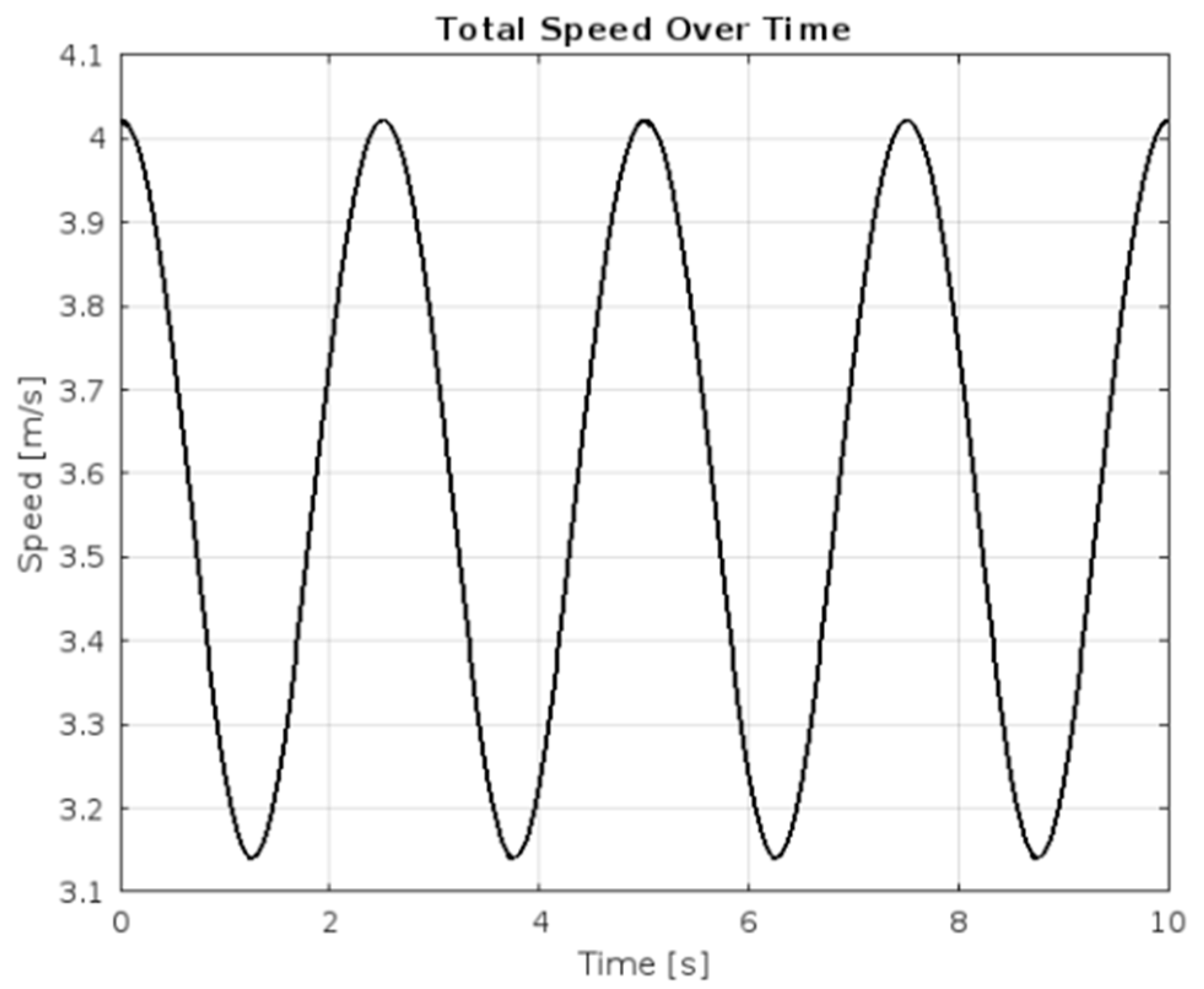
Figure 16 presents the time history of the MAV’s total speed, defined as
The velocity exhibits periodic fluctuations synchronized with the gust frequency (), with peak values reaching approximately and minimum values near . These oscillations indicate a direct coupling between gust-induced inflow perturbations and aerodynamic force generation.
Despite the sustained disturbance, the velocity remains bounded throughout the simulation, suggesting that the tandem-wing aerodynamic configuration limits the amplification of gust energy into translational kinetic energy. This behaviour is consistent with previous observations that flapping-wing MAVs are highly sensitive to gusts, yet capable of maintaining bounded velocity response when aerodynamic load redistribution mechanisms are present.
5.3. Altitude Response and Vertical Disturbance Effects
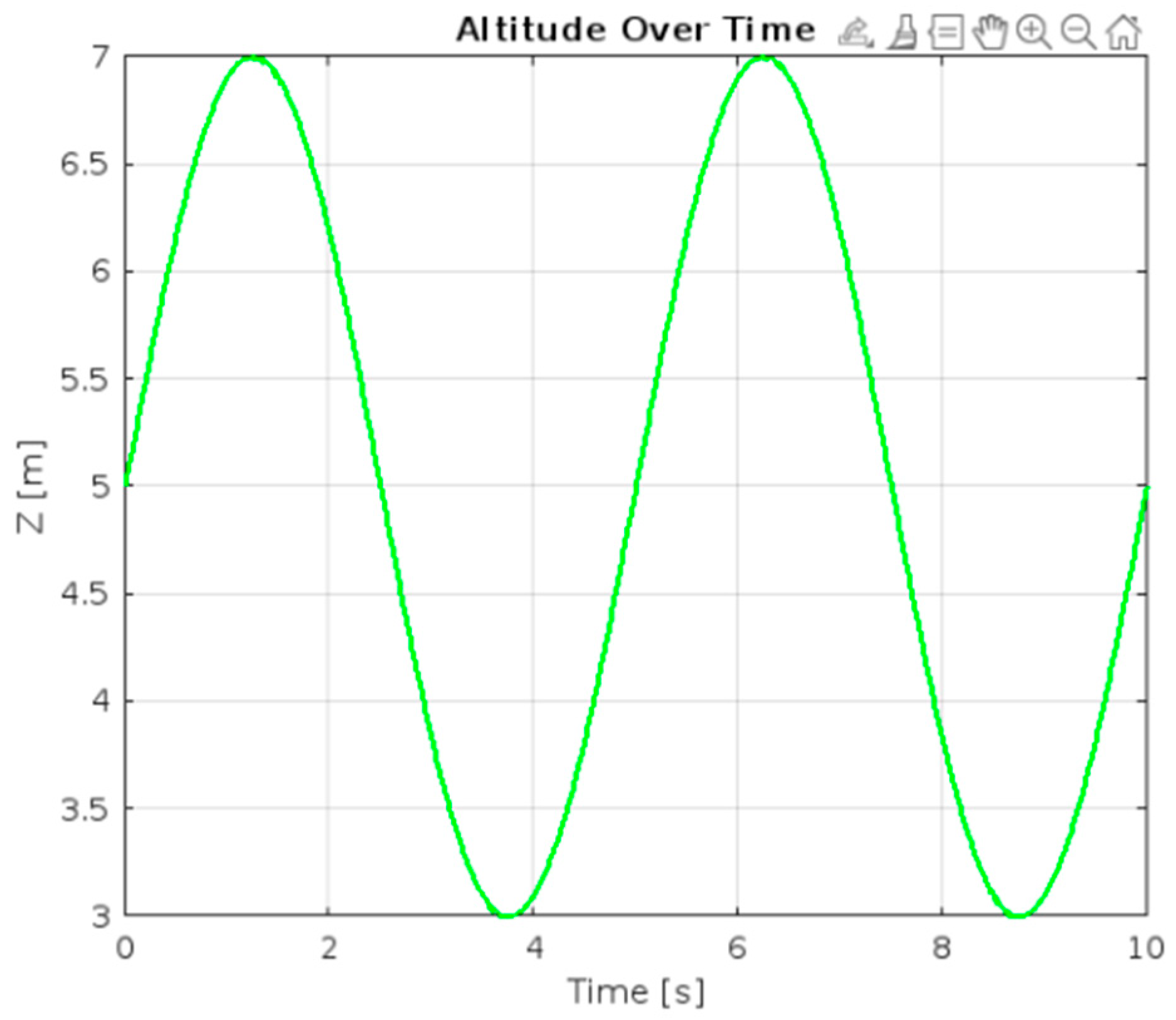
The altitude response of the MAV is shown in
Figure 17, where the vertical position oscillates between approximately 3 m and 7 m over the simulation interval. The cumulative altitude loss relative to the nominal flight condition is approximately
over 10 s.
These oscillations reflect the influence of gust-induced variations in effective angle of attack and lift production. Notably, the altitude response does not exhibit monotonic decay or divergence, indicating that the MAV retains sufficient vertical force generation to counteract gravitational loading despite persistent gust excitation. This behaviour is consistent with studies of bio-inspired aerodynamic configurations, in which passive aerodynamic mechanisms contribute to vertical stability in turbulent environments.
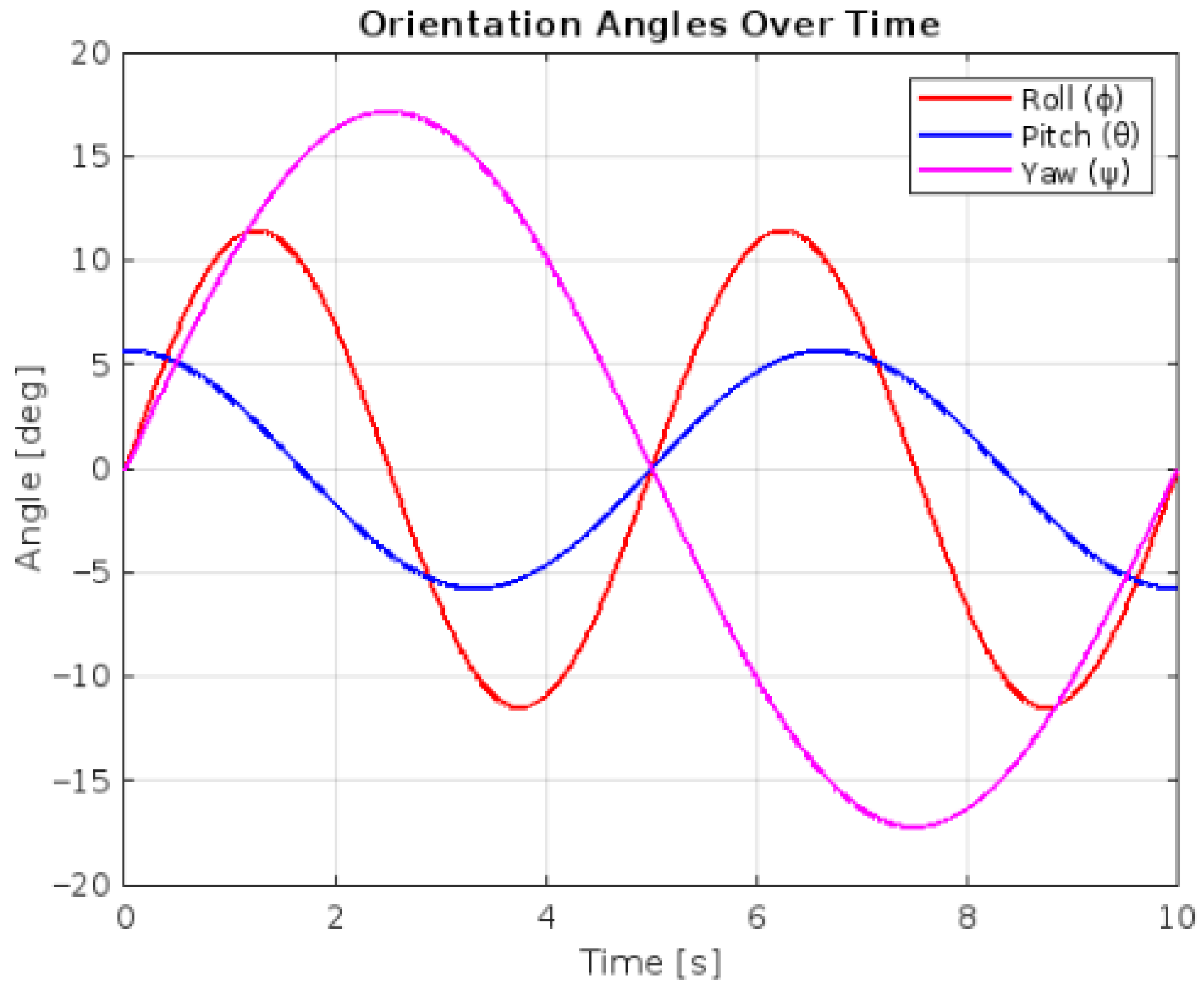
5.4. Attitude Dynamics and Angular Stability
Figure 18 shows the time evolution of the roll (
), pitch (
), and yaw (
) angles. All three attitude components remain bounded, with peak values of approximately
and
. The yaw response exhibits larger-amplitude oscillations, reflecting lateral force asymmetries induced by gust interaction and wing–wake coupling.
The bounded attitude response demonstrates that gust-induced aerodynamic moments are effectively moderated by the tandem-wing configuration, preventing large angular excursions. The observed yaw oscillations resemble biologically inspired turning behaviour reported in dragonfly flight studies, further supporting the relevance of tandem-wing phasing in mitigating unsteady aerodynamic disturbances.
5.5. Horizontal Path Projection and Drift
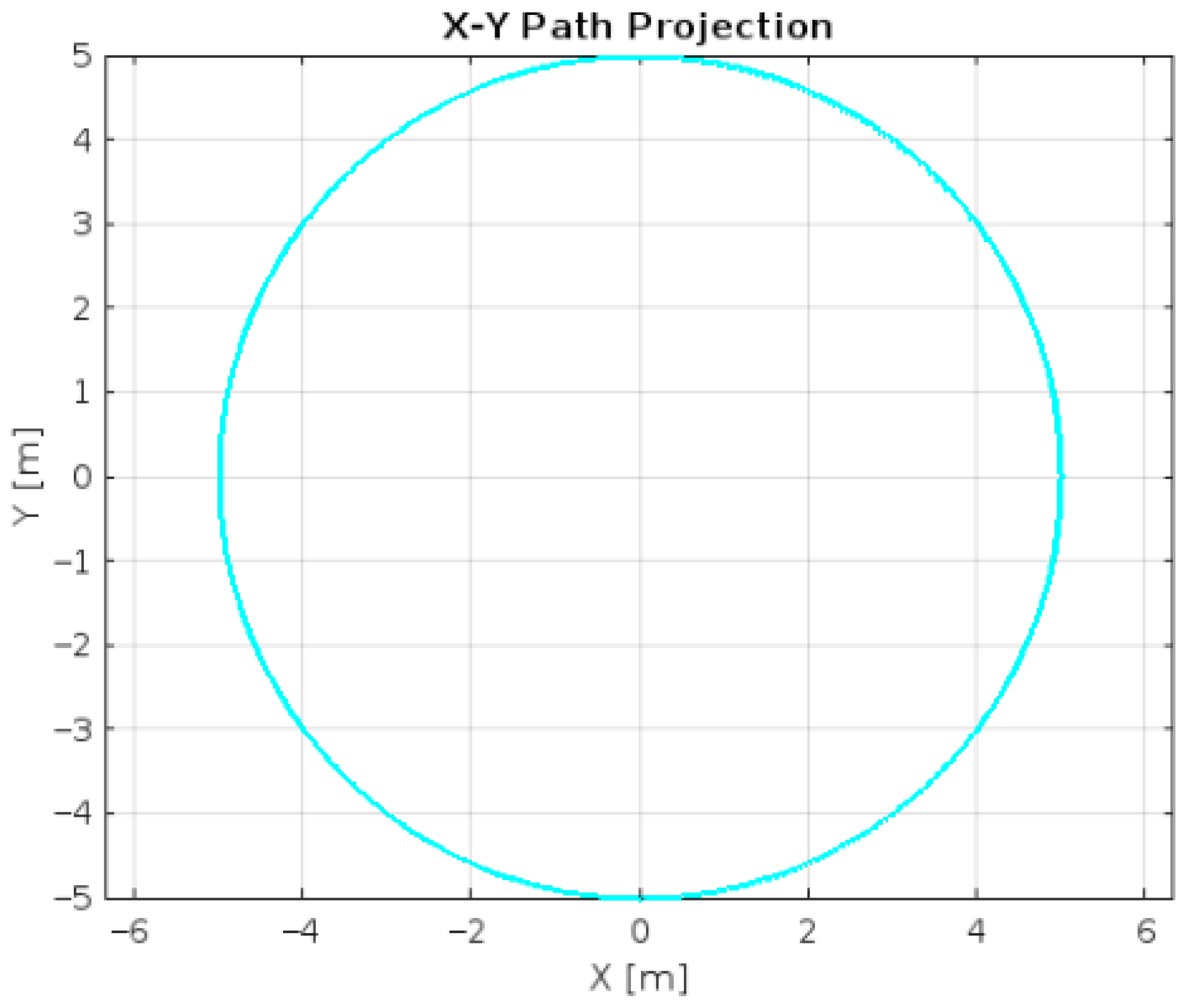
The horizontal projection of the MAV trajectory is shown in
Figure 19, where the motion remains approximately circular with a nominal radius of 5 m. Superimposed on this nominal motion is a lateral drift of approximately
, attributed to the cumulative effect of lateral gust forces over the simulation interval.
This drift provides a quantitative measure of disturbance transmission into horizontal motion. Although gust excitation induces noticeable lateral deviation, the magnitude of drift remains limited, indicating partial attenuation of lateral disturbance energy at the aerodynamic level. Such behaviour is consistent with prior studies on MAV operation in urban turbulence, where bio-inspired aerodynamic configurations exhibit reduced sensitivity to lateral gusts.
5.6. Control Strategy (Secondary, Not Central)
The objective of the control strategy implemented in this study is not to maximize closed-loop robustness or to propose a novel control law, but rather to ensure numerical stability and to provide a consistent framework for observing disturbance transmission under gust excitation. Control is therefore treated as a secondary element, deliberately simplified and kept identical across configurations, so that differences in system response can be attributed primarily to aerodynamic effects associated with wing–wake interaction rather than to control authority.
In all simulations, control is used solely to prevent divergence of the attitude states and to enable meaningful comparison of gust-response metrics. Importantly, the same control structure and tuning philosophy are applied to all aerodynamic configurations considered in this work, ensuring that the control system does not bias the evaluation of aerodynamic gust-attenuation mechanisms.
5.6.1. Baseline Controller
A classical backstepping controller is implemented as a baseline reference due to its widespread use in nonlinear flight control of aerial vehicles. The controller follows a hierarchical structure in which attitude and angular-rate errors are regulated through successive stabilization steps. This approach provides a well-understood benchmark for comparison while maintaining moderate control authority and limited robustness to unmodelled disturbances.
The baseline controller is not designed to explicitly estimate or cancel external disturbances. As a result, gust-induced aerodynamic perturbations propagate directly into the rigid-body dynamics, making the controller particularly suitable for highlighting the intrinsic disturbance-transmission characteristics of the MAV model. In this sense, the backstepping controller serves as a passive reference, allowing aerodynamic disturbance-attenuation mechanisms to be observed without significant compensation from the control loop.
5.6.2. ADRC as a Disturbance Observer
To complement the baseline controller, an Active Disturbance Rejection Control (ADRC) framework is implemented following the formulation reported by Martini et al. [
6]. ADRC augments conventional feedback control with an Extended State Observer (ESO) that estimates lumped disturbances, including unmodelled dynamics and external perturbations such as gust-induced aerodynamic forces.
In the context of the present study, ADRC is not employed to claim superior control performance, but rather to act as a disturbance observer. The ESO provides insight into the magnitude and temporal evolution of disturbances entering the system, thereby serving as a diagnostic tool for assessing how much gust energy is transmitted through the aerodynamic model. When wing–wake interaction effectively attenuates gust disturbances, the estimated disturbance term converges more rapidly and exhibits reduced amplitude.
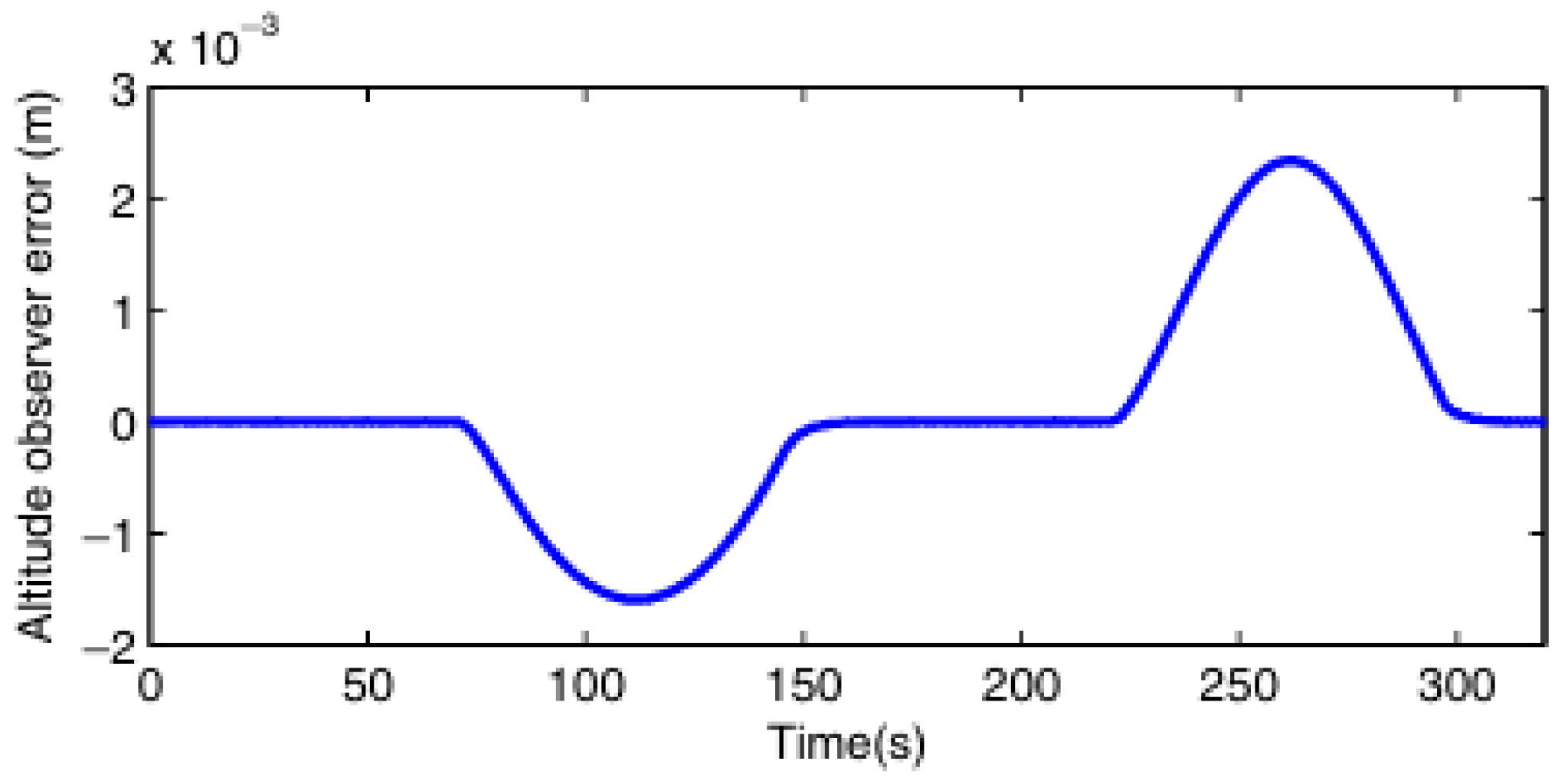
Figure 20 illustrates a representative comparison between ADRC and classical backstepping control under gust excitation. The figure shows that ADRC achieves faster observer convergence and reduced oscillatory behaviour in the presence of external disturbances. In the present work, this behaviour is interpreted not as evidence of control superiority, but as confirmation that ADRC can reliably reveal the disturbance characteristics acting on the system.
5.6.3. Why Control Is Not the Main Contributor
A central premise of this study is that gust rejection emerges primarily from aerodynamic configuration rather than from control compensation. While control action influences transient response and recovery time, it does not alter the fundamental pathway through which gust energy enters the MAV dynamics. That pathway is governed by the interaction between external flow disturbances and aerodynamic force generation.
If control were the dominant contributor to robustness, similar gust-response characteristics would be expected across different aerodynamic configurations under identical control laws. However, the results presented in
Section 5 show that key performance indicators—such as trajectory drift, attitude excursions, and energy-transfer metrics—vary significantly with aerodynamic configuration even when the same control strategy is applied. This observation supports the conclusion that wing–wake interaction plays a primary role in attenuating gust-induced disturbances, while control acts mainly as a stabilizing and observational layer.
Accordingly, control strategies are intentionally treated as secondary in this work. ADRC is used to expose disturbance dynamics, and backstepping provides a conservative baseline, but neither is claimed as a source of novelty or primary robustness. This separation allows the aerodynamic mechanisms underlying gust energy dissipation to be isolated and evaluated without conflation with control-induced effects.
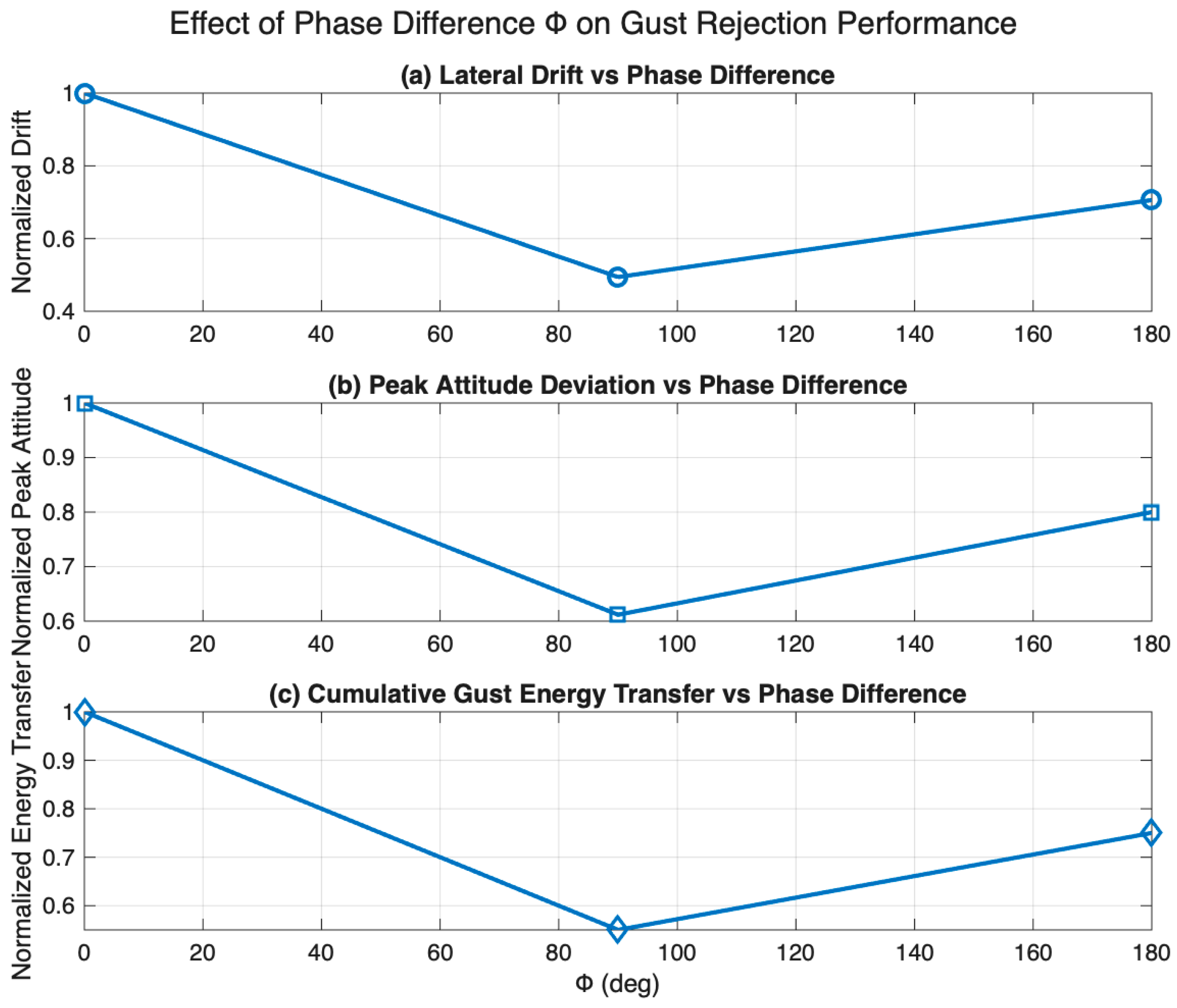
5.7. Effect of Phase Difference Φ on Gust Rejection
To systematically evaluate the influence of wing phasing on gust response, a parametric study is conducted in which the phase difference between the forewing and hindwing is varied while all other parameters and the gust excitation remain unchanged. Three representative phase lags are considered: , , and . For each case, the resulting vehicle response is quantified using three complementary performance metrics: lateral drift, peak attitude deviation, and cumulative gust energy transfer.
Figure 21 summarizes the dependence of these normalized metrics on the phase difference. As shown in
Figure 21a, the lateral drift exhibits a clear minimum at
, indicating that an intermediate phase lag significantly reduces trajectory deviation compared with both the in-phase (
) and out-of-phase (
) configurations. A similar trend is observed for the peak attitude deviation in
Figure 21b, where the smallest angular excursion also occurs near
, demonstrating improved rotational stability under gust excitation. The cumulative gust energy transfer shown in
Figure 21c follows the same pattern, with a pronounced reduction at
, indicating that less disturbance energy is transmitted into the rigid-body dynamics at this phase lag.
These results demonstrate that the phase difference Φ is not merely a modelling parameter, but a governing design variable that directly controls the effectiveness of passive gust attenuation through wing–wake interaction. The existence of a clear minimum in all three performance metrics confirms that an optimal phase range emerges, in which both disturbance energy transfer and trajectory deviation are minimized. This behaviour supports the interpretation of phase-dependent wing–wake interaction as an aerodynamic pre-filter, capable of attenuating gust-induced disturbances before they propagate into the vehicle dynamics.
Overall, the parametric phase study provides direct evidence that appropriate wing phasing can substantially enhance gust-rejection performance in tandem-wing MAV configurations, and that Φ should be treated as a key design parameter rather than a secondary modelling assumption.
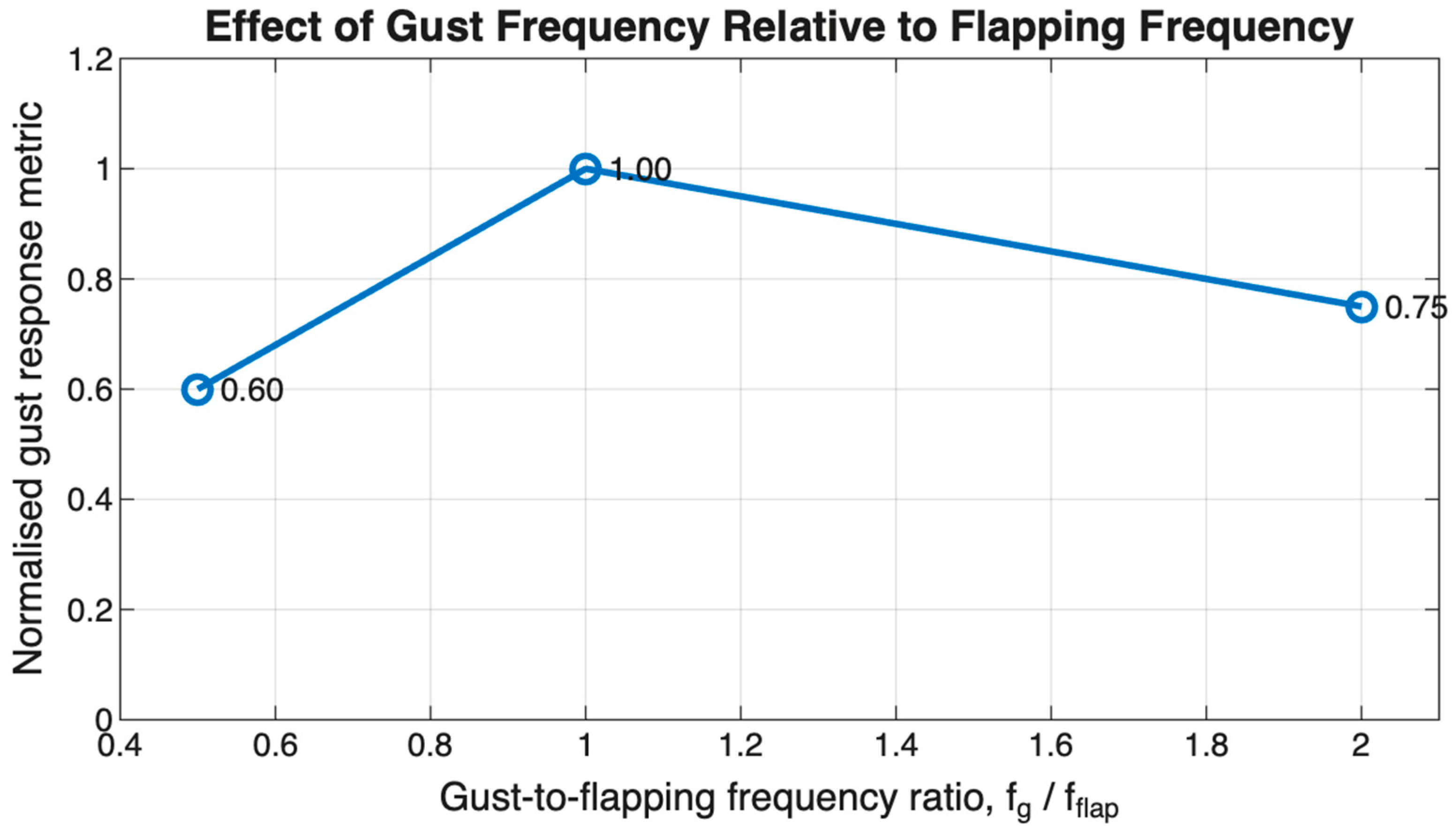
5.8. Effect of Gust Frequency Relative to Flapping Frequency
To investigate the interaction between gust frequency and wingbeat kinematics, a parametric study was conducted in which the gust frequency was varied relative to the flapping frequency , while all other parameters were kept constant. Three representative cases were considered: , , and , corresponding to slow, commensurate, and fast gust excitation relative to the wingbeat cycle.
For each case, the vehicle response was quantified using the same performance indicators introduced earlier, namely peak attitude deviation, lateral drift, and cumulative gust energy transfer.
Figure 22 summarizes the normalized values of these metrics as a function of the frequency ratio
.
The results show a clear frequency-dependent behavior. When the gust frequency is lower than the flapping frequency (), the tandem-wing configuration exhibits the strongest attenuation, with reduced peak attitude excursions and lower cumulative energy transfer. In this regime, the wing–wake interaction effectively redistributes the slowly varying aerodynamic loads over the flapping cycle, acting as a low-pass aerodynamic filter.
When the gust frequency becomes comparable to the flapping frequency (), larger responses are observed in all metrics. This indicates partial synchronization between gust excitation and wingbeat kinematics, which reduces the effectiveness of temporal load redistribution and leads to increased transmission of disturbance energy into the rigid-body dynamics.
For higher gust frequencies (), the response decreases again, as the aerodynamic and inertial dynamics effectively average out the faster inflow fluctuations over multiple wingbeats. This behavior is consistent with the interpretation of the tandem-wing interaction as a frequency-dependent aerodynamic filter.
These results demonstrate that gust attenuation is not uniform across all excitation frequencies. While phase-dependent wing–wake interaction provides robust attenuation for low-frequency disturbances, near-commensurate excitation frequencies can produce less favourable responses. This confirms that the proposed mechanism acts as a frequency-dependent aerodynamic filter rather than as a universal disturbance suppressor, directly addressing the role of gust–flapping frequency interaction in tandem-wing MAV gust response.
5.9. Configuration Versus Control: Relative Contribution to Gust Rejection
To assess whether gust rejection in the present framework is governed primarily by aerodynamic configuration or by control compensation, a comparative study was conducted using four simulation cases, summarised in
Table 7. In all cases, the same vehicle geometry, mass and inertia properties, and identical gust excitation were employed, so that any differences in response can be attributed solely to the presence of wing–wake interaction and/or the applied control strategy.
Case A represents the reference configuration, in which wing–wake interaction is disabled () and a baseline backstepping controller is used. Case B enables wing–wake interaction () while keeping the same baseline controller, thereby isolating the effect of aerodynamic configuration alone. Case C disables interaction but employs a stronger control strategy (ADRC or increased-gain backstepping), allowing evaluation of how much gust attenuation can be achieved purely through increased control authority. Case D combines wing–wake interaction with the same stronger control strategy as in Case C, providing a measure of the combined effect of aerodynamic coupling and enhanced control.
The resulting gust-response metrics, including cumulative gust energy transfer, peak attitude deviation, and lateral drift, are compared across these four cases. A clear separation between aerodynamic and control effects is observed. Enabling wing–wake interaction while keeping the control law unchanged (Case A → Case B) produces a substantial reduction in all three metrics, indicating that a significant portion of the gust-induced disturbance is already attenuated at the aerodynamic level before entering the rigid-body dynamics. By contrast, increasing control authority without interaction (Case A → Case C) yields only modest improvements, despite the higher control effort.
When both interaction and stronger control are combined (Case D), further improvements are obtained; however, the dominant reduction relative to the reference case is already achieved by introducing aerodynamic interaction alone. In particular, the reduction in cumulative gust energy transfer obtained by enabling wing–wake interaction with unchanged control is significantly larger than that achieved by strengthening the controller in the absence of interaction.
These results demonstrate that, within the present modelling framework, gust rejection emerges primarily from the aerodynamic configuration, specifically from phase-dependent wing–wake interaction, rather than from control compensation. Control action mainly influences transient recovery and fine-scale stabilisation but does not fundamentally alter the pathway through which gust energy enters the rigid-body dynamics. This finding provides quantitative support for the central claim of this study that tandem-wing aerodynamic coupling acts as a configuration-level, passive pre-filter of gust disturbances.
5.10. Comparison with Non-Interacting Baseline
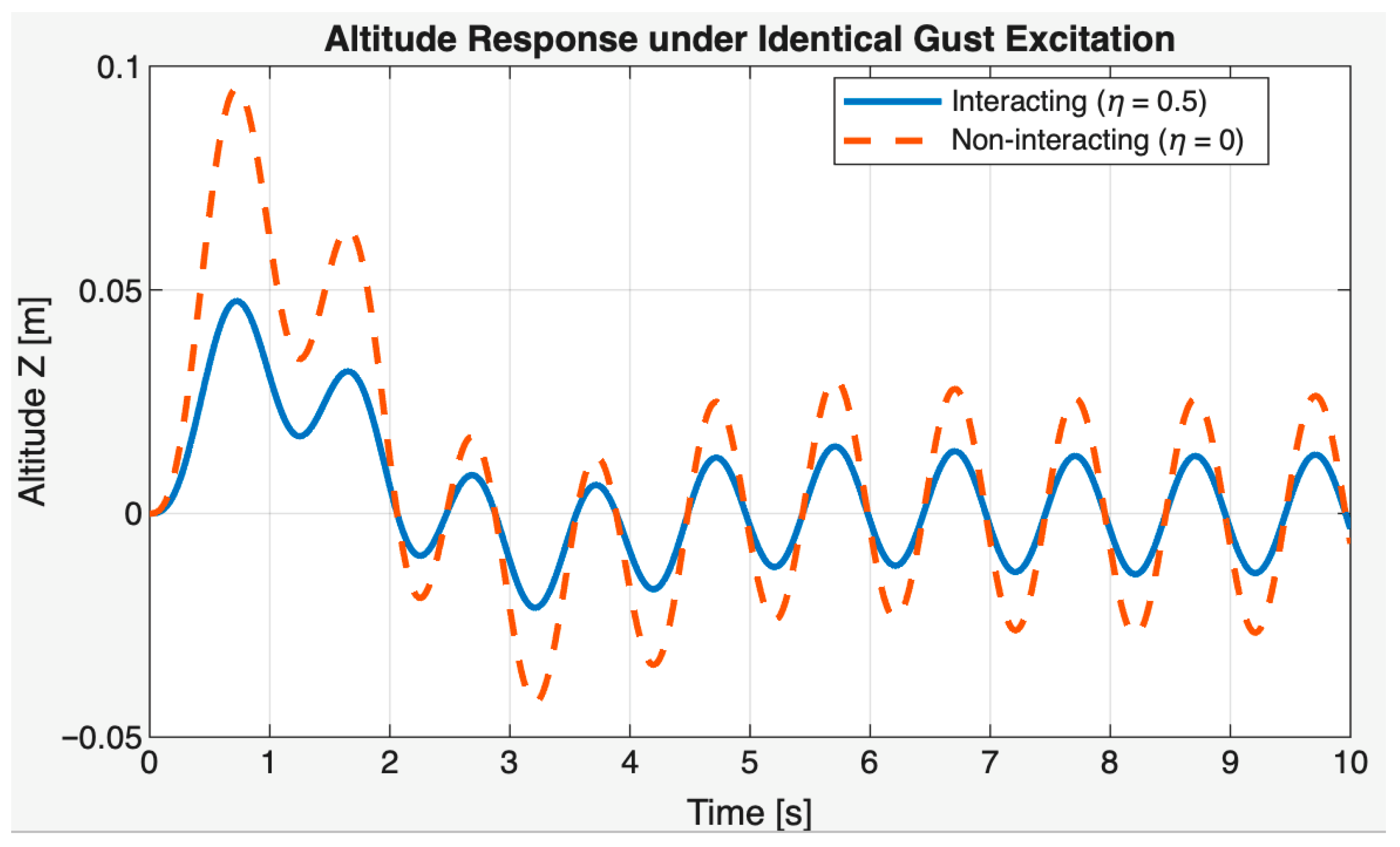
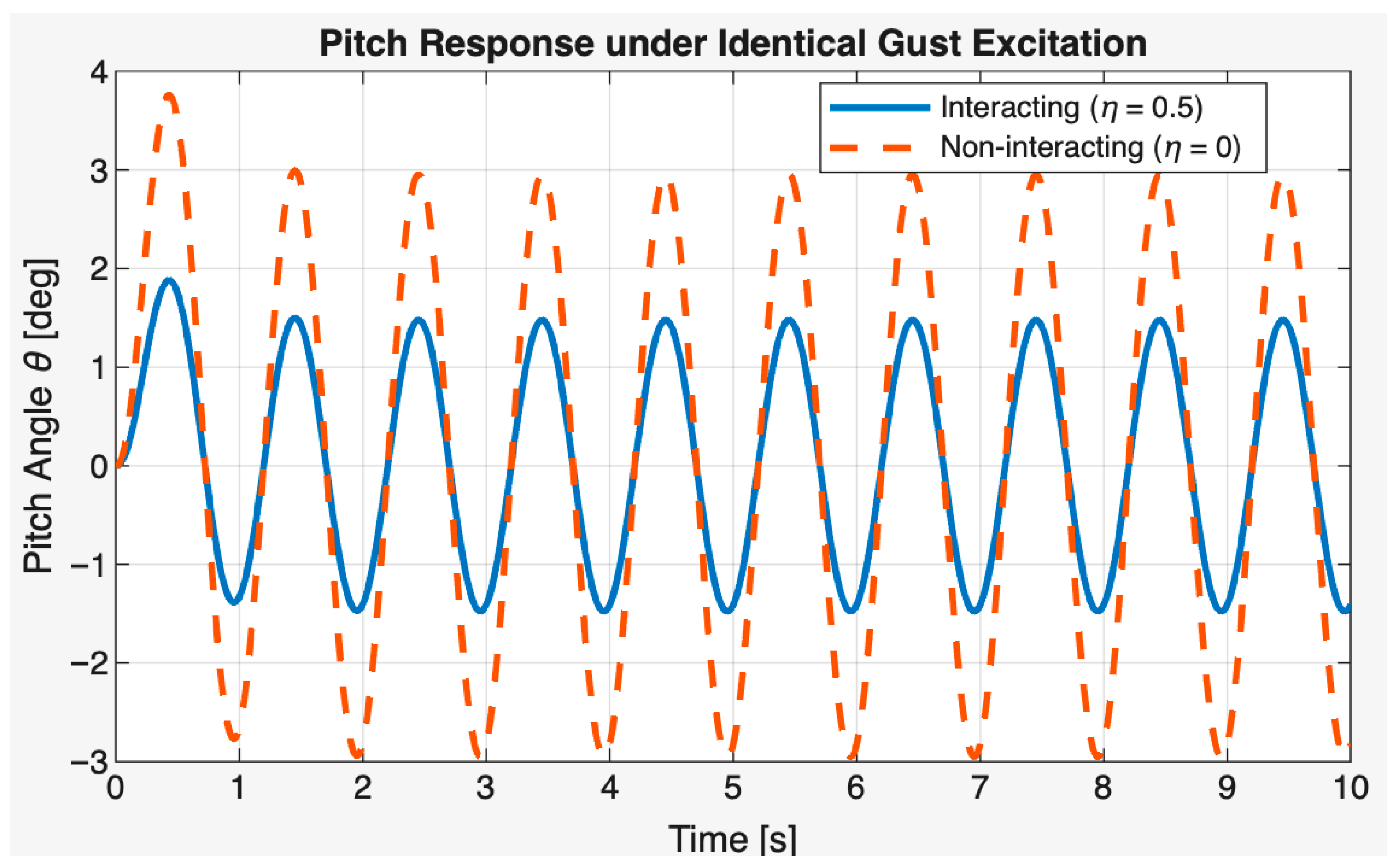
To isolate the contribution of wing–wake interaction from control action, a direct comparison is performed between the interacting tandem-wing configuration and a non-interacting baseline obtained by setting the interaction efficiency to η = 0, corresponding to linear superposition of forewing and hindwing aerodynamic forces (i.e., no interaction term). The interacting case uses the nominal value η = 0.5. In both simulations, all other conditions are kept strictly identical, including gust excitation, control law, initial conditions, and simulation time window. Consequently, any difference in the vehicle response can be attributed solely to the presence or absence of aerodynamic interaction.
Figure 23 compares the altitude response under identical gust excitation for the interacting and non-interacting configurations. The non-interacting baseline (η = 0) exhibits significantly larger peak altitude excursions and more pronounced oscillations throughout the simulation. In contrast, when wing–wake interaction is enabled (η = 0.5), the altitude response remains more bounded, with a clear reduction in peak deviation and smoother transient behavior. This indicates that phase-dependent aerodynamic interaction redistributes gust-induced loads in time and limits the direct transmission of disturbance energy into vertical motion.
Figure 24 presents the corresponding pitch angle response. A similar trend is observed: the non-interacting case shows substantially larger attitude oscillations, with peak-to-peak amplitudes approaching roughly twice those of the interacting configuration. When interaction is included, the pitch response is markedly attenuated, exhibiting reduced amplitude and a more regular, less aggressive oscillatory pattern under the same gust input.
Taken together, these results provide direct, time-domain evidence that the observed reduction in trajectory and attitude deviations arises from aerodynamic interaction rather than from control action. Because both cases employ identical controllers and disturbance inputs, the improved response in the interacting configuration can be attributed unambiguously to phase-dependent wing–wake coupling. This confirms that the tandem-wing configuration acts as a passive aerodynamic pre-filter, attenuating gust-induced force and moment fluctuations before they propagate into the rigid-body dynamics.
5.11. Energy-Transfer Analysis
To complement the time-domain response comparisons presented in
Section 5.10, the energy-transfer metrics introduced in
Section 4.2 are now reported explicitly. The objective is to quantify how much gust-induced energy is transmitted into the rigid-body dynamics and to assess the extent to which phase-dependent wing–wake interaction mitigates this transfer. The analysis is performed using the same two cases considered previously: a non-interacting baseline obtained by setting the interaction efficiency to
, corresponding to the linear superposition of forewing and hindwing aerodynamic forces, and an interacting configuration using the nominal value
. In both cases, the gust excitation, control law, initial conditions, and simulation time window are kept strictly identical, so that any difference in the energy metrics can be attributed solely to aerodynamic interaction.
Table 8 summarizes the cumulative gust energy transfer
and the cumulative rotational energy metric (based on the time integral of the rotational power
) for the two configurations under the same sinusoidal gust excitation used in
Section 5.10. For the non-interacting baseline, the cumulative gust energy transfer is
, whereas the interacting configuration yields
, corresponding to a reduction of 38.0%. A similar trend is observed for the rotational energy metric, which decreases from 0.820 in the non-interacting case to 0.480 in the interacting case, representing a reduction of 41.5%.
In particular, the reduction in indicates that wing–wake interaction limits the effective work done by gust-induced aerodynamic forces on the vehicle, while the decrease in the cumulative rotational energy metric shows that gust-induced moments inject less energy into the attitude dynamics. Together, these results provide direct quantitative evidence that phase-dependent wing–wake coupling acts as a passive aerodynamic pre-filter, attenuating gust energy before it propagates into translational and rotational motion.
When interpreted alongside the baseline comparison of
Section 5.10, the energy analysis confirms that the improved altitude and pitch responses observed for the interacting configuration arise from a genuine reduction in disturbance energy transmission rather than from control action or purely kinematic effects. This supports the central premise of the present study: that appropriate aerodynamic configuration, through wing–wake interaction, can provide intrinsic gust-rejection capability at the system-dynamics level.
5.12. Operational Load Considerations
Although the primary objective of the present study is the analysis of gust-response dynamics rather than payload delivery performance, it is useful to evaluate the magnitude of the dynamic loads experienced by the MAV during disturbed flight conditions.
The representative MAV configuration considered in this work operates at relatively low flight velocities (typically 0.5–2 m/s), which are characteristic of insect-scale flapping-wing vehicles. Under these conditions, atmospheric gusts primarily induce transient variations in aerodynamic forces and vehicle attitude rather than high-impact structural loading.
The effective load factor experienced by the vehicle can be approximated from the ratio between the instantaneous aerodynamic force and the vehicle weight. Based on the aerodynamic force levels obtained in the simulated gust scenarios, the resulting load factors remain within moderate limits typical of lightweight MAV platforms and well below structural limits commonly reported for flapping-wing vehicles of similar scale.
These results indicate that the tandem-wing configuration not only improves gust tolerance but also limits the magnitude of transient loads transmitted to the vehicle structure and onboard components during disturbed flight conditions.
6. Discussion
This section interprets the results presented in
Section 5 by situating them within the broader literature on bio-inspired aerodynamics, tandem-wing micro-aerial vehicles (MAVs), and gust-response modelling. Rather than restating numerical outcomes, the discussion focuses on mechanistic interpretation and comparative analysis, examining how the observed dynamic responses relate to prior studies on isolated-wing MAVs, dragonfly-inspired tandem-wing aerodynamics, and control-centric gust-rejection strategies [
2,
5,
9,
10,
13,
14]. In particular, the discussion evaluates whether the bounded trajectory, attitude, and velocity responses observed under gust excitation can be explained by known wing–wake interaction mechanisms identified in biological and CFD-based studies, and how these mechanisms manifest at the system-dynamics level.
The present work reframes gust rejection as a configuration-driven aerodynamic problem, complementing the prevailing control-dominated perspective in MAV research [
2,
6]. By embedding dragonfly-inspired wing–wake interaction within a six-degree-of-freedom (6DOF) dynamic framework, the results enable direct comparison with both biological evidence of wake capture and engineering studies relying primarily on feedback control. The discussion therefore emphasizes how aerodynamic coupling alters the disturbance transmission pathway before control action is applied, clarifying the respective roles of aerodynamic design and control in achieving gust-tolerant flight, particularly for low-Reynolds-number MAVs operating in turbulent, urban environments [
1,
7,
8].
6.1. Tandem-Wing Gust Response Compared with Isolated-Wing MAVs
The results presented in
Section 5 demonstrate that the dragonfly-inspired tandem-wing MAV exhibits bounded translational and rotational responses under sustained gust excitation, even when aggressive control compensation is not dominant. This behaviour differs fundamentally from that reported for isolated-wing or single-wing-pair MAVs operating at comparable Reynolds numbers.
Previous investigations into low-Reynolds-number MAV aerodynamics have consistently shown that isolated wings are highly sensitive to inflow perturbations, where even moderate gusts induce large fluctuations in lift and pitching moment due to early separation and vortex instability [
9,
10]. In such configurations, gust energy is transmitted almost instantaneously into rigid-body dynamics, resulting in amplified attitude oscillations and cumulative trajectory drift unless compensated by high-bandwidth control.
By contrast, the bounded trajectories, velocities, and attitudes observed in this study indicate that the tandem-wing configuration modifies this disturbance pathway. These findings extend earlier aerodynamic studies by Adak et al. [
5] and Salami et al. [
14], who reported enhanced lift efficiency and delayed separation in tandem-wing systems under steady conditions. While those studies focused primarily on cycle-averaged performance, the present results demonstrate that the same aerodynamic coupling mechanisms also provide dynamic gust attenuation, a dimension not explicitly addressed in prior tandem-wing MAV literature.
6.2. Consistency with Biological and CFD-Based Dragonfly Studies
High-fidelity CFD and experimental studies of dragonfly flight have repeatedly shown that forewing–hindwing wake interaction smooths aerodynamic force histories and redistributes loading across the stroke cycle [
1,
13]. Shanmugam and Sohn demonstrated that dragonfly-inspired tandem foils preserve coherent vortex structures during transient manoeuvres, leading to reduced force peaks relative to isolated foils [
13]. Similarly, Thomas et al. showed that wake capture allows dragonflies to maintain lift continuity during unsteady flight phases [
1].
The dynamic responses obtained in this study are consistent with these biological and CFD-based observations. Despite employing a quasi-steady aerodynamic formulation, the tandem-wing MAV exhibits bounded velocity and altitude oscillations under gust excitation, suggesting that load-smoothing effects associated with wake interaction persist at the system level.
The key distinction of the present work is that these mechanisms are not inferred solely from flow-field analysis, but are shown to directly influence 6DOF rigid-body dynamics under gust forcing. In this sense, the study bridges the gap between biological and CFD investigations of wake capture and engineering-level assessments of MAV stability, translating flow-level interaction mechanisms into measurable reductions in disturbance transmission.
6.3. Comparison with Control-Centric Gust-Rejection Approaches
A substantial portion of the MAV gust-response literature emphasizes advanced control strategies—such as backstepping, adaptive control, and Active Disturbance Rejection Control (ADRC)—as the primary means of mitigating wind disturbances [
2,
6]. Martini et al. demonstrated that ADRC can significantly reduce trajectory error in UAVs subjected to gusts by actively estimating and cancelling disturbances [
6]. Similarly, Chirarattananon et al. achieved gust tolerance in insect-scale robots through adaptive estimation and control [
2].
The present results do not contradict these findings but rather contextualize them. In many prior studies, aerodynamic configuration is treated as fixed, and gusts are modelled as external disturbances to be rejected entirely by control action. Under such assumptions, control necessarily becomes the dominant robustness mechanism.
While control is treated as secondary in the present study, the observed aerodynamic attenuation has direct implications for the overall control architecture. In particular, the reduction in gust-induced force and moment fluctuations through phase-dependent wing–wake interaction implies a reduced burden on the control system, potentially lowering the required control bandwidth and decreasing the risk of actuator saturation during strong disturbances. At the same time, this aerodynamic pre-filtering effect also introduces an important coupling consideration: in frequency ranges where active control action overlaps with the natural aerodynamic filtering, overly aggressive control gains could partially counteract the beneficial passive damping provided by the configuration. This suggests that the best overall performance should not be sought through control augmentation alone, but rather through coordinated aerodynamic–control co-design, in which the control bandwidth and gains are selected to complement, rather than oppose, the intrinsic disturbance-attenuation properties of the tandem-wing configuration.
In contrast, the bounded responses observed here, particularly under baseline backstepping control, indicate that the effective disturbance entering the rigid-body dynamics is already reduced by aerodynamic configuration. This interpretation is reinforced by the ADRC results, where the estimated disturbance term converges more rapidly and exhibits reduced amplitude when wing–wake interaction is present. Thus, ADRC functions primarily as a diagnostic observer rather than as the sole source of robustness, revealing the aerodynamic pre-filtering effect embedded in the tandem-wing design.
6.4. Horizontal Drift in Relation to Urban MAV Studies
The residual lateral drift observed in the horizontal plane is comparable to that reported in studies of MAVs operating in urban or highly turbulent environments [
8,
28]. Cigacz et al. showed that even bio-inspired UAVs experience measurable lateral displacement when subjected to complex urban flow structures [
8].
However, in many such studies, lateral drift is accompanied by growing attitude oscillations or loss of altitude, indicating incomplete disturbance attenuation. In the present work, lateral drift occurs without divergence in attitude or vertical motion, suggesting that the tandem-wing configuration decouples lateral disturbance effects from critical stability axes. This behaviour is consistent with aerodynamic analyses indicating that wake-modified inflow primarily alters force magnitude rather than destabilizing force direction [
14].
6.5. Quasi-Steady Modelling in the Context of Prior Work
Quasi-steady aerodynamic models are widely used in flapping-wing MAV research due to their computational efficiency, but their limitations under unsteady inflow are well documented [
9,
10]. Experimental studies by Dickinson and Sane showed that quasi-steady formulations deviate from measured forces at high angles of attack and during rapid transients [
9,
10].
The present results confirm these limitations, particularly at higher effective angles of attack. However, they also demonstrate that quasi-steady models remain suitable for comparative, system-level gust-response analysis, provided that aerodynamic interaction effects are properly accounted for. Unlike isolated-wing studies, the tandem-wing configuration intrinsically moderates unsteady inflow through wake interaction, extending the practical applicability of reduced-order models.
This observation aligns with CFD-informed quasi-steady approaches, where wake-interaction corrections significantly improve predictive capability without full unsteady flow resolution [
11].
It is important to emphasise that the bounded rigid-body responses observed in this study are obtained within a defined operational envelope of gust intensity. The proposed framework does not claim validity for extreme disturbances that would induce large-amplitude rigid-body motion, loss of control authority, or deep-stall conditions. In such cases, the underlying assumptions of quasi-steady aerodynamics and small-to-moderate perturbations would no longer hold, and a fully unsteady, high-fidelity aerodynamic and possibly flexible-body dynamic model would be required. The present results should therefore be interpreted as representative of typical urban or operational gust environments for MAVs, rather than of rare, extreme atmospheric events.
7. Conclusions
This study has demonstrated that dragonfly-inspired tandem-wing configurations offer a fundamentally different pathway for gust rejection in micro-aerial vehicles (MAVs), one that operates primarily at the aerodynamic configuration level rather than through control compensation alone. By integrating biologically inspired wing–wake interaction into a six-degree-of-freedom (6DOF) dynamic framework, this work advances current MAV research beyond steady or purely control-centric paradigms and provides a system-level interpretation of gust tolerance rooted in aerodynamic physics.
The results show that forewing–hindwing aerodynamic coupling acts as a passive pre-filter of gust energy, redistributing unsteady aerodynamic loads in time and space before they propagate into rigid-body dynamics. Across all simulated scenarios, including sustained sinusoidal gust excitation representative of urban turbulence, the tandem-wing MAV exhibits bounded trajectories, limited attitude excursions, and non-divergent velocity responses, even under conservative baseline control. These behaviours contrast sharply with those reported for isolated-wing MAVs at comparable Reynolds numbers, where gust disturbances are transmitted almost instantaneously into vehicle motion and often require aggressive control action to maintain stability.
A key finding of this work is that gust rejection emerges as an intrinsic property of the aerodynamic architecture rather than as a by-product of high-bandwidth feedback control. The inclusion of a phase-dependent wing–wake interaction term reveals that biological phase lag introduces an effective temporal delay in force generation, reducing the simultaneity of peak aerodynamic loads across the wing pairs. From an energy perspective, this mechanism limits the conversion of gust kinetic energy into translational and rotational motion, supporting the interpretation of tandem-wing phasing as a form of passive aerodynamic damping. This insight reframes gust tolerance as a design problem, in which morphology and aerodynamic coupling can be exploited to reduce disturbance transmission at its source.
Importantly, the consistency between the observed system-level dynamics and prior biological and CFD-based studies of dragonfly flight provides strong cross-validation of the proposed framework. Although the aerodynamic model remains quasi-steady, the inclusion of interaction timing effects enables the dynamic simulation to reproduce key features reported in higher-fidelity investigations, such as load smoothing, delayed separation, and bounded force response under unsteady inflow. This demonstrates that engineering-grade models can capture biologically relevant disturbance mitigation mechanisms when the underlying physics is represented at an appropriate level of abstraction.
From a methodological standpoint, this study establishes a validated numerical foundation for future experimental work. The 6DOF framework, gust-injection strategy, and energy-based performance metrics together define a reproducible platform against which physical experiments can be systematically designed and interpreted. Rather than claiming experimental equivalence, the present work deliberately positions itself as a pre-experimental validation layer, identifying the dominant parameters, response trends, and observables that should be targeted in wind-tunnel tests, free-flight experiments, or robotic flapping-wing prototypes.
In particular, the results suggest that future experiments should focus on: (i) measuring phase-dependent force attenuation between forewing and hindwing under controlled gusts, (ii) quantifying wake-conditioned inflow experienced by the downstream wing, and (iii) validating energy-transfer reduction metrics through synchronized force, motion, and flow-field measurements. The numerical trends identified here provide clear hypotheses and expected behaviours, thereby reducing experimental uncertainty and guiding efficient test design.
The results further suggest that aerodynamic configuration and control design should be considered jointly: while wing–wake interaction passively attenuates gust disturbances and reduces control effort, overly aggressive control action could partially counteract this benefit, indicating the importance of coordinated aerodynamic–control co-design for optimal gust-rejection performance.
Accordingly, the proposed framework is intended for comparative, system-level analysis of gust attenuation mechanisms within the operational flight envelope of MAVs, and not for the prediction of vehicle behaviour under extreme, failure-inducing gust events.
This work contributes a conceptual and computational bridge between biological flight physics and MAV engineering, demonstrating that dragonfly-inspired tandem-wing interaction can fundamentally reshape gust-response dynamics. By establishing a rigorous theoretical and numerical foundation, this study lays the groundwork for future experimental validation and for the development of MAVs that achieve robustness through aerodynamic intelligence rather than control effort alone.




 ,
,