

Stable and Smooth Trajectory Optimization for Autonomous Ground Vehicles via Halton-Sampling-Based MPPI
Highlights
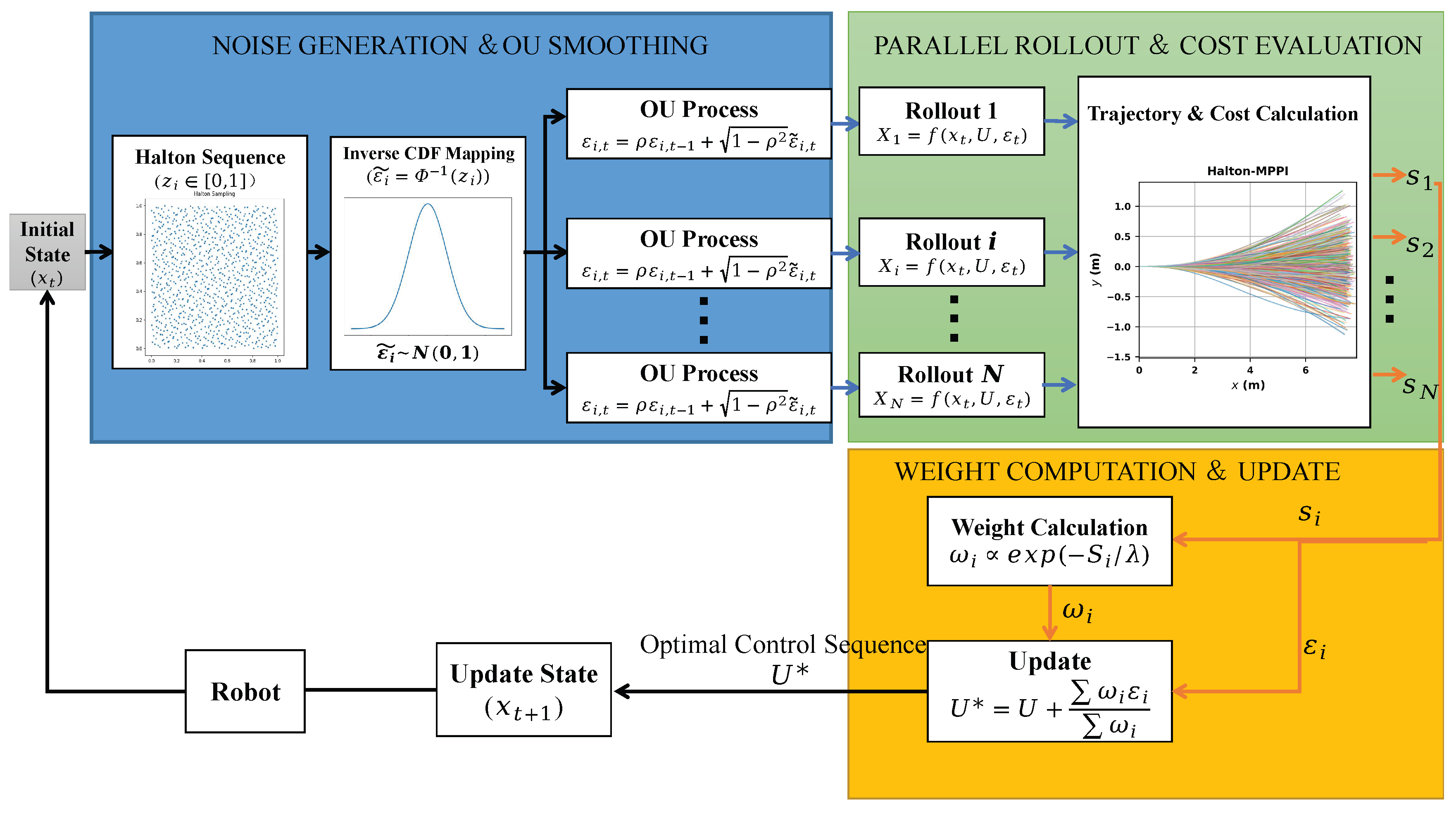
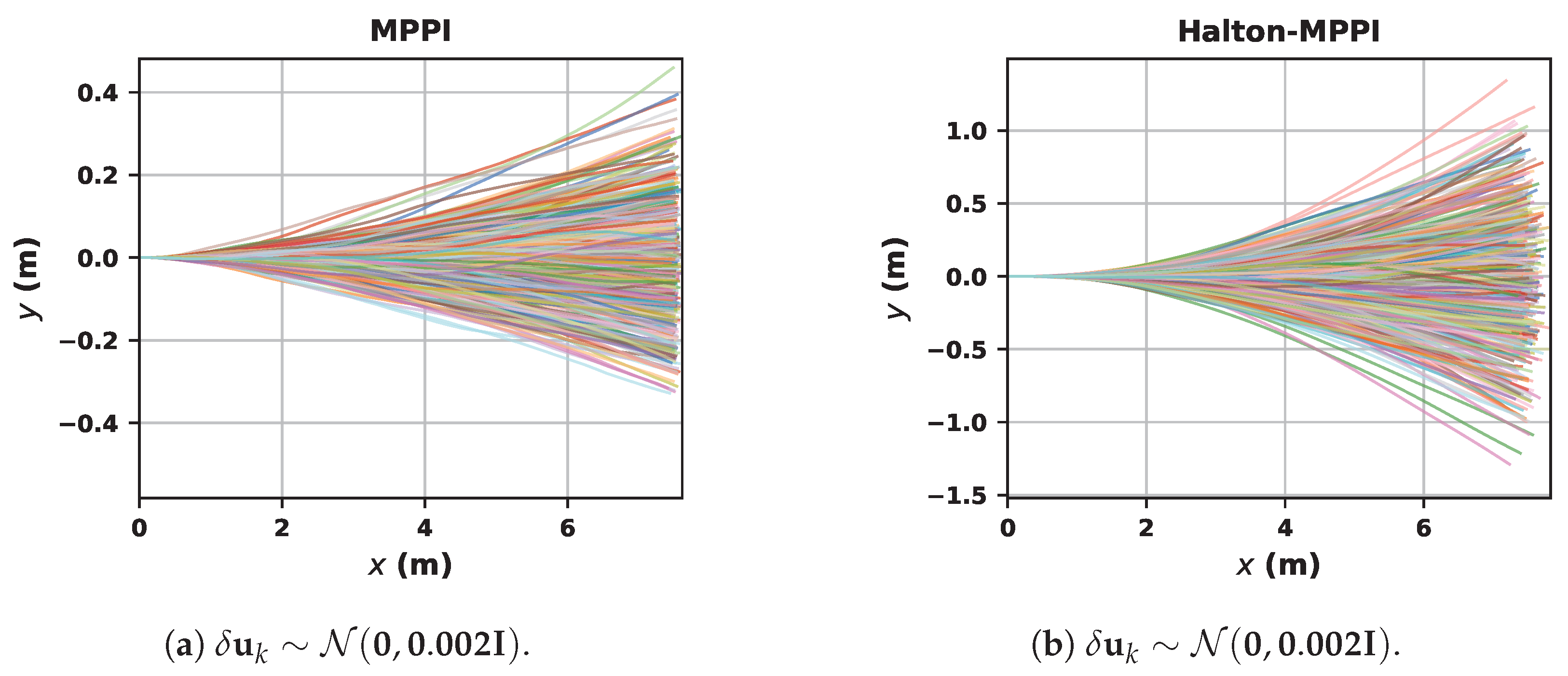
- A Halton-sampling-based MPPI trajectory optimization framework is proposed for unmanned systems. By integrating low-discrepancy Halton sequences with temporally correlated Ornstein–Uhlenbeck (OU) perturbations, structured sampling constraints are introduced across both the control space and the temporal domain, leading to significantly improved stability and smoothness of trajectories and control sequences.
- Extensive simulations on the BARN benchmark dataset demonstrate that the proposed method outperforms several representative MPPI variants in terms of trajectory smoothness and control smoothness while maintaining high navigation success rates and real-time computational performance; further validation through real-world experiments in outdoor environments confirms its robustness and engineering applicability.
- The proposed Halton–OU sampling mechanism provides a generally applicable perturbation modeling and sampling optimization paradigm for sampling-based model predictive control in unmanned systems, effectively reducing sampling variance and control jitter without introducing additional computational burden, thereby enhancing optimization stability and convergence consistency.
- Halton-MPPI can serve as a general local trajectory optimization module that can be directly integrated into multi-sensor fusion-based perception and navigation frameworks, offering a valuable technical pathway for enabling safe, smooth, and efficient autonomous motion of autonomous ground vehicles in complex environments.
Abstract
1. Introduction
2. Materials
2.1. MPPI Framework
2.2. Halton Sequence
2.3. Ornstein–Uhlenbeck Process for Correlated Noise
3. Methods
3.1. Perturbation Sampling Mechanism Based on Halton Sequences and OU Process
- 1.
- Halton Low-Discrepancy Sampling
| Algorithm 1 Halton Sequence Generation |
|
- 2.
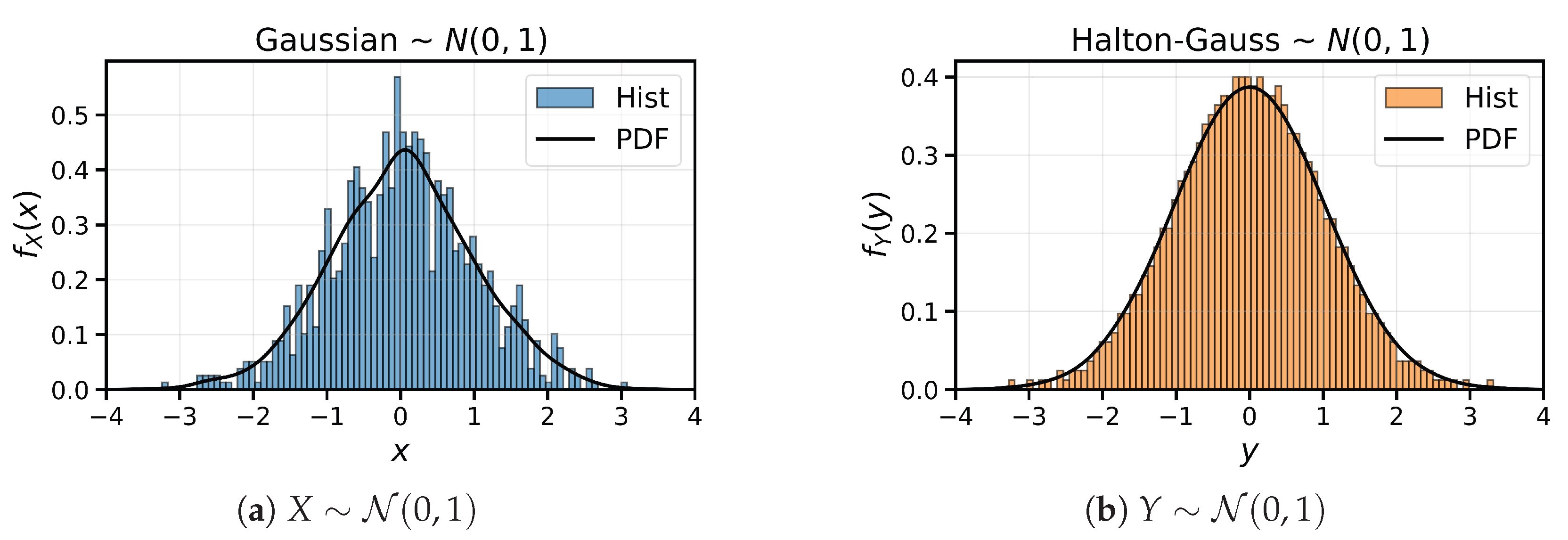
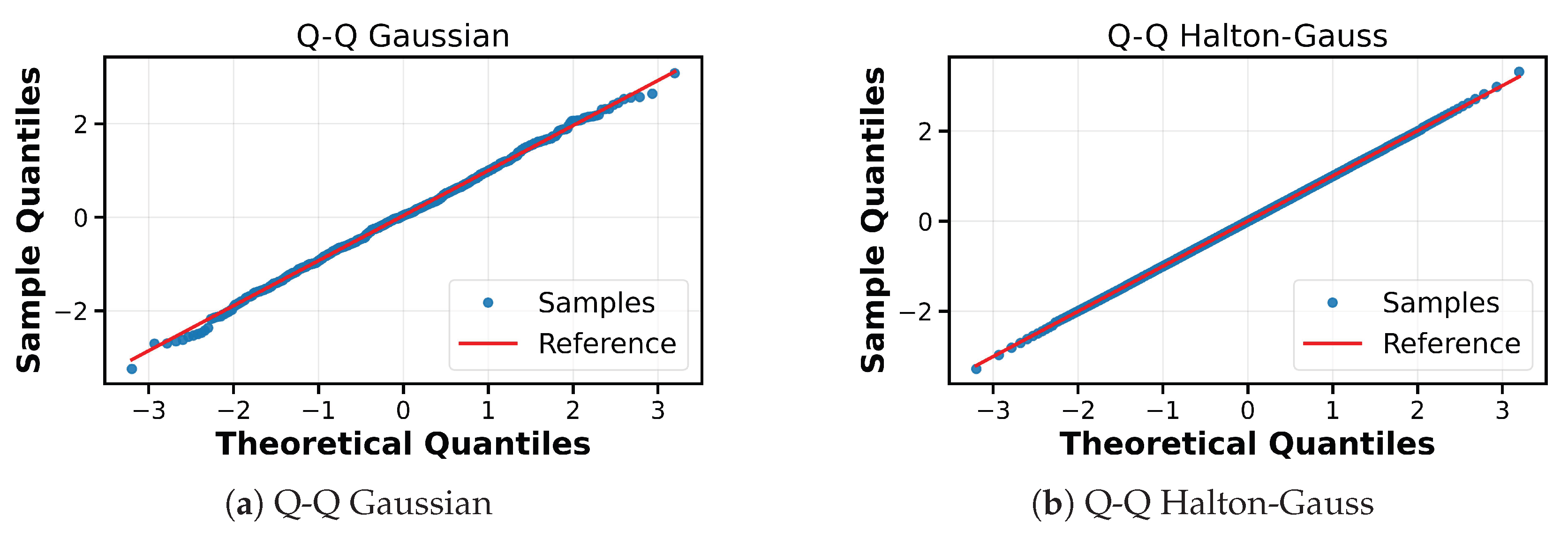
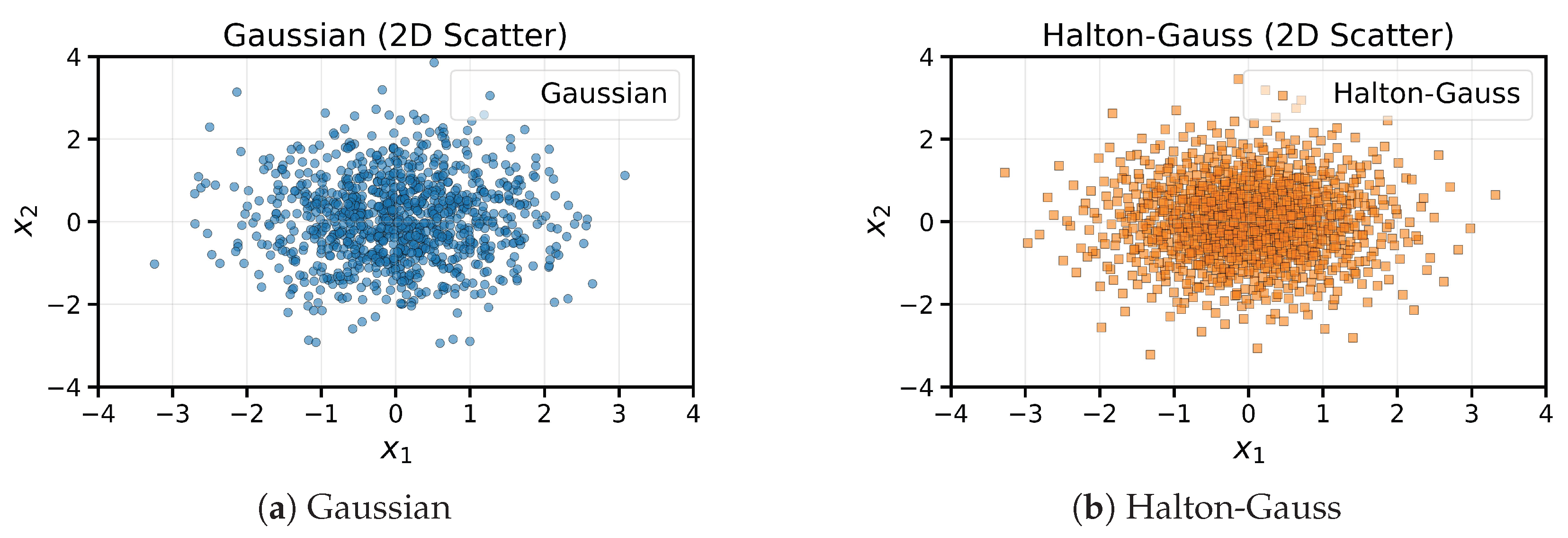
- Mapping to Gaussian Perturbation Space
- 3.
- OU-Based Temporal Correlation for Control Smoothness
- 4.
- Affine Transformation for Policy Matching
3.2. Halton-MPPI Strategy
| Algorithm 2 Halton–MPPI Algorithm |
|
4. Results
4.1. Simulation-Based Evaluation
4.1.1. Experimental Setup and Evaluation Metrics
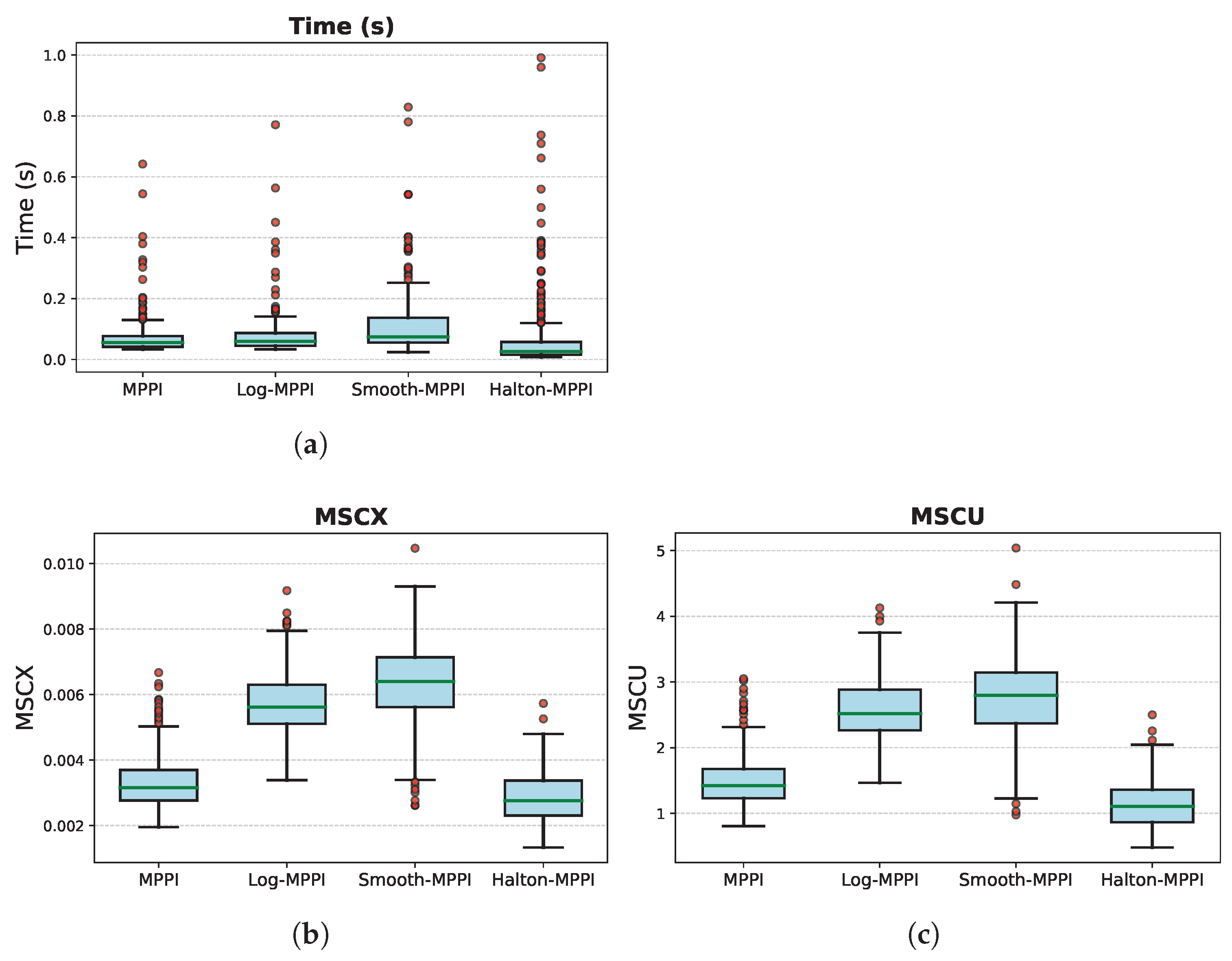
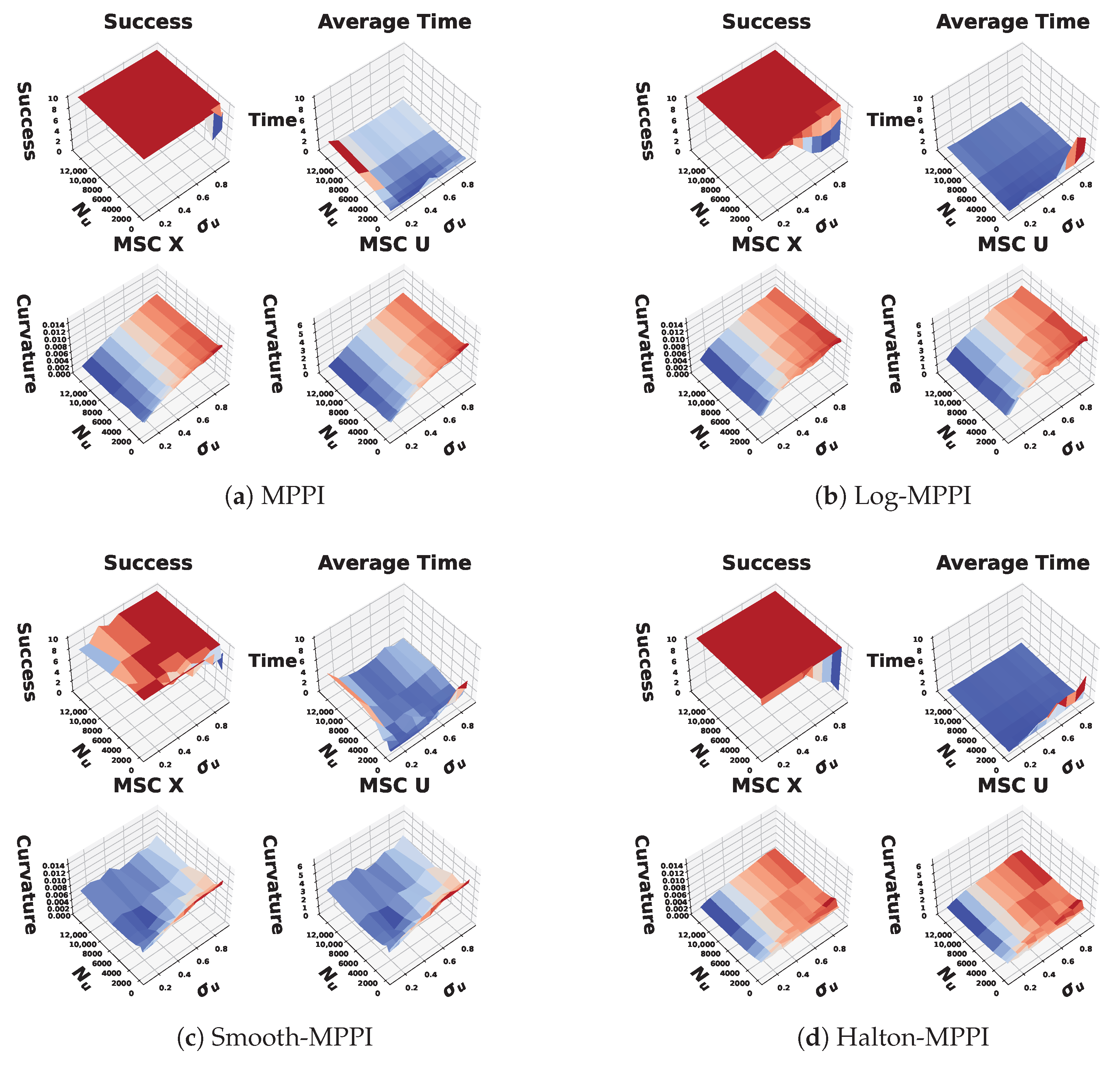
4.1.2. Quantitative Performance Comparison
- MPPI control [7] serves as the canonical baseline and remains a foundational method in sampling-based trajectory optimization.
- Log-MPPI [14] is a recent extension that improves numerical stability and sampling robustness through logarithmic cost reformulation.
- Smooth-MPPI [34] introduces an input lifting strategy by sampling control increments in the derivative action space and reconstructing the control sequence through temporal integration.
4.1.3. Ablation Study
- MPPI: Standard MPPI control using independent Gaussian sampling to generate control perturbations.
- Penalty-based MPPI: Standard MPPI control augmented with an explicit control perturbation penalty term to suppress high-frequency control variations.
- Halton–MPPI w/o OU: Halton–MPPI without introducing OU-based temporal correlation.
- Halton–MPPI: The full method combining Halton low-discrepancy sampling with OU-based temporally correlated control perturbations.
4.2. Real-World Demonstration
4.2.1. Perception Module
4.2.2. Bicycle Kinematic Vehicle Model
4.2.3. Cost Function Modeling
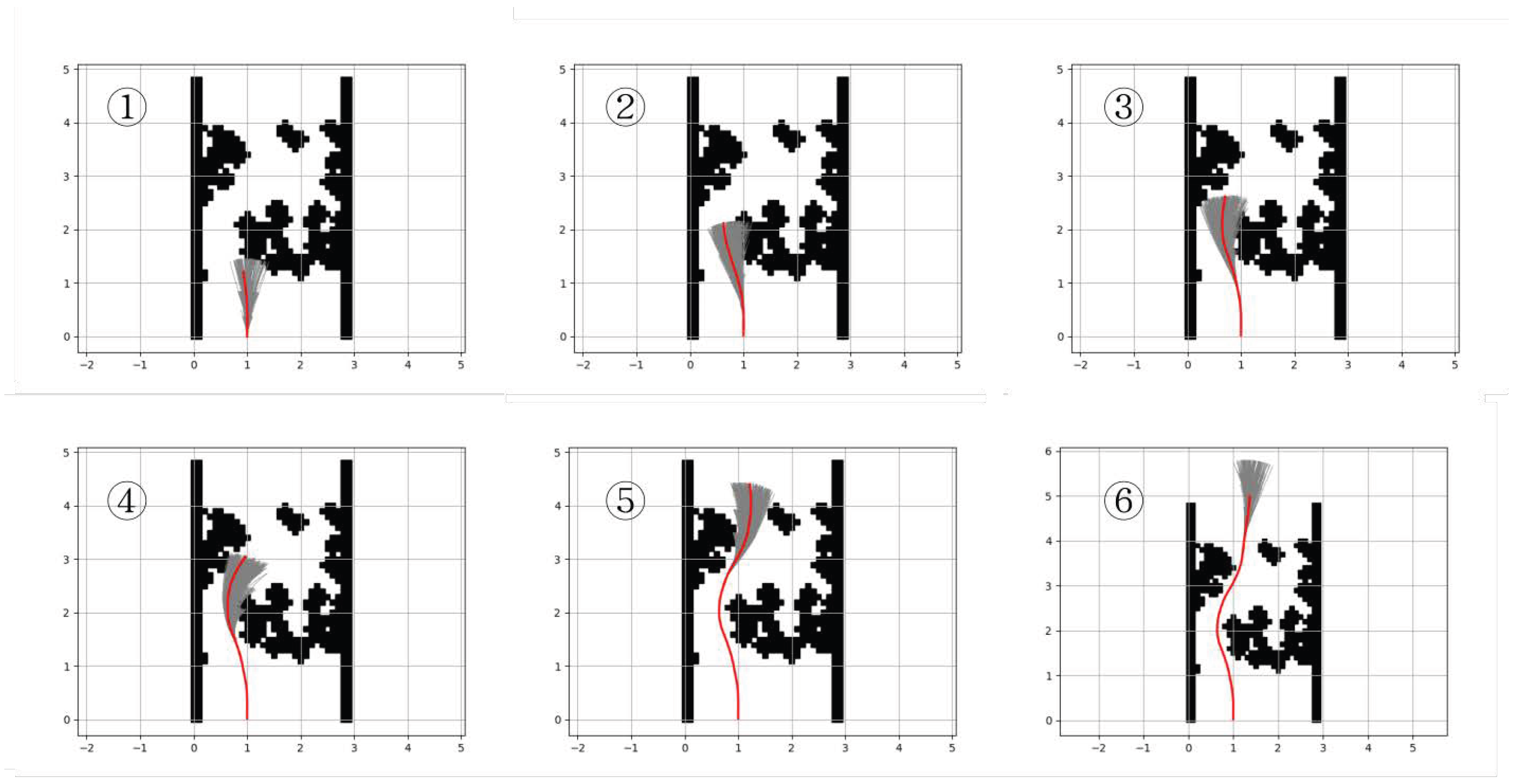
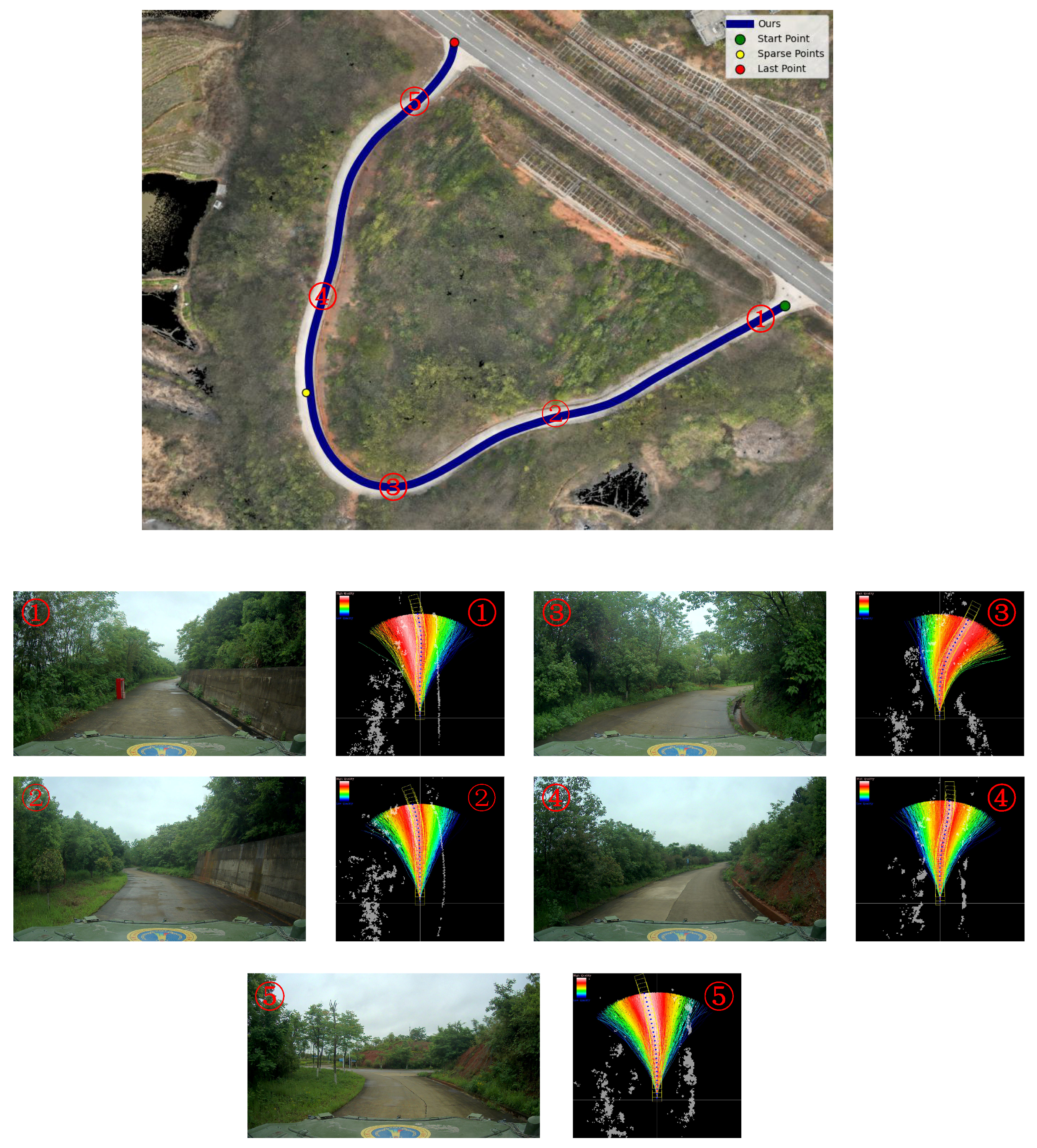
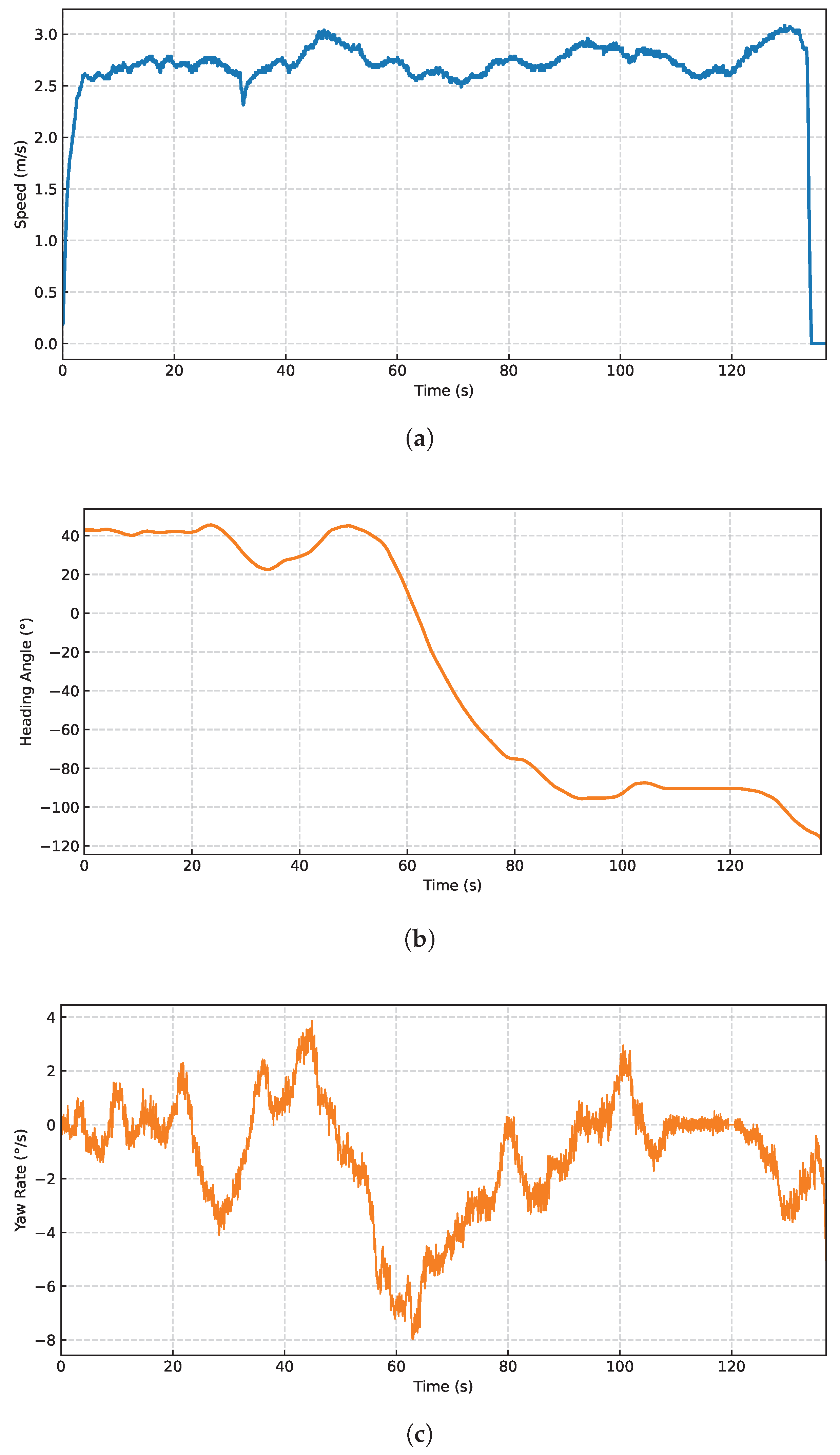
4.2.4. Experimental Results
5. Conclusions
Author Contributions
Funding
Data Availability Statement
Conflicts of Interest
References
- Wijayathunga, L.; Rassau, A.; Chai, D. Challenges and solutions for autonomous ground robot scene understanding and navigation in unstructured outdoor environments: A review. Appl. Sci. 2023, 13, 9877. [Google Scholar] [CrossRef]
- Lyu, Z.; Gao, Y.; Chen, J.; Du, H.; Xu, J.; Huang, K.; Kim, D.I. Empowering Intelligent Low-Altitude Economy with Large AI Model Deployment. IEEE Wirel. Commun. 2026, 33, 64–72. [Google Scholar] [CrossRef]
- Xiao, W.; Shi, C.; Chen, M.; Vasilakos, A.V.; Chen, M.; Farouk, A. LLM-based UAV Path Planning for Autonomous and Adaptive Industry Systems. ACM Trans. Auton. Adapt. Syst. 2025. [Google Scholar] [CrossRef]
- Wang, N.; Li, X.; Zhang, K.; Wang, J.; Xie, D. A Survey on Path Planning for Autonomous Ground Vehicles in Unstructured Environments. Machines 2024, 12, 31. [Google Scholar] [CrossRef]
- Gerdpratoom, N.; Yamamoto, K. Decentralized Nonlinear Model Predictive Control-Based Flock Navigation with Real-Time Obstacle Avoidance in Unknown Obstructed Environments. Front. Robot. AI 2025, 12, 1540808. [Google Scholar] [CrossRef]
- Han, T.; Liu, A.; Li, A.; Spitzer, A.; Shi, G.; Boots, B. Model Predictive Control for Aggressive Driving over Uneven Terrain. arXiv 2023, arXiv:2311.12284. [Google Scholar] [CrossRef]
- Williams, G.; Aldrich, A.; Theodorou, E.A. Model Predictive Path Integral Control: From Theory to Parallel Computation. J. Guid. Control Dyn. 2017, 40, 344–357. [Google Scholar] [CrossRef]
- Williams, G.; Wagener, N.; Goldfain, B.; Drews, P.; Rehg, J.M.; Boots, B.; Theodorou, E.A. Information Theoretic MPC for Model-Based Reinforcement Learning. In Proceedings of the IEEE International Conference on Robotics and Automation (ICRA), Singapore, 29 May–3 June 2017; pp. 1714–1721. [Google Scholar]
- Kazim, M.; Hong, J.; Kim, M.-G.; Kim, K.-K.K. Recent Advances in Path Integral Control for Trajectory Optimization: An Overview in Theoretical and Algorithmic Perspectives. Annu. Rev. Control 2024, 57, 100931. [Google Scholar] [CrossRef]
- Bhardwaj, M.; Sundaralingam, B.; Mousavian, A.; Ratliff, N.D.; Fox, D.; Ramos, F.; Boots, B. STORM: An Integrated Framework for Fast Joint-Space Model-Predictive Control for Reactive Manipulation. In Proceedings of the Conference on Robot Learning (CoRL), Auckland, New Zealand, 14–18 December 2022; pp. 750–759. [Google Scholar]
- Williams, G.; Drews, P.; Goldfain, B.; Rehg, J.M.; Theodorou, E.A. Information-Theoretic Model Predictive Control: Theory and Applications to Autonomous Driving. IEEE Trans. Robot. 2018, 34, 1603–1622. [Google Scholar] [CrossRef]
- Williams, G.; Goldfain, B.; Drews, P.; Saigol, K.; Rehg, J.M.; Theodorou, E.A. Robust Sampling-Based Model Predictive Control with Sparse Objective Information. In Proceedings of the Robotics: Science and Systems (RSS), Pittsburgh, PA, USA, 26–30 June 2018. [Google Scholar]
- Yin, J.; Zhang, Z.; Theodorou, E.; Tsiotras, P. Trajectory Distribution Control for Model Predictive Path Integral Control Using Covariance Steering. In Proceedings of the IEEE International Conference on Robotics and Automation (ICRA), Philadelphia, PA, USA, 23–27 May 2022; pp. 1478–1484. [Google Scholar]
- Mohamed, I.S.; Yin, K.; Liu, L. Autonomous Navigation of AGVs in Unknown Cluttered Environments: Log-MPPI Control Strategy. IEEE Robot. Autom. Lett. 2022, 7, 10240–10247. [Google Scholar] [CrossRef]
- Mohamed, I.S.; Xu, J.; Sukhatme, G.S.; Liu, L. Towards Efficient MPPI Trajectory Generation with Unscented Guidance: U-MPPI Control Strategy. IEEE Trans. Robot. 2025, 41, 1172–1192. [Google Scholar] [CrossRef]
- Asmar, D.M.; Senanayake, R.; Manuel, S.; Kochenderfer, M.J. Model Predictive Optimized Path Integral Strategies. arXiv 2022, arXiv:2203.16633. [Google Scholar]
- Kim, M.G.; Jung, M.; Hong, J.G.; Kim, K.K.K. MPPI-IPDDP: A Hybrid Method of Collision-Free Smooth Trajectory Generation for Autonomous Robots. IEEE Trans. Ind. Inform. 2025, 21, 5037–5046. [Google Scholar] [CrossRef]
- Higgins, J.; Mohammad, N.; Bezzo, N. A Model Predictive Path Integral Method for Fast, Proactive, and Uncertainty-Aware UAV Planning in Cluttered Environments. In Proceedings of the 2023 IEEE/RSJ International Conference on Intelligent Robots and Systems (IROS), Detroit, MI, USA, 1–5 October 2023; pp. 830–837. [Google Scholar]
- Lambert, A.; Fishman, A.; Fox, D.; Boots, B.; Ramos, F. Stein Variational Model Predictive Control. arXiv 2020, arXiv:2011.07641. [Google Scholar]
- Miura, T.; Akai, N.; Honda, K.; Hara, S. Spline-Interpolated Model Predictive Path Integral Control with Stein Variational Inference for Reactive Navigation. In Proceedings of the 2024 IEEE International Conference on Robotics and Automation (ICRA), Yokohama, Japan, 13–17 May 2024; pp. 13171–13177. [Google Scholar]
- Liu, B.; Jiang, G.; Zhao, F.; Mei, X. Collision-free motion generation based on stochastic optimization and composite signed distance field networks of articulated robot. IEEE Robot. Autom. Lett. 2023, 8, 7082–7089. [Google Scholar] [CrossRef]
- Halton, J.H. Algorithm 247: Radical-Inverse Quasi-Random Point Sequence. Commun. ACM 1964, 7, 701–702. [Google Scholar] [CrossRef]
- L’Ecuyer, P. Random Number Generation and Quasi-Monte Carlo. Wiley StatsRef Stat. Ref. Online 2014, 1–12. [Google Scholar] [CrossRef]
- Berblinger, M.; Schlier, C. Monte Carlo Integration with Quasi-Random Numbers: Some Experience. Comput. Phys. Commun. 1991, 66, 157–166. [Google Scholar] [CrossRef]
- Dick, J.; Kuo, F.Y.; Sloan, I.H. High-Dimensional Integration: The Quasi-Monte Carlo Way. Acta Numer. 2013, 22, 133–288. [Google Scholar] [CrossRef]
- Maller, R.A.; Müller, G.; Szimayer, A. Ornstein–Uhlenbeck Processes and Extensions. In Handbook of Financial Time Series; Andersen, T.G., Davis, R.A., Kreiß, J.-P., Mikosch, T., Eds.; Springer: Berlin/Heidelberg, Germany, 2009; pp. 421–437. [Google Scholar]
- Mayne, D.Q. Model Predictive Control: Recent Developments and Future Promise. Automatica 2014, 50, 2967–2986. [Google Scholar] [CrossRef]
- Theodorou, E.A.; Todorov, E. Relative Entropy and Free Energy Dualities: Connections to Path Integral and KL Control. In Proceedings of the IEEE 51st Conference on Decision and Control, Maui, HI, USA, 10–13 December 2012; IEEE: Maui, HI, USA, 2012; pp. 1466–1473. [Google Scholar]
- Caflisch, R.E. Monte Carlo and Quasi-Monte Carlo Methods. Acta Numer. 1998, 7, 1–49. [Google Scholar] [CrossRef]
- Plappert, M.; Houthooft, R.; Dhariwal, P.; Sidor, S.; Chen, R.Y.; Chen, X.; Asfour, T.; Abbeel, P.; Andrychowicz, M. Parameter Space Noise for Exploration. arXiv 2017, arXiv:1706.01905. [Google Scholar]
- Uhlenbeck, G.E.; Ornstein, L.S. On the Theory of the Brownian Motion. Phys. Rev. 1930, 36, 823–841. [Google Scholar] [CrossRef]
- Ortega, R.; Astolfi, A.; Bastin, G.; Rodriguez, H. Stabilization of Food-Chain Systems Using a Port-Controlled Hamiltonian Description. In Proceedings of the American Control Conference (ACC), Chicago, IL, USA, 28–30 June 2000; pp. 2245–2249. [Google Scholar]
- Perille, D.; Truong, A.; Xiao, X.; Stone, P. Benchmarking Metric Ground Navigation. In Proceedings of the IEEE International Symposium on Safety, Security, and Rescue Robotics (SSRR), Abu Dhabi, United Arab Emirates, 4–6 November 2020; pp. 116–121. [Google Scholar]
- Kim, T.; Park, G.; Kwak, K.; Bae, J.; Lee, W. Smooth Model Predictive Path Integral Control without Smoothing. IEEE Robot. Autom. Lett. 2022, 7, 10406–10413. [Google Scholar] [CrossRef]
- Jung, M.; Kim, K. BiC-MPPI: Goal-Pursuing, Sampling-Based Bidirectional Rollout Clustering Path Integral for Trajectory Optimization. arXiv 2024, arXiv:2410.06493. [Google Scholar]



| Parameter | MPPI | Log-MPPI | Smooth-MPPI | Halton-MPPI |
|---|---|---|---|---|
| 2000 | 2000 | 2000 | 2000 | |
| T | 100 | 100 | 100 | 100 |
| 0.1 | 0.1 | 0.1 | 0.1 | |
| (0.25, 0.25) | (0.25, 0.25) | (0.25, 0.25) | (0.25, 0.25) | |
| - | - | - | 0.95 |
| Algorithm | Success Rate | Avg Time (s) | MSCX () | MSCU () |
|---|---|---|---|---|
| Halton–MPPI | 97% (9/300) | 0.0710 ± 0.1318 | 0.0029 ± 0.0008 | 1.1438 ± 0.3632 |
| MPPI | 97% (9/300) | 0.0738 ± 0.0662 | 0.0033 ± 0.0008 | 1.4984 ± 0.3870 |
| Log-MPPI | 98% (6/300) | 0.0791 ± 0.0711 | 0.0058 ± 0.0010 | 2.5804 ± 0.4880 |
| Smooth-MPPI | 95% (16/300) | 0.1126 ± 0.1008 | 0.0063 ± 0.0013 | 2.7370 ± 0.6549 |
| Algorithm | Succ. Rate | Avg Time (s) | MSCX | MSCU |
|---|---|---|---|---|
| MPPI | 100% | 0.0742 ± 0.0351 | 0.0041 ± 0.0006 | 1.8070 ± 0.2816 |
| Penalty-based MPPI | 100% | 0.1230 ± 0.0406 | 0.0030 ± 0.0004 | 1.2731 ± 0.2041 |
| Halton–MPPI w/o OU | 100% | 0.0726 ± 0.0415 | 0.0021 ± 0.0004 | 0.7818 ± 0.4025 |
| Halton–MPPI | 100% | 0.0712 ± 0.0586 | 0.0019 ± 0.0007 | 0.6344 ± 0.2035 |
Disclaimer/Publisher’s Note: The statements, opinions and data contained in all publications are solely those of the individual author(s) and contributor(s) and not of MDPI and/or the editor(s). MDPI and/or the editor(s) disclaim responsibility for any injury to people or property resulting from any ideas, methods, instructions or products referred to in the content. |
© 2026 by the authors. Licensee MDPI, Basel, Switzerland. This article is an open access article distributed under the terms and conditions of the Creative Commons Attribution (CC BY) license.
Share and Cite
Xu, K.; Ye, L.; Li, X.; Sun, Z.; Bu, Y. Stable and Smooth Trajectory Optimization for Autonomous Ground Vehicles via Halton-Sampling-Based MPPI. Drones 2026, 10, 96. https://doi.org/10.3390/drones10020096
Xu K, Ye L, Li X, Sun Z, Bu Y. Stable and Smooth Trajectory Optimization for Autonomous Ground Vehicles via Halton-Sampling-Based MPPI. Drones. 2026; 10(2):96. https://doi.org/10.3390/drones10020096
Chicago/Turabian StyleXu, Kang, Lei Ye, Xiaohui Li, Zhenping Sun, and Yafeng Bu. 2026. "Stable and Smooth Trajectory Optimization for Autonomous Ground Vehicles via Halton-Sampling-Based MPPI" Drones 10, no. 2: 96. https://doi.org/10.3390/drones10020096
APA StyleXu, K., Ye, L., Li, X., Sun, Z., & Bu, Y. (2026). Stable and Smooth Trajectory Optimization for Autonomous Ground Vehicles via Halton-Sampling-Based MPPI. Drones, 10(2), 96. https://doi.org/10.3390/drones10020096