1. Introduction
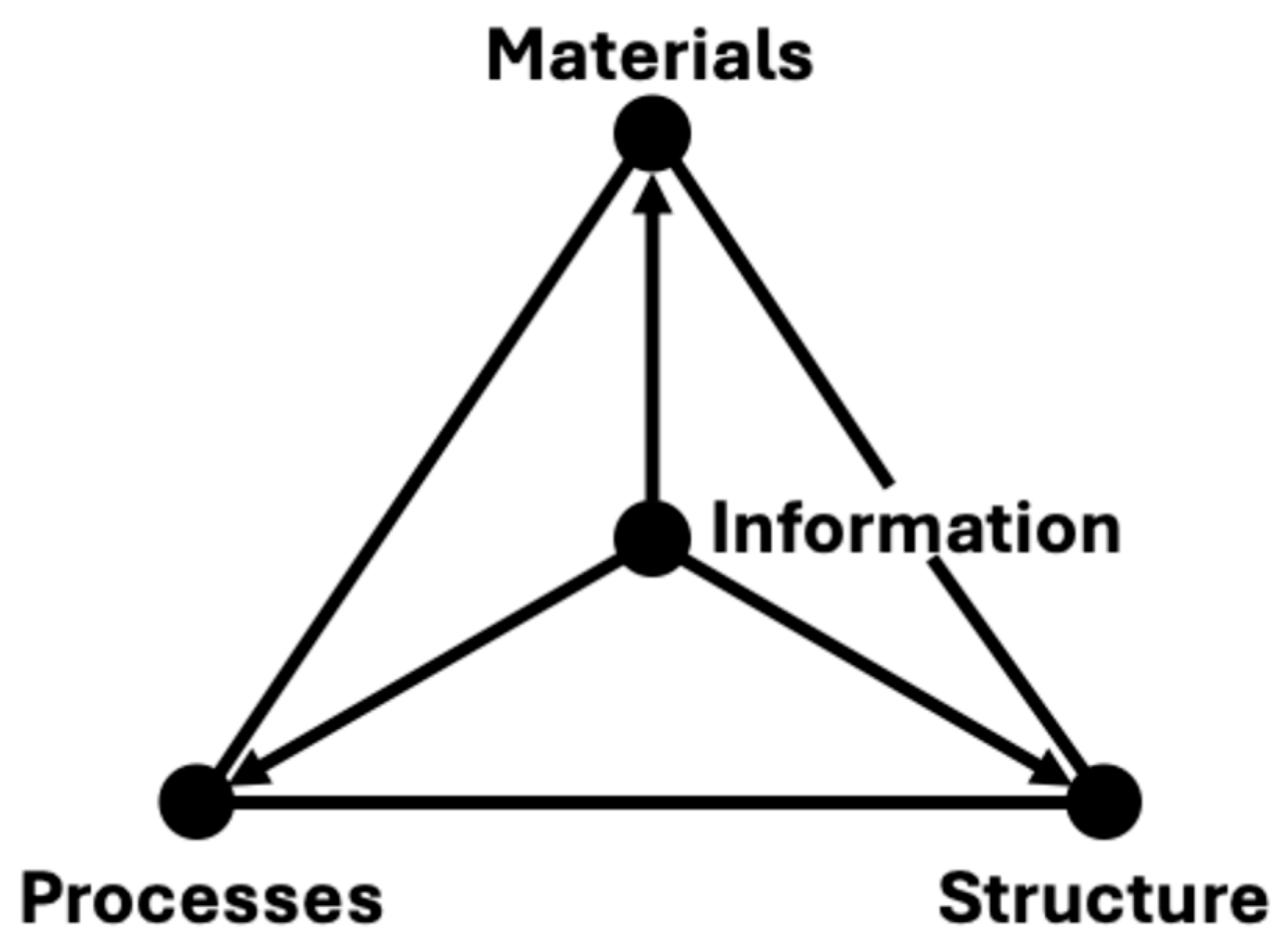
Information is a fundamental organizing principle of living systems, embodied in their materials, structures, and processes. In plants, information is continuously sensed, processed, and translated into physiological, morphological and developmental responses. Changes in soil chemistry influence metabolic composition, mechanical constraints shape growth forms, and climatic cues regulate phenology. These dimensions comprise materials, structures and processes and are not independent, but interconnected through information flow, as schematically illustrated in
Figure 1. This perspective aligns with biomimetic thinking, which emphasizes understanding how information is encoded and transformed in natural systems to inspire sustainable design principles [
1,
2].
Plant galls provide a particularly striking example of information-driven form generation. Galls are complex plant structures induced by insects, fungi, bacteria, or other organisms through biochemical and molecular signaling that redirects the host plant’s development [
3,
4]. Although composed entirely of plant tissue, gall morphology, internal organization, and function are largely determined by the inducing organism. In insect-induced galls, this phenomenon is widely interpreted as an extended phenotype of the inducer, shaped by natural selection acting primarily on the gall-forming species rather than on the host plant [
5,
6]. Extensive empirical research has shown that gall formation is generally parasitic, often imposing metabolic costs on the plant, including suppressed photosynthesis, altered nutrient allocation, and reduced fitness [
7].
At the same time, galls remain biologically remarkable structures. They frequently display tissue types, spatial organization, and developmental trajectories that are absent from ungalled plant organs. Molecular, cytological, and transcriptomic studies have demonstrated that gall induction typically involves the repurposing of existing plant developmental pathways, such as those associated with meristems, reproductive organs, or regenerative growth, rather than the creation of entirely new biochemical mechanisms [
8,
9,
10]. From this perspective, galls can be understood as morphologically novel outcomes produced through the redeployment of conserved plant gene regulatory networks under external control.
The present contribution does not challenge the prevailing view of galls as parasitic manipulations, nor does it claim that gall formation confers direct adaptive benefits to the host plants. Instead, it introduces a conceptual and explicitly speculative framework, termed the Gall-Accelerated Innovation (GAI) framework, that explores a different line of questioning: can gall induction be viewed as an extreme, localized instance of developmental reprogramming that exposes plants to unusual structural and biochemical configurations, and can this phenomenon serve as inspiration for biomimetic thinking, artistic exploration and STEAM education? In this context, STEAM education refers to an integrative educational paradigm that combines science, technology, engineering, arts, and mathematics into a unified framework for inquiry and creation. By explicitly incorporating the arts, STEAM extends beyond the problem-solving orientation of STEM to include aesthetic reasoning, material experimentation, narrative construction, and reflective practice, thereby fostering creativity, systems thinking, and embodied understanding alongside analytical and technical skills.
The GAI framework is not proposed as a demonstrated evolutionary mechanism. In particular, no claim is made that somatic modifications in gall tissue are transmitted to the plant germline or contribute directly to long-term plant evolution. Rather, the framework draws attention to the contrast between long plant generation times and the rapid life cycles of many gall inducers, suggesting that gall systems may function as developmental probes that repeatedly test alternative growth trajectories at the plant–inducer interface.
By situating plant galls within the information-centric perspective outlined in
Figure 1, this work connects gall biology with biomimetics, speculative design, and interdisciplinary education. Through observational examples, conceptual modeling, and artistic translation, the paper reframes galls not as evolutionary solutions, but as natural experiments in information-driven form generation. This reframing aims to support STEAM-based learning environments in which Nature is approached not only as a source of optimized functions, but as a dynamic system that generates questions, imagination, and new ways of thinking across disciplinary boundaries.
2. Conceptual Framework: Galls as Innovation Boosters
This section introduces the Gall-Accelerated Innovation (GAI) framework as a conceptual and heuristic model, rather than as a biological mechanism or evolutionary claim. The framework is intended to support interdisciplinary thinking across biology, biomimetics, art, and education by highlighting how extreme, localized developmental reprogramming events, including plant galls, can be interpreted through an information-centric lens. It does not propose that gall formation enhances the host plant’s fitness or accelerates plant evolution; instead, gall systems are used here as illustrative case studies for exploring information-driven form generation and its potential relevance for biomimetic reflection and creative inquiry.
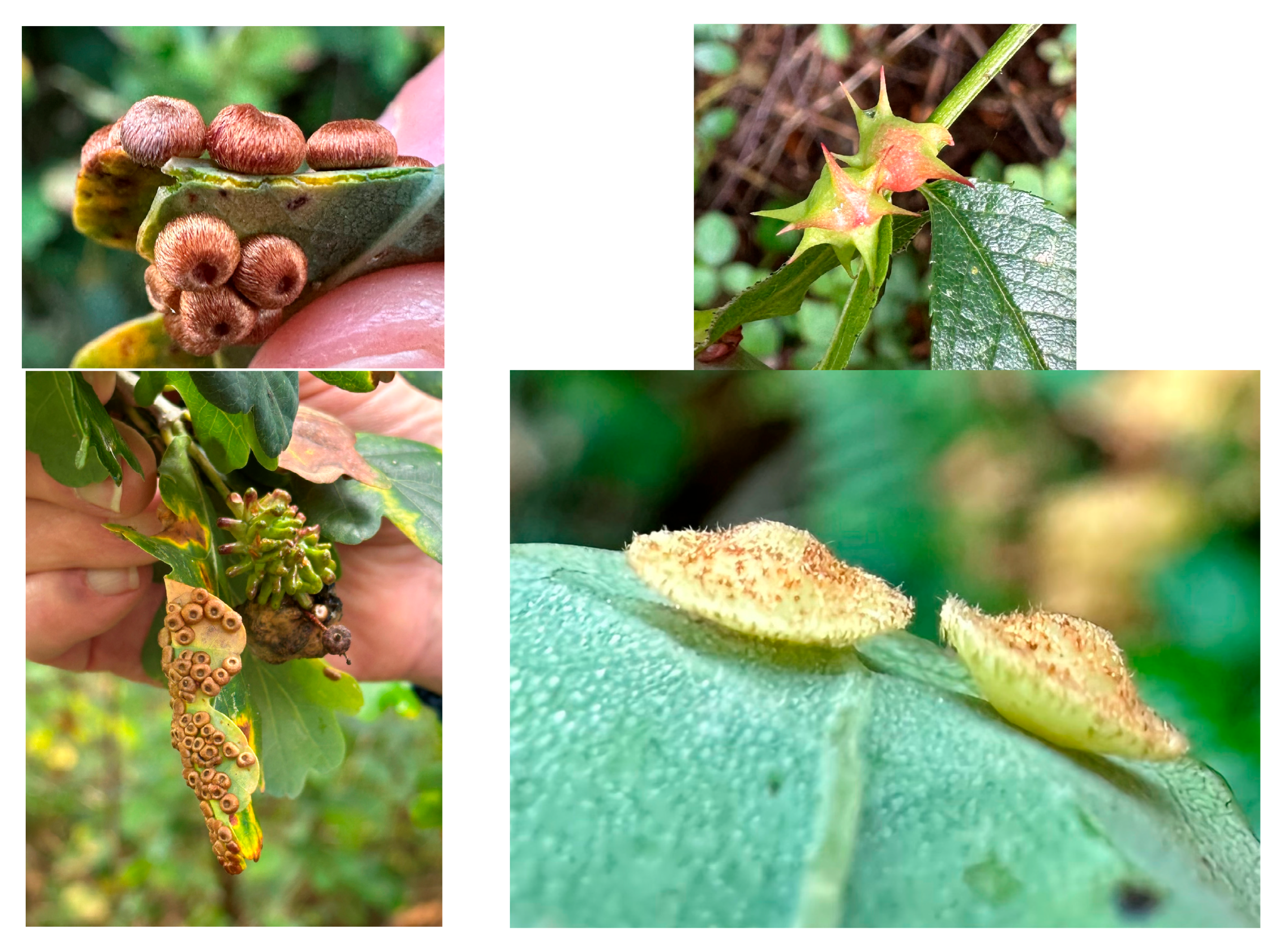
Insects such as cynipid wasps (Cynipidae) can complete multiple generations within a single growing season, whereas woody host plants typically develop and reproduce on much longer timescales. This disparity motivates the heuristic idea that galls (
Figure 2) may be viewed as localized arenas of intense developmental interaction, in which plant growth pathways are repeatedly redirected at the plant–gall inducer interface [
3]. In this metaphorical framing, the inducing organism relies on the plant’s existing developmental capacities to construct a highly specialized structure, while the plant tissue undergoes atypical differentiation in response to externally supplied biochemical signals.
Within the GAI framework, such interactions are not interpreted as cooperative or mutually beneficial processes, but as conceptual examples of extreme developmental perturbation. The term ‘innovation booster’ is therefore used metaphorically, referring to conceptual exploration of form rather than to biological or evolutionary acceleration. The notion that plants might “retain” information from gall formation is therefore posed strictly as a question-generating hypothesis, rather than as an established phenomenon. If localized structural or biochemical changes associated with gall formation were ever shown to influence subsequent plant responses, whether through transient priming, altered sensitivity, or other mechanisms, this would represent an incidental consequence rather than an adaptive strategy.
Scope and Limitations of the GAI Framework
The GAI framework is not intended to explain gall formation mechanisms, plant fitness outcomes, or evolutionary trajectories. Instead, it provides a conceptual lens for examining how extreme developmental reprogramming events may inform biomimetic design, speculative research, and interdisciplinary education. Any references to acceleration, experimentation, or innovation are used metaphorically and do not imply demonstrated biological advantages for the host plants.
3. Materials and Methods: Bridging Biomimetics and the Arts
For materials and methods, the work presented here follows a conceptual, observational, and educational approach, rather than an experimental or hypothesis-testing methodology. No new molecular, physiological, or genetic experiments were conducted. Instead, the study integrates qualitative biological observation, conceptual modeling, and art-based educational practice to explore plant galls as inspiration for biomimetics and STEAM-oriented learning.
3.1. Biological Observation and Contextual Analysis
Observations of plant galls were conducted during the 40th Annual Meeting of the British Plant Gall Society (BPGS) in Yorkshire, UK, in October 2025. The observations focused on insect-induced galls on oak (
Quercus spp.) and rose (
Rosa sp.), documented photographically by the author (
Figure 2). The selected examples illustrate diversity in gall morphology, including differences in size, surface texture (smooth versus hairy), coloration, internal chamber structure, and attachment to the host’s tissue.
These observations were not intended as a systematic survey or quantitative analysis, but as qualitative exemplars supporting conceptual reflection. Interpretation of gall induction mechanisms and host–inducer relationships is grounded in the established literature on gall biology [
3,
4,
7], which characterizes insect galls as parasitic structures shaped by the inducing organism through the repurposing of the host plant’s developmental pathways.
3.2. Conceptual Modeling
Conceptual modeling can be used to frame gall formation within an information-centric biomimetic perspective. Drawing on established biomimetic frameworks [
1,
2], plant galls can be interpreted as localized perturbations in the information flow linking materials, structures, and processes within living systems (
Figure 1). This modelling approach does not propose mechanistic explanations for gall development, but serves to translate biological phenomena into abstract design-relevant concepts, such as programmable growth, hierarchical organization, and adaptive form generation.
3.3. Art-Based Inquiry and STEAM-Oriented Educational Context
The art-based and educational components of this work are embedded in a broader, previously published STEAM framework developed by the author and collaborators, which integrates biomimetics, sustainability, and creative practice in engineering and science education [
11,
12]. These approaches aligned with foundational models of STEAM education that emphasized the deliberate integration of science, technology, engineering, art, and mathematics as mutually reinforcing modes of inquiry, rather than as isolated disciplines [
13]. In particular, the inclusion of artistic practice should be understood not as an illustrative add-on, but as a critical mode of knowledge generation, interpretation, and reflection within interdisciplinary learning environments [
14].
The specific school workshop described here represents one instantiation of this established approach. The workshop was designed and conducted by the artist and educator Sofia Groß within the context of secondary education (Bildnerische Erziehung, eighth grade, students aged approximately 14 years). Florian Gisinger, who completed his Bachelor’s thesis under the supervision of the author on a different biomimetics topic and attended interdisciplinary biomimetics lectures jointly taught by the author and Prof. Ruth Mateus-Berr at the University of Applied Arts Vienna, contributed to the conceptual preparation of the workshop and was present during its implementation at the school. The author was not present during the workshop itself, but situates the activity within a broader interdisciplinary research and teaching framework.
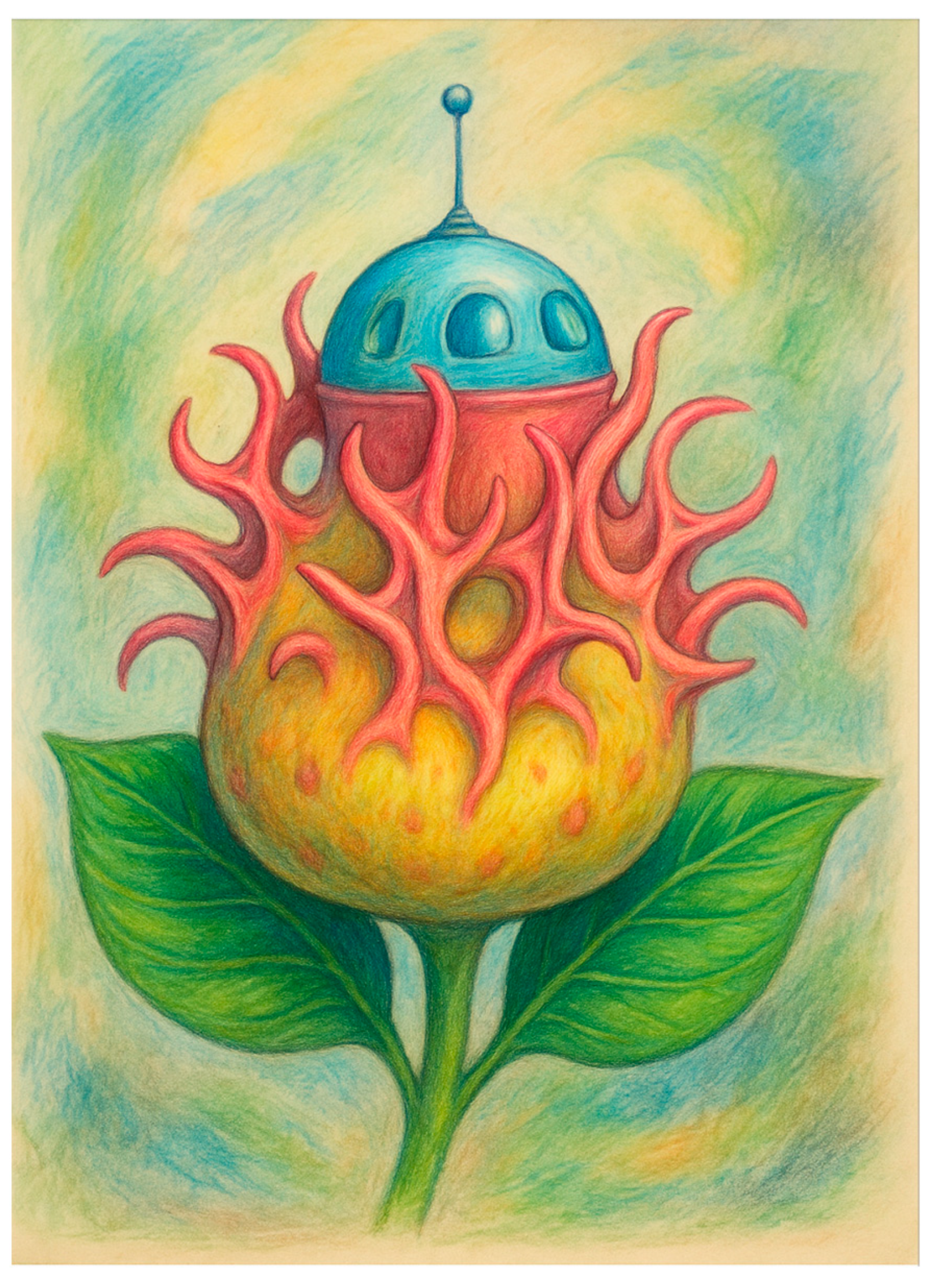
As part of the art-based inquiry, gall morphology was explored through speculative drawing and visual abstraction, exemplified by the illustrated gall artwork shown in
Figure 3, which translated biological form into an interpretative visual language rather than a scientific diagram. Such visual abstractions complemented hands-on material engagement by enabling learners to externalize and reinterpret biological complexity through artistic means, a core principle of STEAM education [
13,
14].
During the workshop, students also produced ink from oak galls and used it to write messages reflecting hopes and concerns for the future on leaf-shaped substrates made from kombucha-derived biopolymer material. These elements were subsequently assembled into a temporary, classroom-based installation. The activity was preceded by an introduction to ephemeral art practices, natural materials, and environmental change, and was designed to encourage sensory engagement, material awareness, and speculative reflection rather than formal assessment.
In line with established STEAM and interdisciplinary education methodologies [
11,
12,
13,
14], this workshop was not intended to generate quantitative educational outcomes or evaluative metrics. Instead, it functioned as an experiential learning setting in which biological phenomena (plant galls), material transformation (ink extraction and biopolymers), and artistic expression were combined to make abstract concepts tangible. The approach reflected key principles of STEAM education, including integrative thinking, embodied learning, and the role of art and design in enabling learners to engage with complexity, uncertainty, and open-ended questions [
13,
14].
4. Results and Discussion
4.1. Observational and Conceptual Outcomes
The primary outcomes from this work are conceptual and observational rather than experimental. Observations of diverse insect-induced galls (
Figure 2) highlight the remarkable range of morphological configurations that can arise from localized developmental reprogramming, including variations in size, tissue texture, internal chamber structure, and surface characteristics. These qualitative differences are well documented in the literature on gall biology, and are understood to reflect species-specific induction strategies shaped by selection acting on the gall-inducing organism, rather than on the host plant.
Within the Gall-Accelerated Innovation (GAI) framework, these observations are not interpreted as evidence of adaptive benefit to the plant. Instead, they serve as illustrative examples of how biological information encoded in signaling pathways, growth responses, and material differentiation can generate complex form through interaction rather than construction. In this sense, galls function here as natural case studies for information-centric form generation, supporting biomimetic reflection without implying biological optimization or evolutionary advantage for the host.
4.2. Educational and Interdisciplinary Insights
From an educational perspective, the integration of biological observation, conceptual modeling, and art-based inquiry can enable learners to engage with plant galls as both biological phenomena and sources of creative inspiration. Activities such as gall ink production, material-based writing, and speculative drawing (
Figure 3) facilitates embodied and sensory engagement with biological materials, supporting STEAM principles of integrative and experiential learning.
Rather than producing measurable learning outcomes, these activities generate qualitative insights into how learners approach complexity, uncertainty, and cross-disciplinary translation. The combination of scientific context and artistic practice encourage participants to move fluidly between observation, interpretation, and imagination, reinforcing the role of art and design as epistemic tools within STEM-related education. These outcomes align with established STEAM frameworks that emphasize creativity, systems thinking, and ethical reflection over content memorization.
4.3. Biological Interpretation and Conceptual Boundaries
The GAI framework intentionally maintains clear conceptual boundaries. While gall induction involves extensive reprogramming of plant developmental pathways, existing evidence indicates that such modifications are localized and somatic, with no demonstrated mechanism for transmission to the plant germline. Moreover, the metabolic and physiological costs associated with gall formation suggest that galls are best understood as parasitic manipulations, rather than cooperative or mutually beneficial interactions.
The frequently cited disparity between insect and plant generation times is therefore not interpreted here as a driver of accelerated plant evolution. Faster insect generations select for increasingly effective manipulation strategies, and not for innovation on the plant’s side. Within the present framework, references to acceleration or experimentation are strictly metaphorical and intend to highlight conceptual exploration of form and not these evolutionary processes.
Nested interactions involving inquilines and parasitoids further underscore the ecological complexity of gall systems, but they do not provide evidence for innovation benefiting the host plant. Inquilines exploit and sometimes modify existing gall structures without inducing them, while parasitoids attack gall inducers or their associates, often exerting strong selective pressure on gall morphology and life-history traits. Together, these multitrophic interactions illustrate how galls function as ecological microhabitats shaped by multiple interacting organisms, reinforcing the view of galls as emergent outcomes of interspecies interactions rather than plant-driven experimentation [
4,
5].
5. Limitations and Future Directions
This work is subject to several important limitations. First, the GAI framework is explicitly speculative and does not constitute a testable biological hypothesis in its current form. No empirical data are presented to support claims of epigenetic inheritance, long-term plant memory, or adaptive benefit arising from gall formation. As emphasized in comprehensive reviews, while epigenetic mechanisms can influence plant responses to biotic stress and contribute to phenotypic plasticity, including maternally mediated and transgenerational-induced responses to herbivory [
15], evidence for stable, adaptive transgenerational inheritance, particularly among plants and in an evolutionary sense, remains limited and highly context dependent [
16,
17,
18,
19,
20]. Second, observational material is qualitative and illustrative, and not systematic or comparative. Third, educational activities have been exploratory and not designed for formal evaluation or quantitative assessment.
Future research could address these limitations by translating conceptual questions into testable research directions, including:
Transcriptomic or epigenetic comparisons between galled and ungalled tissues over time;
Investigation of short-term priming or altered responsiveness in tissues adjacent to galls;
Controlled studies examining whether any gall-induced changes persist beyond the affected tissue;
Design research exploring how principles abstracted from gall morphology (e.g., hierarchical organization, localized growth control) can inform programmable materials without biological overextension.
From an educational perspective, future work could include structured evaluation of STEAM-based interventions, longitudinal studies on learner engagement, and comparative analysis of art-integrated versus conventional biology instruction.
From a biomimetic and design-research perspective, principles abstracted from gall morphology, such as hierarchical organization, localized growth control, and information-driven form generation, resonate with ongoing work on programmable and stimuli-responsive materials. In such systems, complex form and functionality emerge from embedded material rules and interactions with the environment, rather than from centralized control. This perspective aligns with recent biomimetic research emphasizing ‘good enough’ performance and rule-based material behavior inspired by biological systems, including programmable and morphing material architectures developed in materials science and design research [
21,
22,
23,
24].
6. Conclusions
Plant galls are among the most striking examples of form emerging from information-mediated growth in Nature. While biologically best understood as parasitic manipulations that benefit the inducing organism, they nevertheless provide powerful material for interdisciplinary reflection. By framing galls within a conceptual, biomimetic, and educational framework, this work does not seek to redefine their biological role, but instead explores how such phenomena can inspire new ways of thinking across science, art, and education.
The Gall-Accelerated Innovation framework is presented as a question-generating lens, not as an explanatory model. Its value lies in fostering dialogue, creativity, and ethical reflection, particularly within STEAM contexts where learners are encouraged to navigate complexity and uncertainty. In this sense, plant galls function not as evolutionary solutions, but as invitations to observe more carefully, to think more broadly, and to imagine responsibly.
Looking further ahead, one may imagine a future in which technological artifacts are no longer manufactured through assembly, but cultivated through growth. From such a perspective, complex objects might emerge from initial “seeds” that encode developmental rules, responding to environmental signals over time rather than being fully specified in advance. While such scenarios lie far beyond current technological capabilities, plant galls provide a compelling biological analogy for thinking about how localized interactions and growth guided by information flow can generate complex form. In this sense, galls do not offer direct solutions, but serve as teachers, inviting reflection on how growth, interaction, and programmability might one day converge in sustainable technological systems.