
Maximum Shoulder Torque and Muscle Activation During Standing Arm Flexion: Reference Data for Biomechanical and Ergonomic Applications

 , ,
, ,
Abstract
1. Introduction
2. Materials and Methods
2.1. Participant Characteristics
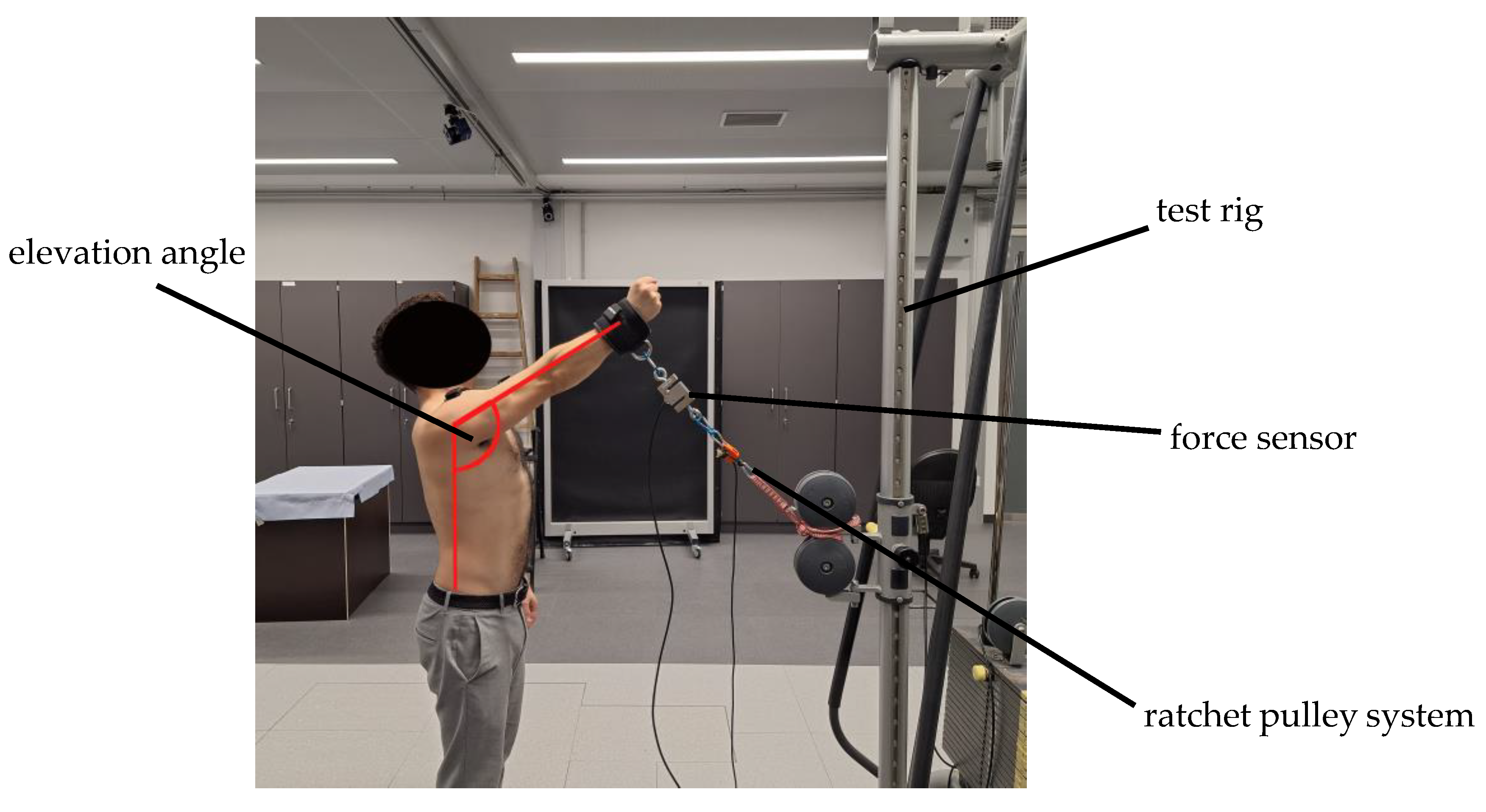
2.2. Testing Setup and Procedure
2.3. Torque Calculation
2.4. Sensor Placement
2.5. Data Collection and Processing
2.6. Statistical Analysis
3. Results
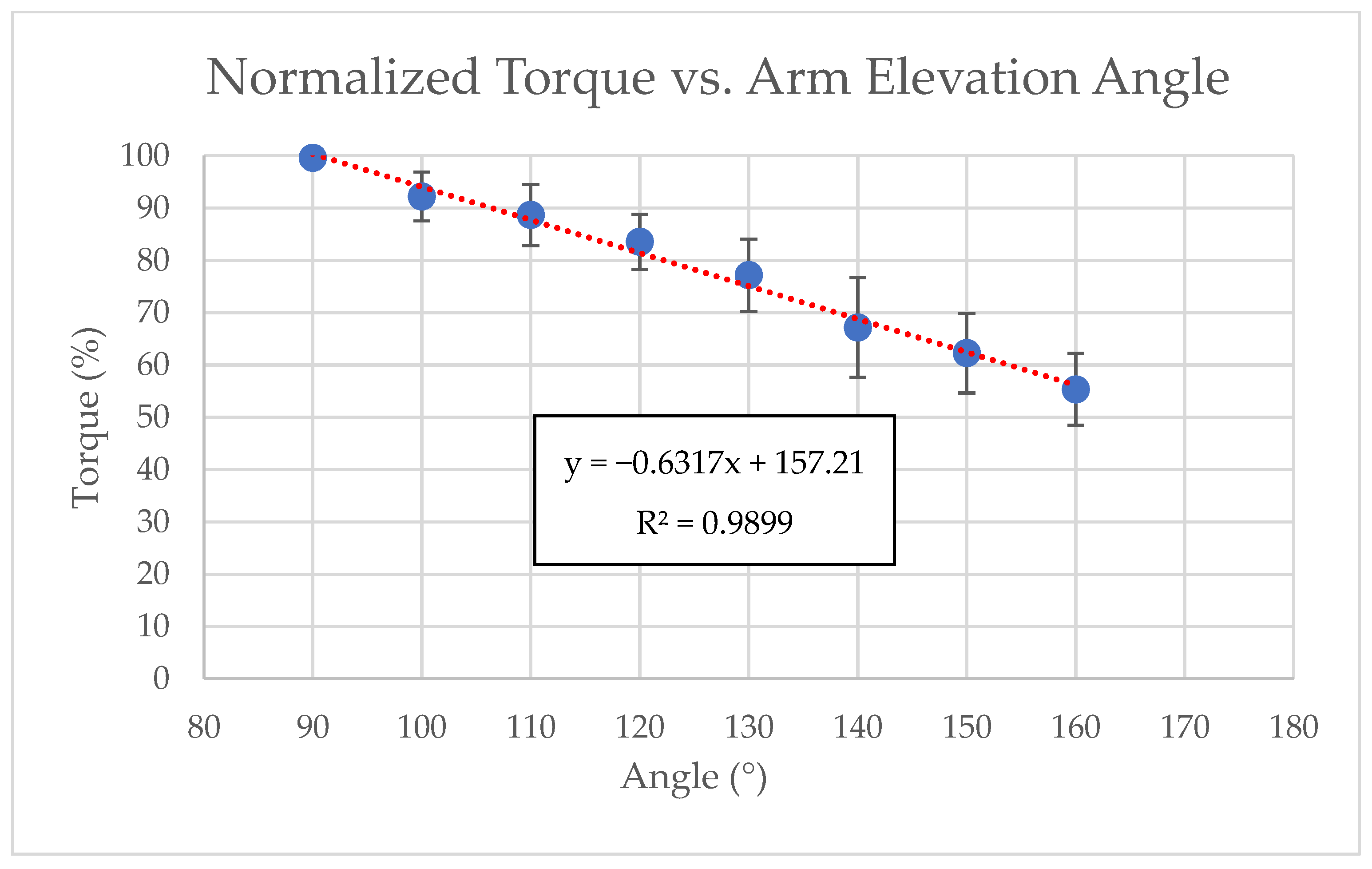
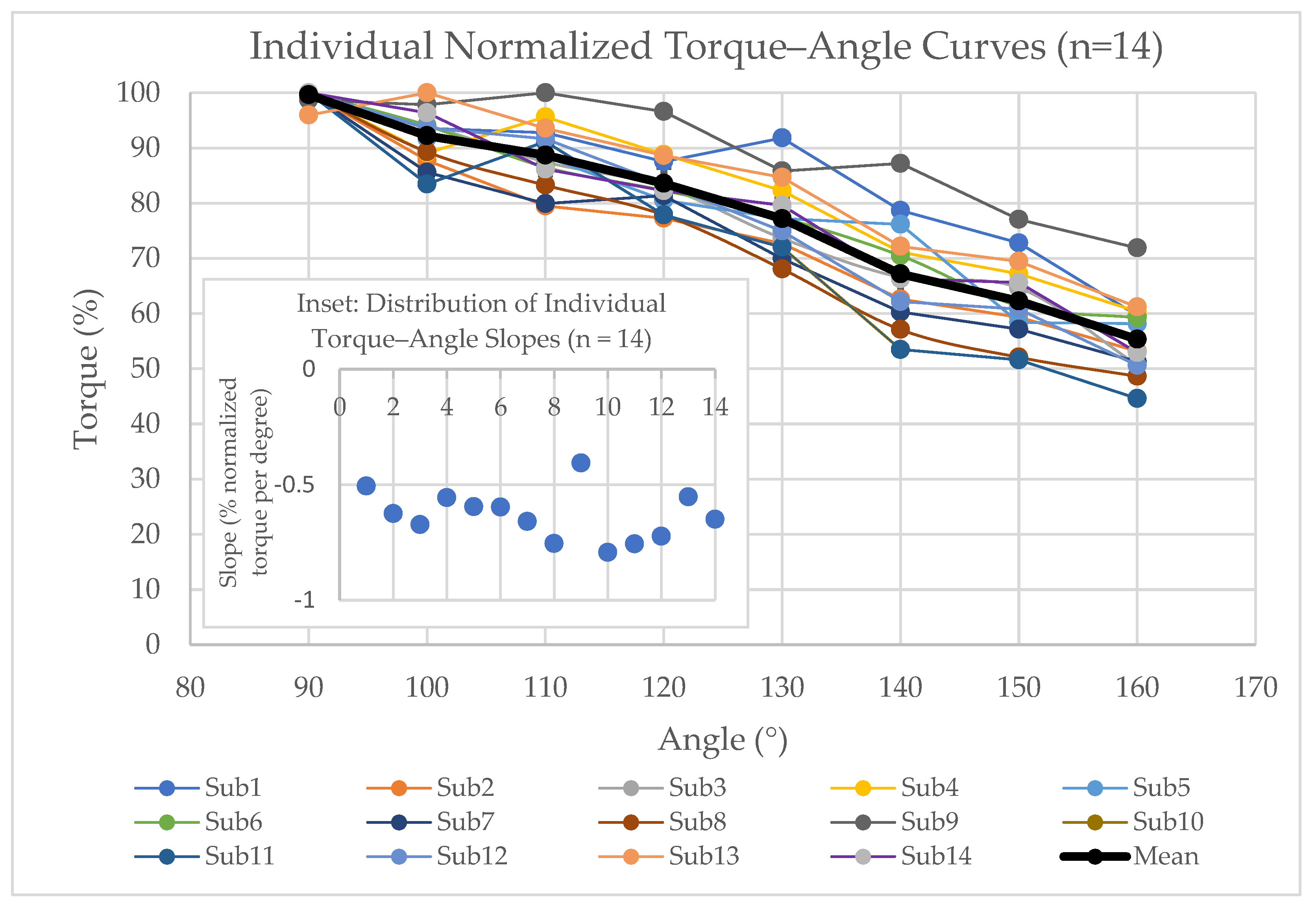
3.1. Normalized Shoulder Flexion Torque vs. Elevation Angle
3.2. Actual Shoulder Flexion Torque with Elevation Angle
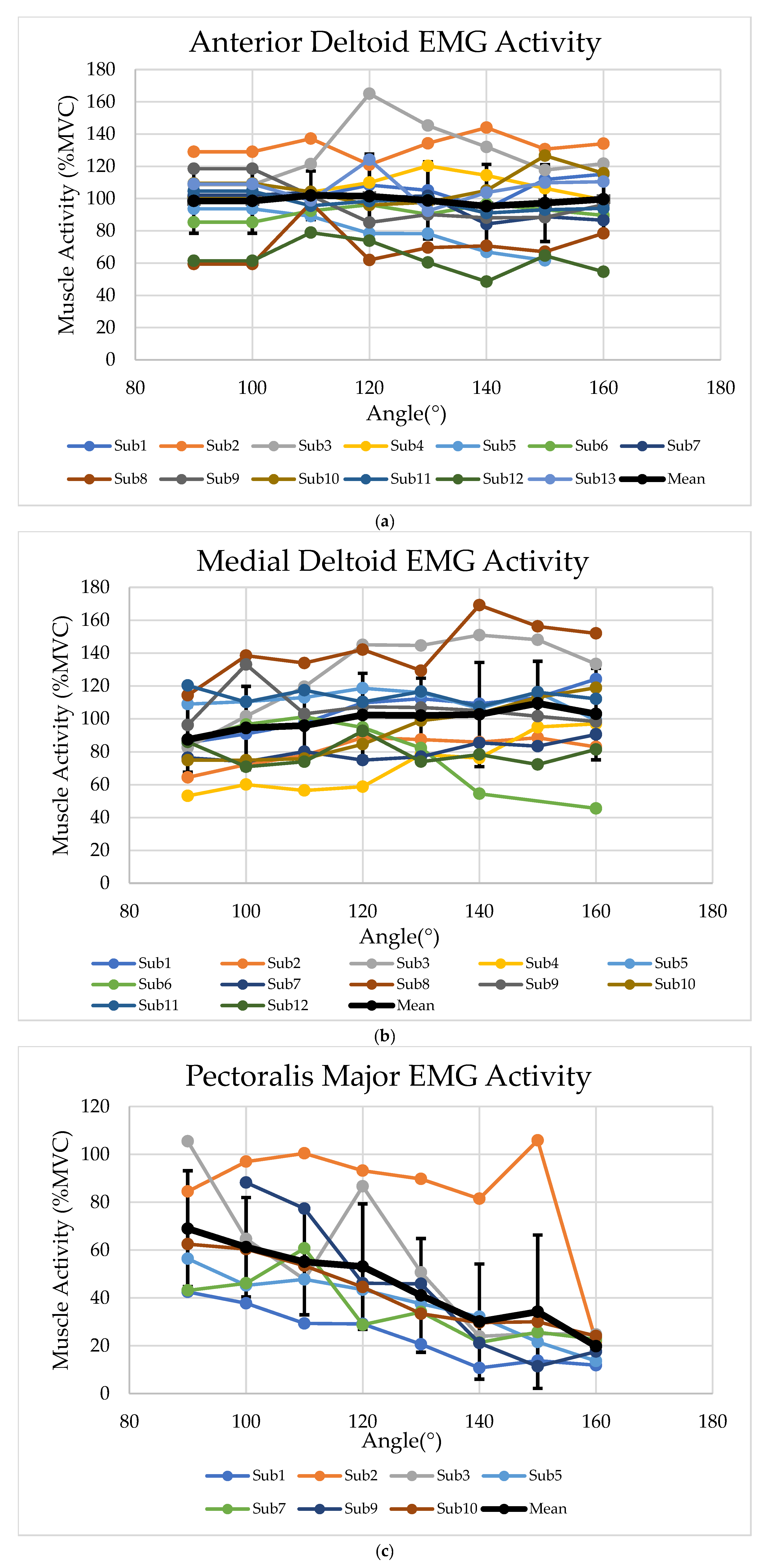
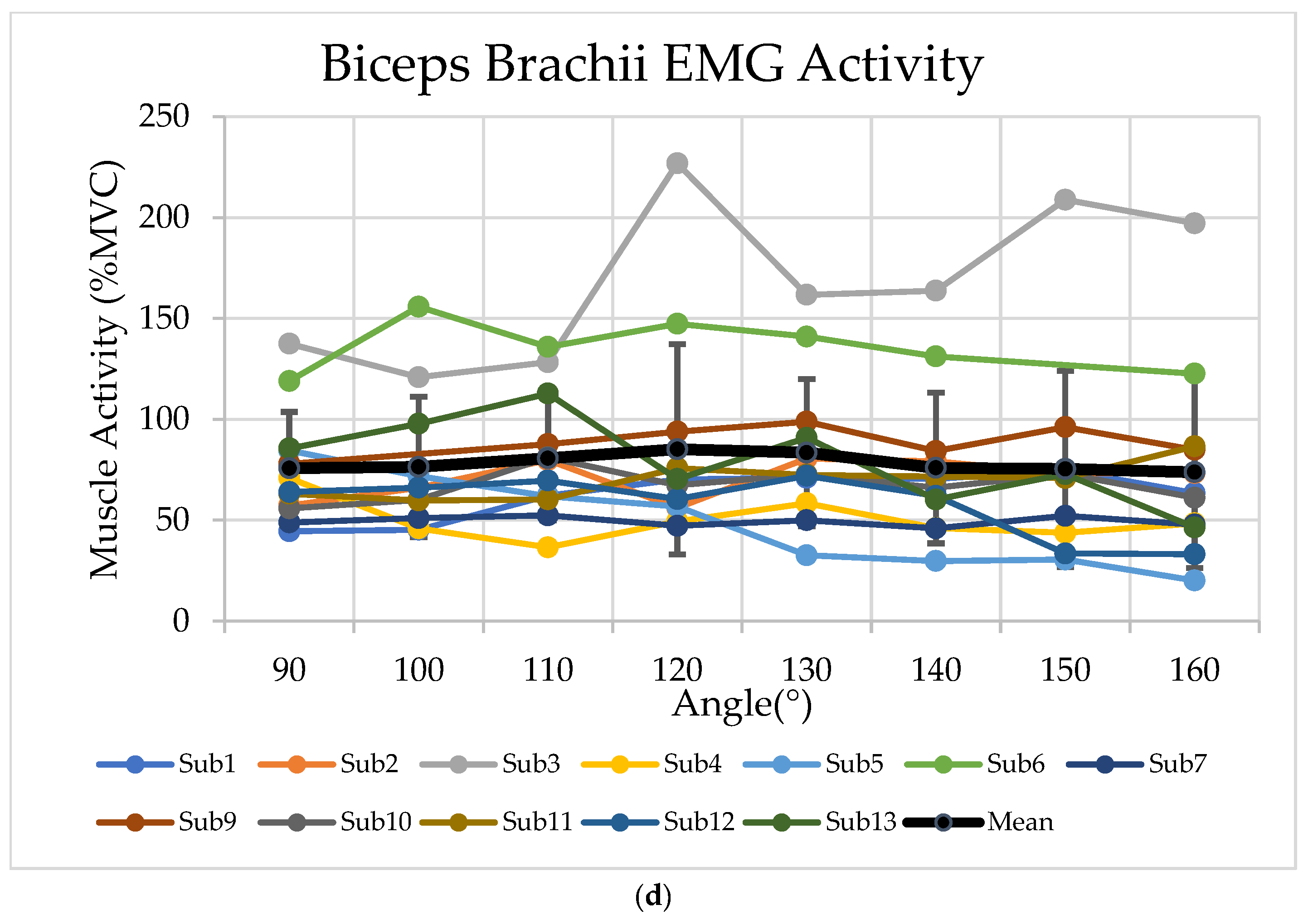
3.3. Muscle Activation Profiles During Isometric Shoulder Flexion
4. Discussion
4.1. Interpretation of Torque–Elevation Dynamics
4.2. Muscle Activation Patterns Across Elevation Angles
4.3. Mechanistic Insights: Torque–Activation Relationships
4.4. Limitations
4.5. Implications and Applications
4.6. Future Directions
5. Conclusions
Author Contributions
Funding
Institutional Review Board Statement
Informed Consent Statement
Data Availability Statement
Acknowledgments
Conflicts of Interest
References
- European Agency for Safety and Health at Work. Workplace Safety and Health in the EU: Trends and Statistics. 2019. Available online: https://osha.europa.eu/en/facts-and-figures (accessed on 4 November 2025).
- Dickerson, C.R.; Brookham, R.L.; Chopp, J.N. The working shoulder: Assessing demands, identifying risks, and promoting healthy occupational performance. Phys. Ther. Rev. 2011, 16, 310–320. [Google Scholar] [CrossRef]
- Anderson, V.; Bernard, B.; Burt, S.E.; Cole, L.L.; Estill, C.; Fine, L.J.; Grant, K.; Gjessing, C.; Jenkins, L.; Hurrell, J.J.; et al. Musculoskeletal Disorders and Workplace Factors: A Critical Review of Epidemiologic Evidence for Work-Related Musculoskeletal Disorders of the Neck, Upper Extremity, and Low Back; U.S. Department of Health and Human Services, Public Health Service, Centers for Disease Control and Prevention, National Institute for Occupational Safety and Health: Cincinnati, OH, USA, 1997; Available online: https://www.researchgate.net/publication/255875317_Musculoskeletal_Disorders_and_Workplace_Factors_A_Critical_Review_of_Epidemiologic_Evidence_for_Work-Related_Musculoskeletal_Disorders_of_the_Neck_Upper_Extremity_and_Low_Back (accessed on 4 November 2025).
- Dickerson, C.R.; McDonald, A.C.; Chopp-Hurley, J.N. Between Two Rocks and in a Hard Place: Reflecting on the Biomechanical Basis of Shoulder Occupational Musculoskeletal Disorders. Hum. Factors 2023, 65, 879–890. [Google Scholar] [CrossRef] [PubMed]
- Alexandrov, A.; Morton, A.; Molino, J.; Pelusi, J.; Chrostek, C.A.; Crisco, J.J.; Arcand, M.A. Investigating the Effect of Elevation and Sex-Based Differences on Shoulder Proprioceptive Accuracy. Orthop. J. Sports Med. 2025, 13, 23259671251315524. [Google Scholar] [CrossRef]
- Suprak, D.N.; Sahlberg, J.D.; Chalmers, G.R.; Cunningham, W. Shoulder elevation affects joint position sense and muscle activation differently in upright and supine body orientations. Hum. Mov. Sci. 2016, 46, 148–158. [Google Scholar] [CrossRef]
- Moghadam, A.N.; Mohammadi, R.; Arab, A.M.; Kazamnajad, A. The effect of shoulder core exercises on isometric torque of glenohumeral joint movements in healthy young females. J. Res. Med. Sci. 2011, 16, 1555–1563. [Google Scholar]
- Hecker, A.; Aguirre, J.; Eichenberger, U.; Rosner, J.; Schubert, M.; Sutter, R.; Wieser, K.; Bouaicha, S. Deltoid muscle contribution to shoulder flexion and abduction strength: An experimental approach. J. Shoulder Elb. Surg. 2021, 30, e60–e68. [Google Scholar] [CrossRef]
- Chow, A.Y.; Dickerson, C.R. Shoulder strength of females while sitting and standing as a function of hand location and force direction. Appl. Ergon. 2009, 40, 303–308. [Google Scholar] [CrossRef]
- Michiels, I.; Bodem, F. The deltoid muscle: An electromyographical analysis of its activity in arm abduction in various body postures. Int. Orthop. 1992, 16, 268–271. [Google Scholar] [CrossRef]
- Bravi, M.; Fossati, C.; Giombini, A.; Mannacio, E.; Borzuola, R.; Papalia, R.; Pigozzi, F.; Macaluso, A. Do the testing posture and the grip modality influence the shoulder maximal voluntary isometric contraction? J. Funct. Morphol. Kinesiol. 2023, 8, 45. [Google Scholar] [CrossRef] [PubMed]
- Bober, T.; Kulig, K.; Burnfield, J.M.; Pietraszewski, B. Predictive torque equations for joints of the extremities. Acta Bioeng. Biomech. 2002, 4, 23–60. [Google Scholar]
- Grazi, L.; Trigili, E.; Fiore, M.; Giovacchini, F.; Sabatini, A.M.; Vitiello, N.; Crea, S. Passive shoulder occupational exoskeleton reduces shoulder muscle coactivation in repetitive arm movements. Sci. Rep. 2024, 14, 27843. [Google Scholar] [CrossRef]
- Ackland, D.C.; Pak, P.; Richardson, M.; Pandy, M.G. Moment arms of the muscles crossing the anatomical shoulder. Am. J. Anat. 2008, 213, 383–390. [Google Scholar] [CrossRef]
- Ackland, D.C.; Pandy, M.G. Lines of action and stabilizing potential of the shoulder musculature. Am. J. Anat. 2009, 215, 184–197. [Google Scholar] [CrossRef]
- Inoue, S.; Sato, M.; Takahashi, Y.; Tamura, M.; Ozaki, H.; Furuya, K.; Nishinaka, N. Investigation of the association between shoulder flexion range of motion and deltoid and trapezius muscle activity after reverse total shoulder arthroplasty. J. Phys. Ther. Sci. 2025, 37, 537–545. [Google Scholar] [CrossRef]
- Landin, D.; Thompson, M.; Jackson, M.R. Actions of the Biceps Brachii at the Shoulder: A Review. J. Clin. Med. Res. 2017, 9, 667–670. [Google Scholar] [CrossRef][Green Version]
- Krainak, D.M.; Ellis, M.D.; Bury, K.; Churchill, S.; Pavlovics, E.; Pearson, L.; Shah, M.; Dewald, J.P. The effects of body orientation on maximum voluntary arm torques. Muscle Nerve 2011, 44, 805–813. [Google Scholar] [CrossRef] [PubMed]
- Beardsley, C.L.; Howard, A.B.; Wisotsky, S.M.; Shafritz, A.B.; Beynnon, B.D. Analyzing glenohumeral torque–rotation response in vivo. Clin. Biomech. 2010, 25, 759–764. [Google Scholar] [CrossRef] [PubMed][Green Version]
- Meskers, C.; van der Helm, F.; Rozendaal, L.; Rozing, P. In vivo estimation of the glenohumeral joint rotation center from scapular bony landmarks by linear regression. J. Biomech. 1997, 31, 93–96. [Google Scholar] [CrossRef]
- Koepke, N.; Zwahlen, M.; Wells, J.C.; Bender, N.; Henneberg, M.; Rühli, F.J.; Staub, K. Comparison of 3D laser-based photonic scans and manual anthropometric measurements of body size and composition. PeerJ 2017, 5, e2980. [Google Scholar] [CrossRef] [PubMed]
- Winter, D.A. Biomechanics and Motor Control of Human Movement, 4th ed.; Wiley: Hoboken, NJ, USA, 2009; Available online: https://onlinelibrary.wiley.com/doi/book/10.1002/9780470549148 (accessed on 7 November 2025).
- Stegeman, D.F.; Hermens, H.J. Standards for Surface Electromyography: The European Project Surface EMG for Non-Invasive Assessment of Muscles (SENIAM); Roessingh Research and Development: Enschede, The Netherlands, 2007; Available online: https://www.researchgate.net/publication/228486725_Standards_for_suface_electromyography_The_European_project_Surface_EMG_for_non-invasive_assessment_of_muscles_SENIAM (accessed on 7 November 2025).
- Katsavelis, D.; Threlkeld, A.J. Quantifying thigh muscle co-activation during isometric knee extension contractions: Within- and between-session reliability. J. Electromyogr. Kinesiol. 2014, 24, 502–507. [Google Scholar] [CrossRef]
- Gorgey, A.S.; Dudley, G.A. The role of pulse duration and stimulation duration in maximizing the normalized torque during neuromuscular electrical stimulation. J. Orthop. Sports Phys. Ther. 2008, 38, 508–516. [Google Scholar] [CrossRef] [PubMed]
- Alshatti, T.A.; Summers, S.; Hankin, F.M.; Kulig, K. Accuracy of two methods in estimating target muscle force during shoulder submaximal isometric contractions. Int. J. Sports Phys. Ther. 2025, 20, 79. Available online: https://ijspt.scholasticahq.com/article/127141 (accessed on 18 December 2025). [CrossRef] [PubMed]
- Papotto, B.M.; Rice, T.; Malone, T.; Butterfield, T.; Uhl, T.L. Reliability of isometric and eccentric isokinetic shoulder external rotation. J. Sport Rehabil. 2016, 25, 1–7. [Google Scholar] [CrossRef]
- Calver, R.; Cudlip, A.; Dickerson, C.R.; Mondal, P.; Butcher, S.; Kim, S.Y. A comparison of isometric and isokinetic normalization methods for electromyographic data from sub-regions of supraspinatus and infraspinatus during dynamic tasks. Int. Biomech. 2023, 10, 1–9. [Google Scholar] [CrossRef] [PubMed]
- Burden, A. How should we normalize electromyograms obtained from healthy participants? What we have learned from over 25 years of research. J. Electromyogr. Kinesiol. 2010, 20, 1023–1035. [Google Scholar] [CrossRef]
- Ito, Y.; Matsumoto, H.; Ishida, T.; Suenaga, N.; Oizumi, N. Electromyographic activities of glenohumeral joint muscles during shoulder forward flexion with isometric horizontal abduction loading. J. Shoulder Elb. Surg. 2023, 32, 1718–1727. [Google Scholar] [CrossRef]
- Ashworth, B.; Hank, M.; Khaiyat, O.; Coyles, G.; Miratsky, P.; Verbruggen, F.F.; Zahalka, F.; Maly, T. Muscle activity relationships during isometric shoulder internal and external rotation using the ForceFrame dynamometer and athletic shoulder tests in baseball athletes. Front. Physiol. 2025, 16, 1632248. [Google Scholar] [CrossRef]
- Hug, F.; Goupille, C.; Baum, D.; Raiteri, B.J.; Hodges, P.W.; Tucker, K. Nature of the coupling between neural drive and force-generating capacity in the human quadriceps muscle. Proc. R. Soc. B Biol. Sci. 2015, 282, 20151908. [Google Scholar] [CrossRef]
- Wang, Z.; Persad, L.S.; Binder-Markey, B.I.; Hoffman, E.M.; Litchy, W.J.; Shin, A.Y.; Kaufman, K.R.; Lieber, R.L. In vivo human gracilis muscle active force-length relationship is explained by the sliding filament theory. J. Physiol. 2025, 603, 3049–3059. [Google Scholar] [CrossRef]
- De Wilde, L.; Audenaert, E.; Barbaix, E.; Audenaert, A.; Soudan, K. Consequences of deltoid muscle elongation on deltoid muscle performance: A computerised study. Clin. Biomech. 2002, 17, 499–505. [Google Scholar] [CrossRef]
- Elder, A.; Powers, C.M. Scapular Stabilization for Shoulder Pain: Putting the Cart Before the Horse? Int. J. Sports Phys. Ther. 2025, 20, 275–282. [Google Scholar] [CrossRef]
- Lieber, R.L. Skeletal Muscle Structure, Function, and Plasticity, 2nd ed.; Lippincott Williams & Wilkins: Philadelphia, PA, USA, 2002; Available online: https://books.google.lu/books?id=T0fbq_b89cAC (accessed on 12 November 2025).
- Bosch, T.; van Eck, J.; Knitel, K.; de Looze, M. The effects of a passive exoskeleton on muscle activity, discomfort and endurance time in forward bending work. Appl. Ergon. 2016, 54, 212–217. [Google Scholar] [CrossRef] [PubMed]
- di Luzio, F.S.; Tamantini, C.; Di Maro, R.; Carnazzo, C.; Spada, S.; Draicchio, F.; Zollo, L. Biomechanical and physiological effects of passive upper limb exoskeletons in simulated manufacturing tasks. Wearable Technol. 2025, 6, e37. [Google Scholar] [CrossRef]
- Gurney, A.B.; Mermier, C.; LaPlante, M.; Majumdar, A.; O’Neill, K.; Shewman, T.; Gurney, J.G. Shoulder Electromyography Measurements During Activities of Daily Living and Routine Rehabilitation Exercises. J. Orthop. Sports Phys. Ther. 2016, 46, 375–383. [Google Scholar] [CrossRef] [PubMed]
- Yang, J.; Lee, J.; Lee, B.; Kim, S.; Shin, D.; Lee, Y.; Lee, J.; Han, D.; Choi, S. The effects of elbow joint angle changes on elbow flexor and extensor muscle strength and activation. J. Phys. Ther. Sci. 2014, 26, 1079–1082. [Google Scholar] [CrossRef] [PubMed]



| Actual Values | Normalized Values | |||
|---|---|---|---|---|
| Elevation Angle (°) | Mean (Nm) | SD (Nm) | Mean (%) | SD (%) |
| 90 | 77.24 | 13.81 | 99.62 | 1.11 |
| 100 | 71.81 | 14.87 | 92.20 | 4.67 |
| 110 | 68.85 | 13.73 | 88.68 | 5.85 |
| 120 | 64.92 | 13.07 | 83.57 | 5.28 |
| 130 | 59.92 | 12.33 | 77.17 | 6.92 |
| 140 | 52.37 | 13.56 | 67.16 | 9.50 |
| 150 | 48.29 | 10.71 | 62.27 | 7.62 |
| 160 | 43.19 | 10.84 | 55.33 | 6.88 |
| Normalized EMG Activity | ||||
|---|---|---|---|---|
| Elev. Angle (°) | AD | MD | BB | PM |
| 90 | 100.0 (-) | 87.5 ± 19.9 | 75.7 ± 28.0 | 68.9 ± 24.2 |
| 90 (n) | n = 12 | n = 12 | n = 12 | n = 7 |
| 100 | 98.5 ± 20.0 | 94.4 ± 25.3 | 76.4 ± 34.7 | 61.2 ± 20.8 |
| 100 (n) | n = 13 | n = 12 | n = 11 | n = 7 |
| 110 | 102.0 ± 15.1 | 95.8 ± 23.0 | 80.7 ± 30.7 | 55.1 ± 22.2 |
| 110 (n) | n = 12 | n = 12 | n = 12 | n = 7 |
| 120 | 101.5 ± 26.2 | 102.2 ± 25.4 | 85.1 ± 52.1 | 53.1 ± 26.2 |
| 120 (n) | n = 13 | n = 12 | n = 12 | n = 7 |
| 130 | 98.8 ± 23.9 | 101.9 ± 22.7 | 83.5 ± 36.4 | 41.0 ± 23.8 |
| 130 (n) | n = 13 | n = 12 | n = 12 | n = 7 |
| 140 | 95.3 ± 25.9 | 102.6 ± 31.6 | 75.9 ± 37.4 | 30.1 ± 24.1 |
| 140 (n) | n = 13 | n = 12 | n = 12 | n = 7 |
| 150 | 97.2 ± 23.9 | 109.4 ± 25.6 | 75.4 ± 48.6 | 34.2 ± 32.1 |
| 150 (n) | n = 12 | n = 11 | n = 11 | n = 7 |
| 160 | 99.6 ± 21.5 | 102.9 ± 27.8 | 73.8 ± 47.4 | 19.8 ± 5.6 |
| 160 (n) | n = 12 | n = 12 | n = 12 | n = 6 |
Disclaimer/Publisher’s Note: The statements, opinions and data contained in all publications are solely those of the individual author(s) and contributor(s) and not of MDPI and/or the editor(s). MDPI and/or the editor(s) disclaim responsibility for any injury to people or property resulting from any ideas, methods, instructions or products referred to in the content. |
© 2025 by the authors. Licensee MDPI, Basel, Switzerland. This article is an open access article distributed under the terms and conditions of the Creative Commons Attribution (CC BY) license.
Share and Cite
Aronis, G.; Kurz, M.; Wimmer, F.; Hackl, H.; Angeli, T.; Gföhler, M. Maximum Shoulder Torque and Muscle Activation During Standing Arm Flexion: Reference Data for Biomechanical and Ergonomic Applications. J. Funct. Morphol. Kinesiol. 2026, 11, 20. https://doi.org/10.3390/jfmk11010020
Aronis G, Kurz M, Wimmer F, Hackl H, Angeli T, Gföhler M. Maximum Shoulder Torque and Muscle Activation During Standing Arm Flexion: Reference Data for Biomechanical and Ergonomic Applications. Journal of Functional Morphology and Kinesiology. 2026; 11(1):20. https://doi.org/10.3390/jfmk11010020
Chicago/Turabian StyleAronis, Georgios, Michael Kurz, Florian Wimmer, Harald Hackl, Thomas Angeli, and Margit Gföhler. 2026. "Maximum Shoulder Torque and Muscle Activation During Standing Arm Flexion: Reference Data for Biomechanical and Ergonomic Applications" Journal of Functional Morphology and Kinesiology 11, no. 1: 20. https://doi.org/10.3390/jfmk11010020
APA StyleAronis, G., Kurz, M., Wimmer, F., Hackl, H., Angeli, T., & Gföhler, M. (2026). Maximum Shoulder Torque and Muscle Activation During Standing Arm Flexion: Reference Data for Biomechanical and Ergonomic Applications. Journal of Functional Morphology and Kinesiology, 11(1), 20. https://doi.org/10.3390/jfmk11010020