1. Introduction
Research consistently demonstrates that lesbian, gay, bisexual, transgender or queer (LGBTQ+) young people experience significantly poorer mental health than their heterosexual peers, including higher levels of psychological distress, depression, and suicidal ideation, as well as lower levels of wellbeing and perceived social support [
1,
2,
3]. These disparities are widely understood as consequences of minority stress [
4], produced through experiences of prejudice and stigmatization, which are reported to be particularly salient in school environments [
5,
6].
At the same time, the social acceptance of homosexuality has advanced significantly over the past several decades in many regions of the world. Numerous countries have taken significant steps by acknowledging same-sex partnerships within their legal frameworks and incorporating protections against discrimination based on sexual orientation, gender identity, and/or gender expression. Such substantial legal progress has actively contributed to lessening of prejudice and discrimination towards LGBTQ+ people. Stigma towards Human Immunodeficiency Virus/Acquired Immunodeficiency Syndrome (HIV/AIDS) also seems to be on the decline, not least because HIV infection is no longer a “death sentence” but a manageable chronic condition. These changes correspond with the predictions of some scholars of intimacy who already in the 1990s noted that gradual but profound changes are taking place in the sphere of intimacy and sexuality in contemporary Western societies [
7,
8,
9].
These broader changes were the context of our study on secondary school students in Slovenia. On the one hand, sexual diversity has become more socially visible and, in many respects, more accepted; on the other hand, evidence from Slovenia points to persistent—and in some respects increasing—experiences of homophobic violence among young gay and lesbian people in school settings. Notably, the longitudinal study on the everyday lives of gays and lesbians in Slovenia [
10] shows that experiences of homophobic violence in schools have doubled over the past two decades. In 2004, approximately 22% of surveyed gays and lesbians reported that their schoolmates were perpetrators of homophobic violence; ten years later this share had increased to around 44%, a level that has remained stable in the most recent data from 2024 [
11].
Existing research further indicates that attitudes toward sexual minorities are not homogeneous. Attitudes toward sexual diversity are shaped by sociodemographic factors, particularly gender, religiosity, and educational level. However, the role of education has been insufficiently examined among adolescents, despite consistent evidence from adult populations linking higher levels of education to greater acceptance of sexual minorities [
12]. Addressing this gap in the context of Slovenia, which in 2022 became the first state in post-socialist Eastern Europe to legalize same-sex marriage, is a key contribution of the present study. In this article, we specifically examine secondary school students’ attitudes toward homosexuality and their social distance toward people living with HIV/AIDS.
The findings of the study addressed in this article were gathered right after the contentious public debate and referendum on marriage equality in 2015, as well as before the legalization of marriage equality [
13]. Therefore, the findings show how Slovenia’s last generation of young people felt about homosexuality and HIV/AIDS before marriage equality legislation was passed. The results are part of a broader sociological and public health study on sexuality among secondary school students, a follow-up to the two “Youth and AIDS I and II” surveys conducted by Bernik [
14] and his colleagues in the mid-1990s.
The article is structured as follows. First, we briefly review existing research on attitudes toward homosexuality and social distance toward people living with HIV/AIDS, with particular attention to studies focusing on adolescents. Second, we outline the Slovenian context in terms of LGBTQ+ rights and the social position of LGBTQ+ people. The methodological section then presents the research design and research questions. Finally, the results are discussed in the concluding section.
2. Attitudes Toward Homosexuality in Cultural, Religious, and Gendered Contexts
A wide range of psychological and sociological approaches has been used to explain attitudes toward homosexuality [
15]. Research consistently shows that such attitudes are shaped by cultural and religious background, gender, personal experiences, and contact with LGBTQ+ individuals, as well as by broader ideological orientations such as gender-role beliefs and authoritarianism. Religiosity emerges as one of the most robust predictors of negative attitudes: more religious and traditional individuals tend to express higher levels of homonegativity [
16], a pattern also confirmed by World Value Survey data [
17]. Comparative studies demonstrate that followers of different religions express more negative attitudes than non-religious individuals [
18], while cross-national differences are partly explained by cultural orientations intersecting with religion [
19]. Social context also matters, as more supportive legal and policy environments are associated with more positive attitudes toward homosexuality [
20,
21].
Gender differences are another well-established finding, with men generally holding more negative attitudes and women more positive ones [
22,
23,
24]. Negative attitudes are closely linked to traditional gender-role beliefs, modern sexism, and hypermasculinity [
25], with men showing particularly strong negativity toward gay men [
26,
27,
28], especially when traditional gender dichotomies are perceived as threatened [
29]. Attitudes are further shaped by social norms, political conservatism, and intergenerational transmission [
30,
31,
32]. Finally, personality traits such as openness to experience [
33] and empathy [
34] are associated with more positive attitudes toward homosexuality, a pattern also observed in attitudes toward HIV/AIDS [
35].
Studies that looked particularly into youth attitudes towards homosexuality demonstrate that sexual prejudice is best understood as a socially embedded, multi-level phenomenon rather than as an expression of individual pathology. Studies focusing on adolescents and youth consistently identify religiosity, adherence to traditional concepts of family and gender norms, conservative political orientation, negative attitudes toward feminism, and lack of contact with lesbian and gay individuals as key predictors of homophobia [
36,
37,
38]. Peer context also plays a crucial role: perceptions of friends’ agreement with one’s own attitudes, engagement in gender-typed activities, and peer-group norms significantly shape attitudes toward sexual minorities. Longitudinal studies further demonstrate that homophobic attitudes and behaviors are patterned at the peer-group level. Group norms can shape individual trajectories independently of personal characteristics, suggesting that homophobia functions as a social resource for regulating gender, enforcing conformity, and consolidating dominance within youth status systems [
39].
An important analytical distinction in research on adolescents concerns the difference between abstract moral judgments about homosexuality and concrete evaluations of how gay and lesbian peers should be treated in everyday settings [
40,
41]. Adolescents may endorse egalitarian principles at an abstract level while simultaneously tolerating or participating in exclusion, teasing, or harassment in peer interactions. This pattern can be fruitfully interpreted through Herek’s functional model of sexual prejudice [
15], which remains highly relevant for understanding youth attitudes. The model conceptualizes homophobic attitudes as serving experiential, defensive, and symbolic functions; for young people, the symbolic function appears particularly salient, as sexual prejudice becomes a means of expressing commitment to broader ideological systems such as traditional gender roles, heteronormativity, or religious orthodoxy.
As in the general population, gender also emerges as the most robust and consistent predictor of attitudes toward sexual diversity among students across cultural contexts. Female students generally report more positive attitudes than male students, a pattern widely attributed to masculinity norms and pressures toward gender conformity. Male students are especially likely to reject gay men who are perceived as violating dominant masculine ideals, underscoring the close link between homophobia and the policing of gender boundaries. Educational context further structures these attitudes: students in academically oriented, higher pre-university tracks tend to express greater tolerance than those in vocational tracks, pointing to the role of institutional pathways in shaping normative orientations [
12,
40,
42].
There is also a pronounced developmental dimension to sexual prejudice. Middle adolescence appears to be a period of heightened homophobia, often driven by peer pressure and the need for identity stabilization within gendered peer hierarchies. As young people move into late adolescence and young adulthood—particularly within higher education—attitudes tend to become more liberal. Universities often provide spaces for self-reflection, exposure to diversity, and personal growth that are less available in secondary education, although scholars caution that higher education curricula may still reproduce heterosexuality as the norm and homosexuality as the “other.” Reflecting these dynamics, research in this field has increasingly shifted away from individual-level explanations toward analyses that foreground social, structural, and intersectional factors [
43,
44].
Finally, attitudes toward homosexuality among youth are closely linked to social distance toward people living with HIV/AIDS. High levels of social distance persist among students, often driven by “stigma by association,” whereby HIV/AIDS remains symbolically linked to homosexuality. As a result, all sexually diverse individuals—including groups such as lesbians, who are at comparatively low risk of HIV infection—may be stigmatized simply by falling under the broader category of sexual minorities [
45]. This association underscores how attitudes toward homosexuality and HIV/AIDS stigma remain interconnected within broader regimes of sexual normativity.
3. The Slovenian Context
Slovenia, like many European countries, has seen a shift towards greater acceptance of homosexuality in recent decades. Historically, it has been considered the most tolerant and progressive society in the context of socialist Yugoslavia. After all, it was in Slovenia that the LGBT movement began in 1984, almost a decade earlier than in most post-socialist societies, where the LGBT movement only emerged in the aftermath of the change in the political system in 1990s [
46]. Accordingly, Slovenia is also ahead of other post-socialist societies in terms of the legal regulation of same-sex partnerships and families. In 2022, it became the first Eastern European country to adopt full marriage equality, including the possibility of joint adoption of children by same-sex couples.
The legal progress is consistent with the fact that the social distance towards homosexuals in Slovenia, as measured by the longitudinal Slovenian Public Opinion Survey, has also decreased significantly over the last twenty years. In the 1990s, around 60% of Slovenians did not want a homosexual as a neighbor, but in 2024 that number has dropped to 15% [
47]. Several further surveys also indicate relatively liberal attitudes towards LGBT individuals. More than 80% of respondents to the 2018 “Call it Hate” survey believed that LGBT individuals should be free to live their lives as they wished. Higher levels of agreement were reported by women, younger respondents, and those with a higher degree of education [
48]. The 2017 “Dare” survey, on the other hand, revealed a reluctance to observe non-heterosexual displays in public and indicated that public domain in Slovenia is still infused with the heteronormative expectations: more than 90% of respondents did not object if a man and a woman held hands in public. The same was true, albeit to a lesser extent, for kissing: 76% of respondents did not object if a man and a woman kissed in public. In terms of same-sex couples, the level of acceptance towards public displays of intimacy was notably lower: just over 63% of respondents did not mind if a same-sex pair held hands in public, and 47% did not mind if two men or two women kissed in public [
49].
Slovenia has never experienced a major outbreak of HIV infections. This is partly due to the fact that it is a small country with a population of only two million, but on the other hand, LGBT organizations have been running successful prevention and awareness campaigns in close cooperation with the public health service since the late 1980s. Today, Slovenia is one of the best European countries in terms of HIV control. Almost all confirmed infected people—around 850 of them, mostly men who have sex with men—are treated with effective drugs. According to data from December 2022, no one died of AIDS in Slovenia in the period 2018–2022 [
50].
HIV/AIDS in Slovenia has always been closely linked to men who have sex with men. In other groups, such as injecting drug users, the virus has never been widespread, so the stigmatized link between homosexuality and HIV has always existed. Nevertheless, there has been an important difference between LGBT people and people living with HIV: while LGBT individuals have entered the public imaginary of Slovenian society, especially in the last decade, including through the many personal stories of gays, lesbians, and transgender people in the Slovenian mass media, people living with HIV still do not have a “face”: no HIV+ person is known in public life in Slovenia. On the other hand, some out gays and lesbians occupy prominent positions in the country, including the first out gay man to become a minister in a center-left government in early 2023.
4. Methods
In designing the questionnaire, we drew on several foreign and domestic studies: a German longitudinal study on adolescent sexuality [
51], a Slovenian study on sexual behavior in the general population [
52], and a study on the intimate lifestyles of students in Slovenia [
53,
54]. Due to the complexity and comprehensiveness of the questionnaire, we first validated it with expert assessments from both experts in the methodology and experts in the subject area. Within the framework of the project, we carried out qualitative testing with focus groups of individual key terms and definitions of concepts in the questionnaire. Twenty-one online and 21 offline focus groups were conducted in the winter of 2014 by 21 moderators (each moderator conducted one online and one offline focus group). The moderators were international Master’s students enrolled in a methodological course. More details on these focus groups can be found in [
55]. Pilot testing was performed on two schools, one vocational and one general (altogether 77 students). No large drawbacks were found and only a few more precise descriptions of some terms were added.
We have drawn a random stratified systematic sample. We sampled separately general and vocational secondary schools. The sampling frame consisted of 145 general and 148 vocational schools. The sampling frame took into account the population share of students in general (40%) and vocational secondary schools (60%). Assuming an average ward size of 30 students, we estimated that we needed 27 general and 40 vocational secondary schools in the sample, with a maximum of two wards from each school (to avoid sampling design effects). We carried out a systematic sampling by dividing the total sample size by 27 and 40, respectively, to obtain the sampling interval. In the end, 52 schools participated in the survey, seven schools refused to be interviewed or could not be contacted, and seven schools could not be contacted despite repeated attempts.
The questionnaire was administered in an online format. The interviews took place in a computer lab at the selected school. The manager of the school designated a member of staff as a contact person who also chose the wards and time for the interviews. The member of staff from the school and a member of our research team were present at the interview. The final realized sample size is 2143, mostly third year students. The survey was carried out between January and March 2016.
Two dependent variables were used in the analysis:
- (1)
Attitudes towards homosexuality with six statements (e.g., “Gays and lesbians are as good parents as heterosexuals” or “Homosexuality is a disease”) on a five-point scale of (dis)agreement: Factor analysis with the PAF method showed that the variables measure a single factor, so we were able to use it as a Likert scale in further analyses, by calculating the average value of all statements. Factor loadings ranged between 0.39 and 0.85, and explained variance was 52.18%. Cronbach’s alpha was 0.85. The lower the value of this composite variable, the less homophobic the views expressed by the respondents, and vice versa.
- (2)
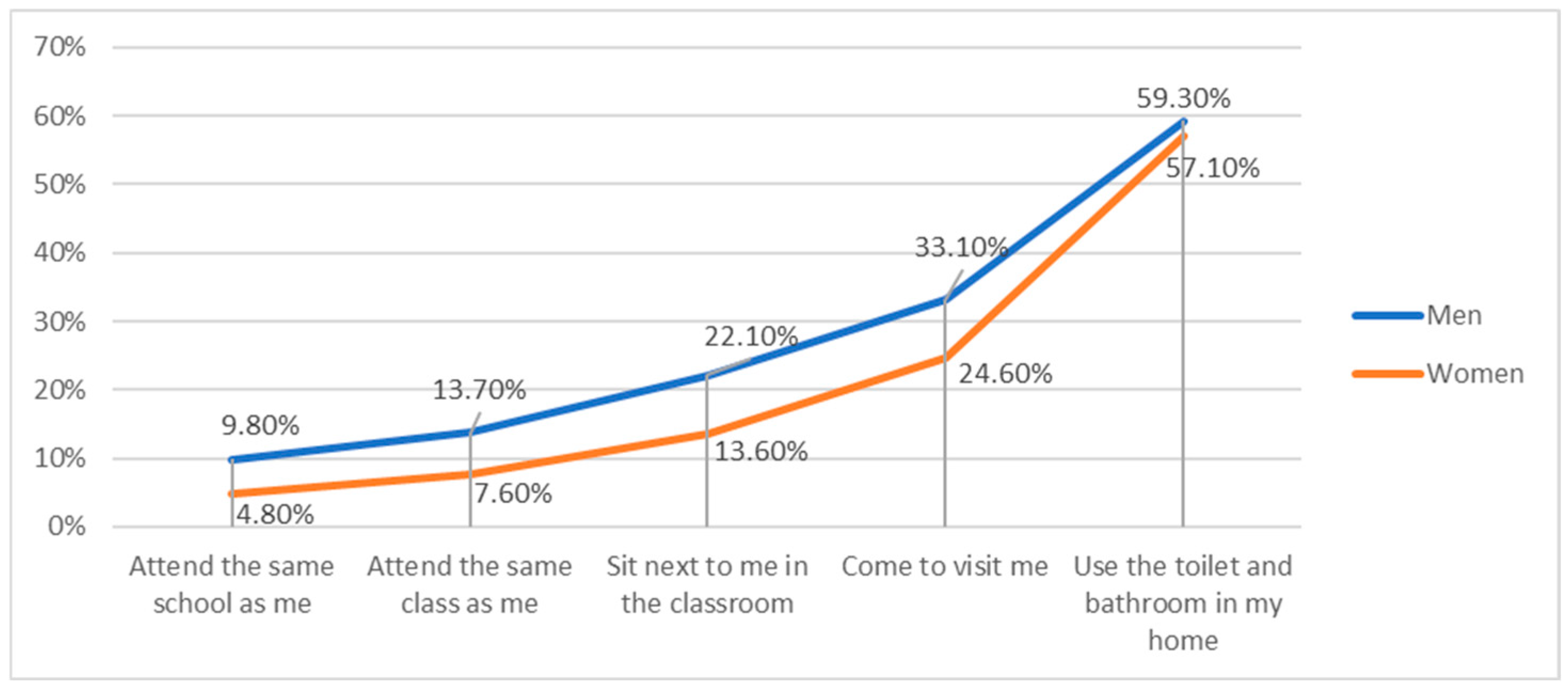
Social distance towards people living with HIV was measured by five graded statements: Would it bother you if a person you knew to be HIV-positive … (1) went to the same school with you; (2) went to the same class with you; (3) sat next to you in the same classroom; (4) came to your home to visit you; (5) used the toilet and bathroom in your home. Respondents could answer yes or no to the statements. Based on these five statements, we created a social distance index as the sum of the ‘yes’ answers. The lower the value of this index, the lower the social distance expressed, and vice versa.
The study set out four hypotheses:
H1. Men express more homophobic attitudes and greater social distance towards HIV+ people than women.
H2. Students from rural areas express more homophobic attitudes and greater social distance towards HIV+ people than those from urban and suburban areas.
H3. Students in vocational secondary schools express more homophobic attitudes and greater social distance towards HIV+ people than students in general secondary schools.
H4. Students who attend religious services express more homophobic attitudes and greater social distance towards HIV+ people than students who do not.
5. Results
In terms of the sample composition, 44.1% identify as female, while 55.9% identify as male. In total, 56.5% of the students come from vocational secondary schools, and 43.5% from general secondary schools. Moreover, 52.8% of students live in a village, 15.2% in a suburb, and 32.1% in a city. Further, 65.1% of students attend religious services. Attendance of religious services was measured on a four-point scale (1—yes, but only on special occasions, e.g., Christmas, wedding, 2—yes, but less than once a month, 2—yes, more than once a month, 4—no), but since one possible answer had a relatively low frequency, we decided to dichotomize it. Mean age of students was 17.7 years with standard deviation 0.5, minimum 15.6, and maximum 20.8.
Among the results in
Table 1, we first present the basic descriptive statistics for the two independent variables. The data suggests a relatively liberal attitude towards homosexuality, as the mean value is lower than the middle value. The expressed distance towards HIV+ people is low on average, as the mean value is low, but the differences between respondents are also relatively large, as the standard deviation is larger than the arithmetic mean.
Next, the effect of the independent variables on the dependent variable was tested using multiple classification analysis. Multiple classification analysis [
56] is a multivariate method that allows the association between several independent variables and one dependent variable to be examined. Unlike multiple regression analysis, it also allows the use of non-dichotomized categorical variables and therefore a more nuanced view on the effects and differences among groups of respondents.
Multiple classification analysis provides, inter alia, the following information:
The overall mean and the means of the dependent variable by group for each combination of categories of independent variables;
Tests of the statistical significance of the effects of the individual independent variables;
β—the strength of the effect of each independent variable (i.e., if all other independent variables are held constant);
The deviations from the overall average of the dependent variable for each category of independent variable (indicating by how much the average in that category is higher or lower than the overall average as a result of the influence of that independent variable);
R2: the proportion of explained variance for all independent variables combined.
In
Table 2, it is evident that both models as a whole are statistically significant (F statistic). However, it is noteworthy that the proportion of explained variance is quite low, particularly in relation to social distance towards individuals living with HIV, where it amounts to merely 0.03. For attitudes towards homosexuality, three variables were found to be statistically significant, with the strongest effect from gender (β = 0.44), followed by school type (β = 0.16) and attendance at religious services (β = 0.15). Place of residence did not have a statistically significant effect. The deviations from the overall mean show that men are on average slightly more homophobic than women, that vocational school students are slightly more homophobic, and that those who attend religious services are slightly more homophobic. However, only the effects of gender (β = 0.13) and school type (β = 0.10) were statistically significant for social distance towards HIV+ people. Consistent with our expectations, male respondents and students attending vocational schools exhibit greater social distance compared to female respondents and students enrolled in general secondary schools and other similar educational institutions.
Figure 1 below shows the proportion of affirmative responses concerning the notion of cohabitation, both in educational and domestic settings, with an individual living with HIV. Notably, female students exhibit a comparatively reduced social distance towards this particular social group. However, for both genders, a notable shift occurs specifically in the context of sharing a bathroom within the household. This observation implies that, while there may be an outward declaration of tolerance at a social expectation level, there exists a substantial potential for the manifestation of stigmatization and intolerance once students encounter closer proximity to individuals living with HIV.
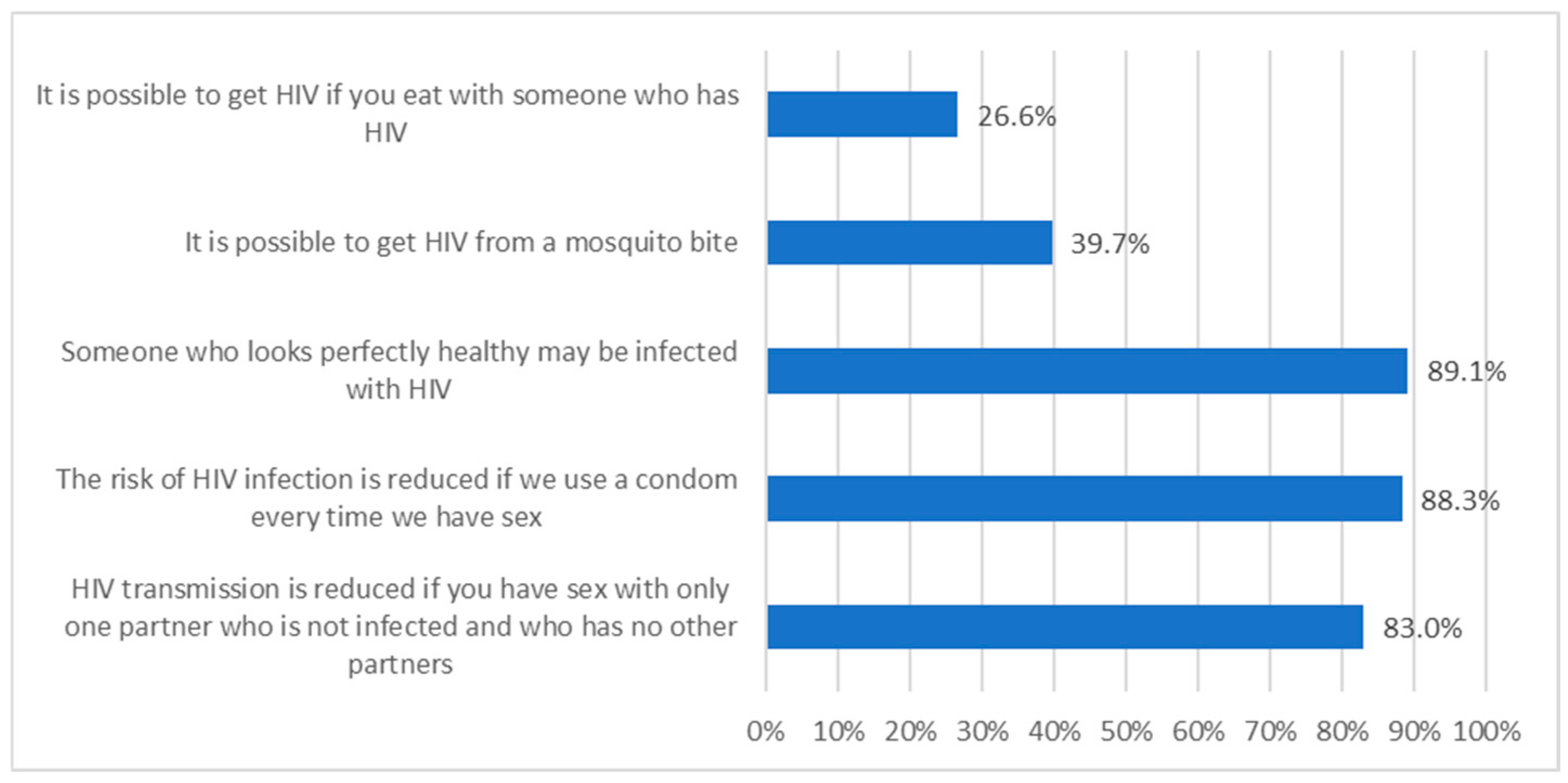
In a manner analogous to the phenomenon of social distance, an inherent duality can be observed in the attitudes towards individuals living with HIV, wherein individuals may express declarative acceptance while exhibiting rejection in the context of direct interpersonal engagement. Similarly, a duality is discernible in the realm of knowledge pertaining to HIV and the potential for viral transmission. While a substantial portion of students exhibit a satisfactory grasp of fundamental information concerning HIV, a disconcerting proportion of respondents persist in harboring misconceptions, including the belief that infection can occur through mosquito bites or the sharing of food (see
Figure 2).
In conclusion, we can say that we have fully confirmed the first and third hypotheses and partially confirmed the fourth hypothesis. However, the second hypothesis did not receive confirmation in our findings.
6. Discussion
The findings of this study provide insight into the factors shaping secondary school students’ attitudes toward homosexuality and people living with HIV in Slovenia. Gender, type of school, and attendance at religious services emerge as significant predictors of attitudes toward homosexuality, while social distance toward people living with HIV is only weakly explained by the examined sociodemographic variables.
Although Slovenia has seen substantial legal and normative liberalization regarding sexual diversity, our results align with evidence that schools can remain sites where heteronormativity is reproduced and where homophobic victimization persists. In adolescence, attitudes and behaviors are strongly shaped by peer-group norms and status dynamics, and school settings can amplify pressures to conform, especially around gender. In this sense, macro-level progress does not automatically translate into micro-level safety and inclusion: tolerance may be expressed in principle, while everyday peer interaction continues to police boundaries of acceptable masculinity and sexuality.
Consistent with previous research [
22,
23,
24], male students express more negative attitudes toward homosexuality than female students. Although the overall level of acceptance among Slovenian secondary school students is relatively high, gender differences remain pronounced, particularly among students attending vocational secondary schools. This pattern aligns with earlier findings on sexual attitudes: sexuality (e.g., double sexual standards, views on virginity) and gender norms and can be interpreted through sociological theories of the transformation of intimacy [
8,
9], which emphasize women’s role as carriers of more liberal changes in attitudes and practices related to sexuality.
At the same time, the gender gap is also consistent with developmental and sociological work that treats homophobia as a peer-regulatory practice linked to masculinity norms. Among boys in particular, distancing from homosexuality can function as a symbolic resource to demonstrate conformity to dominant masculine ideals and to secure status within gendered peer hierarchies. This helps explain why the strongest differences are observed among male students and why school contexts where traditional gender norms are more salient may intensify homonegative attitudes.
Our findings confirm a link between religious attendance and attitudes towards homosexuality, albeit with a relatively weaker correlation. This can be explained by the specific Slovenian context, characterized by a predominantly Catholic cultural tradition alongside a relatively high level of societal secularization. The widespread practice of religious customs and traditions does not necessarily align with strict adherence to religious dogma or belief. In other words, while people respect religious customs and practices in the sense of tradition, they do not necessarily follow all religious beliefs and may have liberal views in this regard, also in connection with sexuality. Respect for religious customs therefore often coexists with more liberal attitudes, a trend that may be attributed to the historical context of the limited power of the Catholic Church during socialism. Concurrently, the state’s emphasis on gender equality, family planning, sexual and reproductive health, and sex education has contributed to a broader acceptance of sexuality. This, of course, does not mean that attitudes toward homosexuality in socialism were positive, but the state’s equality policies certainly paved the way for more liberal attitudes toward sexuality in general, including gradual acceptance of sexual minorities among a portion of the population. These dynamics have shaped the attitudes of the younger generation, who are the offspring of parents raised in a more liberal atmosphere during socialism, even among those from more religious backgrounds.
Place of residence does not have a statistically significant effect, which can be attributed to the lack of a clear rural–urban divide in Slovenia. Despite rapid industrialization and modernization during socialism and afterwards, the country has maintained its predominantly rural character, with Ljubljana and Maribor serving as the primary urban centers. From the 1980s onwards, there has been a shift towards suburbanization around these major urban areas, driven by the perception of better living conditions and improved quality of life in rural areas [
57], and in recent decades by the more affordable housing outside Ljubljana. As a result, making a clear distinction between rural and urban areas becomes challenging and less meaningful compared to larger or more socially stratified societies. More broadly, this finding reinforces the idea that youth attitudes are socially embedded and context-dependent: classic rural–urban gradients observed elsewhere may weaken when everyday peer networks, commuting patterns, and media environments blur spatial boundaries. In such contexts, school-based peer norms may be more decisive than residential location per se.
Furthermore, additional data from the survey shed light on attitudes towards HIV-positive individuals and knowledge about HIV. Overall, social distance towards HIV-positive individuals was relatively low, with the explanatory variables displaying weak or nonexistent effects, explaining only a small portion of the variability but also revealing important contradictions. While students often express declarative acceptance, social distance increases markedly in situations involving closer personal contact, such as sharing household facilities. This finding points to the persistence of stigma at a more implicit level. This implicit stigma should also be interpreted in light of the well-documented “stigma by association” mechanism: HIV remains symbolically linked to homosexuality and sexual nonconformity, even in settings where biomedical knowledge and treatment availability have improved. As a result, social distance toward people living with HIV may partly reflect broader regimes of sexual normativity and moral evaluation rather than only fear of infection. In this way, HIV-related distancing can operate as an extension of sexual prejudice, especially in adolescent contexts where sexuality is a key terrain for boundary-making.
Moreover, the weak explanatory power of the models suggests that attitudes toward HIV are shaped less by stable sociodemographic characteristics and more by factors such as knowledge, misinformation, perceived risk, and emotional reactions. In addition, several factors contribute to this result as well. Firstly, the relatively low prevalence of HIV in Slovenia, or the perception thereof, influences attitudes and social distance. Secondly, advancements in medical treatments have transformed HIV from a fatal disease to a manageable chronic condition, further diminishing stigma and social distance. Thirdly, the reduced negative media coverage of HIV in recent decades, compared to previous years, contributes to a decreased salience of the issue. Lastly, improved research, education campaigns, and public knowledge about HIV and its prevention have fostered greater awareness and reduced misconceptions among the population, albeit with exceptions. The fact is that social distance towards people living with HIV breaks down at the point of most intimate contact with them (i.e., using the same toilet and bathroom). A considerable amount of stigma and misunderstanding remains hidden at this level of intimate contact. This pattern mirrors the theoretical distinction between abstract endorsement of egalitarian principles and concrete evaluations in everyday situations. In other words, students may express acceptance at the level of social desirability or general norms, while rejecting close contact when scenarios become personal and embodied. Such discrepancies are consistent with functional accounts of prejudice in which symbolic and defensive functions become particularly salient in adolescence.
The data on HIV-related knowledge further supports this interpretation. Despite relatively widespread awareness of basic facts, a substantial proportion of students continue to hold incorrect beliefs about modes of HIV transmission. The coexistence of declarative tolerance, persistent misinformation, and latent fear highlights the complexity of HIV-related stigma, even in a context where HIV prevalence is low, and effective treatment is widely available.
These findings point to significant gaps in how young people acquire and interpret information about HIV, particularly in digital environments where misinformation is widespread. At the same time, they underscore the need for a comprehensive and systematically organized approach to sex education. In the Slovenian context, sex education remains largely focused on biological and reproductive aspects of sexuality and predominantly framed within heterosexual norms, while topics such as equality, diversity, and the lived experiences of sexual and gender minorities are largely absent from the curriculum.
Limitations of the Study
Several limitations should be considered when interpreting the findings. First, the study is based on a cross-sectional design and therefore does not allow for causal conclusions regarding the relationships between sociodemographic factors and attitudes. Second, the explanatory power of the statistical models—particularly for social distance toward people living with HIV—is low, indicating that important explanatory variables were not included. Factors such as personal contact with LGBTQ+ individuals or people living with HIV, political orientation, family socialization, and media exposure may play a significant role and should be addressed in future research.
Third, the study relies on self-reported data collected in a school setting, which may be affected by social desirability bias, especially given the sensitive nature of the topics. Fourth, the measurement of social distance toward people living with HIV relied on dichotomous response options, limiting the ability to capture more nuanced variations in attitudes. Finally, the findings reflect a specific historical moment—after the public debate and referendum on marriage equality but prior to the legal recognition of same-sex marriage—which limits their direct comparability with the current Slovenian social context.
7. Conclusions
This study shows that attitudes toward homosexuality and people living with HIV among Slovenian secondary school students are shaped by a combination of gender, educational context, and broader cultural factors. Although the overall level of acceptance is relatively high, persistent gender differences and school-type differences remain evident, and stigma related to HIV continues to surface in situations involving close personal contact. It is also crucial to underline the historical timing of the data collection. The survey captures attitudes formed in the aftermath of the highly contentious 2015 public debate and referendum on marriage equality and before the 2022 legalization of same-sex marriage. In this sense, the findings document how Slovenia’s “last pre-marriage-equality generation” of secondary school students evaluated homosexuality and HIV, providing a baseline against which post-2022 shifts can be assessed.
The findings underscore the importance of comprehensive and systematically organized sex education that goes beyond biological and reproductive aspects of sexuality and includes issues of equality, diversity, sexual orientation, and HIV-related stigma. Importantly, our results suggest that interventions should not only target general attitudes but also the gap between declarative acceptance and responses to concrete situations of proximity and intimacy—where stigma becomes more likely to surface. Addressing this “principle–practice” gap requires pedagogical approaches that engage with everyday scenarios, emotions, and peer norms, rather than relying solely on factual information.
However, educational reform alone is insufficient to address the complexities revealed by the data. Based on the results, additional policy and practical measures are warranted. These include targeted training for teachers and school counselors, the development of inclusive school policies that explicitly address discrimination and continued public health campaigns aimed at correcting persistent misconceptions about HIV transmission. Cooperation with non-governmental organizations, which have long-standing experience in HIV prevention and LGBTQ+ advocacy in Slovenia, may further contribute to reducing stigma and promoting informed and inclusive attitudes among young people. Future research should replicate these measures among cohorts socialized after the 2022 legal change to examine whether macro-level legal equality is accompanied by measurable improvements in school climates, peer norms, and reductions in both homonegativity and HIV-related social distance. Such a multi-level approach may play an important role in fostering greater acceptance and reducing prejudice among future generations.
Author Contributions
Conceptualization, R.K. and A.Š.; Methodology, T.K.; Software, T.K.; Formal analysis, T.K., R.K., and A.Š.; Investigation, T.K., R.K., and A.Š.; Resources, R.K. and A.Š.; Data curation, T.K.; Writing—original draft, R.K., T.K., and A.Š.; Writing—review and editing, T.K., R.K., and A.Š.; Project administration, T.K.; Funding acquisition, T.K. All authors have read and agreed to the published version of the manuscript.
Funding
The funding was provided by ARRS (Slovenian Research Agency) (now ARIS—Slovenian Research and Innovation Agency) for research project J5-5540 and programs P6-0194, P5-0183 and P5-0168.
Institutional Review Board Statement
At the time of the study, an official Ethics Committee statement was not obligatory for survey studies in Slovenia. It became obligatory after the EU Parliament passed the General Data Protection Regulation (GDPR) on 14 April 2016, it entered into force on 24 May 2016, and became fully enforceable on 25 May 2018. In Slovenia, it was fully implemented on 26 January 2023. However, Slovenia already had quite a strict data protection law (ZVOP-1) since 1 January 2005, which was fully followed in our study.
Informed Consent Statement
At the time of the study, written informed consent was not obligatory for survey studies in Slovenia. It became obligatory after passing of the General Data Protection Regulation (GDPR) and the subsequent national legislation in 2023. Firstly, we asked for permission for research from the Ministry of the Republic of Slovenia of Education, Science and Sport. The reply from the ministry was that permission for research should be obtained directly from schools. Only a few schools asked for an informed consent form, which we provided. All respondents were informed that participation in the survey was completely voluntary.
Data Availability Statement
Data are currently not yet publicly available, but are available on request from the authors of the study.
Conflicts of Interest
The authors declare no potential conflicts (financial or non-financial) of interest with respect to the research, authorship, and/or publication of this article.
References
- Choukas-Bradley, S.; Thoma, B.C. Mental health among LGBT youth. In Gender and Sexuality Development; VanderLaan, D.P., Wong, W.I., Eds.; Springer: Cham, Switzerland, 2022; pp. 539–565. [Google Scholar] [CrossRef]
- Velez, B.; Zelaya, D.; Scheer, J. Context matters: Minority stress and mental health experiences of diverse LGBTQ people. In Queer Psychology; Nadal, K.L., Scharrón-del Río, M.R., Eds.; Springer: Cham, Switzerland, 2021. [Google Scholar] [CrossRef]
- Wilson, C.; Cariola, L.A. LGBTQI+ youth and mental health: A systematic review of qualitative research. Adolesc. Res. Rev. 2020, 5, 187–211. [Google Scholar] [CrossRef]
- Meyer, I.H. Prejudice, social stress, and mental health in lesbian, gay, and bisexual populations: Conceptual issues and research evidence. Psychol. Bull. 2003, 129, 674–697. [Google Scholar] [CrossRef]
- Weeks, S.N.; Renshaw, T.L.; Lefevor, G.T. The influence of school climate, family acceptance, and minority stress on sexual minority adolescents’ subjective wellbeing. J. Child Fam. Stud. 2025, 34, 573–586. [Google Scholar] [CrossRef]
- Ferbežar, N.; Gavriloski Tretjak, M. Minority stress of LGBT+ youth in the context of education: Integrative literature review. Psihol. Obz./Horiz. Psychol. 2023, 32, 94–107. [Google Scholar] [CrossRef]
- Bauman, Z. Liquid Love: On the Frailty of Human Bonds; Polity Press: Cambridge, UK, 2003. [Google Scholar]
- Beck, U.; Beck-Gernsheim, E. The Normal Chaos of Love; Polity Press: Cambridge, UK, 1995. [Google Scholar]
- Giddens, A. The Transformation of Intimacy: Sexuality, Love and Eroticism in Modern Societies; Polity Press: Cambridge, UK, 1992. [Google Scholar]
- Kuhar, R.; Švab, A. Between Heteronormativity and Acceptance: Gays and Lesbians in Private and Public Space in a Comparative Perspective. J. Homosex. 2024, 71, 3295–3316. [Google Scholar] [CrossRef]
- Kuhar, R.; Švab, A. Everyday Life of LGBTQ+ People in Slovenia, 2024 Study; Unpublished Research Report: Ljubljana, Slovenia, 2025. (In Slovene) [Google Scholar]
- Stiekema, E.; Warrens, M.J.; van Bergen, D.D.; Parlevliet, S. Assessing attitudes toward LGB people in young adolescents. PLoS ONE 2024, 19, e0305057. [Google Scholar] [CrossRef]
- Kuhar, R. How the Anti-Gender Movement Contributed to Marriage Equality in Slovenia|illiberalism.org. Cult. Wars Pap. 2022, 36, 12. Available online: https://www.illiberalism.org/how-the-anti-gender-movement-contributed-to-marriage-equality-in-slovenia/ (accessed on 20 January 2026).
- Bernik, I.; Godina, V.; Hlebec, V. Youth and AIDS: Research Report; Faculty of Social Sciences, University of Ljubljana: Ljubljana, Slovene, 1996. (In Slovene) [Google Scholar]
- Herek, G.M. Beyond “Homophobia”: A Social Psychological Perspective on Attitudes Toward Lesbians and Gay Men. J. Homosex. 1984, 10, 1–21. [Google Scholar] [CrossRef] [PubMed]
- Whitley, B.E. Religiosity and Attitudes Toward Lesbians and Gay Men: A Meta-Analysis. Int. J. Psychol. Relig. 2010, 19, 21–38. [Google Scholar] [CrossRef]
- Janssen, D.J.; Scheepers, P. How Religiosity Shapes Rejection of Homosexuality Across the Globe. J. Homosex. 2018, 66, 1974–2001. [Google Scholar] [CrossRef] [PubMed]
- Jäckle, S.; Wenzelburger, G. Religion, Religiosity, and the Attitudes Toward Homosexuality—A Multilevel Analysis of 79 Countries. J. Homosex. 2014, 62, 207–241. [Google Scholar] [CrossRef] [PubMed]
- Adamczyk, A.; Pitt, C. Shaping attitudes about homosexuality: The role of religion and cultural context. Soc. Sci. Res. 2009, 38, 338–351. [Google Scholar] [CrossRef]
- Takács, J.; Szalma, I.; Bartus, T. Social Attitudes Toward Adoption by Same-Sex Couples in Europe. Arch. Sex. Behav. 2016, 45, 1787–1798. [Google Scholar] [CrossRef]
- Takács, J.; Szalma, I. Homophobia and same-sex partnership legislation in Europe. Equal. Divers. Incl. Int. J. 2011, 30, 356–378. [Google Scholar] [CrossRef]
- Gelbal, S.; Duyan, V. Attitudes of university students toward Lesbians and gay men in Turkey. Sex Roles 2006, 55, 573–579. [Google Scholar] [CrossRef]
- LaMar, L.; Kite, M. Sex differences in attitudes toward gay men and lesbians: A multidimensional perspective. J. Sex Res. 2010, 35, 189–196. [Google Scholar] [CrossRef]
- Parrott, D.J.; Adams, H.E.; Zeichner, A. Homophobia: Personality and attitudinal correlates. Personal. Individ. Differ. 2002, 32, 1269–1278. [Google Scholar] [CrossRef]
- Whitley, B.E. Gender-Role Variables and Attitudes Toward Homosexuality. Sex Roles 2001, 45, 691–721. [Google Scholar] [CrossRef]
- Kite, M.E.; Whitley, B.E. Sex Differences in Attitudes Toward Homosexual Persons, Behaviors, and Civil Rights A Meta-Analysis. Personal. Soc. Psychol. Bull. 2016, 22, 336–353. [Google Scholar] [CrossRef]
- Sakallı-Uğurlu, N.; Uğurlu, O. Predicting Attitudes Toward Gay Men with Ambivalence Toward Men, Questioning Religion, and Gender Differences. Sex Roles 2016, 74, 195–205. [Google Scholar] [CrossRef]
- Schelenberg, G.E.; Ellen, S.; Hirt, J.; Sears, A. Attitudes Toward Homosexuals Among Students at a Canadian University. Sex Roles 1999, 40, 139–152. [Google Scholar] [CrossRef]
- Falomir-Pichastor, J.M.; Berent, J.; Anderson, J. Perceived Men’s Feminization and Attitudes Toward Homosexuality: Heterosexual Men’s Reactions to the Decline of the Anti-Femininity Norm of Masculinity. Sex Roles 2019, 81, 208–222. [Google Scholar] [CrossRef]
- Ciocca, G.; Niolu, C.; Déttore, D.; Antonelli, P.; Conte, S.; Tuziak, B.; Limoncin, E.; Mollaioli, D.; Carosa, E.; Gravina, G.L.; et al. Cross-cultural and socio-demographic correlates of homophobic attitude among university students in three European countries. J. Endocrinol. Investig. 2016, 40, 227–233. [Google Scholar] [CrossRef]
- Bryan, M.; Fishbein, H.D.; Ritchey, P.N. Intergenerational transmission of prejudice, sex role stereotyping, and intolerance. Adolescence 2004, 39, 407–427. [Google Scholar] [PubMed]
- Oksal, A. Turkish family members’ attitudes toward Lesbians and gay men. Sex Roles 2008, 58, 514–525. [Google Scholar] [CrossRef]
- Cullen, J.M.; Wright, L.W.; Alessandri, M. The Personality Variable Openness to Experience as It Relates to Homophobia. J. Homosex. 2008, 42, 119–134. [Google Scholar] [CrossRef] [PubMed]
- Johnson, M.E.; Brems, C.; Alford-Keating, P. Personality Correlates of Homophobia. J. Homosex. 2018, 34, 57–69. [Google Scholar] [CrossRef]
- Özakgül, A.A.; Şendir, M.; Atav, A.S.; Kiziltan, B. Attitudes towards HIV/AIDS patients and empathic tendencies: A study of Turkish undergraduate nursing students. Nurse Educ. Today 2014, 34, 929–933. [Google Scholar] [CrossRef]
- Bozkurt, F.; Korkut-Owen, F. University Students’ Attitudes Toward Homosexuals. Turk. Psychol. Couns. Guid. J. 2020, 10, 495–513. Available online: https://dergipark.org.tr/tr/download/article-file/1316937 (accessed on 20 January 2026).
- Herek, G.M. Heterosexuals’ attitudes toward lesbians and gay men: Correlates and gender differences. J. Sex Res. 2010, 25, 451–477. [Google Scholar] [CrossRef]
- Worthen, M.G.F.; Lingiardi, V.; Caristo, C. The Roles of Politics, Feminism, and Religion in Attitudes Toward LGBT Individuals: A Cross-Cultural Study of College Students in the USA, Italy, and Spain. Sex. Res. Soc. Policy 2017, 14, 241–258. [Google Scholar] [CrossRef]
- Poteat, V.P. Peer group socialization of homophobic attitudes and behavior during adolescence. Child Dev. 2007, 78, 1830–1842. [Google Scholar] [CrossRef]
- Horn, S.S. Heterosexual adolescents’ and young adults’ beliefs and attitudes about homosexuality and gay and lesbian peers. Cogn. Dev. 2006, 21, 420–440. [Google Scholar] [CrossRef]
- Heinze, J.E.; Horn, S.S. Intergroup Contact and Beliefs about Homosexuality in Adolescence. J. Youth Adolesc. 2009, 38, 937–951. [Google Scholar] [CrossRef] [PubMed]
- Wuestenenk, N.; van Tubergen, F.; Stark, T.H. Attitudes towards homosexuality among ethnic majority and minority adolescents in Western Europe: The role of ethnic classroom composition. Int. J. Intercult. Relat. 2022, 88, 133–147. [Google Scholar] [CrossRef]
- Horn, S.S. Sexual orientation and gender identity-based prejudice: Developmental perspectives. Child Dev. Perspect. 2019, 13, 21–27. [Google Scholar] [CrossRef]
- Poteat, V.P.; Anderson, C.J. Developmental changes in sexual prejudice from early to late adolescence: The effects of gender, race, and ideology on different patterns of change. Dev. Psychol. 2012, 48, 1403–1415. [Google Scholar] [CrossRef] [PubMed]
- Vincent, W.; Peterson, J.L.; Parrott, D.J. The association between AIDS-related stigma and aggression toward gay men and lesbians. Aggress. Behav. 2016, 42, 542–554. [Google Scholar] [CrossRef]
- Kuhar, R. Ljubljana: The tales from the queer margins of the city. In Queer Cities, Queer Cultures: Europe Since 1945; Evans, J.V., Cook, M., Eds.; Bloomsbury: London, UK, 2014; pp. 135–150. [Google Scholar]
- Hafner-Fink, M.; Broder, Ž.; Doušak, M.; Falle Zorman, R.; Gerdina, O.; Jagodic, A.; Kecman, I.; Kurdija, S.; Miheljak, V.; Uhan, S.; et al. Slovene Public Opinion 2024/1—Report on Data Collection and Summary Results; Faculty of Social Sciences: Ljubljana, Slovenia, 2024. (In Slovene) [Google Scholar]
- Podreka, J.; Smrdelj, R.; Kuhar, R. Acceptance with reservations: LGBT people in Slovenia. In Awareness of Anti-LGBT Hate Crime in the European Union; Godzisz, P., Viggiani, G., Eds.; Lambda Warsaw Association: Warsaw, Poland, 2019; pp. 180–197. [Google Scholar]
- Kuhar, R. DARE: Public Opinion Survey; Unpublished Research Report: Ljubljana, Slovenia, 2017. (In Slovene) [Google Scholar]
- MMC. V Sloveniji Letos Potrdili 38 Primerov Okužbe z Virusom HIV, Zdravljenje je Zgodba o Uspehu—RTV SLO. 2022. Available online: https://www.rtvslo.si/zdravje/v-sloveniji-letos-potrdili-38-primerov-okuzbe-z-virusom-hiv-zdravljenje-je-zgodba-o-uspehu/649394 (accessed on 15 January 2026).
- Schmidt, G. Das Neue Der Die Das: Über Die Modernisierung des Sexuellen; Psychosozial-Verlag: Gießen, Germany, 2014. [Google Scholar]
- Bernik, I.; Klavs, I. Spolno Življenje v Sloveniji; Aristej: Maribor, Slovenia, 2011. [Google Scholar]
- Bernik, I.; Kogovšek, T.; Kuhar, R.; Švab, A. Intimni Življenjski Stili Študentov in Študentk v Sloveniji; Fakulteta za Družbene Vede, Založba FDV: Ljubljana, Slovenia, 2018. [Google Scholar]
- Kogovšek, T.; Bernik, I.; Švab, A.; Kuhar, R. The social organization of university students’ first heterosexual intercourse in Slovenia. Teor. Praksa 2015, 52, 759–776. [Google Scholar]
- Lozar Manfreda, K.; Hlebec, V.; Kogovšek, T.; Lobe, B. Comparison of Offline and Online Focus Groups for Pretesting Sensitive Survey Questionnaires. Teor. Praksa Rev. Za Družbena Vprašanja 2025, 62, 681–700. [Google Scholar] [CrossRef]
- Andrews, F.M.; Morgan, J.N.; Sonquist, J.A.; Klem, L. Multiple Classification Analysis; Institute for Social Research, University of Michigan: Ann Arbor, MI, USA, 1973. [Google Scholar]
- Rebernik, D. Razvoj prebivalstva v ljubljanski urbani regiji. Dela 2004, 22, 89–99. [Google Scholar] [CrossRef]
| Disclaimer/Publisher’s Note: The statements, opinions and data contained in all publications are solely those of the individual author(s) and contributor(s) and not of MDPI and/or the editor(s). MDPI and/or the editor(s) disclaim responsibility for any injury to people or property resulting from any ideas, methods, instructions or products referred to in the content. |