1. Assessment of Sexual Arousal Response in Cisgender Women
Sexual function is thought to include several different components including desire, arousal and orgasm [
1]. Sexual desire can be classified as motivation or interest in sexual activity while sexual arousal refers to the response to sexual stimuli [
2]. Sexual arousal in particular is composed of both subjective and physical arousal [
2]. Subjective sexual arousal refers to the mental and positive cognitive engagement during sexual arousal and is important to women’s sexual experience [
3]. Physical arousal refers to the body’s physiological responses, encompassing both full-body and genital sensations, such as vaginal blood flow and genital lubrication [
4].
Physical and sexual arousal is typically assessed through self-report and physiological measures. While genital blood flow is a mainstay of physiological sexual arousal assessment tools in sex research (e.g., vaginal plethysmography [
5], laser Doppler assessment [
6]), genital blood flow is typically not emphasized in current standard self-report sexual function assessment measures, such as the FSFI (Female Sexual Function Index; [
1]).
Traditionally, physiological sexual functions such as erectile capacity and genital blood flow have been heavily emphasized as relevant for men more so than for women [
1,
7]. However, experiences of genital blood flow may be similarly important across sexes. Certainly, vaginal vasocongestion is an important component of sexual arousal, with increasing blood flow in the circuitry of blood vessels located underneath the vaginal epithelium facilitating sexual response [
8]. Additionally, engorgement of the clitoris can facilitate sexual pleasure by enhancing sensitivity to touch, and vaginal engorgement can increase space to accommodate penetrative activities [
9,
10]. These functions are contingent on blood flow to the genitals [
11].
The relationships between the processes of sexual arousal, vaginal blood flow and genital lubrication are complex and do not always correlate [
4]. The agreement of subjective and physiological sexual arousal can be referred to as sexual concordance and has been found to have considerable variability [
12]. In contrast, arousal
non-concordance is experienced when subjective arousal and physiological arousal do not co-occur [
13]. Arousal non-concordance may occur when the body responds with physiological genital responses (e.g., lubrication, clitoral erection) but the person is not subjectively aroused (e.g., no sexual thoughts, thinking of something else entirely). It can also occur when subjective arousal (e.g., thinking of sexual activity, being ‘turned on’ by their partner) is reported, but physiological arousal (e.g., no lubrication, no clitoral erection) is not. Sexual arousal in women overall needs to be further investigated to determine what components of arousal women emphasize as most relevant. Additionally, physiological arousal may include more breadth of sensations than what is typically captured in self-report sexual function assessments.
Several factors may also relate to individuals’ reports of what is most important to their arousal. For example, sex education or social conditioning experiences related to what women know about their bodies and what they expect to happen during sexual arousal could influence what they describe as important sexual arousal experiences. Other aspects of sexual well-being may also be important factors that influence experiences of sexual arousal. For example, sexual functioning may influence experiences of arousal, with lower-function individuals possibly having a more limited array of sexual responses [
14]. Sexual flexibility has also been known to influence sexual functioning, and descriptions of sexual arousal may also be influenced by participants’ adaptation and flexibility in sexual thoughts and sexual behaviors [
15]. Given that low desire and arousal are common sexual concerns [
16], sexual distress related to these concerns may also be important in characterizing our study sample. Additionally, sexual satisfaction also allows researchers to understand how participants perceive the quality of their sexual relationships and provide an understanding of their sexual health [
17], which may be an important factor influencing participants’ descriptions of arousal. Additional potentially relevant factors may also include how much importance individuals place on sexuality or how frequently they engage in sexual activities. Lastly, women may also have differing reports related to what is important and necessary for sexual arousal if they have any history of sexual trauma or if they report experiencing sexual difficulties. Research suggests that for individuals who have had sexual trauma, specific nuanced and contextual factors may influence capacity for arousal response such as feeling close to one’s partner [
18] and navigating sexual experiences in the context of safety and autonomy [
19]. Additionally, individuals experiencing sexual difficulty may have difficulty related to sexual arousal specifically, and while research suggests they may have similar genital responses to women without sexual difficulty [
20], there may be differences in how these sensations are described.
We sought to interview young cisgender women about their arousal experiences and explore factors including genital, non-genital and mental experiences, as well as what factors are most relevant to them. In addition, standard sexual function assessment tools were used, and information about several of the above mentioned sexuality-related and demographic variables was also collected. Therefore, it was intended that pre–post responses would be compared within the educational condition group, and across the educational condition group and controls. By comparing the two groups, the authors wanted to query what terminology the two groups would use when describing their experiences of physiological sexual arousal.
This study had the following primary aims in exploring aspects of sexual arousal:
To explore factors that are important to cisgender women regarding their experiences of sexual arousal.
To qualitatively explore whether exposure to a brief educational video (no-education condition vs. education condition) influences how participants describe physiological sexual arousal.
To compare pre–post qualitative responses for those in the educational condition.
To examine the relative identification with possible terminology describing physiological sexual arousal sensations.
Additional exploratory aims included quantitative comparison of group differences in the following: (1) counts of arousal terms in the reporting of full-body vs. genital sensations and (2) counts of arousal terms describing blood flow for those in the educational vs. no-education groups. Additionally, group differences were explored for those with a history of sexual trauma/abuse vs. no trauma/abuse, in terms of self-reported perceptions of the importance of feeling safe or comfortable with a sexual partner.
2. Method
Following REB approval, young women participants were recruited through the University Research Participation System at the University of Calgary. Potential participants were emailed and screened prior to the interview to ensure they met eligibility criteria, including that they identified as a cisgender women, were a minimum age of 18 years and were fluent in English. Participants had to be sexually active at some point in their life but did not need to be currently sexually active.
Participants were informed the study was seeking to understand what cisgender women deem to be important components of arousal during sexual response. Within the consent form, sexual arousal is defined through examples, differentiating arousal from other sexual processes. Sexual arousal was defined to include experiences of the sexual response, including when individuals get excited about a sexual context—which may include bodily and genital sensations, as well as mental activity.
After obtaining informed consent, participants were randomized to conditions through a research randomization generator, with half of participants (n = 15) randomly assigned to condition one (no-education condition) and half (n = 15) to condition two (educational condition). All participants subsequently completed a questionnaire package. The questionnaire package included demographics, sexual history and validated sexual measurement tools. A variety of factors were hypothesized to potentially influence results including sexual trauma history and abuse and therefore were also included in the questionnaire package. Validated sexual measurement tools were used to better characterize our sample. After completing the initial questionnaire package, all participants completed the interview questions. Participants randomized to the educational condition went on to watch a brief educational video (2 min) and were then asked the interview questions again in a brief follow-up interview. Following the interviews, all participants completed a brief follow-up questionnaire assessing and ranking relevant genital and non-genital arousal terminology. All initial interview data was analyzed collectively from all participants about experiences related to arousal, and the post-educational condition questions served to answer the specific research aim relating to the pre–post educational condition.
3. Measures
Sexual function: The Female Sexual Function Index (FSFI; [
1]) is a 19-item measure designed to assess aspects of sexual function including sexual desire, arousal, orgasm and satisfaction. The index’s score has a possible range of 2.0 to 36.0, with greater scores indicating higher sexual functioning; a score below 26.0 is often used to further investigate if someone has female sexual dysfunction (FSD) [
1].
Sexual distress: The Sexual Distress Scale—Short Form (SDS-SF; [
21]) is a five-item version of the Female Sexual Distress Scale. The shortened version shows stronger validity and reliability. This scale’s score has a possible range of 0 to 20, with a greater score indicating higher sexual distress; the score has a preliminary cutoff of 7 [
21].
Sexual flexibility: The SexFlex Scale (SFS; [
22]) is a six-item questionnaire designed to assess flexibility with sexual practices when experiencing a sexual challenge. This scale’s score has a possible range of 6 to 24, with a higher score indicating higher sexual functioning [
22].
Sexual satisfaction: The Global Measure of Sexual Satisfaction (GMSEX; [
17]) is a five-item questionnaire asking participants to rank their sex life according to five binary (positively and negatively valanced) aspects (e.g., pleasant vs. unpleasant, good vs. bad). This measure’s score has a possible range of 5 to 35, with a lower score indicating less sexual satisfaction [
17].
Arousal terminology: Participants were provided a list of both genital and non-genital physiological arousal sensation words. The list of genital arousal words contained 18 items, including 10 genital arousal words and 8 non-genital arousal words. These items were generated by a team of five sex researchers and then compiled into a list. The years of practice of the sex researchers ranged from 1 to 30 years, with a mean of 14.75 years; respondents included one (20%) cisgender man and four (80%) cisgender women. Sex researchers were asked to generate a list of words that they commonly think of or use when describing physiological (up to 10 words) and non-physiological (up to 10 words) arousal. These words were used to compile the list of potential arousal-related descriptors. While this list is not exhaustive, it is likely to represent much of what are commonly understood to be possible arousal-related descriptors. This served as a method of quantitatively and comparatively assessing various arousal descriptors, as opposed to freely generating descriptors as participants could in the open-ended interview. This list was intentionally presented following the interview so as not to influence freely generated responses. Participants were asked to rate the items according to perceived relevance to describing arousal response, using a response scale from zero (Not at all) to ten (Extremely). From the list of arousal words given, participants were also asked to list the three words they felt were most relevant for their experience of genital physiological arousal and for their experience of non-genital arousal sensations.
Additional items: All generated for this study, these items assessed participants’ sociodemographic characteristics, the sexual history of participants including types and frequencies of sexual practices that participants had engaged in including primary motivations, and their sources, including a primary source of sexual education. Additional items were formulated to have a better understanding of our sample size and their current sexual history prior to being in their condition.
Sexual history included multiple-choice and dichotomous questions, scoring each answer nominally. Participants also answered (yes/no) to whether they had had various experiences, such as a history of sexual trauma, a conservative or religious upbringing, having been in a relationship of ≥6 months, or having had a period of sexual inactivity (≥6 months). Sexual education included a multiple-choice option including school, friends, personal experience, parents, online, erotic films/books, educational books, and other. Participants were asked of the importance of sexuality in their life including the importance of receiving and providing genitally focused sexual stimulation. These questions had a range of 1 (Not at all) to 10 (extremely). Primary motivation questions included multiple-choice questions and asked whether various activities were engaged in for their own benefit, their partner’s benefit, or both of their benefit, or not performed. Lastly, they were asked if there was a certain sexual script they follow.
Participants were also queried about sexual difficulties and were presented a checklist allowing for multiple selections, with options including low sexual desire, low sexual arousal, difficulty experiencing orgasm, sexual pain, and other.
4. Interview
Semi-structured interviews were conducted and recorded online using Zoom (by HS; Zoom Communications, Inc., 2023) [
23]. The interview guide included questions examining experiences of sexual arousal including experiences of physiological and subjective sensations, what participants considered most important in how their body responds, and terms or sensation words used to describe their sexual response. For participants randomized to the educational condition, a brief animated educational video (2 min) was introduced after the interview; the same interview questions were then repeated. The video described physiological genital responses associated with sexual arousal, including similarities between penile and vulvo-vaginal anatomy. Once the interview was completed, the follow-up questionnaire containing genital and non-genital physiological response terminology was given.
5. Analysis
A content analysis including both qualitative thematic and quantitative (counts) analysis was conducted with the interview data. Emergent themes were identified using word-by-word, line-by-line, and conceptual coding [
24]. An inductive approach was used to identify themes as they arose in the qualitative analysis, from these themes, codes were also used to quantify the data according to frequency of use of individual words, and categories were generated [
25]. Sub-categories were also created. Many participants could only think of a few sensations or descriptions, requiring the interviewer to provide prompts or examples. Participants agreed or disagreed with the prompts and then elaborated on the sensations or descriptions.
Quantified themes and codes were analyzed with chi-square and t-tests to assess group differences relevant to the exploratory study aims. Counts of terms tallied in the qualitative interviews were also used as exploratory mechanisms for tests of group differences.
The control and educational condition group completed identical pre-condition questionnaires and interviews, which made up most of the data. All initial interview data was pooled together for the pre-education qualitative analysis.
Following the interview, those in the educational condition group then watched a short video (i.e., a brief animated genital anatomy and response video introducing similarities between penile and vulvovaginal structures and a description of similarities in sexual function), and repeated their interview questions. This data was used to compare previous responses on an individual level, to determine if responses changed at all after viewing the educational video. It was hypothesized that the educational condition group may endorse more relevance of genital blood flow after watching the brief educational video. The primary aim, comparing influence of the educational condition, was assessed by comparing the pre–post data for those in the educational condition.
6. Results
6.1. Participants
Interviews averaged 12.07 min (SD = 3.92 min) in length. The mean participant age was 21.10 years (SD = 4.38) and ethnically the sample was White (53%), Asian (30%), Black or African/African American (13%), or of another group (13%). In terms of sexual orientation, 63% identified as straight, 30% as bisexual, 3% as lesbian, and 3% as pansexual. Most participants (63%) were in a committed relationship, with a mean relationship duration of 2.57 years (SD = 3.67) (see
Table 1).
6.2. Sexual Characteristics
Of the 30 participants, 4 participants were not currently sexually active, and 26 participants were currently engaging in sexual activity either alone, with a partner, or both alone and partnered (
Table 2). Additionally, 43% of participants reported a history of sexual trauma, and 83% reported experiencing at least one form of sexual difficulty, including issues with desire, arousal, orgasm, or pain (
Table 2). There were no dropouts within this sample.
The mean score on the FSFI was 24.08 (SD = 9.64). This, however, included sexually inactive participants [
1]. When calculating amongst only sexually active participants, the mean score of
M = 27.07 (SD = 6.22) indicated sexual functioning (≥26; [
1]). Sexual distress was low (
M = 4.53, SD = 3.99; [
21]), as was sexual flexibility, (
M = 14.77, SD = 5.26; [
22]). Participants also obtained a mean score of
M = 27.80 (SD = 5.53) on the GMSEX, indicating that participants were experiencing sexual satisfaction [
17].
7. Qualitative Results
Two main arousal themes that emerged included physiological and subjective response. Other themes that were elicited during the interview related to specific questions about arousal terminology, and the influence of the educational condition. Qualitative examples of each theme and category are shown in
Table 3.
The two primary arousal themes contained sub-themes. The physiological arousal theme contained two sub-categories: full-body and genital. Two sub-categories that emerged within subjective arousal included one’s mental and emotional arousal response. While describing subjective and physiological arousal, many participants described experiencing arousal non-concordance. With regard to types of subjective arousal response, the coding process emerged differently.
Several participants within the educational condition mentioned the educational video reaffirmed what they were experiencing. In addition to this, numerous participants shared that the video allowed them to better put into words what they were thinking and experiencing. A few reflective statements have been included in
Table 3. The majority of participants in both groups provided many indicators of blood flow as a relevant response in the interview, and those in the educational condition reported this prior to being shown the video. All qualitative data is presented together in the analysis.
7.1. Subjective Arousal
Mental Arousal: Women commonly reported that when it came to arousal, subjective arousal came first and was most dominantly emphasized, with most participants reporting that their subjective arousal and mental state were most important. In fact, several participants indicated that without subjective arousal, physiological arousal was irrelevant. Participants commonly suggested that mental arousal came first: “It’s like very mental [arousal], physical comes after”. When querying aspects of ‘mental arousal’, many participants reported that when engaged with a partner they preferred to try to be “present in the moment” rather than to think or imagine activities, as reflected by the statement: “Yeah, like, I just become less thoughtful and more…in my body, I guess. Yes, yeah, less in my head”. This focus on present moment experience allowed them to stay “mentally aroused”.
Emotional Arousal: While the mental response theme was very clearly articulated by participants right from the first interview, the sub-category of emotional response emerged over time. Many participants mentioned the importance of feelings of safety and comfort in facilitating their arousal response. This was not reported initially as a type of response, but rather as a facilitator of arousal. Over time, with analysis of additional interviews, it became more apparent that emotional response was as significant as mental response and was thus coded at the same level.
Feeling “safe” and “comfortable with one’s partner” were prominent themes. Other salient themes included feeling “happy” and “excited”, as depicted by the statement “I guess for me it’s a lot of it would be like if I’m with my partner. Then I want to be connected with my partner and feel safe and happy”. These themes often came up in the interview when the participant was asked about the mental sensations they experienced when aroused and about the ways in which their body responded to sexual arousal. These feelings of safety, comfort and trust seemed to be discussed not only as facilitators of subjective arousal but also as a distinct component of the subjective arousal itself. One participant described this emotional response to arousal as “emotional comfort” and commented, “I’d say, like I say, comfort, I think that’s a big one. Yeah, like, emotional comfort, being sexually comfortable with your partner as well”.
7.2. Physiological Arousal
Full-body: To varying degrees, participants reported having full-body physiological arousal experiences. In general, participants largely experienced full-body sensations with some describing it beginning with genital-specific sensation and then spreading across the body to other areas. One participant stated they would use the term genital engorgement and that “if something’s like actually happening, then it just becomes more intense. And then it starts to be like more whole-body tingling.” Other participants reported the opposite, beginning with full-body sensations and moving in a more concentrated fashion to genital sensations, as indicated in the statement “I think initial arousal it’s like my entire body gets like a new baseline, and then as my arousal increases it gets more and more and more focused in on just like genitals”. One participant described their full-body experience as “I’ll get goosebumps if I really am turned on or [\] my nipples will get hard”. When engaged with their partner, their sexual experience was described as “definitely more full-bodied” and “the stages are more specified and it’s longer”; when alone, “it’s very genital focused and it’s quicker”. Additionally, other participants similarly reported that full-body sensations were stronger when engaged in partnered sex compared to when they are engaged in sexual activity alone.
Genital-Specific: When discussing human sexual response more generally, in contrast to personal experiences, participants described genital components of sexual arousal and emphasized experiences of getting “wet” or being “lubricated”. However, when they described their own genital response more specifically, several other themes emerged. Some participants elaborated on experiencing “wetness”, and some described also experiencing “tinglyness”, as depicted in the statement “Wetness or lubrication [and] I’d say like tingling, more specific to like the clitoris area yeah, sensitive, but like not in a bad way”. Often participants used various ways of describing blood flow and genital sensations, with some saying “like a pulsating feeling in your genital region”, and also describing it as “It feels like swelling, and things definitely get more sensitive”. A variety of different terms were used by participants to describe genital physiological arousal sensations. Sometimes, responses endorsing some experiences contrasted with others, even appearing slightly contradictory. Statements like “no genital engorgement, but clitoral erection for sure”, reflect this experience. Despite no unanimous agreement to a single term, most participants identified with the experience of genital blood flow in some capacity, even if specific anatomy was emphasized differentially, or if a variety of terminology was used. One participant shared that, for her, tingly was not “the right word”; rather, she noted an experience of a “sore, achy feeing. Like a bit of an almost bruised sensation but in a nice way—not painful or anything”. Another participant stated “If I could boil it down to one word, it would be pressure”. Interestingly, however, she also used other terms such as “swelling” interchangeably with “pressure” and also “clitoral erection”.
7.3. Arousal Response Terminology
During interviews, participants regularly described blood flow when asked what terminology they would use to describe their genital arousal response. Commonly used terminology (see
Table 3) to describe genital response included swelling (
n = 18) and throbbing (
n = 15), with wetness (
n = 15) also described frequently. Some participants paired the words together: “Probably throbbing, and mostly just like heat and wetness yeah”. Participants frequently described blood flow to the genitals as the most significant genital sensation. For example, one participant shared, “I would say, mostly, it feels like a swelling like it definitely gets more sensitive. And even like maybe some warmth, like I guess there is a sense of like a blood rush”.
Some participants were prompted to reflect on whether the term clitoral erection may have fit their experiences. Preference of terms varied greatly, with some participants stating that specific terms such as clitoral or genital erection “feel really clinical” and therefore were not terms they themselves would think to use. However, despite reports such as this, or that these terms were “not the first terms that comes to mind”, several participants (n = 7) still indicated that the terms were relevant to describing their sexual arousal and response. Of note, a total of four participants who were not in the educational condition reported that they did not think vaginal blood flow was a part of the arousal process.
7.4. Educational Resources
Most participants mentioned that the dominant messages they received in their schooling were about safer sex and reproductive health, rather than about sexual function or arousal. More specific instances of learning about sexual arousal and response largely came from their own experiences, discussion with friends, and reading educational and fictional books (
Table 3).
7.5. Arousal Non-Concordance
Many participants described experiencing arousal non-concordance. Some participants indicated that they might feel extremely (subjectively) aroused but not have any accompanying physiological arousal response. Others mentioned the opposite—that their body would be responding (i.e., physiological arousal) when they were not experiencing subjective arousal. Commonly cited reasons for a lack of subjective arousal included the influence of other life stressors (e.g., upcoming exams) as well as relationship issues. Participants reported that it was their experiences of subjective arousal that primarily trumped any physiological arousal. In other words, unless they were “in the mood”, sensations of physical arousal were irrelevant. Therefore, if physiological arousal occurred in the absence of subjective arousal, arousal experiences were considered insufficient and did not constitute a satisfying arousal response.
8. Quantitative Results
8.1. Genital and Non-Genital Arousal Preferred Terminology
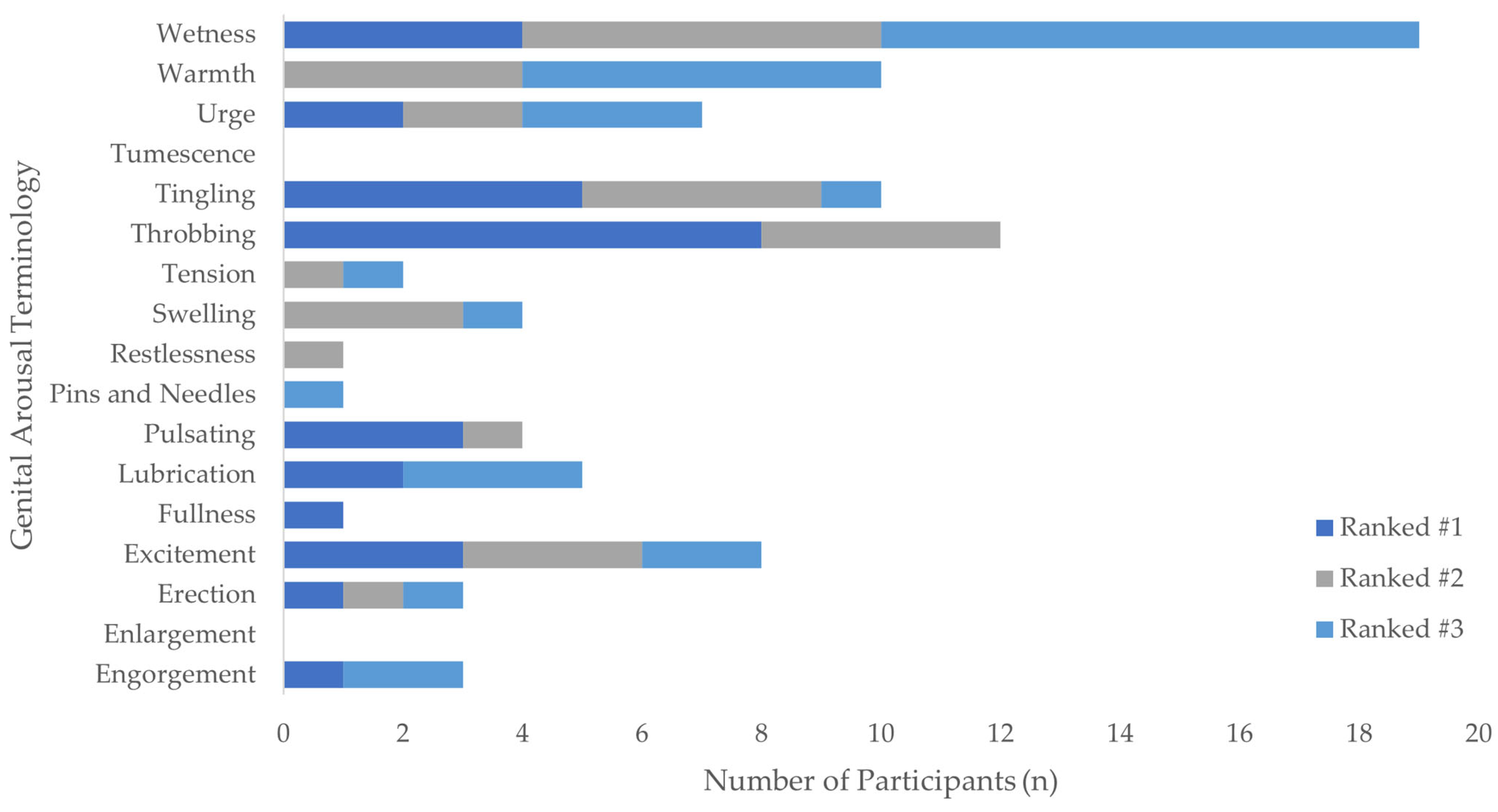
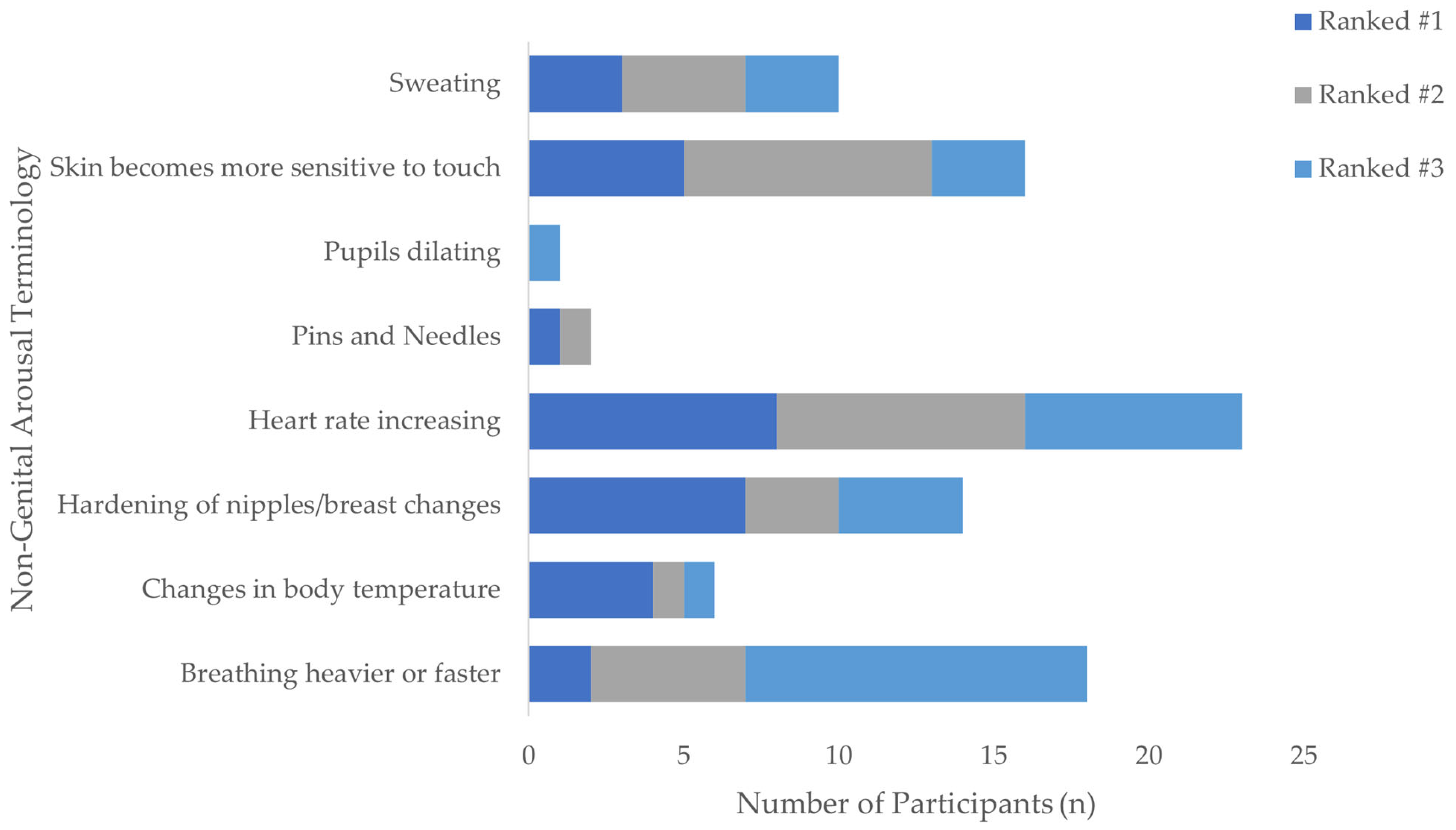
All participants were provided a list of both genital and non-genital physiological arousal sensation words. The response scale ranged from zero (Not at all) to ten (Extremely) and rated relevance of words describing arousal response. The genital physiological arousal list contained eighteen words, and the non-genital arousal list contained eight words. Participants were also able to rank their top three words from each list as first, second, and third. No observable differences were found across the conditions, and therefore results of the two conditions were combined to create a cumulative ranking, as seen in
Figure 1 and
Figure 2.
The words that were ranked the highest as relevant descriptors of experiences of genital physiological arousal were wetness (
n = 19), throbbing (
n = 12), and tingling (
n = 10) (shown in
Figure 1). While wetness received the highest overall numerical rating, it received fewer first-place rankings than throbbing (
n = 8) and tingling (
n = 5), and it received the most second-place rankings, indicating that other experiences may be more relevant than just wetness. Additionally, as seen in
Table 4, participants rated all genital arousal words on a scale of 1–10 in terms of perceived relevance. The three highest mean scores were for excitement (
M = 8.37, SD = 1.65), wetness (
M = 8.23, SD = 1.65), and tingling (
M = 7.73, SD = 2.38). No observable differences were found across the conditions, and therefore results of the two conditions were combined, as seen in
Table 4.
The sensations that ranked the highest as relevant descriptors of experiences of non-genital physiological arousal were heart rate increasing (
n = 23), breathing heavier or faster (
n = 18), and skin becomes more sensitive to touch (
n = 16) (shown in
Figure 2). Heart rate increasing (
n = 8) and hardening of nipples/breast changes received more first-place rankings (
n = 7). As seen in
Table 4, participants additionally rated all non-genital arousal words on a scale of 1–10 in terms of perceived relevance. The three highest mean scores were for heart rate increase (
M = 7.87, SD = 1.85), skin becoming more sensitive to touch (
M = 7.63, SD = 2.58), and breathing heavier or faster (
M = 7.27, SD = 2.34). No observable differences were found across the conditions for these results as well, and therefore the results of the two conditions were combined, as seen in
Table 4.
8.2. Tests of Group Differences
T-tests and chi-square tests were conducted to test for group differences on several variables. No group differences were found between condition one (no-educational video) and two (educational video) in the counts of reports of total full-body sensations and total genital sensations, as mentioned within the interview. No group differences were found between those with a sexual trauma history versus no trauma history on the count of reports of the importance of feeling safe or comfortable with a sexual partner. A Pearson correlation indicated a weak and statistically insignificant positive correlation between trauma history and the importance of safety/comfort (
r(28)
= 0.223,
p = 0.236). No group differences (condition one or two) were found on a
t-test in the mean frequency of use of terminology related to blood flow, indicating that observing the educational video did not increase descriptions of genital blood flow. For tests of group differences see
Table 5.
9. Discussion
This study investigated how cisgender women describe their experiences of sexual arousal, including relevant aspects of physiological and subjective sexual arousal response [
12]. Given that current standard assessment measures heavily emphasize experiences of vaginal lubrication as a prime indicator of sexual arousal, we sought to explore participants’ reports of important factors pertaining to sexual arousal more broadly [
1]. We were also interested in whether other aspects of physiological arousal may be relevant, including genital blood flow as a potentially important part of genital response.
We explored whether relative emphasis on descriptors of blood flow may increase following introduction of a brief educational video describing similarities in function between penile and vulvo-vaginal anatomy. Results demonstrated that participants in both conditions used genital blood flow terms both prior to viewing the educational video and without viewing the educational video, suggesting that genital blood flow is an important component of participants’ genital arousal experience (shown in
Figure 1). Participants reflected that the brief educational condition was unlikely to have influenced outcomes, but that it affirmed their experiences. Additionally, participants also emphasized other non-genital physiological signs of arousal, including nipple and skin sensitivity as well as increased heart rate and breathing (shown in
Figure 2).
Quantitative analysis showed that the additional education did not appear to demonstrate a difference in reporting of full-body or genital sensations (
Table 5). The frequency of use of terminology related to blood flow was also unlikely to be influenced by the educational condition (
Table 5). As the majority of participants used genital blood flow terms to describe their physiological arousal, future research could be performed with larger populations to determine which physiological terminology is best to use in sexual arousal assessment, and whether a broader array of terms, beyond the narrow focus on vaginal lubrication, may be more relevant and accurate in assessing women’s sexual response. This may be particularly relevant for post-menopausal women, who may find vaginal lubrication to be a less relevant aspect of their sexual experience [
26].
Current self-report assessment measures of sexual function tend to emphasize physiological arousal and in particular vaginal lubrication [
1], while physiological measures tend to emphasize genital blood flow [
5,
6]. Study results demonstrate there may be other important indicators of genital and non-genital arousal that are not included in current self-report assessment measures. While wetness received higher overall responses, it still may have been less relevant than other terms more related to genital blood flow (throbbing and tingling). Most participants actually ranked wetness in third place, with throbbing and tingling receiving more first-place ranks related to relevancy (
Figure 1). In addition to this, when being ranked for perceived relevance, the term excitement averaged higher than wetness (
Table 4). As supported by Meston et. al [
27], non-genital terms like heart rate and respiration increasing were rated high and an accurate way to describe arousal (
Figure 2 and
Table 4). This highlights the difference in relative importance of relevant arousal words and how women identify their arousal.
Additionally, participants placed strong emphasis on subjective arousal experiences, describing this as extremely important and more valuable to their sexual response than physiological arousal. Indeed, most participants noted that without subjective arousal, experiences of physiological arousal were largely irrelevant. Current assessment methods for subjective arousal use a continuous measure, the arousometer, to monitor and report women’s sexual arousal rating [
28], which assesses active states of subjective arousal in a lab context. Future research could explore the addition of tools assessing subjective arousal into retrospective and self-report scales of sexual arousal and into clinical assessment of sexual function [
28].
This study supports the idea that current validated tools used to assess women’s sexual arousal may not sufficiently evaluate the components of arousal that are most important to women [
16]. Most women in our study reported far more sensations than what are typically assessed using the FSFI [
1]; moreover, they described a great deal of nuance about the relationship between differential experiences of arousal. This is consistent with Meston et. al [
27] who noted interrelated components of arousal including genital and non-genital physical components such as engorgement of genital tissue and heart rate increase, as well as non-physical components such as positive mental engagement. Together, these findings show that current self-report measures of sexual function largely overlook subjective arousal, which is a key component of sexual arousal, and that relevant aspects of physiological arousal likely have far more breadth than is typically assessed. As reported by Rellini et al. [
28], the current definition of sexual response includes only physiological aspects of women’s sexual arousal, and these currently are assessed in a narrow capacity. Given the low correlation between physiological and subjective arousal in women, and in light of results of this study which show a higher importance being placed on subjective arousal, measures emphasizing physiological genital arousal are therefore likely inadequate [
28].
Implications of these combined findings include the possibility of adaptation of current assessment tools. For example, these may include (1) self-report assessments of genital blood flow (e.g., tingling, throbbing), (2) other physiological arousal terms such as those that are non-genital (e.g., changes in heart rate, hardening of nipples/breast changes, skin becoming more sensitive to touch, or body temperature changes), and (3) indicators of subjective arousal experiences. Additionally, this study demonstrates that important facilitators of physical arousal include comfort and safety, along with subjective arousal. With many participants reporting the need for subjective or mental arousal as more important than physical arousal, it is possible that subjective arousal as well as comfort and safety may be necessary pre-cursors for physiological arousal, and therefore should be assessed in individuals reporting low sexual function (e.g., physical response) on current self-report measures.
While this sample showed high sexual functioning, satisfaction, and minimal distress, they also indicated relatively low sexual flexibility. Given the young mean age of 21 years, it is possible that this group may have fewer years of opportunity for experience or less exposure to varied kinds of sexual experiences. Other studies have found greater sexual flexibility is associated with greater sexual functioning in women [
14]. In a recent study by Komlenac et. al [
14], sexual flexibility had a low, negative correlation with sexual script. It is possible that sexual flexibility is something that develops with more diverse experiences, with increased age, or with increased sexual confidence. It is also possible that participants with higher sexual flexibility scores may show more varied responses in regard to arousal terminology and sensations [
15]. Future research is needed to confirm these theories on sexual flexibility.
An additional sub-category under subjective arousal was identified, with most participants sharing that their emotional response to arousal was significant. Nearly half the sample described experiences of sexual trauma or abuse (shown in
Table 2), but nearly all participants mentioned that safety and comfort were imperative to their sexual arousal. Chi-square test and correlations between past experiences of sexual trauma and the mentioning of safety and comfort did not indicate a relationship; however, this may be tested more directly in future studies (
Table 5). Current studies surrounding sexual arousal and safety, focus on safe sex and safe play decision-making [
29], rather than on aspects of sexual response. One might also hypothesize that the observed emphasis on safety and comfort is related to the young age of the sample. This theme emerged relatively uniquely in this study and is seldomly mentioned in prior research. Research querying this concept with an older demographic will therefore be important.
This study aimed to explore experiences of sexual arousal more broadly, and also to expand the relevant descriptors of genital sexual arousal. We learned there were few participants who were unaware of or who did not emphasize the role of genital blood flow. This knowledge appeared to be relevant, independent of the introduction of the educational video (i.e., a brief animated genital anatomy and response video introducing similarities between penile and vulvo-vaginal structures). Most participants already emphasized sensations of genital blood flow as relevant to their genital response, prior to the administration of the educational video. Several participants mentioned the educational video reaffirmed what they were experiencing and assisted them in putting into words the sensations they had already observed experiencing and tried to describe, as seen in
Table 3. Future research is needed to confirm whether the educational video may be influential in different age groups and study samples.
10. Limitations
This research is limited in terms of representation of the sample, as all participants self-identify as cisgender women who were attending university. They were on average 21 years of age, and the majority were White. Different experiences of sexual arousal may be reported from more diverse populations. The young age of the sample likely indicates fewer years of sexual experience than the general population.
Existing research suggests contextual factors may influence capacity for arousal and how it is defined [
18]. As a substantial proportion of the sample size reported history of sexual trauma and/or at least one form of sexual difficulty, these experiences could also influence our results. Prior research suggests that survivors of trauma can often feel disconnected from their body, with sensations that were once associated with pleasure associated as triggers or negative reminders of their traumatic experience [
19].
This study also only surveys only young women, and age-related comparisons may reveal different results. Participants were also well educated and appeared to be aware of the relative importance of genital blood flow as a part of sexual response. Participants endorsed a history of sexuality-based education through a variety of sources including formal sex education. Sex education may also differ according to age and culture. This study defined sexual arousal and desire as separate; however, various research approaches may combine them together, and this may have affected how participants responded [
16].
Cisgender women were the focus of this study; however, it may be beneficial to repeat the study in a sample of transgender women and men as studies of this nature indicate more flexibility in sexual experiences and diversity in terminology [
30]. Given the gendered nature of terms like erection, it may be that transgender men with vulvo-vaginal anatomy may find the term erection to be gender-affirming. In contrast, transgender women may be more reluctant to use the term erection because of its traditionally masculine use; however, they may be more familiar with and identify more with experiences of genital blood flow. Additionally, transgender individuals may be more flexible when it comes to terminology.
Lastly, given the limited sample size (n = 30) quantitative analyses are likely underpowered and therefore are only included as exploratory analyses. Future studies should repeat these analyses with a substantially larger sample size to determine potentially meaningful effects.
11. Conclusions
This study focused on aspects of sexual arousal that are reportedly important to young, educated, cisgender White women participants. The brief educational condition is unlikely to have influenced the way woman described their physiological arousal. While current self-report assessments of women’s sexual function tend to focus exclusively on genital physiological signs of arousal, this study demonstrates that other aspects of physiological arousal and subjective arousal may be considered more important to women. Emphasized experiences of physiological arousal go beyond vaginal lubrication, with women valuing numerous other factors related to physiological arousal including non-genital responses. Participants mentioned a variety of sensations and used a multitude of terms to describe aspects of genital blood flow. Adaptations of self-report measures should consider inclusion of other aspects of sexual arousal, in particular subjective arousal experiences, in order to be more comprehensive and accurate. Additionally, patients and participants with low scores on existing sexual function assessment tools may need further inquiry into mental and subjective aspects of arousal.