1. Introduction
According to 2024 data, Istanbul ranks 8th among the most visited cities in the world. The number of tourists visiting the city in 2024 increased by 6.98% compared to the previous year according to the Istanbul Tourism Statistics Report (ITIR), reaching 18,582,322 people (
ITIR 2024).
The reason for Istanbul’s appeal is that its rich cultural heritage holds great potential for tourism. The Cultural Heritage Inventory of the Historical Peninsula (Fatih) (FKME) for 2021–2022 alone includes approximately 6485 examples of civil architecture and 623 monumental buildings. This number corresponds to approximately one-third of all registered buildings in Istanbul (
FKME 2021). The historic hammams, which are the subject of this study, constitute a significant part of the cultural inventory list. The inclusion of a historic building in the cultural inventory means that its importance to the country or society is recognized, it is taken into account in the planning of state or locally supported projects, it is eligible for tax benefits, and it is part of the protection of the area.
Today, the Ottoman hammams in the Historical Peninsula are regarded not merely as historical hammams but as representatives of a multi-layered cultural heritage.
Hammams have been the subject of numerous recent studies. In addition to the invaluable work of historians and art historians on hammams, hammams used for a different function than their original function have been extensively analyzed in various studies in the field of architecture. Some of these studies examined the architectural changes made to hammams due to reuse (
Şen 2008) or the suitability of new functions (
Cichocki 2005), while others focused on recommendations for protecting some historical hammams (
Kudde 2007). Analyzing hammams only through historical descriptions or individual building studies has led to a lack of holistic assessments of their spatial distribution, typological differences, and their relationship with the urban context. Since the current state of preservation of historic hammams, their re-functioning, and their reflections in urban memory remain controversial, they require re-evaluation using an interdisciplinary methodology. The hammams in Istanbul, the capital of the Ottoman Empire, are noteworthy research objects not only locally but also internationally, as they are unique examples that are situated at the intersection of architecture and social life in terms of physical and mental health.
This study aims to fill a gap by integrating cultural heritage management and urban morphology theories within the same research framework, with the goal of revealing the historical, architectural, and social values of hammams. The methodology involves analyzing the change in the location of hammams over time using historical maps; conducting a morphological analysis of architectural typologies through photographs and drawings; evaluating social representations through visual documents; and thematically coding historical and cultural functions in light of the literature. Based on the integration of qualitative and visual data, this approach leads to a unique methodological model that can be used both for the case of Istanbul and for the study of cultural and architectural heritage of a similar scale on a global level.
The research questions considered in this study are as follows:
Within the context of urban spatial organization and heritage conservation, how have the hammams in Istanbul evolved throughout history?
How are these buildings spatially distributed in terms of their location within the city, accessibility, and potential for social interaction?
What similarities and differences are observed among hammams in terms of typology, location, and usage characteristics?
To what extent are the current conservation conditions of hammams sufficient in terms of transferability to future generations and potential for repurposing?
What insights do Istanbul’s historic hammams offer for the conservation and evaluation of similar heritage buildings on a global scale?
2. Materials and Methods
In this study examining the historic hammams in the Historical Peninsula of Istanbul, qualitative data—including data from an analysis of historical and contemporary maps and visual documents obtained through sitework based on in situ observations—has been interpreted holistically. This approach reveals temporal continuity through the comparative analysis of historical maps, archival documents, and contemporary site data, while enabling the joint evaluation of urban morphology and cultural heritage management theories.
2.1. Determining the Research Area
The research area consists of the area included in the map entitled “Registered Hammams in the Historical Peninsula,” prepared by the Istanbul Metropolitan Municipality (IMM), Directorate of Cultural Heritage Protection, as part of the “Istanbul Cultural Heritage Inventory Project (2015–2019)” and presents the most up-to-date status of the Historical Peninsula in detail (
IMM 2019). This map shows 81 hammams classified according to the century in which they were built.
2.2. Analysis of Historical Maps
In order to conduct a detailed analysis of the research area, historical maps—important sources for examining the historical topography of Istanbul—were consulted. The maps were selected based on their coverage of the entire Historical Peninsula, their accuracy, and their conformity with the actual topography. The selected maps are as follows:
Charles Edouard Goad’s maps (
Goad [1904–1906] 2007) of Istanbul, commissioned by insurance companies for fire prevention purposes;
Ayverdi maps (
Ayverdi 1958), complementing the Pervititch Maps;
The plan showing the historical monuments of Suriçi Istanbul, Galata, and Pera, created by
Müller-Wiener (
1977) for historical and topographical research.
Both these maps and their indexes were scanned to determine which hammams were included in each one.
2.3. In Situ Observation and Visual Documentation
The authors conducted individual visits to each of the 81 hammams indicated on the map within the designated research area. During these visits, the façades and interiors of the hammams were photographed, and their general characteristics were recorded through observation, with detailed notes taken. Following these visits, systematic analysis tables were prepared based on the observations made and the photographs and notes taken.
The data collected using the in situ observation method is listed below:
Plan features: Plan type (double hammam: adjacent hammams for women and men; single hammam: only for women, only for men, or for both groups at different times or on different days) and entrance–exit arrangement (women and men enter from the same street, different streets, or a shared entrance).
Facade characteristics: material, color, door, window, and decorative elements.
Roof form and covering elements: dome, hipped roof, oculi, and lanterns.
Construction and facade materials: stone, brick, wood, plaster and paint.
Location and public relationship: in a square or on a street; pedestrian access.
Visibility: provided or blocked.
Conservation status: repaired, under restoration program, and neglected.
Current use: used as a hammam or partial different use.
The data obtained by evaluating the 24 hammams currently in use according to these criteria was transferred to analysis tables.
In the Istanbul Metropolitan Municipality’s 2015–2019 map, registered hammams in the Historical Peninsula are classified according to the century in which they were built. This classification has been largely preserved in the study for ease of understanding and tracking. Thus, the following methods have been employed:
Hammams have been coded with different letters and consecutive numbers according to their current existence (H1), absence (N1), and ruin status (R1). The same codes have been used in all maps and tables. This ensures a direct correspondence between maps and tables and facilitates site references.
In the coding tables, hammams are listed according to the century designation on the map. To ensure data reliability, the term “unknown” is clearly used in the tables when the exact year is unknown.
Map labeling: The same codes used in the tables are also shown on the maps with the same code number and dot symbol to speed up cross-reading between text and maps and to enable visual–text matching. Different colors are used to track periodical differences.
2.4. Study Methodology
In this study, which can be split into three sections—historical map analysis, the literature review, and in situ observation—46 criteria grouped under 13 headings were utilized to determine the current state of the hammams under investigation. The 24 hammams currently in use were evaluated using the criteria listed in
Figure 1. These criteria were developed based on observations and a review of established studies in the literature on hammams.
3. Results
3.1. History of Hammams on the Historical Peninsula
Although the origins of hammams can be traced back to ancient Greece, their representation in the urban space, as an example of civil architecture associated with hygiene, sports, and entertainment, dates back to the Roman period (
Yegül 2011).
Müller-Wiener (
2016) reports that there are numerous baths, including palace and private baths, whose names are known but whose locations cannot be determined, dating back to the Byzantine era and earlier. He also mentions two Byzantine bath remains—one at the Zeuksippos Baths, which were uncovered during excavations between 1955 and 1956 and then covered again, and another at the Konstantinia Bath between the Valens Aqueduct and the Burmalı Minare Mosque—as well as the remains of a bath used until the 6th century near the Chora Church (now the Kariye Mosque) that could have been a double bath and the existence of private baths that can now only be traced through written documents.
Magdalino (
2012) lists the names of many baths built at different times during the Byzantine period and provides information about their approximate locations. In his 1990 study, he notes that the Byzantine church’s definition of baths as luxurious and secular, coupled with water shortages and economic reasons, led to their decline over time (
Magdalino 1990). In a different study, he highlights the disproportionate number of baths in the wealthy and poorer areas of the city (
Magdalino 2015; pp. 421–22).
Eyice (
1997) notes that the literature does not mention any surviving Byzantine bath structures in Istanbul, apart from the remains of their foundations. He draws attention to the plans of the Çardaklı Hammam, near the Küçük Hagia Sophia Mosque, and the now-vanished Koğacılar Hammam in the Vefa district. He believes they may have been partially built on Byzantine precursors. He also states that “The only hammam known to have been built on the ruins of a Byzantine church is the Yıldız Dede Hammam, built in the 15th century” (p. 3/25). The last remains of this hammam, removed in the 1980s, now stand on the site of a business center (
Yıldız Dede Hammam Cultural Inventory 2025).
The Ottomans adopted the tradition of the hammam, reinterpreting their architectural features and social functions and reproducing them with unique features (
Boyar and Fleet 2012).
Eyice (
1997) states that numerous hammams were constructed during the Ottoman period not only to attract congregations to mosques but also because they generated good income; if they did not generate income, they were removed.
The 15th and 16th centuries mark the period when hammams began to play an active role in the urban life of Ottoman Istanbul. According to
Kafescioğlu (
2009), 26 hammams were built in Istanbul during the reign of Fatih Sultan Mehmed II (1451–1481). During the reign of Sultan Suleiman the Magnificent (1520–1566), the addition of 45 hammams designed by Mimar Sinan played a crucial role in shaping the classical hammam architecture of Ottoman Istanbul (
Batur and Batur 1968).
Yaşar (
2020), based on a 1766 foundation document, states that the number of hammams in Istanbul reached its peak in the mid-18th century, at 195, 112 of which were within the city walls. He also reports that, two years after this census, Sultan III. Mustafa ordered to not build any new hammams in Istanbul due to excessive wood and water consumption. The 1918 (
Ihsaiyat Mecmuası 1918) states that 178 hammams were operating in Istanbul at that time, 80 of them inside the city walls and 98 outside.
Haskan (
1995), who examined 237 hammams throughout Istanbul in 1995, states in his book
Istanbul Hammams that he personally examined 60 of them that were still in use, 12 of which were converted into bazaars after 1990 and 9 of which were closed.
In the self-sufficient neighborhood structure of the Ottoman-era city, hammams—an important part of the “marketplace” defined by a local mosque, bakeries, and street fountains—were represented by one or sometimes several hammams. According to
Ertuğrul (
2015), as an indispensable part of these complexes, they were built with donations from sultans, palace officials, or wealthy individuals, within the scope of the foundations. In times when homes lacked plumbing, not only was going to the hammam an indispensable requirement for hygiene, but over time, they also became a very meaningful place for society, becoming a place for socializing, meeting, having a good time, and where rituals, such as those before weddings or circumcisions, took place.
Avcıoğlu (
2011,
2014) points out that in the second half of the 19th century, Turkish hammams were built in Europe and the United States as part of the new era of hygiene reforms, labor laws, urban transformation, and the Industrial Revolution.
Breathnach (
2004) states that Dr. Richard Barter, inspired by Scottish diplomat David Urquhart’s descriptions of hot air hammams in his novel, established the first “improved” Turkish hammam, the precursor to Turkish hammams, in St. Ann’s in 1856, together with Urquhart.
Pasin (
2023), referring to Urquhart’s pioneering work, states that, during this period, over 600 public hammam complexes were constructed in various regions of the British Isles. Drawing on his direct experience with hammams in Morocco, Spain, and Istanbul, Urquhart argued that these buildings, capable of accommodating large groups in a heated hammam area, offered a more hygienic and economical alternative to individual hammam tubs. He also believed that the social environment could help reduce class barriers in English society. Initially serving solely as medical treatment centers, these facilities were eventually commercialized, becoming part of the general trend toward the middle classes’ evolving entertainment world.
Breathnach (
2004) thus argues that the Turkish hammam has been transformed into a more comfortable and enjoyable activity through its association with health and physical fitness, art and science, travel, and knowledge-related pursuits.
Shifrin’s (
2003) book,
Victorian Turkish Hammams, the product of many years of research, provides a detailed classification of recorded hammams, including independent and municipal hammams and hammams in clubs, hospitals, hotels, and mental hospitals open only to members or patients.
Dinu et al.’s (
2023) work on the Golesti Hammam in Romania, and
Bodolai et al.’s (
2018) work on Turkish hammam culture in Hungary, which mentions the existence of many hammams built there and states that traces of “other” cultures are worth preserving, are evidence that hammams were embraced and spread across a wide area.
Today, tourism marketing initiatives present the hammam as part of a package tour or as an alternative, authentic tourist destination that visitors can explore individually.
Crompton (
1979) identifies seven motivations for pleasure-seeking travel: novelty, socialization, prestige/status, relaxation/recreation, education/intellectual development, strengthening family ties, and relaxation. Therefore, when evaluated from the tourists’ perspective, the motivation to visit a hammam aligns with the socio-psychological motivations of leisure travel. For the business owner, in addition to economic expectations, it offers the authority and opportunity to organize and present the history of their people and land, along with hammam culture, as an educational and entertaining tourism product for tourists. In cultural heritage tourism interactions, tourists usually learn from the host. In this interaction, the host has the authority to tell their own story and the history of their people and land in an organized manner as an educational and entertaining tourism product for the traveler (
Cameron 2018). For example, applying the kese (bath peeling glove) in a hammam through the tellak (the man who baths the clients of the hammam) allows the cultural framework of body care in the ‘Turkish hammam’ to be experienced/introduced (
Hahn 2016).
3.2. Spatial Organization and Continuity of Historical Hammams
The Istanbul Metropolitan Municipality, Directorate of Cultural Heritage Protection, has prepared a map as part of the “Istanbul Cultural Heritage Inventory Project (2015–2019),” which shows the 81 registered hammams located in the Historical Peninsula and their construction periods. The 81 hammams marked on the map and listed in the index were inspected on site, and 43 of them were found to be located where indicated on the map.
The hammams are listed as follows in ascending order according to their construction period: 7 hammams dating back to the 15th century are marked as H1, H2, … H7; 11 hammams dating back to the 16th century are coded as H8, H9, … H18; and 6 hammams dating back to the 17th, 18th, and 19th centuries are coded as H19, H20, … H24 (
Table 1).
In the Historical Peninsula, there are ten registered hammams dating back to the 15th century (H26, H27, … H34), seven hammams dating back to the 16th century (H35, H36, … H41), and two hammams of unknown construction date (H42 and H43) (
Table 2) that are currently used for different purposes or abandoned but still exist as buildings.
The hammams for which only their remains can be identified at the locations shown on the municipal map have been coded as ruins according to the periods indicated on the map, starting with R1, R2, … R6 and continuing with numbers following all periods. Although shown on the map, hammams that could not be identified at their locations (no longer existing) were coded using the same approach, continuing with numbers such as N1, N2, … N32. These codes were also used in the tables used to perform the analyses (
Table 3).
The hammams, marked with different colors according to their construction date in accordance with these codes, are shown in
Figure 2 based on their location on the city plan.
3.3. Comparison of the Historical Hammams in the Historical Peninsula That Continue to Be in Use and Those That Have Disappeared Using Historical Maps
The most recent maps are the Istanbul Metropolitan Municipality’s Registered Hammam Map in the Historic Peninsula (2015–2019), Charles Edouard Goad’s Maps of Istanbul (
Goad [1904–1906] 2007), German Blue Maps of Istanbul before World War I (
Alman Mavileri [1913–1914] 2007), the Pervititch Maps (
Pervititch 1920–1940), the Ayverdi Maps (
Ayverdi 1958), and the Müller-Wiener Plan of Inner Istanbul, Galata, and Pera (
Müller-Wiener 1977). These maps were used to determine how many hammams existed, how many and which of them still exist today, and the number and names of hammams that no longer exist.
The Istanbul Maps, dated 1904–1906 and created by Goad, identify 16 hammams located in the Historical Peninsula area. Ten of these hammams still exist today, while six no longer exist. The Goad Maps (
Goad [1904–1906] 2007), commissioned by insurance companies for fire prevention purposes, mainly cover commercial buildings. The fact that most hammams were not included in these maps may also indicate that the economic situation at the time was not good enough to warrant fire insurance. However, the highly detailed index table, which includes 18 street or avenue names containing the word “hammam,” is an important reference, showing traces of urban memory.
The index of German Blue Maps, dating from 1913 to 1914, identifies 71 hammams, of which 41 still exist today and 30 no longer exist. There are 66 street names containing the word “hammam” in the German Blue Maps (
Alman Mavileri [1913–1914] 2007). The fact that even hammams that no longer exist today are kept alive in historical and contemporary maps through street names referring to “hammams” proves that hammams were part of everyday life and society and were recorded spatially in the urban memory. This finding corroborates the work of researchers studying “urban focus” (
Lynch 2015), and “urban memory” (
Assmann 2001;
Crang and Travlou 2001;
Özkaya Duman 2017).
The “Lieux d’inhumation dans Istanbul Intra-Muros. Carte extraite
Müller-Wiener (
1977), Bildlexikon Zur Topographie Istanbuls”, dated 1977, and its index show 71 hammams. Three of these—Çömlekçiler Hammam (N41), Yalı Hammam (N42), and Kule Hammam (N43)—are located outside the city walls and were not included in the 2015–2019 Istanbul Metropolitan Municipality (IMM) map. Furthermore, seven hammams shown on the Müller-Wiener map based on remains or information in the literature are not included on the IBB map. These 10 hammams are shown on the Müller-Wiener map in a different color, starting with N33 and continuing with the data in
Table 2, following the N code of hammams that no longer exist today (
Figure 3).
These hammams are Saray Hammam (N33), Sarıgüzel Hammam (N34), Kıztaşı Hammam (N35), Küçük Kovacılar Hammam (N36), Çelebi Mehmed Ağa Hammam (N37), Aksaray Hammam (N38), Tevekkül Hammam (N39), İmrahor Hammam (N40), Büyük Kovacılar Hammam (M42), Sultan Hammam (M53), and Zeuksippos Hammams (M68). In addition, it was observed that Vezneciler Hammam (H27) is also known as Merdivenli Hammam, and Ali Paşa Hammam (N5), Zincirlikuyu Hammam and Ferruh Kethüda, or Historical Balat Çavuş Hammam (H1) as it is called on the building, and Osman Efendi Hammam are also known by different names. This indicates that the names of the hammams changed over the course of their existence.
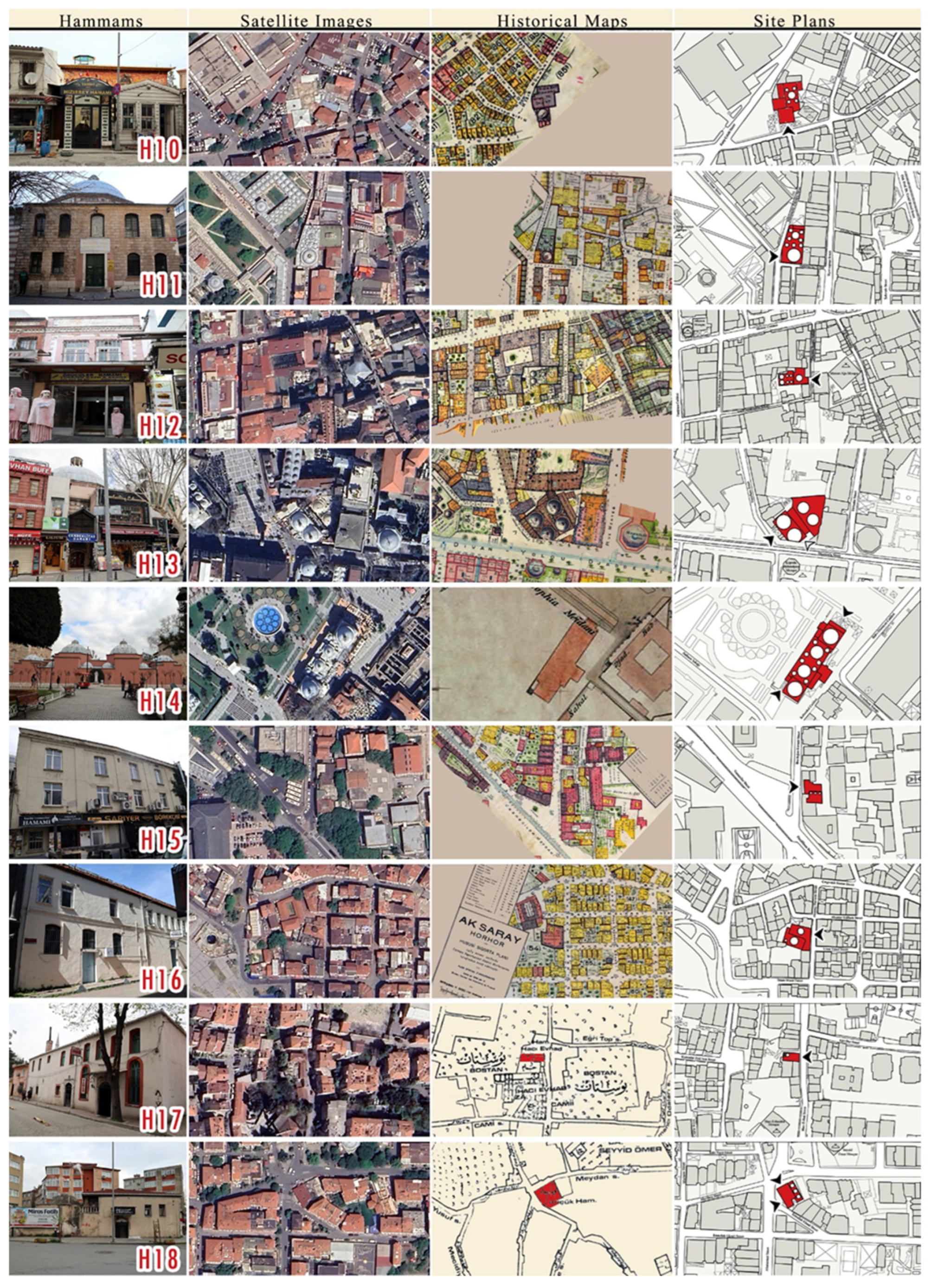
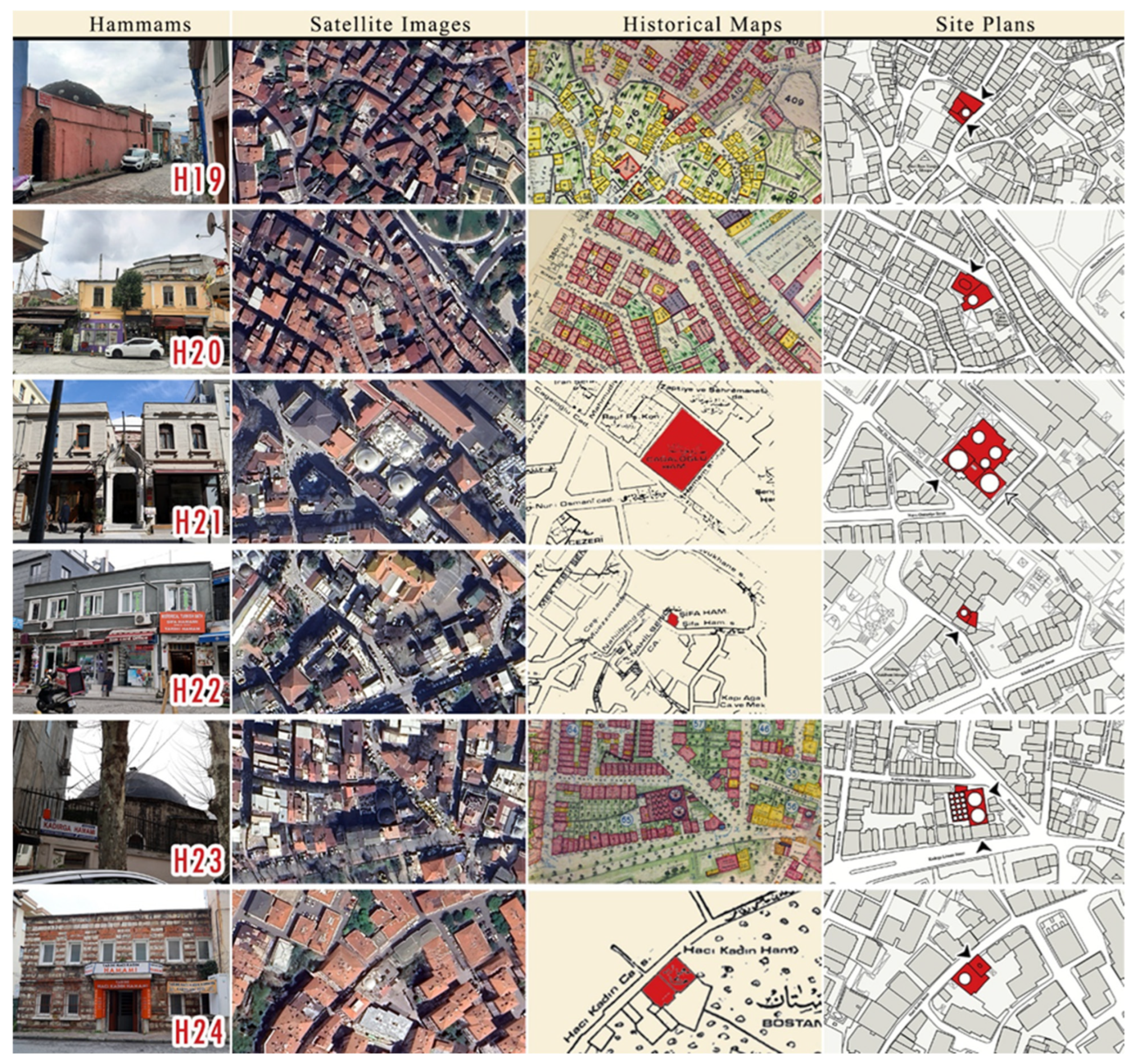
The 24 active hammams, along with their identifying numbers, photographs, aerial photographs, and locations (site plans) on historical and current maps, are shown in
Figure 4,
Figure 5 and
Figure 6. The Pervititch maps, as the most detailed historical maps, were used to compare the hammams’ current locations with their past locations. For the seven hammams excluded from the Pervititch maps (H2, H7, H17, H18, H21, H22, H24), the Ayverdi maps were consulted, and for two hammams (H3, H14), the Goad maps were consulted. Since the Ayverdi and Goad maps are not as detailed as the Pervititch maps due to their scale, it is difficult to track the changes to these hammams in the urban context. Comparison with the Pervititch maps reveals that some hammams (H8, H10, H23), once separated from the street and neighboring structures by gardens in the early 1900s, are now surrounded by new constructions, resulting in reduced visibility and altered relations with their surroundings.
4. Architectural Analyses and Comparisons of Hammams in the Historical Peninsula
In situ observations revealed that 53.09% (43) of the 81 hammams shown on the Istanbul Metropolitan Municipality’s 2015–2019 map still exist today. Of these, 24 (29.63%) continue to serve their original function. It was determined that 46.91% of the hammams have lost their place in the city. The 24 hammams currently in use were compared using standardized evaluation tables created based on information obtained from in situ observation and the literature. The findings are presented below.
4.1. Architectural and Morphological Findings: Tables Related to Historical and Architectural Characteristics (Plan Typologies, Facade Arrangements, Etc.)
Hammams that serve both men and women simultaneously, featuring twin structures with separate entrances placed back-to-back and referred to as “double hammams,” are heated through a shared heating system. A frigidarium, tepidarium, and caldarium are present on both sides (
Figure 7a). They cover a larger area, with the women’s section being slightly smaller, which affects the size of the dome, making it appear smaller and lower.
Another type of hammam is the “single hammam,” which serves only men, only women, or men and women alternately at certain times of the day or on specific days of the week. Typical sections of hammams, such as a frigidarium, tepidarium, and caldarium, are also present in this type (
Figure 7b).
The data shows that the 24 hammams currently still in use as a hammam in the Historical Peninsula of İstanbul are equally distributed between double hammams (50%), which in earlier periods could be used by both genders simultaneously in their original form, and single hammams (50%), which were used alternately. Accordingly, the entrance arrangements of these hammams are also equally distributed, with 50% having a single entrance and 50% having a double entrance. However, today, the single hammam typology is clearly dominant (62.5%; 15 hammams), while double hammams have decreased to 37.5% (9 hammams). As a result of this transformation, in 25% of hammams, one of the entrances has been closed; Gedikpaşa Hammam (H4) and Çemberlitaş Hammam (H13), shown in
Figure 7a above, are examples of this situation. This change is related to the economic sustainability of single hammams and, in some cases, the fact that the target audience is tourists and that mixed-gender use or use of the same entrance does not pose a problem.
In hammams with a dual-entrance system, it is observed that 84% of women’s and men’s entrances are on different streets, while only 16% of them are on the same street. This can be explained by the desire to ensure privacy, to the extent permitted by the local adaptation capacity, in the dual-hammam typology and the desire to limit public visibility at the entrance used by women. However, it can also be explained by restrictions imposed by the local structure and land use permit, which may not allow for the entrances to be on the same street.
It was observed that either two or three of the following materials are used together as facade materials: stone, brick, wood, and plaster/paint. In 12.5% of the 24 hammams currently used for their original function, only stone was used as the façade material, while in 33% of them, only plaster or paint was used. The most common materials used together are stone, brick, and plaster/paint (25%). In 12.5% of cases, wood was used together with other facade materials. The fact that plaster/paint is observed on 71% of the hammams’ facades, either alone or together with other materials, should be considered as a reflection of interventions made in the 20th century.
While 45.83% of hammams have arched door typologies, 54.17% have doors finished with flat lintels. The presence of both typologies indicates that the door’s typology is not limited to a single type. Here, the flat lintel represents functionality and rationality, while the arch represents monumentality, indicating both the functionality and monumental identity of the hammam’s architecture.
Of the 24 active hammams, 54.17% have arched windows, 37.5% have flat lintels, 12.5% have no windows at all, and 8.33% have both arched and flat windows. Furthermore, all hammams with no windows were built in the 15th century. These statistics indicate a hybrid approach in window design and the representation of a monumental language.
It was determined that in 16.67% of these hammams, the doors on the main facade are used as decorative elements, in the form of “crown doors.” Of these hammams, 4.17% were built 15th century, 8.33% in the 16th century, and 4.17% in later periods, including the 17th, 18th, and 19th centuries. These percentages indicate that the “crown door” was not widely used as a decorative element in hammams, and that it partially referenced Seljuk and Ottoman architectural elements, emphasizing historical and cultural continuity.
Only 12.5% of hammams that retain their original function have inscriptions indicating the year of construction or who built them. Of these, 8.33% are hammams dating from the 16th century and 4.17% are hammams dating to later periods such as the 17th, 18th, and 19th centuries. These percentages indicate that inscriptions were not always used and are concentrated mainly in 16th-century structures.
Of the 24 hammams that continue to function, 20.83% feature carving or profiling as a distinctive decorative element on the facade. Their distribution by century is as follows: 4.17% are from the 15th century, 8.33% from the 16th century, and 8.33% from later periods such as the 17th, 18th, and 19th centuries. Although these proportions show that functionality has been prioritized and although this feature requires a fairly extensive exterior surface, these findings show that these fundamental elements, which enhance the architectural representational power of hammams, are used and that esthetic concerns are not limited to the interior space.
The data shows that 100% of the roofs in existing historical hammams in Istanbul are domed. In addition to domed roofs, pitched roofs are also used at a rate of 62.5%. While pitched roofs indicate a local language that blends with the urban tissue, domes are preferred in hammams with high representational power and monumental character. To provide natural lighting, roof lanterns, obtained by raising a certain section of the roof, or glass structural elements called oculi are integrated directly into the dome. In 25% of hammams, only lanterns are used; in 25%, only oculi are used; and in 50%, both lanterns and oculi are used together. It is noteworthy that the combined use of skylights and oculi was preferred in hammams with high representational power and monumental character.
4.2. Environmental and Urban Context Findings
4.2.1. Relationships with the Nearby Surroundings (Street, Road, Square, Public Space)
In terms of location, 45.8% of the hammams still functioning are located on corners, 4.16% in squares, 4.16% in squares and on corners, and 50% on streets. The fact that 45.8% of the hammams are located on corners should be prioritize this layout, because it allows for greater visibility as well as the possibility of double entrances from different streets.
It was determined that 79.17% of these hammams are attached, while 21% are detached. The fact that such a large proportion (79.17%) are attached can be traced back to historical and contemporary maps, and stems from the effort to reach a much wider audience by integrating with the urban infrastructure such as water networks, roads, sidewalks, and transportation. In addition, the fact that 21% of the hammams are detached highlights the monumental representational power of these buildings.
4.2.2. Pedestrian Access, Public Visibility, and Potential for Social Interaction
Currently, 57.17% of actively used hammams are located in historic center areas that experience a tourist influx throughout the year; 29.17% are located on the periphery of the Historic Peninsula, in residential areas far from the center; and 16.7% are located at the intersection of both areas. There is a direct correlation between the location of hammams and their user profiles and accessibility; hammams in the transition zone are used by both tourists and locals.
Only 8.33% of these hammams are accessible at street level, 25% are above street level, and 66.67% are below street level. It is very clear that rising street levels over time have negatively affected accessibility.
In 58.33% of the 24 active hammams, visibility was not restricted, while it was restricted by surrounding developments in 41.67% of them. An example of the increasing density of urban developments can be seen in the Pervititch Map (1925–1940), which shows the relationship between the Gedikpaşa Hammam (H4) and its surroundings. Although separated from the street by a wall to ensure privacy at that time, the hammam can be seen as a distinct mass within a garden (
Figure 8a).
Figure 8b, showing the current location of the same hammam, reveals that its visibility has been restricted over time due to the addition of commercial spaces replacing the gardens bordering the street. One reason for the restricted visibility is that hammam structures are generally extensive, outwardly closed masses, which allows for their surroundings to be closed off over time by new developments or advertising billboards.
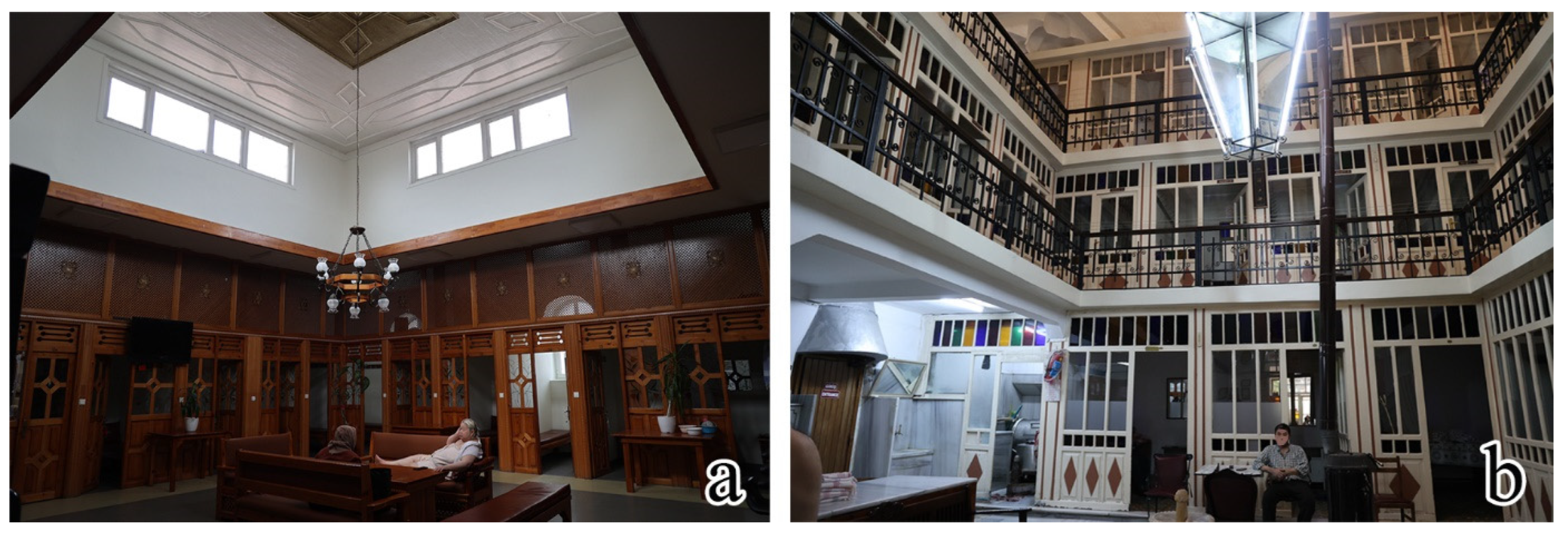
When evaluating the profile of users of the hammams in the Historic Peninsula that are still functioning, it was observed that 8.33% of the hammams are predominantly used by the local population, 29.17% are predominantly used by tourists, and 45.83% are used by both the local population and tourists. The reason why hammams are predominantly preferred by the local population or foreign tourists is related to their location. This situation is exemplified by two cases: the Mihrimah Sultan Hammam (H8), designed by Mimar Sinan, serving mainly the local population on the periphery of the Historical Peninsula, and the Kadırga Hammam (H23), located near the touristic zone and serving both locals and tourists (
Figure 9a,b).
4.3. Conservation Status of the Hammams
A total of 62% of the hammams that continue to serve their original function have undergone restoration or some form of intervention, 4% have been included in a restoration program and are awaiting action, and 33% are neglected and their future is uncertain. This high percentage indicates the prevalence of repairs, reinforcements, and partial additions carried out throughout the 20th century.
A systematic visual synthesis of findings obtained from fieldwork (in situ observations), archival documents, and historical maps is presented in
Table 4 and
Table 5 below. The table format allows for a comparative assessment of each hammam in terms of fundamental indicators, such as plan and facade characteristics, facade materials, roof form, environmental context, conservation status, and current function. This approach has made it possible to determine not only individual examples but also typological trends and differences and the continuity or change over time from a holistic perspective.
The structure of these tables has made the qualitative findings of the study, related to the morphological diversity, environmental context, and conservation levels, more visible and directly comparable. It also demonstrates that the observations regarding historical hammams in Istanbul can provide transferable, analytically interpretable, and comparable data relevant to global heritage discourses.
4.4. The Current Functions and Reuse of Historical Hammams
Today, 55.81% of the 43 hammams that still exist in the Historical Peninsula still serve their original function. Of these 24 hammams, 16.67% are partially used for different purposes (such as dining, cafes, hostels, and commerce).
The remaining 19 hammams that have lost their original function are used as dining and drinking establishments (10.53%), for cultural purposes (21.05%), for commercial purposes (15.79%), as storage spaces (10.53%), for education (5.26%), or simultaneously for cultural, commercial, and storage purposes (5.26%). This provides important examples of adaptable reuse and demonstrates that hammams used for purposes other than their original function have a wide range of uses and can be successfully integrated into urban life (
Table 6).
5. Discussion
The findings of this study show that hammams were not merely places for hygiene, purification, and washing but also served as spatial tools for socialization, communication, and rituals within the Ottoman city. This result corresponds with those of recent studies on Ottoman-Turkish hammams, which show that hammams were recorded in social memory (
Eyice 1997;
Haskan 1995;
Ertuğrul 2015;
Orcan 2011).
Comparisons of historical maps show that the construction and use of hammams continued in the Historical Peninsula with spatial continuity throughout the 15th, 16th, 17th, 18th, and 19th centuries. Of the 24 hammams that continue to serve their original function today, 29.17% date back to the 15th century, while 45.83% date back to the 16th century. These data support
Kafescioğlu (
2009) observation that hammams began to play an active role in the urban life of Ottoman Istanbul from the 15th century onwards, as well as
Batur and Batur’s (
1968) observation that the classical hammam architecture in Ottoman Istanbul took shape in the 16th century. The percentage of hammams built between the 17th and 19th centuries that still serve their original function today is 25%.
The data shows that 62.5% of the hammams currently functioning in their original capacity in the Historical Peninsula of İstanbul bear traces of restoration or intervention, 4.17% are undergoing active restoration, and approximately 33.33% are neglected or have not undergone any intervention. The fact that a significant proportion of hammams are neglected or have not undergone intervention is an important observation, indicating that their original state has not yet undergone significant change and that there is potential to preserve their esthetic, historical, and cultural values through conscious intervention.
On the other hand, 37.5% of examined hammams continue to exist spatially and have undergone functional changes, indicating that the issue of reusing buildings that have lost their function should also be addressed.
The Venice Charter views the re-assignment of function to buildings that have lost their original purpose as a means of preserving them and passing them on to future generations (Article 5). On the other hand, to adaptively reuse historical buildings, adapting spaces to new functional needs is also an inevitable necessity. At this point, creative solutions must come into play, and interventions during transformation processes must be meticulously planned while remaining faithful to the building’s historical identity and documentary value. This view is shared by
Sewell (
2005), who emphasizes the importance of ensuring the authenticity and continuity of the building’s originality within its socio-historical context in historical interpretation. At the same time,
Bandarin and Van Oers (
2012) also emphasize that transformation processes must integrate cultural and historical identity and ensure the long-term heritage value of planning and management programs.
Osborne’s (
2001) views, which emphasize that well-planned interventions can strengthen collective identity and memory by reducing the risk of losing familiar elements that connect the community to its heritage, also support this.
The observations noted in this study, namely the use of stone (58%) and brick (38%) as the main materials on the facades and the coexistence of arched (54%) and flat lintel (42%) in the windows, can be evaluated as a synthesis of hybrid late Ottoman style and corroborate
Çelik’s (
1993) findings on eclectic-modernizing urban transformations in 19th-century Istanbul and
Girardelli’s (
2005) discussions on late-period stylistic hybridity and identity.
The use of “crown doors” in 16.67% of the hammams, which are frequently used in Ottoman mosque architecture and are based on the Seljuk stalactite-decorated door typology, confirms
Ersoy’s (
2015) analysis of the historicist and revivalist discourses of the late Ottoman period.
A total of 8.33% of actively used hammams are primarily used by the local population, which can be explained by the fact that, in the mid-20th century, technological advances led to improvements in domestic sanitary facilities, making having a bath in hammams no longer a necessity and gradually removing them from people’s daily routines. Now, attending a hammam, which has become authentic for the local population, is motivated by a nostalgic feeling among the elderly who have experienced it before, and by a desire among young people to explore new, different experiences.
On the other hand, the fact that 29.17% of actively used hammams are primarily used by tourists indicates that historical hammams in Istanbul have become quite popular tourist destinations and also shows that these hammams have become partially or completely dependent on foreign tourists. This observation is related to the fact that hammams, which are no longer a real part of Turkish daily life, are seen by tourists as a place of oriental authenticity and are part of their “to do” lists. However, there is a risk that this situation will turn into one where the local population sees its own culture through the eyes of foreigners.
It has been determined that a significant 45.83% of actively used hammams are used by both locals and tourists. This is the most desirable form of use. The fact that hammams are also used by locals can be a guarantee of authenticity, and it can also be an opportunity for different cultures to meet and exchange cultures within the same framework.
However, despite the existence of independently operated historical hammams in the city center, hotels are increasingly creating hammams and beauty centers within their own premises and marketing them as part of their accommodation facilities. Beauty tourism, also known as “wellness” or “spa” tourism, markets hammams as providers of health and beauty, presenting both an opportunity and a threat for existing hammams, as they are essentially “advertised hammams.” However, these places, which are merely artificial extensions, represent the culture only in name and market it internationally. Often, more attractive and luxurious tourist offers that have no connection to the real hammam tradition are narrowing the customer potential for historical hammams (
Figure 10).
While 58.33% of actively used hammams are visible, 41.67% are blocked from street view through various spatial integrations with modern urban planning programs, thereby restricting their visibility. This morphological change stems from the spatial strategies of modernization.
Furthermore, only 8.33% of active hammams are at street level; 25% are above street level and 66.67% are below street level. Rising street levels over time have negatively affected accessibility. The location of these hammams within the historical city center, combined with the region’s hilly terrain and narrow roads, which limit vehicle access, also negatively impacts accessibility to these areas.
During fieldwork, information gathered from local residents and sources revealed that five hammams (H25, H32, H33, H34, H35) have lost their original functions over the past 10 years. Many of these historical hammams have closed due to a lack of customers, demonstrating the fragile nature of their existence. In addition, hammams such as the Hacı Kadın-Hızır Bey Hammam (H10), located in the tourist area, which have undergone costly restoration processes so that they can offer luxurious and modern facilities instead of traditional facilities in order to compete for the current market demand, have not yet attracted customers, which is also an indication that hammams are operating at the limits of their capacity.
6. Conclusions
Istanbul’s long history as the capital of the Ottoman Empire and the relatively well-preserved urban texture of the Historical Peninsula make it an intriguing area for researching the current state of hammams. Historical buildings continue to exist as the most tangible examples of cultural heritage, embodying change and continuity. The findings of this study highlight the need to protect this cultural heritage by revealing the evolution of the historical hammams in the Historical Peninsula of İstanbul and the reasons for their survival or demise. This comprehensive field study, supported by textual and visual explanations, reveals that the success of hammams that maintain their spatial existence lies in their formal and spatial consistency.
All 81 hammams examined in the study are currently registered in the cultural inventory. Four of these are in ruins and can be identified by their wall remains, while thirty-four of them have been destroyed, burned down, and/or lost due to neglect for various reasons (earthquakes, urban development activities, etc.), and they can now only be identified through historical maps. Cultural changes throughout history, along with social, communal, economic, and technological developments, have led to both formal and functional transformations in existing hammams.
In today’s metropolitan city of Istanbul, transformed in terms of economic, social, and environmental factors through globalization, historical hammams continue to exist in the Historical Peninsula as cultural heritage, maintaining their original function despite having endured many disasters over the centuries. There is a significant number of such hammams (24). In particular, the hammams in the historical center (H9, H10, H14, H24) have been restored for tourist purposes and continue to serve their original function.
With their original function serving only touristic purposes, hammams can also be identified as a gentrification phenomenon due to their economic inaccessibility to the local population. The Çemberlitaş Hammam (H13) and the Çinili Hammam (H9) in the tourist area have opened up special areas for local use, with events such as a ‘henna night’ and ‘bride’s hammam’, which are part of traditional wedding celebrations, for a more sustainable and attractive use for the local community. However, this approach only provides solutions that satisfy the nostalgic longings and feelings of a small, local, and wealthy segment of the population. Offering public days on a rotating basis in these types of hammams, which are linked to historical figures (Köseki Hürrem Sultan or, in many hammams, the architect Mimar Sinan) and are thus not only places of purification but also great symbols in terms of historical testimony, could be a solution in terms of economic accessibility.
The following improvements can be recommended for existing hammams:
To increase understanding and awareness of the cultural heritage value of hammams, it is recommended that signs indicating that each hammam is “Registered in the Cultural Heritage Inventory” be placed in a visible part of the building in an appropriate format.
It is recommended to remove advertising boards and similar unsightly buildings that limit the visibility of existing hammams.
Solutions such as ramps can be implemented to ensure the accessibility of hammams at different levels from the street.
It has been documented that restoration traces are prevalent in 62.5% of hammams currently in active use. Additionally, 4.17% are undergoing restoration, while approximately 33.33% are neglected or have not been subjected to intervention, indicating that their historical integrity has not been significantly compromised. This situation highlights that there is potential for the hammams to be brought into the future with an integrated conservation method.
Of the 19 hammams that still exist spatially, 42.11% have been converted and are used for different functions, demonstrating the spatial continuity of the urban cultural changes. These buildings with new functions, which are still referred to by the name “hammam,” are also worth questioning. New functions should respect the historical and cultural values of the hammams; uses such as storage facilities or factories, which may endanger the architectural and esthetic integrity of the heritage, should be avoided. Instead, they can be considered for adaptable reuse scenarios based on the principles of low intervention and high benefit, such as conversions into micro-museums, archives, libraries, and educational workshops, and should be passed on to future generations with appropriate functions that provide public benefit. Maintaining continuity by keeping the intervention threshold significantly low should be the primary goal. To this end, and considering that 47.37% of hammams are currently unused, the following issues should be prioritized when considering their use for different functions:
A clear distinction must be made between original and new architectural elements in accordance with international conservation charters (e.g., the Venice Charter, the Valetta Charter).
When assigning new functions, approaches that preserve the continuity of urban memory and identity should be adopted that are considerate of the relationship the structure has established with the city in the past and the present.
Context-sensitive assessments should be performed for each new function, recognizing that each hammam has unique cultural and functional characteristics that must be respected.
To preserve architectural legibility, the original structural systems, materials, and spatial proportions should be preserved and displayed.
Design decisions specific to the new function should be integrated without compromising the historical identity of the hammams.
The historical and cultural sustainability of hammams undergoing functional changes and reuse projects in the future can be ensured by adhering to these strategies. It should not be overlooked that the historical hammams in the Historical Peninsula have great spatial potential to serve as preserved heritage sites that could contribute to intergenerational continuity.