2. Key Questions: Pond and Reservoir (PR) Culture in Sanuki
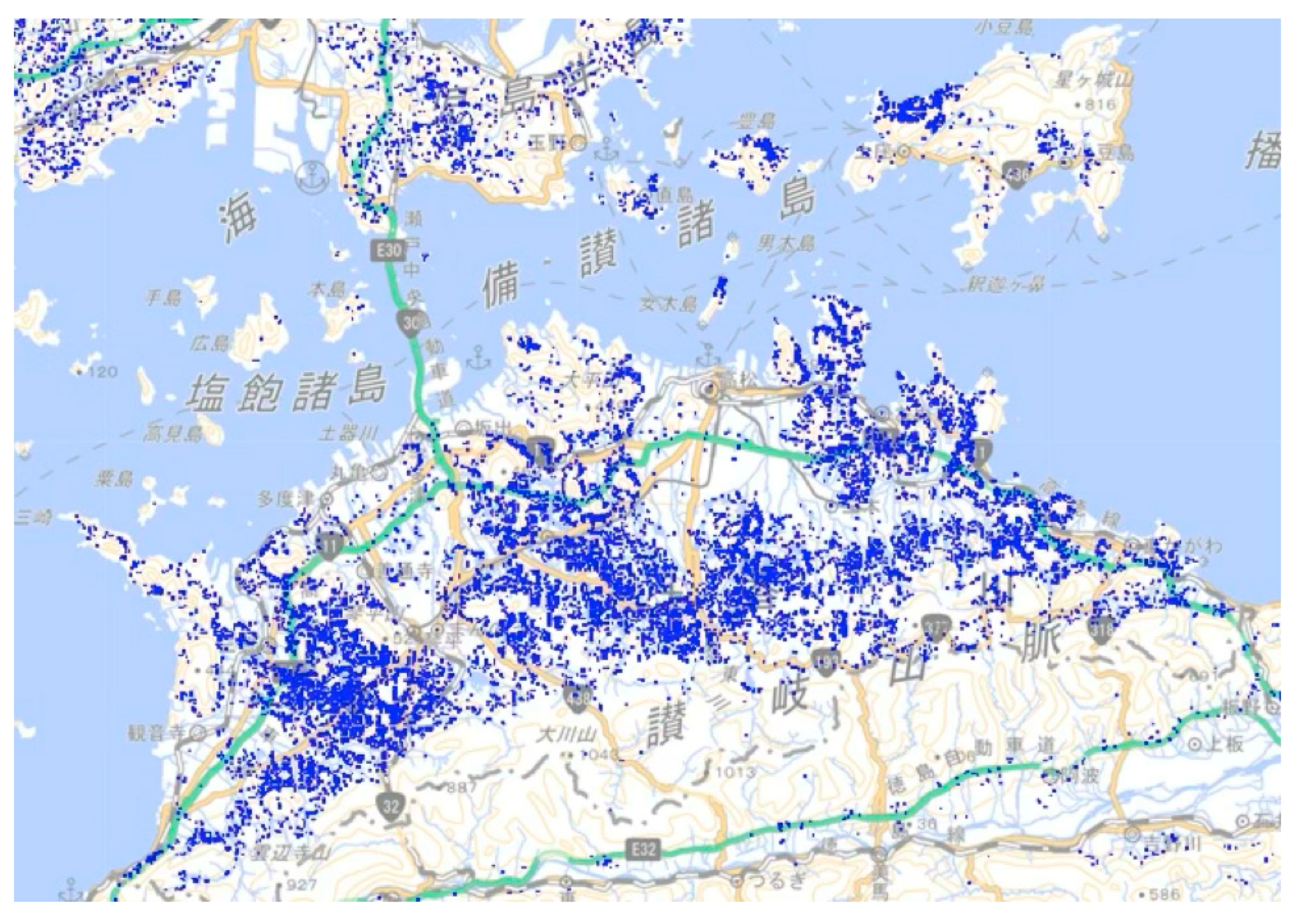
The blue dots on
Figure 1 represent ponds and reservoirs (PRs). In Japanese, PR means “
ike” or “tame-
ike,” where “tame-
ike” means “stored-
ike.” PRs are the plural form of “
ike.” The Japanese word “
ike” does not distinguish between ponds and reservoirs or between singular and plural PRs. However, the largest ones are not called
ike, but rather lakes. In Sanuki, there are only three lakes: Fuchū-ko, Hōzan-ko, and Ōkawa-dam-ko. These lakes were created by modern dam construction.
As of 1999, there were more than two million PRs in Japan (see
Table 1). The Hyōgo, Hiroshima, Kagawa, Yamaguchi, and Osaka prefectures are representative PR regions in Japan. Many PRs are in the Chūgoku region, which includes part of the Kinki region. This area is generally low rainfall with a Setouchi climate. At that time, Kagawa Prefecture, formerly known as Sanuki, had 14,619 PRs. Ōsaka has the oldest PR in Japan, Sayama-
ike, and Kagawa Prefecture has the second oldest, Mannō-
ike. Both prefectures are small, but Osaka is more urbanized than Kagawa, which has the highest number of PRs at 7.79 km
2.
The
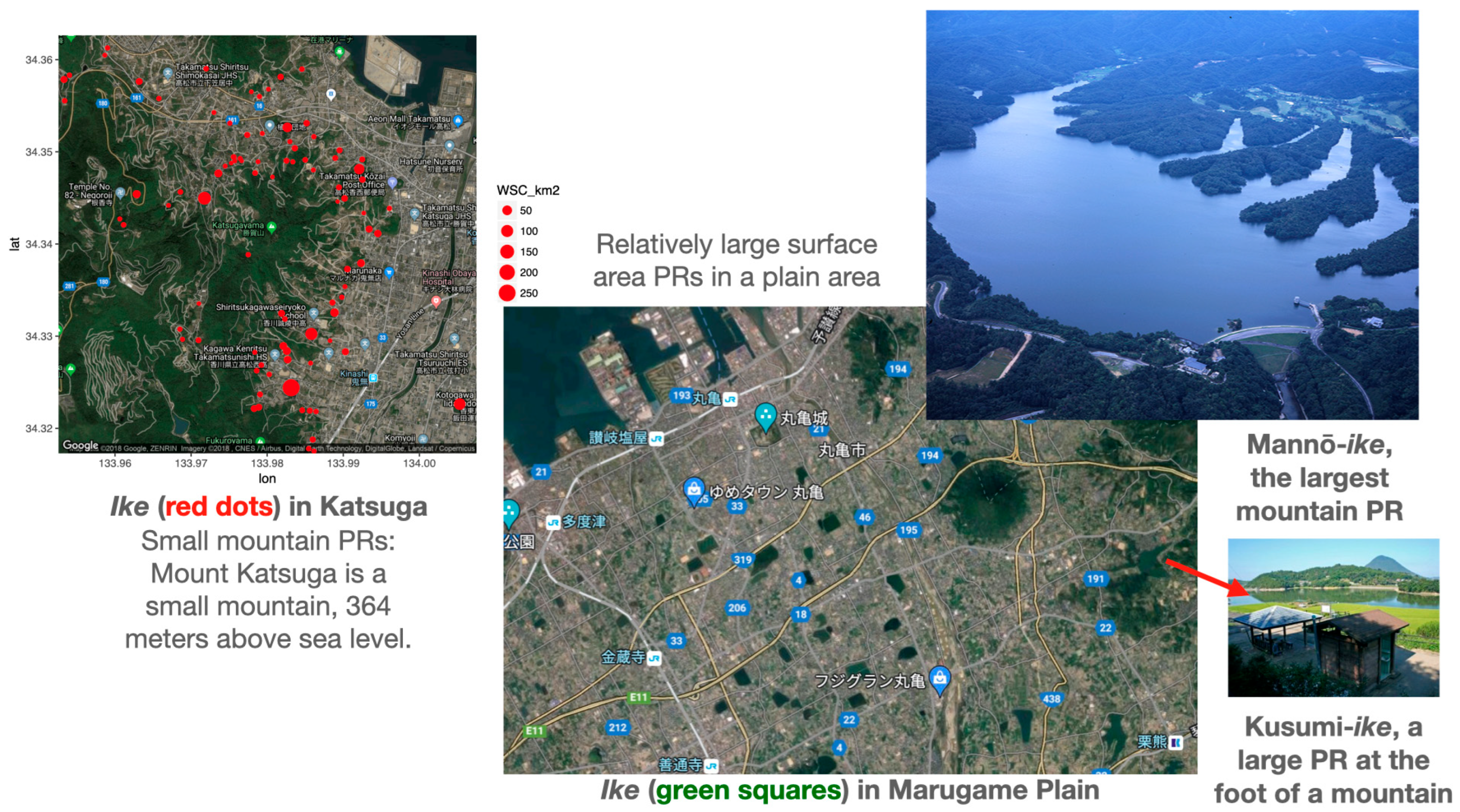
ike (PR) in Sanuki can be divided into three categories: (1) those in the surrounding area of small, isolated mountains (see
Figure 2, left), (2) those in plain areas (see middle), and (3) those of various sizes in mountain districts. The largest, ancient-born Mannō-
ike is located in the upper right corner of
Figure 2. It has a bank length of 156 m, a bank height of 32 m, a storage capacity of 15,400 m
3, a full water area of 138.5 ha, a landed area of 142.1 ha, and an irrigated area of 3239 ha. Similar information has been obtained for 6019 of the 14,619 PRs (
Sanuki no Tameike-shi 2000, p. 13).
Around the turn of the 21st century, a large volume entitled Sanuki no Tameike-shi [Topography of Ponds and Reservoirs in Sanuki] (2000) was published. Consisting of 1700 pages of main text and 558 pages of data, the book was written by 119 authors living in Kagawa Prefecture. While the book provides a wealth of knowledge, it contains many common-sense notions. For instance, Takeki Manabe, the governor of Kagawa Prefecture at the time, wrote the following in the book’s preface:
Blessed with a mild climate and fertile land, Kagawa Prefecture (Sanuki) has long been one of Japan’s leading rice-growing regions. However, due to low rainfall, shallow mountains, and the absence of large rivers, our ancestors had to work hard to secure water and created a unique landscape known as the “tame-ike kingdom.”
It is said that 60% of the current rice paddy area was reclaimed during the Nara period (710–794), and a significant number of tame-ike are believed to have been constructed by that time. Nevertheless, the number of tame-ike did not increase dramatically until the period when the development of new rice paddies was promoted.
This is the general understanding of the history of Ike in Sanuki. At first glance, there seems to be nothing wrong with this. But is it correct to assume that precipitation was low, bloody efforts were made to secure water, and 60% of the present paddy fields were cultivated by the Nara period? Furthermore, is it an accurate historical understanding that PRs increased dramatically during the period when the development of new rice paddies was promoted, as exemplified by the early Edo period?
In Japan, where agriculture has developed around paddy rice cultivation, securing water is essential, and the reason PRs were built due to low precipitation is clear. However, why were they so concerned about paddy fields? Why did they want to develop paddy fields in areas with little rainfall? Why did they build PRs to secure water? And how did they acquire the technology and labor to do so? How were the PRs maintained, and who took the initiative to build them?
The historical record is always biased. Large PRs are documented, while small PRs, which can be constructed at the family level, are rarely documented. However, the Chi-Sen-Gōfuroku (Records of Lakes and Springs) (1797) of the Takamatsu clan succeeded in identifying all ponds, reservoirs, and springs in the Eastern Sanuki area, despite being limited to that region of the clan’s territory. This demonstrates the importance of PRs and springs for sustaining life at that time and indicates that administrative power had matured sufficiently to control water resources. Furthermore, the PRs documented the size of the paddy fields they could supply, indicating the total amount of rice that could be produced with human resources. In other words, the PRs were understood based on human understanding. In terms of identifying individuals, early modern Japan was one of the few countries in the world with a well-developed administrative capacity.
In recent years, the actual situation regarding the restoration of Mannō-
ike, the largest pond in Sanuki during the time of Kūkai (774–835), has been estimated (
Sanuki no Tameike-shi 2000, p. 37). Although it currently has only one-third of its original storage capacity, it can still hold five million tons of water, and its embankment is twenty-two meters high. It is no exaggeration to call it a dam of the modern era. It should be noted that this was an era before the existence of huge, automated machines such as modern earth movers, and the “dam” was built solely by human and animal power. It is estimated that 380,000 man-days of mobilization, including technical staff, were required. How was such mobilization possible when it far exceeded the region’s population? This is one of the most important questions addressed in this article.
Kūkai completed the renovation of Mannō-
ike in 821 (Kōnin 12) (
Sanuki no Tameike-shi 2000, p. 79). The PR was repaired several times due to floods and other disruptions, but not after 1 May 1184, when a major flood caused the levee to break (
Sanuki no Tameike-shi 2000, p. 82). In 1626, the Sanuki area experienced a drought, with no rain falling for 95 days, and people starved to death. Following a detailed investigation in 1628, restoration efforts began. The turfing of the embankment was completed on 15 February 1631, and a ridgepole-raising ceremony was held (
Sanuki no Tameike-shi 2000, p. 89).
The reconstruction took 1184 to 1631 years. This must have been a significant turning point in the history of labor mobilization for PRs in Sanuki. In other words, using the concept of Living Spaces, it was a sort of “localization” of people’s Living Spaces through rural independence and self-responsibility based on a peasant economy at the beginning of the early modern period in Japan, mainly from the 15th to the 17th century. The inhabitants of the locality may have assumed responsibility for it. Why did this establishment require such a long period of 447 years? This is the final hypothetical question in this article.
Although there are significant differences in the locations of PRs (see
Figure 2),
Table 2 shows that the management systems for PRs in Sanuki have crucial characteristics in common. Of the 14,619 PRs, 41.37% are privately owned, while 38.95% are managed by individuals. Few are owned by the prefecture. Although nearly 25% are owned by the national government, the government does not manage them. Almost all of them—more than 98%—are managed by local organizations, municipalities, and individuals. In other words, it is important to note that each PR is managed primarily at the local level, a system that has endured to this day.
The academic question addressed in this article is not specific to a specialized field of history. It is also a bold attempt to reexamine 1400 years of history, from the seventh to the twentieth century, from the perspective of one physical entity: PRs. Narrowing the scope of consideration would challenge Conrad Totman’s periodization of Japanese environmental history (
Totman 2014). In his book, which could not refer to the three major edited volumes on Japanese environmental history (
Hirakawa et al. 2012–2013;
Nakatsuka et al. 2020–2021;
Fujihara 2023) due to its publication time, he divides Japanese history into seven periods: (1) Hunting and gathering society until 500, (2) Early agricultural society until 600, (3) Early agricultural society from 600 to 1250, (4) Later agricultural society from 1250 to 1650, (5) Later agricultural society from 1650 to 1890, (6) Imperial industrialism until 1890, (7) Entrepreneurial industrialism from 1945 to 2010. This periodization is supported by the general understanding of the transition from an agricultural society to an industrial society. When focusing on the historical development of PRs, this socio-hydrological article’s greatest contribution may be its potential to offer new insights into this general periodization.
3. Materials and Methods
The basic data on PRs compiled in
Sanuki no Tameike-shi (
2000) is being digitized to create a statistical dataset that can be analyzed. This dataset in
Supplementary Materials: Dataset for PRs in Sanuki is the most important material for this article. The data includes the length and height of the banks; the storage capacity; and the water, land, and irrigated areas of 6019 PRs under 14,619 categories. Topographic and historical descriptions of the 668 main PRs are also available. The author also consulted several local histories and topographies of Sanuki regarding these PRs.
The historical document discussed here is a valuable early record book from 1644 (
Shūmon-chō of Sakamoto-gō 1644). Throughout Japan, people were forced to trample on statues of Mary in February, March, or April to prove that they were not Christian. In any case, individuals were recognized as residents only after proving their affiliation with a particular Buddhist temple. The priests of each temple provided proof. This historical document is from the early stages of the Shūmon Aratame-chō, a pivotal text in the study of historical demography in Japan (
Hayami 1986,
2003). It is extremely valuable because it dates from the earliest period of production of this type of historical material. The discovery of its survival in this area was also the starting point of this article.
The Shūmon Aratame-chō, also known as the Shūmon Ninbetsu Aratame-chō (Religious Population Register), was a document that the Edo shogunate required each village to prepare to enforce the prohibition of Christianity. Once a year, Buddhist temples required everyone to prove that they were not Christian because the people being investigated were members of a Buddhist temple. Initially, this was only done in the shogunate’s domain, but starting in 1671, clans throughout Japan were required to produce this register in approximately 63,000 villages. The documents were made annually in principle, although this varied depending on the time of year and the region. They contained the names and ages of the head of the household and his or her family, as well as information on the temple to which the residents belonged.
In the early Shūmon Aratame-chō, the unit of record sometimes included several dozen people. The largest unit of record in the books analyzed in this article included 108 people. The number of houses in that unit and the total taxable income were also listed. This measurement symbolizes Japan as a rice society and was recorded in terms of rice quantity.
Although the term “household” is in question, it is proven which Buddhist temple each listed unit belonged to. In the 1644 Shūmon Aratame-chō compiled in Sakamoto-gō, not only is the “household” stated, but also the number of houses and total income subject to taxation for each unit of entry, all in terms of rice. For simplicity’s sake, one Koku (150 kg of rice) is considered the equivalent of one year’s sustenance for the population as a whole. A quantity of 100 Koku is considered sufficient income and property for 100 people to live on and pay taxes. In fact, the record of Kawahara village in Sakamoto-gō shows that a household of 108 people could be described as a single business entity with over 190 Koku in total. This quantity is significant because usually, even 10 Koku is a large farmhouse. This is an exceptional group.
The PRs are a prominent feature of the Sanuki landscape. Even if they originated in ancient times, it makes sense that they were built to address the area’s long-term drought due to low rainfall. The argument that they were built using forced labor in premodern times ignores historical reality. The mobilization of people must have its own logic that works within a specific time and place. Religious motivations may drive people to enthusiasm, or a practical need to secure food for the people may exist. It may also be an increase in productivity that allows politicians to collect taxes to finance their political entities.
There are historical records of PR construction since ancient times, as well as records of floods and droughts in Sanuki. The author analyzed these figures using a soft-clustering approach called Non-Negative Matrix Factorization (NNMF) (
Satoh 2024). The specifics of this approach are discussed in the following chapters. The author also used other methods, such as analyzing the distribution of PR sizes, estimating development stages by fitting logistic curves, and Geographic Information System (GIS) analysis. This analysis considers the flow of residents from the perspective of the labor force and workload. This approach provides a multidimensional view of the long-term history of PRs and takes a holistic approach.
In recent years, quantitative historical research on Japan has dramatically progressed in terms of population (
Saito 2018), economic indicators (
Takashima 2017,
2023), precipitation (
Nakatsuka 2022), and other long-term factors. This article is one such attempt, focusing on PRs as objects that shape a place’s cultural landscape. The author believes this approach will present new challenges in long-term historical research.
4. Results
4.1. Rank-Size Distribution of PRs
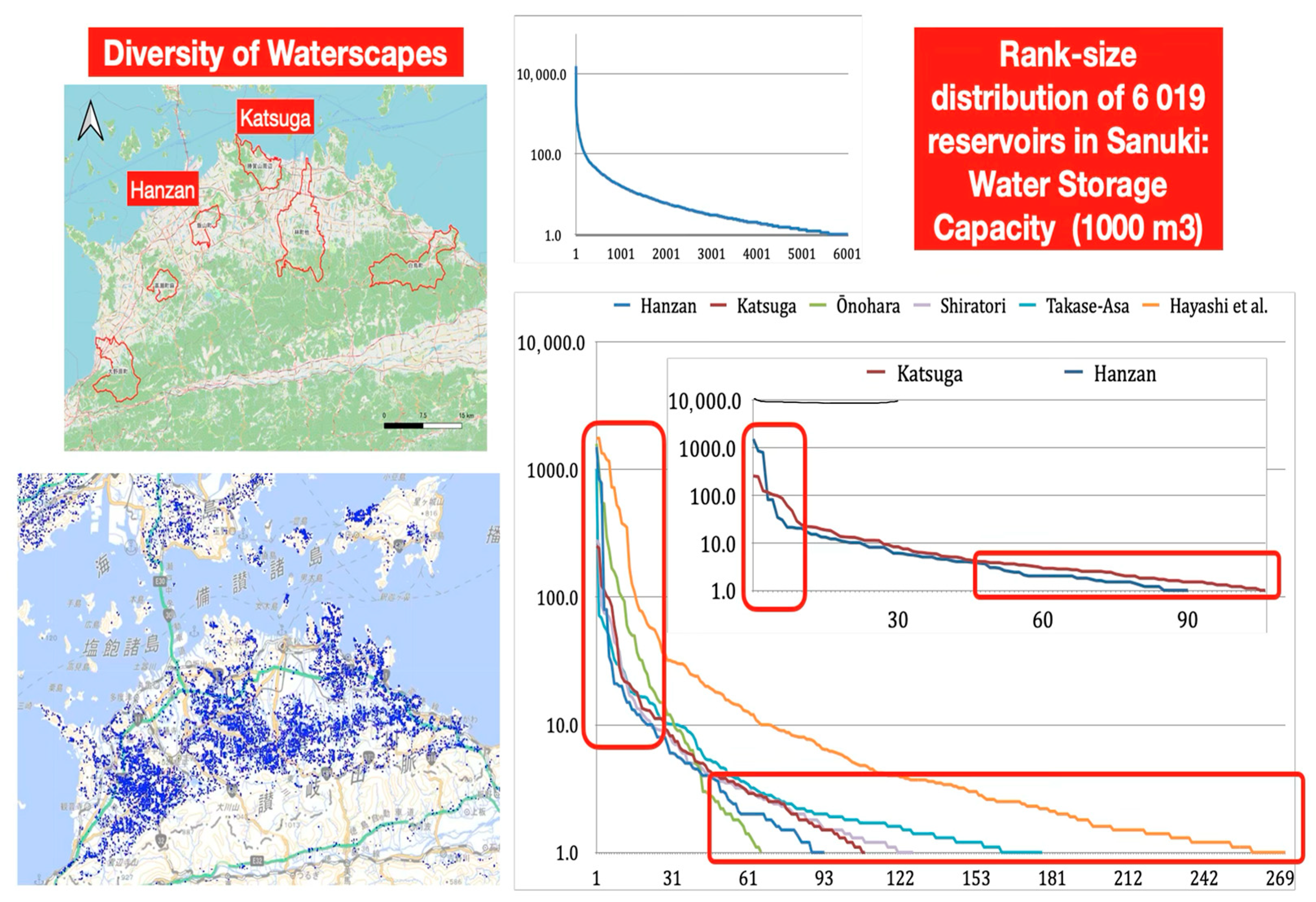
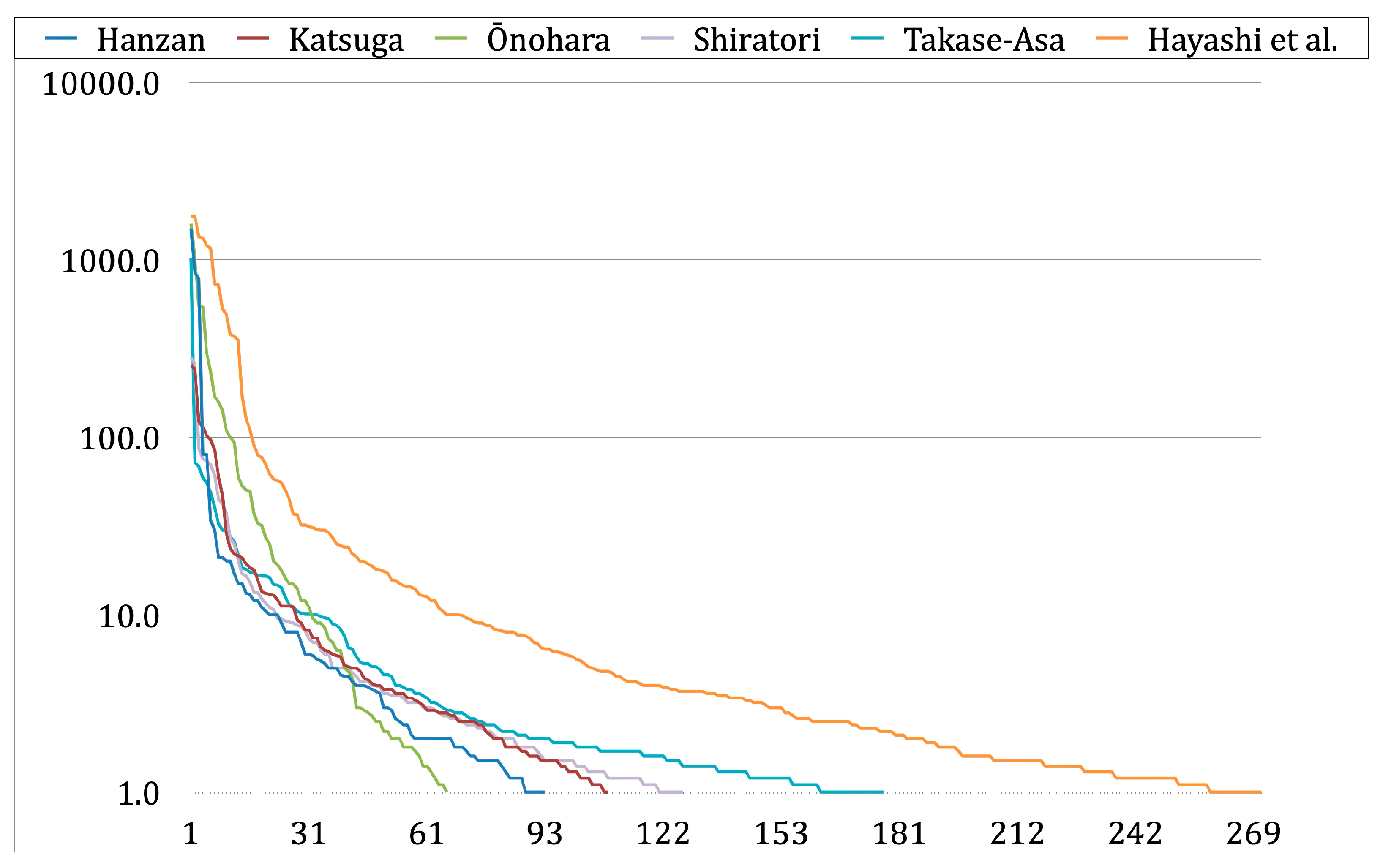
Unlike micro-historical research, which is driven by the history of individual events due to the variety of historical developments, macro-historical research can reveal things through aggregation. For instance, identifying hundreds of PRs in each area through the distribution of water storage capacity reveals the characteristics of each area. In such cases, attention should be paid to the presence of large PRs and the relative proportions of smaller PRs. Selecting six regions from the entire Sanuki reveals a particularly striking difference in the ratio of small PRs (
Figure 3). Plotting curves on a logarithmic scale reveals that they extend sharply along the Y-axis in regions dominated by large PRs, while in areas with a relatively high number of smaller PRs, the curves extend farther along the X-axis. This illustrates the regional variations across different areas. This difference is in the proportion of PRs that can be managed by one or a few families. Conversely, when comparing the Katsuga and Hanzan regions, the differences between small PRs are minimal, but the differences between large PRs are significant.
Hanzan (
Hanzan Chōshi 1988) is located on the Marugame Plain. There are PRs in Hanzan, such as Kusumi-
ike, which utilizes the mountainous area. However, the large PRs built on the plains are also characteristic (
Figure 4 and
Table 3). Some of the large PRs in Hanzan were constructed in the 16th and 17th centuries. These include Ni-
ike, Kusumi-
ike, and Ōkubo-
ike. They have a water storage capacity of over 700,000 m
3. Kusumi-
ike has a capacity of 783,000 m
3. Ōkubo-
ike has a capacity of 843,000 m
3. Ni-
ike has a capacity of more than 1.5 million m
3. For this reason, managing the PRs required the cooperation of more than ten villages. In contrast, the largest PR in the Katsuga region, Kandaka-
ike, has a capacity of only 251,400 m
3.
Table 3, which is quantified by PR storage volume, shows striking differences between the Katsuga and Hanzan regions. However, this is not clearly visible in the rank-size distribution graph (
Figure 4). In the Hanzan region, there are three large PRs and almost no medium-sized PRs. There is a significant difference in the management and maintenance of PRs. In other words, even though water scarcity is a universal phenomenon, regional differences arise in how it is addressed. Although topographical–geological factors play a major role, differences in hydro-climatological factors, such as river and weather conditions, need to be clarified.
4.2. The NNMFA to a Logistic Curve Fitting of PRs
There are limited figures on the number of PRs: There were 1372 in 1645, 1953 in 1686, 5555 in the late 18th century, and 5568 in the early 19th century (
Table 4). These numbers are only available for the eastern half of Sanuki. These numbers vary from one source to another. The mid-18th-century numbers are the result of decades of early modern investigations of each PR. Various physical quantities are said to follow a logistic curve. Logistic curve-fitting analysis has been proven effective for population analysis when sufficient data is unavailable (
Saito 2018).
Figure 5 and
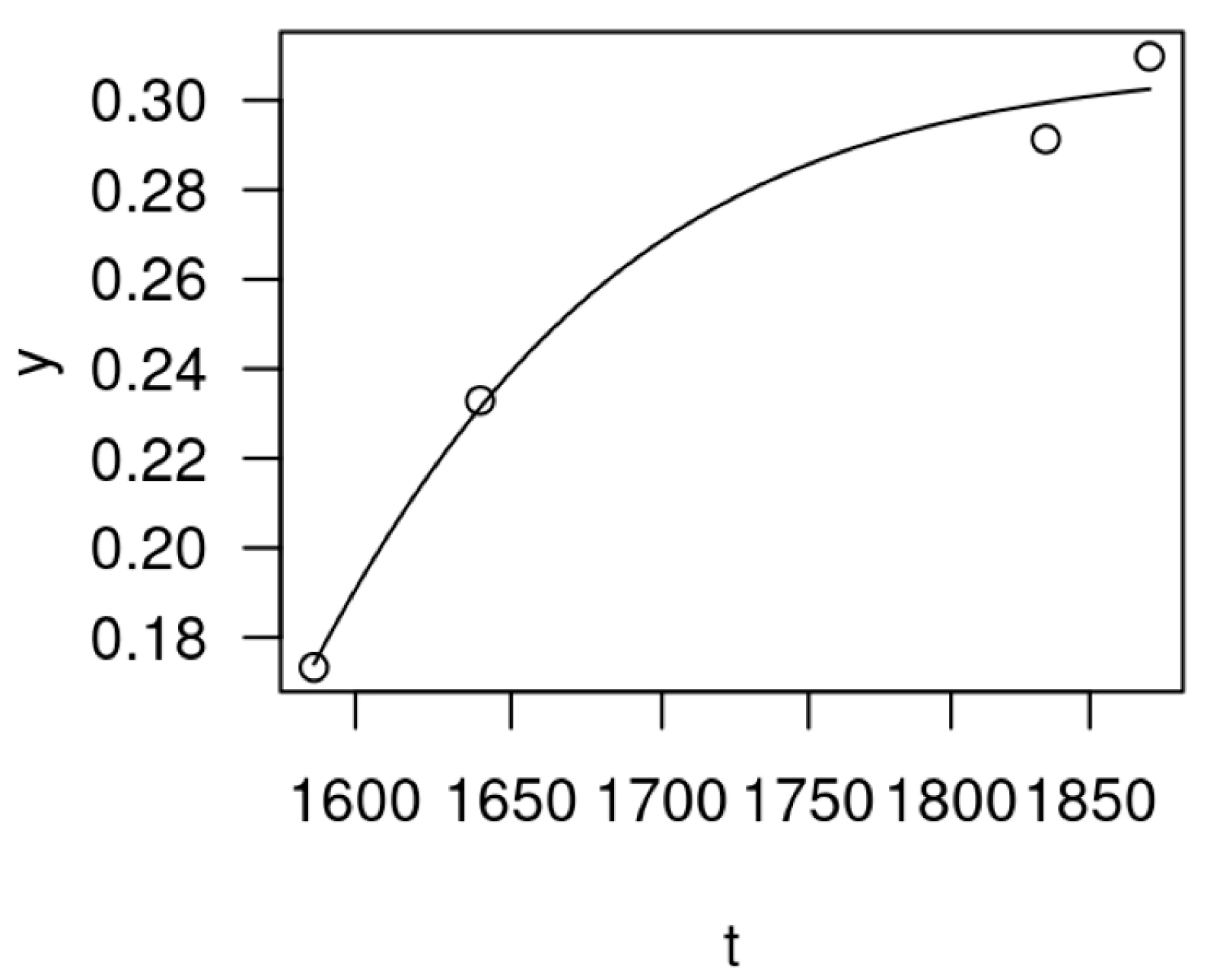
Table 5 shows a marked increase in the number of PRs in the 17th century. The Takamatsu domain’s economic size had already grown rapidly, increasing from 173,300 koku in 1587 to 232,948.93 koku in 1640 and further rising to 307,602.83 koku in 1872. When these economic sizes are applied to the logistic curve, the result is shown in
Figure 6. The logistic curve shown here represents only part of a larger logistic curve. A typical logistic curve traces an S-shaped path: it increases gradually at first, accelerates its growth rate, and finally converges. If there are four data points over time, the curve can be plotted. These four data points produce the shape seen in
Figure 6. It can be inferred that the initial increase in economic volume likely occurred before 1600. If PRs were designed to prevent drought and promote economic growth, this would not be an issue. However, this does not appear to be the case. When examining Sanuki’s PRs, it is evident that the nascent coal industry in England was already emerging in the 16th century (
Wrigley 2016). This diverges from the path of sustained economic development leading into the modern era, suggesting instead the potential for economic growth inherent within water circulation systems.
Historical research has attributed the beginning of PR construction to the Buddhist monk Gyōki (668–749) and his group during the Nara period (710–794). Another famous Buddhist monk, Kūkai, is credited with restoring the largest PR in Sanuki a little later. Though there are few references to this in the medieval period, many PRs are said to have been constructed in the early modern period by governmental officials (samurai) such as Hachibei Nishijima (
Sanuki no Tameike-shi 2000, pp. 1483–88) and Heiroku Yanobe (
Sanuki no Tameike-shi 2000, pp. 1489–93). Nishijima is said to have constructed more than 90 large PRs in the 14 years from 1625. Yanobe built 406 PRs in response to the unprecedented drought of 1645, bringing the total to 1366, including the original 960 PRs (
Hanzan Chōshi 1988, p. 296).
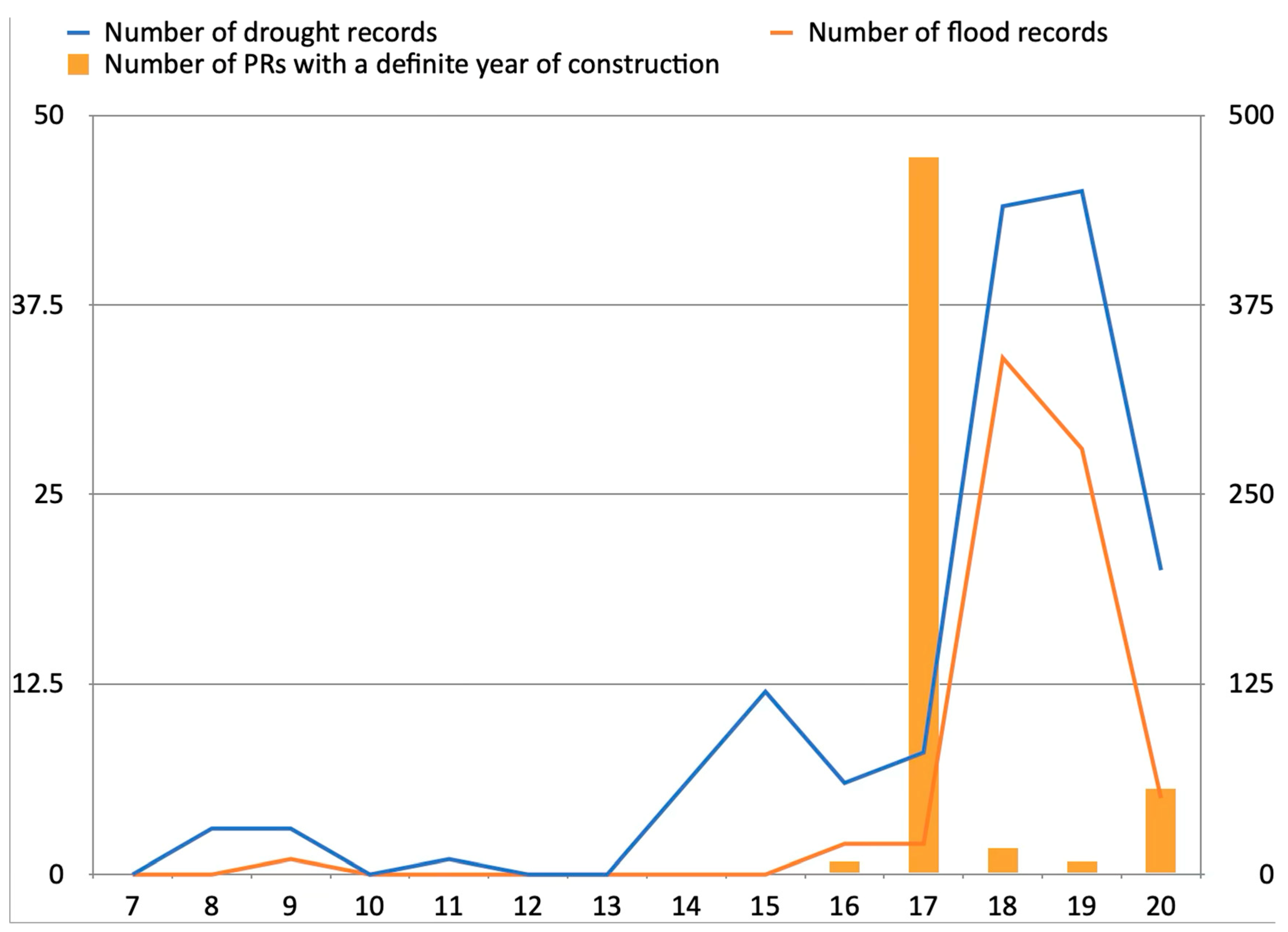
Additionally, the
Sanuki no Tameike-shi (
2000) collects data on past droughts and floods since ancient times (
Figure 5 and
Table 5), as well as the years in which the PRs were constructed from the 8th century onwards.
Table 5 shows that 473 PRs were constructed in the 17th century, and their dates of establishment are recorded. How can we understand the relationship between the PRs and the drought and flood data? It is generally accepted that the construction of PRs was triggered by drought, as evidenced by the written historical record. However, why were droughts and floods recorded in the first place, and what is the significance of clearly stating the year of construction for PRs?
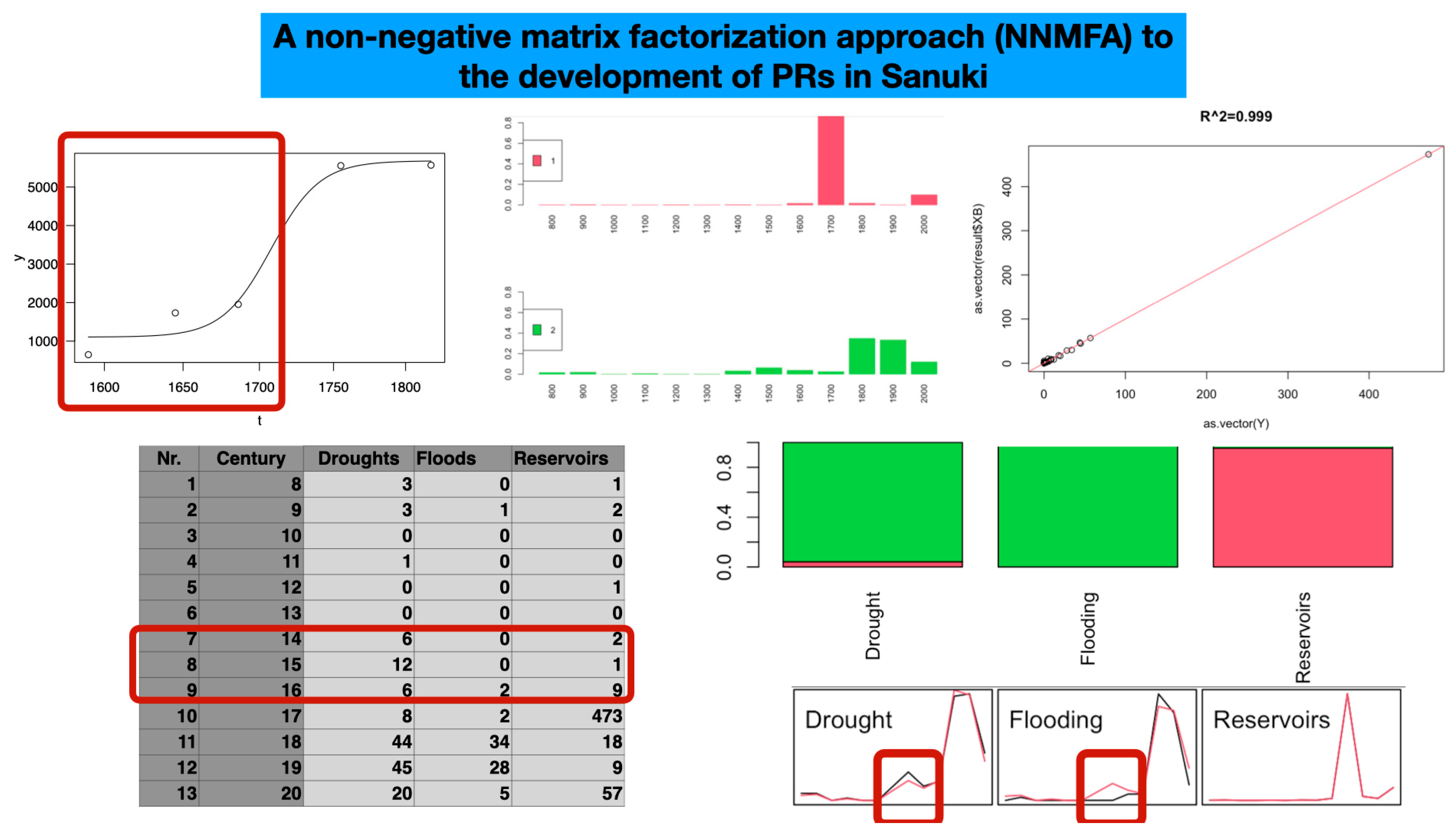
The issue at hand is the relationship between accumulated experience with droughts or floods and the construction of PRs. The author used a non-negative matrix factorization (NNMF) for 1400 years of drought and flood records, as well as the number of PRs whose construction years are known. The author does not believe there is enough space to provide further technological detail here. The result is an interesting difference in the historical patterns of the three numbers. The results depict that droughts, floods, and PRs have different underlying logics, i.e., basic trends over the past 1400 years.
The development of a particular element seems to follow a logistic curve to a significant degree. However, it cannot be said that PRs were developed directly from ancient ideas or constructions to the present day. The primary response to water scarcity is the bass note, and one could argue that the concept has been combating water scarcity since ancient times. However, this would be inaccurate. There was a period when the local situation clearly forced a response to water scarcity. This response probably occurred in the 15th century when drought records clearly increased.
In this respect, the method used here is not logistic curve fitting analysis, but rather, NNMFA (Non-Negative Matrix Factorization Approach). NNMFA models how a few basic factors influence the development of a time series, revealing trends close to real numerical information. In other words, this method clarifies the multiple development paths seen throughout history. Here, the logic of creating PRs is contrasted with the logic of recording droughts and floods (
Figure 7). NNMFA decomposes these three time series datasets—such as the drought, flood, and PR construction records discussed here—into two basics that generate historical changes and statistically reproduce those changes. These two basic patterns, shown in red and green, combine to explain each change. In this case, the two factors explain 99% of the variation. This reflects the concentrated construction of PRs in the 18th century and the subsequent increase in drought and flood records. Of course, statistical predictions and observed data contain some differences. Taking these uncertainties into account clarifies that the focus of the discussion lies in the 15th century. This method is called soft clustering because it does not rigidly classify droughts, floods, and PRs. Rather, it recognizes their shared characteristics of temporal variation and combinations.
Building a PR cannot be done by one person alone. A few families may be able to do it. In many cases, though, it requires collaboration, producing struggling actors in terms of interests. The commons are precisely within the logic of struggle. Of particular interest, based on observations of the Sanuki PRs, is the record of droughts in the 15th century. Entering the Warring States period, PR construction progressed beyond individuals and families to include small groups of local units. This gave rise to the era of rapid PR construction that followed. In this sense, the 17th century was the age of PR construction, but it was a legacy of an earlier age.
The idea that PRs were created due to a lack of water is overly simplistic. The focus is on the 15th century. However, there is a gap in Japanese historical sources. Additionally, there is a disconnect between the content of the early modern period and earlier periods. The issue of continuity and disconnection in historical sources is complex, and the Living Spaces approach could be effective. In other words, the historical logic of each record of drought or flooding and each dated PR construction is unique.
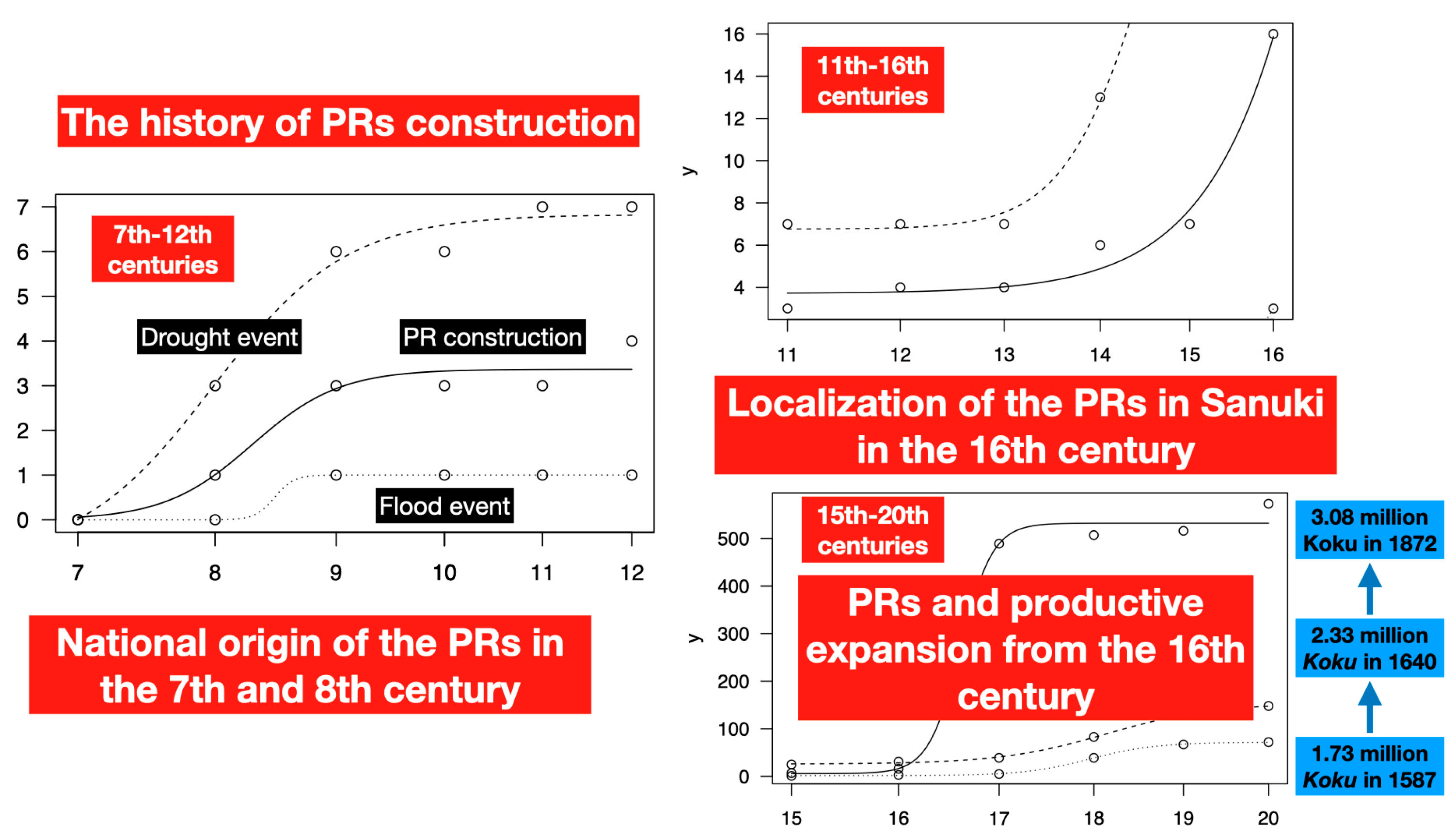
Note that the vertical axes of the three graphs in
Figure 8 have different scales, but they show that, in ancient times, when PRs were first constructed in the Kinki region of central Japan, information about droughts gradually became important in the Sanuki region as well. The solid line shows the development trend of PR construction; the dashed line shows the record of drought events, and the dotted line shows the record of flood events. Flood records may have been insignificant in ancient times and the Middle Ages.
Figure 5 and
Table 5 shows there was a significant increase in drought and flood records from the 18th century onwards, but this subsided after the 19th century. At the same time, the boom in PR construction also subsided after the 18th century. The early modern period, when clan leaders made efforts to build PRs, was a boom period for PR construction in clan society, which began dramatically in the 16th century. As shown in
Figure 8, applying logistic curve-fitting analysis to visualize this trend makes these historical changes more apparent.
One development trend can be identified by looking at the number of PRs. However, drought data suggest three phases since antiquity. Flooding is a relatively modern phenomenon that only affects human-made landscapes. In contrast, drought provides opportunities for human activities such as building PRs and constructing waterway networks.
Extending this discussion further into antiquity, these two phases should be considered as two initial points in time. This is because records of drought, famine, and other events began to be kept in historical documents at the same time as the construction of the PRs. The Kinki region, the center of the ancient period, leads in the accumulation of such records. The Sanuki region is also linked to the study of droughts in central Japan. This is why Kūkai constructed the largest PR in Sanuki, as mentioned above. However, the details of this construction are not well documented (
Sanuki no Tameike-shi 2000, pp. 1469–76).
In conclusion, the history of PRs can be divided into three phases over a period of 1400 years. These phases include the overlapping centuries of the 7th to 12th, 11th to 16th, and 15th to 20th. The second phase involved the construction of PRs in the advanced Kinki region, which took root and spread to Sanuki. This was followed by the third, final phase, during which large numbers of PRs were constructed alongside economic expansion.
4.3. People Flow and PRs
The final section is a study of a historical document from 1644 focusing on labor. It is a type of resident registry that reveals significant migration, technological innovation, and family structure issues related to the mountainous area of Kusumi-ike in PR.
While some households with a few members are common, larger households existed, including one with 108 members. However, the term “household” may not be the correct one (
Nishitani 2021;
Saito 2022). It is a registered unit. This group is believed to have played a central role in constructing, extending, and managing the “communized” PR in Sakamoto-gō, Kusumi-
ike.
In early modern villages, the amount of rice that each household received as Kokudaka was weighed and measured. This quantitative decision determined the household’s tax burden, meaning the property and income that would be taxed. In this case, the group of one hundred and eight “household” members who managed Kusumi-ike showed a Kokudaka that would be unthinkable for an average peasant. The household unit of Densuke has 108 members and a tax burden of 190 Koku, which is equivalent to the annual income of 190 household members.
Each household is affiliated with a specific temple. For example, in ancient times, there was a group of water-related developers led by a monk named Gyōki. Mannō-ike, the largest pond in Sanuki, is attributed to the renowned monk Kūkai. Was the Buddhist community the source of a group of workers, engineers, and prayer groups?
The 108 people under Densuke, including himself, form a modern-day composite of several conjugal households. Densuke and his family belong to the Miya-no-Bō temple of the Shingon sect of Buddhism. It could be called a family temple. The family consists of 16 members, including Densuke’s wife; three couples from the next generation, including their children; Densuke’s 76-year-old mother; and a 55-year-old male servant (This age is calculated using the traditional Japanese age system). It is a three-generation family.
The village of Kawahara in Sakamoto-gō appears to consist of many migrants. A Jōdo Shinshū temple in a neighboring village, Shōren-ji (No. 1), has 47.3 percent of Kawahara’s population as its members (
Table 6). While many other villages have villagers who belong to one or two central temples, Kawahara has a very high proportion of families with their own temples. In other words, most of the villagers are migrants, and it is reasonable to assume that the village developed around Kusumi-ike as a settlement of migrants. Did family members migrate as a group? Even so, individual households usually secured more koku than expected. It is likely that a group of people were directly involved in creating and expanding Kusumi-
ike, though there is no proof. However, it is certain that they were one of the groups that benefited from the PR’s irrigation.
This final analysis could provide one last point of clarification. While the location of a PR is specific, it is not only the local inhabitants who play an important role in its construction, maintenance, or extension. In premodern societies, a more mobile group may have played a greater role. This was also the case in ancient times. Gyōki and Kūkai were highly migratory people who eventually established their own bases. While PRs certainly serve the function of storing water, regional variations in water flow caused by the Asian monsoon must also be considered. The monsoon determines seasonal variations in precipitation, including the heavy rain associated with typhoons. This should also be understood in relation to the mobility of human populations. Local histories are not just local histories.