
Bioinspired Heat Exchangers: A Multi-Scale Review of Thermo-Hydraulic Performance Enhancement

Abstract
1. Introduction
2. Methodology and Classification
2.1. Scope of the Review
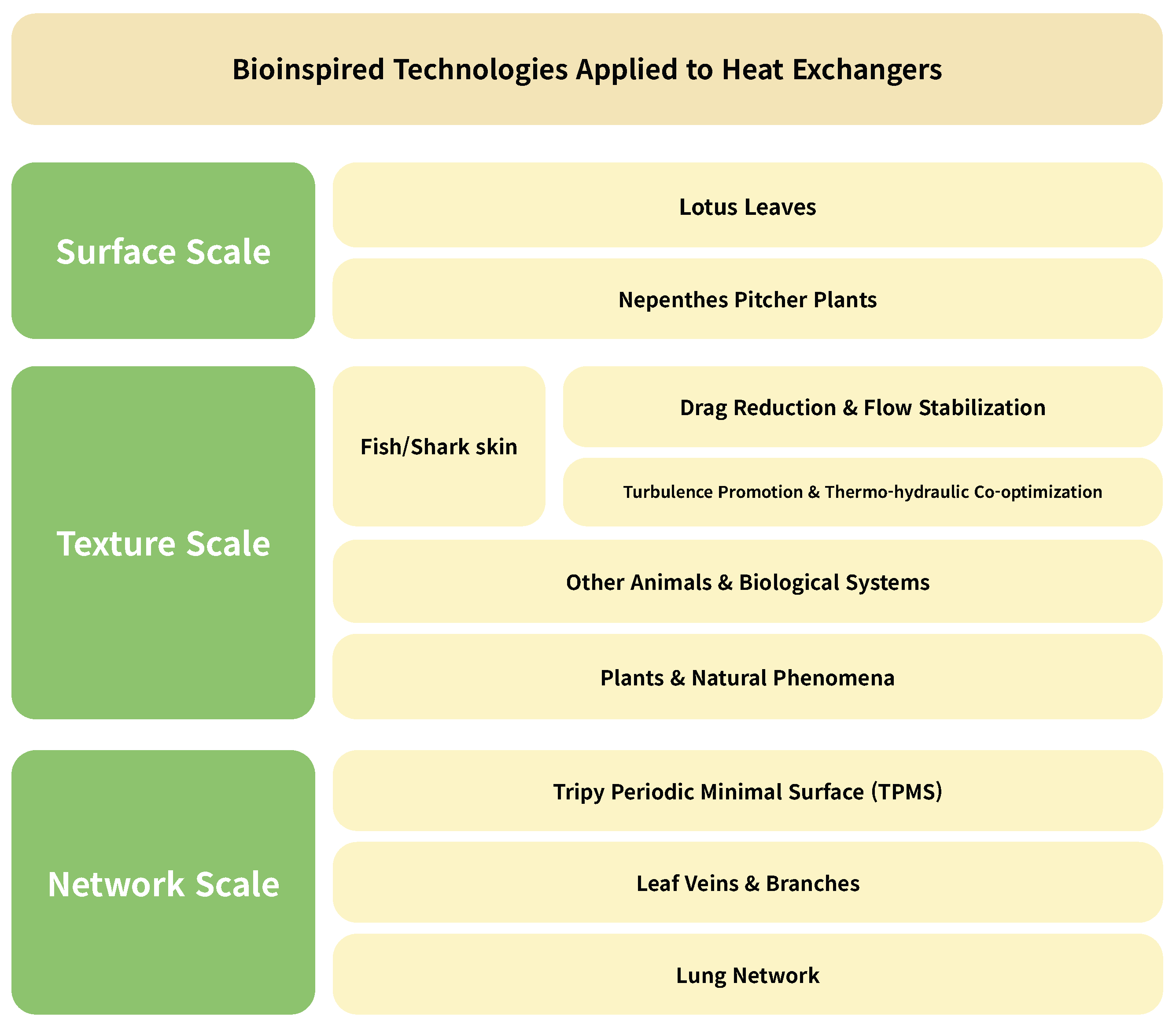
2.2. Classification
2.3. Performance Evaluation and Validation of Numerical Analysis
3. Bioinspired Technologies Applied to Heat Exchangers
3.1. Surface Scale
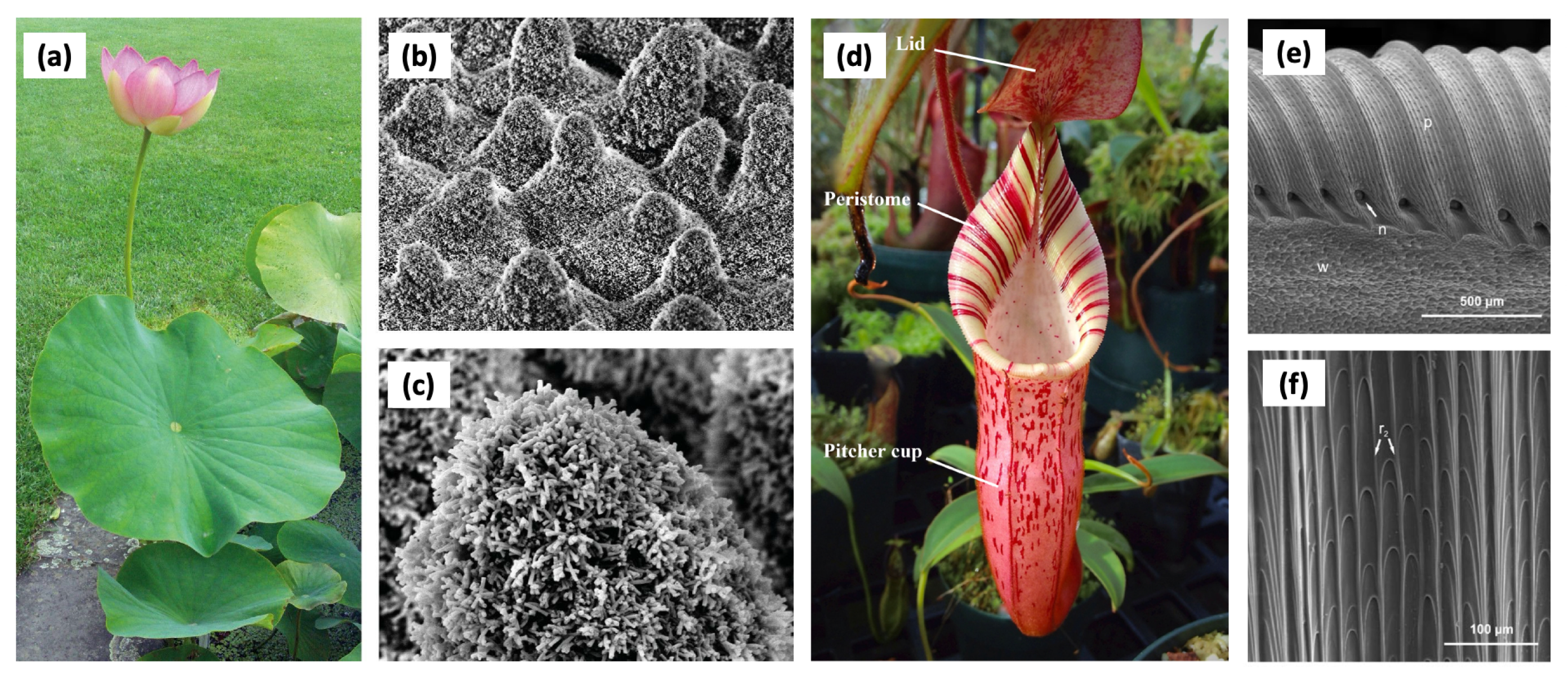
3.1.1. Lotus Leaves
3.1.2. Nepenthes Pitcher Plants
3.1.3. Surface Scale Critical Synthesis and Design Guidelines
3.2. Texture Scale
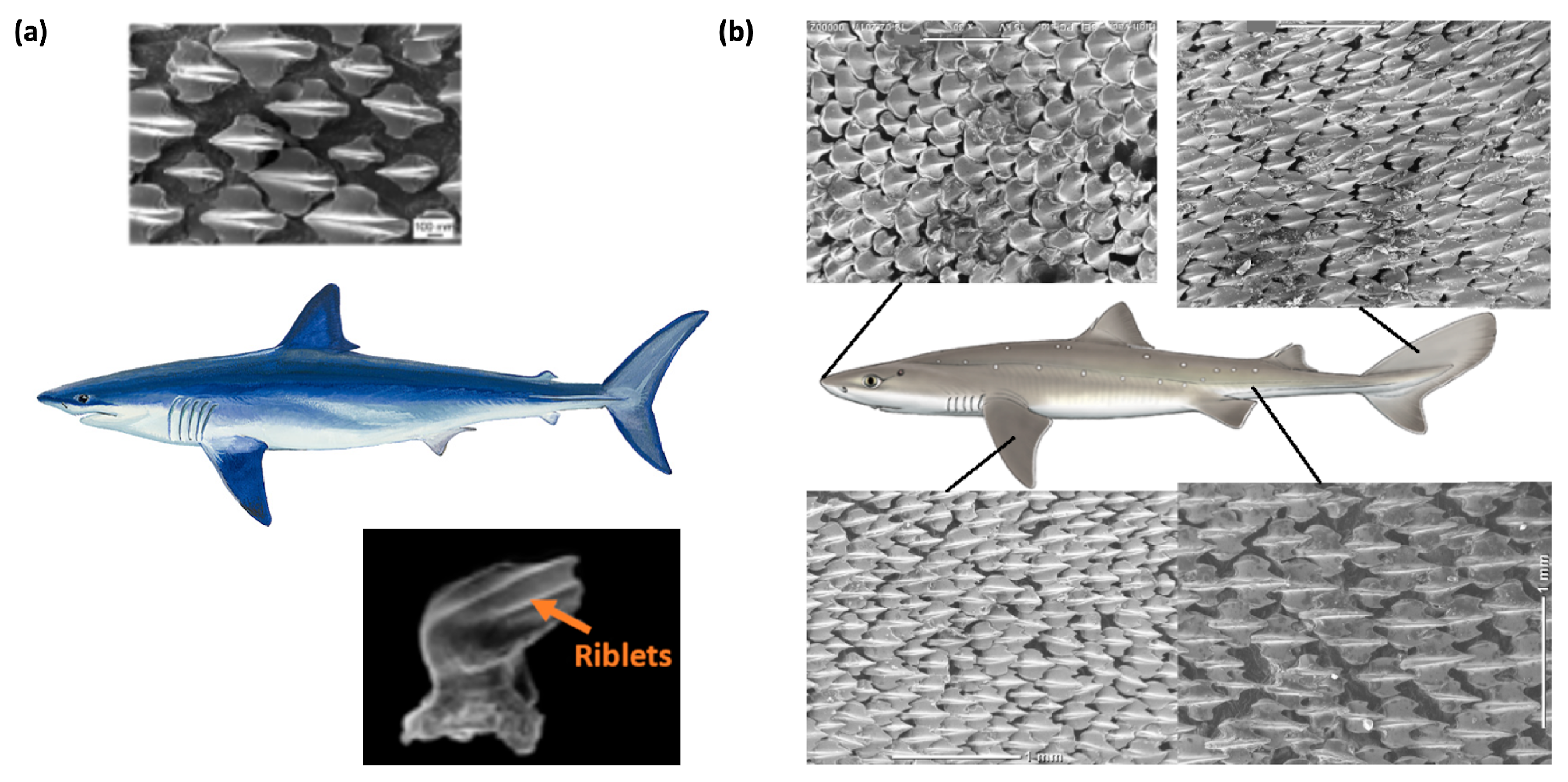
3.2.1. Fish and Shark Skin
- Drag Reduction and Flow Stabilization


| Biomimetic Target | Maximum Drag Reduction Rate (%) | Comparator (Baseline) | Trade-Off/Boundary | Ref. |
|---|---|---|---|---|
| Shark Skin Riblets (Blade-type) | 11.6 | Smooth surface (no riblets) | drag reduction peaks only near the optimized s+, h+/overly large s+ may increase drag | [17] |
| 3D Sinusoidal Riblets | 9.8 (±2) | Smooth-wall turbulent channel (no riblets) | pressure drag can rise with higher h+/a+ or shorter λ+/too short λ+ can induce separation and negate benefits. | [18] |
| Ctenopharyngodon Idellus Scale | 3.014 | Smooth surface | modest drag reduction/higher speed increases near-wall viscous resistance and pressure force | [19] |
| Shark Skin Riblets | 6 | Flat, unstructured PTFE | benefit limited to a narrow spacing window; validated only for airflow on PTFE | [20] |
- Turbulence Promotion and Thermo-hydraulic Co-optimization
3.2.2. Animal and Biological Systems
3.2.3. Plants and Natural Phenomena
3.2.4. Texture Scale Critical Synthesis and Design Guidelines
3.3. Network Scale
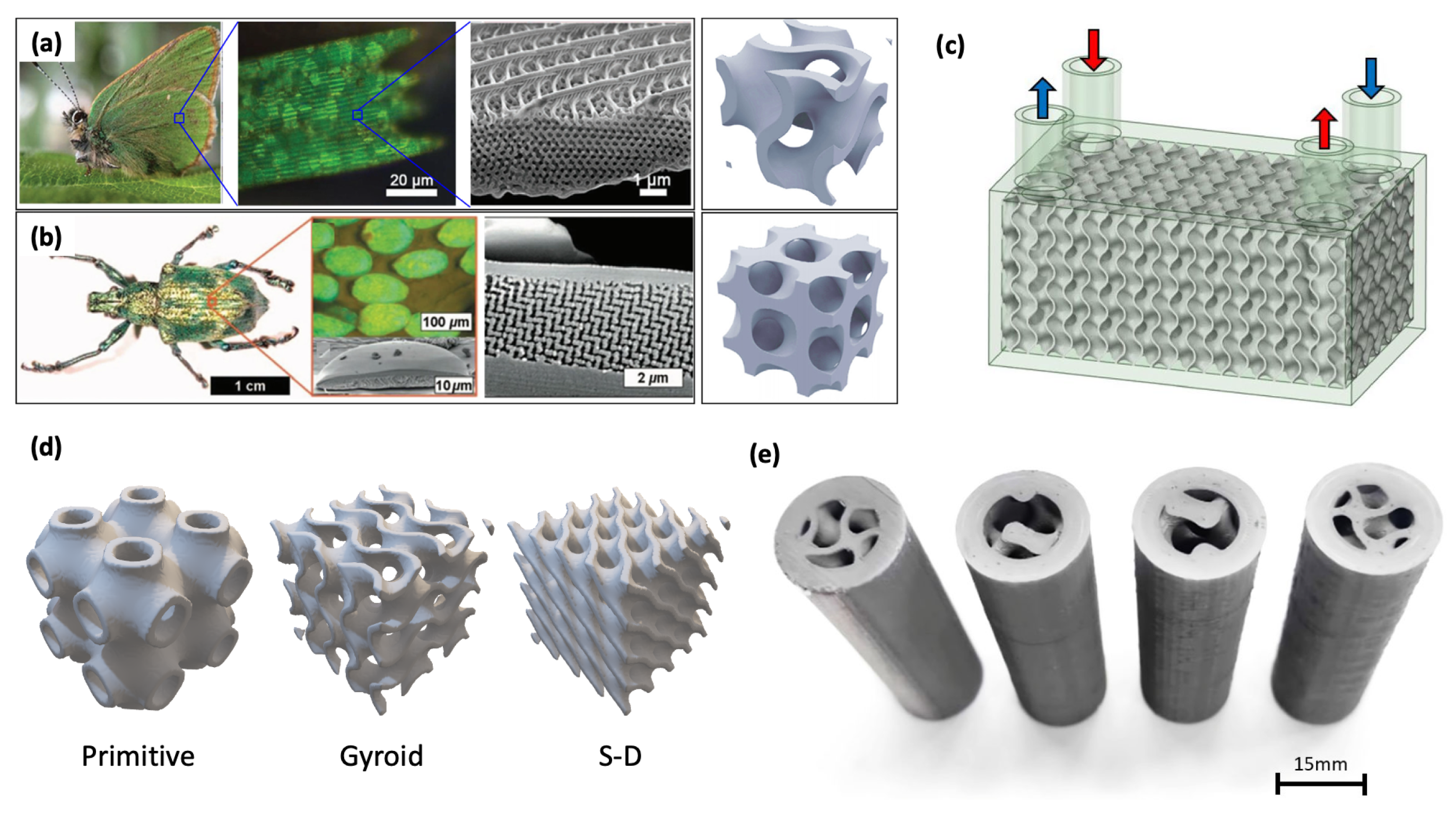
3.3.1. Triply Periodic Minimal Surface (TPMS)
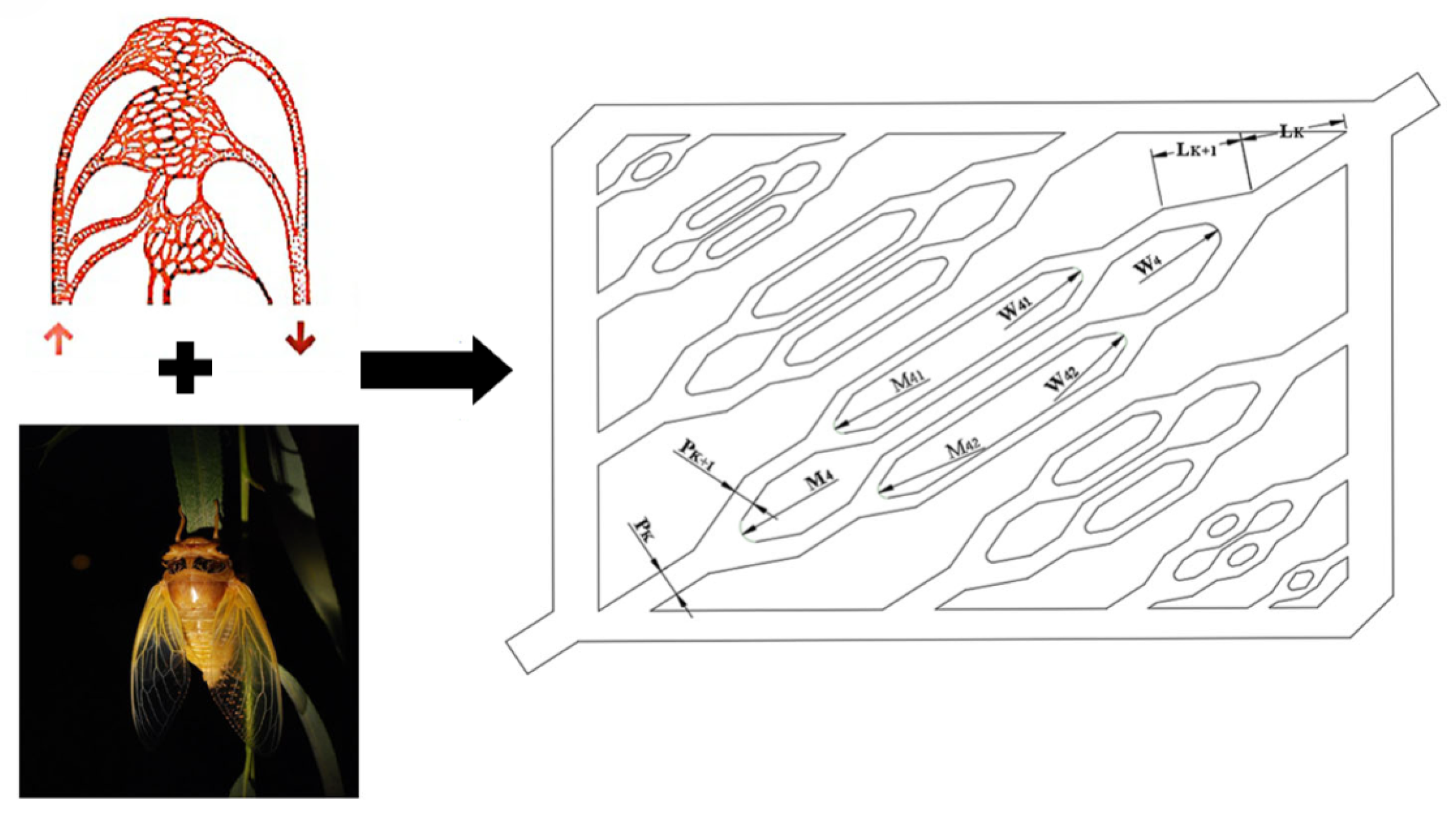
3.3.2. Leaf Veins & Branches
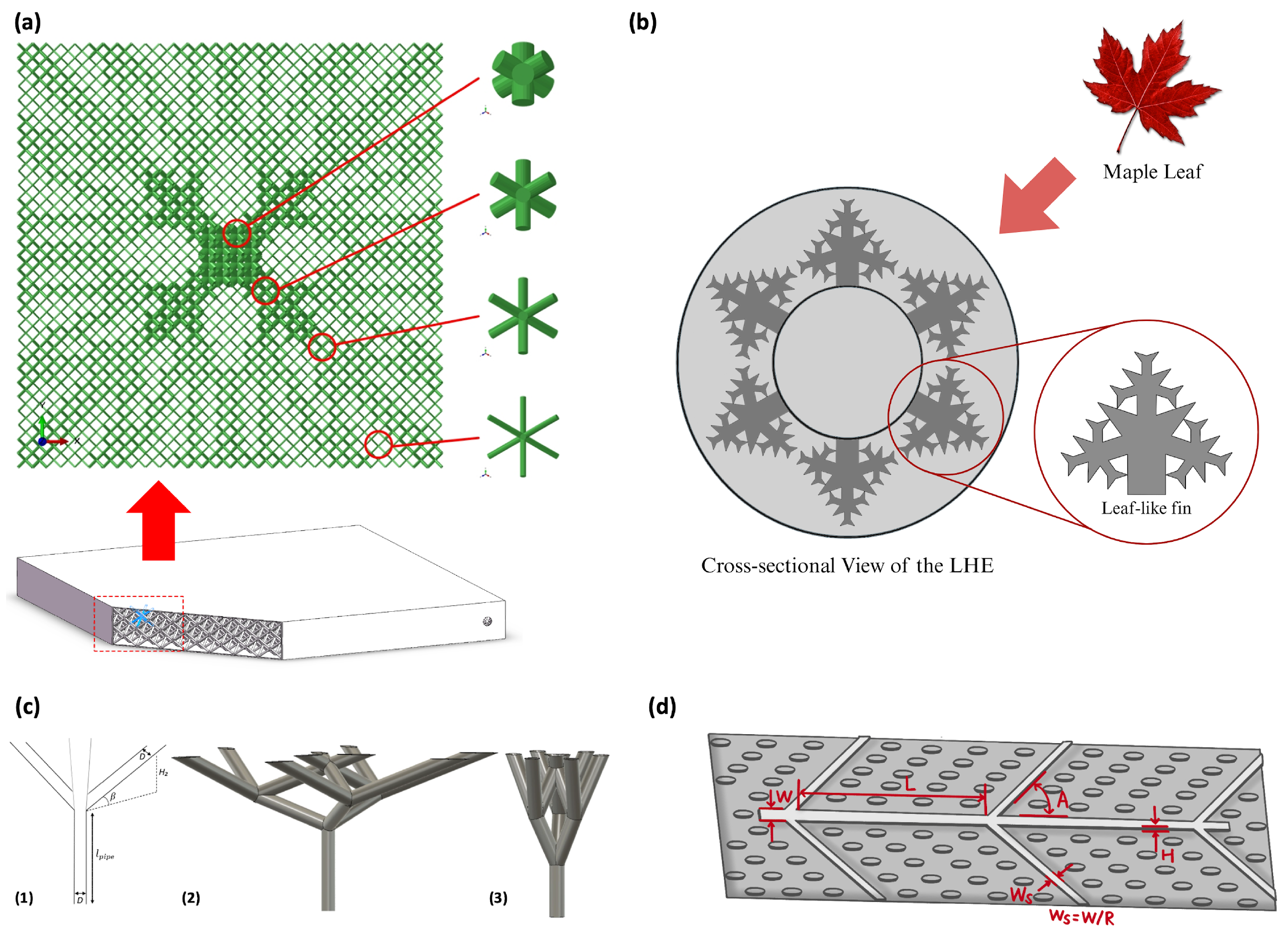
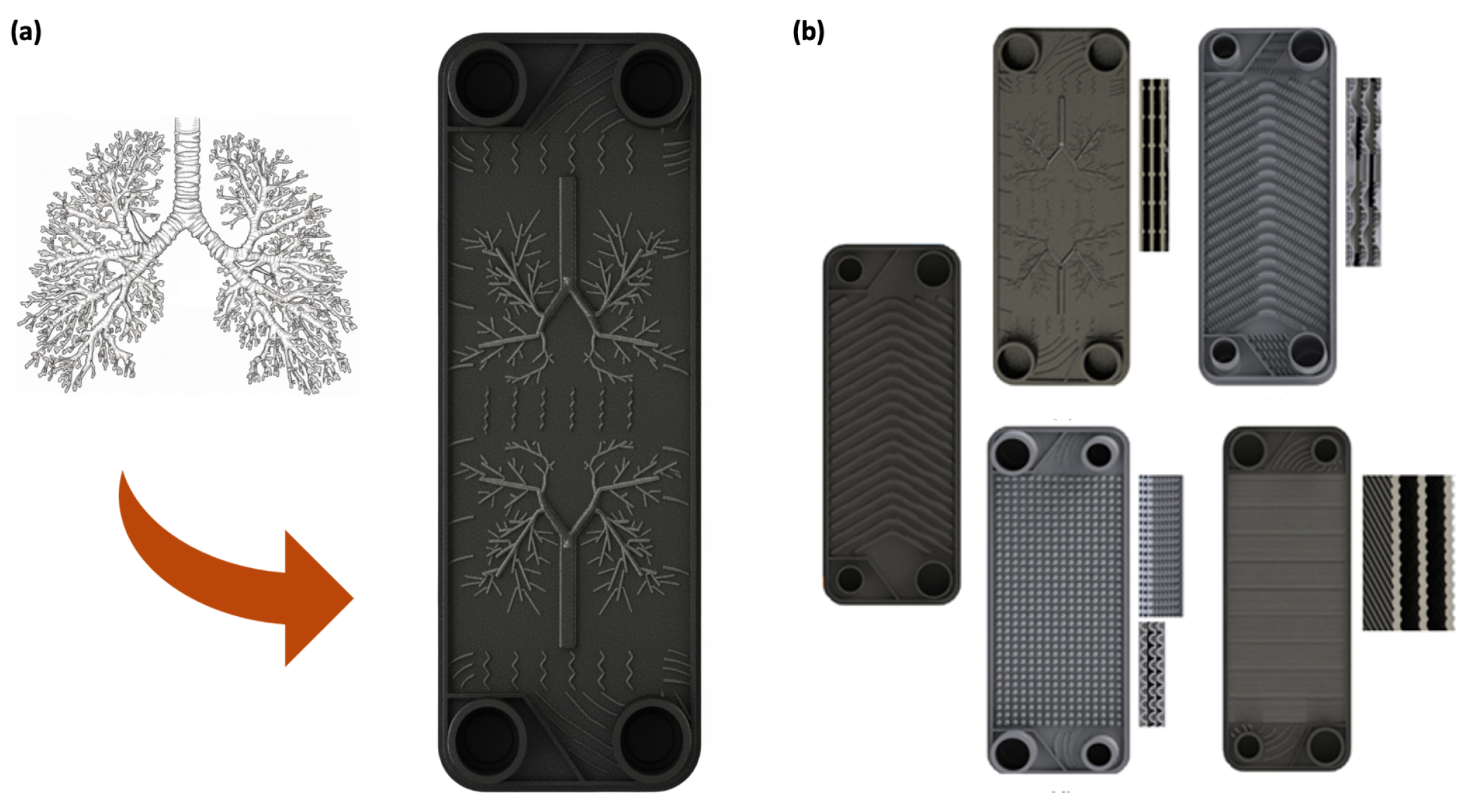
3.3.3. Lung Network
3.3.4. Network Scale Critical Synthesis and Scale-Up Considerations
4. Limitations and Future Perspectives
4.1. Current Limitation and Practical Challenges
4.2. Complementary Evaluation Frameworks Beyond Conventional Thermo-Hydraulic Metrics
5. Conclusions
Author Contributions
Funding
Institutional Review Board Statement
Informed Consent Statement
Data Availability Statement
Acknowledgments
Conflicts of Interest
Abbreviations
| PEC | Performance Evaluation Criterion |
| PHE | Plate Heat Exchangers |
| PCHE | Printed Circuit Heat Exchangers |
| MCHE | Micro Channel Heat Exchangers |
| PCM | Phase Change Materials |
| CFD | Computational Fluid Dynamics |
| SEM | Scanning Electron Microscope |
| ASHP | Air-Source Heat Pump |
| PDMS | Polydimethylsiloxane |
| SLIPS | Slippery Liquid-Infused Porous Surfaces |
| CAH | Contact-Angle Hysteresis |
| LES | Large-Eddy Simulation |
| DNS | Direct Numerical Simulation |
| NACA | National Advisory Committee for Aeronautics |
| CPHE | Compact Plate Heat Exchanger |
| COP | Coefficient Of Performance |
| AM | Additive Manufacturing |
| TPMS | Triply Periodic Minimal Surface |
| TPF | Thermal Performance Factor |
References
- Li, C.; Apelt, S.; Feuer, A.; Idrisov, R.; Bergmann, U. Bio-inspired surface modification of aluminium heat exchanger fins using laser structuring and PDMS coating for improved and scalable hydrophobic and ice-adhesion performance. J. Adhes. 2025, 101, 1906–1921. [Google Scholar] [CrossRef]
- Wu, S.; Gao, S.; Wang, H.; Deng, Z. Dropwise condensation heat transfer on vertical superhydrophobic surfaces with gradient microgrooves in humid air. Int. J. Heat Mass Transf. 2023, 201, 123583. [Google Scholar] [CrossRef]
- Mail, M.; Koch, K.; Speck, T.; Megill, W.M.; Gorb, S.N. Biomimetics on the micro- and nanoscale—The 25th anniversary of the lotus effect. Beilstein J. Nanotechnol. 2023, 14, 850–856. [Google Scholar] [CrossRef] [PubMed]
- Samaha, M.A.; Gad-el Hak, M. Polymeric Slippery Coatings: Nature and Applications. Polymers 2014, 6, 1266–1311. [Google Scholar] [CrossRef]
- Shen, J.; Guo, C. Biomimetic Design for Enhanced Thermal Performance of Vapor Chambers. Energies 2025, 18, 1250. [Google Scholar] [CrossRef]
- Cheng, J.; Zhu, Y.; Zhan, F.; Wang, L. Lotus leaf-inspired thermal insulation and anti-icing topography. RSC Adv. 2024, 14, 18798–18806. [Google Scholar] [CrossRef]
- Xing, Q.; Gu, Y.; Han, Y.; Li, S.; Wang, B.; Li, Y.; He, G. Experimental evaluation of the frost suppression performance of a superhydrophobic finned tube heat exchanger. Int. J. Heat Fluid Flow 2024, 109, 109497. [Google Scholar] [CrossRef]
- Li, R.; Wang, Z.; Chen, M.; Li, Z.; Luo, X.; Lu, W.; Gu, Z. Fabrication and Characterization of Superhydrophobic Al-Based Surface Used for Finned-Tube Heat Exchangers. Materials 2022, 15, 3060. [Google Scholar] [CrossRef]
- Kim, P.; Wong, T.S.; Alvarenga, J.; Kreder, M.J.; Adorno-Martinez, W.E.; Aizenberg, J. Liquid-Infused Nanostructured Surfaces with Extreme Anti-Ice and Anti-Frost Performance. ACS Nano 2012, 6, 6569–6577. [Google Scholar] [CrossRef] [PubMed]
- Yu, R.; Jacobi, A.M. Self-healing, Slippery Surfaces for HVAC&R Systems. In Proceedings of the 15th International Refrigeration and Air-Conditioning Conference (IRACC 2014), West Lafayette, IN, USA, 14–17 July 2014. Paper 1378. [Google Scholar]
- Abraham, J.; Rajkumar, M.; Gangadharan, V.; Poopady, J. Condensation Heat Transfer Performance of Vertical Condenser Tube With Slippery Liquid Infused Surface Coatings. SSRN Electron. J. 2023. [Google Scholar] [CrossRef]
- Baba, S.; Sawada, K.; Tanaka, K.; Okamoto, A. Condensation Behavior of Hierarchical Nano/Microstructured Surfaces Inspired by Euphorbia myrsinites. ACS Appl. Mater. Interfaces 2021, 13, 32332–32342. [Google Scholar] [CrossRef] [PubMed]
- Sirohia, G.K.; Dai, X. Designing air-independent slippery rough surfaces for condensation. Int. J. Heat Mass Transf. 2019, 140, 777–785. [Google Scholar] [CrossRef]
- Ryu, M.; Choi, H.; Yoon, J.; Choi, Y.N.; Lee, S.; Kim, H.; Chae, M.; Lee, J.W.; Kang, J.; Lee, H. Silica-nanoparticle reinforced lubricant-infused copper substrates with enhanced lubricant retention for maintenance-free heat exchangers. Chem. Eng. J. 2023, 451, 138657. [Google Scholar] [CrossRef]
- Yu, Y.; Wei, Y.; Li, B.; Gao, H.; Liu, T.; Luan, X.; Qiu, R.; Ouyang, Y. Bioinspired metal-organic framework-based liquid-infused surface (MOF-LIS) with corrosion and biofouling prohibition properties. Surfaces Interfaces 2022, 34, 102363. [Google Scholar] [CrossRef]
- Dean, B.; Bhushan, B. Shark-skin surfaces for fluid-drag reduction in turbulent flow: A review. Philos. Trans. R. Soc. A Math. Phys. Eng. Sci. 2010, 368, 4775–4806. [Google Scholar] [CrossRef]
- Martin, S.; Bhushan, B. Modeling and optimization of shark-inspired riblet geometries for low drag applications. J. Colloid Interface Sci. 2016, 474, 206–215. [Google Scholar] [CrossRef]
- Sasamori, M.; Iihama, O.; Mamori, H.; Iwamoto, K.; Murata, A. Parametric Study on a Sinusoidal Riblet for Drag Reduction by Direct Numerical Simulation. Flow, Turbul. Combust. 2017, 99, 47–69. [Google Scholar] [CrossRef]
- Wu, L.; Jiao, Z.; Song, Y.; Ren, W.; Niu, S.; Han, Z. Water-trapping and drag-reduction effects of fish Ctenopharyngodon idellus scales and their simulations. Sci. China Technol. Sci. 2017, 60, 1111–1117. [Google Scholar] [CrossRef]
- Žemaitis, A.; Mikšys, J.; Gaidys, M.; Gečys, P.; Gedvilas, M. High-efficiency laser fabrication of drag reducing riblet surfaces on pre-heated Teflon. Mater. Res. Express 2019, 6, 065309. [Google Scholar] [CrossRef]
- Bhushan, B. Biomimetics inspired surfaces for drag reduction and oleophobicity/philicity. Beilstein J. Nanotechnol. 2011, 2, 66–84. [Google Scholar] [CrossRef]
- Santos, L.M.; Lang, A.; Wahidi, R.; Bonacci, A.; Gautam, S. Understanding Low-Speed Streaks and Their Function and Control through Movable Shark Scales Acting as a Passive Separation Control Mechanism. Biomimetics 2024, 9, 378. [Google Scholar] [CrossRef]
- Feld, K.; Kolborg, A.N.; Nyborg, C.M.; Salewski, M.; Steffensen, J.F.; Berg-Sørensen, K. Dermal Denticles of Three Slowly Swimming Shark Species: Microscopy and Flow Visualization. Biomimetics 2019, 4, 38. [Google Scholar] [CrossRef]
- Garcıa-Mayoral, R.; Jiménez, J.; de Fluidos Computacional, G.d.M. Breakdown of the viscous regime and maximum drag reduction in riblet surfaces. In Proceedings of the CEAS/KATnet II Conference, Bremen, Germany, 12–14 May 2009; pp. 12–14. [Google Scholar]
- Gürel, B.; Kurtuluş, K.; Kecebas, A.; Güler, O.V.; Göltaş, M.; Akkaya, V.R.; Gürbüz, E.Y. Investigation of reducing pressure drop by patterning dermal denticles (shark skin) on the plate surface of compact plate heat exchanger. Heat Transf. Res. 2023, 54, 1–15. [Google Scholar] [CrossRef]
- Liu, X.; Zhao, X.; Ran, L.; Xiao, H.; Zhang, Y.; Zhang, Y.; Liu, Y.; Zhang, N.; Ding, M. Analysis of enhanced heat transfer characteristics in a bionic fish scale tube for turbulent flow. Nucl. Eng. Technol. 2025, 57, 103715. [Google Scholar] [CrossRef]
- Yao, Z. Enhanced Heat Transfer and Flow Characteristics of Micro Channel Heat Exchangers with Biomimetic Fish Scale Fins. SSRN Electron. J. 2024, 4945851:1–4945851:31. [Google Scholar] [CrossRef]
- Xiaoya, L.; Xinwen, Z.; Hongguang, X.; Lingke, R.; Yinxing, Z.; Yongfa, Z.; Jichen, S.; Ming, D. Analysis of Convective Heat Transfer Characteristics and Entropy Generation of Fluid in Fish-scale Bionic Enhanced Heat Transfer Tubes. Nucl. Power Eng. 2024, 45, 92. [Google Scholar] [CrossRef]
- Dey, P.; Hedau, G.; Saha, S.K. Experimental and numerical investigations of fluid flow and heat transfer in a bioinspired surface enriched microchannel. Int. J. Therm. Sci. 2019, 135, 44–60. [Google Scholar] [CrossRef]
- Wang, J.; Yao, J.; Liang, X.; Li, Z.; Lu, F.; Čuček, L.; Zheng, D. Numerical investigation on thermal–hydraulic performance of an intercooler with bionic channel textures. Int. J. Heat Fluid Flow 2025, 112, 109744. [Google Scholar] [CrossRef]
- Hurry, A.S.; Vafadar, A.; Hayward, K.; Guzzomi, F.; Rauthan, K. Numerical investigation of the thermo-hydraulic performance of a shark denticle-inspired plate fin heat exchanger. Appl. Therm. Eng. 2024, 239, 122192. [Google Scholar] [CrossRef]
- Zhao, C.; He, L.; You, W.; Meng, X.; Li, Z. Numerical simulation of flow and heat transfer characteristics of microchannels with ribbed structures of bionic fish fins. Int. J. Refrig. 2025, 178, 298–311. [Google Scholar] [CrossRef]
- Gürel, B.; Akkaya, V.R.; Göltaş, M.; Nur Şen, Ç.; Güler, O.V.; İlkay Koşar, M.; Keçebaş, A. Investigation on flow and heat transfer of compact brazed plate heat exchanger with lung pattern. Appl. Therm. Eng. 2020, 175, 115309. [Google Scholar] [CrossRef]
- Gürbüz, E.Y.; Güler, O.; Bölükbaş, M.; Gürel, B.; Keçebaş, A. Numerical investigation of thermal flow characteristics in compact plate heat exchanger with various surface patterns. In Proceedings of the 14th International Conference on Thermal Engineering: Theory and Applications (ICTEA 2023), Yalova, Türkiye, 25–27 May 2023. Conference paper. [Google Scholar]
- Göltaş, M.; Gürel, B.; Keçebaş, A.; Akkaya, V.R.; Güler, O.V. Improvement of thermo-hydraulic performance with plate surface geometry for a compact plate heat exchanger manufactured by additive manufacturing. Int. J. Heat Mass Transf. 2022, 188, 122637. [Google Scholar] [CrossRef]
- Güler, O.V.; Gürel, B.; Kurtuluş, K.; Aryanfar, Y.; Castellanos, H.G.; Göltaş, M.; Keçebaş, A.; Akkaya, V.R. Thermo-hydraulic efficiency of lung-inspired compact plate heat exchangers made using additive manufacturing techniques with steel, aluminum and titanium powders. Chem. Eng. Sci. 2024, 283, 119378. [Google Scholar] [CrossRef]
- Güler, O.V.; Georgiev, A.; Göltaş, M.; Gürbüz, E.Y.; Keçebaş, A.; Hasan, M.A.; Islam, S.; Aryanfar, Y.; Gürel, B. Thermal-hydraulic performance optimization of plastic plate heat exchanger with lung flow channel using additive manufacturing. Therm. Sci. Eng. Prog. 2025, 66, 104013. [Google Scholar] [CrossRef]
- Gadakh, S.D. Heat Transfer Analysis of a Biomimetic Plate Heat Exchanger with Bird Feather Pattern. Int. Res. J. Eng. Technol. 2022, 9, 424–430. [Google Scholar]
- Benschop, H.; Breugem, W.P. Drag reduction by herringbone riblet texture in direct numerical simulations of turbulent channel flow. J. Turbul. 2017, 18, 717–759. [Google Scholar] [CrossRef]
- Tang, J.; Qi, C.; Ding, Z.; Afrand, M.; Yan, Y. Thermo-hydraulic performance of nanofluids in a bionic heat sink. Int. Commun. Heat Mass Transf. 2021, 127, 105492. [Google Scholar] [CrossRef]
- Wang, Z.; Liu, D.; Li, Z.; Qi, X.; Wan, C. Simulation and Experimental Study on Heat Transfer Performance of Bionic Structure-Based Battery Liquid Cooling Plate. World Electr. Veh. J. 2024, 15, 464. [Google Scholar] [CrossRef]
- Yue, L.; Qi, C.; Tang, M. Cooling characteristics of nanofluids in a snowflake and squid fin composite bionic microchannel heat sink. Colloids Surfaces A Physicochem. Eng. Asp. 2025, 705, 135614. [Google Scholar] [CrossRef]
- Benschop, H.O.G.; Guerin, A.J.; Brinkmann, A.; Dale, M.L.; Finnie, A.A.; Breugem, W.P.; Clare, A.S.; Stübing, D.; Price, C.; Reynolds, K.J. Drag-reducing riblets with fouling-release properties: Development and testing. Biofouling 2018, 34, 532–544. [Google Scholar] [CrossRef] [PubMed]
- Li, W.; Yu, G.; Yu, Z. Bioinspired heat exchangers based on triply periodic minimal surfaces for supercritical CO2 cycles. Appl. Therm. Eng. 2020, 179, 115686. [Google Scholar] [CrossRef]
- Liang, D.; Shi, C.; Li, W.; Chen, W.; Chyu, M.K. Design, flow characteristics and performance evaluation of bioinspired heat exchangers based on triply periodic minimal surfaces. Int. J. Heat Mass Transf. 2023, 201, 123620. [Google Scholar] [CrossRef]
- Dassi, L.; Chatterton, S.; Parenti, P.; Pennacchi, P. Gyroid Lattice Heat Exchangers: Comparative Analysis on Thermo-Fluid Dynamic Performances. Machines 2024, 12, 922. [Google Scholar] [CrossRef]
- Chen, F.; Jiang, X.; Lu, C.; Wang, Y.; Wen, P.; Shen, Q. Heat transfer efficiency enhancement of gyroid heat exchanger based on multidimensional gradient structure design. Int. Commun. Heat Mass Transf. 2023, 149, 107127. [Google Scholar] [CrossRef]
- Lai, W.H.; Samad, A. Development and flow optimization of “Gyroid” based additive manufacturing heat exchanger: Both computational and experimental analyses. Int. J. Therm. Sci. 2025, 213, 109835. [Google Scholar] [CrossRef]
- Yan, K.; Deng, H.; Xiao, Y.; Wang, J.; Luo, Y. Thermo-hydraulic performance evaluation through experiment and simulation of additive manufactured Gyroid-structured heat exchanger. Appl. Therm. Eng. 2024, 241, 122402. [Google Scholar] [CrossRef]
- Hu, J.; Xu, W.; Liang, H.; Shi, J.; Tang, W.; Guo, B.; Yang, J.; Zhu, L. Flow and heat transfer characteristics of 3D printed sheet and solid triply periodic minimal surfaces porous structures. Sci. Rep. 2025, 15, 29255. [Google Scholar] [CrossRef]
- Oh, S.H.; Kim, J.E.; Jang, C.H.; Kim, J.; Park, C.Y.; Park, K. Multifunctional gradations of TPMS architected heat exchanger for enhancements in flow and heat exchange performances. Sci. Rep. 2025, 15, 19931. [Google Scholar] [CrossRef]
- Qian, C.; Wang, J.; Qiu, X.; Ma, R.; Xuan, W.; Yu, B.; Shi, J.; Chen, J. Optimization design and heat transfer investigation of TPMS compact heat exchanger based on field synergy principle. Int. Commun. Heat Mass Transf. 2025, 165, 109003. [Google Scholar] [CrossRef]
- Deng, H.; Zhao, J.; Wang, C. Leaf Vein-Inspired Bionic Design Method for Heat Exchanger Infilled with Graded Lattice Structure. Aerospace 2021, 8, 237. [Google Scholar] [CrossRef]
- Jiang, S.; Huang, Y. Investigation on the heat discharge performance of a bioinspired latent heat exchanger with leaf-like fins. Sustain. Energy Technol. Assessments 2023, 57, 103187. [Google Scholar] [CrossRef]
- Mardanov, A.; Andersson, R.; Chew, J.W. Natural branching-inspired heat exchanger design for heat transfer enhancement. Chem. Eng. Process. - Process Intensif. 2025, 218, 110556. [Google Scholar] [CrossRef]
- Zhang, Q.; Yu, C.; Cui, Y.; Yang, S.; Liu, B.; Liu, H. Experimental study and numerical simulation of microchannel heat exchanger structure optimization based on heat transfer and flow. Can. J. Chem. Eng. 2025. [Google Scholar] [CrossRef]
- Wang, G.; Gu, Y.; Zhao, L.; Xuan, J.; Zeng, G.; Tang, Z.; Sun, Y. Experimental and numerical investigation of fractal-tree-like heat exchanger manufactured by 3D printing. Chem. Eng. Sci. 2019, 195, 250–261. [Google Scholar] [CrossRef]
- Calamas, D.; Baker, J. Experimental Performance of a Solid Heat Exchanger with Tree-Like Flow Passages. Exp. Heat Transf. 2015, 28, 205–221. [Google Scholar] [CrossRef]
- Rastogi, S.; Mondal, N.; Bakli, C. Systematic design of tree-like branching network microchannel heat sinks for enhanced heat transfer with nanofluids. Appl. Therm. Eng. 2024, 257, 124272. [Google Scholar] [CrossRef]
- Puttur, U.; Ahmadi, M.; Ahmadi, B.; Bigham, S. A novel lung-inspired 3D-printed desiccant-coated heat exchanger for high-performance humidity management in buildings. Energy Convers. Manag. 2022, 252, 115074. [Google Scholar] [CrossRef]
- Ahmadi, B.; Cesarano, J.; Nawaz, K.; Ninos, N.; Bigham, S. A high-performance lung-inspired ceramic 3D-printed heat exchanger for high-temperature energy-efficient systems. Appl. Therm. Eng. 2023, 219, 119378. [Google Scholar] [CrossRef]
- Ahmadi, B.; Bigham, S. Performance Evaluation of hi-k Lung-inspired 3D-printed Polymer Heat Exchangers. Appl. Therm. Eng. 2022, 204, 117993. [Google Scholar] [CrossRef]
- Song, H.; Han, B.; Wang, Y.; Zhang, Q. Enhanced heat transfer of alveolar biomimetic interlaced hollow lattice metastructures. Energy 2025, 326, 136272. [Google Scholar] [CrossRef]
- Yu, X.; Cao, M.; Zhang, X.; Zhang, C.; Ji, H.; Tong, W. Research on flow heat transfer characteristics of heat exchanger based on bionic fractal structure. In Proceedings of the 33rd Congress of the International Council of the Aeronautical Sciences, Stockholm, Sweden, 4–9 September 2022. [Google Scholar]
- Magnanelli, E.; Wilhelmsen, Ø.; Acquarone, M.; Folkow, L.; Kjelstrup, S. The Nasal Geometry of the Reindeer Gives Energy-Efficient Respiration. J. Non-Equilib. Thermodyn. 2017, 42, 59. [Google Scholar] [CrossRef][Green Version]
- Cheon, H.L.; Kjelstrup, S.; Kizilova, N.; Flekkøy, E.G.; Mason, M.J.; Folkow, L.P. Structure-function relationships in the nasal cavity of Arctic and subtropical seals. Biophys. J. 2023, 122, 4686–4698. [Google Scholar] [CrossRef]
- Flekkøy, E.G.; Folkow, L.P.; Kjelstrup, S.; Mason, M.J.; Wilhelmsen, Ø. Thermal modeling of the respiratory turbinates in arctic and subtropical seals. J. Therm. Biol. 2023, 112, 103402. [Google Scholar] [CrossRef]
- Cheon, H.L.; Kizilova, N.; Flekkøy, E.G.; Mason, M.J.; Folkow, L.P.; Kjelstrup, S. The nasal cavity of the bearded seal: An effective and robust organ for retaining body heat and water. J. Theor. Biol. 2024, 595, 111933. [Google Scholar] [CrossRef] [PubMed]


| Technology | Objective/Mechanism | Valid Operating Window (Works/Fails) | Key Evaluation Metrics | Implementation Risks | Ref. |
|---|---|---|---|---|---|
| Superhydrophobic Surface | Suppress droplet spreading to promote roll-off, droplet jumping, and surface refreshment, thereby maintaining stable dropwise condensation. | Works: Operating regimes where frosting and defrosting burdens directly translate into efficiency penalties. Fails: When micro/nanostructures progressively degrade due to wear and contamination, leading to Cassie-state failure (Cassie–Wenzel transition). | Sliding angle; contact-angle hysteresis (CAH); critical departure diameter/period | – Wear and contamination accumulation – Potential thermal-resistance trade-off due to added coating/polymer layers or trapped air layers | [1,5,6,7,8,12] |
| SLIPS | Introduce a lubricant layer to achieve ultra-low hysteresis, enabling enhanced droplet mobility and reduced adhesion (condensate/ice). | Works: Humid, low-temperature environments where anti-icing/drainage performance is critical. Fails: When lubricant depletion is accelerated and/or under high-contamination conditions that promote lubricant loss or surface damage. | CAH; ice-adhesion strength; frost delay time; lubricant depletion rate | – Need for lubricant replenishment and re-application – Lubricant loss/depletion during long-term operation | [9,12,13,14,15] |
| Self-replenishing SLIPS | Achieve long-term stability by continuous lubricant resupply, sustaining a slippery interface over extended cycles. | Works: Long-cycle operation where maintenance access is limited and lubricant stability must be maintained. Fails: When performance is highly sensitive to operating conditions outside the designed window, or when the resupply mechanism is insufficient under real contamination/flow conditions. | Performance retention time; replenishment stability | – Potential pinning and flow-pattern alteration, with increased structural complexity – Contamination management and maintenance requirements | [11] |
| Biomimetic Target | Heat Transfer Gain (vs. Baseline) | Hydraulic Penalty/Benefit (vs. Baseline) | Validity/Trade-Off | Ref. |
|---|---|---|---|---|
| Fish-scale | Nu +38.2% | f +150.2% | High Nu gain, high f penalty; narrow optimum | [26] |
| Fish-scale | Type 1: Nu +12.3–25.2%; Type 2: Nu +14.9–38.0% | Type 2: f/f0 up to 1.50 | Re-limited benefit; type-dependent trade-off | [28] |
| Fish-scale | Nu +14% | f −5% | Best case improves both; larger If/Dh increases Nu and f | [29] |
| Crab shell | j factor +22.57% | f +26.11% | j gain with f rise; parameter-sensitive | [30] |
| Shark Denticle | Nu +13.1% | ΔP average : 19% ; peak : 26% | Comparator-dependent; not universally best | [31] |
| Technology | Objective/Mechanism | Valid Operating Window (Works/Fails) | Key Evaluation Metrics | Implementation Risks | Ref. |
|---|---|---|---|---|---|
| Drag-reduction surfaces | Suppress near-wall turbulence structures to reduce skin friction. Riblets (streamwise grooves) constrain spanwise motions and vortex interactions, thereby reducing Cf. Some patterns can induce secondary flows, potentially affecting heat-transfer-related behavior as well. | Mainly turbulent boundary layers/turbulent channel flows. Key scaling is often not Re itself but wall-unit scaling, where an optimum emerges. | Drag reduction, Cf reduction ratio, wall shear stress, friction factor, dimensionless geometric parameters such as s+/ Ag+ | – High sensitivity to alignment (yaw/misalignment). – Strong dependence on tolerances, wear, contamination/fouling. – Frost/scale/particle deposition can become a critical failure mode for heat-exchanger. | [16,17,18,19,20,24,39,43] |
| Compact HX textures (channels, fins, tubes) | Surface/shape textures targeting simultaneous improvement of heat transfer and reduction of Δp. Examples: denticle/streamlined fins, fish-scale protrusions on tubes; control mixing, secondary flows, and boundary- layer separation. | Internal flows (tubes/fin-channels), typically turbulent to transitional regimes. (e.g., PFHE denticle fins, fish-scale tubes). | Nu, h, Δp, f, PEC/TPF | – Nonlinear trade-off. – Manufacturing difficulty and reproducibility. – Cleanability and susceptibility to fouling. | [26,28,30,31] |
| Microchannels/heat sinks | Enhance mixing via micro-ribs/fins/asymmetric distributions, or improve heat transfer and exergy efficiency using nanofluids and/or magnetic fields. | Typically microchannel forced convection at Re = O(102–103) (e.g., Re ≈ 700–1400). Comparisons often performed under fixed heat-flux boundary conditions. | Nu, friction factor, Δp, PEC, temperature reduction rate, thermal resistance | – Clogging/particle-related issues. – Increased pumping power demand. – Under frosting/icing assumptions, micro-passages face a high risk of ice-plug formation. | [27,29,32,40,42] |
| Patterned plate heat exchangers and materials | Use lung/gill/trachea-type patterns to co-design surface area, flow distribution, and secondary flows. Complex patterns enabled by additive-manufacturing (AM), while material choice (e.g., steel/Al/Ti, PA12) directly affects thermo-hydraulic performance and durability. | Mainly water-based, single-phase heat exchange. Often evaluated by jointly comparing ε – Δp – pumping power across flow- rate variations. | Heat-transfer rate Q, overall U, effectiveness ε, Δp, pumping power, COP, PEC | – AM-related surface roughness/internal defects/leakage risk. – Cleanability challenges for complex patterns. – Material-related risks (strength, creep, temperature/chemical compatibility, etc.) | [33,34,35,36,37,38] |
| Technology | Objective/Mechanism | Valid Operating Window (Works/Fails) | Key Evaluation Metrics | Implementation Risks | Ref. |
|---|---|---|---|---|---|
| TPMS core | Leverage the high surface-area-to-volume ratio and 3D continuous flow pathways of TPMS architectures to promote mixing and vortex generation. | Works: Regimes where heat-transfer enhancement is prioritized under fixed pumping-power and/or volumetric constraints. Fails: Systems with a tight pressure-drop budget, or when manufacturing-induced surface roughness and wall-thickness increases cannot be controlled; performance may also become condition-dependent at low flow rates/low Re. | Nu, U, Q, ΔP, f, PEC (typically compared under an identical pumping-power basis) | – AM defects, surface roughness, and increased wall thickness can distort interpretation of absolute performance. – As-built deviations can undermine simulation–experiment agreement and scale-up reliability. | [44,45,48,49,50] |
| Functionally graded TPMS | Optimize the heat-transfer vs. pressure-drop trade-off via functional gradation (e.g., cell-size variation, level-set modulation, and filtering) to improve flow uniformity and thermo-hydraulic performance. | Works: Applications where the target Reynolds-number range is relatively well-defined, enabling grading to be tuned to a known operating window. Fails: When the optimum is non-monotonic or highly condition-dependent, or when performance deteriorates outside the tuned window. | Nu, U, Q, ΔP/f, PEC | – High implementation difficulty of multi-parameter gradation. – Increased risk of design manufacturing mismatch due to many optimization variables and sensitivity to as-built tolerances. | [47,51,52] |
| TPMS infill/tube- filling enhancement | Fill cylindrical tubes with TPMS lattices to increase turbulence intensity, mixing, and heat-transfer augmentation within an existing tube-based framework. | Works: Retrofittable conventional tube-based systems where internal enhancement is preferred over a complete redesign. Fails: When relative density is high and/or the structure is sheet-like, which can impose excessive hydraulic penalties. | Composite indices such as (Q/Q0)/(ΔP/ΔP0), along with turbulence intensity and ΔP. | – Outcomes are strongly governed by relative density, printing defects, and material selection/thermal conductivity. – As-built imperfections can dominate both ΔP and heat-transfer trends. | [46] |
| Leaf/branch-inspired flow distribution | Use branched and hierarchical network architectures (leaf veins/tree branches) to uniformly distribute flow or optimize diffusion pathways. | Works: Systems where distribution uniformity is performance-critical, and where terminal-branch maldistribution dominates overall performance. Fails: When manufacturing variability, assembly/installation errors, or non-uniform surface roughness induce severe maldistribution. | ΔP–Q correlation, Nu–Re correlation, terminal-channel deviation (flow-distribution metric), TPF | – Highly sensitive to manufacturing and assembly tolerances. – Need to ensure structural robustness/ mechanical integrity. | [55,57,58,59] |
| Leaf/branch-inspired rib and channel augmentation | Introduce rib networks to disturb boundary layers and induce secondary flows/vortices, enhancing convective heat transfer. | Works: Microchannel-dominated regimes where Nu is the primary bottleneck, and rib optimization enables PEC > 1. Fails: When the pressure-drop penalty offsets the heat-transfer gain. | Nu, ΔP, PEC, sensitivity to rib height and diameter ratio | – ΔP penalty and potential flow non-uniformity. – Performance can drop sharply outside the optimized parameter range. – Requires re-validation under refrigerant changes and scale-up. | [56] |
| Leaf/branch-inspired thermal diffusion and phase-change enhancement | Optimize heat-spreading pathways in solids or PCMs using leaf/branch-like fins or lattice networks, thereby accelerating internal heat diffusion and phase- change dynamics. | Works: PCM-based systems where transient heat spreading is the dominant limitation. Fails: Regimes dominated by forced-convection heat exchange, or cases with large interfacial contact resistance (which can suppress the benefit of internal heat- spreading networks). | Solidification time, average and peak temperature, thermal response time | – PCM leakage and cycle durability issues. – Sensitivity to 3D-printing tolerances and post-processing. – Thermal-resistance redistribution during scale-up (non-uniform effective conduction paths). | [53,54] |
| Lung-inspired bicontinuous network | Mimic bronchial–alveolar principles to build a branched bicontinuous/interwoven network that co-distributes two fluids across the full volume, increasing volumetric performance density and/or adsorption throughput. | Works: Systems targeting high volumetric performance density and uniform distribution (e.g., high-Re/high-flow regimes, adsorption-based DCHX). Fails: When scale-up causes accumulated ΔP to become prohibitive, or when fabrication cannot ensure reliability of complex 3D-printed structures. | Volumetric power density, ΔP, Nu, PEC | – 3D-printing defects and dimensional deviations. – Need for validation of coatings/infiltration/sealing and leakage reliability. – Limited evidence on long-term durability and field validation. | [60,61,62,63,64] |
Disclaimer/Publisher’s Note: The statements, opinions and data contained in all publications are solely those of the individual author(s) and contributor(s) and not of MDPI and/or the editor(s). MDPI and/or the editor(s) disclaim responsibility for any injury to people or property resulting from any ideas, methods, instructions or products referred to in the content. |
© 2026 by the authors. Licensee MDPI, Basel, Switzerland. This article is an open access article distributed under the terms and conditions of the Creative Commons Attribution (CC BY) license.
Share and Cite
Yang, H.; Pi, J.; Park, S.; Bae, W. Bioinspired Heat Exchangers: A Multi-Scale Review of Thermo-Hydraulic Performance Enhancement. Biomimetics 2026, 11, 76. https://doi.org/10.3390/biomimetics11010076
Yang H, Pi J, Park S, Bae W. Bioinspired Heat Exchangers: A Multi-Scale Review of Thermo-Hydraulic Performance Enhancement. Biomimetics. 2026; 11(1):76. https://doi.org/10.3390/biomimetics11010076
Chicago/Turabian StyleYang, Hyunsik, Jinhyun Pi, Soyoon Park, and Wongyu Bae. 2026. "Bioinspired Heat Exchangers: A Multi-Scale Review of Thermo-Hydraulic Performance Enhancement" Biomimetics 11, no. 1: 76. https://doi.org/10.3390/biomimetics11010076
APA StyleYang, H., Pi, J., Park, S., & Bae, W. (2026). Bioinspired Heat Exchangers: A Multi-Scale Review of Thermo-Hydraulic Performance Enhancement. Biomimetics, 11(1), 76. https://doi.org/10.3390/biomimetics11010076