

Article

Optimizing 3D LiDAR Installation Height for High-Fidelity Canopy Phenotyping in Spindle-Shaped Orchards


1
College of Mechanical and Electronic Engineering, Shandong Agriculture and Engineering University, Jinan 250100, China
2
College of Mechanical and Automotive Engineering, Guangxi University of Science and Technology, Liuzhou 545006, China
*
Authors to whom correspondence should be addressed.
Horticulturae 2026, 12(3), 331; https://doi.org/10.3390/horticulturae12030331
Submission received: 21 January 2026 / Revised: 4 March 2026 / Accepted: 9 March 2026 / Published: 10 March 2026

Abstract

High-fidelity acquisition of canopy phenotypic data is critical for the advancement of orchard Artificial Intelligence (AI). Yet, an improper Light Detection and Ranging (LiDAR) installation height (IH) frequently induces data occlusion and substantial measurement errors. To address this limitation, this study developed an information collection vehicle (ICV) integrated with a 16-channel three-dimensional (3D) LiDAR to determine the optimal LiDAR IH. Three representative LiDAR IHs (1.4 m, 2.0 m, and 2.6 m) were evaluated on spindle-shaped cherry trees under both forward and reverse driving strategies. Subsequently, a novel 12-zone refined evaluation framework was introduced to quantify localized errors that are conventionally obscured by traditional whole-canopy metrics. Results demonstrated a profound nonlinear relationship between IH and measurement accuracy. Specifically, the 2.0 m IH (approximating the canopy’s geometric center) emerged as the optimal setup, maintaining relative errors (REs) below 5% with minimal dispersion. Conversely, the 2.6 m IH caused lower-canopy volume REs to surge beyond 16% owing to restricted downward viewing angles. Additionally, reverse driving at higher IHs exacerbated mechanical vibrations via the “lever arm effect”, thereby significantly degrading point cloud registration accuracy. Ultimately, these findings underscore the critical necessity of aligning sensors with the canopy geometric center, supplying essential theoretical guidelines for the hardware design of future orchard robots.

1. Introduction

Driven by the dual imperatives of global food security and environmental sustainability, modern horticulture is undergoing a fundamental transition from yield-centric practices to quality-driven precision management [1]. Agricultural artificial intelligence (AI) has emerged as the technological cornerstone of this paradigm shift [2]. By facilitating the real-time acquisition and interpretation of crop data, AI empowers intelligent decision-making for operations, such as variable-rate spraying and robotic pruning, thereby optimizing agronomic inputs and maximizing resource use efficiency.
In precision horticulture, the fruit tree canopy represents the primary functional interface for photosynthesis and production. Its key three-dimensional (3D) morphological traits, such as tree height, width, canopy thickness, canopy volume, and leaf area density, serve as robust proxies for assessing vegetative vigor and yield potential [3]. Consequently, the high-fidelity, high-throughput acquisition of these phenotypic parameters is a prerequisite for implementing AI-driven orchard management. Historically, reliance on manual mensuration (e.g., utilizing calipers or measuring rods) has been plagued by subjectivity, low temporal resolution, and labor-prohibitive costs, rendering such methods unsuitable for large-scale commercial applications [4,5].
To surmount the limitations of manual assessment, non-destructive remote sensing technologies utilizing optical imaging (e.g., digital photogrammetry, multispectral imaging, and hyperspectral imaging) have been extensively adopted in precision horticulture [6]. Among these, digital photogrammetry reconstructs 3D canopy models from multi-view imagery via stereo matching algorithms, offering advantages that include operational simplicity, cost-effectiveness, and non-destructive measurement. Simultaneously, multispectral and hyperspectral imaging can capture structural, physiological, and biochemical traits, thereby facilitating comprehensive growth evaluation. Nevertheless, passive remote sensing remains inherently sensitive to ambient lighting conditions; it is susceptible to image blurring and the loss of textural detail under cloudy, backlit, or otherwise complex illumination scenarios. Additionally, within orchard environments characterized by dense canopy architecture, passive systems are vulnerable to severe internal occlusion, which hinders the accurate reconstruction of detailed 3D structures and constrains the accuracy of parameter inversion.
As an active remote sensing technology, 3D Light Detection and Ranging (LiDAR) effectively mitigates the inherent limitations of passive measurement methods [7,8]. Characterized by illumination invariance, high ranging precision, and rapid data acquisition, LiDAR has emerged as the gold standard for high-throughput canopy phenotyping [9]. Unlike passive remote sensors, LiDAR pulses possess superior penetration capabilities, traversing canopy gaps to map the spatial distribution of internal branches and foliage. This capacity enables the robust reconstruction of complex 3D structures and the extraction of fine-scale parameters. Driven by maturing technology and declining costs, mobile LiDAR applications have expanded into two primary modalities: ground-based mobile laser scanning (MLS) and unmanned aerial vehicle (UAV) scanning [9,10]. While UAVs offer extensive coverage suitable for large-scale monitoring, ground-based MLS facilitates proximal sensing. This approach yields significantly higher point cloud densities, capturing crucial structural details in the middle and lower canopy layers that are essential for refined orchard management.
Current research on orchard LiDAR applications has predominantly prioritized the optimization of post-processing algorithms to enhance inversion accuracy and computational efficiency. Regarding point cloud preprocessing, various noise filtering and target segmentation algorithms have been proposed to mitigate interference from ground clutter, weeds, and adjacent trees. For instance, Zhang et al. [11] developed a hybrid algorithm integrating region growing with morphological filtering; by leveraging laser reflection intensity and spatial distance thresholds, they achieved accurate canopy segmentation with an accuracy exceeding 92%. Similarly, Li et al. [12] constructed an adaptive ground-fitting model based on an improved Random Sample Consensus (RANSAC) algorithm, effectively eliminating ground artifacts under complex terrain conditions. In the domain of parameter extraction, methodologies have been tailored to diverse tree architectures. Dong et al. [13] employed a voxelization approach to discretize canopy point clouds, estimating volume by counting effective voxels and constraining the relative error (RE) to within 8% against manual benchmarks. In a parallel effort, Guo et al. [14] reconstructed canopy contours via convex hull algorithms, enabling the rapid retrieval of geometric traits (height, width, and projection area) with a threefold increase in efficiency over traditional methods. Furthermore, integration of machine learning with LiDAR data has broadened the technology’s scope, facilitating the estimation of complex parameters such as canopy biomass and the Leaf Area Index (LAI) [15].
Despite the growing maturity of data processing algorithms for LiDAR-based phenotyping, critical gaps persist in optimizing the hardware configuration of MLS systems [16]. This limitation represents a primary bottleneck constraining measurement fidelity and large-scale applications. The accuracy of MLS systems is contingent not merely on sensor specifications but critically on spatial geometric configurations [17]. Specifically, the installation height (IH), a pivotal configuration parameter, governs the laser incidence angle, canopy coverage, and the spatial distribution of point clouds [5,18,19,20]. Consequently, an improper IH can easily induce systematic measurement deviations, thereby compromising the accuracy of canopy parameter inversion. To date, extant literature remains predominantly confined to single IH validations or rudimentary comparisons. The absence of systematic analyses concerning error sources, impact mechanisms, and canopy-sensor interactions precludes the establishment of standardized installation protocols.
Three critical limitations persist in the current literature. First, there is a narrow scope regarding research objects. Existing studies predominantly focus on dwarf, high-density species (e.g., apple and citrus), lacking empirical validation for spindle-shaped cherry trees. These trees exhibit distinct architectural features, including greater height, prominent trunks, and clear vertical stratification. Such structural differences significantly influence laser penetration dynamics, potentially altering the optimal IH. Second, the evaluation methodologies typically employed are broadly imprecise. The majority of current studies adopt a whole-tree evaluation approach, assessing the rationality of IH exclusively by comparing the REs of whole-tree parameters. This method proves inadequate for uncovering variations in accuracy across distinct canopy layers. In practical precision orchard management, layer-stratified canopy parameters hold substantially greater significance for guiding targeted operations such as layered variable-rate spraying and robotic pruning. As a result, focusing solely on whole-tree metrics is insufficient to meet the demands of refined management practices. Third, there is a notable deficiency in research concerning multi-factor coupling. Most studies treat IH as an isolated variable, overlooking its coupled effects with other pivotal factors in real-world orchard settings. During ground-based MLS, alterations in IH can modify the relative positioning between the sensor and the different canopy layer, thereby influencing laser incidence angles and inducing shielding effects. Moreover, the interplay between the heterogeneity of the canopy’s vertical structure and IH may exacerbate the complexity of measurement errors. These coupling effects have yet to be fully elucidated.
To address these gaps, this study employs spindle-shaped cherry trees as the primary research subject and utilizes a custom-built ground mobile information collection vehicle (ICV) to systematically investigate the impact of various 3D LiDAR IHs on the measurement accuracy of key canopy parameters. By integrating the forward and reverse driving strategies commonly executed in actual orchard operations, this study innovatively adopts a 12-zone refined evaluation method to comprehensively analyze the interaction patterns among IH, canopy vertical structure, and driving direction. Through quantifying measurement REs across distinct canopy layers under diverse conditions and analyzing the physical mechanisms underlying these errors, this study aims to identify the optimal LiDAR IH for cherry orchard scenarios. Additionally, it establishes a quantitative relationship model between IH and measurement accuracy, elucidating the mechanisms governing the interaction between IH and vertical canopy structure. Ultimately, this study clarifies the error distribution characteristics across different layers and analyzes the synergistic effects of driving direction and IH, proposing a driving strategy that optimally balances measurement accuracy with operational efficiency.
The principal contributions of this paper are summarized as follows:
(1)
Systematically revealing the nonlinear influence mechanism of mobile LiDAR IH on the measurement accuracy by applying photogrammetric principles to the orchard environments.
(2)
Proposing a novel 12-zone refined evaluation method that transcends the limitations of traditional whole-tree assessments, thereby providing a high-resolution metric for local error quantification.
(3)
Uncovering the interaction mechanisms between IH and canopy layers through orthogonal driving experiments.
The overarching objective of this research is to establish theoretical guidelines and standardized hardware parameters for the designing smart, mobile orchard phenotyping platforms. By optimizing the data acquisition workflow, this research ensures that future large-scale operations can capture 3D canopy architectures with high fidelity and cost-effectiveness. Consequently, this work provides not only a robust theoretical framework for accurate phenotyping but also critical engineering design criteria for the configuration sensor on next-generation orchard robots.

2. Materials and Methods

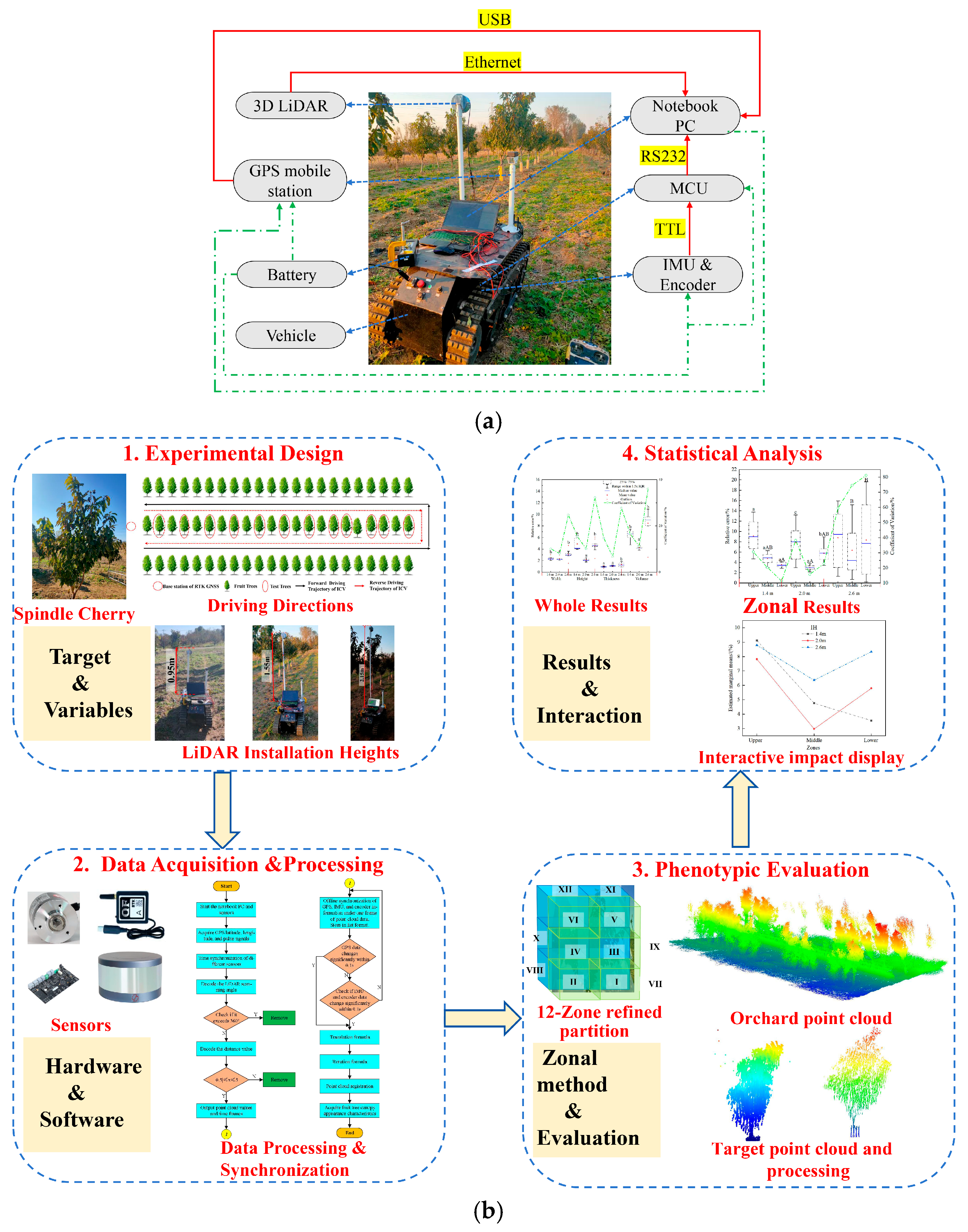
To investigate the impact of different 3D LiDAR IHs on canopy structural characteristics, an ICV (Figure 1a) was developed to acquire fruit tree canopy point clouds. As illustrated in Figure 1b, the overall research methodology encompasses four primary phases. The workflow begins with (1) Experimental Design, which selects spindle-shaped cherry trees as the target and defines LiDAR IHs and driving directions as key variables. This is followed by (2) Data Acquisition and Processing, integrating hardware sensors with a software-based data synchronization and filtering workflow. Subsequently, (3) Phenotypic Evaluation is conducted by applying a novel 12-zone refined partition method to the processed orchard point clouds for detailed zoning assessment. Finally, (4) Statistical Analysis is performed to systematically evaluate the whole-canopy results, zoning results, and their interactive impacts.

2.1. Composition and Electronic Hardware System of ICV

The hereby custom-designed ICV, measuring 1.2 m × 0.45 m × 1.5 m in length, width and height, respectively, and a maximum payload of 200 kg, is shown in Figure 1a. It primarily consists of an electronic hardware system, a mobile tracked chassis, and a positioning system. The integrated electronic hardware system perceives the surrounding environment in real time while continuously acquiring ICV status data. Functionally, it is divided into a sensor module (3D LiDAR, IMU, and Encoder), a processing module and a power module. The mobile tracked chassis serves as the structural foundation, providing physical support for all onboard payloads. Furthermore, positioning system (Figure 1b) accurately records the operational trajectory of the ICV. The green dotted lines indicate power supply routing, whereas the red lines denote data transmission pathways, with specific communication protocols explicitly annotated in the diagram.

2.1.1. Mobile Tracked Chassis

The mobile tracked chassis utilizes a 48 V Bunker chassis (AgileX Robotics Co., Ltd., Shenzhen, China), measuring 1.2 m × 0.4 m × 0.45 m (L × W × H). The ICV achieves differential steering and 360° zero-radius turning via differential speed control of the bilateral driving wheels. A spring suspension system is integrated to provide the ICV with superior terrain adaptability. During operation, the platform exhibits a maximum velocity of 3.0 m/s, a gradeability of 30°, and a high ground clearance of 20 cm, enabling agile navigation within complex orchard environments. Furthermore, a custom internal controller was embedded to maintain a constant operational velocity. In this study, the ICV operated at a fixed speed of 1.0 m/s, requiring operators solely to manage directional steering and obstacle avoidance, thereby ensuring consistent data acquisition.

2.1.2. Sensor Module

The sensor module mainly comprises a 3D LiDAR, two Encoders and an IMU, etc. The 16-channel mechanical LiDAR (RoboSense Technology Co., Ltd., in Shenzhen, China) perceives the surrounding environment. It continuously captures 360° horizontal and 30° vertical fields of view (±15° relative to the LiDAR horizontal plane), generating up to 300,000 points per second. The sensor features a maximum detection range of 150 m, an accuracy of ±2 cm, and a vertical angle resolution of 2°. A 10 Hz rotation rate was configured for this study (yielding a 0.18° horizontal resolution), powered by a 12 V DC supply and transmitting data to the notebook PC via a 100M Ethernet interface (Figure 1b).
Kinematic and attitude data are acquired by the Encoder and IMU. A high-precision Encoder (E6B2-CWZ6C, Omron, Kyoto, Japan) with a resolution of 1000 P/R (pulse/ring) is co-axially connected to the ICV’s drive wheel (diameter 22 cm) via a connecting shaft. The IMU (WT61C-RS485, Weite Intelligent Technology Co., Ltd., Dongguan, China) integrates a Kalman filter algorithm to ensure stable data output. It delivers a static angular accuracy of 0.05°/s, dynamic accuracy of 0.2°/s (X/Y axes), and Z-axis accuracy of 1°/s (without magnetic interference). Acceleration and gyroscope accuracies are 0.0005 g and 0.061°/s, respectively. The data output frequency was set to 100 Hz in this study.

2.1.3. Processing Module

Processing a high-throughput data stream of 300,000 points per second requires robust computational capabilities. Consequently, a central notebook PC was equipped with an Intel Core i7-8750H processor, 16 GB RAM, a 128 GB SSD paired with a 1 TB HDD, and an NVIDIA GeForce GTX 1050 Ti GPU, running Windows 10. To establish the data flow architecture between the central PC and the hardware subsystem, an STM32 MCU (stm32f103zet6, ARM Cortex-M3 core, 72 MHz, 512 KB flash, 144 pins, produced by QiXingChong Co., Dongguan, China) was employed to acquire IMU and Encoder information via TTL serial communication. In parallel, the MCU and the GPS module transmit data to the notebook PC utilizing USB and RS232 interfaces, respectively.

2.1.4. Power Module

A dedicated power module is requisite to sustain the aforementioned subsystems. A 6S ternary lithium battery pack (12,000 mAh capacity, Shenzhen, China) with a fully charged voltage of 22.2 V was utilized. Integrated with voltage regulation and power monitoring displays, it sustains continuous ICV operation for 2.0 to 4.5 h under standard conditions. An audible buzzer is programmed to trigger a low-voltage alarm if the capacity drops below 11.5 V, while a full recharge requires approximately 1.5 h. Furthermore, dedicated step-down voltage regulators are installed to supply stable 5 V and 12 V outputs for distinct functional modules.

2.1.5. Positioning System

To obtain accurate inter-row positioning of the ICV, the mobile trajectory measurement system needs to have a high accuracy. The “QFQ3” RTK GNSS positioning system produced by China Quanfang Navigation Company, which is compatible with GLONASS, Galileo, QZSS, SBAS, BDS, and GPS, is hereby adopted. The positioning system incorporates real-time differential algorithms to provide centimeter positioning accuracy, ±1 cm horizontal positioning accuracy, initialization time < 5 s, data output frequency up to 20 Hz (10 Hz is used), and a power supply range of 5 to 24 V DC. The RTK GNSS mobile station (±2.5 cm movement accuracy) on the robot has a linear distance of 0.5 m from the center of the body and a vertical distance of 0.2 m.

2.2. Experimental Site Description

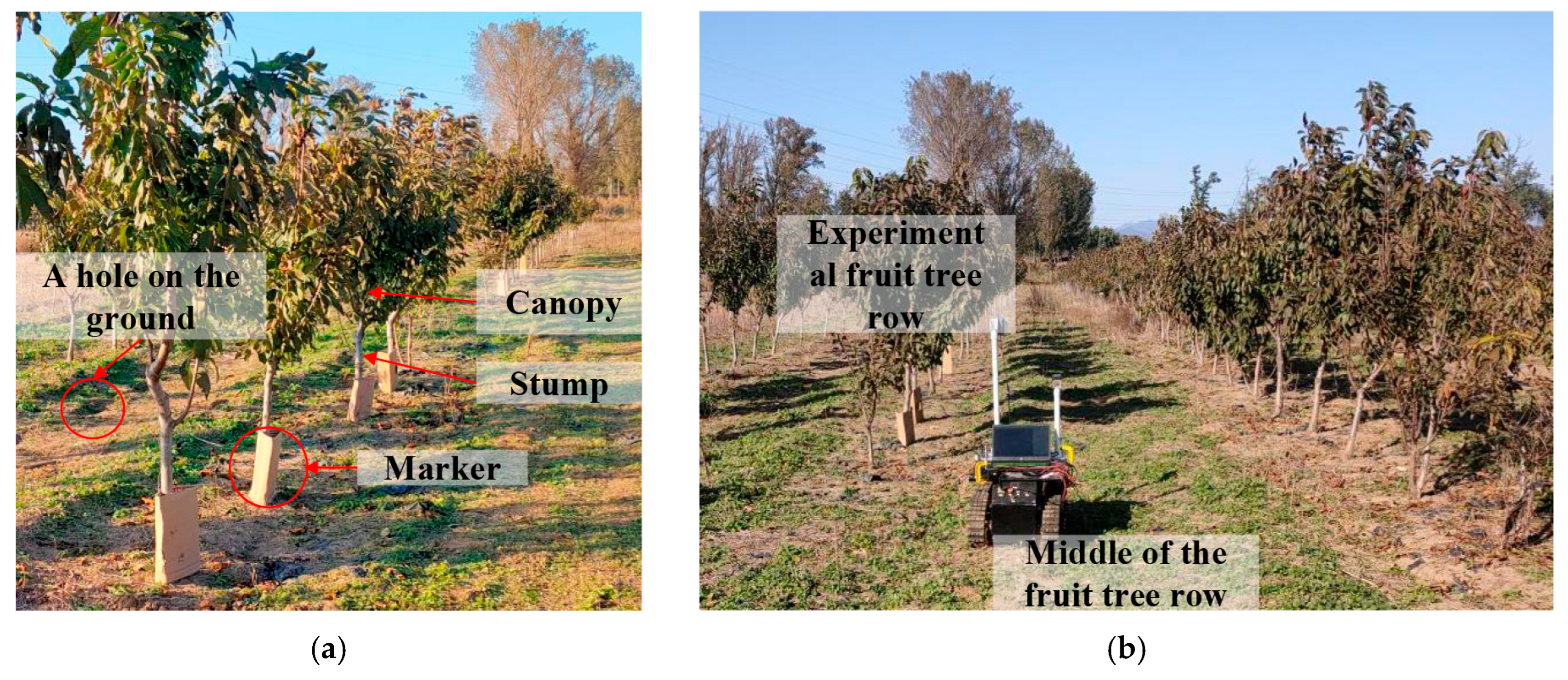
The experiment was conducted in a 0.91 ha, 4-year-old cherry orchard located on flat terrain in the Haidian District of Beijing (116.19° E, 40.15° N). The plantation exhibited an average tree height of 2.9 m and an average trunk height of 1.1 m, with an intra-row spacing of 1.5 m and an inter-row spacing of 4.0 m. The maximum canopy thickness and length were 1.7 m and 1.8 m, respectively. Field data collection occurred from 20–25 September 2021. Weather conditions remained consistently sunny, with ambient temperatures ranging from 25.6 °C to 32.4 °C and wind speeds strictly below 1.0 m/s (Figure 2).

2.3. Test Methods

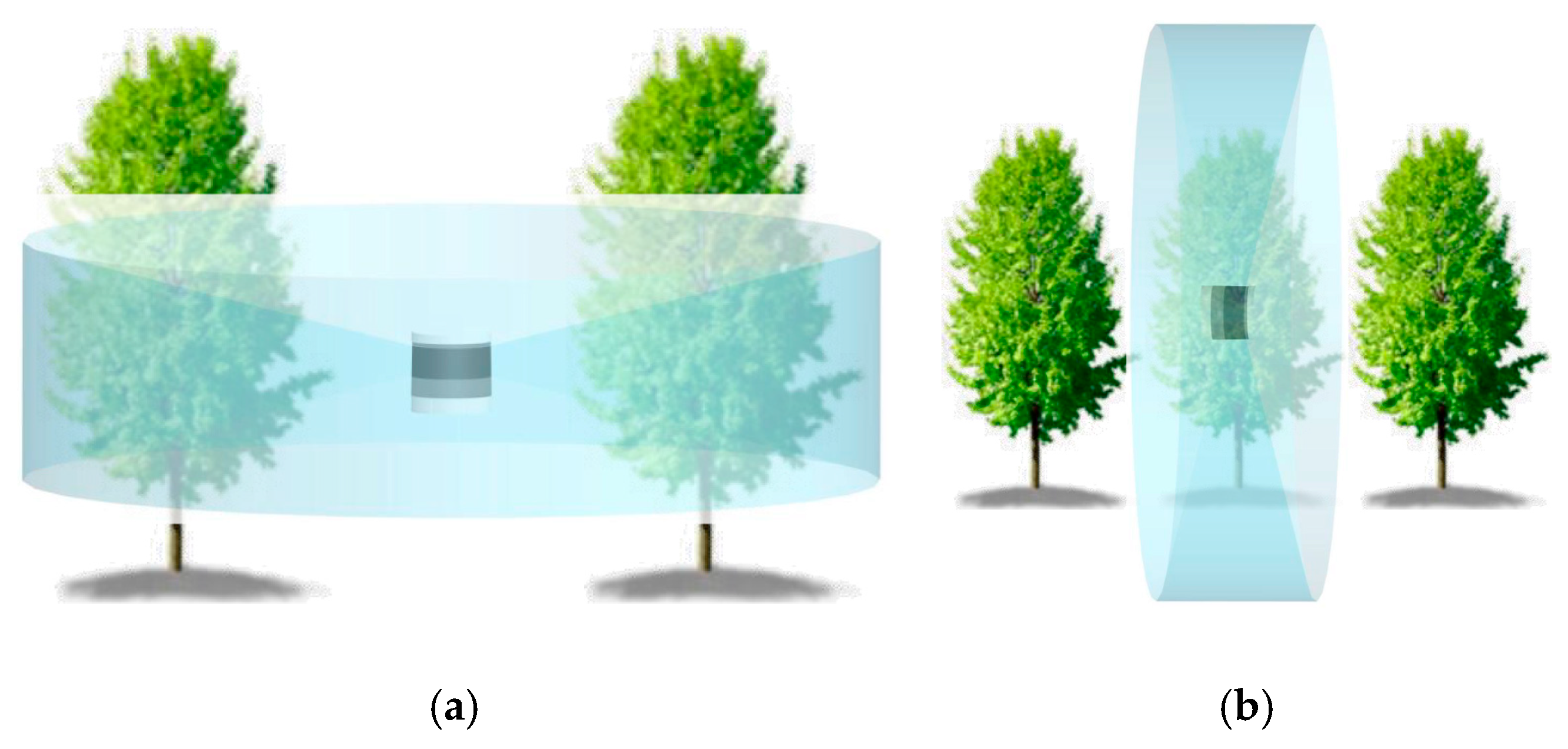
Given that the 16-channel mechanical LiDAR possesses a vertical field of view of merely 30°, a horizontal orientation inherently fails to capture the complete structural profile of adjacent canopies (Figure 3a), rendering it suitable primarily for autonomous navigation [7]. Conversely, a vertical installation comprehensively acquires the full canopy point cloud but compromises forward obstacle detection (Figure 3b), making this configuration specifically suited for high-fidelity plant phenotyping [8].
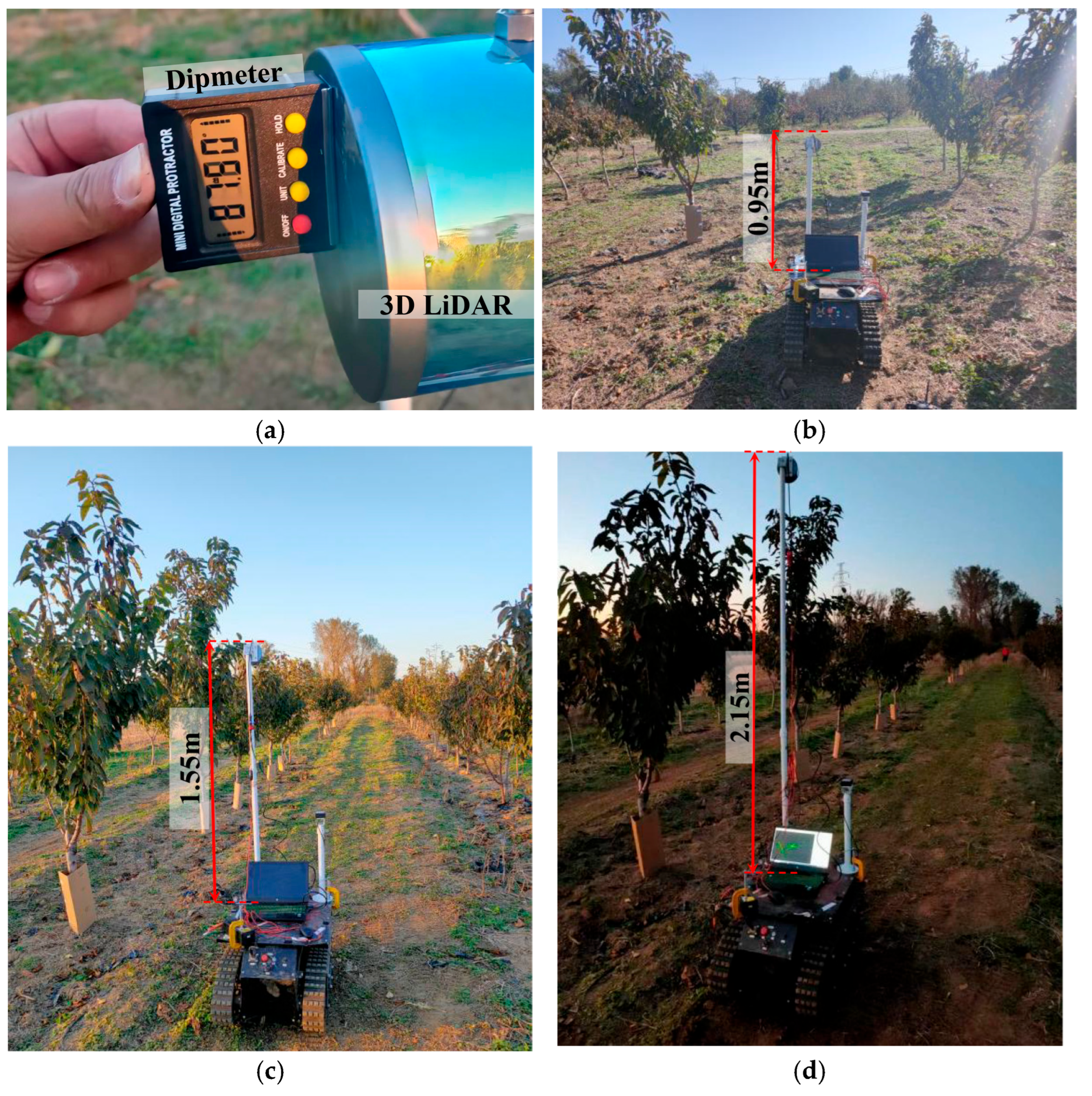
To accurately capture the 3D morphological traits of the fruit trees, the LiDAR sensor necessitated a vertical installation posture. An electronic inclinometer (R&D INSTRUMENT Co., Ltd., Shenzhen, China) was employed to precisely calibrate the 3D LiDAR’s mounting angle (Figure 4a). This device features a measurement range of ±90° with a high accuracy of ±0.01°. To determine the absolute installation angle of the LiDAR, the forward inclination angle of the ICV chassis relative to the horizontal plane was initially quantified. Subsequently, the relative angle between the 3D LiDAR and the ICV platform ( α L , Equation (1)) was derived through geometric calculation.
α L = 90 ° α M
where α M denotes the forward inclination angle of the platform, as quantified by the electronic inclinometer.
By adjusting the mounting mast, the 3D LiDAR was positioned at heights of 1.4 m, 2.0 m, and 2.6 m above ground level (Figure 4b–d). These specific IHs conceptually align with the lower, middle, and upper layer of the fruit tree canopy, respectively. This configuration facilitated a systematic evaluation regarding the impact of varying LiDAR IHs on the measurement accuracy of canopy structural characteristics.
Within the designated test row, 11 cherry trees were randomly selected as experimental samples and explicitly marked with cardboard indicators at their bases (Figure 4c) to assist subsequent point cloud registration. To acquire high-precision absolute positioning, the RTK-GNSS base station was deployed in an unobstructed area 5 m adjacent to the tree row (Figure 5a), working in tandem with the ICV’s mobile station. To ensure robust data acquisition, two distinct driving strategies (forward and reverse traversal) were executed. The solid black line and the red dashed line delineate the forward and reverse trajectories, respectively, with directional arrows indicating the ICV’s heading (Figure 4a). Importantly, five repeated runs were conducted for each driving direction and at each IH to guarantee algorithmic robustness and repeatability.
As depicted in Figure 5b, a local 3D Cartesian coordinate system was established with the tree trunk at the origin. The north–south and east–west orientations defined the horizontal axes (X and Y, respectively), dividing the canopy into four quadrants. Subsequently, the canopy was vertically segmented along the Z-axis into upper, middle, and lower layer based on the average tree height, ultimately generating a 12-zone refined canopy partition.
Within this canopy partition, specific spatial zones were designated to map local deviations. For the lower canopy bottom, the eastern quadrants were defined as Zone I (north) and Zone II (south). Correspondingly, the western quadrants within this same lower layer were designated as Zone VII (north) and Zone VIII (south), respectively (Figure 5b).

2.4. Point Cloud Processing

Given the heterogeneous sampling frequencies of the integrated sensors, strict temporal calibration is imperative prior to data fusion. Following precise hardware time synchronization, the raw point clouds undergo a systematic processing workflow.

2.4.1. Sensor Time Synchronization

Because the sampling frequencies of the RTK-GNSS, 3D LiDAR, IMU, and encoders are inherently heterogeneous, a Python-based synchronization framework was developed to handle data discrepancies. The 1 Hz GPS clock pulse (10 Hz GNSS data output) served as the absolute time reference. A custom Python 3.8 script extracted the start pulse of each GPS second, acting as a universal trigger to align the incoming data streams. Specifically, the high-frequency IMU data (100 Hz) and encoder signals were interpolated and timestamp-matched to the lower-frequency LiDAR frames (10 Hz) and GPS pulses. This strict temporal alignment is critical for validating the precision of point cloud registration during mobile scanning.

2.4.2. Point Cloud Processing Method

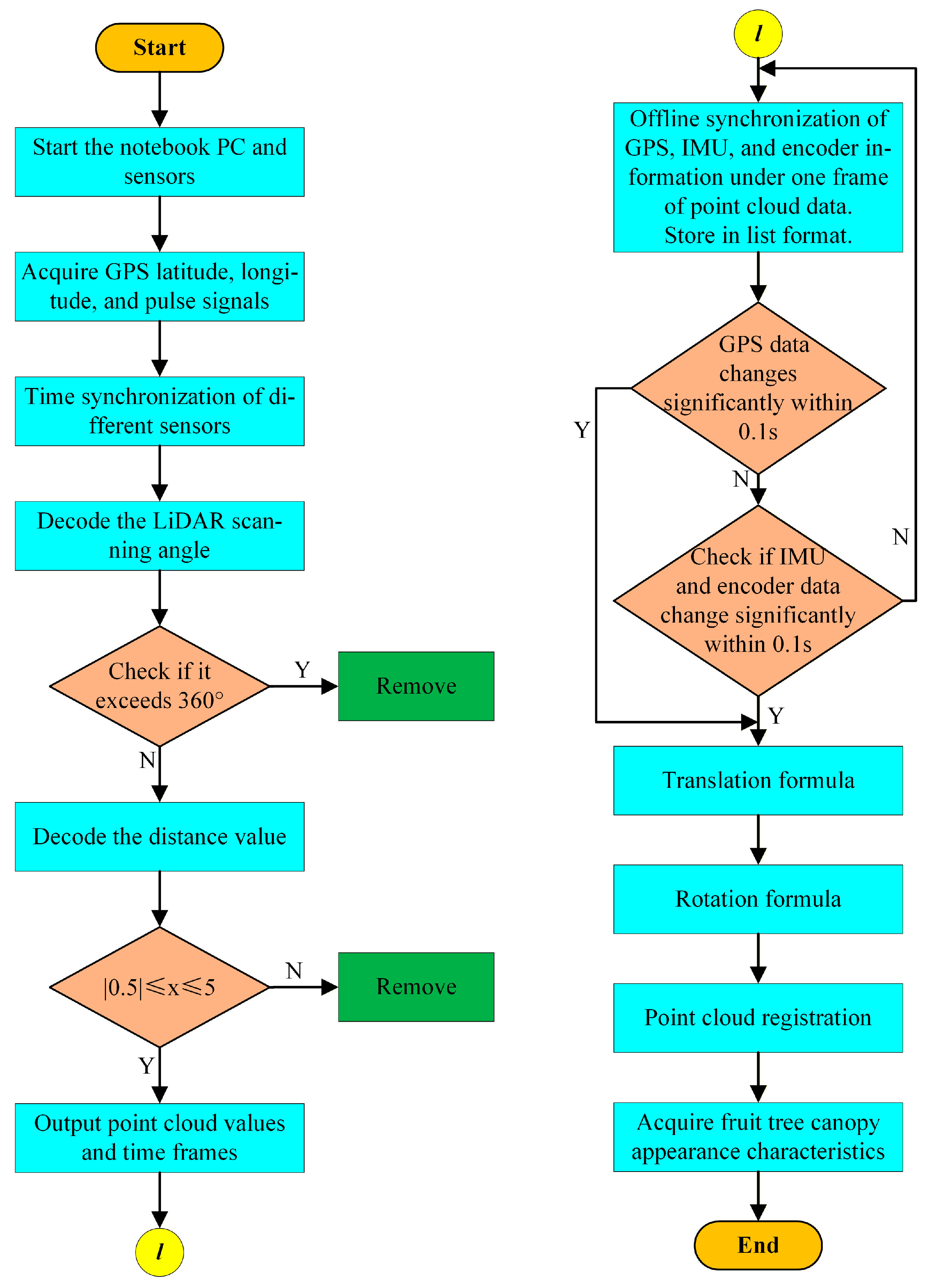
In this study, we mainly use 3D LiDAR to obtain the appearance information of fruit trees. The raw point clouds undergo a rigorous processing workflow to extract high-fidelity morphological traits. The specific process of point cloud processing is shown in Figure 6.
Step 1: System initialization and temporal synchronization.
Prior to data acquisition, the notebook PC and sensors are powered and initialized. The RTK-GNSS spatial coordinates and Pulse-Per-Second (PPS) signals are acquired to establish a universal time baseline. Subsequently, the ICV is deployed to scan the cherry canopy.
Step 2: Initial point cloud filtering.
Leveraging Python 3.8, the 3D LiDAR data frame is decoded to extract precise scanning angles. Redundant spatial data exceeding the 360° horizontal scan range are filtered out. Furthermore, the raw point cloud corresponding to the experimental fruit tree is isolated through distance-based spatial cropping.
Step 3: Kinematic state determination and anomaly detection.
The ICV’s motion status is initially verified via GPS coordinate variations. If kinematic motion is confirmed (displacement exceeding 0.05 m within 0.1 s), the workflow advances to Step 4. Conversely, if GPS data remain static, an auxiliary motion detection subroutine cross-references the IMU outputs. A steady IMU variation indicates ICV movement amidst an unstable GPS signal, thereby triggering an alternate positioning algorithm [8]. Otherwise, the ICV is deemed stationary, and generated point clouds are discarded.
Step 4: Frame reconstruction and temporal re-synchronization.
Following the removal of invalid frames, the valid point cloud sequence is reconstructed. Utilizing the established initial time baseline and the inherent timestamps of the LiDAR frames, multi-sensor data are strictly re-synchronized and exported as a sequential dataset for subsequent offline processing.
Step 5: Offline point clouds processing.
Use Open3D 0.11.0 and Python 3.8 to process the point clouds offline, and then move and rotate the point clouds to obtain the final point cloud information (Figure 7, Equations (2)–(6)).
Step 6: Parameter extraction.
Key structural parameters of the entire canopy, specifically maximum tree height, width, thickness, length, and volume, were computationally extracted. Subsequently, the above structural parameters were derived for each partitioned canopy zone.
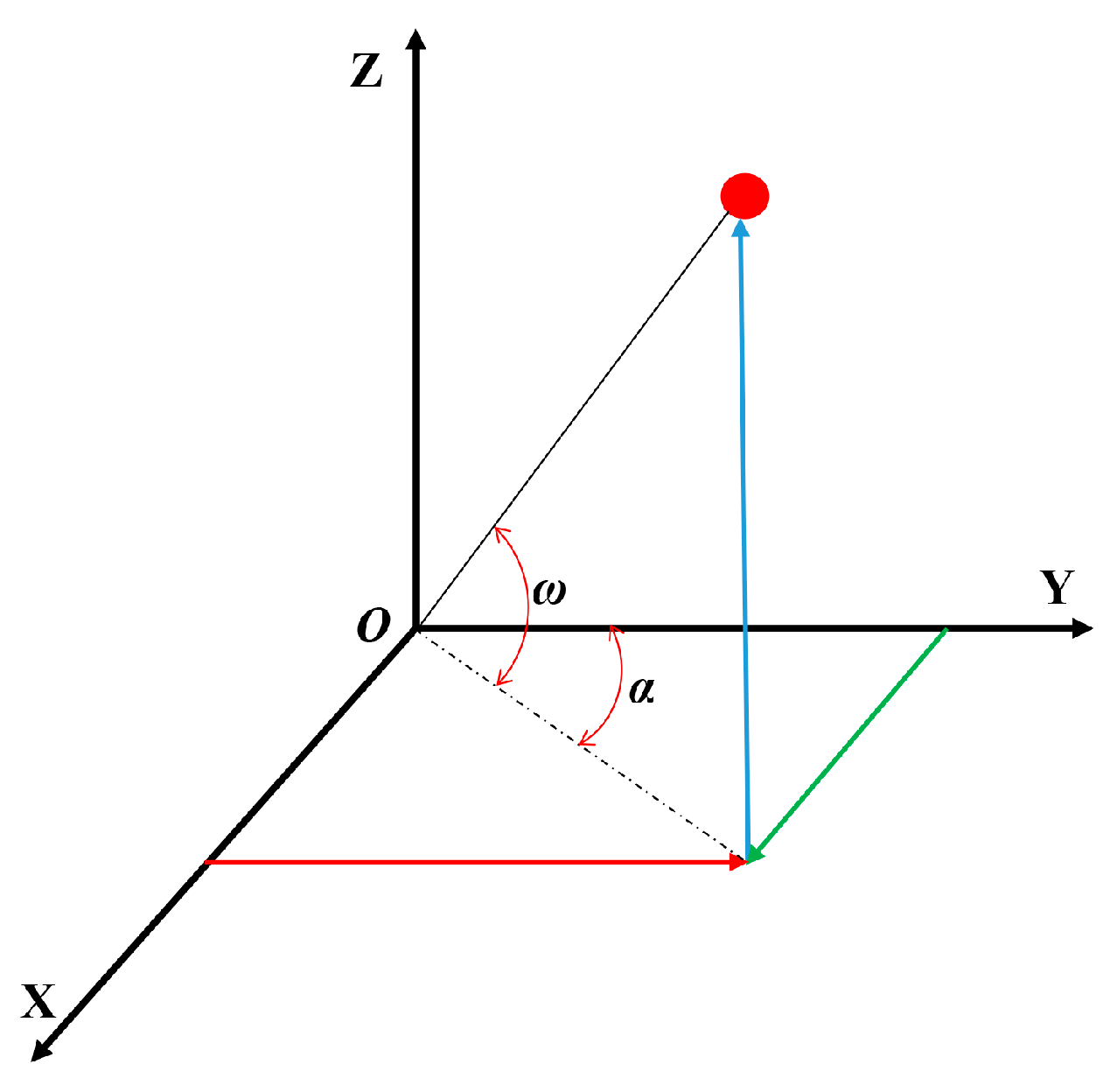
x = r c o s ( ω ) s i n ( α ) y = r c o s ( ω ) c o s ( α ) z = r s i n ( ω )
where x , y , and z represent the Cartesian coordinates; r denotes the polar coordinate of one frame of 3D LiDAR data; ω indicates the horizontal scanning angle; and α signifies the vertical distribution angle.
X 1 Y 1 Z 1 1 = 1 0 0 Δ x 0 1 0 Δ y 0 0 1 Δ z 0 0 0 1 × X 0 Y 0 Z 0 1
where x 0 , y 0 and z 0 are the coordinate of the raw point cloud; Δ x , Δ y and Δ z represent the change values of ICV within 0.1 s; X 1 , Y 1 and Z 1 denote the point cloud coordinates after translation.
X 2 Y 2 Z 2 1 = 1 0 0 0 0 cos I x sin I x 0 0 sin I x cos I x 0 0 0 0 1 × X 1 Y 1 Z 1 1
where I x is the pitching angle; and X 2 , Y 2 and Z 2 represent the point cloud coordinates corrected for pitching.
X 3 Y 3 Z 3 1 = cos I y 0 sin I y 0 0 1 0 1 sin I y 0 cos I y 0 0 0 0 1 × X 2 Y 2 Z 2 1
where I y is the yaw angle; and X 3 , Y 3 and Z 3 represent the coordinates corrected for yaw.
X 4 Y 4 Z 4 1 = cos I z sin I z 0 0 sin I z cos I z 0 0 0 0 1 0 0 0 0 1 × X 3 Y 3 Z 3 1
where I z is the rolling angle; and X 4 , Y 4 and Z 4 represent the final point cloud coordinates corrected for rolling angle

2.5. Data Processing

The macroscopic structural parameters (length, width, and height) of the fruit tree canopies were manually measured five times using a standard measuring tape (±1 cm accuracy) to establish ground truth. Additionally, the spatial dimensions of the 12 zones per tree were manually recorded to compute zoning canopy volumes, alongside qualitative observations of branch and foliage density. The phenotypic metrics extracted from the processed point clouds were subsequently evaluated against these manual measurements by calculating the RE ( G r , Equation (7)), where a higher percentage denotes greater measurement deviation.
G r = T p   -   T g T p   ×   100 %
where T p represents the mean value derived from multiple manual ground truth measurements; and T g is the corresponding value extracted from the LiDAR point cloud.
The coefficient of variation (CV) serves as a standardized statistical metric to quantify data dispersion. Calculated as the ratio of the standard deviation to the mean and expressed as a percentage, it eliminates the influence of disparate units and dimensionalities, facilitating robust comparisons of fluctuation across heterogeneous datasets. It can be obtained by Equation (8).
CV = SD MN   ×   100 %
where S D denotes the standard deviation, and M N is the mean of the dataset group.
M N and S D are expressed by Equations (9) and (10), respectively.
MN = i = 1 n P i n
where n signifies the sample size and P i denotes the i th sample value.
SD = i = 1 n ( P i   -   MN ) 2 n   -   1
Statistical analyses were executed using SPSS Statistics Version 20 (IBM Inc., Armonk, NY, USA), with data visualization generated via OriginPro 2020 (OriginLab Inc., Northampton, MA, USA). Prior to hypothesis testing, all datasets were subjected to normality tests in SPSS, confirming normal distributions.
Independent sample t-tests were performed on the canopy detected results using SPSS with a significance level of 0.05. Furthermore, Duncan’s post hoc test was performed on the overall zoning canopy detected results using SPSS one-way analysis of variance (ANOVA) with a significance level of 0.05. Similarly, Duncan’s post hoc test was performed on the canopy detected results using SPSS two-way ANOVA with a significance level of 0.05, analyzing the interactive effects within the 12-zone partitioned canopy parameters.

3. Results

Acquiring high-fidelity point clouds of fruit tree canopies is a foundational prerequisite for optimizing the geometric configurations of MLS. As delineated in the Introduction, this study establishes a standardized data acquisition and processing workflow tailored for complex orchard environments, specifically mitigating the prevalent occlusion and noise artifacts in contemporary phenotypic analyses. Utilizing the aforementioned filtering and registration algorithms, the raw LiDAR data were subjected to rigorous processing.

3.1. Visualization of Point Cloud Processing

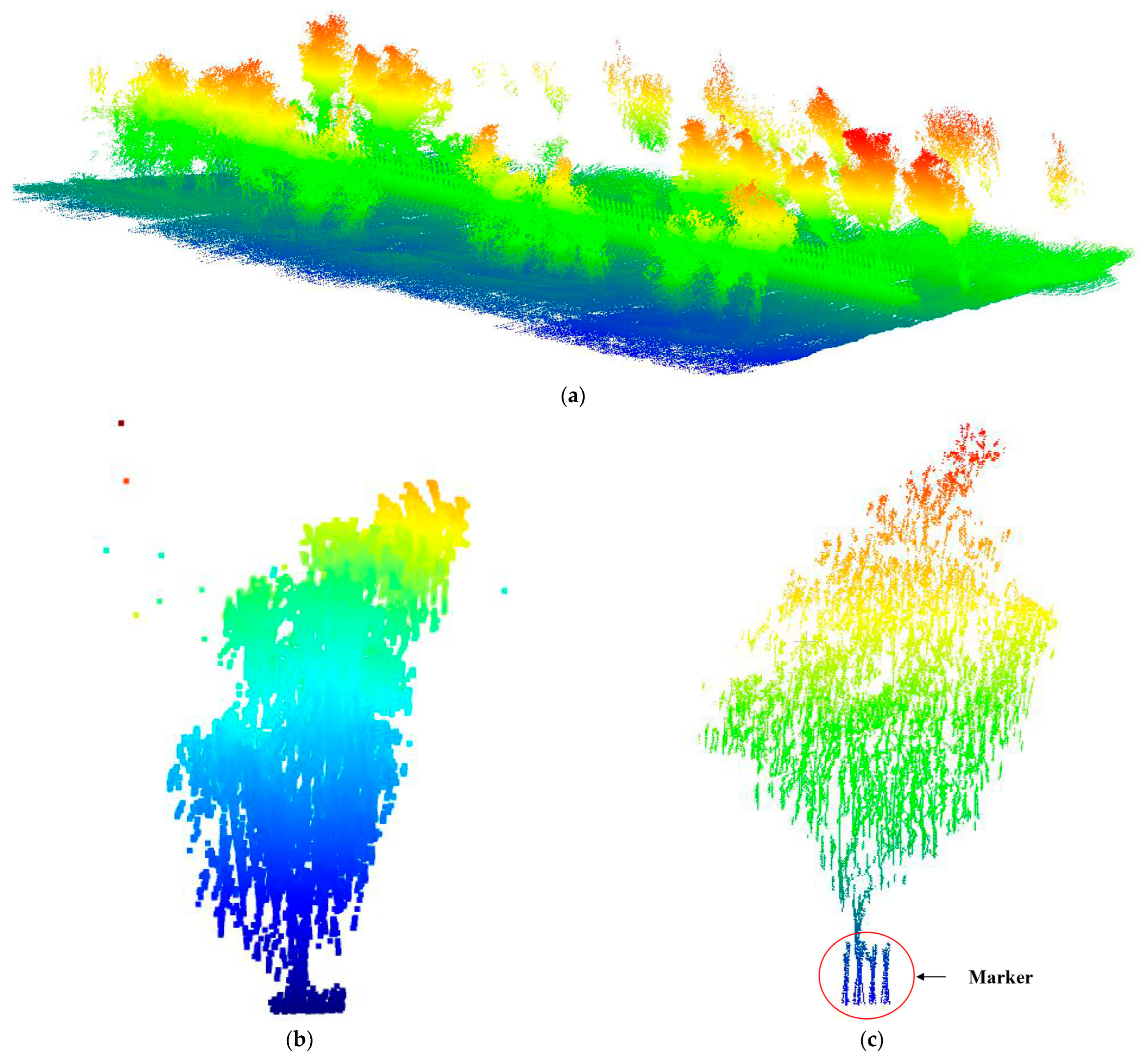
Figure 8 illustrates the sequential point cloud processing outcomes. Figure 8a displays the raw point cloud acquired by LiDAR prior to any noise reduction. Invalid spatial elements, including the vehicle body, ground points, and inter-row clutter, are distinctly visible, rendering the initial dataset chaotic and necessitating filtering. Figure 8b presents the intermediate point cloud post-application of the Open3D pass-through filter, which successfully eliminates the vehicle and ground planes but retains residual clutter. Finally, Figure 8c exhibits the highly refined fruit tree point cloud, neatly isolated from background interference and primed for subsequent structural computations. Furthermore, the cardboard marker at the tree base is clearly resolvable in Figure 8c, providing a reliable fiducial reference for precise canopy positioning and point cloud registration.

3.2. Impact of Driving Direction on Canopy Parameters

To systematically evaluate the effect of driving direction (forward, reverse) on the measurement accuracy of canopy parameters, this study integrated three LiDAR IHs configurations (1.4 m, 2.0 m, 2.6 m). Meanwhile, we analyzed the macroscopic whole-canopy parameters (width, height, thickness, volume) and the 12 canopy zones volume. Independent sample t-tests (α = 0.05) were conducted to ascertain statistical differences between the two driving trajectories, while RE was utilized to quantify accuracy fluctuations.

3.2.1. Impact of Driving Direction on Whole-Canopy Parameters

Table 1 compares the measurement results and statistical variances for the 11 sampled cherry trees across the three IHs. At 1.4 m and 2.0 m IHs, there were no significant differences in canopy parameters between forward and reverse driving (p > 0.05). The REs for all parameters were below 6.1%, indicating that driving direction has a minimal impact on whole-canopy measurement in this height range. Conversely, at the 2.6 m IH, all evaluated parameters exhibited significant differences (p < 0.05).
Specifically, the standard deviations of canopy parameters during reverse driving consistently exceeded those of forward driving across all IH configurations, underscoring the detrimental effect of reverse traversal on measurement stability. At 1.4 m IH, the standard deviation increased from 0.24 to 0.31 for canopy width, from 0.78 to 0.92 for height, and from 1.07 to 1.32 for volume. This dispersion intensified at the 2.0 m IH, where the canopy thickness standard deviation surged by 85.7%. The error amplification peaked at the 2.6 m IH, with the volume standard deviation expanding dramatically from 2.61 to 3.42. At the 1.4 m IH, the standard deviation increased from 0.24 to 0.31 for canopy width, from 0.78 to 0.92 for height, and from 1.07 to 1.32 for volume. t-test results showed that the influence of driving direction became significant as IH increased. At 2.6 m, the t-value for canopy height was the largest (2.418) and the p-value was the smallest (0.028), demonstrating that high-level installations render tree height measurements exceptionally susceptible to interference during reverse operation.

3.2.2. Influence of Driving Direction on Zoning Canopy Parameters

To more accurately elucidate the differential impact of driving direction on measurement accuracy across varying canopy regions, the partitioned volumes of 12 zones were utilized as indicators to calculate the RE under forward and reverse traversals (utilizing manual measurements as the ground truth). The error distribution patterns and the specific impacts of driving direction were systematically analyzed (Table 2). This approach clarifies the error variation tendencies within each canopy bottom under distinct driving directions and IH configurations.
Irrespective of the driving direction, the error distribution exhibited a consistent pattern: RE remained lowest in the middle layer, while being significantly higher in the upper and lower layer (Table 2). This pattern was consistent across all IHs. At the 2.0 m IH, the average REs for the upper, middle, and lower layers were 7.81%, 2.98%, and 5.79% (forward driving), respectively, indicating that the middle layer serves as the optimal accuracy zone. Even at the 2.6 m IH, where the overall RE was elevated, the middle layer RE remained relatively low (6.35%), whereas the upper and lower layer REs surged to 8.79% and 8.35%, respectively.
Reverse driving exhibited a “reverse amplification effect”, the magnitude of which varied significantly across different zoning canopies and IHs. At the same IHs, REs during reverse driving consistently exceeded those during forward driving. At 2.6 m, the RE amplification caused by reverse driving was dramatic, exhibiting a 167.65% increase for the upper layer and 88.24% for the lower layer. Overall, the impact of driving direction on accuracy demonstrated a profound “height dependence.” At low and medium IHs (1.4 m, 2.0 m), reverse driving marginally increased the RE, yet the overall accuracy remained acceptable (p > 0.05). Conversely, at the high IH (2.6 m), reverse driving triggered a surge in REs within the upper and lower layer, diverging significantly from forward driving results (p < 0.05), with interference proving most pronounced in the lower canopy.

3.3. Test Results for Whole-Canopy Parameters

To clarify the influence of different 3D LiDAR IHs on the measurement accuracy of whole-canopy parameters, this study evaluated the main effect of IH utilizing one-way ANOVA. Combined with a descriptive statistical analysis of parameter characteristics and data stability, this provides a rigorous quantitative basis for selecting the optimal IH.

3.3.1. One-Way ANOVA Results

Utilizing the three IHs as independent variables, a one-way ANOVA was executed on the whole-canopy parameters (Table 3). The results demonstrate that LiDAR IH exerts an extremely significant effect (p < 0.001) on whole canopy width, height, thickness, and volume. Canopy height yielded the largest F-value (72.584), indicating extreme sensitivity to height, followed by thickness, volume, and width. Although canopy width was the least sensitive to height variations (F = 13.775), the effect remained highly significant. This confirms that LiDAR IH is a critical determinant of measurement accuracy. Given the substantial differences in measurement outcomes across the tested IHs, multiple comparisons are necessitated to definitively identify the optimal configuration.

3.3.2. Distribution Analysis of Whole-Canopy Parameters Under Different IHs

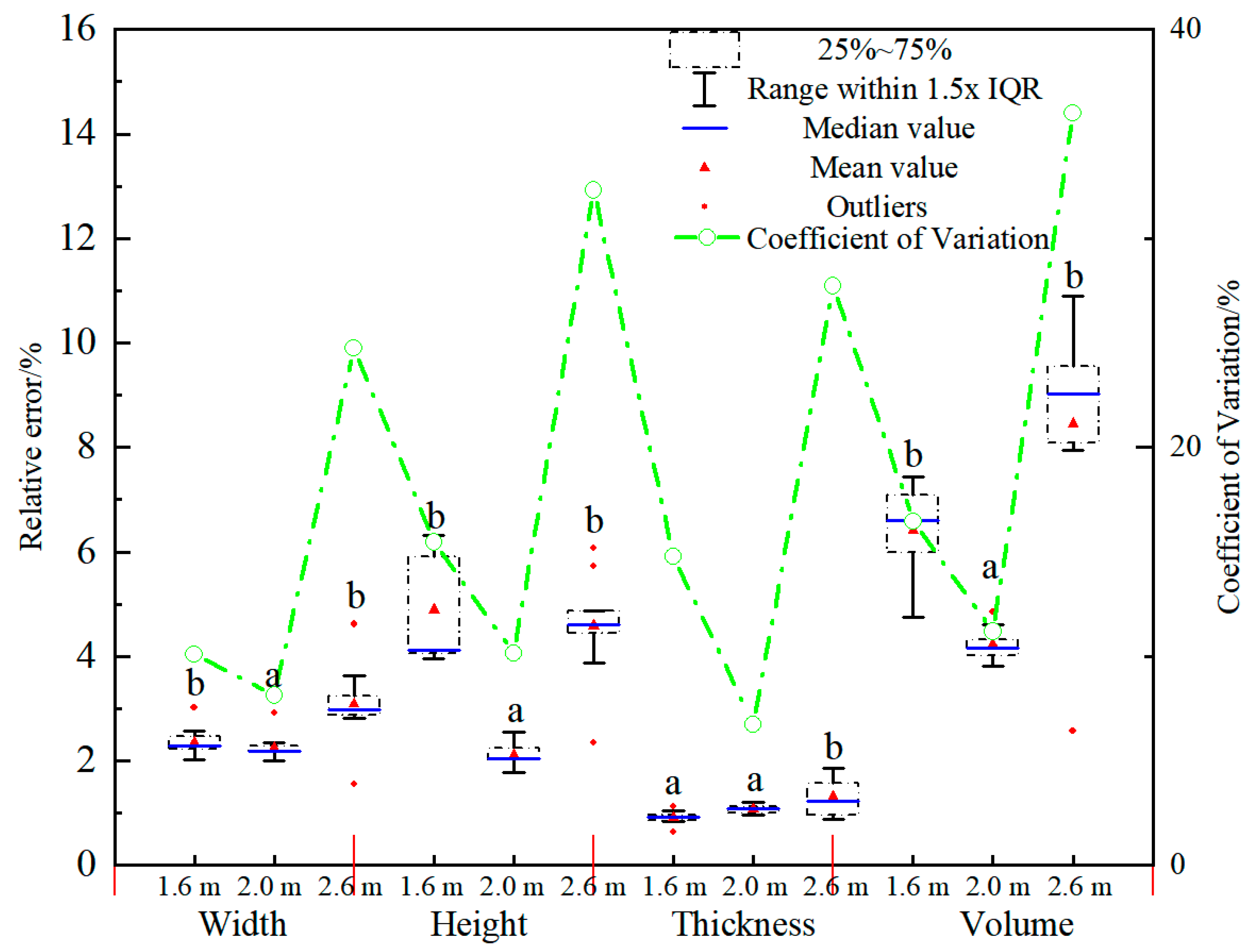
Boxplots (Figure 9) were used to visualize the measurements distribution, thereby clarifying accuracy discrepancies and data dispersion under different IHs.
As LiDAR IH increased, the RE and CV for whole-canopy parameters exhibited a “V-shaped” change (Figure 9), characterized by an initial decrease followed by a subsequent increase. The RE and CV at 2.6 m IH were significantly higher than others at lower configurations. This trend is “stable accuracy at low and medium IH (1.4 m, 2.0 m) and sharp deterioration of accuracy of high IH (2.6 m)”.
The RE of canopy width measured at 2.0 m IH was the lowest (2.22 ± 0.18%), differing significantly from measurements obtained at 1.4 m (2.34 ± 0.24%) and 2.6 m (2.82 ± 0.70%). The CV remained minimal at 1.4 m and 2.0 m IHs (10.11% and 8.14%, respectively). However, as the IH elevated to 2.6 m, the CV abruptly surged to 24.75%, exhibiting the highest frequency of outliers. This indicates that canopy width measurement accuracy sharply declines at high IHs, accompanied by severe deterioration in data stability. Similarly, variations in height and volume measurements mirrored the width trends, albeit with larger RE and CV magnitudes, aligning with the maximum F-values observed for height and volume in the ANOVA.
Conversely, at 1.4 m and 2.0 m IH, the REs of tree thickness measurements were 1.00 ± 0.15% and 1.10 ± 0.07%, respectively, displaying no significant difference. At 2.6 m IH, the RE for thickness significantly increased to 1.51 ± 0.42% (p < 0.05), with the CV escalating to 27.72%, indicating substantially reduced measurement stability. In summary, the 2.0 m IH yielded the lowest data dispersion and highest stability, whereas 2.6 m IH resulted in the poorest stability and most severe fluctuations.

3.4. Test Results of Zoning Canopy Parameters

While whole-tree analysis offers a macroscopic perspective, vertical canopy heterogeneity necessitates a rigorous zoning assessment (Table 4).

3.4.1. Two-Way ANOVA Results

Both IHs and canopy layers exerted extremely significant effects on the four zoning canopy parameters. Notably, the canopy layer demonstrated the most prominent impact on thickness (F = 83.523), while IH had the most significant impact on width (F = 47.758). Furthermore, their interaction effects were profound; excluding no impact on thickness (p = 0.011 < 0.05), interactive impacts on all other parameters were extremely significant (p < 0.01). This indicates that IH and canopy layers do not act independently; rather, they synergistically influence measurement accuracy, requiring further elucidation through multiple comparisons.

3.4.2. Characteristic Analysis of Zoning Parameters Under Different IHs and Canopy Layers

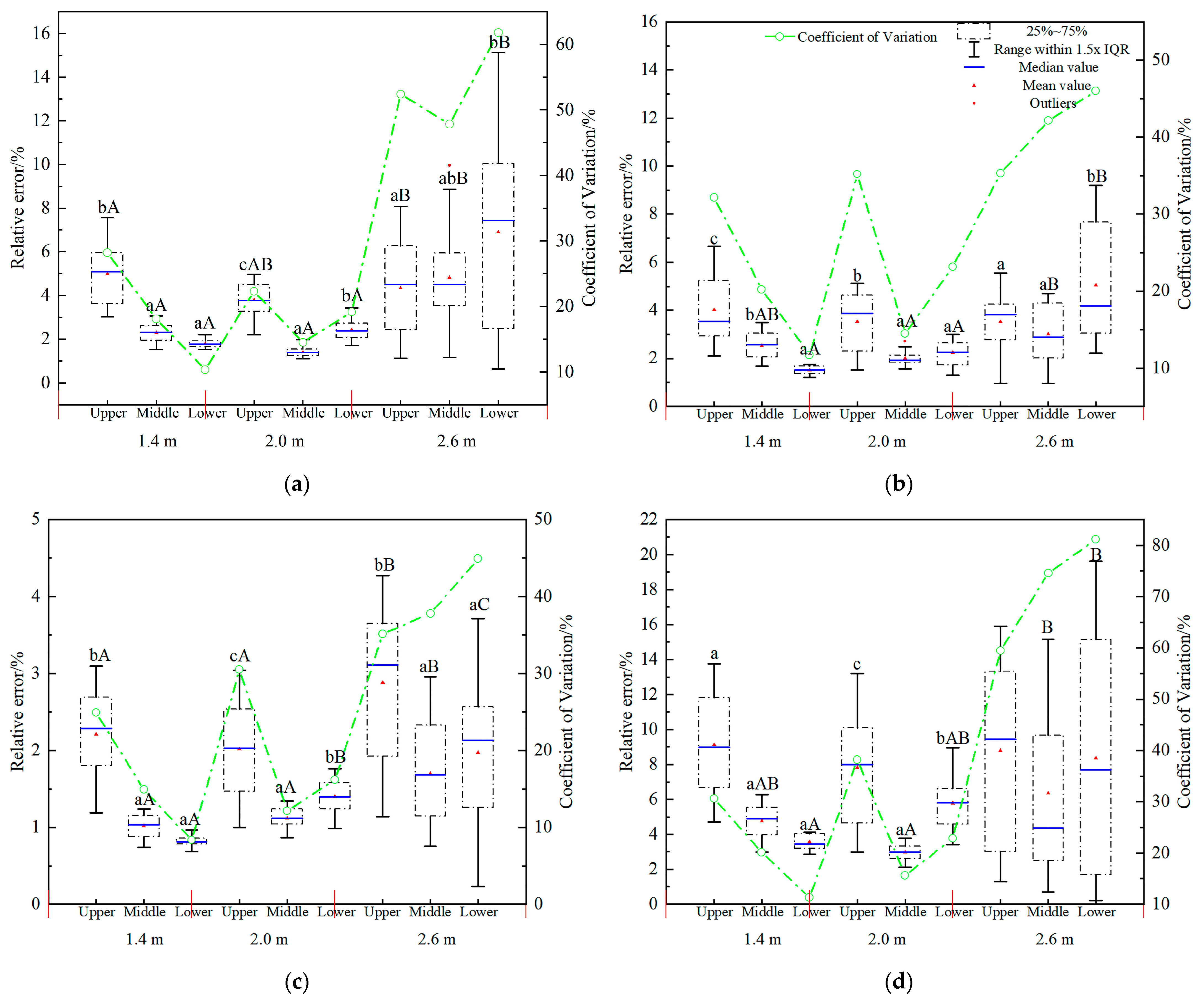
To further elucidate the influence of IH and canopy layers, multiple comparisons and characteristic analyses were conducted for each zoning parameter (Figure 10).
At 1.4 m and 2.0 m IH, the RE and CV of upper canopy width were significantly higher than those in the middle and lower layers (p < 0.05). Conversely, at 2.6 m IH, the lower layer RE (6.90%) and CV (61.80%) peaked, significantly exceeding those of the upper layer. Overall, the 2.6 m IH yielded significantly higher measurement REs and data dispersion within identical zones compared to the other IHs.
Similarly, for canopy height at 1.4 m and 2.0 m IHs, the upper canopy exhibited significantly higher RE and CV than the middle and lower layers. Yet, at 2.6 m IH, this trend reversed, with the lower canopy RE (5.05%) and CV (45.99%) reaching the maximums. While the 2.6 m IH significantly increased REs in the middle and lower layers compared to lower IHs (p < 0.05), the upper layer accuracy remained comparable across all heights.
Regarding thickness, 1.4 m and 2.0 m IHs showed significantly higher REs in the upper canopy. The 2.6 m IH systematically resulted in significantly higher REs and CVs across all zones compared to the other configurations.
For zoning volume, 1.4 m and 2.0 m IHs exhibited significantly higher REs in the upper canopy. In contrast, 2.6 m IH produced high REs across all layers with no significant inter-zone difference, though CVs surged dramatically (59~81%), failing to meet high-fidelity phenotyping requirements. Despite 2.6 m IH severely degrading accuracy for middle and lower layers, the upper layer results did not differ significantly from those at lower IHs.

3.4.3. Independent Sample t-Test Results of Zoning Canopy Volume

At 1.4 m and 2.0 m IHs, measured canopy volumes aligned with ground truth values (p > 0.05), maintaining REs below 11.32% (Table 5) and thereby fulfilling high-fidelity AI training requirements. The middle canopy attained optimal accuracy, with REs of ranging merely from 4.08% to 5.2%. In contrast, the 2.6 m IH produced significant deviations from ground truth (p < 0.001), drastically increased REs. The lower canopy RE peaked at 89.83%, rendering the measured volume nearly double the actual volume and practically unusable. Even with its most accurate middle layer, the 2.6 m IH yielded an 11.22% RE, significantly underperforming compared to the 1.4 m and 2.0 m results. Consequently, excessively high installation positions severely degrade zoning volume measurement accuracy, failing practical application standards.

3.5. Influence of Interaction on Zoning Canopy Parameters

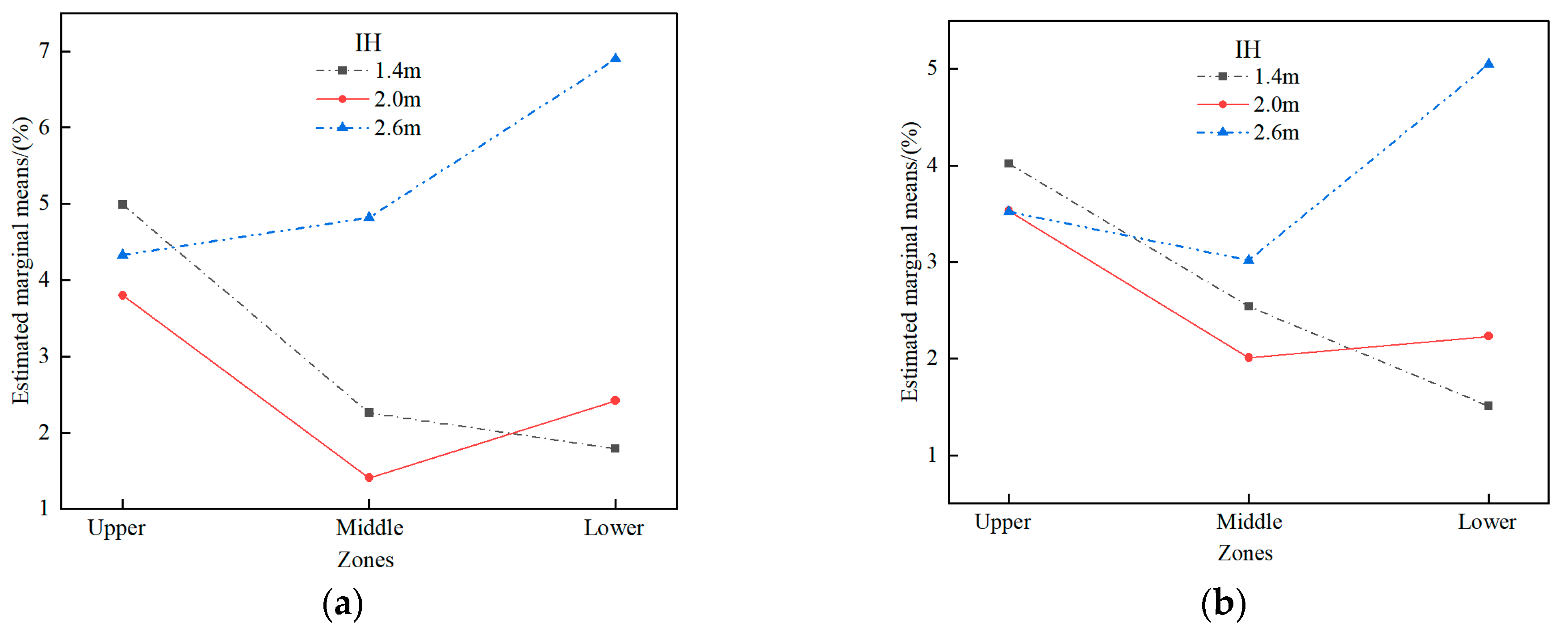
To further elucidate these interaction effects, the RE of each zoning parameter was utilized as the core analytical index. We synthesized the data to explore the error distribution patterns under the combined influence of varying IHs and canopy layer (Figure 11), providing a theoretical basis for precise error mitigation.

3.5.1. Interactive Influence on Zoning Canopy Width

Figure 11 a reveals a profound interaction between IH and zoning canopy width. At 1.4 m IH, REs were lowest in the middle (2.26%) and lower (1.79%) layers, whereas the upper layer was significantly higher (4.99%). The 2.0 m IH displayed a comparable trend. Nevertheless, at 2.6 m IH, this distribution shifted drastically. Middle and lower canopy REs spiked to 4.82% and 6.9%, respectively, while the upper layer RE decreased to 4.33%. Thus, high-level installation significantly amplify deviation in the lower canopy, whereas 1.4 m IH offers superior consistency across the whole canopy.

3.5.2. Interactive Effect on Interaction on Zoning Canopy Height

Canopy stratification effects varied fundamentally by IH (Figure 11b). At 1.4 m and 2.0 m, REs decreased monotonically from the upper to the lower layer, favoring lower-canopy data acquisition. Conversely, the 2.6 m IH inverted this trend; the lower layer RE surged abnormally to 5.05%, surpassing the upper layer. This “crossover phenomenon” confirms that high installation positions critically undermine the system’s capacity to capture height characteristics in the lower layers.

3.5.3. Interactive Effect on Interaction on Zoning Canopy Thickness

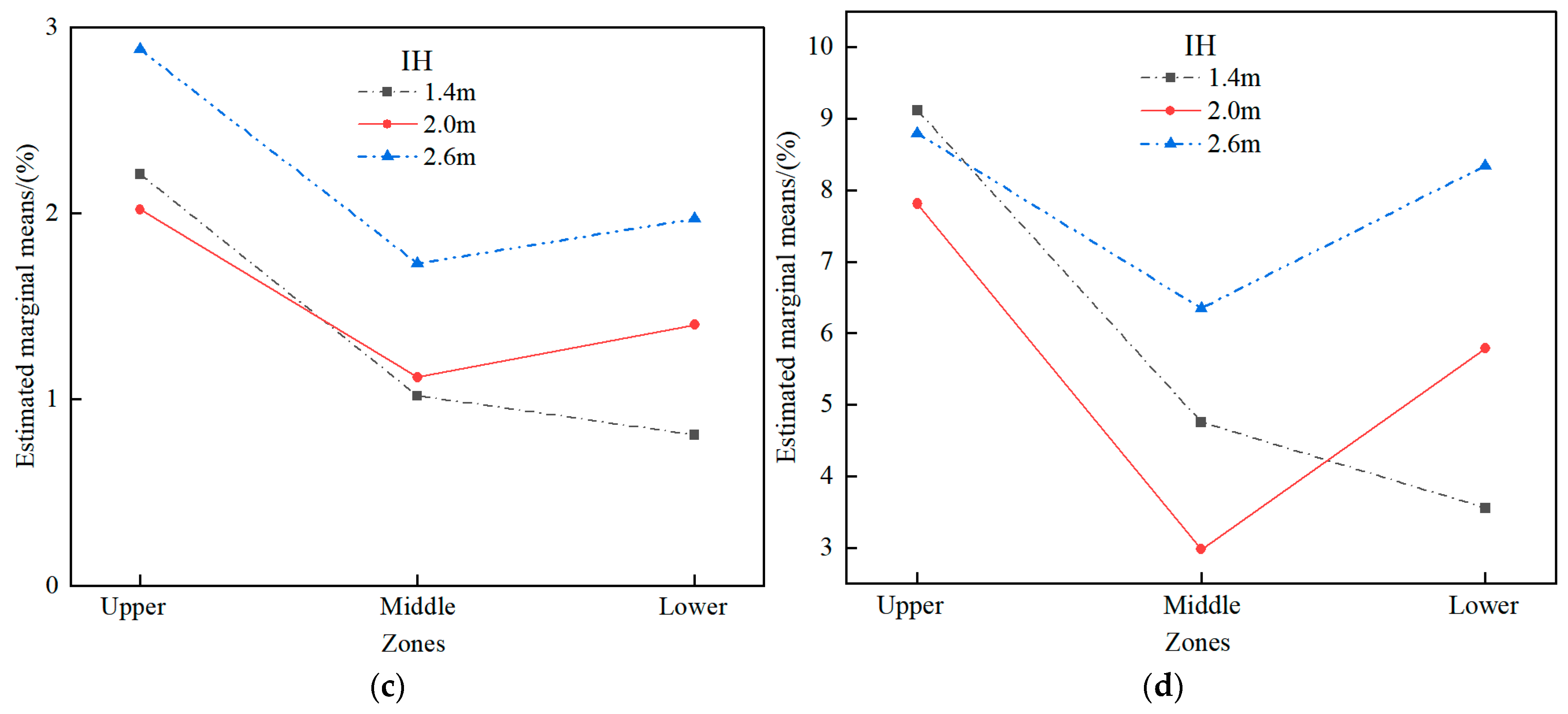
Thickness REs maintained a consistent downward trend across all IHs (Figure 11c), with the highest REs consistently localized in the upper layer. Unlike other parameters, no significant trend inversion materialized (p = 0.011). Instead, the RE curve for the 2.6 m IH remained systematically higher than the 1.4 m and 2.0 m curves, especially in the upper canopy. Although bottom position primarily dictates local accuracy, a high IH systematically reduces overall precision.

3.5.4. Interactive Effect on Interaction on Zoning Canopy Volume

Zoning canopy volume showed the most complex interactive behavior (Figure 11d). At 1.4 m IH, RE decreased monotonically, culminating in optimal accuracy within the lower layer (3.56%). In contrast, the 2.0 m and 2.6 m IHs formed a “V-shape” distribution, generating the smallest REs in the middle layer. Notably, at 2.6 m IH, the lower canopy RE surged to 8.34%, approaching the upper layer’s RE and vastly exceeding the lower layer RE observed at 1.4 m IH. Furthermore, the canopy volume RE across all zones at 2.0 m IH was consistently lower than 2.6 m, indicating that the 2.0 m IH provides distinct advantages for middle layer volume assessments. This diverging error distribution pattern underscores the profound complexity of these interactive effects.

4. Discussion

As horticulture advances toward AI-driven automation, acquiring high-fidelity canopy parameters becomes essential for intelligent orchard management. While 3D LiDAR serves as the premier tool for phenotypic data acquisition, the impact of sensor geometric configuration remains insufficiently addressed, frequently resulting in occlusion artifacts and measurement deviations. This study systematically explored the effects of three IHs (1.4 m (low), 2.0 m (middle), and 2.6 m (high)) on measurement accuracy within a standardized cherry orchard, employing a novel 12-zone refined evaluation methodology to optimize LiDAR spatial deployment.

4.1. Nonlinear Influence and Mechanism of IH

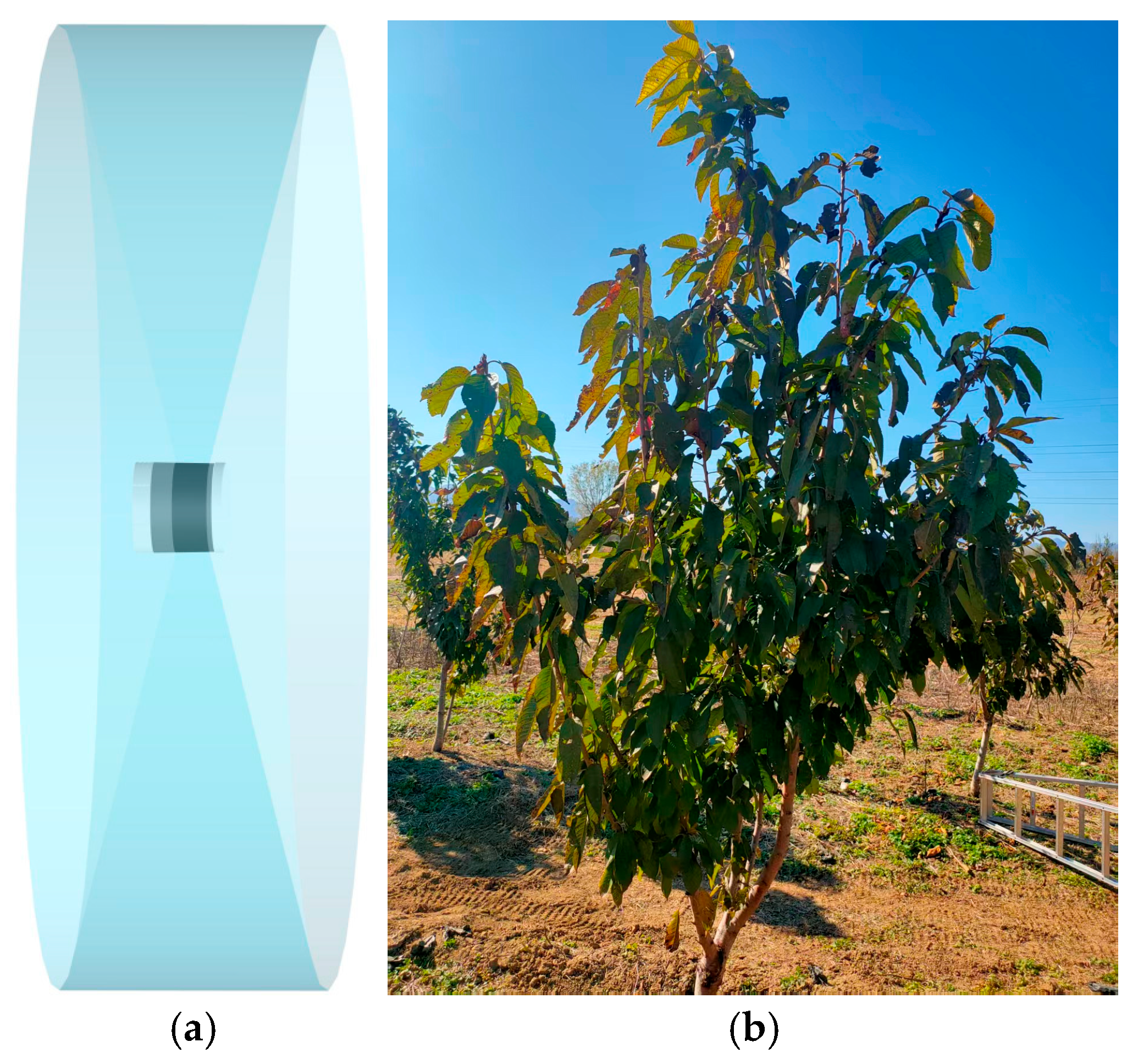
This study confirms that IH is a critical determinant of measurement accuracy, exhibiting a distinct nonlinear trend wherein the 2.0 m IH proved optimal (Table 1, Table 2, Table 3 and Table 4, Figure 8 and Figure 9). This configuration maintained average REs within 5% with minimal data dispersion. Mechanistically, altering the IH directly modifies the interaction between the laser beam’s incidence angle and the target canopy elements. Although a LiDAR sensor may emit 300,000 pulses per second, the effective point cloud density captured from the identical object varies dramatically with sensor placement (Figure 12a). At 2.0 m (approximating the canopy geometric center), the laser incidence angle is nearly orthogonal to the target, significantly reducing scattering and shadowing. This aligns perfectly with photogrammetric orthogonal observation principles, wherein sensor positioning governs projection shadows [21]. The 2.0 m setup balances spatial coverage by simultaneously observing the upper and lower canopy structures, minimizing the required laser path. This corroborates Zhang et al.’s assertion that sensors should be positioned in close proximity to the canopy’s biomass center [22]. Furthermore, this physical phenomenon can be applied to orchards such as apple hedgerows or open-center citrus trees.
In contrast, the 1.4 m IH accurately captured the lower canopy (3.56% RE) but systematically underestimated total tree height. This is attributed to an umbrella-like occlusion caused by dense mid-to-lower canopy foliage, which impedes laser penetration to the apex. When sensors are installed too low, the dense lower branches induce severe self-occlusion of the upper architecture, restricting the laser beams from reaching the tree’s highest points [23]. This phenomenon mirrors observations by Hillman et al. in forest ground-based LiDAR studies, noting that single-station low-altitude LiDAR struggles to reconstruct the canopy apex completely [24].
Conversely, the 2.6 m IH caused the most severe deviation, with lower canopy volume REs surging past 16%, contradicting the intuitive assumption that “higher is better.” The underlying mechanism involves a blind spot directly beneath the sensor (often referred to as the “dark-under-lamp” effect), where laser energy attenuates significantly before penetrating to the bottom layer [24]. Additionally, leaf phototropism (upward-facing leaves) inherently creates a severe occlusion effect during top-down scanning, causing laser blocking or mirror reflections [18,25]. Elevated IHs further exacerbate interference from ground clutter [26]. These findings underscore that the optimal IH is not a fixed absolute value, but must be proportional to the canopy’s geometric center. If prescription maps for variable-rate spraying are generated using high-mounted LiDAR data, lower-canopy biomass will be drastically underestimated, leading to insufficient pesticide application in canopy zones highly susceptible to pests and diseases.
While high-level IH is conventionally employed to acquire broad crop profiles, it presents significant limitations for refined phenotypic characterization [27]. It is noteworthy that the optimal 2.0 m IH determined in this study diverges from the 1.4 m configuration recommended for digital leaf area evaluation in apple orchards. This discrepancy arises primarily from fundamental differences in target tree architectures. The referenced study targeted dwarf, high-density apple trees (approximate height 2.5 m with negligible trunks). In our study, the cherry trees averaged 2.9 m in height and featured prominent trunks (average 1.1 m). This reaffirms that optimal IH is not static; it must scale proportionally with the target’s geometric center, providing a flexible heuristic for configuring sensors across diverse species. Moreover, unlike Auat Cheein et al.’s utilization of a single 2D push-broom LiDAR [28], the 16-channel 3D LiDAR deployed here offers superior vertical resolution. Nevertheless, we found that even when utilizing a multi-channel LiDAR, precise vertical positioning remains paramount; merely increasing the number of laser channels cannot inherently eliminate structural blind spots dictated by the viewing angle.

4.2. Interaction Between IH and Vertical Structure

Zoning canopy volume, serving as a comprehensive metric, exhibited the most complex interaction behavior (Figure 11d). At 1.4 m IH, RE decreased monotonically from top to bottom, yielding maximum accuracy in the lower layer. However, at 2.0 m and 2.6 m IH, the RE curves adopted a “V” shape, with the smallest RE in the middle layer. Crucially, the lower layer RE at 2.6 m surged to 8.34%, massively exceeding that at 1.4 m. This stems from disparate laser coverage efficiencies: low-level installations capture the bottom layer but suffer from upper layer occlusion, whereas high-level installations favor the upper layer but sacrifice bottom data. In contrast, middle-level installations balanced vertical coverage. This finding exposes a critical flaw in traditional whole-tree evaluation: even if the aggregate whole-volume RE appears acceptable (7% at 2.6 m), substantial localized errors persist due to an “error compensation effect” (overestimation in the upper layer negating underestimation in the lower layer). Such localized inaccuracies pose severe risks to precision agriculture tasks, such as automated layered pruning.

4.3. Synergistic Effect of Driving Direction and IH

Ideally, driving direction should not influence structural measurement; however, this study reveals a critical dependency intimately tied to IH. While low-to-medium heights (1.4 m, 2.0 m) demonstrated stable performance irrespective of traversal direction (p > 0.05), the 2.6 m height exhibited significant instability during reverse driving (p < 0.05), particularly in tree height measurement.
This instability is mechanistically driven by a mechanical coupling between the chassis dynamics and the sensor’s lever arm effect. Treating the sensor mounting mast as an inverted cantilever beam [16], the extended lever arm at 2.6 m amplifies the linear displacement induced by chassis pitch and roll to nearly double that of the 1.4 m configuration. Crucially, reverse operation of the tracked chassis alters the track tension angle, thereby diminishing the suspension system’s capacity to buffer ground impacts (e.g., the ground depressions visible in Figure 2a) and inducing high-frequency mechanical vibrations. These vibrations, magnified by the extended lever arm, result in severe point cloud mismatching (ghosting artifacts) that surpass the correction thresholds of conventional tightly coupled IMU/LiDAR integration algorithms [29,30]. Consequently, high-level installations render the scanning system acutely vulnerable to the inherent mechanical disadvantages of reverse traversal.

4.4. Role of Zoning

Traditional phenotypic studies predominantly rely on the correlation (R2) of whole-tree volume as the primary evaluation metric. For instance, whole-tree volume is frequently utilized to predict yield in almond orchards via the fusion LiDAR and vision sensors [31]. However, through our 12-zone comparison analysis, this study reveals that a seemingly acceptable whole-tree RE (7% at 2.6 m) often masks a significant “error compensation effect”, wherein upper-canopy overestimation numerically cancels out lower-canopy underestimation.
Consequently, the “hierarchical partition” verification framework introduced herein provides a vastly more granular accuracy assessment than traditional whole-tree comparisons [31], which inherently obscure local discrepancies. The masking of such localized errors is profoundly detrimental to precision agricultural management. For example, modeling site-specific spray deposition in vineyards across phenological stages relies entirely on accurate, localized canopy density mapping [32]. If a hierarchical variable-rate spraying application were parameterized using the 2.6 m IH data from this study, the lower canopy, often a high-risk zone for pathological infections, would receive insufficient pesticide, while the upper canopy would be excessively overdosed. Therefore, the zoning evaluation protocol proposed in this study establishes a rigorous, standardized benchmark for evaluating phenotyping platforms, highlighting the irreplaceable necessity of field-based, layer-stratified verification over generalized simulation studies.

4.5. Limitations and Future Prospects

Current limitations stem from the exclusive focus on spindle-shaped cherry trees, reliance on mechanical LiDAR, and ideal windless conditions. Therefore, there are four limitations. First, the exclusive focus on spindle-shaped cherry trees limits the direct extrapolation. Future studies should investigate how these configuration rules translate to other common canopy architectures, such as apple hedgerows or open-center citrus trees, to determine if the “geometric center” rule remains universally proportional to the canopy structure. Second, the reliance on a specific mechanical LiDAR model warrants further validation utilizing hybrid solid-state sensors with varying scanning patterns. Third, the exclusion of wind effects under ideal experimental conditions overlooks branch oscillation, a critical noise source in dynamic field environments. Fourth, the lateral distance between the LiDAR sensor and the tree row was kept constant; future research must investigate whether varying this distance influences the optimal IH and the acquisition of high-fidelity results.
In light of these limitations, future work will pursue five key avenues: (1) Develop an automatic, dynamic height-adjustable sensor mast. Since our results demonstrate that optimal height is relative to the canopy center, a dynamically adjusting mast would provide a robust path toward maintaining high-fidelity data in orchards with heterogeneous tree ages and sizes. (2) Explore a multi-LiDAR layout scheme. Installing low-cost sensors at both upper and lower canopy elevations could resolve occlusion constraints via multi-view point cloud fusion. (3) Establish standardized field collection protocols. We propose defining IH as a percentage ratio relative to average canopy height rather than a fixed metric value, enhancing cross-study comparability. (4) Develop deep learning-based point cloud completion networks. These architectures could leverage upper-structure features to predict missing geometric data in occluded lower layers, optimizing data quality for non-ideal installations. (5) Conduct field validations across diverse canopy morphologies and environments. By translating photogrammetric principles into agricultural contexts, this study bridges existing gaps and delivers essential hardware design guidelines for next-generation orchard robotics.

5. Conclusions

Accurate canopy detection is foundational for agricultural AI in orchard management, yet research regarding optimal LiDAR geometric configuration remains inadequate, frequently resulting in data acquisition blind spots. This study systematically optimized the 3D LiDAR IH utilizing a custom-developed ICV. Field experiments in a standardized cherry orchard rigorously evaluated different IHs and driving strategies. By employing a novel 12-zone refined evaluation methodology to analyze error distribution against manual measurements, this study addresses the research gap concerning how spatial geometry dictates data quality, satisfying the critical demand for high-fidelity AI training data.
The principal conclusions are as follows:
(1)
The RE of canopy volume measurement was minimized to 2.98% ± 0.47% at the optimal IH, significantly outperforming other configurations (p < 0.001). Notably, at the 2.6 m high-level IH, the measurement RE in the lower canopy soared to over 80% in extreme zones, indicating that improper installation renders data in specific areas effectively practically unusable.
(2)
In MLSs, the geometric alignment between the LiDAR’s field of view and the target crown structure is the decisive factor for accuracy. The distinct advantage of the 2.0 m IH lies in its capacity to penetrate the dense central canopy while simultaneously minimizing occlusion from both the ground and the canopy apex. This emphatically corroborates the critical importance of the median orthogonal observation principle.
(3)
Limitations persist, as the experiment was confined to standard spindle-shaped cherry trees and mechanical rotary LiDAR. Adjustments may be necessary for trees with significantly different shapes (e.g., open-center peach, hedgerow grapes) or for solid-state LiDARs with fixed viewing angles.
(4)
The center-crown installation strategy can be directly integrated into the hardware design of intelligent orchard robots, autonomous variable-rate sprayers, and robotic pruning manipulators. This approach represents a highly cost-effective, high-yield engineering optimization, significantly enhancing overall perception system performance without necessitating the adoption of more expensive sensor hardware.
This research enriches the engineering theoretical framework of agricultural robot perception, elevating sensor deployment strategy from a routinely neglected mechanical detail to a rigorous scientific parameter directly dictating data fidelity. Future work will focus on engineering dynamically height-adjustable platforms that align LiDAR with real-time tree height variations, alongside exploring multi-LiDAR (high-middle-low) collaborative scanning schemes to definitively eliminate blind spots. Furthermore, field trials will be extended to encompass diverse orchard planting patterns, ultimately establishing a universal, standardized sensor configuration library.

Author Contributions

Conceptualization, L.L. and Y.D.; methodology, L.L. and Y.D.; software, L.L. and X.L.; validation, L.L., W.L. and Q.X.; formal analysis, C.L. and S.L.; investigation, S.L. and Y.H.; resources, Y.H. and C.L.; data curation, L.L. and W.L.; writing—original draft preparation, L.L. and Y.D.; writing—review and editing, L.L. and Q.X.; visualization, L.L. and X.L.; supervision, C.L.; project administration, L.L. and X.L.; funding acquisition, L.L. All authors have read and agreed to the published version of the manuscript.

Funding

This study was financially supported by the earmarked fund for High-level Talent Funding Project of Shandong Agriculture and Engineering University (No.2025GCCZR-07).

Data Availability Statement

The raw data supporting the conclusions of this article will be made available by the authors on request.

Conflicts of Interest

The authors declare no conflicts of interest.

Abbreviations

The following abbreviations are used in this manuscript:
IHinstallation height
ICVinformation collection vehicle
RErelative error
AIArtificial Intelligence
ANOVAanalysis of variance
3Dthree-dimensional
LiDARLight Detection and Ranging
MLSmobile laser scanning
UAVunmanned aerial vehicle
RANSACRandom Sample Consensus
RTK GNSSReal-Time Kinematic Global Navigation Satellite System
CVCoefficient of Variation

References

  1. McBratney, A.; Park, M. Agriculture over the Horizon: A Synthesis for the Mid-21st Century. Sustainability 2025, 17, 9424. [Google Scholar] [CrossRef]
  2. Mahmud, M.S.; Zahid, A.; Das, A.K. Sensing and Automation Technologies for Ornamental Nursery Crop Production: Current Status and Future Prospects. Sensors 2023, 23, 1818. [Google Scholar] [CrossRef]
  3. Wang, Y.; Jia, W.; Ou, M.; Wang, X.; Dong, X. A Review of Orchard Canopy Perception Technologies for Variable-Rate Spraying. Sensors 2025, 25, 4898. [Google Scholar] [CrossRef] [PubMed]
  4. Scalisi, A.; O’Connell, M.G.; Goodwin, I. Plant-Based, Proximal and Remote Sensing in Orchards and Vineyards—State of the Art, Challenges, Data Fusion and Integration. Horticulturae 2025, 11, 1031. [Google Scholar] [CrossRef]
  5. Zang, J.; Jin, S.; Zhang, S.; Li, Q.; Mu, Y.; Li, Z.; Li, S.; Wang, X.; Su, Y.; Jiang, D. Field-Measured Canopy Height May Not Be as Accurate and Heritable as Believed: Evidence from Advanced 3D Sensing. Plant Methods 2023, 19, 39. [Google Scholar] [CrossRef]
  6. Fotouo Makouate, H.; Zude-Sasse, M. Advances in Growing Degree Days Models for Flowering to Harvest: Optimizing Crop Management with Methods of Precision Horticulture—A Review. Horticulturae 2025, 11, 1415. [Google Scholar] [CrossRef]
  7. Liu, L.; Liu, Y.; He, X.; Liu, W. Precision Variable-Rate Spraying Robot by Using Single 3D LIDAR in Orchards. Agronomy 2022, 12, 2509. [Google Scholar] [CrossRef]
  8. Liu, L.; Ji, D.; Zeng, F.; Zhao, Z.; Wang, S. Precision Inter-Row Relative Positioning Method by Using 3D LiDAR in Planted Forests and Orchards. Agronomy 2024, 14, 1279. [Google Scholar] [CrossRef]
  9. Saha, K.K.; Tsoulias, N.; Weltzien, C.; Zude-Sasse, M. Estimation of Vegetative Growth in Strawberry Plants Using Mobile LiDAR Laser Scanner. Horticulturae 2022, 8, 90. [Google Scholar] [CrossRef]
  10. Cantón-Martínez, S.; Mesas-Carrascosa, F.J.; de la Rosa, R.; López-Granados, F.; León, L.; Pérez-Porras, F.; Páez, F.C.; Torres-Sánchez, J. Evaluation of Canopy Growth in Rainfed Olive Hedgerows Using UAV-LiDAR. Horticulturae 2024, 10, 952. [Google Scholar] [CrossRef]
  11. Zhang, Y.; Sun, H.; Zhang, F.; Zhang, B.; Tao, S.; Li, H.; Qi, K.; Zhang, S.; Ninomiya, S.; Mu, Y. Real-Time Localization and Colorful Three-Dimensional Mapping of Orchards Based on Multi-Sensor Fusion Using Extended Kalman Filter. Agronomy 2023, 13, 2158. [Google Scholar] [CrossRef]
  12. Li, Z.; Wu, Q.; Xiong, F.; Zhang, Y. Adaptive Threshold Ground Segmentation Algorithm Based on Point Cloud Surface Fitting. Comput. Eng. Appl. 2025, 61, 337–347. [Google Scholar] [CrossRef]
  13. Dong, X.; Kim, W.Y.; Yu, Z.; Oh, J.Y.; Ehsani, R.; Lee, K.H. Improved Voxel-Based Volume Estimation and Pruning Severity Mapping of Apple Trees during the Pruning Period. Comput. Electron. Agric. 2024, 219, 108834. [Google Scholar] [CrossRef]
  14. Guo, C.; Zong, Z.; Zhang, X.; Liu, G. Apple Tree Canopy Geometric Parameters Acquirement Based on 3D Point Clouds. Nongye Gongcheng Xuebao/Trans. Chin. Soc. Agric. Eng. 2017, 33, 175–181. [Google Scholar] [CrossRef]
  15. Gongal, A.; Amatya, S.; Karkee, M.; Zhang, Q.; Lewis, K. Sensors and Systems for Fruit Detection and Localization: A Review. Comput. Electron. Agric. 2015, 116, 8–19. [Google Scholar] [CrossRef]
  16. Rottok, L.T.; Zhou, J.; Wang, Y.; Zizhen, J.; Gemechu, T.T.; Syed, T.N.; Aurangzaib, M.; Chepkemoi, M. Development of a LiDAR-Based Framework for Obstacle Identification and Mapping in Orchard Environments. Biosyst. Eng. 2025, 257, 104245. [Google Scholar] [CrossRef]
  17. Sandonís-Pozo, L.; Plata Moreno, J.M.; Llorens, J.; Escolà, A.; Pascual Roco, M.; Martínez-Casasnovas, J. PlanetScope Vegetation Indices to Estimate UAV and LiDAR-Derived Canopy Parameters in a Super-Intensive Almond Orchard. In Proceedings of the 14th International Symposium FRUTIC 2022, Valencia, Spain, 29 June–1 July 2022. [Google Scholar]
  18. Westling, F.; Mahmud, K.; Underwood, J.; Bally, I. Replacing Traditional Light Measurement with LiDAR Based Methods in Orchards. Comput. Electron. Agric. 2020, 179, 105798. [Google Scholar] [CrossRef]
  19. Ou, M.; Zhang, Y.; Yu, Z.; Zhang, J.; Jia, W.; Dong, X. Research on Leaf Area Density Detection in Orchard Canopy Using LiDAR Technology. Appl. Sci. 2025, 15, 7411. [Google Scholar] [CrossRef]
  20. Cheraïet, A.; Naud, O.; Carra, M.; Codis, S.; Lebeau, F.; Taylor, J. An Algorithm to Automate the Filtering and Classifying of 2D LiDAR Data for Site-Specific Estimations of Canopy Height and Width in Vineyards. Biosyst. Eng. 2020, 200, 450–465. [Google Scholar] [CrossRef]
  21. Bietresato, M.; Carabin, G.; Vidoni, R.; Gasparetto, A.; Mazzetto, F. Evaluation of a LiDAR-Based 3D-Stereoscopic Vision System for Crop-Monitoring Applications. Comput. Electron. Agric. 2016, 124, 1–13. [Google Scholar] [CrossRef]
  22. Zhang, C.; Jiang, Y.; Xu, B.; Li, X.; Zhu, Y.; Lei, L.; Chen, R.; Dong, Z.; Yang, H.; Yang, G. Apple Tree Branch Information Extraction from Terrestrial Laser Scanning and Backpack-LiDAR. Remote Sens. 2020, 12, 3592. [Google Scholar] [CrossRef]
  23. Sanz, R.; Llorens, J.; Escolà, A.; Arnó, J.; Planas, S.; Román, C.; Rosell-Polo, J.R. LIDAR and Non-LIDAR-Based Canopy Parameters to Estimate the Leaf Area in Fruit Trees and Vineyard. Agric. For. Meteorol. 2018, 260, 229–239. [Google Scholar] [CrossRef]
  24. Hillman, S.; Wallace, L.; Reinke, K.; Jones, S. A Comparison between TLS and UAS LiDAR to Represent Eucalypt Crown Fuel Characteristics. ISPRS J. Photogramm. Remote Sens. 2021, 181, 295–307. [Google Scholar] [CrossRef]
  25. Bailey, B.N.; Mahaffee, W.F. Rapid Measurement of the Three-Dimensional Distribution of Leaf Orientation and the Leaf Angle Probability Density Function Using Terrestrial LiDAR Scanning. Remote Sens. Environ. 2017, 194, 63–76. [Google Scholar] [CrossRef]
  26. Sultan Mahmud, M.; Zahid, A.; He, L.; Choi, D.; Krawczyk, G.; Zhu, H.; Heinemann, P. Development of a LiDAR-Guided Section-Based Tree Canopy Density Measurement System for Precision Spray Applications. Comput. Electron. Agric. 2021, 182, 106053. [Google Scholar] [CrossRef]
  27. Rivera, G.; Porras, R.; Florencia, R.; Sánchez-Solís, J.P. LiDAR Applications in Precision Agriculture for Cultivating Crops: A Review of Recent Advances. Comput. Electron. Agric. 2023, 207, 107737. [Google Scholar] [CrossRef]
  28. Auat Cheein, F.A.; Guivant, J.; Sanz, R.; Escolà, A.; Yandún, F.; Torres-Torriti, M.; Rosell-Polo, J.R. Real-Time Approaches for Characterization of Fully and Partially Scanned Canopies in Groves. Comput. Electron. Agric. 2015, 118, 361–371. [Google Scholar] [CrossRef]
  29. Zhou, T.; Hasheminasab, S.M.; Habib, A. Tightly-Coupled Camera/LiDAR Integration for Point Cloud Generation from GNSS/INS-Assisted UAV Mapping Systems. ISPRS J. Photogramm. Remote Sens. 2021, 180, 336–356. [Google Scholar] [CrossRef]
  30. Shu, Y.; Li, Q.; Zhou, H.; Tao, R.; Xu, L. Design of Variable Rate Spray Control System Based on LiDAR Detection. J. For. Eng. 2020, 5, 139–147. [Google Scholar] [CrossRef]
  31. Underwood, J.P.; Hung, C.; Whelan, B.; Sukkarieh, S. Mapping Almond Orchard Canopy Volume, Flowers, Fruit and Yield Using Lidar and Vision Sensors. Comput. Electron. Agric. 2016, 130, 83–96. [Google Scholar] [CrossRef]
  32. Gené-Mola, J.; Gregorio, E.; Auat Cheein, F.; Guevara, J.; Llorens, J.; Sanz-Cortiella, R.; Escolà, A.; Rosell-Polo, J.R. Fruit Detection, Yield Prediction and Canopy Geometric Characterization Using LiDAR with Forced Air Flow. Comput. Electron. Agric. 2020, 168, 105121. [Google Scholar] [CrossRef]
Figure 1. Composition of ICV and process chart for the study. (a) ICV, and (b) Process chart. Figure 1b illustrates the deployment of the ICV to evaluate the effects of varying LiDAR IHs and driving directions on canopy parameter measurements.
Horticulturae 12 00331 g001
Figure 2. Photographs of experimental orchard. (a) Selected experimental tree row (b) General view of the plantation. The inter-row ground surface was predominantly flat, albeit with minor localized depressions. To facilitate precise spatial localization of the target plants, cardboard markers were positioned at the base of the selected fruit trees. Additionally, the specific test row was chosen for its ample headland clearance, ensuring unimpeded turning maneuvers for the ICV.
Horticulturae 12 00331 g002
Figure 3. Different installation methods of 3D LiDAR perspective. (a) Vertical installation (b) Horizontal installation. Evidently, a vertical 3D LiDAR configuration comprehensively captures the full structural characteristics of the target fruit tree, whereas a horizontal orientation fails to.
Horticulturae 12 00331 g003
Figure 4. Calibration of 3D LiDAR installation angle and mounting configurations at various IHs. (a) Installation angle measurement, (b) IH of 1.4 m, (c) IH of 2.0 m, and (d) IH of 2.6 m. An electronic inclinometer was utilized to recalibrate the 3D LiDAR installation angle subsequent to each trial. The respective IHs are explicitly annotated, and a representative orchard point cloud is visualized in Figure 4d.
Horticulturae 12 00331 g004
Figure 5. Experimental design. (a) Field experimental scheme, and (b) 12-zone refined canopy partition. The selected tree rows exhibited dense foliage and unobstructed RTK-GNSS reception, ensuring that the randomly sampled trees presented uniform and robust growth conditions. Furthermore, the canopy was vertically stratified into upper, middle, and lower layers, yielding 12 distinct spatial zones. This partition methodology facilitates a high-resolution evaluation of how varying 3D LiDAR IHs and driving directions influence the measurement of canopy structural characteristics.
Horticulturae 12 00331 g005
Figure 6. Point cloud processing workflow. Specifically, a spatial displacement exceeding 0.05 m (changing significantly) within a 0.1 s interval, as measured by the GPS and IMU, verifies continuous data reception and confirms the ICV’s kinematic motion. Notably, ICV operation commences only post-sensor time synchronization. This preparatory phase, spanning from system power-up to operational readiness, is defined as the ICV initialization time.
Horticulturae 12 00331 g006
Figure 7. 3D LiDAR polar coordinate and Cartesian XYZ coordinate mapping.
Horticulturae 12 00331 g007
Figure 8. Visualization of the point cloud processing workflow. (a) Raw point cloud after pass-through filtering, (b) Isolated raw point cloud of a single fruit tree, and (c) Final point cloud of a single fruit tree. The different colors in the figure represent the elevation range of the point cloud. We selectively displayed 3 point cloud display pictures during the point cloud processing. Among them, (c) clearly shows the markers at the base of the tree.
Horticulturae 12 00331 g008
Figure 9. Influence of different LiDAR IHs on whole-canopy parameters. The red line on the horizontal axis in the figure represents grouping. Different lowercase letters indicate significant differences between identical test parameters under different LiDAR IH configurations (p ≤ 0.05). The horizontal axis groups the parameters by canopy Width, Height, Thickness, and Volume across IHs. The vertical axis represents the RE (%) and CV (%) of the measurement.
Horticulturae 12 00331 g009
Figure 10. Test results of zoning canopy parameters under LiDAR IHs and layers. (a) Width; (b) Height; (c) Thickness; (d) Volume. The red line on the horizontal axis in the figure represents grouping. The horizontal axis categorizes data by IH, subdivided into Upper, Middle, and Lower layers. Different lowercase letters indicate significant differences between zoning layer within the same LiDAR IH (p < 0.05). Different uppercase letters denote significant differences within same zoning layer across different LiDAR IHs (p < 0.05).
Horticulturae 12 00331 g010
Figure 11. Interactive effects between LiDAR IH and zoning canopy parameters (a) Width; (b) Height; (c) Thickness; (d) Volume. The vertical axis represents RE, and the horizontal axis denotes canopy stratification. Distinct lines illustrate the 1.4 m, 2.0 m, and 2.6 m IHs, respectively.
Horticulturae 12 00331 g011aHorticulturae 12 00331 g011b
Figure 12. LiDAR scanning principles and cherry tree structure. (a) Schematic of LiDAR emission mechanics. (b) Structural profile of the measured tree. Point cloud density attenuates with increasing vertical distance, while measurement error compounds due to the 2° vertical angular resolution. Furthermore, laser incidence angles critically govern point cloud reception. The experimental trees exhibited a spindle-shaped-like morphology, characterized by high branch and foliage density concentrated in the middle canopy.
Horticulturae 12 00331 g012
Table 1. Independent-sample t-test results of whole-canopy parameters under forward and reverse driving strategies. All measured metrics are expressed as mean ± standard deviation. Statistical significance is denoted by t value and p value.
IHSimpleDirectionWidth (m)Height (m)Thickness (m)Volume (m3)
ValuetpValuetpValuetpValuetp
1.4 m11Forward2.97 ± 0.311.8620.0782.62 ± 0.181.9450.0681.32 ± 0.091.7930.0855.61 ± 1.971.8120.083
Reverse3.15 ± 0.542.81 ± 0.421.38 ± 0.126.03 ± 2.02
2.0 m11Forward2.42 ± 0.182.0130.0592.51 ± 0.112.1070.0511.45 ± 0.071.9860.0635.21 ± 1.472.0350.057
Reverse2.68 ± 0.322.69 ± 0.161.57 ± 0.195.85 ± 1.65
2.6 m11Forward5.01 ± 0.902.3470.032 *3.64 ± 0.462.4180.028 *2.01 ± 0.312.2950.035 *7.26 ± 2.312.3740.031 *
Reverse5.62 ± 1.434.03 ± 0.551.38 ± 0.478.42 ± 3.52
Note: * means p < 0.05, with significant difference.
Table 2. RE (%) of canopy volume in each zone under forward and reverse driving. All measurements are presented as mean ± standard deviation. Zones I, II, VII, and VIII represent the lower layer; zones III, IV, IX, and X represent the middle layer; and zones V, VI, XI, and XII represent the upper layer.
Zone1.4 m of IH2.0 m of IH2.6 m of IH
ForwardReverseForwardReverseForwardReverse
I3.42 ± 0.393.69 ± 0.455.24 ± 1.296.42 ± 1.496.03 ± 3.5611.51 ± 6.85
II3.33 ± 0.353.58 ± 0.415.19 ± 1.246.31 ± 1.325.99 ± 3.5111.63 ± 6.93
III4.56 ± 0.914.89 ± 0.992.78 ± 0.403.11 ± 0.484.82 ± 3.597.41 ± 5.87
IV4.62 ± 0.954.93 ± 1.012.83 ± 0.443.18 ± 0.524.86 ± 3.647.36 ± 5.83
V7.73 ± 1.927.78 ± 2.015.87 ± 2.157.39 ± 1.985.04 ± 4.0610.06 ± 8.15
VI9.52 ± 3.059.67 ± 3.126.23 ± 2.769.75 ± 3.454.12 ± 3.3414.18 ± 11.54
VII3.39 ± 0.363.75 ± 0.555.28 ± 1.326.39 ± 1.526.21 ± 3.5911.22 ± 6.31
VIII3.45 ± 0.413.62 ± 0.515.16 ± 1.276.37 ± 1.446.05 ± 3.4211.34 ± 6.59
IX4.67 ± 0.994.94 ± 1.032.72 ± 0.433.09 ± 0.514.93 ± 3.427.59 ± 5.66
X4.59 ± 0.974.99 ± 1.142.86 ± 0.483.20 ± 0.484.81 ± 3.547.28 ± 5.74
XI8.63 ± 2.219.71 ± 2.326.87 ± 3.158.39 ± 3.985.13 ± 4.2110.14 ± 8.23
XII10.21 ± 3.7811.79 ± 4.047.23 ± 3.7610.75 ± 4.454.35 ± 3.4614.35 ± 11.48
Table 3. ANOVA main effect analysis at different IHs.
SourceDFWidthHeightThicknessVolume
Mean SquareFSig.Mean SquareFSig.Mean SquareFSig.Mean SquareFSig.
IH22.64813.7750.000 ***67.2772.5840.000 ***1.86827.9810.000 ***65.68424.0660.000 ***
Note: *** means p < 0.001, with extremely significant difference.
Table 4. ANOVA of different IHs and canopy layers on the measured zoning parameters.
SourceDFWidthHeightThicknessVolume
Mean SquareFSig.Mean SquareFSig.Mean SquareFSig.Mean SquareFSig.
IH2168.68947.7580.000 ***37.50127.2160.000 ***15.34545.6960.000 ***123.1019.6070.000 ***
Zone244.40312.5710.000 ***26.41819.1730.000 ***28.04883.5230.000 ***307.23723.9760.000 ***
IH × Zone456.19615.9100.000 ***29.12421.1370.000 ***1.1233.3440.011 *56.1234.3800.002 **
Note: * indicates p < 0.05, with significant difference; ** indicates p < 0.01, with highly significant difference; *** means p < 0.001, with extremely significant difference.
Table 5. Independent sample t-test results of zoning canopy volume under different IHs (m3).
IHCanopy LayerSampleMeasured MeanGround Truth Meant-Valuep-Value
1.4 mUpper440.530.591.7820.079
Middle440.981.031.3450.182
Lower440.590.621.5630.122
2.0 mUpper440.530.581.0240.308
Middle440.981.020.9870.326
Lower440.590.641.2150.228
2.6 mUpper440.530.678.9630.000 ***
Middle440.981.096.7420.000 ***
Lower440.591.1211.3270.000 ***
Note: *** means p < 0.001, with extremely significant difference.
Disclaimer/Publisher’s Note: The statements, opinions and data contained in all publications are solely those of the individual author(s) and contributor(s) and not of MDPI and/or the editor(s). MDPI and/or the editor(s) disclaim responsibility for any injury to people or property resulting from any ideas, methods, instructions or products referred to in the content.