

Clinical Evaluation of a Polyethylene Glycol Derivative Rinse for Xerostomia

 , , , , and
Abstract
1. Introduction
2. Materials and Methods
2.1. Materials
2.1.1. Investigational Device
2.1.2. Comparator Information
2.2. Study Plan
2.2.1. Study Purpose
2.2.2. Study Design
2.2.3. Sample Size Calculation
2.2.4. Randomization
2.2.5. Statistical Analysis of Clinical Data
2.3. Methods
2.3.1. Visual Analog Scale (VAS)
2.3.2. Dry Mouth Relief Questionnaire (DMRQ)
2.3.3. Challacombe Scale of Clinical Oral Dryness
2.3.4. Dry Mouth Inventory (DMI) [3]
- My mouth feels dry.
- I have difficulty eating dry foods.
- I get up at night to drink.
- My mouth feels dry when eating a meal.
- I sip liquids to aid in swallowing food.
- I suck sweets or cough lollies to relieve dry mouth.
- My lips stick to the teeth.
- My tongue sticks to the roof of my mouth.
2.3.5. Product Performance and Attributes Questionnaire (PPAQ)
3. Results
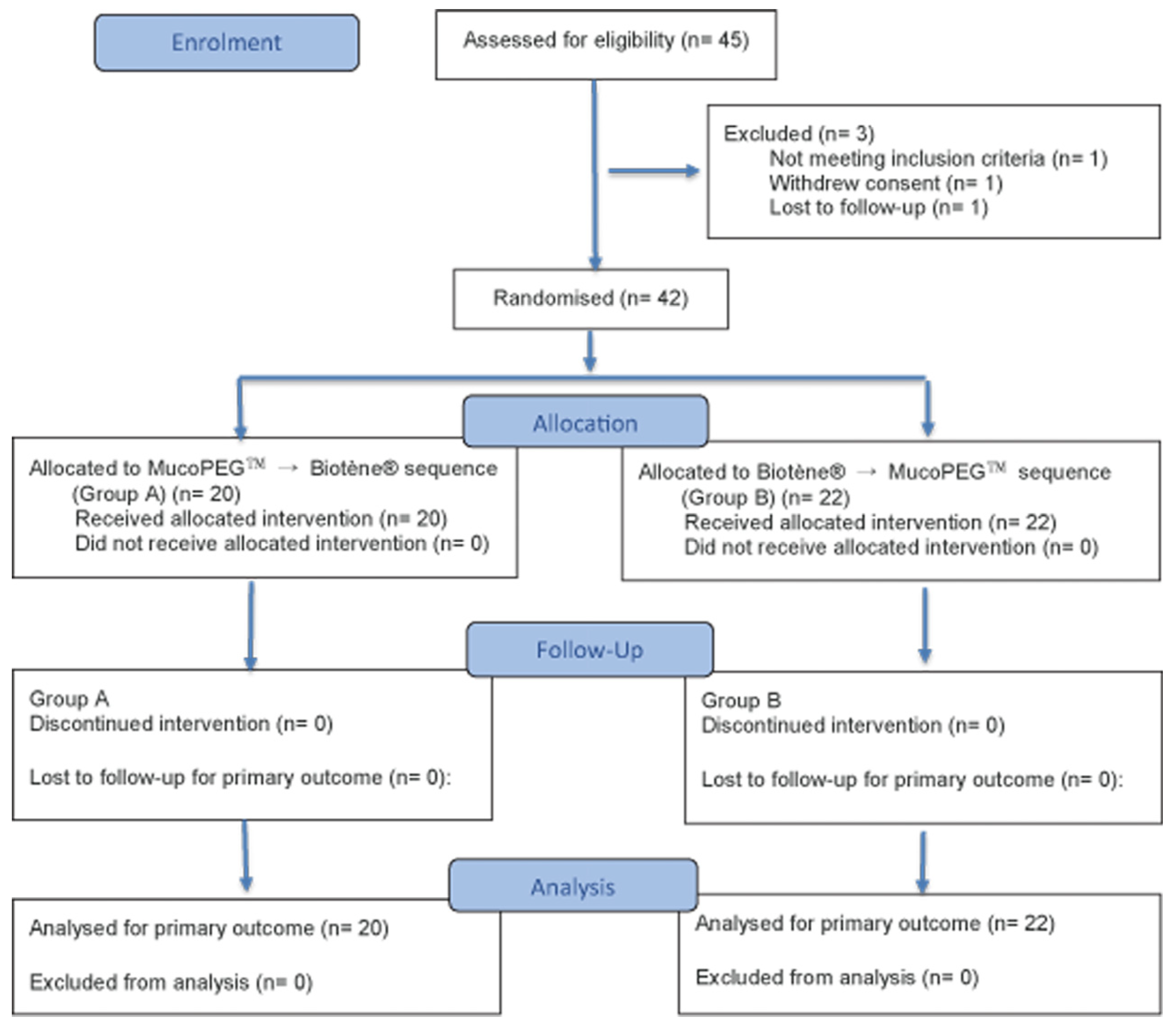
3.1. Disposition of Subjects
3.2. Demographics (Intention-to-Treat)
3.3. VAS for Oral Dryness
3.4. VAS for Tongue Dryness
3.5. DMRQ Responses
3.6. Challacombe Scale of Clinical Oral Dryness
3.7. Dry Mouth Inventory
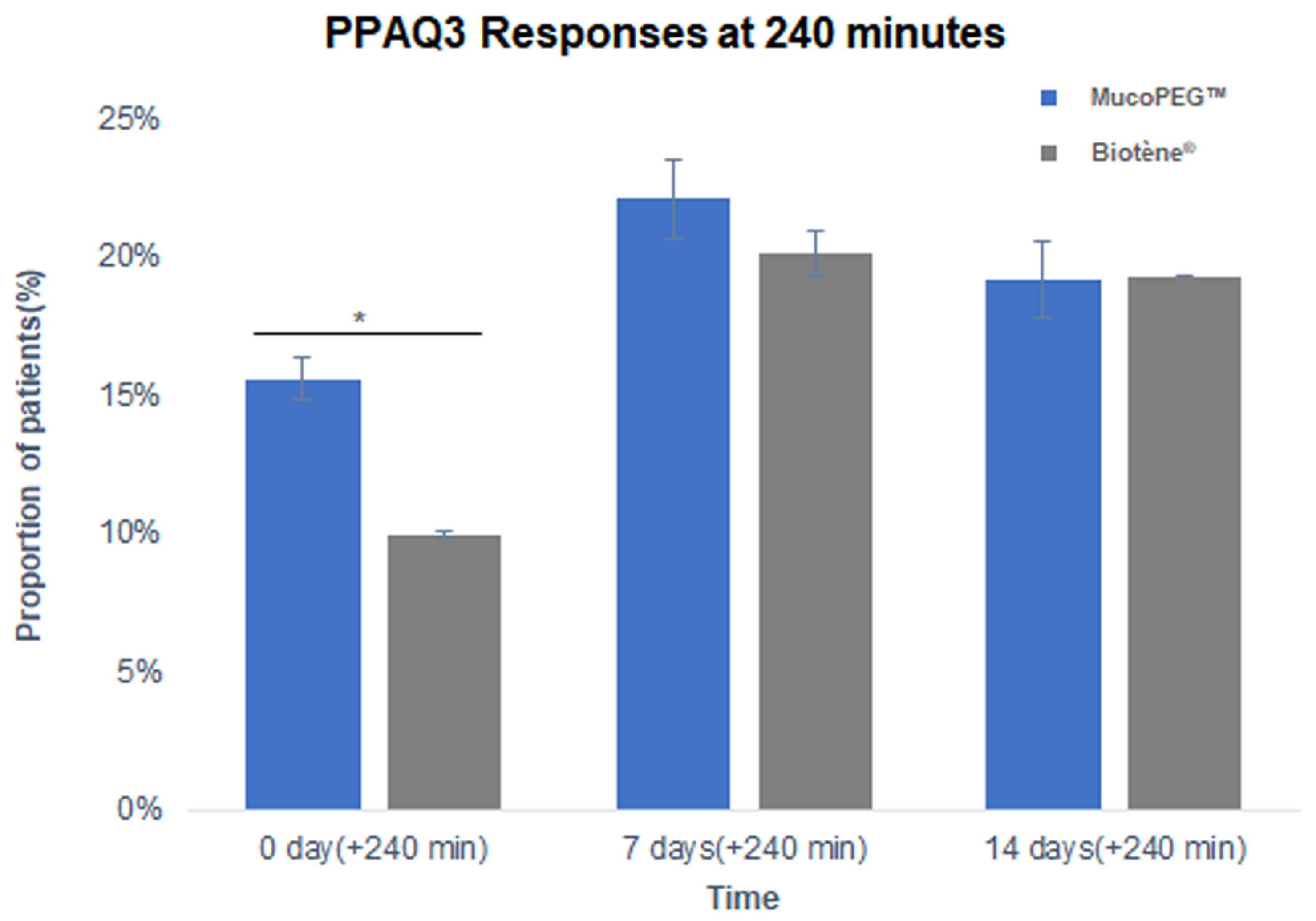
3.8. Product Performance and Attributes Questionnaire (PPAQ)
4. Discussion
5. Conclusions
Supplementary Materials
Author Contributions
Funding
Institutional Review Board Statement
Informed Consent Statement
Data Availability Statement
Conflicts of Interest
References
- Fox, P.; van der Ven, P.; Sonies, B.; Weiffenbach, J.; Baum, B. Xerostomia. Part I: Relationship to other oral symptoms and salivary gland hypofunction. Oral Surg. Oral Med. Oral Pathol. 1988, 66, 451–458. [Google Scholar]
- Jose, A.; Siddiqi, M.; Cronin, M.; DiLauro, T.S.; Bosma, M.L. A randomized clinical trial in subjects with dry mouth evaluating subjective perceptions of an experimental oral gel, an oral rinse and a mouth spray compared to water. Am. J. Dent. 2016, 29, 58–64. [Google Scholar] [PubMed]
- Villa, A.; Connell, C.L.; Abati, S. Diagnosis and management of xerostomia and hyposalivation. Ther. Clin. Risk Manag. 2015, 11, 45–51. [Google Scholar] [CrossRef] [PubMed]
- Furness, S.; Worthington, H.V.; Bryan, G.; Birchenough, S.; McMillan, R. Interventions for the management of dry mouth: Topical therapies. Cochrane Database Syst. Rev. 2011, 12, CD008934. [Google Scholar]
- Sreebny, L.; Valdini, A. Xerostomia: Part I: Relationship to other oral symptoms and salivary gland hypofunction. Oral Surg. Oral Med. Oral Pathol. 1988, 66, 451–458. [Google Scholar]
- Jose, A.; Singh, M.L.; Magnuson, B.; Farag, A.; Varghese, R.; Papas, A. A randomized controlled study to evaluate an experimental moisturizing mouthwash formulation in participants experiencing dry mouth symptoms. Oral Surg. Oral Med. Oral Pathol. Oral Radiol. 2018, 126, 231–239. [Google Scholar]
- Osailan, S.M.; Pramanik, R.; Shirlaw, P.; Proctor, G.B.; Challacombe, S.J. Clinical assessment of oral dryness: Development of a scoring system related to salivary flow and mucosal wetness. Oral Surg. Oral Med. Oral Pathol. Oral Radiol. 2012, 114, 597–603. [Google Scholar]
- Tan, E.C.K.; Lexomboon, D.; Sandborgh-Englund, G.; Haasum, Y.; Johnell, K. Medications That Cause Dry Mouth As an Adverse Effect in Older People: A Systematic Review and Metaanalysis. J. Am. Geriatr. Soc. 2018, 66, 76–84. [Google Scholar] [CrossRef]
- Singh, M.L.; Papas, A. Oral implications of polypharmacy in the elderly. Dent. Clin. North. Am. 2014, 58, 783–796. [Google Scholar]
- Sreebny, L.M.; Schwartz, S.S. A reference guide to drugs and dry mouth—2nd edition. Gerodontology 1997, 14, 33–47. [Google Scholar] [CrossRef]
- Rojas-Ramirez, M.V.; Eldomiaty, W.; Sangalli, L.; Al-Sabbagh, M.; Dawson, D.R.; Miller, C.S. Xerostomia, reduced salivary flow, and oral burning: Associations from a cross-sectional study. Oral Surg. Oral Med. Oral Pathol. Oral Radiol. 2023, 136, 154–161. [Google Scholar] [CrossRef] [PubMed]
- Furuta, M.; Yamashita, Y. Oral Health and Swallowing Problems. Curr. Phys. Med. Rehabil. Rep. 2013, 1, 216–222. [Google Scholar] [CrossRef] [PubMed]
- Dawes, C.; Watanabe, S. The effect of taste adaptation on salivary flow rate and salivary sugar clearance. J. Dent. Res. 1987, 66, 740–744. [Google Scholar] [CrossRef] [PubMed]
- Martins, M.L.; Leite, K.L.d.F.; Magno, M.B.; Masterson, D.; Vicente-Gomila, J.M.; Cavalcanti, Y.W.; Maia, L.C.; Fonseca-Gonçalves, A. The Xylitol Applicability and its Effects in Health Area Worldwide: A Bibliometric Analysis Based on Randomized Controlled Trials. Pesqui. Bras. Odontopediatria Clín. Integr. 2022, 22, e210046. [Google Scholar] [CrossRef]
- Ship, J.A.; McCutcheon, J.A.; Spivakovsky, S.; Kerr, A.R. Safety and effectiveness of topical dry mouth products containing olive oil, betaine, and xylitol in reducing xerostomia for polypharmacy-induced dry mouth. J. Oral Rehabil. 2007, 34, 724–732. [Google Scholar] [CrossRef]
- Jang, H.; Shin, C.; Kim, K. Safety Evaluation of Polyethylene Glycol (PEG) Compounds for Cosmetic Use. Toxicol. Res. 2015, 31, 105–136. [Google Scholar] [CrossRef]
- Fruijtier-Pölloth, C. Safety assessment on polyethylene glycols (PEGs) and their derivatives as used in cosmetic products. Toxicology 2005, 214, 1–38. [Google Scholar] [CrossRef]
- Pashankar, D.; Loening-Baucke, V.; Bishop, W. Safety of Polyethylene Glycol 3350 for the Treatment of Chronic Constipation in Children. Arch. Pediatr. Adolesc. Med. 2003, 157, 661–664. [Google Scholar] [CrossRef]
- Sanchez Armengol, E.; Unterweger, A.; Laffleur, F. PEGylated drug delivery systems in the pharmaceutical field: Past, present and future perspective. Drug Dev. Ind. Pharm. 2022, 48, 129–139. [Google Scholar] [CrossRef]
- Antonsen, K.P.; Hoffman, A.S. Water Structure of PEG Solutions by Differential Scanning Calorimetry Measurements. In Poly(Ethylene Glycol) Chemistry: Biotechnical and Biomedical Applications; Harris, J.M., Ed.; Springer: Boston, MA, USA, 1992; pp. 15–28. [Google Scholar]
- SunBio. The PEGylation Expert. Available online: http://www.sunbio.com/ (accessed on 25 March 2024).
- ISO 10993-1; Biological Evaluation of Medical Devices—Part 1: Evaluation and Testing within a Risk Management Process. International Organization for Standardization: Geneva, Switzerland, 2016.
- Biotene. Biotene Dry Mouth Gentle Oral Rinse. Available online: https://www.biotene.com/dry-mouth-products/mouthwash/ (accessed on 25 March 2024).
- Tiisanoja, A.; Syrjälä, A.-M.H.; Kullaa, A.; Ylöstalo, P. Anticholinergic Burden and Dry Mouth in Middle-Aged People. JDR Clin. Trans. Res. 2020, 5, 62–70. [Google Scholar] [CrossRef]
- Singh, M.; Kilar, A.; Papas, A. Oral manifestations and management in Sjögren’s syndrome. In Sjogren’s Syndrome: A Clinical Handbook; Chapter 3; Vivino, F.B., Ed.; Elsevier: Amsterdam, The Netherlands, 2020; pp. 37–55. [Google Scholar]
- Ma, S.J.; Rivers, C.I.; Serra, L.M.; Singh, A.K. Long-term outcomes of interventions for radiation-induced xerostomia: A review. World J. Clin. Oncol. 2019, 10, 1–13. [Google Scholar] [CrossRef] [PubMed]
- Fukushima, Y.; Sano, Y.; Isozaki, Y.; Endo, M.; Tomoda, T.; Kitamura, T.; Sato, T.; Kamijo, Y.; Haga, Y.; Yoda, T. A pilot clinical evaluation of oral mucosal dryness in dehydrated patients using a moisture-checking device. Clin. Exp. Dent. Res. 2019, 5, 116–120. [Google Scholar] [CrossRef] [PubMed]
- Bulthuis, M.S.; Jan Jager, D.H.; Brand, H.S. Relationship among perceived stress, xerostomia, and salivary flow rate in patients visiting a saliva clinic. Clin. Oral Investig. 2018, 22, 3121–3127. [Google Scholar] [CrossRef] [PubMed]
- Gholami, N.; Hosseini Sabzvari, B.; Razzaghi, A.; Salah, S. Effect of stress, anxiety and depression on unstimulated salivary flow rate and xerostomia. J. Dent. Res. Dent. Clin. Dent. Prospect. 2017, 11, 247–252. [Google Scholar]
- Pinna, R.; Campus, G.; Cumbo, E.; Mura, I.; Milia, E. Xerostomia induced by radiotherapy: An overview of the physiopathology, clinical evidence, and management of the oral damage. Ther. Clin. Risk Manag. 2015, 11, 171–188. [Google Scholar] [CrossRef]
- Morales-Bozo, I.; Rojas, G.; Ortega-Pinto, A.; Espinoza, I.; Soto, L.; Plaza, A.; Lozano, C.; Urzua, B. Evaluation of the efficacy of two mouthrinses formulated for the relief of xerostomia of diverse origin in adult subjects. Gerodontology 2012, 29, e1103–e1112. [Google Scholar] [CrossRef]
- Kapourani, A.; Kontogiannopoulos, K.N.; Manioudaki, A.E.; Poulopoulos, A.K.; Tsalikis, L.; Assimopoulou, A.N.; Barmpalexis, P. A Review on Xerostomia and Its Various Management Strategies: The Role of Advanced Polymeric Materials in the Treatment Approaches. Polymers 2022, 14, 850. [Google Scholar] [CrossRef]
- Blakeley, M.; Sharma, P.K.; Kaper, H.J.; Bostanci, N.; Crouzier, T. Lectin-Functionalized Polyethylene Glycol for Relief of Mucosal Dryness. Adv. Healthc. Mater. 2022, 11, e2101719. [Google Scholar] [CrossRef]
- Niklander, S.E.; Martínez, M.; Miranda, A.; Rodriguez, M. Treatment alternatives for dry mouth: A scoping review. J. Clin. Exp. Dent. 2022, 14, e846–e853. [Google Scholar] [CrossRef]
- Thakkar, J.P.; Lane, C.J. Hyposalivation and Xerostomia and Burning Mouth Syndrome: Medical Management. Oral Maxillofac. Surg. Clin. North. Am. 2022, 34, 135–146. [Google Scholar] [CrossRef]
- Ludwar, L.; Mannel, H.; Hamacher, S.; Noack, M.J.; Barbe, A.G. Oil pulling to relieve medication-induced xerostomia: A randomized, single-blind, crossover trial. Oral Dis. 2022, 28, 373–383. [Google Scholar] [CrossRef]
- Alhejoury, H.A.; Mogharbel, L.F.; Al-Qadhi, M.A.; Shamlan, S.S.; Alturki, A.F.; Babatin, W.M.; Mohammed Alaishan, R.A.; Pullishery, F. Artificial Saliva for Therapeutic Management of Xerostomia: A Narrative Review. J. Pharm. Bioallied Sci. 2021, 13, S903–S907. [Google Scholar] [CrossRef] [PubMed]
- Baum, B.J.; Alevizos, I.; Chiorini, J.A.; Cotrim, A.P.; Zheng, C. Advances in salivary gland gene therapy—Oral and systemic implications. Expert Opin. Biol. Ther. 2015, 15, 1443–1454. [Google Scholar] [CrossRef] [PubMed]
- Plemons, J.M.; Al-Hashimi, I.; Marek, C.L.; American Dental Association Council on Scientific A. Managing xerostomia and salivary gland hypofunction: Executive summary of a report from the American Dental Association Council on Scientific Affairs. J. Am. Dent. Assoc. 2014, 145, 857–873. [Google Scholar] [CrossRef] [PubMed]
- Wolff, A.; Fox, P.C.; Porter, S.; Konttinen, Y.T. Established and novel approaches for the management of hyposalivation and xerostomia. Curr. Pharm. Des. 2012, 18, 5515–5521. [Google Scholar] [CrossRef]
- Shirodaria, S.; Kilbourn, T.; Richardson, M. Subjective assessment of a new moisturizing mouth spray for the symptomatic relief of dry mouth. J. Clin. Dent. 2006, 17, 45–51. [Google Scholar]
- Papas, A.S.; Fernandez, M.M.; Castano, R.A.; Gallagher, S.C.; Trivedi, M.; Shrotriya, R.C. Oral pilocarpine for symptomatic relief of dry mouth and dry eyes in patients with Sjögrens syndrome. Adv. Exp. Med. Biol. 1998, 438, 973–978. [Google Scholar]
- Talal, N.; Quinn, J.H.; Daniels, T.E. The clinical effects of electrostimulation on salivary function of Sjögren’s syndrome patients. A placebo controlled study. Rheumatol. Int. 1992, 12, 43–45. [Google Scholar] [CrossRef]
- Varghese, R.; Jose, A.; Singh, M.L.; Magnuson, B.; Farag, A.; Kafasis, N.; Tzavaras, E.; Papas, A. Sensory Perception of an Experimental Mouthwash for Dry Mouth Symptoms: Two Randomized Clinical Studies. J. Oral Med. 2018, 2, 5. [Google Scholar]
- D’Souza, A.; Shegokar, R. Polyethylene glycol (PEG): A versatile polymer for pharmaceutical applications. Expert Opin. Drug Deliv. 2016, 13, 1257–1275. [Google Scholar] [CrossRef]



| Data | Site 1 | Site 2 | Both Sites Combined |
|---|---|---|---|
| Age at consent (years) | 51.3 ± 16.4 (21) | 68.6 ± 10.6 (21) | 60.0 ± 16.2 (42) |
| 54.0 [23.0, 75.0] | 67.0 [50.0, 93.0] | 62.5 [23.0, 93.0] | |
| Age group | |||
| Under 62 years | 66.70% | 28.60% | 47.60% |
| Over 62 years | 33.30% | 71.40% | 52.40% |
| Sex | |||
| Female | 57.10% | 38.10% | 47.6% (20/42) |
| Male | 42.90% | 61.90% | 52.4% (22/42) |
| Race | |||
| American Indian or Alaska Native | 0.0% (0/21) | 0.0% (0/21) | 0.0% (0/42) |
| Asian | 4.8% (1/21) | 0.0% (0/21) | 2.4% (1/42) |
| Black or African American | 19.0% (4/21) | 0.0% (0/21) | 9.5% (4/42) |
| Native Hawaiian or Pacific Islander | 0.0% (0/21) | 0.0% (0/21) | 0.0% (0/42) |
| White | 71.4% (15/21) | 100.0% (21/21) | 85.7% (36/42) |
| Not Reported | 4.8% (1/21) | 0.0% (0/21) | 2.4% (1/42) |
| Ethnicity | |||
| Not Hispanic or Latino | 85.7% (18/21) | 100% (21/21) | 92.9% (39/42) |
| Hispanic or Latino | 14.3% (3/21) | 0.0% (0/21) | 7.1% (3/42) |
| Pregnancy Status | |||
| Patient is of non-childbearing status | 50.0% (6/12) | 87.5% (7/8) | 65.0% (13/20) |
| Patient verbally confirmed they are not pregnant | 50.0% (6/12) | 12.5% (1/8) | 35.0% (7/20) |
| Change in VAS | MucoPEG™ | Biotène® | Mean Difference: MucoPEG™–Biotène® (Upper Limit of 90% Confidence Interval) | p-Value | ||||
|---|---|---|---|---|---|---|---|---|
| VAS Before Any Dose on First Day | VAS After Last Dose on Final Day | Change in VAS | VAS Before Any Dose on First Day | VAS After Last Dose on Final Day | Change in VAS | |||
| Both periods combined | 6.1 ± 2.7 (42) 6.8 [0.2, 10.0] | 5.0 ± 2.7 (42) 5.6 [0.1, 9.6] | −1.1 ± 2.3 (42) −1.0 [−6.8, 5.9] | 5.6 ± 2.5 (42) 5.8 [0.3, 9.2] | 5.0 ± 2.7 (42) 4.8 [0.1, 9.9] | −0.5 ± 2.4 (42) −0.2 [−5.7, 6.1] | −0.59 (0.26) | 0.13 |
| Period 1 | 4.9 ± 3.2 (20) 5.0 [0.2, 10.0] | 4.1 ± 2.8 (20) 4.0 [0.2, 9.6] | −0.8 ± 2.0 (20) −0.6 [−3.5, 5.9] | 6.5 ± 2.0 (22) 7.3 [1.6, 8.8] | 5.9 ± 2.3 (22) 5.9 [2.1, 9.9] | −0.7 ± 3.0 (22) −0.6 [−5.7, 6.1] | −0.10 (1.24) | 0.45 |
| Period 2 | 7.2 ± 1.5 (22) 7.4 [3.1, 10.0] | 5.7 ± 2.4 (22) 6.8 [0.1, 8.8] | −1.5 ± 2.4 (22) −1.1 [−6.8, 2.9] | 4.5 ± 2.7 (20) 4.7 [0.3, 9.2] | 4.1 ± 2.8 (20) 4.2 [0.1, 9.3] | −0.4 ± 1.6 (20) −0.2 [−3.4, 2.8] | −1.06 (−0.00) | 0.05 |
| Change in VAS | MucoPEG™ | Biotène® | Mean Difference: MucoPEG™–Biotène® (Upper Limit of 90% Confidence Interval) | p-Value | ||||
|---|---|---|---|---|---|---|---|---|
| VAS Before Any Dose on First Day | VAS After Last Dose on Final Day | Change in VAS | VAS Before Any Dose on First Day | VAS After Last Dose on Final Day | Change in VAS | |||
| Both periods combined | 5.8 ± 2.9 (42) 6.6 [0.2, 10.0] | 4.8 ± 2.8 (42) 5.0 [0.2, 9.3] | −1.0 ± 2.4 (42) −0.7 [−5.7, 5.8] | 5.2 ± 2.6 (42) 4.9 [0.3, 9.4] | 4.8 ± 2.7 (42) 4.6 [0.2, 10.0] | −0.3 ± 2.6 (42) −0.2 [−5.9, 7.4] | −0.67 (0.23) | 0.11 |
| Period 1 | 4.6 ± 3.4 (20) 4.0 [0.2, 10.0] | 4.0 ± 2.9 (20) 3.8 [0.3, 9.3] | −0.6 ± 2.4 (20) −0.4 [−4.7, 5.8] | 6.2 ± 2.2 (22) 6.4 [1.3, 8.8] | 5.7 ± 2.4 (22) 5.7 [2.0, 10.0] | −0.4 ± 3.3 (22) −1.0 [−5.9, 7.4] | −0.16 (1.36) | 0.43 |
| Period 2 | 6.9 ± 1.8 (22) 7.0 [3.2, 10.0] | 5.6 ± 2.5 (22) 6.3 [0.2, 8.9] | −1.4 ± 2.4 (22) −1.0 [−5.7, 3.0] | 4.1 ± 2.7 (20) 4.0 [0.3, 9.4] | 3.9 ± 2.7 (20) 3.9 [0.2, 9.4] | −0.2 ± 1.3 (20) −0.0 [−3.2, 1.9] | −1.16 (−0.18) | 0.03 |
| Proportion of Patients with a Favorable Response at Last Visit | MucoPEG™ | Biotène® | Proportion Difference: MucoPEG™–Biotène® (Lower Limit of 90% Confidence Interval) | p-Value * |
|---|---|---|---|---|
| Overall | 23.8% (10/42) | 26.2% (11/42) | −2.4 (−17.9) | 0.6 |
| Period 1 | 25.0% (5/20) | 13.6% (3/22) | 11.4 (−8.6) | 0.17 |
| Period 2 | 22.7% (5/22) | 40.0% (8/20) | −17.3 (−40.5) | 0.89 |
| Site 1 | 23.8% (5/21) | 38.1% (8/21) | −14.3 (−37.5) | 0.84 |
| Site 2 | 23.8% (5/21) | 14.3% (3/21) | 9.5 (−10.3) | 0.21 |
| Data Item | Visit | Site 1 | Site 2 | All Study Sites Combined | ||||||
|---|---|---|---|---|---|---|---|---|---|---|
| Screening | MucoPEG™ | Biotene® | Screening | MucoPEG™ | Biotene® | Screening | MucoPEG™ | Biotene® | ||
| Total score | 1 | 3.5 ± 1.4 (21) 4.0 [1.0, 6.0] | 4.9 ± 1.7 (21) 5.0 [2.0, 9.0] | 4.2 ± 1.7 (42) 4.0 [1.0, 9.0] | ||||||
| 2 (Pre) | 2.8 ± 2.0 (11) 2.0 [1.0, 8.0] | 3.4 ± 1.5 (10) 3.0 [2.0, 6.0] | 4.7 ± 2.2 (9) 4.0 [2.0, 8.0] | 4.5 ± 1.4 (12) 4.5 [2.0, 7.0] | 3.7 ± 2.3 (20) 3.5 [1.0, 8.0] | 4.0 ± 1.5 (22) 4.0 [2.0, 7.0] | ||||
| 3 (1 wk) | 2.3 ± 1.3 (11) 2.0 [1.0, 5.0] | 3.4 ± 1.3 (10) 3.0 [2.0, 6.0] | 4.4 ± 1.7 (9) 4.0 [2.0, 8.0] | 3.7 ± 1.8 (12) 4.0 [1.0, 7.0] | 3.3 ± 1.8 (20) 3.0 [1.0, 8.0] | 3.5 ± 1.6 (22) 3.5 [1.0, 7.0] | ||||
| 4 (2 wk) | 1.9 ± 1.7 (11) 2.0 [0.0, 5.0] | 3.0 ± 1.2 (10) 3.0 [1.0, 5.0] | 3.7 ± 2.1 (9) 3.0 [1.0, 7.0] | 3.8 ± 0.9 (12) 4.0 [2.0, 5.0] | 2.7 ± 2.1 (20) 2.0 [0.0, 7.0] | 3.5 ± 1.1 (22) 4.0 [1.0, 5.0] | ||||
| Washout Period/1 wk | ||||||||||
| 5 (Pre) | 3.4 ± 1.8 (10) 3.0 [1.0, 7.0] | 2.3 ± 1.2 (11) 2.0 [1.0, 4.0] | 4.3 ± 1.7 (12) 4.0 [1.0, 8.0] | 3.9 ± 2.2 (9) 4.0 [1.0, 7.0] | 3.9 ± 1.8 (22) 4.0 [1.0, 8.0] | 3.0 ± 1.9 (20) 3.0 [1.0, 7.0] | ||||
| 6 (1 wk) | 2.7 ± 1.3 (10) 3.0 [1.0, 4.0] | 2.8 ± 1.3 (11) 2.0 [2.0, 6.0] | 3.5 ± 1.7 (12) 4.0 [1.0, 6.0] | 4.3 ± 1.5 (9) 4.0 [3.0, 8.0] | 3.1 ± 1.6 (22) 3.5 [1.0, 6.0] | 3.5 ± 1.5 (20) 3.0 [2.0, 8.0] | ||||
| 7 (2 wk) | 2.7 ± 0.8 (10) 2.5 [2.0, 4.0] | 2.1 ± 1.3 (11) 2.0 [0.0, 5.0] | 3.9 ± 1.2 (12) 4.0 [2.0, 6.0] | 3.6 ± 1.2 (9) 4.0 [2.0, 6.0] | 3.4 ± 1.2 (22) 3.0 [2.0, 6.0] | 2.8 ± 1.4 (20) 2.5 [0.0, 6.0] | ||||
| Data Item | Site 1 | Site 2 | All Study Sites Combined | |||
|---|---|---|---|---|---|---|
| MucoPEG™ | Biotène® | MucoPEG™ | Biotène® * | MucoPEG™ | Biotène® | |
| My mouth feels dry | 1.4 ± 0.9 (63) 1.0 [0.0,3.0] | 1.3 ± 1.0 (63) 1.0 [0.0,3.0] | 1.9 ± 1.0 (63) 2.0 [0.0,3.0] | 1.8 ± 0.9 (62) 2.0 [0.0,3.0] | 1.6 ± 1.0 (126) 2.0 [0.0,3.0] | 1.5 ± 0.9 (125) 2.0 [0.0,3.0] |
| I have difficulty in eating dry foods | 0.9 ± 1.0 (63) 1.0 [0.0,3.0] | 0.9 ± 0.9 (63) 1.0 [0.0,3.0] | 1.6 ± 1.1 (63) 2.0 [0.0,3.0] | 1.6 ± 1.1 (62) 2.0 [0.0,3.0] | 1.3 ± 1.1 (126) 1.0 [0.0,3.0] | 1.3 ± 1.0 (125) 1.0 [0.0,3.0] |
| I get up at night to drink | 0.9 ± 0.8 (63) 1.0 [0.0,3.0] | 0.8 ± 0.8 (63) 1.0 [0.0,3.0] | 1.7 ± 1.0 (63) 2.0 [0.0,3.0] | 1.6 ± 1.0 (62) 2.0 [0.0,3.0] | 1.3 ± 1.0 (126) 1.0 [0.0,3.0] | 1.2 ± 1.0 (125) 1.0 [0.0,3.0] |
| My mouth feels dry when eating a meal | 0.8 ± 0.8 (63) 1.0 [0.0,3.0] | 1.0 ± 0.9 (63) 1.0 [0.0,3.0] | 1.5 ± 0.9 (63) 2.0 [0.0,3.0] | 1.5 ± 1.0 (62) 2.0 [0.0,3.0] | 1.2 ± 0.9 (126) 1.0 [0.0,3.0] | 1.2 ± 1.0 (125) 1.0 [0.0,3.0] |
| I sip liquids to aid in swallowing food | 1.0 ± 0.9 (63) 1.0 [0.0,3.0] | 1.1 ± 0.9 (63) 1.0 [0.0,3.0] | 1.8 ± 1.1 (63) 2.0 [0.0,3.0] | 1.7 ± 1.1 (62) 2.0 [0.0,3.0] | 1.4 ± 1.1 (126) 1.0 [0.0,3.0] | 1.4 ± 1.1 (125) 1.0 [0.0,3.0] |
| I suck sweets or cough lollies to relieve dry mouth | 0.6 ± 0.8 (63) 0.0 [0.0,3.0] | 0.6 ± 0.9 (63) 0.0 [0.0,3.0] | 1.4 ± 1.1 (63) 2.0 [0.0,3.0] | 1.5 ± 1.2 (62) 1.0 [0.0,3.0] | 1.0 ± 1.1 (126) 1.0 [0.0,3.0] | 1.0 ± 1.2 (125) 1.0 [0.0,3.0] |
| My lips stick to the teeth | 0.8 ± 0.8 (63) 1.0 [0.0,3.0] | 0.7 ± 0.8 (63) 0.0 [0.0,2.0] | 0.8 ± 0.7 (63) 1.0 [0.0,2.0] | 1.0 ± 0.9 (62) 1.0 [0.0,3.0] | 0.8 ± 0.8 (126) 1.0 [0.0,3.0] | 0.9 ± 0.9 (125) 1.0 [0.0,3.0] |
| My tongue stick to the roof of the mouth | 0.8 ± 0.8 (63) 1.0 [0.0,3.0] | 0.8 ± 0.9 (63) 1.0 [0.0,3.0] | 0.9 ± 0.9 (63) 1.0 [0.0,3.0] | 0.8 ± 0.9 (62) 1.0 [0.0,3.0] | 0.8 ± 0.9 (126) 1.0 [0.0,3.0] | 0.8 ± 0.9 (125) 1.0 [0.0,3.0] |
| Total score | 7.2 ± 4.9 (63) 7.0 [0.0,19.0] | 7.3 ± 5.3 (63) 7.0 [0.0,21.0] | 11.6 ± 4.7 (63) 11.0 [1.0,21.0] | 11.5 ± 5.2 (62) 12.0 [2.0,21.0] | 9.4 ± 5.3 (126) 10.0 [0.0,21.0] | 9.4 ± 5.6 (125) 10.0 [0.0,21.0] |
Disclaimer/Publisher’s Note: The statements, opinions and data contained in all publications are solely those of the individual author(s) and contributor(s) and not of MDPI and/or the editor(s). MDPI and/or the editor(s) disclaim responsibility for any injury to people or property resulting from any ideas, methods, instructions or products referred to in the content. |
© 2026 by the authors. Licensee MDPI, Basel, Switzerland. This article is an open access article distributed under the terms and conditions of the Creative Commons Attribution (CC BY) license.
Share and Cite
Singh, M.L.; Davis, B.; Bairos, T.; Cimmino, J.; Singh, I.; Ahn, M.; Nho, K. Clinical Evaluation of a Polyethylene Glycol Derivative Rinse for Xerostomia. Dent. J. 2026, 14, 181. https://doi.org/10.3390/dj14030181
Singh ML, Davis B, Bairos T, Cimmino J, Singh I, Ahn M, Nho K. Clinical Evaluation of a Polyethylene Glycol Derivative Rinse for Xerostomia. Dentistry Journal. 2026; 14(3):181. https://doi.org/10.3390/dj14030181
Chicago/Turabian StyleSingh, Mabi L., Bryan Davis, Tiffany Bairos, Joseph Cimmino, Isha Singh, Minjung Ahn, and Kwang Nho. 2026. "Clinical Evaluation of a Polyethylene Glycol Derivative Rinse for Xerostomia" Dentistry Journal 14, no. 3: 181. https://doi.org/10.3390/dj14030181
APA StyleSingh, M. L., Davis, B., Bairos, T., Cimmino, J., Singh, I., Ahn, M., & Nho, K. (2026). Clinical Evaluation of a Polyethylene Glycol Derivative Rinse for Xerostomia. Dentistry Journal, 14(3), 181. https://doi.org/10.3390/dj14030181