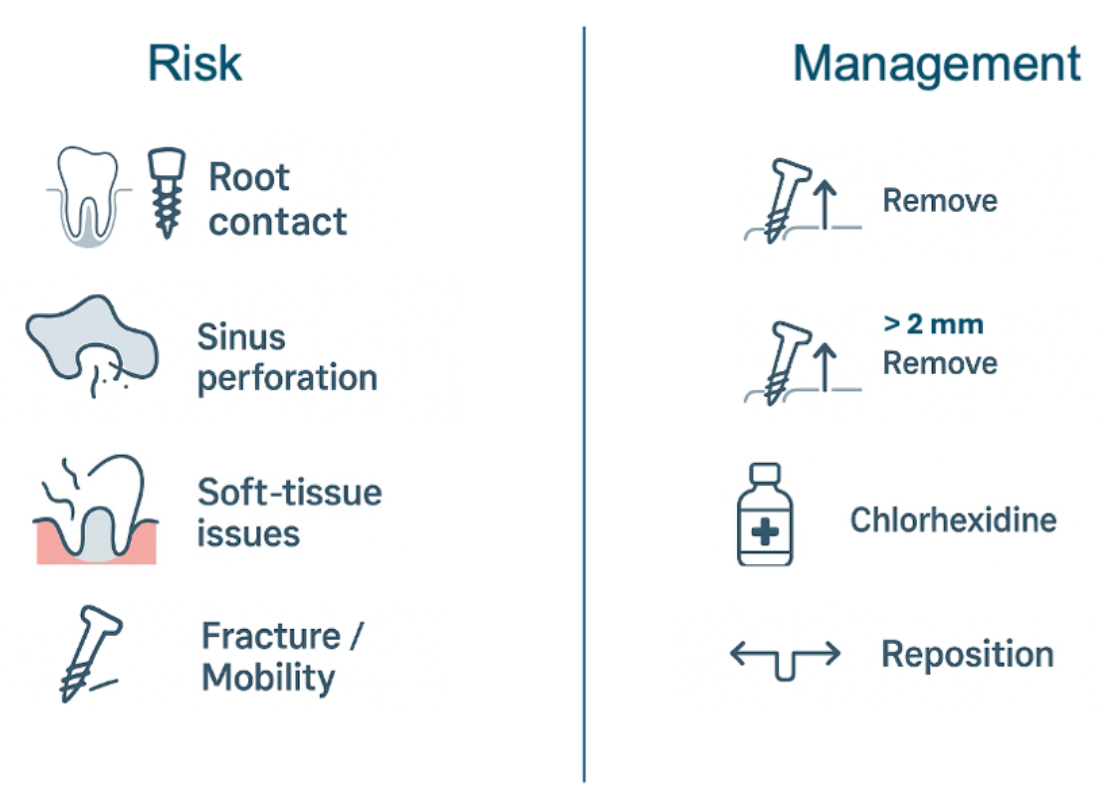


Clinical Management of Orthodontic Miniscrew Complications: A Scoping Review

 , and
, and 
Abstract
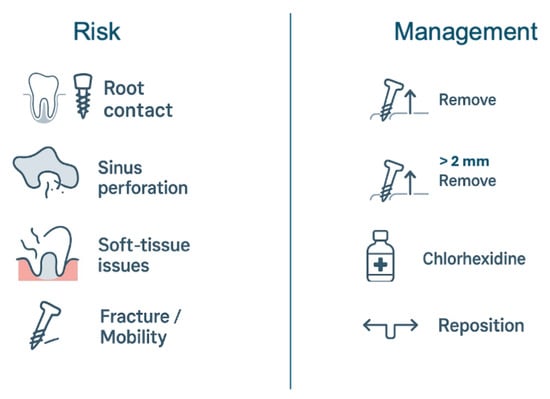
1. Introduction
2. Materials and Methods
2.1. Focused Questions
2.2. Eligibility Criteria
2.3. Search Strategy
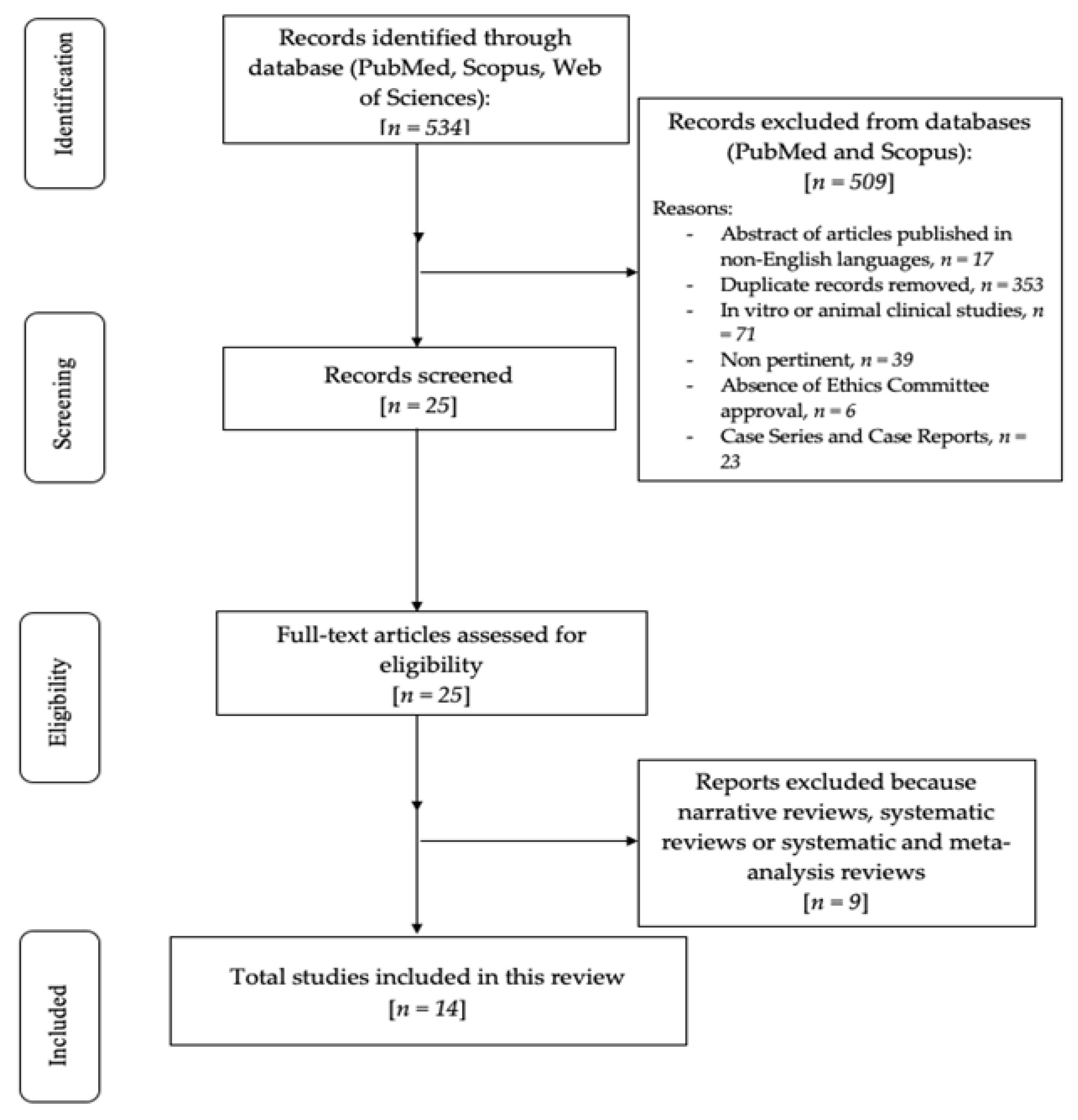
2.4. Research
2.5. Quality Assessment of Included Studies
3. Results
Risk of Bias
4. Discussion
4.1. Surgical Complications
Periodontal Ligament Injury, Root Contact with or Without Pulpal Involvement
4.2. Miniscrew Slipping
4.3. Nervous Damage
4.4. Subcutaneous Emphysema
4.5. Sinus Perforation
4.6. Bone Overheating
4.7. Orthodontic Complications: Failure of the Static Anchoring, Miniscrew Relocation
4.8. Mechanical Complications
4.9. Soft Tissue Complications
Scarring
4.10. Aphthous Ulcerations
4.11. Soft Tissue Overgrowth
4.12. Peri-Implant Disease
4.13. Removal Complication
Bone Damage
5. Conclusions
- -
- Miniscrews offer flexible and cost-effective orthodontic anchorage, yet their use requires careful planning and execution to avoid complications.
- -
- Surgical precision, guided by radiological assessment, is crucial to prevent periodontal ligament injury and root contact.
- -
- While orthodontic and mechanical issues can arise, diligent monitoring and post-placement care can mitigate these risks.
- -
- Soft tissue complications, such as scarring and ulcerations, underscore the importance of meticulous patient management. Similarly, the risk of peri-implant disease and bone damage during removal highlights the need for thorough assessment and intervention.
- -
- Despite challenges, advancements continue to improve miniscrew anchorage efficacy. With proper planning and ongoing monitoring, miniscrews can significantly enhance orthodontic outcomes, ensuring patient satisfaction and treatment success.
Supplementary Materials
Author Contributions
Funding
Institutional Review Board Statement
Informed Consent Statement
Data Availability Statement
Conflicts of Interest
References
- Cope, J.B. Temporary anchorage devices in orthodontics: A paradigm shift. Semin. Orthod. 2005, 11, 3–9. [Google Scholar] [CrossRef]
- Chang, H.-P.; Tseng, Y.-C. Miniscrew implant applications in contemporary orthodontics. Kaohsiung J. Med. Sci. 2014, 30, 111–115. [Google Scholar] [CrossRef]
- Golshah, A.; Gorji, K.; Nikkerdar, N. Effect on miniscrew insertion angle in the maxillary buccal plate on its clinical survival: A randomized clinical trial. Progress. Orthod. 2021, 22, 2–9. [Google Scholar] [CrossRef]
- Aboshady, H.; Abouelezz, A.M.A.; Fotouh, M.H.A.; Elkordy, S.A.M. Failure Rate of Orthodontic Mini-screw After Insertion Using 3D Printed Guide Versus Conventional Free Hand Placement Technique: Split Mouth Randomized Clinical Trial. Open Access Maced. J. Med. Sci. 2022, 10, 6–13. [Google Scholar] [CrossRef]
- Truong, V.M.; Kim, S.; Kim, J.; Lee, J.W.; Park, Y.-S.; Faot, F. Revisiting the Complications of Orthodontic Miniscrew. BioMed Res. Int. 2022, 2022, 8720421. [Google Scholar] [CrossRef] [PubMed]
- Motoyoshi, M.; Matsuoka, M.; Shimizu, N. Application of orthodontic mini-implants in adolescents. Int. J. Oral Maxillofac. Surg. 2007, 36, 695–699. [Google Scholar] [CrossRef] [PubMed]
- Melsen, B. Mini-implants: Where are we? J. Clin. Orthod. 2005, 9, 539–547. [Google Scholar]
- Carano, A.; Velo, S.; Leone, P.; Siciliani, G. Clinical Applications of the Miniscrew Anchorage System. J. Clin. Orthod. 2005, 39, 9–24. [Google Scholar]
- Tseng, Y.C.; Hsieh, C.H.; Chen, C.H.; Shen, Y.S.; Huang, I.Y.; Chen, C.M. The application of mini-implants for orthodontic anchorage. Int. J. Oral Maxillofac. Surg. 2006, 35, 704–707. [Google Scholar] [CrossRef]
- Sfondrini, M.F.; Gandini, P.; Alcozer, R.; Vallittu, P.K.; Scribante, A. Failure load and stress analysis of orthodontic miniscrews with different transmucosal collar diameter. J. Mech. Behav. Biomed. Mater. 2018, 87, 132–137. [Google Scholar] [CrossRef]
- Park, H.S.; Lee, S.K.; Kwon, O.W. Group distal movement of teeth using microscrew implant anchorage. Angle Orthod. 2005, 75, 602–609. [Google Scholar] [CrossRef]
- Motoyoshi, M.; Yoshida, T.; Ono, A.; Shimizu, N. Effect of cortical bone thickness and implant placement torque on stability of orthodontic mini-implants. Int. J. Oral Maxillofac. Implant. 2007, 22, 779–784. [Google Scholar]
- Morea, C.; Dominguez, G.; Wuo, A.; Tortamano, A. Surgical guide for optimal positioning of mini-implants. J. Clin. Orthod. 2005, 39, 317–321. [Google Scholar]
- Florvaag, B.; Kneuertz, P.; Lazar, F.; Koebke, J.; Zöller, J.E.; Braumann, B.; Mischkowski, R.A. Biomechanical Properties of Orthodontic Miniscrews. An In-vitro Study. J. Orofac. Orthop. 2010, 71, 53–67. [Google Scholar] [CrossRef]
- Motoyoshi, M.; Hirabayashi, M.; Uemura, M.; Shimizu, N. Recommended placement torque when tightening an orthodontic mini-implant. Clin. Oral Implant. Res. 2006, 17, 109–114. [Google Scholar] [CrossRef]
- Wiechmann, D.; Meyer, U.; Buchter, A. Success rate of mini- and micro-implants used for orthodontic anchorage: A prospective clinical study. Clin. Oral Implant. Res. 2007, 18, 263–267. [Google Scholar] [CrossRef] [PubMed]
- Fritz, U.; Ehmer, A.; Diedrich, P. Clinical suitability of titanium microscrews for orthodontic anchorage—Preliminary experiences. J. Orofac. Orthop. 2004, 65, 410–418. [Google Scholar] [CrossRef] [PubMed]
- Xun, C.; Zeng, X.; Wang, X. Microscrew anchorage in skeletal anterior open-bite treatment. Angle Orthod. 2007, 77, 47–56. [Google Scholar] [CrossRef] [PubMed]
- Iodice, G.; Nanda, R.; Drago, S.; Repetto, L.; Tonoli, G.; Silvestrini-Biavati, A.; Migliorati, M. Accuracy of direct insertion of TADs in the anterior palate with respect to a 3D-assisted digital insertion virtual planning. Orthod. Craniofac. Res. 2022, 25, 192–198. [Google Scholar] [CrossRef]
- Bae, M.J.; Kim, J.Y.; Park, J.T.; Cha, J.Y.; Kim, H.J.; Yu, H.S.; Hwang, C.J. Accuracy of miniscrew surgical guides assessed from cone-beam computed tomography and digital models. Am. J. Orthod. Dentofac. Orthop. 2013, 143, 893–901. [Google Scholar] [CrossRef]
- Qiu, L.; Haruyama, N.; Suzuki, S.; Yamada, D.; Obayashi, N.; Kurabayashi, T.; Moriyama, K. Accuracy of orthodontic miniscrew implantation guided by stereolithographic surgical stent based on cone-beam CT–derived 3D images. Angle Orthod. 2012, 82, 284–293. [Google Scholar] [CrossRef]
- Lee, D.W.; Park, J.H.; Bay, R.C.; Choi, S.K.; Chae, J.M. Cortical bone thickness and bone density effects on miniscrew success rates: A systematic review and meta-analysis. Orthod. Craniofac Res. 2021, 24, 92–102. [Google Scholar] [CrossRef]
- Ludwig, B.; Glasl, B.; Bowman, S.J.; Wilmes, B.; Kinzinger, G.S.; Lisson, J.A. Anatomical guidelines for miniscrew insertion: Palatal sites. J. Clin. Orthod. 2011, 45, 433–441. [Google Scholar]
- Pozzan, L.; Migliorati, M.; Dinelli, L.; Riatti, R.; Torelli, L.; Di Lenarda, R.; Contardo, L. Accuracy of the digital workflow for guided insertion of orthodontic palatal TADs: A step-by-step 3D analysis. Prog. Orthod. 2022, 23, 27. [Google Scholar] [CrossRef]
- Nagmode, S.; Kolte, R.P.; Aphale, H.; Shinde, V.; Kalaskar, V.; Ingle, V. CAD—CAM based 3D printed surgical guides for posterior mini-screw placement. Bioinformation 2025, 21, 538–543. [Google Scholar] [CrossRef] [PubMed]
- Yildiz, M.S.; Ulutas, P.A.; Ozenci, I.; Akcalı, A. Clinical and radiographic assessment of the association between orthodontic mini-screws and periodontal health. BMC Oral Health 2024, 24, 1376. [Google Scholar] [CrossRef] [PubMed]
- Aromataris, E.; Munn, Z. JBI Manual for Evidence Synthesis. 2020. Available online: https://synthesismanual.jbi.global (accessed on 30 July 2025).
- Tricco, A.C.; Lillie, E.; Zarin, W.; O’Brien, K.K.; Colquhoun, H.; Levac, D.; Moher, D.; Peters, M.D.; Horsley, T.; Weeks, L.; et al. PRISMA extension for scoping reviews (PRISMA-ScR): Checklist and explanation. Ann. Intern. Med. 2018, 169, 467–473. [Google Scholar] [CrossRef]
- National Heart, Lung, and Blood Institute. Study Quality Assessment Tool. Available online: https://www.nhlbi.nih.gov/health-topics/study-quality-assessment-tools (accessed on 30 July 2025).
- Giudice, A.L.; Rustico, L.; Longo, M.; Oteri, G.; Papadopoulos, M.A.; Nucera, R. Complications reported with the use of orthodontic mini-screws: A systematic review. Korean J. Orthod. 2021, 51, 199–216. [Google Scholar] [CrossRef]
- Papageorgiou, S.N.; Zogakis, I.P.; Papadopoulos, M.A. Failure rates and associated risk factors of orthodontic miniscrew implants: A meta-analysis. Am. J. Orthod. Dentofac. Orthop. 2012, 142, 577–595. [Google Scholar] [CrossRef]
- Mohamed, A.M.; Yang, Y.; Yaosen, C.; Badawy, R.; Alaa, M.; Maher, A. Effect of Operator-Related Factors on Failure Rate of Orthodontic Mini-Implants (OMIS) used as Temporary Anchorage Devices (TAD); Systematic Review. J. Dent. Oral Care Med. 2018, 4, 205. [Google Scholar]
- Inchingolo, A.M.; Malcangi, G.; Costa, S.; Fatone, M.C.; Avantario, P.; Campanelli, M.; Piras, F.; Patano, A.; Ferrara, I.; Di Pede, C.; et al. Tooth Complications After Orthodontic Miniscrews Insertion. Int. J. Environ. Res. Public Health 2023, 20, 1562. [Google Scholar] [CrossRef]
- Ramírez-Ossa, D.M.; Escobar-Correa, N.; Ramírez-Bustamante, M.A.; Agudelo-Suárez, A.A. An Umbrella Review of the Ef-fectiveness of Temporary Anchorage Devices and the Factors That Contribute to Their Success or Failure. J. Evid. Based Dent. Pract. 2020, 20, 101402. [Google Scholar] [CrossRef] [PubMed]
- Kakali, L.; Alharbi, M.; Pandis, N.; Gkantidis, N.; Kloukos, D. Success of palatal implants or mini-screws placed median or paramedian for the reinforcement of anchorage during orthodontic treatment: A systematic review. Eur. J. Orthod. 2019, 41, 9–20. [Google Scholar] [CrossRef]
- Yi, J.; Ge, M.; Li, M.; Li, C.; Li, Y.; Li, X.; Zhao, Z. Comparison of the success rate between self-drilling and self-tapping mini-screws: A systematic review and meta-analysis. Eur. J. Orthod. 2017, 39, 287–293. [Google Scholar]
- Tsui, W.K.; Chua, H.D.; Cheung, L.K. Bone anchor systems for orthodontic application: A systematic review. Int. J. Oral Maxillofac. Surg. 2012, 41, 1427–1438. [Google Scholar] [CrossRef] [PubMed]
- Mousa, M.M.; Hajeer, M.Y.; Sultan, K.; Almahdi, W.H.; Alhaffar, J.B. Evaluation of the Patient-Reported Outcome Measures (PROMs) with Temporary Skeletal Anchorage Devices in Fixed Orthodontic Treatment: A Systematic Review. Cureus 2023, 15, 361–365. [Google Scholar] [CrossRef]
- Khlef, H.N.; Hajeer, M.Y.; Ajaj, M.A.; Heshmeh, O. Evaluation of Treatment Outcomes of En masse Retraction with Temporary Skeletal Anchorage Devices in Comparison with Two-step Retraction with Conventional Anchorage in Patients with Dentoalveolar Protrusion: A Systematic Review and Meta-analysis. Contemp. Clin. Dent. 2018, 9, 513–523. [Google Scholar] [CrossRef]
- Gintautaitė, G.; Gaidytė, A. Surgery-related factors affecting the stability of orthodontic mini-implants screwed in alveolar process interdental spaces: A systematic literature review. Stomatologija 2017, 19, 10–18. [Google Scholar]
- Fah, R.; Schatzle, M. Complications and adverse patient reactions associated with the surgical insertion and removal of palatal implants: A retrospective study. Clin. Oral Implant. Res. 2014, 25, 653–658. [Google Scholar] [CrossRef]
- Motoyoshi, M.; Sanuki-Suzuki, R.; Uchida, Y.; Saiki, A.; Shimizu, N. Maxillary sinus perforation by orthodontic anchor screws. J. Oral Sci. 2015, 57, 95–100. [Google Scholar] [CrossRef]
- Shinohara, A.; Motoyoshi, M.; Uchida, Y.; Shimizu, N. Root proximity and inclination of orthodontic mini-implants after placement: Cone-beam computed tomography evaluation. Am. J. Orthod. Dentofac. Orthop. 2013, 144, 50–56. [Google Scholar] [CrossRef] [PubMed]
- Wang, Z.; Zhang, D.; Liu, Y.; Zhao, Z. Buccal mucosal lesions caused by the inter radicular mini-screw: A preliminary report. Int. J. Oral Maxillofac. Implant. 2010, 25, 1183–1188. [Google Scholar]
- Xin, Y.; Wu, Y.; Chen, C.; Wang, C.; Zhao, L. Miniscrews for orthodontic anchorage: Analysis of risk factors correlated with the progressive susceptibility to failure. Am. J. Orthod. Dentofac. Orthop. 2022, 162, 192–202. [Google Scholar] [CrossRef]
- Fabbroni, G.; Aabed, S.; Mizen, K.; Starr, D.G. Transalveolar screws and the incidence of dental damage: A prospective study. Int. J. Oral Maxillofac. Surg. 2004, 33, 442–446. [Google Scholar] [CrossRef]
- Gurdan, Z.; Szalma, J. Evaluation of the success and complication rates of self-drilling orthodontic mini-implants. Niger. J. Clin. Pract. 2018, 21, 546–552. [Google Scholar]
- Hourfar, J.; Bister, D.; Lisson, J.A.; Ludwig, B. Incidence of pulp sensibility loss of anterior teeth after paramedian insertion of orthodontic mini-implants in the anterior maxilla. Head Face Med. 2017, 13, 1. [Google Scholar] [CrossRef]
- Jung, S.A.; Choi, Y.J.; Lee, D.W.; Kim, K.H.; Chung, C.J. Cross-sectional evaluation of the prevalence and factors associated with soft tissue scarring after the removal of miniscrews. Angle Orthod. 2015, 85, 420–426. [Google Scholar] [CrossRef]
- Jia, X.; Chen, X.; Huang, X. Influence of orthodontic mini-implant penetration of the maxillary sinus in the infra zygomatic crest region. Am. J. Orthod. Dentofac. Orthop. 2018, 153, 656–661. [Google Scholar] [CrossRef]
- Takaki, T.; Tamura, N.; Yamamoto, M.; Takano, N.; Shibahara, T.; Yasumura, T.; Nishii, Y.; Sueishi, K. Clinical study of tem-porary anchorage devices for orthodontic treatment--stability of micro/mini-screws and mini-plates: Experience with 455 cases. Bull. Tokyo Dent. Coll. 2010, 51, 151–163. [Google Scholar] [CrossRef] [PubMed]
- Ziebura, T.; Flieger, S.; Wiechmann, D. Mini-implants in the palatal slope—A retrospective analysis of implant survival and tissue reaction. Head Face Med. 2012, 8, 32. [Google Scholar] [CrossRef] [PubMed]
- Turley, P.K.; Kean, C.; Schur, J.; Stefanac, J.; Gray, J.; Hennes, J. Orthodontic force application to titanium endosseous implants. Angle Orthod. 1988, 58, 151–162. [Google Scholar] [PubMed]
- Roberts, W.E.; Helm, F.R.; Marshall, K.J.; Gongloff, R.K. Rigidendosseous implants for orthodontic and orthopedic anchorage. Angle Orthod. 1989, 59, 247–256. [Google Scholar]
- Block, M.S.; Hoffman, D.R. A new device for absolute anchorage for orthodontics. Am. J. Orthod. Dentofac. Orthop. 1995, 107, 251–258. [Google Scholar] [CrossRef]
- Costa, A.; Raffaini, M.; Melsen, B. Miniscrews as orthodontic anchorage: A preliminary report. Int. J. Adult Orthod. Orthognath. Surg. 1998, 13, 201–209. [Google Scholar]
- Freudenthaler, J.W.; Haas, R.; Bantleon, H.P. Bicortical titanium screws for critical orthodontic anchorage in the mandible: A preliminary report on clinical application. Clin. Oral Implant. Res. 2001, 12, 358–363. [Google Scholar] [CrossRef] [PubMed]
- Umemori, M.; Sugawara, J.; Mitani, H.; Nagasaka, H.; Kawamura, H. Skeletal anchorage system for open-bite correction. Am. J. Orthod. Dentofac. Orthop. 1999, 115, 166–174. [Google Scholar] [CrossRef] [PubMed]
- Papadopoulos, M.A.; Papageorgiou, S.N.; Zogakis, I.P. Clinical effectiveness of orthodontic miniscrew implants: A meta-analysis. J. Dent. Res. 2011, 90, 969–976. [Google Scholar] [CrossRef]
- Chen, Y.J.; Chang, H.H.; Lin, H.Y.; Lai, E.H.H.; Hung, H.C.; Yao, C.C.J. Stability of miniplates and miniscrews used for orthodontic anchorage: Experience with 492 temporary anchorage devices. Clin. Oral Implant. Res. 2008, 19, 1188–1196. [Google Scholar] [CrossRef]
- Lai, T.T.; Chen, M.H. Factors affecting the clinical success of orthodontic anchorage: Experience with 266 temporary anchorage devices. J. Dent. Sci. 2014, 9, 49–55. [Google Scholar] [CrossRef]
- Roncone, C.E. Complications Encountered in Temporary Orthodontic Anchorage Device Therapy. Semin. Orthod. 2011, 17, 168–179. [Google Scholar] [CrossRef]
- Hourfar, J.; Ludwig, B.; Bister, D.; Braun, A.; Kanavakis, G. The most distal palatal ruga for placement of orthodontic mini-implants. Eur. J. Orthod. 2015, 37, 373–378. [Google Scholar] [CrossRef] [PubMed]
- Asscherickx, K.; Vannet, B.V.; Wehrbein, H.; Sabzevar, M.M. Root repair after injury from miniscrew. Clin. Oral Implant. Res. 2005, 16, 575–578. [Google Scholar] [CrossRef] [PubMed]
- Mine, K.; Kanno, Z.; Muramato, T.; Soma, K. Occlusal forces promote periodontal healing of transplanted teeth and prevent dentoalveolar ankylosis: An experimental study in rats. Angle Orthod. 2005, 75, 637–644. [Google Scholar] [CrossRef]
- Melsen, B.; Verna, C. Miniscrew implants: The Aarhus anchorage system. Semin. Orthod. 2005, 11, 24–31. [Google Scholar] [CrossRef]
- Carano, A.; Velo, S.; Incorvati, C.; Poggio, P. Clinical applications of the mini-screw anchorage system (M.A.S.) in the maxillary alveolar bone. Prog. Orthod. 2004, 5, 212–235. [Google Scholar]
- Schnelle, M.A.; Beck, F.M.; Jaynes, R.M.; Huja, S.S. A radiographic evaluation of the availability of bone for placement of mini screws. Angle Orthod. 2004, 74, 832–837. [Google Scholar]
- Poggio, P.M.; Incorvati, C.; Velo, S.; Carano, A. “Safe zones”: A guide for miniscrew positioning in the maxillary and mandibu lar arch. Angle Orthod. 2006, 76, 191–197. [Google Scholar]
- Suzuki, E.Y.; Buranastidporn, B. An adjustable surgical guide for miniscrew placement. J. Clin. Orthod. 2005, 39, 588–590. [Google Scholar]
- Kyung, H.M.; Park, H.S.; Bae, S.M.; Sung, J.H.; Kim, I.B. Development of orthodontic micro-implants for intraoral anchorage. J. Clin. Orthod. 2003, 37, 321–328. [Google Scholar]
- Kravitz, N.D.; Kusnoto, B. Risks and complications of orthodontic miniscrews. Am. J. Orthod. Dentofac. Orthop. 2007, 131, 43–51. [Google Scholar] [CrossRef]
- Bornstein, M.M.; Balsiger, R.; Sendi, P.; von Arx, T. Morphology of the nasopalatine canal and dental implant surgery: A radiographic analysis of 100 consecutive patients using limited cone-beam computed tomography. Clin. Oral Implant. Res. 2011, 22, 295–301. [Google Scholar] [CrossRef]
- Torgay, A.; Ayhin, E.; Cilasun, U.; Durmaz, L.; Arslan, G. Subcutane- ous emphysema after dental treatment: A case report. Paediatr. Anaesth. 2006, 16, 314–317. [Google Scholar] [CrossRef]
- Jeong, C.H.; Yoon, S.; Chung, S.W.; Kim, J.Y.; Park, K.H.; Huh, J.K. Subcutaneous emphysema related to dental procedures. J. Korean Assoc. Oral Maxillofac. Surg. 2018, 44, 212–219. [Google Scholar] [CrossRef]
- Schuman, N.J.; Owens, B.M.; Shelton, J.T. Subcutaneous emphysema after restorative dental treatment. Compend. Contin. Educ. Dent. 2001, 22, 38–40,42. [Google Scholar]
- Sener, B.C.; Dergin, G.; Gursoy, B.; Kelesoglu, E.; Slih, I. Effects of irrigation temperature on heat control in vitro at different drilling depths. Clin. Oral Implant. Res. 2009, 20, 294–298. [Google Scholar] [CrossRef]
- Kim, H.-J.; Yun, H.-S.; Park, H.-D.; Kim, D.-H.; Park, Y.-C. Soft-tissue and cortical-bone thickness at orthodontic implant sites. Am. J. Orthod. Dentofac. Orthop. 2006, 130, 177–182. [Google Scholar] [CrossRef] [PubMed]
- Liou, E.J.; Pai, B.C.; Lin, J.C. Do miniscrews remain stationary under orthodontic forces? Am. J. Orthod. Dentofac. Orthop. 2004, 126, 42–47. [Google Scholar] [CrossRef]
- Pietrokovski, J.; Massler, M. Ridge remodeling after tooth extraction in rats. J. Dent. Res. 1967, 46, 222–231. [Google Scholar] [CrossRef] [PubMed]
- Chen, S.; Chang, H.; Chen, Y.; Wang, Y.P.; Chen, Y.J.; Chen, Y.J.; Lai, H.-H.E.; Yao, C.-C.J. Tissue reaction surrounding miniscrews for orthodontic anchorage: An animal experiment. J. Dent. Sci. 2012, 7, 57–64. [Google Scholar] [CrossRef]
- Murray, L.N.; McGuinness, N.; Biagioni, P.; Hyland, P.; Lamey, P.J. A comparative study of the efficacy of Aphtheal in the management of recurrent minor aphthous ulceration. J. Oral Pathol. Med. 2005, 34, 413–419. [Google Scholar] [CrossRef] [PubMed]
- Herman, R.; Cope, J. Miniscrew implants: IMTEC mini ortho implants. Semin. Orthod. 2005, 11, 32–39. [Google Scholar] [CrossRef]
- Othman, S.; Haugen, E.; Gjermo, P. The effect of chlorhexidine supplementation in a periodontal dressing. Acta Odontol. Scand. 1989, 47, 361–366. [Google Scholar] [CrossRef] [PubMed]
- Lafaurie, G.I.; Sabogal, M.A.; Castillo, D.M.; Rincón, M.V.; Gómez, L.A.; Lesmes, Y.A.; Chambrone, L. Microbiome and Microbial Biofilm Profiles of Peri-Implantitis: A Systematic Review. J. Periodontol. 2017, 88, 1066–1089. [Google Scholar] [CrossRef] [PubMed]
- Zhao, N.; Zhang, Q.; Guo, Y.; Cui, S.; Tian, Y.; Zhang, Y.; Zhou, Y.; Wang, X. Oral microbiome contributes to the failure of orthodontic temporary anchorage devices (TADs). BMC Oral Health 2023, 23, 22. [Google Scholar] [CrossRef] [PubMed]


| References (Authors, Year of Publication) | Random Sequence Generation | Allocation Concealment | Blinding | Incomplete Outcome Data | Selective Reporting |
|---|---|---|---|---|---|
| Golshah A et al., 2021 [3] |  |  |  |  |  |
| Aboshady H. et al., 2022 [4] |  |  |  |  |  |
| Fäh et al., 2014 [41] |  |  |  |  |  |
| Motoyoshi et al., 2015 [42] |  |  |  |  |  |
| Shinohara et al., 2013 [43] |  |  |  |  |  |
| Wang et al., 2010 [44] |  |  |  |  |  |
| Xin et al., 2022 [45] |  |  |  |  |  |
| References (Authors, Year of Publication and Study Design) | N° of Patients and % Women | Mean Age (Years), Mean (SD or Range) | Inclusion and Exclusion Criteria | Type of Complication |
|---|---|---|---|---|
| Golshah A et al., 2021, RCT [3] | 25 W: 64% | Inclusion: Skeletal class II division 1 malocclusion with full cusp class II molar relationship and a normal maxillary angle relative to the mandibular plane (25° ± 5°), required extraction of the first premolars and maxillary canine retraction assisted by miniscrew insertion in the maxillary buccal plate. Exclusion: Missing or impacted teeth at the treatment site, periodontal disease or bone loss, insufficient attached gingiva, nonoptimal frenum position, medication use, facial asymmetry, cleft palate/lip, craniofacial disorders, syndromes, cigarette smoking, and poor oral hygiene. | pain | |
| Aboshady H. et al., 2022, RCT [4] | 44 W: N.R. | age (22.56 ± 3.47 years) range 18–30 | Inclusion: Maxillary first premolars’ extraction, biprotrusion and Class II division 1 with maximum anchorage Nonsmoker No maxillary partial except for 3rd molars Exclusion: smokers, bleeding disorder bone disorder, osteoporosis on anticoagulant therapy, on medication, cleft lip and palate. | Moderate correlation between root proximity and miniscrew failure rate |
| Fabbroni G. et al., 2004, prospective study [46] | 55 W: 1.81% | Range 16–52 yo | Inclusion: Patients who had mandibular fractures and required control of their occlusion using transalveolar screws were included in the study. Exclusion: N.R. | Small granulation area in the screw hole. Root contact. |
| Fäh et al., 2014, retrospective study [41] | 146 W: 72.6% | Mean age 21 yo | Inclusion: patients treated with palatal implant anchorage between 1999 and 2010. Surgeon with >10 miniscrew insertion Patients’ available data: age, gender, type of implant, surgical procedure, placement location. Good general health Exclusion: N.R. | Loss of primary stability, prolonged pain. Secondary bleeding, perforation of nasal floor, necrotic mucosa, sensory impairment, disturbed wound healing, fracture of the implant. |
| Gurdan et al., 2018, retrospective study [47] | 47 patients W: 74.4% | Mean age 20–30 yo | Inclusion: orthodontic treatment with self-drilling miniscrews between 11/2014 and 11/2016. Exclusion: N.R. | Soft tissue infection, screw mobility |
| Hourfar et al., 2017, retrospective study [48] | 284 patients W: 64% | 14.4 years old ± 8.8 years old. | Inclusion: orthodontic fixed therapy with miniscrew. Unrestored maxillary front teeth without previous trauma or dental procedures. Exclusion: generalized diseases, craniofacial malformation, chemo or radiotherapy during tooth development, craniofacial trauma, history of endotracheal intubation, dental malformation, severe upper anterior crowding, periodontal disease, previous orthodontic treatment, tooth loss or agenesis (except for 3rd molars), previous stripping or occlusal adjustment of the maxillary anterior teeth, no medications like tranquilizers, sedatives or analgesics | No response to pulp sensibility and no tooth vitality. Root perforations |
| Jung et al., 2014, cohort study [49] | 66 patients W: 78.78% | Mean age 28.58 years old | Inclusion: patients that went through orthodontic therapy with miniscrews removed at least 1 year (12 to 58 months range) prior to the assessment. Presence of soft tissue scarring at miniscrew removal sites. Exclusion: N.R. | N.R. (not reported) |
| Jia et al., 2018, retrospective study. [50] | 32 patients W: 68.75% | Mean age of 28 ± 6 yo | Inclusion: Chinese patients that went through orthodontic fixed therapy for distalization of the upper dental arch with mini implants inserted in the infrazygomatic crest as anchorage. With a CBCT right before miniscrew removal and an image with the clear and complete sinus floor. Exclusion: miniscrews with tooth root contact. | Mobility |
| Motoyoshi et al., 2015 prospective study [42] | 45 patients W: 58.3% | age 23.3 ± 8.9 years | Inclusion: miniscrews placed in the buccal alveolar bone between the upper second premolar and upper first molar at Nihon University Dental Hospital. Exclusion: N.R. | N.R. |
| Shinohara et al., 2013 prospective study [43] | 50 patients W: 70% | 21.8 ± 5.7 years; | Inclusion: miniscrews in the buccal alveolar bone between second premolar and first molar used as orthodontic anchorage. Exclusion: cases of 2nd premolar extractions or miniscrew penetrated the maxillary sinus. | N.R. |
| Takaki et al., 2010 Retrospective study [51] | 455 patients W: 78.6% | Mean age 25.7 ± 9.8 years | Inclusion: patients having malocclusion, impaction, syndromes, cleft palate/lip, jaw deformity, that required orthodontic therapy. All of them underwent surgery between 11/2000 and 06/2009 at the Tokyo dental college Chiba Hospital. Exclusion: N.R. | Inflammation of soft tissue around the miniscrew |
| Ziebura et al., 2012 Retrospective study [52] | 51 W: 43% | mean age 15.1 years, standard deviation 4.9. | Inclusion: Jet screws placed in the palatal slope between 12/2009 and 11/2011. Exclusion: patients who aborted treatment and patients who did not agree with using their clinical photographs for scientific use. | Implant loss, lessening, mild bleeding, overgrowth of soft tissue onto the implant head. |
| Wang et al., 2010 retrospective study [44] | 54 W: 62.9% | Age from 16 to 32 years, average of 21.8 years. | Inclusion: patients with the following data were included: basic information, angle of screw placement, and information about the buccal lesions caused by the corresponding miniscrew. Exclusion: N.R. | Buccal trauma, overgrowth of soft tissue onto the screw’s head. |
| Xin et al., 2022 Retrospective study [45] | 347 patients W: 84.1% | Mean Age 25.62 ± 7.43 Years | Inclusion: patients who underwent orthodontic treatment with titanium alloy miniscrews as orthodontic anchorage between 01/2017 and 12/2020. Exclusion: pathologic bone loss, lesions or bone disorders or medication affecting bone density, cysts. | N.R. |
| Rest | Avoid harsh chewing |
| Ice | Apply ice packs on the affected area intermittently for 20 min on and off during the first day. Ice has analgesic effects. |
| Compression | Compression with ice packages reduces swelling. |
| Elevation | Lie down, while maintaining the interested zone elevated. |
| Study | Complications/Incidence (%) | Quantitative Indicators | Identified Risk Factors |
|---|---|---|---|
| Golshah et al., 2021 [3] | Failure: 24% (90°) vs. 12% (45°) | PTV 1 mo: 4.07 ± 7.76 (90°), 3.72 ± 9.19 (45°). | Insertion angle not significant; bone density may influence stability. |
| Aboshady et al., 2022 [4] | Failure: 7.14% (guide) vs. 16.6% (free-hand) | — | Root proximity = moderate predictor of failure (free-hand). |
| Fabbroni et al., 2004 [46] | Root contact: 27.1% (11.2% major, 15.9% minor). Non-vital teeth: 17 cases | — | Greater contact severity = more pulp effects. |
| Fäh et al., 2014 [41] | Complications: 24%. Primary stability loss 6.7%. Pain 6.7%. Bleeding 5.8%. Necrosis 1.9%. Nasal perforation 1.9%. Fracture 2.3%. | — | Low stability, flap approach, bone quantity, surgeon experience. |
| Gurdan et al., 2018 [47] | Soft-tissue infections 6.3–33.3%. Mobility 3.1–20.8%. No root injury. | Success 89.8%. Loading 8.1 ± 3.3 mo. | Buccal fold ↑ mobility (p = 0.034). Intrusion ↑ mobility (p = 0.036). Age/gender NS. |
| Hourfar et al., 2017 [48] | PST loss: 1.06% patients; 0.53% per OMI; 0.18% per tooth. No root injury on radiographs. | 568 OMIs. | Position at R-2 ruga significant (p = 0.008). Other factors NS. |
| Jung et al., 2015 [49] | Scarring 44.6%. TAD success 92.1%. | — | Flat biotype ↑ scarring RR = 2.5. Maxillary buccal sites RR = 2.1 vs. mandibular. Attached gingiva RR = 2.5 vs. alveolar mucosa. |
| Jia et al., 2018 [50] | Sinus penetration: 78.3%. Success: 96.7%. Membrane thickening: 88.2% (>1 mm penetration). | Membrane thickness 1.0 vs. 0.2 mm (p < 0.05). | Penetration > 1 mm ↑ membrane changes. Recommend ≤ 1.0 mm. |
| Motoyoshi et al., 2015 [42] | Sinus perforation: 9.8%. Failures: 1/8 perforated vs. 4/74 non (NS). | Penetration depth 0.79 ± 0.39 mm. SFT: 5.6 (perforated) vs. 10.5 mm (non) (p = 0.000). | SFT < 6 mm OR = 21.6 for perforation (p < 0.001). |
| Shinohara et al., 2013 [43] | Root contact ≈ 20%. | Angles: Maxilla 48–50°, Mandible 57–63°. | Buccal maxillary right region ↑ distal root contact (significant). |
| Takaki et al., 2010 [51] | Overall failure: 6.9%. By type: Micro-screws 7%, mini-screws 6%, palatal screws 11%, plates 6%. | 904 TADs. Age 25.7 ± 9.8 yrs. | Younger age ↑ palatal failure (up to 36–50%). Mandibular-body plates = 15% failure. |
| Ziebura et al., 2012 [52] | Permanent failure: 3%. Loosening: 3%. Gingival overgrowth: 12.1%. | — | Lateral loading → loosening. Short 3 mm neck ↑ overgrowth. Patient manipulation caused 1 failure. |
| Wang et al., 2010 [44] | Buccal mucosal lesions: 11.8%. | Incidence by angle: 10–30° → 28.1%; 30–60° → 8.6%; 60–80° → 4.4%. | Site and vertical position significant (p = 0.00). Low insertion angle ↑ lesions. |
| Xin et al., 2022 [45] | Failures: 17.1% failed once; 5.29% failed ≥2. Never failed 77.6%. | — | Younger age ↑ failure. Early loading ↑ failure. Retromaxillary/retromandibular sites ↓ stability. Removable appliances ↑ failures. More screws/patient ↑ failures. |
Disclaimer/Publisher’s Note: The statements, opinions and data contained in all publications are solely those of the individual author(s) and contributor(s) and not of MDPI and/or the editor(s). MDPI and/or the editor(s) disclaim responsibility for any injury to people or property resulting from any ideas, methods, instructions or products referred to in the content. |
© 2025 by the authors. Licensee MDPI, Basel, Switzerland. This article is an open access article distributed under the terms and conditions of the Creative Commons Attribution (CC BY) license (https://creativecommons.org/licenses/by/4.0/).
Share and Cite
del Rosso, C.; Poli, P.P.; Ghizzoni, M.; Caprioglio, A. Clinical Management of Orthodontic Miniscrew Complications: A Scoping Review. Dent. J. 2025, 13, 582. https://doi.org/10.3390/dj13120582
del Rosso C, Poli PP, Ghizzoni M, Caprioglio A. Clinical Management of Orthodontic Miniscrew Complications: A Scoping Review. Dentistry Journal. 2025; 13(12):582. https://doi.org/10.3390/dj13120582
Chicago/Turabian Styledel Rosso, Cristina, Pier Paolo Poli, Martina Ghizzoni, and Alberto Caprioglio. 2025. "Clinical Management of Orthodontic Miniscrew Complications: A Scoping Review" Dentistry Journal 13, no. 12: 582. https://doi.org/10.3390/dj13120582
APA Styledel Rosso, C., Poli, P. P., Ghizzoni, M., & Caprioglio, A. (2025). Clinical Management of Orthodontic Miniscrew Complications: A Scoping Review. Dentistry Journal, 13(12), 582. https://doi.org/10.3390/dj13120582