Next Article in Journal
IoTToe: Monitoring Foot Angle Variability for Health Management and Safety
Previous Article in Journal
Equilibrium Drift Restriction: A Control Strategy for Reducing Steady-State Error Under System Inconsistency
 
 
Due to scheduled maintenance work on our servers, there may be short service disruptions on this website between 11:00 and 12:00 CEST on March 28th.
Article

Performance Defect Identification in Switching Power Supplies Based on Multi-Strategy-Enhanced Dung Beetle Optimizer

by
Zibo Yang
1,
Jiale Guo
1,
Rui Li
2,
Guoqing An
1,*,
Kai Zhang
1,
Jiawei Liu
1 and
Long Zhang
2
1
School of Electrical Engineering, Hebei University of Science and Technology, Shijiazhuang 050018, China
2
Shijiazhuang Tonhe Electronics Technologies Co., Ltd., Shijiazhuang 050035, China
*
Author to whom correspondence should be addressed.
Math. Comput. Appl. 2026, 31(1), 12; https://doi.org/10.3390/mca31010012
Submission received: 11 November 2025 / Revised: 26 December 2025 / Accepted: 9 January 2026 / Published: 12 January 2026

Abstract

To address the limited defect-detection capability of existing performance testing methods for switching power supplies under varying operating conditions, this paper proposes a defect identification approach based on an enhanced Dung Beetle Optimizer. The algorithm integrates multi-strategy improvements—including piecewise chaotic mapping, Lévy flight perturbation, hybrid sine–cosine updating, and an alert sparrow mechanism—to refine the initial population generation, position update rules, and late-stage exploration. These enhancements strengthen its spatial search ability and computational performance. The experimental results show that the method accurately identifies the predefined defect intervals with a precision of 94.79%, covering 91.3% of the operating conditions. Comparisons with existing mainstream methods confirm the superior performance, effectiveness, and feasibility of the proposed method.

1. Introduction

In the field of modern electronic technology, switching-mode power supplies (SMPS) have found extensive applications across numerous domains such as communications, industrial automation, medical equipment, and aerospace, owing to their high efficiency, high power density, and favorable dynamic response characteristics [1,2,3]. The dynamic performance of SMPS is central to their stable operation in high-reliability applications. Efficiently and accurately identifying potential performance defects is crucial for ensuring the safety of a series of critical electronic systems, ranging from communication devices to aerospace systems [4,5,6].
However, this identification process inherently presents a complex optimization challenge characterized by high dimensionality and nonlinearity. Traditional monitoring methods, which rely on analyzing input/output waveforms [7,8,9], exhibit limitations in both detection accuracy and the ability to cover all operational conditions, making it difficult for them to meet the increasingly stringent requirements for precision and comprehensive analysis in modern high-density power supply designs.
With the continuous advancement of computational intelligence, mathematical programming, deep reinforcement learning, and metaheuristic algorithms have provided new pathways for solving various complex optimization problems [10,11,12,13,14]. Deep reinforcement learning is a data-driven strategy learning method adept at real-time decision-making in dynamic environments with unknown models [14]. Mathematical programming methods are grounded in rigorous mathematical theory. When a problem can be precisely formulated as an optimization model, these methods can efficiently obtain globally optimal solutions. Consequently, they are widely applied to optimization problems with well-defined objectives and constraints. For instance, in Ref. [15], mixed-integer linear programming is employed for the optimal scheduling of a multi-energy airport microgrid (MEAM), aiming to minimize energy supply costs while effectively handling uncertainties. Ref. [16] proposes a novel convex optimization framework for hybrid AC/DC networked microgrids, transforming the original non-convex model into a tractable convex form. In contrast, the core strength of metaheuristic algorithms lies in their powerful global exploration capability. They do not rely on precise mathematical models of the problem, making them particularly suitable for solving “black-box” optimization problems characterized by complex objective functions and solution spaces with multiple extrema. The advantages, disadvantages, and applicable scenarios of the different methods are summarized in Table 1.
The objective of this paper is the identification of performance defect points in switching-mode power supplies across all operating conditions. The essence of this task is the rapid and comprehensive search and localization of all operating points that meet defect conditions within a high-dimensional parameter space, rather than the pursuit of a single optimal solution. This task characteristic aligns perfectly with the population-based parallel search mechanism of metaheuristic algorithms. This mechanism enables the simultaneous exploration of different regions within the solution space, thereby achieving efficient full operating condition coverage. Therefore, this study chooses to base its research on the metaheuristic algorithm framework, as opposed to mathematical programming methods aimed at finding precise optimal solutions or deep reinforcement learning focused on learning strategies.
The Dung Beetle Optimizer (DBO), with its unique multi-population division-of-labor mechanisms simulating behaviors such as ball rolling, breeding, and stealing, demonstrates a good balance between global exploration and local exploitation. This has led to its outstanding comprehensive performance in numerous benchmark tests and engineering problems [17]. Consequently, DBO is regarded as a highly promising foundational algorithm for solving the optimization problem of SMPS dynamic performance indicators.
Despite the aforementioned advantages of DBO, its inherent limitations become apparent when applied directly to the specific engineering scenario of identifying dynamic performance defects in SMPS—a task that imposes stringent requirements on precision, convergence speed, and stability. Similar to many population-based optimization algorithms, the standard DBO still faces challenges such as entrapment in local optima, insufficient search precision in the later stages of convergence, and limited adaptability when dealing with complex, multi-peak optimization problems [18,19].
To overcome these limitations, researchers have proposed various enhancement strategies. For example, chaotic mapping has been employed for population initialization to improve diversity [20,21]; Lévy flight perturbations have been introduced to enhance global escape capability [22,23]; and hybrid strategies with the Sine Cosine Algorithm have been used to optimize search step sizes [24,25]. The alert mechanism from the Sparrow Search Algorithm has also proven effective in improving the algorithm’s exploratory behavior during later stages [26]. However, as shown in Table 2, most of these improvements target a single aspect of the algorithm (e.g., initialization, global search, or local exploitation). There remains a lack of a systematic integration framework capable of synergizing the strengths of multiple strategies and providing tailored enhancements aligned with the intrinsic characteristics of DBO’s multi-population collaboration, to comprehensively address the dual demands of high precision and high robustness in SMPS performance identification. This shortcoming restricts the potential for further performance breakthroughs of DBO in complex engineering optimization problems.
To solve this problem, this paper proposes a multi-strategy integrated and enhanced Dung Beetle Optimizer for the problem of identifying dynamic performance defects in switching-mode power supplies. Our core objective is not the simple superposition of strategies, but the construction of an organically synergistic enhancement framework. Specifically: (1) We designed a piecewise chaotic initialization strategy compatible with the multi-population structure of DBO to establish a high-quality starting point for the search. (2) We adaptively introduced a hybrid Sine–cosine strategy into the search processes of both the ball-rolling and breeding dung beetles to dynamically balance exploration and exploitation intensity across different phases. (3) We incorporated Lévy flight perturbations for the stealing beetle population to enhance its ability to escape local optima. (4) We introduced a new vigilant beetle population to effectively prevent stagnation in later iterations and improve solution accuracy. The main contributions of this paper can be summarized as follows:
  • We propose a novel multi-strategy enhanced DBO framework. This framework systematically integrates piecewise chaotic mapping, adaptive Lévy flight, a hybrid Sine–cosine strategy, and an improved vigilance mechanism into the multi-population division-of-labor architecture of DBO, achieving complementary and synergistic enhancement of the respective strategies.
  • We establish a complete methodological pipeline from performance indicator analysis to algorithmic optimization and verification. The proposed algorithm is applied to identify and optimize key dynamic performance indicators of SMPS (such as overshoot and steady-state error), providing a complete case study from problem formulation to algorithmic solution.
  • We conduct comprehensive and rigorous experimental validation. Through multiple sets of algorithmic ablation tests and specific SMPS simulation case studies, the proposed algorithm is compared with the original DBO and other advanced metaheuristic algorithms. The results fully demonstrate the superiority of the proposed method in terms of convergence accuracy, stability, and robustness.
The remainder of this paper is organized as follows. Section 2 introduces the evaluation metrics for SMPS dynamic performance and the principles of the baseline DBO algorithm. Section 3 elaborates in detail on the proposed multi-strategy integrated and improved DBO algorithm. Section 4 presents the experimental setup, result analysis, and comparative discussion. Finally, Section 5 concludes the paper and outlines directions for future research.

2. Performance Evaluation Metrics for Switching Power Supplies and DBO

2.1. Methodology

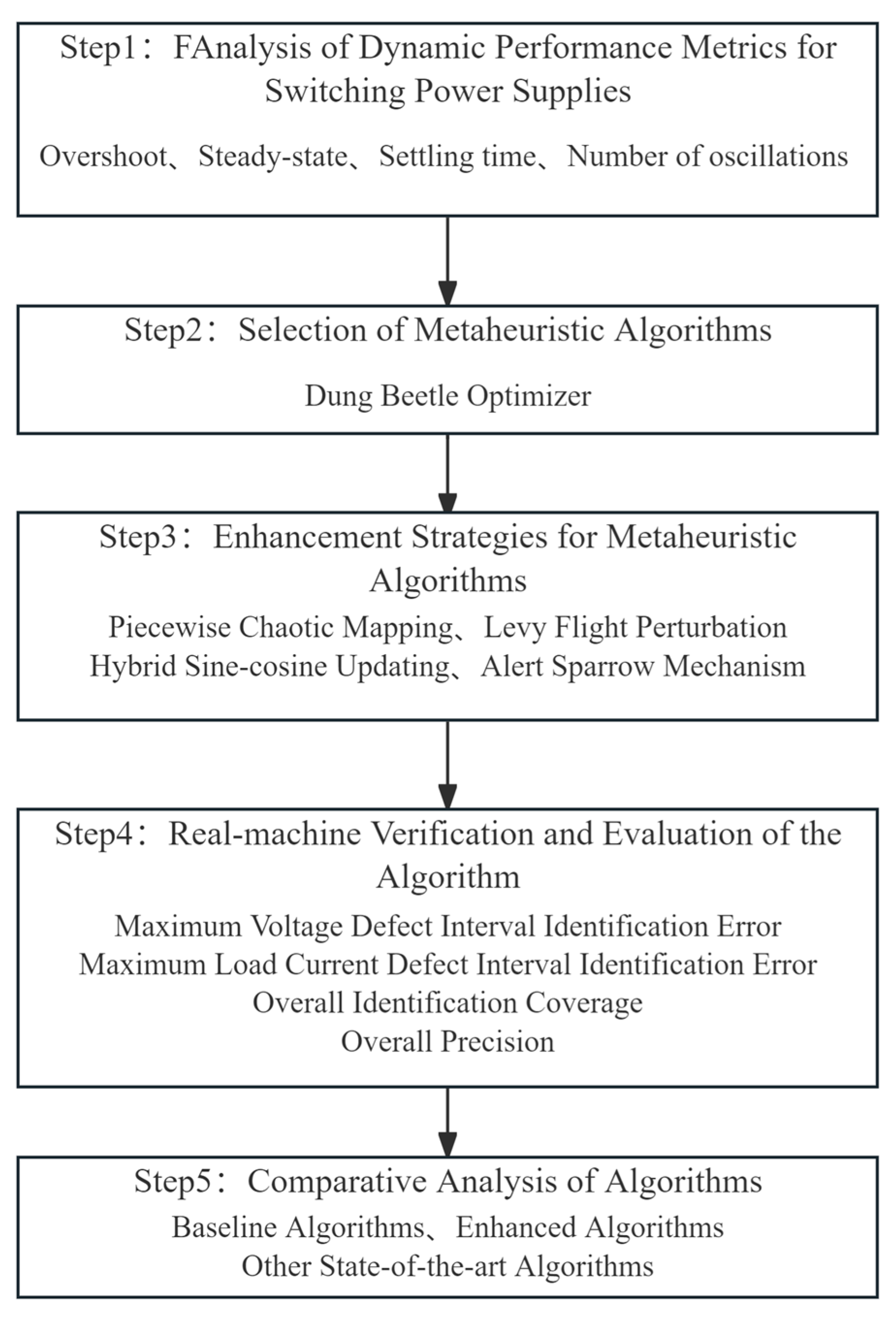
The research framework of this study is illustrated in Figure 1. The analysis of dynamic performance metrics for switching-mode power supplies serves as the foundation for identifying performance deficiencies. It is necessary to determine which performance indicators are most influential on dynamic behavior, thereby selecting a set of key metrics to establish evaluation criteria. The selection of a metaheuristic algorithm should be based on the one demonstrating the best overall performance, which will form the algorithmic foundation. DBO is chosen as this baseline due to its unique division-of-labor mechanism within the population, which contributes to its superior comprehensive performance compared to other algorithms. However, a single algorithm often fails to meet all target requirements; therefore, multi-faceted enhancements are necessary, tailored to the specific characteristics of the DBO. Subsequently, experiments are conducted to verify the algorithm’s search results, and a comprehensive performance evaluation of the proposed algorithm is performed. Finally, a comparative analysis against the baseline DBO and other state-of-the-art algorithms is carried out to demonstrate the effectiveness of the proposed method.

2.2. Performance Metrics

The performance metrics of a closed-loop control system for switching power supplies revolve around three core requirements: stability (the system’s ability to return to equilibrium after a disturbance), rapidity (the speed of the system’s dynamic response), and accuracy (the closeness of the steady-state output to the desired value). In the production testing of switching power supplies, these performance metrics are typically embodied in four specific indicators: overshoot, steady-state error, settling time, and number of oscillations, as detailed below.
  • Overshoot: Defined as the maximum deviation of the output value beyond the steady-state value when the system response curve reaches its first peak, expressed as a percentage of the steady-state value.
  • Steady-state error: Defined as the deviation between the expected output and the actual output of the system as time approaches infinity.
  • Settling time: Defined as the shortest time required for the output response to enter and remain permanently within the allowable error band (typically ±2% or ±5%).
  • Number of oscillations: Defined as the number of times the output response crosses the steady-state value during the settling time, divided by 2.
The following discussion clarifies the potential physical defects corresponding to abnormalities in each performance metric, thereby establishing a link between the numerical results and actual hardware failures, as shown in detail in Table 3.
It is important to emphasize that the relationship between performance metrics and physical defects is often many-to-many. For instance, a drift in the value of a single capacitor within the compensation network can simultaneously lead to increased overshoot, prolonged settling time, and induce oscillations. Therefore, the defect identification method proposed in this paper offers the advantage of enabling rapid, first-pass performance screening across all operating conditions. When the system identifies a defect under certain conditions, engineers can refer to the ‘metric-defect’ mapping relationship shown in the table above to focus their analysis on the most likely faulty components. The method presented in this study provides crucial initial clues and a direction for narrowing down the focus for subsequent precise identification of specific physical faults, addressing the bottleneck of traditional methods that struggle to achieve automated screening across the full range of operating conditions.

2.3. Dung Beetle Optimizer (DBO)

Dung Beetle Optimizer simulates cooperative mechanisms of a dung beetle population to search for and solve objective functions. The dung beetle population is divided into four groups: rolling, foraging, stealing, and reproducing.

2.3.1. Rolling Dung Beetles

Rolling dung beetles are responsible for global exploration, simulating the straight-line navigation behavior of dung beetles rolling dung balls. Their direction is adjusted based on changes in light intensity (deflection coefficient k and natural coefficient φ 1 ) and obstacle avoidance (dancing behavior) to prevent falling into local optima. The position update for rolling dung beetles is given by:
x i t + 1 = x i t + φ 1 k 1 x i t 1 + b Δ x Δ x = x i t x w *
where x i t represents the position of the i-th dung beetle at iteration t; φ 1 is the natural coefficient; k 1 is the constant deflection coefficient; b is a constant value between [0, 1]; x w * is the global worst position in the current population; Δ x is used to simulate changes in light intensity.
When a dung beetle encounters obstacles and cannot move forward, it uses dancing to reposition itself and obtain new paths. The new rolling direction is determined using a tangent function. The position update formula for the rolling dung beetle is:
x i t + 1 = x i t + tan θ x i t x i t 1
where θ ∈ [0, π] is the deflection angle. When θ equals 0, π/2, or π, the dung beetle does not change its position.

2.3.2. Reproducing Dung Beetles

Reproducing dung beetles are responsible for local exploitation, simulating the behavior of female dung beetles laying eggs in safe areas. Dynamically contracting egg-laying regions are constructed around the local optimal solution to improve local search accuracy:
L c * = max x p * × 1 R , L c U c * = max x p * × 1 R , U c R = 1 t T
where L c * is the lower bound of the egg-laying region; U c * is the upper bound of the egg-laying region; Lc and Uc are the lower and upper bounds of the search region; x p * is the local optimal position of the population; R is the inertia weight; T is the maximum number of iterations during algorithm iteration.
After the egg-laying region is determined, each female dung beetle produces only one egg per iteration. The position of the egg is defined as:
b i t + 1 = X p * + b 1 b i t L c * + b 2 b i t U c *
where b i t is the position of the i-th egg ball at iteration t; b1 and b2 are two independent random vectors of size 1 × D; and D is the dimension of the population.

2.3.3. Small Dung Beetles

Small dung beetles, AKA foraging dung beetles, are responsible for fine search within the optimal foraging region, simulating the foraging behavior of adults developed from larvae. They dynamically adjust the search range based on the global optimal position to balance exploitation and exploration. The foraging region is defined as follows:
L b b = max x g * × 1 R , L b U b b = max x g * × 1 R , U b
where U b b and L b b are the upper and lower bounds of the foraging region., respectively, x g * is the global optimal position.
After the region is determined, the position update formula for small dung beetles is defined as:
x i t + 1 = x i t + C 1 x i t L b b + C 2 x i t U b b
where C1 and C2 are random numbers following a normal distribution.

2.3.4. Stealing Dung Beetles

Stealing dung beetles are responsible for introducing random perturbations, simulating the behavior of dung beetles stealing dung balls. By perturbing the current optimal solution using a normally distributed random vector (g), the algorithm’s ability to escape local optima is enhanced. During the iteration process, the position update strategy for stealing dung beetles is defined as:
x i t + 1 = x g * + S × g × x i t x p * + x i t x g *
where g is a random vector of size 1 × D (population dimension) following a normal distribution, and S is a constant between [0, 1].

3. Multi-Strategy Enhanced Dung Beetle Optimizer (MSDBO)

3.1. Piecewise Chaotic Mapping Strategy

Chaotic mapping is a method for generating chaotic sequences, used to replace traditional pseudo-random number generation. Piecewise chaotic mapping is employed to initialize the population, replacing the pseudo-random numbers generated by DBO with random numbers produced by Piecewise chaotic mapping. The Piecewise chaotic mapping is described as follows [27]:
x i 1 = x i 1 φ , 0 x i 1 < φ x i 1 φ 0.5 φ , φ x i 1 < 0.5 1 φ x i 1 0.5 φ , 0.5 x i 1 < 1 φ 1 x i 1 φ , 1 φ x i 1 < 1
where φ is the piecewise control factor.

3.2. Attenuation Perturbation Strategy Integrating Lévy Flight and Brownian Motion

Lévy flight enhances the algorithm’s local optimization capability by perturbing the original position of stealing dung beetles. Brownian motion, combined with Lévy flight, balances the algorithm’s local exploitation and global exploration capabilities, improving search accuracy [28]:
L e v y L = μ / v 1 β , μ N 0 , σ 2 , v N 0 , 1 σ = Γ 1 + β sin π β / 2 / Γ 1 + β 2 β 2 β 1 / 2
where μ is the scaled Gaussian distribution random vector; v is the standard Gaussian distribution random vector; β is the characteristic exponent. When β = 2, Lévy flight degenerates into Brownian motion (an ideal local exploitation tool); when 0 < β < 2, the heavy-tail proper-ty endows it with super-diffusion ability, helping the algorithm escape local optima; σ is the normalization co-efficient.
After incorporating Lévy flight, the position update formula is defined as:
x i t + 1 = x i t + L e v y L

3.3. Improved Sine–Cosine Guidance Strategy

Rolling dung beetles and reproducing dung beetles are responsible for global exploration and local exploitation, respectively. The improved sine–cosine strategy achieves a good balance between early global exploration and late local exploitation. Its update formula is as follows [29]:
x i t + 1 = ω x i t + G t + M t
where G(t) and M(t):
G t = c r 1 sin r 2 x g * x i t M t = 2 c 1 r 1 cos r 2 x a v g t x i t ω = ω max ω min t / T 1 / 2
where c = 1 + 0.5 cos t π / T and ω max , ω min represent the maximum and minimum adaptive weights; r 1 , r 2 is a uniform random number in [0, 1]; x a v g t represents the average position of the current population.

3.4. Alert Mechanism Introduction Strategy

Inspired by the alert sparrow mechanism, a new alert dung beetle population is introduced to enhance the algorithm’s search capability in the later stages. Specifically, when the iteration count meets the requirements, a certain number of dung beetle positions are selected for random updates, replacing the original positions to help strengthen the algorithm’s late-stage exploration capability [30].
First, the current population mean is calculated by:
x i n e w = x a v g t + Δ t Δ t = ε t s t
where ε t is the population perturbation at iteration t; s t is the perturbation intensity at iteration t.
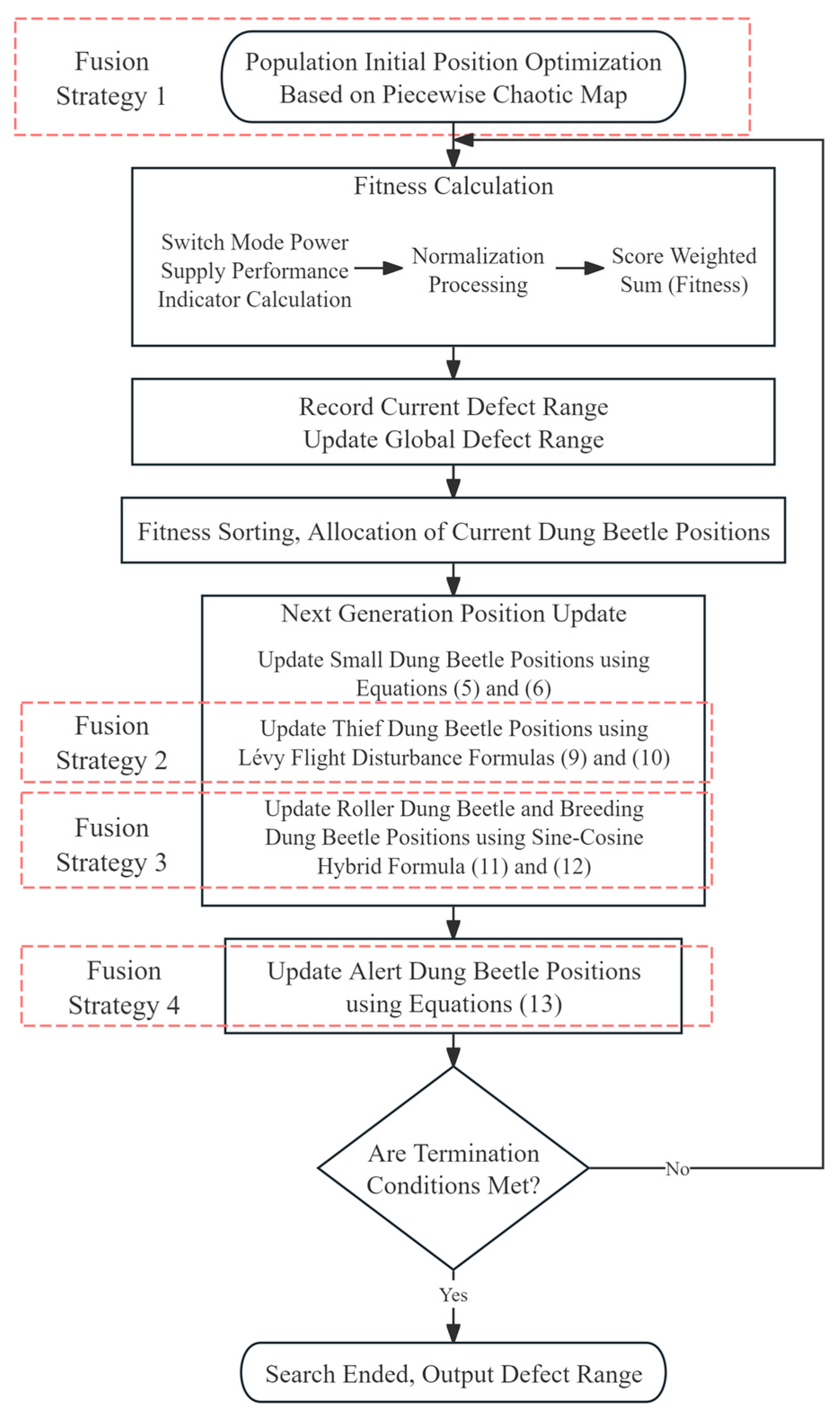
After the aforementioned improvements, the Multi-Strategy Improved Dung Beetle Optimizer (MSDBO) was formed. The application flowchart is shown in Figure 2.
The specific process is as follows:
  • Population position initialization
    Set the population proportions of the four types of dung beetles. Initialize the first-generation population positions using Piecewise chaotic mapping based on the input voltage range and load resistance range of the switching power supply.
  • Fitness calculation
    The performance evaluation metrics of the switching power supply are used as fitness calculation results.
As indicated previously, there is often a many-to-many correlation between performance metrics and physical defects. Furthermore, to normalize dimensions and facilitate calculation, the algorithm normalizes the results of the four performances metrics and performs a weighted summation, ultimately obtaining a value between 0 and 1 to represent the performance score of the switching power supply under that operating condition, i.e., the fitness of an in-dividual in the population. Since each of the four performances metrics has a threshold, a normalized com-prehensive score threshold can be set. When the performance score of an operating point is greater than or equal to the threshold, it is defined as a defect point; otherwise, it indicates good performance. The normalization formula is as follows:
n σ = min 1 , σ M σ n e = min 1 , e M e n t s = min 1 , t s M t s n N = min 1 , N M N
where M σ is the maximum allowable value for over-shoot; M e is the maximum allowable value for steady-state error; M N is the maximum allowable value for the number of oscillations; M t s is the maximum allowable value for settling time.
Weighted summation formula (fitness calculation):
G θ = α 1 n σ + α 2 n e + α 3 n t s + α 4 n N
where G θ 0 , 1 ; α 1 + α 2 + α 3 + α 4 = 1 .
  • Record the current defect range and update the global defect range.
    Record the defect range identified by the current population and compare it with the global defect range. Merge new defect points into the global defect range.
  • Sort fitness and assign dung beetle positions for this generation.
    Sort fitness values from high to low. Assign positions with high fitness to rolling dung beetles, positions with medium fitness to reproducing and small dung beetles, and positions with low fitness to stealing dung beetles.
It should be noted that the “optimality” of the dynamic role allocation mechanism based on fitness sorting lies in its adaptivity. It is not a static strategy pursuing mathematical absolute optimality, but rather an efficient heuristic rule. In the early stages of iteration, individuals with high fitness may be distributed across different regions of the solution space. This mechanism helps to quickly lock onto multiple promising regions. In the later stages of iteration, it guides the population to converge near the globally optimal region.
  • Next generation positions update.
    Use the attenuation perturbation strategy integrating Lévy flight and Brownian motion for the position update of stealing dung beetles. Use the improved sine–cosine hybrid update strategy for the position update of rolling and reproducing dung beetles.
  • Alert dung beetle mechanism.
    Based on Equation (13) a certain number of dung beetle positions are selected for random updates, replacing the original positions.
  • Termination condition judgment.
    During population iteration, if no new defect range is identified for several consecutive generations, or if the maximum number of iterations is reached, the algorithm stops searching and outputs the identified defect range. Otherwise, continue iterating until one of these two conditions is met.

4. Experiments and Analysis

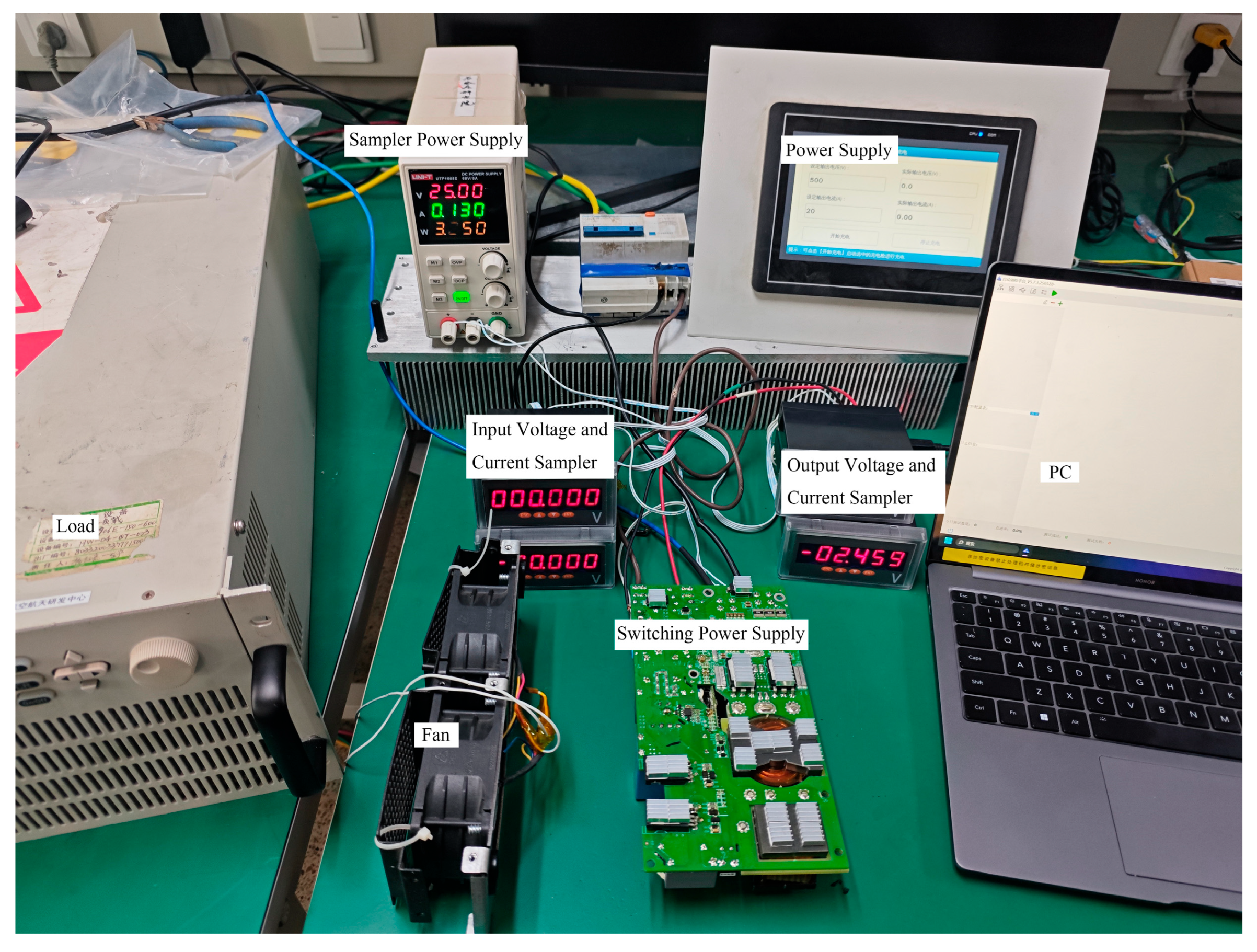
This paper takes an LLC switching power supply module with a rated input voltage of 540 V, a rated output of 24 V/60 A, an input voltage range of 300–800 V, and an output current range of 0–60 A as an example to conduct performance defect identification tests. The experimental setup is shown in Figure 3.

4.1. Data-Driven Model Construction of the Switching-Mode Power Supply

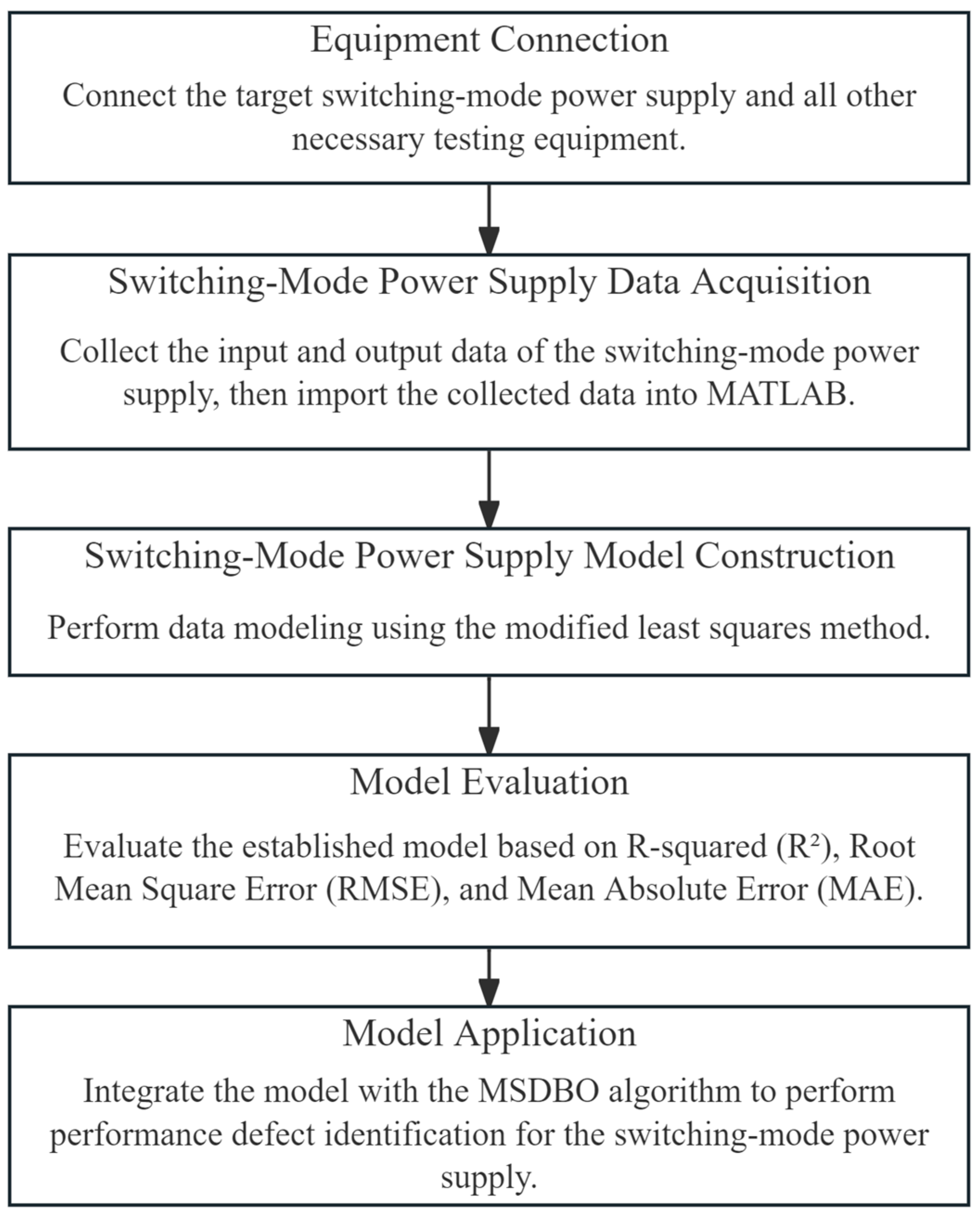
To ensure the efficiency and safety of the MSDBO algorithm in identifying performance defects of the switching-mode power supply, and to avoid conducting a large number of time-consuming and potentially risky tests directly on physical equipment, this study first establishes a high-fidelity, data-driven model of the SMPS as the foundation for algorithm verification.
The specific workflow is as follows in Figure 4.

4.1.1. Open-Loop Model of LLC Switching Power Supply

The model is constructed using a modified nonlinear least squares method [31].
The constructed mathematical model is as follows:
V o u t P ; V i n , f s w , I o u t , n o r m = V i n M t o t a l P ; f s w , I o u t , n o r m
In which, the total DC gain Mtotal consists of the FHA fundamental gain and an empirical correction term.
M t o t a l P ; f s w , I o u t , n o r m = M F H A P ; f s w + Δ M e m p P ; f s w , I o u t , n o r m
The expressions for each component are:
M F H A P ; f s w = 1 2 n 1 1 + 1 k 1 k f s w / f r 2 + Q f s w f r f r f s w 2
Δ M e m p P ; f s w , I o u t , n o r m = a f n o r m 2 + b f n o r m + c + d f n o r m I o u t , n o r m + e I o u t , n o r m
The normalized variables are:
f n o r m = f s w f r / f s c a l e , f s c a l e = 0.2 f r e s t I o u t , n o r m = I o u t / I o u t , max
Parameter description: f r e s t represents the initial estimated value of the resonant frequency; f s w represents the switching frequency; P = [k, Q, fr, n, a, b, c, d, e]T is the parameter vector to be identified; k = Lm/Lr is the inductance ratio; Q is the quality factor; fr is the resonant frequency; n is the transformer turns ratio; a, b, c, d, e are the coefficients of the correction terms.
The specific values of each parameter are presented in Table 4.
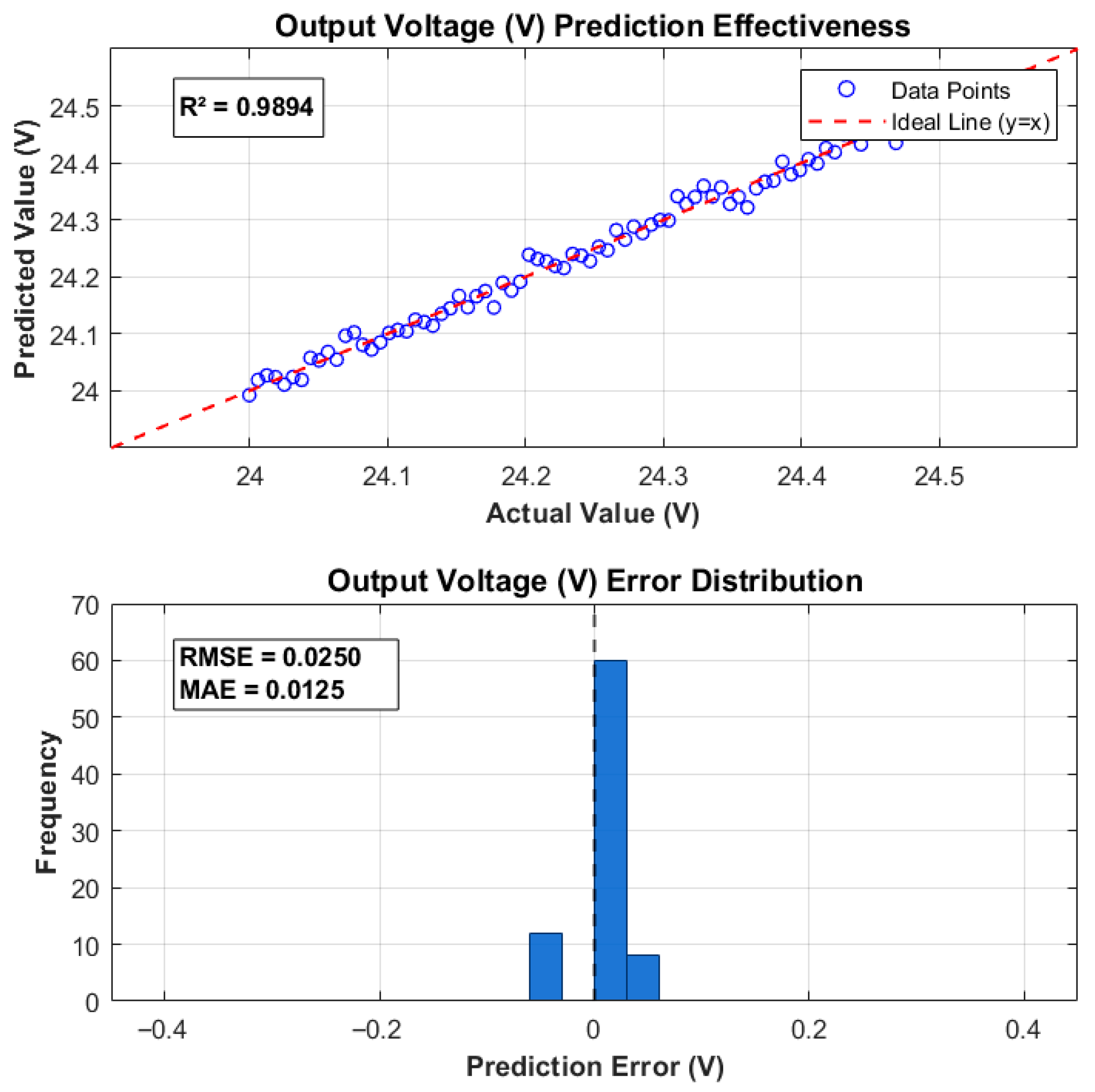
The results of the model performance evaluation are shown in Figure 5.
The results show that the model’s performance metrics are R2 = 0.9894, RMSE = 0.025, and MAE = 0.0125. These metrics indicate that the simulation model possesses excellent goodness-of-fit and very low error, enabling it to accurately represent the characteristics of the physical switching-mode power supply. Consequently, the model is deemed fully sufficient for the needs of the subsequent defect identification algorithm research.

4.1.2. Closed-Loop Control System Structure

The above model only describes the physical characteristics of the LLC itself. In practical applications, a PI controller is required for closed-loop control, forming a complete mathematical model of the closed-loop system.
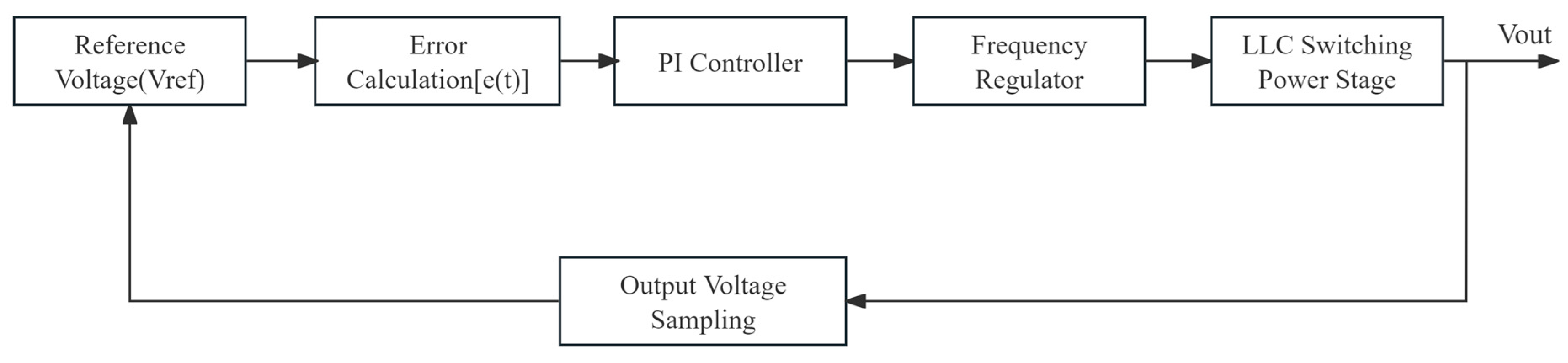
The control process of the voltage-mode closed-loop LLC system is as follows in Figure 6.
Assuming the system operates under digital control with a sampling period of Ts the calculation formulas for each link of the closed-loop control at the k-th switching cycle are as follows:
(1)
Error Calculation
The output voltage error e[k] is the difference between the reference voltage and the actual sampled voltage.
e k = V r e f V o u t k
(2)
Digital PI Controller
The output of the PI controller is the control variable u[k].
u k = K p e k + K i i = 0 k e i T s + u 0
where Kp, Ki are the proportional and integral gains, which are the controller parameters to be designed. u0 the initial control variable at the steady-state operating point.
(3)
Frequency Modulation
After limiting, the controller output u[k] is converted into the switching frequency fsw[k + 1] for the next cycle (k + 1).
f s w k + 1 = C l a m p f n + K f m u k , f min , f max
where fn is the rated switching frequency (around the resonant frequency fr). Kfm is the frequency modulation gain, which converts the control signal amplitude into a frequency value. Clamp(⋅) is the limiter function that restricts the frequency within a safe range.
(4)
LLC Switching Power Stage
It describes the output voltage generated under a given switching frequency fsw[k + 1] and the current load current Iout[k].
V o u t k + 1 = V i n M t o t a l P ; f s w k + 1 , I o u t , n o r m k
(5)
Load Model
The load current Iout[k] may be related to the output voltage. For a resistive load RL
I o u t k = V o u t k R L
By combining the above equations, a set of discrete-time equations describing the entire closed-loop system can be obtained:
e k = V r e f V o u t k u k = P I e k f s w k + 1 = Γ u k V o u t k + 1 = V i n M t o t a l P ; f s w k + 1 , I o u t , n o r m k I o u t k = Φ V o u t k
This model will be used for subsequent algorithm verification.

4.2. Performance Metric Thresholds and Preset Defect Interval Settings

4.2.1. Performance Metric Threshold Settings

To identify performance defects in the switching power supply, thresholds for performance metrics must be set to evaluate its performance. The thresholds for the four performances metrics are set as shown in Table 5.

4.2.2. Preset Defect Interval Settings

The PI parameter is directly related to the dynamic performance of the switching power supply. To verify the effectiveness of the algorithm, the PI parameters of the closed-loop control in the switching power supply simulation model were artificially biased to achieve preset performance defects. Based on the in-put voltage range, five defect intervals are set, as shown in Table 6.

4.3. Evaluation Metrics for the Performance Defect Assessment Algorithm

4.3.1. Voltage Defect Interval Identification Error

This metric characterizes the error between the algorithm-identified defect interval and the actual preset defect interval in terms of upper and lower limits. The identification error is divided into voltage defect interval identification error and load current defect interval identification error. The specific calculation method is defined as follows:
E V = V u p s e t V u p i d + V d o w n s e t V d o w n i d
where V u p s e t and V d o w n s e t are the upper and lower limits of the preset voltage defect interval, respectively; V u p i d and V d o w n i d are the upper and lower limits of defects actually searched by the algorithm.

4.3.2. Load Current Defect Interval Identification Error

E I = I u p s e t I u p i d + I d o w n s e t I d o w n i d
where I d o w n s e t and I u p s e t are the lower and upper limits of the preset load current defect interval, respectively; I d o w n i d and I u p i d are the lower and upper limits of the load current defect interval actually identified by the algorithm.

4.3.3. Identification Coverage of Defect Interval Range

The identification coverage is defined as the ratio of the space actually covered by the algorithm population within the preset defect interval to the preset defect interval. It represents the exploration of the preset defect conditions of the switching power supply by the search algorithm. The specific calculation formula is:
η = μ c μ s × 100 %
where μ c is the space actually covered by the algorithm population; μ s is the preset defect interval.

4.3.4. Precision of Defect Interval Range Identification Results

When the defect interval is identified with the search algorithm, some individuals in the population may incorrectly identify poorly performing conditions within the preset defect interval as normal due to various reasons. Precision is used to represent the overall judgment accuracy of the algorithm. The specific calculation formula is as follows:
P = T P T P + F N
where TP represents the number of population individuals correctly identified as defect points within the pre-set defect interval; FN represents the number of population individuals within the preset defect interval incorrectly identified as normal points.

4.4. Parameter Settings

4.4.1. Performance Indicator Weights

As mentioned in Section 3.4, the fitness calculation involves first computing a weighted sum of the four performances metrics to obtain a composite score for the operating condition. This score is then compared against a predefined defect threshold to determine whether the condition qualifies as a defect. The weighting assigned to each of these four performances metrics warrants further discussion here.
The four metrics—overshoot, settling time, steady-state error, and the number of oscillations—are fundamental and critical dimensions for comprehensively evaluating the dynamic performance of a switching power supply. They correspond to the system’s relative stability, rapidity, accuracy, and absolute stability, respectively. Since the objective of this study is to conduct comprehensive screening for performance defects, without a priori subjective prioritization of one type of dynamic deficiency (e.g., excessive overshoot) over another (e.g., large steady-state error), employing equal weights ensures a balanced and unbiased evaluation, thereby avoiding the introduction of subjective arbitrariness.
As a foundational investigation, the equal-weight strategy offers the advantages of simplicity, transparency, and ease of reproducibility. It serves as a robust and unbiased baseline model. Future research could focus on optimizing these weights for specific applications where certain metrics might be more critical, but for the general-purpose screening tool proposed in this paper, equal weighting represents a standard and justified starting point.
Therefore, the weights for all four dynamic performance metrics are set to 0.25 in this study.

4.4.2. The Determination of Standardized Defect Thresholds

In the switching power supply performance defect identification method presented in this paper, the selection of the normalized defect threshold Gθ is crucial, as it is a key step in determining whether a specific operating condition qualifies as a defect condition. Setting Gθ too low may lead to misclassifying normal conditions as defects, whereas setting it too high might cause actual defect conditions to be missed. To address a simulation experiment was conducted in this study. Within the 200 V input voltage range, 50 small defect intervals with a step size of 2 V were established to validate the appropriate range for the normalized defect threshold. Based on empirical knowledge. Gθ was initially set within an approximate range of (0.7–0.9) based on experience, and then experimentally verified with a step size of 0.05. The results are shown in Table 7.
As can be seen from the table, when Gθ is set to 0.7, although the number of correctly identified defects is similar to the preset number of defects, there are many instances where normal points are incorrectly identified as defect points. This indicates that the system erroneously misclassifies a significant number of normal operating conditions as defect conditions. As the value of Gθ increases, the misclassification of normal points as defects becomes sufficiently minimal when Gθ reaches 0.8. The few remaining occurrences of this type can be attributed to inherent system errors causing individual misjudgments.
When Gθ increases from 0.8 to 0.9, it is observed that the number of correctly captured defect conditions decreases, while the number of defect points misclassified as normal points increases. This shows that a Gθ value of 0.9 is unreasonable, as it leads to the system failing to identify some defect conditions, classifying them as normal instead. Although there are still a few cases where normal points are misclassified as defect points at this setting, their number is very small and can also be considered a result of inherent system errors causing individual misjudgments.
In conclusion, the normalized defect threshold Gθ that results in the least number of misjudgments needs to be selected. Therefore, in this paper, Gθ = 0.8 is chosen.

4.4.3. Determination of the Proportion of Population Size

As described in Section 2.2, different dung beetle populations serve distinct roles: ball-rolling dung beetles and stealing dung beetles primarily drive global exploration, while breeding dung beetles and small dung beetles are mainly responsible for local exploitation. Literature [17] explicitly states that population proportions should be determined according to the characteristics of the specific application scenario. The defect identification problem in switching-mode power supplies studied in this paper exhibits a solution space with significant multimodal and high-dimensional characteristics. In such cases, the algorithm must strike a balance between exploration and exploitation.
Based on the theoretical analysis of the problem characteristics, the rolling dung beetles and stealing dung beetles in this paper are primarily responsible for exploring the full operating range of the switching power supply. To achieve comprehensive performance defect identification across all operating conditions, their population sizes are set slightly higher compared to the breeding dung beetles and small dung beetles. Therefore, the population ratio in this study adheres to 3:2:2:3, where the rolling dung beetles and stealing dung beetles each account for 30% of the population, while the breeding dung beetles and small dung beetles each constitute 20%.

4.4.4. Summary of Algorithm Parameter Settings

In the experiments, besides the three parameters discussed above, the MSDBO algorithm involves other key parameters, all of which are summarized in Table 8. The details are as follows.

4.5. Outcome Analysis

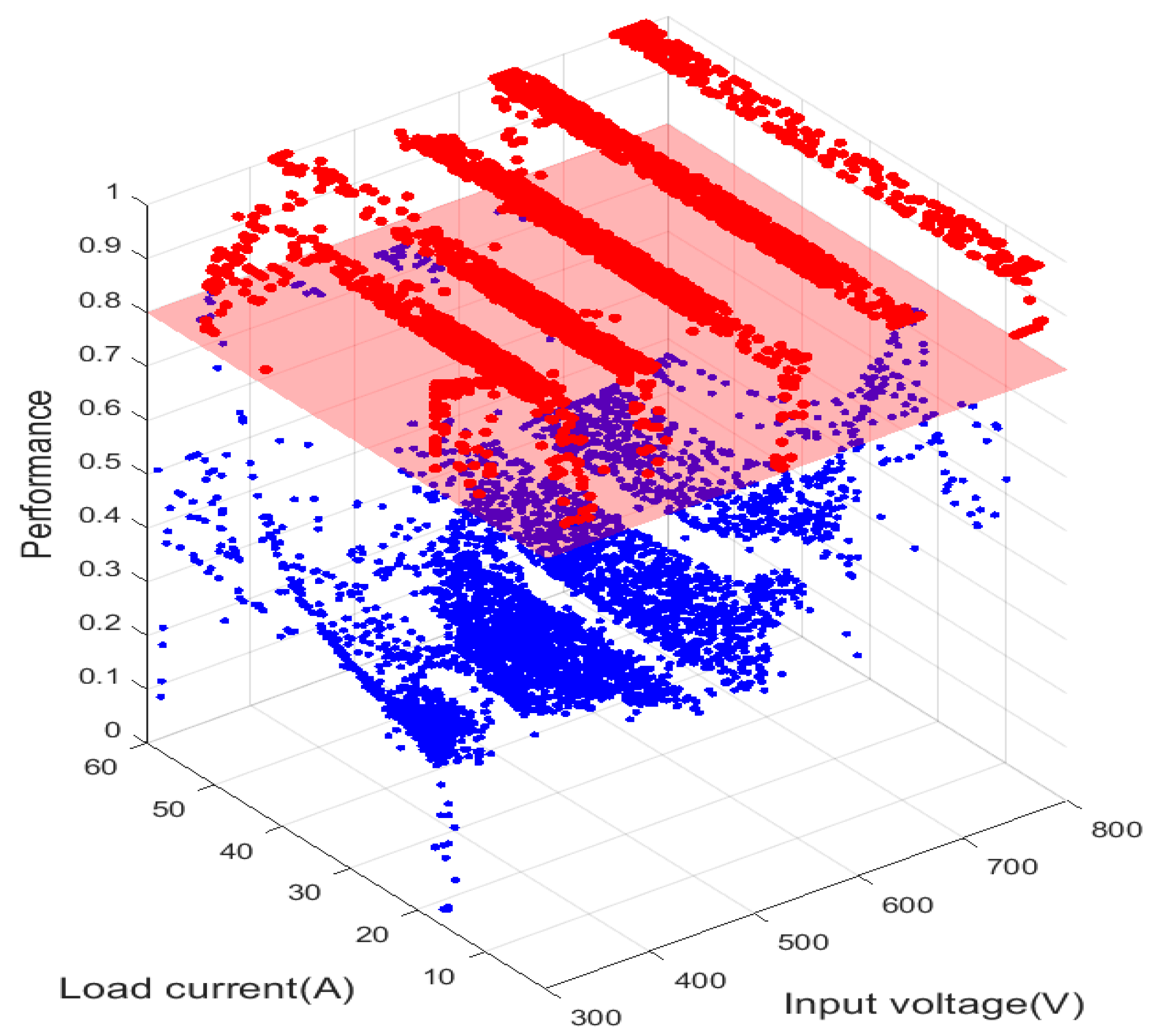
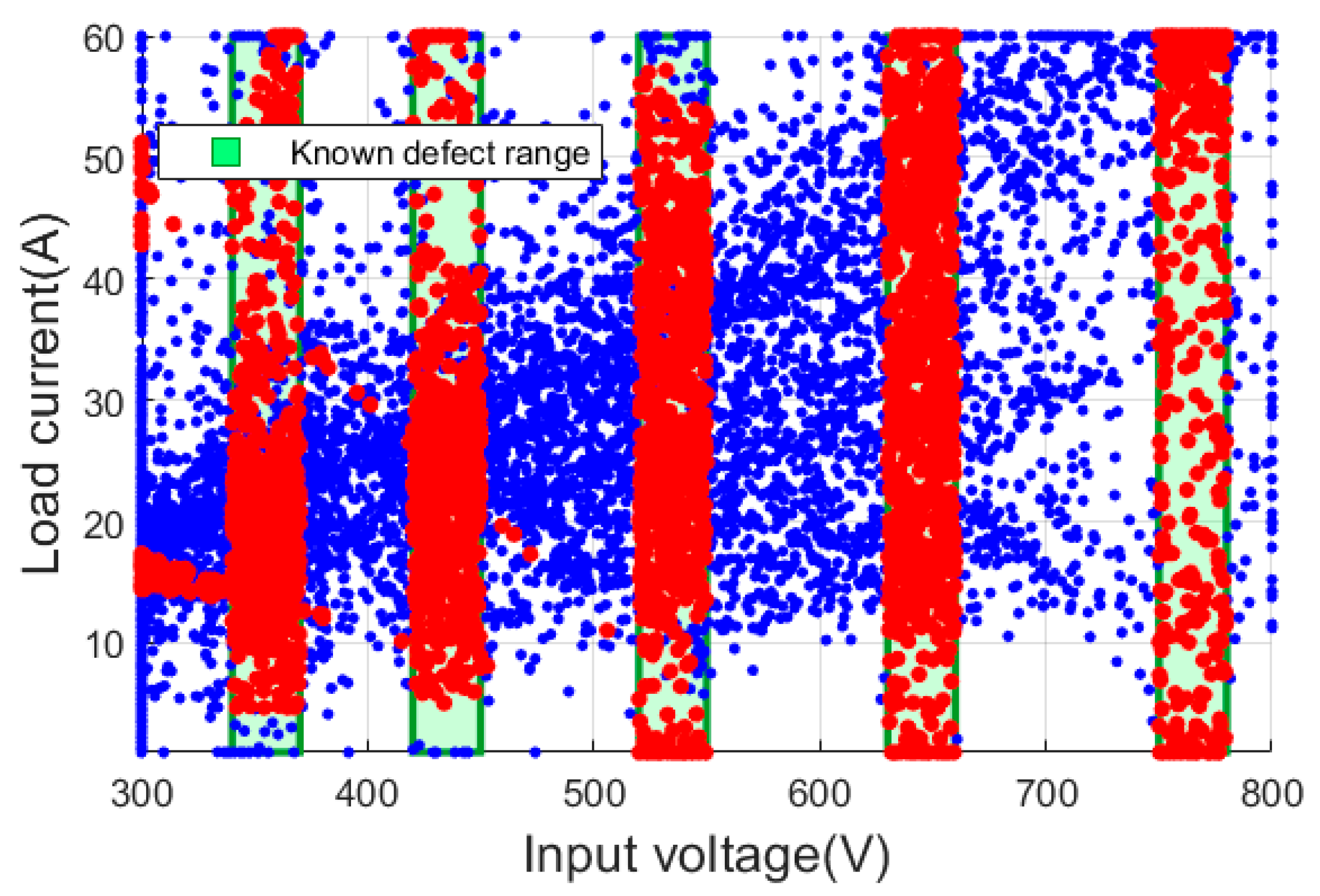
The preset defect intervals were searched using MSDBO, and the results are shown in Figure 7 and Figure 8. Figure 7 presents a three-dimensional plot with input voltage, output current, and performance score as the x-, y-, and z-axes, respectively. Figure 8 displays a two-dimensional plot with input voltage and output current as the x- and y-axes. The three-dimensional visualization in Figure 7 emphasizes the performance scores corresponding to different individuals in the search results, while Figure 8 aims to provide a more intuitive representation of the performance defect intervals of the switching power supply. In the plots, normally performing individuals are marked in blue, while those exhibiting defects are highlighted in red.
Figure 7 illustrates the three-dimensional relationship between performance score, input voltage, and load current. It not only identifies the voltage–current combinations that lead to defects but, more importantly, reveals the magnitude of the performance score under those operating conditions, i.e., the degree of performance degradation.
In Figure 7, the performance defect intervals are not randomly scattered but form distinct “clusters” or “clouds” within the three-dimensional space. This highlights the algorithm’s capability to accurately identify the boundaries of the predefined defect intervals.
Figure 8 presents a two-dimensional projection of Figure 7, offering a more intuitive visualization of the defect intervals identified by the algorithm. The green background areas represent the predefined known defect intervals. The high degree of coincidence between the algorithm-identified defect regions and the predefined “known defect ranges” strongly validates the accuracy and reliability of the multi-strategy dung beetle optimizer (MSDBO).
In terms of algorithmic superiority, the multi-strategy improved dung beetle optimizer avoids the common pitfall of becoming trapped in local optima—a issue prevalent in other algorithms—thus effectively balancing the relationship between local exploitation and global exploration.
Based on Formulas (27)–(30), the specific results and evaluation metrics for MSDBO performance defect identification are shown in Table 9, Table 10 and Table 11.

4.6. Performance of the Proposed Optimizer

To systematically evaluate the effectiveness and necessity of each innovative module in the proposed MSDBO, an ablation study is conducted in this section. By comparing the performance differences between the complete model and simplified models with one or more key components removed, the individual contribution of each component to reducing voltage identification error and current identification error, as well as improving operating condition coverage and overall accuracy, is quantitatively analyzed. The experimental results are presented in Table 12, and the contribution levels of each improvement strategy are detailed in Table 13.
As shown in Table 12, all four improvement strategies contribute to enhancing the algorithm’s performance, with gradual performance improvements observed as more strategies are incorporated. Table 13 illustrates the contribution of each strategy to different metrics. It is evident that each improvement plays a distinct role: the piecewise chaotic mapping primarily enhances the algorithm’s identification coverage rate, improving it by 8.3%; the sine–cosine update strategy significantly reduces voltage and current identification errors by 10.2% and 6.5%, respectively; while Lévy flight and the vigilance mechanism contribute to a balanced improvement across all metrics.

4.7. Analysis of Advantages of the Multi-Strategy Optimized Dung Beetle Algorithm

To verify the advantages of MSDBO, it is compared with DBO and other latest search algorithms. The specific results are as follows in Table 14.
As can be seen from the table, the SSA algorithm, due to its sparrow warning mechanism, achieves a higher overall identification coverage rate compared to the SWO and COA algorithms. However, it underperforms SWO and COA in terms of voltage and current identification errors. In contrast, the DBO algorithm demonstrates superior overall performance across all metrics compared to the three aforementioned algorithms.
The MSDBO algorithm, optimized with multiple strategies, also shows significant improvements over the DBO algorithm in all metrics. The voltage defect interval identification error is reduced by 22.3%, the current defect interval identification error is reduced by 15.2%, the algorithm identification coverage is increased by 18.4%, and the precision is improved by 10.29%. This demonstrates the effectiveness of multi-strategy optimization.

5. Conclusions

The identification of defect interval in switching power supplies was conducted based on four performance metrics: overshoot, steady-state error, settling time, and number of oscillations. The identification precision of the algorithm was evaluated using the following criteria: voltage and current defect interval identification error, identification coverage of defect interval range, and precision of defect interval range identification results. Compared with the advanced algorithms of SSA, SWO and COA, DBO demonstrates advantages in population space exploration and identification accuracy. MSDBO proposed in this paper enhances the original DBO in terms of population space exploration and identification precision by improving the initial population generation, updating strategies for different dung beetle populations, and introducing a population alert mechanism. In this paper, pre-defined defects were introduced into LLC switched-mode power supplies, and the algorithms were used to identify defect ranges. The results validate the superiority and effectiveness of the proposed multi-strategy optimized search algorithm in identifying defects in switching power supplies.

Author Contributions

Conceptualization, Z.Y. and J.G.; methodology, Z.Y.; software, J.G.; validation, Z.Y., J.G. and K.Z.; formal analysis, R.L.; investigation, R.L.; resources, L.Z.; data curation, Z.Y.; writing—original draft preparation, Z.Y.; writing—review and editing, G.A.; visualization, J.L.; supervision, G.A.; project administration, L.Z.; funding acquisition, G.A. All authors have read and agreed to the published version of the manuscript.

Funding

This research was funded by the Shijiazhuang Industry-University-Research Collaboration Project for Higher Education Institutions in Hebei Province, “Research on Key Technologies for Dynamic Performance Analysis and Transfer Function Identification of DC Power Conversion Modules” (No. 241060171A).

Data Availability Statement

The original contributions presented in this study are documented within the article. For additional information, please contact the corresponding author.

Conflicts of Interest

The author declares no conflicts of interest. The author declares that the research was conducted in the absence of any commercial or financial relationships from Shijiazhuang Tonhe Electronics Technologies Co., Ltd. that could be construed as a potential conflict of interest.

References

  1. Mohammed, S.A.Q.; Jung, J.-W. A State-of-the-Art Review on Soft-Switching Techniques for DC–DC, DC–AC, AC–DC, and AC–AC Power Converters. IEEE Trans. Ind. Inf. 2021, 17, 6569–6582. [Google Scholar] [CrossRef]
  2. Peftitsis, D.; Rabkowski, J. Gate and Base Drivers for Silicon Carbide Power Transistors: An Overview. IEEE Trans. Power Electron. 2015, 31, 7194–7213. [Google Scholar] [CrossRef]
  3. Lakshminarayana, S.; Perumalsamy, R.; Pan, C.; Jung, S.; Chung, H.-J.; Park, H. A CMOS Switched Capacitor Filter Based Potentiometric Readout Circuit for pH Sensing System. J. Low Power Electron. Appl. 2025, 15, 3. [Google Scholar] [CrossRef]
  4. Xu, X.; Collin, A.J.; Djokic, S.Z.; Langella, R.; Testa, A. Operating Cycle Performance, Lost Periodicity, and Waveform Distortion of Switch-Mode Power Supplies. IEEE Trans. Instrum. Meas. 2018, 67, 2434–2443. [Google Scholar] [CrossRef]
  5. Forest, F.; Huselstein, J.-J.; Faucher, S.; Elghazouani, M.; Ladoux, P.; Meynard, T.A.; Richardeau, F.; Turpin, C. Use of Opposition Method in the Test of High-Power Electronic Converters. IEEE Trans. Ind. Electron. 2006, 53, 530–541. [Google Scholar] [CrossRef]
  6. Singh, V.; Yadav, A.; Gupta, S.; Abdelaziz, A.Y. Switch Fault Identification Scheme Based on Machine Learning Algorithms for PV-Fed Three-Phase Neutral Point Clamped Inverter. e-Prime-Adv. Electr. Eng. Electron. Energy 2024, 8, 100582. [Google Scholar] [CrossRef]
  7. Cauffet, G.; Keradec, J.-P. Digital Oscilloscope Measurements in High-Frequency Switching Power Electronics. IEEE Trans. Instrum. Meas. 1992, 41, 856–860. [Google Scholar] [CrossRef]
  8. Lloyd, B.A.; Gupta, B.K.; Campbell, S.R.; Sharma, D.K. Instrumentation for High-Speed Digital Recording of Switching Surges. IEEE Trans. Power Deliv. 1989, 4, 932–937. [Google Scholar] [CrossRef]
  9. Xiao, C.; Chen, G.; Odendaal, W.G.H. Overview of Power Loss Measurement Techniques in Power Electronics Systems. IEEE Trans. Ind. Applicat. 2007, 43, 657–664. [Google Scholar] [CrossRef]
  10. Mohammad Shtayat, M.; Kamrul Hasan, M.; Kumar Budhati, A.; Solaiman, R.; Islam, S.; Pandey, B.; Saleh Abbas, H.; Saeed, M.M.A. An Improved Binary Spider Wasp Optimization Algorithm for Intrusion Detection for Industrial Internet of Things. IEEE Open J. Commun. Soc. 2025, 6, 2926–2944. [Google Scholar] [CrossRef]
  11. Shikoun, N.H.; Al-Eraqi, A.S.; Fathi, I.S. BinCOA: An Efficient Binary Crayfish Optimization Algorithm for Feature Selection. IEEE Access 2024, 12, 28621–28635. [Google Scholar] [CrossRef]
  12. Dai, P.; Bao, J.; Gong, Z.; Gao, M.; Xu, Q. Lifetime Prediction of IGBT by BPNN Based on Improved Dung Beetle Optimization Algorithm. IEEE Trans. Device Mater. Relib. 2025, 25, 341–351. [Google Scholar] [CrossRef]
  13. Feng, C.; Huang, Z.; Lin, J.; Wang, L.; Zhang, Y.; Wen, F. Aggregation Model and Market Mechanism for Virtual Power Plant Participation in Inertia and Primary Frequency Response. IEEE Trans. Power Syst. 2025, 1–15. [Google Scholar] [CrossRef]
  14. Wang, X.; Wang, S.; Liang, X.; Zhao, D.; Huang, J.; Xu, X.; Dai, B.; Miao, Q. Deep Reinforcement Learning: A Survey. IEEE Trans. Neural Netw. Learn. Syst. 2024, 35, 5064–5078. [Google Scholar] [CrossRef] [PubMed]
  15. Li, Z.; Hilber, P.; Li, Z.; Laneryd, T.; Ivanell, S. Temporally Coordinated Operation of Green Multi-Energy Airport Microgrids with Climatic Correlations and Flexible Loads via Decomposed Stochastic Programming. IEEE Trans. Sustain. Energy 2025, 1–12. [Google Scholar] [CrossRef]
  16. Liang, Z.; Chung, C.Y.; Zhang, W.; Wang, Q.; Lin, W.; Wang, C. Enabling High-Efficiency Economic Dispatch of Hybrid AC/DC Networked Microgrids: Steady-State Convex Bi-Directional Converter Models. IEEE Trans. Smart Grid 2025, 16, 45–61. [Google Scholar] [CrossRef]
  17. Xue, J.; Shen, B. Dung Beetle Optimizer: A New Meta-Heuristic Algorithm for Global Optimization. J. Supercomput. 2023, 79, 7305–7336. [Google Scholar] [CrossRef]
  18. Macedo, M.; Siqueira, H.; Figueiredo, E.; Santana, C.; Lira, R.C.; Gokhale, A.; Bastos-Filho, C. Overview on Binary Optimization Using Swarm-Inspired Algorithms. IEEE Access 2021, 9, 149814–149858. [Google Scholar] [CrossRef]
  19. Ezugwu, A.E.-S. Metaheuristic Optimization for Sustainable Unrelated Parallel Machine Scheduling: A Concise Overview With a Proof-of-Concept Study. IEEE Access 2024, 12, 3386–3416. [Google Scholar] [CrossRef]
  20. Xu, Z.; Yang, H.; Li, J.; Zhang, X.; Lu, B.; Gao, S. Comparative Study on Single and Multiple Chaotic Maps Incorporated Grey Wolf Optimization Algorithms. IEEE Access 2021, 9, 77416–77437. [Google Scholar] [CrossRef]
  21. Paul, P.S.; Dhungel, A.; Sadia, M.; Hossain, M.R.; Hasan, M.S. Self-Parameterized Chaotic Map for Low-Cost Robust Chaos. J. Low Power Electron. Appl. 2023, 13, 18. [Google Scholar] [CrossRef]
  22. Fan, X.; Wang, H.; Zhuo, Z.; Bei, S.; Li, Y.; Liu, Z. A Novel Dung Beetle Optimization Algorithm Based on Lévy Flight and Triangle Walk. Future Gener. Comput. Syst. 2026, 174, 108006. [Google Scholar] [CrossRef]
  23. Wang, W.; Tian, J. Optimal Parameters Extraction for Photovoltaic Models Utilizing an Artificial Rabbit Optimizer Incorporating Swarm-Elite Learning Mechanism’s Levy Flight Strategy. Comput. Electr. Eng. 2025, 127, 110582. [Google Scholar] [CrossRef]
  24. Kale, G.A.; Yüzgeç, U. Advanced Strategies on Update Mechanism of Sine Cosine Optimization Algorithm for Feature Selection in Classification Problems. Eng. Appl. Artif. Intell. 2022, 107, 104506. [Google Scholar] [CrossRef]
  25. Nanyan, N.F.; Ahmad, M.A.; Hekimoğlu, B. Optimal PID Controller for the DC-DC Buck Converter Using the Improved Sine Cosine Algorithm. Results Control Optim. 2024, 14, 100352. [Google Scholar] [CrossRef]
  26. Wu, R.; Huang, H.; Wei, J.; Huang, H.; Wang, S.; Zhu, Y.; Han, Z.; Gu, Q. Fusion Prediction Strategy-Based Dynamic Multi-Objective Sparrow Search Algorithm. Appl. Soft Comput. 2024, 165, 112071. [Google Scholar] [CrossRef]
  27. Wang, S.; Yip, P.C.; Leung, H. Estimating Initial Conditions of Noisy Chaotic Signals Generated by Piecewise Linear Markov Maps Using Itineraries. IEEE Trans. Signal Process. 1999, 47, 3289–3302. [Google Scholar] [CrossRef]
  28. Coelho, L.S.; Guerra, F.; Batistela, N.J.; Leite, J.V. Multiobjective Cuckoo Search Algorithm Based on Duffing’s Oscillator Applied to Jiles-Atherton Vector Hysteresis Parameters Estimation. IEEE Trans. Magn. 2013, 49, 1745–1748. [Google Scholar] [CrossRef]
  29. Mirjalili, S. SCA: A Sine Cosine Algorithm for Solving Optimization Problems. Knowl.-Based Syst. 2016, 96, 120–133. [Google Scholar] [CrossRef]
  30. Zhu, Y.; Yousefi, N. Optimal Parameter Identification of PEMFC Stacks Using Adaptive Sparrow Search Algorithm. Int. J. Hydrogen Energy 2021, 46, 9541–9552. [Google Scholar] [CrossRef]
  31. Dong, Z.; Ma, N. A Novel Nonlinear Partial Least Square Integrated With Error-Based Extreme Learning Machine. IEEE Access 2019, 7, 59903–59912. [Google Scholar] [CrossRef]
  32. Xue, J.; Shen, B. A Novel Swarm Intelligence Optimization Approach: Sparrow Search Algorithm. Syst. Sci. Control Eng. 2020, 8, 22–34. [Google Scholar] [CrossRef]
  33. Abdel-Basset, M.; Mohamed, R.; Jameel, M.; Abouhawwash, M. Spider Wasp Optimizer: A Novel Meta-Heuristic Optimization Algorithm. Artif. Intell. Rev. 2023, 56, 11675–11738. [Google Scholar] [CrossRef]
  34. Jia, H.; Rao, H.; Wen, C.; Mirjalili, S. Crayfish Optimization Algorithm. Artif. Intell. Rev. 2023, 56, 1919–1979. [Google Scholar] [CrossRef]
Figure 1. Research idea flowchart.
Mca 31 00012 g001
Figure 2. MSDBO algorithm application flowchart.
Mca 31 00012 g002
Figure 3. Schematic diagram of the experimental setup.
Mca 31 00012 g003
Figure 4. Flowchart of model construction.
Mca 31 00012 g004
Figure 5. Model performance evaluation.
Mca 31 00012 g005
Figure 6. Closed-loop control flowchart.
Mca 31 00012 g006
Figure 7. Three-dimensional population distribution of MSDBO algorithm.
Mca 31 00012 g007
Figure 8. Two-dimensional population distribution of MSDBO algorithm.
Mca 31 00012 g008
Table 1. Summary of different intelligent approaches and their applicable scenarios.
MethodologyAdvantagesMain Applications
Mathematical Programming SolversRapidly finds the global optimum, provides precise solutions, but requires precise modeling.Suitable for optimization problems with well-defined mathematical models and strict constraints.
Deep Reinforcement LearningExcels in handling high-dimensional, sequential decision-making problems and possesses predictive capability, but demands substantial data and time resources.Applicable to data-driven modeling and dynamic control policy learning scenarios.
Heuristic algorithmsHighly flexible, conceptually intuitive, and easy to implement, but prone to local optima and influenced by the initial population.Ideal for rapidly locating multiple defect points that meet the requirements, achieving the search goal of “full operating condition coverage”.
Table 2. A review of metaheuristic algorithm enhancements and their shortcomings.
MethodologyAdvantages or LimitationsStudy(s)
Integration of chaotic maps into the Grey Wolf Optimizer (GWO)Limited to numerical benchmark tests, without considering the balance between local and global searchXu et al. [20], Paul et al. [21]
Integration of Lévy flight into intelligent algorithmsOnly emphasizes the global search capability in the later stages of the algorithm and is influenced by the initial population generationFan et al. [22], Wang et al. [23]
Sine Cosine AlgorithmThe improvement mechanism is vague and lacks theoretical guidanceKale et al. [24], Nanyan et al. [25]
Multi-objective sparrow search algorithm (SSA)Although equipped with a vigilance mechanism to aid in finding the global optimum, it remains prone to getting trapped in local optima due to the algorithm’s computational methodsWu et al. [26]
Table 3. Dynamic performance indicators and their relationship with physical defects.
Performance MetricAbnormal ManifestationCorresponding Physical Defects
OvershootA significant increase in overshootInsufficient phase margin in the feedback loop.
Increased Equivalent Series Resistance (ESR) or decreased capacitance of the output capacitor.
Variation in the switching speed of power devices affecting transient response.
Steady-state errorOutput voltage deviates from the rated valueAccuracy drift of the reference voltage source.
Resistance value change in the feedback voltage divider network.
Increased parasitic resistance in the power path
Settling timeProlonged settling time, sluggish system responseInsufficient loop gain or bandwidth in the feedback loop.
Inductor saturation.
Insufficient drive capability of the control IC.
Number of oscillationsInsufficient damping, leading to sustained oscillationsPoor conditional stability of the feedback loop.
Parasitic inductance and capacitance introduced by improper layout and routing.
Specific load conditions that mismatch with the loop compensation
Table 4. Summary of model parameters.
Parameter NameValue
k4.3983
Q0.3385
fr94.7 k
n8.6212
a0.016263
b0.024964
c0.007748
d0.022942
e0.029290
Table 5. Performance metric threshold settings.
Performance MetricThreshold Value
Overshoot σ%10%
Steady-state error ess0.48 V
Settling time ts5 ms
Number of oscillations N3
Table 6. Preset Performance Defect Intervals.
Voltage Defect Interval (V)
[Vdown-set, Vup-set]
Corresponding Load Current Defect Interval (A) [Idown-set, Iup-set]Original PI ValueCurrent PI Value
KPKIKPKI
340–3701–600.30.080.50.01
420–4501–600.60.01
520–5501–600.70.003
630–6601–600.810.003
750–7801–600.90.003
Table 7. Standardized defect threshold setting.
The Size of GθPreset Number of DefectsCorrectly Identified CountNormal Points Misclassified as DefectsDefect Points Misclassified as NormalTotal Number of Misjudgments
0.7504712315
0.755048729
0.85048224
0.855044167
0.9503811213
Table 8. Parameter settings.
Parameter NameValue
Population size Z200
Rolling dung beetle number Z160
Reproducing dung beetle number Z240
Small dung beetle number Z340
Stealing dung beetle number Z460
Population dimension D2
Maximum iterations M100
Normalized defect threshold Gθ0.8
Lévy exponent β1.5
Piecewise control factor φ0.5
Maximum adaptive weight for sine–cosine ωmax0.9
Minimum adaptive weight for sine–cosine ωmin0.4
Perturbation intensity of alert dung beetle s (t)1.5
The four weight coefficients in formula (13)0.25
Table 9. MSDBO voltage range defect identification error.
Preset Voltage Defect Interval (V)Algorithm Identified Defect
Interval (V)
Total Identification Error EV (V)Identification Eror Percentage
340–370343–370310%
420–450417.6–4502.48%
520–550520–55000
630–660630–66000
750–780750–78000
Table 10. MSDBO current range defect identification error.
Preset Voltage Defect Interval (V)Preset Load Current Defect Interval (A)Algorithm Identified Load Current Defect Interval (A)Total Boundary Error EI (A)Identification Error Percentage
340–3701–604.9–57.76.210.5%
420–4504.1–603.15.2%
520–5501–56.43.66.1%
630–6601–6000
750–7801–6000
Table 11. Coverage and precision of defect range identification.
Preset Voltage Defect Interval (V)Identification CoveragePrecision
340–37096.5%71.95%
420–45095.9%87.22%
520–55098.0%97.37%
630–66097.2%96.89%
750–78088.5%99.54%
Overall Coverage91.3%/
Overall Precision/94.79%
Table 12. Algorithm abandonment experiment.
Comparative MetricsMaximum Voltage Defect Interval Identification Error (MVE)Maximum Load Current Defect Interval Identification Error (MLE)Overall Identification Coverage (OIC)Overall Precision (OP)
DBO32.3%25.7%72.9%84.5%
DBO+ Piecewise chaotic mapping28.7%22%81.2%86.1%
DBO+ Piecewise chaotic mapping + Lévy Flight24.6%18.6%85.9%89.4%
DBO+ Piecewise chaotic mapping + Lévy Flight + Sine–Cosine Guidance14.4%12.1%87.1%92.6%
MSDBO10%10.5%91.3%94.8%
Table 13. Contribution degree of each improvement strategy.
Contribution of Each ImprovementMVE Reduction (Compared with the Previous Algorithm Combination)MLE Reduction (Ditto)OIC Improvement (Ditto)OP Improvement (Ditto)
Piecewise chaotic mapping3.6%3.7%8.3%1.6%
Lévy Flight4.1%3.4%4.7%3.3%
Sine–Cosine Guidance10.2%6.5%1.2%3.2%
Alert Mechanism4.4%1.6%4.2%2.2%
Table 14. Comprehensive comparison of performance metrics.
Comparative MetricsMaximum Voltage Defect Interval Identification ErrorMaximum Load Current Defect Interval Identification ErrorOverall Identification CoverageOverall Precision
Sparrow Search Algorithm(SSA) [32]36.2%30%71.3%81.6%
Spider Wasp Optimizer (SWO) [33]33%25.3%66.3%82.5%
Crayfish Optimization Algorithm (COA) [34]29.4%28%68.4%81.4%
DBO32.3%25.7%72.9%84.5%
MSDBO (This Article Proposes)10%10.5%91.3%94.8%
Disclaimer/Publisher’s Note: The statements, opinions and data contained in all publications are solely those of the individual author(s) and contributor(s) and not of MDPI and/or the editor(s). MDPI and/or the editor(s) disclaim responsibility for any injury to people or property resulting from any ideas, methods, instructions or products referred to in the content.