1. Introduction
The bifurcation and chaos in the real dynamics of logistic maps
,
,
are vastly investigated numerically, computationally and theoretically; see for instance [
1,
2]. Stavroulaki and Sotiropoulos [
3] have shown bifurcation and chaos in logistic-like maps
,
for real positive parameters
r,
and
. The real dynamics of some generalized logistic maps are investigated in [
4]. The dynamics of the real cubic polynomials is a little more complicated than that of the quadratic polynomials. The real dynamics of the cubic polynomials are given in [
5,
6]. Generally, the dynamics of transcendental functions is more complicated than polynomials. For sine families
and
, chaotic behaviour in the real dynamics can be seen in [
7]. The chaotic behaviour in the dynamics of the one-dimensional families of maps corresponds to Fibonacci-generating functions associated with the golden-, the silver- and the bronze mean is explored in [
8]; and in [
9], it is described with periodic boundary conditions. The bifurcation and chaotic behaviour in the real dynamics of one-parameter families of transcendental functions are found in [
10,
11,
12]. The real dynamics of one-parameter family of function
is explored in [
13]. A graphical tool that allows the study of the real dynamics of iterative methods whose iterations depend on one-parameter, is discussed in [
14]. The fixed points are also very important to describe the behaviour of dynamical systems. The real fixed points of one-parameter families of functions are found in [
10,
15,
16,
17] and the two-parameter families are studied in [
18,
19].
The real dynamics of functions has become an important research area, partially due to the dynamics in the complex plane which is induced using its real dynamics. Such investigations are interesting for the description of Julia sets, Fatou sets and other properties in the complex dynamics; see for instance [
20,
21,
22,
23,
24,
25,
26]. Moreover, the study of real dynamics has attracted much interest from researchers due to the fast-growing availability of computer software for both simulation and graphics. These computer implementations demonstrate and disclose unexpected and beautiful patterns, generating a number of predictions that lead to new developments in nonlinear phenomena in dynamical systems such as the phenomenon of chaos.
In recent years, chaos has been observed in a large number of experiments and it fabricates the highest quality research in different disciplines of science, engineering and technology [
27,
28,
29]. Chaos is commonly characterized by the sensitive dependence on the initial conditions of the dynamics. There are many methods to identify and quantify the chaos in dynamics. It can be identified by looking for period doubling or observing time series behavior and it can be quantified by computing Lyapunov exponents [
1,
30].
For a periodic point of period p, the orbit is called a cycle or a periodic cycle of . The periodic point of period p is classified as follows: If , then the periodic point is called attracting. If , then the periodic point is called repelling. If , then the periodic point is called neutral (rationally or irrationally indifferent). If , then the point is said to be a fixed point of function .
The Lyapunov exponent of the function
, for a given trajectory {
} starting at
, is defined as
It is well known that the behaviour of a dynamical system is chaotic if the Lyapunov exponent of the function
is a positive number [
30,
31].
Let
be a two-parameter family of transcendental functions which is neither even nor odd and not periodic.
Our two-parameter family of functions is, to some extent, generalized form of a one-parameter family of functions
[
10]. Moreover, our family of transcendental functions is associated with a unified family of the generating function of the generalized Apostol-type polynomials
of order
[
32],
Setting
,
,
,
and
, we have
This research work focuses on the real dynamics of the two-parameter family of transcendental functions since scanty researches on transcendental functions and their applications in science and engineering are available. The objectives to study this two-parameter family of transcendental functions are to compute the real fixed points, periodic points and determine their nature. Moreover, the chaotic phenomena are observed by drawing bifurcation diagrams and quantifying the chaos by calculating the positive Lyapunov exponents for different parameter values.
The present paper is organized as follows: In
Section 2, the real fixed points of the function
and their stability are investigated analytically. For some values of parameter
, the numerical computation of the real periodic points and their nature are given in
Section 3 for the function
. For
, it is observed that the period doubling occurs in the real dynamics of
which is visualized by bifurcation diagrams in
Section 4. In
Section 5, the chaotic behaviour in the real dynamics of
is found by computing positive Lyapunov exponents. Finally, in
Section 6, conclusions are drawn about this research work.
2. Real Fixed Points of and Their Nature
The existence and stability of the real fixed points of the function are described in the present section. The following theorem shows the real fixed point of the function :
Theorem 1. Let . Then, the function has one fixed point 0 for all λ, one nonzero real fixed point for and has no nonzero real fixed points for . Further, the fixed point of is negative for and is positive for .
Proof. For fixed points of , we have to solve the equation . This gives us and . Hence, and are solutions. There are no real nonzero solutions for . Therefore, the function has a fixed point 0 for all and another real nonzero fixed point for .
Further, it is easily seen that, for , the fixed point of is negative. For , the fixed point of is positive. ☐
To determine the nature of the real fixed points of , the following lemma is needed in the proof of Theorem 2:
Lemma 1. Then, the function has maximum at , where is the unique negative root of the equation .
Moreover, , , , , where is the unique positive root of the equation for .
Proof. Since , then, for extrema, we have . It gives that . This equation has only one real root, say . With a brief analysis, it is shown that . Hence has maximum at .
It is seen that the function
tends to 0 as
and tends to ∞ as
. Then,
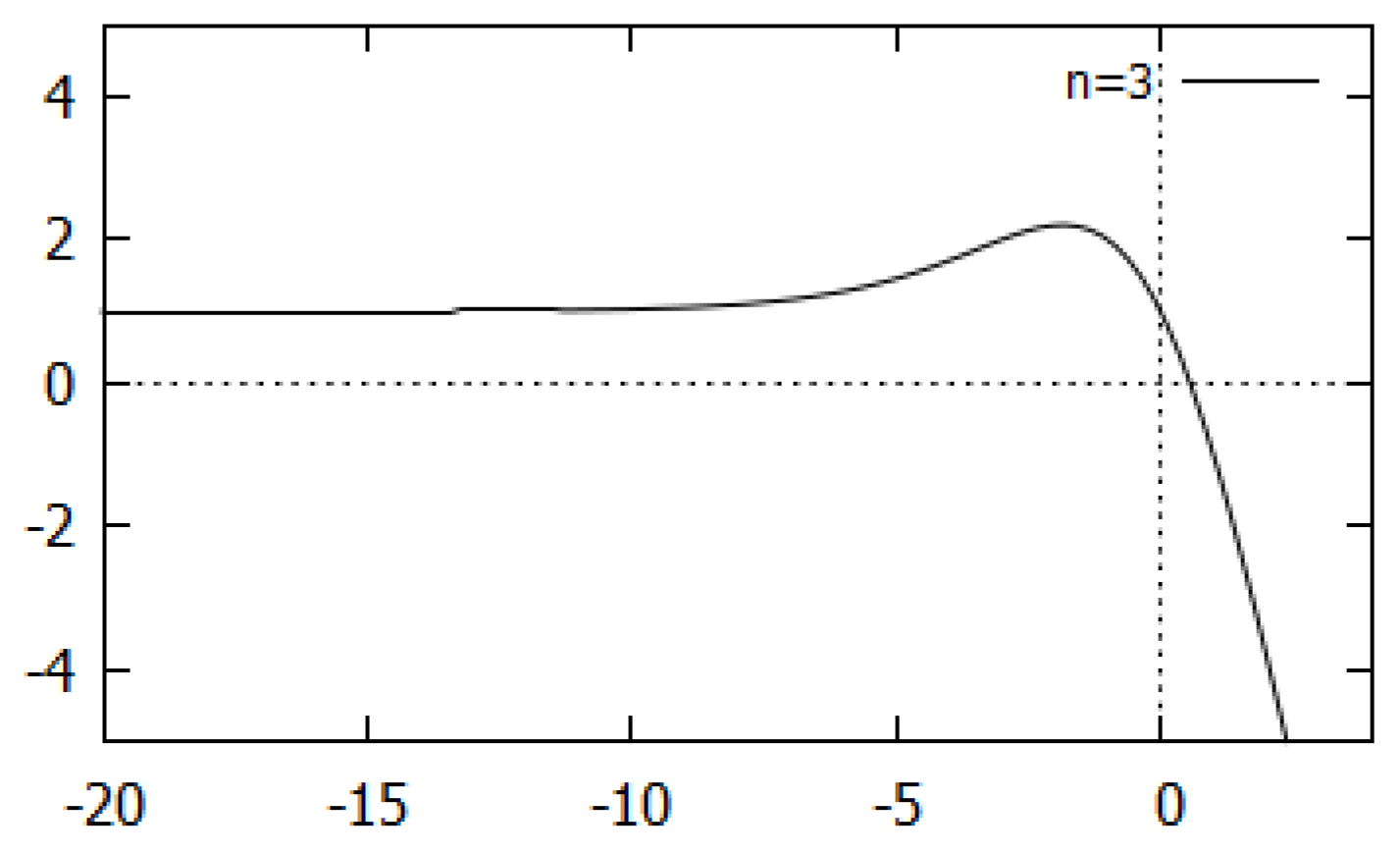
The graph of the function
is given in
Figure 1 for
. ☐
Let us define
where
is the unique positive root of the equation
for
.
The nature of the real fixed points of is explored in the following theorem:
Theorem 2. Let .
- (a)
The fixed point 0 of the function is attracting for , rationally indifferent for and repelling for .
- (b)
The fixed point (negative) of the function is repelling for and the fixed point (positive) of the function is attracting for , rationally indifferent for and repelling for .
Proof. - (a)
For fixed point 0, we obtain . Hence, for , for and for . Therefore, it follows that the fixed point 0 of is attracting for , rationally indifferent for and repelling for .
- (b)
For
and
, it is easily seen that
for
and
for
. Since
is a fixed point of
, then, by Equation (
4),
The fixed point
of
is negative for
by Theorem 1. By Equation (
5), it is seen that, using Lemma 1,
for
. Hence, the fixed point
(negative) of the function
is repelling for
.
The fixed point of is positive for by Theorem 1. Similarly as above, applying Lemma 1, we have for , for and for . It follows that the fixed point (positive) of is attracting for , rationally indifferent for and repelling for .
This completes the proof of theorem. ☐
For , there exist periodic points of periods greater than or equal to 2. We discuss these cases in the next section using numerical simulations.
3. Numerical Simulation of Real Periodic Points of and Their Nature
In this section, the numerical simulation of real periodic points of and their nature are discussed since the theoretical computation of the periodic points of is significantly complicated. For , the function has periodic points of period greater than or equal to 2 in in addition to having one fixed point 0 for all and another nonzero fixed point for . These periodic points are roots of . The periodic cycles of period come into existence when parameter increases beyond . For , the periodic points of period 2 start from .
3.1. Numerical Computation of Real Periodic Points of Period and Their Nature
Here, we numerically compute the real periodic points of period and 8 for and their nature.
For , the following periodic points of period of are computed numerically for different values of parameter respectively:
If
, then the 2-cycle periodic points
and
of
are obtained as
and
. Then,
and
. It follows that
Hence, the periodic 2-cycle of is attracting.
If
, then the 4-cycle periodic points
,
,
and
of
are found as
,
,
and
. Then,
,
,
and
. It follows that
Consequently, the periodic 4-cycle of is attracting.
If
, then the 8-cycle periodic points
,
,
,
,
,
,
and
of
are determined as
,
,
,
,
,
,
and
. Then,
,
,
,
,
,
,
and
. It follows that
It gives that the periodic 8-cycle of is attracting.
For , the following periodic points of period of are determined for different values of parameter respectively:
- ⋄
If
, then the 2-cycle periodic points
and
of
are obtained as
and
. Then,
and
. It follows that
Therefore, the periodic 2-cycle of is attracting.
- ⋄
If
, then the 4-cycle periodic points
,
,
and
of
are found as
,
,
and
. Then,
,
,
and
. It follows that
Hence, the periodic 4-cycle of is attracting.
- ⋄
If
, then the 8-cycle periodic points
,
,
,
,
,
,
and
of
are determined as
,
,
,
,
,
,
and
. Then,
,
,
,
,
,
,
and
. It follows that
It shows that the periodic 8-cycle of is attracting.
For , the following periodic points of period of are simulated numerically for different values of parameter respectively:
- ○
If
, then the 2-cycle periodic points
and
of
are obtained as
and
. Then,
and
. It follows that
It gives that the periodic 2-cycle of is attracting.
- ○
If
, then the 4-cycle periodic points
,
,
and
of
are found as
,
,
and
. Then,
,
,
and
. It follows that
Hence, the periodic 4-cycle of is attracting.
- ○
If
, then the 8-cycle periodic points
,
,
,
,
,
,
and
of
are determined as
,
,
,
,
,
,
and
. Then,
,
,
,
,
,
,
and
. It follows that
Therefore, it is shown that the periodic 8-cycle of is attracting.
For , the following periodic points of period of are computed for different values of parameter respectively:
- *
If
, then the 2-cycle periodic points
and
of
are obtained as
and
. Then,
and
. It follows that
Therefore, the periodic 2-cycle of is attracting.
- *
If
, then the 4-cycle periodic points
,
,
and
of
are found as
,
,
and
. Then,
,
,
and
. It follows that
Hence, the periodic 4-cycle of is attracting.
- *
If
, then the 8-cycle periodic points
,
,
,
,
,
,
and
of
are determined as
,
,
,
,
,
,
and
. Then,
,
,
,
,
,
,
and
. It follows that
Therefore, it is shown that the periodic 8-cycle of is attracting.
3.2. Numerical Computation of Real Periodic Points of Period 3 and Their Nature
We numerically compute the real periodic points of period 3 for corresponding to respectively and their nature.
For
and
, the 3-cycle periodic points
,
and
of
are determined as
,
, and
. Then,
,
and
. It follows that
Consequently, the periodic 3-cycle of is attracting.
For
and
, the 3-cycle periodic points
,
and
of
are computed as
,
, and
. Then,
,
and
. It follows that
Hence, the periodic 3-cycle of is attracting.
For
and
, the 3-cycle periodic points
,
and
of
are calculated as
,
and
. Then,
,
and
. It follows that
It shows that the periodic 3-cycle of is attracting.
For
and
, the 3-cycle periodic points
,
and
of
are simulated as
,
and
. Then,
,
and
. It follows that
It gives that the periodic 3-cycle of is attracting.
We can easily observe the existence of periodic points of periods greater than or equal to 2 in the next section through bifurcation diagrams.
4. Bifurcation Diagrams and Route to Chaos
Using graphical simulation, we explore the dynamical behaviour of
through plots of bifurcation diagrams in this section. It is known that if the period-doubling occurs in the real dynamics of function, then it is a route to chaos in the real dynamics of function and period 3 implies chaos [
1]. From Theorem 2, it is observed that the nature of the fixed points of
changes when parameter
crosses a certain parameter value. Further, if the parameter
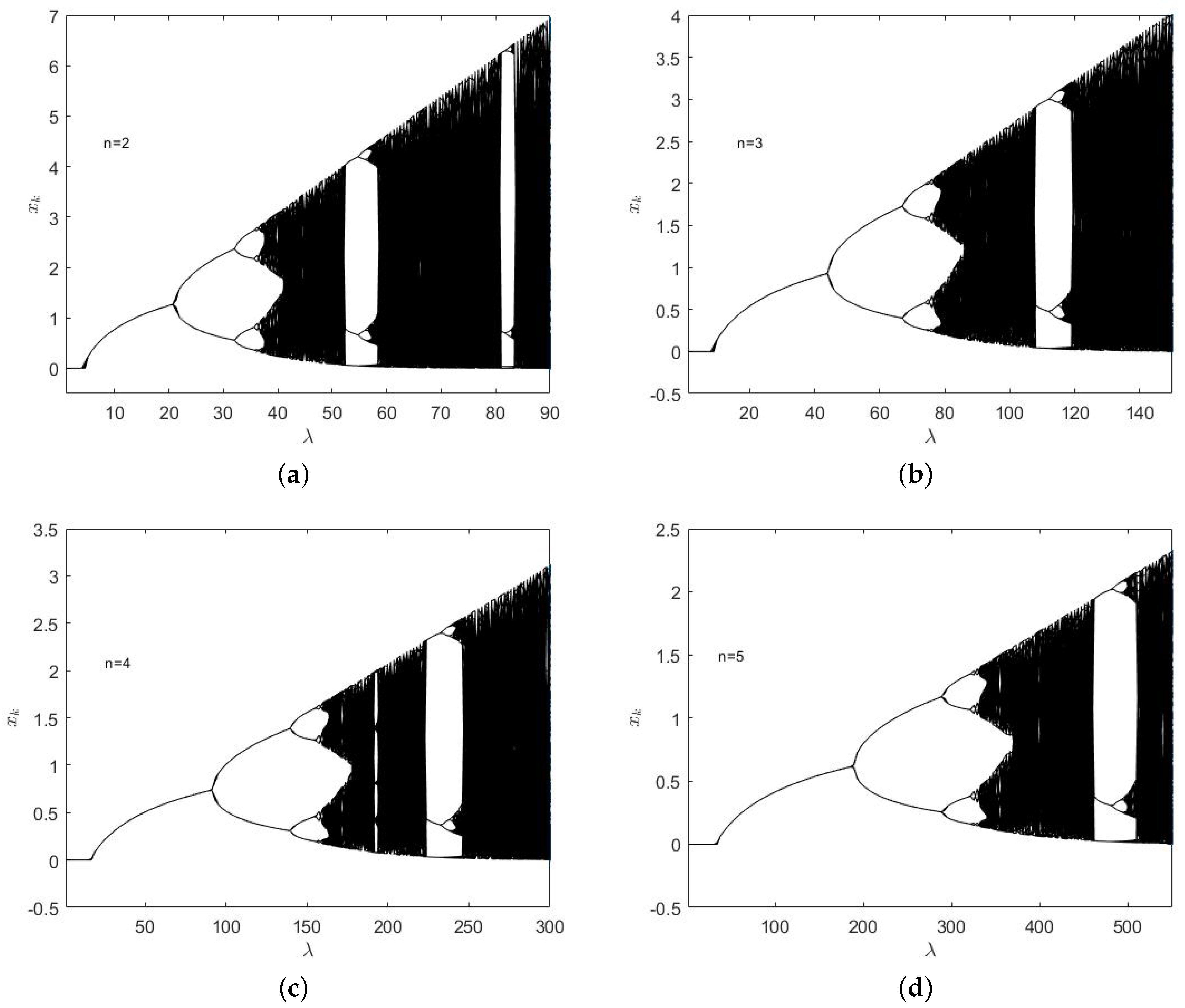
increases, then the periodic points of period 2 or more occur in the dynamical system. It can be seen by bifurcation diagrams in
Figure 2 for
with
,
,
and
respectively. It is easily seen that the period-doubling occurs in these bifurcation diagrams. Moreover, period 3 is also visible in these bifurcation diagrams.
In bifurcation diagrams (
Figure 2a–d), it is observed that when
n increases from 2 to 5, then the period-doubling happens for larger values of parameter
. The occurrence of periodic-doubling in the bifurcation diagrams leads to a route to chaos in the real dynamics of
. Moreover, white regions represent the appearance of periodic windows inside bifurcation diagrams. It is also seen that a periodic 3-window also occurs in the bifurcation diagrams of
for
corresponding to
respectively which also represents chaotic behaviour in the dynamical system. After this periodic 3-window, a new 6-period cycle comes into existence. After that, we enter into a very complicated dynamics region.
In the next section, Lyapunov exponents are computed corresponding to values of parameter for which period-doubling happens in the bifurcation diagrams.
5. Lyapunov Exponents
To quantify the chaos, the Lyapunov exponent of the function
needs to be computed which is the main key for the chaotic systems. It is known that if the Lyapunov exponent is positive, then it represents chaotic behaviour in the dynamical system [
1]. Using Formula (
1), the Lyapunov exponent of the function
is computed as
For our computation, we choose
and
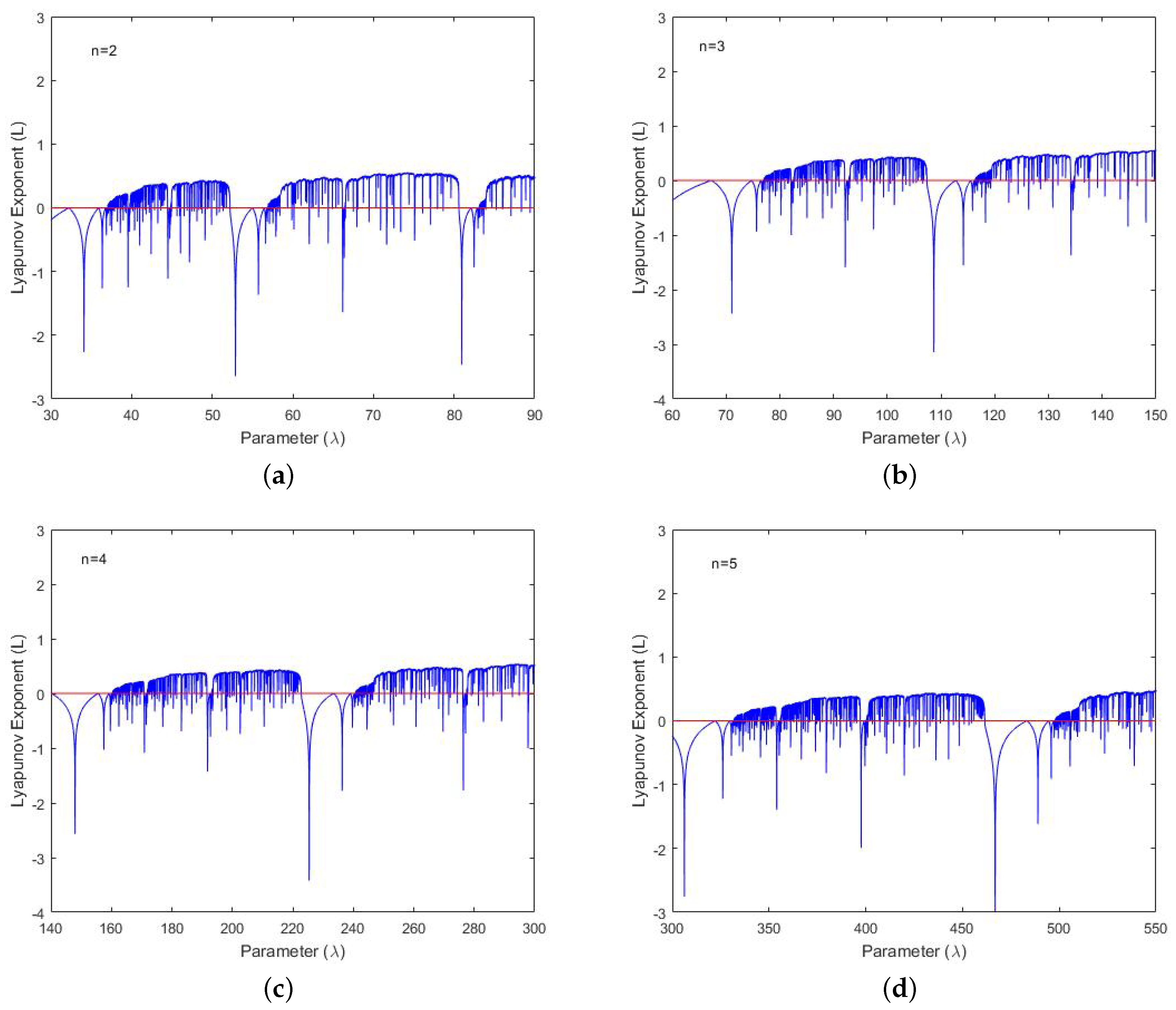
. The computed values of Lyapunov exponents are demonstrated in
Figure 3 for
with
,
,
and
respectively. From these figures, it is observed that the Lyapunov exponents are positive for certain ranges of parameter
which exhibits sensitive dependence on the initial conditions. Hence, the chaotic behaviour exists in the real dynamics of
.
The bifurcation diagrams in
Figure 2 and the corresponding Lyapunov exponents
L in
Figure 3, for intervals of parameter
, are represented as follows: when Lyapunov exponents are positive, then the bifurcation diagrams have dark regions which show chaotic behaviour in the real dynamics
for certain ranges of parameter values. Moreover, for some ranges, Lyapunov exponents are negative and bifurcation diagrams have white regions; this shows that the chaotic regions break up into non-chaotic temporarily and then return to being chaotic.