


Summary
Magistretti PJ, Ansermet F. Neuronal plasticity: a new paradigm for resilience. Schweiz Arch Neurol Psychiatr. 2008;159:475–9. The biological evidence of neural plasticity implies revisiting the notion of determinism, in general as well as in the psychological dimension. Indeed, through the mechanisms of plasticity, experience leaves a trace in the neuronal network. This view could imply a linear and direct relationship between cause and effect. However, as we will discuss in detail in this article, plasticity also entails the re-association of traces introducing a potential for discontinuity, response and change. We will discuss this phenomenon as a new basis for considering resilience and the emergence of singularity. Over several decades we have witnessed an often animated debate between organic and psychic approaches when considering brain-mind relationships. The mental reality and the biological reality have often been viewed as belonging to domains with opposing logics, separated in their very fundamentals. One should also note a recent tendency based on analogical reasoning in which a complete overlap between the mental reality and biological phenomena is proposed without any differentiation thus rendering any validation impossible. We propose a different approach which consists in considering that even though the biological and mental aspects are without common measure, there exist potential intersections between them. The principles of neuroscience and those of clinical practice, in the particular from the psychoanalytical angle, can meet in our view around a series of critical questions such as that of neuronal plasticity (Ansermet and Magistretti 2007). Through the mechanisms of neuronal plasticity, experience leaves a trace in the neuronal network. Through these mechanisms the subject is an actor in its becoming, leaving room for the emergence of the individual response including one of resilience.
Correspondence:
Pierre J. Magistretti, MD Brain Mind Institute, EPFL
and Centre for Psychiatric Neuroscience University of Lausanne and CHUV
7, rue du Bugnon CH-1005 Lausanne
e-mail: Pierre.Magistretti@unil.ch
What is a trace?
What is a trace? For the neuroscientist it is a concept which experimentally has extensively been explored over the last 30 years. The basic idea is that synaptic transmission can be modulated by experience and that the efficacy of information transfer between neurons can be modified for a lasting time by significant experiences. These phenomena are at the basis of the processes of learning and memory. One of the experimental models which have largely been studied is long-term potentiation which can modify the efficacy of synaptic transfer [1].
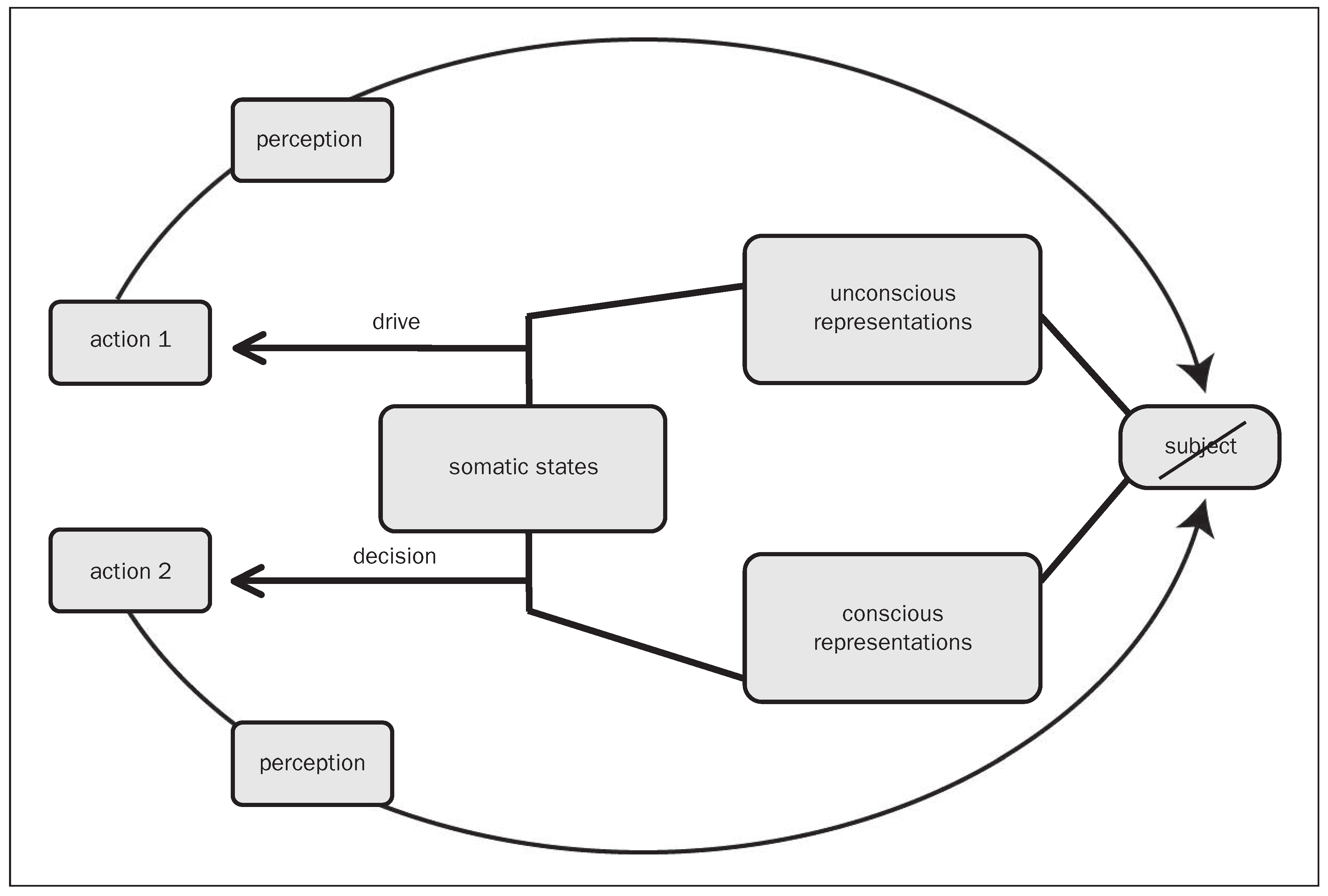
Through the mechanisms of synaptic plasticity, experience leaves a trace in the neuronal network. Results from contemporary neuroscience indicate that this network is made up of a series of facilitated synapses acting in concert in what are now called “neuronal assemblies” [2]. These neuronal assemblies represent the neuronal substrate of our memories, thus, in other words, what makes us unique. However, there are traces which are not conscious. Through the same mechanisms of plasticity, through synaptic re-arrangements and reassociation of the traces that have been inscribed, an unconscious internal reality could be formed which would play a key-role in the determination of the subject (fig. 1).
Figure 1.
Link between conscious and unconscious internal realities of a subject with somatic states. The subject is divided by the incidence of perceptions produced by decisional processes (action 1) or by those resulting from the discharge of the drive (action 2). Modified from Ansermet and Magistretti [3].
Somatic markers
When considering the trace, another dimension has to be taken into account, namely the emotional connotation of such traces. We indeed know that any perception which leaves a trace will be associated with changes in somatic states. A somatic marker, to take the term proposed by Damasio, is therefore associated with a given trace [4]. Let us consider an emotion such as fear. The presentation of a stimulus which triggers fear is accompanied by important somatic changes, such as, for example, the increasing cardiac frequency and respiration. Initially, a perception is emotionally neutral. However, its association with a somatic state generates a significant emotional connotation. This is the basis of the theory of emotions formulated by William James at the end of the 19th century [5] and reactivated in an original way by Antonio Damasio [4]. Perception which leaves a trace in the neuronal network is therefore associated with a somatic state which can trigger a state of pleasure or displeasure. Perception does not only originate from the external world through exteroceptive pathways; a link with the body is carried by the interoceptive pathways, which inform the brain permanently about the state of our internal organs and muscles. This interoceptive system is central for our feeling of pleasure or displeasure [6]. Therefore, traces cannot be thought without the somatic state which is associated to them. The inscription of experience should be thought at the interface between the somatic and the psychic, much as Freud himself was posing the problem through the theory of drive as a limit concept between these two domains [7].
Homoeostasis and pleasure principle
For Freud the goal of the drive is the re-establishment of a previous state through its discharge which aims at satisfaction. The object used for the satisfaction of the drive is completely irrelevant. The essential element is the homoeostatic function of the drive.
As a general point, one can say that the maintenance of homoeostasis is a central feature of any living organism as was postulated by Claude Bernard [8], with the concept of the constancy of the “internal milieu”. One can say that the brain is in a way the supreme organ for the maintenance of homoeostasis. Drive, as an expression of the processes of the living matter, aims at re-establishing this homoeostasis by an action which implies an object, unique and different for each one of us, at the condition, however, that it allows to discharge the excitation, according to Freud, or the re-establishment of homoeostasis, according to physiology.
Traces are therefore linked to somatic states which are carried along the chain of the trace re-associations. Thus, the body is in play in the establishment of individuality. One cannot think the mental without the somatic. The homoeostatic function of drive, central in the psychoanalytical theory, has a clear meaning in the field of neuroscience.
Thus, one can elaborate a model produced by psychoanalysis which is fundamentally pertinent with the neurosciences, a model which at the same time introduces the subject and the organism, the unconscious and the body, in the interplay between pleasure and displeasure. Such a concept removes the vision of an organism directed simply in terms of adaptation and action-reaction. The subject participates in his/her constitution as a function of pleasure and displeasure. This view, therefore, suggests that the mental reality of the subject is not simply constituted by traces in direct relationship with perception. A discontinuity exists whereby traces are linked to somatic states, and through their associations and re-arrangements depending on the homoeostatic requirement and in relation to the actions of the subject they produce a discontinuity which goes well beyond the simple inscription of experience and through which the subject can emerge in his/her individuality.
Homoeostasis can be viewed as the biological correspondent of the principle of pleasure/displeasure, which is fundamental in psychoanalytical theory. A central place should therefore be given to the biology of the interoceptive system which permanently informs the brain of the somatic states. The interoceptive pathways which have various relays in sensory areas such as the insula, before they synapse in the anterior cingulate cortex, inform the brain on the state of the body and the potential deviation from homoeostasis.
The paradoxes of plasticity
To summarise, one can say that it is possible to follow how perception is inscribed under the form of traces and consider how traces become associated between them later on. One can also consider the biological basis of the somatic markers. The integration of these different levels should be at the centre of the questions posed to attempt an understanding of mental phenomena. Indeed, there is not a simple and direct mapping of a stimulus, its perception and its inscription in the neuronal network. In the same way, there is not a simple mapping between these inscriptions and the behaviour which will result from it. One should think in terms of discontinuity between the stimulus, its inscription and the response produced by the subject if one wants to understand what a mental phenomenon is. It is therefore highly unsatisfactory to be restricted to a model which would imply a reflex response from the subject following a stimulus. Such a model would emerge from a simple and linear causality which is not particularly valuable to consider the mental phenomenon. It is central to adhere to an open approach that takes into consideration the biology of the subject in terms of discontinuity. The notion of neuronal plasticity produces a series of paradoxes which re-introduce the notion of the subject in biology.
Plasticity and discontinuity
Plasticity illustrates the fact that experience leaves a trace, structurally as well as functionally, in the neuronal network. The finest elements of the process of information transfer between neurons, the synapses, are constantly remodelled following experience in a permanently renewed manner. The neuronal network is not a structure determined once and forever: quite the contrary, it is submitted to a permanent change as a function of experience.
Thus, the phenomenon of plasticity clearly challenges the classical opposition between mental causality and organic causality. If experience leaves a trace, one should admit that mental causality would also participate in the determination of the organism. Experience is not only an incidence of the environment: it also results from the actions that the subject has produced.Thus, the subject participates in this way in the process of his/her becoming. This point has a particular relevance for the notion of resilience, as it provides a framework for considering how and why the response of each subject to a traumatic experience may be so strikingly different.
From trace to trace, from inscription to reinscription to the re-association of traces, the link and connection between the initial experience and the traces is somehow lost, even though the initial traces maintain a direct link with experience. Thus, plasticity introduces a discontinuity. Current neurobiological data, related to the phenomenon called “reconsolidation”, support this notion of discontinuity created by the re-association of traces. More specifically, when mnemonic items are reactivated, the neural traces which are encoding them become transiently labile and susceptible to be associated with other traces [9].
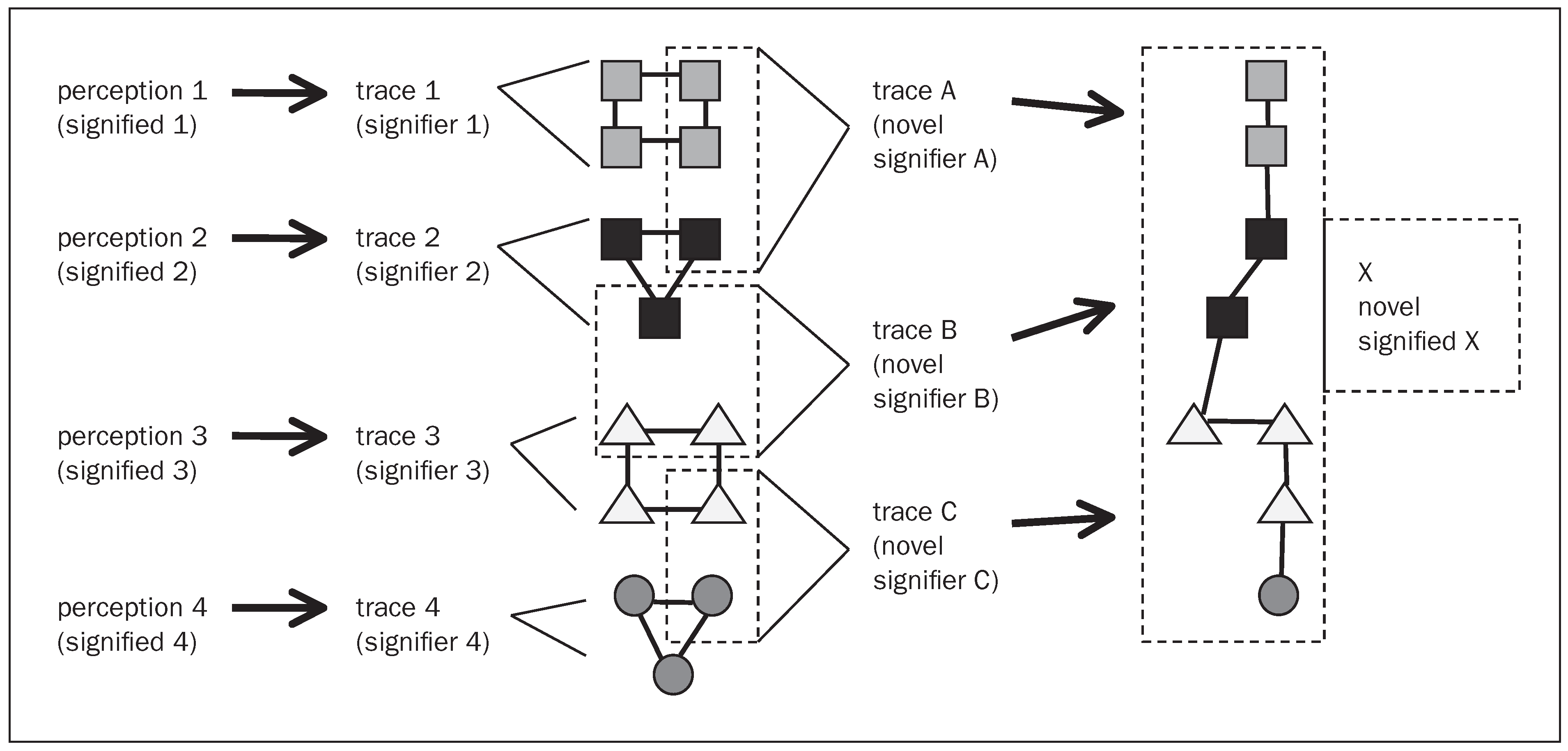
As a general point, one could say that as far as the establishment of the unconscious is concerned, inscription of experience separates from experience. The unconscious is therefore not a memory system. This point leads to a paradox in which memory in its relationship with the unconscious does not represent a means to preserve experience under the form of traces of perception. As Freud himself said, consciousness and memory exclude themselves reciprocally [10].The mnemonic traces produced by experience can associate with one another and produce a new unconscious internal reality. This is independent of what has constituted the first traces. The unconscious can therefore be seen as a discontinuity from which the subject emerges in its uniqueness (fig. 2).
Determination of the unpredictable
Through the unique interplay mediated by the re-association of traces, the universal mechanisms of plasticity result in the production of a unique subject, each time different. One could say that in this way and paradoxically plasticity implies a determination of the unpredictable.
Neuronal plasticity modifies neuronal networks; thus two stimuli, even though identical, could result in different responses depending on the state of the brain. As in a game of chess, everything depends on the move that has been done previously. Plasticity introduces a variability which removes any idea of an equal, univocal and determined response through a system which would be rigid and fixed in time. One never uses the same brain twice!
Thus, we would be biologically determined not to be biologically determined; we would be genetically determined to be free. The notion of plasticity implies to revisit the question of determinism in a completely novel fashion.
There is a permanent synaptic rearrangement, resulting in an integration of exteroceptive and interoceptive information which modifies the internal reality both consciously and unconsciously, providing integration between perception and action. Thus, when one is speaking of perception, one cannot simply consider it as exclusively originating from the external world. As William James already noted, it is possible that the majority of our perceptions are produced from the interior, in fact by our mental activity [5].
Functional brain imaging
Thus the brain is permanently stimulated by perception from the external and the internal realities. Functional brain imaging produces images of the brain at work, online, when for example a visual or auditory stimulation is presented to a subject. These images allow us to localise a given activity to a given region of the brain on the basis of the local increase in blood flow or glucose utilisation related to cerebral work [11]. These increases in the use of energy which are visualised “online” and which are at the basis of the mappings produced by functional brain imaging, represent, however, only an increase of 5 to 15% of the basal energy utilisation by the brain. Indeed, 80 to 90% of the energy consumed by the brain can be related to its basal function. To what does this basal energy consumption correspond? Possibly to a “post-processing” of the online perceptions, a fact that would witness to the importance of the synaptic rearrangements that permanently occur in the brain and which are based on the mechanisms of plasticity. The question is today at the heart of great debate [12]. Thus, the mechanisms of plasticity, which as we see are so critical for resilience, represent a considerable basal energetic cost to the brain, as revealed by functional imaging.
Figure 2.
Schematic representation of the association and re-association of certain elements of initial traces corresponding to the representation of initial perceptions. These re-associations of traces generate novel neuronal ensembles. The combination of such novel neuronal ensembles may produce a metarepresentation which is no longer in direct relationship with the initial perceptions which have generated the initial traces, thus producing a discontinuity. Modified from Ansermet and Magistretti [3].
The neurobiology of resilience
The potential determinism which is related to the diachronic inscription of traces coexists with the unpredictability due to the synchronic association of traces. The unpredictability of the subject’s becoming beyond the determination of the inscription of traces, forces one to question the continuity which would be the characteristic of natural causality. The logic of discontinuity and response must therefore be opposed to the logic of continuity and cause. Thus discontinuity and response would represent the basis of the phenomenon of resilience.
Resilience could be grounded on the existence of an unconscious processing. If one admits that plasticity is an integral part of the establishment of an unconscious life, one could induce two views of the unconscious. On the one side, an unconscious determined by the past, on the basis of the inscription of traces by the mechanisms of plasticity, and on the other side, an unconscious which is open to the future based on actions that have not been enacted yet and a potentiality always open to possible changes. The issue of the discontinuity which allows defining an unconscious which is not necessarily determined by the past and which is open to the future provides a central conceptual and biological point to consider the notion of resilience.
The existence of the mechanisms of plasticity stresses the notion of discontinuity which allows the emergence of a subject active on its proper becoming beyond determinism.
References
- Malenka RC, Bear MP. LTP and LTD: an embarrassment of riches. Neuron. 2004;4(1):5–21.
- Buzsaki G. Large-scale recording of neuronal ensembles. Nat Neurosci. 2004;7(5):446–51.
- Ansermet F, Magistretti P. Biology of Freedom. New York: Other Press; 2007 (12004).
- Damasio AR. Descartes’ Error. New York: G. P. Putnam; 1994.
- James W. The Principles of Psychology. New York: Dover; 1950 (11890).
- Craig AD. How do you feel? Interoception: the sense of the physiological condition of the body. Nat Rev Neurosci. 2002;3(8):655–66.
- Freud S. Instinct and their vicissitudes. In: Strachey J, editor. The Standard Edition of the Complete Psychological Works of Sigmund Freud: vol. XIV. London: Hogarth Press; 1957 (11915). p. 109–40.
- Bernard C. An Introduction to the Study of Experimental Medicine. New York: Dover Publications; 1957 (11865).
- Tronel S, Milekic MH, Alberini CM. Linking new information to a reactivated memory requires consolidation and not reconsolidation mechanisms. PLoS Biol. 2005;3(9):e293.
- Freud S. Letter to Wilhelm Fliess, December 6, 1896. In: Freud S. The Complete Letters of Sigmund Freud to Wilhelm Fliess: 1887–1904. Cambridge, MA: Harvard University Press; 1985 (11896). p. 207–15.
- Magistretti PJ, Pellerin L, Rothman DL, Shulman RG. Energy on Demand. Science. 1999;283(5401):496–7.
- Gusnard DA, Raichle ME. Searching for a baseline: functional imaging and the resting human brain. Nat Rev Neurosci. 2002;2(10):685–94.
This is an open-access article distributed under the terms of the Creative Commons Attribution Non-Commercial No Derivatives (CC BY-NC-ND) 4.0 License.